Category Archives: Photography

Thank You for Reading

I am thankful.

This is a post about this blog.

At Thanksgiving, in a lot of families, a blessing is performed before the turkey comes on in its golden, crispy glory. The blessing consists of going around the table with every guest sharing some thing they are especially grateful for. On the occasions I’ve taken part in this ritual, I’ve sometimes had to squelch the urge to say something slightly comical or snarky. I don’t know why, perhaps because the whole thing seemed so self serious. Real thanks seem quieter, more internal, perhaps.

Now, with a few days before us until we’ll be stuffed with stuffing, with a clear head, I want to be serious.

I am grateful, deeply grateful, to those of you who read this blog.

When people ask what my site is all about, I say different things. It’s called Blog Cabin, and it’s about living in a circa 1800 home in a thoroughly modern world, and the time travel that allows for. Sometimes I call it a personal magazine. A diary. A cultural commentary. It’s about the past as a living, breathing entity. All about history and art and nature and literature… An author blog, as I have one novel about to come out and one just in the rearview.

What it really is, is playtime. Writing books, of course, is hard work. (If you’re doing it right.) Writing this blog has given me a chance to dabble in the things that absorb me in my book writing life, but on a more finite scale, with pleasure at the foremost – yes, history and art and nature and literature and… a pogo stick championship?

jack-cu

It was hot July and the contestants soared. You could taste the adrenaline.

Writing for you has given me a reason to go on adventures that you might not take, even if you had the chance. Or perhaps you would, like my search for an infant saguaro cactus at a botanical garden in Scottsdale, Arizona, with a beaming guide, but you couldn’t get there that day.

desert-gardener

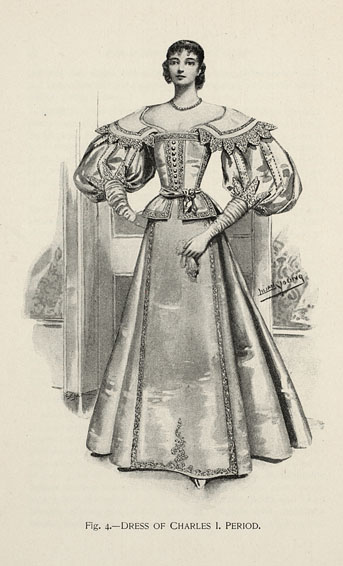
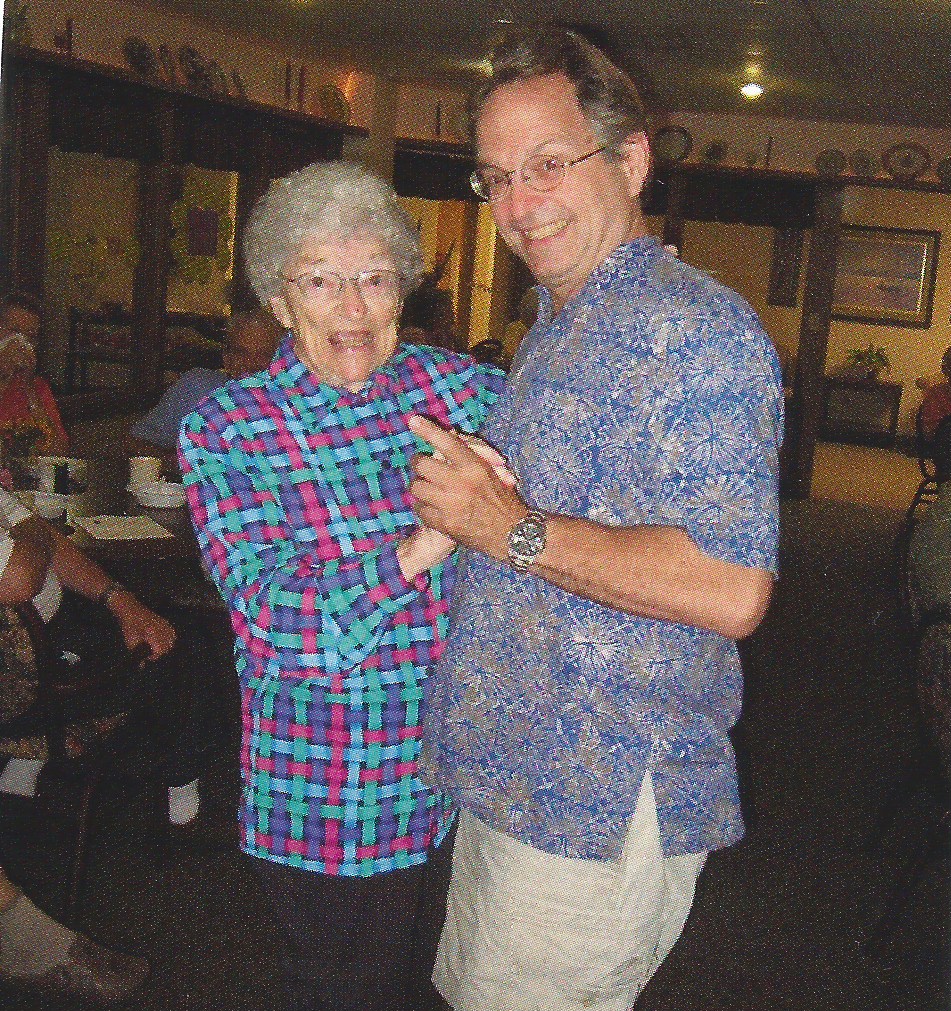
I’ve taken myself to a Victorian waltz class and tea.

jz-tea

To a Broadway disco-play, and to a euphoria-inducing Brahms recital. And to a dramatic dance performance en plein air, at Manhattan’s Lincoln Center.

bum-blur

I’ve plumbed the depths of the 20-something psyche, because I have a young adult close to my heart. Instagramming is their life.

serendipity-picture

They’re fascinating animals, as are husbands, and mine hitchhikes along with me from time to time.

As are dogs. Mine is inscrutable, but adds flavor to the mix.

oliver-about-to

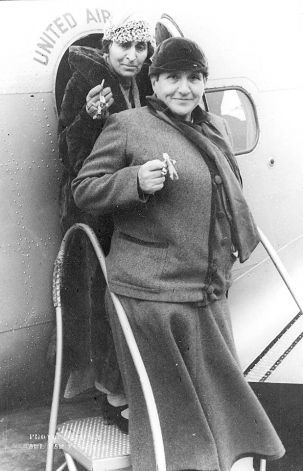
And writers.  I’ve loved writing about Gertrude Stein.
steintoklas-plane

I’ve shared many favorite recipes, like the one for Marcella Hazan’s braised pork in milk.

Observed motorcycle pirates on the loose in NYC. With some history about pirates intertwined, of course.
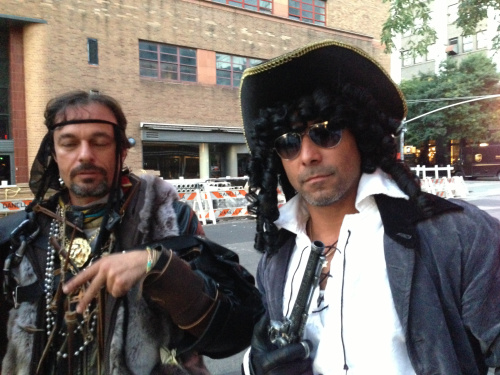
two-pirates

A rowdy pig festival in upstate New York.

michael

Explored a local farm on an enchanted evening, just as dusk fell.
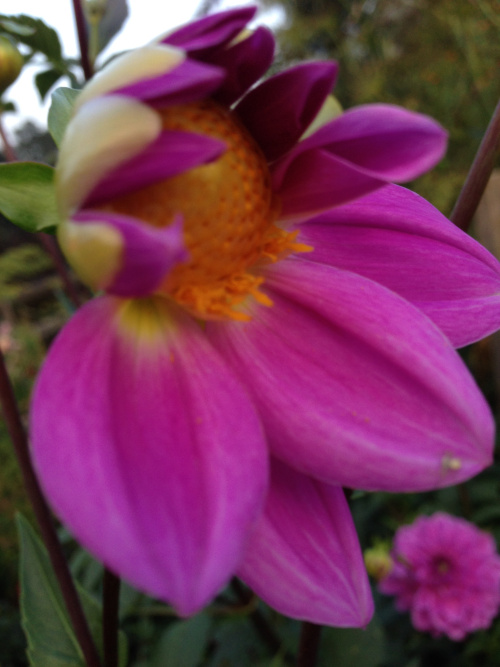
fuschia-flower

Learned about the power of graffiti at the late, great 5Pointz. Got my leg cast tagged there, too.

colorful-paint

And witnessed the unlikely beauties of slime mold in a pristine nature preserve.

slime

It’s been my pleasure to gather these treasures and offer them to you, and your great generosity has been receiving them from me. So thank you. I’m looking forward to many more adventures.

11 Comments

Filed under Art, Cooking, Culture, Dance, Dogs, Fashion, Fiction, History, Home, Jean Zimmerman, Music, Nature, Photography, Poetry, Publishing, Savage Girl, The Orphanmaster, Writers, Writing

Starring Gertrude Stein

“If you enjoy my work you understand it… if you don’t enjoy it, why do you make a fuss about it?

These were Gertrude Stein’s slightly sharp-elbowed words pronounced sixty-nine years ago to an interviewer at at New York’s Algonquin Hotel upon her arrival in America to record The Making of Americans and some of her other works. The lecture tour had bestseller wind beneath its sails, as The Autobiography of Alice B. Toklas had been published to raves in 1933. The opera she created with Virgil Thomson, Four Saints in Three Acts, was opening on Broadway. Suddenly Stein had become rich, a condition she’d never before known.

stein:toklas plane

On October 24, 1934, Stein and Toklas arrived in New York aboard the S.S. Champlain. The crowds and the press went wild. One newspaper headline read: Gerty Gerty Stein is Back Home Home Back. Tickertape lights flashed across The New York Times building announced her arrival.

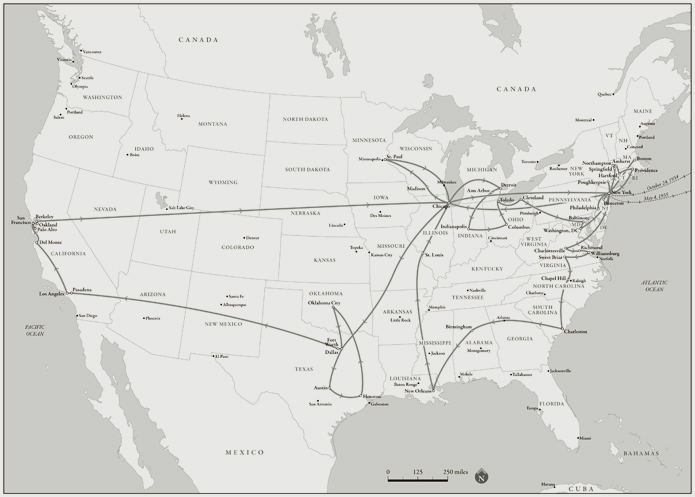
Stein had not been in the United States in nearly thirty years. Now, for seven months, with Toklas at her side, she crisscrossed America, speaking to campuses, arts groups and museum audiences about her writing and love of modern painting.

lecture route

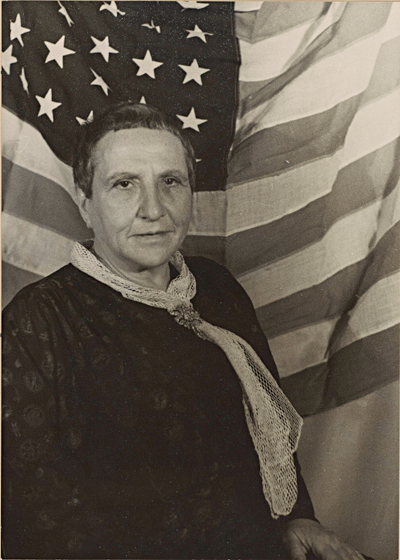
Early in 1935 she published Lectures in America, with a patriotic picture tucked inside the front cover.

stein:flag

Seventy appearances later, her celebrityhood held strong. An observer described the two travelers: “a large lady firmly dressed in a shirt-waist and skirt and jacket, and a smaller lady in something dark with a gray astrakhan toque…slightly suggestive of a battleship and a cruiser.” A headline in the New York Sun read: Miss Stein a Wow; Her Lectures a Sellout She’s Such a Hit.

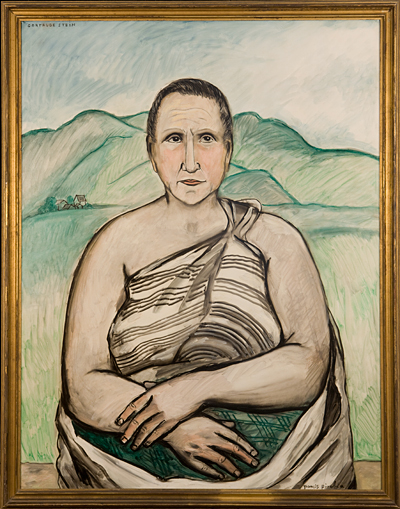
Francis Picabia did her in oils in 1933. Stein was a star!

picabia 33

1 Comment

Filed under Culture, Fiction, History, Photography, Poetry, Publishing

Another Fine Dress You’ve Got Me Into

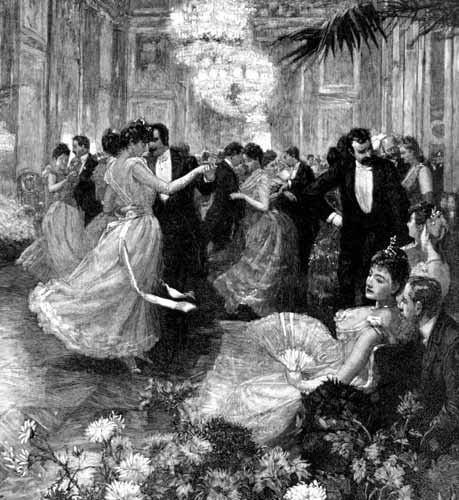
I always wondered by what means people got up their getups for fancy dress balls during the Gilded Age. A fancy dress ball didn’t mean, as it sounds, elegant gowns for the ladies and stiff black tails for the gents. They were actually masquerades, opportunities for the well-heeled to escape their own trials and tribulations – there were, in fact, economic downturns and “reversals” throughout the last decades of the 1800s – with a lot of very pricey role-playing. And to prove just how boss they were.

ball

Balls were splendid on their own. Edith Wharton described a typical scene.

Couples were already gliding over the floor beyond: the light of the wax candles fell on revolving tulle skirts, on girlish heads wreathed with modest blossoms, on the dashing aigrettes and ornaments of the young married women’s coiffures, and on the glitter of highly glazed shirt-fronts and fresh glace gloves.
For Savage Girl I looked into debutante balls, when 18-year-olds got their first taste of all the splendour that money could buy.

I first got interested in fancy-dress shenanigans, though, when I wrote about I.N. Phelps Stokes as a young man studying architecture in Paris in 1894.

Edith & Isaac

Most of the people he knew attended the spectacular Bal des Quat’z’Arts, where artists and architects partied hearty in the name of everything aesthetic and bohemian. Revelers could expect gold and silver paint slapped on bare flesh along with displays like the last days of Babylon, complete with “blackamoors,” camels and nearly naked women. Excess reigned every year.

quatzarts2

Stokes, I  learned from his generally no-nonsense memoir, wrote home to his mother demanding she ship over the black velvet dress he’d worn for a costume ball at his home the previous winter.

What, I wondered, trying to imagine Stokes be-gowned in velvet, was this slightly stiff, shy young gentleman doing cross-dressing at a balls-out ball?

It was the thing to do, though. Fancy dress celebrations were prevalent in Victorian England and Canada as welll as Paris and New York. One Canadian scholar who has studied archival material puts it this way:

The sheer number of archival photographs of people in fancy dress, as it was known, attests to the popularity of this phenomenon, as well as its importance to those who took part. These portraits reveal a great deal about Victorian morals, values, taboos and tastes regarding clothing, bodies and social behaviour. While the basic appeal of fancy dress lay in its semblance of permissiveness and escapism, this sort of amusement was controlled by a complex set of moral restrictions.

Few costumes survive, but these people were photo-obsessed and made sure to document the fancy ball madness.

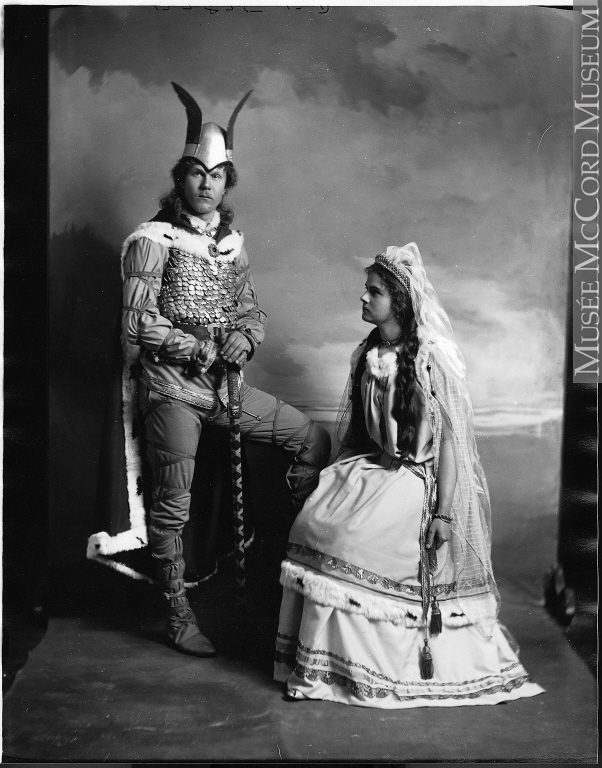
On the website of Montreal’s McCord Museum you can find startling images of partygoers dressed to the nines, such as Herbert Molson and his sister Naomi  as “Vikings,” costumed in 1898 for the Chateau de Ramezay Ball in Montreal.

Vikings

And Miss Bethune as “An Incroyable,” in Montreal, in 1881.

incroyab.e

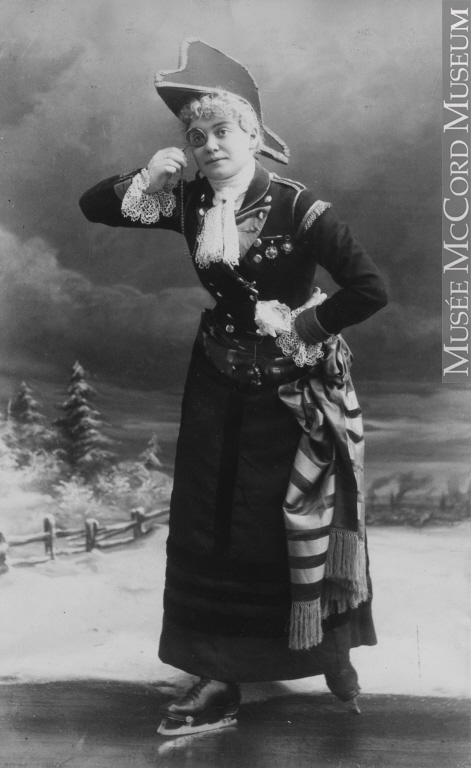
There was also the “Girl of the Period,” shot in 1870. The Victorians could really break loose on ice skates with a swinging braid and a cigarillo.

1870 photo like painting

The image was spookily familiar, and I realized it was the embodiment of a Currier and Ives print I have hanging on my wall.

currier

You can see some of these photos as a video. 

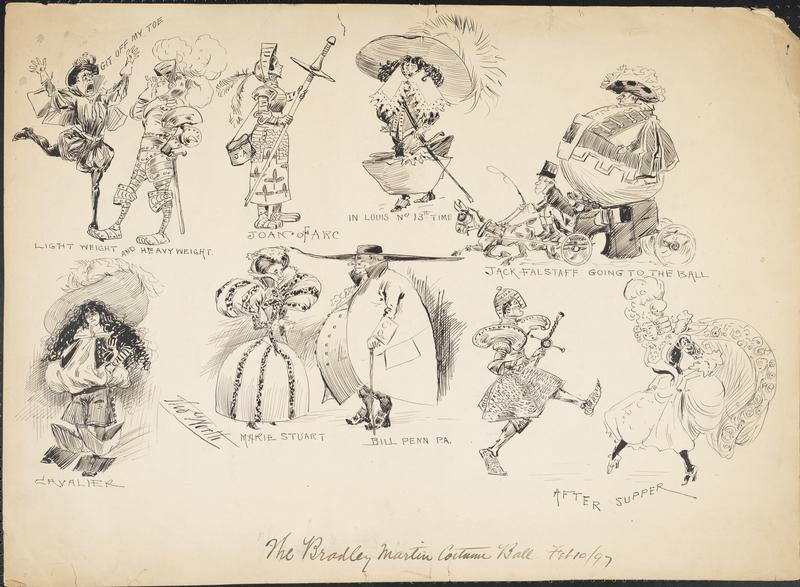
 At the end of the century,New York City could always put on the biggest fancy show. One of the most famous costume extravaganzas was the Bradley-Martin Ball, which took place at the Waldorf in February 1897. Cornelia Bradley-Martin vowed that it would be “the greatest party in the history of the city”.

bradley martin ball

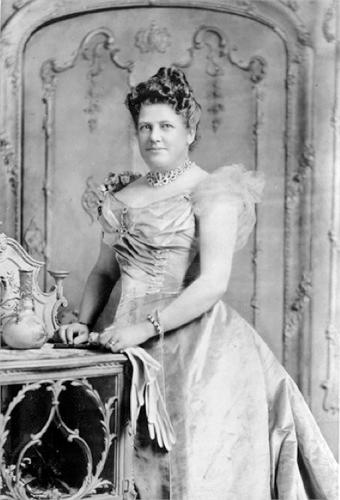
She and her husband spent nearly nine-million dollars in current money hosting eight hundred of the city’s leading lights, Astors, Schermerhorns, Morgans and Posts included. Cornelia doesn’t look like a party animal, but the fact that she is smiling slightly suggests something to me. Most people still did not smile when posing for a portrait.

Mrs.-Bradley-Martin

The ballroom was a replica of Versailles, wigmakers stood at the ready, and guests arrived as Mary, Queen of Scots, a Spanish toreador, Henry the IV. The hostess appeared with a gold, pearl and precious stone embroidered gown.

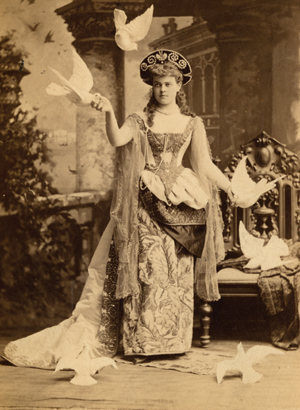
She might have managed to best the Vanderbilts’ legendary ball of 1883, thrown by Cornelius Vanderbilt II and his wife Alva to christen their new Fifth Avenue chateau. Alva sure looked good in doves.

alva vanderbilt

The Museum of the City of New York has a extensive collection of photos of people posed with all seriousness at the ball. Including Mrs. Henry T. Sloane as, I think, a witch. Probably a good witch.

Mrs. Henry T. Sloane

If you’d like to get up a Gilded Age costume there are resources at your disposal.

But, what are we to wear? asks a manual from 1896, accessible on line in its entirety. This is the first exclamation on receipt of an invitation to a Fancy Ball, and it is to assist in answering such questions that this volume has been compiled.

Several hundred costumes are described with every incidental novelty introduced of late, including Autumn, Bee, Gipsies, Carmen, Dominos, Esmerelda, Fire, etc.

0070

Henry James wrote:

The rooms were filling up and the spectacle had become brilliant. The ball borrowed its splendor chiefly from the shining shoulders and profuse jewels of the women, and from the voluminous elegance of their dresses.

You’ll have to invite 1,000 or so people to really get the fancy ball experience. And make sure to call your wigmaker. Everything will be rosy.

Rose Garden

2 Comments

Filed under Art, Culture, Dance, Fashion, Fiction, History, Jean Zimmerman, Love, Fiercely, Music, Photography, Savage Girl, Writers, Writing

The Things We Carry

What heirloom would you bring?

I’m reading about refugees and the things that they carry (remembering the Tim O’Brien tale The Things They Carried, about the impedimenta Vietnam soldiers take with them into battle.) BBC News Magazine profiles refugees during the Nazi menace of the 1940s, asking that question.

Isabelle Rozenbaumas’s mother escaped  Nazi-overrun Lithuania, barely, with her carriage-driver father, and snuck out three class photographs from that time.

refugee photo

Julian Glowinski’s grandmother was deported from Poland to Siberia in 1940. Amazingly, she packed a sewing machine onto a cattle truck, and converted gowns into wedding dresses in her concentration camp in exchange for food.

Elke Duffy and her family fled East Prussia in January 1945. With her she took an amber necklace her mother had strung from amber she and her sister found on a Baltic beach.

 _71135868_464_amber

Ian Carr-de Avelon’s wife’s grandfather was forced onto a train in Lwow (then Poland, now Ukraine) with his wife. Rather than cherished photos he took a camp stove. A camp stove? But of course ultimately it made perfect sense.

So what to take in a hurry, with the monsters breathing down your throat?

Photos. But today they mostly stay trapped in the computer. You can’t just lift them out of an album, with yellowed tape stains on their backs. So print some, fast.

Maybe I’d take this one, if I had to take one.

Gil and Maud Hug

I’d have to take another. Mark it on the back with a Sharpie, April 1987. The engagement party.

April 1987

If I could, I’d grab more. My parents. My extended family. Gil would take this burst of joy.

el 1

Or, he says, an oilcloth Santa he remembers making when he was six.

What object would I choose? Not a sewing machine. Not an iPhone. I looked around my house, and I thought about storage. At least three dusty cardboard boxes are marked Heirlooms, mostly from a family bow-windowed breakfront now residing in a home with more space. How do you choose among the loved objects of the past?

I might take my paternal grandmother’s copy of Ulysses, by James Joyce, its cover broken off, which she bravely purchased at a time when the novel was still censored in the U.S.

Joyce Ulysses 750 wraps 1000

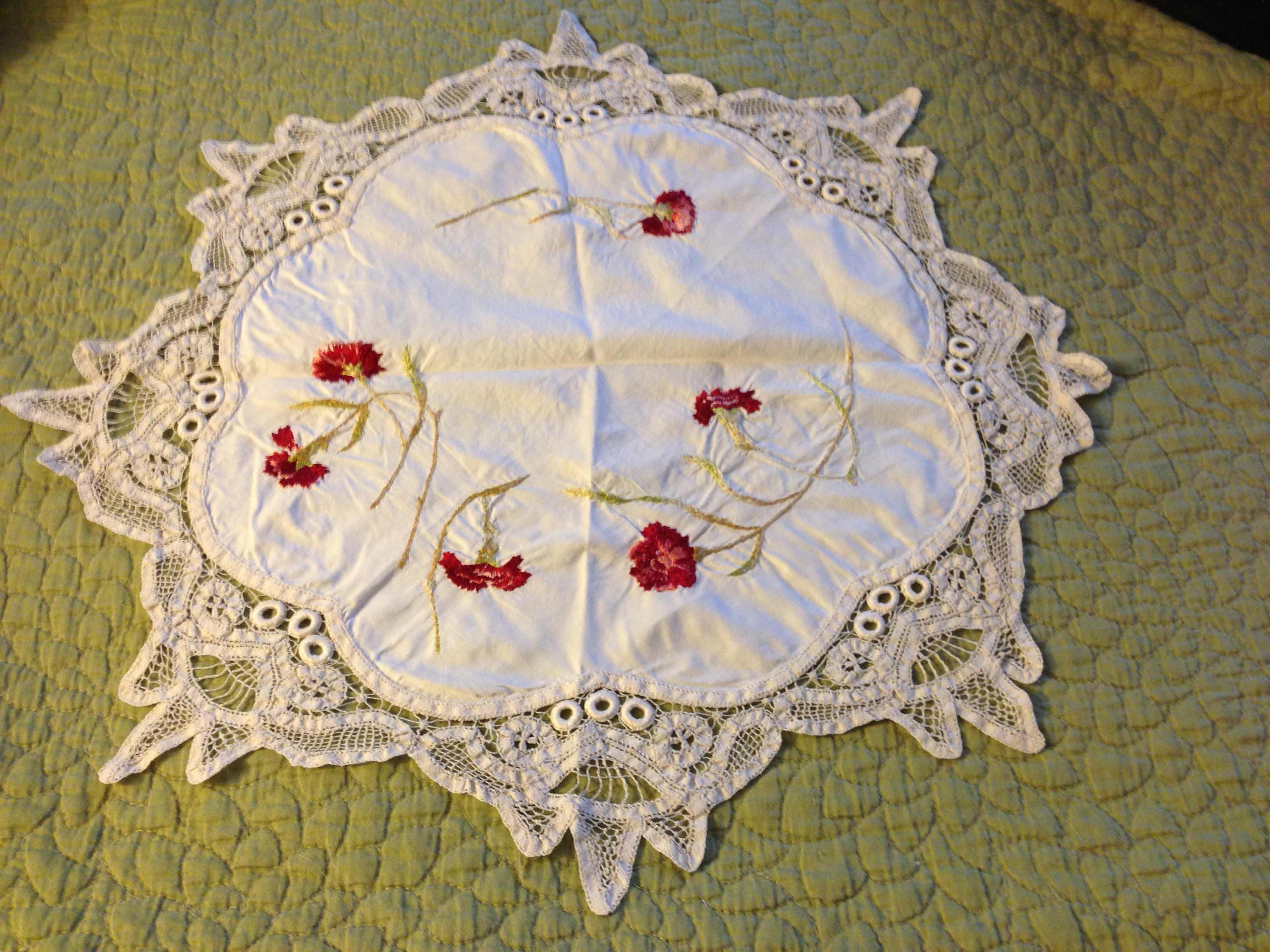
Or a scrap tatted by my ancestors, embroidered with carnations, the cloth handled by their fingers.

carnations

I could tuck that into my sock.

But if I was going to bring some bigger object – what?

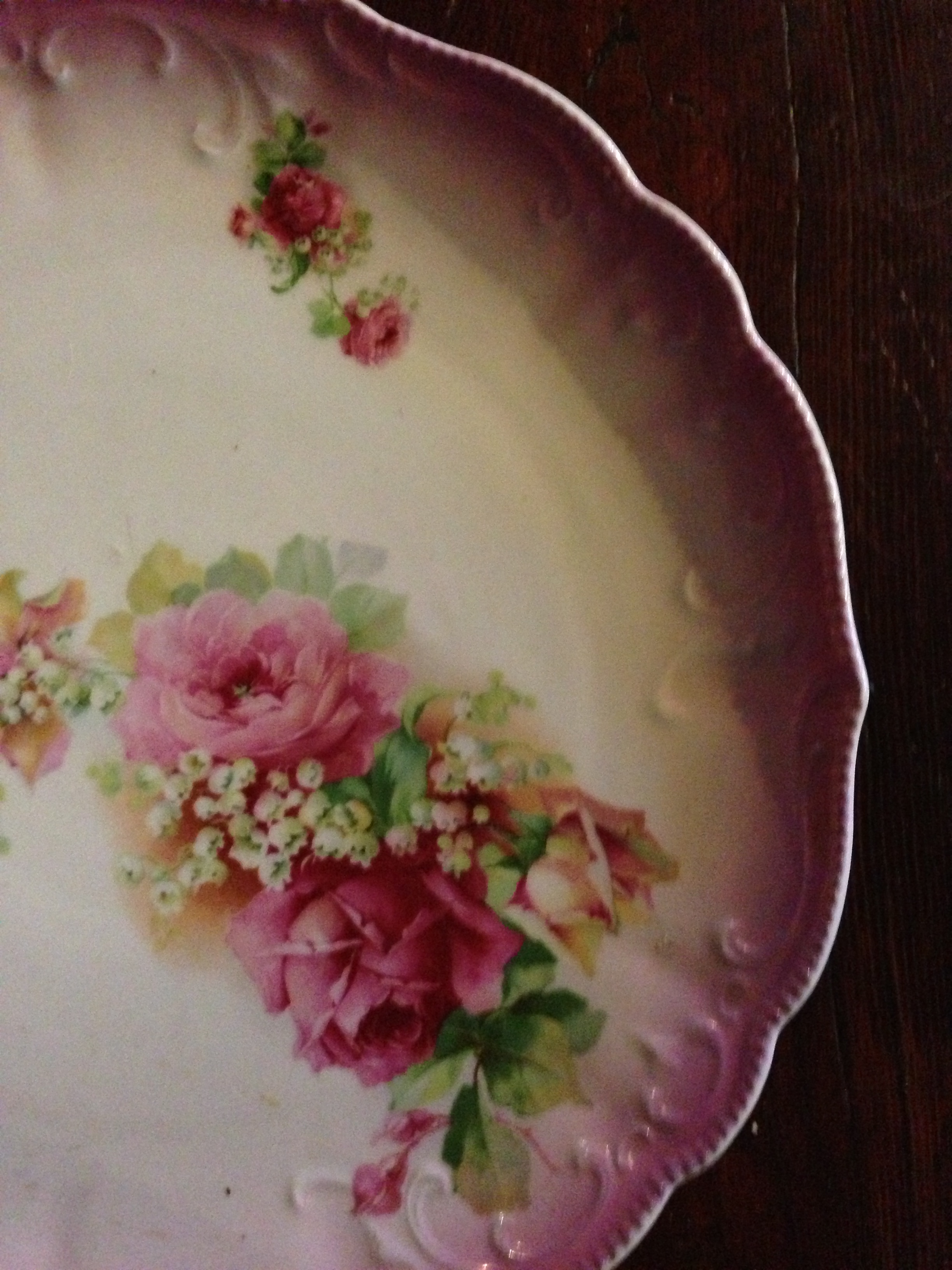
How about a china plate. A cake plate, a foot across, strewn with pink roses and lilies of the family. Utilitarian as well as cherished.

cake-plate

Just a plate. But a plate belonging to my great-great-grandmother, a woman with the interesting name of Brown Coats. A deep souvenir of family, embodying the optimistic conviction that sometime in the future, there will be cake.

Will the plate make it through the mud, the rutted roads, the mountain passes? Despite its apparent fragility, I am certain it is strong.

6 Comments

Filed under Art, Cooking, Culture, Fashion, Fiction, History, Home, Jean Zimmerman, Photography, Publishing

Forever Twenty-One

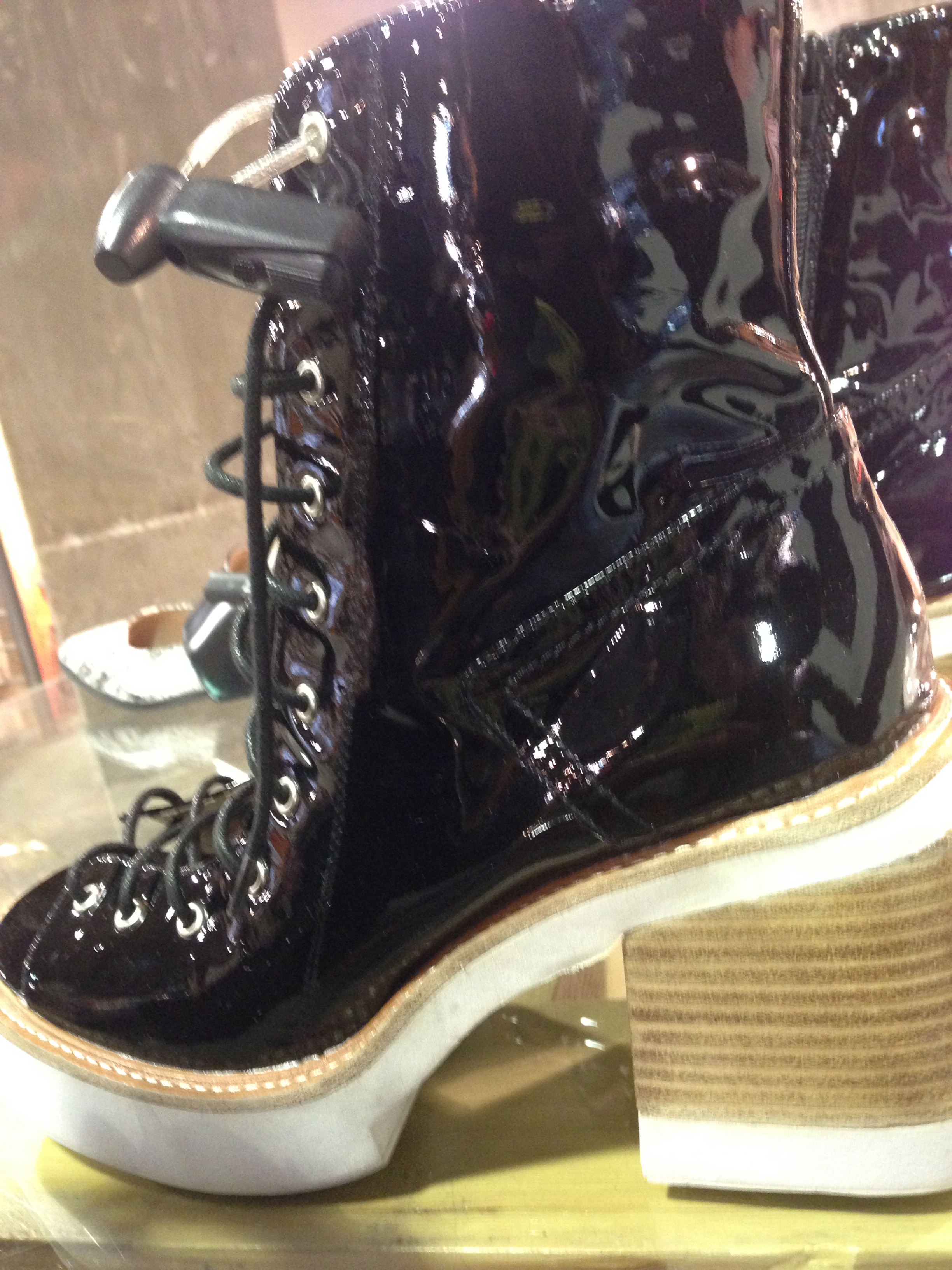
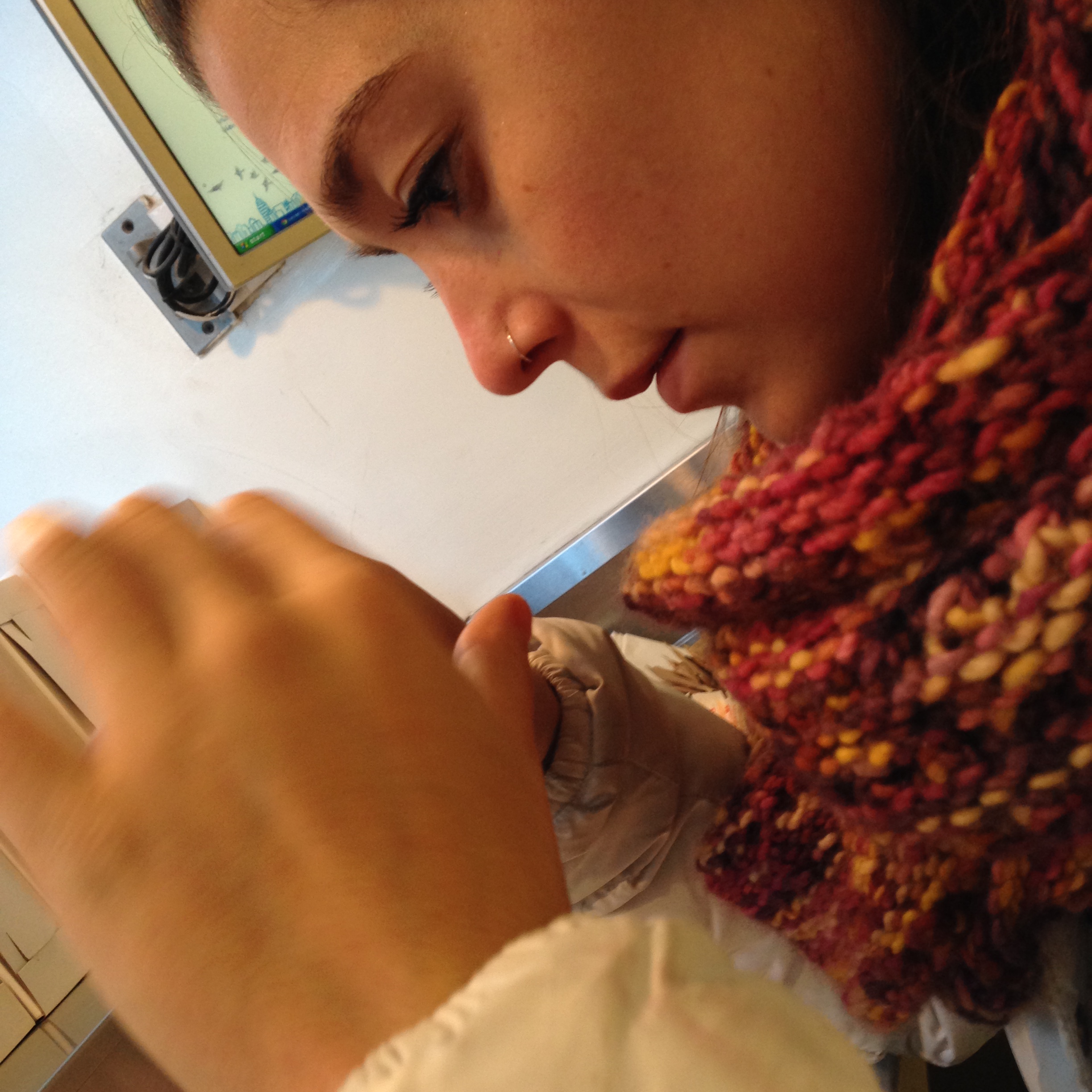
Icy New York City, hot colors, textures, tastes – drinking it all in with a 21-year-old, on break from scholarly endeavors, who needs a pair of boots.

shiny boot

Not those boots.

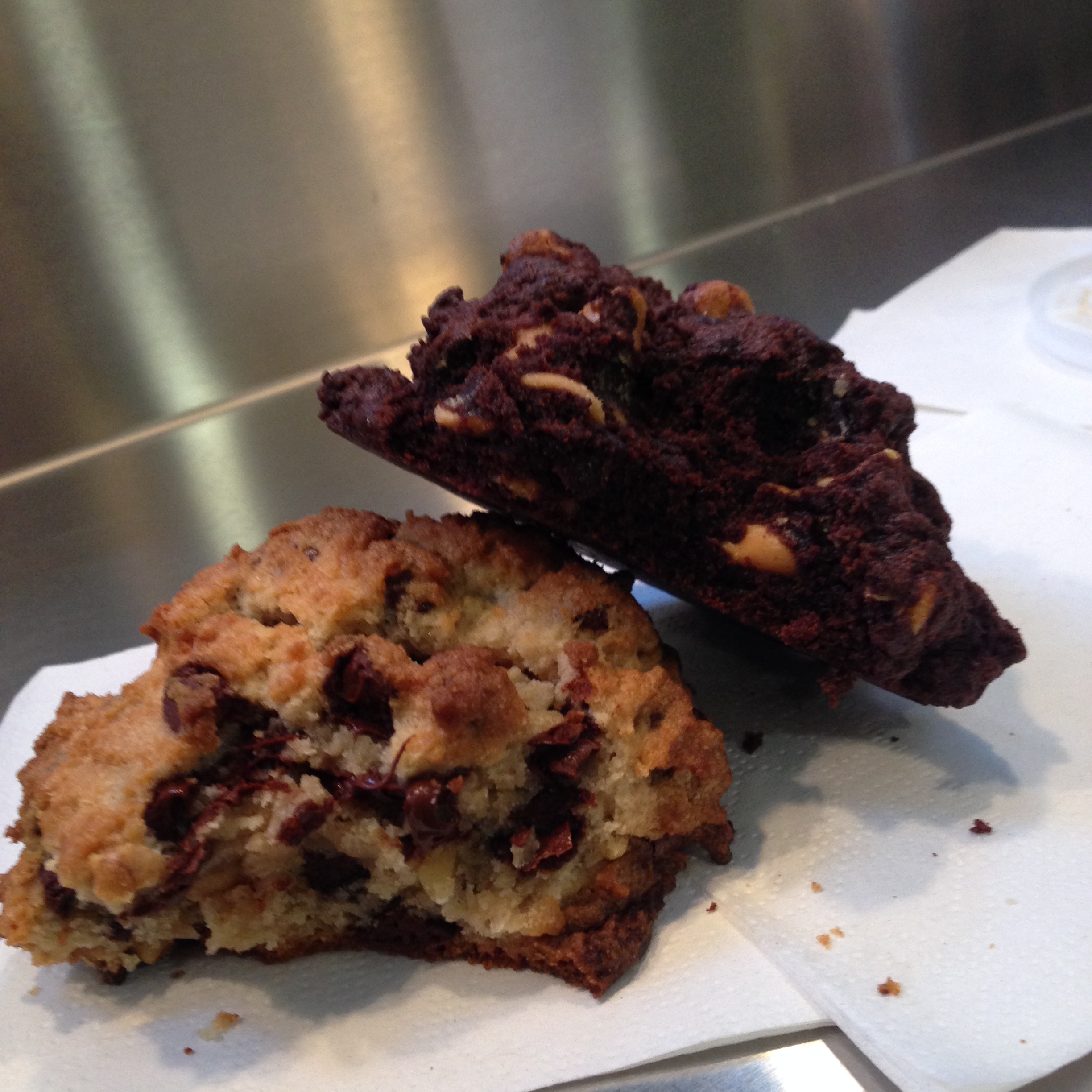
Who needs a cookie.

cookies

The crumbliest, crunchiest, richest cookie in Manhattan, from Levain bakery on West 74th Street. Chocolate, a zillion calories. Would make a good lunch. Highly photogenic, too.

shooting cookies

What she doesn’t need: forced bulbs from a fancy shop.

narcissus

She creates blossoms of her own in her mind.

Needs no silly store slogans.

boy problems

A suit of clothes suitable for a different girl.

And no other body than her own, please.

mannikin

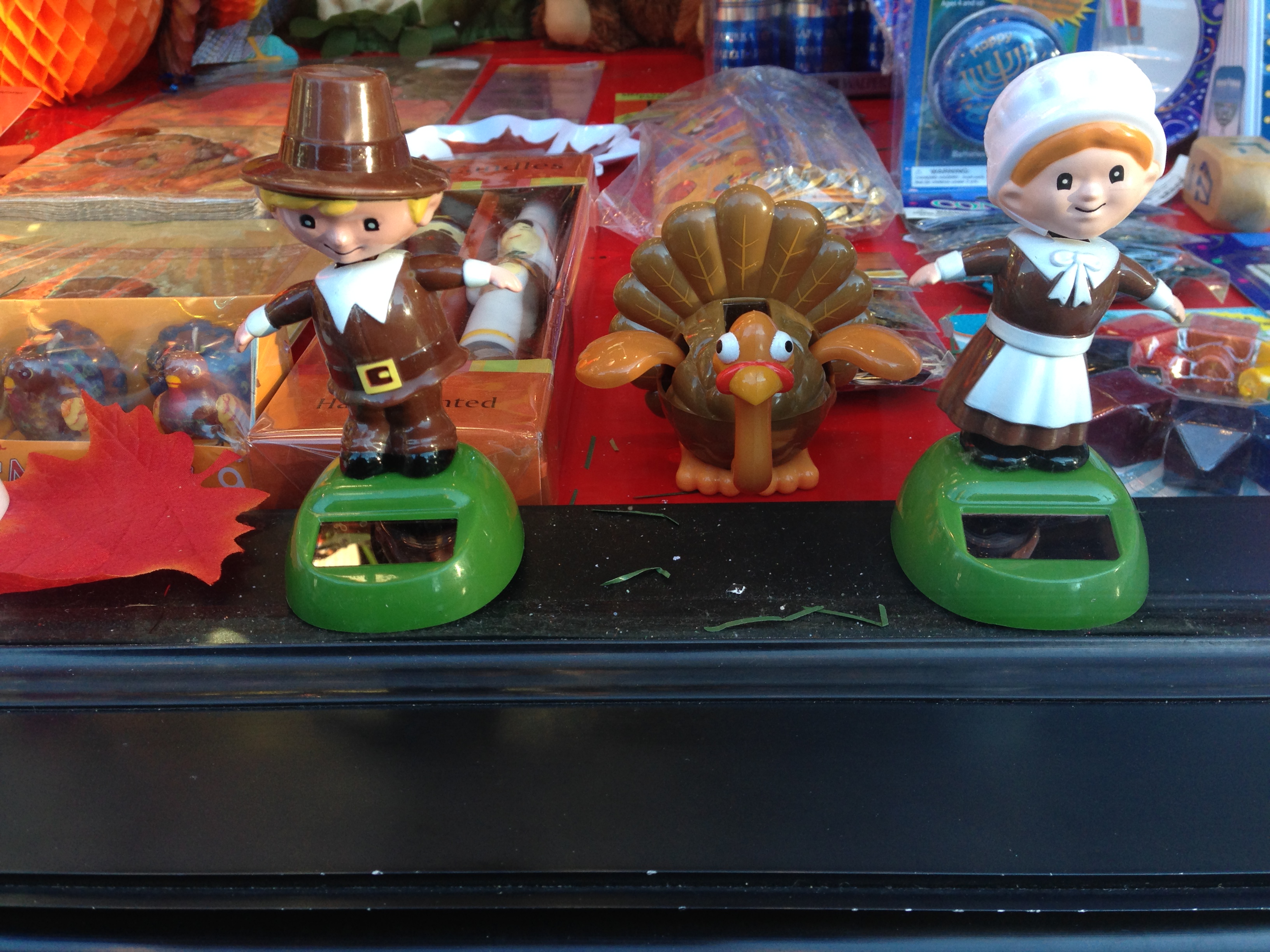
No plastic toys, either, no matter how quirky. These flap!

toys

Life itself is a sweet, quirky game.

1 Comment

Filed under Culture, Fashion, Jean Zimmerman, Photography

Author Page Debut

I wanted to let everyone know that I have set up an author’s page on Facebook, where you are welcome to go to discover news about my books both forthcoming and previously published, and also bits and pieces about the literary life, book goings on, tweets, interesting historical phenomena and other things that pertain to my life as a writer.

Please do stop by and “like” the page, and leave a comment – I’d love to see you there.

For the Facebook page, and just because I  hadn’t done so in a while, I came up with a new author photo. I wanted the picture to be less posed, more natural than my past ones, and to have some kind of a natural context.

IMG_8745 revised

Maud Reavill was prevailed upon to record her mother’s image for posterity. I stood in front of Columbia University’s St. Paul’s Chapel, designed in 1907 by I.N. Phelps Stokes, he who I profiled in my book  Love, Fiercely: A Gilded Age Romance. It’s an exquisite Italianate structure, one of Stokes’ finest accomplishments, and the first non-McKim, Mead and White building erected on campus. It’s just as beautiful inside as it is on the exterior, but the light inside didn’t favor a shot. I wrote about the chapel and getting my picture taken earlier this year.

The bricks are old. I am not.

Leave a comment

Filed under Art, Culture, Fiction, History, Jean Zimmerman, Love, Fiercely, Photography, Publishing, Writers, Writing

Historical Pork

I brought the porker totem home to a curious canine, though Oliver didn’t seem to feel the swine deserved an aggressive posture.

oliver:pig

And though I debated on the drive back, porker clunking in the trunk, what Gil’s reaction would be – would he object to the creature because of its cost or size or general mien – he too was delighted by it. One of his favorite song lyrics, he said, was Dylan’s “I’m no pig without a wig/I hope you treat me kind.” Hard to hold anything against a grotesquerie that cost 24 dollars.

whole pig

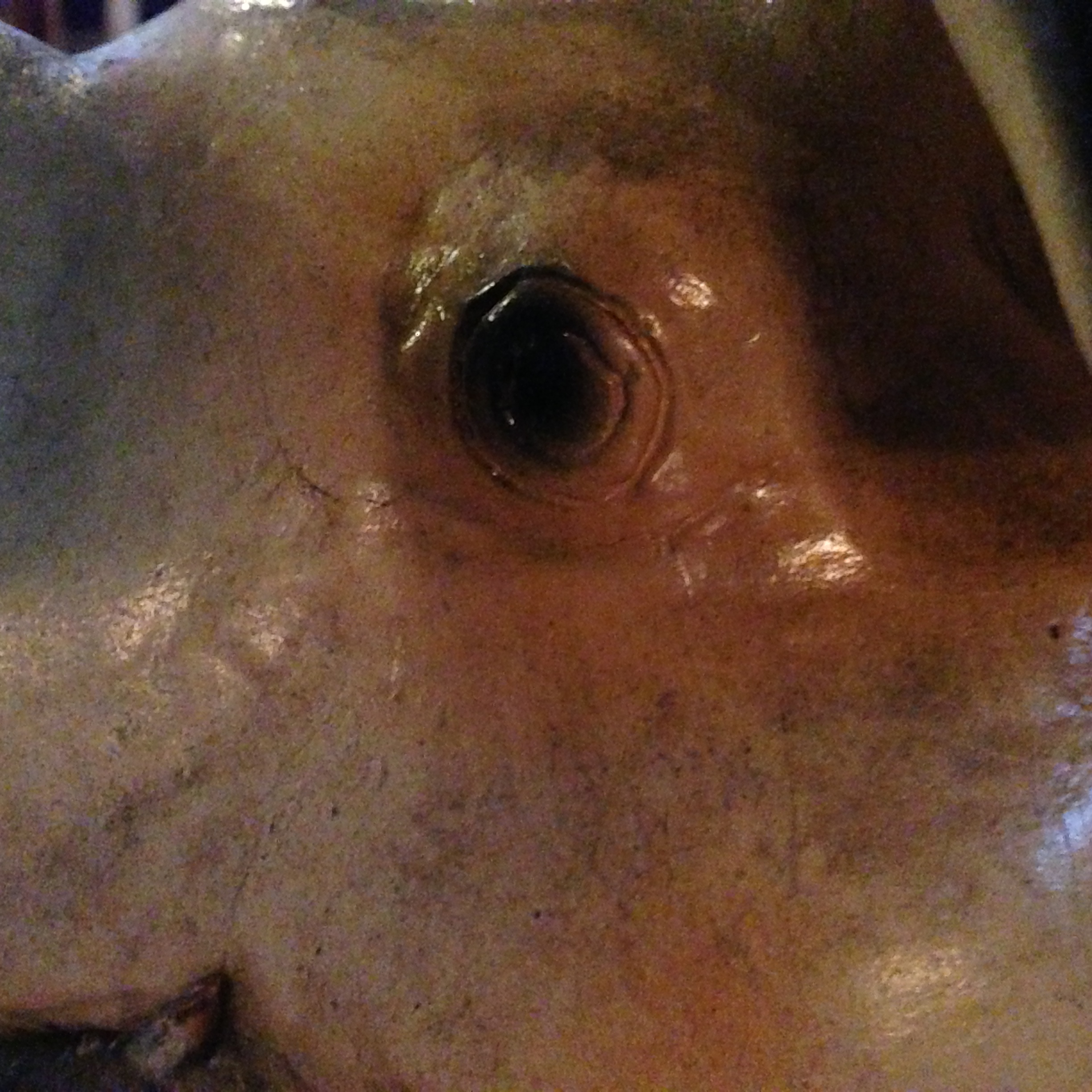
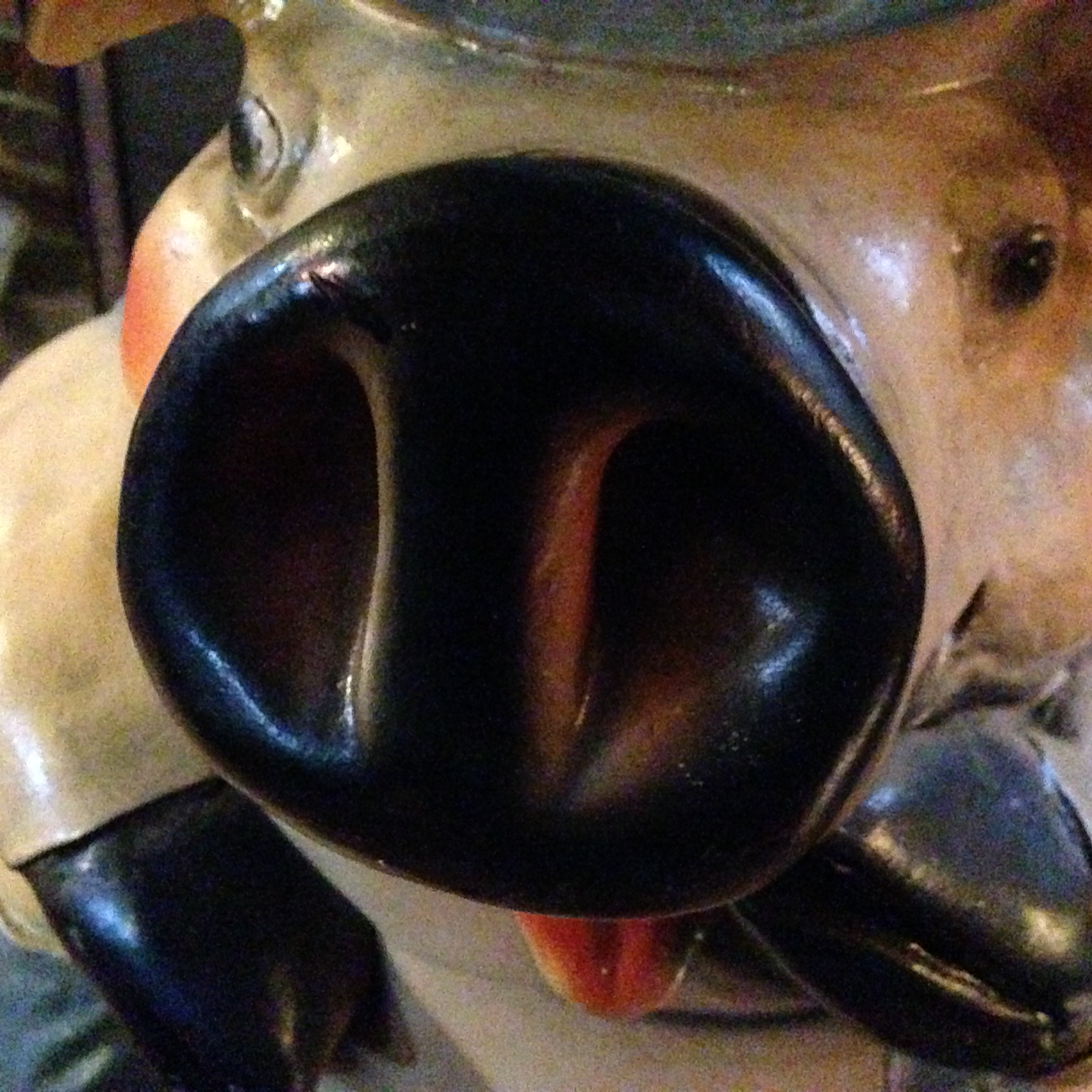
We decided the painted plaster pig with the voluptuous nose must have at one time enticed customers in a store or eatery. The woman in the antiques shop felt sure he had a former life as a piggy bank, but no piggy bank is thigh high. I snapped him up quickly, before anyone else could. If anyone else would.

pig eye

My eye for art is my own. I’m the one who finds things at estate sales after all the “good stuff” has been bought, after everyone else goes home. In our storage locker the other day I went through our collection of two-dimensional pieces, some by friends, that the Cabin walls can’t accommodate. Space is extremely limited and 250-year-old logs hard to pound nails into.

I did hang a Currier & Ives print, an antique spoof showing a nineteenth century woman with a braid dangling to her knees, a cigarette and a riding crop. “The Girl of the Period” reads the legend on the only slightly stained image. The friends who gave me this know me well.

currier

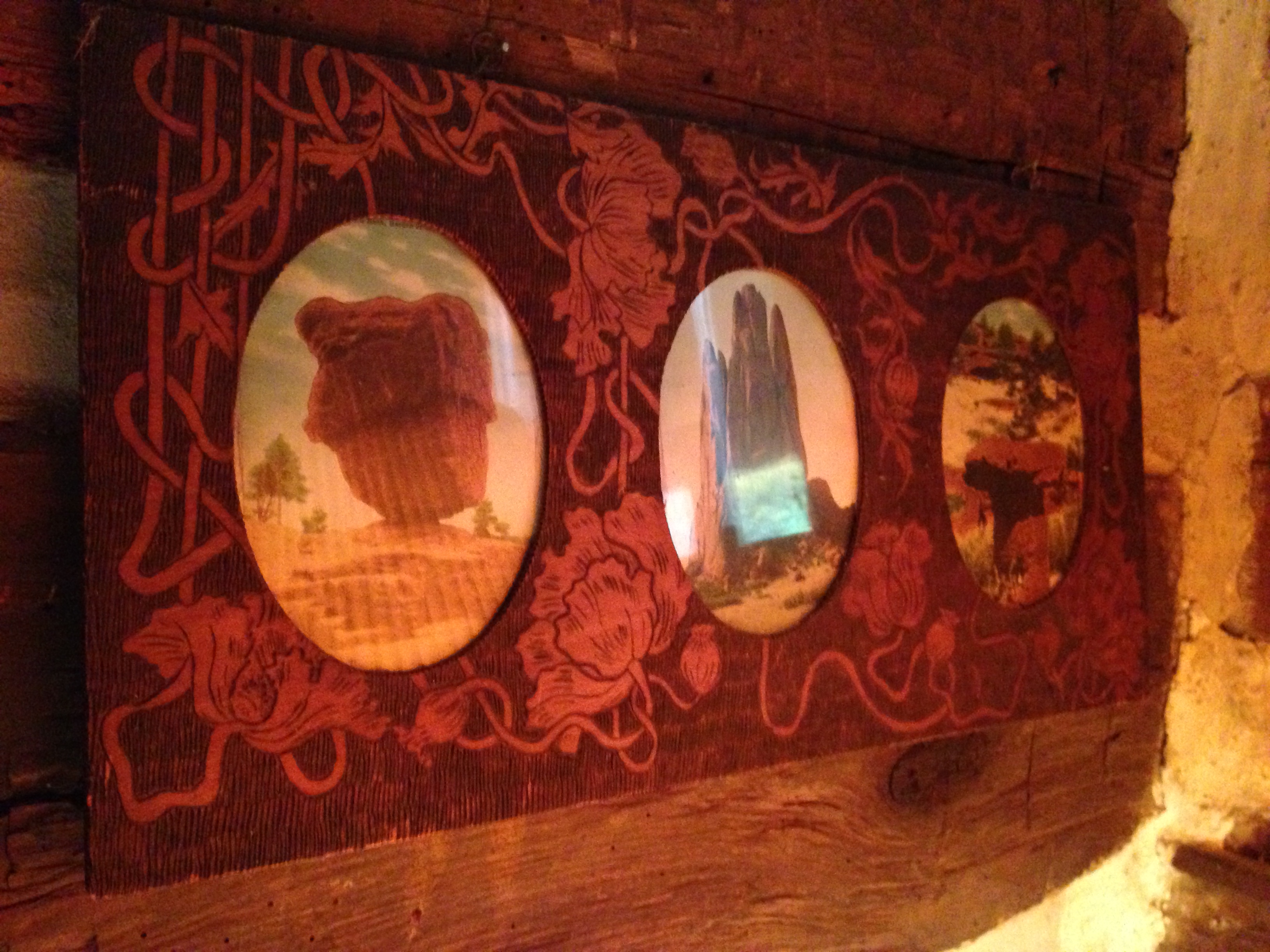
I do like things that are a bit stained, worn, faded or torn. Things that have the spirit of the vernacular in them. That show the human hand. It’s not outsider art when it comes from your own relative. One vintage artwork in my house was the creation of my great-grandmother Lockie Hillis, three landscape postcards she collected on a trip to the Panama Pacific International Exposition in 1915, which she mounted in a wood-burned frame (she herself burned the wood).

Lockie

I greatly appreciate handmade signs, but I’ll only collect them for free. Our best sign, hanging outside on the porch wall, we collected off a telephone pole next to a cornfield on a midwestern two-lane.

cherish

The one above the fireplace makes an ironic comment on Oliver and the other beloved dogs that have lived with us.

no dogs

Another perhaps more frightening comment, the mask hanging above the wooden sign. Leather of some kind, it comes from Mexico, and has dropped a few eyelashes since I picked it up 30 years ago. Gil has been known to put it on for Halloween and terrify small children.

mask

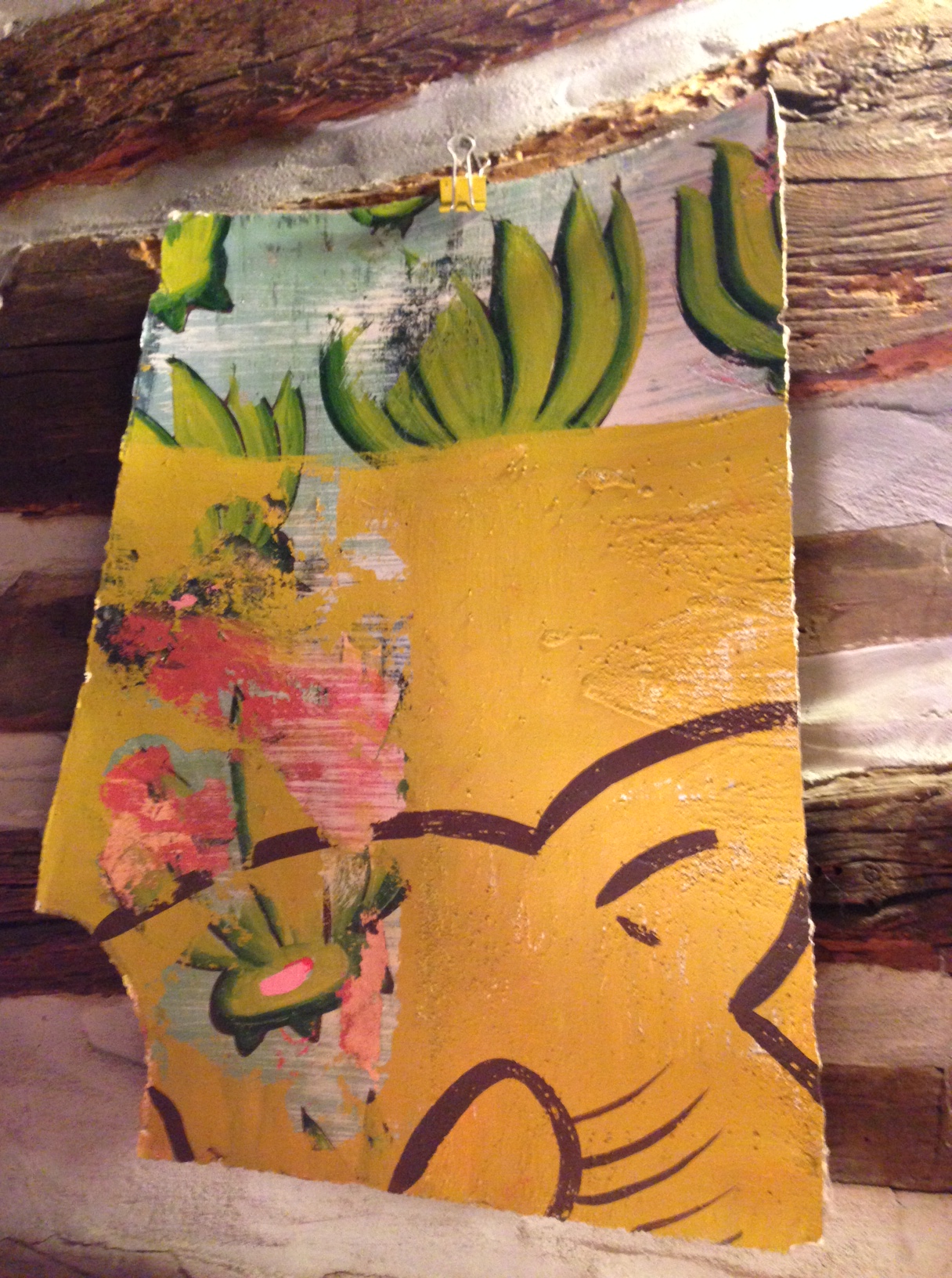
The Cabin makes a perfect backdrop for a painted work like the one my artist friend Sandra bequeathed, titled “Cairo in the Garden,” named for a beloved tabby we owned with seven toes on each paw.

cairo

We don’t frame it because it doesn’t need a frame to show off its fresco-like charms.

Back to the pig without a wig. Where to exhibit his bulbous corpus? I think he needs to stand by the door, sticking out his tongue in welcoming us. Or by the hearth, though I wouldn’t want his fat to singe. Perhaps the kitchen would be the most logical, given the amount of bacon this household consumes. In a corner, where we can observe him observing us.

While I consider it I’m going to give my attention to a National Audobon Society “miniature chart” showing Twigs of Common Trees.

Twigged Out

Here we have 62 ink-drawings of buds, bark, leaf scars and pith. The total effect is exquisite and I’d like to do the impossible: find it wall space. I fished Twigs out of storage and Gil said, You want that? Yes, as a matter of fact I do.

pig nose

What this jolly pig reminds me of most of all is old-fashioned signage, when shops had a giant shoe or pair of eyeglasses out front, bespeaking loud and clear what they had to offer. That’s a history dating back to the middle ages, but you still find pigs today decorating barbecue joints. That might be this one’s origin. Oink.

6 Comments

Filed under Art, Cooking, Culture, Dogs, History, Home, Jean Zimmerman, Nature, Photography, Writers

Mums the Word

The kiku were fragrant, lovely to look at, cool to the touch.

buttons

I had been in a mood. My foot was slower to heal than I’d like. I had a cold. I didn’t feel like working.

strange

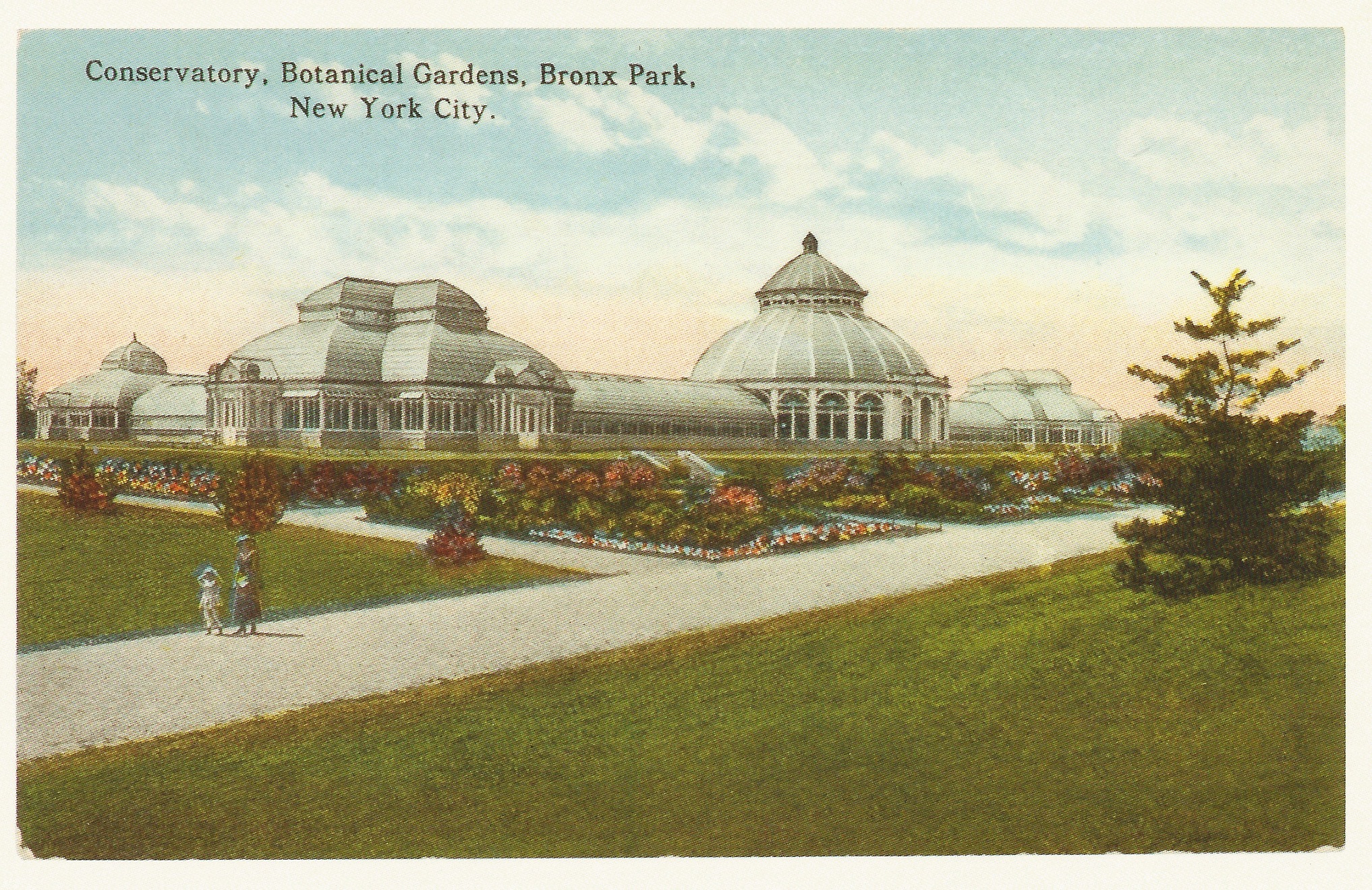
So I got myself to The New York Botanical Garden in the Bronx. It was offering its annual chrysanthemum show.

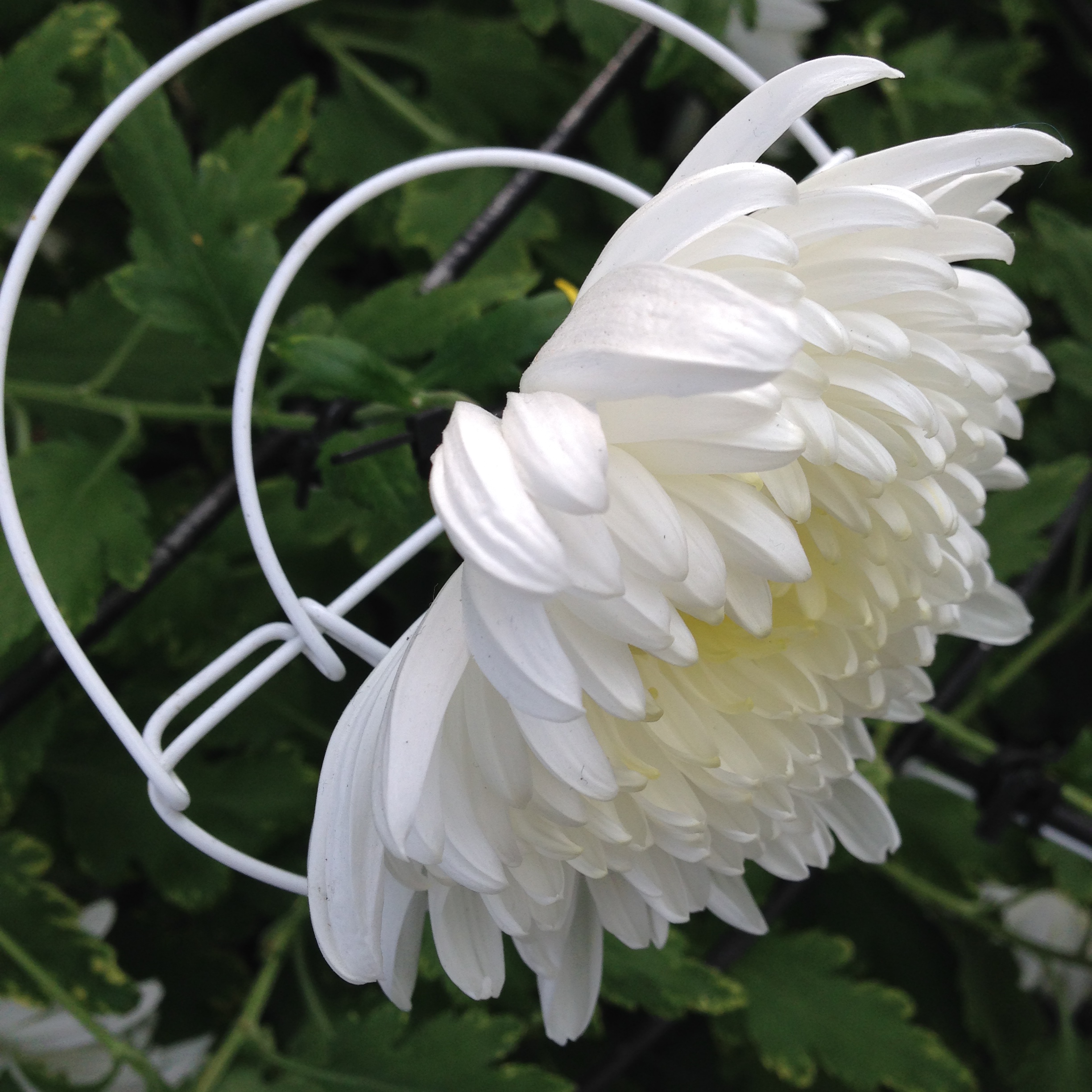
delicate white

As soon as the door swung shut behind me – the exhibit is indoors, in the haute-Victorian 1902 glass expanse of the Enid Haupt Conservatory – a feeling of bonhomie settled over me.

BG, Bronx

A feeling of chrysanthemum-induced ecstasy, a tranquil happiness enhanced by the Japanese flute music piped in to the gallery.

spangle 2

You could call on your phone for information on these amazing flowers, which had been trained for a year to be massed in geometric shapes by horticulturalists. They start with one stem, and pinch it off again and again until they wind up with a hundred flowers in rows, held in place by metal frames.

structure

That’s the back of one display. “You tell the plant how many flowers it’s going to have,” said the disembodied voice on the phone when I called for info. Called ozukuri, the practice somehow appealed to me. The human hand so obviously taming nature.

flower in frame

year by year passes

thinking of being thought of by

chrysanthemums

So mused the nineteenth century poet Masaoka Shiki in one of the poems displayed along the garden’s walkways.

I couldn’t help but be contemplative. Chrysanthemum-contemplative. Consider the Ogiku, diagonal rows of pink, yellow and white, like, they used to say, the bridle of the Japanese emperor’s horse.

rows

China introduced Japan to the flower in the fourth century, and the emperor soon made it his personal crest. In 1878 he opened an exclusive park to show off the plants grown in his garden. Since the 1920s that viewing opportunity has taken place in the Shinjuku Gyoen National Garden in Tokyo.

Chrysanthemums are members of the aster family. There are 13 species, some fat and regular, others ragged, others spider-like, others spoon shaped, the anenome with a disk for an eye. Here they all were.

Everyone was snapping pictures, as they always are, everyplace you go nowadays.

photographer

I like the big’uns.

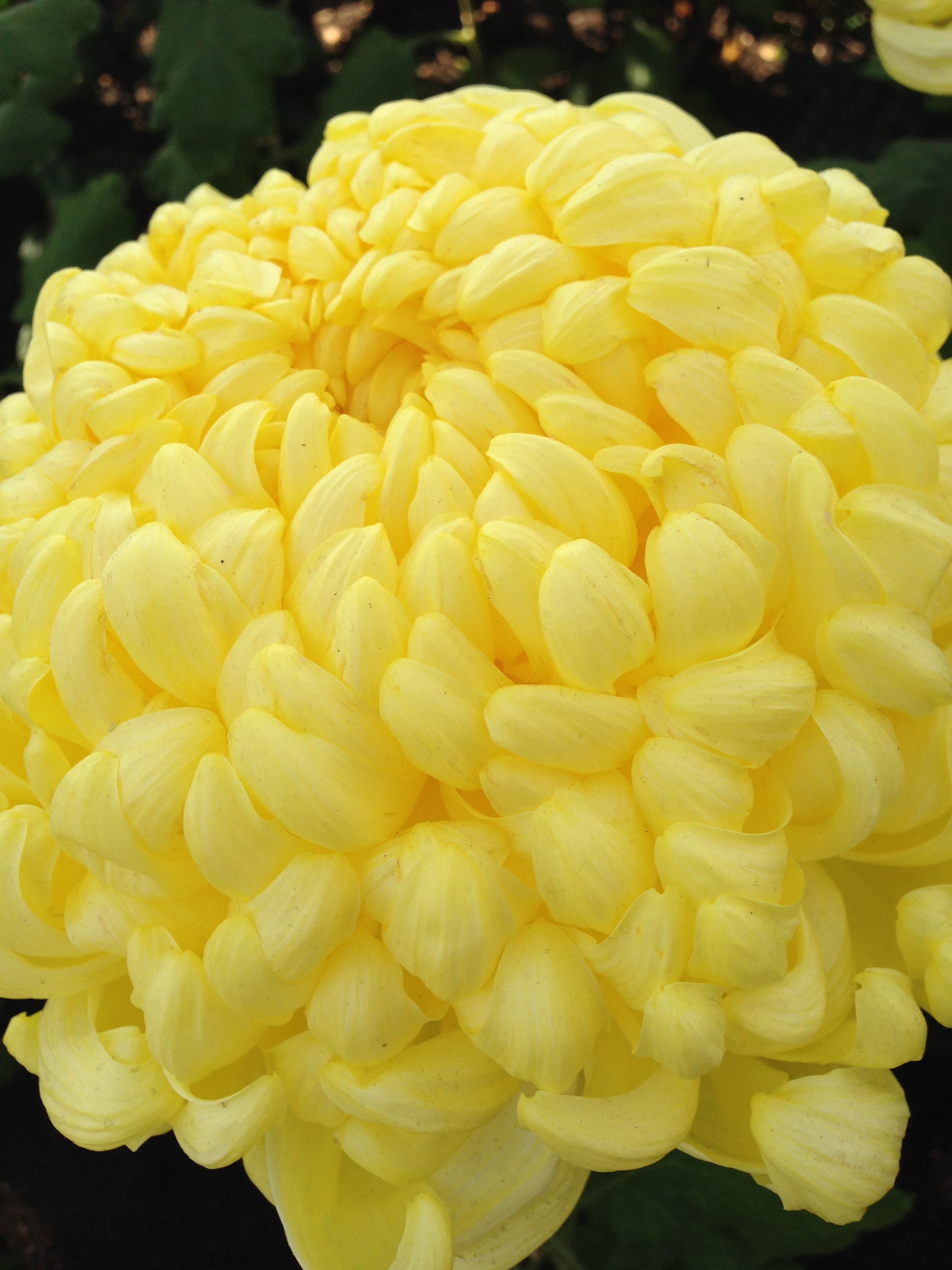
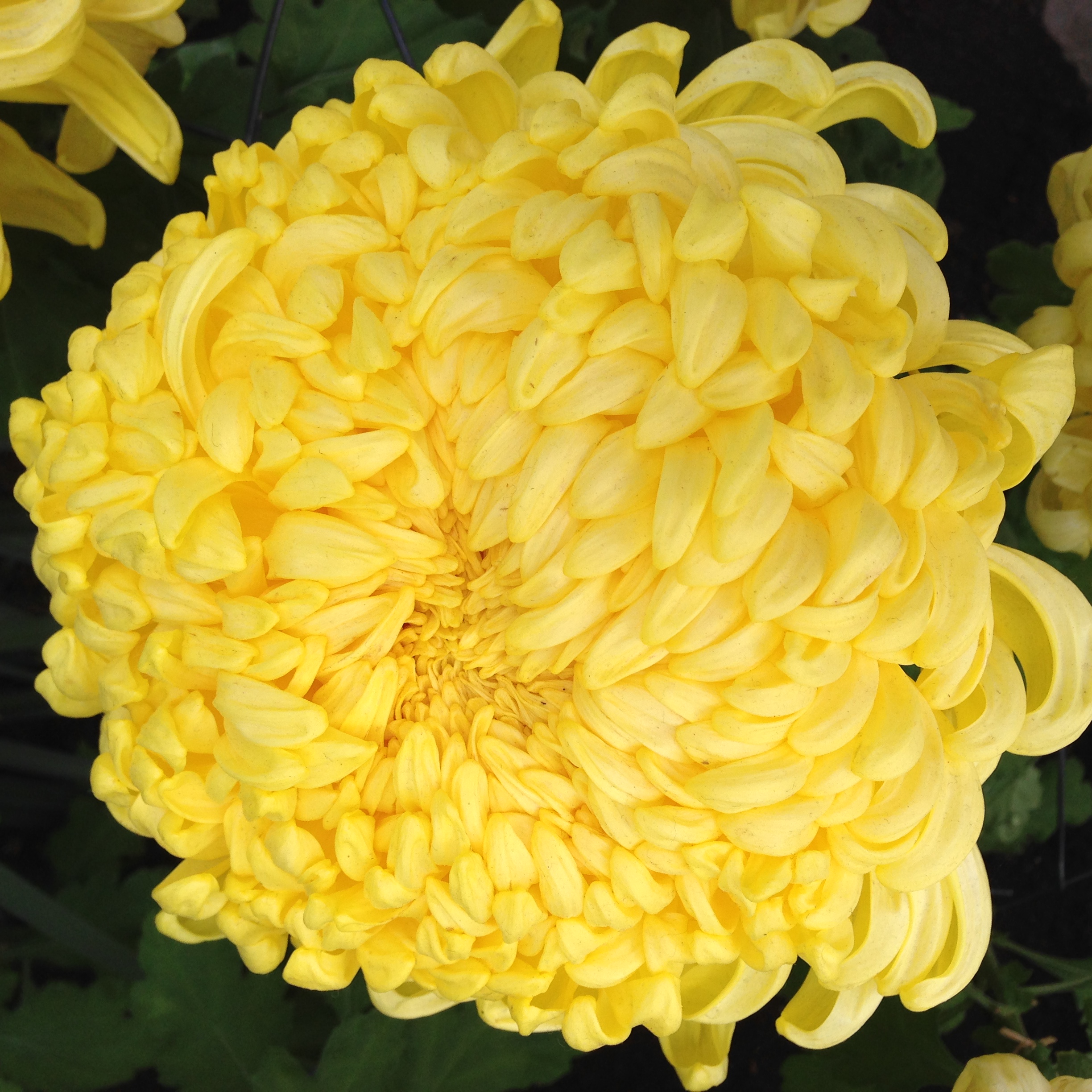
vivid yellow 2

I have to control myself not to publish all the pictures of them that I took.

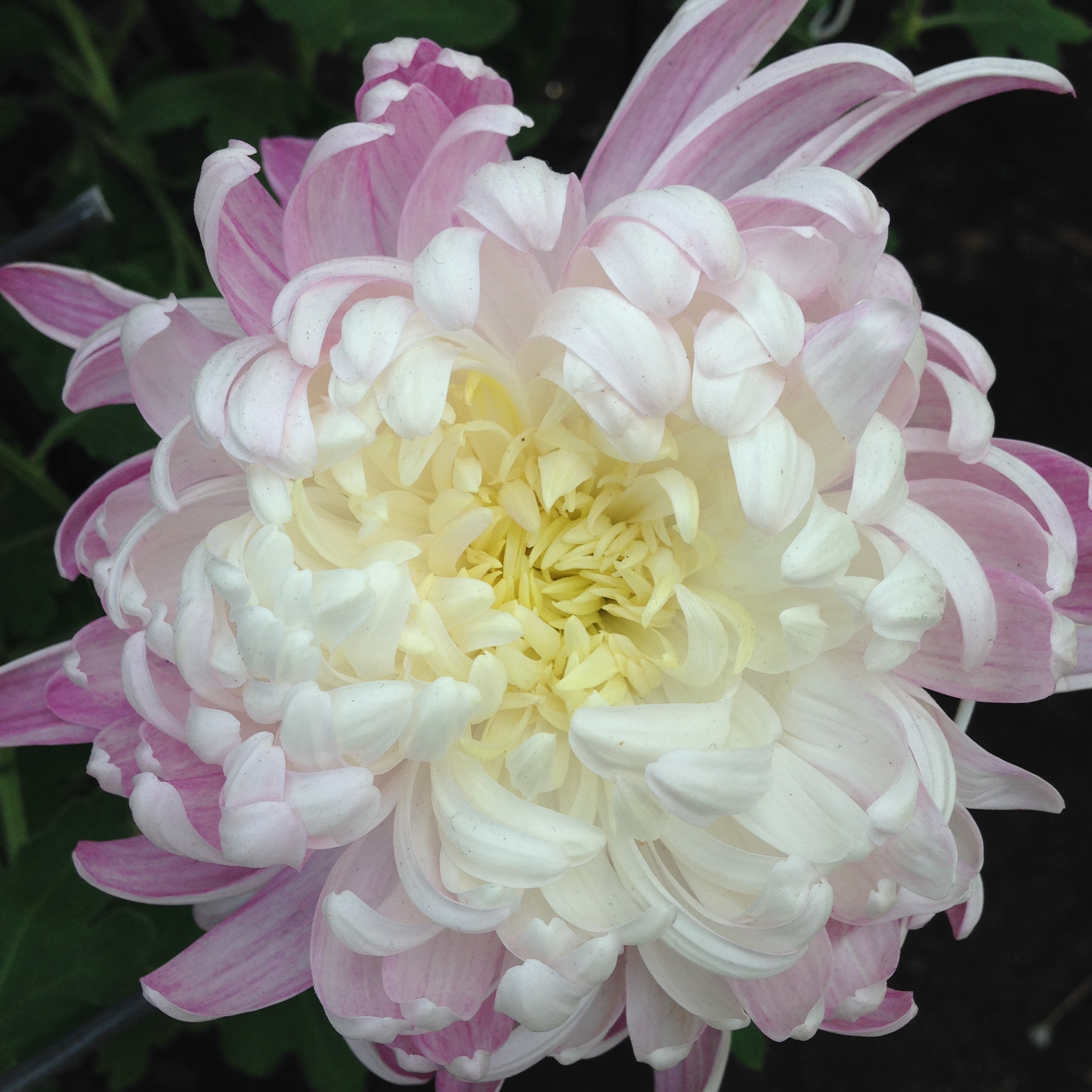
white pink yellow

Some were big as a grapefruit.

fat

Some almost the size of a newborn’s head.

Like circus animals, they could be trained to do anything, even climb up a tree, an enormous flowery bonsai.

bonsai

I love their peppery, spicy scent and the cool, slightly rubbery feel of their petals. I was ready to pitch my tent and lie down to sleep beside the smooth-stone-bottomed pool that so glamorously reflected the mums’ enormous heads.

A woman crowed to her friend, “This is the color you wore to my wedding thirty years ago!” Well, yes, that butter yellow was the color of my bouquet, as it happened.

vivid yellow

Basho:

late-chrysanthemum-fragrance-

in the garden,

the worn-out sole of a shoe

Kiku plants need 14 hours of darkness every day as they develop into glamour pusses like the ones in this exhibit. They spent a lot of time with a black cloth thrown over their heads.

Now that they’re out the bees want a piece of them.

bee

I left the gallery, walked to the exit door and stopped in my tracks. You know the way you finish a book you loved and you turn to the beginning, to the first chapter, to start again? I proceeded back into the kiku gardens and took another look at everything as if for the first time.

2 Comments

Filed under Culture, History, Jean Zimmerman, Music, Nature, Photography, Poetry

A Pear Tree at Ground Zero

I waited a long time to go.

9:11 sign

I had all sorts of excuses. The 9/11Memorial stood behind too many fences. The lines were too long. It was filled with gawking out-of-town sightseers. But then some sightseers of my own came to visit. And off we went, to the Memorial, a broad plaza studded with small trees under the shadow of skyscrapers. It was one of a few things my sister-in-law knew she wanted to do when she hit town.

lisa

There were in fact probably a thousand people at the site on a Friday morning, including some incongruously attired tourists – incongruous for a place of mourning, not for being tourists in New York. They’re always wacky.

wtc tourists

Guards ushered us through an endless line. You could see a scrap of the Freedom Tower along the way.

freedom tower fence

Then we were there, in the open plaza with its great, deep South Pool, whose waters seem to flow down into an abyss.

pool 3

An abyss of longing, of sorrow, of wonderment? Of absence? Of wordless pain? Everyone decides for themselves. You can read about the 9/11 Memorial, you can read what I’m writing now, but you’ll only understand the power of it if you’re standing there.

We could see the Freedom Tower clearly now, still unfinished, seemingly created as a photo op.

freedom tower construction

Cameras, of course, proliferated.

bronze camera

All around were construction sites. Various projects are energetically  in progress. As is the memorial itself.

construction

And at the pool, there are the names.

bronze and rose

Taking a picture is a way of touching the nearly 3,000 names of the dead inscribed in bronze around the pools.

bomb squad

The deeply carved letters, cut out with a laser to symbolize absence, invited touching with the fingers. Touching. Wrenching, some especially.

unborn child

The names are not rendered alphabetically but instead arranged based on layers of “meaningful adjacencies,” where the deceased had been that day and the relationships they had with each other, taking into account the wishes of kinfolk.

It must have been hell to figure out. Visitors access the location of their loved ones’ names through kiosks to the side of the pools.

But powerful as the pools were, as the names were, they paled slightly for me alongside what is being called the “survivor tree.” All but one of the trees planted on the plaza are young white oaks. One, though, is different. A Callery pear tree dating to the World Trade Center plaza of the 1970s, it stood on the eastern edge of the site, near Church Street. It lived through the 9/11 devastation, though reduced to a stump of eight feet, then was nursed back to health in a city park, was uprooted by spring storms in March of 2010, but came back once again. New branches, buds, flowers, everything. Life, amazingly.

wtc pear

Now the pear tree stands beside the South Pool, braced by guide wires as it takes root, and visitors migrate across the plaza to stand beneath its thick branches, to absorb its legend, its poetry.

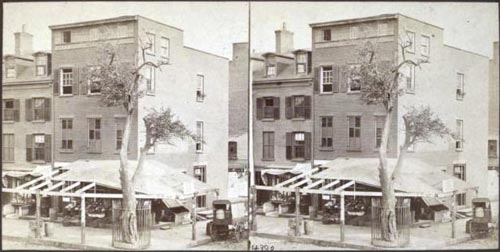
The parable of the pear tree that would not perish has its bookend in another historic Manhattan pear tree. Peter Stuyvesant, the legendary governor of New Amsterdam, planted one on his bowerie in the late 1600s. Way out in the country then, the location eventually became 10th Street and Third Avenue.

stuyvesant-tree-01

That pear tree survived the creation of the New York street grid plan in the early 1800s, and everything else the developing city had to throw at it. The tree lived over two hundred years, only giving it up when a dray mowed into it in 1867.

2513096754_5f8140c23a

The people of the city mourned the loss, as they celebrate the life of the Ground Zero pear tree today. A tree that stands, gnarled, unbowed.

3 Comments

Filed under Culture, History, Home, Jean Zimmerman, Nature, Photography

What a Wonderful House

The walls can talk in Satchmo’s house. Literally. Standing in Louis Armstrong’s den in his longtime residence in Corona, New York, we heard his perfect rumbling tones describing his inspiration for What a Wonderful World – the children of his neighborhood in Queens. The docent had pressed a button. The effect was magic.

Louis kids

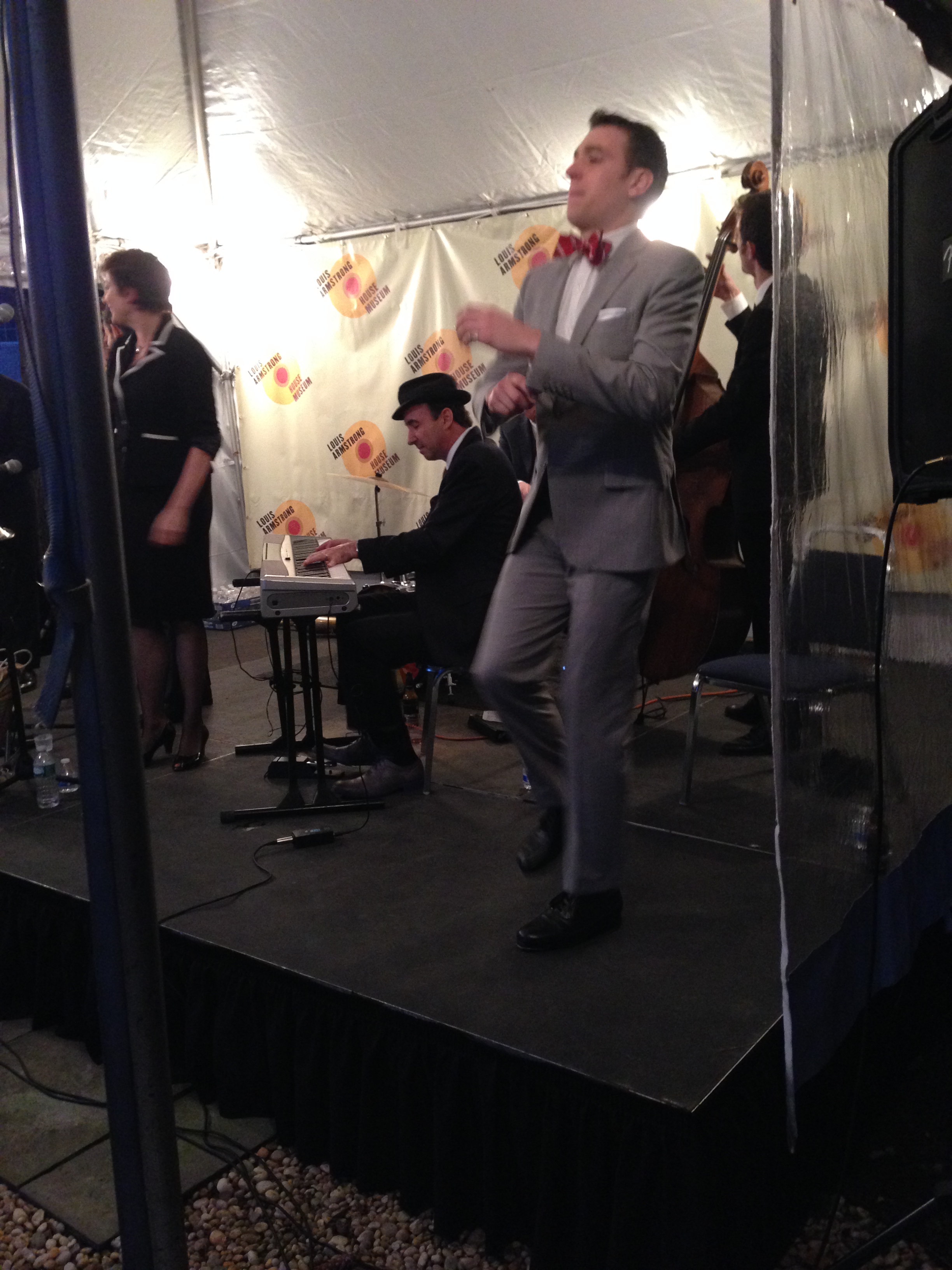
We were visiting the Louis Armstrong House Museum, where the atmosphere created by Pops and his wife Lucille has been impeccably preserved. It was the house’s tenth anniversary as a public destination. A celebration was underway. A group called The Hot Sardines had a throwback style and even a peppy tap dancer, dressed in the current men’s fashion of skinny, tight suits.

tap dancer

There was a powerful trumpet player who might have felt a bit under Armstrong’s shadow.

trumpet player

The singer called herself Miz Elizabeth and the dancer was Fast Eddy. Basin Street Blues and Ain’t Nobody’s Business mingled nicely with the jingle of the Mister Softee truck making its way through the neighborhood.

Waiters came around bearing paper bowls of gumbo — “based on Louis’s own recipe” according to the museum — prepared by The Cooking Channel’s Tamara Reynolds and her company, Van Alst Kitchen.

gumbo queen

The cornbread squares were properly crumbly-chewy. We went back for thirds on the gumbo.

“There are some people that if they don’t know, you can’t tell them,” Armstrong said. Anyone that couldn’t feel the swing in the air of this little Japanese-inflected garden in Queens would have to be unconscious.

After Miz Elizabeth delivered a soulful rendition of Sophie Tucker’s great signature tune, One of These Days, we ventured inside.

living room

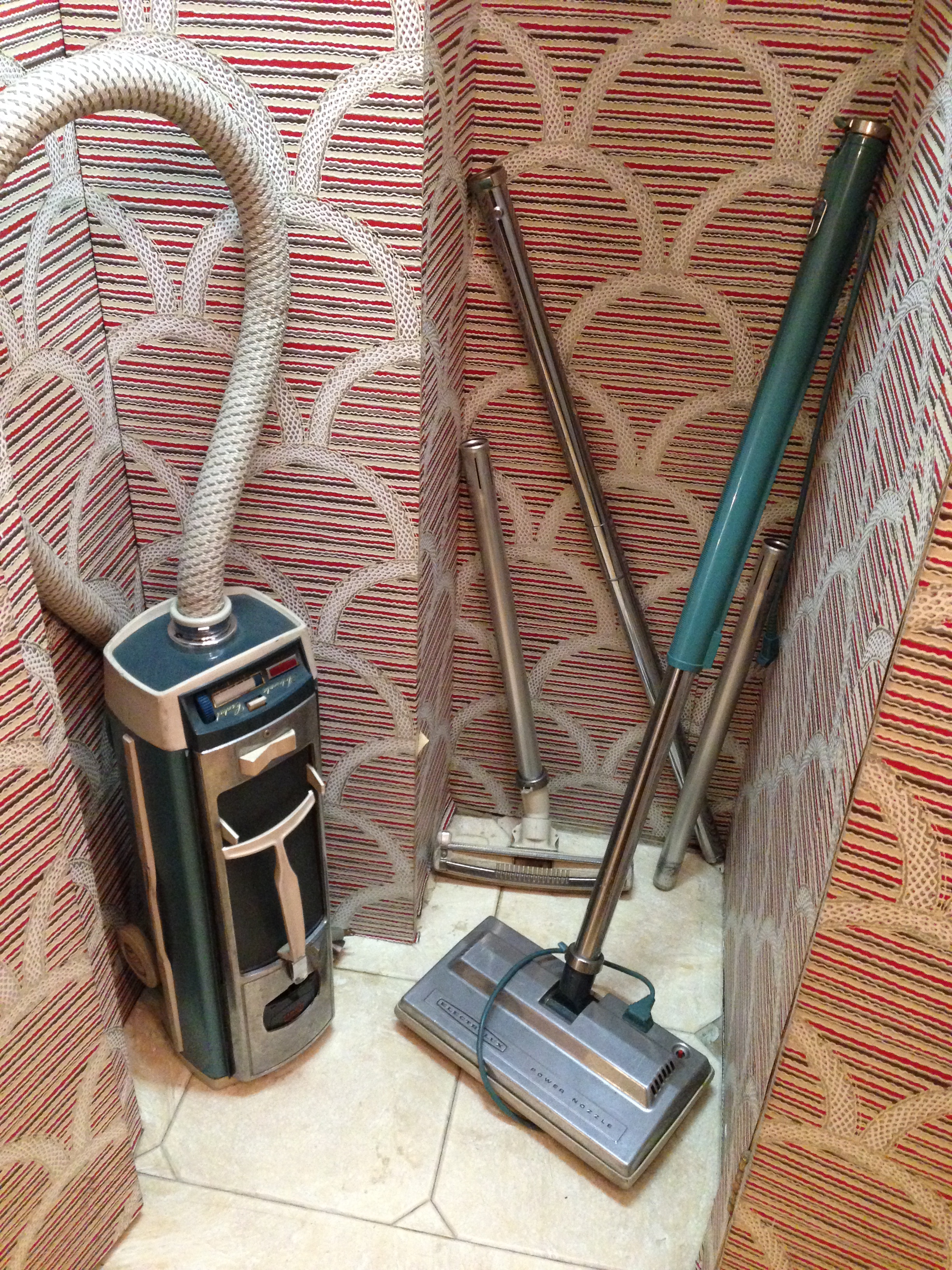
A time capsule. Everything was exactly as it had always been, down to the knick knacks and the vacuum cleaner.

vacuum

Lucille, a Cotton Club dancer, made this a showplace,  a glitzy but cozy habitat. She had found the house while Armstrong was out touring, she bought it, fixed it up, and gave him the address, so when he came back from the airport in a taxi he drove up and didn’t believe it – That’s not my house! he said. Or so a docent told us.

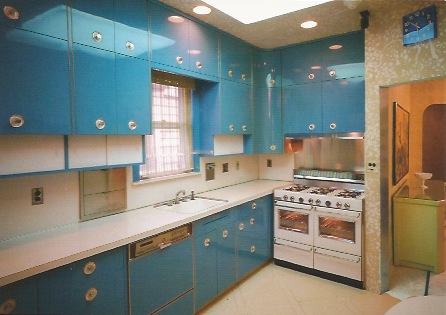
Everything is from another age. The kitchen has glossy turquoise cabinets.

Louis kitchen

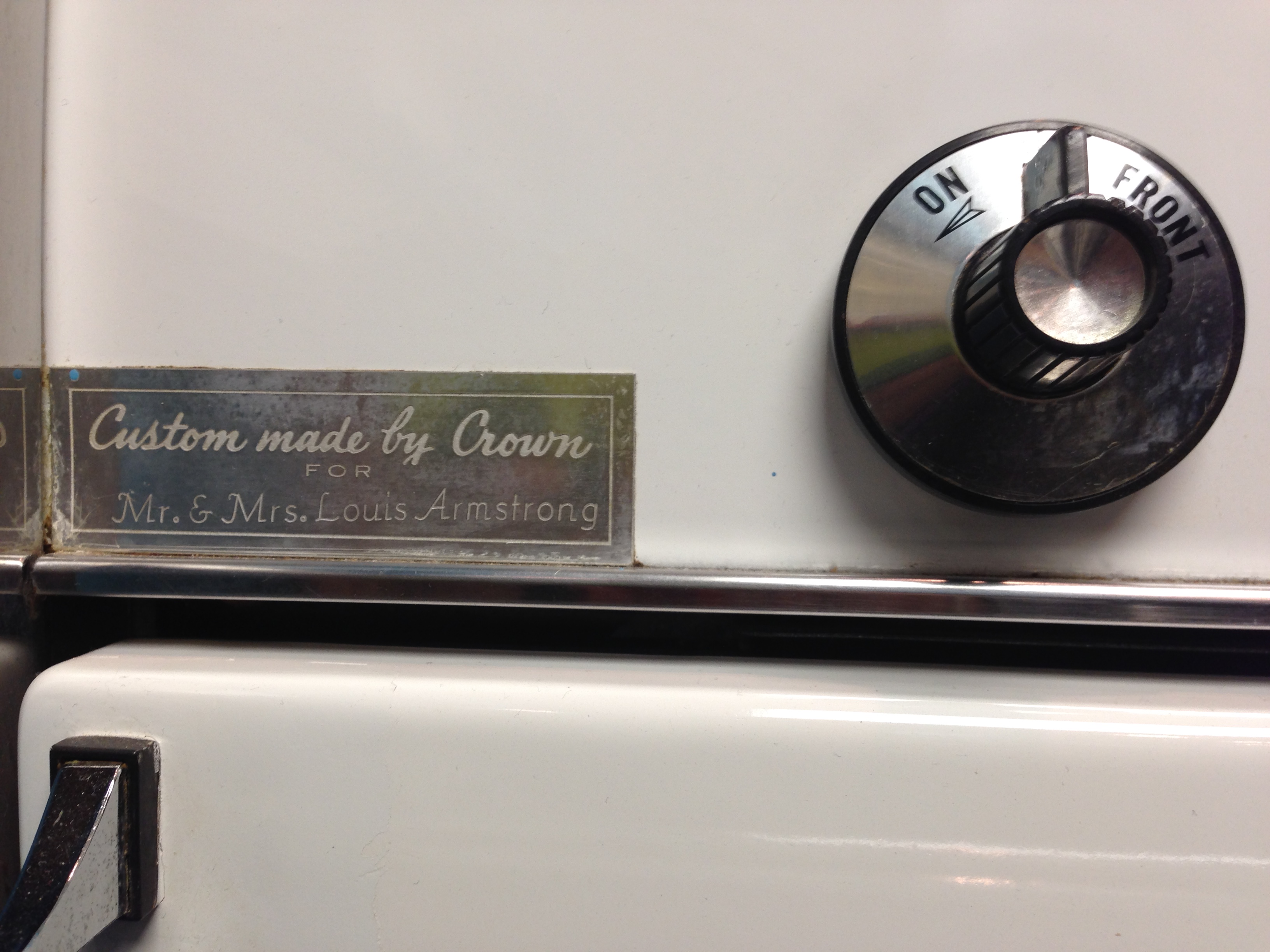
And a stove to which a personalized nameplate was affixed.

Louis stove

You could see the Armstrongs’ recipe box.

Louis recipe

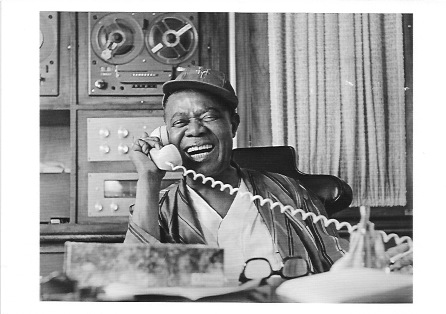
Duke Ellington called Armstrong “an American original.” Pops liked all types of music, not just jazz, and kept a well-used reel-to-reel tape deck with a collection of 750 tapes. He once made a country album and among his first recordings was a duet with Jimmie Rodgers.

Louis phone

His den was his sanctuary, the only place in the house he could smoke weed. Pot, he said, insulated him from racism.

What about that 14-carat-gold-plated bathroom? High style for Corona, Queens.

gold bathroom

A young woman with cat eye glasses was giving a guided tour to her boyfriend as we passed through the upstairs rooms. She had been there many times before. Look at the wallpaper, she said. I just love the decor, she told me, it has so much of them.

So many things change. This hasn’t. The telephone number for the museum is the original for the Armstrongs’ house.


1 Comment

Filed under Cooking, Culture, Fashion, History, Home, Jean Zimmerman, Music, Photography

Making Change

It’s a good day for working. I just finished proofing the third pass Savage Girl galleys. Found some periods and commas that persisted perversely in the manuscript despite everyone’s best efforts. A few tiny, tiny changes make all the difference. If. You. Ask. Me.

Yes, it’s a good day for scrunching your forehead and working. Especially if your work is being on the lookout for deer.

scrunch

But isn’t it a better day for rolling in the grass? Those fallen leaves add a toasty texture to a run-of-the-mill back scratch.

O rolling

Closer to waist level, the sun warms the fall berries. Where do they come from? The landscape has changed. All of the sudden they’re there.

red berries

Then there are the last of the morning glories, though they don’t know it. The deer have already had at most of their leaves. Soon the blooms will fold up their tent.

glories

They mirror the arching sky. Contrails: someone’s going someplace.

blue sky

The morning glories unfurl for just a single day. Their only work is being beautiful.

This morning I revamped the front page of this site, and I invite you to visit. To improve is to change, said Churchill. To be perfect is to change often. I don’t know that I change often enough or dramatically enough, but I’d like to try something new.

For one thing, I’m settling on an up-to-date author photo. Not quite sure, but this one’s a strong possibility.  I like it because I seem bemused. Which I often am.

IMG_8745 revised

2 Comments

Filed under Dogs, Fiction, Jean Zimmerman, Nature, Photography, Publishing, Savage Girl, Writers, Writing

Dam It All

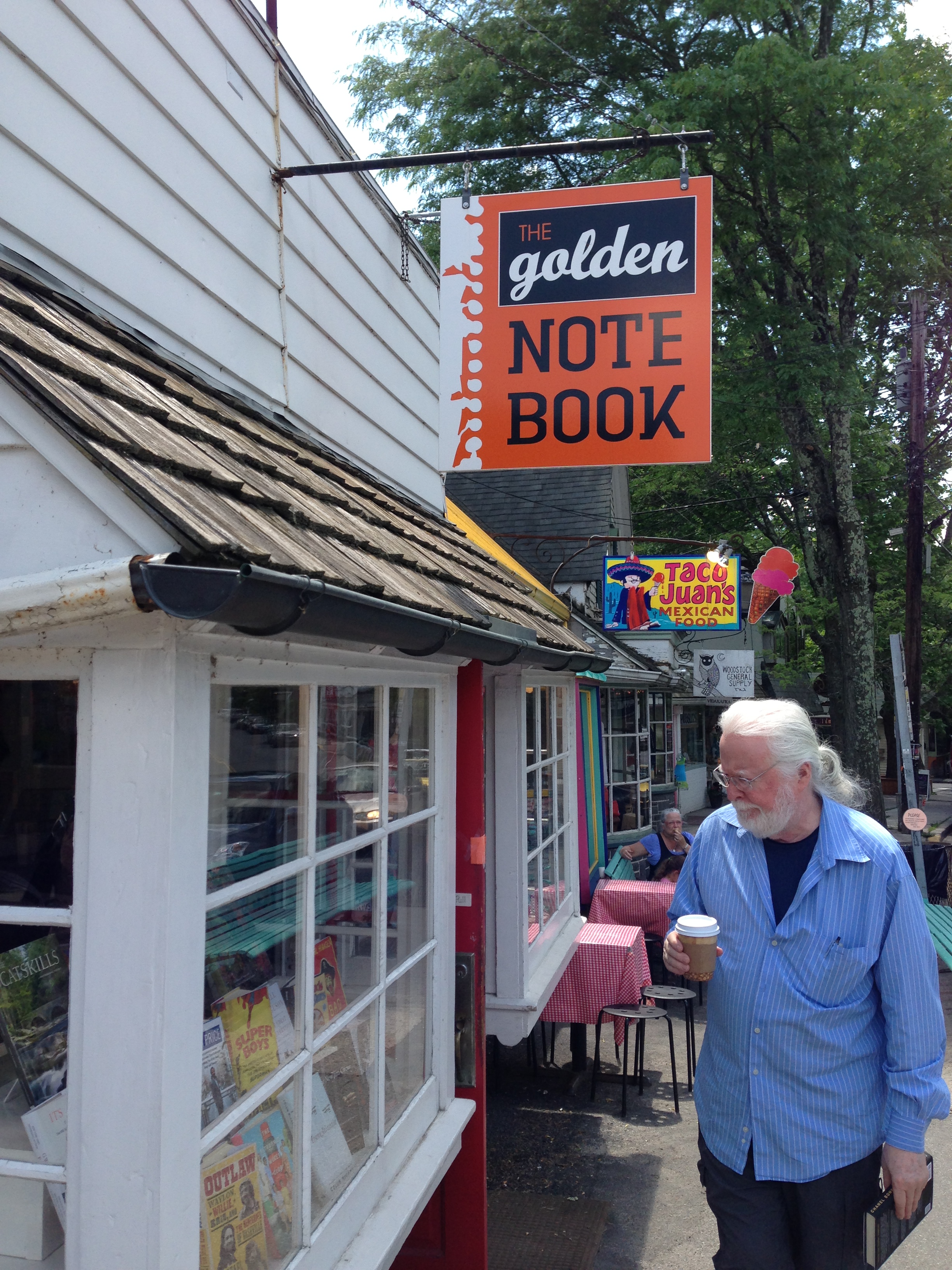
Friends in the audience, new and old. We met together upstairs at The Golden Notebook in Woodstock, New York.

golden notebook

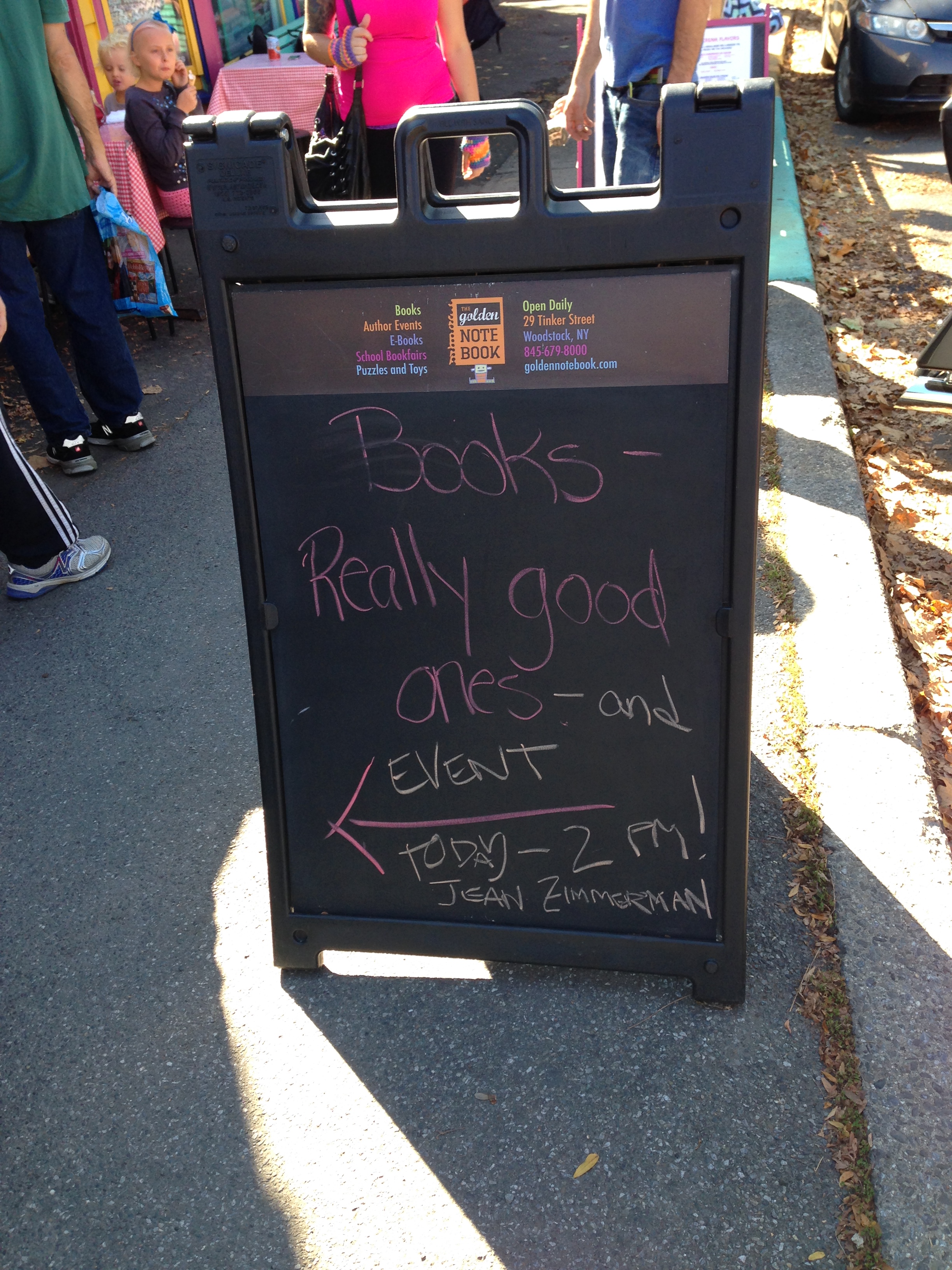
It was a warm autumn day outside, and everything had that sun-burnished appearance. In the middle was a sign that beckoned: come inside, come inside, come inside.

store sign

Afterwards I wondered just what it was that made me so fascinated by beavers that I hold forth about them in every talk I give about The Orphanmaster.

beaver1687

True, not enough has been said about beaver.

New York was built on the foundation of the shaggy, rotund rodent with the frying pan tail.

The animal was easily trapped by Native Americans in their winter dens. The pelts were then traded with Europeans for copper, guns, rum, which was called “English milk.”

Cartographers dressed up their work with the animals.

Fur_Trade map

Everyone wanted to know where the beavers were. In the 1600s, traders sent hundreds of thousands of pelts back to Europe. The sole reason for this huge trade? Beaver hats.

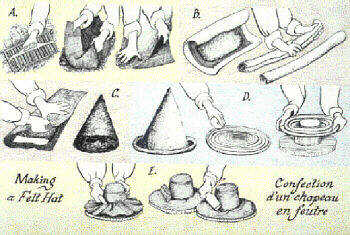
Beaver felt

Not made from the fur proper, but from felt made from the fur, an extraordinarily complex process that involved a heavy dose of mercury, the chemical that made the Mad Hatter mad.

making_felt_hat

The felt was waterproof in an era before umbrellas. It was glossy, sturdy. The beaver – so the beaver hat was called – was the essential accoutrement for men and women of Europe. Everyone who could afford one had one, or two, or three. Beavers were bequeathed in wills.

painting of hats

In The Orphanmaster, everyone would have worn a beaver, even the women. All kinds of styles were available. Blandine, the protagonist of the story, is bent on getting rich buying and selling beaver pelts to Europe, venturing out into the woods to make her trades with Indian trappers.

Later, my friend Lloyd led us on a beaver hunt. Not to capture the animals but to see their impressive lodges.

Lloyd at his pond

Down the hill from his house was a magical if uneven path.

magic if uneven

Far in the distance, across the pond, we could glimpse the rodents’ handiwork. More sun-burnishing.

distant lodge

A ways down the road,  the ruins of an ancient lumber mill.

mill:den

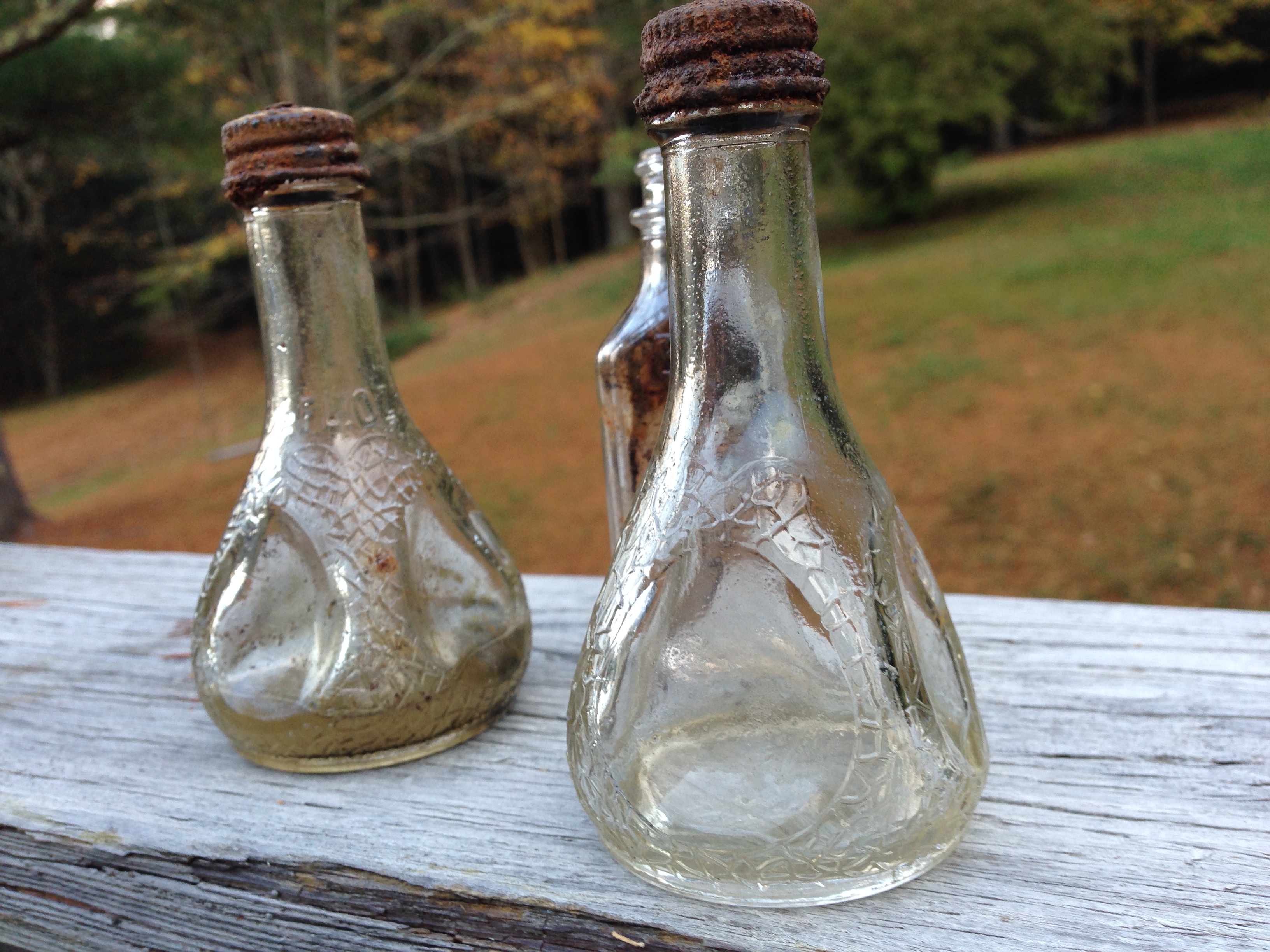
So much history of this area, the Catskill region of upstate New York, is a stumbleupon away. Like the antique bottles Lloyd’s daughter Alice excavates from the woods behind their house. Also in those woods, black bears rumble around, tearing open rotted logs to get at the creepy crawlers within.

old bottles

We saw one more lodge at Yankeetown Pond — to the right, below. David Bowie owns the mountain above. Probably has befriended a few of the beavers over the years. Like to come up for a drink? I’m Bowie.

Yankee

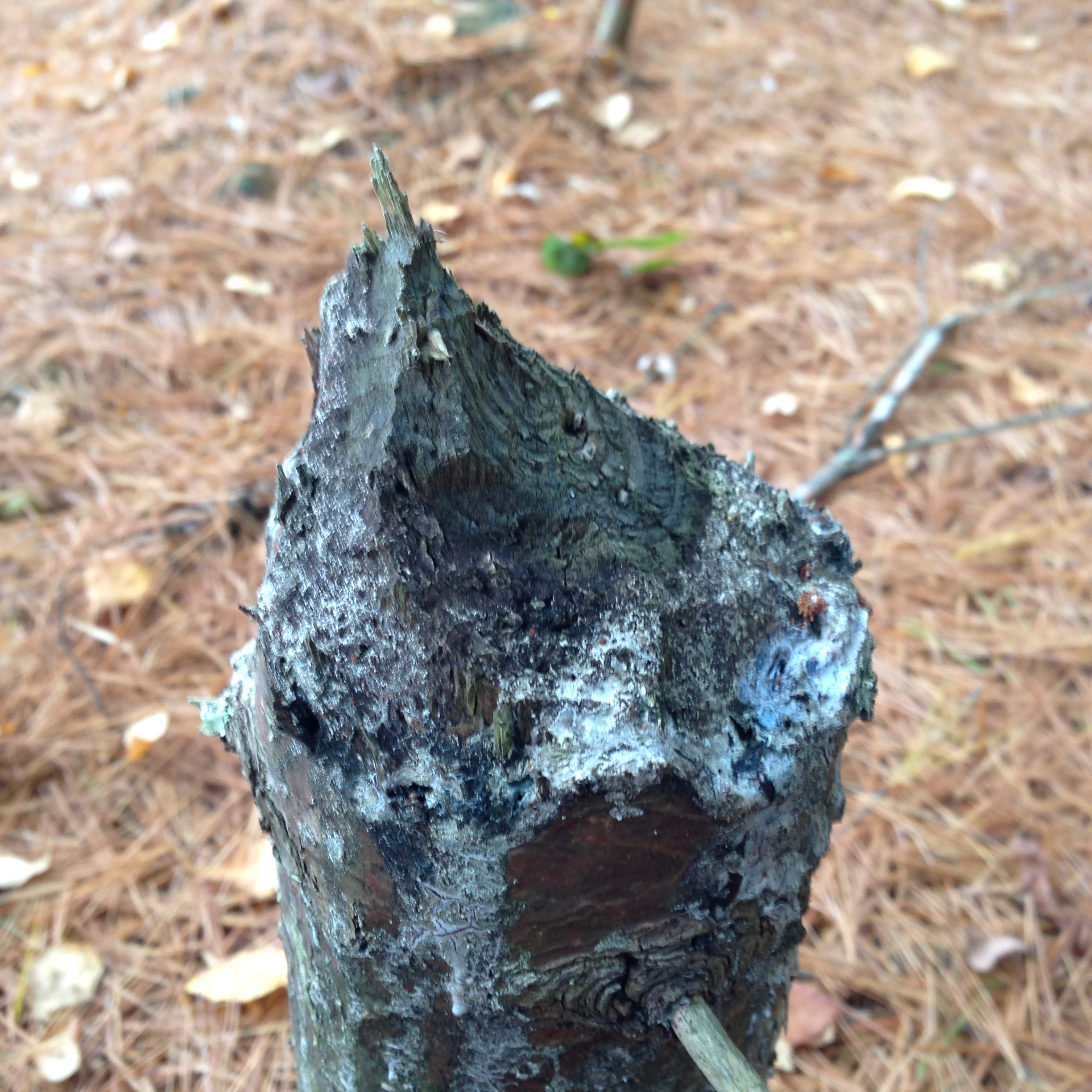
The finest specimen of the afternoon stood just to the side of the water, a gnawed tree that had clearly been someone’s snack.

beaver post

The beaver population was hunted out in the seventeenth century in these parts and is only just coming back today in earnest. They found one at the Bronx Zoo a few years back. No one could understand where it came from. Its name, they decided, was not Ernest, but Jose.

6 Comments

Filed under Culture, Fiction, History, Home, Nature, Photography, Publishing, The Orphanmaster, Writers, Writing

Truck Garden

125th and Broadway, 9pm on a Tuesday night. The hush of dusk is just behind us as we pull up to a red light at the intersection.

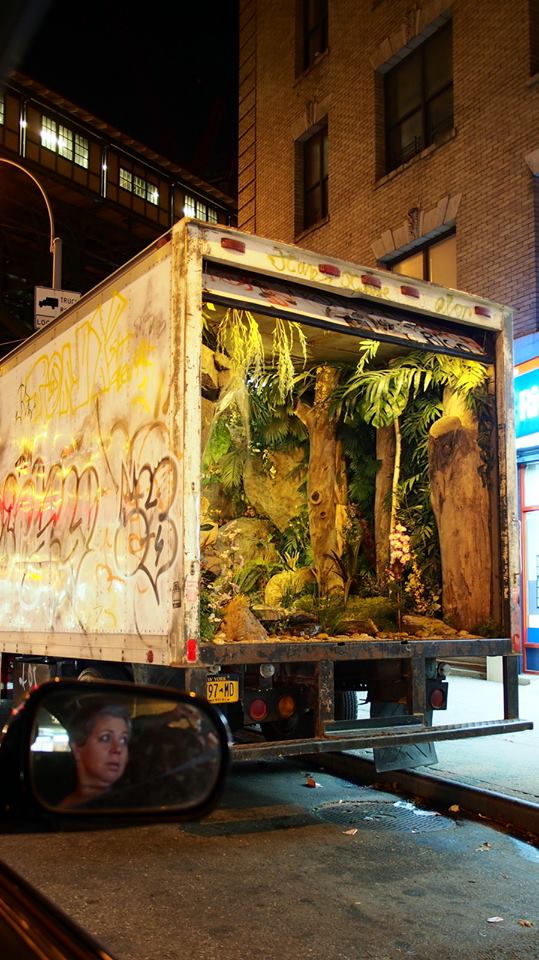
To our right, a dilapidated box truck covered with hieroglyphics of graffiti. Dirty and timeworn. The back is open, but nothing is being loaded or unloaded. Inside, we suddenly register, is a magical forest, a glistening waterfall. We can’t believe our eyes. The crack photographer Suzanne Levine, tucked in the back sea, takes out her camera.

Banksy

Gil says, Get out, you’ll get a better picture. It’s okay, she says. It’s fine this way.

And it is. (Check out my mug in the rear view.) A drive-by photo shoot in the New York City night is the perfect way to capture an artwork by, it turns out, one of the greatest creative minds and pranksters of the age.

Banksy was here.

Banksy has been turning up all over New York recently, though he’s headquartered elsewhere, with his mysterious stencilled message graffiti and now… this. A grungy delivery truck complete with a motorized waterfall and plastic butterflies. He was quoted today as saying, I should probably be somewhere more happening like Moscow or Beijing, but the pizza is better here.

The truck will make a stop at dusk each evening, but no one knows exactly where, or for how long, just as no one knows just about anything for real about Banksy. But if you want to listen to a story about the Garden of Eden in a box truck, you can call 1-800-656-4271 and press 3# at the prompt.

Manhattan comes through, just something we rolled up on in the gloaming.

2 Comments

Filed under Art, Culture, Jean Zimmerman, Nature, Photography

Going to the Chapel

I needed to get a new author photo and I wanted to pose against the neat red bricks of St. Paul’s Chapel on the campus of Columbia University. It was not difficult to set up, since Maud was the photographer and this is where she went to school.

St. Paul's

When I.N. Phelps Stokes designed St. Pauls, it was the first non-McKim, Mead and White structure erected on campus. This was 1907. A photo from the time shows it looking new and bare. It would prove to be Stokes’ greatest architectural achievement.

1905

Over a century later, the diminutive chapel’s Renaissance design still wins acclaim for its beacon-like green dome, its Italianate authenticity, its salmon-brick Guastavino vaults and its splendid acoustics. A schedule of magnificent music was posted outside the doors. People love to get hitched here.

hitched

Waiting for our photo session, I took a seat–as I had many times, many years ago, when I was studying writing and this was my school–on the curving stone bench across from the Chapel.

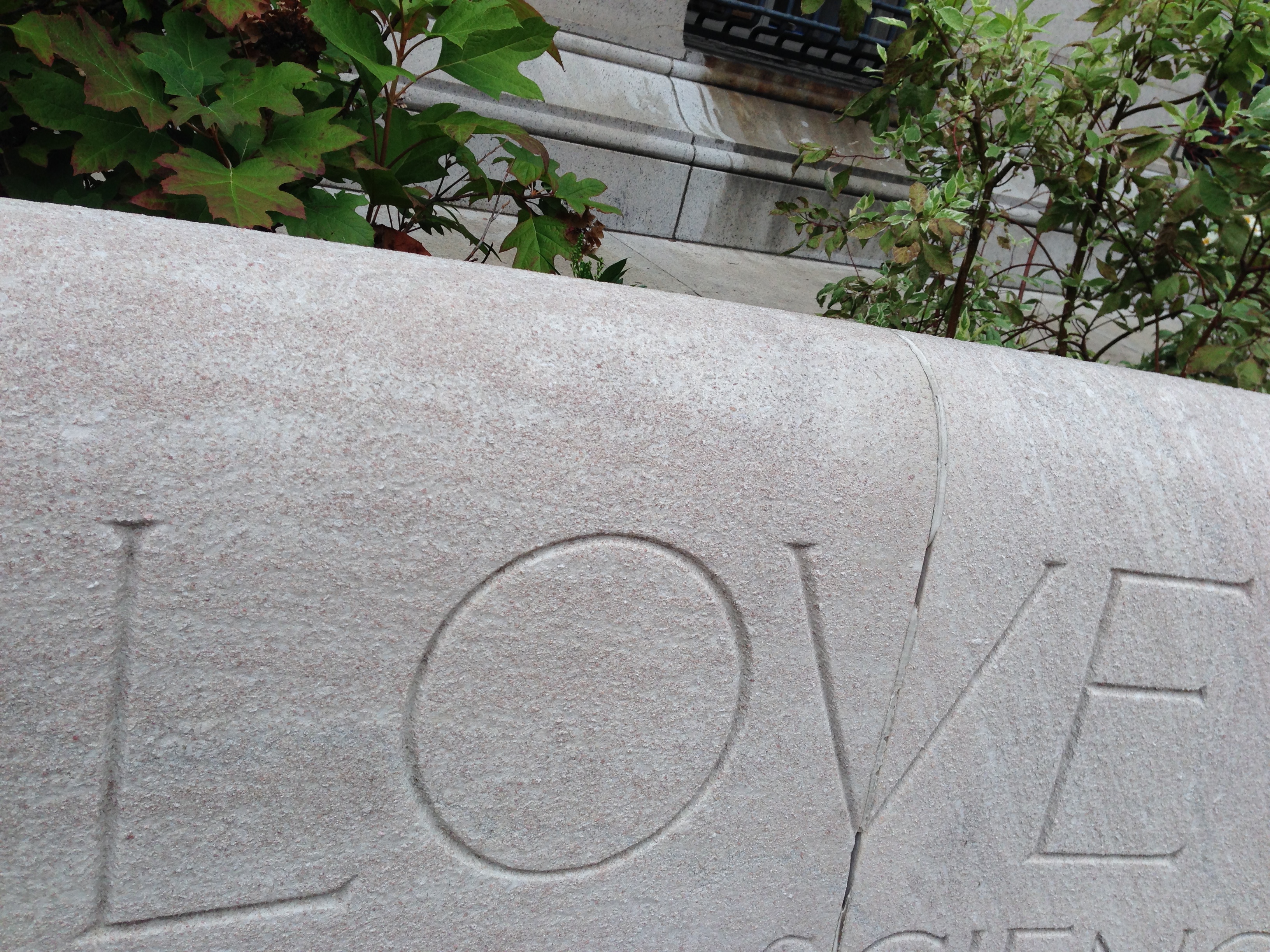
love

It actually spells out Love Your Alma Mater, but I like the more elemental, bare-bones message.

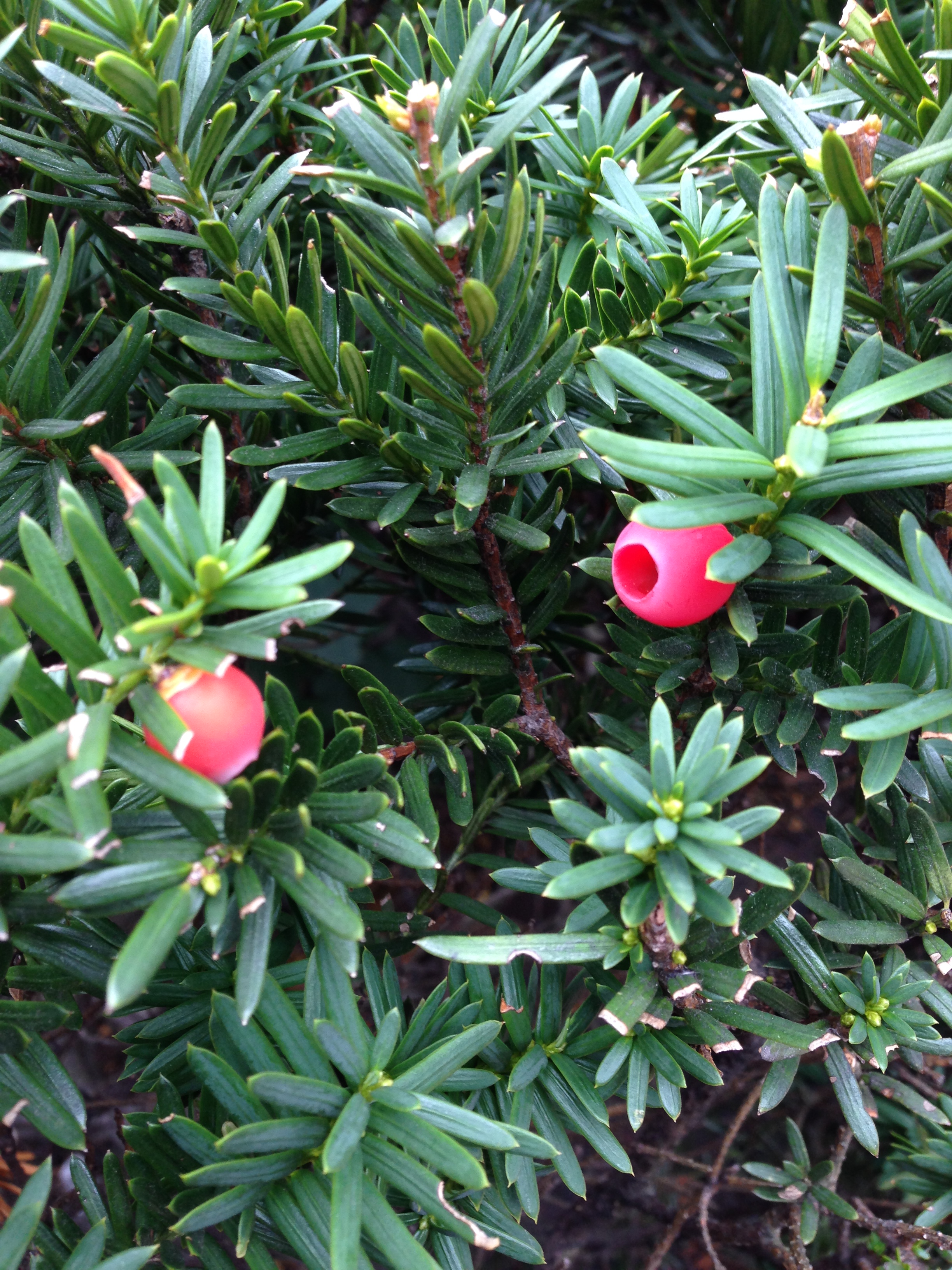
All around, the autumn hedges were producing moist red berries.

berries

They looked like pieces of candy stuck there for the taking.

I ducked inside to check out Stokes’ inspired efforts. (Not pictured here, because no pictures allowed.) He created the glossy floors of marble fragments in intricate patterns resembling those you find in Italian churches, but these patterns are purely decorative, with no symbolic meaning. Sturdy wood chairs were preferable to pews, he decided. He and Edith had toured Italy in the winter and spring of 1905 as preparation for working on St. Pauls. During the trip he decided to bring back some wine – not just a few jugs of Chianti but 50 liters of red in casks that he then had decanted into half-pint bottles.

Stokes was a meticulous man, and a driven one. He wanted the job of designing St. Paul’s. His passion for the project was shared by his altruistic aunts, immensely wealthy sisters who refused to provided the funding unless their nephew was hired on.

I hovered in the back of the Chapel while mass was conducted in the nave. Short and sweet, body, wine, done.

My pictures also came about pronto. In the background the bricks, yes, to the side of the columned portico – at the top of each of those columns is a cherub carved by Gutzon Borglum, who was responsible for Mount Rushmore.

columns

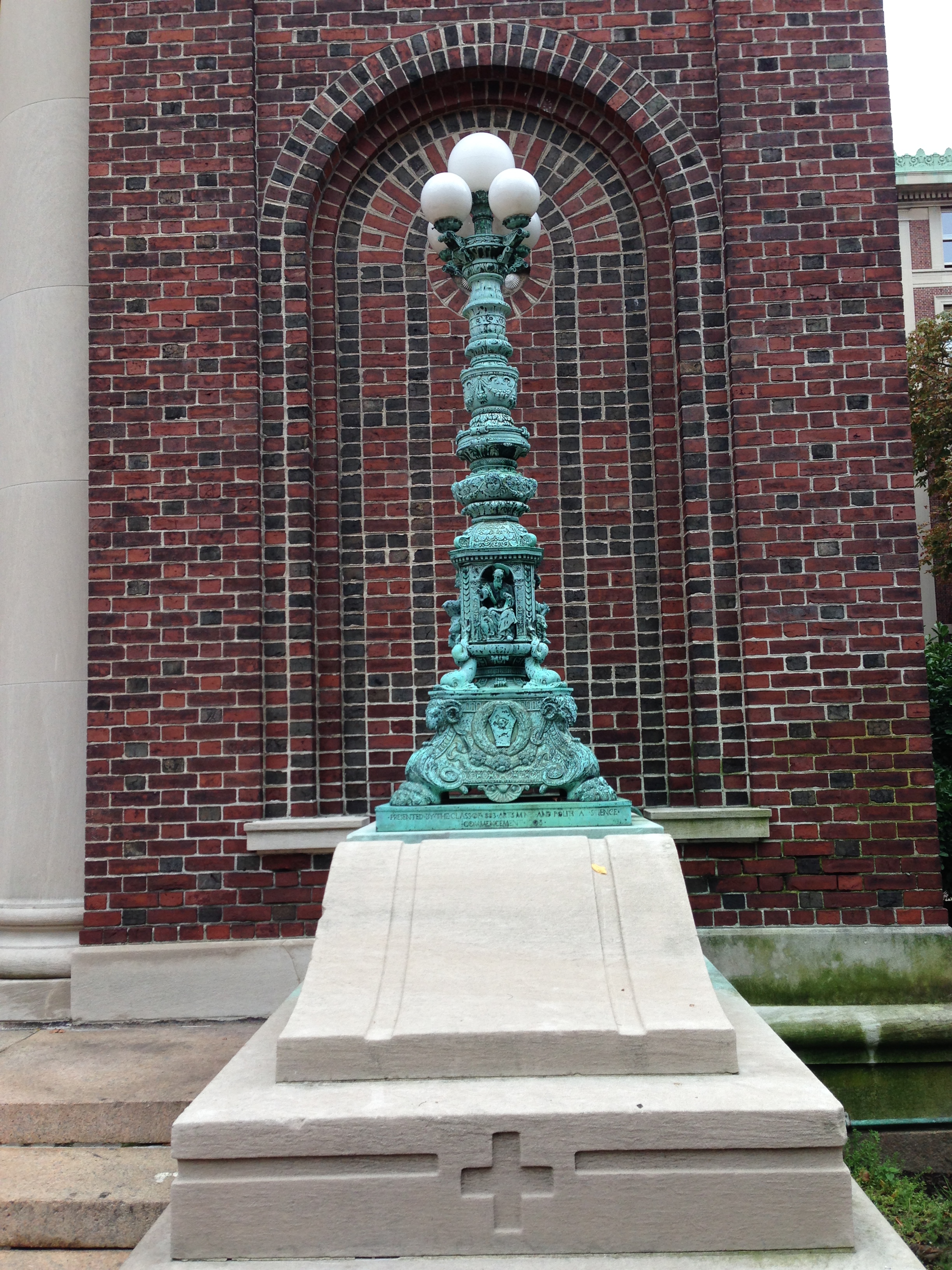
In the background of the photos stands a Quattrocento-style bronze lamp, pickled green by time, designed by sculptor Arturo Bianchini to show the four apostles of the Old Testament but also a pod of swimming dolphins.

lumiere

Of course what you’ll see most of all in Maud’s pictures is not the bricks, not the dolphins, but my smile, beaming, because it is my daughter behind the camera and we are connecting through the medium of photography.

dolphins

3 Comments

Filed under Art, Culture, History, Jean Zimmerman, Love, Fiercely, Music, Nature, Photography, Writers, Writing

A Victorian Evening

There were not enough chairs. Victorian Society guests who came in late had to huddle by the door rather than join the hundred or so in the room. I was only a little distracted by all those wide eyes in the audience, drinking in the images on the screen behind me, so entranced were they by the Gilded Age. It was a marvelous evening.

The Victorian Society New York members are a lovely bunch, very serious about their history and dedicated to preserving the built past of the nineteenth century. Talking about I.N. Phelps Stokes and his passion for Old New York, I could see that that strong interest of his resonated personally with so many of this group. That Edith “Fiercely” Minturn’s old-fashioned beauty touched them.

Minturn Girls Portrait jpeg

There were some great minds and delicate sensibilities in the crowd. The master horologist John Metcalfe – clock expert, to you — with public school English diction and an L.L. Bean bag, informed me that when Newton and Edith Stokes packed up a sixteenth-century British house in 688 boxes to export and reassemble on the coast of Connecticut, they were not the only ones.

John Metcalfe - DAY TWO

It was, apparently, a vogue at the time for those who could afford it. I knew that those of tremendous wealth paid people like Stanford White to cull the monasteries of Europe for great rooms that would be installed intact in their country houses. But I didn’t realize the wholesale shipping over of houses was a fashion for the fashionables until Mr. Metcalfe told me so.

There was the great preservationaist and historian Joyce Mendelsohn, who introduced me with the gracious admonition that listeners buy “two or three books “ and to give the extras to friends. Music to a writer’s ears.

mendelsohn-lower-author

An author herself, most recently of The Lower East Side Remembered and Revisited: A History and Guide to a Legendary New York Neighborhood, Joyce has been a pivotal presence in Victorian Society New York.

Then there was the architect-scholar David Parker, who first introduced me to the dripping-with-history Loeb house at 41 East 72 Street. David knows pretty much everything about buildings and interiors of the late nineteenth century, all of which he applied to the renovation of that brownstone, with its Herter furniture, Tiffany glass, Minton ceramics, swags of velvet and fantastically patterned wallpapers.

Loeb_01

There was a woman from Fraunces Tavern that had me sign copies of all my books at the request of her boss there. Fraunces Tavern is one of the oldest structures in Manhattan – it was first opened by Samuel Fraunces in 1767 — and I was proud to give a talk there once before.

samuel-fraunces-small

I hope I do so again soon.

One scholar present had completed a doctoral thesis called “Psychosexual Dynamics in the Ghost Stories of Henry James.”

henry james

If she had had a copy with her I would have bought it and asked her to sign it.

book signing pic

5 Comments

Filed under Art, Culture, Fashion, History, Home, Jean Zimmerman, Love, Fiercely, Photography, Publishing, Writers, Writing