Category Archives: Music

Live From Lincoln Center

AND ONCE AGAIN, let me welcome guest post-er Gil Reavill, who took himself out of Cabinworld while I was in lockdown to visit Lincoln Center Out of Doors in Manhattan:

After days of rain (writes Gil) the 30th Annual Roots of American Music, under the aegis of Lincoln Center Out of Doors Festival, kicked off the weekend with perfect weather.

A political rant festered in the warmth of the beautiful sunshine on the Upper West Side of Manhattan. All around the Lincoln Center cultural mecca, billionaires had festooned their names. Bloomberg sponsored the music festival, so that name was emblazoned on banners and signs. There was also Hearst Plaza, as well as David H. Koch Theater, home of the New York City Ballet and formerly the home of City Opera, used to be called the New York State Theater. If just plain folks do it, it’s called graffiti and prosecuted. But if big-money smears its name around on buildings, it’s called philanthropy and celebrated.

This is how the scam works. Conservatives agitate to eliminate arts funding (among other frivolities like roads and bridges). Under pressure from the billionaire-owned-and-operated Republican party, arts funding is duly cut to the bone. So when some noblesse oblige moneybag like David Koch comes along, a funding-parched venue like Lincoln Center (which was, after all, founded by Rockefeller money) can do nothing else but buckle. The populist-named New York State Theater becomes Koch Theater, and the arts become privatized.

David Koch and his brother Charles Koch lead the radical right-wing libertarian charge. They want to be free of government interference for their pollution-spewing enterprises. The day I willingly enter an edifice named after a corporate gangster like Koch is “when shrimps learn to whistle,” a phrase Nikita Khrushchev liked to use. If we adequately funded our public institutions, they wouldn’t have to lease themselves to big-money robber barons.

Then there was something called the “Modern Luxury Lounge sponsored by Celebrity Cruises,” an enormous covered and cordoned off seating area erected stage left at Damrosch Bandshell. American have slowly gotten accustomed to the idea that these sort of luxury skyboxes/VIP areas are always looking down on them whenever they venture into public spaces. But such zones are a clear violation of the egalitarian spirit. They’ve been tearing down stadiums all over the country just to erect replacements that feature more skyboxes, more segregated playgrounds for the rich. Just remember, folks, some pigs are more equal than others.

But on to the music.

In the smaller performance space on the north side of the Met, we caught the New Orleans band Hurray for the Riff Raff fronted by the wonderful Alynda Lee Segarra.
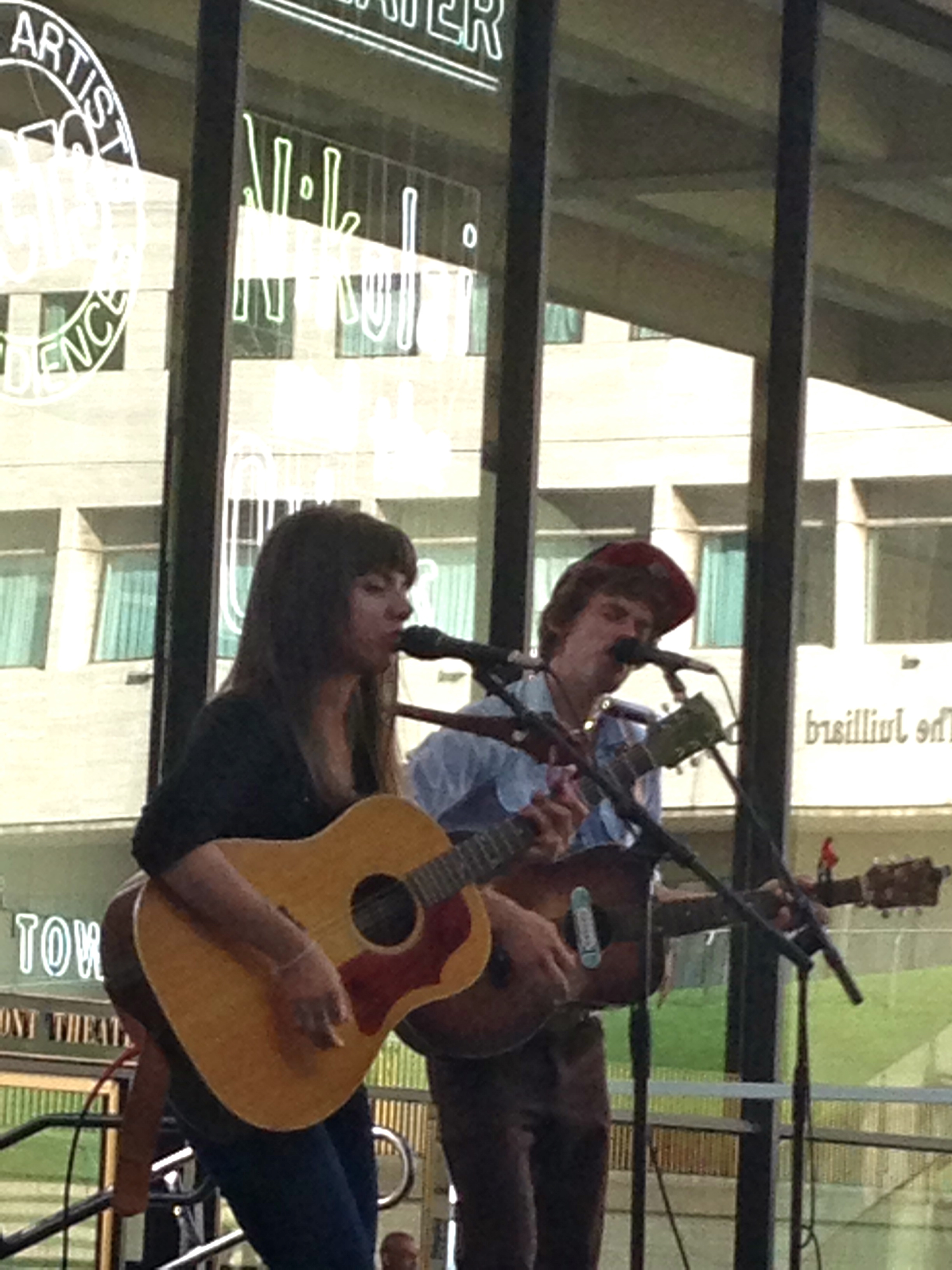
Alynda_Hurray for the Riff Raff

Her smooth, powerful alto is her own, but her phrasing reminded me a little of Concrete Blonde’s Johnette Napolitano. She writes and sings all the band’s songs herself. She killed with The Body Electric, a kind of answer song to the whole tradition of Omie Wise-style he-done-her-wrong murder ballads. How would a man feel, she asks in her lyrics, if a song like Omie Wise was about his own daughter? Beautifully strong stuff, worth tracking down.

The program transferred to the Damrosch Park bandshell on the south side of the Met. Kicking off the evening show was a rockabilly revue, featuring the real reason for showing up that night: James Burton, master of the telecaster, Elvis’s longtime guitarist for his live shows, who played with everybody else under the Sun Records sun, too.

Master of the Telecaster James Burton

Arkansas’s biggest singer (in the literal sense of the word: he’s 6’7″), Sleepy LaBeef performed the vocal duties and brought along his own band.

Sleepy LaBeef_James Burton

Burton did a definitive version of Mystery Train and showed why he was name-checked by almost every person on stage that night.

Burton

Jason Isbell of the Drive-by-Truckers did a full-throated middle set, featuring a song by Isbell’s fiddle player and wife, Amanda Shires, formerly of the Thrift Store Cowboys.

Amanda Shire

Isbell’s recent Southeaster and Shires’s brand-spanking new Down Fell the Doves form a one-two punch for the couple, both albums released within a couple months from each other.

Isbell and Shire

Tough acts to follow. After all the roaring guitars from the all the multiple-personnel bands that crowded Lincoln Center all day, could a single performer with a single acoustic possibly hold the stage? Nick Lowe managed to make it look easy.

Lowe

The man is simply one the best songwriters alive today. What’s really great about Lowe is how long he’s been out there—from way back in the day when he wrote “(What’s So Funny About) Peace Love and Understanding” for his late-60s band, Brinsley Schwarz. Half a century later, he just keeps going without losing a step, his vocals and songwriting still superb. Lowe’s performance at Damrosch was masterful. Just one guy (he’d probably say “bloke”) held the whole 2,000-plus audience mesmerized with feel-good pop tunes and killer lyrics. Lowe may be a dinosaur, but he’s the kind that eats younger bands for lunch.

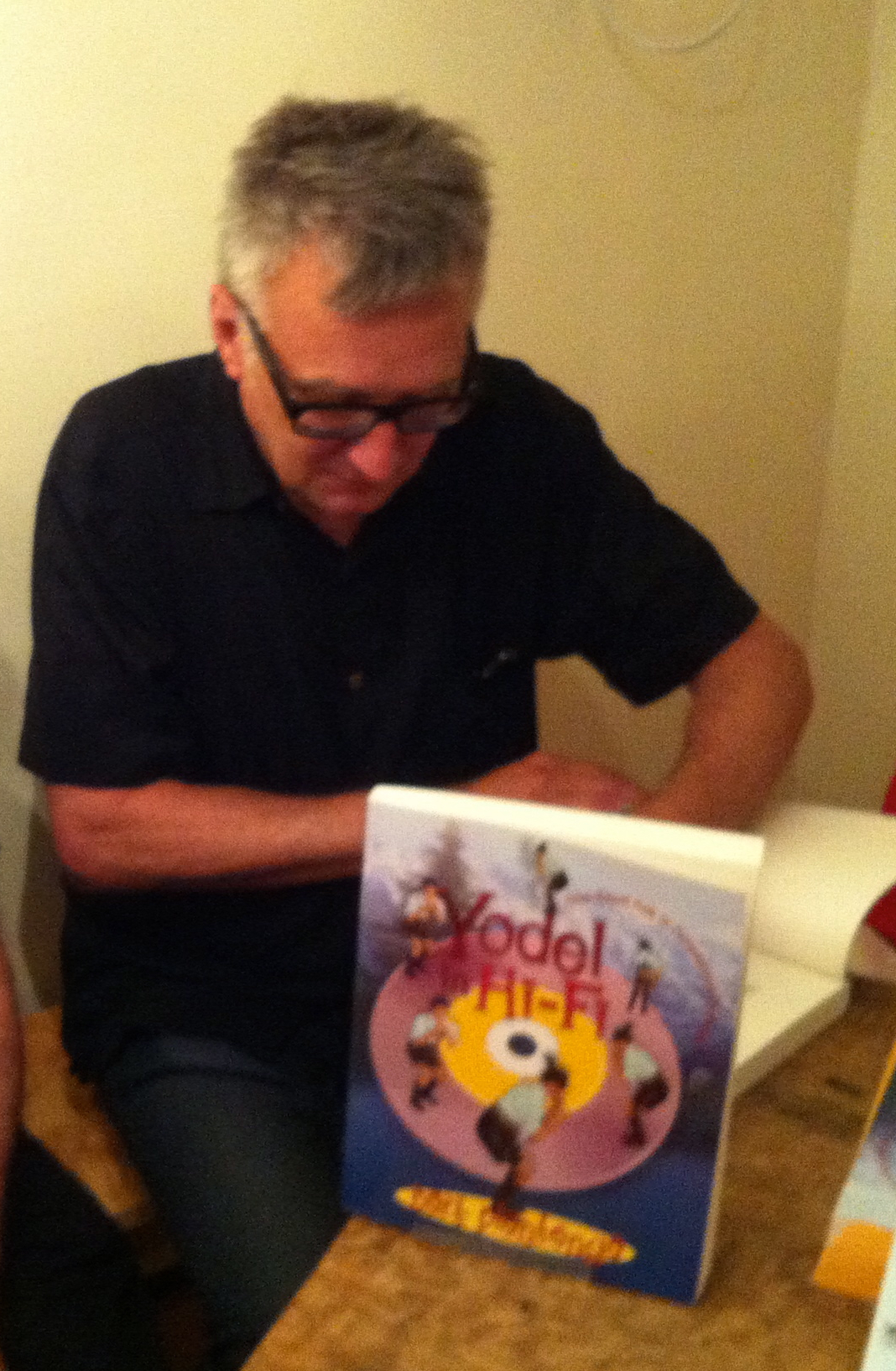
Lowe onstage

4 Comments

Filed under Culture, History, Jean Zimmerman, Music

A Full-throated Yodel

Today, Gil Reavill guest-posts as I rest:

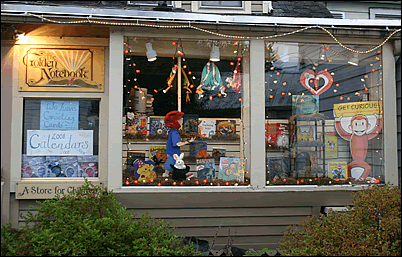
THAT SOUND YOU HEAR is the yodels echoing down from the Catskill Mountains. Author, provocateur, deejay, beer mystic and worldwide yodeling authority Bart Plantenga recently appeared for a full-throated presentation and book-signing at Woodstock, NY’s great indie bookstore, The Golden Notebook.

Bart Signing

The event was held on a tourist-flocked sunny Saturday in Woodstock, aka the People’s Republic of Woodstock. The iconic Aquarian village looked to be thriving and was chock full of public art and cheeky signage.

Woodstock sign

The Golden Notebook is one of our all-time favorites as both a bookstore and a book: the venue is named after Doris Lessing’s nervous breakdown of a masterpiece.

golden-800wi

A feminist touchstone of the Sixties, Notebook turned a lot of minds around and established the author as a leading light in the literature of the day. Margaret Drabble famously called it “inner space fiction.”

doris

We summered in Woodstock once back in the day at the Byrdcliffe Arts Colony in the hills above town, staying in one of the tiny cabins. The founder of Byrdcliffe believed in the health benefits of bathing, so he furnished each cabin there with immense eight-foot-long clawfoot tubs. Water was delivered to the faucet by a spring-fed system which ran through hoses that snaked through the woods. Bob Dylan’s old place was just down the road, and we snuck in for a nighttime swim or two in his former grotto. That year the Byrdcliffe Playhouse was doing a stage adaptation of the film Casablanca, and during the show a spotlight rigged on the theater’s roof would strobe the darkness and a claxon would sound as Louis and his friends would search for “the usual suspects.”

Byrdcliffe-theatre

With the publication of his second book on the subject, Yodel in Hi-Fi: From Kitsch Folk to Contemporary Electronica, our friend Bart has established himself as an unparalleled resource for musicologists, aficionados and just plain yodel-crazy folks. While he does not indulge in the art himself, Plantenga has exhaustively documented yodeling practices all over the globe.

yodel in hi fi

He rounds up the usual suspects—Switzerland, Germany, Scandinavia—but gives fascinating insights into unexpected yodeling traditions among the Pygmy people in Africa and the Hmong in Southeast Asia. Yodeling is a method of changing pitch from ordinary chest register to falsetto, long used as a communication method in mountainous countries where the echo is most pleasing to the ears. Of course it also appears as a vocal effect in many different kinds of music, most notably in country and western but also, as Plantenga shows, in classical, electronica, pop and pretty much every other style on the face of the earth. The great country music pioneer Jimmie Rogers rode to fame on the strength of his “blue yodel.”

yodel

Johnny Weismuller’s Tarzan yodel entered into the modern pop culture in the middle of the last century, and the practice was played for laughs by comic Carol Burnett, who used to open her television show with a suitably loony example. Plantenga’s reach goes much deeper than these popular examples, unearthing gems such as Bollywood actor Kumar, a yodeling sub-genre of German video porn (!), and South Korean faux-Bavarian yodeling groups. Bart spoke about yodeling as an “outburst of joy,” citing the “total Oktoberfest insanity” of alcohol-fueled burghers who bust out in freestyle tavern yodel throwdowns. “I like anomalies that make people re-assess clichés,” he says, and in Yodel in Hi-Fi, he has unearthed dozens of them.

8 Comments

Filed under Culture, History, Jean Zimmerman, Music, Writers, Writing

Life’s a Beach

Visiting Jones Beach today was like being on a public strand circa the 1950s, the bright beach bags, chairs, umbrellas, suits (except the suits were skimpier, even on the less than skimpy subathers).

beach first shot

Families with their chairs drawn around in big circles. Teenagers jumping around, full of beans. Grandpas dozed. Mothers and daughters plunked themselves down  just like me and Maud, who immediately tugged her towel into the perfect rectangle, the perfect protected zone for her to sun her bod.

maud blanket

The middleaged couple next to us seemed to be mooning over each other for the first hour we were there, then disappeared into a dome tent whose sides wobbled along to their muted boom box: I’ve Had the Time of My Life, sung by Bill Medley and Jennifer Warnes, the finale song from Dirty Dancing.

The hardest working man on Jones Beach came around in his Ray Bans and sweaty tee shirt, hoisting his cooler.

ice cream man

Ice cream, Chipwich, frozen fruit bar! he called out. “Is this a picture for the winter?” he asked me as I captured his likeness for my personal magazine. The strawberry FrozFruit was like a rock, like a sweet Antarctica iceberg, until it melted all at once in sticky swirls around my mother-daughter friendship rings.

fruit bar

The whoosh of the waves rolling in and out. Hypnotic. The sun that penetrated even under my floppy hat brim. Snooooooze. Flip through a magazine. Is anything really worth reading?

Music. Manna for a twenty-one year old.

maud arms

I am beginning to wonder what effect Taylor Swift has had on her generation, a group of closet romantics.

Stay stay stay

I’ve been loving you for quite some time…

You took the time to memorize me my fears my hopes and dreams

I just like hanging out with you all the time

All those times that you didn’t leave it’s been occuring to me

I would like to hang out with you for my whole life

The cool soft grit of the sand as I paddle through it with my contented toes.

feet sand

The waves? Too cold, except for an ankle bath. I like my fruit bar chilly, not my Atlantic Ocean. As long as the air is pure. As long as I come home with salt caked in my hair and sand dusting my ankles. Do you know what I like about Jones Beach? You lean back and close your eyes and listen to people laugh.

3 Comments

Filed under Culture, Fashion, Jean Zimmerman, Music, Nature

Lincoln Center Whirl and Twirl

It is about the dance. It is about the crowd. It is about the dance.

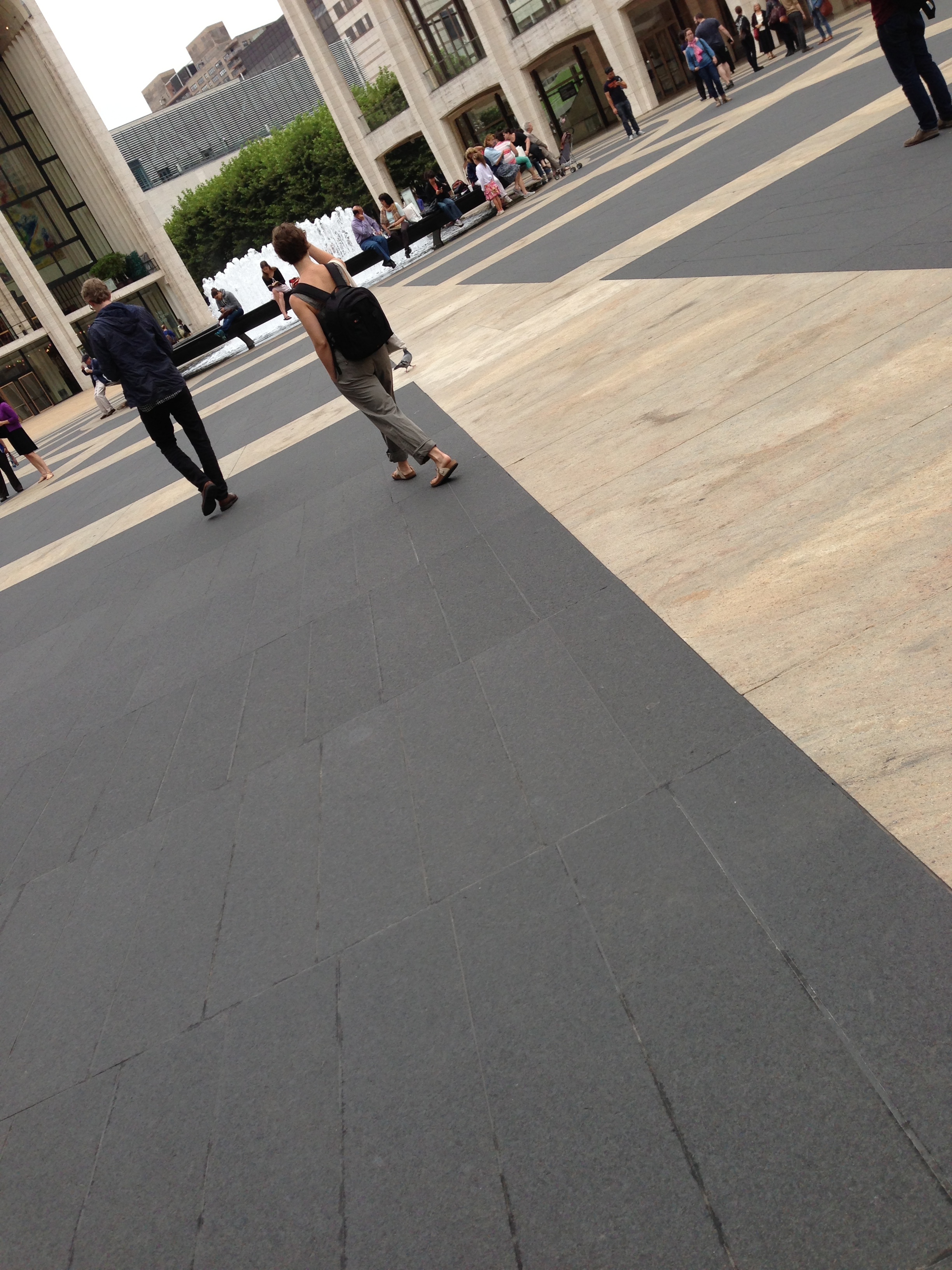
The dance, choreographed by Mark Dendy, is called “Ritual Cyclical,” and it takes place at Lincoln Center, at the north end of its outdoor plaza, on the Upper West Side of Manhattan.

Not at the fountain. That would be too conventional.

fountain

It takes place at the pool, the rectangular, shallow reflecting pool crowned with a sculpture by Henry Moore.

We know the dance is supposed to mysteriously start out of nowhere so as soon as Josefa and I get there we start looking for signs.

It’s hard, because New York is all signs. We have heard there will be some eighty dancers in this flash-mob-ish piece, so anyone could be a performer. Everyone is facing the pool, then someone dressed in business clothes will bolt behind you, a hand on your shoulder. A dancer.

A disembodied voice welcomes us: How to see this piece? Fluidly, moving along, circulating, there is no front, it’s all around, constantly shifting, and changing, and the audience needs to change with it.

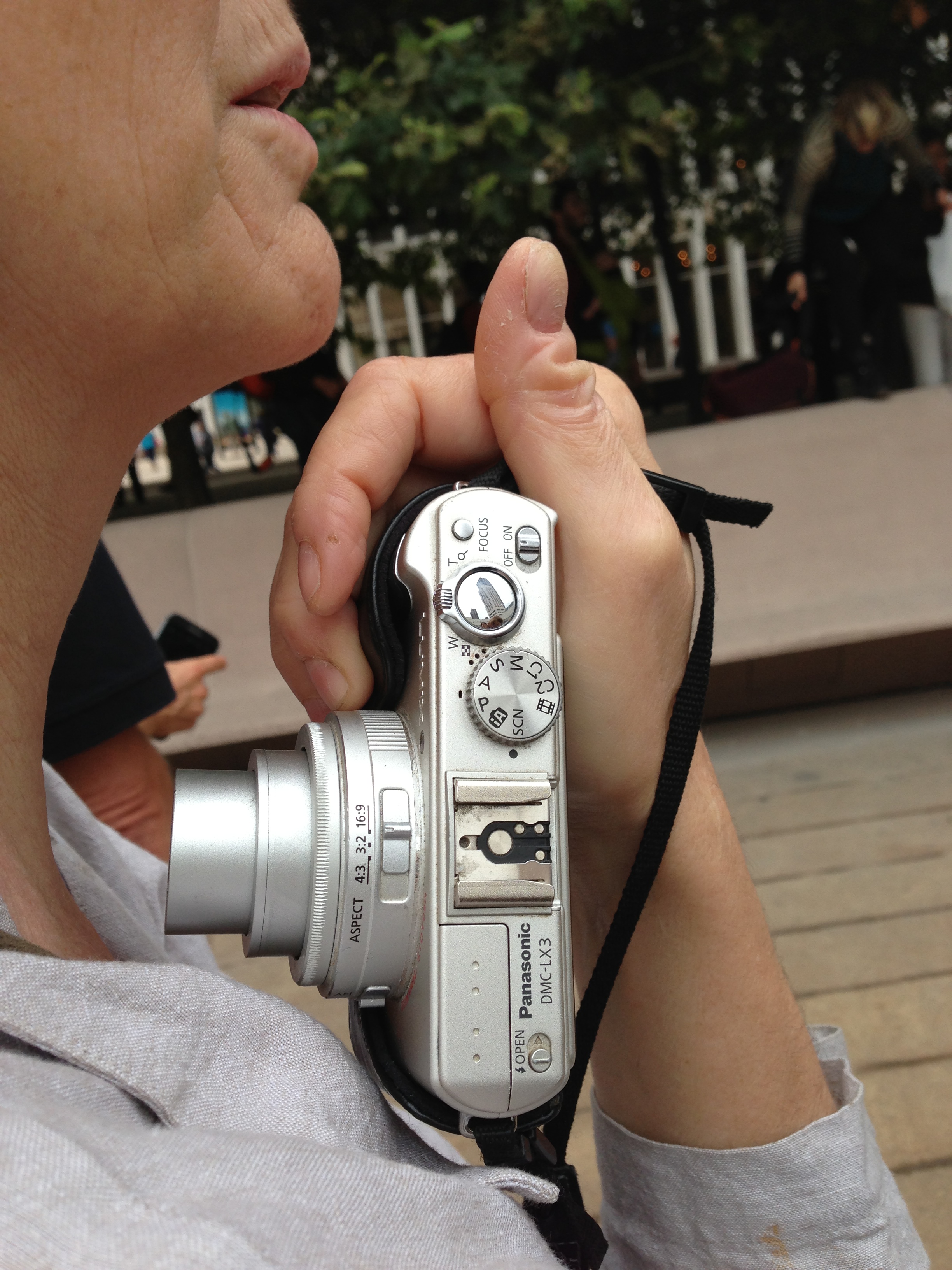
We talk about cameras. Josefa has a great camera and a better eye, and most of these are her images.

josefa camera

How to get the best shot here, where good shots are difficult? I complain that I can’t get a long-distance picture and Josefa tells me a little about the debate over the telephoto lens. In the world of photography, she says, there is thinking going on about what is the responsible way to document something. Is it intimate in a way that is not so good to shoot from far away, rather than close to the subject? The telephoto might be dishonest.

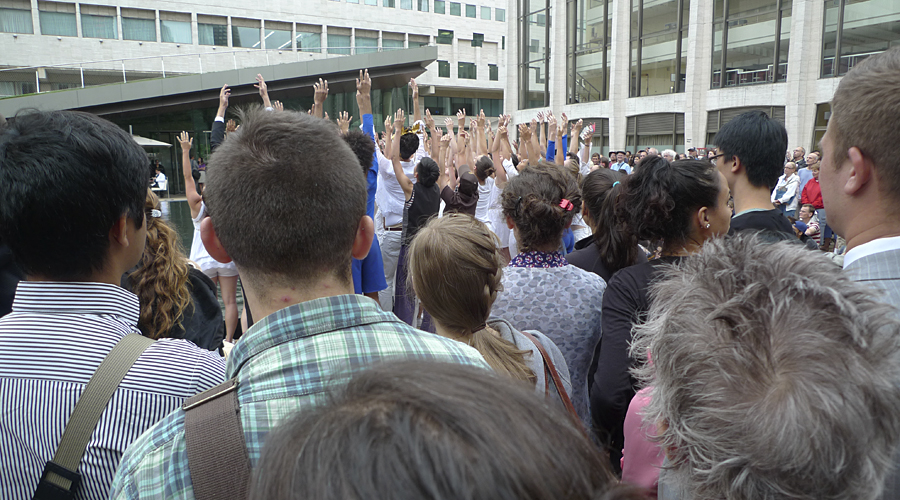
Around peoples’ heads, around  peoples’ cameras, we see people holding their hands up to the sky, waggling their fingers.

hands

It’s as if they are hailing a space ship. The music of the Kronos Quartet soars from speakers all around. It’s six o’clock, just past the afternoon and still not dusk. An hour of expectation, and this piece seems to be a lot about expectation. We’re all crushed up against one another, against hair and shoulders, bellies, hips. It isn’t so bad, strangely.

summer new yorker

New Yorkers in their summer finery.

red glasses

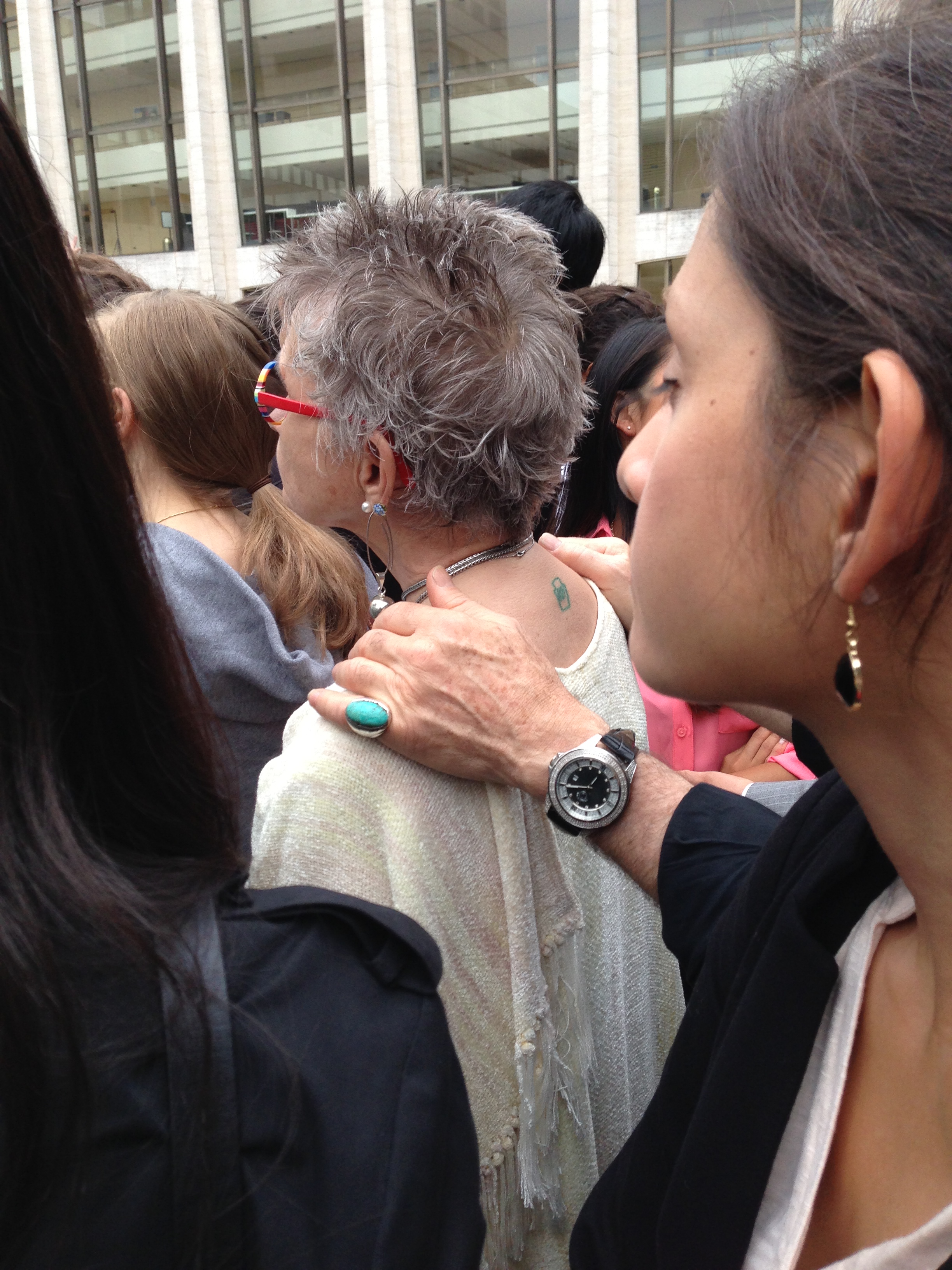
The woman with red glasses has a green tatto of a number on the back of her neck. Josefa always wonders what the numbers mean.

Kids in fatigues already barked at spectators to stand back, clear the area. But the crowds surge.

camouflage

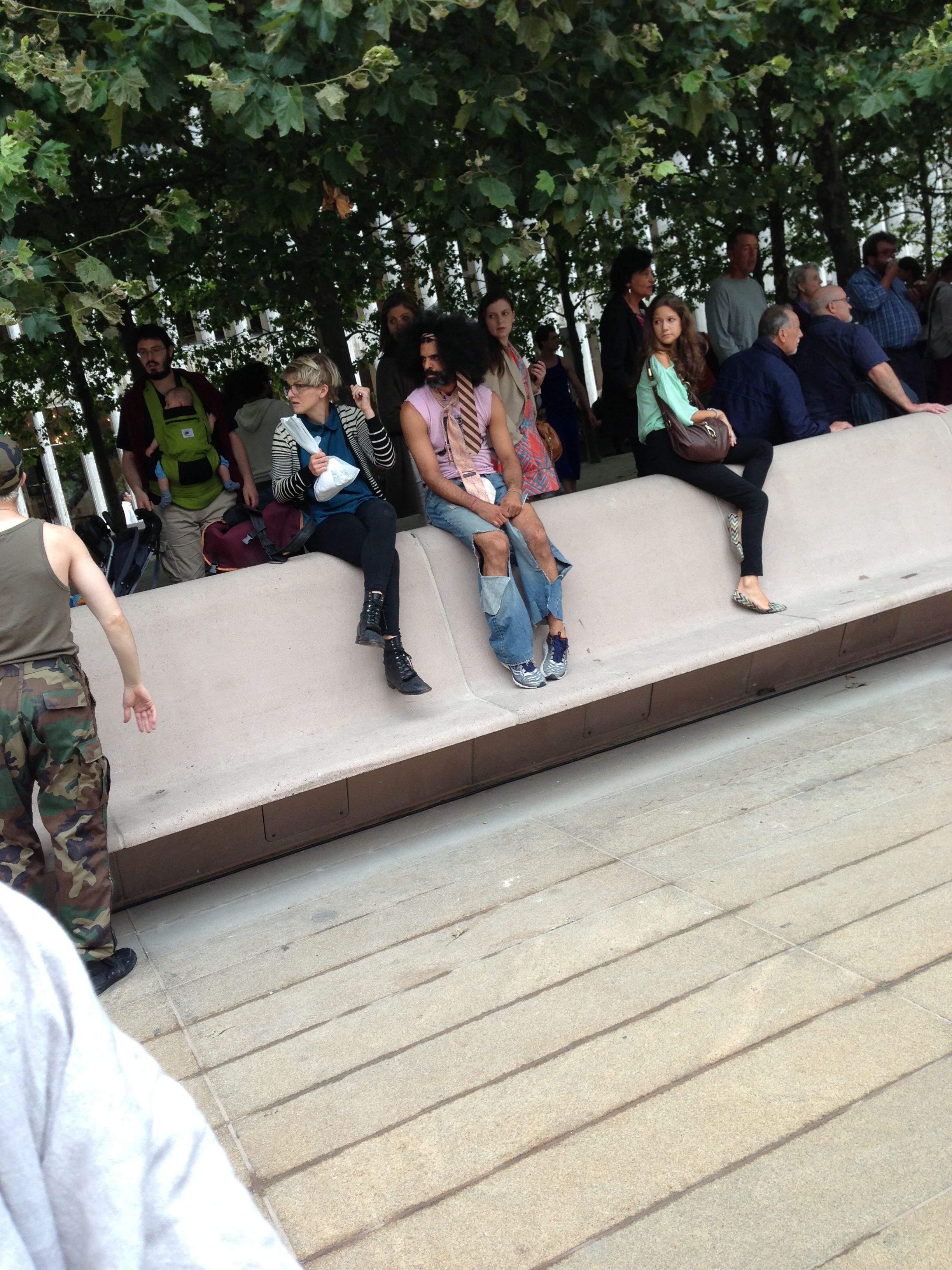
There’s a bum sitting on a concrete bench. Should he be here? Really. Harrumph.

bum sitting

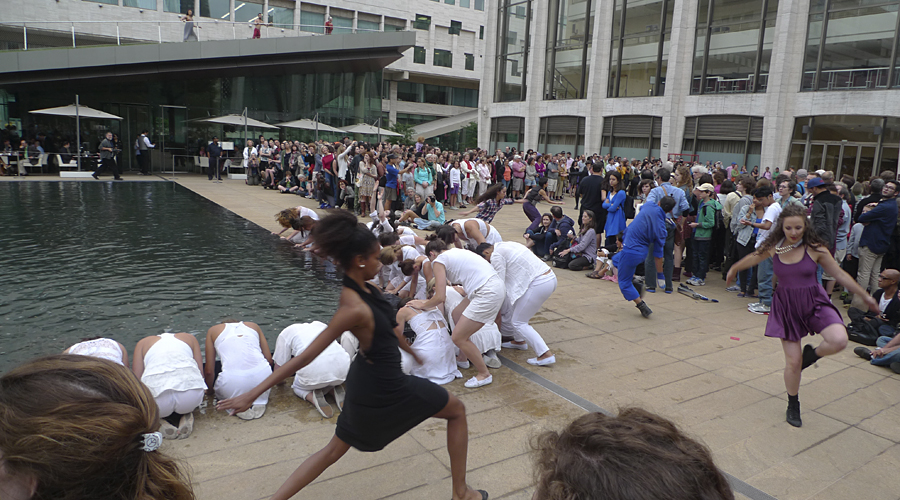
Now girls in white are caressing the water, dripping it across their bodies. A beautiful white-shirted man removes a golden crown from his head.

white girls in water

The dance has begun.

It proceeds on all surfaces, all around, people writhing and twirling, in all manner of costume.

pool dancer

A young man and woman splash and play and court in the middle of the water. She goes piggyback. Up on the green grass plane above the pool, an audience of three dancers stretch their bodies, do what dancers do.

white boy and girl

Then the crowd shifts to the grove of small trees just to the south. Human forms in blue, grey trunks. Josefa: It must be nice to dance against trees like that.

blue dancers

They collapse, and other dancers erupt, doing Latin steps next door.

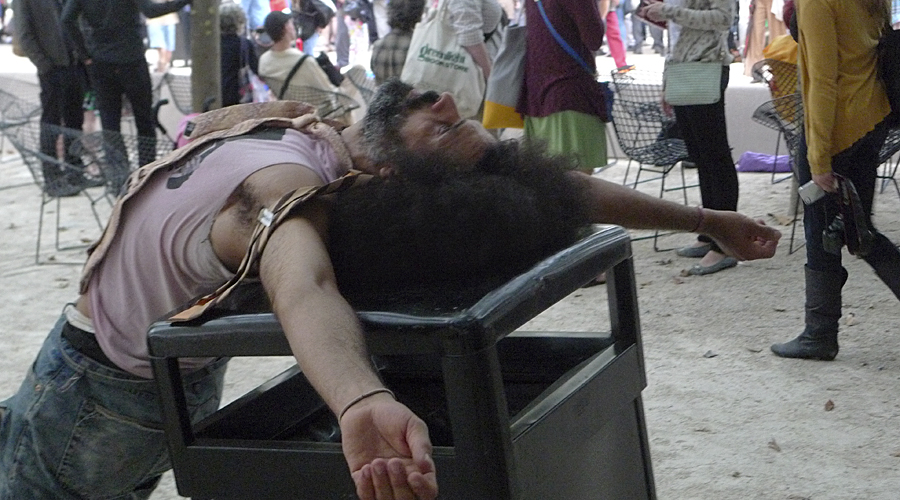
We have a realization. The bum is a dancer. He has appeared everywhere, and is not an interoper, except in our consciousness.

bum blur

His clothes are dirty, he picks up trash from the ground. A dirty dancer. Josefa takes pictures as he twirls, relishing his intransigence.

bum:can

Is he homeless? a man asks me.

No, he’s a dancer.

The homeless dance? he says.

For a finale there is a stage in front of the New York Public Library for the Performing Arts and American tunes: The Battle Cry of Freedom, Dixieland, Elvis, Hendrix.

USA! USA! The performers yell. The crowd presses up close yet everyone gives each other room, room to breathe.

boy:shoulders

We can smell sweat – the dancers’? Our own?

iwo

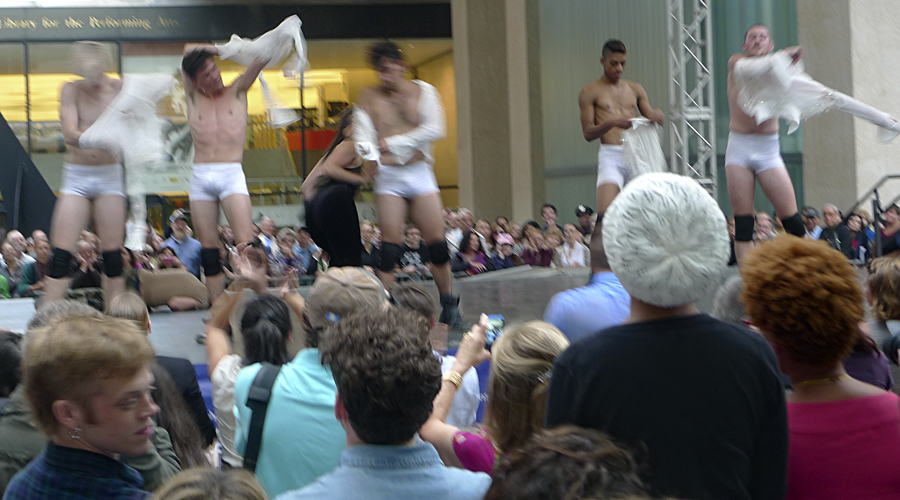
They hoist a flag a la Iwo Jima. American uniforms, then, wow, the vogue-ing, marching dancers strip to their briefs and pitch their shirts and pants out to the audience like rock stars.

clothes

We don’t care, we’re New Yorkers, but still it’s pretty cool.

Mark Dendy told The New Yorker, “Every day, every New Yorker comes into contact with about two hundred thousand other people, and they all depend on each other. So in this piece we do this thing called New York City together.”

Do they ever.

9 Comments

Filed under Dance, Fashion, Jean Zimmerman, Music, Photography

Blues Chicken

With every last i dotted in the proofread Savage Girl galleys, I raced to my reward, a sultry New York City where everyone, it seemed, was perambulating, doing something exciting and interesting. Gil and I would go among them, we would do something exciting and interesting, too.

Eat chicken, for one.

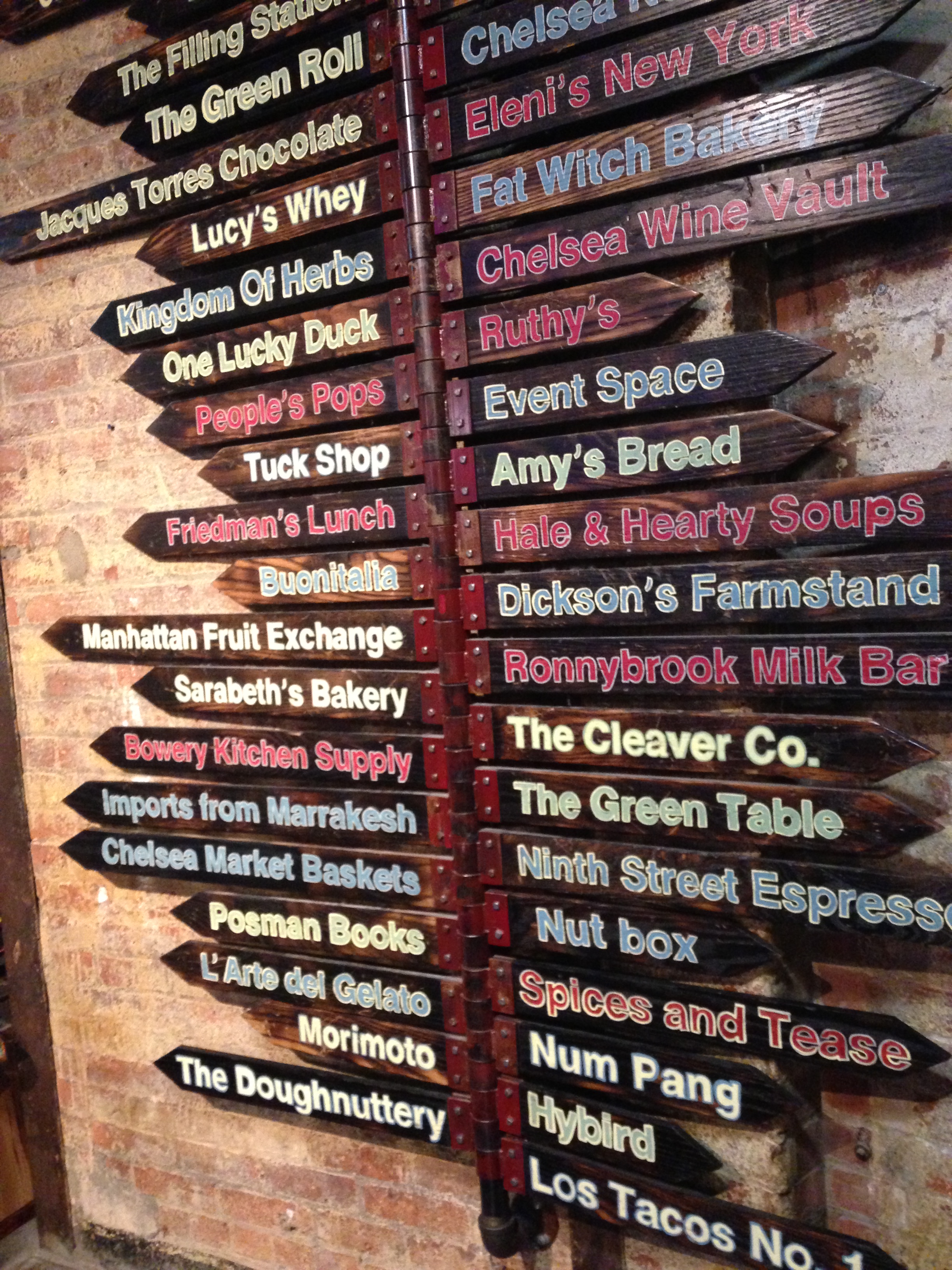
Questlove, the drummer and frontman for the band the Roots, has got so deep into the fried poultry business that he had some kind of a late night throwdown with Momofuko head honcho and chicken man David Chang on Late Night with Jimmy Fallon. Now the musician has opened a counter joint in New York’s Chelsea Market called Hybird that serves exclusively drumsticks, fried dumplings, biscuits and cupcakes. All the essentials for a balanced diet.

hybird

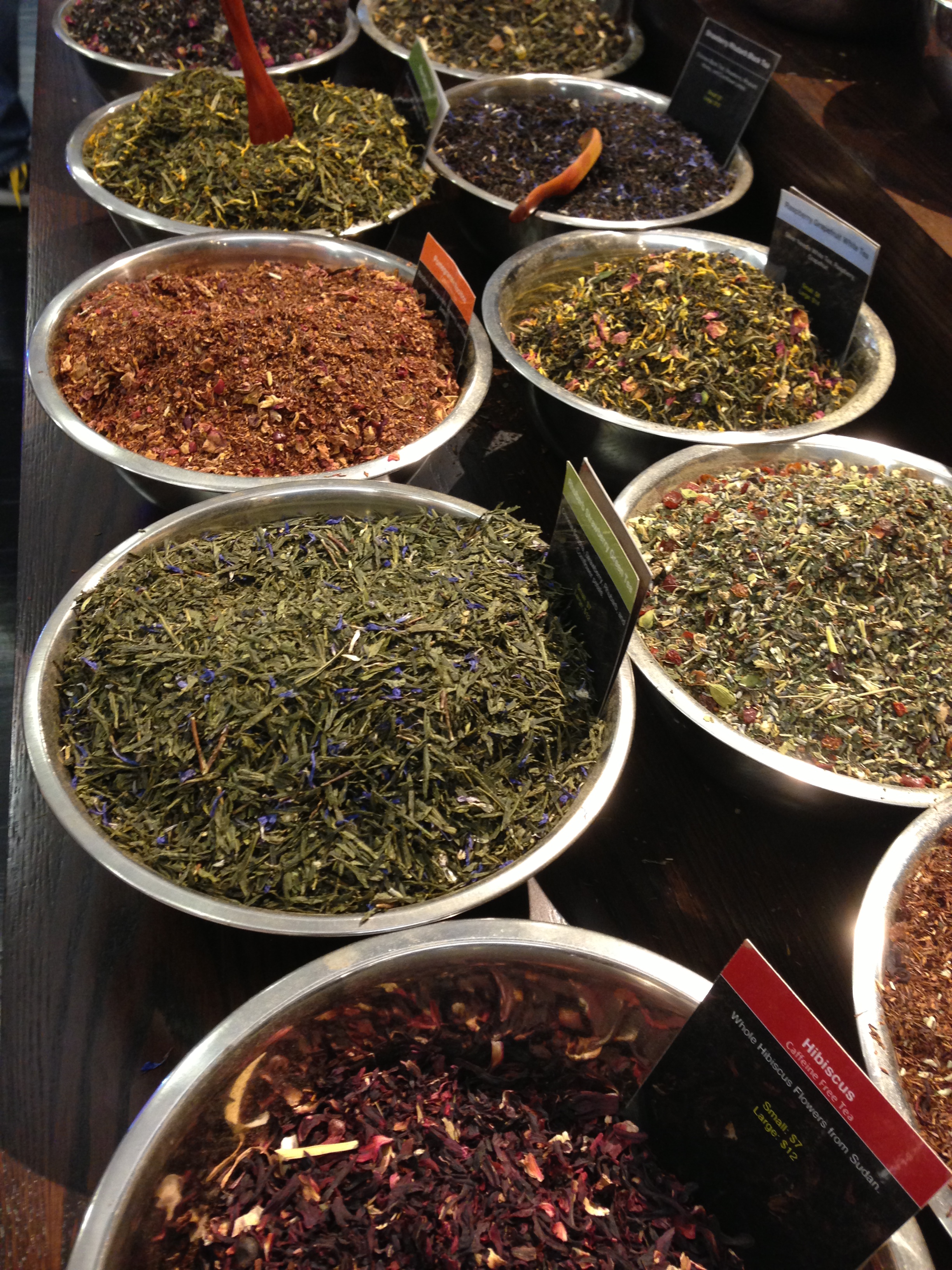
We got to the labyrinthine food concourse in midafternoon, ahead of the crowds, snaking through a corridor lined with dozens of teas, our stomachs rumbling.

tea

The enormous Chelsea Market complex is located on the premises where the Oreo was developed and perfected, lending an air of sanctity to our excursion.

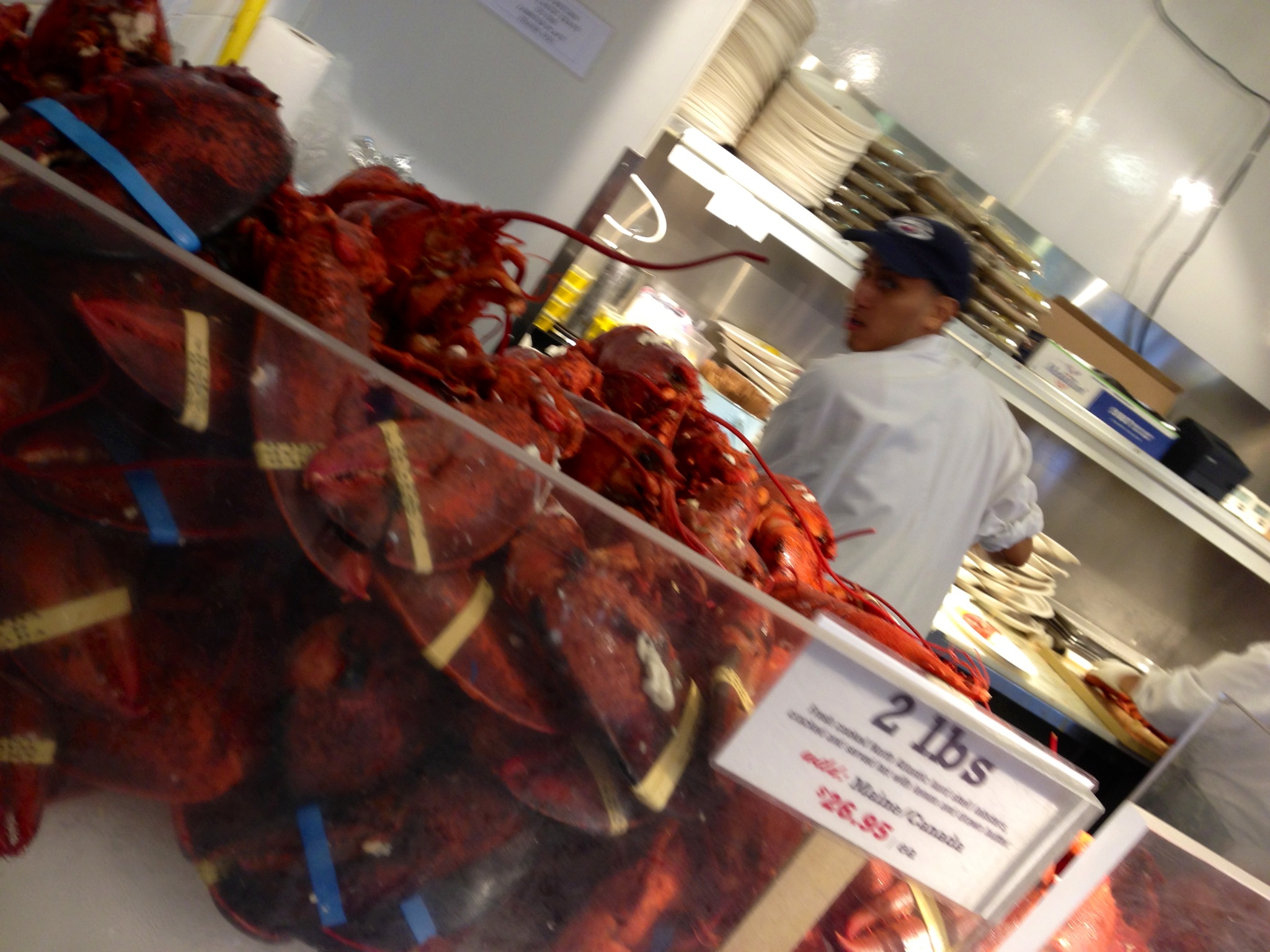
Chelsea Market features a lot of exciting things. Chilled, hefty lobsters.

lobsters

Falling water.

chelsea waterfall

Food venues. Outrageously good smells swirled around us.

bounty

What it didn’t have before is this particular chicken.

chix box

What is the seasoning, I asked Sammy, the guy double dipping chicken parts in a creamy paste behind the counter, when I managed to unstuff my mouth with chicken.

sammy

It’s a secret, Sammy said. A lady from Philadelphia comes in and mixes it up for us. She brings all the spices but she doesn’t tell us what they are.

I love a secret, especially when it tastes as good as this. The biscuit too was perfectly crumbly, smeared with honey butter, and we piled on further with crunchy dumplings that oozed out their sweet-savory crab filling when bitten.

Stencilled footsteps seemed to indicate where you should stand at Hybird, and naturally Gil was outside the lines.

feet

I saved the cupcake, whose flavor was described as “Sexual Chocolate,” for the car, a sexier environment than Chelsea Commons.

A bookstore.

books

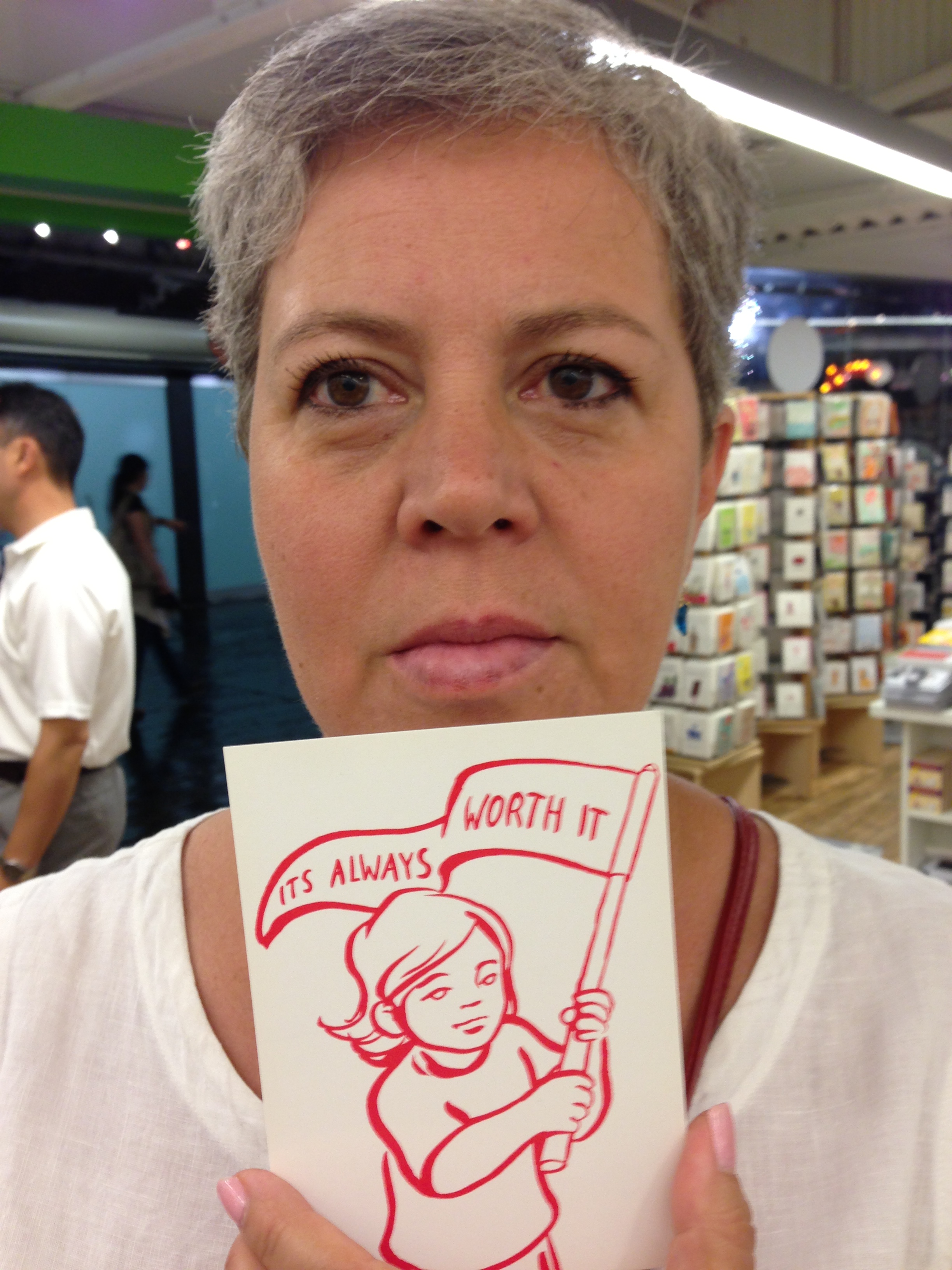
Nary a copy of The Orphanmaster in sight. It happens. I fell back on my motto, handily available on a postcard.

it's always worth it

You never know who you will meet on a summer afternoon ramble around New York. In this case a young woman wearing a pair of the new Google glasses.

google glasses

Wilma told me she’d just picked them up upstairs, in the Google offices, having won them in a contest. She said she was recording a video of me as we spoke.

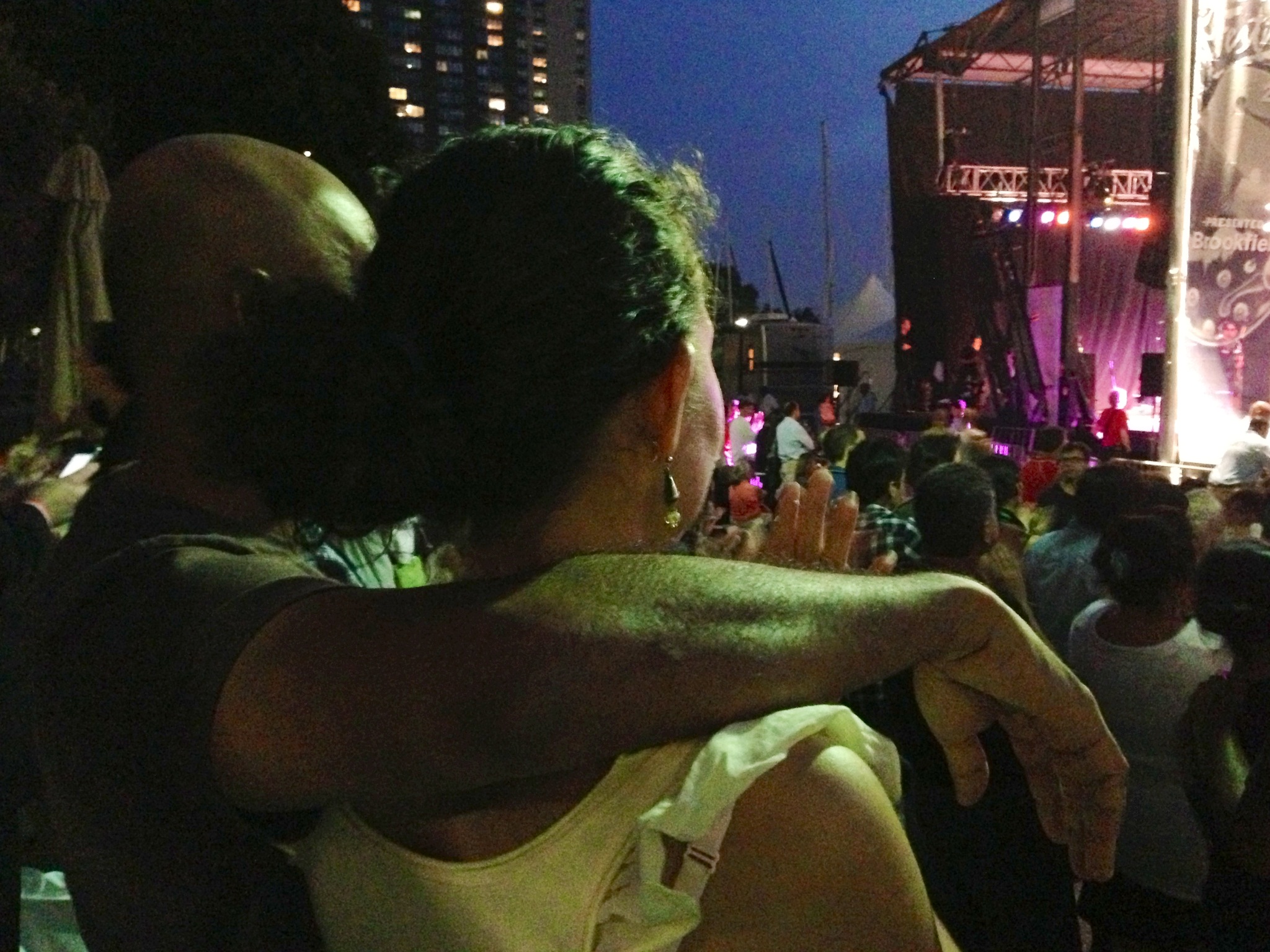
Sated, Gil and I continued to the World Financial Center, in Battery Park City, directly across the Hudson from Jersey City. We were looking forward to a triple bill of bluesy rockers, or rockin’ blues players, depending on your perspective, on a public terrace that sits in the shadow of the Freedom Tower.

freedom day

The sun shone so bright and hot that half the waiting crowd put up their rain umbrellas, a spectrum of colored and patterned domes across the concrete. New Yorkers are always more slovenly than they are expected to be, and serious exhibitionists. Women flaunted the briefest sundresses up to their backsides and sweat-slicked men ran shirtless through the crowd. In the harbor a stroll away, sailboats and yachts docked, and motor boats cruised in to check out the action.

harbor

Alejandro Escovedo hit the stage with his sweet blasts of melody, punk rock in its roots. His song Sensitive Boys could make you cry, or was that the sun glare in your eyes. He brought on David Hidalgo to do a searing You Are Like a Hurricane. Alejandro called it the Canadian national anthem.

We met up with friends and family at the venue. My touselled buddy Sandra the artist-environmentalist noticed that the masts of the little boats were themselves rocking, pushed by the wind, in line with the beat of the tunes.

touseled Sandra

Los Lonely Boys, the Chicano rock band out of San Angelo, Texas, were tight. A trio of brothers, they call their music Texican Rock ‘n’ Roll. How can three guys make so much noise? marveled Gil.

Los Lonely Boys

The lead singer and guitarist Henry shouted above the applause, We appreciate it! We know you can be anywhere else!

And it was true of course, on this summer night, with this breeze and the salmon streaks of sunset glowing, in this fantastic city. We could be doing anything but we chose to be here because Heaven, their hit debut single from a decade ago, was so exciting.

How far is heaven? Los Lonely Boys sang. You know it’s right here, right now, shouted Henry, in New York City!

Los Lobos followed, another American Chicano group, this one from California, with considerable chops that they took no time in putting out on the stage. They’d been around since the ‘80s, after all. The sun set, the klieg lights glowed, people wrapped their arms around each other and danced.

By the time we gathered our things, the skinny minx beside me who’d been flipping her skirt in time to the beat was sweetly reunited with her man.

couple

Love and music in sun-stunned, summertime New York City. A treat as scrumptious as fried chicken.

1 Comment

Filed under Cooking, Culture, Dance, Jean Zimmerman, Music, Nature, Publishing, Savage Girl, Writers, Writing

Deep Purple

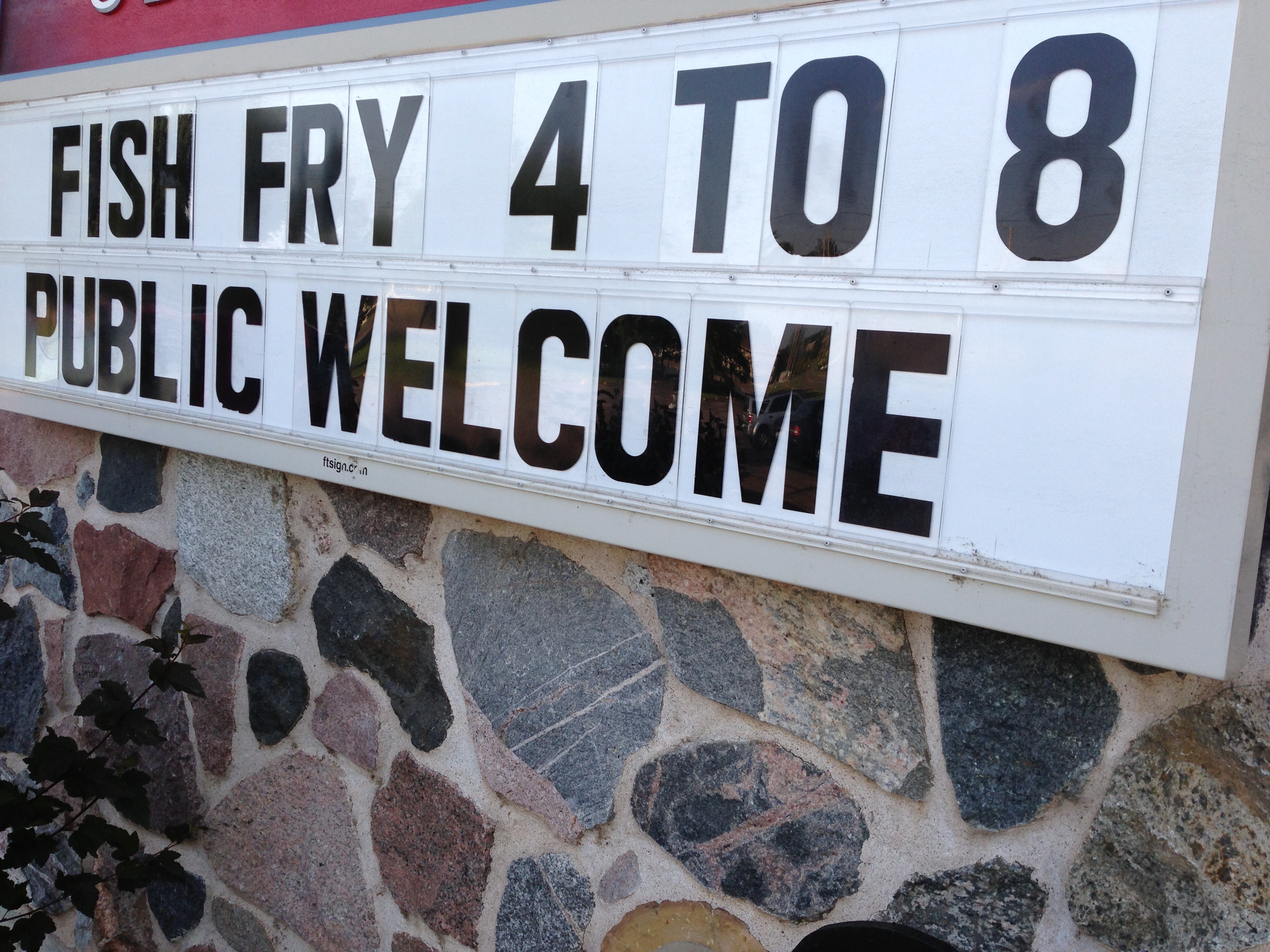
No better place to be on a mild summer night in Wausau, Wisconsin.

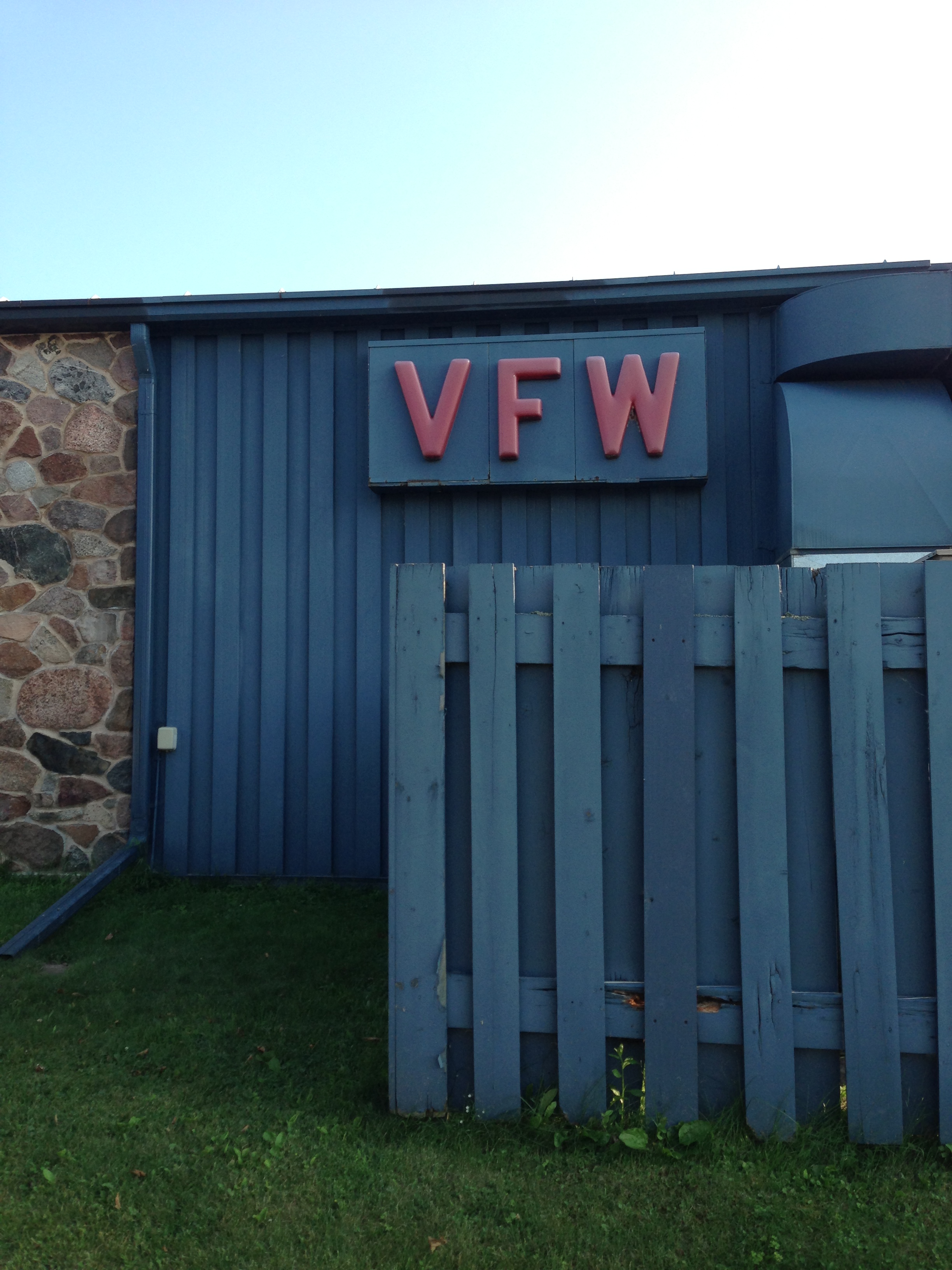
fish fry signOne place allows you to do more than chow down on walleye.

vfw


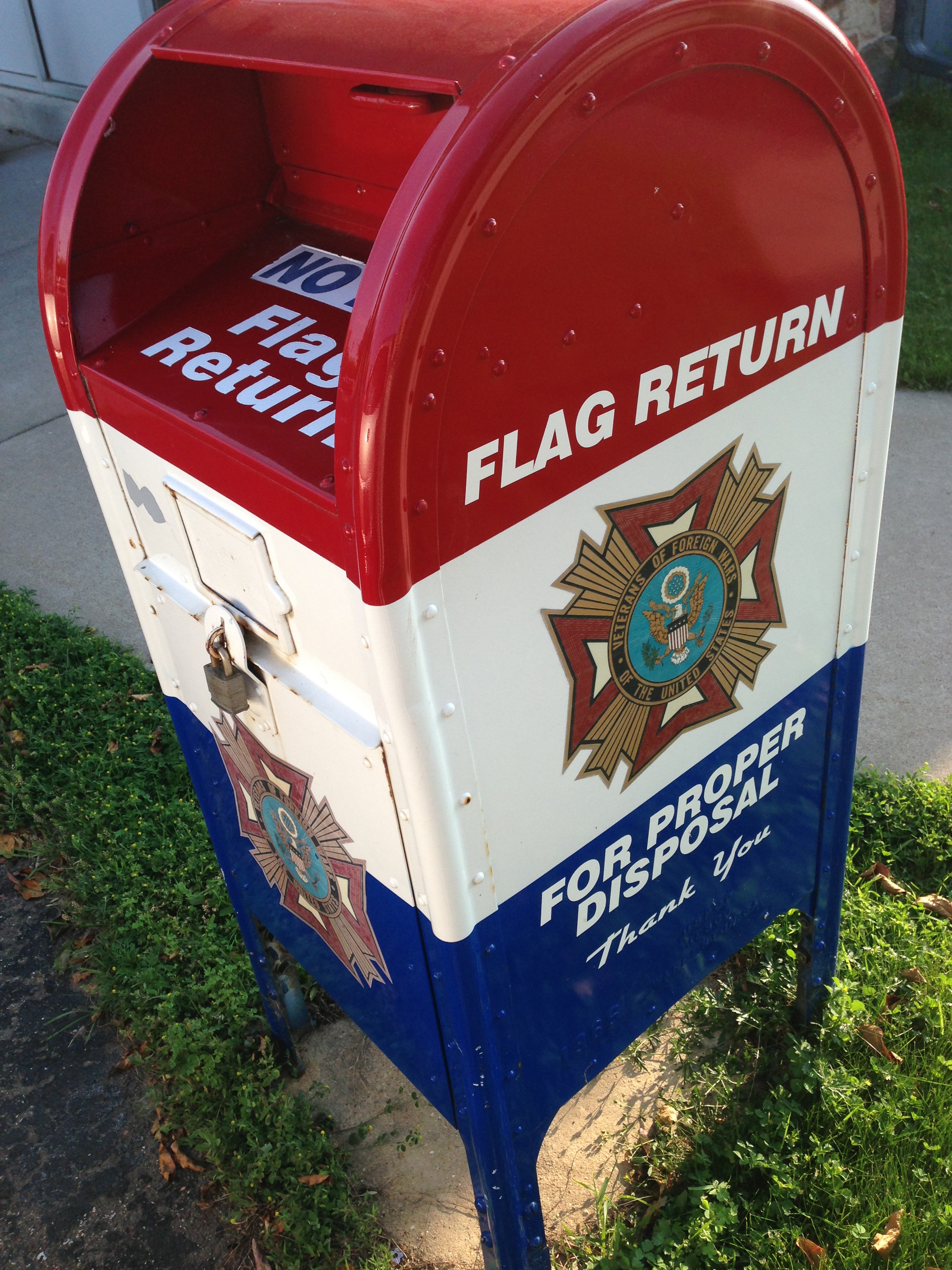
Return a flag.

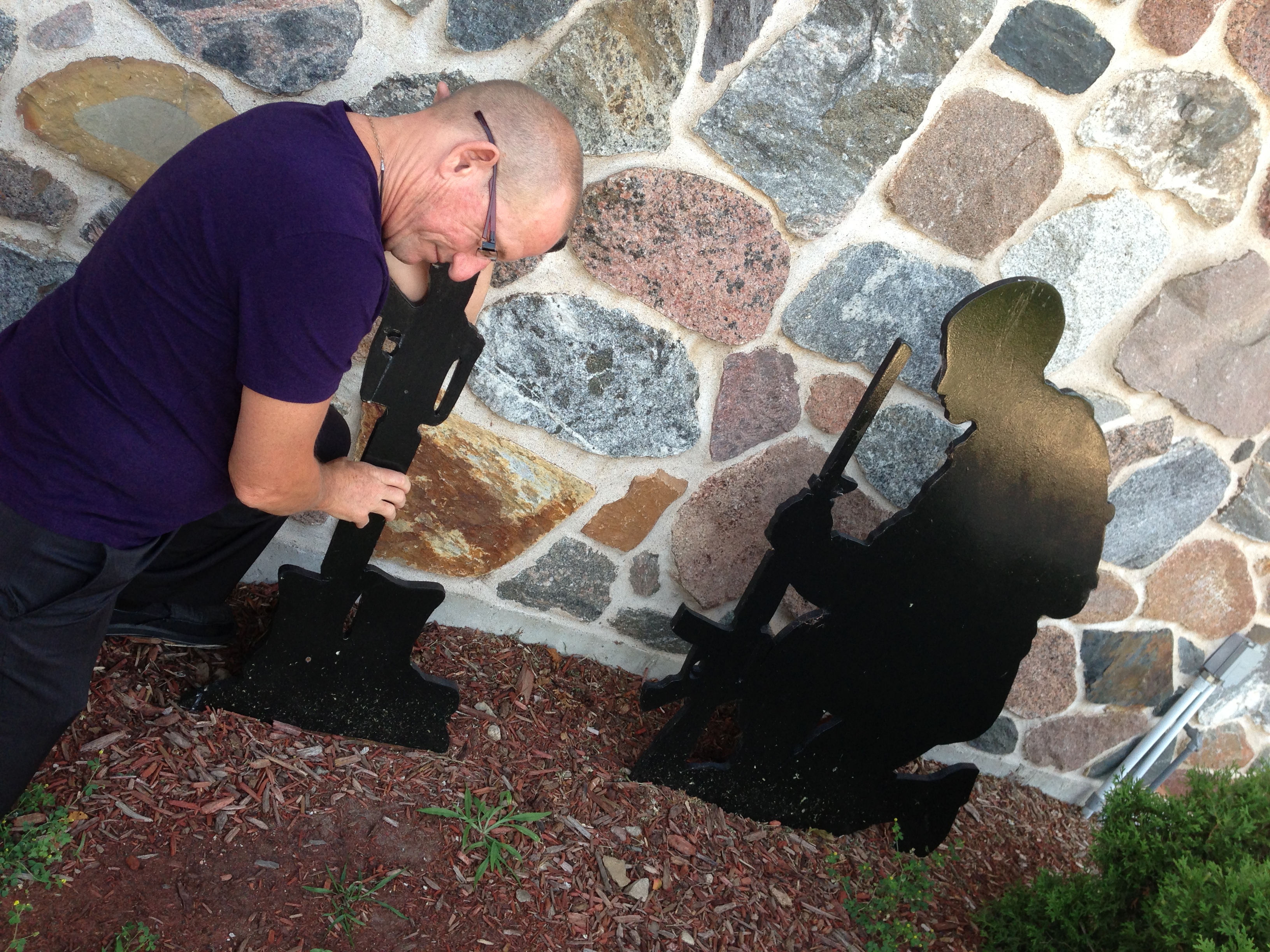
flag returnHug a military sculpture.

Rick

Make like a pinup girl in front of a valuable Air Force Corsair II that made its bones in Southeast Asia 40 years ago.

plane

There is fellowship over fish. Sisters who trekked here for their cousin Eloise’s memorial service tomorrow.

lois:janetEloise loved purple. Some people wear purple.

quinn

The Old Fashioned cocktail is analyzed, quaffed. Don Draper’s choice. You can drink one sweet, with cherries, or sour, with mushrooms. Let’s order a round.

tom collins


Bet you can’t drink just one.

lydia


Reunions.

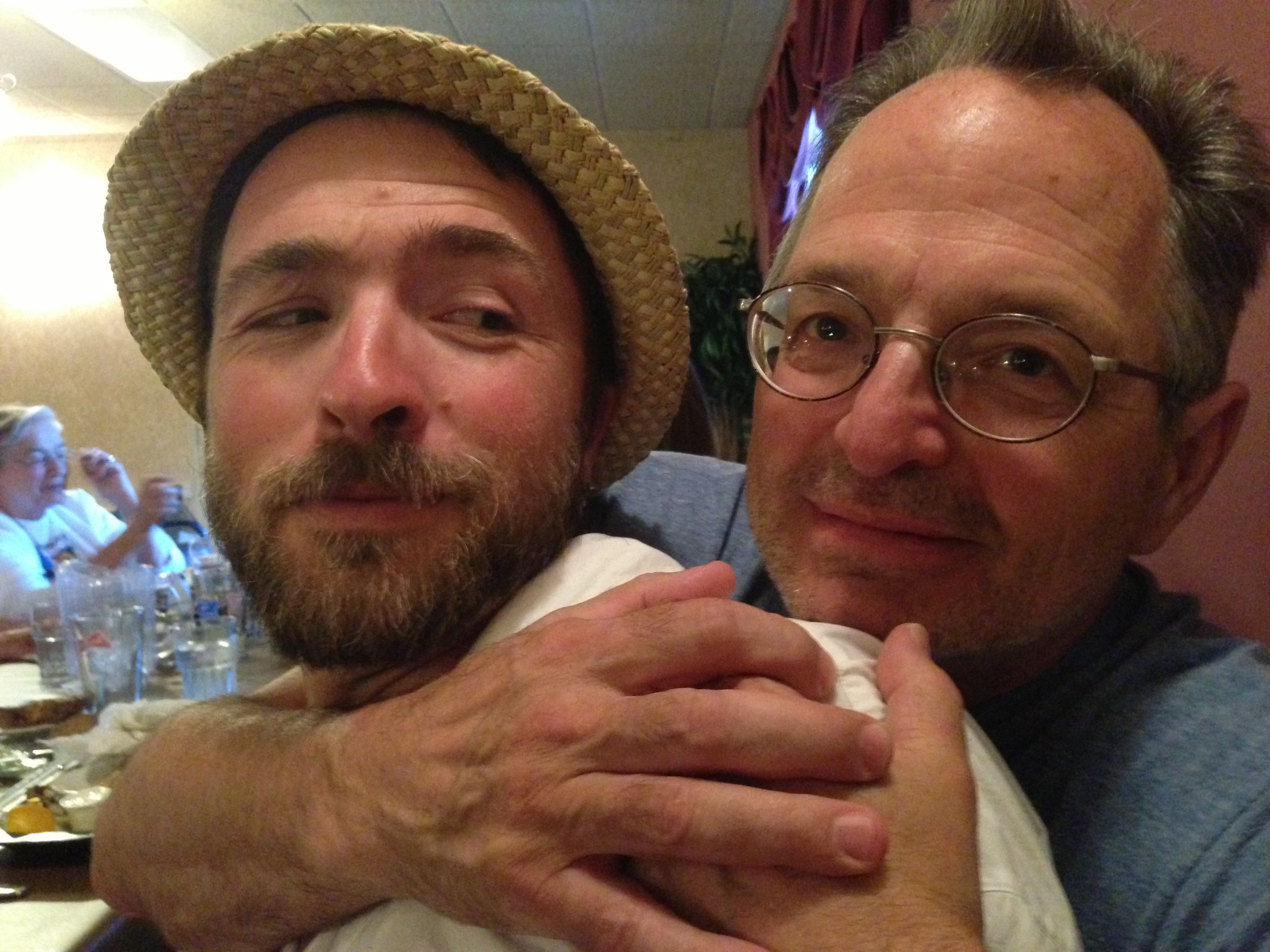
jesse:gil


Mid-life romance, second marriage engagement bling.

bling


A couple of accordion players who will perform Deep Purple at the church.
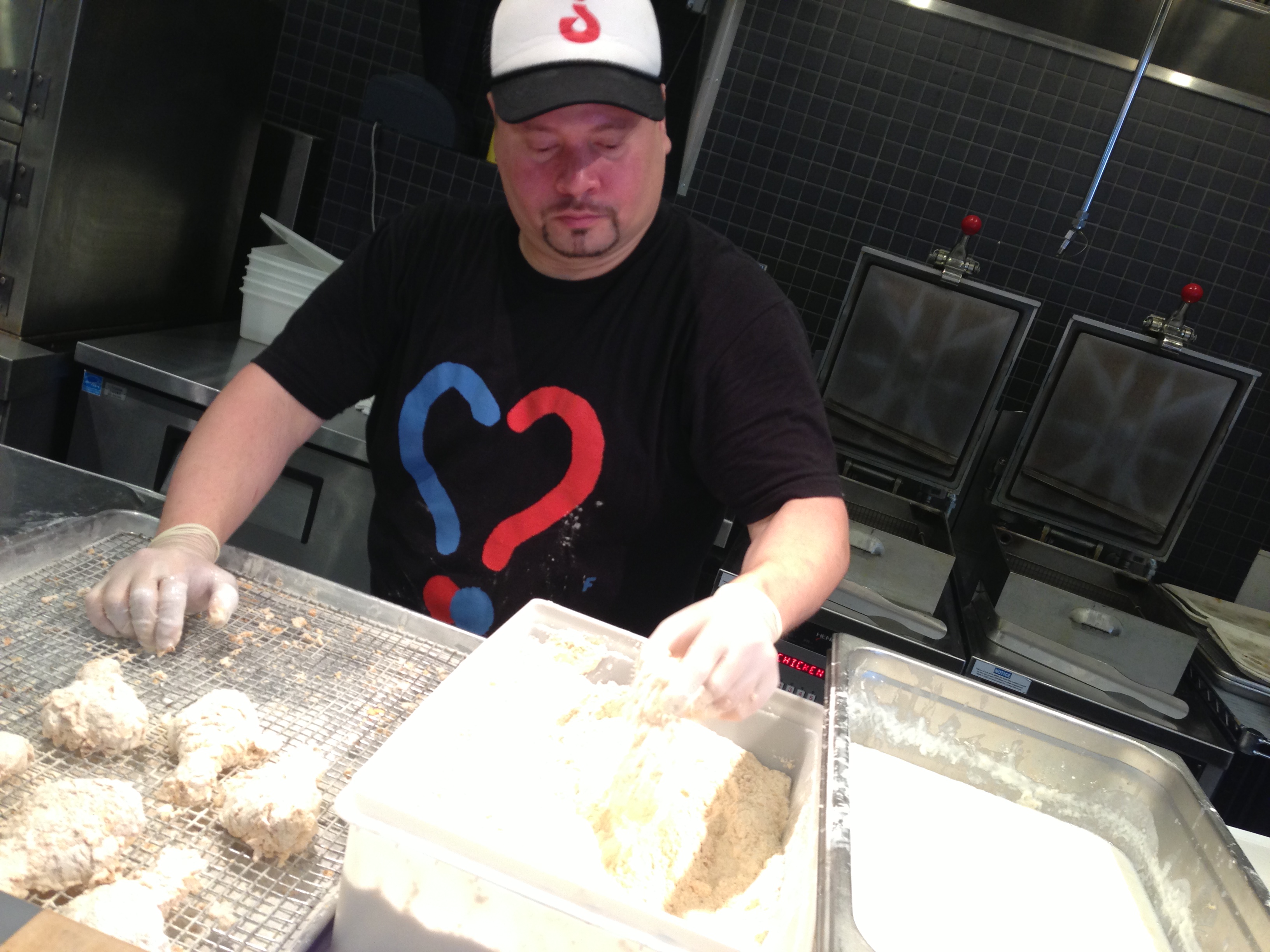
accordion


More sisters, more gab.

sisters


And finally the fish.

fish plate


A mellow night.

thomas


A memorable lady who is missed tonight.


If you want to stay longer, says the waitress, you can go drink in the lounge.

lounge


2 Comments

Filed under Art, Cooking, Culture, Fashion, History, Home, Jean Zimmerman, Music

Rockets Glare

Hastening toward Wisconsin. Can it be a true road trip if you only drive one road? On the other hand, it’s a massive road, Interstate 80. And it’s the glorious Fourth.We begin at the GW bridge.

flagOliver has already finessed the jump from the  cargo hold to the back seat, next to Maud.

oliver back seatGil is principal road man.

gil's armsJohn Lennon’s Dig a Pony plays repeatedly on the console.

Well, you can celebrate anything you want

Yes, you can celebrate anything you want

The land rolls by.

cloud shadow

The trucks roll  by.

truck

I do a road hog

Well, you can penetrate any place you go

Yes, you can penetrate any place you go

I told you so

Rain hits as I drive. Maud sweet talks her beau long distance.

windshield washer

Well, you can radiate everything you are

Yes, you can radiate everything you are

midwest sunset w carEyes drift over my book as the sun sets, superlative driver Maud in the driver’s seat.

I feel the wind blow

Well, you can indicate everything you see

Yes, you can indicate anything you see

Lennon later said he thought the song was garbage. Can you imagine?

dancers bookOn to the Chicago Skyway at Dusk.

chicago skyway


And then, all up the corridor through the great city of Chicago, starting at nine o’clock, splashes of fireworks go up from all the little communities along the way, on every side, red, pink, green, blue and silvery-white, some cascading right over our heads on the highway. Pop! Pop!

Chicago fireworks

All I want is you

Everything has got to be just like you want it to

Because

Fifteen hours, forty minutes, over 1,000 miles. I’d do this again, says Gil. Maud says, Me too.


2 Comments

Filed under Culture, Dogs, Fiction, Music, Photography

Prayers and Limits

Rainy day rush hour on 9A, the four-lane that runs through Manhattan and north past the Cabin. Traffic has us crawling. But the radio is loud, with Phosphorescent singing Ride On/Right On.

phosphorescent

E-Z lyrics:

Let’s go for a ride, hey you turn me right on


Let’s get on the bike, hey you turn me right on


Ain’t nothing to hide and hey you turn me right on


The city at night, hey she turn me right on

Phosphorescent’s the moniker for an Alabama-to-Brooklyn boy named Matthew Houck (he previously went by the nom de guerre Fillup Shack) and he has out a new album, perfect for rainy day traffic jam listening.

I’m approaching that long, weedy section of highway, bordered by a sluggish streambed, where ordinarily the cars sail along briskly. There’s a sign along here someplace, planted out here near the road by someone who remains invisible. It’s plain plywood, painted white with black Gothic lettering and a simple legend: GOD ANSWERS PRAYERS. I’ve passed it hundreds of times, but I’ve never been able to get a picture of it because traffic moves so fast and there’s no shoulder to stop on. The sign just blinks by.

Now, God and I are not ordinarily on the most intimate terms. But I love this sign that has greeted me on every drive home and in many frames of mind, including the most dispirited. GOD ANSWERS PRAYERS. Okay, whatever you say. And I start to wonder about other manifestations of the same phrase.

gap rock

They abound, on hats as well as rocks.

gap hat

In rhinestones.

gap rhinestones

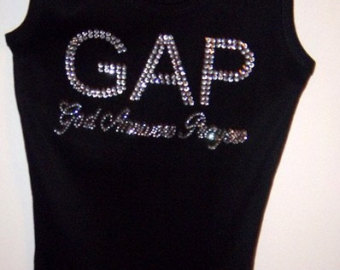
Is that what GAP means, as in The Gap? Those nice pants I bought last Fall? Never knew.

Zowie. Turn the radio up. Mr. David Bowie has come out with a new body of work, including the exciting song The Next Daythe video for which has been condemned by the Catholic Church as indecent. Well, it does show Bowie attired as Christ alongside Gary Oldman as a debauched priest (I thought Oldman was already a debauched priest) and Marion Cotillard as a beautiful prostitute with stigmata wounds.

david.bowie_

Bowie hadn’t put out a record in a decade, I guess he felt pent up.

my-prayers-have-been-answered

Ho hum, the traffic does crawl. Gil was in a jam yesterday and God answered his prayers with the Dan Hicks song on his shuffle, Traffic Jam.

Dan Hicks

Prayers, they don’t always work so good. I favor the sentiment of Oliver Wendell Holmes: We have learned that whether we accept from Fortune a spade, and look downward and dig, or from Aspiration an axe and rope to scale the ice, the one and only success which is ours to command is to bring to our work a mighty heart.

As true today as it was when he said it in 1884. It doesn’t fit on a plywood sign, unfortunately.

You can get a daily “meditation” like the Holmes quote in your inbox from All Souls, a church that is almost not a church it is so open-minded – “deeds, not creeds” is its motto. To get you questioning things like prayer.

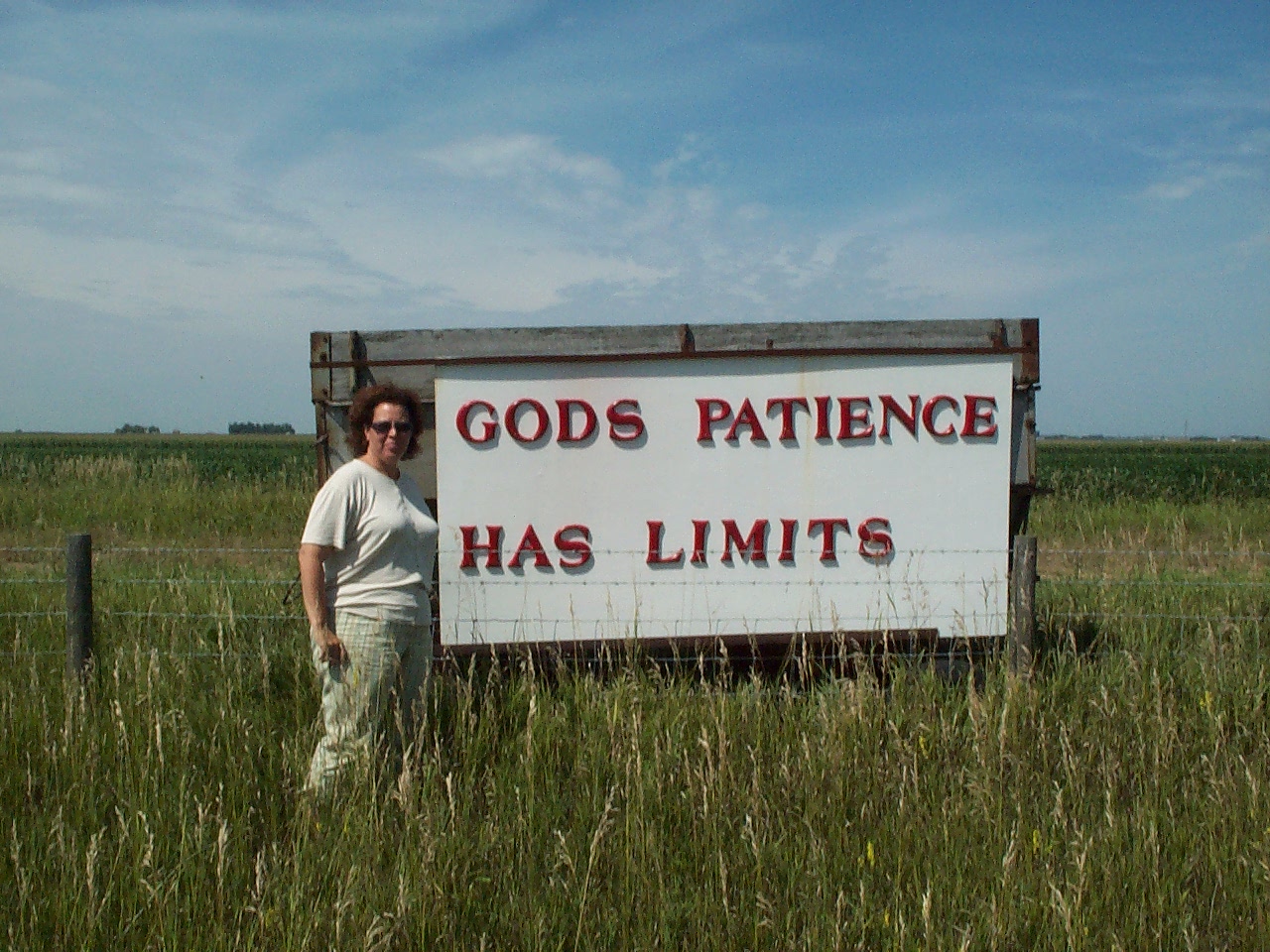
That sign on 9A, I like it almost as much as the one I saw by the side of a Nebraska highway about ten years ago. We wanted to bring it home with us but couldn’t figure out a way to tie it on top of the car.

god's patience has limits

A God with limits? Isn’t that heretical? For some reason I like the in-your-face Nebraska farm wife who stuck it along the interstate. She was probably shaking her fist at us as we drove away.

Whooosh—there goes GOD ANSWERS PRAYERS. Funny, I was just praying I would see that sign come around.

3 Comments

Filed under Culture, History, Home, Jean Zimmerman, Music, Photography, Writers, Writing

Out of Africa

Maud is back from Malawi.

back from malawi

Wearing a chichinge, a wrap skirt of block-printed African cloth. Her resilient muscles are only a little sore, and she seems impervious to jet lag after 20  hours in the air.

Maud and her group from buildOn, working with hundreds of village men, laid a foundation and raised a quarter of the walls for a new school block that will allow the town of Mpandakila to educate its 5th and 6th graders. So that after 4th grade the kids will not drop out rather than hike the six kilometers to the nearest school.

Maud ate nsima — corn porridge — pumpkin greens and soupy beans for 12 days, sleeping on a bamboo mat in a very special homestead. Her hosts were one of the chiefs of the community and his wife and their five precocious daughters. Also grandma, the babies of the two eldest daughters, and a two-day-old goat that cried for its mom all night. 

A hen slept in the room with Maud and her friend Claire, laying its eggs while they were sleeping.  The chief offered the young women a chicken as they left, which they took and sold to the bus driver who took them six hours back to Lilongue. They fed it ground nuts (peanuts), which they picked fresh from the vine every morning.

Dancing was a big thing in the village, to the pounding of drums and the ululations of the older women. The whole village loved learning the Macarena.

What Maud loved learning about the most was how to carry water atop her head — and dirt, and bricks. A woven circle of straw helped her balance. 

water carrier

It felt so far away, but at the same time there was a human familiarity about it all — a smile as you walked by someone, the  bossiness of the sisters. Maud didn’t come away with any answers about the best way to go about helping other countries, without imposing your will or encouraging dependency. What matters is asking the questions, and coming away with more.

Zikomo kwambiri means thank you very much in Chichewa.

6 Comments

Filed under Cooking, Culture, Fashion, History, Home, Jean Zimmerman, Music

Bluebirds Dancing in the Rain

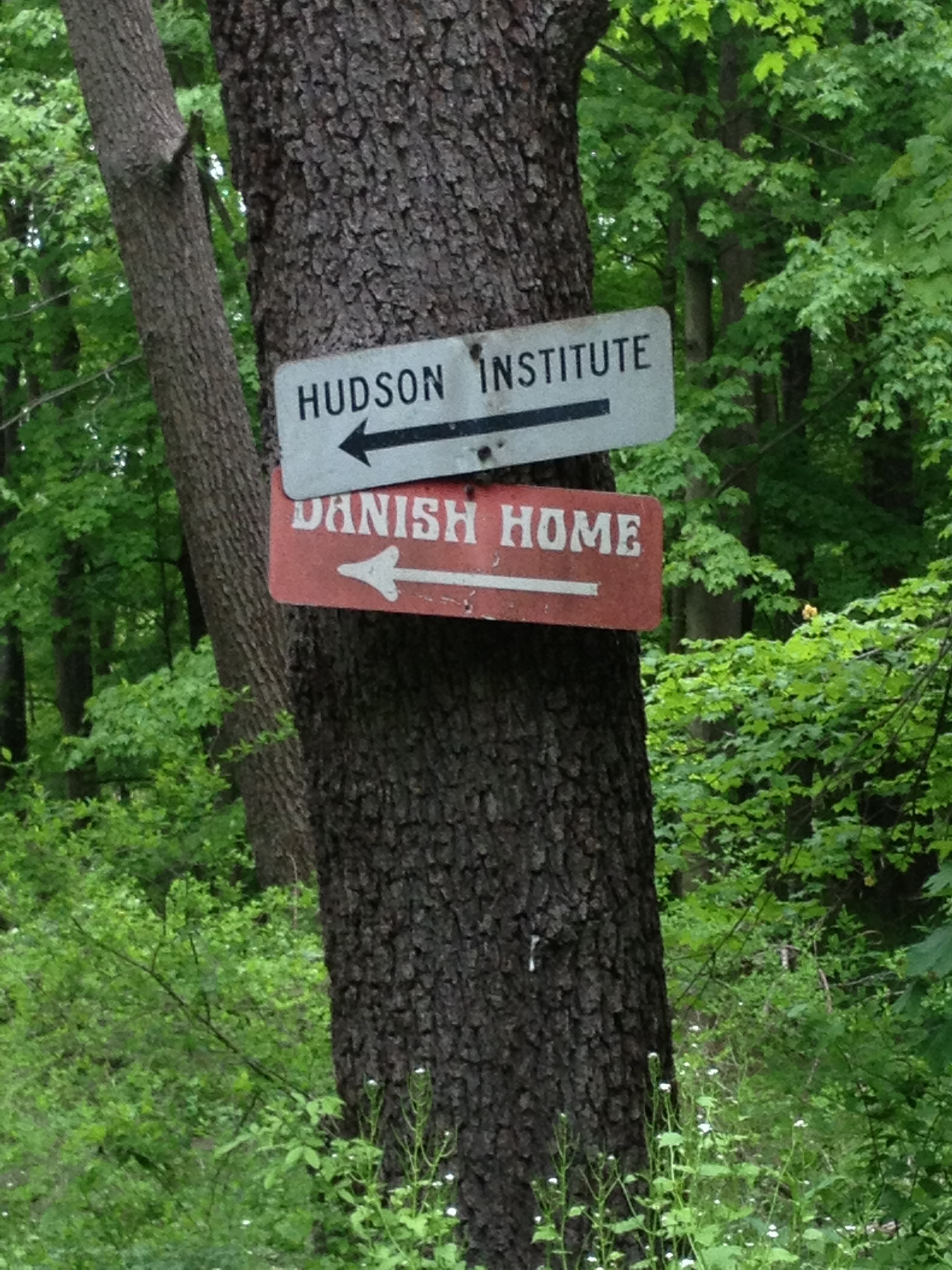
I always wondered about the Danish Home. I’d passed the faded sign on Cedar Lane a hundred times, and never followed it down.

danishhome sign

I always pictured Keebler elves performing pirouhettes atop a barrel in the woods.

keebler_elves

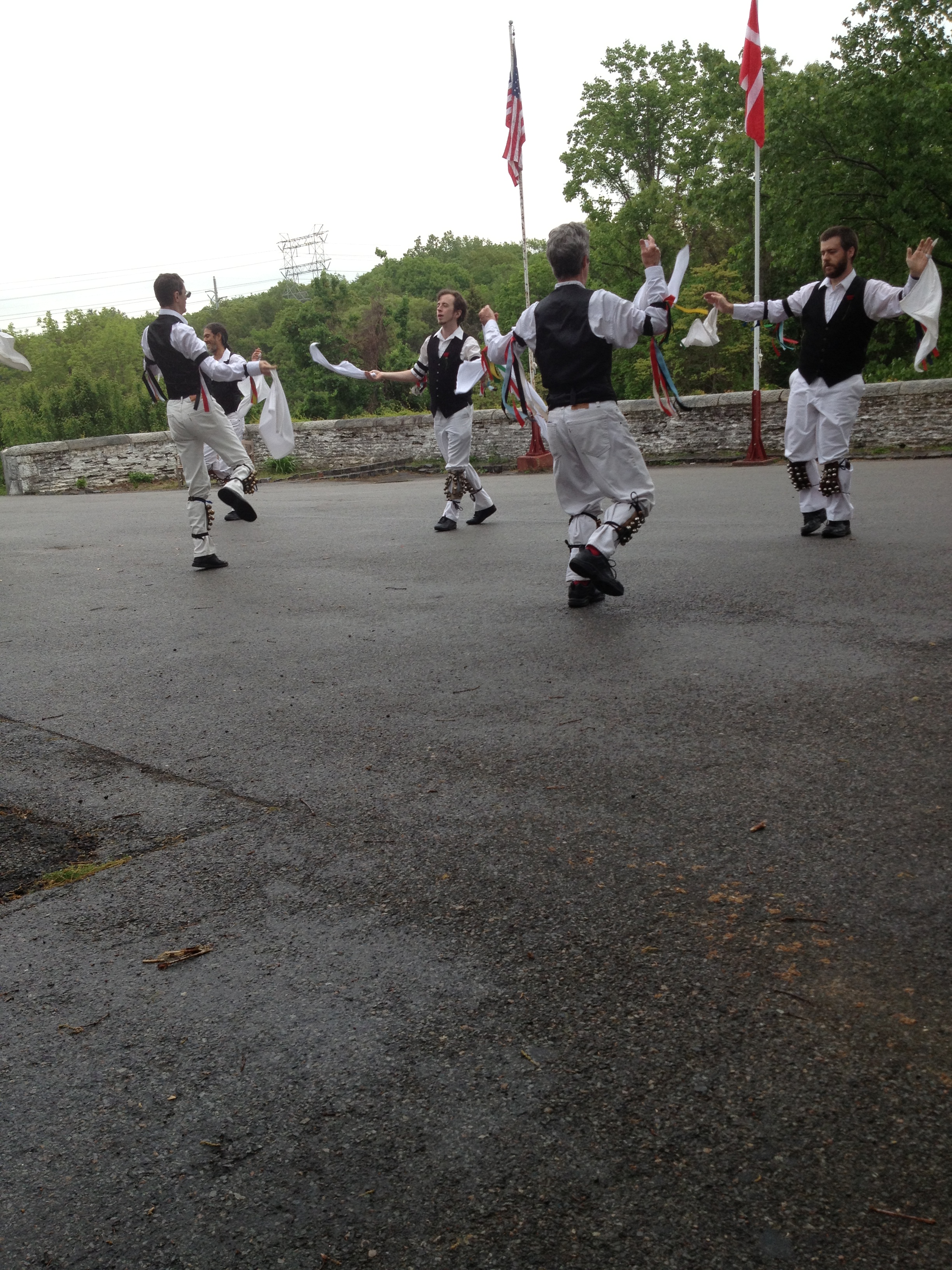
Saturday I had a chance to check it out, because the troupe of Morris Dancers known as the Bouwerie Boys were set to perform at the site. It was, of course, a home for seniors. Nonresidents were welcome.

A light drizzle from the still-cool sky only enhanced the lush perfection of the setting. May flowers.

irises

A venerable orchard.

orchard

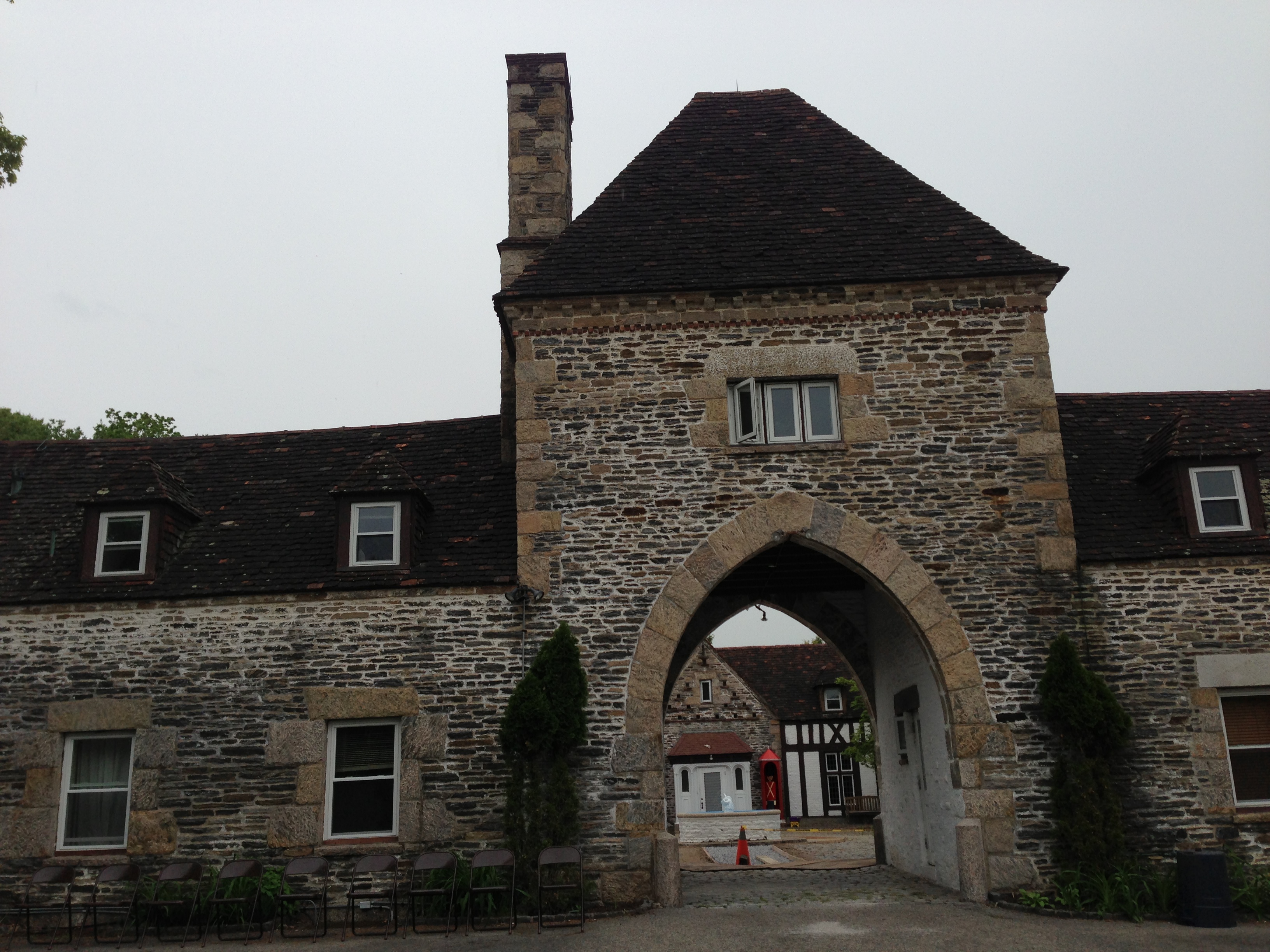
An imposing building of dark stone. A castle.

stable

Maud and I learned about the Danish Home. Founded in Brooklyn in 1906 for those of Scandinavian descent, it moved in 1954 to Croton-on-Hudson, New York. Eighteen or so seniors inhabit the former stable–the castle–built by financier JM Kaplan earlier in the century as part of a 40-acre estate. It felt like a different country.

back of bldg

A harbinger of good fortune greeted us when we stepped across the wet grass behind the building while waiting for the dancers to arrive. Atop a cockeyed birdhouse tethered to a hydrant sat a bluebird.

bluebird house

Well–with a flash of sapphire and a touch of rust it fluttered away, not allowing a picture. Thank goodness it didn’t fly up my nose. We learned from Eric Anderson, who runs the place, that bluebirds and barn swallows squabble over the dozen birdhouses on the property, each camp currently claiming half.

Morris dancing also is supposed to bring prosperity, fertility and good luck after the long winter. Each village of the Cotswolds, in England, where the tradition originates, has its own style and costume, and all the moves are passed down from father to son.

man with dog

No elves, but something elfin about these husky grown men and their skips and hops, their bells and ribbons and flashes of “whites.”

dancers

The Bouwerie Boys dance all over the New York area (you can find their schedule on Facebook) and a little drizzle seemed to bother them not a whit.

single dancer

Nor did it trouble the elderly ladies in attendance, though umbrellas were in short supply. One kept up a steady gab throughout the performance. “I want to know what this is all about!” she said at one point and, later, with authority, “Goes back to Shakespeare’s day.” Which was not, in point of fact, correct. The year 1452 was the earliest recorded show of Morris dancing, so by Shakespeare’s day the steps were ancient.

fiddle player

The fiddle player in his “reel” life is the violist for the Manhattan String Quartet. By the end of the performance he’d popped a string.

Then the dancers sang a jolly tune: I like to hear those small birds singing early in the morning – hurrah for the life of a country boy.

Finally, shots of a clear liquid were passed among the dancers. Well earned, after valiant leaps in the light, ancient rain.

9 Comments

Filed under Dance, History, Jean Zimmerman, Music

It Makes Perfect Sense

About to be Mother’s Day. The night before, Saturday night, we go into Manhattan just as the thunder starts to roll. Fissures of lightning streak the sky.

As is my mother’s prerogative, I let Gil do the driving.

We check out a movie not for the weak of stomach.

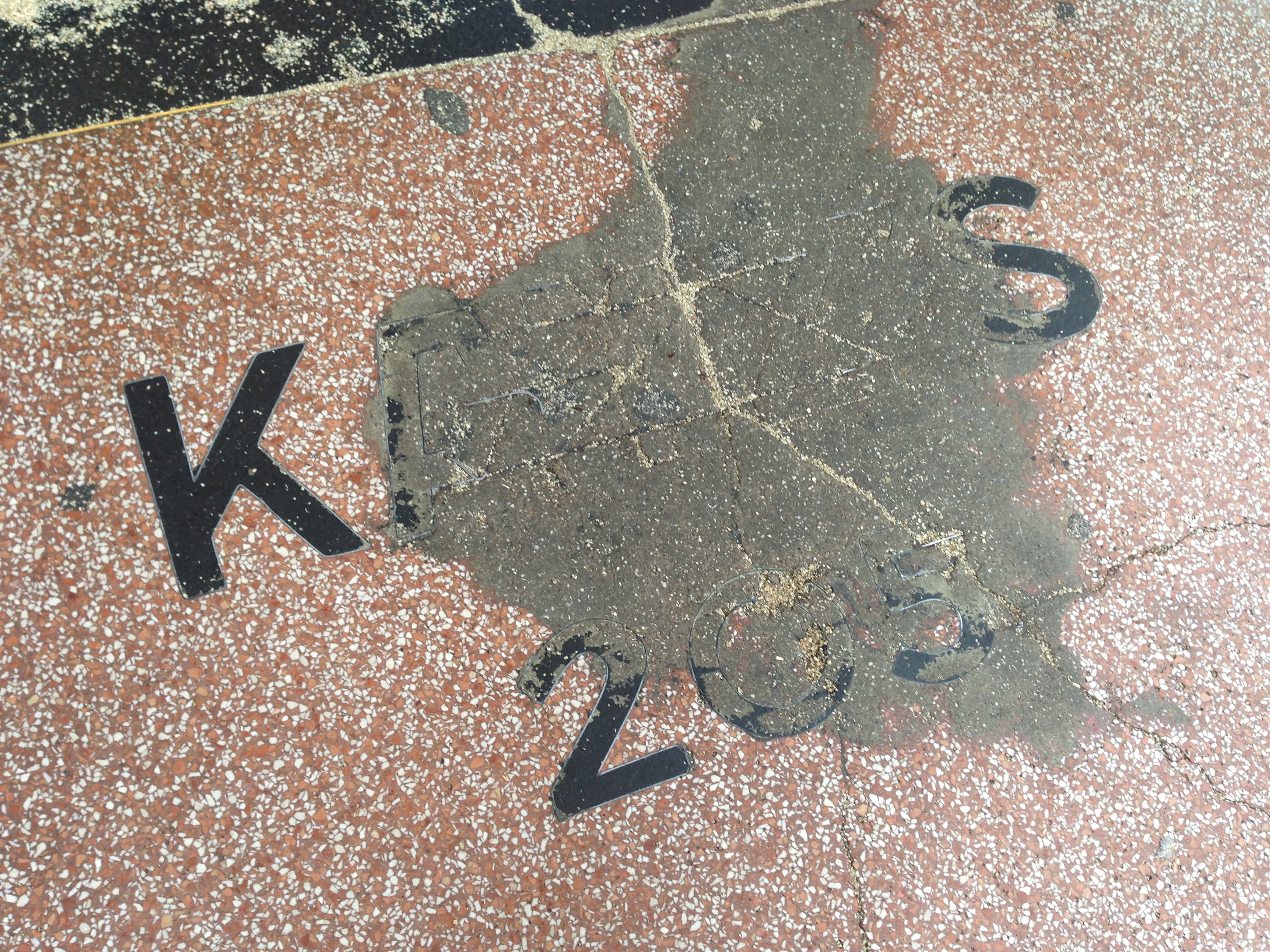
Then take dinner at Katz’s, founded in 1888 on Houston Street, its threshold long worn-out.

katz's door jamb

There is really no reason to go anywhere in New York for dinner except Katz’s.

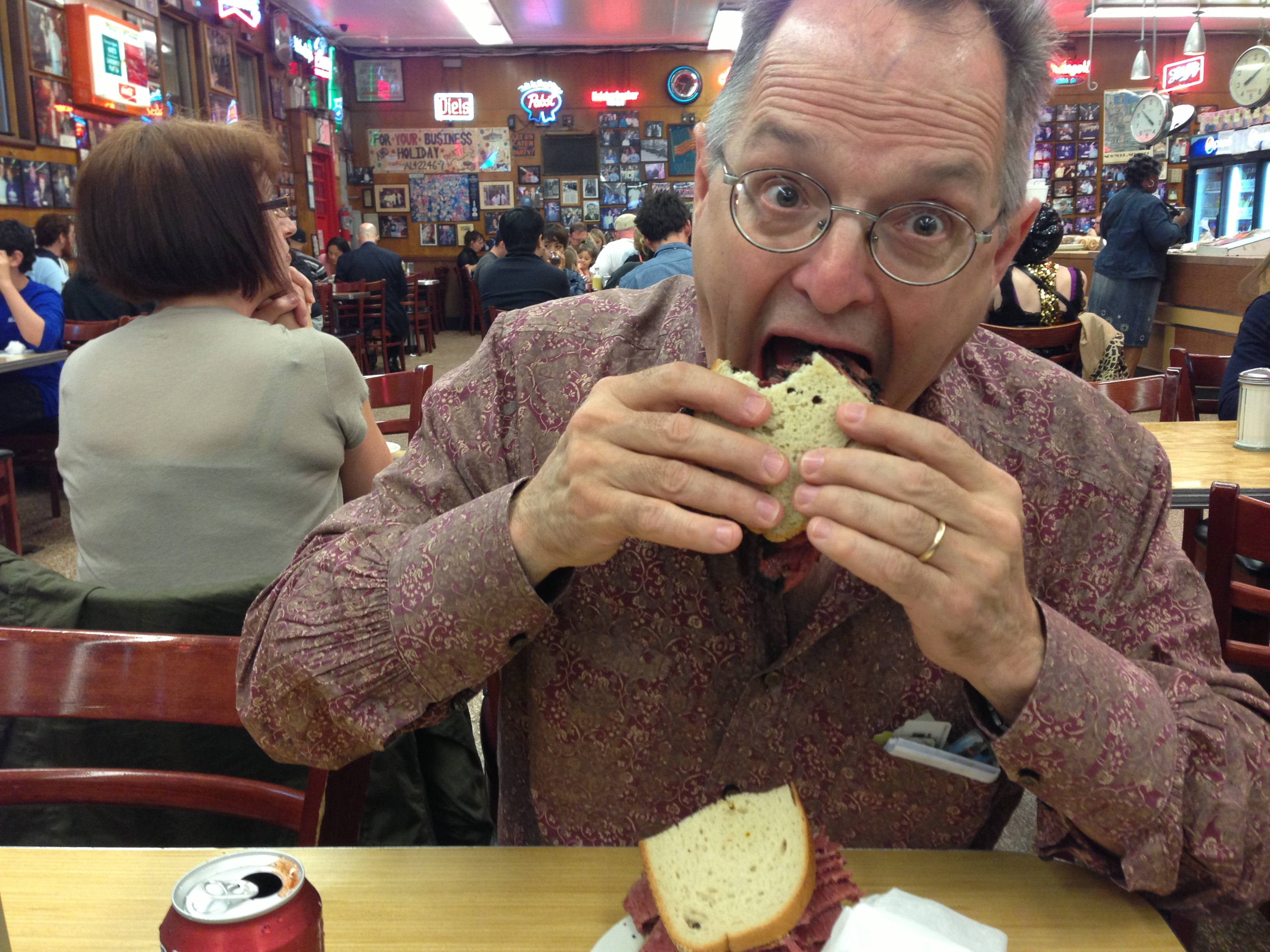
gil sandwich

You wait on line for your carver to finish your sandwich and he pushes a hot little slice of pastrami across the counter at you. It makes perfect sense. A morsel to whet your appetite.

carving

David has worked his station since ’02.

The pickles are luscious. Green tomato, sour dill and new.

pickles

But they can’t match the pastrami. As Sinead O’Connor sang, Nothing compares to you.

pastrami

Anyone can sit at the Where Harry Met Sally table. We did. It makes sense to do it if you can.

where harry met sally

Outside I was surprised to see a sign on the side of the building that read WURST FABRIC.

wurst fabric

Was Katz once in the textile business?
 Michael Stern, the road food genius, schooled me.
 Fabric is an Americanization of the Yiddish term meaning home-made.

Our pre-mom’s day Gastro-crawl continued on 23rd St. right next door to the Chelsea Hotel, scene of so much poetry and debauch over the years.

Now we have the Donut Plant. Gourmet donuts done right. 
Proctology cushions  covered with fabric (home-made in yiddish) covered the wall.

donut walls

Perfect coffee, Mother’s Day specials.

donut sign

Rose petals in donuts. Could it be a joke?
 Yes, but it made a weird kind of sense.

rose donut

There were in fact petals baked into the dough. I was transported to the Middle Ages. Or the middle of India and its rosewater delicacies.
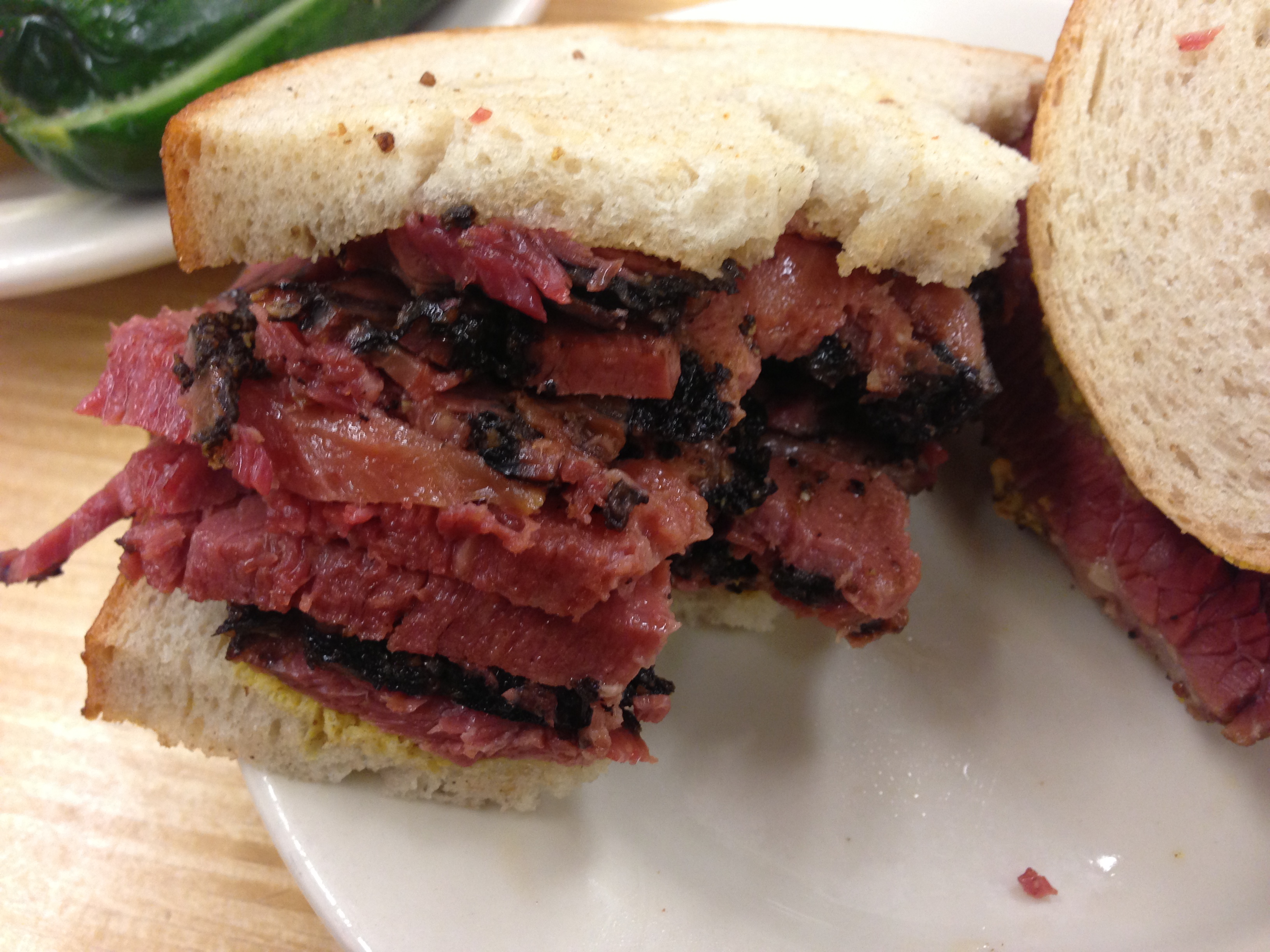
 I don’t know if biting into one made me feel more maternal or just trendy. Anyway, I liked it.

Right across the street, the historic home of the Communist Party in America, 235 west 23 street,
was hosting a musical extravaganza. 
A group called Legacy Women performed Afro Dominican palo and Afro Puerto Rican bomba for a rapt,  folky audience that shushed us numerous times.

legacy-women

These women rocked. One song they announced was for mothers, and they belted out the chorus, mama-ah. 
Another sounded like they were singing put your pants on in some native dialect.

Hitting the street again, the rain had all cleared away, leaving things new.

I looked across the street to the Chelsea Hotel, 
now sadly being modernized, made into condos, its art collection all sold off. 
I thought of Alejandro Escovedo’s song about the Chelsea, Chelsea Hotel ’78.

It makes no sense, he sings, it makes perfect sense.

6 Comments

Filed under Art, Cooking, History, Home, Music, Poetry, Writers

All This and a Hand-Crafted Marshmallow Recipe

The day after. All that’s left of the pig roast are the party tulips and the dogwood stars.

tulips and dogwood

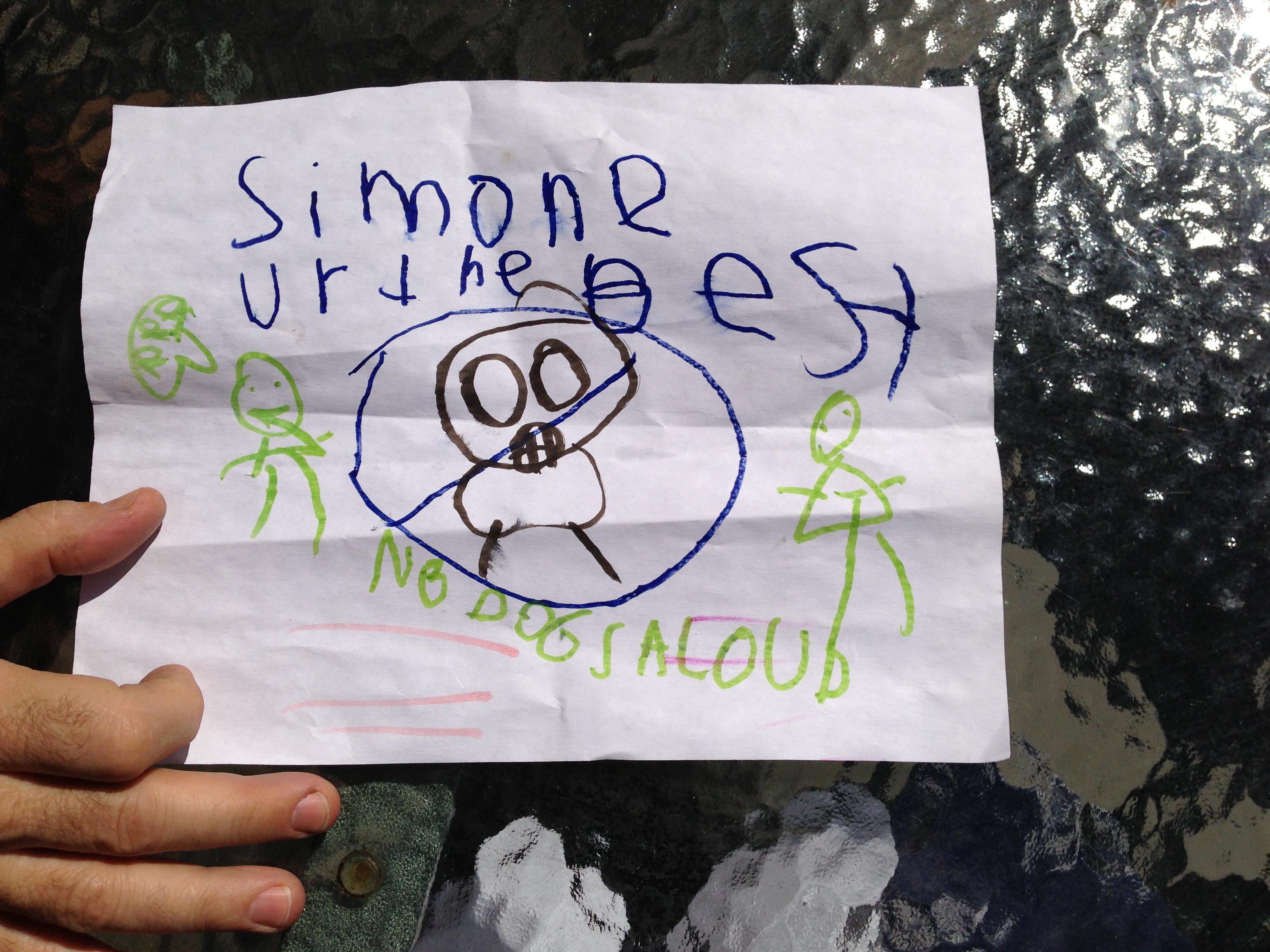
And a drawing by doting 6-year-old Jasper for winsome three-year-old Simone.

Simone picture

Oliver was locked away until the waning hours, when he was let out in all his growly glory, with a  muzzle and a leash, and petted by the braver partygoers. Says something about the loving spirit of this particular gathering.

OLYMPUS DIGITAL CAMERA

The love reached its apotheosis in the marshmallows.

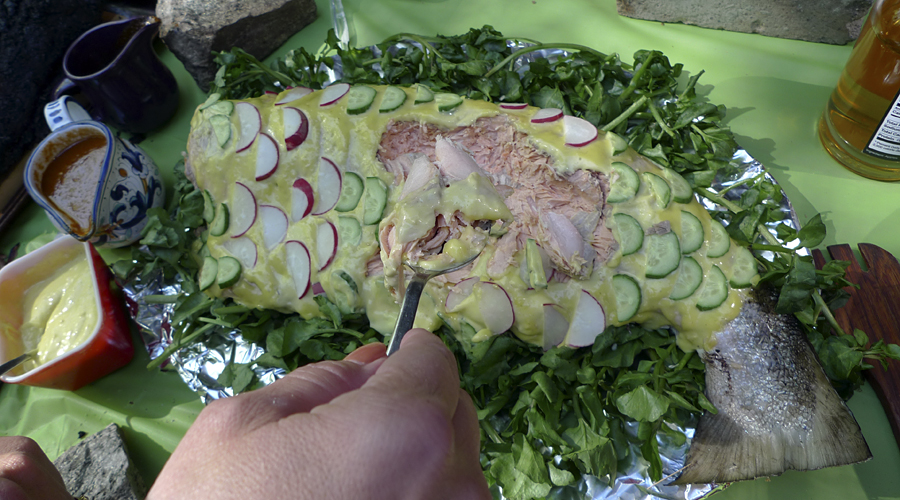
I was almost too busy replenishing food on the buffet to have a conversation, let alone to document anything, and the hours of the pig roast sailed by in something of a haze. Josefa gave me this photo of my salmon, thickly coated with rich horseradish mayonnaise and scales of radish and cucumber. The fish, not the photo.

salmon josefa

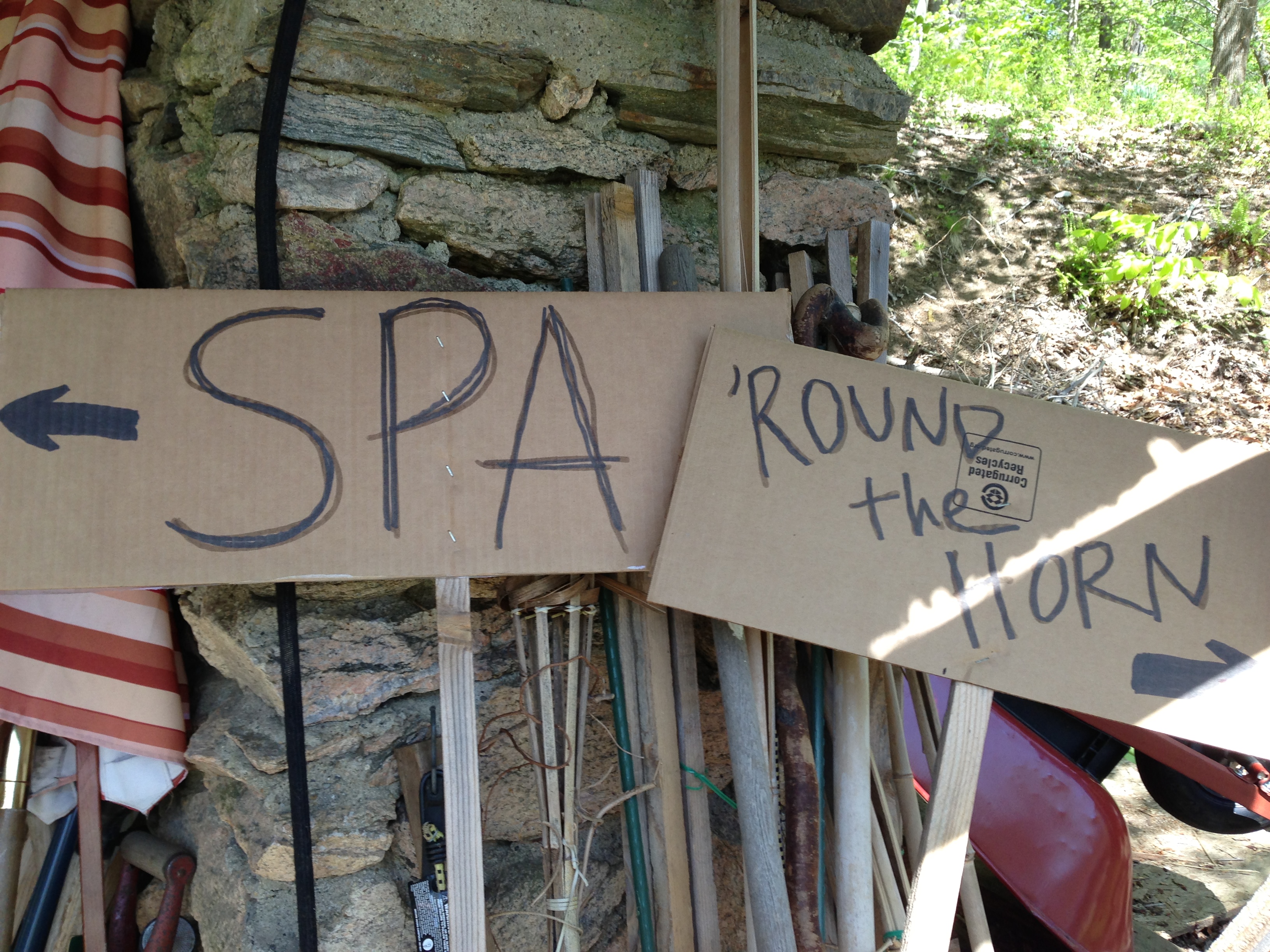
The signs we put up around the property are taken down.

signs

The Spa, of course, which Gil had dug out of the swamp. As far as I know, unutilized for a mud bath. ‘Round the Horn, where you could hike around a promontory, past the pachysandra groves, and wind up back at the Cabin.

Human gatherings are so ephemeral. Did you talk to so-and-so? No? I had an intimate conversation with him I didn’t intend upon. Little epiphanies, most of them forgotten by the next morning.

Gary found a skull.

Rat? Rabbit?

The music  boomed, especially near the speaker, which hovered in a window above the food. George Jones’ essential question: Who’s gonna chop my baby’s kindling when I’m gone? Who indeed?

The rum was drained.

Nora-marshmallows

You would think that after the huge smoked brisket, the salmon and the cripy pig, the fava beans and asparagus with Pecorino, and the spicy blue cheese slaw, people’s stomachs would be full to bursting.

Gil in the pit

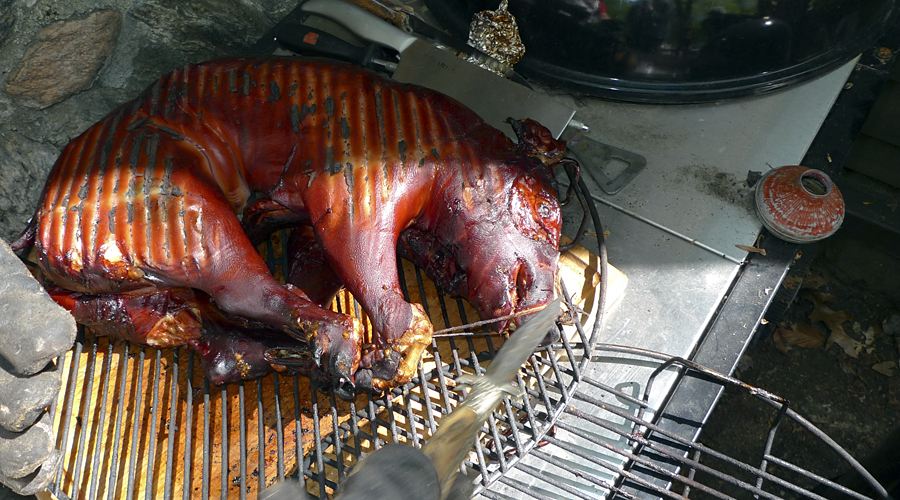
Gil, down in the Pit, pulled the pig off the fire at just the right golden moment.

pig

And the biscuits. I took a gamble on whole wheat biscuits this time. I think they disappeared even before the rest of the platters were set down. A sparkling day builds an appetite. And shoe golf.

shoe golf

That’s Josefa’s picture. Somehow she caught the shoe flying through the air on its way to the hole, a plastic bin set some 10 yards away. Far enough to make people look ridiculous taking a shot at it. Even college students lowered themselves to try.

OLYMPUS DIGITAL CAMERA

But the marshmallows. It was as if people had never seen a marshmallow before. As if they had never seen food before. You can make those? I never knew.

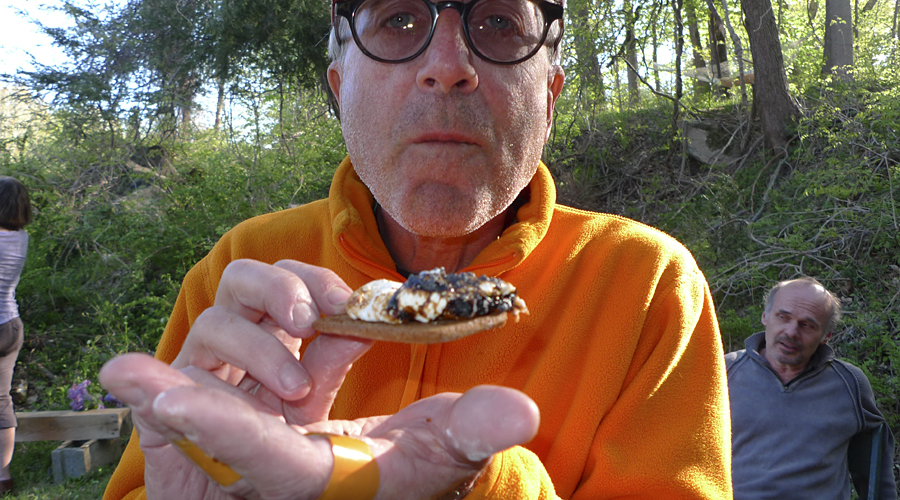
We had cut young green branches up in the woods yesterday morning, and now all the adults were acting like kids, standing over the fire and toasting Gil’s home-made marshmallows with glee.

marshmallow

Everyone had drips of white around their mouths.

OLYMPUS DIGITAL CAMERA

Grown men made s’mores. (Gil concocted his version of home-made graham crackers, too.) We layered in slivers of salted caramels.

gary

Our friend Stu left us with a mix-cd that has party tunes, including Ray Wylie Hubbard with the lyrics: Only two things that money can’t buy, that’s true love and home-grown tomatos. I would add a  third, hand-crafted marshmallows.

Hand-Crafted Marshmallows

6 packages gelatin (the unflavored kind, GoBio has an organic product)

2 cups icewater

3 cups granulated sugar

2 cups corn syrup (Wholesome Sweeteners organic brand has a little vanilla in it)

½ teaspoon salt

2 tsp vanilla extract

½ cup confectioners sugar

½ cup cornstarch

(Optional flavorings: almond extract, lavender drops, orange extract, etc)

In the bowl of an electric mixer with a whisk attachment combine the gelatin with half the ice water.

Combine in a saucepan: the rest of the ice water, the sugar and the salt. Using a candy thermometer, cook until mixture reaches 240 degrees (soft-ball stage). Remove from heat, pour into bowl with gelatin and whisk on slow speed to combine. Increase speed to high and whisk for fifteen minutes. Add vanilla and optional flavorings at end and whisk for a minute to combine.

Pour into greased 9 x 13 pan that’s also well dusted bottom and sides with the half-and-half mixture of the confectioners sugar and cornstarch. Spread evenly with a lightly oiled spatula. Let stand uncovered overnight.

Turn out onto cutting board dusted with the confectioners sugar and cornstarch. Cut into cubes with a pizza wheel dusted with the confectioners sugar and cornstarch. Dust with the confectioners sugar and cornstarch (mix up more if necessary).

Makes about sixty marshmallows. Enough for a roiling pig roast.

2 Comments

Filed under Cooking, Dogs, Home, Jean Zimmerman, Music, Nature, Photography

The Algorithm of Curvy Passion

Whale bone doll. Greyhound vs. great dane.

dane pup

WTF?

I get a regular report from WordPress, the outfit that hosts this blog, which tells me the search terms used every day to find my site.

I love to read these oddly linked words and imagine the people that typed them into a search box and, even more, wonder about how those phrases got to me. It’s a little of what’s Hecuba to him, or he to Hecuba, as Hamlet says (and you haven’t heard the plaintive, flummoxed quality of these lines unless you’ve experienced Paul Giametti’s turn with Hamlet at Yale Repertory Theater, as I did recently). What is the algorithm? Where do they come from,  these disjointed, nonsensical idioms, and what do they have to do with yours truly?

Curvy passion. Another search that landed someone on my site.

Anna karenina dresses.

Anna Karenina  Race Dress 2


Well, okay, that is conceivably something you’d find in my blog. But:

Alligator tails?

Knock knock. I’m at your door. Do you have anything on your site that can respond to that?

Horse gilding furry porn.

Embroidery on plywood.

ColonialBoston

Kids in grass winter.

They’re interesting, but as far as I know, I haven’t yet filed a post related to these phrases.

Peacock one to one correspondence.

Sorry.

Now, there are some crazy-sounding terms that beat an understandable trail to jeanzimmerman.com.

Wooden cowboy roadside, for instance. Recently, from Arizona, I described a series of handmade wooden signs posted mysteriously along a highway in Scottsdale, one of them featuring, yes, a cowboy. I like hand-painted signs, and this was one of the finest.

Cowboy sign

Sweet old world meaning. Last month, I tried to get at the feeling Lucinda William’s rhapsodic song gave me, when Gil’s mother lay in the cocoon of her dying, and it struck a chord in some readers.

More music. Sweet milk and peaches tuning. I’m no musician, I barely even sing in the car, but I watched a fiddler play country songs from the rural south circa the beginning of the 20th century, and it carried me off in a square dance time machine.

I want to do to you what spring does to the cherry trees. Someone actually typed that in a search box. The achingly erotic verse of Pablo Neruda, who I profiled the other day when word emerged that his remains were being disinterred (to the strains of a string quartet) so the authorities could check if he had been poisoned.

Tiny silver spoons. Well, yes, that would be my mother’s collection of family cutlery.

Prickly pear babies. My quest to find the infant spawn of the saguaro.

desert gardener

Mark Wyse 17 parked cars. I talked about Wyse’s book 17 Parked Cars in my review of Ed Ruscha’s exhibit at the Gagosian Gallery in Manhattan.

Faviken. A rave-up of the brilliant Scandinavian chef/restauranteur Magnus Nilsson, who likes more than anything to cook with lichen.

But perhaps the searches I get most of all have to do with witika or wendigo or native american monsters, which all point to the beast in The Orphanmaster, nine feet tall with putrid green skin, razor-sharp fangs and claws good for slashing.

wendigo

P.S. The witika finds human beings pretty tasty. Apparently there’s a healthy coterie of witika enthusiasts out there, and on this site I have an essay with some fantastic pictures about the monster.

So I’m not seeing any searches for Lindsay Lohan here. Nor anyone leaning in to find Sheryl Sandberg. Nor to find the dope on Louis CK,  though I plan to write something about the genius comic one of these days.

One of these days…Some of these days… Sophie Tucker, my favorite jazz era nightclub singer, known to her fans as The Last of the Red Hot Mamas, did a hit song called “Some of these days.” I wrote about her and Etta James in the same post – two singers who wow me.

sophie-tuckerNow go do some searching, and we’ll see if you circle back my way. And if there’s something you’d like to see me write about that I haven’t already — or even if I have — just leave me a comment and let me know. We aim to please.


Leave a comment

Filed under Art, Cooking, Dogs, Fashion, Fiction, Music, Poetry

A Sweet Old World

“Sweet Old World” came on the radio when I was driving today. I’ve heard Lucinda Williams’ song a hundred times before — it’s 20 years old —  and I still blinked back tears. I was thinking of someone in particular: my mother-in-law.

See what you lost when you left this world, this sweet old world

The breath from your own lips, the touch of fingertips

The heartbreak in Lucinda’s voice and that intertwined fiddle and guitar, it gets you coming and going. But the lyrics truly soar.

A sweet and tender kiss

The sound of a midnight train, wearing someone’s ring

It’s commonly understood that the whole point of “Sweet Old World” is to enumerate all that you leave behind when you go – that, specifically, it speaks to a person who has made the mistake of choosing to leave this earth. About a loved one’s suicide.

Someone calling your name

Sad, so sad. But the song has depths of meaning besides. Emmy Lou Harris covered “Sweet Old World.” She told Lucinda in a conversation that while people think she’s singing about the death of Gram Parsons, “sometimes that enters into it, but that song has so many different levels. It’s a song that talks about our own mortality, as well as others.”

My mother-in-law, Eloise, now in her 90s, is just waiting to step off this mortal coil, confined to a bed, drifting in a hospice-administered cloud of sweet morphine. Some stern higher being decided to take her brain before her body, so she was left in a devastating irony exactly as she hadn’t planned or wished: without her sharp mind, her wit, her total independence.

Somebody so warm cradled in your arms

What makes Lucinda’s song relevant here is that in verses’ litany of things undone, not experienced, undervalued, Eloise had them all in spades. The touch of fingertips,the ring, the sound of a train, someone calling her name. She had her church, the friends she played cards with, a handsome, charming husband, a bushel basket of kids and grandkids.

Millions of us in love, promises made good

Your own flesh and blood

Eloise could hike faster than anybody I’ve ever seen. I saw her plant a quarter acre of wildflower seed, then spend hours on her hands and knees pulling weeds until the garden was perfect.

Looking for some truth, dancing with no shoes

Gil and his sisters take turns by the bedside, holding their mother’s hand. Good night Eloise. It is a sweet old world.

el 1

21 Comments

Filed under Jean Zimmerman, Music

A Tune Up

I thought I’d spend the midday concert with my knitting. I’ve always thought that being able to knit and do something at the same time was the coolest thing in the world. My great aunt, a knitter par excellence, took her work with her into the darkened movie theater. I’ve always had a burning envy of that.

But today it was not to be, and that was probably a good thing. The ribbon I’m employing to knit is too slippery and the library’s basement theater was too shadowy to allow me to handle it properly.

So I listened. I paid attention. I dreamed.

The first thing I noticed was the fiddle, color blocked, as the fashionistas would have it, in glossy black and honey-colored wood. I’ve never seen such a beaut of a violin. It belonged to Harry Bolick, “fiddle player and tunesmith,” as he styles himself.

Harry Bolick

Then came the tunes, old-timey, straightforward and pretty… sweet, said Bolick, introducing each number. He played with a guitar accompanist. The full room hushed to hear this message from another place and time.

We were transported to Carroll County, Mississippi, listening to the compositions of rural musicians–both black and white–from the beginning of the 20th century, collected as part of WPA efforts in the mid-‘30s then basically forgotten about. Bolick has been researching the “lost fiddle tunes” of the Magnolia State for a book. As he played, we could hear the simple thunking steps of the square dance, the slightly lighter gait of the waltz. We listened to one song that was the best seller of 1929, selling 100,000 copies. Bolick is a fiddle player, yes, a tunesmith, yes, but also a musicologist. (Some songs can be heard on his website.)

In those days, men out in the countryside courted women that had pianos because they wanted to marry music. There was a virtuoso named Alvin Alsop, now known to almost no one but surely one of the brightest talents of his neighborhood. His song Sweet Milk and Peaches lifted me up, spun me around and set me down in another time.

Kerr 2

I saw a road leading through black-dirt fields to a community center. I saw patched gingham skirts and dungarees and a fifth of whiskey poking out of a chest pocket, the windows propped open and a fiddler and banjo player in the corner, everyone flushed and ready to go all night… When I got home I found this picture, snapped in 1939. It matched my fantasy exactly. Let’s waltz.

Couples at square dance in rural home, McIntosh County, Oklahoma   by russell lee 1939a


2 Comments

Filed under History, Knitting, Music, Photography