Category Archives: Writers

Good Housekeeping Seal of Approval

I’m so pleased to see Savage Girl among Good Housekeeping‘s recommended books for March.

March-cover-230114-de-lg

Here is the magazine’s thumbnail review, which manages to distill the essence of the story quite well, I think.

Good Housekeeping, March 2014

New Book Picks: No matter what mood you’re in, we have a page-turner to tempt you

FOR INTRIGUE

Savage Girl

A wealthy couple touring the American West in 1875 “rescue” a young woman who’s said to have been raised by wolves, then attempt to introduce her into society back East. Bronwyn cleans up nicely, but her suitors keep ending up dead. A wild ride.


5 Comments

Filed under Culture, Fiction, Home, Jean Zimmerman, Publishing, Savage Girl, Writers, Writing

Big Ol’ Brick of Books

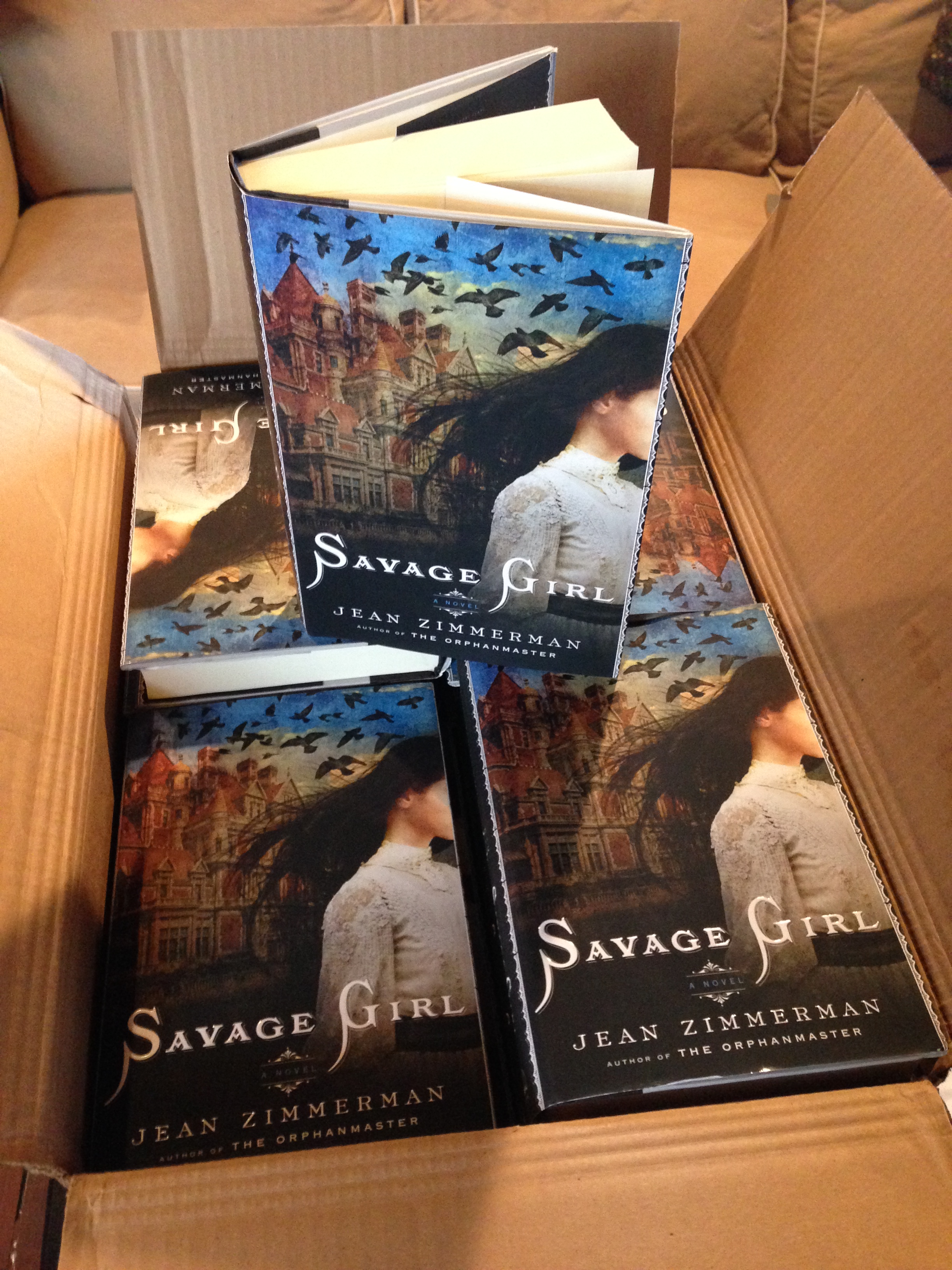
A brick of books. Author copies. Twenty-eight, to be exact, sitting where UPS dumped the box, in the fresh, deep pile of snow at the head of the driveway. The cardboard was soaked around the edges.

But the books were dry, miraculously. That novel is watertight.

open

2 Comments

Filed under Art, Culture, Fiction, Home, Jean Zimmerman, Nature, Publishing, Savage Girl, Writers, Writing

Kirkus Reviews Savage Girl

Kirkus Reviews Savage Girl (pub. Feb. 15, 2014):

A formal, measured tempo only heightens the tension in Zimmerman’s second historical fiction–cum-thriller (The Orphanmaster, 2012), this one set in the 1870s and concerning a serial killer whose rampage ranges from a rough mining community in Nevada to upper-class Manhattan.

The novel opens in 1876 with narrator Hugo Delegate, Harvard-educated scion of one of New York’s wealthiest and most socially connected families, locked up for the gruesome murder of another New York dandy. He willingly claims his guilt—though that guilt is far from certain—but his expensive lawyers demand he tell them the true story from the beginning. Hugo starts with his family’s visit to Virginia City, Nev., home of his father Freddy’s silver mine. Soon, Hugo’s parents, eccentric liberals interested in the nurture/nature debate raised by Darwin, are eager to adopt a young girl they have discovered in a Virginia City freak show, the owner of which claims she was raised by wolves. Of unknown origins, she speaks Comanche as well as a smattering of English, and her performance involves a set of mechanical claws and a swimming tank. The girl, whose name turns out to be Bronwyn, travels on the Delegates’ private train to New York, where the Delegates plan to put one over on their friends My Fair Lady–style by having her debut as a fashionable young lady. But one grisly murder after another seems to follow in Bronwyn’s wake, the victim always a man who has shown his attraction to Bronwyn’s considerable charms. Is Bronwyn, with her animallike instincts, the killer? Or is it Hugo, with his past mental problems, his capacity to black out and his love for Bronwyn that borders on jealous insanity? Neither Hugo nor the reader is sure right up to the satisfying if melodramatic end.

Zimmerman’s dark comedy of manners is an obvious homage to Edith Wharton, a rip-roaring murder mystery more Robert Louis Stevenson than Conan Doyle and a wonderfully detailed portrait of the political, economic and philosophical issues driving post–Civil War America.

4 Comments

Filed under Culture, Fiction, History, Jean Zimmerman, Publishing, Savage Girl, The Orphanmaster, Writers, Writing

A Fresh and Juicy Book

The dog woke up. It was mid-afternoon.

sleepy oliver

He barked. I looked out the window. A UPS truck. More important, snow.

snow cabin

I didn’t want to go outside to get a package. I wasn’t expecting anything. I’d stay in my socks.

Do the trees feel cold? On this day they would have.

trees

The UPS guy whistled a tune as he headed from the Cabin back to the truck, winding his way through the snow banks.

Have you ever handled The First Book, fresh from the package? No?

When Gil came home he told me something had come for me, out on the porch. He slit open the plastic.

A hardcover of Savage Girl fell out, fresh and juicy as a ripe apple and cold as though it had been plucked from a tree in fall. The jacket, of course, was no surprise, as my publisher had involved me in the design process. But so many little details seemed different, the exact shade of blue on the back cover, the smidgen of lace along the edge. The spine, with my book’s title and my name and “A NOVEL” all perfectly proportioned.

jean book

There are a number of peak moments when you write books. The day you jot down a note and think about all it might be. The first page you write. Getting halfway done. Turning it in. Turning it in again after you revise it. Seeing the typeface. Paging through a galley.

No matter how many milestones you’ve passed, nothing can prepare you for the heft of the hardcover, holding this object in your hand, the ephemeral idea you had so long ago transformed into a tactile reality.

2 Comments

Filed under Art, Fiction, Jean Zimmerman, Nature, Publishing, Savage Girl, Writers, Writing

Stop by My Author Page and Say Hi

My Facebook author page has a brand new cover – it quotes Library Journal saying that Savage Girl is “A fanciful and occasionally surreal take on Gilded Age New York.”

And hey, I just reached 100 likes, a figure I’m a little proud of. But I’d like more likes, more! And more visitors. Come see reviews and interviews as they come in, as well as offers for galley giveaways. Savage Girl doesn’t hit stores until March 6 but there’s a lot going on before then.

I’m always trying to put up something fresh, not only about my books (Savage Girl, The Orphanmaster, Love Fiercely and others) but about writing, reading, and living in such a way as to make those things possible. How do you water an idea to make a book come up? Always trying to figure that out.

watering-can

Something else: please post on my page! I would love to hear what you’re thinking about.

2 Comments

Filed under Culture, Fiction, Jean Zimmerman, Love, Fiercely, Poetry, Publishing, Savage Girl, The Orphanmaster, Writers, Writing

A Room of One’s Own-Thank You Virginia

A belated happy birthday to Virginia Woolf (born January 25th), a writer whose fiction I idolized when I was around sixteen. I had the firm conviction that her novels To the Lighthouse and Mrs. Dalloway, innovative, modernist, poetic, were about as good as literature got.

Virginia Woolf cu

When I discovered Woolf’s book-length essay A Room of One’s Own, in college, I was thunderstruck. And I’ve never lost that feeling. I re-read Woolf’s arch 1929 critique of a sexist world, a discriminatory educational system, the need to nurture female talent, and I’m still pumping my fist in the air.

“A woman must have money and a room of her own if she is to write fiction.” A Room of One’s Own

Adeline Virginia Stephen was born on January 25, 1882, to Julia Stephen, a model for Pre-Raphaelite painters, and Leslie Stephen, a well-known biographer. She had seven siblings and half-siblings, and was brought up in an upper-middle-class Kensington household. That she suffered some sort of mental disorder (she was probably bipolar) was clear from her first breakdown at the time of her mother’s death in 1895. She collapsed again when her father died in 1904. In 1912 she married Leonard Woolf and in 1915 she published her first novel. Despite her recurring “madness,” she was able to publish and run Hogarth Press with Leonard and be active in the Bloomsbury literary group for the rest of her life.
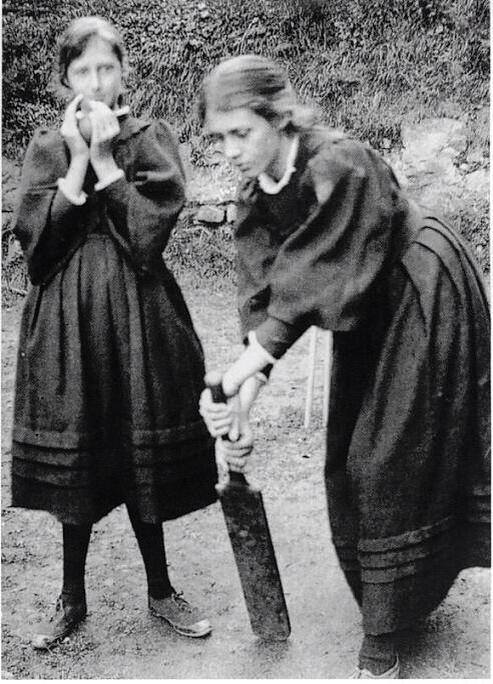
Virginia and her sister Vanessa playing cricket

That’s Virginia and her sister Vanessa playing cricket, proving that she had a lighter side.

“One cannot think well, love well, sleep well, if one has not dined well.” A Room of One’s Own

On March 28, 1941, Woolf filled the pockets of her overcoat with stones and walked into the River Ouse, near her house, to drown. An object that moved me beyond words was the simple wooden walking stick she took with her into the river, found floating near where she went in, preserved in the collection of The New York Public Library and shown in an exhibit of the library’s treasures a few years back.

woolf's walking stick

“When, however, one reads of a witch being ducked, of a woman possessed by devils, of a wise woman selling herbs, or even of a very remarkable man who had a mother, then I think we are on the track of a lost novelist, a suppressed poet, of some mute and inglorious Jane Austen, some Emily Bronte who dashed her brains out on the moor or mopped and mowed about the highways crazed with the torture that her gift had put her to. Indeed, I would venture to guess that Anon, who wrote so many poems without signing them, was often a woman.A Room of One’s Own

There is one surviving recording of Virginia Woolf’s voice. She delivered a talk called “Craftsmanship,” part of a 1937 BBC radio broadcast.

VIRGINIA WOOLF

Here is Woolf’s take on Judith, Shakespeare’s erstwhile sister, also from A Room of One’s Own. Tell me if after reading this you are not also pumping your fist in the air.

“I told you in the course of this paper that Shakespeare had a sister; but do not look for her in Sir Sidney Lee’s life of the poet. She died young—alas, she never wrote a word. She lies buried where the omnibuses now stop, opposite the Elephant and Castle. Now my belief is that this poet who never wrote a word and was buried at the cross–roads still lives. She lives in you and in me, and in many other women who are not here to–night, for they are washing up the dishes and putting the children to bed. But she lives; for great poets do not die; they are continuing presences; they need only the opportunity to walk among us in the flesh. This opportunity, as I think, it is now coming within your power to give her. For my belief is that if we live another century or so—I am talking of the common life which is the real life and not of the little separate lives which we live as individuals—and have five hundred a year each of us and rooms of our own; if we have the habit of freedom and the courage to write exactly what we think; if we escape a little from the common sitting–room and see human beings not always in their relation to each other but in relation to reality; and the sky. too, and the trees or whatever it may be in themselves; if we look past Milton’s bogey, for no human being should shut out the view; if we face the fact, for it is a fact, that there is no arm to cling to, but that we go alone and that our relation is to the world of reality and not only to the world of men and women, then the opportunity will come and the dead poet who was Shakespeare’s sister will put on the body which she has so often laid down. Drawing her life from the lives of the unknown who were her forerunners, as her brother did before her, she will be born. As for her coming without that preparation, without that effort on our part, without that determination that when she is born again she shall find it possible to live and write her poetry, that we cannot expect, for that would he impossible. But I maintain that she would come if we worked for her, and that so to work, even in poverty and obscurity, is worth while.”
4 Comments

Filed under Cooking, Culture, Fiction, History, Home, Jean Zimmerman, Photography, Poetry, Publishing, Writers, Writing

“First to Read” at Penguin

Please note that the art people at Viking have helped me with a facelift for the site, posting a new Savage Girl banner with a matching background pattern of gleaming orangey rust. Publishing a book is anything but a one-person job. I so appreciate all the help I’ve gotten bringing this novel to the state it’s at today.

The state it’s at… well, you’re going to have to wait to find Savage Girl at your corner bookstore for another six weeks, so here’s some good news. The folks at Penguin (Viking’s parent company) have a special program through which you can request a digital version of the book. If you love paper pages and a luscious new jacket, wait. If you want, though, you can jump in now, through Penguin’s “First to Read” program, and get the novel on your e-reader. Then please leave a comment and let me know your reactions.

penguinlogo_60w

1 Comment

Filed under Art, Culture, Fiction, Jean Zimmerman, Publishing, Savage Girl, Writers, Writing

The Body Parts of Vesalius

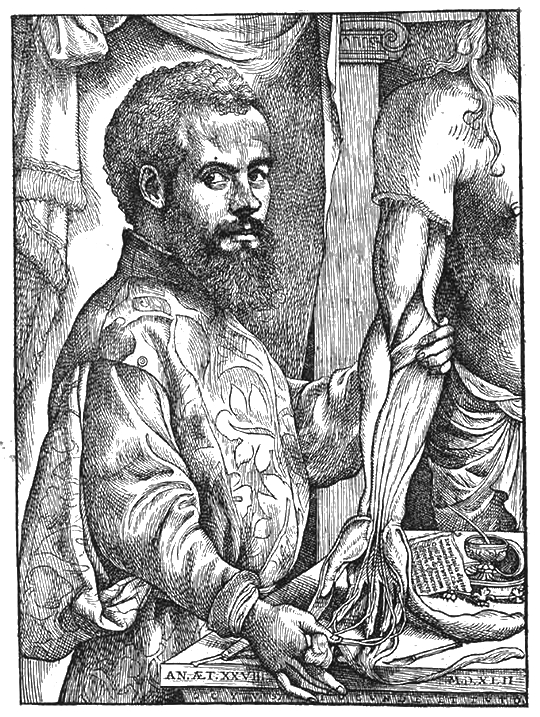
In Savage Girl, the Harvard student and aspiring anatomist Hugo Delegate spends untold hours over his drawing table, making pictures of whatever body parts he is lucky enough to get ahold of: human bones, hearts, hands, the cerebellum of a child killed tragically in a streetcar accident. The body is a mystery to him, one he wants earnestly to plumb. Aiding him in his self education is the work of a sixteenth-century anatomist named Andreas Vesalius, a Flemish physician based in Brussels who published a book called De Humani Corporis Fabrica in which the human body was for the first time demystified.

vesalius portrait

The fruit of untold hours of dissection and learning, the Fabrica went against the scholarly approach heretofore used to teach medical students. It exposed the body to the light with an exactitude that shocked and dismayed the day’s scientists.

vesalius 1

Vesalius performed the dissections but did not execute the illustrations. Those he supervised closely at his own expense in the Venice studio of Titian. In the text, he used metaphor to describe parts of the body, some of which did not yet have names. To talk about muscles, he used such images as a fish, a pyramid, a cleaver. Other parts were described as pumpkin vines and pigeon coops. It might seem odd, this combination of metaphor with so graphic visuals, but he was trying to discover a language that didn’t exist yet. After the work’s publication he took a position in the court of Emperor Charles V, where he had to put up with the jibes of other physicians calling him a barber (in fact, barbers were usually surgeons in those days, termed chirurgeons in English).

vesalius 2

The circumstances of Vesalius’ death have been debated over the years. Scholars once thought he died after performing an autopsy on a nobleman whose heart was still beating and was sentenced to death. Now it is believed that In 1564 Vesalius went on pilgrimage to the Holy Land. Returning, he died when his ship wrecked on the island of Zakynthos. He was just 50 years old, and so broke that a benefactor came forward to pay for his burial, somewhere on the island of Korfu. Recently Vesalius’ own personal copy of the Fabrica has been discovered, complete with the scientist’s marginal annotations, which prove that he went on exploring long after his great work had been published.

3 Comments

Filed under Art, Culture, History, Jean Zimmerman, Nature, Publishing, Savage Girl, Writers, Writing

Publishers Weekly Interview w/Jean Zimmerman

PW 1

PW 2

2 Comments

Filed under Culture, Fiction, Jean Zimmerman, Publishing, Savage Girl, Writers, Writing

The Power of Words

Martin Luther King, Jr. Day is an occasion that celebrates among other things the power of words.

martin-luther-king-2

The man was a Shakespeare for our day.

And so I really like this post by someone who talks about how some good novels lead us, as Wordsworth once put it, “toward obliterating the vulgarity of exclusiveness.” I urge you to check it out. There is a list of 19 books that speak truth to prejudice. The recommendations are far ranging. They include Julie, or the New Heloise by Jean Jacques Rousseau.

rousseau

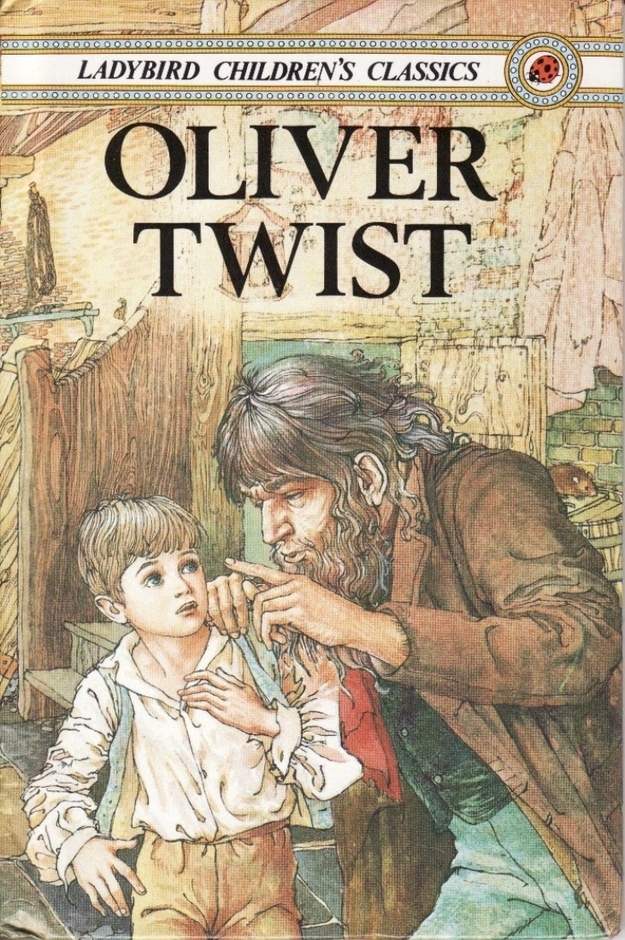
Dickens’ Oliver Twist.

twist

Uncle Tom’s Cabin.

stowe

Ralph Ellison’s Invisible Man.

ellison

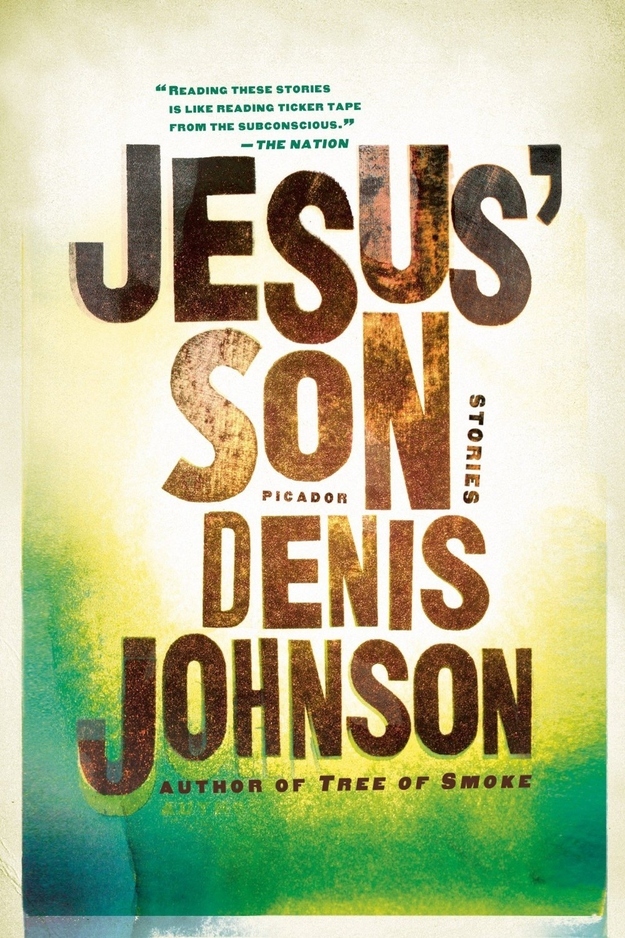
And, interestingly, Jesus’ Son by Denis Johnson.

jesus son

You may have read one or two of these selections before. Let’s read them again, for their politics as well as their poetry.

1 Comment

Filed under Culture, History, Jean Zimmerman, Poetry, Publishing, Writers, Writing

Bound vs E-Books Revisited

How many books do you have stacked on your nightstand? Or piled on the bedroom floor, or scattered across the coverlet? Does your coffee table hold bound books or yesterday’s papers or riffled copies of Vanity Fair? Do you tuck a paperback into your bag when you go to wait in the doctor’s office, or do you slip in your IPad? When you go out to power walk, are you also power listening to a wonderful story?

stack

If you absorbed a book in some form you are in the majority – so did 76 percent of American adults last year. That surprises me, actually. Fully 24 percent of us read no book at all? Who are those people? I guess the ones poring over Vanity Fair. The new Pew Study that identified the 76 percent also found that the “typical American adult” read or listened to five books in a year’s time and that the average for all adults was 12 books. Not bad. A figure that hasn’t changed recently.

Something that will gratify both the hearts of Luddites and of independent book store sellers is that print is still the medium of choice. Even people who read e-books (28 percent) also often read the paper variety. Just four percent of readers confessed themselves to be exclusively e-book.

I like my several-years-old Kindle, now slightly weather-battered. I like that I’m carrying around a library of 100 volumes and can dip into any of them at will, at any time.  I love that I can send an electronic file of a book I’m working on to my Kindle and read it in one hand, rather than printing out clumsy manuscript pages. Or having ready access to the draft of her novel a friend wants me to read. So easy. The prose sings with the Kindle’s light behind it. And I love ordering stuff to read on it with just a click and feel cool that I can do so on a whim. Sometimes I get junk food, like the Central Park murder mystery Death Angel by Linda Fairstein. It’s like a box of New York chocolates I might not pick up in a store.

death angel

If someone at a dinner or over coffee mentions a more obscure or older title, say The Alligators of Abraham, by Robert Kloss, or The Dinner, a novel by Herman Koch, or Eat the Document by Dana Spiotta, I’m off and running.

EatTheDocument

These are works I wouldn’t necessarily find browsing at my local shop, The Village Bookstore in Pleasantville, New York. Though I know they would always be helpful about ordering them. More lucrative for the proprietors that I go in and order stacks of new hardcovers. Which I have been known to do.

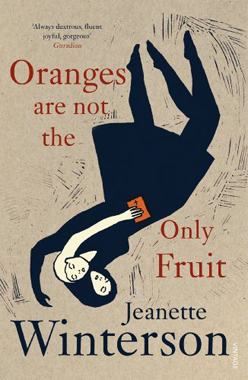
An example of a lesser-known item in my digital library: Jeanette Winterson’s Oranges Are Not the Only Fruit. People had been mentioning this book to me for a long time and it won all kinds of prizes when it came out in 1985.

oranges-1

The British author also wrote the novel Sexing the Cherry. The book begins:

Like most people I  lived for a long time with my mother and father. My father liked to watch the wrestling, my mother liked to wrestle; it didn’t matter what. She was in the white corner and that was that.

White corner?Alright, I’m in. And Winterson goes on, portraying a world I have never imagined that that if it wasn’t for an electronic device I would never experience.

But then sometimes I dip into a book I’ve downloaded to my device and say, Why? What in a million years possessed me to gather this title into my library? The novel I’m trying to read is kind of hiding within the cold glass front of this machine and therefore I can’t access it mentally. A book like Cloud Atlas by David Mitchell (I know, everyone loves this one) begs to have its secrets revealed in a stack of actual pages. Not being able to touch paper numbed me to its charms.

Real books, I find, tomes of paper and ink, with beautifully designed jackets or with soft covers whose spine you feel okay about breaking when you plow through with vehemence – real books tend to hold my interest much more. And I find that when I’m reading a book on my Kindle that I really like, my strong impulse is to rush out to a store and buy a print copy. The phenomenal  Book of Ages: The Life and Opinions of Jane Franklin, say, by Jill Lepore. Or Per Petterson’s pitch-perfect I Curse the River of Time. The whole time I was reading I wished I held paper.

august_patterson_riveroftime

Or The Glass Castle by Jeanette Walls. I want to hold the book in my hands, flip the pages back and forth, cradle it on my chest when I read it in bed. I read in bed a lot and I bet if Pew studied the phenomenon they would find that of the 76 percent of Americans who read any kind of books in the past year, 75 percent of them did so comfily and cozily in their beds.

4 Comments

Filed under Culture, Fiction, Home, Jean Zimmerman, Publishing, Writers, Writing

Savage Girl Review in Library Journal

Woo hoo! This just in, from Library Journal, its Feb. 1 issue:

Wealthy socialite Hugo Delegate and his family rescue the “Savage Girl” from a carnival sideshow and bring her back to their mansion in 1870s New York. Reportedly captured as a child and raised by a Comanche tribe, she instantly captivates Hugo with her boldness and energy. The Delegates undergo a campaign to socialize Savage Girl with limited success. Meanwhile, violence follows this young woman across the country, as men she flirts with end up mutilated and dead. In this follow-up to her acclaimed debut, The Orphanmaster, Zimmerman offers a fanciful and occasionally surreal take on a Gilded Age New York that is reminiscent of Caleb Carr’s The Alienist or even Edgar Allan Poe. Most of the novel is narrated by Hugo recounting events in an extended flashback, which feels jarring and out of place. More successful are the action-packed final chapters. VERDICT This is best for fans of Zimmerman’s first novel and readers who like their historical novels tinged with darkness.

Savage Girl cover

Leave a comment

Filed under Culture, Fiction, Jean Zimmerman, Publishing, Savage Girl, The Orphanmaster, Writers, Writing

Starred Review for Savage Girl

Publishers Weekly has come out with a starred review for Savage Girl. The reviewer says:

The prologue of Zimmerman’s superior historical thriller will suck most readers in instantly. On the night of May 19, 1876, 22-year-old Hugo Delegate awaits the arrival of the police at a house overlooking Manhattan’s Gramercy Park, the site of a savage murder committed by either him or a “girl murderess.” Hugo soon reveals that the victim, a “longtime acquaintance and sometime friend,” is but the latest in a series, and after his arrest, he presents the complex backstory to his defense attorney. Flashback to June 1875. Hugo, a Harvard student recently released from a sanatorium, accompanies his family on a cross-country trip. In Virginia City, Nev., he becomes fascinated with a sideshow freak, the so-called Savage Girl, allegedly raised by wolves. Hugo’s parents decide to civilize the girl, and introduce her into society on their return to New York. Zimmerman (The Orphanmaster) keeps the truth hidden until the end, combining suspense with an unsettling look into a tormented mind. Agent: Betsy Lerner, Dunow, Carlson, and Lerner. (Mar.)

Savage Girl cover

8 Comments

Filed under Culture, Fiction, Jean Zimmerman, Publishing, Savage Girl, Writers, Writing

Bread and Circuses

In the summer of 1977 I ran away to join the circus. I didn’t have to run too far–it was located in New York City, my back yard, where I went to college. The Big Apple Circus was just being born, and I served as a lowly gal friday for the new entity, first in its office in SoHo and later, when the tent went up, at the circus itself, at Battery Park, the lower west side of Manhattan, on a desolate, gritty stretch of landfill in the shadow of the World Trade Towers. Not a circus person, not an acrobat or a performer of any kind – an aspiring writer who did more dreaming than writing – I found myself in awe of the charismatic, enterprising young men who ran the enterprise, Paul Binder and Michael Christensen, street performers just back from doing their ultracool juggling act in Paris.

Paul Binder:Michael Christensen

That July 18, we opened the one-ring, European-style circus with its old-fashioned green canvas big top. No animals, just clowns and tumblers, people I watched balance and jump and stretch as they rehearsed, sweating in the hot early summer weather, some of them street kids seemingly made out of elastic, recruited from some of the less tony precincts of New York.

first tent

I would turn twenty the day after the circus opened. I remember selling tickets out of the office/trailer a stone’s throw from the tent alongside an intense, frizzy-haired kid who taught me the meaning of the term Ashkenazi. Funny the things you recall learning at odd times in your life. The Battery was a magical place to be. Dusk would fall, the hazy sun setting red over New Jersey, shadows would stretch across the landfill, and we would be waiting there, just hoping for an audience for the evening performance.

Earlier, a peak experience came when I somehow got assigned to hop into the cab of the rig that drove into town to deliver the gigantic tent. As I tried to guide the truck around the curve of the Battery to the circus entrance we bumped up over the median with a lurch, and I’m not sure that we didn’t crush it. Oops, don’t send the writer out to get technical with an 18-wheeler.

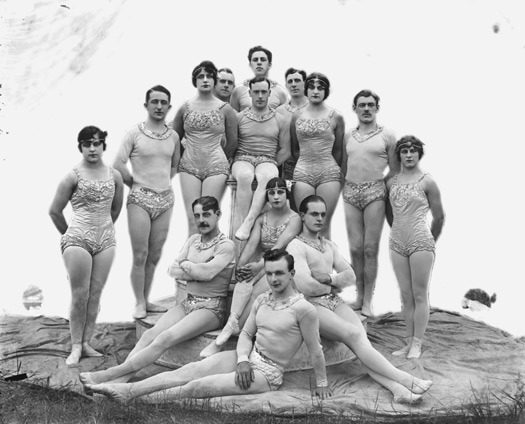
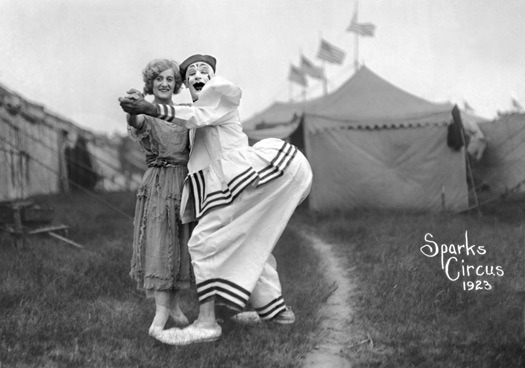
I came upon these turn of the century circus photos by F.W. Glasier, a commercial photographer in Brockton, Mass., who shot promotional photos of the various circuses that came through town over the years, and I was reminded of that time in the late 1970s when one small-town circus was in its infancy.

Here are strongwomen from 1904.

strongwoman1904

A troupe of performers in 1906.

troupe 1906

1907 trapeze work.

Trapeze 1907

A snake handler working it in 1901.

snake1901

The raw energy of clowning.

sparks

A mistress of the wire.

wire 1908

And, from the 1920s, circus twins who look to me like they have the world on a string.

twins 1920s1

Leave a comment

Filed under Culture, History, Home, Jean Zimmerman, Photography, Writers, Writing

Long Winter’s Nap

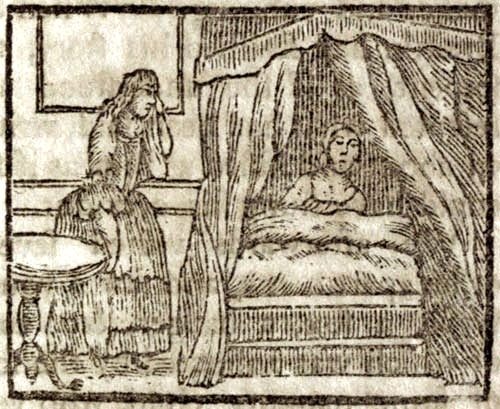
I’ve taken the polar express right upstairs to my bedroom, since my downstairs office is a good 15 degrees colder. Computer, books, coffee, check. The only thing I lack here is a canopy bed such as the kind they built during the middle ages.

medieval block print

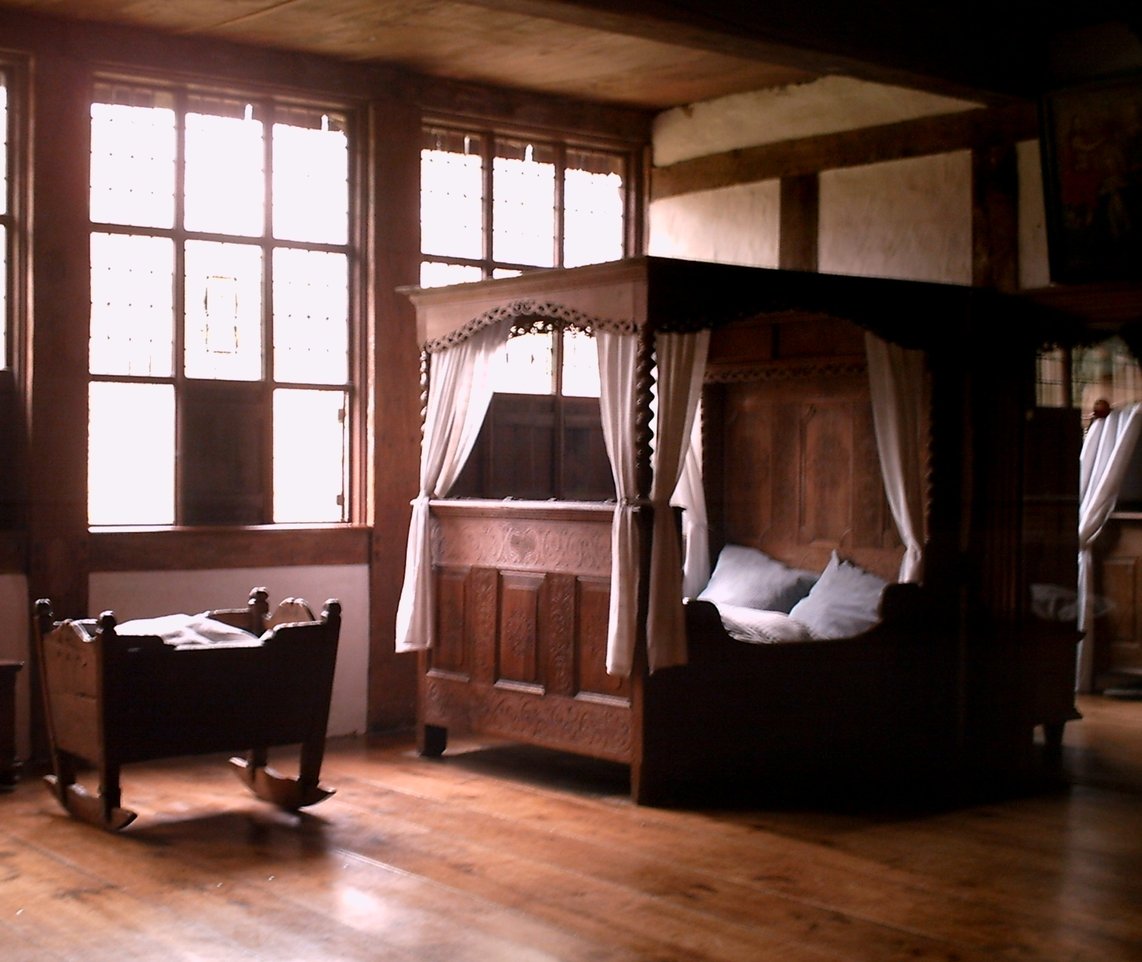
Long curtains to pull around the sides kept you cozy.

DV IMAGE

Sleeping might not have been so comfortable today as it involved straw-stuffed, weevil-engorged mattresses. But it was better, I think, than earlier, when the Romans laid themselves out on planks.

Roman Beds

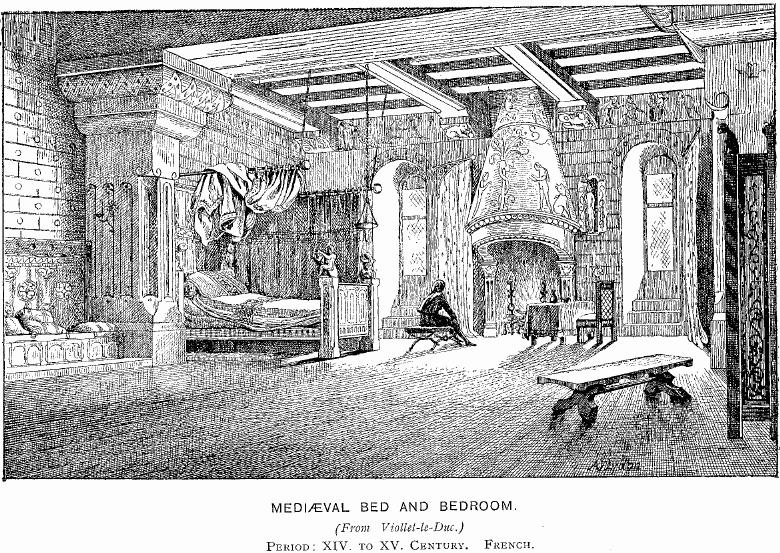
Especially for the wealthier sort in the Middle Ages, drapery offered privacy. Nice when servants and even livestock slept in the same great hall as you did.

med bed and bedroom

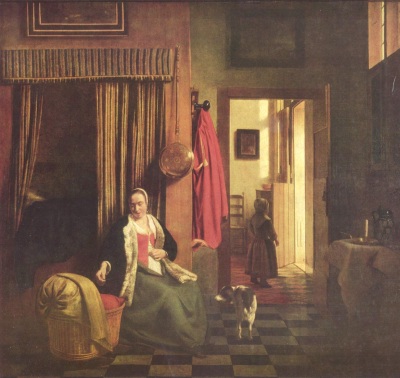
I’ve always liked the Dutch version of the canopy, which often appears in Golden Age art with a cradle right near by.

Woman cradle de Hooch

And often a dog. Here there’s also an idea I’d like to bring back tonight, a warming pan into which you place hot coals, then swish it fast between your sheets before you slide between them.

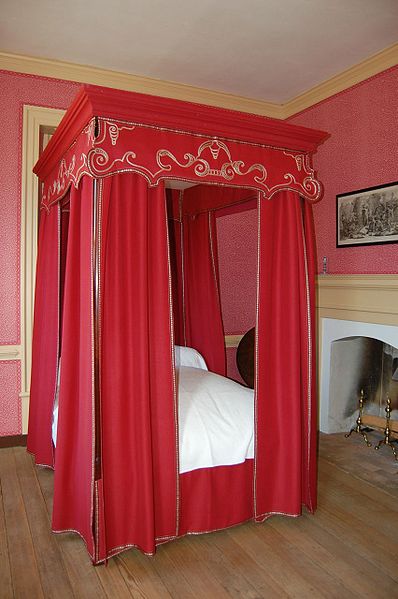
I’ve frequently been tempted  to crawl right in to a bedstead in Colonial museum or historic house. Especially nice is the idea of a blazing fire right nearby.

colonial williamsburg canopy bed

I could hide. Pull the brocade, stay quiet and nobody would find me.

1800 New England bed w curtains and valance

Though they might hear me swiffing the warming pan around.

Van Cortlandt House bed

Wait until spring comes, yank back the curtains, roll out. A survivor of the cold snap of 2014.

2 Comments

Filed under Art, Culture, Dogs, History, Home, Jean Zimmerman, Nature, Writers, Writing