Category Archives: History

Legless and Liking It

I thought the leopard slug I discovered on the porch yesterday at dusk was the worst thing I’d seen this summer.

leopard slug

Almost the length of my hand, it trailed its silvery sap behind it, creeping along the boards as though it hadn’t a care in the world. I could easily have smushed it with my bare foot, on my way to watch the fireflies.

These creatures, genus Limax, live beneath the weathered floor boards in some comfortable arrangement I imagine as including a cigar box bed out of  Mary Norton’s The Borrowers. But ookier. Hermaphrodites, the slugs have an unusual style of mating, using a thick thread of mucus to hang suspended in the air from a tree branch or other structure, an intense balcony scene to beat Shakespeare’s. The leopard slug was first spotted in the New World relatively recently, in a Philadelphia basement, in 1867.

How’d it get up to my house?

This morning, another discovery, when Gil was mowing the grass.

full length snakeskin

He laid it out on the porch. The shed skin of a snake, long and dry.

I saw this very snake not so long ago, out a window, as it travelled across the back forty towards the Cabin. Jet black and thick as my wrist. Moving in a straight shot towards me. Purposeful. We know they hole up under the clapboards at the back wall of the house because we’ve found their skins there before, left behind like a tossed-aside, too-tight jacket.

A black rat snake such as this one consumes mice and rats and sometimes even chipmunks (I noticed a decline in the chipmunk population around the cabin). It exudes an unpleasant musk as a deterrent to predators, but is known to be shy and will freeze, supposedly, if it spots you close by. It’s not poisonous, but if provoked further it will snap.

It’s sometimes identified, according to Wiki,  as:  Alleghany black snake, black chicken snake, black coluber, chicken snake, mountain black snake, mountain pilot snake, pilot, rat snake, rusty black snake, scaly black snake, cow snake, schwartze Schlange, sleepy John, and white-throated racer…

This particular schwartze Schlange was six-and-a-half feet long, from the reptile’s head — you can see its eyeholes —

snake head

to its tail.

snake tail

Perhaps the rat snake will find the leopard slug appetizing. But what will eat the rat snake?

snake sign

4 Comments

Filed under History, Home, Jean Zimmerman, Nature

Ramen in Harlem

Outside on this July afternoon it’s hot, hot, hot, but you feel as if you’re in a cool womb within Jin, the ramen bar on upper Broadway at 125th Street.

jin sign

This is Harlem, a Harlem of changes. Every neighborhood in New York experiences flux, of course, but this one is currently in crisis mode as Columbia University expands its holdings, spending $6.3 billion dollars to cut a gigantic swath across 17 acres of streets and buildings. It all takes place under the shadow of the IRT Broadway-Seventh Avenue viaduct, now over a century old.

Broadway

The goal is positive: a series of buildings that will enhance the university’s offerings in science, business and the arts. Unfortunately, the development will cause the destruction of many locally owned warehouses, factories and auto repair shops. And tenements. The old buildings are getting boarded up. There were huge protests over this.

old Harlem

I’ve always liked the old-fashioned structures of the neighborhood, crumbling as they may be. Some still stand, their paint weathered, looking as though we’ve let them down. That’s why they call it New York, because nothing is allowed to grow old here, said a spectator quoted by The New York Times as he watched the demolition of the glorious old Pennsylvania Station.

Some buildings have already disappeared, even before this latest chapter, like the diner I used to go to at the terminal point of 125th Street when I was a student here.

s_n39_bpm04512

Wedged under the West Side Highway, it was a great, funky place to look out over the Hudson and dream. It was already ancient when I drank my coffee there.

Now when you look uptown from 125th, Columbia’s mammoth cranes hover over the landscape like the skeletons of some futuristic, predatory beasts.

columbia bldg

But not to worry, Jin is here to soothe us, just short of where the redevelopment starts, at the base of the steps that lead up to the subway platform. Convenient. The train can drop you off into a puddle of steaming, flavorsome, broth.

ramen

New York has a lot of ramen parlors just at the moment. Jin is one of the finest. It’s always crowded, with students and families (babies holding soup spoons as big as their faces), young couples, singles intent upon a book and a slurp at the same time. If I were a student now, with no diner on the Hudson, I know where I’d be.

At the counter we have an up close and personal view of the process in this particular ramen kitchen.

joshua

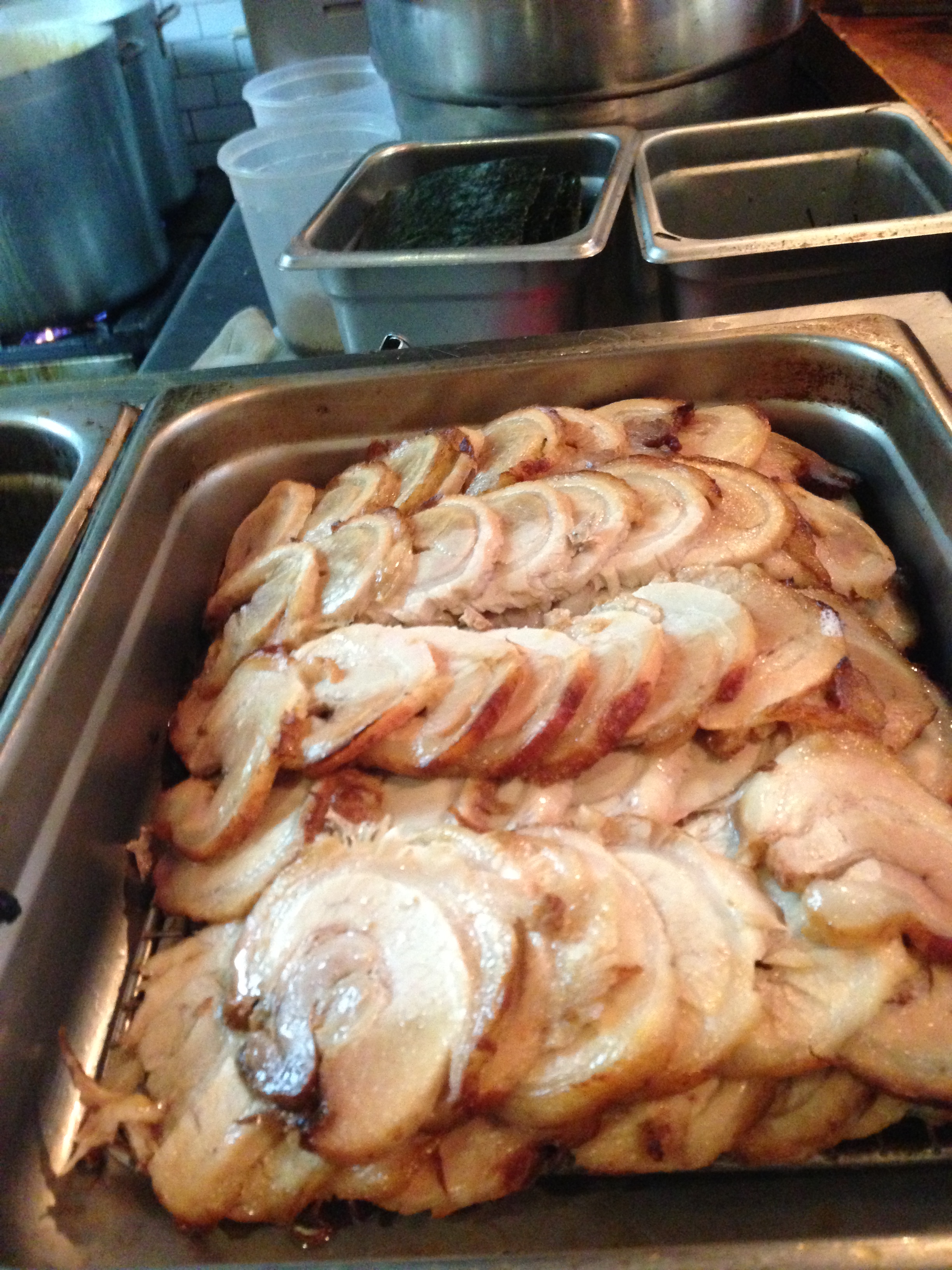
The chef. His name is Joseph. The broth pot, the size of a small boulder. At Jin, they cook the broth to make tonkotsu ramen for hours, pork bones at a high boil, resulting in a creamy texture that’s sort of like a savory gravy. They spoon it into each bowl with a giant’s ladle, then Joseph applies the fixings. The sliced pork belly.

jin pork

Called chashu, roasted for two and a half hours, it’s smoky, fatty and succulent. They can’t leave it in the heat any longer, Joseph says, or it will fall apart. And the idea is to have intact disks of the meat in each serving. Along with a soft-boiled egg, bamboo shoots, fresh scallion and of course the ramen itself. When you enter Jin, everyone is leaning over their bowls, chopsticks flailing, sucking in the long strands of noodle, which are firm, very thin, straight and white. They are unrisen, and are made with sodium bicarbonate water, of all things. If a diner has broth left over and is still not full they can order extra servings of noodles at a nominal cost. This has never happened to anyone as far as I know.

womb room

Now, not because I’m contrary – I don’t usually order the ramen at Jin. You see, the restaurant also offers the rice bowl known as char siu-don, which is one of the more delicious dishes I’ve tasted. It too has slices of pork belly, draped across a mound of perfectly sticky rice, along with a quivering sunny-side-up egg, shreds of bright red pickled ginger, shreds of sliced scallion, sesame seeds and cut nori. I order a side of the spicy garlic paste called mayu to slather all over everything. And then I am excluded from polite company for the next 48 hours.

rice bowl

Jin, if you ask the owners of the restaurant, means “benevolence” and finds its root in Confucianism.  The character that makes up the word consists of two elements, with the left side representing a human being and the right side symbolizing the numeral two. Jin is said to depict the way two people should treat one another.

Perhaps enough tonkatsu ramen can help heal the redevelopment wounds under Harlem’s rumbling IRT bridge.

1 Comment

Filed under Cooking, Culture, History, Home, Jean Zimmerman

Rapid Cycling

You’ve heard about the Citi Bikes that now throng Manhattan. There are thousands of them parked in solar-powered docks from Battery Park to Central Park. Anybody with a bank card can rent one for half an hour. (There are some bikes in the outer boroughs, too.) They’re making New York into Minneapolis or Melbourne or any of the other healthy bike-sharing cities around the world. Everybody in New York is taking a set of wheels out for a spin, tourists and natives alike.

citibikes

I said, when asked, I wouldn’t do it.

I did it.

My logic: there are a lot of things on my reverse bucket list, my fuck-it list, things I pledge never to do. Anything involving getting lofted high above the ground. No skydiving for my 60th birthday.  No bungee jumping any time at all. The list goes on.

Then there are things I will probably never do even though it’s my dream. Leaping over a fence, say, while gracefully swinging my legs out to the side. It’s not a question of being young enough — I never could do it. Too difficult.

But riding a soft-saddled steed on a Manhattan summer afternoon? This I could probably accomplish without undue shock to the system.

Gil agreed.

gil:bike

It would only be 30 minutes, after all.

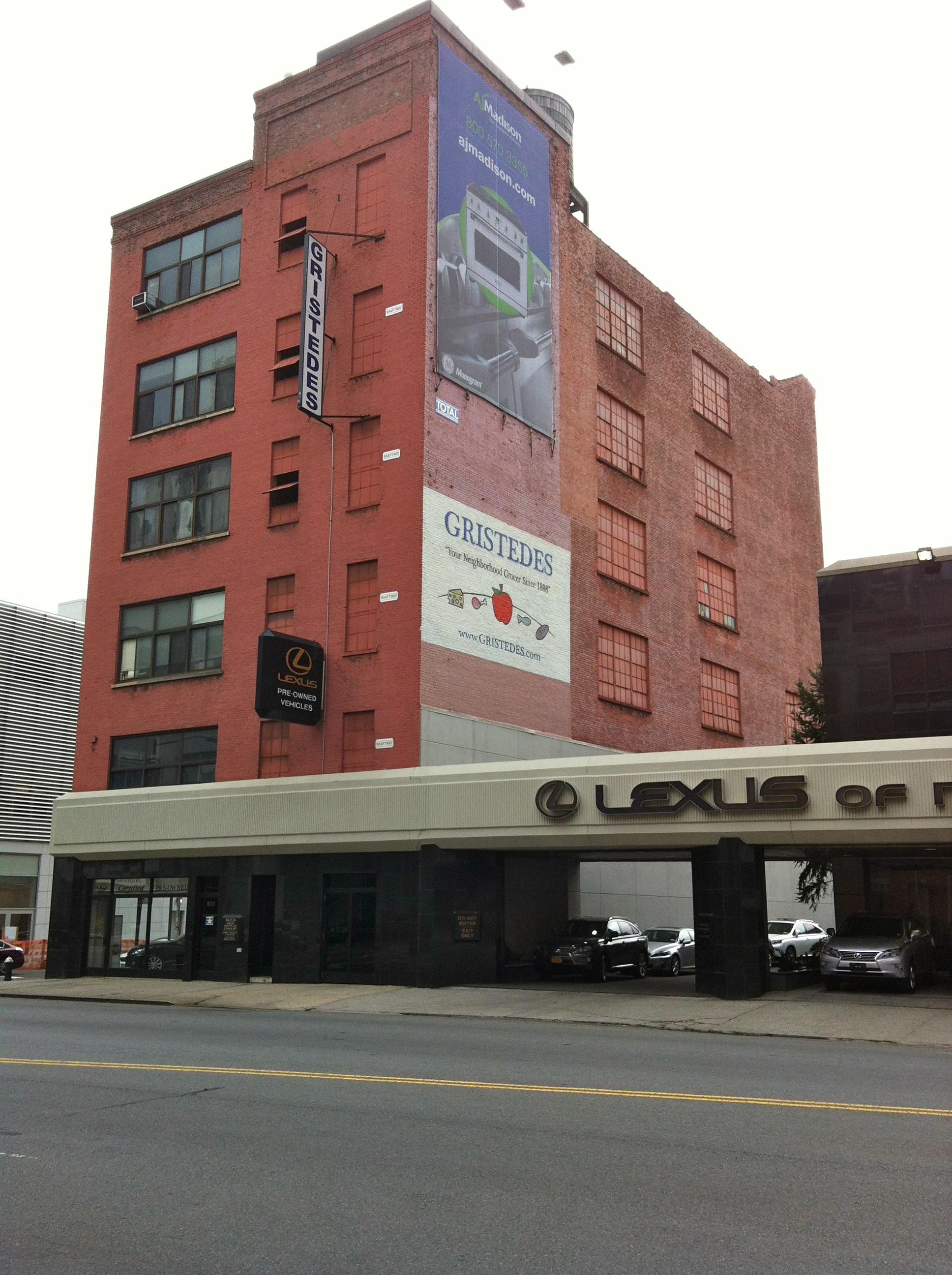
We started at luxury car alley, that stretch of Eleventh Avenue in Midtown where drivers with a fat wallet can take away  a Lexus, an Audi or a Mini. Glossy, glassy buildings on every side. But as in so many corners of New York, shreds of a past neighborhood identity can be found if you look, like old signage for a supermarket over the Lexus dealership.

IMG_0527

Someone was watching us.

IMG_0526

We’d better behave. Across the avenue from the bike rack, at 59th Street, stands a grand monument to both the subway system and steam, a full-block-square Stanford White designed industrial temple that was originally the Interborough Rapid Transit Powerhouse.

power plant

Built in 1904, it has bold Rennaissance Revival details. When it outlasted its usefulness to the subway system in the 1950s, Con Edison took is over to supply the New York City steam system.

Under the shadow of its grand façade we pedaled to the Hudson, wobbling ever so slightly and nearly getting sideswiped by several taxis. Then we joined the stream of cyclists on the pavement along the river under the West Side Highway.

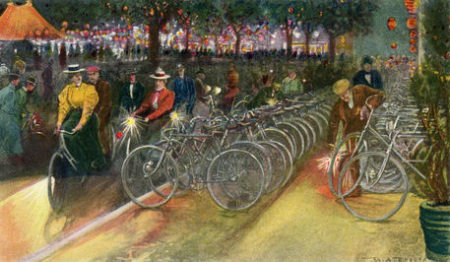
Biking is hardly a new fashion in New York City, especially for women. In the 1890s, female cyclists crowded the urban streets, and their exploits were enthusiastically described by gossip columnists. Pictures of glamorous women, the wind in their upswept hair, graced the covers of Puck, Life, Scribner’s.

1097-1510-Bicycling for Ladies_front cover_copy

A slight hitch in their pursuit of the sport lay in their mode of dress – the yardage of their ankle-length skirts had a tendency to get snagged in the wheels of the so-called “safety bicycle.” But that was okay, split skirts – bloomers – were coming in. Just ignore the consternation of cycling advocate Mrs. Mary Hopkins of Boston on the subject: “It has made wheeling just another way for a woman to make a fool of herself,” she told the New York Times. “She has made a half-way sort of creature of herself. She can’t be a man, and she is a disgrace as a woman.”

wheelsofchange1

Susan B. Anthony thought differently. She said: “I think cycling has done more to emancipate women than anything else in the world. It gives a woman a feeling of freedom and self-reliance.” Feminism before feminism, all on the mean streets of Riverside Drive.

Cyclists in New York, 1890s

“The moment she takes her seat she knows she can’t get into harm unless she gets off her bicycle, and away she goes, the picture of free, untrammeled womanhood.” I don’t know if Susan B. Anthony rode a bike herself.

sewyourownbuttons_wide

I don’t see how I could come to any harm if I got off my bike in one of New York’s new, pristine waterfront parks, aside from getting a headache from looking up at one of the oversized sculptures looking out over New Jersey.

river art

The sculpture by Benat Iglesias Lopez is one of a group installed this year called The Bathers.

I somehow prefer the art of the decrepit pilings that march along the coastline, vestiges of a different age.

nyc pilings

They’ve been there so long, and they’ve seen so much.

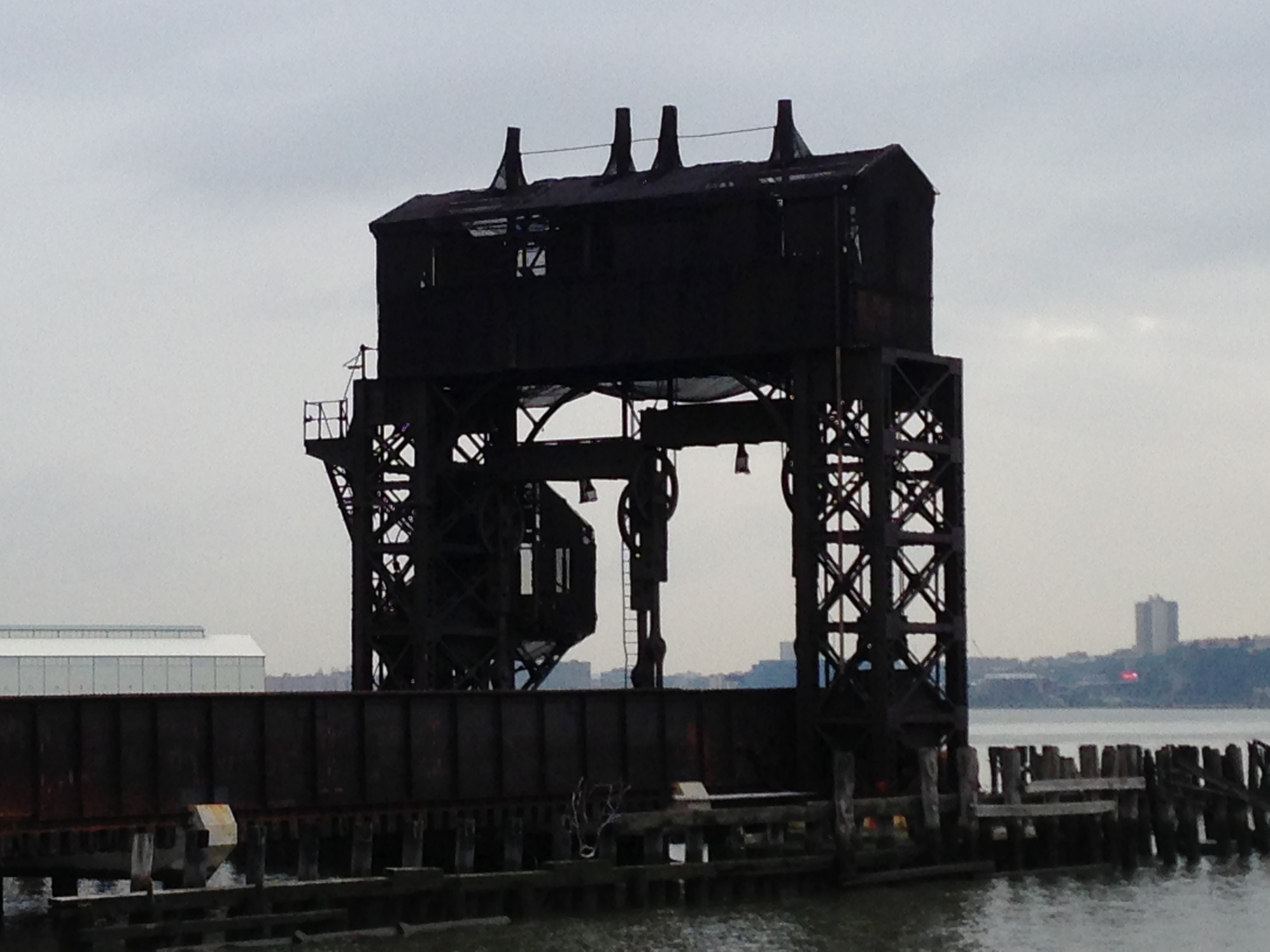
I’ve also always loved this  landmarked historic ruin, the control tower of the 69th Street Transfer Bridge, which at one time belonged to the West Side Line of the NY Central Railroad. The bridge was built in 1911 and enabled the transfer of train cars from rail to boat, to be floated across the river to the rail yards of Weehawken, New Jersey.

elevator tower

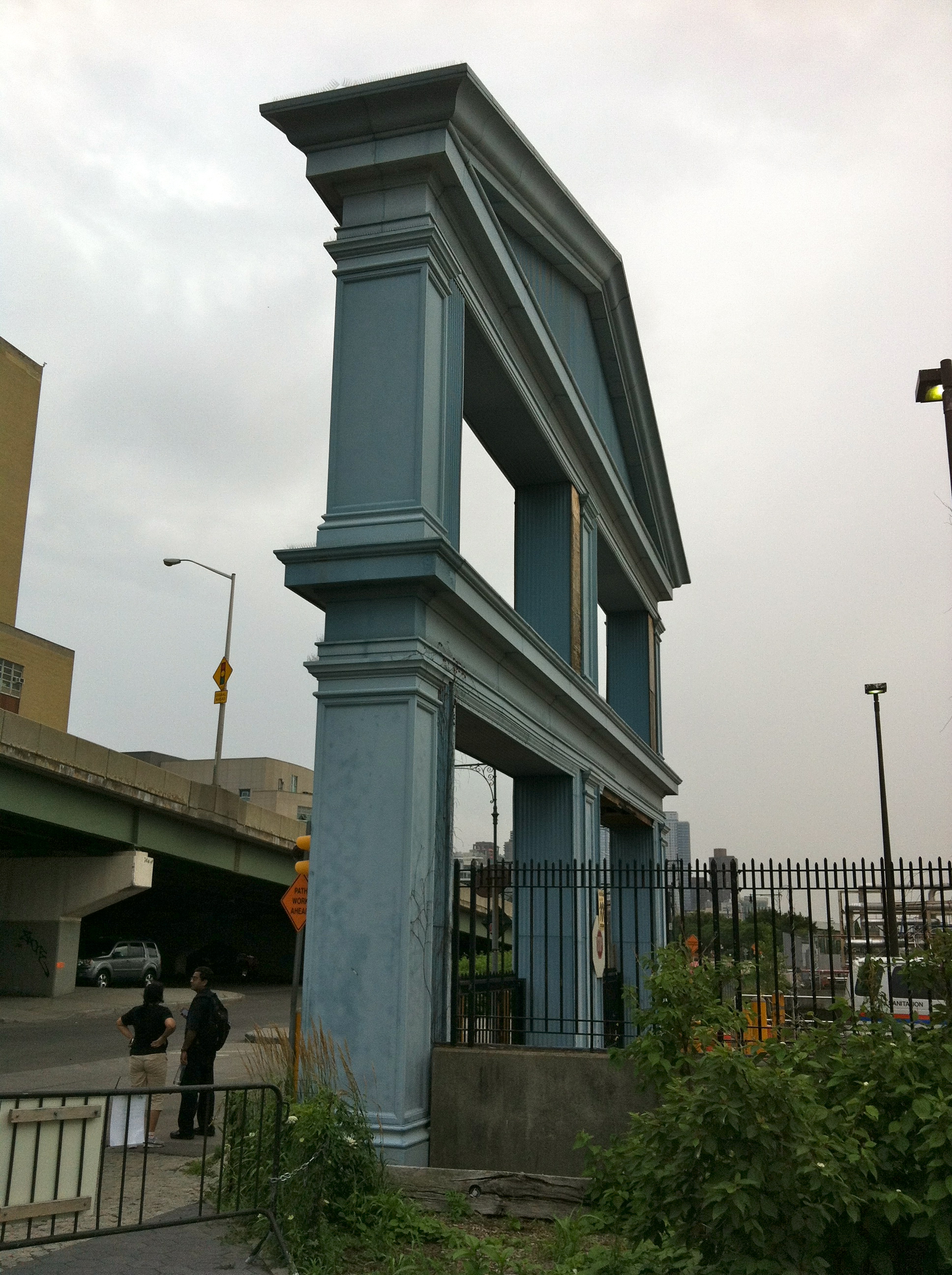
I often get a view of this spooky structure from the West Side Highway that runs alongside it at just about its level. Something else, too, that I can usually spot from the highway but now get a better view from my bike, the proud classical gateway to the Sanitation Pier at 58th Street.

IMG_0525

We checked our watches and found it was the moment to return, but promised ourselves this wouldn’t be the last time we risked our necks for a half hour of the Manhattan wind in our hair.  As we picked up to go, I felt a certain proud resemblance to another female cyclist of the past.

jz bike pose

Only her cycling get-up’s a little more elegant than mine.

17303653102979642

2 Comments

Filed under Culture, Fashion, History, Home, Jean Zimmerman, Photography

Phriends of Phragmites

Today I befriended my inner phragmite.

tulips and dogwood


You’ve probably seen the reeds that form the backdrop for these merry tulips hundreds of times without knowing their Latin name. Marsh grass, aka phragmites. I’ve been thinking about the reeds for a while now, since a landscape-architect friend of mine came to the Cabin and explained that they characteristically grow in “degraded” environments. It hurt a little to know that my beautiful grassy friends have some kind of noxious, invasive taint.

So I was glad to attend a class today that was set up to make art with phragmites and their more distinguished relative, the cattail.

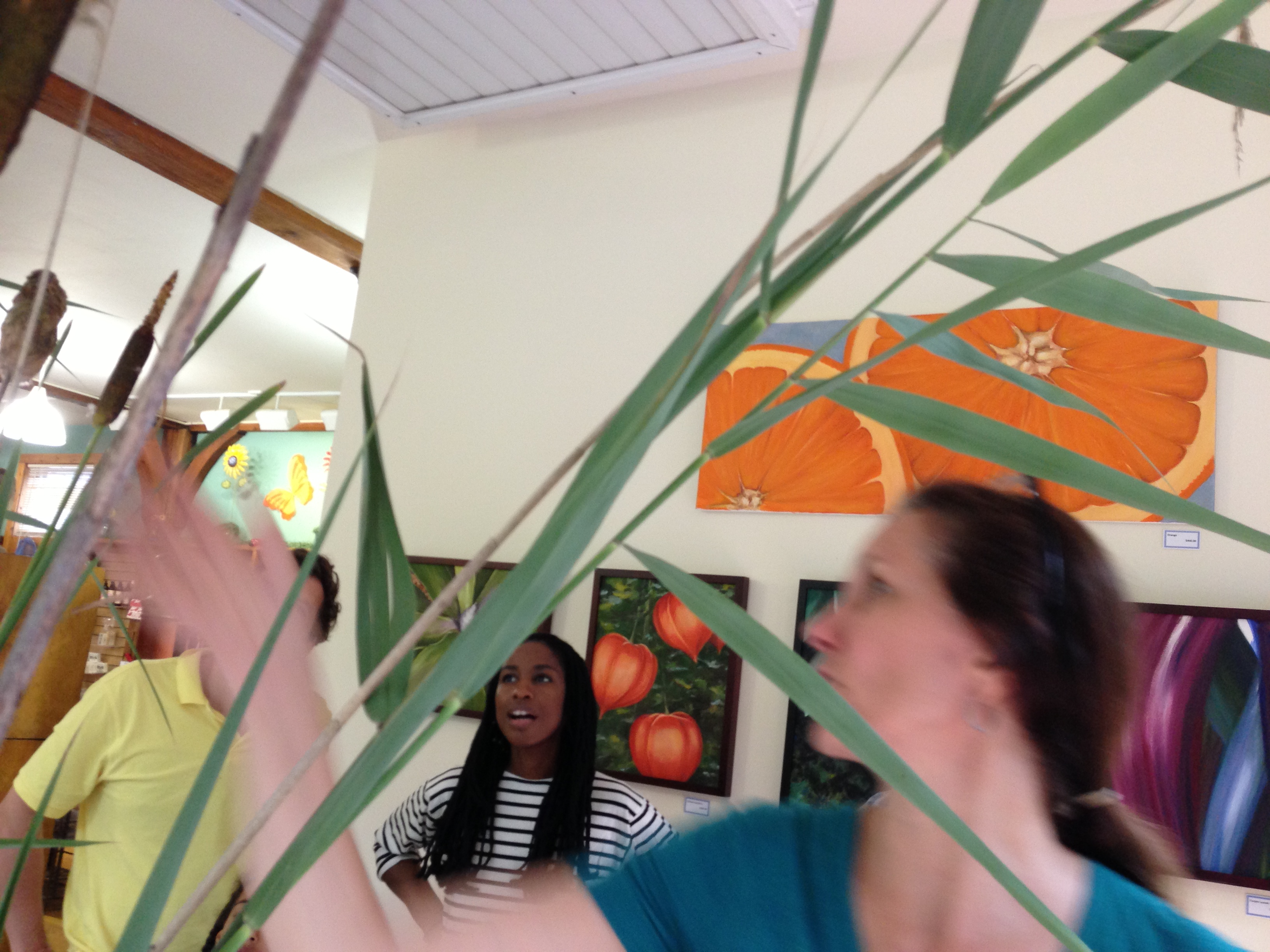
phrags:cattails


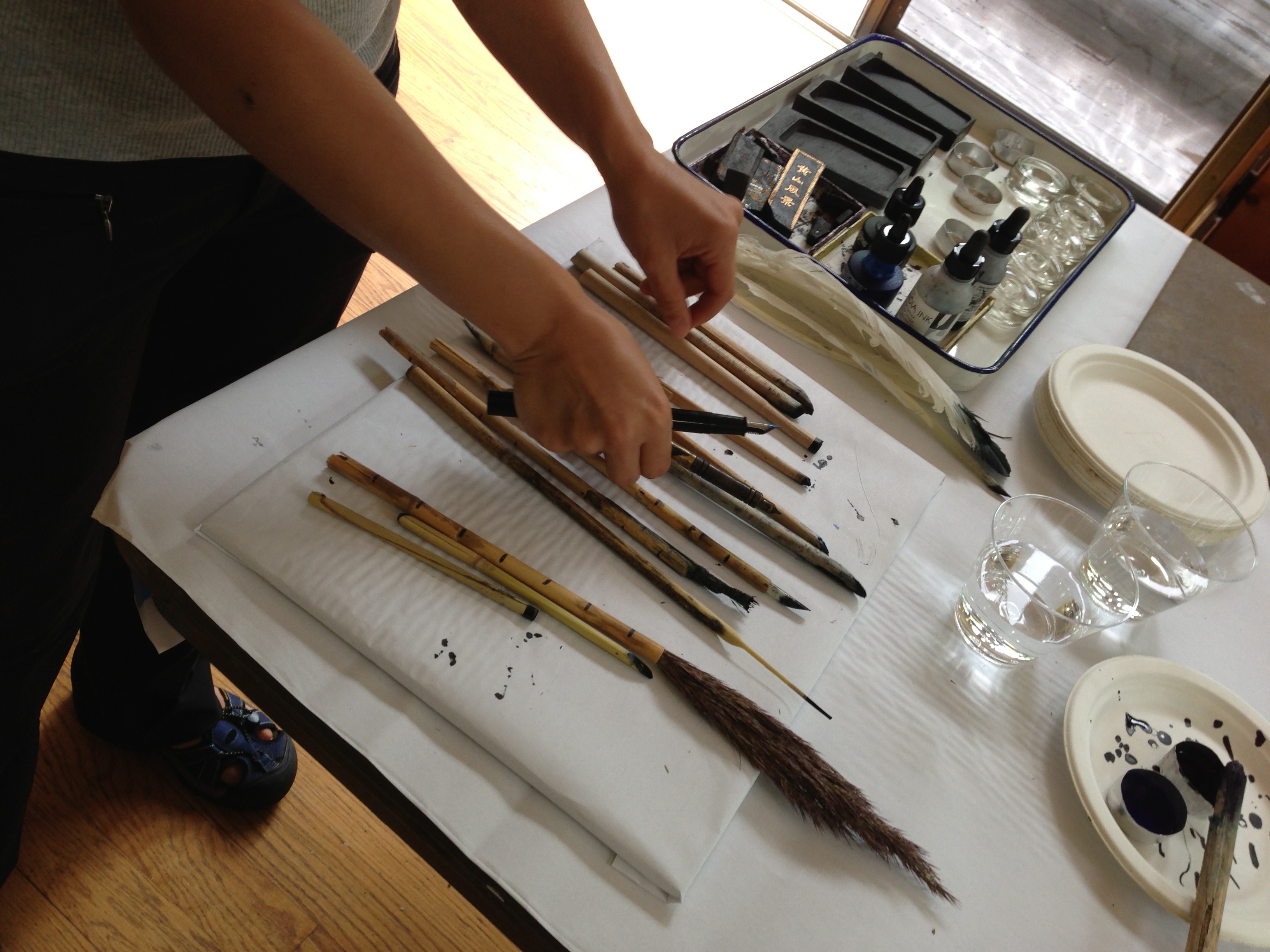
An airy display greeted my eyes upon entering the classroom, at the Teatown Lake Reservation just down the road from the Cabin. Paper and pens and brushes of all different sorts lay ready and waiting.

laying out the brushes


Laurie Seeman and Joanna Dickey were there from Strawtown Art & Garden Studio, ready to explain the differences between and the politics surrounding the different marsh grasses. Yes, there are politics surrounding marsh grasses. The two women are good at teaching about wetlands, that’s what they do at Strawtown for kids and community groups.

While phragmites are used around the world to weave mats and roof thatch, Laurie told me, she didn’t see a use for them in the art studio until she recognized them as “painting partners.” They’d been “demonized,” she said, “by the science people, but as artists we try to look upon them with the most open mind possible.”

laurie in action

What’ s the beef with the phrags? Laurie: “They’re pollution tolerant whereas cattails need cleaner water to thrive.  Certain species need the cattails, and when the phragmites take over there’s no room for them.” Said Joanna, “The phragmites grow closer together and it’s the understory that doesn’t allow the shorter plants to grow.”

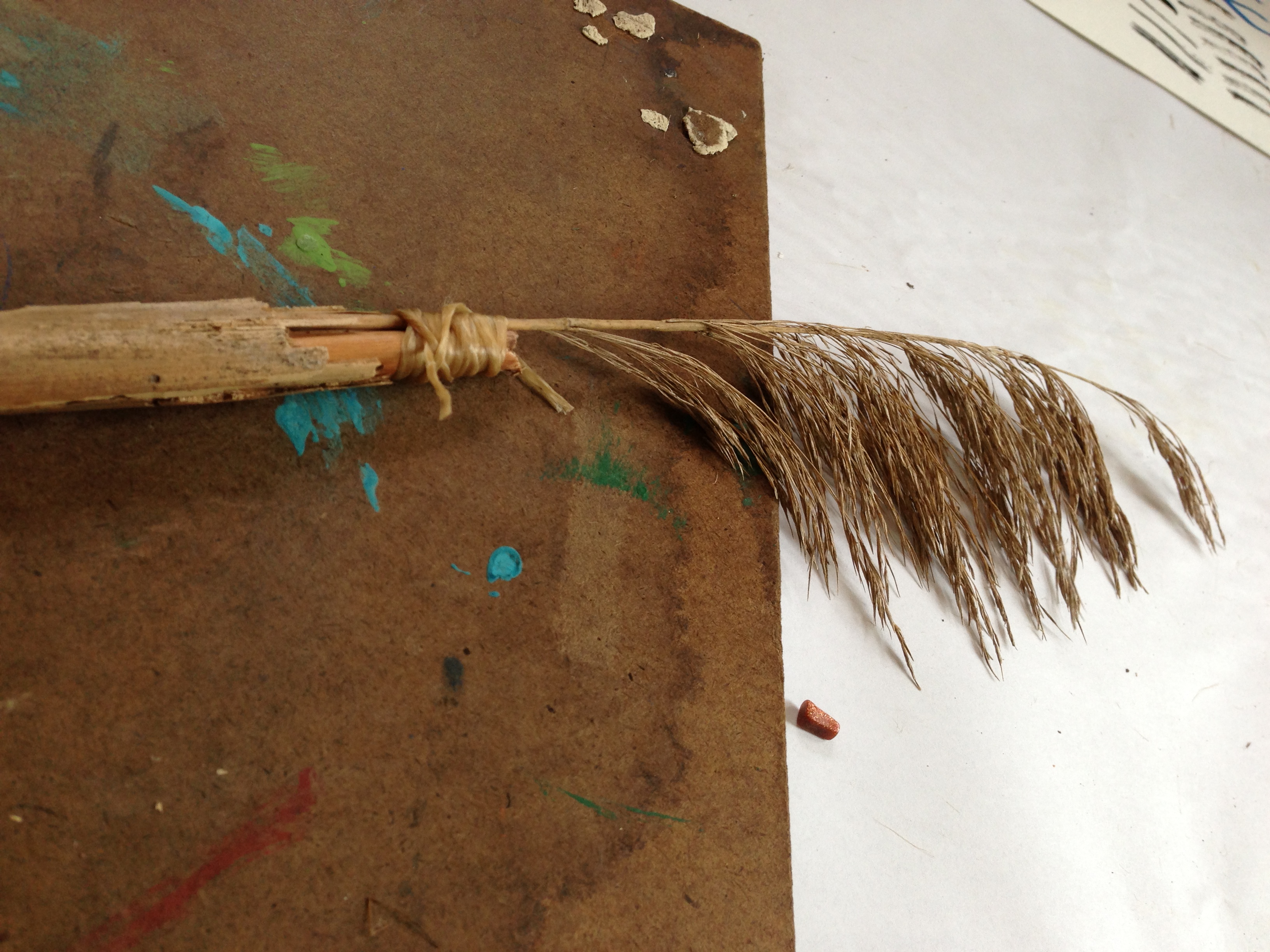
The artist-teachers discovered that for their purposes, the phragmites has a hollow stem like a traditional quill pen whereas the cattail has a spongy interior “much like a magic marker,” as Laurie said. Both work for painting.

interiors


Some say the phrags  came over from China in ship holds long ago, but have proliferated in the last few decades. Some say they clean metals out of sediments — a good thing, maybe. Don’t get Laurie going about research scientists, conservation scientists, corporate scientists, biological scientists, plant scientists, marine scientists. “It’s old-school thinking that phragmites are all bad,” she said. “They have a relationship with places that have been invaded.”

Today we’re going to appreciate them, stems and plumes alike. Gerard Manley Hopkins says, Long live the weeds, and I say, Long live the phragmites.

phrag brush


We dipped the reeds in ink.

ink


We made our own brushes if we wanted. (I wanted.) We took our time, something Joanna advocated.

joanna


Now, cattails are indigenous, and have a plump appeal. They make “comforting places for a bird to sit,” said Joanna.

cattail cu


Their roots are tubers. They’re amazing. Yes, yes, everyone loves a cattail, I know that. It would be un-American not to. But let’s not leave the phrags in the lurch.

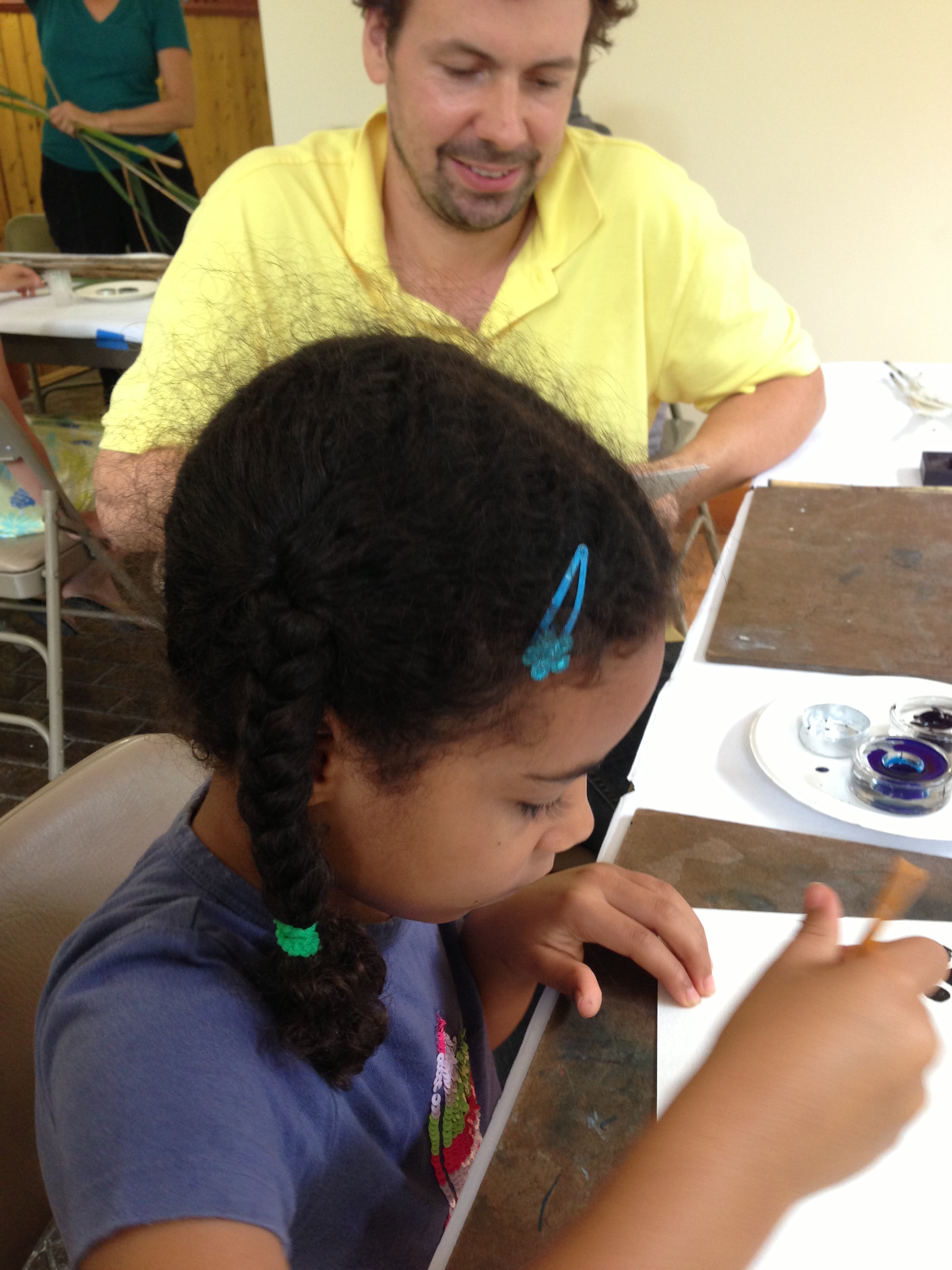
People of all ages were pressing them into service today for art.

father:daughter


In the meantime, there are well-meaning authorities who are trying to destroy parts of venerable Piermont Marsh, just across the Hudson River, with what they’re calling an “enhancement project.” I’ve canoed there many times, and know it as a mystical place with its towering grasses. Good bye, 200 plus acres of phragmites, which have been a stable presence there for 2,500 years. The reeds protected the riverbank during Sandy.

But let’s digress for a discussion of ink. In Japan, the soot that accumulates in the eaves from a pine wood fire makes good calligraphy ink, while whale fat smoke is better for imagery. I’ve left politics behind, lost in my painting, shaking loose drops of ink from my phragmite feather like a marsh-y Jackson Pollack. Laurie introduced something she’d brought along, water in a dark bowl, what she called “water as first mirror.” She said that in ancient times dark liquid was the only source for a person’s reflection.

Laurie and Joanna had gathered branches to make frames, and as I was twisting sinew around sticks I noticed someone I knew, Marguerite, coming over to create her own frame. She was positioning four graceful, delicate boughs before even beginning on the painting it will contain.

Marguerite


Doing it her way.

Something some entities simply have to do. Even the phragmites.

jz w painting

7 Comments

Filed under Art, Culture, History, Home, Jean Zimmerman, Nature

Swedish Farm

My friend Sarah Hollister, an American who has lived in Sweden for some years now, agreed to do a guest post for me. Her perspective and her pictures are lovely. Here she is:

We’re soon leaving the Henning Mankell Gård (translated farm) up here in Härjedalen in the northwestern part of Sweden. Just one more day. One of the great things about this writing residence is that family is welcome (there’s even a sweet baby crib in one of the bedrooms) so my partner Gunnar has been here with me which has been good. This house is too big for one person.

IMG_1634

I spent the first day roaming the roominess of the house, up and down the stairs, examining the books in the library, checking out the huge laundry room, washer, dryer, and a drying closet for heavy rugs. Just enjoying the space before I settled down in my workroom on the first floor.

Gunnar and I took some day trips on the two cycles provided and discovered a number of deserted houses up here, people who had given up. Though we also saw some very prosperous looking farms.

IMG_1486

You can’t be in this part of Sweden without encountering a fäbod, (translated mountain pasture). But a fäbod is more than grass, it’s a concept, now lost, a way of living. Fäbods consist of a cluster of small weathered log houses built on a site where there was plenty of green grass for cows to graze to their heart’s content.

We visited  one just up the road from the Mankell Gård, climbing up the narrow path that led to the high pasture. I thought of cows, of many cows navigating these paths covered in roots and rocks, mooing and balking.

IMG_1536

The log houses are fairly small, no bigger than a large farm shed, with low ceilings, dispelling the myth of the towering Vikings. It’s easy to bump your head if you don’t duck. Most of the buildings were built for storage, hay and wheat, milk and butter products.

IMG_1523

In one of the buildings, we found pictures carved into the beam logs. There was a written explanation on the door that explained the pictures were representations of the wars between Norway and Sweden, border skirmishes that took place up here in this part of Sweden. It was hard to tell though. The small figures looked like ordinary men and women to me. Someone had an interest in art.

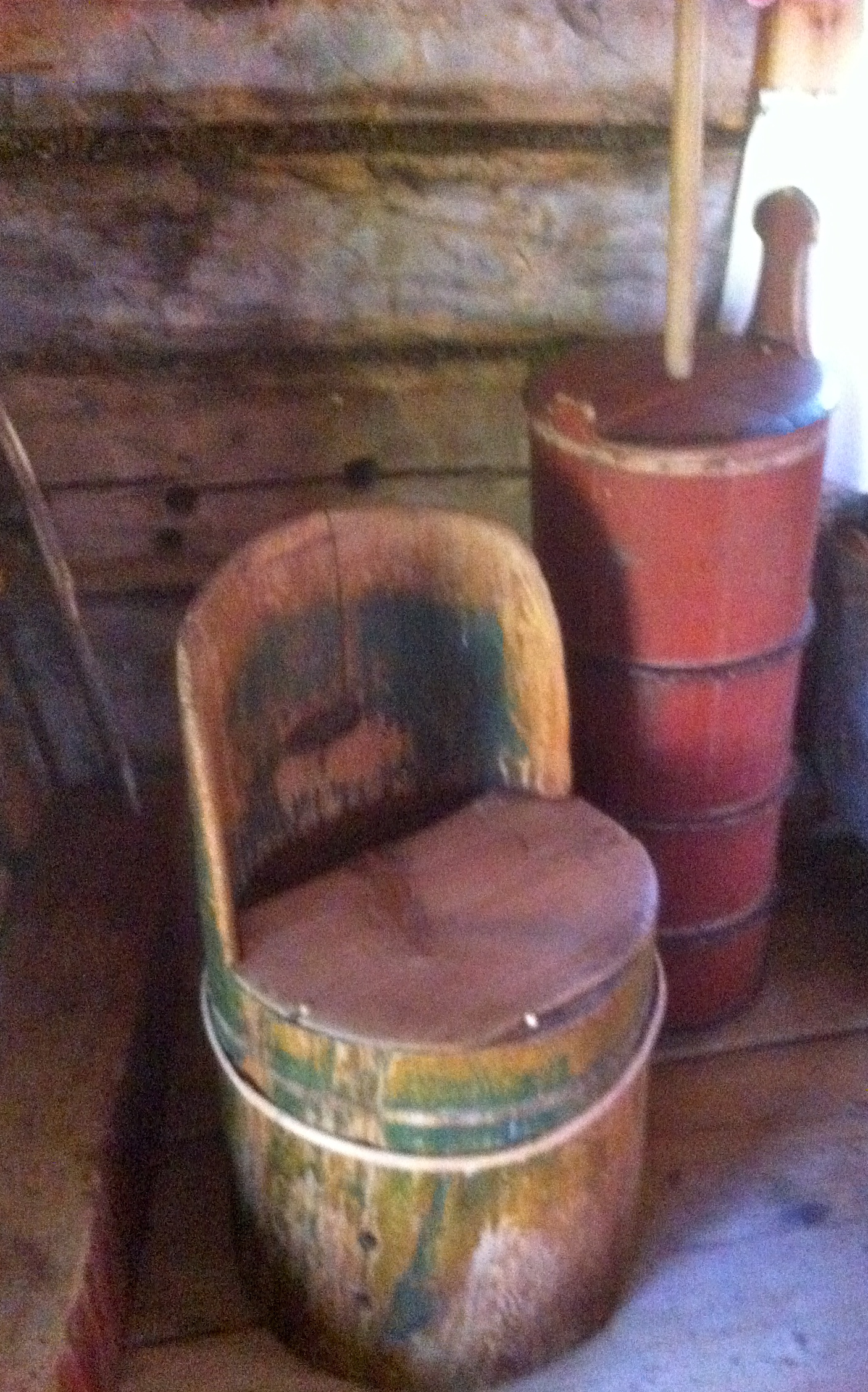
IMG_1532There is one log house (as in every fäbod) specifically to house a young girl, the fäbodjäntan. It’s difficult to find an English translation for this word —  let’s say cow tender. She helped drive the cows up the mountain, then stayed on alone tending the cows over the long summer days.

What do we know about these girls, the fäbodjäntans? They had a song they used to call out to the cows, their voices echoing up and down the hills and mountains. I like the romance of it, I admit. They slept in small beds in the small wooden houses of the fäbod. They were kept warm by a fireplace should the need arise, cooked their meals there as well and at times were allowed a visit from their fiancé if they had one. A larger bed with a curtain was available for those visits.

IMG_1518

Gunnar pointed out that morality was not so strict in those days, at least for farm girls.

IMG_1517

I’ve grown used the quiet of the mountains, the sunlight glinting off the birch leaves, shimmering, silvery. I wouldn’t mind living in a fäbod myself. They’re for sale if someone has a knack (and the money to spend) for renovation. It would be nice though to spend a whole summer in one, dreaming and writing.

IMG_1520

3 Comments

Filed under Art, Culture, History, Home, Jean Zimmerman, Nature, Photography, Writers, Writing

Across the Hudson

We went walking down by the Hudson River in the town where I grew up. Hadn’t been there in a while. The beach curved around, clean and bright.

Hudson beach

When I was young the sand here was covered in beer cans and gnarled driftwood logs, strewn with broken glass and tires. The view was always great, as it is today, even in the murk of mid-July. The majestic Palisades stood proud before the kids who hung out here at the beach, kids called the river rats, who colonized this place.

pilings

Since my childhood the village has taken back its little cove, renamed it, given it a wheelchair-friendly wooden walkway. Gulls and cormorants still post themselves atop the picturesque ruins of old docks. A park next door has a friendly playground, benches, green lawn. It’s all tidied up so that everyone can enjoy the shoreline, not just river rats.

What’s that, says Maud.

We look, out just beyond the beach, where the water gets deep.

I see it, I say.

cross

A large wooden cross, fastened to a piling, the tide lapping up against its neck.

A descanso, says Maud. She knows about descansos, the southwestern side-of-the-road memorials, crosses usually, that show where a person has died in a highway wreck. She’s been researching them for school.

A water descanso.

I remember now… some kind of boating accident, Maud says. She grew up here too, in this town, has seen the changes in the park over the years, the improvements, the things that go on under the radar, too.

The beach is pretty, the tall stone cliffs ever-beautiful, but you can’t tidy up death.

3 Comments

Filed under Culture, History, Home, Jean Zimmerman, Nature

Piquant Spoonfuls of the Past

At a bric a brac shop in Wisconsin I came away with some new treasures for my recipe pamphlet collection.

macaroni magic

What is bric a brac, anyway? Something you love and nobody else gives a fig for. The phrase originated with the French in the early 1830s, and it literally means at random or without rhyme or reason.

Well, my affection for vintage cookery pamphlets is certainly that.

ground beef

My collection of over a hundred booklets spans the 1930s to the 1980s, but these simple illustrated bound-paper time machines were already being produced in the late 19th century, when food companies began to lure women into the kitchen with recipes that delicately enticed them to use their products. As time went on, companies like Spry (a competitor of Crisco) produced fantastic, clever efforts. Home Economics institutions also stepped in to help sort out culinary complexities, particularly during the years of the second world war, when shortages affected almost all households.

eggs

300 Ways to Serve Eggs came out  in 1940 under the auspices of the Culinary Arts Institute, “One of America’s foremost organizations devoted to the science of Better Cookery.” I love the optimistic bounty of that egg basket, and the idea embodied in the introduction to the pamphlet that this humble food can change our lives.

We know now, that they carry in their golden hearts every food element the human body needs and especially vitamin D which occurs so rarely in our everyday foods. Our only problem is to eat enough of them.

Of course the kitsch of the illustrations is great, and the nostalgia of such fare as egg frizzle (incorporating chipped beef) and noodle oyster loaf with creamed eggs, served with the ubiquitous white sauce of the age. They sound dated, but I remember growing up with the simple baked eggs found in this pamphlet, and they were delicious.

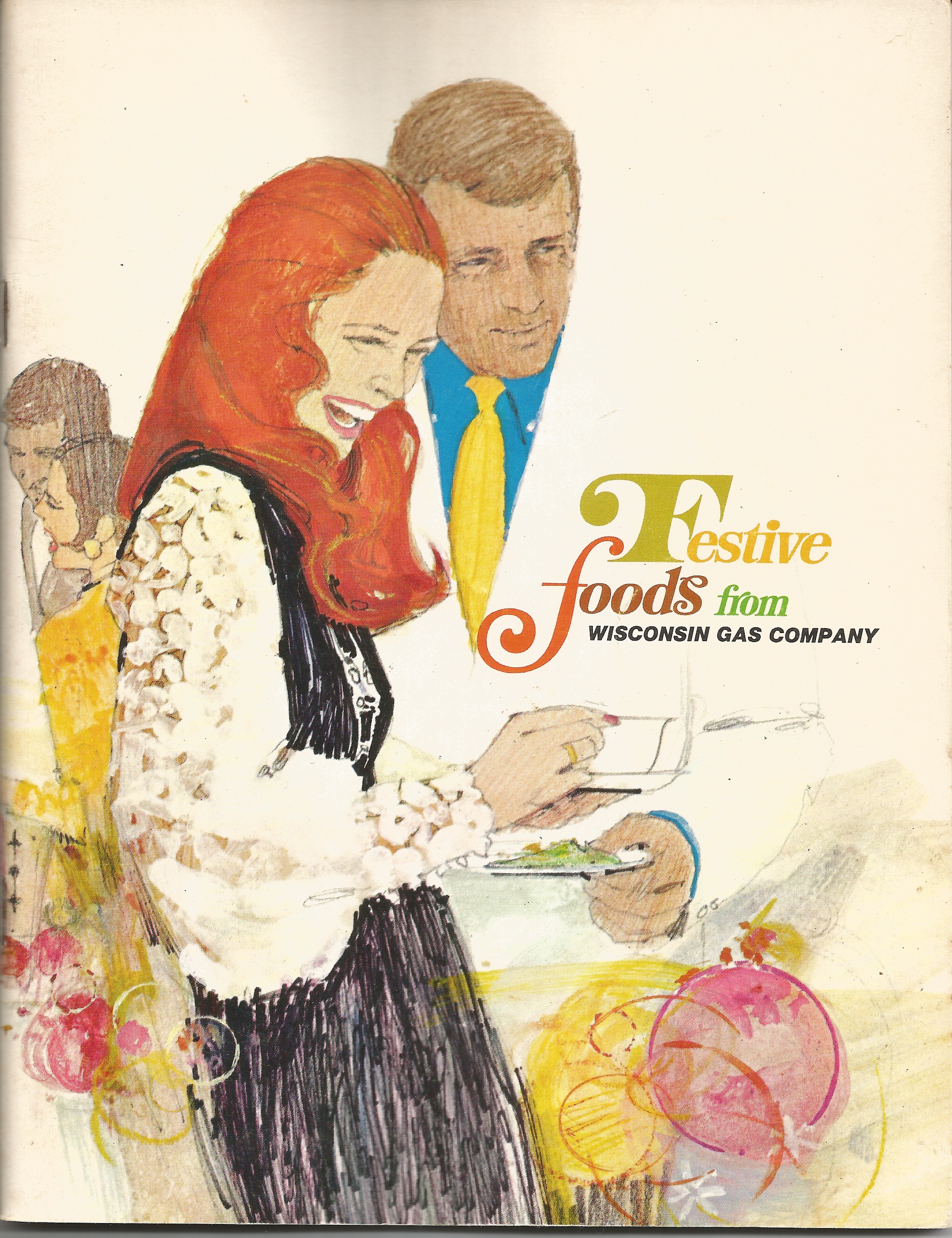
Eventually all sorts of corporate types realized that recipe books made good giveaways, and so you got pamphlets like the one produced by Wisconsin Gas Company in 1969.

gas

Now foodstuffs like wheat germ nut bread were being touted, along with the more Midwest-typical batter-dipped wieners and the promising shrimp divan supreme, which included frozen asparagus, canned shrimp, canned shrimp soup and processed American cheese. I don’t know about you, but the prospect of that dish fills me with a warm, cozy feeling.

gas 2

I couldn’t resist, so I went a little outside my collecting focus and picked up some petite cookbooks, each with its own charm. I admire the vintage men’s cookbooks that appeared at the middle of the century, like The Terrace Chef.

richard rosen

In this two by four inch self-published book, Rosen actually tells you in detail how to build a barbecue pit — this is 1952 — itemizing how many bags of portland cement and how many flagstones you will need. He gives equal time to recipes (steaks, clambakes and shaashlick) and to the principles of the good life.

From décolleté to dungarees, from double-damask to picnic plaids, from sterling to raffia wrapped stainless steel to the tune of brass and copper cooking ware. Away from stuffy formalities to refreshing camaraderie.

It’s somehow reassuring that the foodie culture of today had a precedent in this culinary gusto of an earlier age.

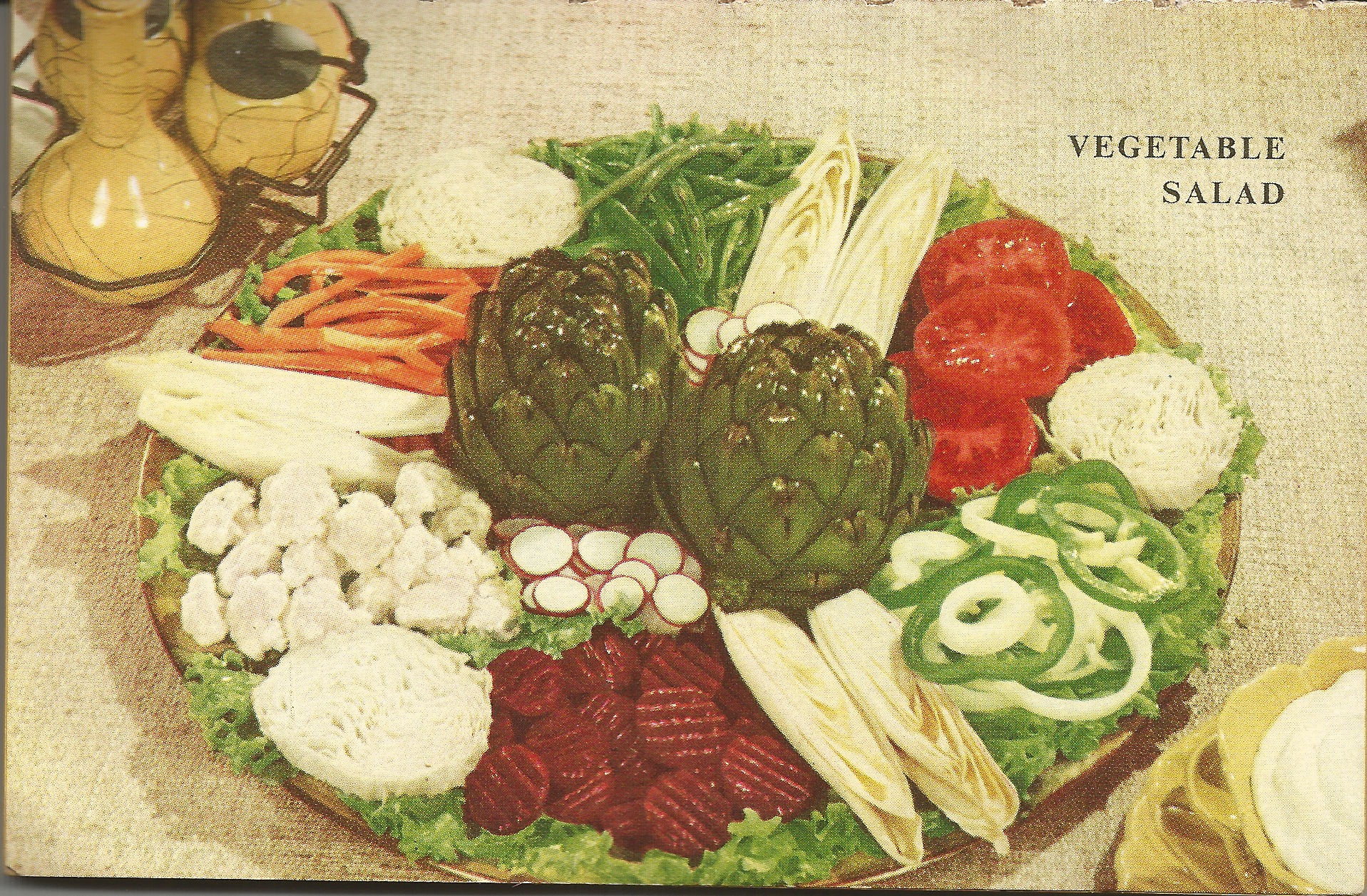
And health. Marye Dahnke’s Salad Book, published in 1954 and “tested in Marye Dahnke’s own Kraft kitchens,” is a compilation I might not just put away with my collection but dip into, now that I’m thinking plant-based.

salad book

Even if what stirs me most about it is the collection of technicolor illustrations, not the chicken-cauliflower salad or the lime light salad with molded Jello.

salad 2

Mrs. Ivere Nelson wrote her name in script on the cover of Dahnke’s comprehensive guide to salads. The least I can do, half a century later, is pick up the reins.

After all, ground beef still rules.

ground beef 2

1 Comment

Filed under Art, Cooking, Culture, History, Home, Jean Zimmerman

Deep Purple

No better place to be on a mild summer night in Wausau, Wisconsin.

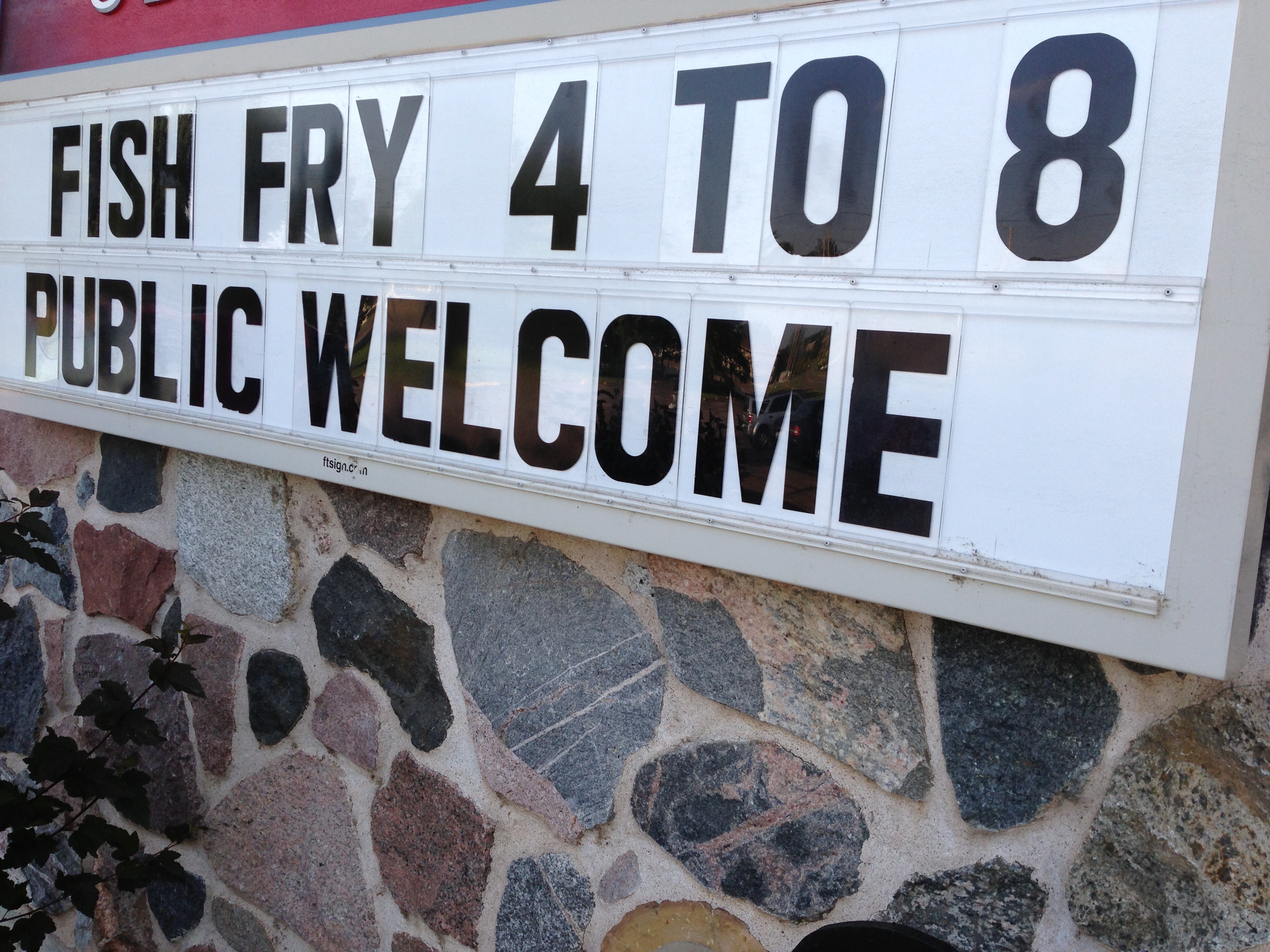
fish fry signOne place allows you to do more than chow down on walleye.

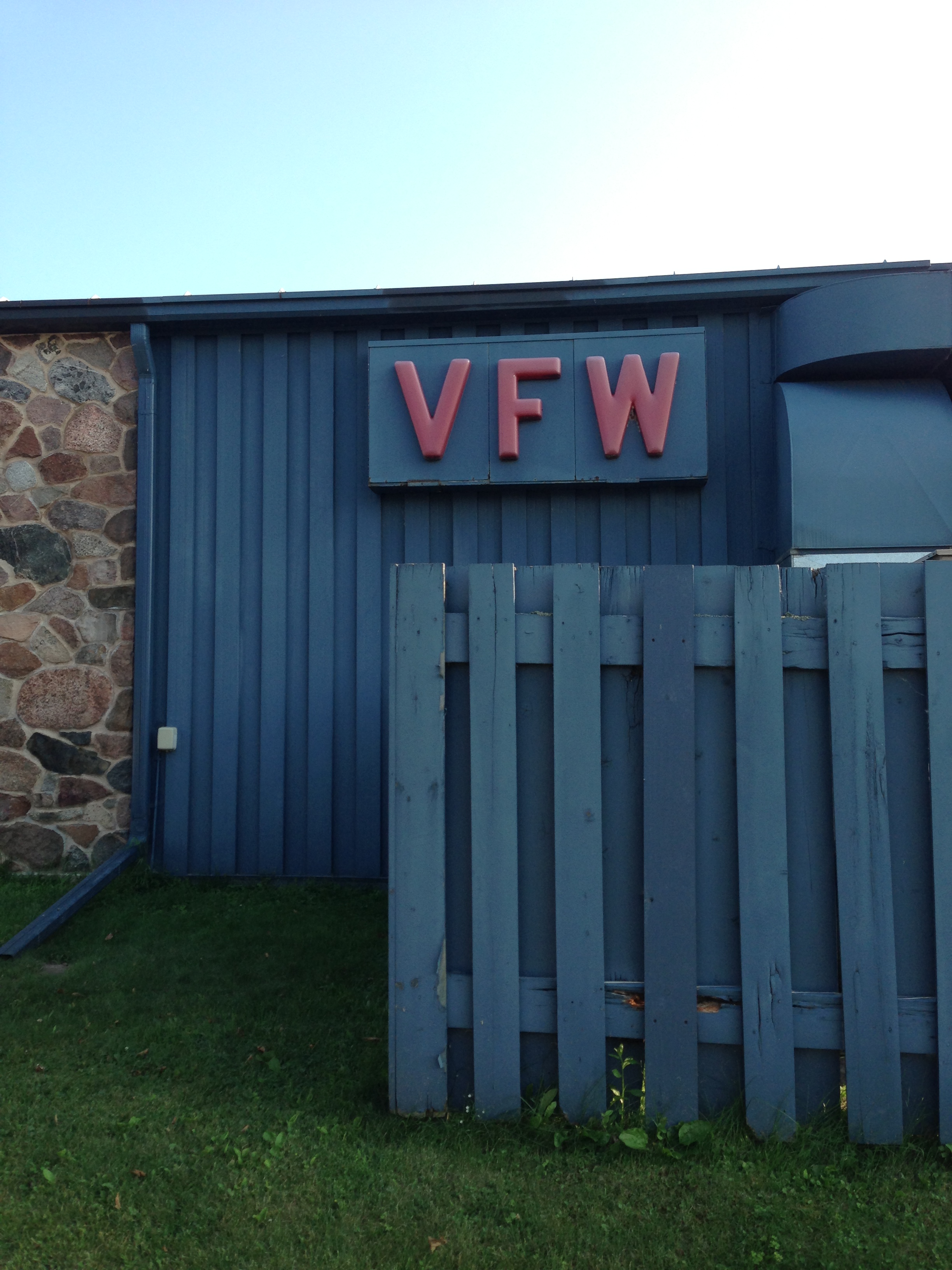
vfw


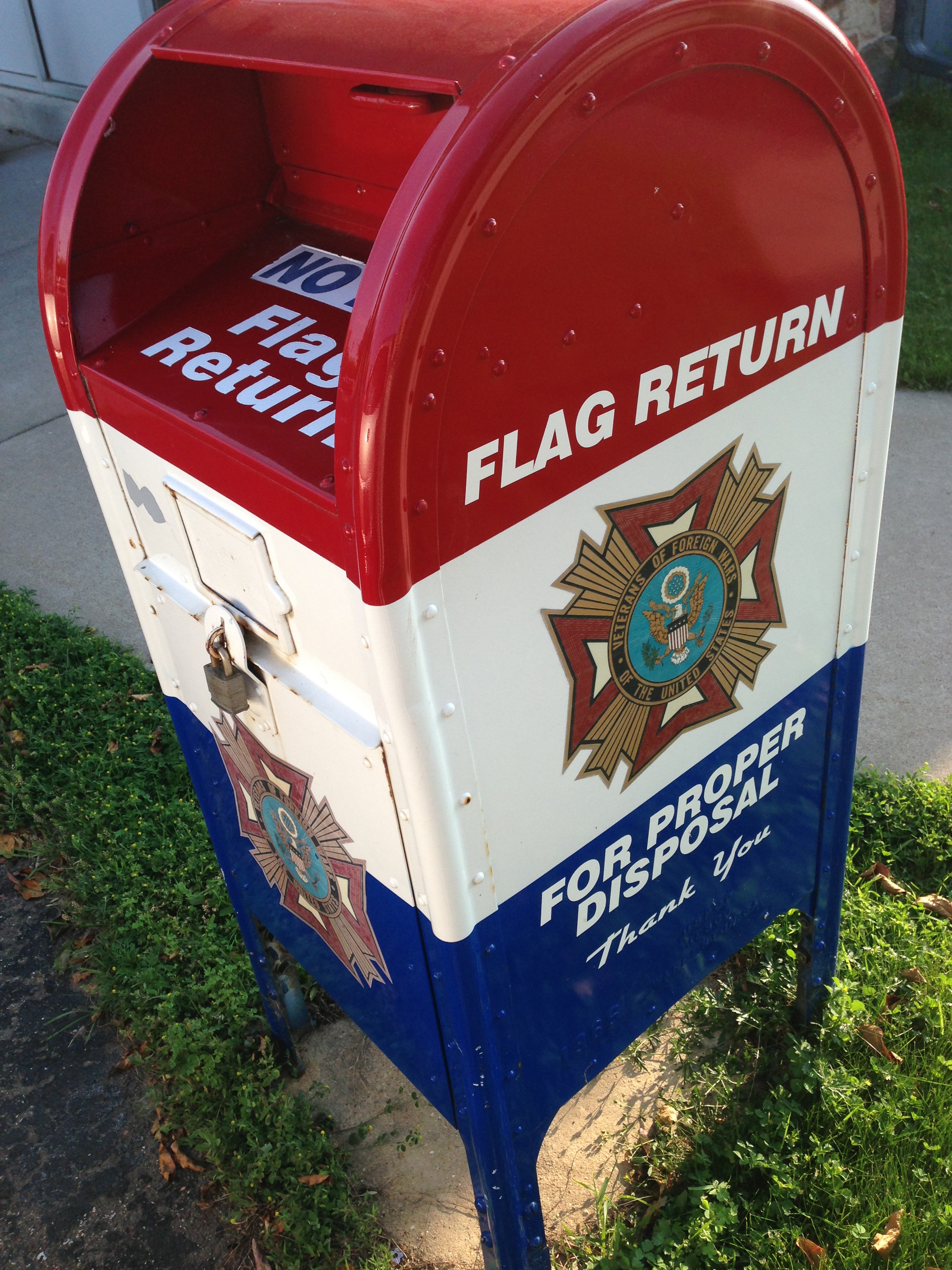
Return a flag.

flag returnHug a military sculpture.

Rick

Make like a pinup girl in front of a valuable Air Force Corsair II that made its bones in Southeast Asia 40 years ago.

plane

There is fellowship over fish. Sisters who trekked here for their cousin Eloise’s memorial service tomorrow.

lois:janetEloise loved purple. Some people wear purple.

quinn

The Old Fashioned cocktail is analyzed, quaffed. Don Draper’s choice. You can drink one sweet, with cherries, or sour, with mushrooms. Let’s order a round.

tom collins


Bet you can’t drink just one.

lydia


Reunions.

jesse:gil


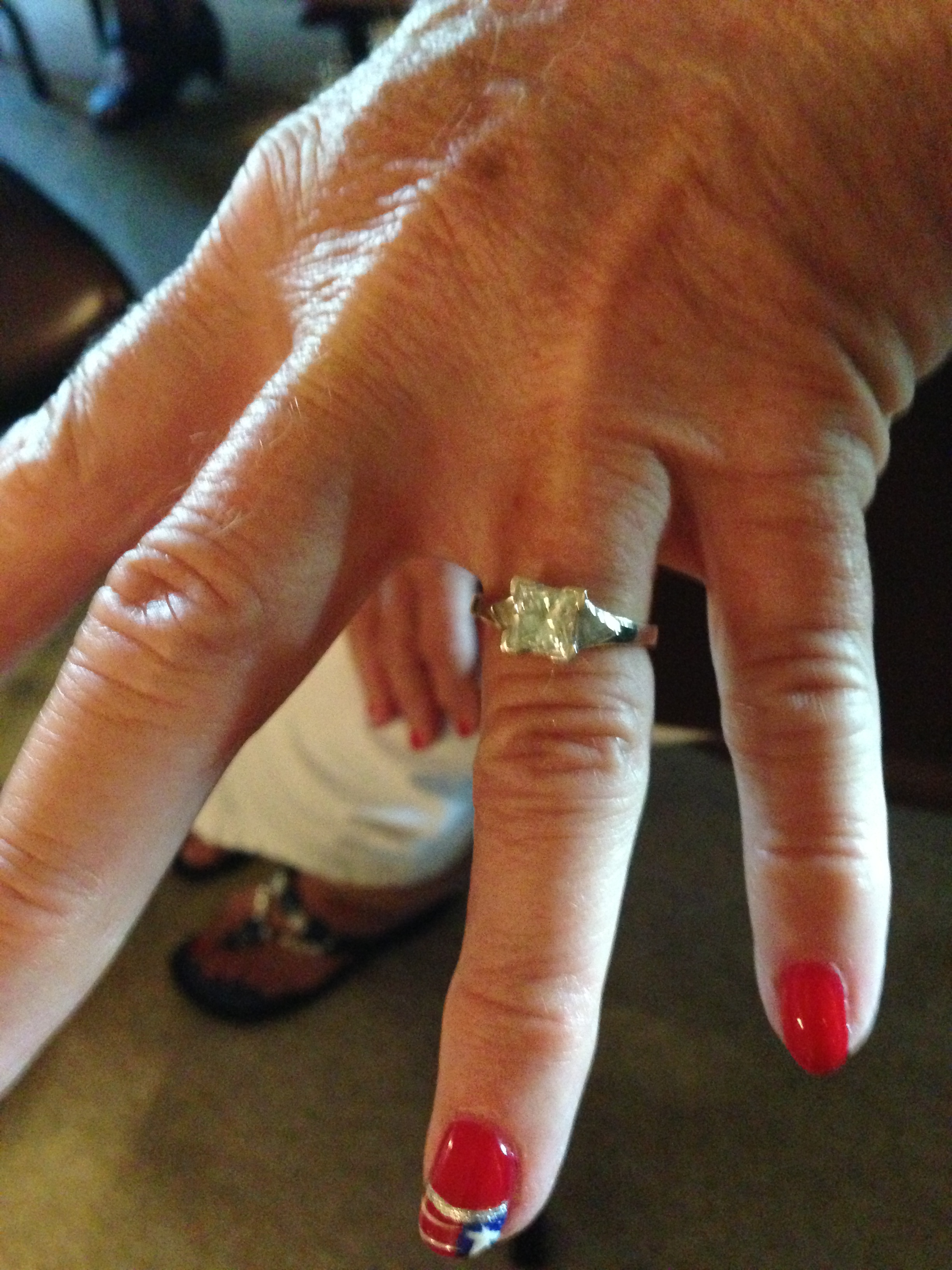
Mid-life romance, second marriage engagement bling.

bling


A couple of accordion players who will perform Deep Purple at the church.

accordion


More sisters, more gab.

sisters


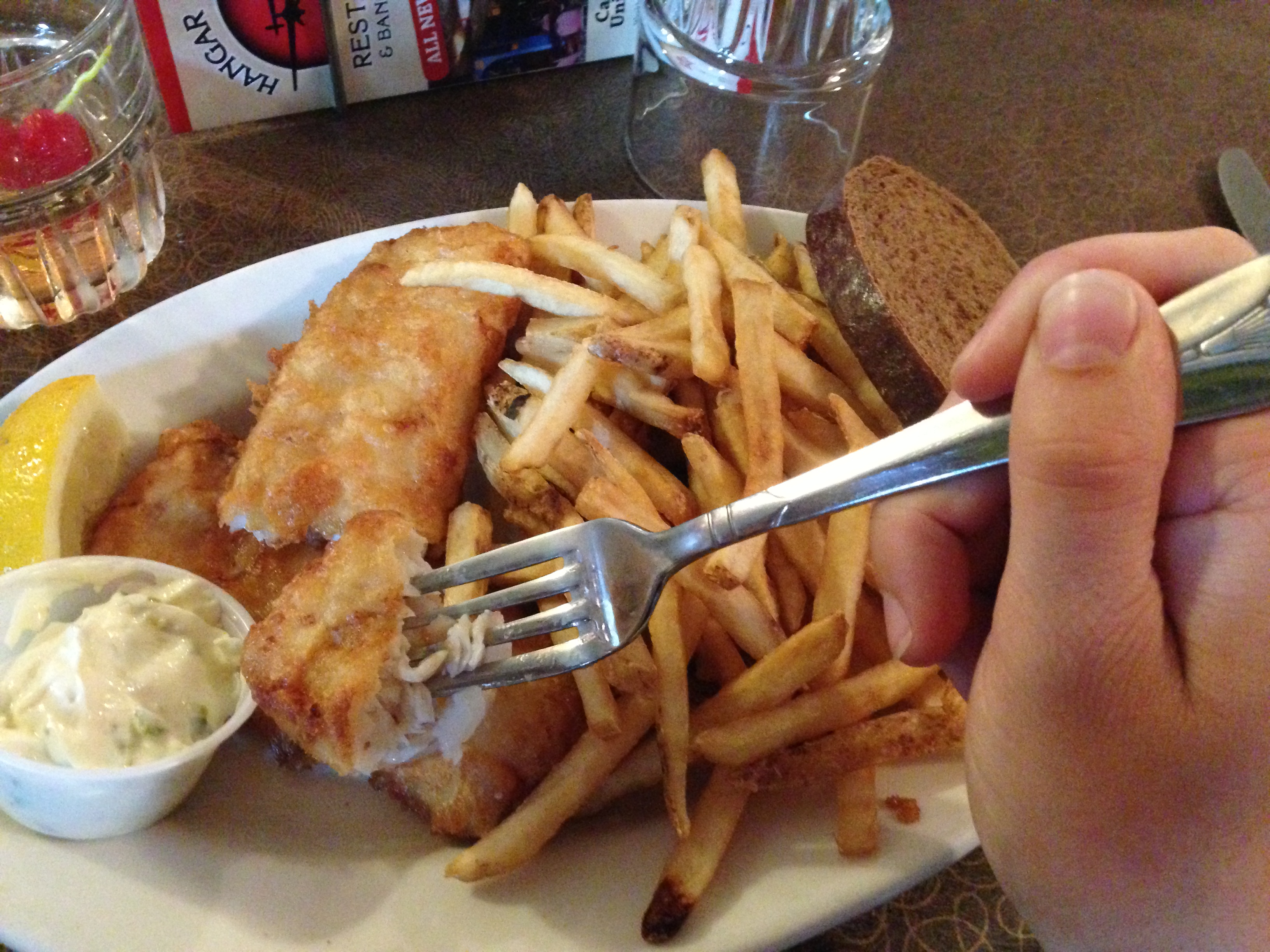
And finally the fish.

fish plate


A mellow night.

thomas


A memorable lady who is missed tonight.


If you want to stay longer, says the waitress, you can go drink in the lounge.

lounge


2 Comments

Filed under Art, Cooking, Culture, Fashion, History, Home, Jean Zimmerman, Music

A Stitch in Time

I keep in storage a box filled with 94 vintage pieces of linen and lace, and an antique silk flowered shawl with long, swaying fringes.

shawl

All heirlooms, all worked by the matriarchs of the White and Coats families, small-town Tennessee residents. Artists.

circle lace on green

The women of my family. Who specifically made these creations we can’t be sure, though my great aunt is a good bet. She was known as an adept with textiles. A tatting shuttle and a crochet hook were surely in her arsenal.

circle lace cu

I take them out these pieces now and again. Take a moment from my contemporary concerns. Pause. Lay them out on the bed.

lace cu 2

Stand back to admire them.

three

How intricate.

lace cu

The colors. Pink.

pink lace

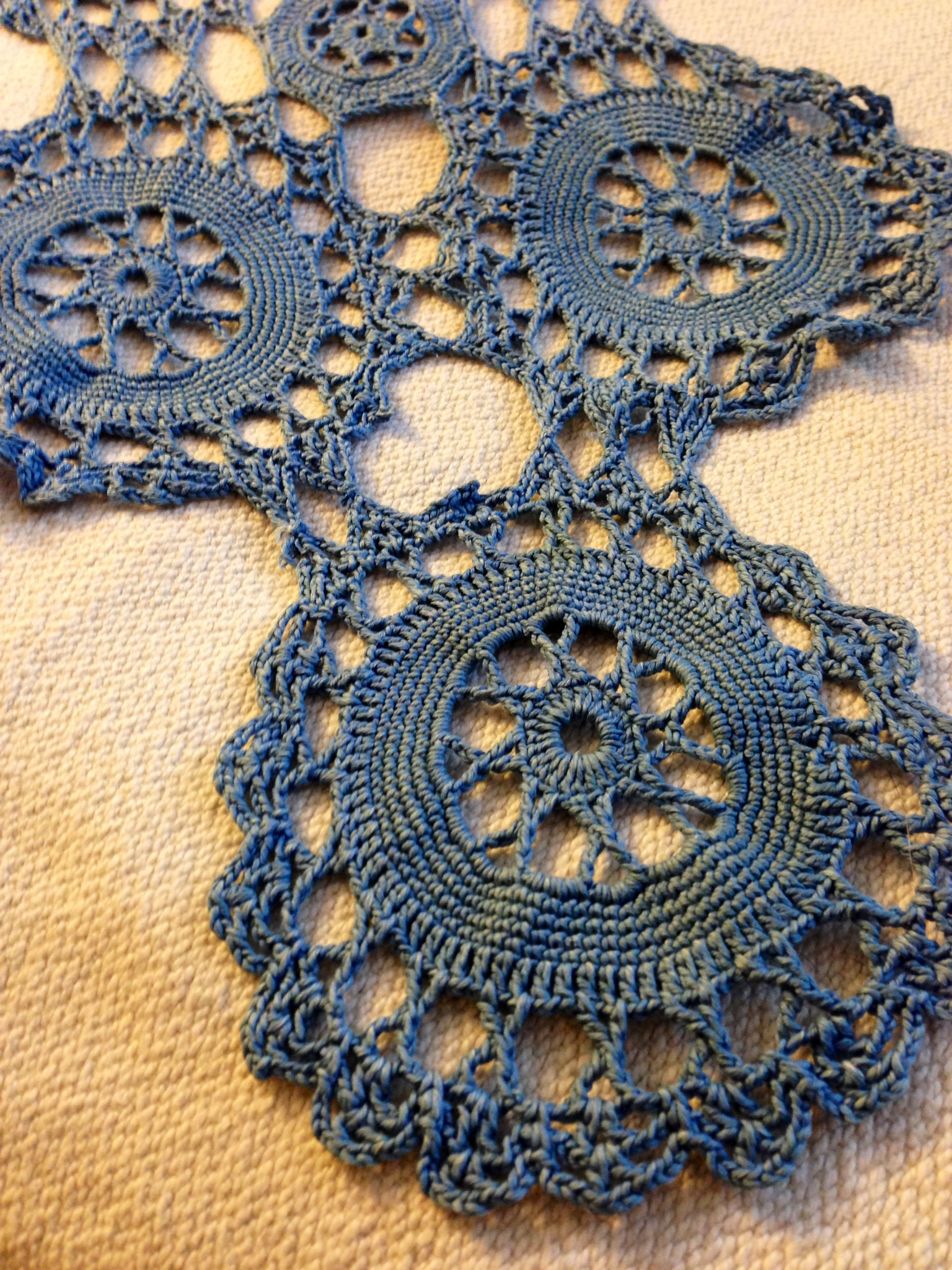
Blue.

blue lace

Run my fingers over the bumps of the embroidery, the open work of the tatting. I think I am in love with this lace and its delicate carnations. Do you like the fragrance of a carnation as much as I do?

carnations

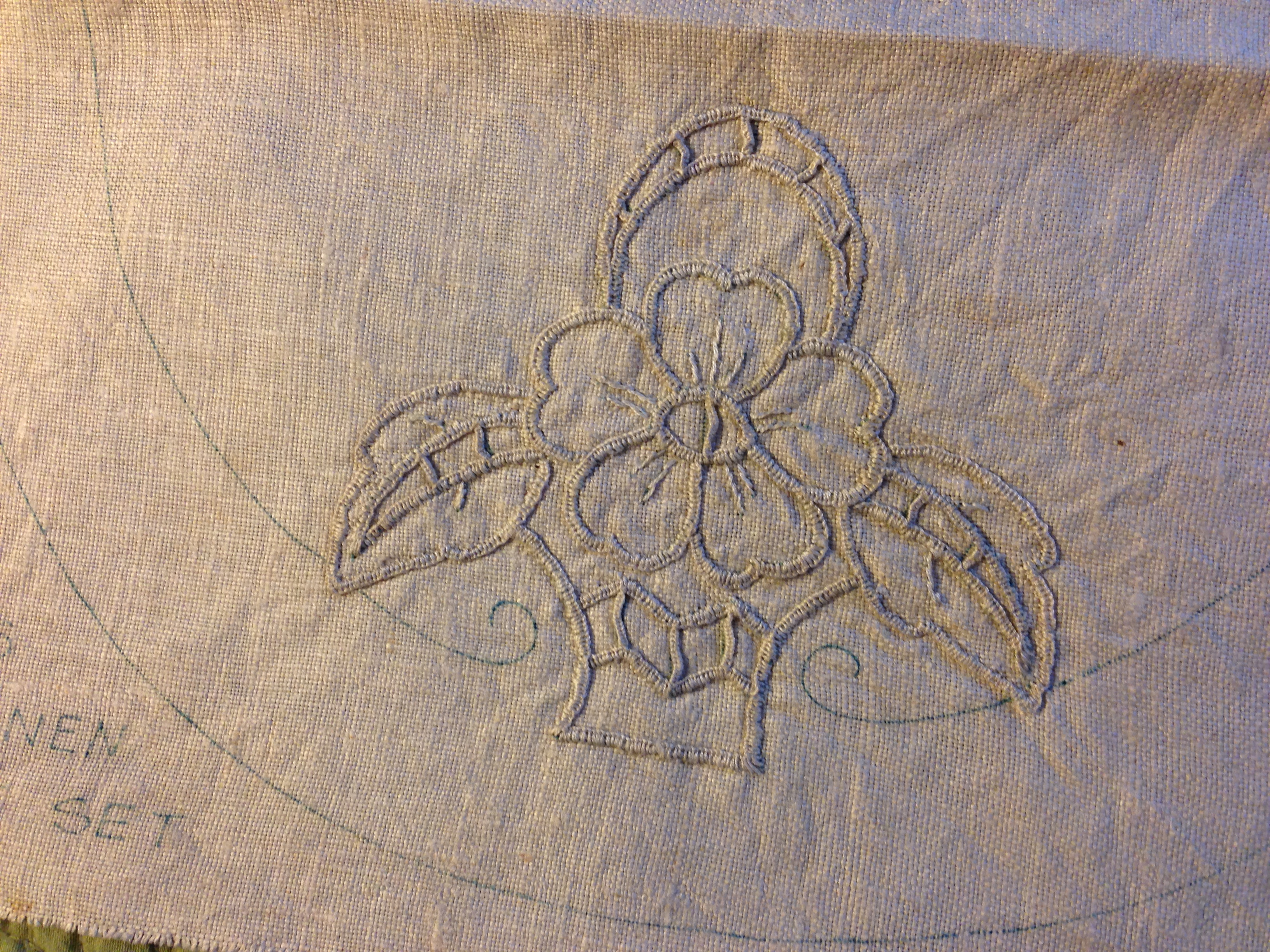
Someone, sometimes, followed a ready-made pattern – you can see the ink on half-finished fabric.

kit 2

I wonder, what inspiration drove the women who came before me to make these brilliant textile works? Because it surely wasn’t necessity. No one could use this many antimacassars or table runners, this many doilies.

lace on green

Although I do see something occasionally that bespeaks everyday life, and these pieces leave me utterly moved. A woven brassiere. (A training bra? So small!)

brassiere

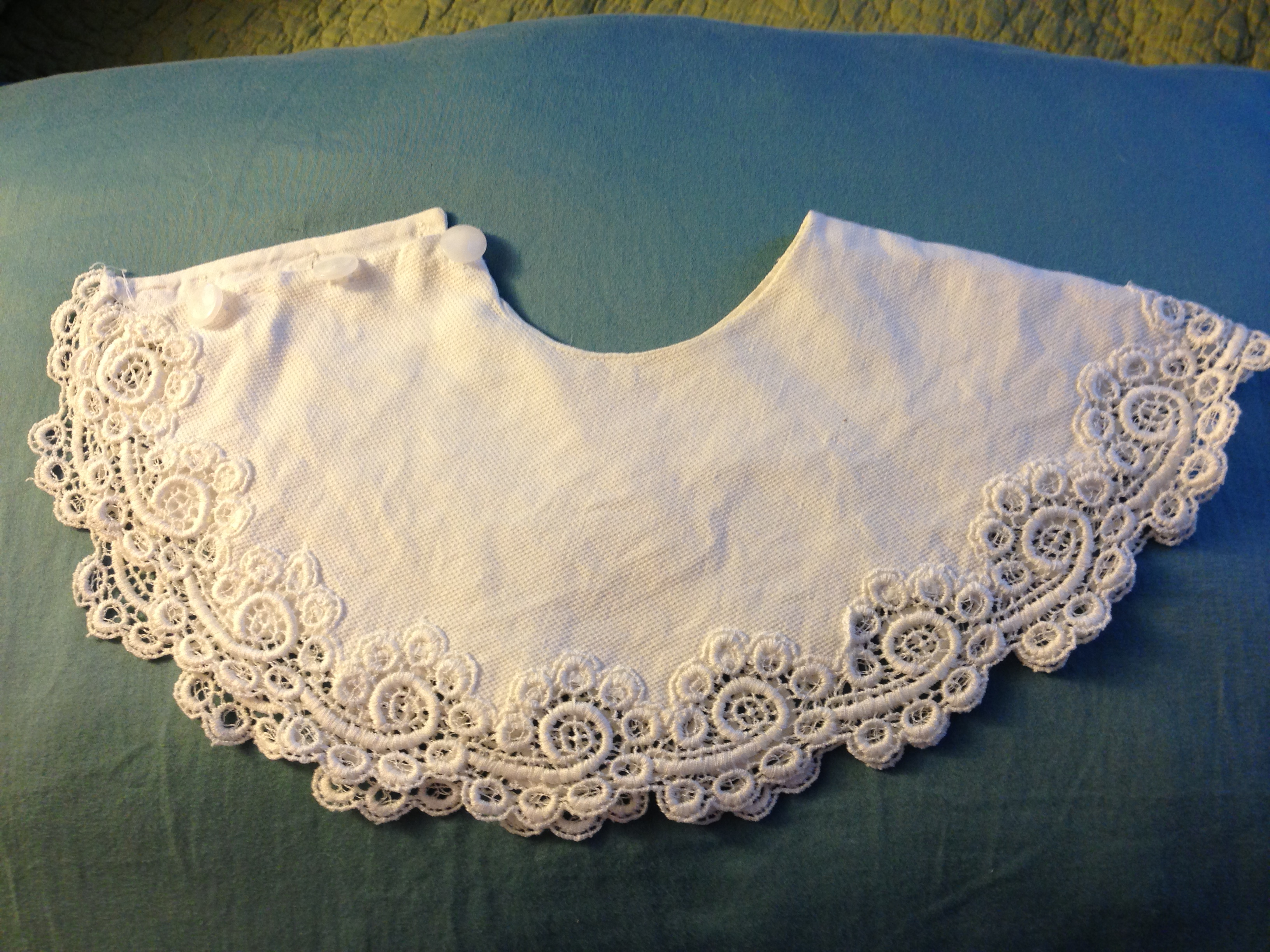
A linen collar with mother-of-pearl buttons.

collar

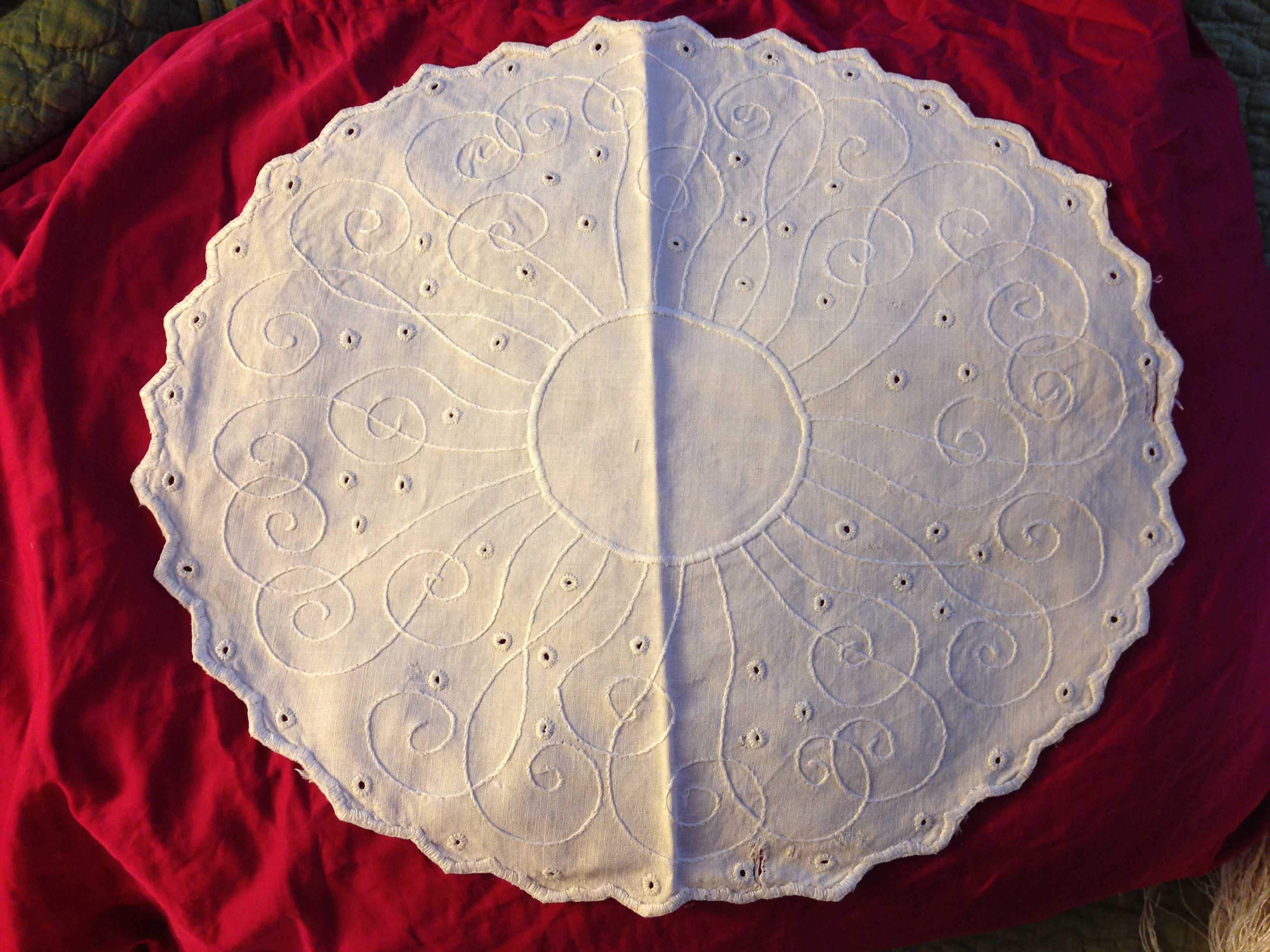
In the rural America of the early twentieth century, there were beans to be snapped, pickles to be put up, floors to be mopped, and even chickens to be wrung by the neck. Yet these people took time, so much time, to make beauty with flash out of plain thread and cloth.

circle

10 Comments

Filed under Art, Culture, Fashion, History, Home, Jean Zimmerman

Plant Based Pesto

I’ve been hearing the expression plant based ringing in my ears a lot lately.

beets

My doc saw my “bad” cholesterol ticking up (Bad, cholesterol! Bad!) and we decided it was time for a change. Get used to quinoa, she said. I had never tried it. Cut out the red meat you love, or at least cut it down to one or two times a month. Chicken or fish, okay, once in a while. But mainly, think plant based. Salads. Beans. Rice. Greens.

Plant based.

collards

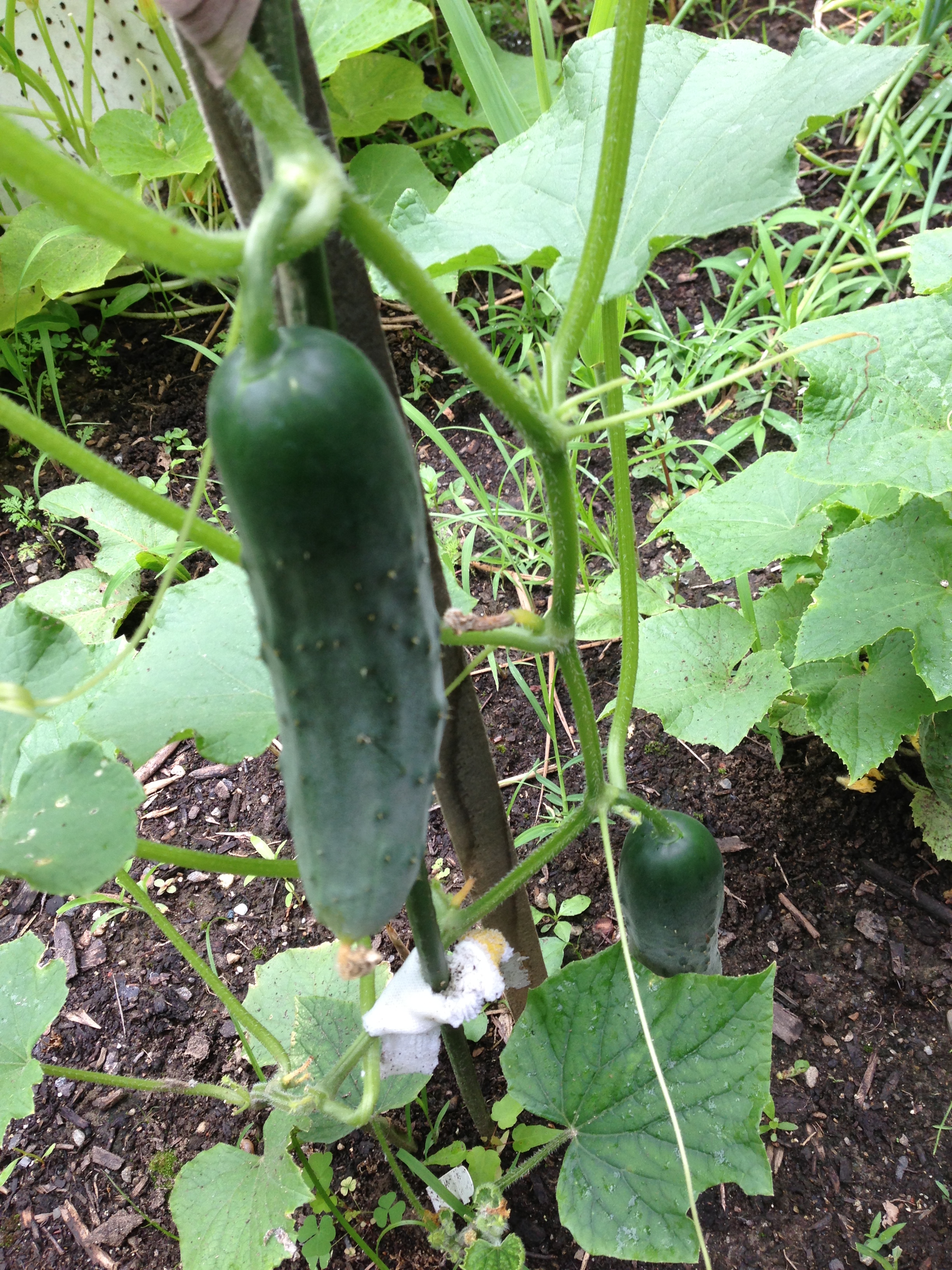
I love vegetables. (So does the yellowjacket I caught on those collard greens.) I’m so excited that my cukes are almost ready to be harvested.

cuke

My new potatoes are such babes they cry when you pull them out of the ground.

potatoes

I couldn’t be a prouder mama.

But changing my diet, all but eliminating pork ribs, beef brisket, skirt steak, this is a big change. I know it’s for the best, but I have to find savory ways to make myself eat the right way happily. (Not to mention a somewhat recalcitrant husband.)

I have always loved pesto. The recipe originated in Liguria, the region of Italy that borders France. Its mineral-rich seaside soil and climate produce exceptionally sweet, sweet basil. The name comes from the mortar and pestle that are used to delicately squeeze the tender leaves rather than coarsely crush them. A similar sauce called battuto d’aglio (beaten garlic) appeared in the 1600s in the city archives of Genoa, the region’s capital city.

I’ve never been to Liguria, and I use a blender to make my sauce (yes, crushing it coarsely), but I think my pesto is mouth-watering. Anyway, we gobble it up. And it’s plant based.

It has a plant, the basil.

basil

Olive oil, derived from a tree.

Nuts, also harvested from trees.

A teensy bit of cheese, parmigiano reggiano, nice and salty, which I think my doctor would forgive if she knew I was foregoing the Italian sausage I used to add to this dish.

cheese

And we all know how beneficial garlic is. Lazy me, I often use chopped garlic from a jar. It only slightly diminishes the flavor. But my favorite garlic is from my sister-in-law Noreen’s farm. She gives us a string that lasts all year.

Marcella Hazan, the doyenne of Italian cooking, has the classic recipe.

cookbook

It takes 15 minutes from start to finish, during which time you can get the water boiling.

What do I do with this fresh-out-of-the-garden pesto? Throw it together with some pasta (imported, preferably).

Then use your imagination. Tonight I’m  spicing up our pasta al pesto with cut-up chicken breast, new potatoes and sweet-hot peppers from the garden. If only I had some really delicious plant-based sausage.

Plant Based Pesto

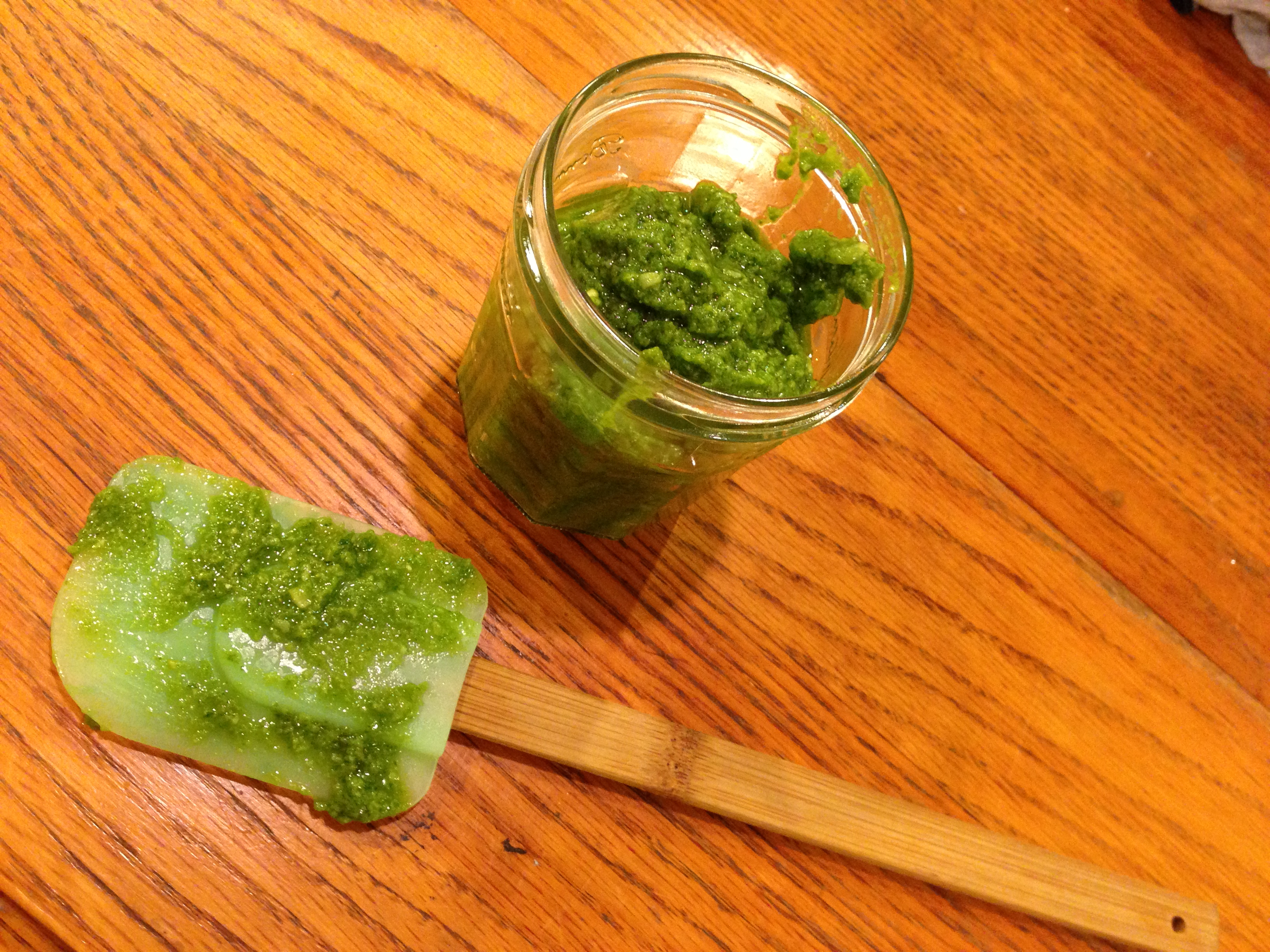
Place 2 well packed cups rinsed basil leaves, ½ cup extra-virgin olive oil, 3 T pine nuts (or walnuts or almonds), 1 T chopped garlic (more if you are a garlic fiend like me) and a pinch of salt and a grind of pepper in the blender. Blend ’til just smooth and then add a healthy ½ cup grated parmesan and blend again briefly.

pesto


4 Comments

Filed under Cooking, Culture, History, Home, Jean Zimmerman

Float Upstream

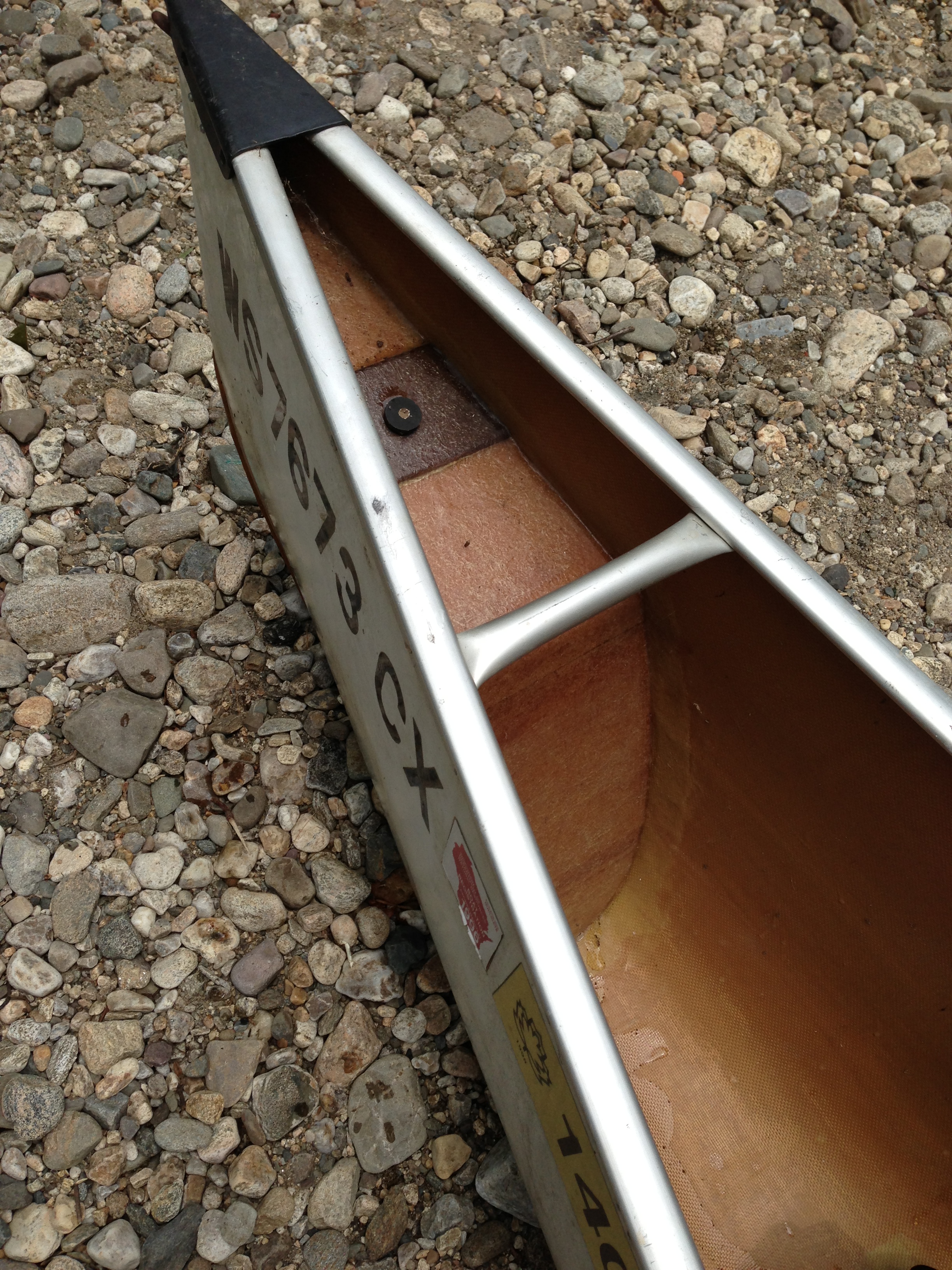
We take the canoe upriver.

canoe bow

Not just any river. The Croton River.

Head upstream from its junction with the Hudson, next to a railroad trestle.

croton river

To our north is the venerable Van Cortlandt homestead, nearly hidden by trees. The family came to New Amsterdam in 1638. They lived on Stone Street – so called because it was the first paved thoroughfare in the settlement – where Oloff ran a very profitable brewery. Eighty-six thousand acres of land here on the Croton River were granted his son Stephanus by the Crown in 1697.

Dip your paddle. No, really lean into it. The tide and current are against us here.

Over our heads flies a cormorant, sleek and fast. A fish flops. A kingfisher appears on a limb, then another in flight.

Around the bend, a heartstopping moment with a wading blue heron. It bends down its serpentine neck and jabs, then gulps, gulps, gulps. It spots us. And barrels away ten feet from us, croaking all the way downriver. (All About Birds gives the precise acoustics.)

Along the way, houses perch atop steep cliffs and water craft wait on shore.

canoes

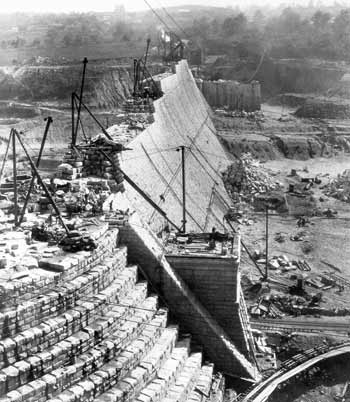
The Croton River travels through the Croton Reservoir, which has supplied water to New York City for a century, so technically it should be clean enough to drink, but the feathering algae under your paddles doesn’t look too appetizing. The Croton Dam was an engineering marvel. For 14 years 1,500 men plied over 500 pieces of heavy machinery, using 745,000 barrels of cement, 100,000 tons of coal and a gigantic amount of locally quarried stone to build what was called the most massive hand-hewn masonry structure since the pyramids.

CrotonDam

I wonder how fast this water flowed before the Dam.

A small rapids, but too much for the canoe to manage, so we portage across the big slippery stones.

croton river stones

I bushwack through the shore’s thorns and poison ivy. At the climb-down point, plenty of coyote scat.

bushwack

Up in the trees, a hawk lights on a bare limb. Light head, light breast. Without binocs its identity remains a mystery.

Then a beach, unpeopled, a desert island.

canoe:stones

The water is perfectly cold.

gil swims

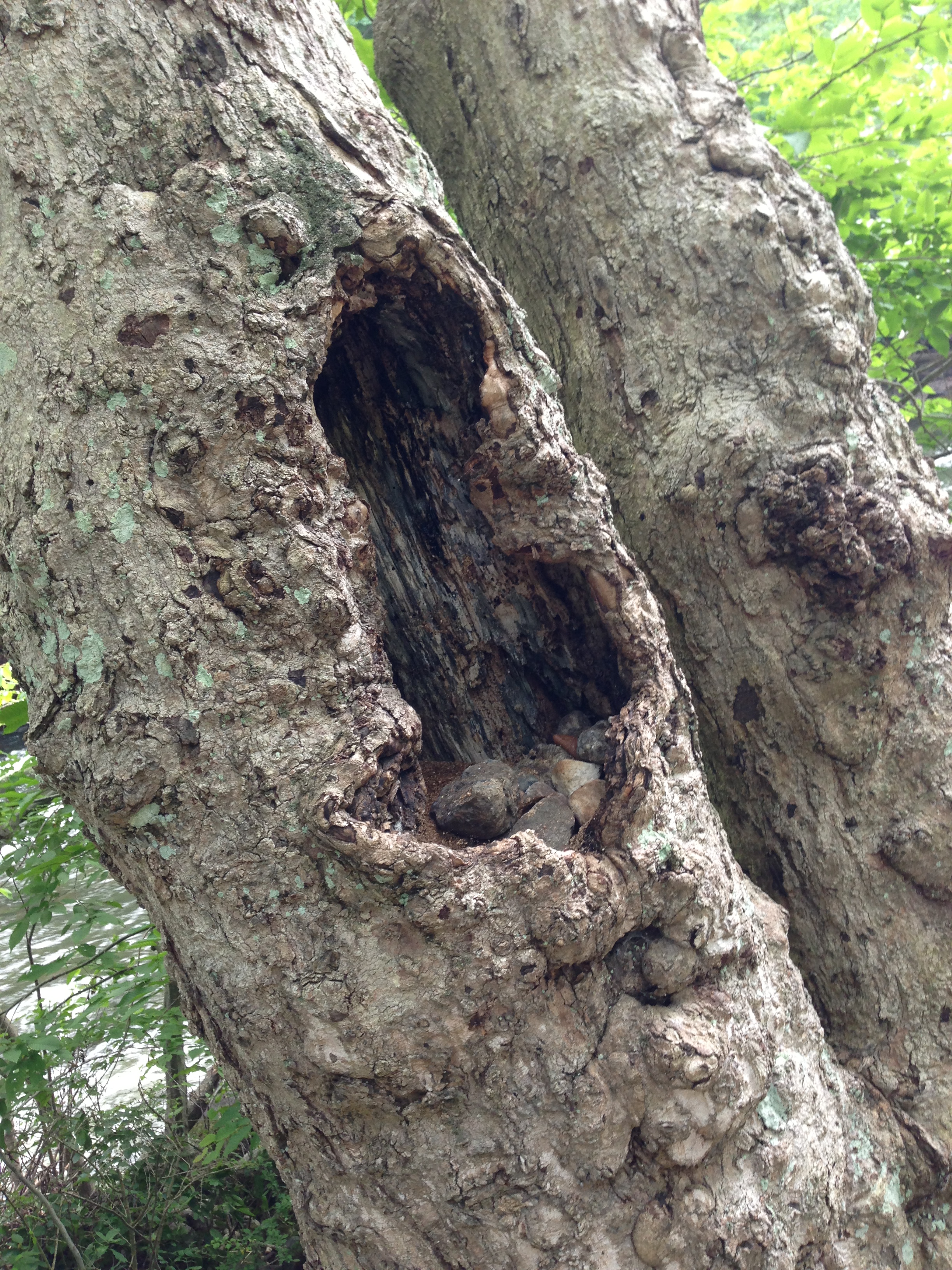
A druid tree displays its magical tangle of roots.

druid roots

A home for critters over many years.

druid tree

It’s an old tree. Probably was a sprout during the American Revolution, when there was no way to cross this river aside from the ferry. No plastic kayaks, recreational canoes. It was closely guarded by the Westchester partisans, who held the land north of the river, while south of the water was the hotly contested “neutral zone.”

A busy set of rapids guides us back.

tree:water

I think I can’t do it. It would be so easy to tumble over, take a cold bath among the slick rocks. But I take a deep breath. Dip my paddle. Go.

2 Comments

Filed under Culture, History, Jean Zimmerman, Nature

At the End of Their Bloom

The end of the rose season and the end of the day. Glinting sweeps of sun, still, but deep shadows starting to fall across the lawn.

You take what you can get.

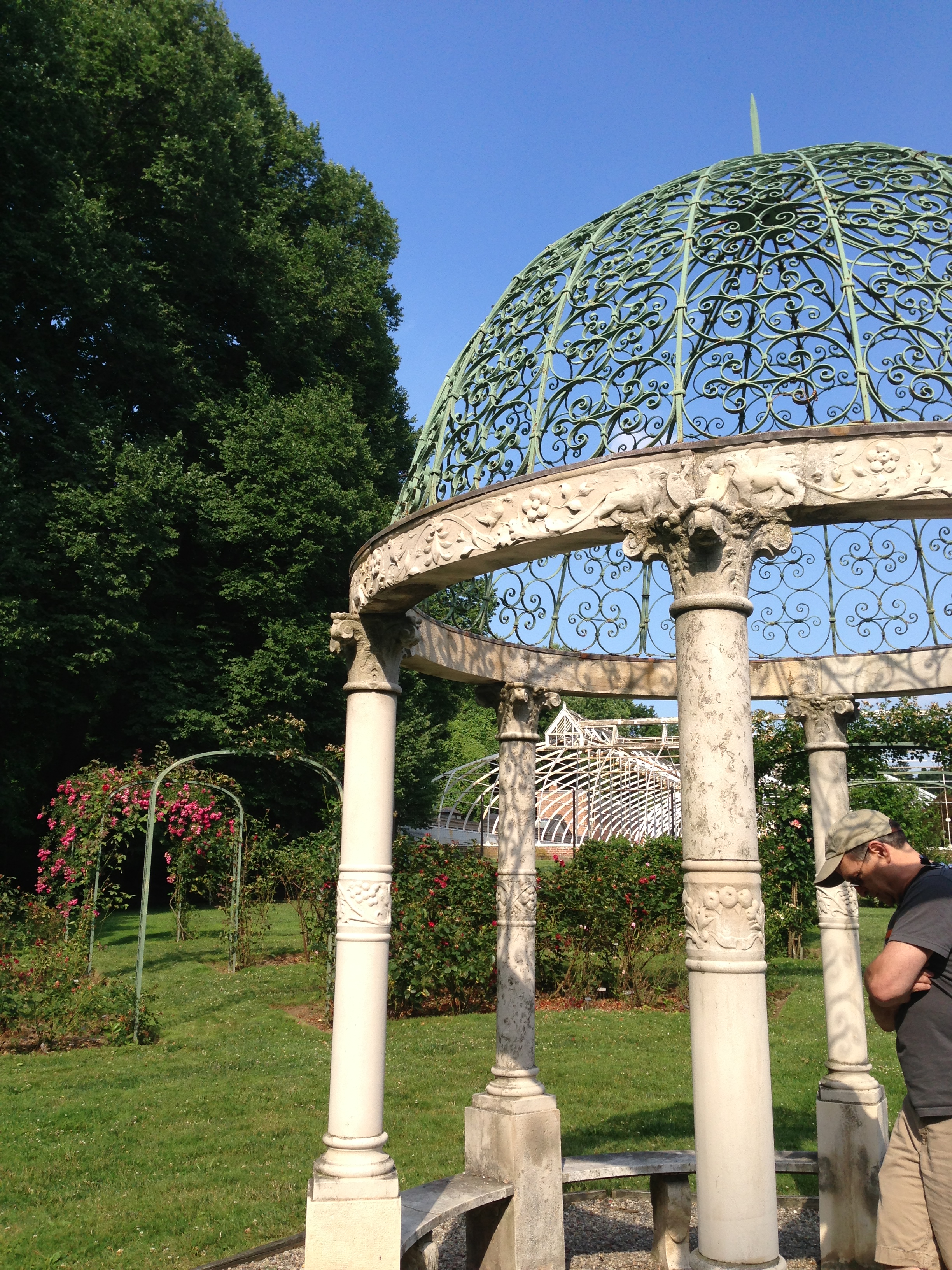
Q yellowThe roses that remain are as lovely as the roses that came before them. At Lyndhurst, the historic property in Tarrytown that used to be the domain of robber-baron Jay Gould, that’s a lot of roses. There are 400 varieties arranged in 24 crescent shaped beds in three circles, a color wheel that moves around a central gazebo from white to yellow to red to pink and back to white.

gazebo


The colors are spectacular at the flowers’ height. Not so much now, late in the season, when you see more bare stalks than blooms. But there is something about loving the last rose. Mr. Lincoln, say, bred by Swim & Weeks in the United States in 1964. The fragrance is massive. I want to wear it on my 60th birthday — five years away, but good to plan.

mr. lincoln

There are only a few buds left on Belle Poitevine, but I love knowing that this hybrid rugosa originated with Francois-Georges-Leon Bruant in 1894. The Swedish Rose Society recommends the plant for northern Sweden.

belle poitevine


Gene Boener, ragged as it is so late in June, reminds me of a rose that had escaped someone’s garden and found its way to my house when I lived in an apple orchard years ago, with the sweetest, spiciest perfume imaginable.

gene boenerThis profusion of flowers is perched on a hill that slopes down to the Hudson River. Jay Gould’s Shangri-La. “I do not believe that since man was in the habit of living on this planet anyone who has ever lived possessed of the impudence of Jay Gould,” said nineteenth-century radical Robert Ingersoll.

lynhurst view


Even Gould, who bragged that “I can hire one half of the working class to kill the other half,” couldn’t keep roses alive beyond their season. His daughter founded this garden, putting in old garden roses like Red Dorothy Perkins, bred in 1908, to climb one of the 24 trellises.

dorothy perkins trellisDorothy unfortunately has no scent. And what is a rose without her scent? A later rose is John S. Armstrong, a grandiflora bred by Herbert C. Swim in 1961.

john S. Armstrong

By the time John S. Armstrong got a place in the loam, the rose garden’s upkeep had been passed to Anna Gould, Duchess de Talleyrand-Perigord, in 1938, and then to the Garden Club of Irvington.

A robin hops briskly through the clover and shade moves over half the beds. One fuchsia bloom called Chrysler Imperial, a hybrid tea, has the vague aroma of leather. When you put your face down to smell, watch out that a beetle doesn’t mistake your nose for a flower.

newdawn


The roses are flaming out.

granadaIt’s time to go home. Duck under the trellis covered with  Kathleen Hybrid Musk, bred in the U.K. in 1922 by Rev. Joseph Hardwick Pemberton. A cross between Daphne, 1912, and Perle des Jardins. Gil’s Lao Tzu tee shirt was a gift from me.

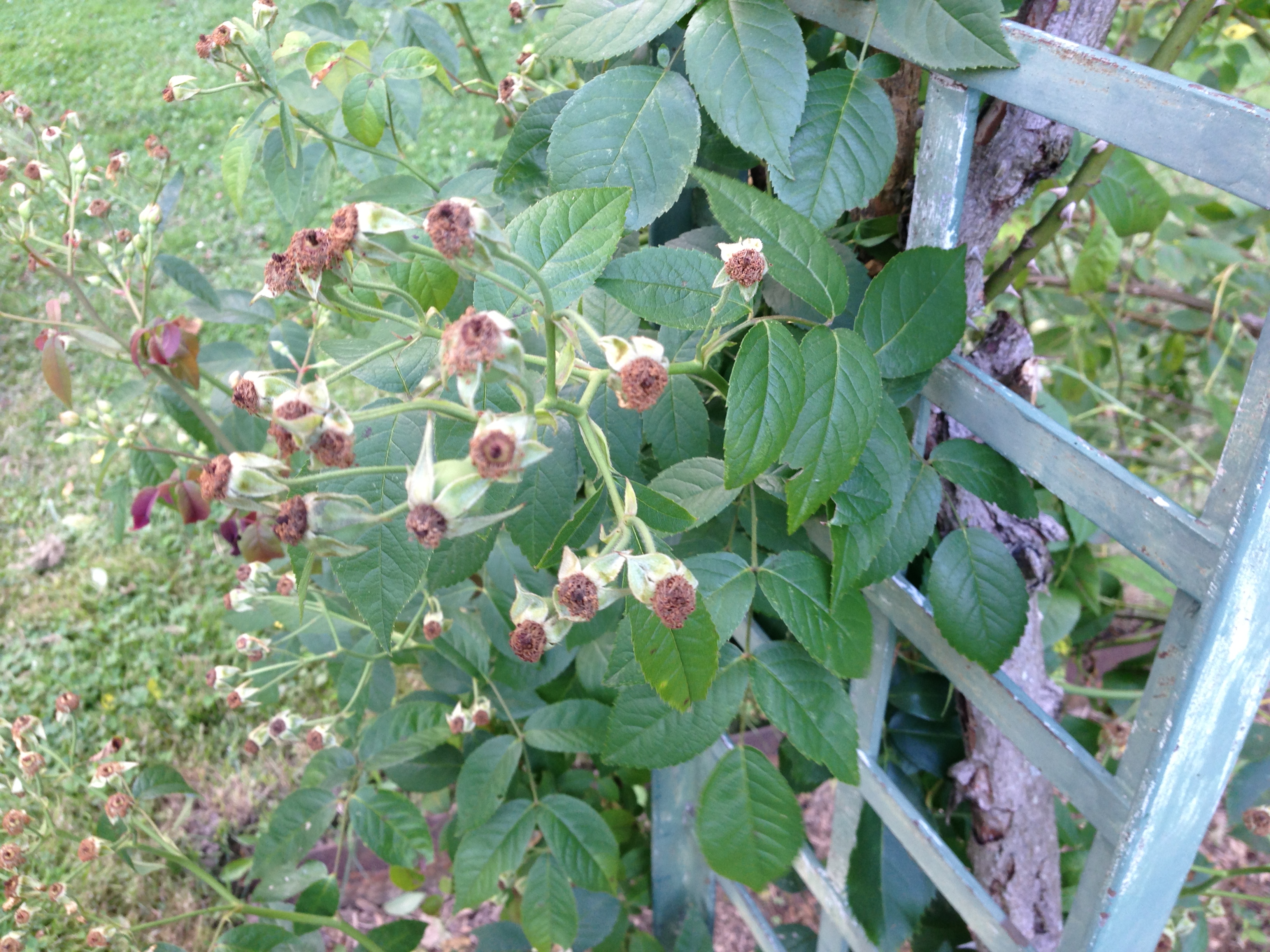
Kathleen hybrid muskNot much left on those stalks climbing the old wooden trellis. But if you love roses, you’ve got to love them when they’re naked aside from their sepals.

kathleenOne of Lao Tzu’s greatest hits, from the Tao Te Ching:

Let there be a small country with few people,

Who, even having much machinery, don’t use it.

Who take death seriously and don’t wander far away.

Even though they have boats and carriages, they never ride in them.

Having armor and weapons, they never go to war.

Let them return to measurement by tying knots in rope.

Sweeten their food, give them nice clothes, a peaceful abode and a relaxed life.

Even though the next country can be seen and its dogs and chickens can be heard,

The people will grow old and die without visiting each others land.


1 Comment

Filed under Culture, History, Home, Jean Zimmerman, Nature

The Taksim Square Book Club

In  Turkey, people are reading books. In public.

Which is amazing, considering the country’s recent history.

Taksim Square Book Club

People are afraid of losing freedoms. And they’re finding a clever way to meet in public when demonstrations have been banned. Book clubs as free speech.

From Ataturk – which means Father of the Turks – who founded the Republic in 1922, all the way up to the present day, the country has had strong secular leadership.

ataturk3

Now the hardliners have come in. In Tacsim square the prime minister wanted to destroy part of a park for “redevelopment.” Somehow that struck a chord with the public and hundreds of thousands of people took to the streets.

The complexities of this story are better left for a political writer, but the numbers have already reached these totals, according to one source: 4,500,000 people provided their support for the Gezi Park Resistance; there were 603 protests in 77 provinces; at least 75 people were arrested; at least 1,750  injured; 3 people including one police officer died. There is an excellent visual timeline of the “ten days of resistance.” New developments are not promising.

Taksim Square Book Club

As an alternative to the violence, the Turkish performance artist Erdem Gunduz chose to stand with his hands in his pockets, facing the Ataturk Cultural Centre in Taksim Square for eight hours.

erdem-gunduz-kimdir-gezi-parki-duran-adam-4746497_1628_o

Gunduz become the symbol of the resistance movement. Thousands of people emulated his action, standing still for minutes or hours around the country. “The Taksim Square Book Club” dovetailed with the still postures, and the books people are choosing form a reflection of their thoughtfulness in the face of this tremendous cultural upheaval. Albert Camus, The Myth of Sisyphus, about God and meaning. Gabriel Garcia Marquez’s Leaf Storm. Nineteen eighty-four. Turkish writer Tezer Oslu’s short story collection Old Garden-Old Love. When Nietzche Wept, a historical novel by Irvin David Yalom. Again, Nineteen eighty-four.

Taksim Square Book Club

What would you hold?

8 Comments

Filed under Culture, Fiction, History, Jean Zimmerman, Photography, Publishing, Writers, Writing

Lowdown on the High Line

New York City’s High Line park is totally overexposed. I’m going to expose it further.

walking

I walk with three menfolk from the top to the bottom of this new icon of the Manhattan landscape, stunned by the native plantings that seem to find city soil the best fertilizer in the world.

yellow flowers

I spent a day in the country looking at wildflowers and saw no profusion like this.

cone

Superflowers.

purple flowers

And a planting of bamboo, which has to be tightly constrained by a metal guard to keep it happy in its place. Kind of the opposite of Jesse, who isn’t happy unless he’s on the open seas or in some other free environment.

jess:bamboo

The High Line was  built between 1929 and 1934 from Gansevoort to 34th Streets to lift dangerous freight trains above the traffic. For years, meat, produce and dairy products were shipped to town and arrived at the third floor level of plants. That might have been a little inconvenient, but the situation previous was insupportable. In the nineteenth century, people actually called Tenth Avenue “Death Avenue” because the street-level railroad caused so many accidents. Men in an outfit called the “West Side Cowboys” were hired to ride in front of trains and wave red flags to warn traffic off.

cowboy

In 1980 the last train came through with a load of frozen turkeys. Then the rail bed deteriorated. Gil, who lived in the city then, says, “It was the high line, alright, everyone was getting high.” What grew there was what the High Line people now politely call a “self sown landscape.” In other words, weeds. Weeds, condoms, syringes.

Now there are trees, grasses and flowers, and I think even Larry, who lives on a farm surrounded by midwestern forest, is impressed.

larry

The gardeners of the High Line transformed the place, beginning in 1999. It’s a classic urban place to stop and smell the roses.

climbing roses

Wild roses are fairest, said Louise May Alcott, and nature a better gardener than art. The High Line has nature, art and a third thing, a deep industrial past.

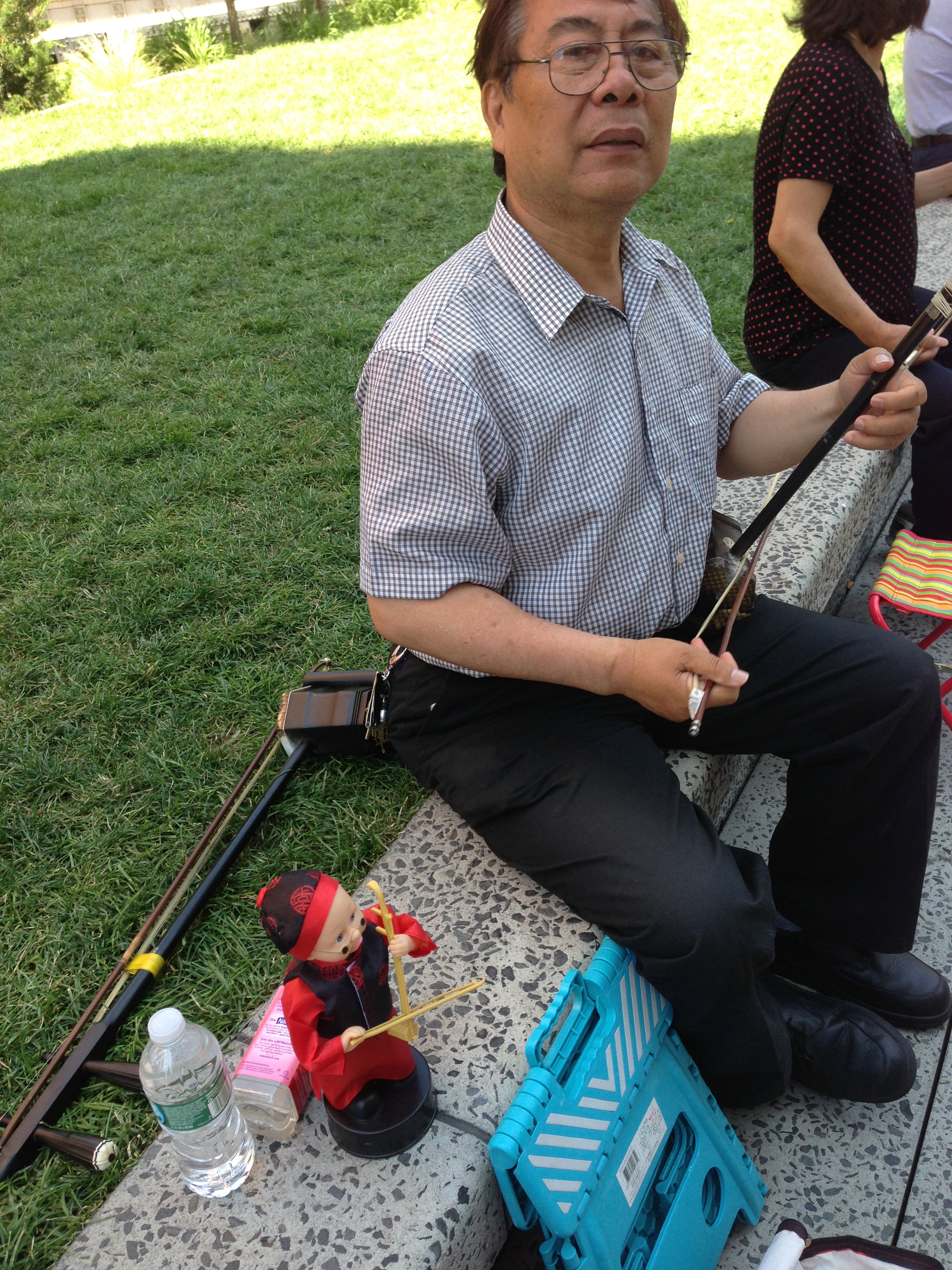
There are musicians.
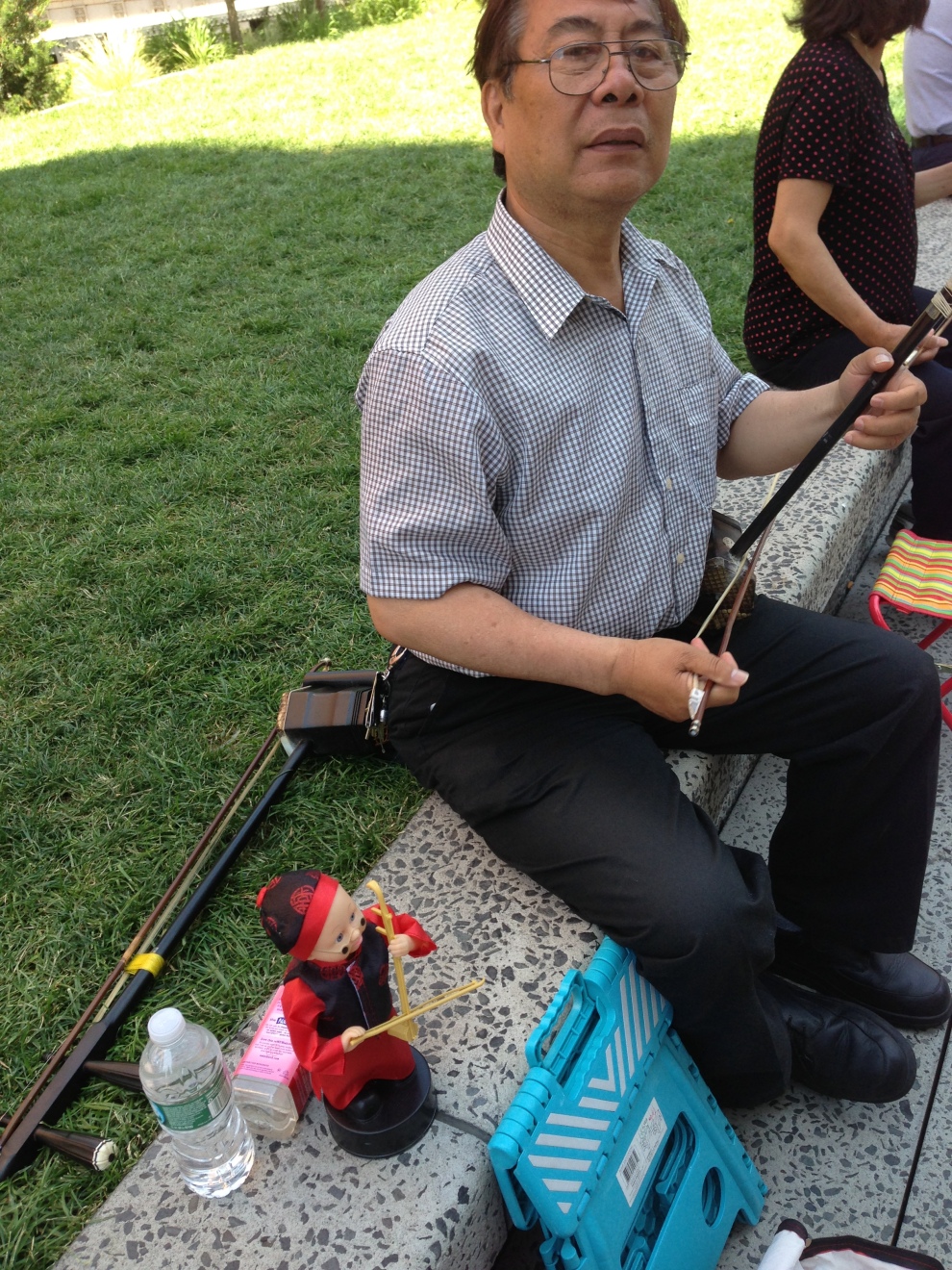
asian musician

Painters.

painter

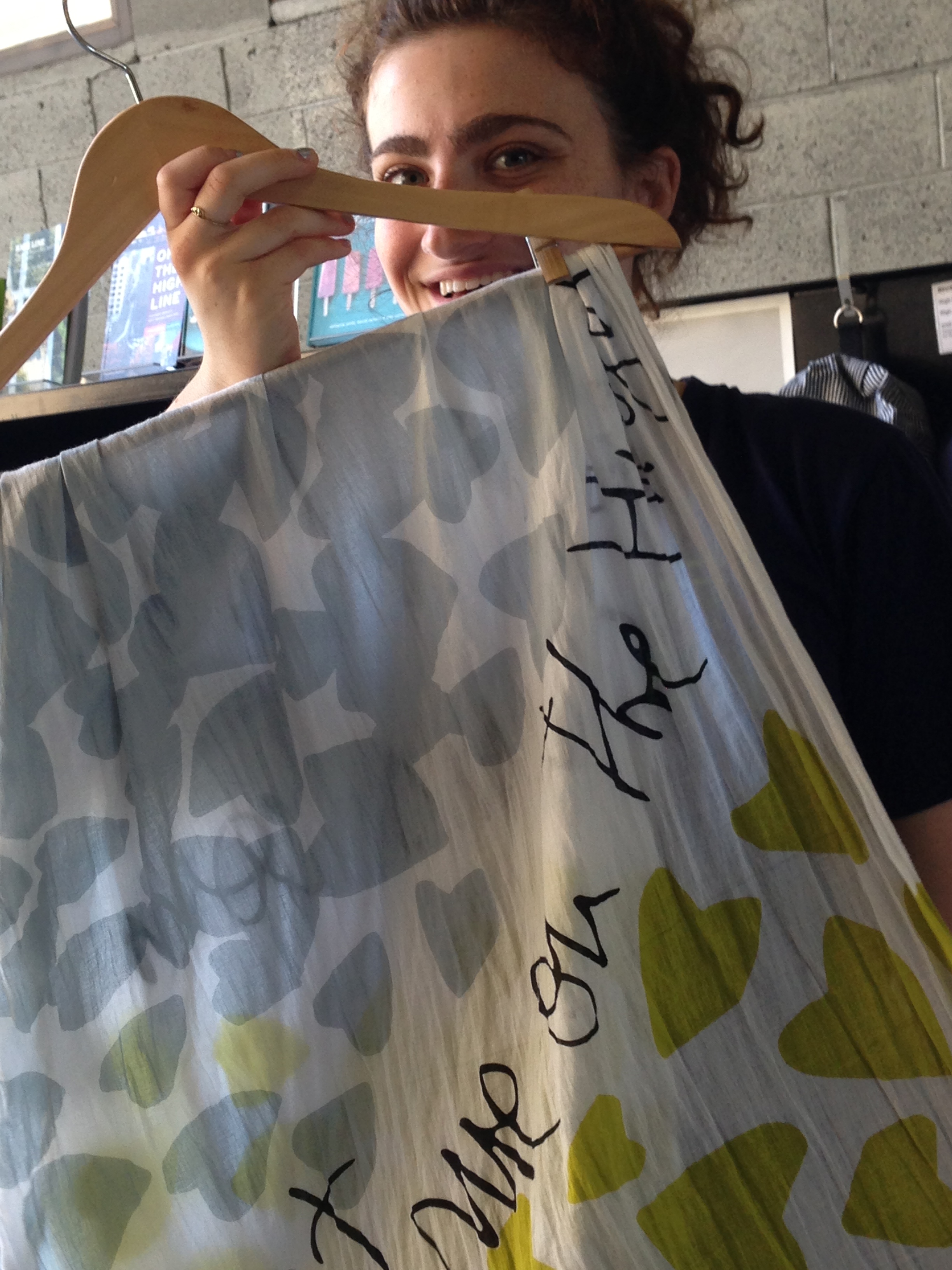
It even has its own clothing franchise, with sarongs that read “Dreams Come True on the High Line.”

sarong

Sculpture rises up along the walkway.
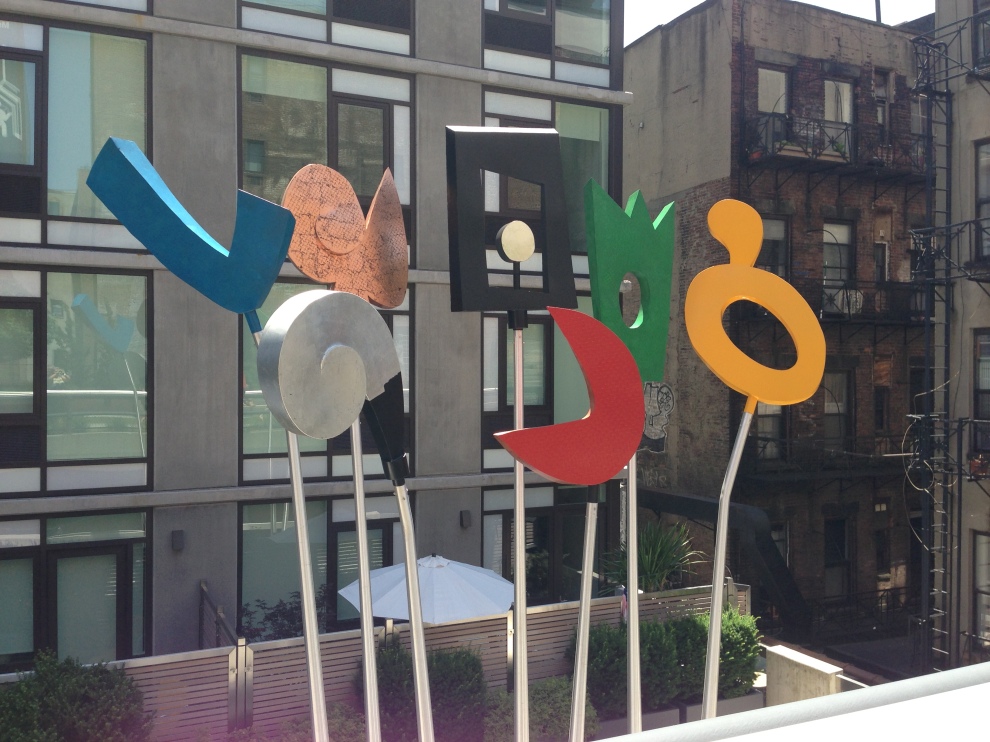
funny sculpture

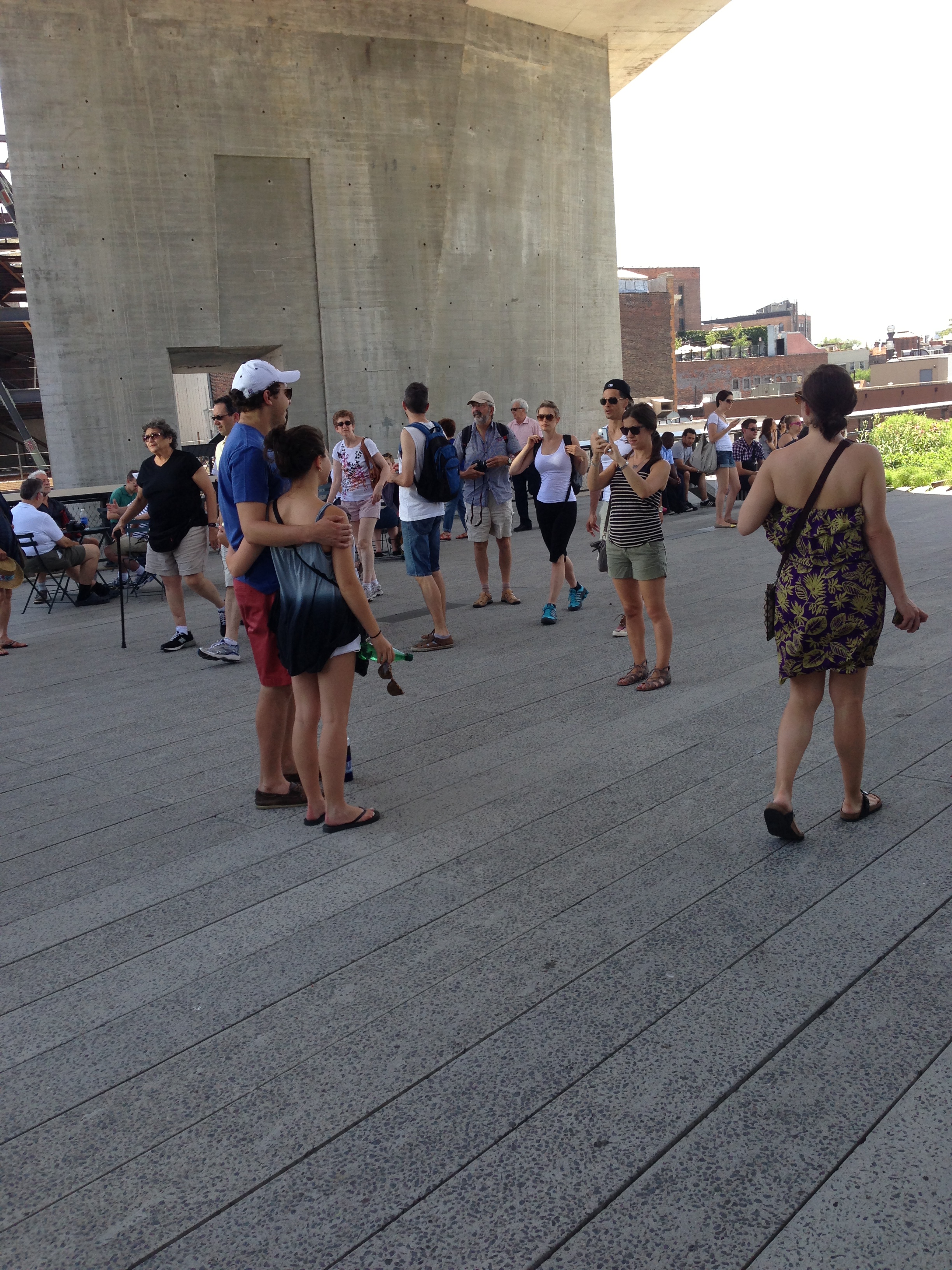
And human sculpture, as people freeze for pictures. What the High Line should have next to the fresh fruit ice pops stand is a camera kiosk. Someone would get rich. Tourists throng — you can walk a long way down the path and not hear a word of English.

taking pictures

With the new, there’s the old – a mysterious pattern of bricks.

bricks

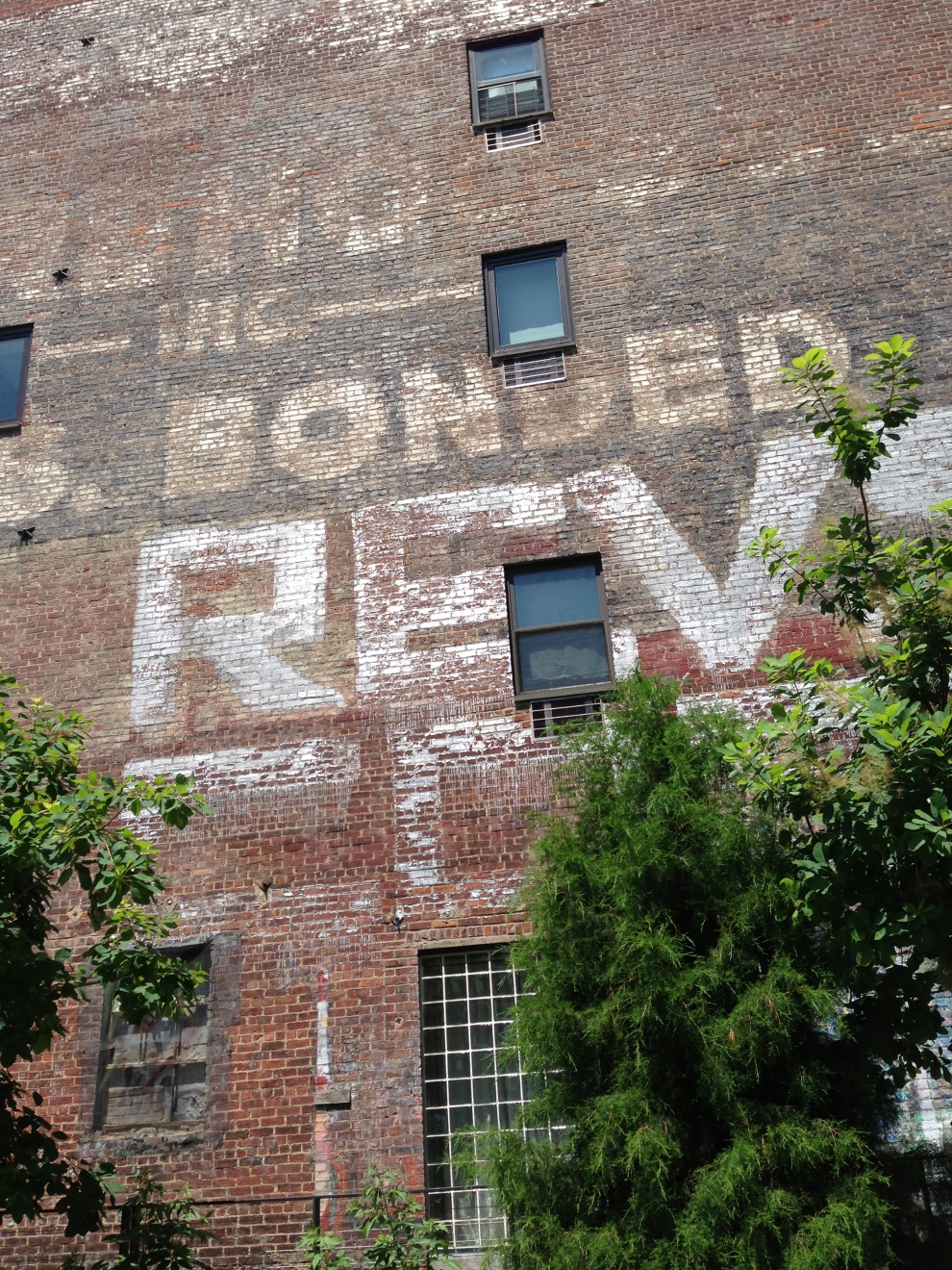
And a towering old painted sign: BONDED. Across it a tag reads REVS, shortened from REVLON, a famous graffitti artist. “It’s got to be on the edge, where it’s not allowed,” REV has said. There’s room on the High Line for all vintages.
old sign

The Gehry-designed IAC Building, at 555 West 18th Street, with its milky, origami exterior, has been open since 2007. Vanity Fair called it the world’s most attractive office building. It’s especially great to see it in tandem with structures of other vintages, including the old-fashioned piedmont of a lower one whose top is flush with the park.

Gehry

The Standard Hotel soars above. It gained some notoriety when High Line strollers realized they could look up and see happy exhibitionists making whoopee in the floor-to-ceiling windows.

the standard

(When Chuck Barris was looking for a word to meet the network censors’ standards on the Newlywed Game, the term ultimately settled upon was whoopee.) Meat trolleys for hanging beeves still exist if you look closely. Right along the Standard, in the shadows, a rusted remnant of the  district’s sanguinary past.

beeves

But one essential thing about the High Line is the views.

cityview

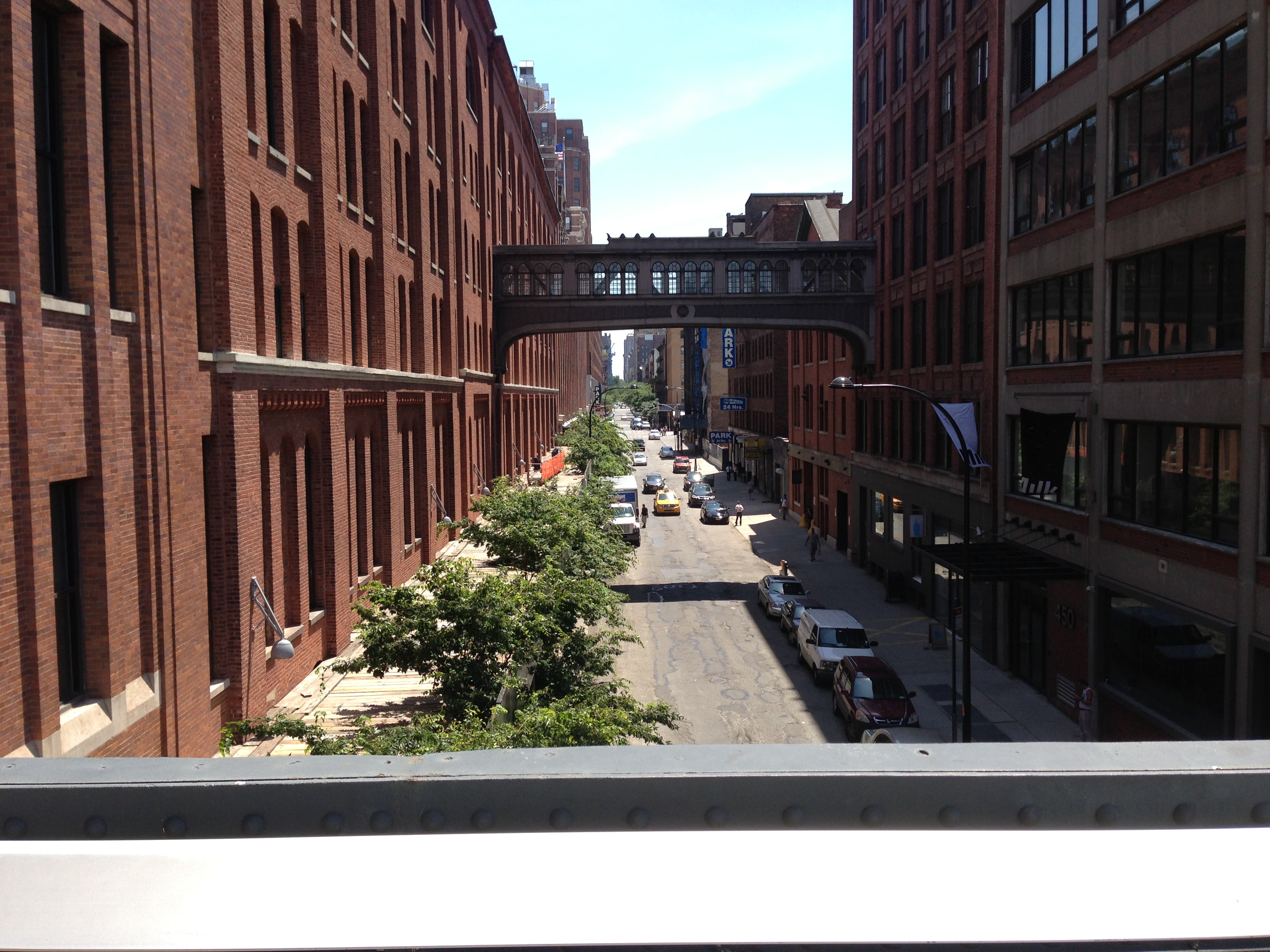
In the nineteenth century, landscape architects carved out pastoral views on grand country estates, cropping trees advantageously to accentuate vistas of rivers, mountains, or other natural elements. The High Line is the 21st century equivalent, with quirky street perspectives all around, framed from this tall iron structure.

bridge

After our promenade, we descend to vintage New York cobbles. A remnant of the lost city.

cobbles

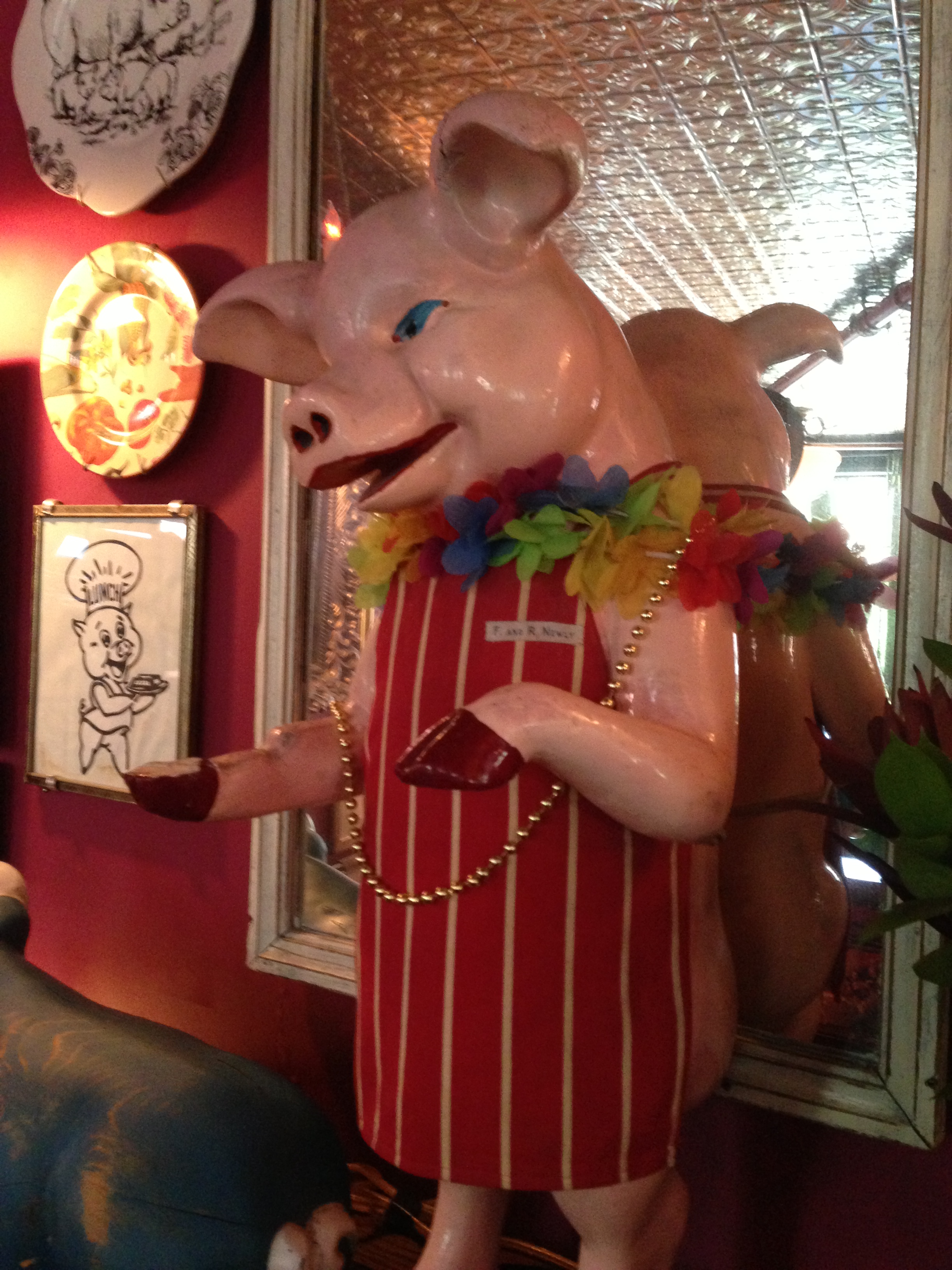
We refuel at a restaurant called The Spotted Pig.

pig

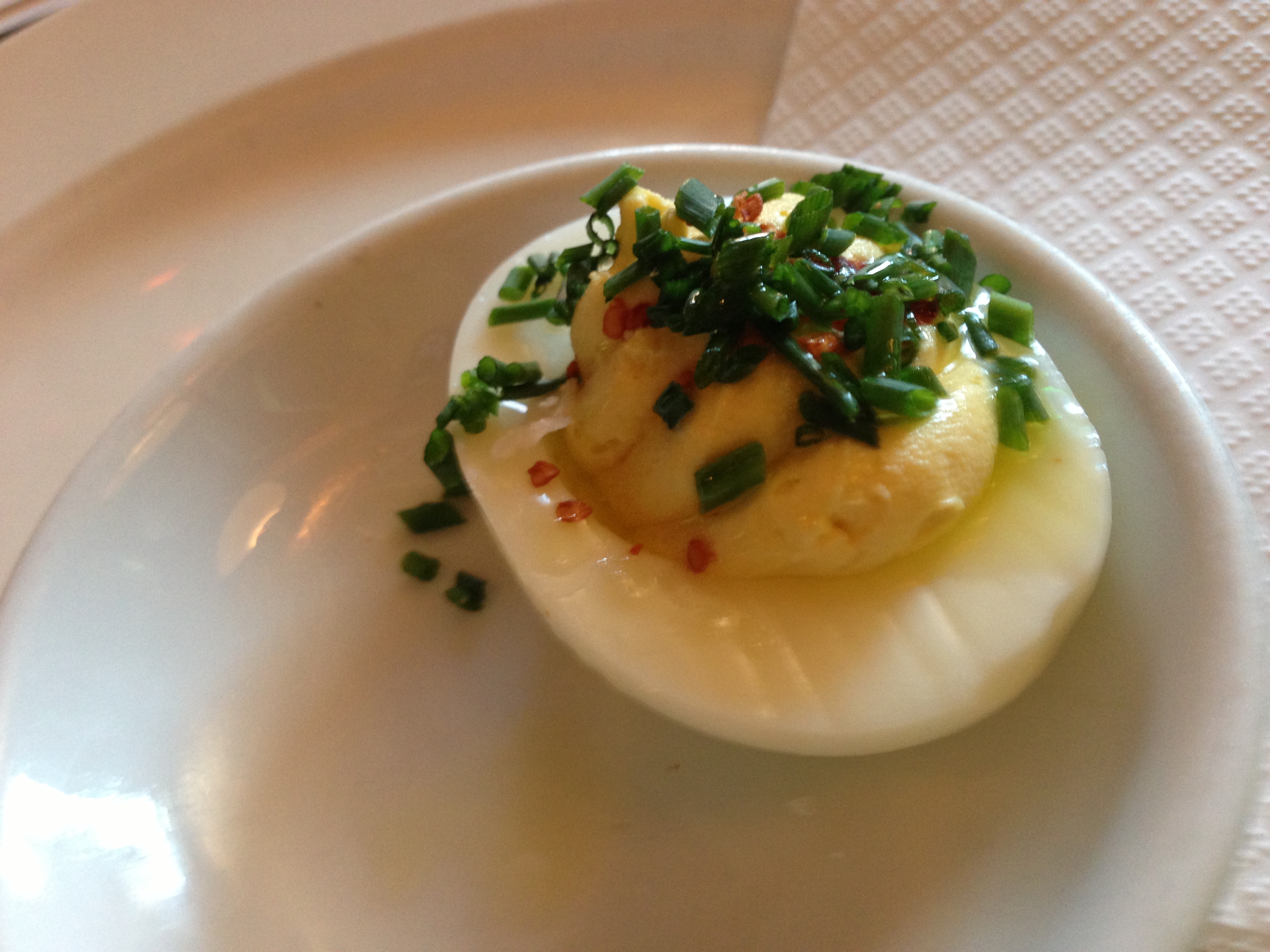
The eggs it serves are divine, with crunchy flecks of sea salt.

egg

I am tired after our sun-blasted walk of a two miles. Jesse is wide awake, which he always is, except when he’s asleep.

jess eyes

And the french fries… well, it is hard to shovel them in fast enough.

fries

The chef strews the shoestrings here with shreds of rosemary. Everything tastes better after the High Line. An ordinary pinapple smoothie from a new perspective.

smoothie

A fantastic church frieze overhead. Had it always been there? I can’t recall. The galleries of Chelsea are closed on Sunday, but that doesn’t mean the great sidewalks of New York are closed for business.

girl graffiti

Too much graffiti has been scrubbed off in recent years. Manhattan is the new Minneapolis. Now we have clean, healthy biking all over town. In Greenpoint, Brooklyn,  where I visited a week ago, it’s a different – and more colorful – story, as it hasn’t quite shed its industrial past and makes a fine canvas for folks who do outdoor outsider art.

slut tribe

Here in the Meatpacking District we find a few worthy efforts.

boy graffitti

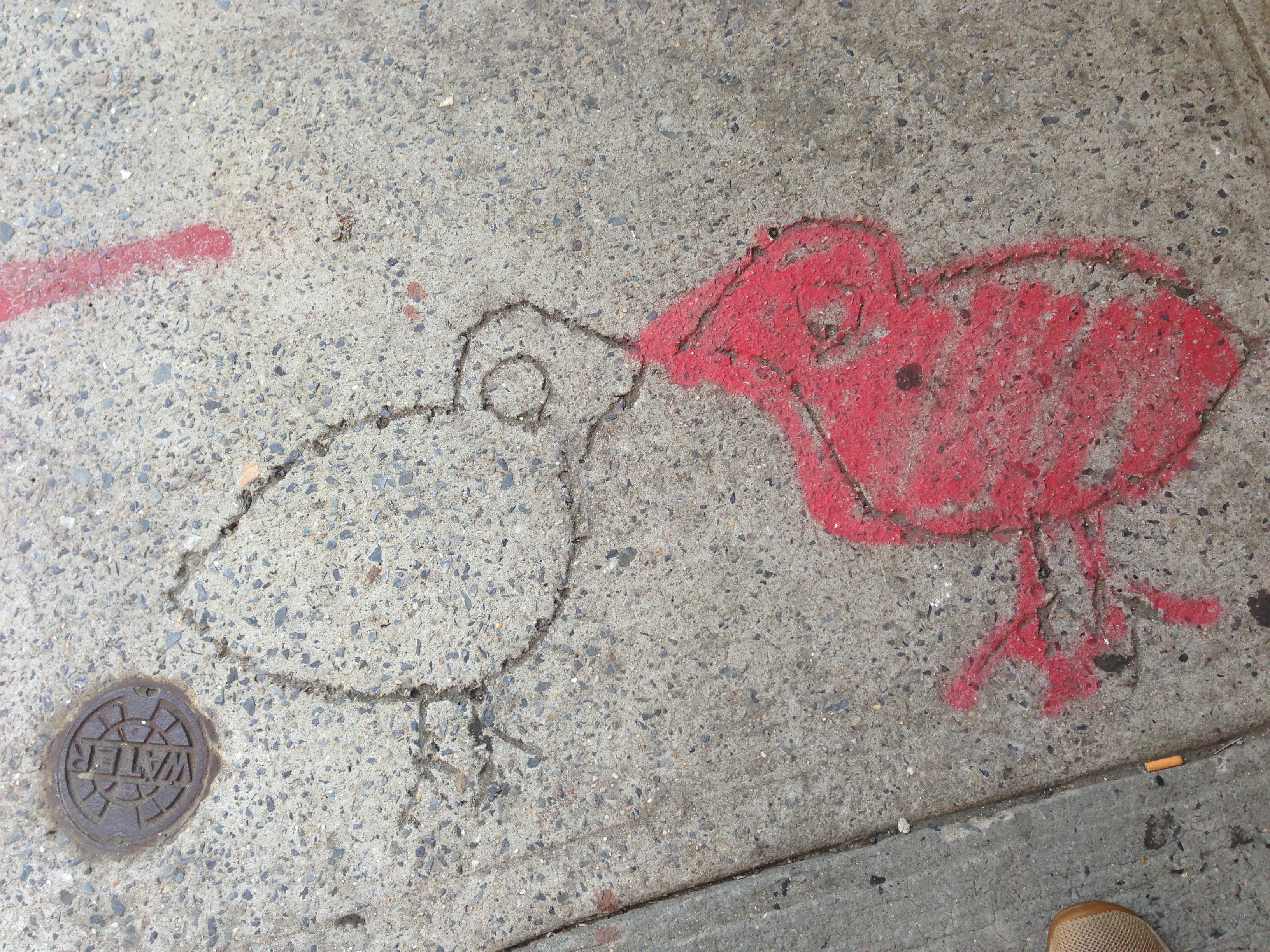
Two chicks etched on the sidewalk beneath our feet.

chick sidewalk art

For some reason I like these simple birds, making kissy next to their little water fountain.

The all-seeing eye. The Eye of Providence.

evil eye

On the island of Manhattan, if you let your vision wander up, you see some marvelous things. A blue horizon chockablock with architects’ freshest concoctions. Pieces of old New York, dusty red bricks that have miraculously been saved from the wrecking ball. Climbing roses, if you’re walking the High Line. From that same pathway, a glimpse of a well-to-do fanny in a chic hotel window. And there are still wooden water towers.

water tower

Just two companies, Rosenwach Tank Company and Isseks Bros., manufacture the tanks, which are unpainted and made with untreated wood. A new water tower is a leaky water tower, as it takes time for the material to become saturated and watertight. Chelsea has one, completely dry of course, that has recently been transformed into an exclusive club called Night Heron. You can see it from the High Line.

1 Comment

Filed under Art, Cooking, Culture, Fashion, History, Jean Zimmerman, Nature, Photography, Writers, Writing

A Farm Grows in Brooklyn

Or sometimes Queens.

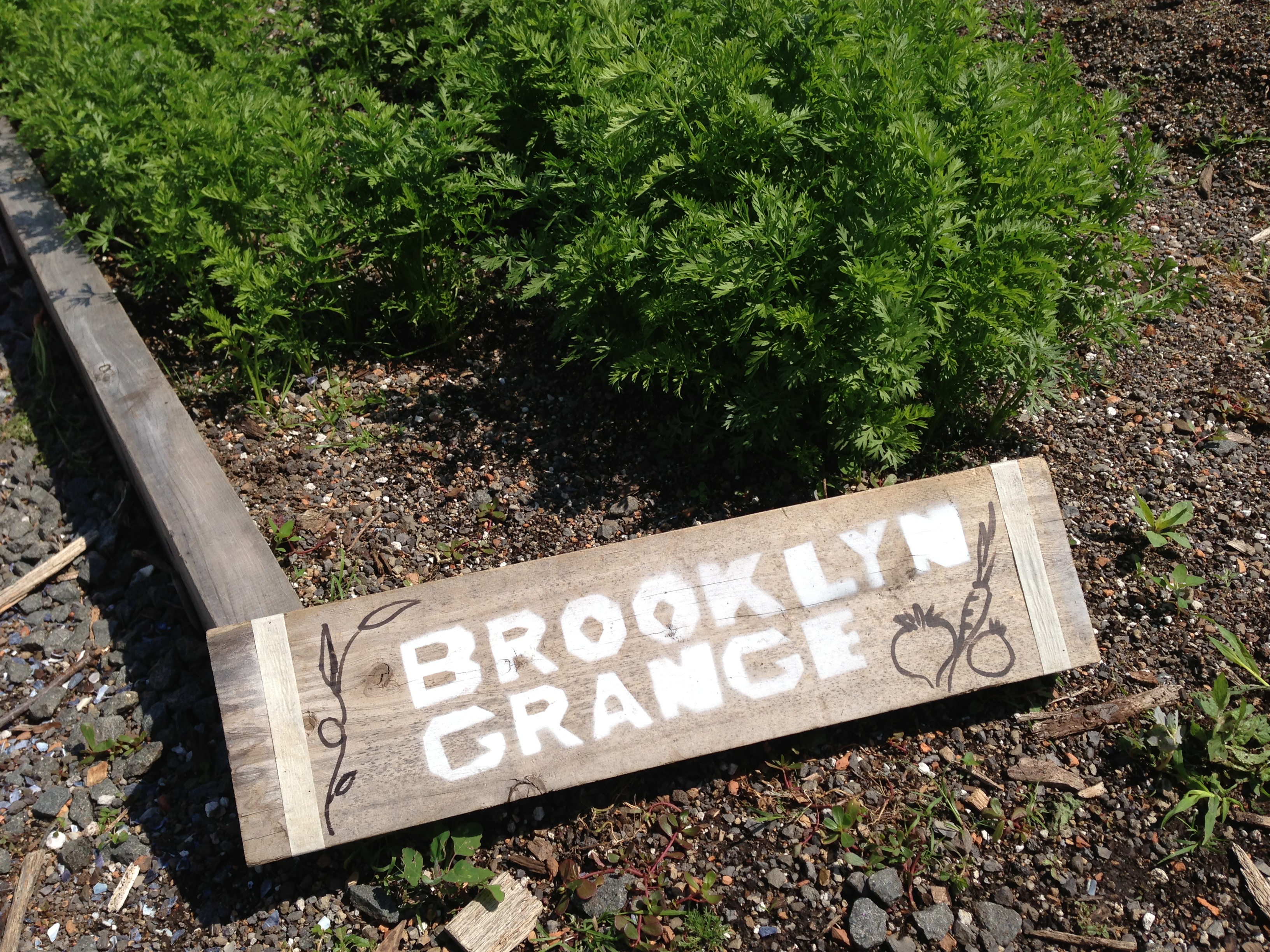
brooklyn grange sign

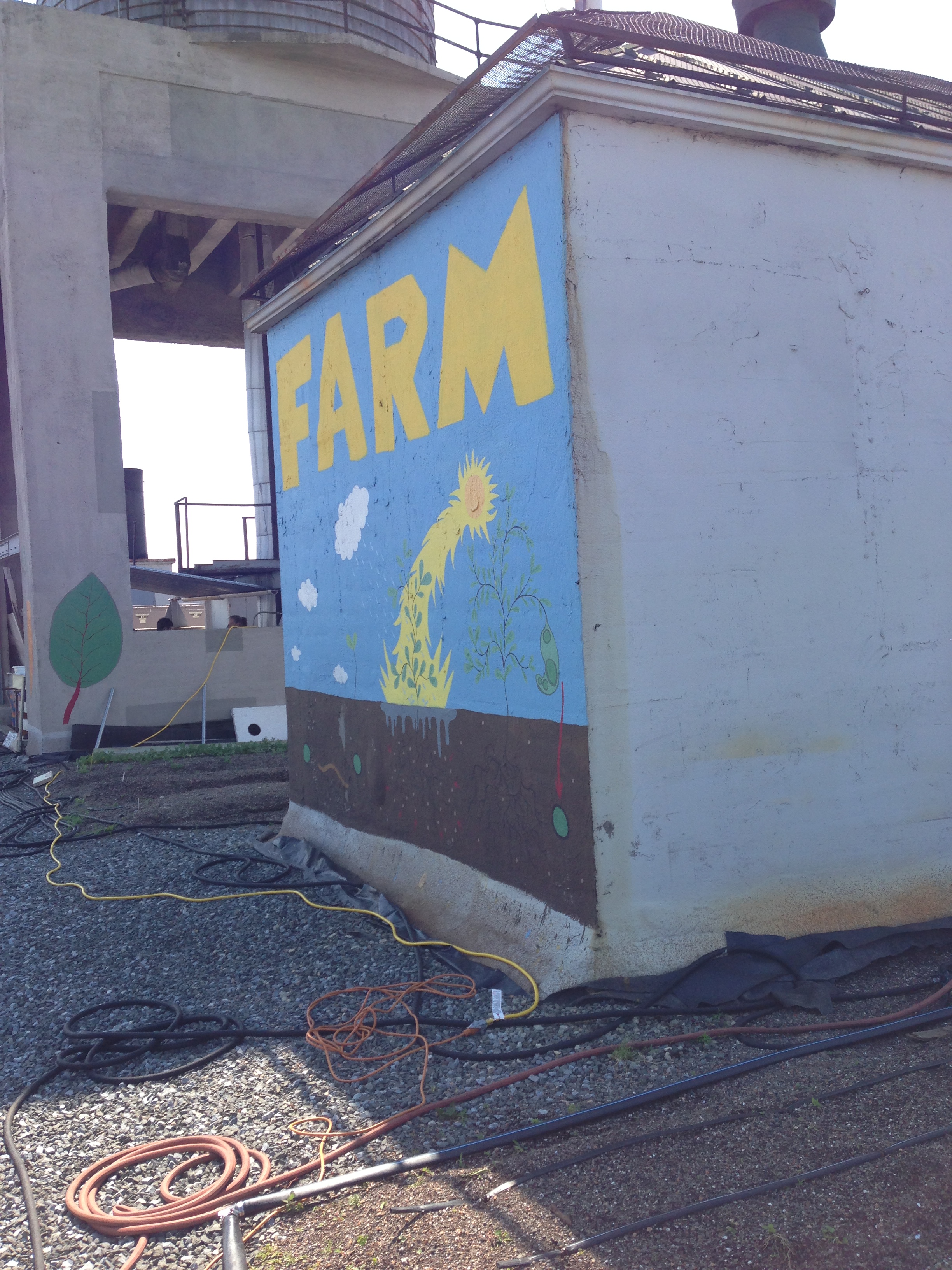
We had to find our way through a coffeehouse and the winding corridor of a building before getting to the unmarked elevator that led to the roof. Then we knew we had hit pay dirt, so to speak.

farm sign aslant

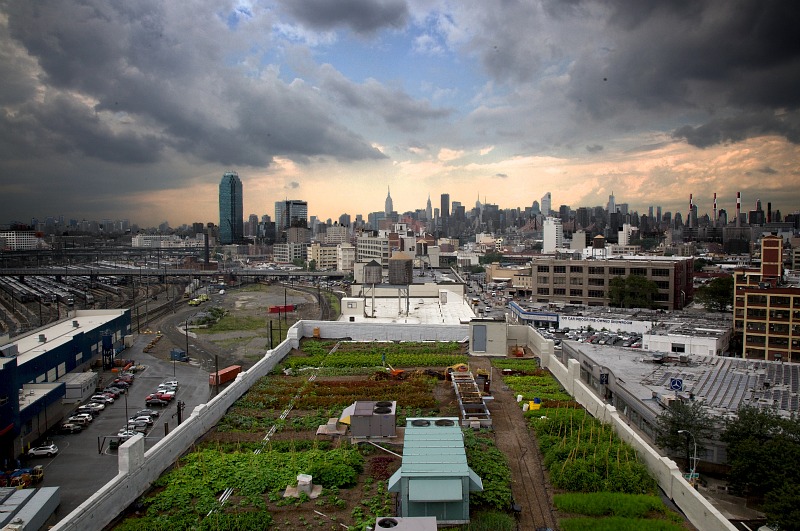
Brooklyn Grange is the largest rooftop farm in the country and perhaps the world. Sited atop a building that originated as a furniture factory, it has the space to produce at least three dozen different vegetables and herbs in the course of a season. You would never know it’s there, looking up from Northern Boulevard, a car-choked  thoroughfare that muscles its way through Queens, New York.

farm bldg

We were a little early. The volunteers were still bagging up the greens for the CSA as Gwen, a busy farm worker, applied sunscreen to her arms. This is great weather for kale, said Gwen. All the rain makes it really spring up. The farm stand also displayed beautifully fresh carrots, mesclun, scallions.

greens in rows

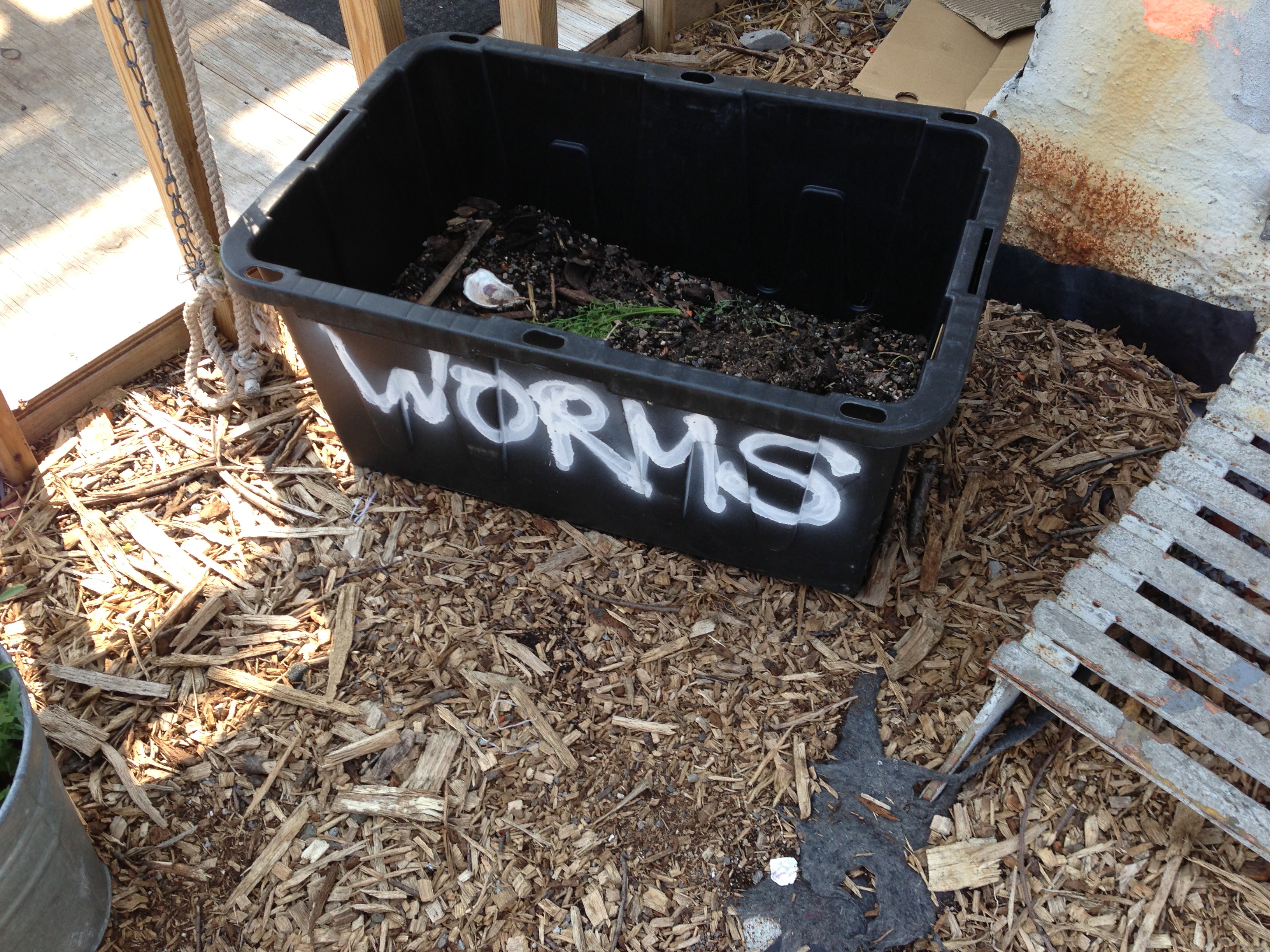
A farm on a roof has to have all the things a farm has on the ground. Worms.

worms

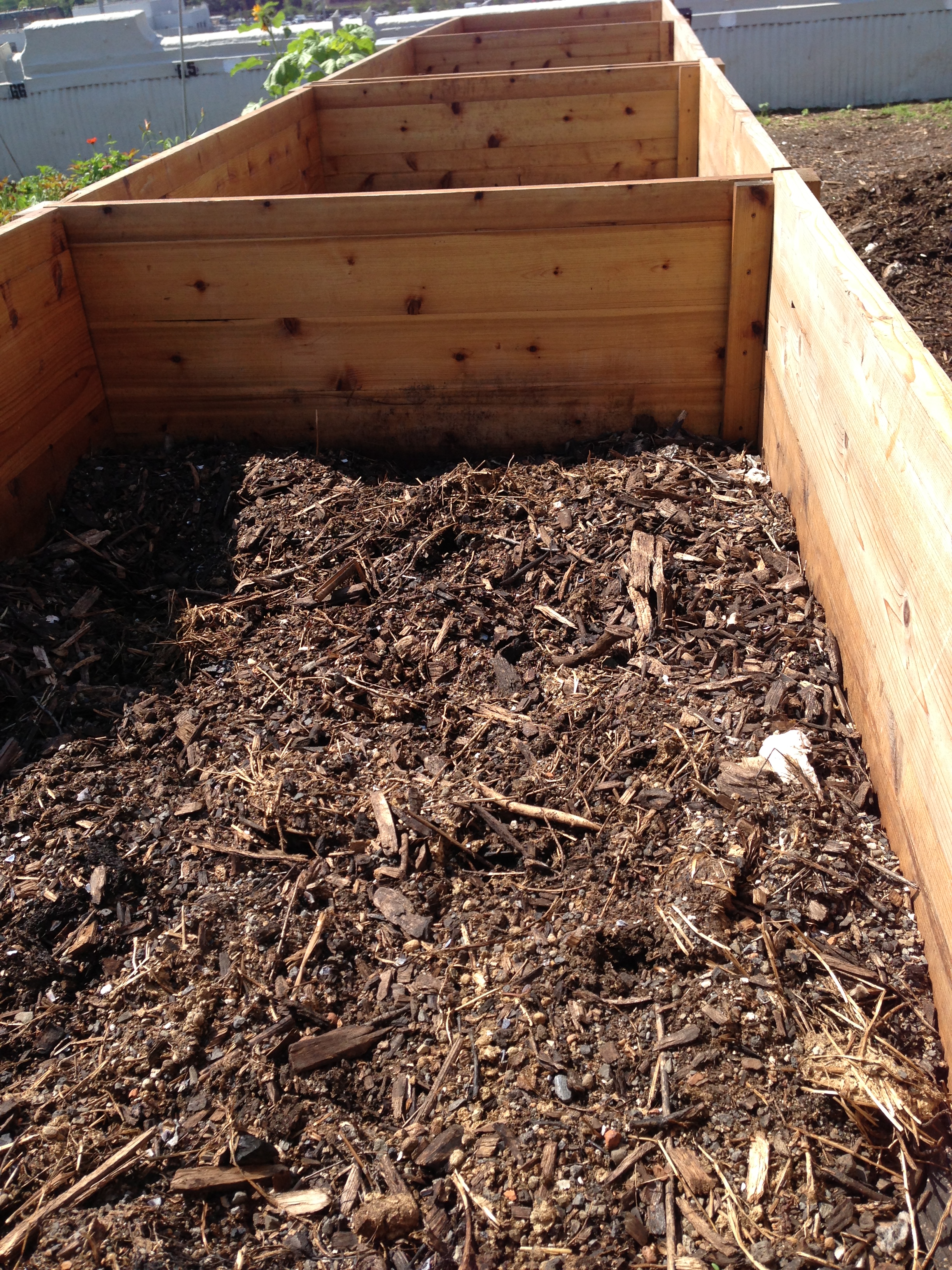
Compost.

compost bins

The farm manager, Bradley, wearing a bright green tee shirt whose back was emblazoned with the words, “This is what a feminist looks like,” told me a little about the chickens.

chickens

The dramatic white one, he said, was a Japanese silky. I asked him about the manure, so great for vegetables. They have about a dozen birds. They give what they can, said Bradley. He directed the volunteers out among the rows to harvest thyme and flowers. Tourists and photographers were beginning to show up, most with the kind of equipment that views like the Farm’s deserve. This one, taken on another day, is by a photographer named Cyrus Dowlatshahi.

Brooklyn-Grange-by-Cyrus-Dowlatshahi2

You feel you could leap the distance from the pepper plants to the Empire State Building in one stride – or at least that Philip Petit could make a project of the crossing.

Photographer Rob Stephenson has made some striking pictures of New York’s farms and gardens.

Hells Kitchen

Not just rooftops but the kind of small, intimate plots that can in found in Harlem and the Bronx, and nurture peoples’ souls as well as their stomachs.

community garden

Close up at Brooklyn Grange you can see the serious thought behind the endeavor.

lettuce w sign

The rows of stakes waiting for the tomato’s slow and steady climb.

tomato stakes

There are roughly 1.2 million pounds of soil in this one-acre plot.  Could the concrete slab roof  give way? Absolutely not. All these details and more are readily available on line.

You can book an event at the rooftop, even a wedding. Perhaps guests could weed between glasses of champagne.
Brooklyn Grange is joined by other urban farms in New York: Added Value, Tenth Acre Farms, Battery Urban Farm, Gotham Greens and and Eagle Farm are just a few of these enterprises. One researcher was quoted in The New York Times last year: “In terms of rooftop commercial agriculture, New York is definitely a leader at this moment.”

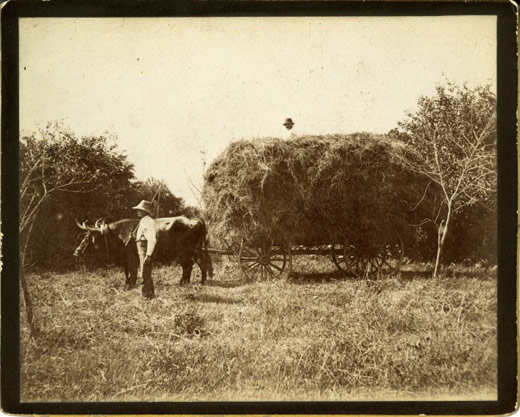
There is a long history of agriculture in the boroughs of Brooklyn and Queens.

Farming-Scene

According toRobin Shulman in her lively and informative book Eat the City: A Tale of the Fishers, Foragers, Butchers, Farmers, Poultry Minders, Sugar Refiners, Cane Cutters, Beekeepers, Winemakers, and Brewers Who Built New York, “As late as 1880, Brooklyn and Queens were the two biggest vegetable-producing counties in the entire country.” She cites one observer as saying, “The finest farmlands in America, in full view of the Atlantic Ocean.” Farmers in the boroughs used the manure of city horses to fertilize their crops, which they brought to the Manhattan market by boat.

I’m thinking about farming as I coax my tiny vegetable plot to maturity. My new strawberries have come in.

new strawberries

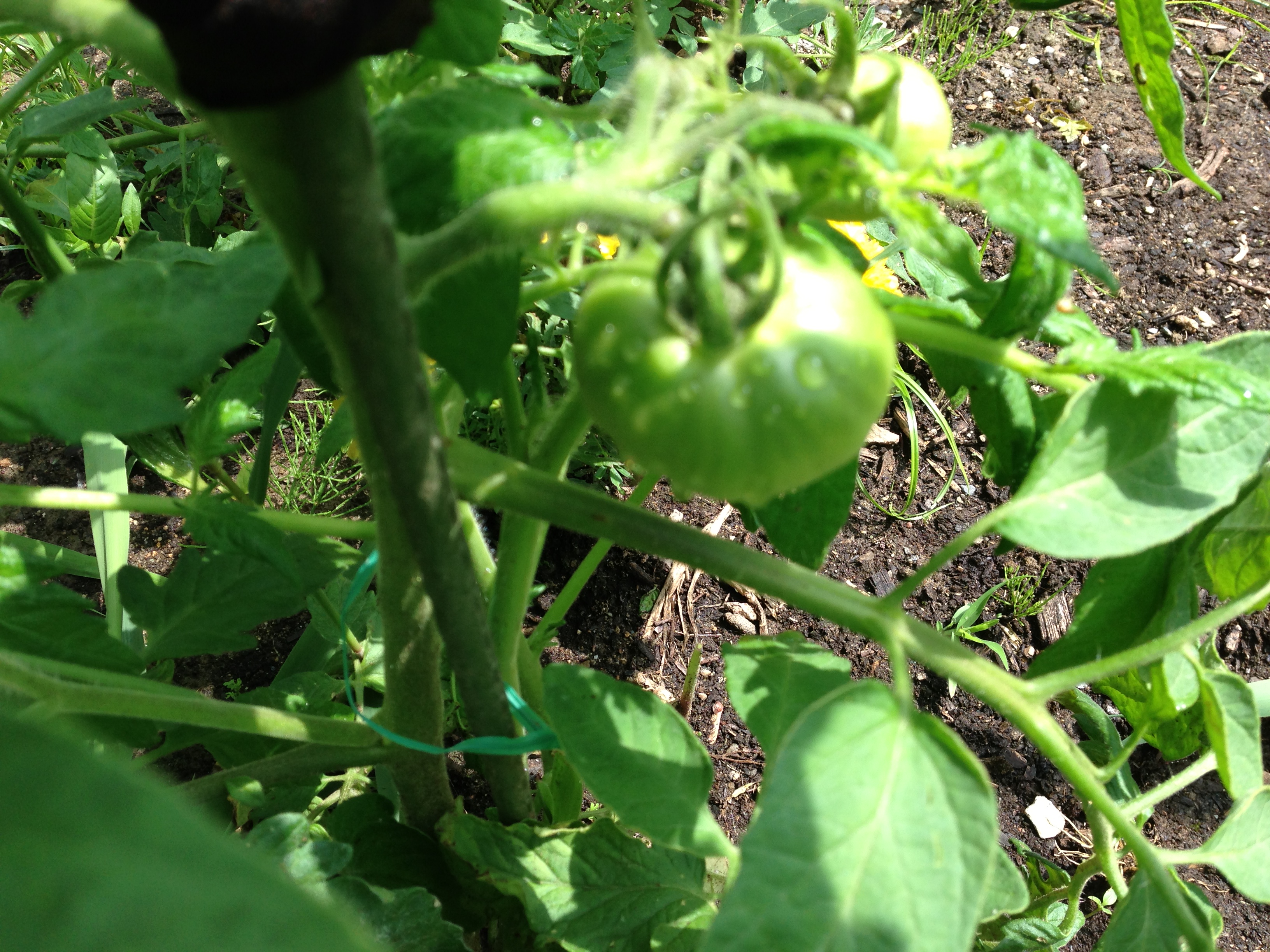
And some tomatos, the size and texture of an Atomic Fireball – remember those? – though not the color, yet.

fourth of july

But I’m tired of all this just looking at good stuff growing. Where’s the table in the fashionable farm-to-table equation?

One was set for us at The Farm on Adderley, in the neighborhood of Ditmas Park, Brooklyn. There is nothing like a restaurant with a mission statement: it “has evolved to pursue the principles of supporting local farmers, artisans, entrepreneurs as much as possible, making delicious food from that, and serving it in a completely honest way.”

pastured poultry

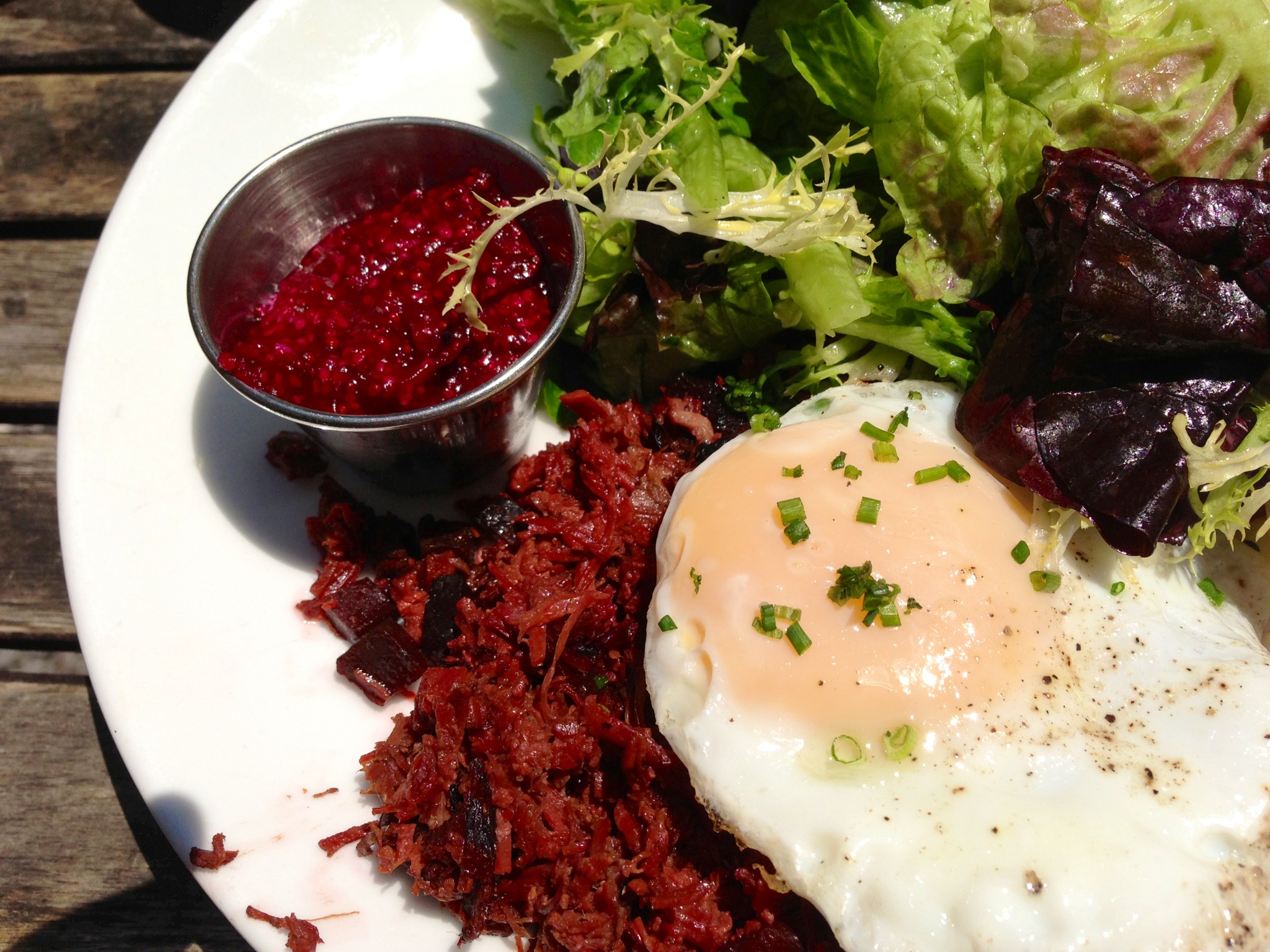
You can get a list of the local farmers who provide the kitchen’s ingredients. But that doesn’t mean anything to me unless I get a plate of food that’s good – as was my red flannel hash, its corned beef colored deeply with beets, and an even deeper burgundy horseradish served alongside. Did it taste better because the beef that was corned had roamed freely? Yes, I believe it did.

hash

The hostess brought to mind a farm girl in her friendliness, and she seated us in the garden, between a towering fir tree and a luxuriant grape vine, next to a wooden crate planted with chard and mint. The sun shone down, and we could have been out in the country. The place hosts events, like a New Amsterdam dinner “curated” by food historian Sarah Lohman, who is an educator at the Lower East Side Tenement Museum and author of a blog called Four Pounds Flour, devoted to “historic gastronomy,”

We were lost in the perfectly crisp, chewy, salty french fries, served with a sultry curry dip.

french fries

Couldn’t help, though, but overhear the young couple next to us planning their nuptials. Should we let them know about Brooklyn Grange? There could be worse places to grow your relationship.

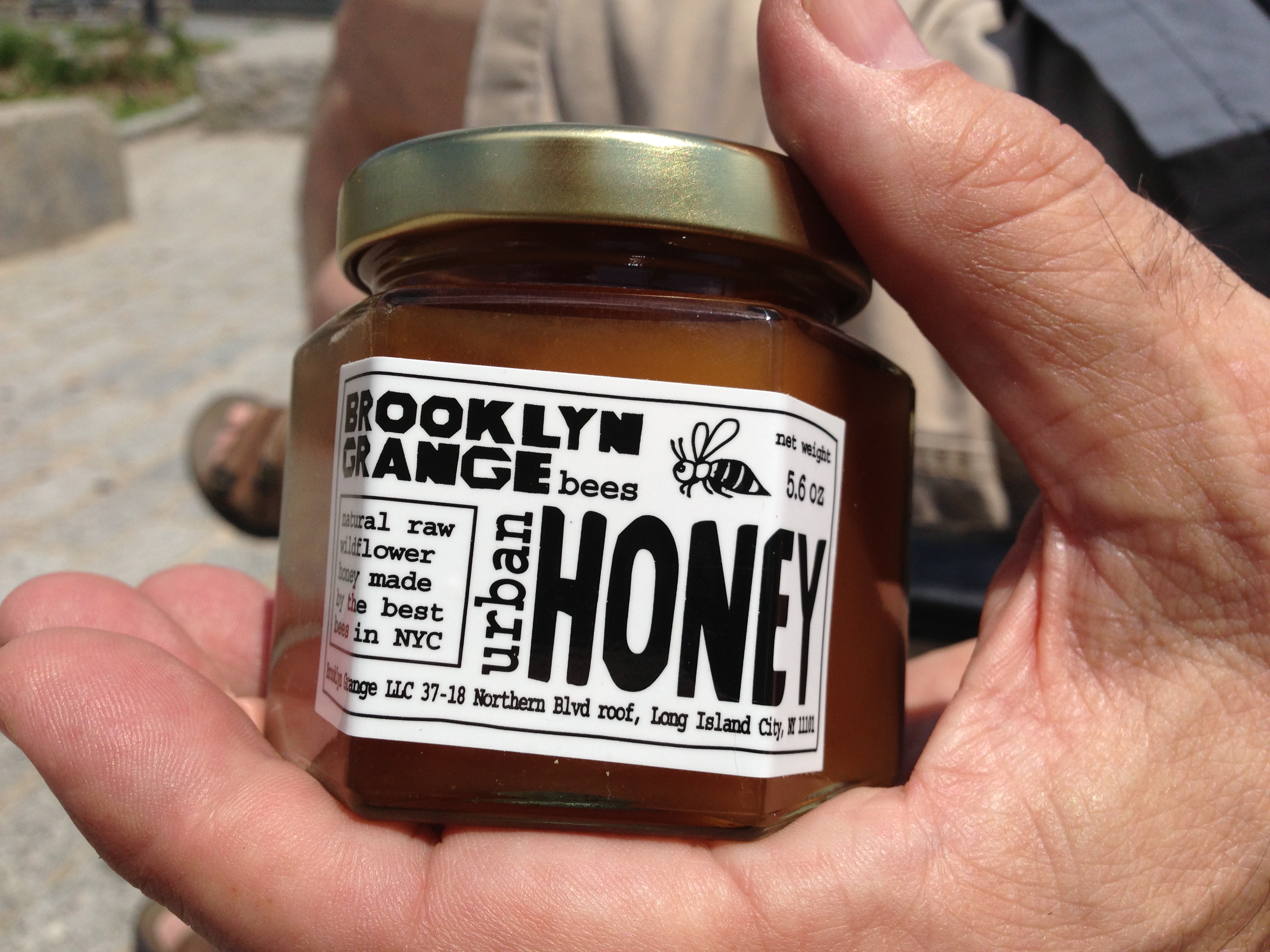
honey


4 Comments

Filed under Cooking, Culture, History, Home, Jean Zimmerman, Nature