Savage Girl was featured on this morning’s Today Show — check out the segment, Bill’s Books, hosted by David Ushery with book reviewer Bill Goldstein!
Savage Girl was featured on this morning’s Today Show — check out the segment, Bill’s Books, hosted by David Ushery with book reviewer Bill Goldstein!
Filed under Culture, Fiction, Jean Zimmerman, Publishing, Savage Girl, Writers, Writing
[Here is another post that I am also putting up under the Savage Girl tab.]
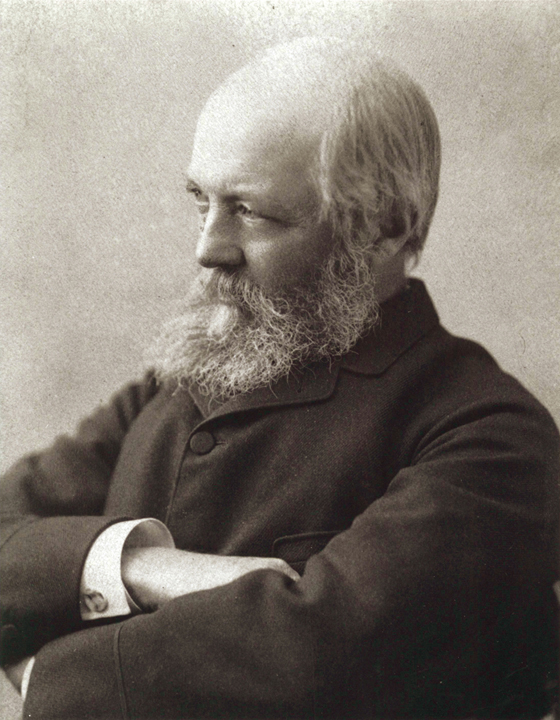
The Central Park, as it was known in the nineteenth century, had only been officially open for two years when Savage Girl arrives at the Delegate Mansion in 1875. The scrupulously landscaped plot of 843 acres, designed by Frederick Olmsted and Calvert Vaux, was set in the middle of the island of Manhattan with the idea that the creeping city would eventually reach far enough uptown to surround it, even though the locus of mid-1800s New York was much farther downtown.

The Park came about as the brainchild of a group of well-heeled Manhattanites who wanted the city to emulate the great parks of Europe, the Bois de Boulogne, Hyde Park and other green urban spaces. Robert Minturn, his wife Anna, William Cullen Bryant and others, classic progressives all, took the lead in advocating the need for a large, verdant playground for both rich and poor, a place that would improve public health and provide jobs in its construction. According to Olmsted, the park was “of great importance as the first real Park made in this country—a democratic development of the highest significance.”
In 1853, when the Park was born by legislative fiat, the land between 59th and 110th Streets was occupied largely by poor squatters who according to one observer “lived off the refuse of the city, which they daily conveyed in smalll carts, chiefly drawn by dogs.”
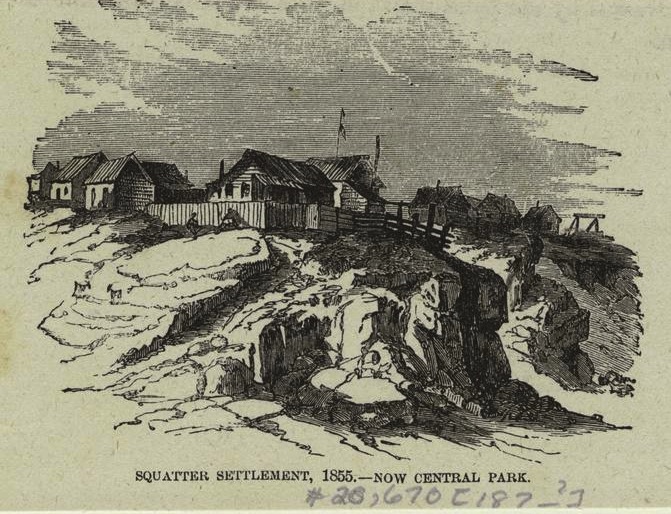
German gardeners and Irish pig farmers occupied shanty towns known as Dutch Hill, Dublin Corners, and the Piggery, and a well-established African-American community called Seneca Village stood at what is now Columbus Avenue and 82nd Street — all of whom were displaced when the Park came in.

Among the more arcane activities of denizens was the nineteenth-century trade of “bone boiling,” which produced a byproduct used in sugar refining. The area encompassed swamps and bluffs, wooded areas, and massive rock outcroppings.
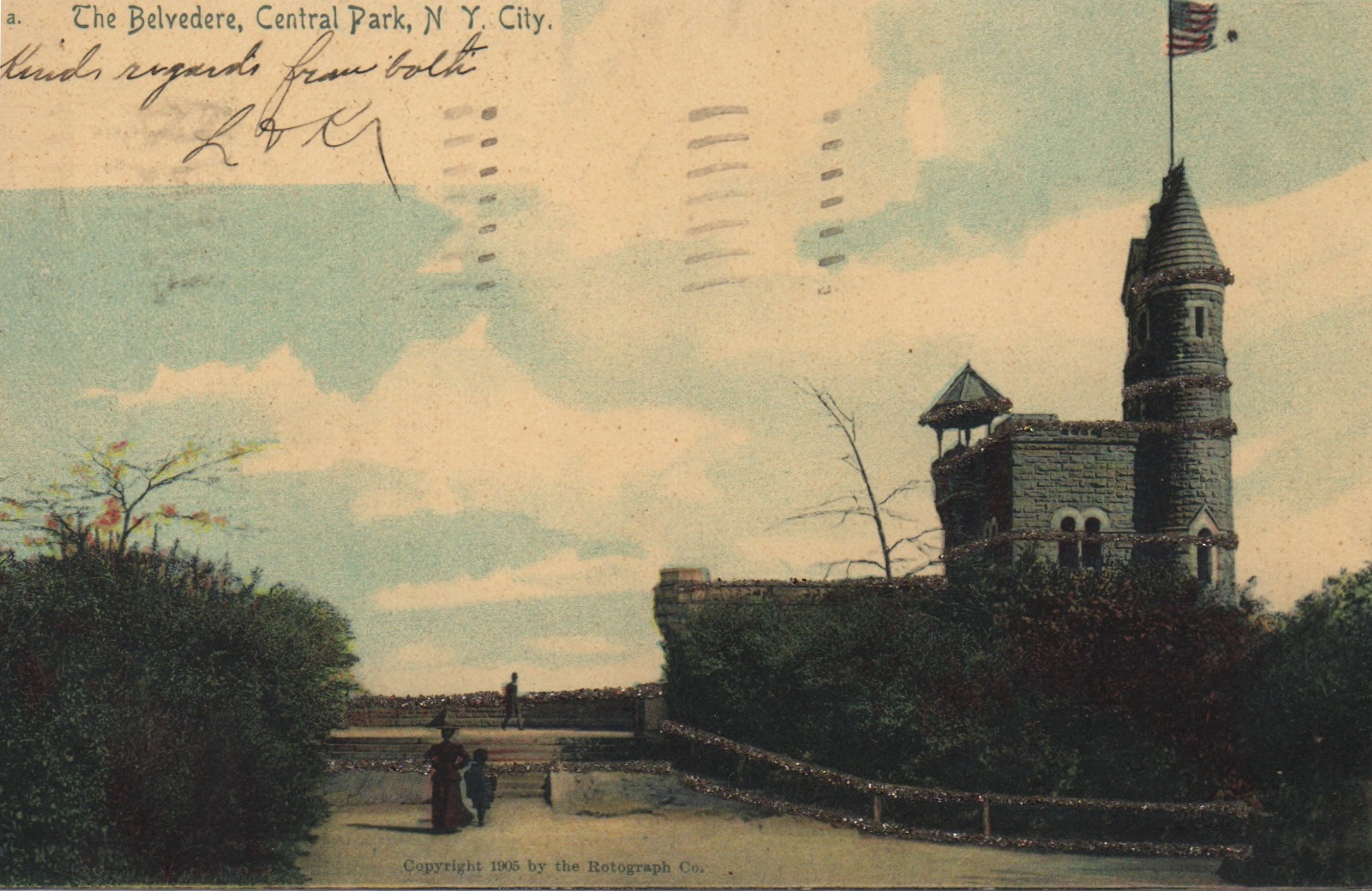
The Greensward Plan of Olmsted and Vaux was eight feet long and three feet wide, covered with stipple points designating vegetation, rock accents, footpaths and carriageways. A topographical tool and work of art all at once, the map specified structures that still exist today. The three and a half million square foot plot of land has remained remarkably the same, despite ideas that have been floated over time for such new things as stadiums, new athletic fields, model farms and airplane landing strips. The Park has 250 acres of lawns, seven bodies of water and 80 acres of woodlands. The Greensward plan called for some 36 bridges, all designed by Vaux, ranging from rugged spans of schist or granite to neo-gothic cast iron. The Mall’s doubled allées of elms comes to a stop at the Bethesda Terrace, whose centerpiece is the Bethesda Fountain. When Calvert Vaux designed the romantic Belvedere Castle in 1869, it was as one of the Park’s many whimsical structures, intended as a lookout to the reservoir to the north and the Ramble to the south.
The charms of the Park’s landscaping are largely man-made; during construction, 1800 cubic yards of top soil were carted in from New Jersey to establish plantings. Laborers planted more than four million trees, shrubs and plants. More gunpowder was used to clear the area than was used at the battle of Gettysburg during the American Civil War.
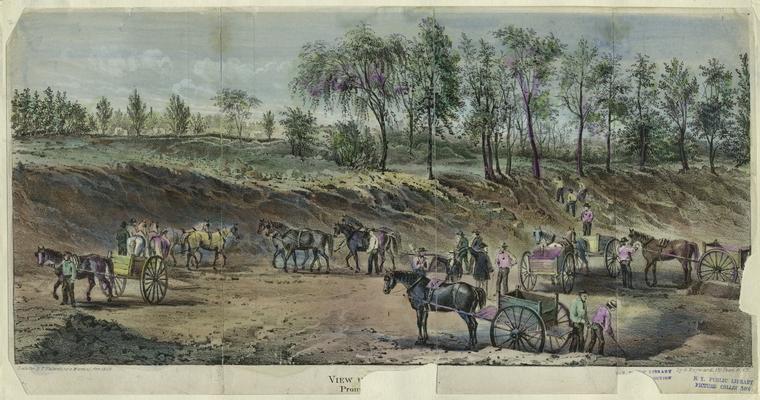
Some elements we associate today with Central Park didn’t exist. The Metropolitan Museum, now sited at the east side of the Park between 83rd and 87th Streets, wouldn’t relocate until 1880 from a townhouse on 14th Street to a red-brick Victorian Gothic building (still part of the museum complex) at the edge of the greensward on the site of a meadow that the city had formerly fenced in as a deer park.
Central Park is a place that is quintessentially public, open to all, and yet offers individuals many sites that become personal favorites. The Dene (a term meaning valley) is one of those. A long stretch of pastoral landscape that exemplifies both the features and the intended effect of Olmsted’s designs runs along the east side from the Conservatory Water and the verdant meadow known as the East Green to the north and the Zoo to the south, it features gently rolling lawns and shaded walks.
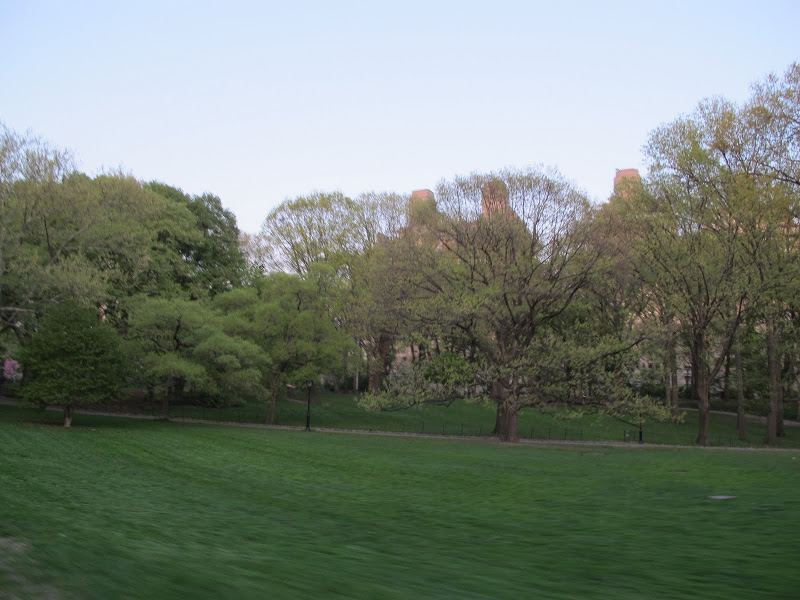
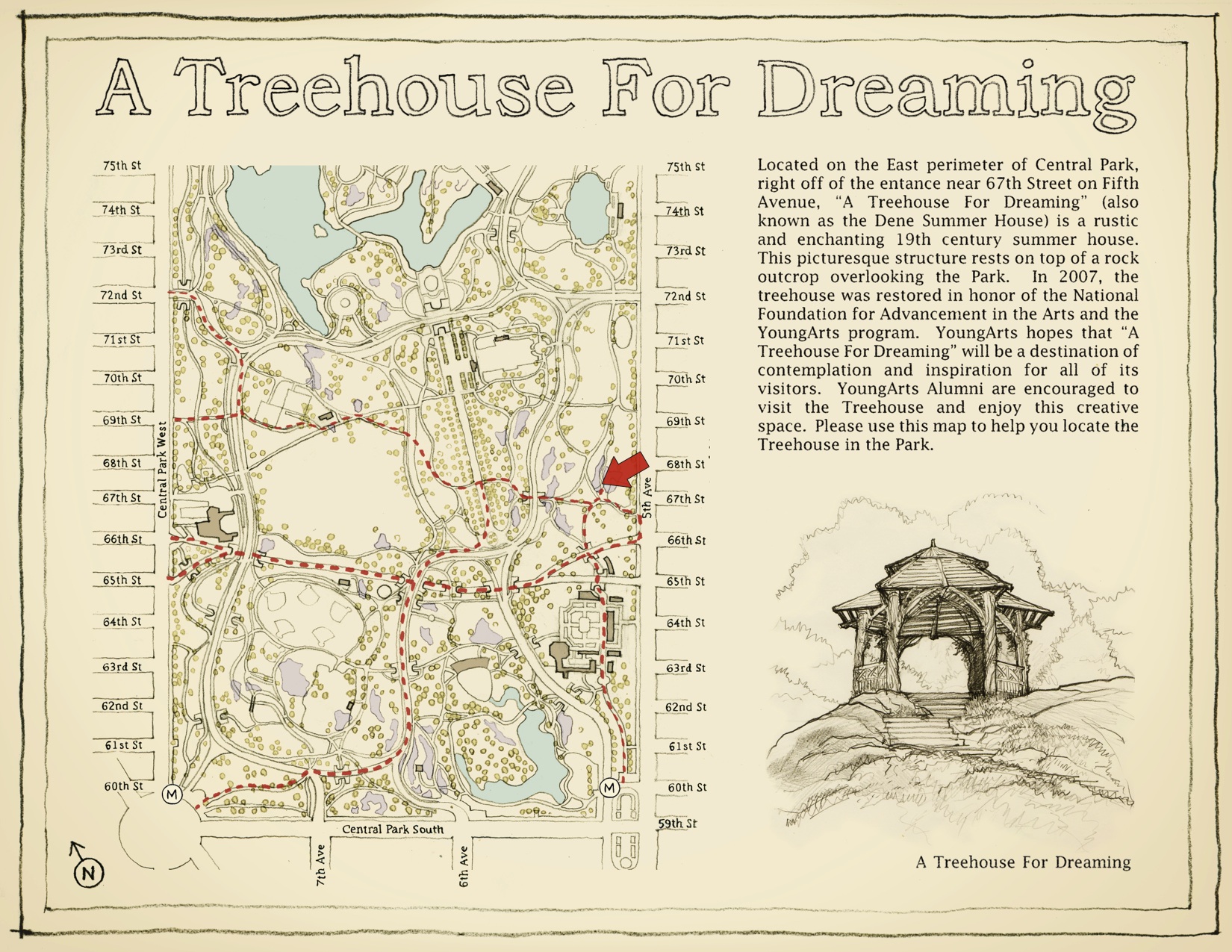
In 2007 the Dene’s rustic summerhouse atop a rock outcropping was restored, and a charming map to the feature was created. You can enter the park at 67th Street and Fifth, just adjacent to where the Delegates house would have stood, to get to the Dene and the historic structure.
From the start, leisure activities reigned in the Park. There was ice-skating on the Pond at 59th street and Fifth Avenue, in front of a much earlier version of the Plaza Hotel.

Elite New Yorkers flew in their coaches down the winding drives. They strolled in the Ramble. They enjoyed such novelties as goat carts, here portrayed in a 1870 lithograph.

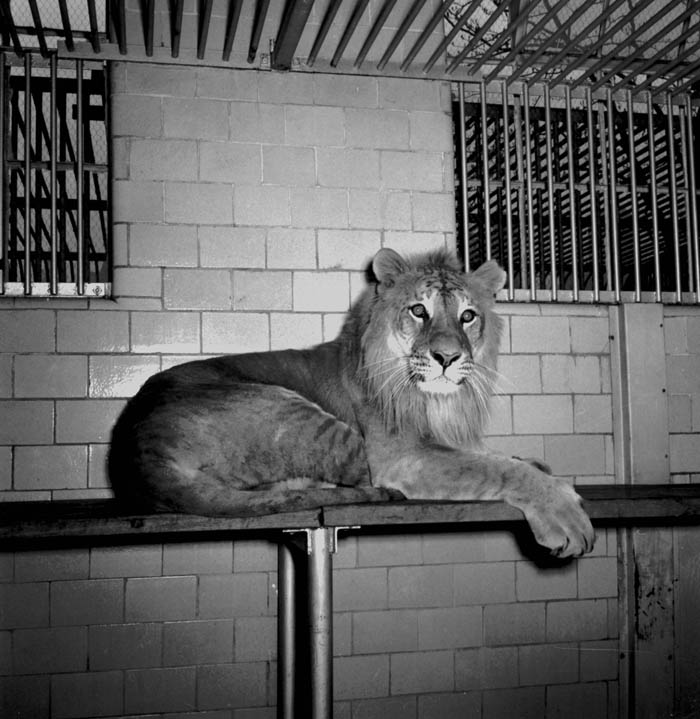
Children sailed toy boats on the Reservoir Pond at 72nd Street. The Central Park Zoo was chartered in 1875, and depended largely on the exotic gifts of wealthy benefactors. General Custer gave the zoo a rattlesnake, and General Sherman offered an African Cape buffalo, one of the spoils of his march through Georgia. One of the zoo’s most exotic donations was Charles the tigon, the offspring of a female African lion and a male Siberian tiger, that was donated to the City in 1938.
The Carousel went up when the Park opened. Mules beneath the flooring provided the horsepower to pull the decorated wooded horses above, as pictured here in 1872 in Applebee’s Journal.
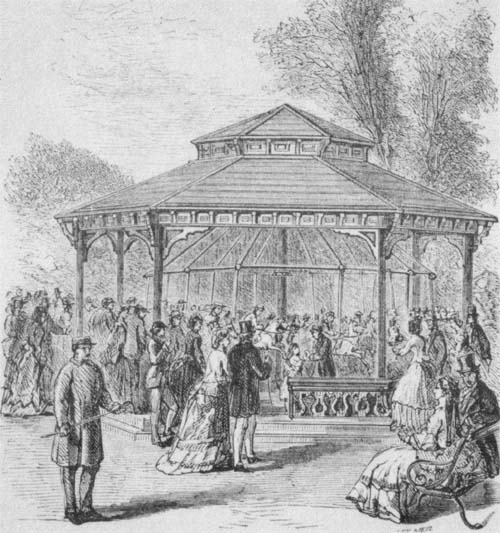 A flock of pedigree Southdown and Dorset sheep grazed on the Sheep Meadow from 1860s until 1934. I wonder what they’d make of a tigon escaped from Central Park Zoo.
Filed under Culture, Fiction, History, Jean Zimmerman, Nature, Photography, Publishing, Savage Girl, Writers, Writing
It’s funny. As an author you work and work on a new book, you write, revise, get copyedited, read galleys, proofread again and again. You see the finished product, it arrives at your doorstep in a box of 20 advance copies for you to do with what you will. On publication day you know the book is out in the world. And yet until you walk until a store and see it with your own eyes you don’t know it for real.

So I had a little time to kill in Pleasantville, New York before going to see The Wind Rises, directed by Hayao Miyazaki. My favorite local indie outfit, The Village Bookstore, lies just across the street.
You go first, I said to Gil. See if it’s there.
Then I thought that was lame. Screw your courage to the sticking place, I told myself, and ventured in. There my book lay, and it was displayed in good neighborly company, alongside Donna Tartt, Sue Monk Kidd, Anna Quindlen and Isabel Allende.
I mildly asked the store clerk if he’d like me to sign some copies while I was there. He seemed delighted, found me a pen, and when I said I hoped people would be interested in Savage Girl he had an answer that made me blush, glow, beam.
Well, he said, I think so. All those people who learned to love your writing in The Orphanmaster.
Now that’s what I call a night at the movies.
Filed under Art, Culture, Fiction, Jean Zimmerman, Publishing, Savage Girl, Writers, Writing
[I will be adding essays in upcoming days under the Savage Girl tab on this site. Here is the first.]
It took two hundred years for the well to do of Manhattan to migrate uptown from the foot of the island to frontier of 59th Street, and even then they weren’t completely sure that living so far uptown was the proper thing to do.
In the beginning, in the mid-seventeenth century, when settlement began, wealthy residents of New Amsterdam kept neat homes of brick and wood.

The only residence approaching grandeur was White Hall, the English name for the house Peter Stuyvesant built at the southern tip of the island, with its stunning view of New York Harbor.
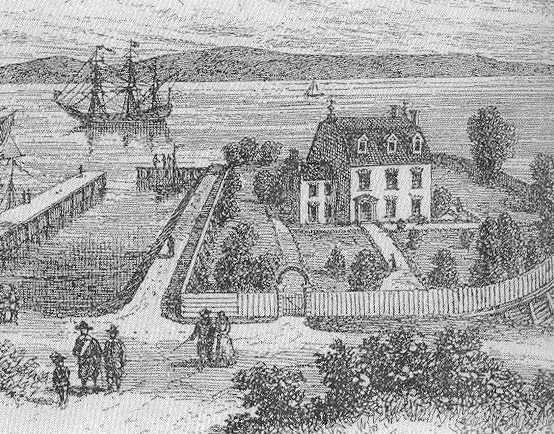
In those early days, before Fifth Avenue had been laid out, a fashionable address for the wealthy meant Bowling Green, after which people who could afford it moved up Broadway through Murray and Chambers Streets, on to Washington Square.
Until the Commissioners’ Plan of 1811 cut regular streets through the city (155 cross streets and 12 Avenues) the start of Fifth Avenue was farmland, as was almost almost all the property north of Canal Street. The name Fifth Avenue appeared for the first time on the Commissioners’ map. No one imagined that the thoroughfare would one day stretch six-and-a-half miles up the island. But the street was spacious and straight, and Manhattanites began to build townhouses along it; within two decades church steeples rose on either side of the street, Belgian blocks were laid for paving, and New Yorkers had begun to promenade along its length. In 1828, the city opened Washington Square at Eighth street at the base of Fifth Avenue, a tract that had been used since 1797 as a potter’s field. Gracious homes went up around the square.
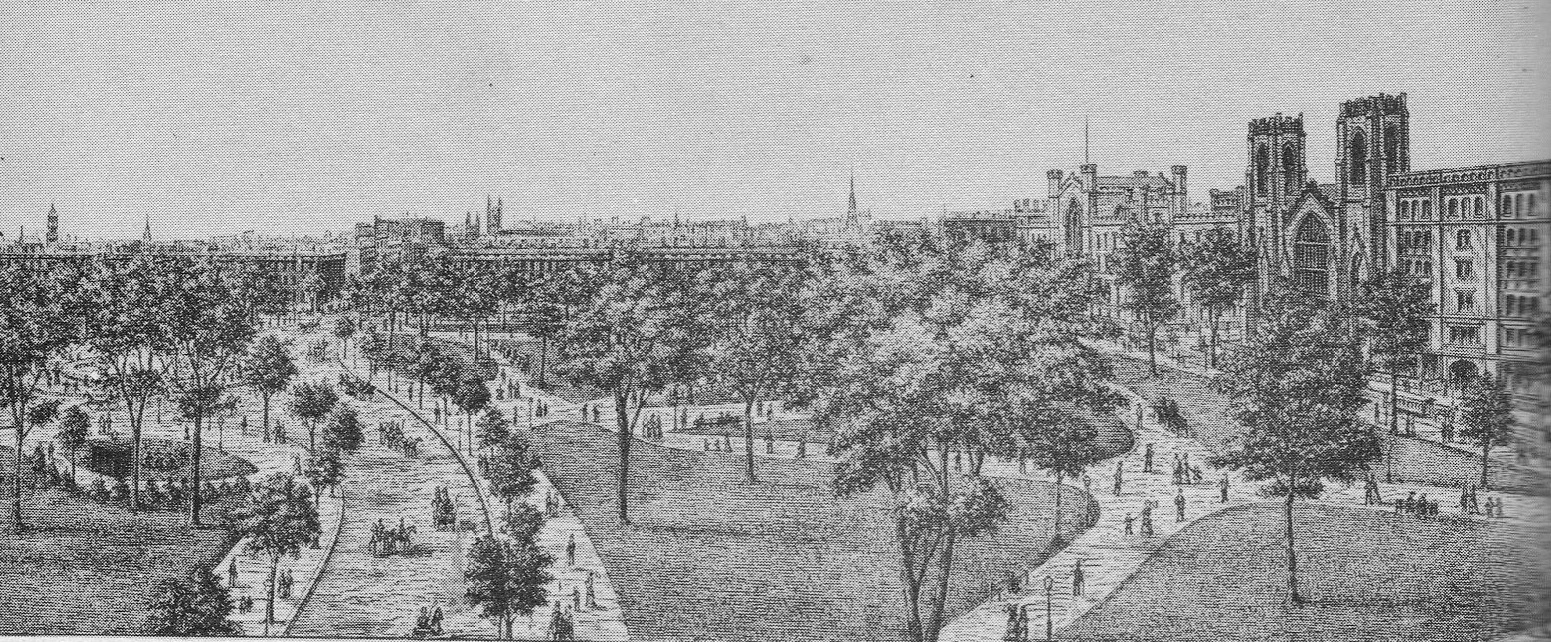
In 1825 the new gas lamps came in south of 14th street; by 1847 they extended up to 18th street. Now lower Fifth Avenue became the fashionable locus of New York. One of the first of the home builders was Henry Brevoort, who inherited all the farmland around from his father and built a luxurious five-bedroom house with iconic columns and lilacs and rose of sharon blooming in the front yard behind an iron fence. The house stood until 1925.

Other fine homes followed, surrounded with yards and gardens, backed by stables. The ambience was quietly fancy, unprepossessing.
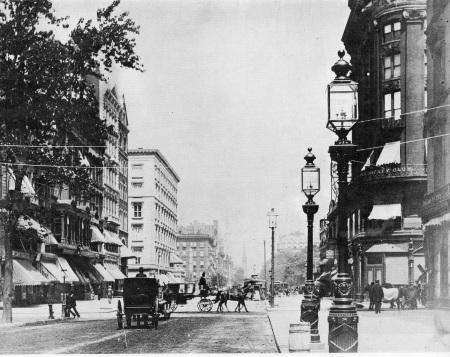
In 1851 a study found that below 23rd Street on Fifth there were still 32 vacant lots, and fifteen others were described as “now building” No matter. When Delmonico’s, New York’s premier restaurant, opened in a shipowner’s home at 14th and 5th it was clear the neighborhood had arrived.

The custom of the leisurely promenade continued, and with it the practice of making calls. Fifth Avenue was a social place.

The move of peoples’ homes uptown was unstoppable if somewhat slow paced. For one thing, the street was still being built. Fifth Avenue did not cut through to 23rd St until 1837, and it was still surrounded largely by countryside, crisscrossed with streams and studded by ponds. Fifth Avenue was surprisingly rural. Stagecoaches stopped at a tavern on 23 Street called Madison Cottage. Cows wandered in front of that day’s incarnation of Grand Central Station.
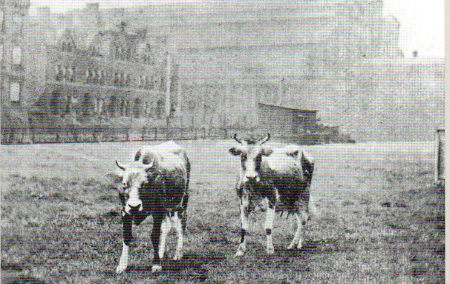
The city’s livestock market took place nearby, and cowboys drove herds of cattle through what we think of now as midtown.
Then handsome houses, some sheathed in brownstone, began to rise. The New York Herald named 200 of the city’s most important men in 1851, and half of them lived north of 14 Street. Madison Square was now becoming the center of the city’s professional class. Fashionable clubs opened there, the Union in 1855, followed by the Athanaeum, the Manhattan, the Lotos and others, along with refined academies for young ladies.
The first tycoons to make the move were William B. Astor, Jr. and his brother John Jacob III. Thirty-fourth street was a good distance uptown from where the family had traditionally settled, down around Lafayette Street. The Astor houses, separated by a garden, were relatively modest, brickfaced, with rustic columns. Nearby stood the mansion of Samuel B. Townsend, “the Sarsparilla King,” and on the same site after his death the grandiose, 55-room marble palace of Alexander Turney Stewart and his wife Cornelia, built in the late 1860s.

Stewart’s department store on Broadway between 9th and 10th Streets landed him among the wealthiest Americans, and ushered in a new age of lavish consumption.
The die was cast. In the next two decades Fifth Avenue up to 42nd Street became an almost unbroken parade of handsome brownstone mansions on 25×100 foot lots, not as large as the Stewart house but occupied by well-to-do, successful New Yorkers and incorporating all the trimmings, from gas lights to running water to fully equipped bathrooms. Chocolate in color, brownstone was quarried in New Jersey and cut into sheets that were applied as a façade to wood, for a uniform appearance that some found grand and others dull.

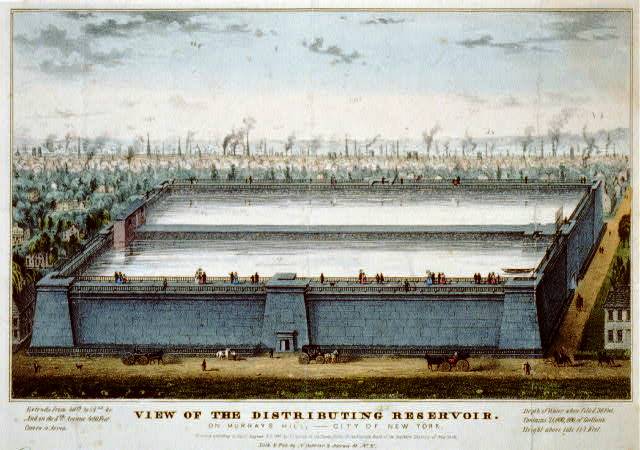
Strolling along the avenue was extended upwards when James Renwick designed the gargantuan Croton Reservoir (also referred to as the Murray Hilll Distributing Reservoir) at 42nd Street in 1842, and ran a promenade along the top rim of its forty-one- and-a-half foot high slanted walls. The walkway became a hit society destination. You could get an ice cream afterward across the street at Croton Cottage.
North of the reservoir stretched the undeveloped city. If you look at a picture made in 1863, facing south from the site of what would become Central Park, you can see the still-pastoral nature of uptown.

Fifth Avenue, to the left, heads determinedly north, flanked by buildings in its lower reaches but by nothing but fields and cattle farther up. A few homes dot the landscape, but more dominant are the ungainly freestanding charitable institutions that would not be accommodated farther downtown. You can see the massive shapes of St. Luke’s Hospital, between 54th and 55th Streets, and the Deaf and Dumb Asylum. Behind St. Luke’s stands the Colored Orphan Asylum, which was attacked in the horrific week-long Draft Riots of 1863 (five years after this image was made). Saint Patrick’s, the landmark we associate with midtown Fifth Avenue, was not begun until 1858.
To give an idea what the surroundings were like, consider Madison Avenue, a block over from Fifth, as it made its way north from 55th Street around this time.
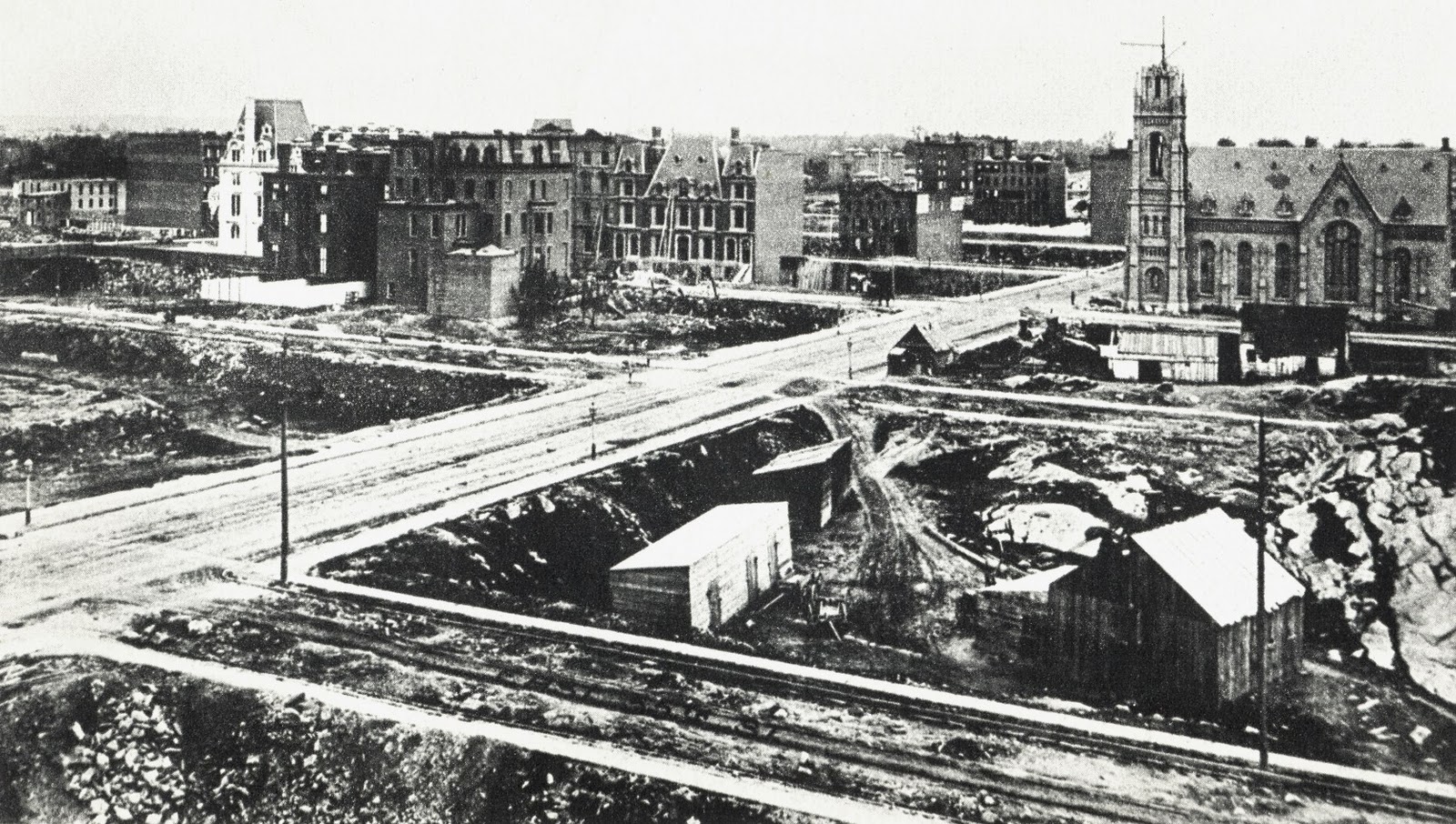
A thirty-acre farm owned by the prosperous Lenox family dominated the neighborhood, with a stolid white tenant farmhouse located between 71 and 72 near Fifth Avenue. Cows grazed nearby and market crops grew in rows. Lying on the outskirts of town this far north were slaughterhouses, stockyards and tanneries, enterprises fashionable downtown did not want near their homes. The Lenox Library, a handsome block-long structure designed by star-architect Richard Morris Hunt, went up in 1875 at Fifth Avenue and 71st Street, an outpost of civilization.
As of 1865, the city was moving uptown.

New Yorkers took the air on Fifth Avenue, promenading as always with vigor. The Easter Parade was only one opportunity to admire and be admired.
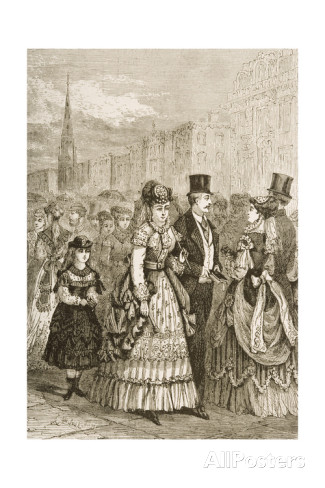
But while the upper tens (the equivalent of today’s “one percent”) of New York built their urban villas and stolid townhouses to the south, wide open stretches of the boulevard north of 60th Street still seemed off limits for luxury development. At the time of Savage Girl, 1875, more than 340 private residences had been constructed up to 59th Street but none above.
The lack of elegant homes didn’t mean people didn’t live there. Those precincts had long been settled by African Americans and German and Irish squatters who occupied shanty towns where the principle businesses were bone boiling, glue, soap and candlemaking. Eventually they were eliminated from the area both by the development of Central Park and rising real estate prices.

Edith Wharton remembered the area as dominated at that time by “the hoardings, the quarries, the one-story saloons, the wooden greenhouses in ragged gardens, the rocks from which goats surveyed the scene.” North of the site I gave the Delegate house, it was still this old, bucolic, rough-hewn New York landscape, unrefined, undeveloped, not yet buried in the smooth cement of the new. Central Park, built in the 1860s and opened officially in 1873, made inroads in “civilizing” the neighborhood; but it still seemed too much like a savage wilderness for the upper crust to build there.
There were a few exceptions, wealthy home builders that for their own reasons decided to go above 42nd Street. Robber baron Jay Gould built a residence on the corner of 47th and Fifth in 1870. The infamous Madame Restell and her husband moved in at the northeast corner of 52nd and Fifth in 1864. But mansions towered over shacks.
Mary Mason Jones, a distant relation of Edith Wharton’s – personified in The Age of Innocence by Mrs. Manson Mingott — built a row of mansions on Fifth Avenue bet. 58th and 57th Streets, completing them in 1870. A remarkably independent, wealthy, well-travelled woman, she had had the first bathtub in New York installed in her home on Chambers Street, and her choice of venue for her new residence was equally offbeat. Five homes were constructed of gleaming white marble, with a two-story mansard roof that had green copper trim.

By the time the fictional Delegates settled into their house in the early 1870s, the intersection of Fifth Avenue and 63rd Street was still quiet, devoid of built structures, undiscovered by Knickerbocker Society. The Delegates were pioneers. I decided to situate them there because the choice makes them outliers, risk takers, iconoclasts in a society they see as conformist. I wanted to show them as the first to build a grand residence there, one that would outshine all the others in the city.
Eventually, Fifth Avenue upwards of 59th Street would be lined with mansions that were even more extravagant than the homes built in the avenue’s lower reaches. When people passed, they would gape at at the welter of materials and styles, the polished marble, dramatic gables and steep-hipped roofs, puncuated by balustrades and moats and massive chimney stacks. Whether architects hewed to the gleaming white symmetries of the Beaux-Arts or the swagger of the Moorish fortress or the period’s beloved French Renaissance design idiom, their creations lorded it over the somber-faced brownstones of the cross streets.
I couldn’t resist borrowing from some of the later residential masterworks to design the Delegate house, even though they would not be erected for a few more years. The various Vanderbilt homes offered the kind of opulence I felt the Delegates would emulate. After inheriting an estate of nearly 100 million dollars from their shipping-and-railroad-magnate father, the Vanderbilt descendents put on a grand architectural show. William Henry Vanderbilt, the Commodore’s eldest son, built triple houses for himself and his daughters between Fifty First and Fifty third Streets. William K. Vanderbuilt, William Henry’s son, had Richard Morris Hunt design him the mansion at the northwest corner of 52nd Street that was the setting for a famous fancy-dress ball of 1883.

I was especially impressed by the mansion Cornelius Vanderbilt II put up at 58th Street and 5th Avenue in 1883, the largest private residence ever built in New York City. A full block long, designed by George B. Post, it stood sentry until 1927, as one mansion after another followed it up the avenue.
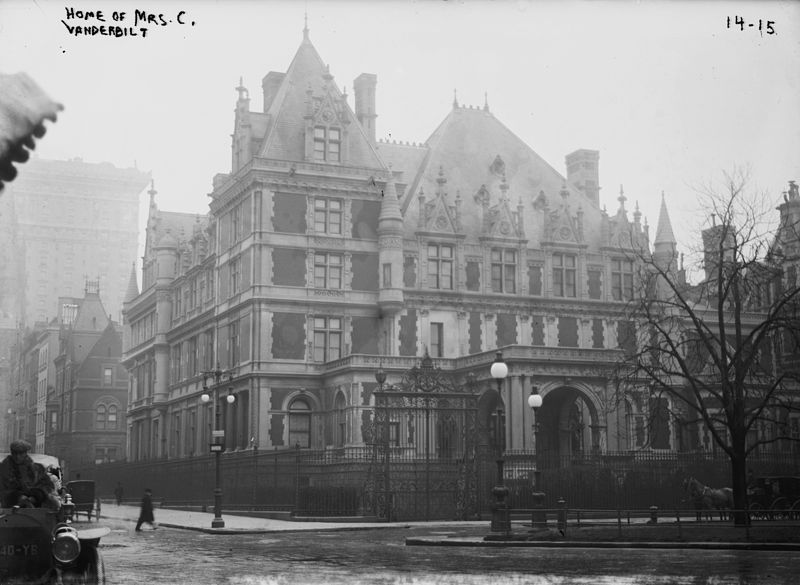
Actually, I’m being slightly inaccurate. For the record, in the early 1870s one house did stand on Fifth Avenue at 63rd Street, above the 59th Street divide, just across the street from the still forbidding Park. A narrow townhouse circa 1871, it was built speculatively built by one Runyon Martin, hardly a mogul. It didn’t last long.
The Delegates knocked it down to put up their turreted, mulberry-colored, block-long twin palaces.
Filed under Culture, Fashion, History, Home, Jean Zimmerman, Photography, Publishing, Savage Girl, Writers, Writing
There are no two better things in the world. The day your book is published. And pancakes.

Filed under Cooking, Culture, Fiction, Jean Zimmerman, Publishing, Savage Girl, Writers, Writing
For anyone wondering when I am venturing forth to speak about Savage Girl, one such event is coming up on March 14, a Friday, at the Mark Twain House and Museum in Hartford, Connecticut. I am extremely happy to speak at Twain’s genteel abode because some of his early work informed Savage Girl. Specifically, the great writer penned Roughing It about his days in Virginia City, Nevada as a cub reporter in the 1860s.
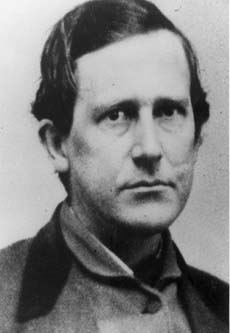
This is how he looked at that time.

I drew on the rollicking material in Roughing It for the first part of Savage Girl, which takes place in 1875 Virginia City at the height of the silver boom.
If you can make it to Hartford on March 14th, I’d love to have you there. I plan to read a bit from the novel and also talk about some wonderful images I’ll bring to flesh out the history behind the fiction.
Filed under Culture, Fiction, History, Jean Zimmerman, Publishing, Savage Girl, Writers, Writing
What wild child anthem gets your juices flowing? Curtis Mayfield’s Little Child Running Wild? Wild Thing by the Troggs? Or perhaps an oldie like Bessie Smith’s I’m Wild About that Thing? My personal favorite: Born to Be Wild as rendered by the immortal Etta James.
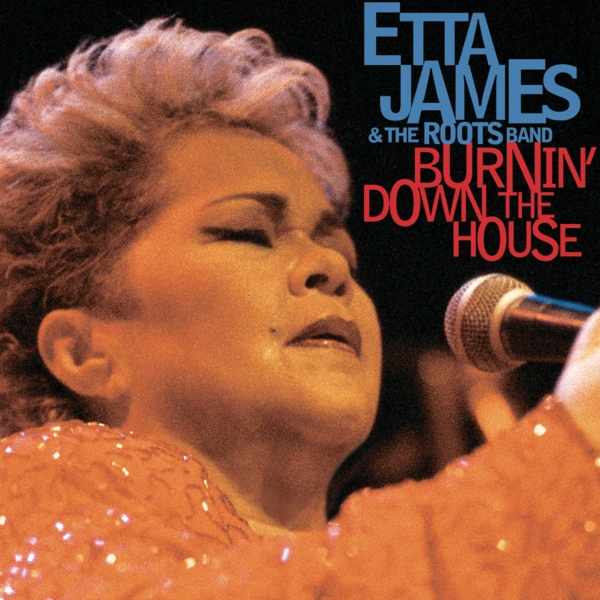
Whatever your taste, you can get a bunch of hits in one place when you check out the Spotify playlist I’ve put together with the help of Viking for Savage Girl’s release in… 11 days (really? is that possible?).
Of course, these selections all appeal to our contemporary taste and would probably appall the characters in Savage Girl, who would have been more entertained by music that was quite different in a pre-Victrola, pre-modern age. To enjoy popular music in the late nineteenth century people might sing around the piano in their homes, enjoying such numbers as My Grandfather’s Clock (1876), Clementine (1863), or Home on the Range (1873). They would also enjoy some of the great composer Stephen Foster’s work, tunes such as Beautiful Dreamer (1864) or Jeannie With the Light Brown Hair (1854), which were popular throughout the second half of the 1800s.
If they attended a ball, they would in all likelihood waltz – the most popular dance step of the nineteenth century — to compositions by Johann Strauss, Jr, who wrote the famous Blue Danube among over 400 waltzes.
I don’t think you’ll ever waltz to the Troggs. But you can try. Just click on my Spotify playlist.
Filed under Culture, Dance, History, Home, Jean Zimmerman, Music, Publishing, Savage Girl, Writers, Writing
This spring I am looking forward to speaking about Savage Girl at various venues. Here are the firm dates so far. Further details to come closer to the date.
When I talk about Savage Girl I’ll likely show some pictures in a powerpoint to give the context for the novel, as well as talk and read from the book. It should be enjoyable! I hope that some of you will be able to attend one of these events.
I’ll continually update my speaking engagements on the sidebar to the right-hand side of this site.
If you live someplace not on my schedule but you’d like me to visit, please drop me a comment here or on my Facebook page, and I’ll get right back to you. (While you’re at it, please like my FB page!)
Savage Girl Events-Spring 2014
March 14 The Mark Twain House and Museum, Hartford, CT
March 26 Ossining Public Library, Ossining, NY
April 3 The Poisoned Pen, Scottsdale, AZ
April 16 The National Arts Club, NY, NY
May 24 Musehouse: A Center for the Literary Arts, Philadelphia, PA
June 21 Millbrook Literary Festival, Millbrook, NY
Filed under Culture, Fiction, Jean Zimmerman, Publishing, Savage Girl, Writers, Writing
My book club has an interestingly intellectual way of approaching literature — with lots of research materials, dozens of post-it notes on the book pages, and nary a glass of Chardonnay in sight. However, I have not seen them use information direct from the publisher. It can be really useful in directing a discussion and, in the case of the materials for Savage Girl, extraordinary beautiful (thanks to the brilliance of the Viking design team). We also offer recipes for cocktails in the Gilded Age spirit and a terrific playlist that you can access on Spotify. And of course I answered some questions. So check out Viking’s on-line book club kit — whether or not you have a reading group of your own. Or maybe you’ll be inspired to start one up. (Warning: there might be spoilers in some of the questions.)
Filed under Culture, Jean Zimmerman, Publishing, Savage Girl, Writers, Writing
Hot off the presses today, my review for NPR Books of a new novel that taught me something about what historical fiction can be, and what to watch out for in writing the historical novel.

Bruce Holsinger’s medieval London, teeming with interesting personages such as Geoffrey Chaucer and Richard II, gets you in the gut. But is the writer’s story overwhelmed by fact? Read my take on it and find out.
Filed under Fiction, History, Jean Zimmerman, Publishing, Writers, Writing
Writing a historical novel requires checking the provenance of words to make sure they are not anachronistic. Your eighteenth-century narrator cannot use the word “dingus,” for example, because it wasn’t coined until 1840. It’s something I feel pretty strongly about.
Sam Spade in The Maltese Falcon called the “black bird” a dingus, slang along the lines of whatchamacallit. I’m sure that was appropriate to its time.

I happened to see the index of words I’ve looked up recently:
staccato, pathetic, unconscious, comatose, manumission, beatitude, hit, runabout, streetwise, kid, dingus, diffuse, eczema, fun, modern, groats, fairy, hand-me-downs, traffic, advertising, rigamarole, twerp, snug, odds, taxi, loopy, goofy, refugee, pronto, scamper, skedaddle, lynch, vogue, all the rage, frisky, borborygmus, hoodwink, four-in-hand, gig, cute, spooky, generalissimo, galumph, archipelago, genius
Do these terms give some kind of skeletal idea of what the novel’s all about? I don’t know, but it’s fun to see them all in a bunch.
Filed under Fiction, History, Jean Zimmerman, Writers, Writing
My new novel is blooming. Much like the amaryllis opening up beside my desk, at the window overlooking the marsh. This plant with its glowing greenish-white flowers doesn’t care about the snow and cold, it’s gonna display it’s stop-motion beauty on its own time, as it pleases. I’m just there to write it along.






Filed under Home, Jean Zimmerman, Nature, Photography, Writers, Writing
I am finally enough recovered from roiling bloat to write about the hamburger I consumed the other night.
DB Bistro Moderne stands on 44th Street in Times Square, on a block that is distinguished by the Harvard Club, the New York Yacht Club and the swanky hostelry attached to the restaurant called the City Club Hotel. The Algonquin, with its always-crowded, ever-literary lobby and comfy cocktail chairs, one of my very favorite places in New York, is right next door.
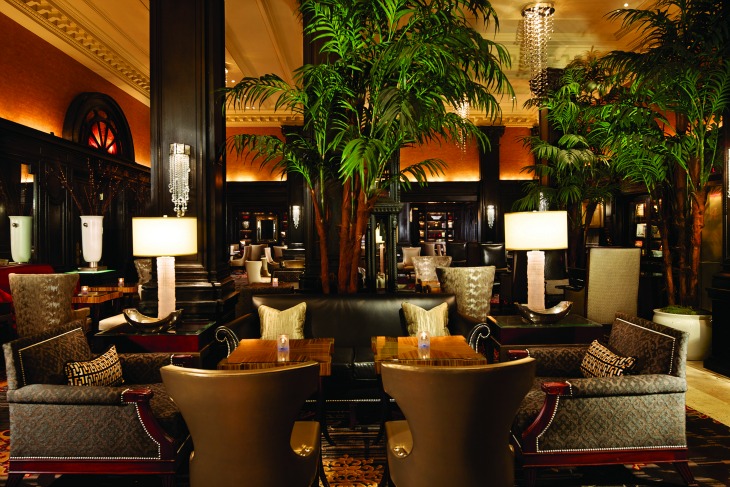
We were celebrating Valentine’s Day early, knowing we were up for a snow pounding that might keep us in the day itself.
For years, we’d heard about a burger. A mythic burger, a burger for those of hearty appetites and gourmet tastebuds. In 2001 Daniel Boulud introduced the thing for an unseemly 27 dollars, but that only made people want it more.

Now the price has risen to $32, roughly twice what we pay for dinner at our favorite ramen joint.

What the hey, it was faux Valentine’s Day. We arrived, we settled in among the blonde New York princesses with gaudy Chanel necklaces and thousand-dollar leather jackets, we ordered a non-alcoholic beer. The bread, studded with olives, went down fine. An arugula and frisee salad with a lemony dressing and lots of almonds tasted better than it sounded.
But what about the burger?
 How would that be? This burger, you see, is no ordinary burger, but a giant softball of ground sirloin embedded with strips of brisket, a chunk of foie gras and a soupcon of black truffle.

It’s a long way way from the simple but tasty culinary icon that Wimpy loved.

How did we get from there to here?
I have learned that the Mongol Army under Genghis Kahn would stuff filets of meat (sometimes beef, sometimes lamb) under their saddles as they rode so that it would crumble and cook in time for lunch.

America’s own Hannah Glasse gave a recipe in her 1770 Art of Cookery that paired minced meat (cooked) and toast. Other cultures have long dined on meatballs, kissing cousins in a smaller ball of beef.
So the claim of the United States to inventing the burger has only a partial foundation in truth. Emigrants from Hamburg brought versions of minced steak to New York in the late nineteenth century, where they were served raw or lightly cooked in exclusive restaurants such as Delmonico’s, sometimes accompanied by a raw egg, and sometimes for breakfast.

The mechanical meat grinder, invented in the mid-1800s – mincing had earlier been done with a chisel – made mass production of ground beef possible. It’s thought that the hamburger in its present form originated as cheap eats at a county fair in Wisconsin, or Ohio – somewhere in the land where people needed sustenance to traverse the games, exhibits and rides. A slick of Heinz ketchup, patented in 1888, soon tagged along.

On this night, our DB burgers landed in front of us with a thud, encased in a polished Parmesan bun, stuck through with wooden sticks and cut neatly in half. On full display were the slices of short rib and diseased goose liver, in lush cross section. A bite through the red of the beef released the flavors of fresh red onion, tomato jam and mustard. No Heinz 44 for this baby.
We could have eaten half but managed the whole. It was juicy, meaty, greasy, messy as a burger should be. But was it the best? Was it $32 worth of hamburger? When the bill arrived we told them that we’d gladly pay them Tuesday for a hamburger today.
Filed under Cooking, Culture, Fashion, History, Home, Jean Zimmerman, Publishing, Writers, Writing
Savage Girl.
Mar 2014. 402 p. Viking, hardcover, $27.95. (9780670014859).
Debutante or demon? The title character of Zimmerman’s gripping historical novel seems to be a little bit of both. Discovered in a Nevada mining town by a wealthy couple determined to overcome the “savage” girl’s apparent feral upbringing, Bronwyn is introduced by them to Gilded Age Manhattan’s high society. But as the couple’s son, the novel’s narrator, can attest, she is perhaps not as innocent as she seems. All revolves around the central question of whether Bronwyn or the captivated narrator is responsible for the trail of bloody crimes left in their wake. Suffused with a gothic aura of dark suspense, this is a finely wrought psychological work from the author of The Orphanmaster (2012), rich with historical detail. The mystery stretches from society’s heights to its absolute depths and touches everything between, always increasing in dramatic tension. Zimmerman’s settings spring off the page, from the stinging dust of the American desert to the dank despair of the Tombs prison in New York. Immensely readable, Savage Girl takes the reader by the throat and doesn’t let go.
— Bridget Thoreson
Filed under Culture, Fiction, Jean Zimmerman, Publishing, Savage Girl, Writers, Writing
I’ve been thinking about voice. Not the voice of Miley Cyrus, or Roseanne Cash, or even the Russian-born soprano, Anna Netrebko, who belted out the Olympic anthem at Sochi last night. She really shook the rafters.
No, I am trying to get a handle on voice in fiction. Writing a new novel about a girl who lives in New York City during the Revolutionary War, I want to make sure I get her right. And it forces me to deal with some difficult issues.
Can I show her best in the first person or the third? That’s probably the biggest question going in, because while writing “as” my protagonist gives me access to all kinds of emotional complexity, it is also limiting. It’s writing in handcuffs. You the reader can only see what my character sees, and by its nature that is not everything. I can see a very interesting house but I can’t necessarily go into that house. If I bring my character into the house it rejiggers the plot in all kinds of ways.
I’ve determined to go down the first-person path if it kills me.
Probably the most famous use of the first-person protagonist is in Dickens’ David Copperfield, with its wonderful first line:
Whether I shall turn out to be the hero of my own life, or whether that station will be held by anybody else, these pages must show.
The myriad of other first-person first lines include Call me Ishmael in Moby Dick.
There is Notes From Underground: I am a sick man . . . I am a spiteful man.
For a long time, I went to bed early, in Proust’s Swann’s Way.
It was a queer, sultry summer, the summer they electrocuted the Rosenbergs, and I didn’t know what I was doing in New York. From Plath’s The Bell Jar.
Considering the first lines of books turns out to be incredibly interesting.
Other issues you have to address as the plot unfolds: how much does my protagonist know about the world, how sophisticated is she? My character is a teenager, but is mature beyond her years, as kids of that era were. What kind of language would she use? Should I eradicate all adverbs from the narrative? How smart-alecky is she, how wise, how snarky?
How much historically appropriate language can you get away with using without a page sinking under the weight of Ye Olde? On the other hand, is a word you’re using wrong because it was invented yesterday, and she can’t possibly have known it? I looked up “goofy” today and found that “giddy” would suit the 1776 world of my character’s speech much better.
Is she addressing someone? Hugo in Savage Girl addresses his story to his lawyers. Is my character relaying the history of her life to someone, say a great granddaughter? Is it an epistolary novel, like The Sun Also Rises? Or is the text simply in her head? Is she “talking to the air,” as Gil and I put it when we discuss these questions.
All these and more are the thorns you must cross through in order to reach the fruit when you are writing a novel. Sometimes it helps to have an image as you work, a picture that reminds you of your heroine. I have adopted this 1750 painting by Pietro Rotari, Girl with a Book, which inspires me to find my character’s voice and do it justice. What draws me is not the cap nor the jewels, charming as they may be, but the wry, lovely expresssion in her eyes.

 Jean Zimmerman