Category Archives: Home

Saying It in Silver

Do you like sparkle? I do.

I’ve been happy lately to usher Savage Girl into the world, delighted to see people get ahold of the book and resonate to the story. There’s nothing like a fresh book out there reaching people to make you feel good — after all, isn’t reaching people a big part of why we do this crazy thing called writing?

And yet my head is partly somewhere else, where my next novel is coming into being. And that’s a little dicey territory sometimes, a dark place where I have to feel my way along rather blindly. It can be a challenge, figuring out voice and plot and characterization, all the basic ingredients in a novelistic stew.

And I’ll say it again, it’s sometimes the kind of dark where you need a heavy duty flashlight.

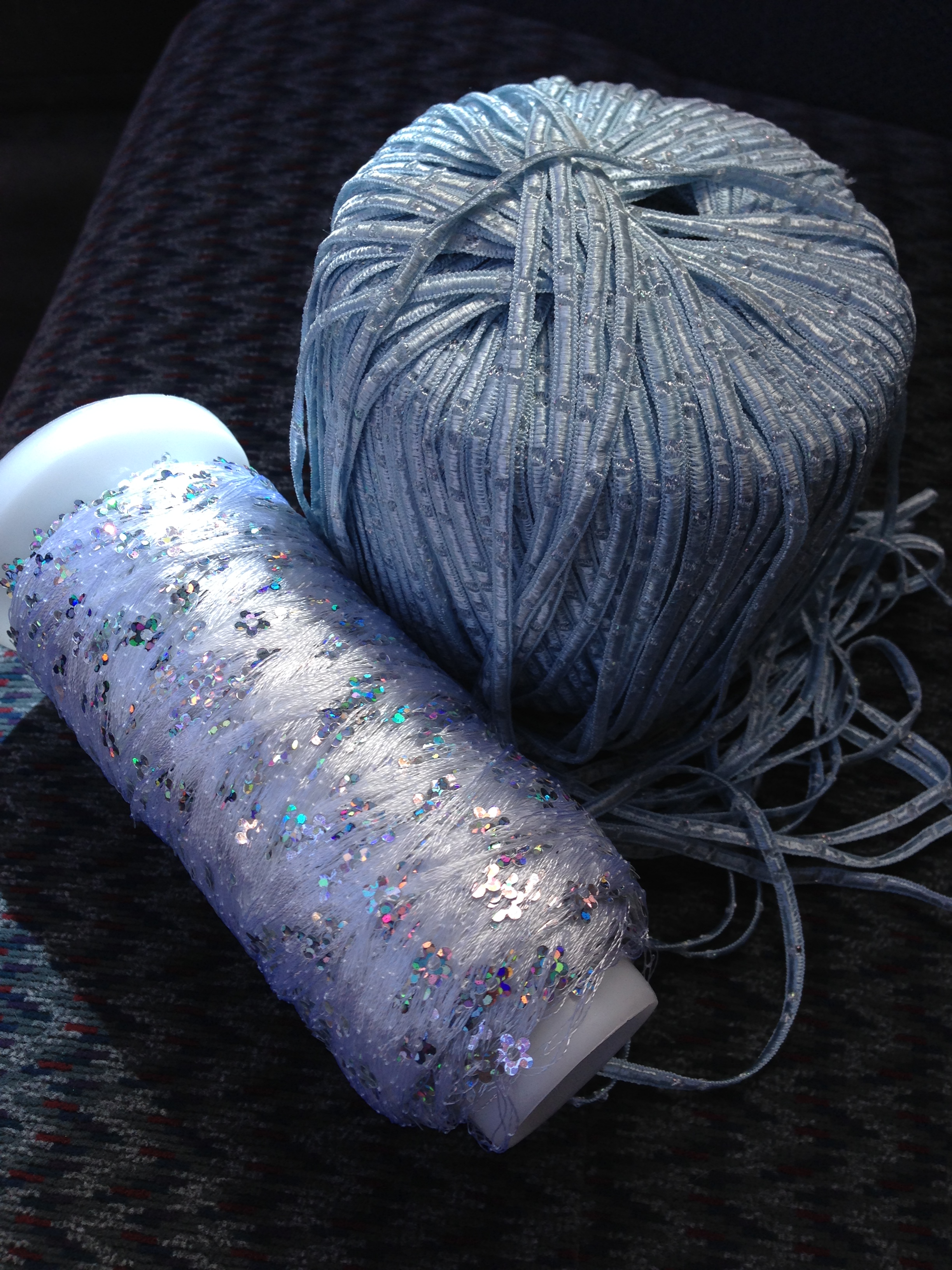
So I went and got some silver to lighten things up. Give my brain a break, and use my hands to knit a slithery sparkly something.
silver sparkleThe outlook seems brighter already.

2 Comments

Filed under Culture, Fiction, Home, Jean Zimmerman, Knitting, Publishing, Savage Girl, Writers, Writing

The Victorian Debut

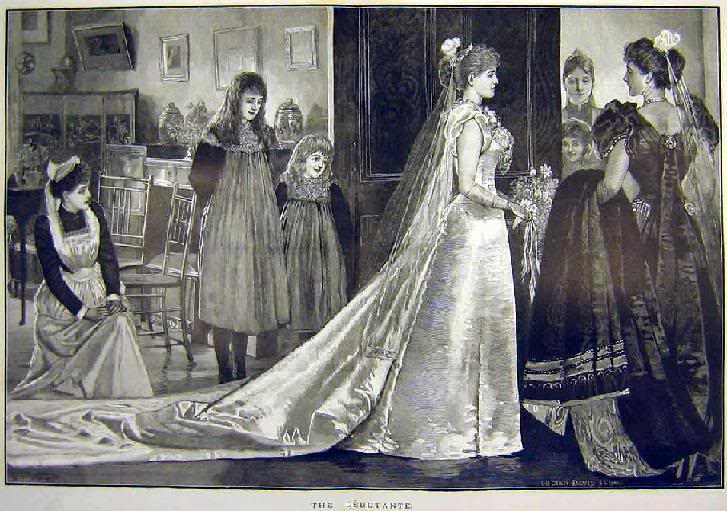
The process of achieving a societal debut in the late nineteenth century was one in which eighteen-year-olds got their first taste of all the splendour that money could buy.

1894 deb

Yet at the same time, the coming out process was one that was as constricting as it was exhilarating. The art of coming out was demanding, an experience that was rigorous to a degree the privileged debutante had not previously experienced. The world of the “fashionables” might be exceedingly comfortable, but it was also fraught with potential dangers of social missteps, especially when it comes to expectations for adolescent girls as they approached maturity.

1851 deb

The culture of the a debutante first originated in Britain during the reign of Queen Elizabeth I, in the second half of the 16th century, when she began the custom of formally presenting eligible young women at court. Three centuries later, Queen Victoria created the ritual we think of today, with girls dressed in white and the official bow called a “curtsey.” It soon spread to America.

In Victorian days, young girls were kept closely guarded at home throughout their adolescence.

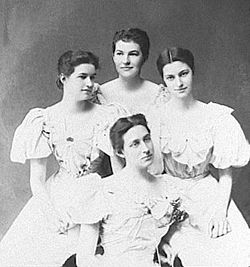
minturn girls

Their debut indicated that they were now officially allowed to come out from under their parents’ close guardianship and begin the rituals of courtship. Not only that, though, they were being ushered into a new status as ladies, on a par with some of the notable creatures of the age.

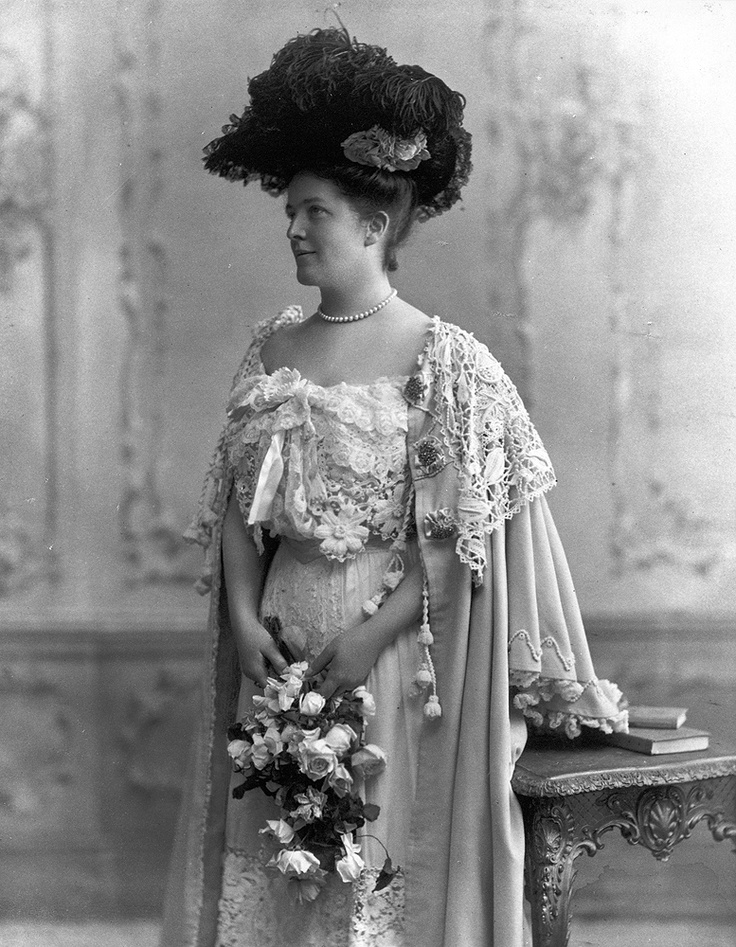
adelaide frick

The grand dames of society banded together when a girl reached what was considered a marriagable age to help usher her into a new social status. The rituals of this transition were female-centric, self-absorbed.

the-metropolitan-museum-of-art-denise-at-her-dressing-table-1368331598_b

There was certainly some power in the process for women, as they created and enforced the rules. But the learning curve for the debutante was steep and it was easy to make mistakes.

There was shopping for a proper wardrobe, to begin with. Godey’s magazine was the Vogue of the day; girls and women perused it to order items to suit their more grown-up status.

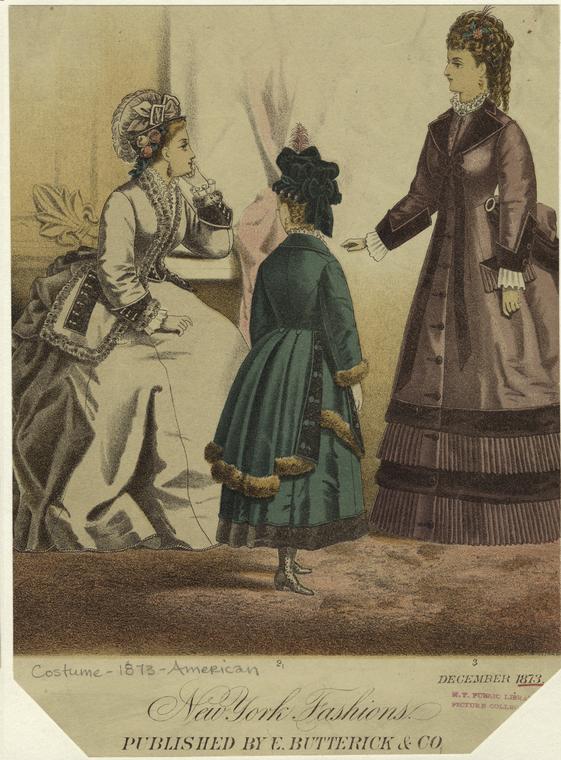
Godey's 1867New dresses were a requisite.

1873 NY Fashions

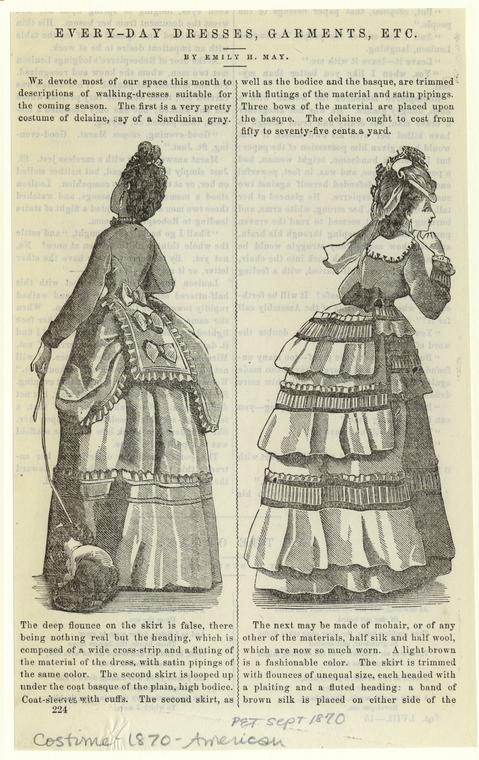
Not only fancy gowns, but “everyday” items.

1870 everyday dresses

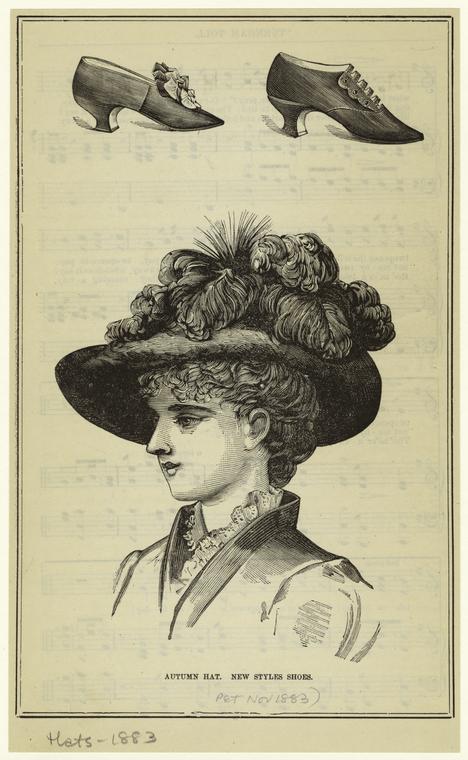
New hats were a vital fashion component.

1883

Dance lessons ensured that the debutante would be able to hold her own with the worthies of the day when she was “out” and socializing. Complex steps posed difficulties and required hours of practice, usually at special schools.

Late afternoon teas  and luncheons in private dwellings brought the debutante together with society ladies she was meant to impress. Throughout, lessons were imparted from mothers to daughters, warnings about indecorous behavior, inappropriate dress. It was all about learning the proper way to act.

A crucial part of the process was the ritualized social visit known as calling. Everyone knew that formal calls were to take place for precisely 15 minutes between 3 and 5:00. One woman would drop her card at another’s house to let her know when she would be at home to receive visitors. The card had her name inscribed upon it, and the debutante’s name would be added to it. It wasn’t unknown to keep a visiting list of over 500 names.

frog-case

Then came the ball. A grand reception that brought together a group of debutantes with young men their age and other, more mature members of high society, it took place at some point over the winter months. The coming out ball was commonly held in a public venue like Delmonico’s restaurant, the most swellegant spot of the age, located on 26th Street opposite Madison Park, which had the facilities to accomodate a large number of guests.

Delmonicos_Fifth_14th

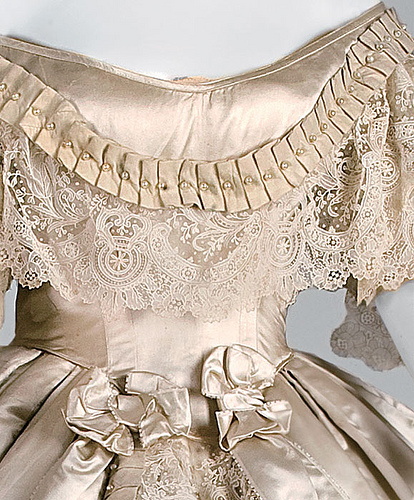
The fashions were extraordinary. The finest gowns came from Worth in Paris.

1861 Worth and Bobergh gown

A French manual from the 1880s described societal expectations for women’s formal dress:

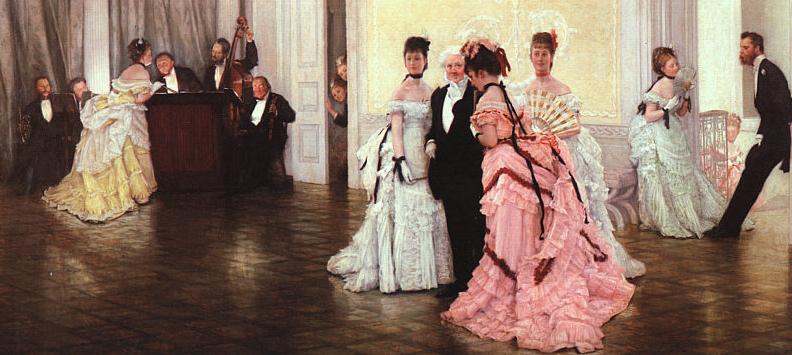
For the ladies, a light-coloured gown with a décolleté revealing the shoulders and arms, very long gloves and light pumps. They must carry in one hand a fan made from ivory or mother-of-pearl and also have their dance card. Many ladies prefer, as do I, a bodice in a shallow square-cut or heart-shape to a very décolleté gown . Sometimes the exposed neckline and tops of the arms are covered with gauze or tulle.

tissot

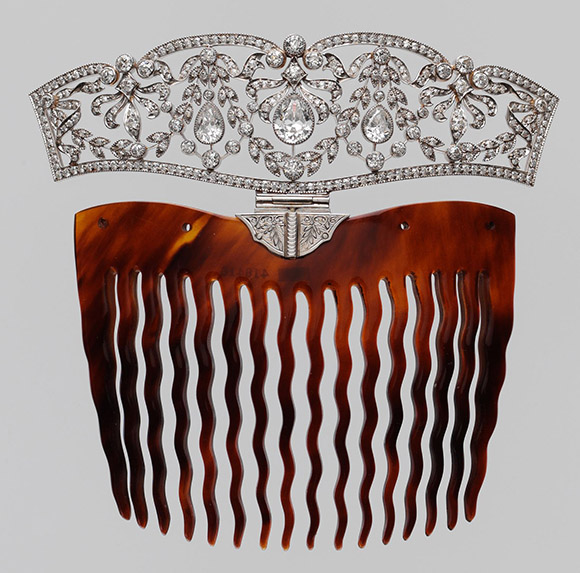
The hair must be put up, preferably with jewels.

????????

The fan was indispensable element of ladies’ finery– closed, open or fluttering, it could reveal a refusal, interest or excitement.

Photograph1880

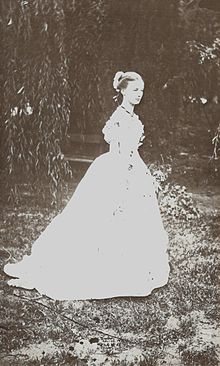
While married women could dress themselves in brightly colored gowns, lavish hairdos and gaudy accessories, young ladies being presented to society had to dress modestly. White symbolized their purity.

deb

One former debutante recalled the gown she wore, made of

white chiffon over white satin and with the huge puffed sleeves of the period. From the left shoulder to the right side of the waist there was a white velvet ribbon about three inches wide, ending in a knot at the shoulder. There was a bunch of white heather by the knot and some more around the skirt, about half way up. The skirt was down on the floor, was very full and had a small train, enough to have to be held up when dancing, and enough to make a modern dancer wild.

In terms of their attire, men were the backdrop to the ladies’ finery. They were to wear a black tailcoat with white tie, black trousers and polished shoes. It was both exciting and terrifying for girls to experience the male gaze in the pressure cooker of the ballroom.

Brooding guy

It could be uncomfortable.  Edith Wharton expressed the painful self consciusness she felt at her debut, remembering that for her

the evening was a long cold agony of shyness. All my brother’s friends asked me to dance, but I was too much frightened to accept, and cowered beside my mother in speechless misery, unable even to exchange a word with the friendly young men.

At the ball, ladies awaited the invitation of a gentleman to dance, but he was supposed to note her recognition before approaching her. The chaperone, usually the mother, hovered nearby. Dance cards were employed, and a man was never supposed to dance more than once with each partner.

ball 1860s

Wharton described a typical scene at a ball.

Couples were already gliding over the floor beyond: the light of the wax candles fell on revolving tulle skirts, on girlish heads wreathed with modest blossoms, on the dashing aigrettes and ornaments of the young married women’s coiffures, and on the glitter of highly glazed shirt-fronts and fresh glace gloves.

ballroom

The cotillion, or german, was a regular feature, and involved a kind of parade of set figures, gestures and steps, all well rehearsed in advanced. Dancing would take place until midnight, when a supper would be served, then the cotillion would resume.

The debutante’s symbolic responsibilities crescendoed at the ball. She stood to the side of her mother as guests entered so that she could be presented to her elders. Here she was, finally, the product of her culture’s teachings. She stood at the precipice of a new role, one that was the inherent goal of the coming out process: to marry brilliantly and embark upon a lovely family.

gilded age family

She was moving from the societal constrictions of her father’s house to her husband’s house, with a brief, glorious moment in between as a model debutante.

2 Comments

Filed under Culture, Dance, Fashion, Fiction, History, Home, Jean Zimmerman, Publishing, Savage Girl

The Mansions of Fifth Avenue

[I will be adding essays in upcoming days under the Savage Girl tab on this site. Here is the first.]

It took two hundred years for the well to do of Manhattan to migrate uptown from the foot of the island to frontier of 59th Street, and even then they weren’t completely sure that living so far uptown was the proper thing to do.

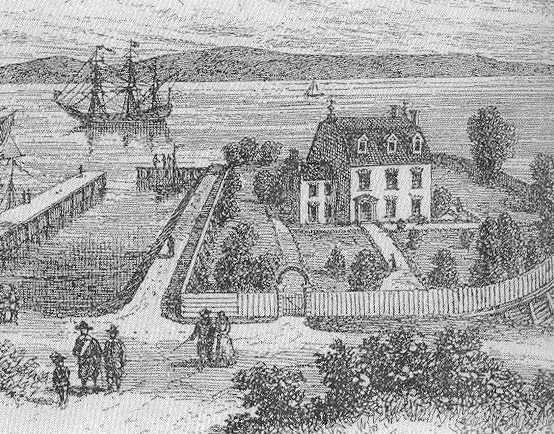
In the beginning, in the mid-seventeenth century, when settlement began, wealthy residents of New Amsterdam kept neat homes of brick and wood.
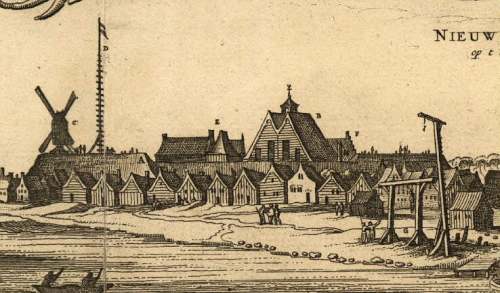
nieuw amsterdam

The only residence approaching grandeur was White Hall, the English name for the house Peter Stuyvesant built at the southern tip of the island, with its stunning view of New York Harbor.

White Hall

In those early days, before Fifth Avenue had been laid out, a fashionable address for the wealthy meant Bowling Green, after which people who could afford it moved up Broadway through Murray and Chambers Streets, on to Washington Square.

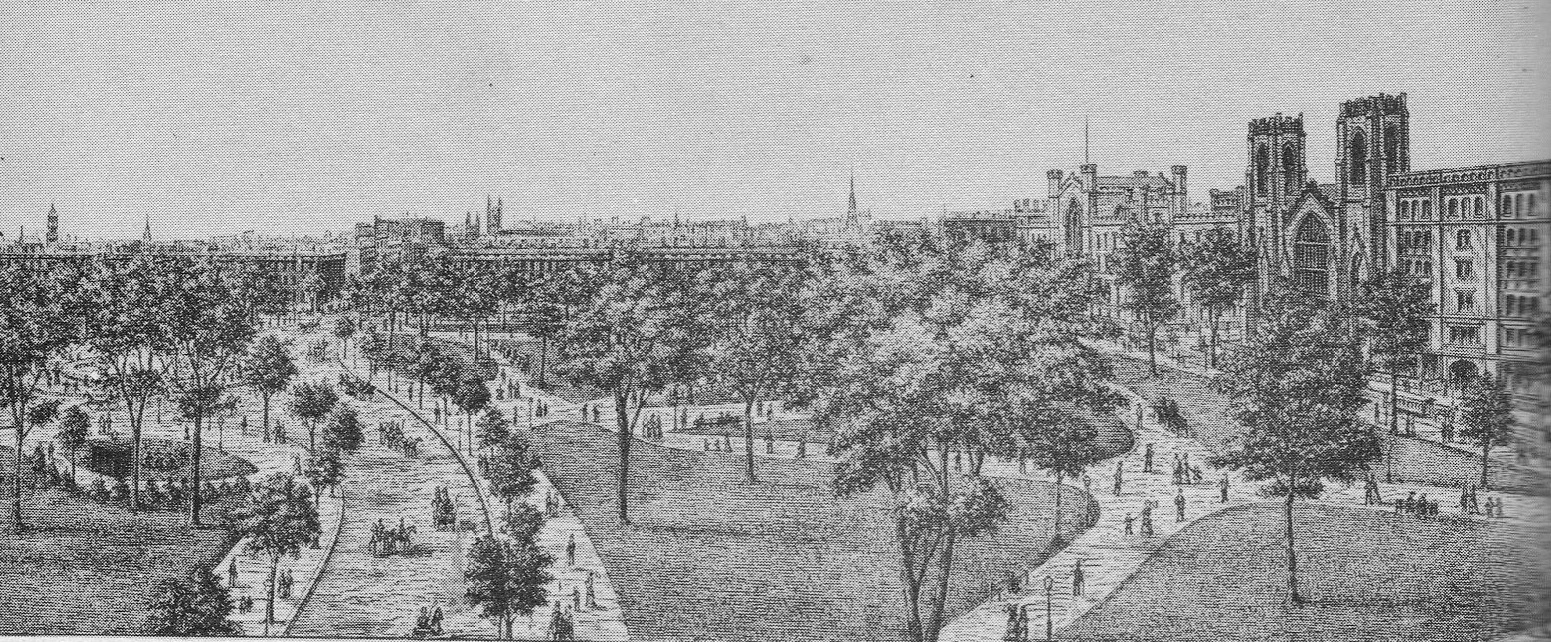
Until the Commissioners’ Plan of 1811 cut regular streets through the city (155 cross streets and 12 Avenues) the start of Fifth Avenue was farmland, as was almost almost all the property north of Canal Street. The name Fifth Avenue appeared for the first time on the Commissioners’ map. No one imagined that the thoroughfare would one day stretch six-and-a-half miles up the island. But the street was spacious and straight, and Manhattanites began to build townhouses along it; within two decades church steeples rose on either side of the street, Belgian blocks were laid for paving, and New Yorkers had begun to promenade along its length. In 1828, the city opened Washington Square at Eighth street at the base of Fifth Avenue, a tract that had been used since 1797 as a potter’s field. Gracious homes went up around the square.
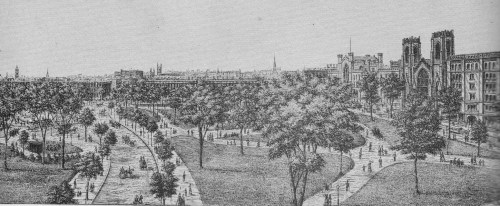
washingtonsquare1880s

In 1825 the new gas lamps came in south of 14th street; by 1847 they extended up to 18th street. Now lower Fifth Avenue became the fashionable locus of New York. One of the first of the home builders was Henry Brevoort, who inherited all the farmland around from his father and built a luxurious five-bedroom house with iconic columns and lilacs and rose of sharon blooming in the front yard behind an iron fence. The house stood until 1925.
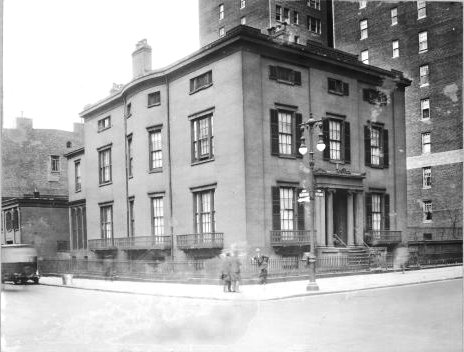
brevoort house april 1925 nypl

Other fine homes followed, surrounded with yards and gardens, backed by stables. The ambience was quietly fancy, unprepossessing.
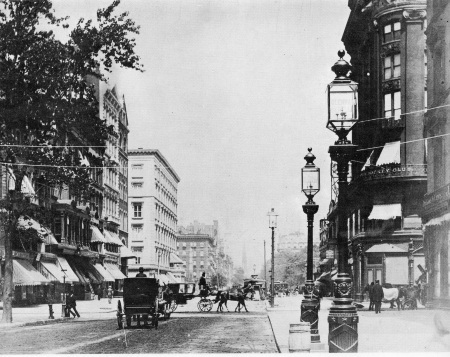
fifthavenue22ndst1889

In 1851 a study found that below 23rd Street on Fifth there were still 32 vacant lots, and fifteen others were described as “now building” No matter. When Delmonico’s, New York’s premier restaurant, opened in a shipowner’s home at 14th and 5th it was clear the neighborhood had arrived.

Delmonico's

The custom of the leisurely promenade continued, and with it the practice of making calls. Fifth Avenue was a social place.
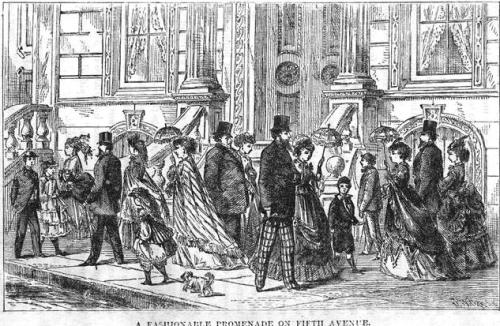
1872 fifth avenue promenade 1872

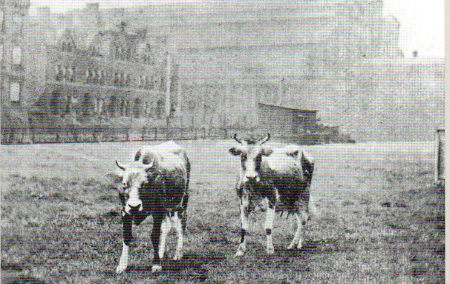
The move of peoples’ homes uptown was unstoppable if somewhat slow paced. For one thing, the street was still being built. Fifth Avenue did not cut through to 23rd St  until 1837, and it was still surrounded largely by countryside, crisscrossed with streams and studded by ponds. Fifth Avenue was surprisingly rural. Stagecoaches stopped at a tavern on 23 Street called Madison Cottage. Cows wandered in front of that day’s incarnation of Grand Central Station.

grandcentralcows 18702

The city’s livestock market took place nearby, and cowboys drove herds of cattle through what we think of now as midtown.

Then handsome houses, some sheathed in brownstone, began to rise. The New York Herald named 200 of the city’s most important men in 1851, and half of them lived north of 14 Street. Madison Square was now becoming the center of the city’s professional class. Fashionable clubs opened there, the Union in 1855, followed by the Athanaeum, the Manhattan, the Lotos and others, along with refined academies for young ladies.

The first tycoons to make the move were William B. Astor, Jr. and his brother John Jacob III. Thirty-fourth street was a good distance uptown from where the family had traditionally settled, down around Lafayette Street. The Astor houses, separated by a garden, were relatively modest, brickfaced, with rustic columns. Nearby stood the mansion of Samuel B. Townsend, “the Sarsparilla King,” and on the same site after his death the grandiose, 55-room marble palace of Alexander Turney Stewart and his wife Cornelia, built in the late 1860s.
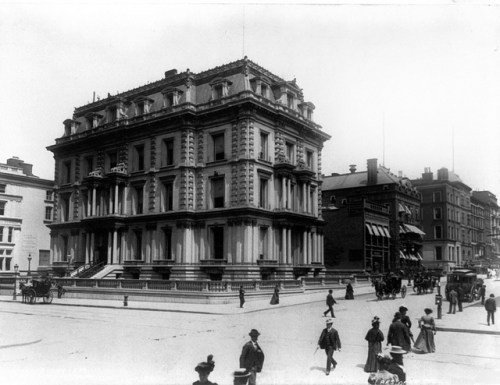
Stewart

Stewart’s department store on Broadway between 9th and 10th Streets landed him among the wealthiest Americans, and ushered in a new age of lavish consumption.

The die was cast. In the next two decades Fifth Avenue up to 42nd Street became an almost unbroken parade of handsome brownstone mansions on 25×100 foot lots, not as large as the Stewart house but occupied by well-to-do, successful New Yorkers and incorporating all the trimmings, from gas lights to running water to fully equipped bathrooms. Chocolate in color, brownstone was quarried in New Jersey and cut into sheets that were applied as a façade to wood, for a uniform appearance that some found grand and others dull.

fifthavenusnday1898

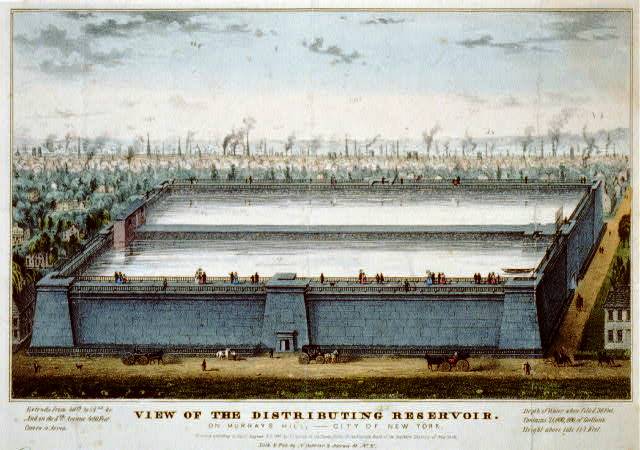
Strolling along the avenue was extended upwards when James Renwick designed the gargantuan Croton Reservoir (also referred to as the Murray Hilll Distributing Reservoir) at 42nd Street in 1842, and ran a promenade along the top rim of its forty-one- and-a-half foot high slanted walls. The walkway became a hit society destination. You could get an ice cream afterward across the street at Croton Cottage.

currier & ives print of croton reservoir

North of the reservoir stretched the undeveloped city. If you look at a picture made in 1863,  facing south from the site of what would become Central Park, you can see the still-pastoral nature of uptown.

valentine's manuel 1858, 5 ave s from 63 st

Fifth Avenue, to the left, heads determinedly north, flanked by buildings in its lower reaches but by nothing but fields and cattle farther up. A few homes dot the landscape, but more dominant are the ungainly freestanding charitable institutions that would not be accommodated farther downtown. You can see the massive shapes of St. Luke’s Hospital, between 54th and 55th Streets, and the Deaf and Dumb Asylum. Behind St. Luke’s stands the Colored Orphan Asylum, which was attacked in the horrific week-long Draft Riots of 1863 (five years after this image was made). Saint Patrick’s, the landmark we associate with midtown Fifth Avenue, was not begun until 1858.

To give an idea what the surroundings were like, consider Madison Avenue, a block over from Fifth, as it made its way north from 55th Street around this time.
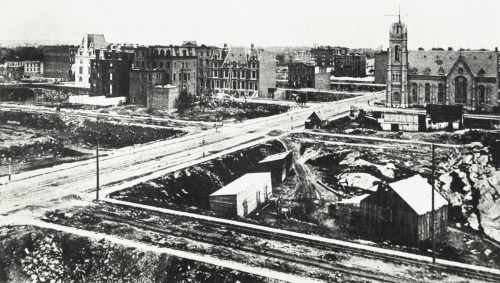
ne from mad and 55

A thirty-acre farm owned by the prosperous Lenox family dominated the neighborhood, with a stolid white tenant farmhouse located between 71 and 72 near Fifth Avenue. Cows grazed nearby and market crops grew in rows. Lying on the outskirts of town this far north were slaughterhouses, stockyards and tanneries, enterprises fashionable downtown did not want near their homes. The Lenox Library, a handsome block-long structure designed by star-architect Richard Morris Hunt, went up in 1875 at Fifth Avenue and 71st Street, an outpost of civilization.

As of 1865, the city was moving uptown.

NYC1865

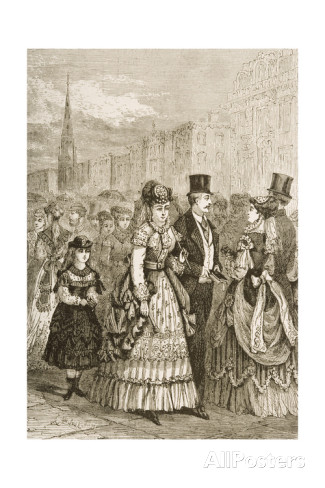
New Yorkers took the air on Fifth Avenue, promenading as always with vigor. The Easter Parade was only one opportunity to admire and be admired.

1870 fifth-avenue-new-york-in-c-1870-from-american-pictures-published-by-the-religious-tract

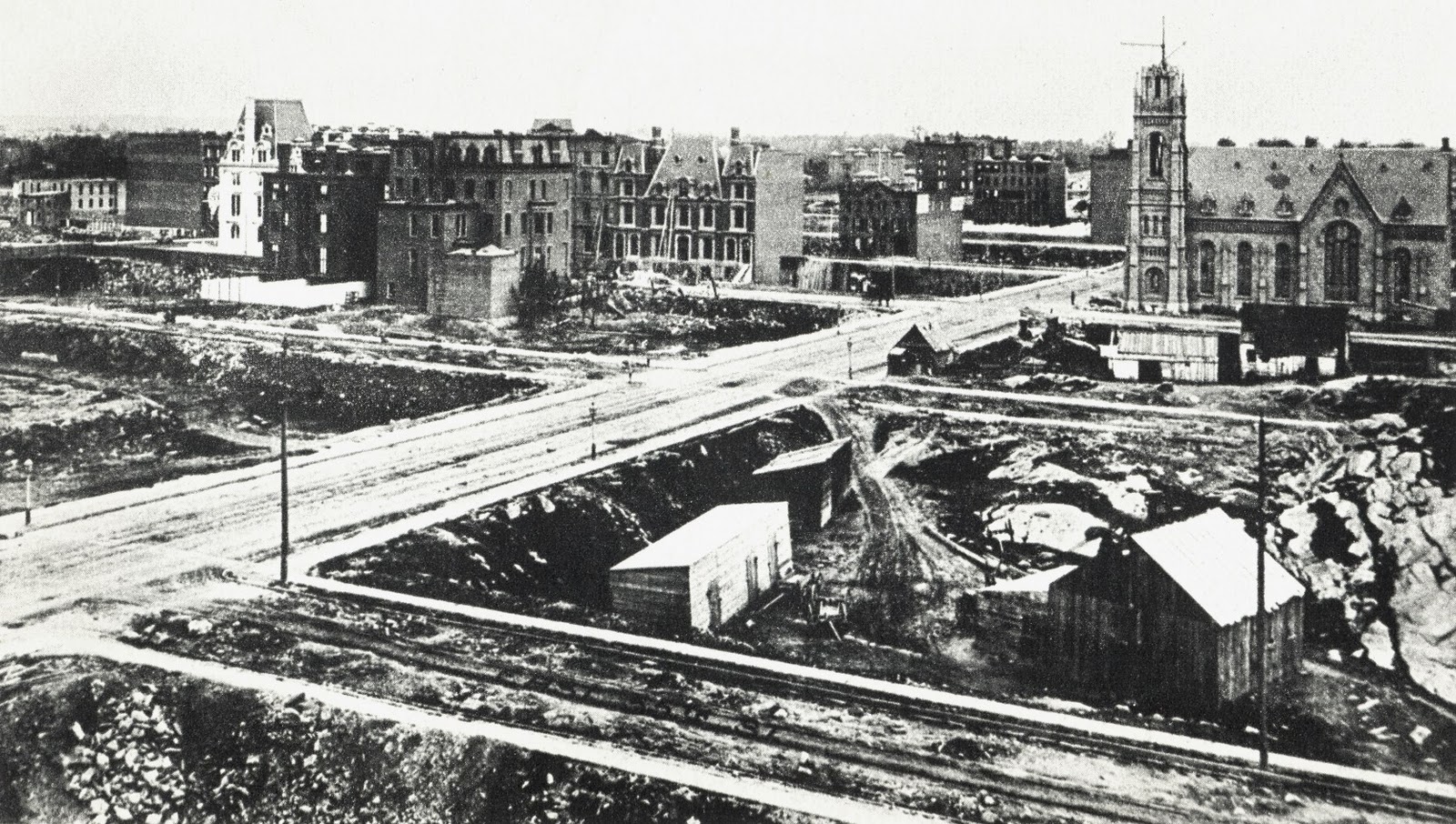
But while the upper tens (the equivalent of today’s “one percent”) of New York built their urban villas and stolid townhouses to the south, wide open stretches of the boulevard north of 60th Street still seemed off limits for luxury development. At the time of Savage Girl, 1875, more than 340 private residences had been constructed up to 59th Street but none above.

The lack of elegant homes didn’t mean people didn’t live there. Those precincts had long been settled by African Americans and German and Irish squatters who occupied shanty towns where the principle businesses were bone boiling, glue, soap and candlemaking. Eventually they were  eliminated from the area both by the development of Central Park and rising real estate prices.
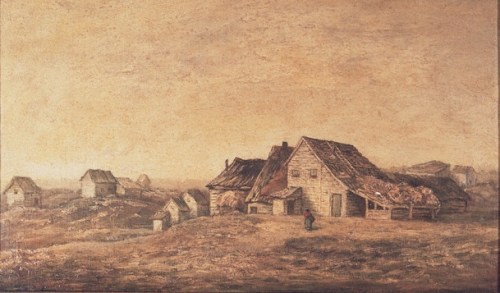
 by Ralph Albert Blakelock

Edith Wharton remembered the area as dominated at that time by “the hoardings, the quarries, the one-story saloons, the wooden greenhouses in ragged gardens, the rocks from which goats surveyed the scene.” North of the site I gave the Delegate house, it was still this old, bucolic, rough-hewn New York landscape, unrefined, undeveloped, not yet buried in the smooth cement of the new. Central Park, built in the 1860s and opened officially in 1873, made inroads in “civilizing” the neighborhood; but it still seemed too much like a savage wilderness for the upper crust to build there.

There were a few exceptions, wealthy home builders that for their own reasons decided to go above 42nd Street. Robber baron Jay Gould built a residence on the corner of 47th and Fifth in 1870. The infamous Madame Restell and her husband moved in at the northeast corner of 52nd and Fifth in 1864. But mansions towered over shacks.

Mary Mason Jones, a distant relation of Edith Wharton’s – personified in The Age of Innocence by Mrs. Manson Mingott — built a row of mansions on Fifth Avenue bet. 58th and 57th Streets, completing them in 1870. A remarkably independent, wealthy, well-travelled woman, she had had the first bathtub in New York installed in her home on Chambers Street, and her choice of venue for her new residence was equally offbeat. Five homes were constructed of gleaming white marble, with a two-story mansard roof that had green copper trim.
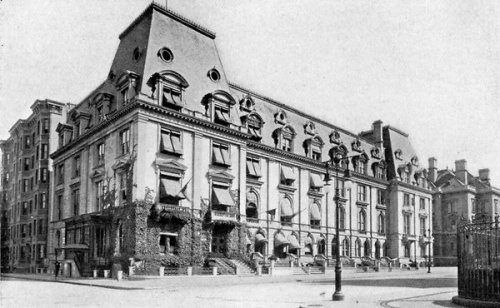
Marble Row, built 58th and 5th 1870

By the time the fictional Delegates settled into their house in the early 1870s, the intersection of Fifth Avenue and 63rd Street was still quiet, devoid of built structures, undiscovered by Knickerbocker Society. The Delegates were pioneers. I decided to situate them there because the choice makes them outliers, risk takers, iconoclasts in a society they see as conformist. I wanted to show them as the first to build a grand residence there, one that would outshine all the others in the city.

Eventually, Fifth Avenue upwards of 59th Street would be lined with mansions that were even more extravagant than the homes built in the avenue’s lower reaches. When people passed, they would gape at at the welter of materials and styles, the polished marble, dramatic gables and steep-hipped roofs, puncuated by balustrades and moats and massive chimney stacks. Whether architects hewed to the gleaming white symmetries of the Beaux-Arts or the swagger of the Moorish fortress or the period’s beloved French Renaissance design idiom, their creations lorded it over the somber-faced brownstones of the cross streets.

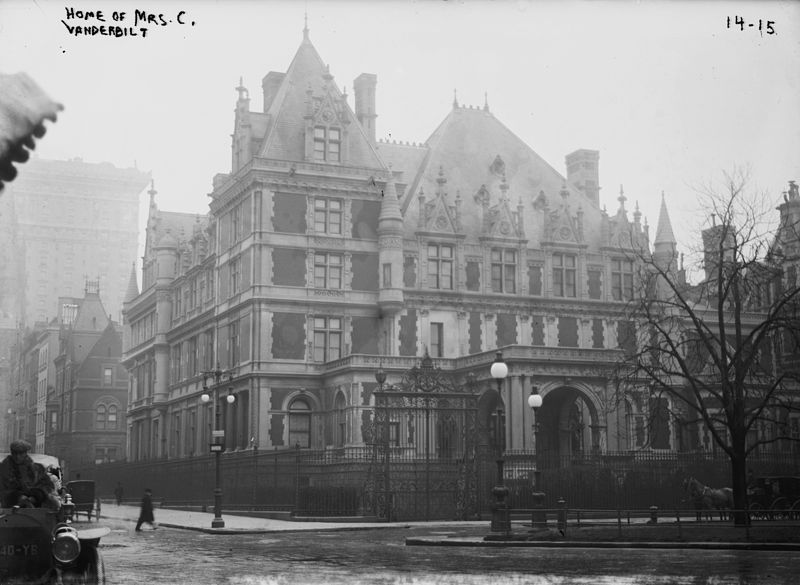
I couldn’t resist borrowing from some of the later residential masterworks to design the Delegate house, even though they would not be erected for a few more years. The various Vanderbilt homes offered the kind of opulence I felt the Delegates would emulate. After inheriting an estate of nearly 100 million dollars from their shipping-and-railroad-magnate father, the Vanderbilt descendents put on a grand architectural show. William Henry Vanderbilt, the Commodore’s eldest son, built triple houses for himself and his daughters between Fifty First and Fifty third Streets. William K. Vanderbuilt, William Henry’s son, had Richard Morris Hunt design him the mansion at the northwest corner of 52nd Street that was the setting for a famous fancy-dress ball of 1883.

Wm K. Vanderbilt House-the Petit Chateau

I was especially impressed by the mansion Cornelius Vanderbilt II put up at 58th Street and 5th Avenue in 1883,  the largest private residence ever built in New York City. A full block long, designed by George B. Post, it stood sentry until 1927, as one mansion after another followed it up the avenue.
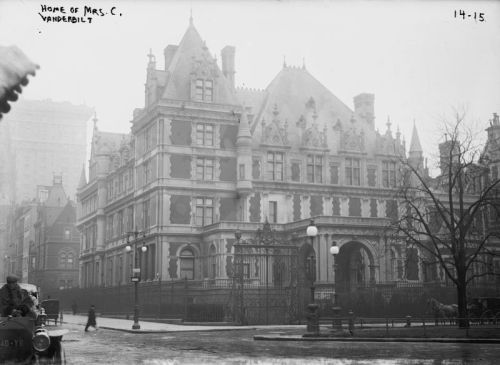
corneliusvanderbiltiimansion

Actually, I’m being slightly inaccurate. For the record, in the early 1870s one house did stand on Fifth Avenue at 63rd Street, above the 59th Street divide, just across the street from the still forbidding Park. A narrow townhouse circa 1871, it was built speculatively built by one Runyon Martin, hardly a mogul. It didn’t last long.

The Delegates knocked it down to put up their turreted, mulberry-colored, block-long twin palaces.
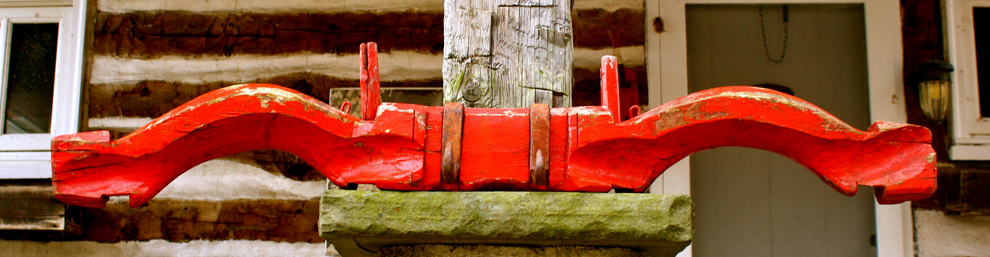
2 Comments

Filed under Culture, Fashion, History, Home, Jean Zimmerman, Photography, Publishing, Savage Girl, Writers, Writing

I Brake for Knit Projects

If I had to choose between these knitted winners, it would have to be the animal heads.

animal-heads

No, the full-body suit.

knitted suit

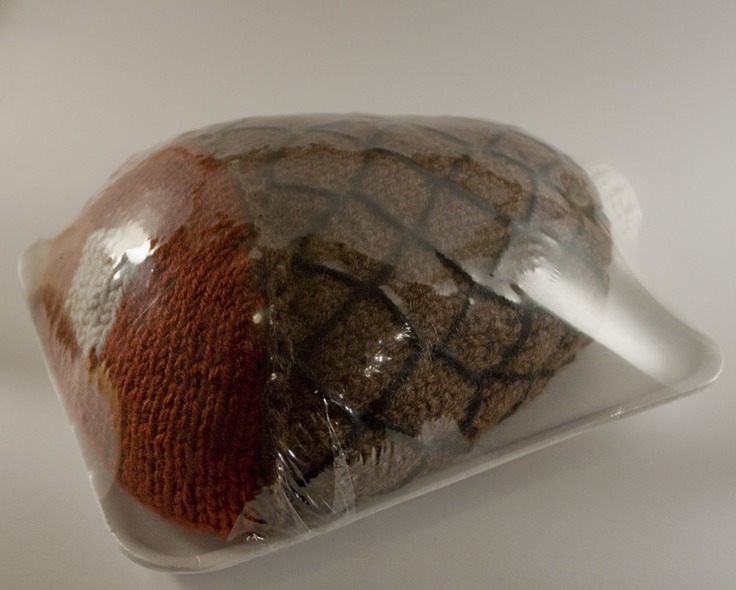
No, the meat. Definitely the meat.

knittedmeat

After this short commercial break, we bring you back to the Oscars, live.

3 Comments

Filed under Art, Cooking, Culture, Home, Jean Zimmerman, Knitting

Skordalia With a Kick

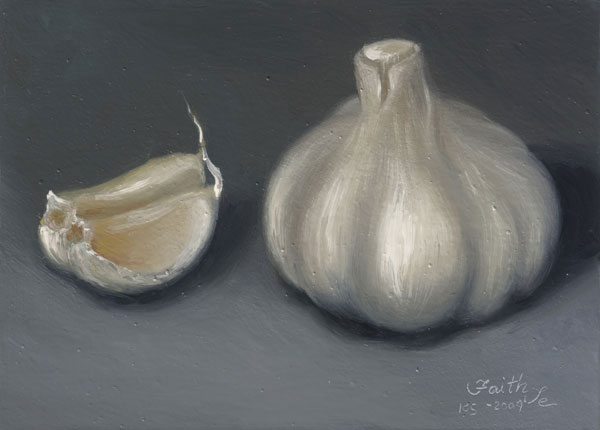
If you are a garlic hound like me you could probably use some skordalia to warm you up in this bitter weather.

garlic-paintings-aceo-daily-oil

The Greek dip/sauce can open your sinuses, for sure. It’s a versatile kind of dish too. First of all, you can use either potatoes or bread soaked in water as a base. I first learned to make it with pulverized pine nuts but if I don’t have them on hand I use almonds or walnuts.

I have a fond memory of preparing skordalia with sunflower seeds once in a pinch, then scooping up the dip with green pepper wedges and washing it down with a pitcher of dry martinis. We were hanging out on a friend’s front stoop, and never was there a more perfect afternoon.

superhero_green_pepper_cartoon_character_cut_out-rf56e6a8f442345fcac782583e8b1c0f6_x7saw_8byvr_512

It doesn’t have to be green pepper wedges, though – you can consume skordalia with pita bread or chips, with boiled beets, crispy slices of fried zucchini or eggplant, or really whatever whets your appetite. Or just grab a spoon and dig in. It’s always good.

Skordalia

  • 4-5 garlic cloves
  • 2 ½ ounces of walnuts
  • 1 large slice stale bread
  • ¾ cup olive oil
  • Salt

1.  Grind the walnuts.

2.  In a food processor process the garlic cloves with a bit of salt until they become a paste.

3.  Add the walnuts to the garlic paste and mix well.

4.  Soak the bread (without the crust, in water) and then squeeze well.

5.  Mix the bread with the walnuts and garlic mixture. Mix until smooth.

6.  Add olive oil gradually until olive oil is absorbed.

Add a spritz of lemon juice if you wish.

2 Comments

Filed under Cooking, Home, Jean Zimmerman

The Dressmaker’s Studio

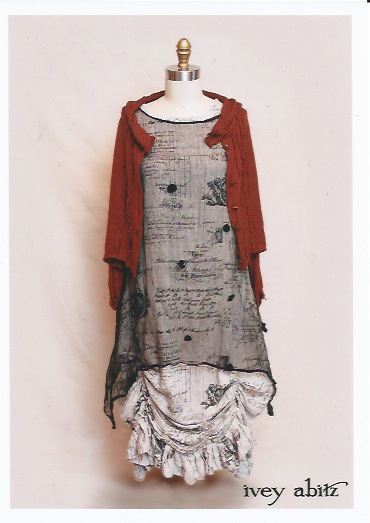
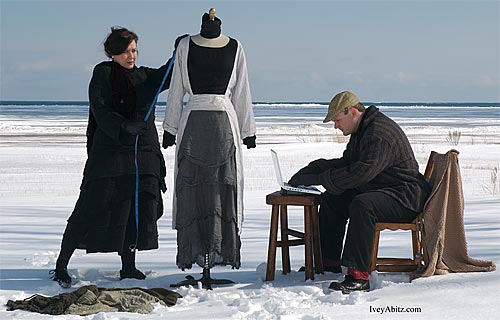
I pay a visit to the dressmaker. Not just any dressmaker. A time machine artist. A bespoke 21st century fashion designer with the soul of a Victorian seamstress. Cynthia Ivey Abitz is her name, and the clothes she designs are magical.

Gil knew I wanted one of her garments, a sweeping, floating coat called the Hambledon duster. He knew because I begged for one, having been tipped off to Ivey Abitz’s existence by an artistic friend. He had no choice, he gave me a gift certificate for Christmas, and I saved up the getting of it like a stocking candy that was too good to eat right away.

ivey abitz dress 1

I decided to visit the Ivey Abitz studio, which she keeps on a cross street in the shadow of St. John the Divine, just above Manhattan’s Central Park. I wanted to feel the leather, as they say in the car-selling business, before deciding on the fabric of my coat. For every one of the hundreds of designs available, the client chooses the material.

swatches

A fluffy quartet of small cats and dogs share the cozy, sun-filled place, which is crowded with the eccentrically beautiful clothing that has earned her a reputation among the eccentrically beautiful. “Antique inspired garments relevant for everyday modern life,” is how Ivey Abitz describes her designs. I would say they have a patina you can’t find on the Macy’s sales rack, where I am usually  inclined to find my wardrobe.

On the Ivey Abitz web site there is a more elaborate manifesto: The collection “gives a nod to the past and present… It’s anti-generic garb. It’s an aesthetic. It embraces certain classic and vintage design elements and gives them life in the present. It’s a celebration of life by getting dressed in something rare and special every day. It’s a state of mind. It’s regalia for everyday life.”

ivey abitz dress 2

Cynthia, Cynthia, you had me at “nod to the past and present.”

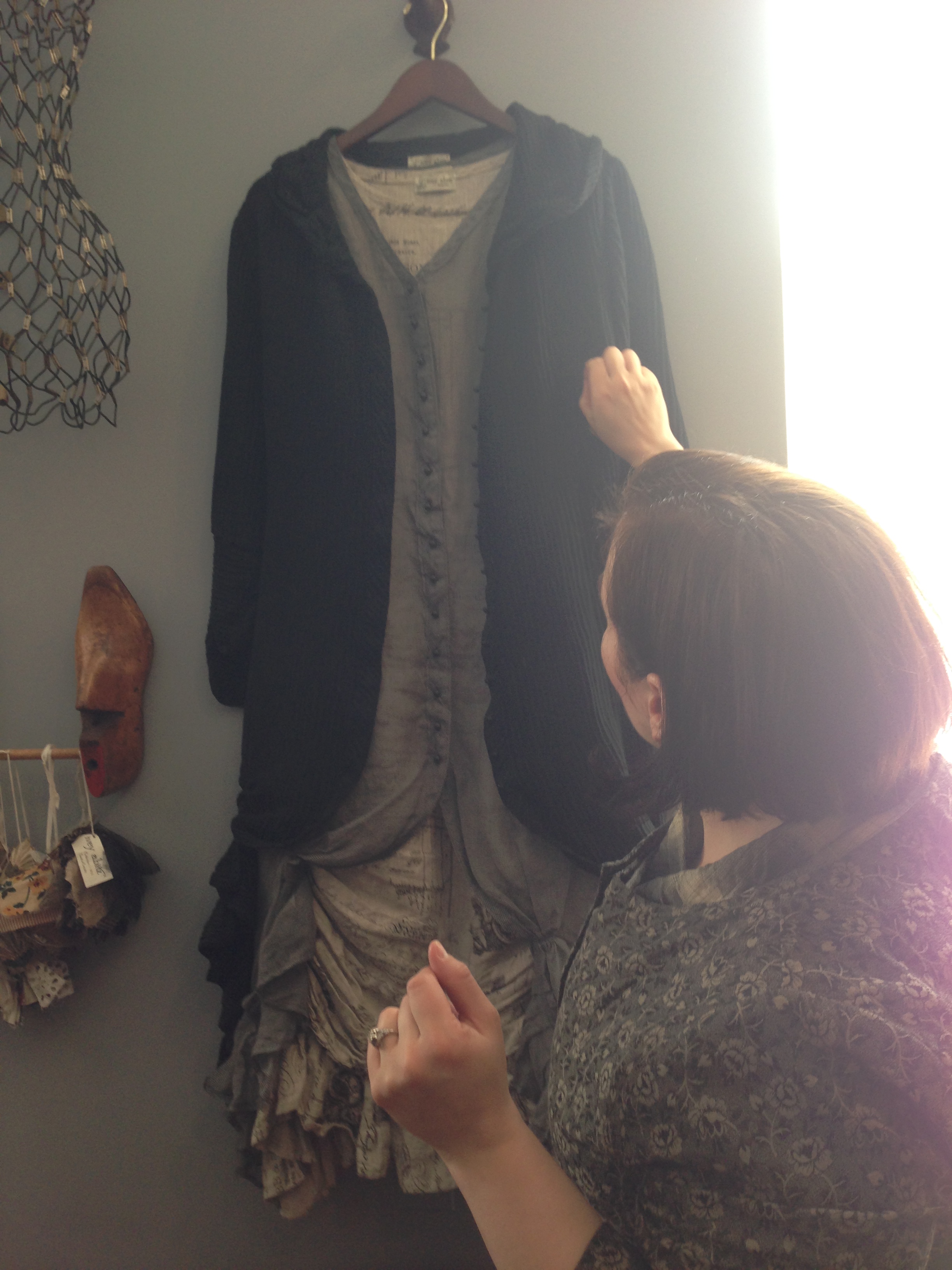
On my visit, the designer bustles around, smoothing, fluffing, brushing away loose threads. I will come home and find loose threads all over me. The hazards of visiting the dressmaker, poor me.

Cyn w frock

How did she arrive at this unique aesthetic? Ivey Abitz remembers a family friend’s collection of antique clothing she happened to see when she was a kid of around eight, dressed in her summer attire of shorts and tee shirt, and saying to herself, Why doesn’t everybody dress like that? She grew up in Michigan farm country and spent her summers on Lake Huron, where she still has a cottage with her husband Josh Ivey Abitz, her partner in the business.

Cynthia and Joshua

The two partnered as magazine photographers before they went into fashion but the outfits she designed and wore to shoots attracted more attention than the pictures. The couple have been coming to New York since 2001, and moved to the city full-time in 2008 to be closer to their beloved seamstresses and fabric makers.

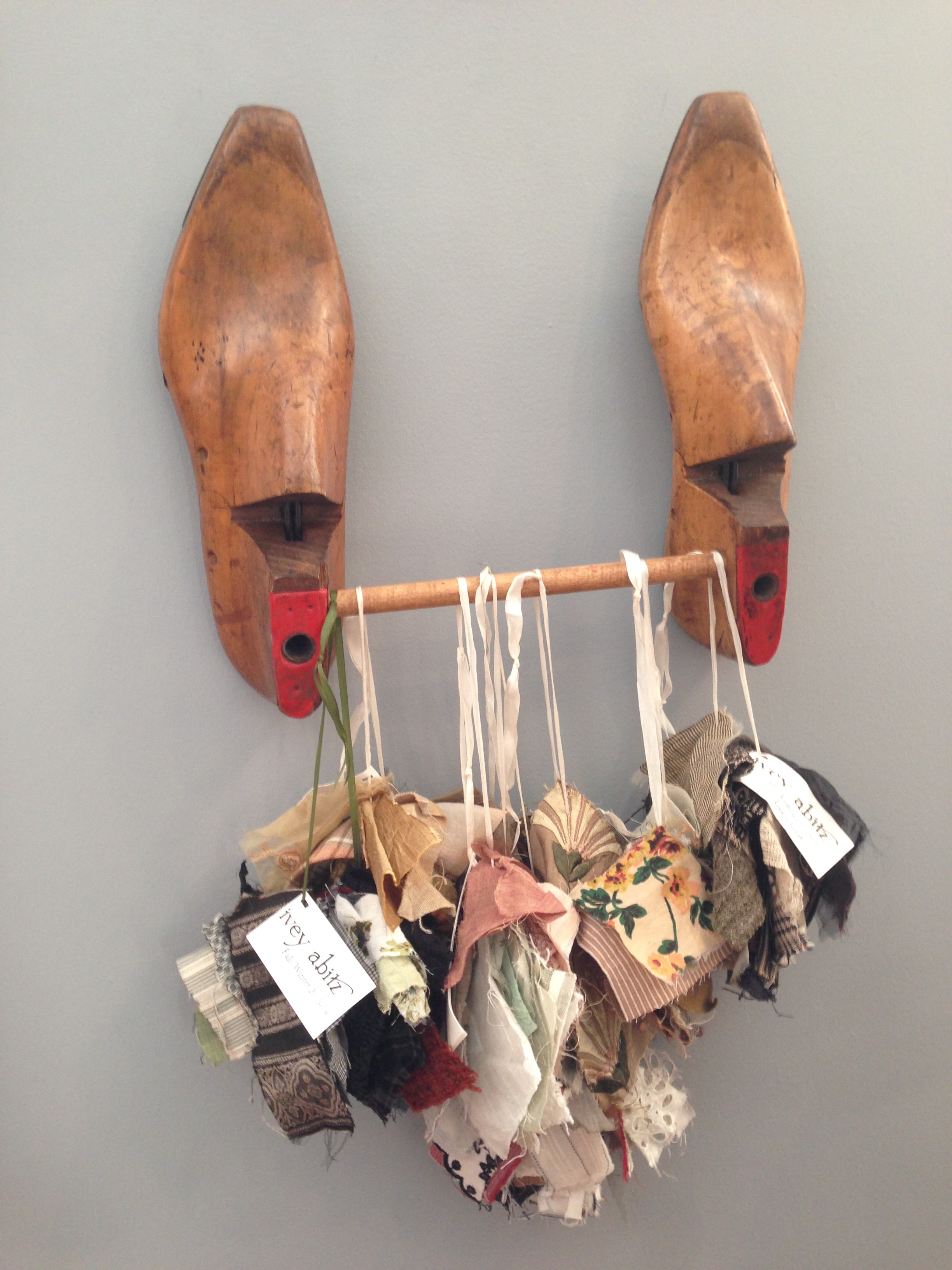
Pretty pretty pretty. Everything here is pretty. A pretty way of displaying fabric swatches.

wood shoes

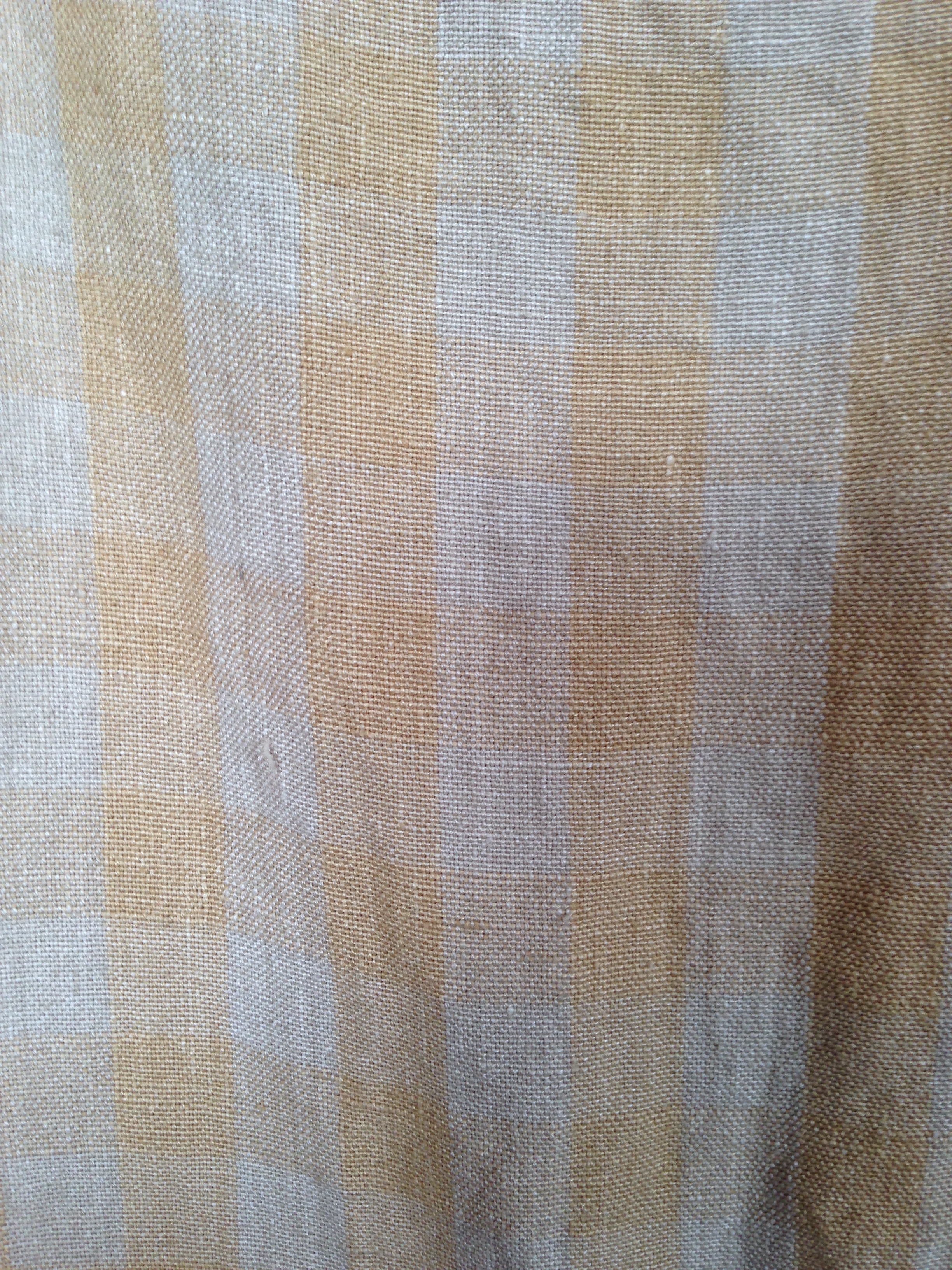
Yellow checks on a dress – we call them frocks here, though — that seem so simple yet are so lovely.

plaid

Wouldn’t it be pretty to think so? floats into my mind, the sad last line of Hemingway’s The Sun Also Rises. Yes, well, what is the matter with pretty thinking? Here in the dressmaker’s studio are silken coats that make you want to go up and nestle your face in them.

beaut shirt

The garments come with stories. A shirt I am infatuated with, featuring a delicate flutter about its raw edges, was inspired by Ivey Abitz’s grandmother, who encouraged her to be a dreamer. Another piece took its inspiration from a favorite childhood dog.

Everything is hand tailored and in some cases is handwoven. Ivey Abitz shows me a jacket fresh in from the tailor, not yet blocked, made of a deep rust-colored hand-loomed wool thread. Luscious.

When I ask her if she has a favorite garment she gently rebuffs me, saying that would be like choosing a favorite child. What she does suggest is that when people get to mix and match the designs and fabrics they prefer, they fall in love with their clothes. “They garden, play with children and grandchildren, go to the symphony, sleep in them… everything,” the dressmaker tells me.

I know that when I put on my duster of black and white checked taffeta, I’m never going to take it off.

8 Comments

Filed under Art, Culture, Fashion, History, Home, Jean Zimmerman, Photography

Wild Music for a Savage Girl

What wild child anthem gets your juices flowing? Curtis Mayfield’s Little Child Running Wild? Wild Thing by the Troggs? Or perhaps an oldie like Bessie Smith’s I’m Wild About that Thing? My personal favorite:  Born to Be Wild as rendered by the immortal Etta James.

etta

Whatever your taste, you can get a bunch of hits in one place when you check out the Spotify playlist I’ve put together with the help of Viking for  Savage Girl’s release in… 11 days (really? is that possible?).

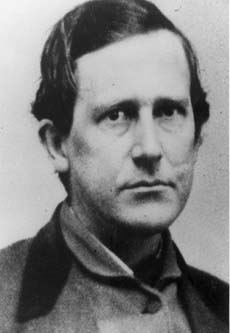
Of course, these selections all appeal to our contemporary taste and would probably appall the characters in Savage Girl, who would have been more entertained by music that was quite different in a pre-Victrola, pre-modern age. To enjoy popular music in the late nineteenth century people might sing around the piano in their homes, enjoying such numbers as My Grandfather’s Clock (1876), Clementine (1863), or Home on the Range (1873). They would also enjoy some of the great composer Stephen Foster’s work, tunes such as Beautiful Dreamer (1864) or Jeannie With the Light Brown Hair (1854), which were popular throughout the second half of the 1800s.

foster1

If they attended a ball, they would in all likelihood waltz – the most popular dance step of the nineteenth century — to compositions by Johann Strauss, Jr, who wrote the famous Blue Danube among over 400 waltzes.

I don’t think you’ll ever waltz to the Troggs. But you can try. Just click on my Spotify playlist.

3 Comments

Filed under Culture, Dance, History, Home, Jean Zimmerman, Music, Publishing, Savage Girl, Writers, Writing

Parisian Time Machine

Here is an amazing story that concerns the Nazi invasion of Paris, a fleeing woman and the apartment she left behind. Not opened for 70 years, when the door was cracked it revealed a person and a style of life in a time capsule you have to see to believe. I think I’ll just hand over the link and let you do the rest.

time-capsule-living-room

3 Comments

Filed under Art, Culture, History, Home, Jean Zimmerman

Bloom Time

My new novel is blooming. Much like the amaryllis opening up beside my desk, at the window overlooking the marsh. This plant with its glowing greenish-white flowers doesn’t care about the snow and cold, it’s gonna display it’s stop-motion beauty on its own time, as it pleases. I’m just there to write it along.

amaryllis 1

amaryllis1-2


amaryllis4

amaryllis5

amaryllis 6

amaryllis7

3 Comments

Filed under Home, Jean Zimmerman, Nature, Photography, Writers, Writing

The Burger of My Dreams

I am finally enough recovered from roiling bloat to write about the hamburger I consumed the other night.

DB Bistro Moderne stands on 44th Street in Times Square, on a block that is distinguished by the Harvard Club, the New York Yacht Club and the swanky hostelry attached to the restaurant called the City Club Hotel. The Algonquin, with its always-crowded, ever-literary lobby and comfy cocktail chairs, one of my very favorite places in New York, is right next door.

The-Algonquin-Hotel-NYC-3

We were celebrating Valentine’s Day early, knowing we were up for a snow pounding that might keep us in the day itself.

For years, we’d heard about a burger. A mythic burger, a burger for those of hearty appetites and gourmet tastebuds. In 2001 Daniel Boulud introduced the thing for an unseemly 27 dollars, but that only made people want it more.

Daniel-Boulud.jpg?q=100

Now the price has risen to $32, roughly twice what we pay for dinner at our favorite ramen joint.

hot and delish

What the hey, it was faux Valentine’s Day. We arrived, we settled in among the blonde New York princesses with gaudy Chanel necklaces and thousand-dollar leather jackets, we ordered a non-alcoholic beer. The bread, studded with olives, went down fine. An arugula and frisee salad with a lemony dressing and lots of almonds tasted better than it sounded.

But what about the burger?

retro_vintage_kitsch_kids_eating_hamburgers_burger_sticker-r5733afe1d44b4938bfeb118e16c8bbd6_v9waf_8byvr_512How would that be? This burger, you see, is no ordinary burger, but a giant softball of ground sirloin embedded with strips of brisket, a chunk of foie gras and a soupcon of black truffle.

DB-Burger-Vancouver-by-E-Kheraj

It’s a long way way from the simple but tasty culinary icon that Wimpy loved.

wimpy

How did we get from there to here?

I have learned that the Mongol Army under Genghis Kahn would stuff filets of meat (sometimes beef, sometimes lamb) under their saddles as they rode so that it would crumble and cook in time for lunch.

genghis-khan-soldiers-images

America’s own Hannah Glasse gave a recipe in her 1770 Art of Cookery that paired minced meat (cooked) and toast. Other cultures have long dined on meatballs, kissing cousins in a smaller ball of beef.

So the claim of the United States to inventing the burger has only a partial foundation in truth. Emigrants from Hamburg brought versions of minced steak to New York in the late nineteenth century, where they were served raw or lightly cooked in exclusive restaurants such as Delmonico’s, sometimes accompanied by a raw egg, and sometimes for breakfast.

delmonico's kitchen

The mechanical meat grinder, invented in the mid-1800s – mincing had earlier been done with a chisel – made mass production of ground beef possible. It’s thought that the hamburger in its present form originated as cheap eats at a county fair in Wisconsin, or Ohio – somewhere in the land where people needed sustenance to traverse the games, exhibits and rides. A slick of Heinz ketchup, patented in 1888, soon tagged along.

burger sign

On this night, our DB burgers landed in front of us with a thud, encased in a polished Parmesan bun, stuck through with wooden sticks and cut neatly in half. On full display were the slices of short rib and diseased goose liver, in lush cross section. A bite through the red of the beef released the flavors of fresh red onion, tomato jam and mustard. No Heinz 44 for this baby.

We could have eaten half but managed the whole. It was juicy, meaty, greasy, messy as a burger should be. But was it the best? Was it $32 worth of hamburger? When the bill arrived we told them that we’d gladly pay them Tuesday for a hamburger today.

8 Comments

Filed under Cooking, Culture, Fashion, History, Home, Jean Zimmerman, Publishing, Writers, Writing

Pot Lucky

Just a neighborly event. The lightest of snows twinkled outside the windows. Someone said, You may not see each other for six months but you’re still glad they’re there. There was a list, a neighborhood email listserve, and these 60-odd people were on it.

The pot-luck took place in the carriage house of the local nature preserve, Teatown.

scenery_teatown1

Such communal feedbags have a history, dating back to the sixteenth century, when pot-luck meant “food provided for an unexpected or uninvited guest, the luck of the pot.”

In this bowling-alone world, community often strikes me as a missing element. Or perhaps that’s just because mine is a solitary profession, handcuffed to my computer keyboard, staring out the window at the winter. I was happy now to talk to people I barely knew about books we’d read, about composing music, about keeping chickens.

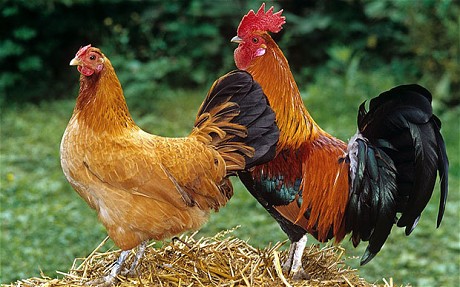
chickens_1844738c

Above all, we spoke about the deep drifts and ice outside that affect everybody.

As Bilbo Baggins once said, “I don’t know half of you half as well as I should like, and I like less than half of you half as well as you deserve.”

Someone brought a soup enriched almost to a stew with wild rice. Someone else baked a crusty bread. When the desserts came out there was a deep-burnished chocolate bundt cake studded with cherries that had folks lining up. We all shared food, shared companionship. A hat was passed to send kids to the local summer camp.

No one spoke about plumber referrals, or the other information that flies across the internet on the listserve. No one talked about rowdy teens on the roads, or co-mingled recyclables.

separate-recyclables

Above all, no one became embroiled in the deer situation, the bane of the neighborhood, the divisive question of whether to leave the overpopulation alone or somehow control it, and if so, how to do so. It would be a fraught conversation. We let it go. (Though some wry soul offered venison sausage on the buffet table.)

We were gracious, putting faces to names. We shook hands, kissed cheeks. We were neighborly.
Outside, it continued to snow.

5 Comments

Filed under Cooking, Culture, Fiction, History, Home, Jean Zimmerman, Music, Nature

Good Housekeeping Seal of Approval

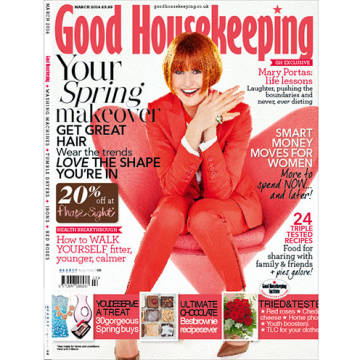
I’m so pleased to see Savage Girl among Good Housekeeping‘s recommended books for March.

March-cover-230114-de-lg

Here is the magazine’s thumbnail review, which manages to distill the essence of the story quite well, I think.

Good Housekeeping, March 2014

New Book Picks: No matter what mood you’re in, we have a page-turner to tempt you

FOR INTRIGUE

Savage Girl

A wealthy couple touring the American West in 1875 “rescue” a young woman who’s said to have been raised by wolves, then attempt to introduce her into society back East. Bronwyn cleans up nicely, but her suitors keep ending up dead. A wild ride.


5 Comments

Filed under Culture, Fiction, Home, Jean Zimmerman, Publishing, Savage Girl, Writers, Writing

A Crinoline Cage

I found a wonderful lecture transcript and powerpoint on line for a talk titled “The Crinoline Cage.” The speaker, Lynda Nead, is an art history professor at the University of London. I’ve always wanted to find a piece that really goes into the history of crinolines and hoop skirts, and this is it. The accompanying images from the nineteenth century include cartoons from Punch, extracts from Dickens, letters from Victorian women and paintings by artists such as Franz Winterhalter, the painter of the Royal and Imperial Courts of Europe. They’re all wonderful, so check this out.

Slide06

In the introduction to her remarks, Nead says this:

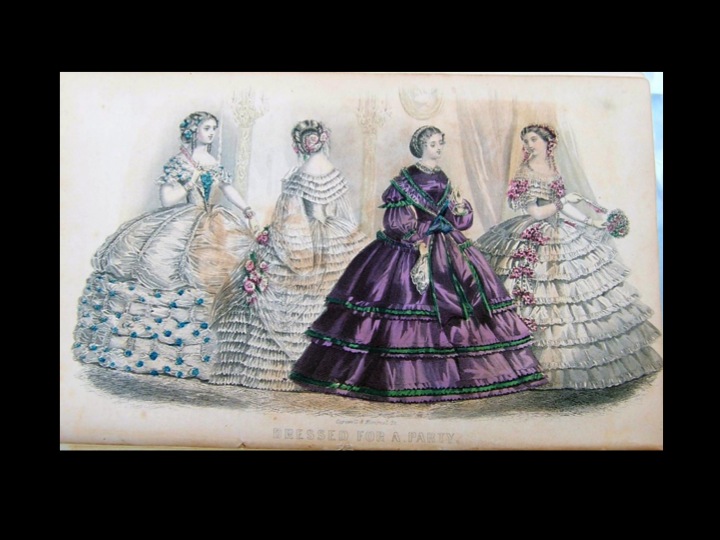
The middle of the nineteenth century was the great age of the crinoline. Dresses became bigger and more ornate; skirts grew wider and wider, devouring metres of fabric and decorated with flounces, fringes and ribbons. The style was facilitated by the development of the sewing machine and technological developments in textile production that introduced new machine-made light, gauzy fabrics, which supplemented the more established and expensive silks and taffetas and were suited to the purses of the middling classes. The key to this fashion, the frame for this confection of fabrics and ornament, was the hooped cage crinoline. Historians have been divided on whether the crinoline turned women into ‘exquisite slaves’ or was a sign of female assertiveness and subversion.

Slide05

Leave a comment

Filed under Culture, Fashion, History, Home

Big Ol’ Brick of Books

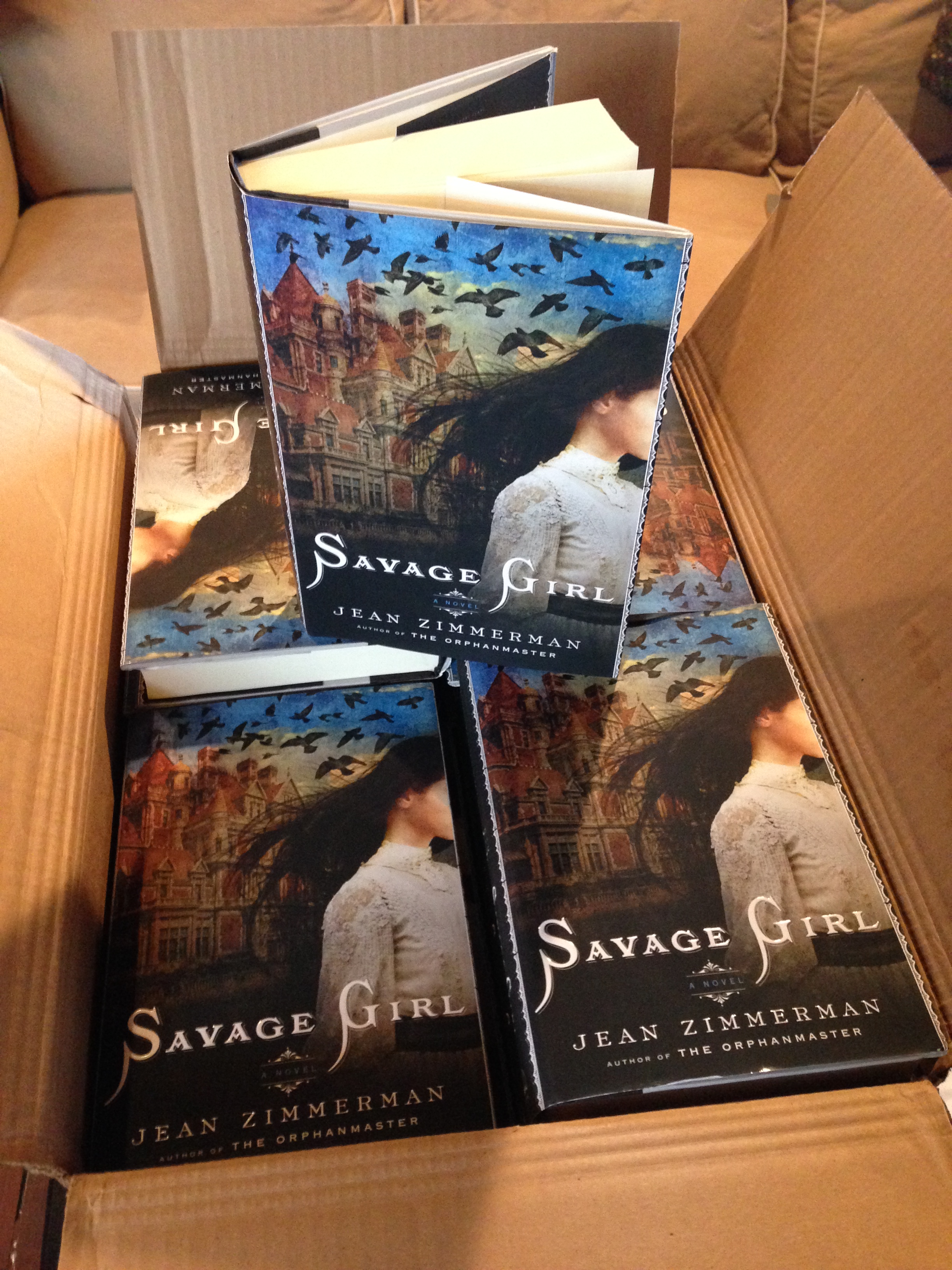
A brick of books. Author copies. Twenty-eight, to be exact, sitting where UPS dumped the box, in the fresh, deep pile of snow at the head of the driveway. The cardboard was soaked around the edges.

But the books were dry, miraculously. That novel is watertight.

open

2 Comments

Filed under Art, Culture, Fiction, Home, Jean Zimmerman, Nature, Publishing, Savage Girl, Writers, Writing

In the Sky With Diamonds

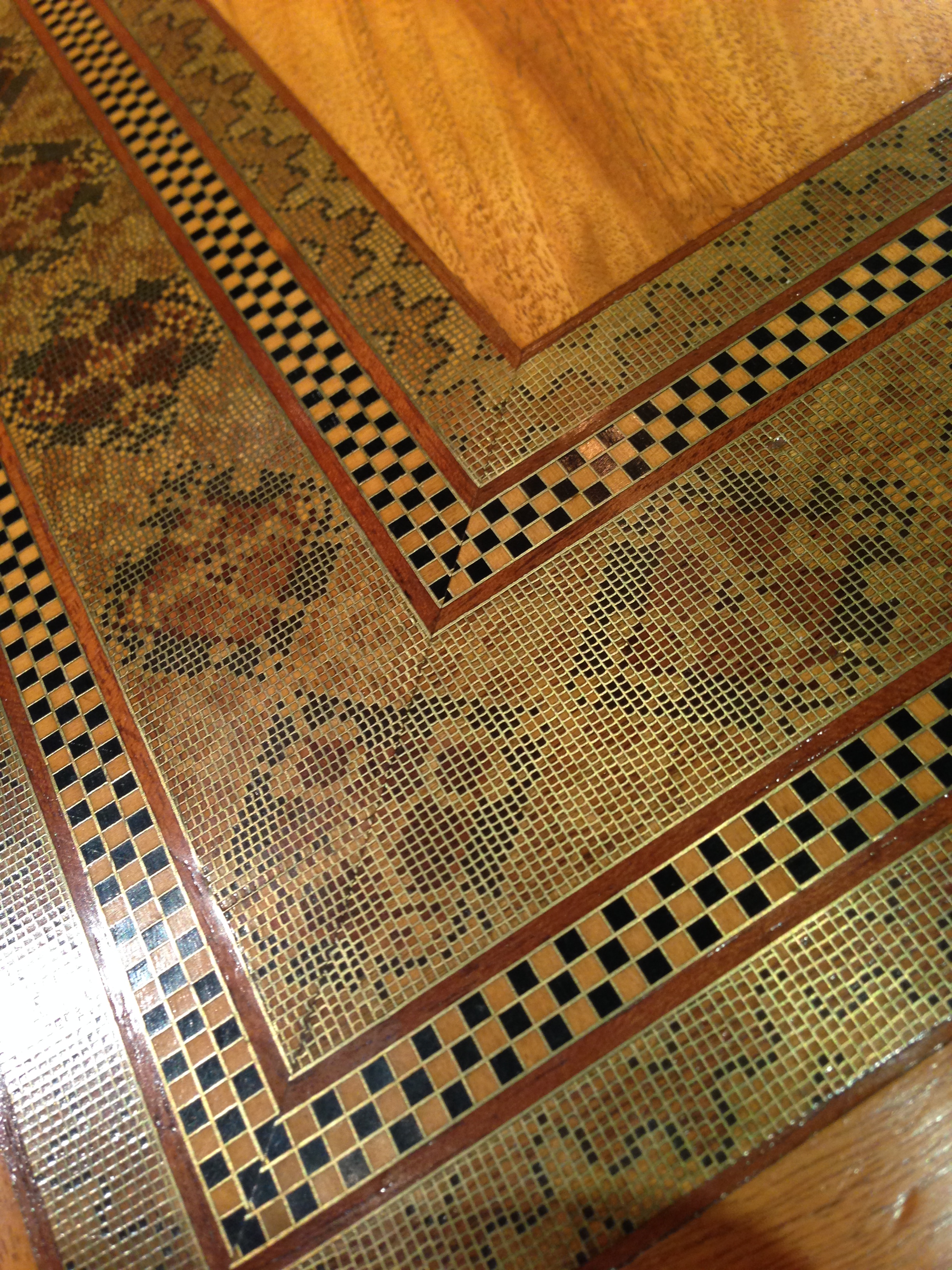
The 60th anniversary of the Winter Antiques Show at New York’s Park Avenue Armory: the Diamond Jubilee. So it features special showings of diamonds, of course. And a lot of people are dripping with their own, too. One pouf-haired dowager in black stretch pants nearly blinds us with her sizable diamond pendant while scoping out the Tiffany Studio micromosaic table at the Associated Artists stall. In 1891, Tiffany designed things besides jewelry and lamps.

micromosaic

There are thousands upon thousands of match-head sized wood chips embedded in this decorative band that resembles cross-stitch, or snakeskin. Imagine the work that went into its intricacy. The table is the only one of its kind ever made, and with two matching chairs is priced today at 1.4 million dollars.

Going, going, gone, to the lady in the diamond dazzler.

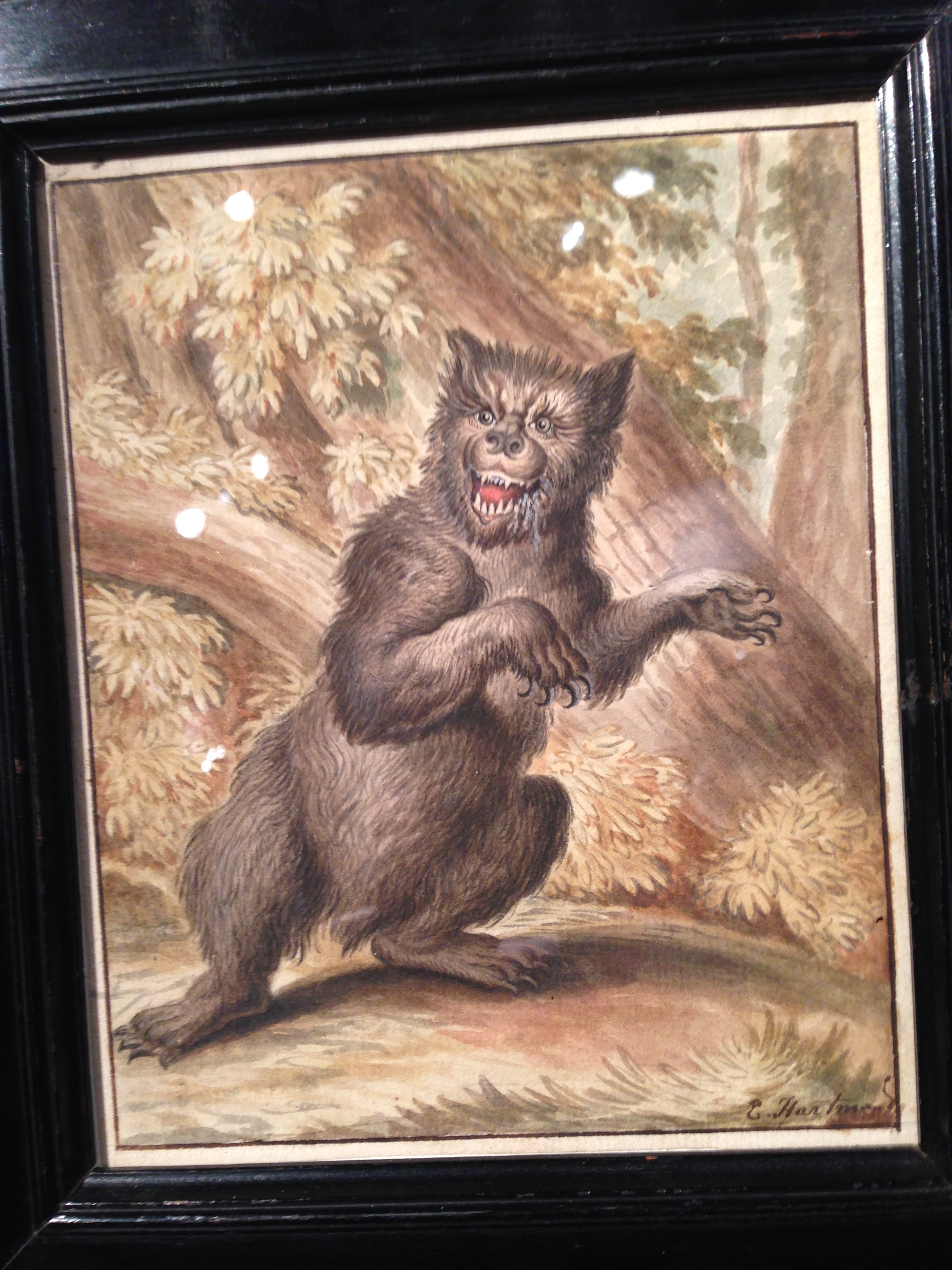
There are a lot of things I love at the show. A small but powerful watercolor of a snarling but somehow jolly wolf circa 1800 gives me a welcome jolt of Savage Girl.

snarling wolf

There are girls here too, including one hand-sewn, winsome doll with brown velvet hair.

doll

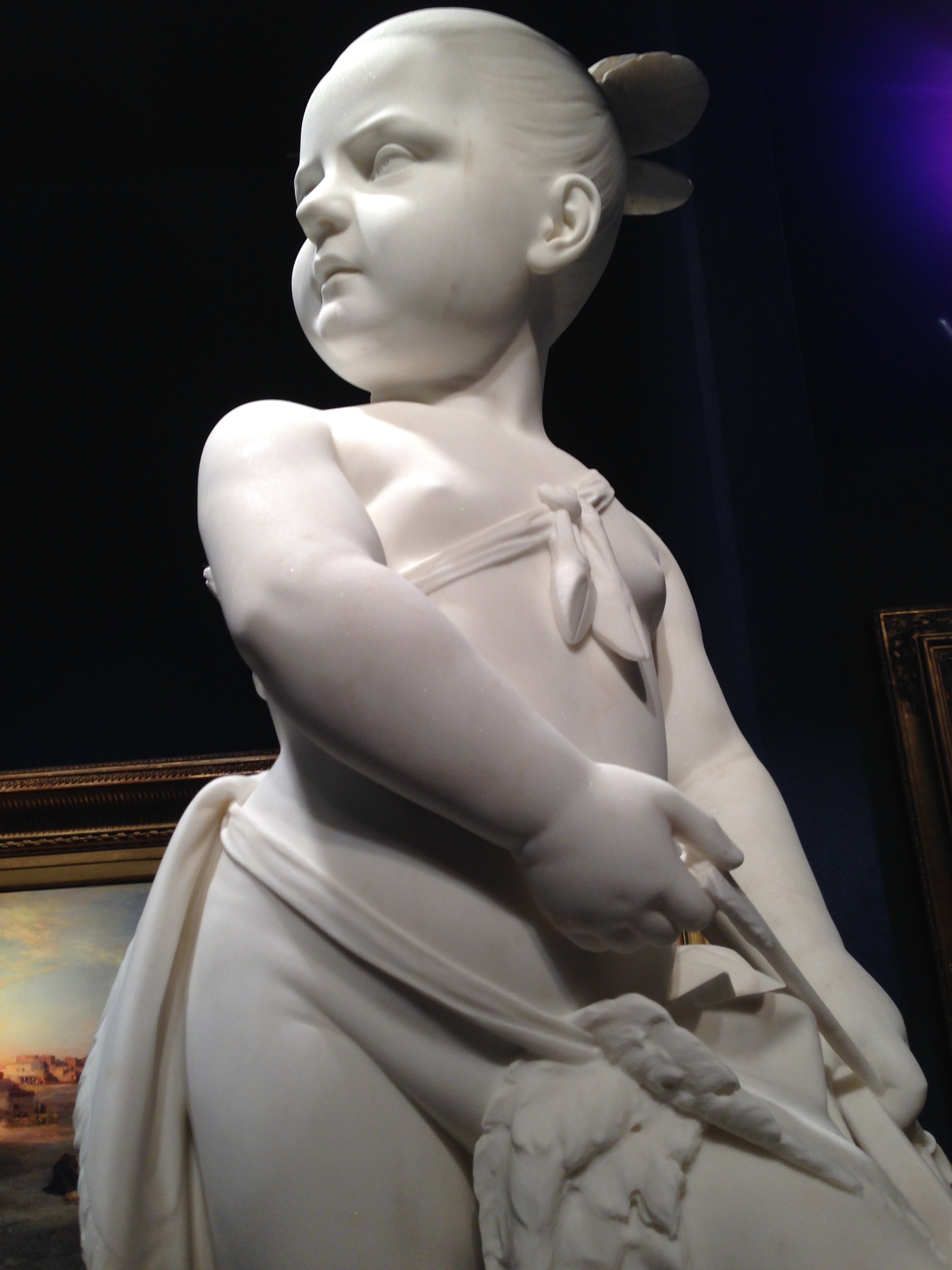
One baby Amazon in glossy marble.

baby amazon

I see a trio of ventriloquist dummies dating back to 1875. Oscar and Louise Shaffer, along with their musical troupe, toured the east coast throughout post-Civil War America. Oscar was the ventrioloquist. His three “friends” were Jerry Doyle, D Day and Sassafras Jones.

dummies

Louise Shaffer was billed as “the most versatile lady artist in America.” She was renowned for her cornet solos and banjo stylings.

Louise probably could have managed this enormous blue guitar, hand-crafted and reminiscent of Picasso’s famous Blue Period painting, The Old Guitarist..

blue guitar

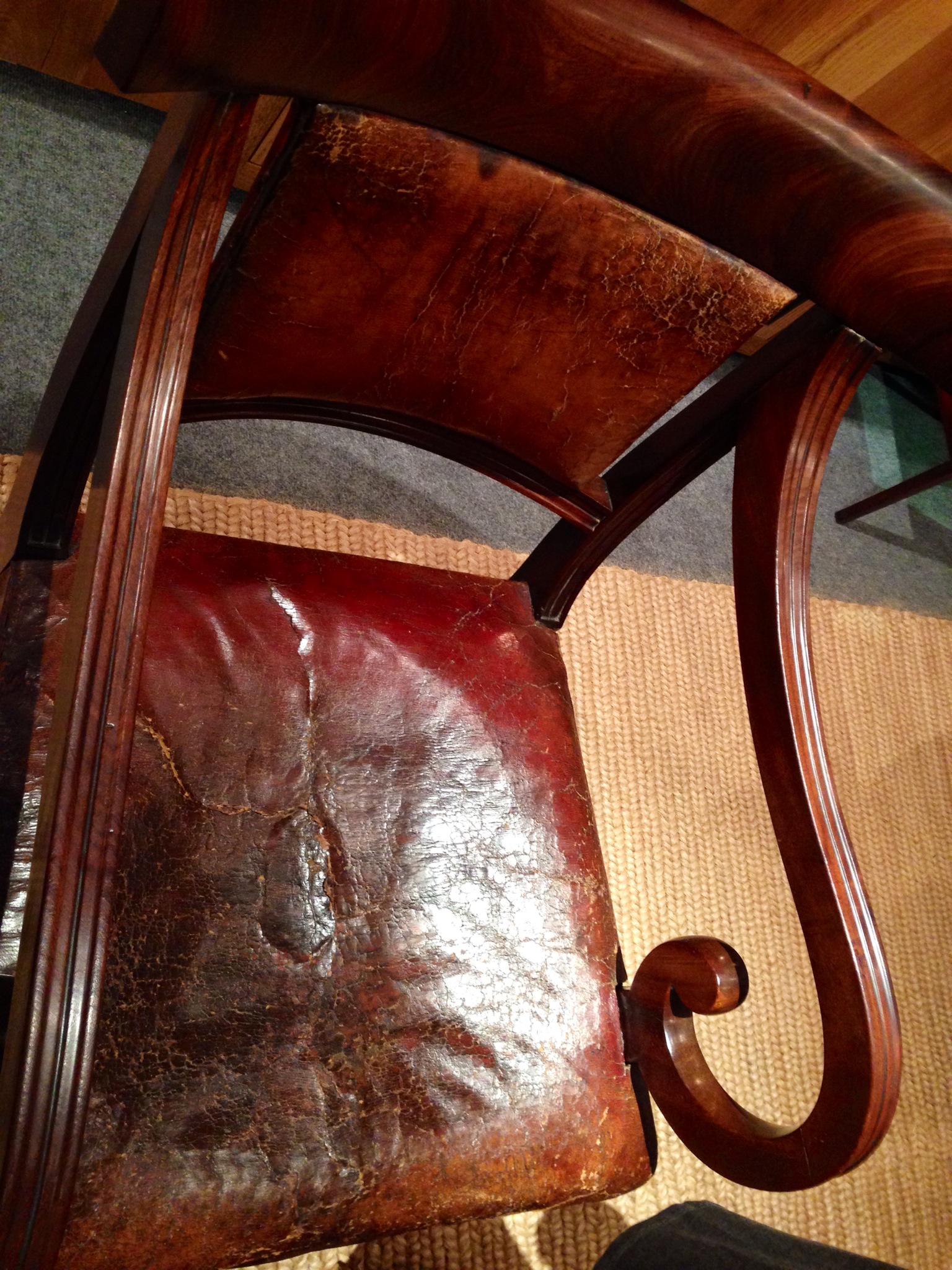
I really like this chair, too. One of my favorites in the show.

worn chair

Now that’s what you call antique. The leather has received its share of buffing and burnishing by uncountable weary behinds.

At the Winter Antiques Show you can buy a quartet of really important geodes, if you have a couple large in your pocket.

geodes

We stand at a counter admiring diamond rings set with emeralds and rubies, next to a gentleman in tweeds examining a set of cufflinks displaying horses, a bargain at $1,400. I don’t ask the price of the rings. I have just been chastised by a guard for attempting to snap a picture of Queen Victoria’s tiara from 1840, ablaze with sapphires along with diamonds and prominently on display. There’s a shot on the show’s website, however.

Queen Victoria's tiara

Tiaras have always intrigued me. We think of them as belonging exclusively to princesses. There was a time, however, in the late nineteenth century, when the only thing that kept a woman from wearing one is if she couldn’t afford it. You didn’t have to be royal. According to one expert, “By 1894 nearly 100 tiaras could be counted among the possessions of New York’s social leaders.” That’s a lot of tiaras. If you were really well off you might have two or three to choose from when you went out to the ball. Tiffany could barely keep enough in the pipeline, churning out beauties like this 1894 piece assembled of gold, platinum and diamonds.

tiara

If you wore one, like Consuela Vanderbilt in 1902, you could imagine yourself to be royalty. She had an Alice in Wonderland neck and a trompe l’oeil waist.

woman

Maybe that’s how that multi-faceted woman in the pouf-hair and leggings sees herself.

4 Comments

Filed under Art, Culture, Fashion, Fiction, History, Home, Jean Zimmerman, Savage Girl