Category Archives: Fiction

Sneak Peak

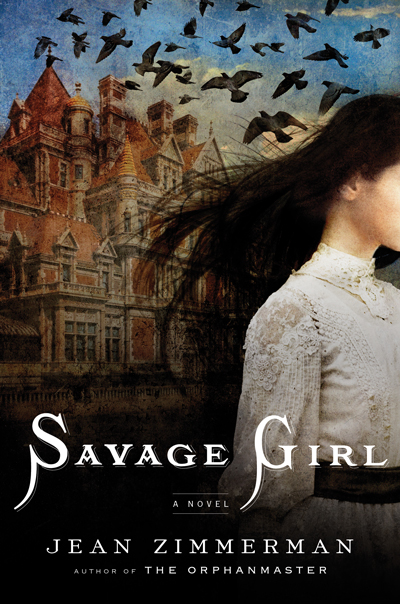
It’s a long time, the final gestation of my novel Savage Girl. Nine months until its publication date in March 2014. But I’m already excited. The book has been written. Edited. Copyedited. We now have a cover.

Savage Girl cover 3

And even some catalog copy. It gives the gist of the story, which is both a tangled web and clear as day. It tells of

the dramatic events that transpire when an alluring, blazingly smart eighteen-year-old girl named Bronwyn, reputedly raised by wolves in the wilds of Nevada, is adopted in 1875 by the Delegates, an outlandishly wealthy Manhattan couple, and taken back East to be civilized and introduced into high society.

This girl

hits the highly mannered world of Edith Wharton-era Manhattan like a bomb. As she takes steps toward her grand debut, a series of suitors find her irresistable. But the willful girl’s illicit lovers begin to turn up murdered.

Savage Girl would not be the same story, would not be so much fun, were it not for its narrator, Hugo Delegate, a Harvard medical student and the scion of the family that takes Bronwyn in.

The tormented, self-dramatizing Hugo Delegate speaks from a prison cell where he is prepared to take the fall for his beloved Savage Girl. This narrative – a love story and a mystery with a powerful sense of fable – is his confession.

So says the catalog description. When the book pops out of the oven next winter you’ll have a chance to judge for yourself.


4 Comments

Filed under Art, Fiction, Jean Zimmerman, Publishing, Savage Girl, Writers, Writing

By Heart

Driving west on Route 6, towards the Catskills, a summer weekday morning, and that old Talking Heads song comes on the radio:

I’m writing ’bout the

Book I read

I have to sing about the

Book I read

I’m embarassed to admit it hit the soft spot in my heart

When I found out you wrote the

Book I read so


Take my shoulders as they touch your arms i’ve

Got little cold chills but I feel alright the

Book I read was in your eyes oh oh

Thinking about when the book you’re reading touches you so much, the words become a part of you. The extreme of that is memorization.

My friend Bethany Pray, the person we’re driving to visit today, commits poems to memory. She wouldn’t say so, but it’s a rather serious pursuit. Not just a limerick for party performances, not a haiku or two. Real poems.  A discipline. She once told me she knew 20 or 30 by heart.

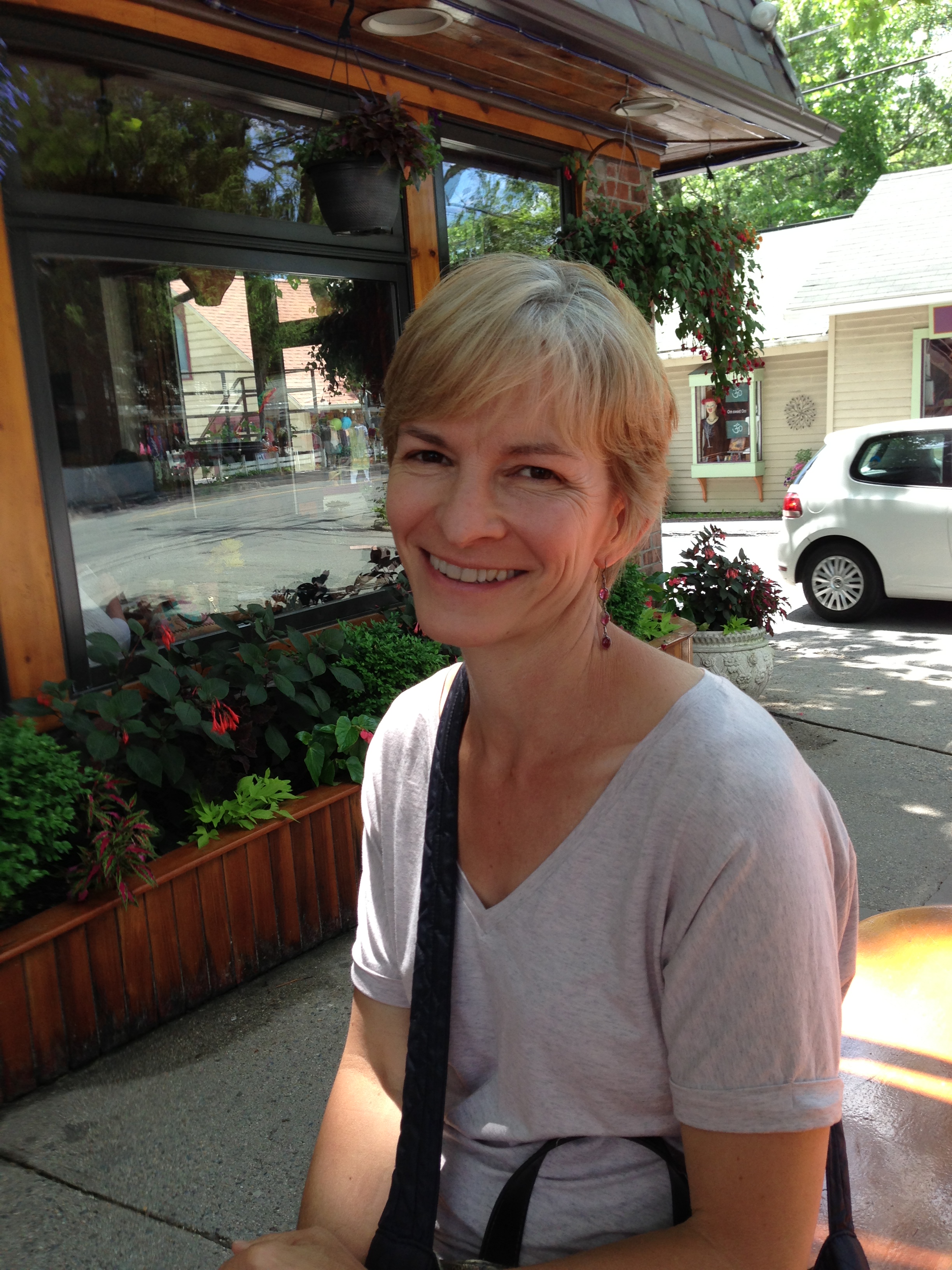
happy bethany

I’ve seen Bethany and Gil have poetry duels around campfires.

Slams? They’re easy. You get up and read or recite your verse, people cheer or boo. With a duel you must remember all the lines of a Shakespeare or a Blake. Not so easy.

Bethany says her favorite to recite is John Berryman’s Sonnet #37
.

Sigh as it ends… I keep an eye on your

Amour with Scotch,—too cher to consummate;

Faster your disappearing beer than late-

ly mine; your naked passion for the floor;

Your hollow leg; your hanker for one more


Dark as the Sundam Trench; how you dilate


Upon psychotics of this class, collate

Stages, and… how long since you, well, forbore. 


Ah, but the high fire sings on to be fed


Whipping our darkness by the lifting sea


A while, O darling drinking like a clock.

The tide comes on: spare, Time, from what you spread


Her story,—tilting a frozen Daiquiri,


Blonde, barefoot, beautiful,

     flat on the bare floor rivetted to Bach.

I remember Bethany recited it on a long hike we took around the rustic Rockefeller Preserve in Tarrytown, New York, and how I thought it was a poem I would find hard to follow on paper, let alone in air. Berryman was a tough one.

john-berryman

Berryman’s a favorite of Gil’s, too. Gil is at a slight disadvantage in a duel, at least in terms of volume, since he has not applied himself to more than a dozen titles. “There’s a word in Arabic,” he says, “for someone who has memorized the whole of the Koran.” HBO did a show on it, called Koran by Heart. But it’s rare to get a prize for memorizing poetry today unless you’re in 8th grade honors English.

quranramadan2

When I was in graduate school the Nobel Prize winning poet Joseph Brodsky loved the poetry of Thomas Hardy (and you thought Hardy only wrote novels) and made us memorize his poems and come in to class and write them out. Not a good assignment for me, as I barely can remember my own name sometimes.

“Pasternak was reading his poems in an auditorium in Russia and dropped his notes,” says Gil. “As he bent to get them the crowd picked up where he left off and finished the poem for him.”

Bethany calls herself a “poet without a portfolio,” but she is modest. Before earning a  law degree she collected an MFA from the Warren Wilson MFA program. She was already working as a paralegal, but “life was boring so I would put a poem in my desk drawer,” occasionally pulling it out. Not to read it – to memorize it.

Her coffee table groans politely under the weight of its poetry. “Kay Ryan is really great,” she says.

coffee table

The duel still in our future, we stop for a sweet moment at Woodstock’s 35-year-old book store The Golden Notebook, to find that they are sold out of The Orphanmaster, with five buyers in the past week alone.

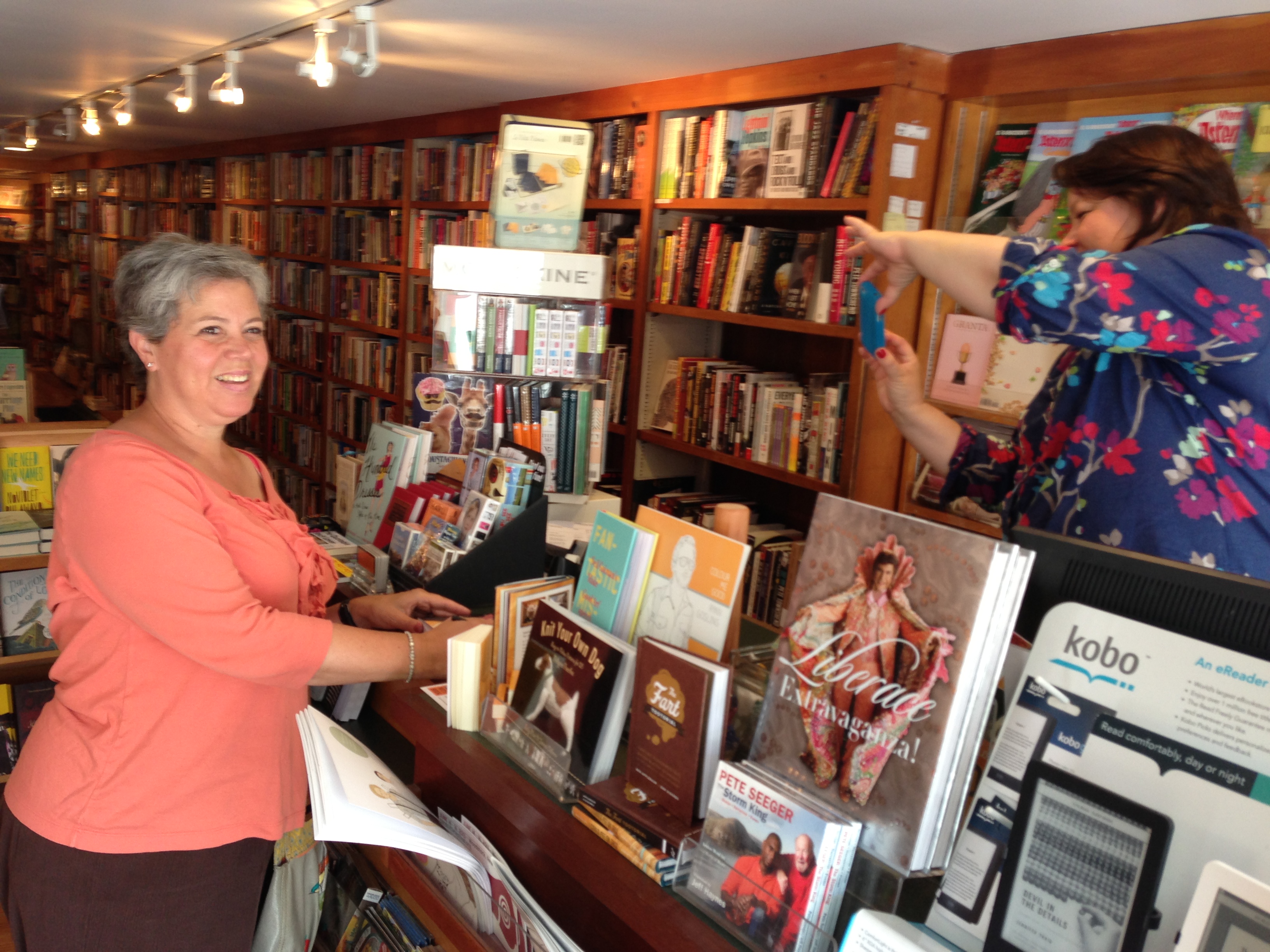
happy Jean

“It’s actually on my bedside table right now,” says Desiree, at her perch behind the counter. “My husband just read your book. He doesn’t like anything, he doesn’t like puppies, and he loved it.”

“You got to feel very famous,” Bethany tells me after we’ve left, happy that she guided us into the shop.

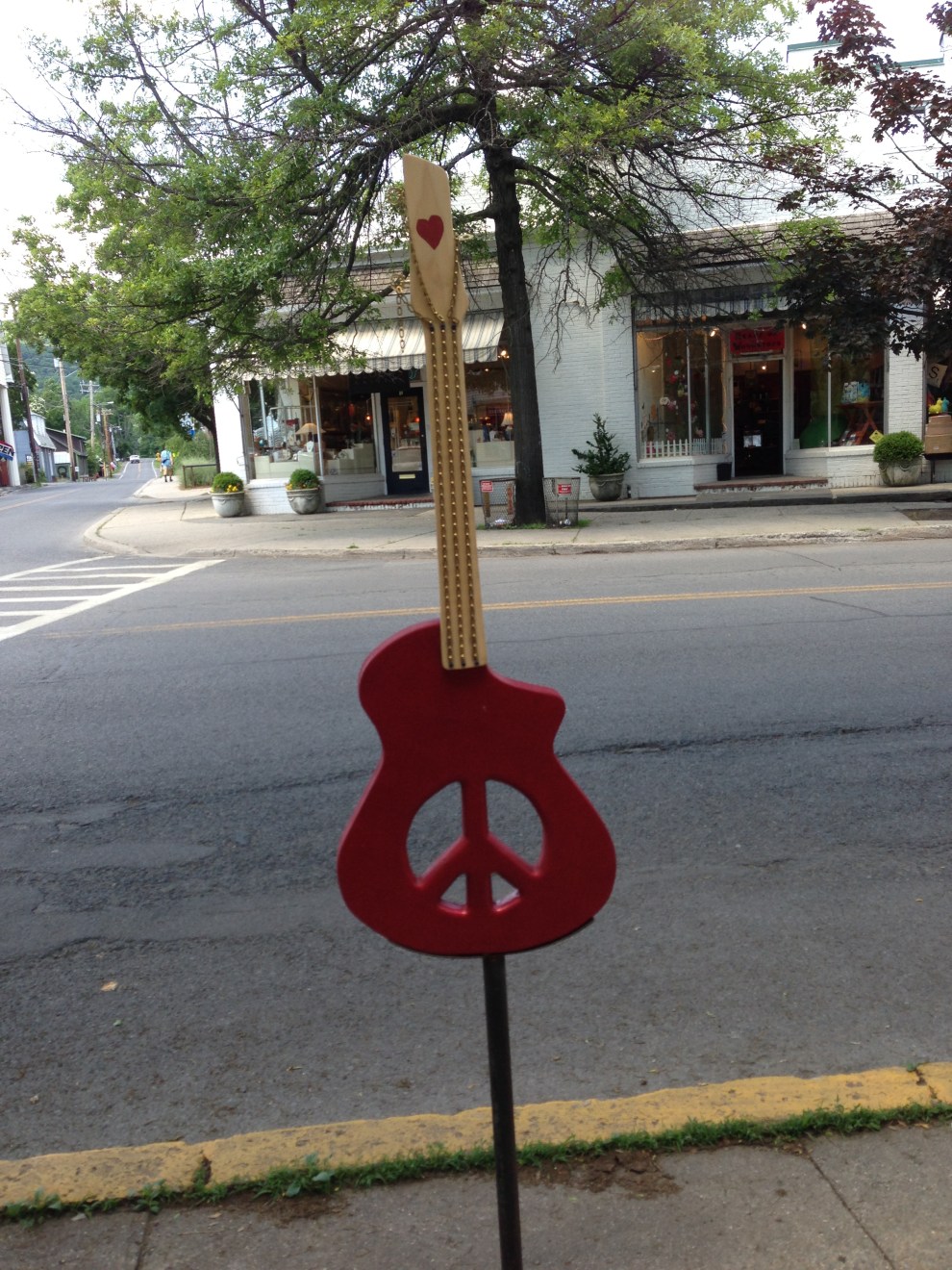
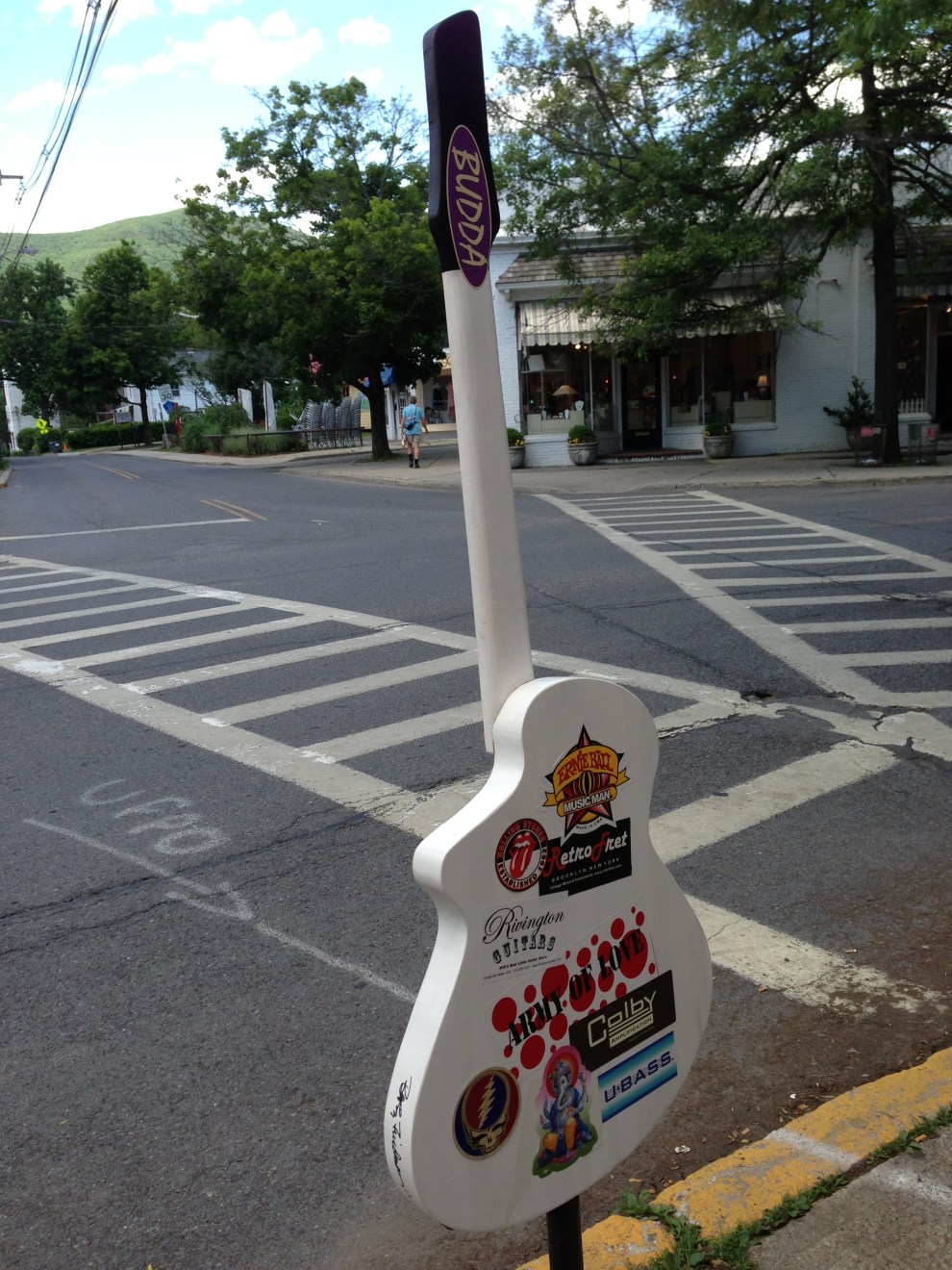
Woodstock is full of bibliophiles and music lovers.
guitar 1

Guitar sculptures stud the sidewalks, each one groovier than the next.
guitar 2

A café has a quiet patio that seems perfect for the poetry throwdown, beneath garlands of honeysuckle and twittering birds, near a lovely puppy with a clubfoot. We get ready to wax poetic. Or rather, they do. I prepare to clap and faint.

gil:beth

Gil begins with Thomas Wyatt’s sonnet to Anne Boleyn, Whoso list to hunt, I know where is an hind… His brain only smokes a little bit as he gropes in his memory.

Gil searching

Bethany goes with Emily Dickinson: On a Columnar self–. “It’s hard to understand her language,” says Bethany. “It’s a kind of mental straitjacket on her passions.”

What do both the duellists have in their quiver? What passions do they share?

They fuck you up, your mum and dad.   
    They may not mean to, but they do.   
They fill you with the faults they had
    And add some extra, just for you…

That’s the opening of Philip Larkin’s dark, hilarious This Be the Verse, one that Bethany and Gil could reel off together, as if in a rock band or at an Irish pub. Gil tells Bethany about the time he recited it in a talent contest at a Universalist family retreat in woodsy Minnesota and got sent away with his knuckles rapped. It’s hardly family friendly, but so brilliant, and Larkin was Poet Laureate of Britain, after all..

Gil’s turn. Blake’s London. I wander through each charter’d street…

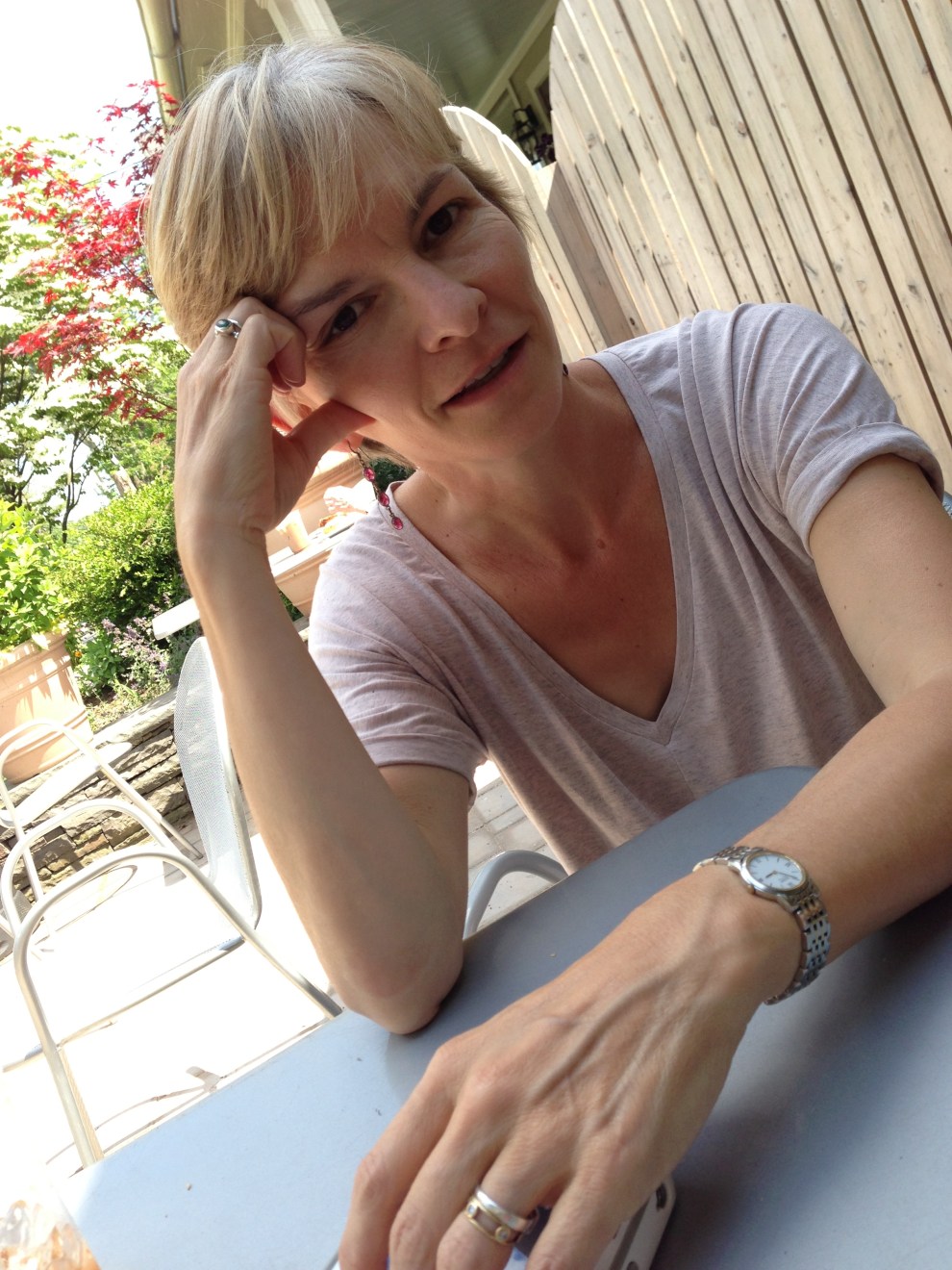
Bethany: Ode to Autumn by John Keats.
Beth reciting

She delivers the three long stanzas and we are properly floored.

Another poem for the two of them together –another Berryman, one of the Dreamsongs. Life, friends, is boring. We must not say so.

Coffee all around.

Bethany, another Dickinson. Gil, some Macbeth. Bethany, Spring by Larkin. And she finishes with Berryman’s wonderful I keep an eye on your/Amour.

“His wife learned he was having an affair by reading those poems,” says Gil. I think Gil was inspired to hit the books for his next contest with Bethany, whenever that might occur.

“People survived in the Gulag archipelago by reciting long stretches of poetry,” says Bethany. She knows a poem by Pushkin. She recited it to someone she met, a Russian mail-order bride, who burst into tears, she was so homesick.
4 Comments

Filed under Culture, Fiction, Jean Zimmerman, Poetry, Writers, Writing

Strangers on a Carousel

I get to see the carousel horses at Binghamton.

george w girlThe Triple Cities, actually — Johnson City, Endicott and Binghamton. A part of the world that strikes me as sort of a blank, a cipher.

blank sign 2Some houses crumble and gape, seemingly lost in time.

sad house


Others are spruced up as garishly as 42nd Street tarts.

blue houseOf course, some of this decrepitude I love. A weatherbeaten sign with “international” flair.

signA space-age car dealership with weeds sprouting up.

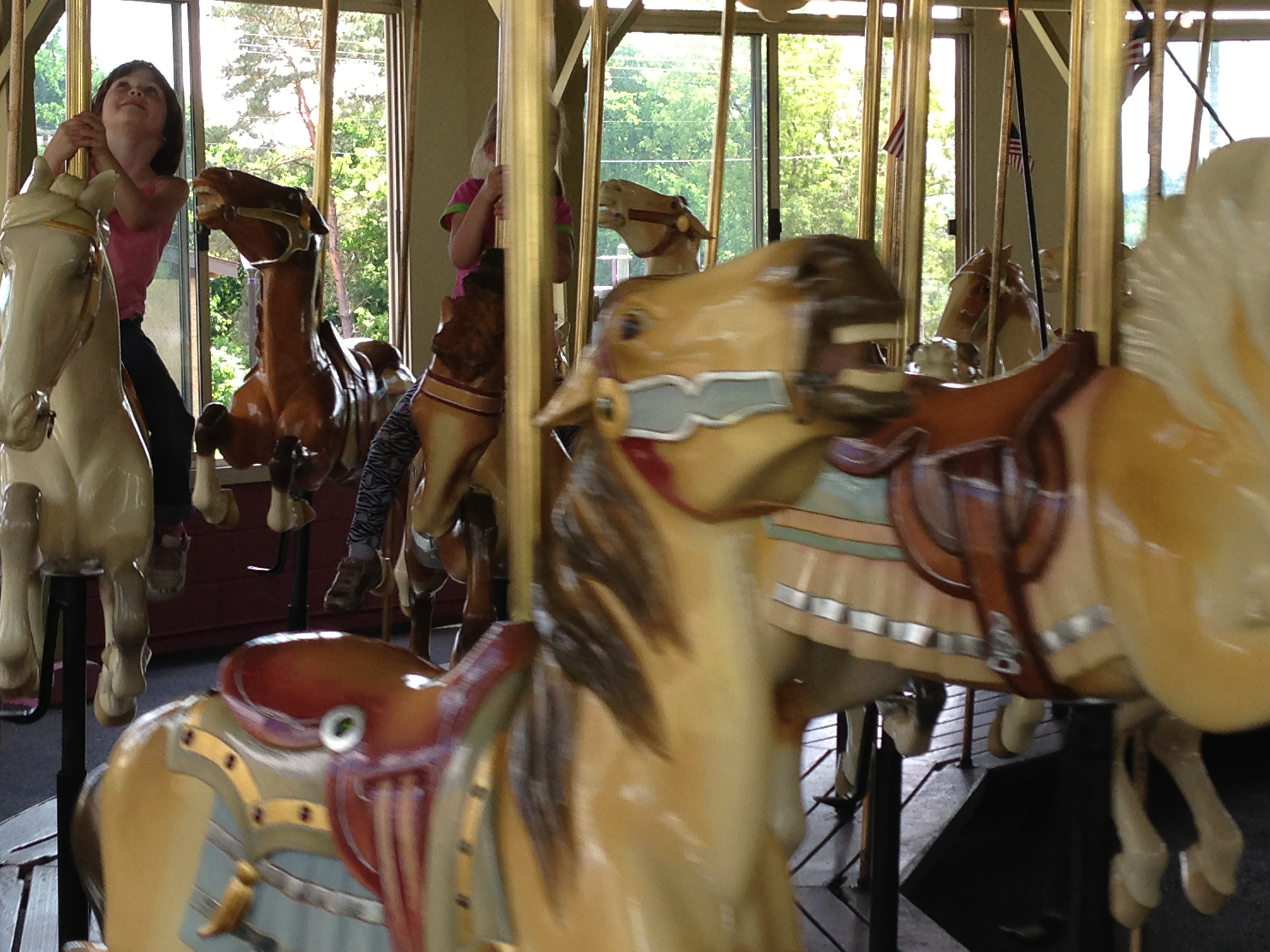
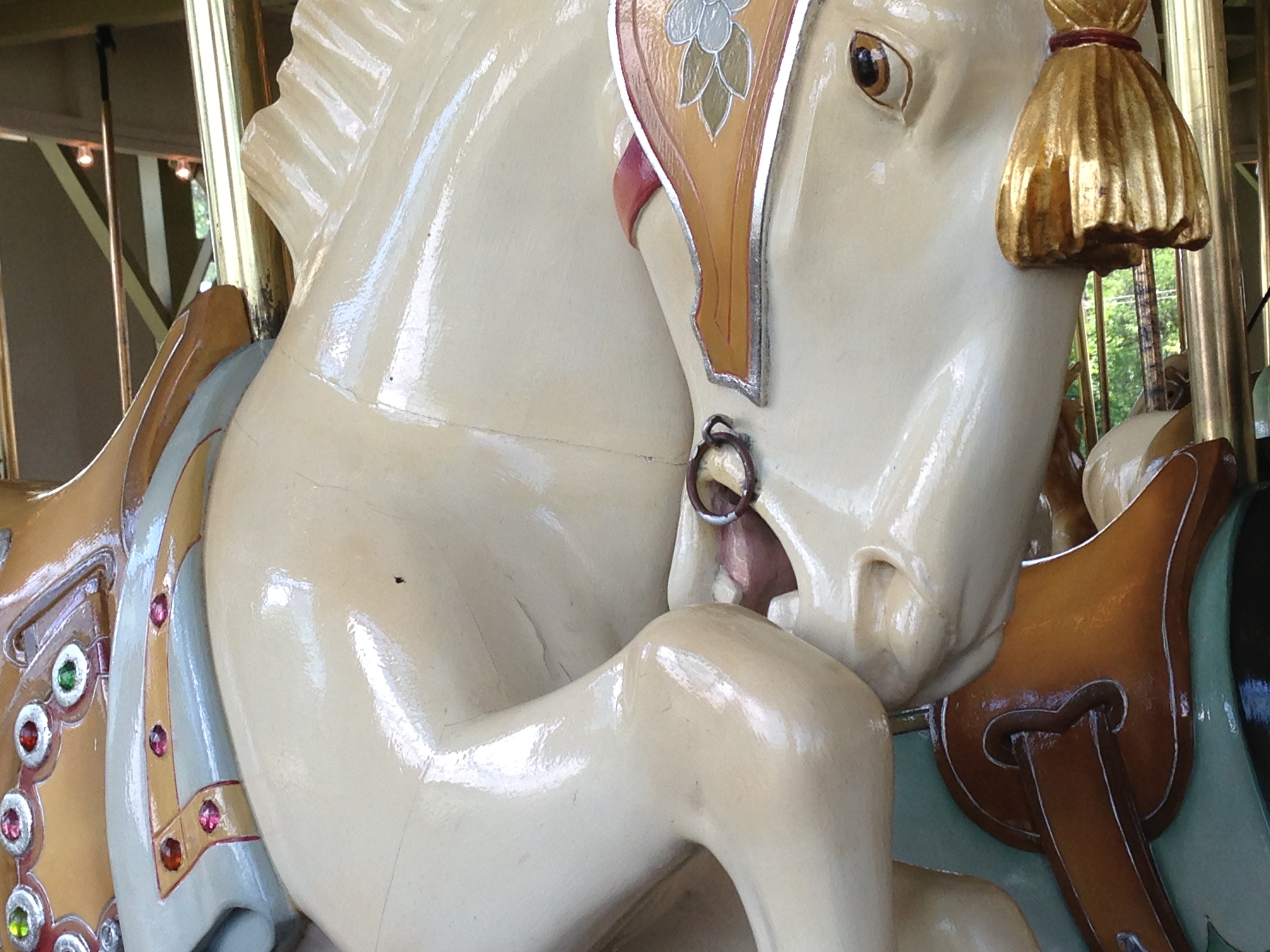
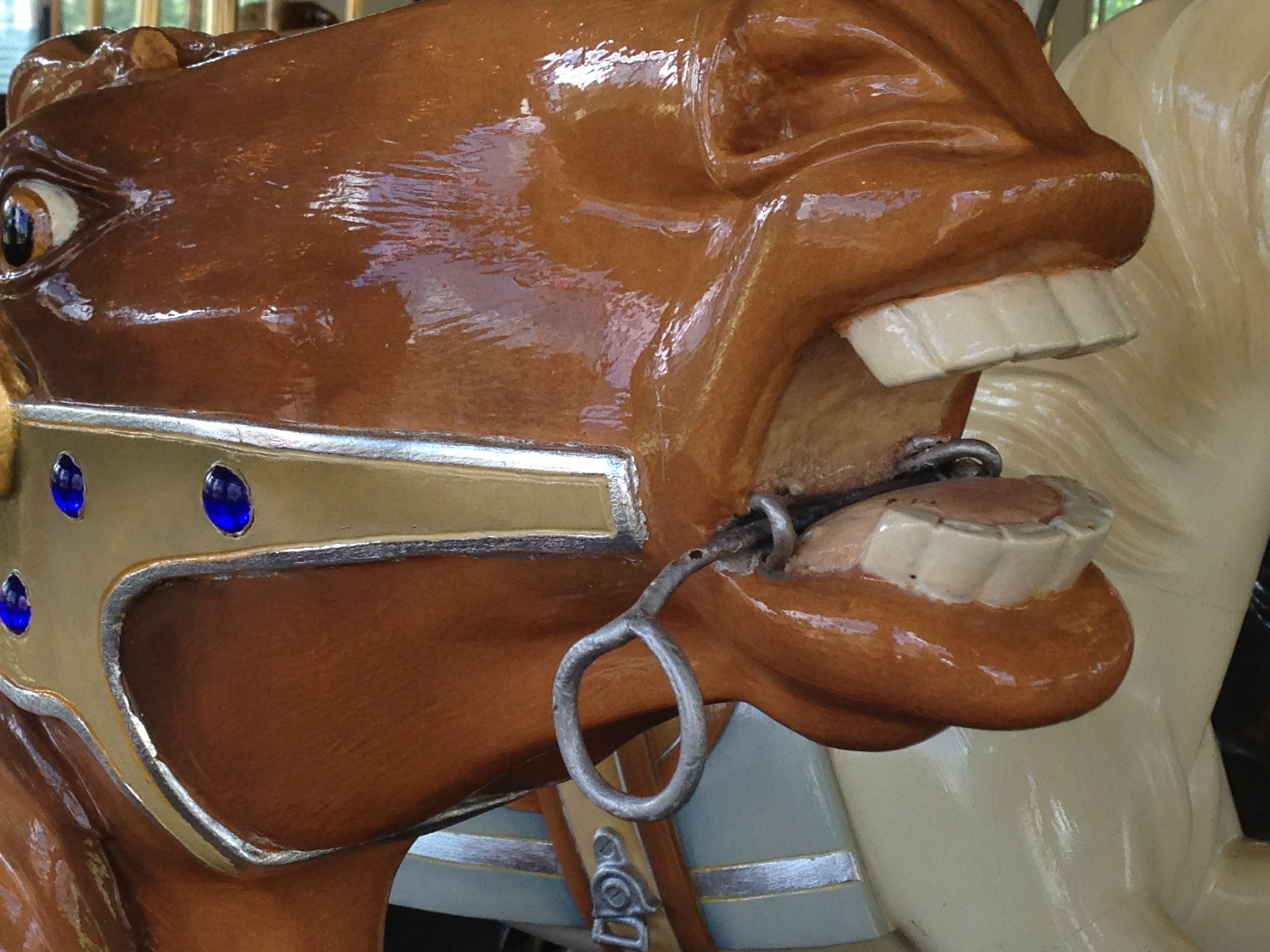
card dealerAll thoughts of the crumbling present go away when we visit four of the six  heirloom merry-go-rounds that still grace the Binghamton area (out of 150 in North America). The first one was installed in 1920, and sits next to a  little zoo — you see and smell a big black pig in its pen as you go ’round. The Ross Park carousel is completely unadvertised, a secret gem known to only a few, reached via a flower-bordered path. The horses, “jumpers,” as they’re called, are a little tattered.

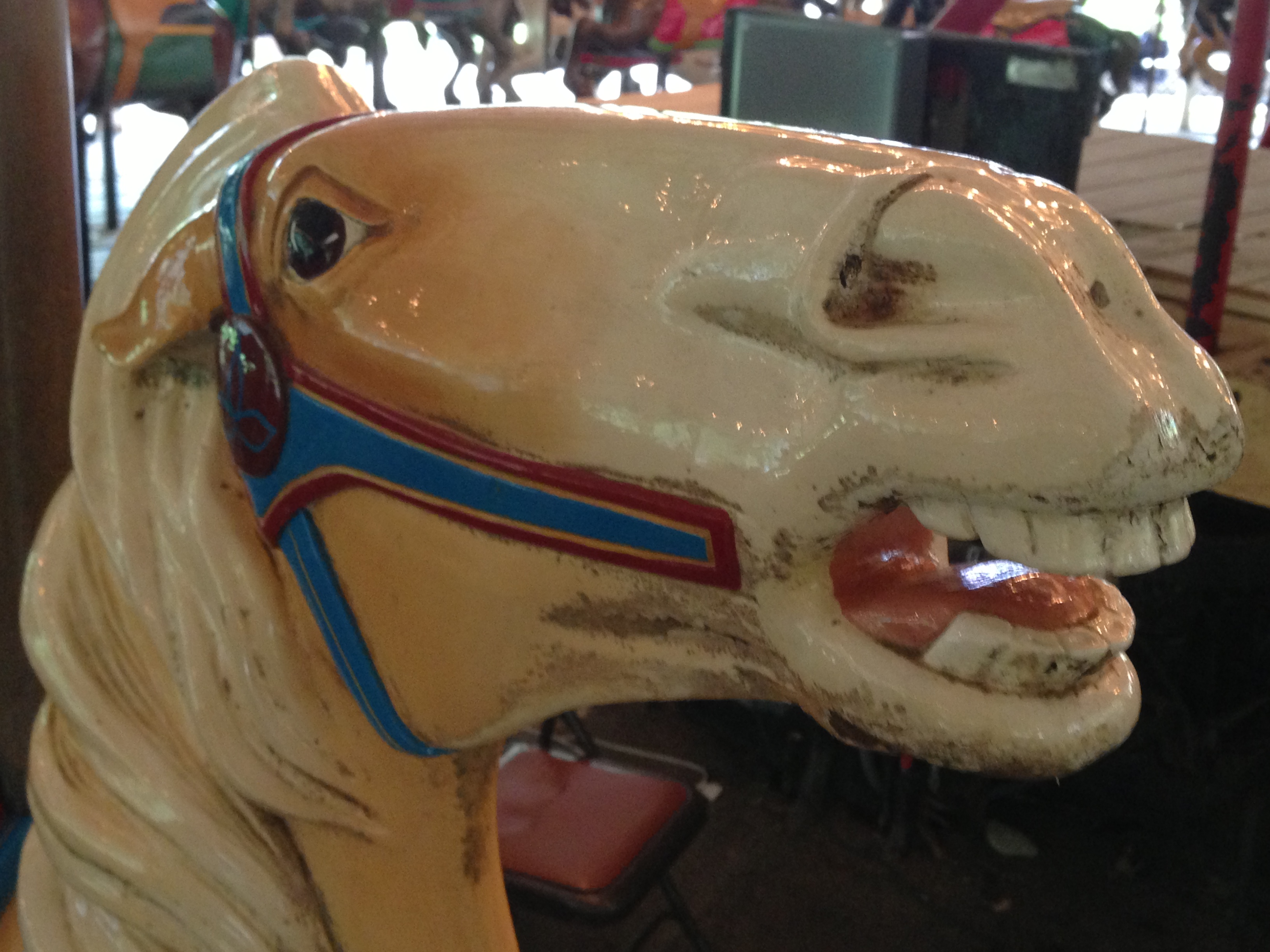
zoo horse 2Gently worn. Still, the original 51-key Wurlitzer Military Band Organ sends you around, and the chariots are flanked by a bathing beauty and an ape, which we sit next to for the whole ride, not noticing its dramatic visage until we rise, slightly rocky, to our feet.

zoo apeA young Tobey-Maguire-in-a-shaved-head-role lookalike blows a whistle, the carousel comes to a halt and we jump off.

The richest men of the city, the Johnson men, funded these spectacular rides of hand-carved wood, made by the Allan Herschell Companies of North Tonawanda, New York. You can visit them all in a day if you get there at the right times, as we do, fueled by a long set of Captain Beefheart on the university radio station. Another of the carousels, in Endicott’s Little Italy, projects a more demure ambiance. It’s housed conveniently next to both a swimming pool (“No Wet Clothing Allowed”) and a window for home-made frozen custard, where a girl is in the middle of changing out the Holy Cannoli for the Watermelon on the flavor board when we arrive.

george horseCare has been taken to preserve and restore the beasts over the years. They are pretty, high-stepping it around the ring. Once upon a time you had to pay admission — a piece of litter! — to get a ride. Now it’s free to all and you can leave your trash in the can where it belongs.

Suddenly, the pavilion gets very quiet. All the kids vamoosed. Is there anything spookier than a silent carousel, especially one that will be 80 years old next year? Then again, calliope music can seem manic, even deranged, and the whole atmosphere fraught — see Strangers on a Train, when the whole ride flies off its axis.

And the horses go around and around, around and around. In Savage Girl I tell the tale of New York’s Central Park carousel, which once upon a time was drawn in its circle by mules trudging in a basement beneath the platform. True story.

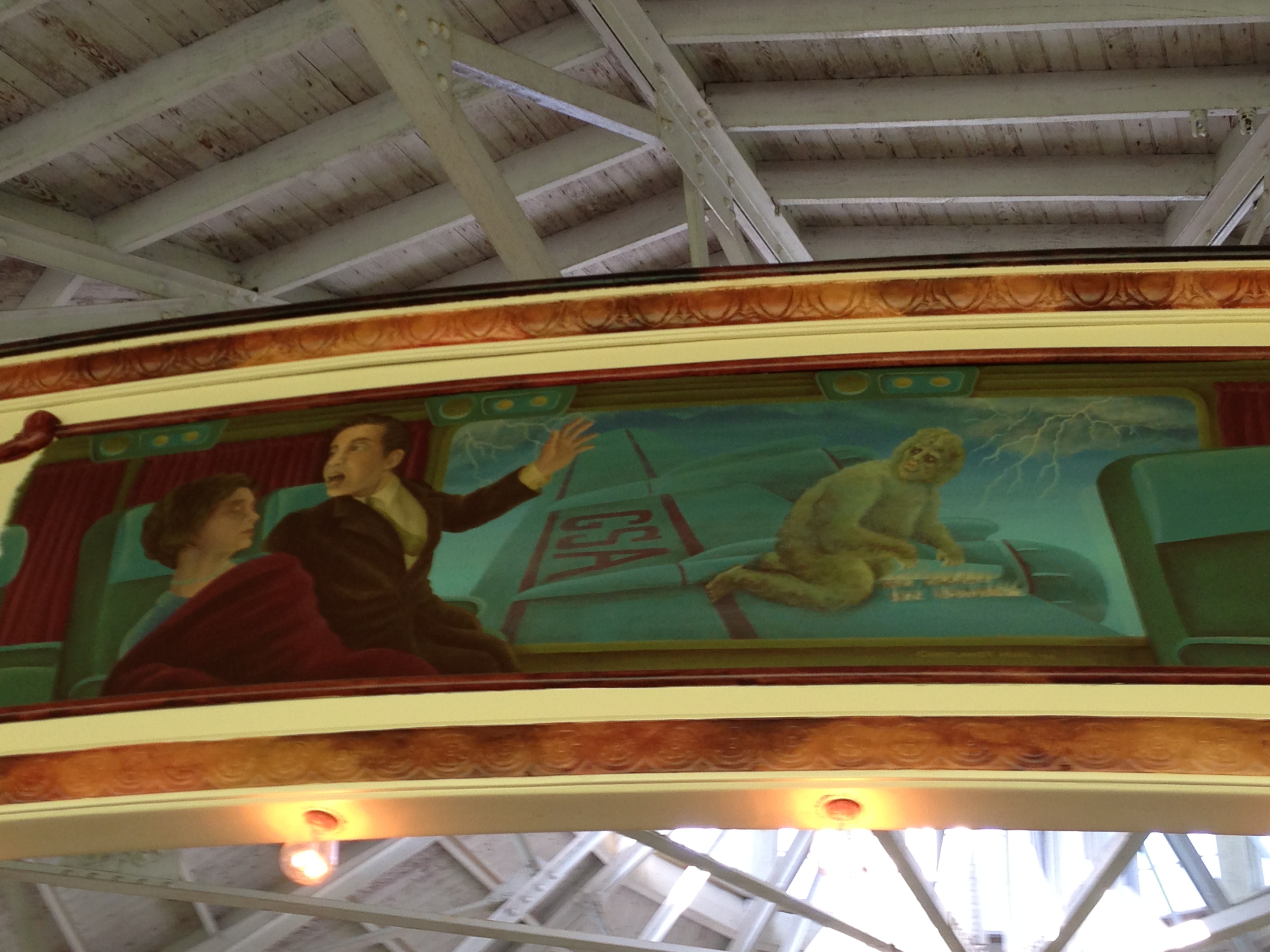
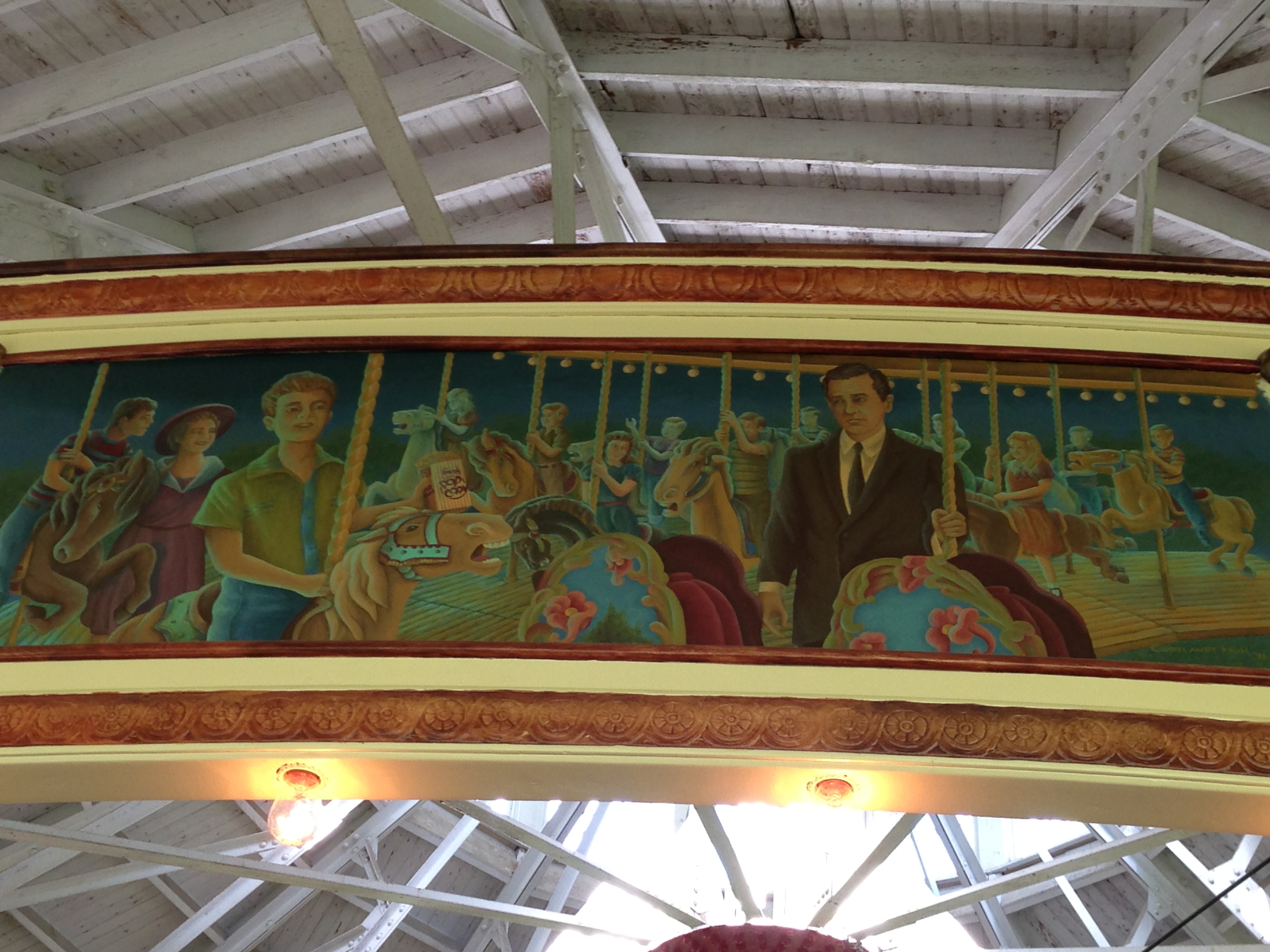
Another carousel, this one at “the Rec”, one of the area’s most used parks,  unexpectedly has a series of rounding boards which feature scenes from Rod Serling’s Twilight Zone. They were painted by artist Cortlandt Hull during a refurbishing in 2011.

twi 3The carousel came to Recreation Park in 1925, well before the TV series, but Serling grew up in Binghamton riding the carousel, so it all makes sense. There’s even a picture of the carousel itself– a scene from the show or a fictive portrait of Serling in his old stomping grounds?

twi 2Endicott-Johnson, the company that earned fortunes for the family that built these beauties, was so big, it made every pair of boots that outfitted American soldiers in world war one. George F. Johnson, the company’s big daddy, in 1916 mandated a 40-hour-work week. Generous, for the time. So was giving his 24,000 workers carousels.

Jack Dougherty, ready with his whistle on a lanyard, told me that they have to be careful at the Rec, closing it up when some rowdy middle schoolers come raging around every afternoon.

Jack

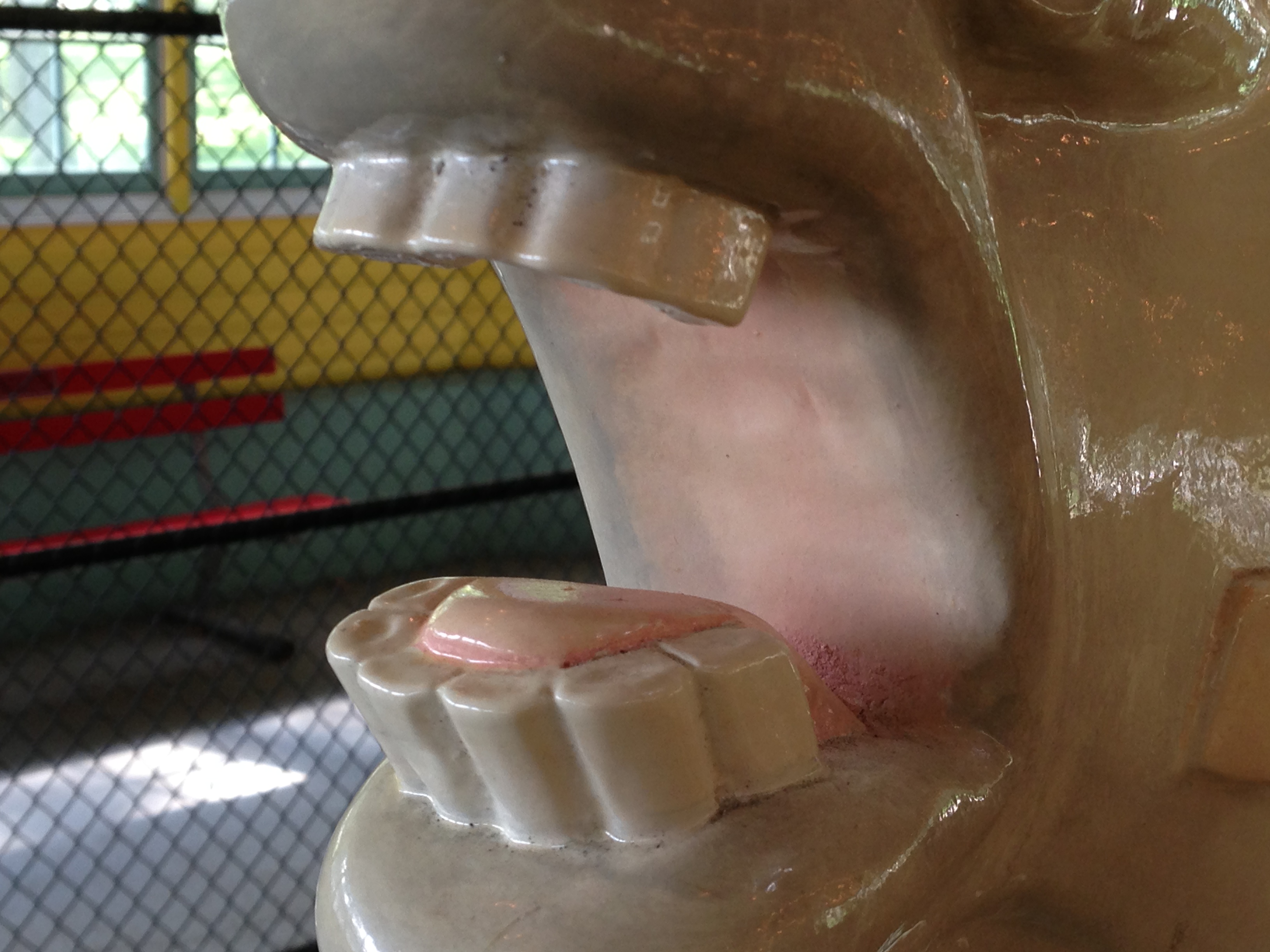
Can’t risk damage to the jumpers. The detail is really exquisite.

twilight chompers


They seem much more sturdy than they are. They’re real/not real.

I wonder if the children of the Triple Cities are somehow happier because of all the carousels in their midst? On the day his namesake merry-go-round opened in 1934, more than 500 neighborhood children paraded to George W. Johnson’s house with a bouquet of flowers to show their gratitude.

george brown horse


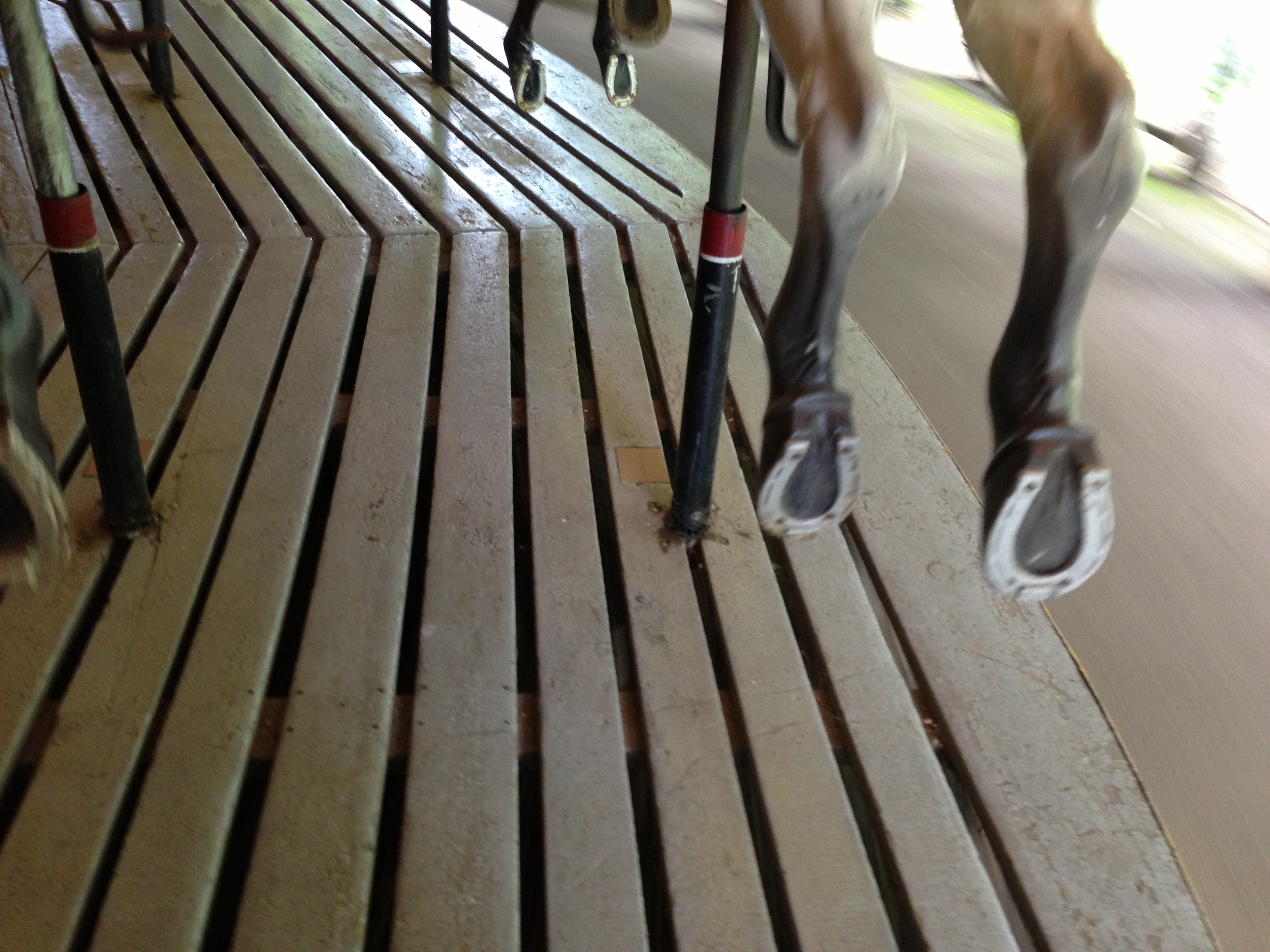
Made by human hands, each of them, so brawny and so delicate.

zoo hoofs


5 Comments

Filed under Art, Culture, Fiction, History, Jean Zimmerman, Savage Girl

A Bookish Brunch

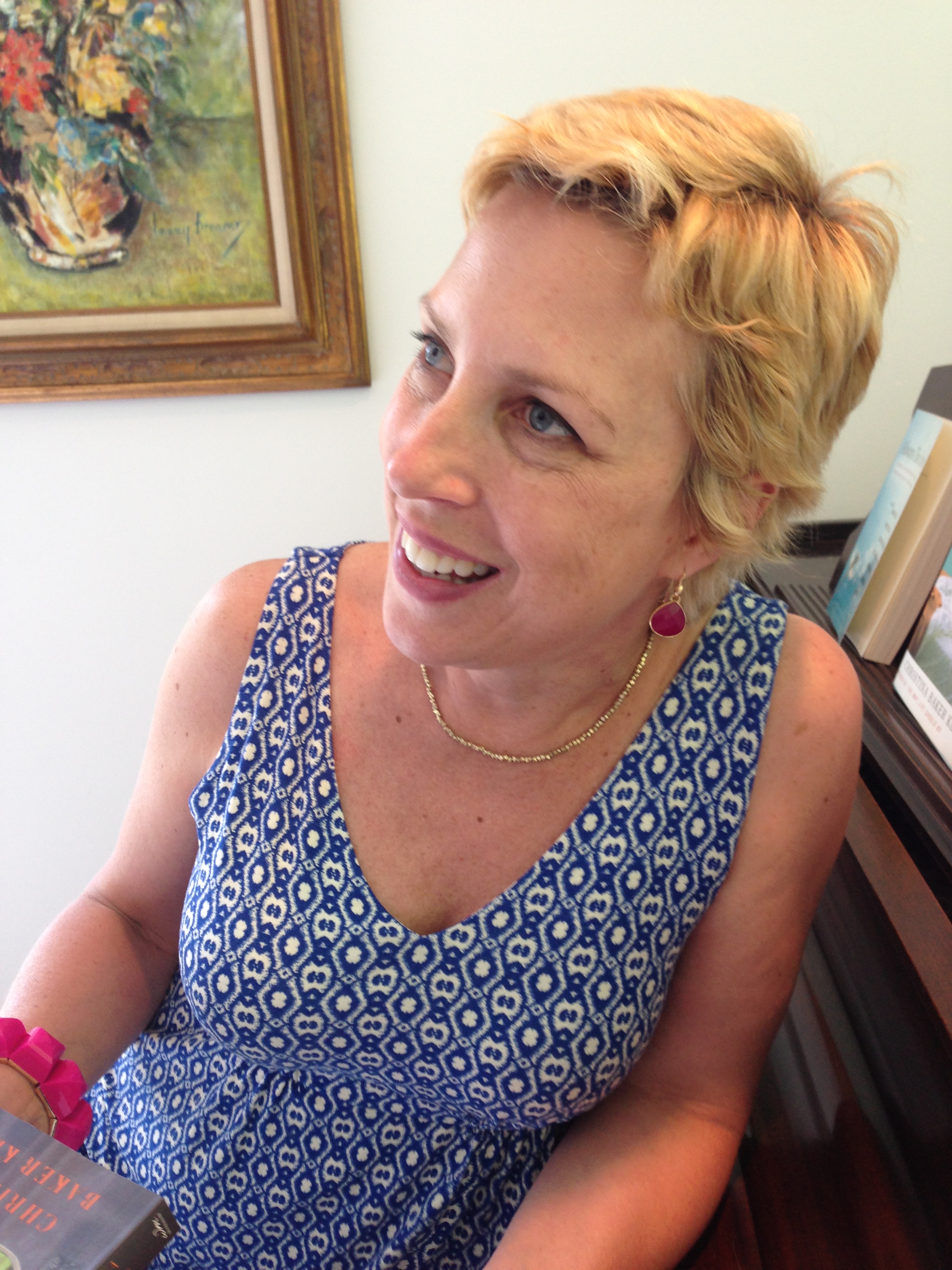
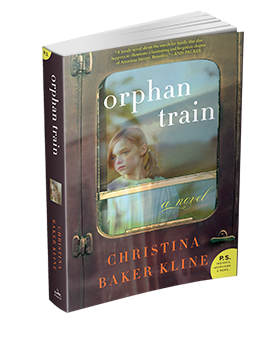
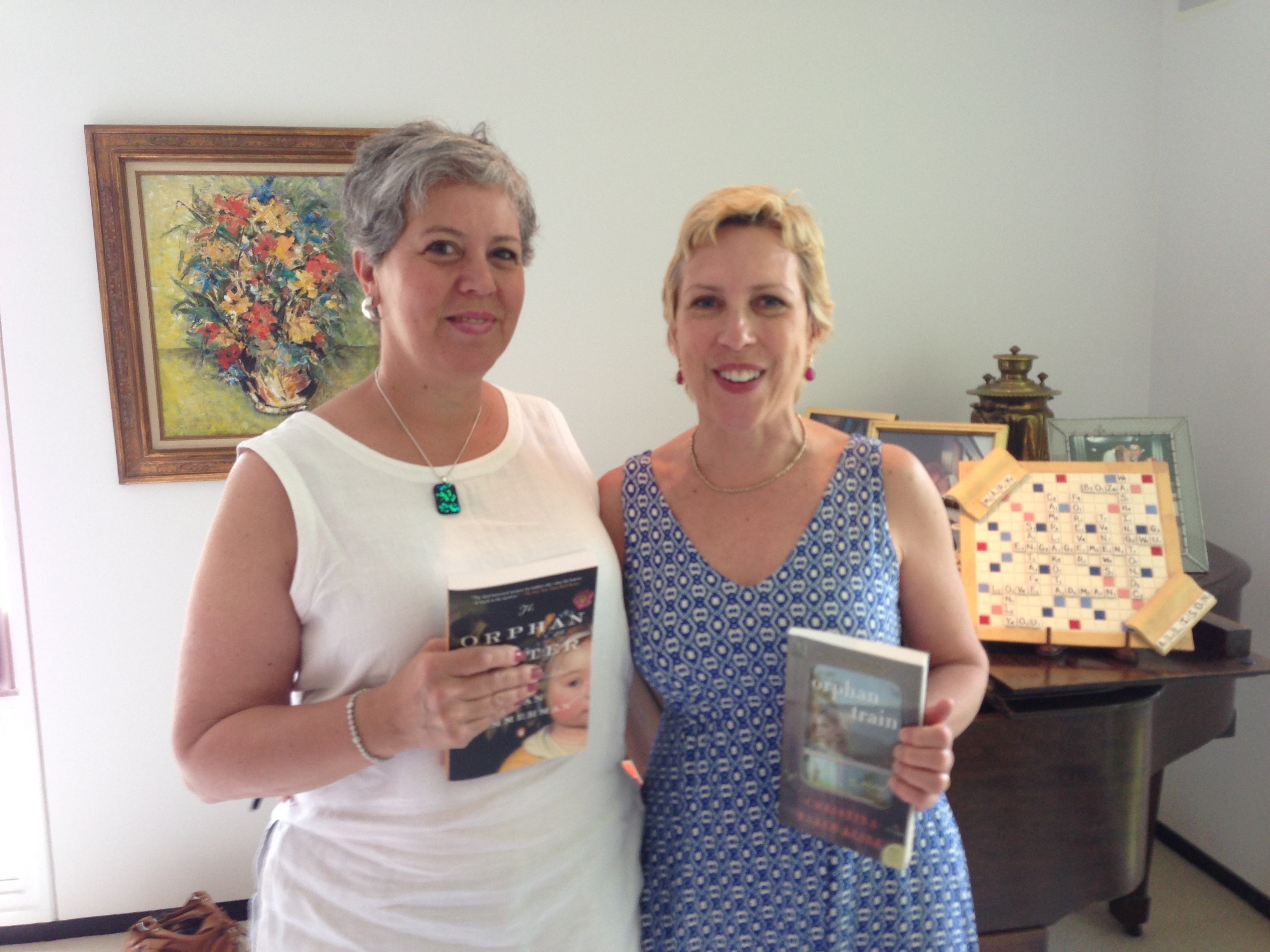
Christina Baker Kline’s book Orphan Train was released on April 2nd by William Morrow, and I was lucky enough to attend a brunch in her honor today. As the intuitive and scrappy Allison Gilbert, our nonfiction-writing hostess, put it, “Writing a book is like pushing a mountain through your head.” An event like this, she said, can show people that a book exists from the ground up. “That’s what we writers do for each other.” Indeed. The house in Irvington, New York was filled with bookish well wishers.

Christina

Orphan Train has hit the best seller lists of both USA Today and The New York Times, Goodreads saluted it as a 2013 beach read, and it has been brought out in a special edition by Target, for which Christina had to sign thousands of copies.

orphan trainShe had come in from a meeting with the powerhouse biographer Robert K. Massie and would go off to be the keynote speaker at an event held by Books New Jersey, but spared a chunk of time in the noon hour to describe her book and the process by which it went from Henry James’ “germ of a story” to a full-blown narrative.

Christina stumbled on to the phenomenon of orphan trains 10 years ago.

orphan-train

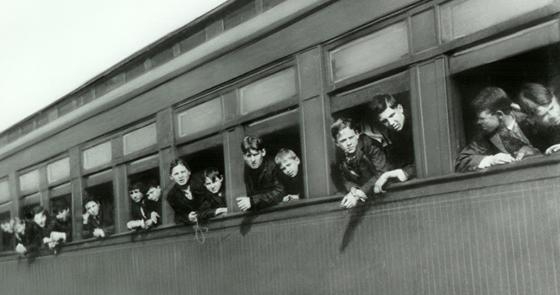
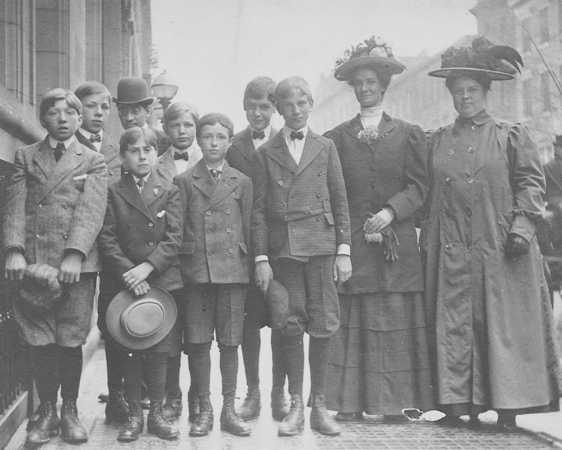
It seems her husband’s North Dakota grandfather was one of “riders.” Most  kids were plucked off the streets of New York between 1854 and 1929 and shipped to the Midwest as free labor for farm families. Ultimately there would be 250,000.

orpans with women


Some of them, actually about 60 percent, were not legitimately parentless, but their single parents, usually their mothers, simply couldn’t afford to feed and house them. Civil War widows, in particular, couldn’t hack the expenses of parenthood, and there were no social programs to help them. Today the original orphans have two million descendants in this country.

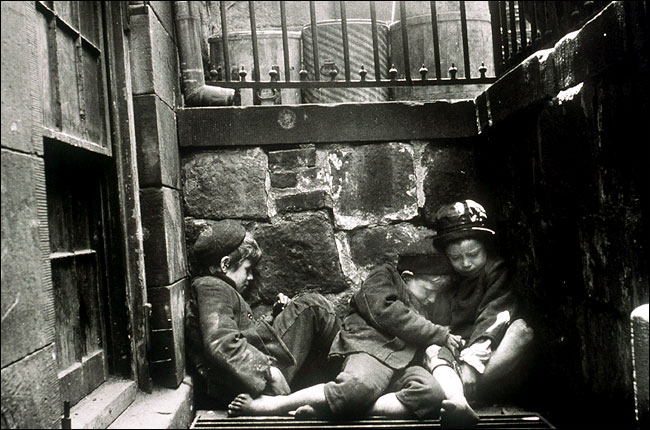
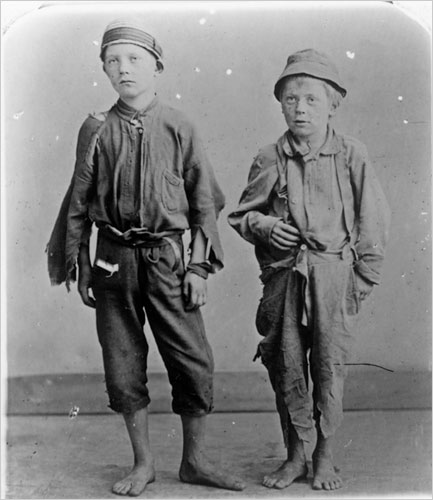
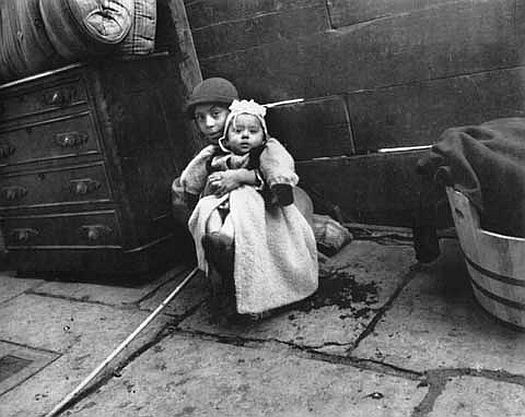
Jacob Riis made devastating pictures late in the 19th century of some of these lost New York street children.

jacob riis boys

The older they were, the more desirable they were for the farmers who took them in. Better workers.

riis grown boys


Babies were popular too.

riis boy and baby


Girls, not so much. A threat to the women in the household. This little girl Riis captured is beyond sad.

riis girl

Now Christina has taken this powerful material and made a story out of it, centered in the relationship between a troubled 17-year-old girl and an aging Irish immigrant who keeps her orphan train memories in an attic trunk.

Christina and I talked over aspects of bringing out a book, including the fact that we both take a powerpoint with us when we hit the road to talk about our work, something not every fiction writer does but that seems appealing to fans of historical fiction. I liked something she said about the writing process, about creating the structure for a story: “We need to build too much, explain too much, before we take that scaffolding away in the revision process.”

I can’t wait to read Orphan Train, to see what commonalities exist between her children of the late-19th century to the early 20th century and the parentless waifs of The Orphanmaster‘s 17th-century New Amsterdam. Novelist Helen Schulman  said Orphan Train “makes for compulsive reading,” and The Orphanmaster has been called “compulsively readable,” so we have a bond. It’s too bad Adam Johnson couldn’t be sharing bagels and lox with us at Allison’s house today.

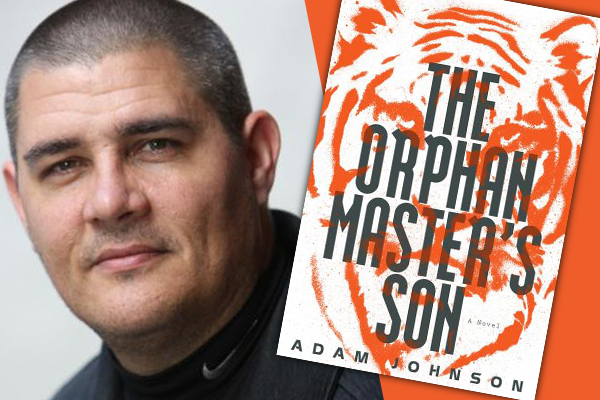
orphanmastersson

His book, The Orphanmaster’s Son, won the 2013 Pulitzer Prize for fiction. I have found myself in the interesting position since the award was announced of having people congratulate me for my “recent honor.” Well… no. But you’ve got to think that this hat trick of orphan novels suggests something in the cultural water. Andre Gide said, Not everyone can be an orphan. I salute Adam, whose book is supposed to be as terrifying as it is wonderful. But for now, it’s just Christina and me in the picture.

j and c


7 Comments

Filed under Cooking, Fiction, History, Jean Zimmerman, Photography, Publishing, Writers, Writing

Rock Paper Scissors Book

Kids write books. They just don’t appear on Kindle.

And they couldn’t. They’re hand-wrought. Messy. One of a kind.

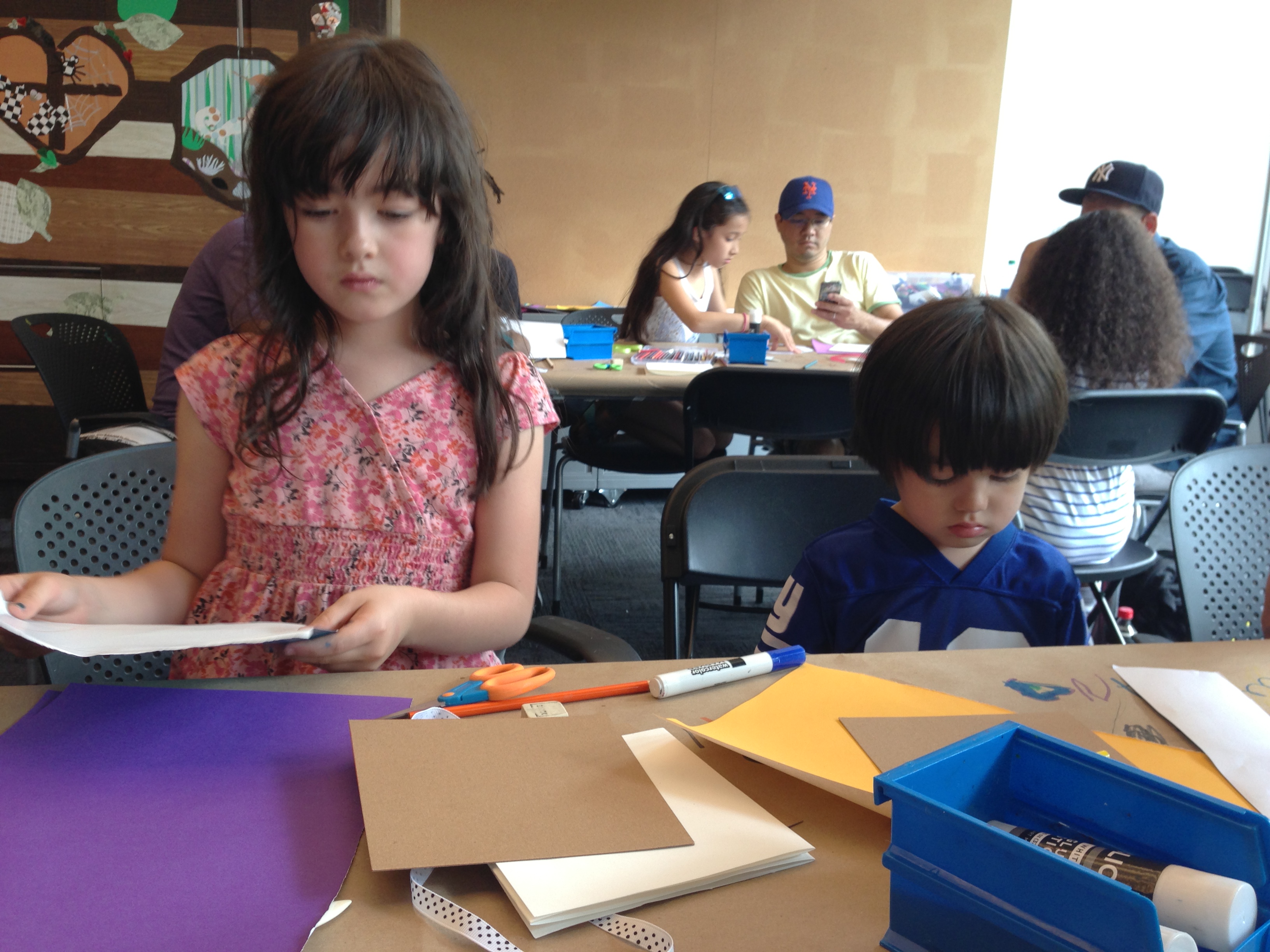
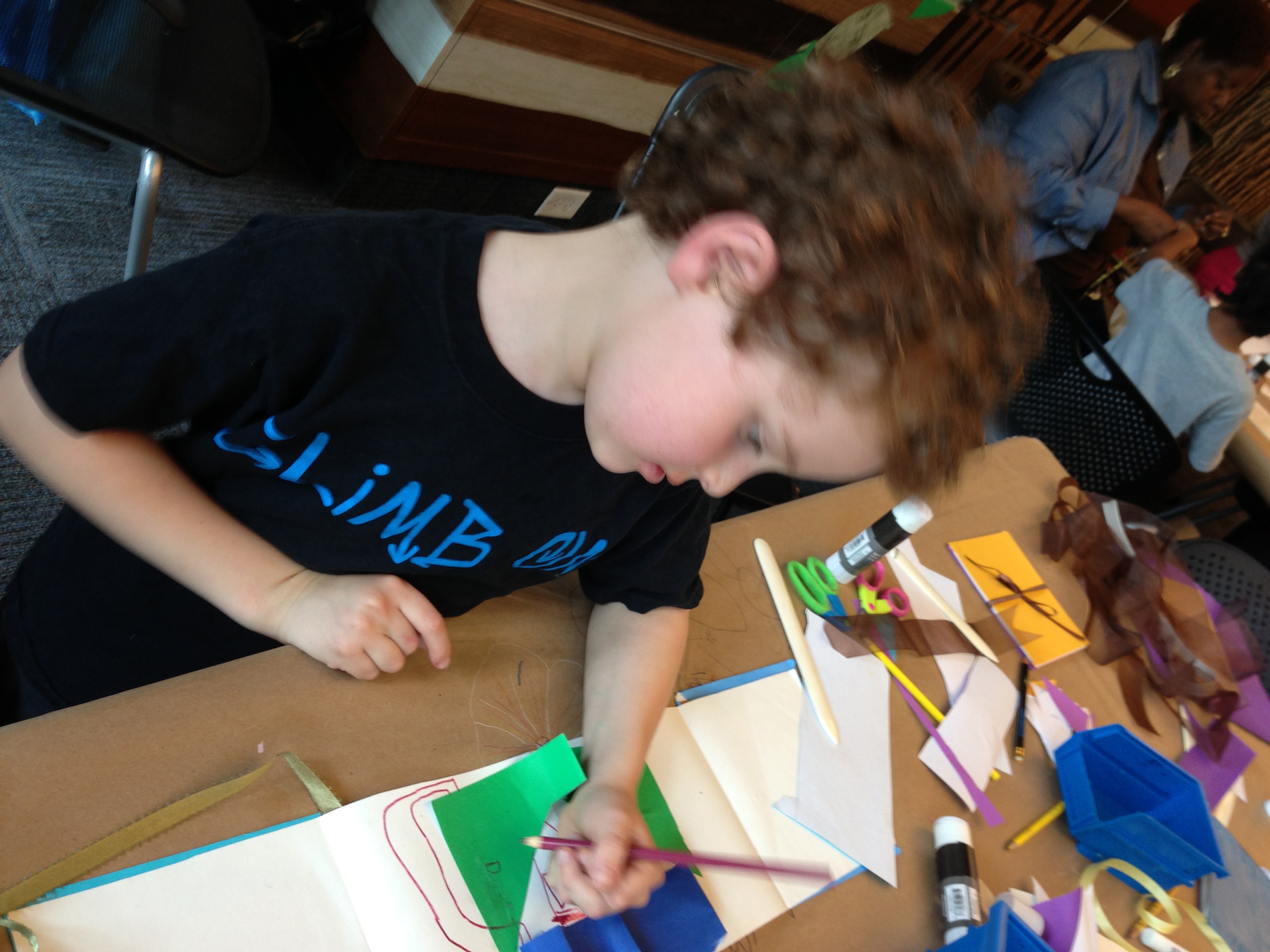
We took our nephew Jasper to a book-making class for children today at the Cooper-Hewitt Museum’s Design Center in Harlem. Jasper is a lefty — is that why he has a creative streak, or is it because he’s my nephew? Just asking.

lefty


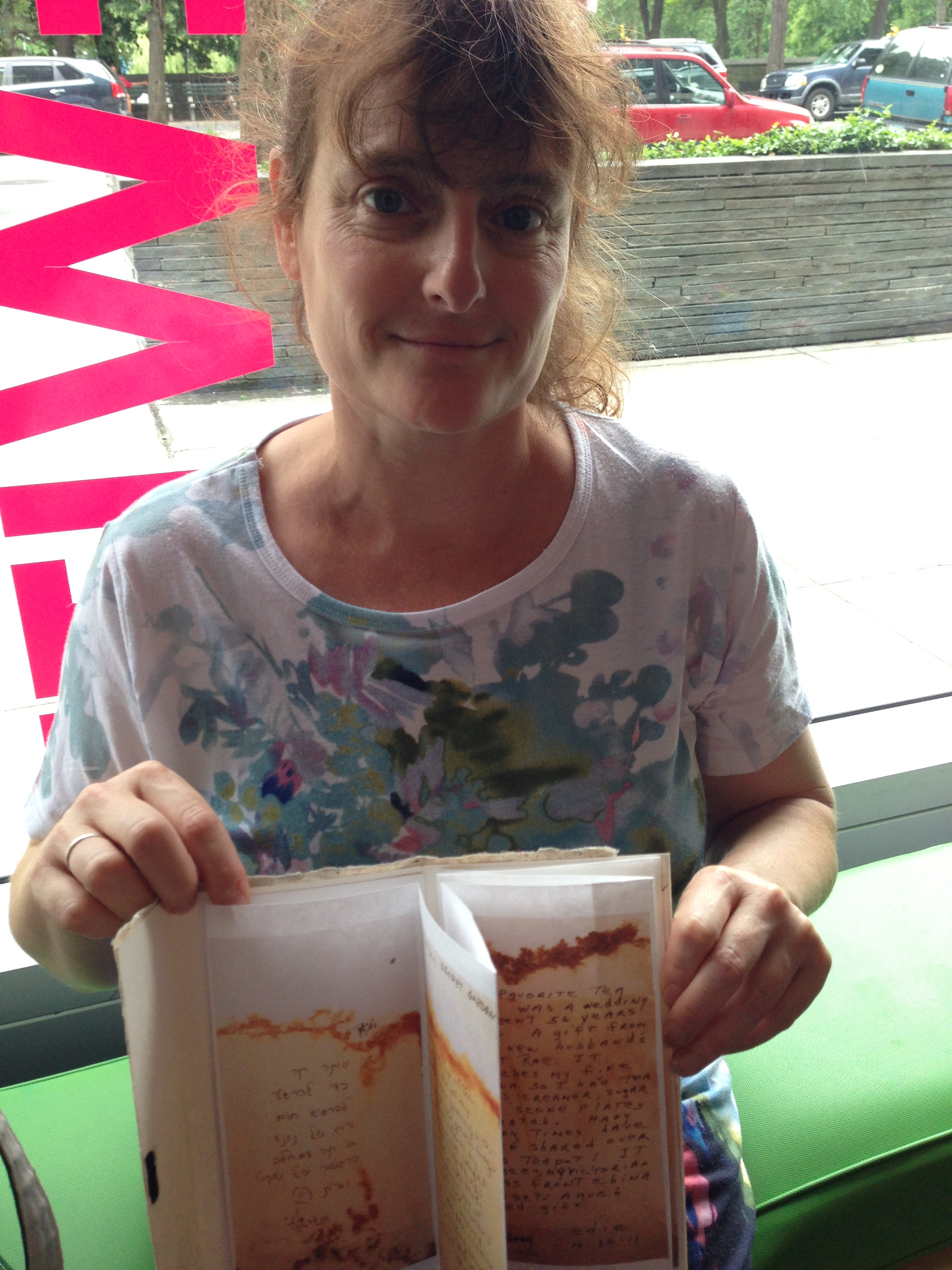
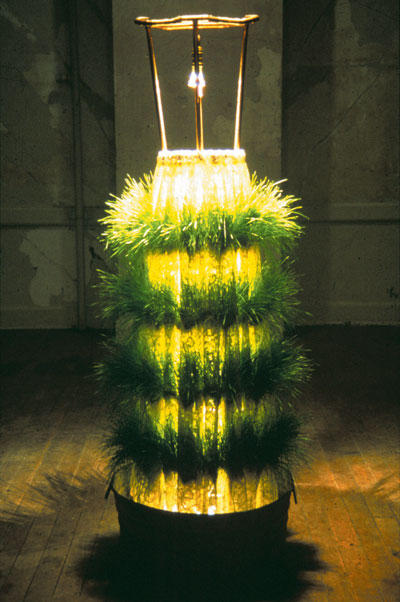
The ever-patient instructor was an artist named Michele Brody, who is well known for producing site-specific installations, including many  involving plants and water.

brody

She likes to show the entire life cycle, she told me, including the decay and death of the plants.

Michele Brody


But she’s also  produced art volumes about tea and stained by tea, so she knows about putting together books from scratch. Today she introduced me to a novel concept, that of the bone folder.

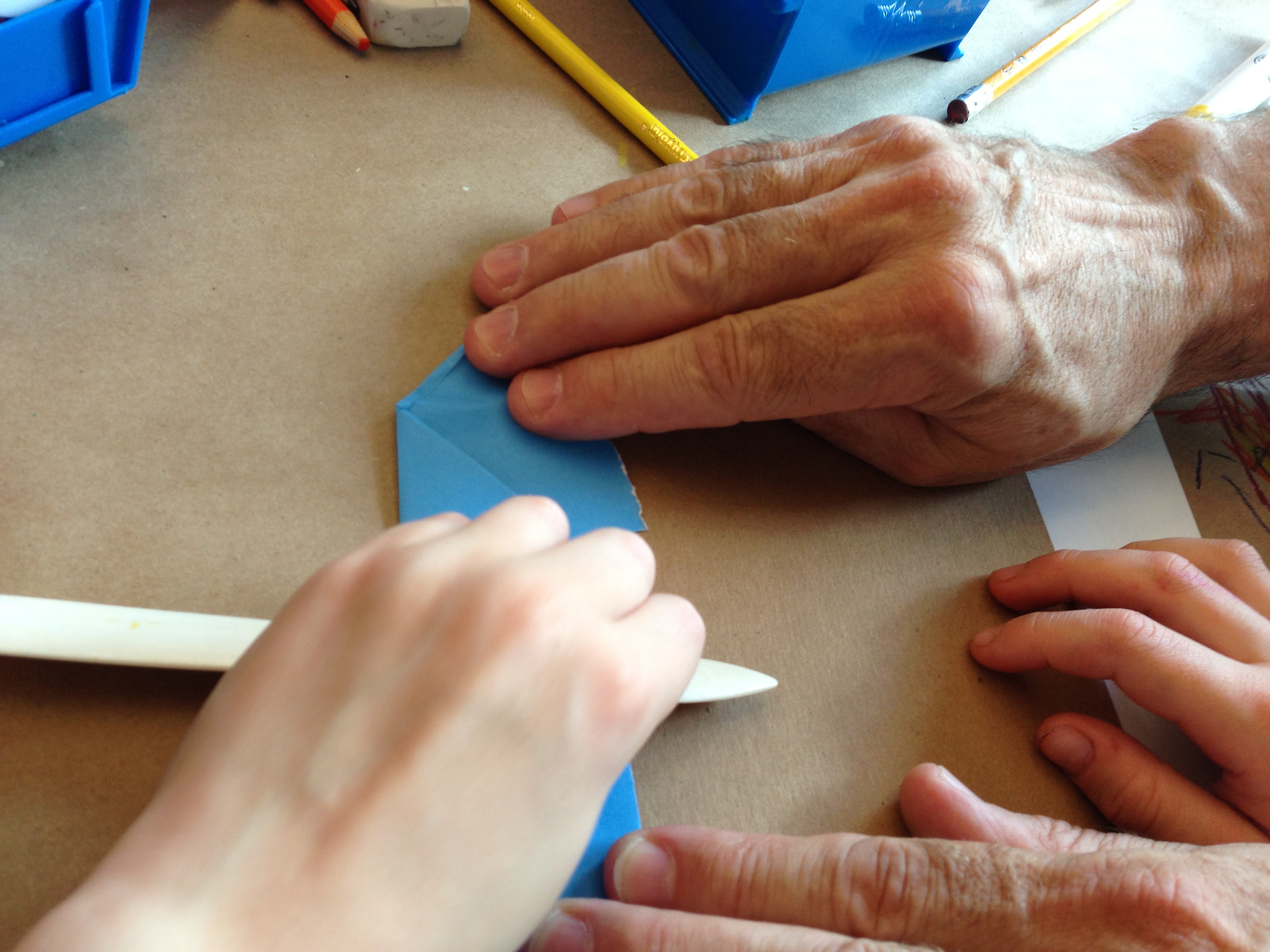
bone folder

The bone folder is a smooth ivory tool that allows you get a nice sharp crease in the paper you’re using to bind your book, and to smooth out any bubbles that might appear in the glueing process. How satisfying, sliding the tool along those bubbles.

The children in the class dove in with cardboard, markers and ribbons every which way. Siblings Aidan and Molly — “silly and active,” according to Jasper —  did better than I did. I watched their creations materialize across the table.

Molly:Aidan


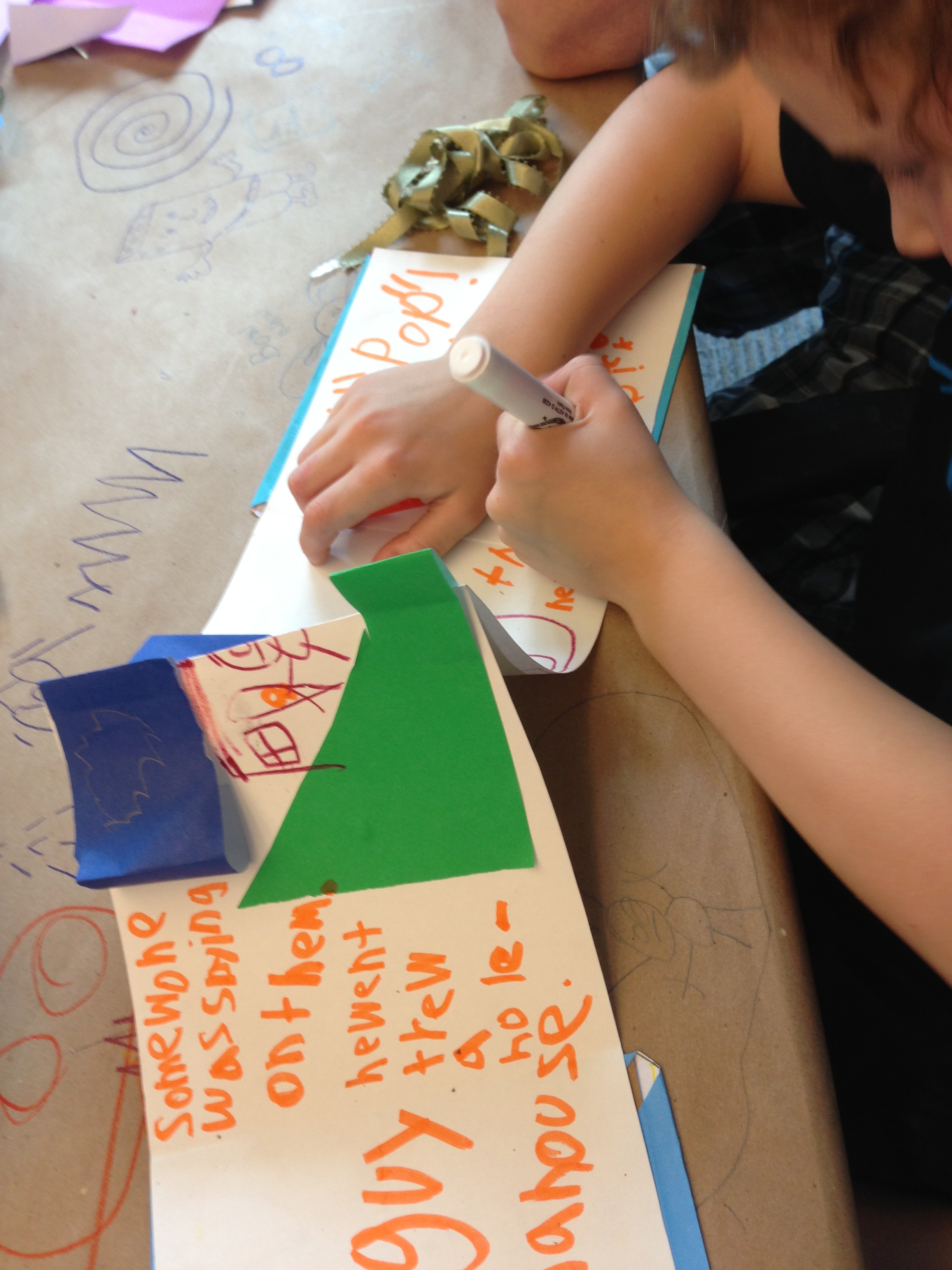
Jasper’s book was crammed with action and surprises. If he could only write a single book in his life, this one would be enough, but of course he’s already written hundreds.

Pop!


What did he like best about writing a book, I inquired.

The kid’s answer was immediate. The pop-ups, he said. He has always liked building pop-ups into his works. Architectural, three-dimensional, crazy blasts from another dimension.

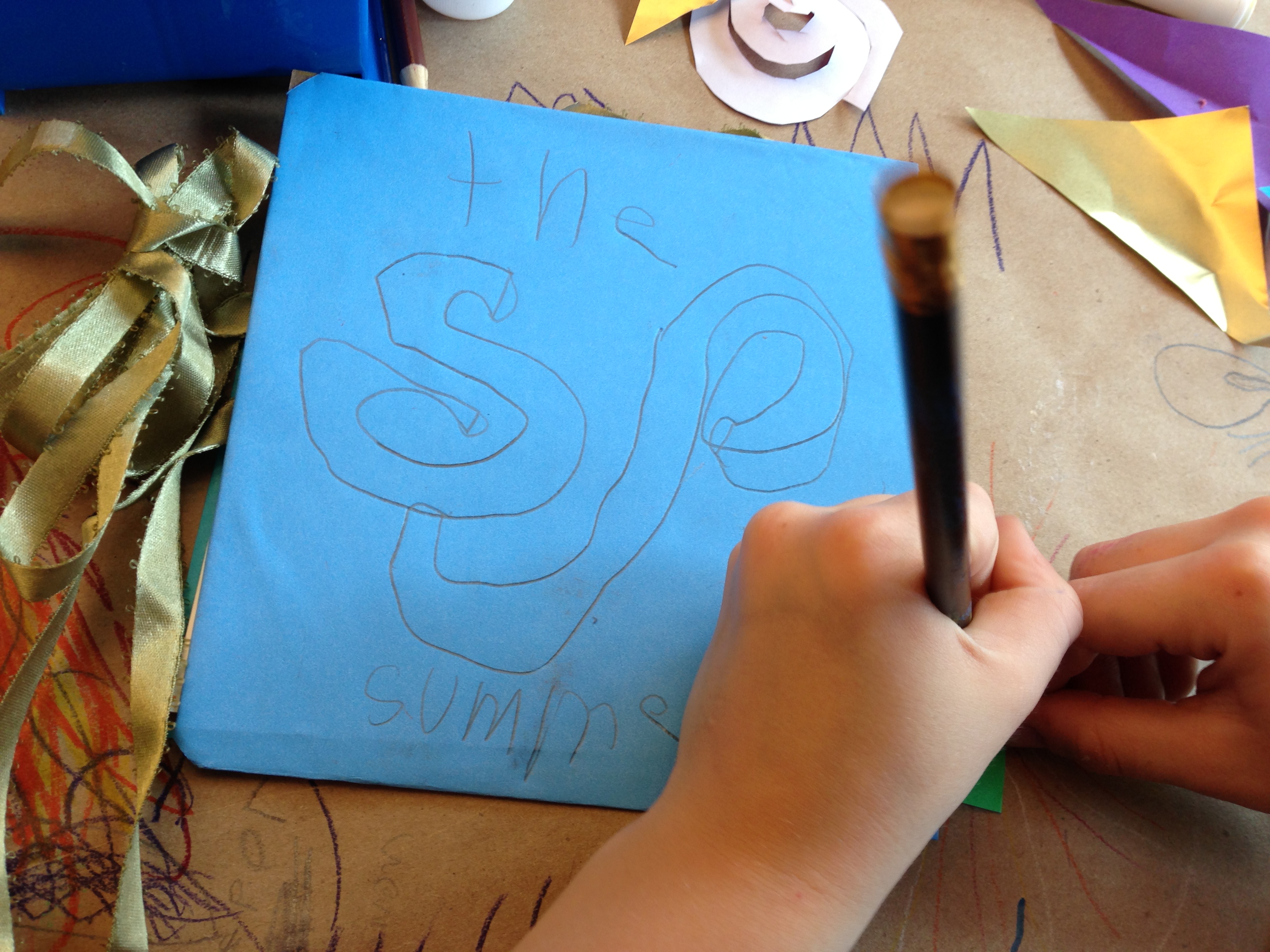
Kindle just can’t accommodate construction-paper pop-ups. And that is why you will never be able to order Jasper Zimmerman’s The Spy in Summer from Amazon. It’s the story of a spy who steals the bad guy’s jewelry, then eats him — well, that last part is not actually in this volume, says the author, but it will be in the sequel.

the spy in summer


That one will have pop-ups, too.


2 Comments

Filed under Art, Culture, Fiction, Jean Zimmerman, Publishing, Writers, Writing

Le Maitre des Orphelins in Bookstores

I opened a plain brown packing box and saw something beautiful.

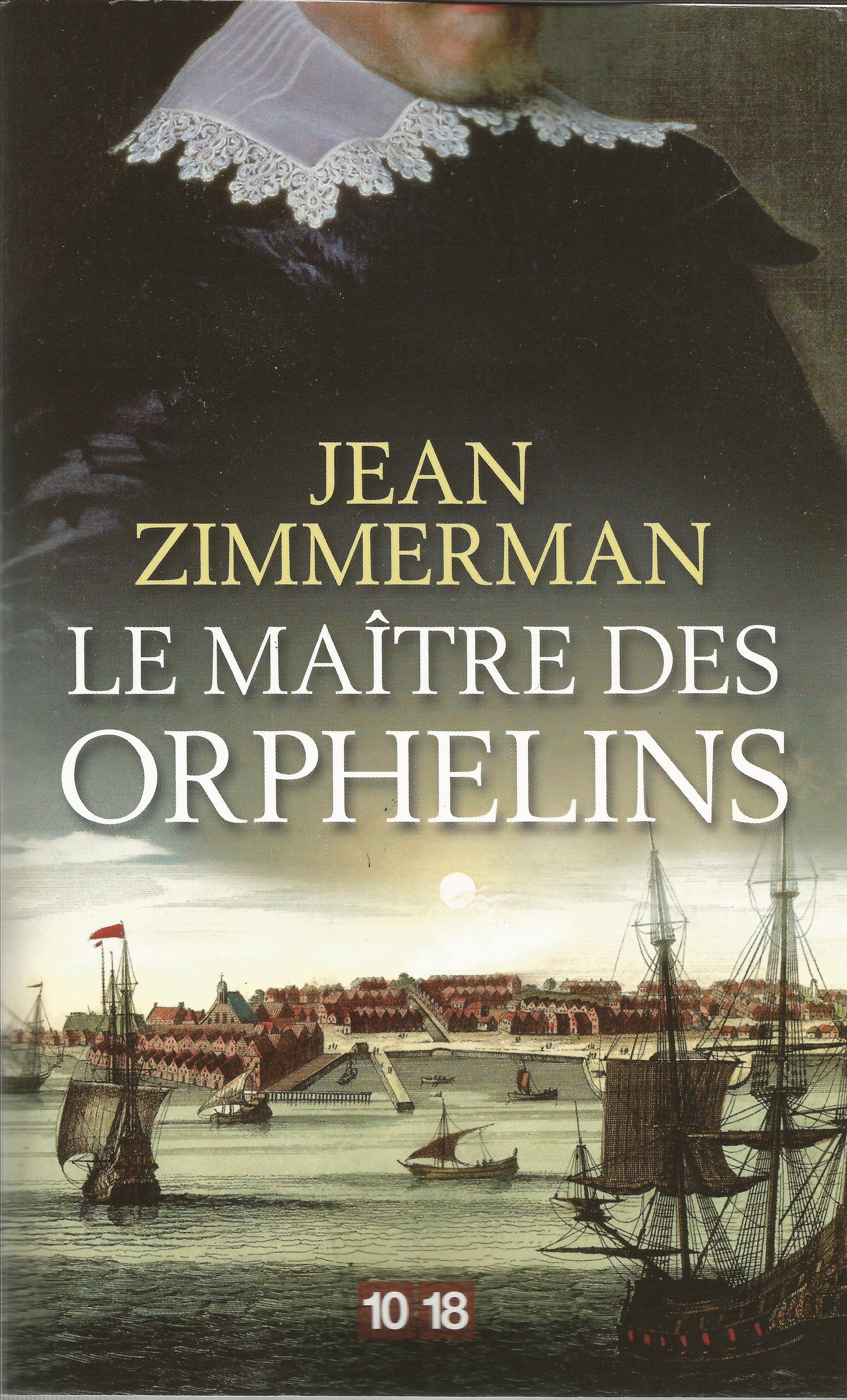
It is so exciting to see The Orphanmaster translated into French, published by the publishing house 10/14.

French O-Master Cover

It’s a great company that has introduced such English-speaking authors as Khaled Hosseini, Haruki Murakami, Bret Easton Ellis, Jim Harrison and Colum McCann, not forgetting Nobel laureates such as Toni Morrison. The house has always had a particular reputation for its detective literature.

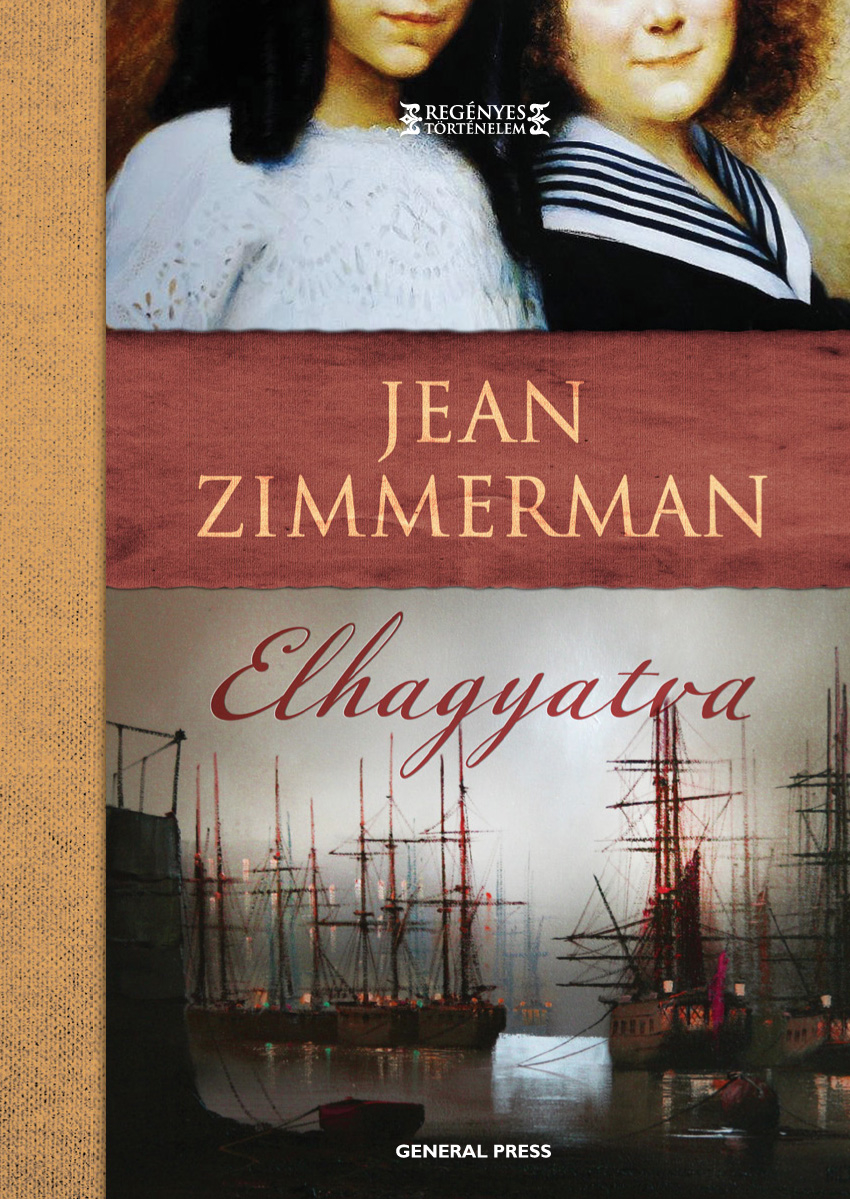
And yes, this is the second time I’ve announced a French edition – it came out already as a book club offering from France Loisirs. There’s also De Weeskinderen, from Holland. And I’m eagerly awaiting the Hungarian version.

Hungarian Cover- Elhagyatva copy

And the Italian and the Taiwanese.

Holding it in your hand, the 10/18 edition is the chunkiest version so far – fully 500 pages!

Very fulfilling to think of Blandine and Drummond making their way around the world.

7 Comments

Filed under Fiction, Jean Zimmerman, Publishing, The Orphanmaster

Simple Stock With a Side of Butter

We in the northeastern U.S. have been deluged with a cool spring rain for several days now. Not good weather for adventuring, though I managed to get out and about yesterday and sample some history and some garlicky pork chops.

weeds

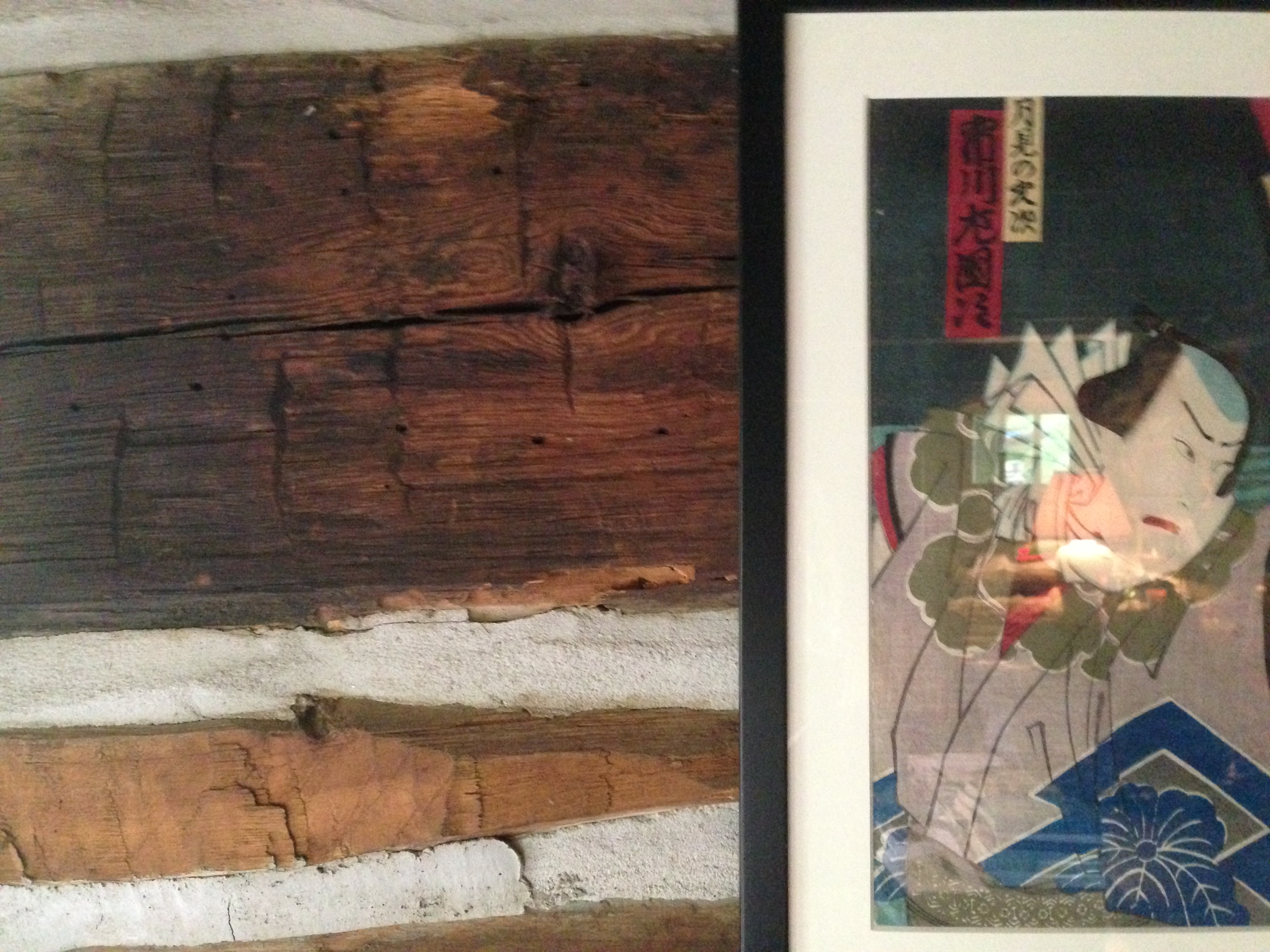
The weeds are thriving. Our sump pump is heaving, with the Cabin set as it is down into an overflowing marsh. And the room around me is dim and shadowy, a womb of dark lumber. The pictures stare out of the murk.

picture

Chestnut, a building expert recently assured me. The Cabin is built of chestnut logs. How do you know? I asked. I just know, he said. You can see it in the fireplace mantle.

mantle

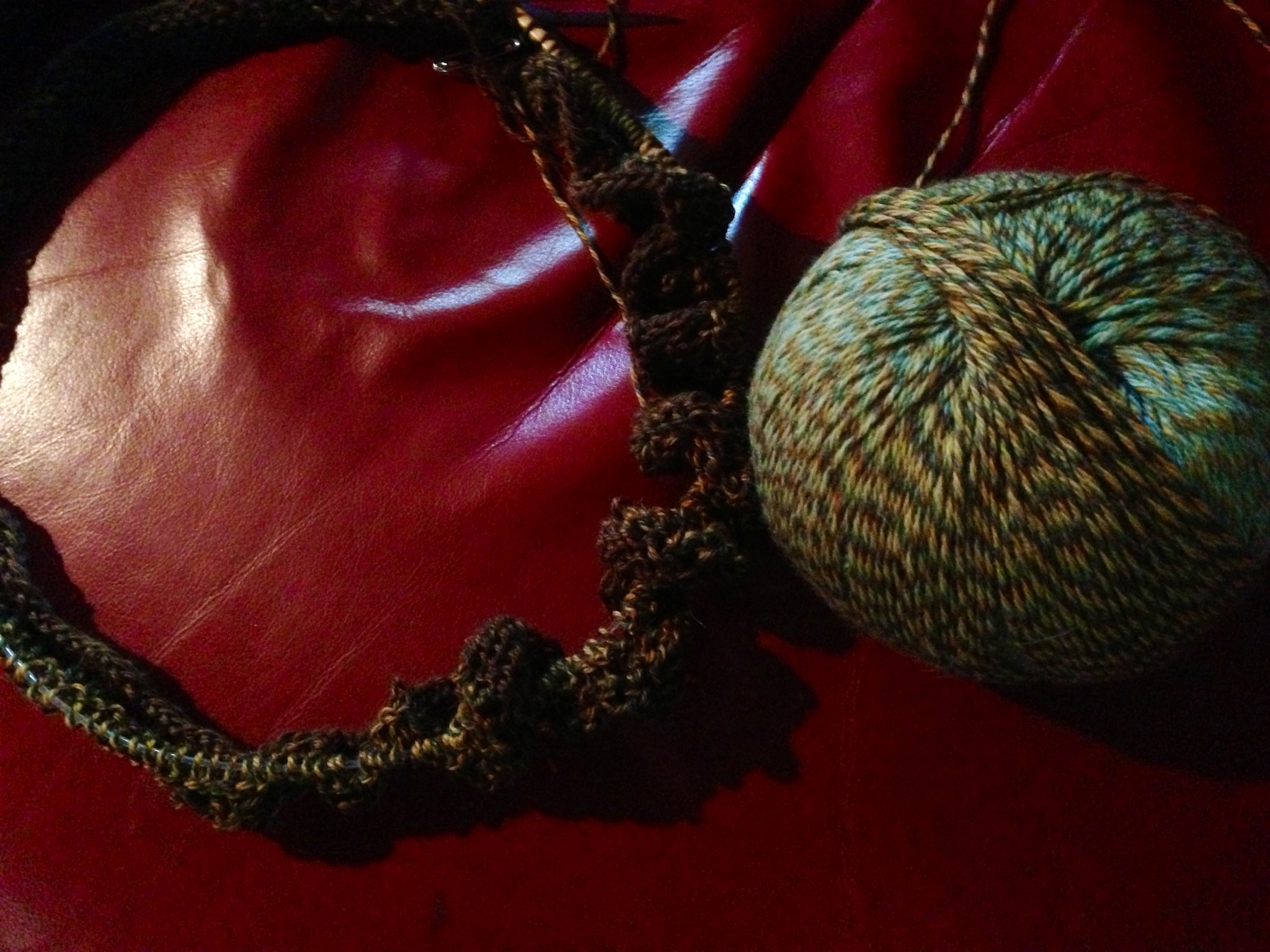
Today is fit for a few errands – dry cleaning, library, Good Will. Then as many rounds of a knitted cowl as I have patience for. Beautifully soft merino wool in a heathery blue-brown. The proprietor of my local knit shop, Flying Fingers, after salvaging yet another botched project of mine, confided that business falls off after the winter, that people seem not to think of knitting as a year-round activity. I immediately bought some new yarn.

heather

I think I’ll take another listen to Barry White’s Ecstasy, which I heard in the car for the first time in a long time. At least 20 years, in fact. Is it still brilliant or is it just me?

barry

Perhaps a chapter of What Maisie Knew, the original by Henry James, which I’m newly interested in after the disturbing contemporary movie version I took in earlier in the week. Perhaps a start on The Flamethrowers by Rachel Kushner, which just appeared in April and takes place in 1975 in New York City, where a young woman named Reno is intent on conquering the SoHo art world.

flame

I know I’ll make a big pot of chicken soup, and dive into another pot: links I’ve been saving to mull over on a day just like today.

Here are some you can sink your teeth into.

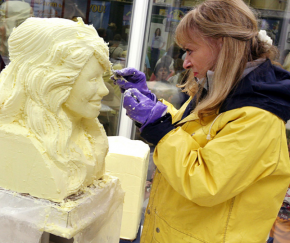
Have you ever wondered about butter sculpting?

butter sculpting

Linda Christensen, a master at the craft, typically spends a week and a half in a booth chilled to near freezing at the Minnesota State Fair in order to render likenesses out of 90-pound blocks. An artist friend of mine once imagined making sculptures out of breast milk butter, but it never came to pass.

How about houses so small they can be mounted on grocery carts?

Early water pipes under New York City carved from whole trees.

wood pipes

Archaeologists are finding them now.

Italian prison inmates who make award-winning chocolate truffles.

The question of whether Michael Pollan is a sexist pig – an excerpt from Homeward Bound: Why Women Are Embracing the New Domesticity, a new book by Emily Matchar that sounds an awful lot like my decade-old Made From Scratch: Reclaiming the Pleasures of the American Hearth.

Is it time to order a new supply of Goatboy Soaps, handmade from goat’s milk and shea butter on a farm in New Milford, Connecticut?

1009wc07.jpg

The one called Heavenly does indeed have a celestial aroma, I can vouch for it,but you can also choose from among Blackberry Sage, Cherry Almond, Clean Greens, Lavender Oatmeal, Serious Citrus and others, including Red Clover Tea, the company’s bestseller. No breast milk in evidence.

Research showing why the act of pointing makes babies human. It turns out, according to Slate, that “Babies point to refer to events in the past and the future. They point to refer to things that are no longer there. They can figure out, when an adult points across the room toward a group of objects, what exactly the adult is gesturing toward (the toy they’ve previously played with, say). They can deduce that, by pointing, an adult is trying to communicate something specific (find that toy hidden in that bucket). And not least of all, babies point because they want to share their experience of the world—that puppy—with someone else.”

The fascinating blog of an Irishman elucidating a video of Dublin phrases.  You’re in for a treat if you make posts from Sentence first a regular part of your day.

A recipe for how to make Mango Sticky Rice, at a site called The High Heel Gourmet, brought to you by Miranti, a young chef who seems to know exactly what she’s doing.

high heeled gourmet

And, finally, a piece so lively it will drive all the rain away (by tomorrow, I hope, when I plan to go mushrooming in the Westchester woods), a photo doc on skateboarding in 1965, courtesy of Life magazine.

girl skateboarding

I am sure that some of the individuals pictured have traded skateboards for walkers, but then everything was a breeze.

If you wind up wanting to make home-made soup, a chicken elixir, here’s how.

A Recipe for Simple Stock

1 soup fowl/heavy fowl/soup hen

A bunch of chicken feet if you can get them

2 big fat carrots

2 sticks celery

1 large onion

1 large purple-shouldered turnip

1 large parsnip

a bunch of dill if you have it

salt and pepper to taste

Bring chicken to boil in a pot large enough to accommodate all ingredients.

Skim off scum and reduce to a simmer.

Add all other ingredients.

Simmer 3 hours or until chicken starts to fall off the bone.

Strain stock.
Add noodles or matzoh balls, use as a base for leek-and-potato soup, make gravy for chicken pot pie or stir up some risotto. Perfect for anything that ails you. And if you dribble a little over the kibble, your dog will love you for it.

1 Comment

Filed under Cooking, Fiction, Film, History, Home, Jean Zimmerman, Knitting, Nature, Publishing, Writers, Writing

Enough to Feed an Army

An army marches on its stomach, said Napoleon, who knew a little something about food as well as armies, if his portrait is to be trusted.

napoleon

I recently read a profile of a man seemingly born to fill that marching stomach, Derrick Davenport, a culinary specialist who has just triumphed over 17 other gastronomic overachievers to become the Armed Forces Chef of the Year. Parade reports that the competition has taken place for two decades at the Joint Culinary Center of Excellence in Fort Lee, Virginia. It’s judged cooking-show style, after contestants prepare four courses in four hours, taking in hand some challenging ingredients they didn’t count on ahead of time.

Derrick Davenport

Quinoa and arugula salad. Roasted lamb loin in mushroom sauce with butternut squash puree. Edam cheese fritters? These are no ordinary MREs. But the military takes its food more seriously than ever now that troops’ palates have grown more sophisticated. Plus, says an army evacuation medic named Corrie Blackshear, “It’s more than nourishment. It’s spiritual nourishment.”

Nourishment to the tune of 5,250,000 gallons of milk, 448,000 pounds of Thanksgiving turkey and 214,000 gallons of ketchup a year. Fully 24,884,000 pounds of cooked chicken.

mmw-fat-chickens

This is just part of the 2012 breakdown for all of the U.S. Armed Forces.

I began thinking about gargantuan military food quanities a long time ago when I served as the head of a soup kitchen in Manhattan. I had picked up a copy of the West Point Officers Wives’ Club Cookbook  at the Naval Academy bookstore when I was at Annapolis doing interviews for Tailspin, Women at War in the Wake of Tailhook.
West POint cookbook

It was a spiral-bound community-style softcover of the type I still collect (I have over a hundred) and it had a subtitle I found enticing: Enough to Feed an Army.
I was new to the soup kitchen, which took place once a week at All Souls Unitarian Church on Lexington Avenue, and was known as Monday Night Hospitality. Wandering down to the kitchen one afternoon, just thinking to check out the volunteer options, I encountered a tall, blonde woman with her coat on. I told her I wanted to help. Fine, she said, you’ll cook tonight. I looked around – I was the only one there.

I had cooked for dinner parties before, but the customary crowd at Monday Night Hospitality reached 100 hungry mouths, sometimes more. Don’t worry, said the woman, we have meatballs. And she pointed to the walk-in pantry.

The soup kitchen had always served government-issued meatballs in tomato sauce. Mystery meat. Bad enough to smell, let alone put in your mouth.

That was the only time I served a meal that was not home cooked. I remember trucking in crates of kale from my favorite market Fairway up in Harlem at 134th Street. The produce manager Jaime saw me coming and would break into a smile.

kale

How much ground beef to make meat loaf for 100? How many eggs? I figured it out. I learned to fry chicken in industrial-size skillets. Not 24,884,000 pounds, but close.

I consulted the West Point Officers Wives’ Club spiral bound. It featured recipes from teachers and parents, officers and their wives (and some husbands). It also contained items like reminiscences of graduations past, and the cadet’s prayer. Finally, and here is where I got some guidance, the mess hall weighed in.

sloppy joes

Forty-five hundred servings? Making sloppy joes for 100 was obviously something  a person like me could do. I would bring my favorite 8-inch chef’s knife from home, wrapped in cardboard and duct tape. And my well-used apron. Sometimes a pan I wanted to employ. I would put those entrees on the table, whatever it took.

pan

And it was worth it. Often, our dinner was the first time our guests had tasted a home-cooked meal in a long while.

I remember an elderly man who used to grab me by the arm and recall his late wife, the loving meals she used to fix him. A man mountain with a tiny rearview mirror attached to his glasses, dressed head to toe in fatigues, how he chowed down. And an Eastern European woman named Margo, and how she pampered my five-year-old daughter while stuffing buttered bread in her handbag.

I learned that for all the differences, these people were more like me than I had known. The aroma of many was more pungent than I could imagine. A shower at home was a foreign concept. But they ate with the same relish I did. As did the volunteers, who devoured our food and brought home leftovers. The perfect sous chef from the West Indies. The mother who occasionally brought her helpful daughter (at 19, she seemed so old!). The high schooler with the handsome face and a bottomless capacity for doing dishes over the capacious sink.

At the end of four years, I had a personal crisis that made it impossible for me to cook at the kitchen anymore. I had a book on deadline that I couldn’t write. Financial woes I couldn’t solve. And finally a meltdown from which I needed time to recover.

I approached a fellow volunteer, a writer named Alex who had spent many dinners at Monday Night Hospitality slinging meatloaf with me. Could he possibly take over as head of the kitchen? Immediately?

Surprised but gracious, he said yes.

He comes highly praised, does novelist Alexander Chee.

Alex Chee

His debut novel The New York Times called “haunting,” and gifted, poetic and elegant are also words that have been offered on Alex’s behalf. His new book The Queen of the Night comes out in February of next year from Houghton Mifflin Harcourt – in it, Alex tells the story of an opera singer in 1882 Paris and a secret past she had sought to keep hidden.

The Queen of the Night cover

All this time later, the soup kitchen behind me, I realize something important. I wasn’t the only one who could do this thing of feeding folks with dignity. I was just a writer, cooking for an army of 100 people with no place else to go. The “spiritual nourishment” was mine as much as theirs.

11 Comments

Filed under Cooking, Fiction, History, Home, Jean Zimmerman, Publishing

Meatpacking Amble

We started and ended our Manhattan amble in the Meatpacking District, that venerable neighborhood from around 14th  down to Gansevoort Street that has been totally gentrified in recent years. This is a place that in 1900 had 250 slaughterhouses and packing plants lining its streets. The paving stones under the butchers’ awnings used to actually lie slick with lard and blood when I first came to New York in the late ’70s. Now Diane von Furstenberg has a building of refurbished brick with lavender windows and a penthouse that looks like a geodesic glass bubble on top, and there are eateries like Bubby’s opening that pride themselves on their farm-to-table cuisine.

Bubby's

The sign announcing the imminent arrival of the joint puts across it’s down home, wry message: Defending the American Table (also, we steal recipes from grandmas.)

With illustrations around the side that already seem faded as a pair of farmer’s Levi’s.

Bubby's 2

It reminded me of a sign we saw up in also gentrifying Morningside Heights recently, on Broadway near 125th Street.

Barbershop sign

There was a man on scaffolding outside and we weren’t sure whether he was taking down an old sign or putting up a new one with an exquisitely vintage look. The sign down below left us equally confused.

Prices 2

Maybe you can figure it out.

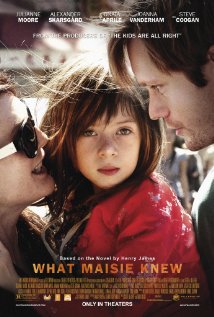
Anyway, on from the Meatpacking District to see a movie on Houston Street, at the northern lip of Soho. “What Maisie Knew” is based on a novella  written by Henry James in 1897 about a classic dysfunctional family. Sad, sad, film.

maisie

It features Julianne Moore as a self-absorbed rock vocalist married to a self-absorbed art dealer played by Steve Koogan. At the heart of the story is their seven-year-old daughter, Maisie, who is being torn apart by the breakup of her parents’ marriage. The two adults literally abandon her places – the story takes place in contemporary Manhattan — when they tire of her. I wondered what James would have made of the profane adaptation.

portrait

The novelist was a theater aficionado and aspiring playwright. Couldn’t he be satisfied with being the most brilliant prose stylist of his day? He never got the reception on the boards that he so very much wanted. Movies might really have rocked his world. We think of him as fusty now, but Edith Wharton writes in her memoir A Backward Glance about how much James loved to “motor.” Yes, driving in the new, perpetually breaking-down automobiles, feeling the wind in his pate, was just about his favorite thing.

Making our way north, we grabbed a schnitzel and a wurst at a little German joint. En route, we passed the phenomenon that has been around longer than anything else I know in New York: the basketball game at West 4th Street and Sixth Avenue, also known as the Cage.

basketball

Anybody can play and there are fierce tournaments. The supports for the baskets are actually padded with duct tape to mitigate injury to players who stuff.

Under the High Line, where we had earlier found parking (who said it’s tough to get along in New York? Come with me, I have the best parking karma in the city) night had fallen.

high line

A park so beautiful that even Manhattanites are impressed, the High Line was once quite different. An old elevated freight line for meat packers, built under the aegis of Robert Moses, it ran through the buildings of the district, raised up above the streets underneath. The rail bed had long since fallen on hard times when I first saw it decades ago. It was basically a long, winding, dispiriting field of syringes, condoms and weeds. Some brilliant dreamers fought to bring it back to life as a park planted throughout with native plants, meticulously cared for, ingeniously designed. The first section of the park opened in 2009. Now people throng to it day and night, both to walk and to lounge on the massive wooden chaise lounges found along its length.

Gil climbed the stairs and waved down from the dark trees above. I was content looking up past the old, weathered, still-extant butcher’s awning at the winking moon.

moon over meatmarket

4 Comments

Filed under Cooking, Fashion, Fiction, Film, History, Jean Zimmerman, Nature, Writers

Boxcar Boy

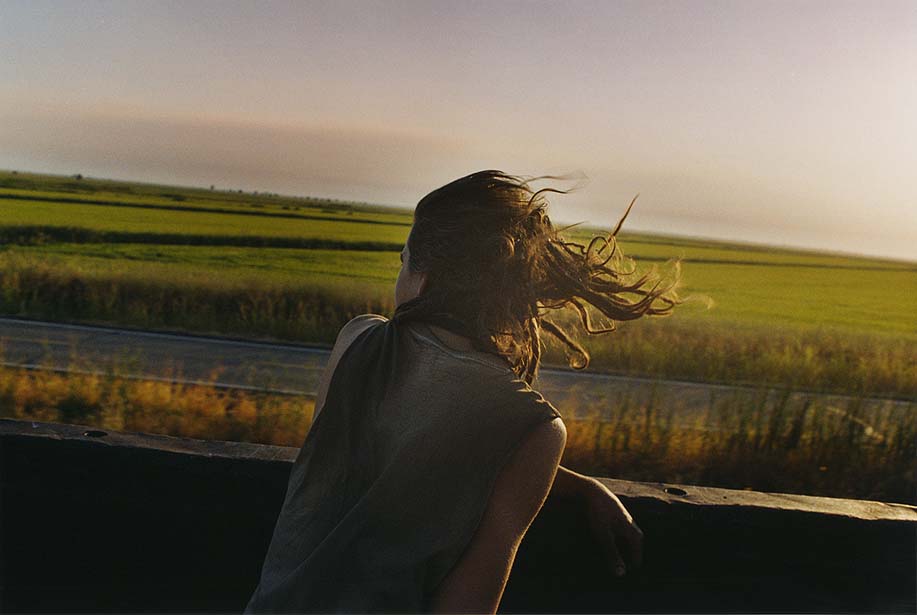
Mike Brodie is not making pictures any more. He left that behind along with a life on the rails, wind in his hair, the dirt of the road.

girl's hair

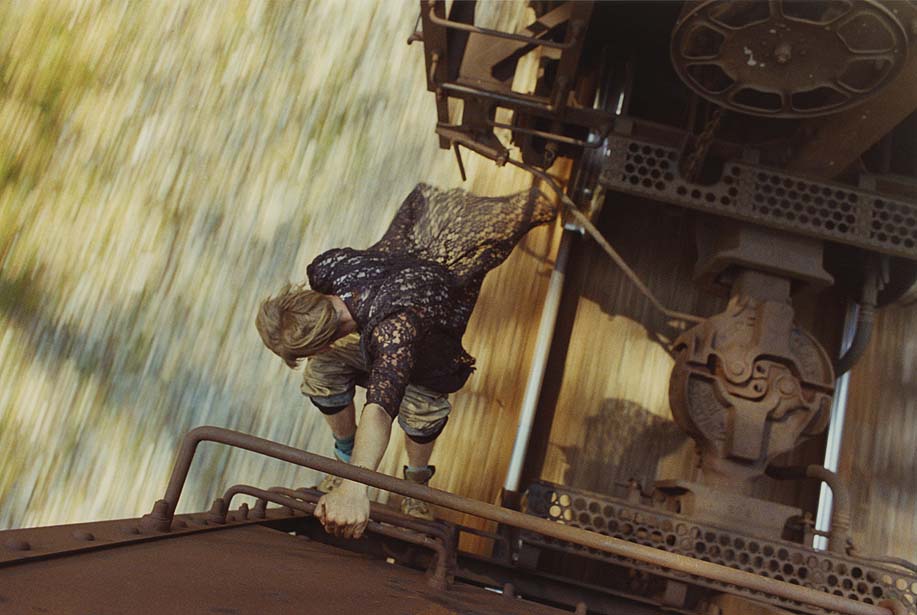
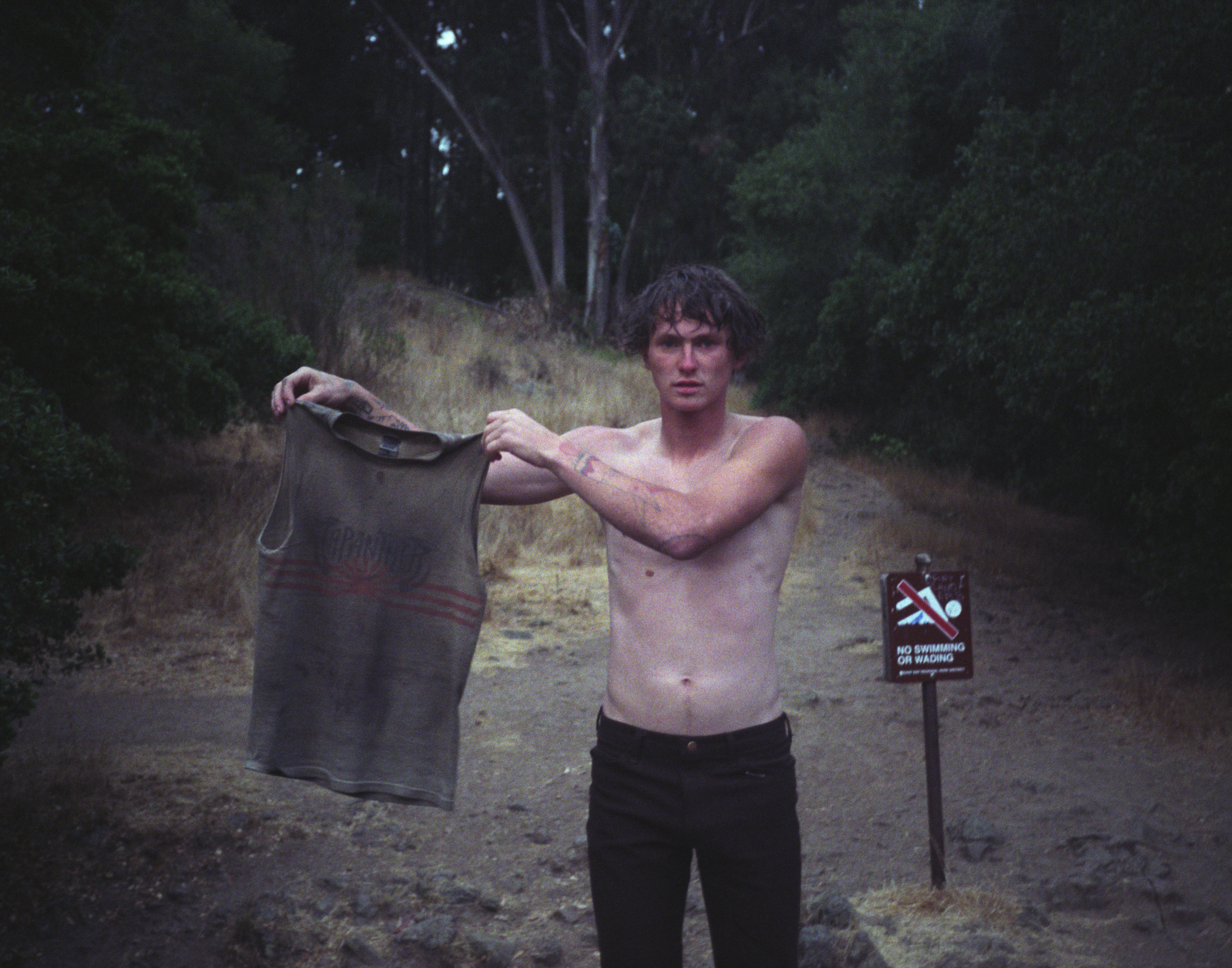
But for almost five years, since he was 17, he used a Polaroid and then a 1980s 35mm camera to document the world of young freight-train hoppers, his peers, in some searing and sweet images.

two figures on train

As I was cleaning my house today I thought, What if I didn’t have a house to clean? What if I didn’t have a counter to scrub, a coffee table to dust? I love home, the idea and the reality. But what if it was all suddenly swept away and I could just fly.

boy on train

Drift.

kids w map

Brodie traveled 50,000 miles through 46 states, catching a lift on more than 170 long-haul freight trains, and capturing the tiny details of life that usually don’t mean anything to anyone outside the people themselves. He had no experience as a photographer, he first picked up a discarded camera left behind in a car and just started to shoot his friends. One of his cronies took this portrait of him along the way.

mike-brodie-self

“There was nowhere to go but everywhere, so just keep on rolling under the stars.” So wrote Kerouac. His words have never felt less dated.

train

Brodie’s photos are romantic, edgy, authentic, and might make someone uncomfortable.

stain

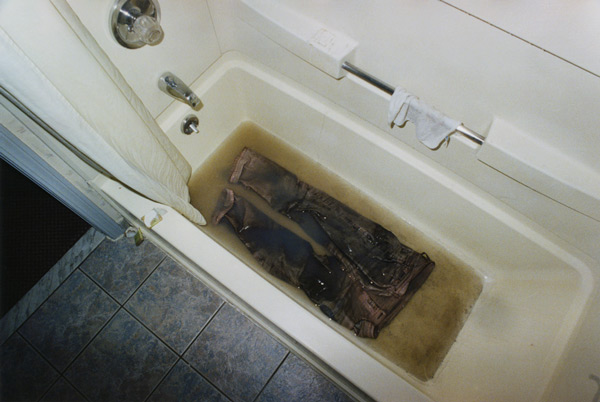
All right. You’re shocked. I’m shocked. Youth shocks, it demands attention. Brodie documents arrests and injuries, squats, disheveled car interiors (trains are only part of this story). Dirt. I love this one.

bathtub

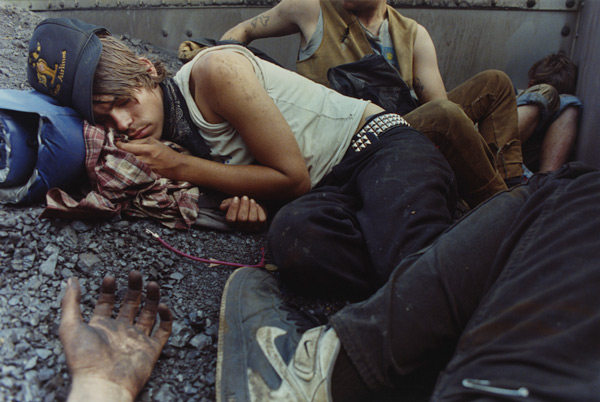
Some photos are grim. One reviewer described the work as “stolen glances.” There’s some truth to that. These are raw depictions of a ramshackle but exhilarating life.

boy sleeping

Whitman’s Song of the Open Road, another chestnut that begs to accompany these pictures:

Henceforth I ask not good-fortune,

I myself am good-fortune,

Henceforth I whimper no more, postpone no more, need nothing,

Done with indoor complaints, libraries, querulous criticisms,

Strong and content I travel the open road.

The result of Brodie’s adventure is a photo book called A Period of Juvenile Prosperity, published by Twin Palms, with coinciding exhibits in art galleries on both coasts. He and his friends apparently have mixed emotions seeing his intimate work appear in the mainstream. “You have a lot of worlds colliding right there,” Brodie told The Guardian.

A Period 2

This is not Never Never Land. Whitman knew the truth. Some of my favorite lines in literature, also from Song of the Open Road:

(Still here I carry my old delicious burdens,

I carry them, men and women, I carry them with me wherever I go,

I swear it is impossible for me to get rid of them,

I am fill’d with them, and I will fill them in return.)

People in the recovery business talk about the uselessness of the “geographical cure” by which you try to escape your problems by changing your location. But still, some lucky people are flying, mostly by choice, rolling under the stars, true angels with dirty faces, thrilling to the open road.

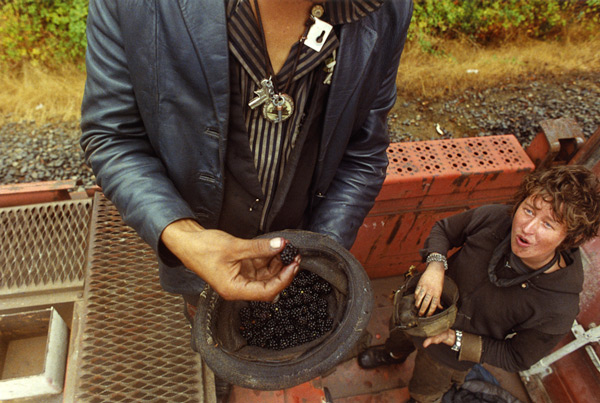
Can you imagine how sweet these berries tasted?

fruit

Cormac McCarthy, in his work of apocalyptic genius, The Road: “Then they set out along the blacktop in the gunmetal light, shuffling through the ash, each the other’s world entire.”

sleepers

Mike Brodie has said the inspiration for his work was “from the folks I was hangin’ out with in Pensacola. The punk scene, like radical anarchists and all these feminist girls, at the time, their ideas and way of life were really interesting and inspiring to me and really gave me the push to think for myself and, well, hit the road.” It was a tight tribe, he says, and nobody was “actually homeless.” Instead, “We took what we could get to make it through one more day or to get to the next town.” He reminisced to the Los Angeles Times about the “sound of a high-priority Z train whizzing by you at 70 mph in the middle of a cornfield in Nebraska, zooom zooom, zooom…”

In an essay for his book, he writes that “I don’t want to be famous, but I hope this book is remembered forever.” He has announced that he will not take any more photographs. He has graduated from the Nashville Auto-Diesel College and now works as a mobile diesel mechanic out of his silver ’93 Dodge Ram.

Mike. Please pick up a camera. Maybe show us the secret world of auto mechanics. Or any secret world you choose.

6 Comments

Filed under Art, Fiction, Photography, Poetry, Writing

A Washington Irving Award, Thank You

Back to Cabinworld after an afternoon at the Washington Irving Awards, presented at a local Hilton.

Compared with hotel air, the azaleas, violets and weeds seem to bloom a bit more riotously.

azalea

The smell of rain in the air. The first angry-sounding, toothpick-billed hummingbird of the year dive-bombed me near the feeder with its red sugar-water.

My weathered old three-legged stool (note pegs that join the top, no nails) is ready for duty as a summer-porch-time computer stand.

stool

At the conference to get one of the awards, I spent time with librarians (hundreds, representing the Westchester Library Association) and authors (20 or so, all Westchester residents). Funny, sometimes, inspiring, always. I saw some friends, nonfiction, fiction and librarian. I always feel a little sleepy after a rubber-chicken luncheon, but I pepped up for the remarks of keynote speaker Barbara Stripling, current head of the American Library Association.

stripling

Barbara’s remarks, passed along with both bubbly mannerisms and erudition, talked among other things about finding a “gorgeous balance” between digital and paper resources. She spoke about libraries changing lives. But first she told a story about when she was in college, craving an A on a paper and seeing only a lot of plus signs in the margins. She stuck up her hand and demanded to know the meaning of the notations. Those were actually t’s, she was told – they stood for trite.

Ouch.

Does the use of primary sources encourage empathy? That’s the question she asked in her Ph.d. studies, going into high school classrooms that were studying slave narratives. It’s a fascinating line of inquiry.

SlaveNarratives1

It’s hard for people to use primaries, she found, without some sort of context. I get that, I suppose. Although as a historian I generally find the original sources when they are embedded in some author’s history to be the most exciting part of the work. They themselves give the context. That’s where you find the BITADs, the bite in the ass details that really give the flavor of a time or place or person.

I liked another story Barbara told, too, about a knitting club that refused to be shut into one of the back rooms at a public library for  their weekly stitch n’ bitch, but instead colonized a  table in the center of the building. Well, a technology club soon discovered the knitters and found what they were doing interesting, and the two groups ended up knit-bombing the library – the mouse, the circulation desk, etc.

knit tech

Everything covered in knit and purl by tech geeks and old ladies.

A library “provides the thinking spaces for civilization,” said Jaron Lanier – he’s the computer geek who popularized the term virtual reality.

lanier

He has a new book just out, Who Owns the Future? Certainly worth a look.

The feeling that you are just another mouth in a chorus of songsters is a welcome one when you spend a lot of your time on your own at your desk. That is what I brought home from talking to my fellow writers and hearing them deliver brief remarks at the podium. Being one of the crowd, one of a club.

Allison Gilbert won a Washington Irving Award for her book Parentless Parents: How the Loss of Our Mothers and Fathers Impacts the Way We Raise Our Children. Allison lost her own parents at a tender age, but the book is much more than a memoir or advice manual.

Allison

It’s not her first book on the subject, and support groups of parentless parents have sprung up around the country to deal with the difficult subject. Allison announced some news, that some these groups have banded together to make a trip to Peru to help orphans there.

It gave me goosebumps to hear about another project she’s got lined up, because the excitement in her demeanor was just so visceral. There’s a real life journalist she wants to write about who went from panning for gold in the early 1900s to penning regular columns for Hearst in one dramatic lifetime. Apparently this person was a rabblerouser, a women’s rights advocate and is now – but perhaps not forever – all but forgotten. What a great topic, a great kernel of history to unearth.

Writers were honored today from all over the literary map.

My colleague Karen Engelmann was there for her novel The Stockholm Octavo, a magical work set in 18th century Sweden. Delicious, witty and swooping are some of the buzzwords used around her book.

jean and karen

Doesn’t everyone look happy today? If a bit blurry? Karen’s next novel is well underway, and she promises to jump forward a few centuries and incorporate greeting cards rather than fortune-telling into the mix.

I stood up to say a few words about The Orphanmaster. How The Orphanmaster is a love story wrapped around a murder mystery that takes place in a tiny settlement in the middle of a vast wilderness. And about libraries. That over the years I’ve not only dug into books and mususcripts, taken thousands of pages of notes and written many chapters in libraries, but eaten and drank within their hallowed halls. My hometown library growing up, in Hastings-on-Hudson, where I read Tristram Shandy for the first time:

hastings library

I’ve also taken some great naps, with fantastic dreams.

Some of what I was saying felt as if it were in the rearview – I’m working on the Savage Girl copyedit, and just took a first peek at the proposed cover for the novel. The art is beautiful and chilling and only needs a little fine tuning to make it perfect. I am obsessed with Savage Girl at the moment, though I have to wait until January 2014 for the book to be published.

Still, The Orphanmaster has just come out in paperback, well in time for another season of beach reading. And to be given an award for The Orphanmaster by librarians, for librarians to appreciate it, was a very special thrill.

Without librarians, said Maggie Barbieri, one of the fiction writers getting an award, we’re “a bunch of noisy trees echoing in an empty forest.”

2 Comments

Filed under Fiction, History, Jean Zimmerman, Knitting, Nature, Publishing, Savage Girl, The Orphanmaster, Writers, Writing

Parsing the Copyedit

My copyeditor got the manuscript for Savage Girl back to me and I’ve been hustling to get it done by the deadline. Did you know that it’s typical for authors to be given two weeks to get a copyedited manuscript back to the publisher? Did you know that copyeditors go way beyond the Chicago Manual of Style, making themselves experts on every subject your book concerns. When copyeditors do their job, the pages are covered with pencil — at least they used to be. Now everyone uses the track changes function on Word, so editors do their work on the computer and so do you.

track changes

Yes, it is nerdy, and yes, as an author you must do it.

Fortunately, there are great copyeditors who make the job easy, using every tool at their disposal. Often they just add or subtract commas, other times they throw queries at you and the judgment is your call. By the way, that previous sentence features a  comma splice, which means two standalone phrases on either side of a comma, and my current copyeditor would not let it occur on her watch. But this is a copyeditor-free zone. So sue me.

comma

I like my copyeditor a lot. Her name is Maureen. She left me a note attached (electronically) to my manuscript telling me that she hoped the rest of the world would love Savage Girl as much as she did. Isn’t that grand? Twice over, that she thought it, and that she went out of her way to tell me. It’s a weird intimacy you have, writer and copyeditor joined for a brief but intense period of time over this thing that you care about so much, before virtually anyone else has seen it.

This afternoon I’ve been addressing concerns such as whether there would actually be a gibbous moon in May of 1776, and the proper Latin translation for “the door has a floor,” a saying in the family portrayed in Savage Girl, the Delegates. Maureen went to great lengths to nail the correct form of the expression, and even consulted with a friend who was a Latin scholar at Columbia University to get it right.

She also wanted to determine precisely when the word was first coined for a tigon, the African cat that has a tiger for a father and a lioness for a mother.

tigon

As opposed to the ligon, for which the reverse parentage is true.

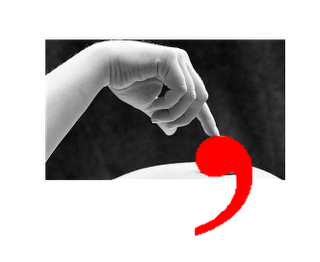
Something that makes the copyedit go better is if you bake at the same time. Well, most things go better if you bake simultaneously. Which I will definitely do next time around, perhaps creating some rice crispy treats in the shape of my favorite punctuation mark.

cereal-commas

3 Comments

Filed under Fiction, Jean Zimmerman, Publishing, Savage Girl, Writers, Writing

Reading a Golden Book

I must have been pretty young, because it was Golden Books we were after.

Poky Little Puppy

Me and Auntie, stopping in at Brasfield’s drug store in Greenfield, Tennessee on a muggy summer afternoon. Auntie, my great aunt, was an important lady, a home economics teacher whose house stood in a field of green beans. I had her all to myself when she took me to buy a book.

Auntie copy

Auntie’s father, J.P. White, another important person, owned the drugstore, smack in the middle of Front Street, just across from the sober-faced local bank. J.P. had long been the town’s pharmacist, as life-saving as anyone with a doctor’s degree in this doctor-less town.

Brasfield’s had fancy floors of black-and-white half-dollar tiles, a grand soda fountain where my grandmother, Auntie’s sister, had jerked sodas as a teenager, tables topped with marble, coca-cola chairs. Body powder and lotion and perfume lined the shelves, making Brasfield’s the place to go when you needed a present for somebody special.

soda-fountain-bottled-waste

And most important, right up at the front, a wooden rack with magazines and books. Golden Books.

Uncle Wiggly

I’d get to choose one, take it back to hunker down with in the little living room Auntie shared with Uncle Bob or on the vast wraparound porch of my grandmother’s house, on the creaky glider.

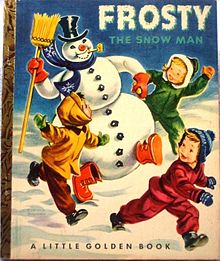
Frosty

Picking a Golden Book was my first experience of picking a book, choosing for myself what book to bring home from the cluttered selection in a store. My idea of what I wanted to read. No one else’s.

I thought of a hot summer day with Auntie and The Poky Little Puppy when I read a lovely essay by  Rebecca Makkai   in Ploughshares Literary Magazine. She writes in How to Shop at a Bookstore: An Easy 20-Step Guide for Authors 

about what happens when an author enters a shop, the jitters and the excitement that go with knowing that your name actually appears on one of the thousands of volumes there. One thing that happens is thinking back to bookstore of yesteryear. She writes:

“First, smell it. Look at the new arrivals, lined up like candy. See if, for just one second, you can remember what it was like to walk into a bookstore as a reader. Just a reader, a happy, curious reader. With no agenda, no insecurities, no history of bookstores as scenes of personal failure and triumph. Wish for a time machine.”

I recall patronizing the great Strand Bookstore on 12th Street and Broadway back thirty years ago, the smell of the paper, the sense that I could find absolutely anything there. Having known and loved the store so long made it thrilling when I found my own book there.

strand

I was delighted to read Makkai’s fresh and honest perspective.

She talks about other parts of the experience authors have in temples of literature, commercial as they are. Such as turning your book around so that shoppers see the cover rather than the spine. (Spine, by the way, is one of the simpler terms that come into play when discussing a book. For more on attributes such as wire lines, chain lines and head-pieces, take a look at 10 Terms to Describe the Anatomy of a Book

 Makkai, whose authorial experience includes the novel The Borrower (Viking, 2011) and numerous short stories, writes about the decision that’s in store for you once you get over the shock of finding yourself on the shelf.

RebeccaMakkai

“There are two copies. If there were only one, you could walk away right now. Because, you’d tell yourself, it might be sad to offer to sign their one and only paperback copy of your book, a copy they were probably planning to return to the publisher tomorrow. A copy they probably ordered by mistake. If there were five, with a lovely staff pick card right below, you could waltz confidently to the counter. But you have to do this. Because it helps the store, and it doesn’t hurt you either. And everyone knows that this is how you build relationships with booksellers.”

slideshow_std_h_417216_491934997486728_2085187251_n

And she’s funny talking about approaching the checkout to sign those copies: “Thank god there’s a cat on the counter. Stroke the cat manically when you approach. The fact that you hate cats is irrelevant.”

But the thing that had me thinking about Auntie and The Poky Puppy is number 18:

“As you cross the street with your bag of new books, remember the first time your mother took you to a bookstore and told you to pick something out. To keep, not borrow. You were overwhelmed by choice and wonder. Remember how you pulled things off the shelf at random because every book was equally unknown and fresh and promising.”

Today, the first discovery of books is usually glitzier than Brasfield’s drug store. You’re as likely to get your stories on a screen as you are on a page. But that’s not all bad. Check out these animated pop up books and see if they don’t give your imagination wings.

The important thing is to have an Auntie there with you to hold your hand.

4 Comments

Filed under Fiction, History, Jean Zimmerman, Publishing, Writers, Writing

Softcover Orphanmaster In Bookstores Today

It’s a beautiful day to publish a book in softcover!

o-master-p-back-cover

Today, April 30th, The Orphanmaster hits the bricks as a paperback. Less than a year ago people were introduced to my book for the first time.

It’s interesting. I’m sitting in the Ossining library researching  Revolutionary New York City for a new novel. At the same, I heard today that the copyedit for my next book, Savage Girl, to be published by Viking in early 2014, is wending its way toward me. Savage Girl‘s story is set in Gilded Age Manhattan. I’m not flummoxed, though, by all these cultures, all these stories, all these versions of New York crashing against each other.

cityroom-smoking-blog480

Like a fat, comfortable burgher in the 1664 Manhattan of The Orphanmaster, I’m taking it in stride.

4 Comments

Filed under Art, Fiction, Jean Zimmerman, Publishing, The Orphanmaster, Writing

Writing From the Nitty Gritty

Reading The New York Times today, I came across a story about archivists in the city, what a rare breed they are and what their jobs are like, and I envied them. “Specialists who snatch objects from oblivion,” as  Alison Leigh Cowan, the author of the piece, describes them, these men and women get to immerse themselves in the nitty gritty of life in a different time and place, continually. It’s an activity that as a history-obsessed writer I only get to spend part of my time doing. The archivists profiled preserve everything from teacups, to Meyer Lansky’s marriage license, to the see-through panties of Gypsy Rose Lee.

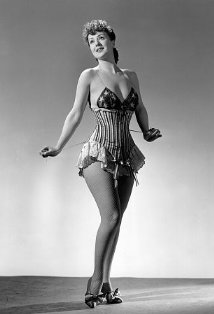
gypy

I have favorites among archival collections.

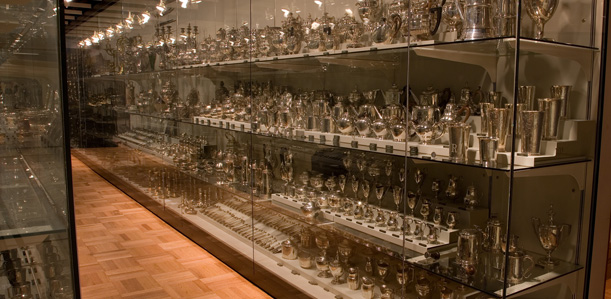
The Henry R. Luce Center for the Study of American Art at the Metropolitan Museum has on view those myriad fine art and decorative art objects that are not currently displayed in the more conventional Museum galleries. It’s a funny sort of place, an open secret, accessible to the public yet off the beaten track. Objects have been arranged in huge glass vitrines according to material (e.g. furniture and woodwork, glass, ceramics, and metalwork).

Luce

It’s a fine place to find a dozen nearly identical andirons, if you’re in the mood to see andirons, or a hundred sterling silver tumblers, or any number of porringers of yesteryear. Oh, and paintings. Any item the museum can’t find a place for at the moment gets tucked away here, in plain sight, and that includes some wonderful canvases. Even such crowd pleasers as John Singer Sargent’s Madame X sometimes cool their heels here. One day I turned a corner and came across one of my favorite paintings that I’d never seen in person, the portait of nine-year-old Daniel Verplanck by John Singleton Copley, painted in 1771.

John-Singleton-Copley-Daniel-Crommelin-Verplanck

It’s not the only boy/squirrel portrait Copley painted – there’s one in Boston, too, at the Museum of Fine Arts, a fine one, of  Henry Pelham, painted in 1765.

copley-squirrel1316573541100

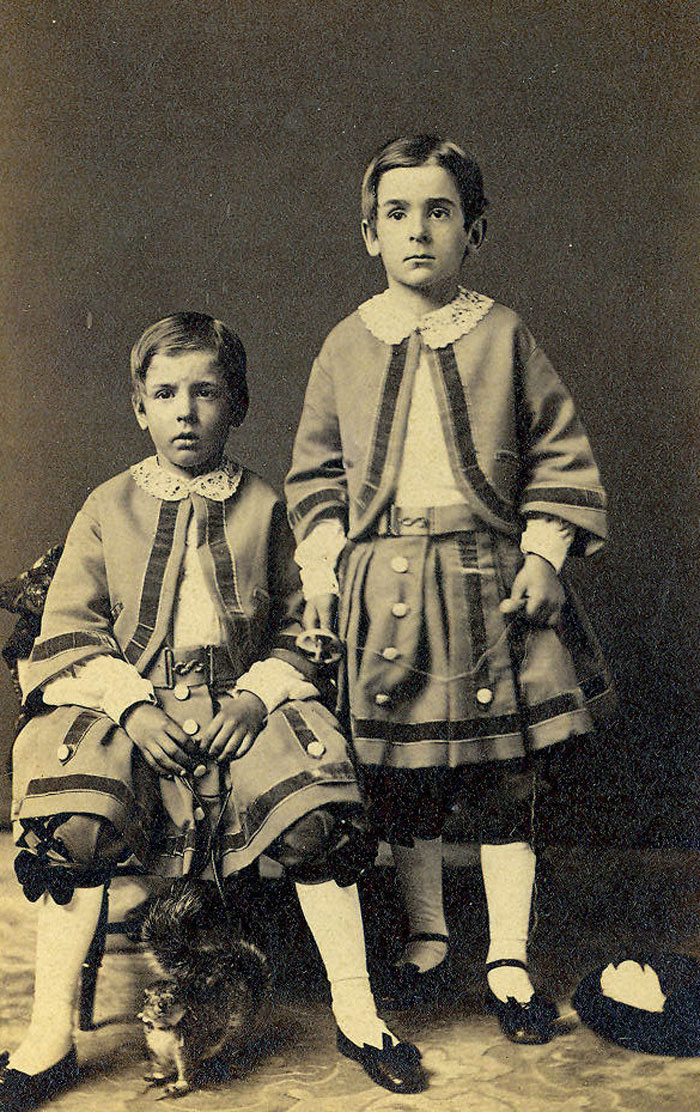
But here I had what amounted to a private viewing, just me and the boy and his pet. It seems funny now, but keeping squirrels as pets was commonplace through to the twentieth century. Before the family dog, the family squirrel. Here we have the Ridgely brothers in 1862, Howard and his younger brother Otho, the children of a wealthy landowning family in Maryland.

squirrel boys

I like to visit another kind of archive when I’m at the Met, as well. Next door to the imposing Temple of Dendur is a tiny warren of display cases that contain long rolls of linen 2000 years old, mummy linen. Here is a scrap.

mummy linen

I don’t know whether the fabric has been unrolled from the embalmed corpses or is waiting to enfold them, but it is incredible to be inches away from these archivally preserved Middle Kingdom textiles. Only slightly frayed and browned by time. Magic.

Another archival highlight. I once ventured up to the attic of the Union Church of Pocantico Hills, with the well-known rose window designed by Henri Matisse – his last work of art, dedicated on Mother’s Day 1956.

henri matisse rose window at union church

There under the eaves lay the physical archives of Historic Hudson Valley, the nonprofit organization that runs the church and other properties in Westchester County. I was there to view a painting of an elite young Mary Philipse by John Wollaston, for my book The Women of the House.

Mary

I was, luckily, sanctioned to browse around the other objects displayed on the shelves while the archivist inspected various historical maps. Some intricately decorated colonial pottery, some other paintings, including one, provenance unknown, of waves crashing against the shore at the southern tip of Manhattan around 300 years ago. And what really got me, a collection of pastel silk slippers in pristine condition, perfect for the fancy parties of the eighteenth century. All these things just breathing there, largely ignored by the world, protected in their secret little alcove atop a church.

The Manuscripts and Archives Division at the New York Public Library, when I went there to do research on I.N. Phelps Stokes for Love, Fiercely: A Gilded Age Romance, always seemed like it existed underwater, dim and calm, holding tight to its treasures. It contains over 29,000 linear feet of archival material in over 3,000 collections, of which I was accessing 36 boxes of yellowed paper.

There is something gratifying about examining letters that have not been paid attention to in a hundred years. Being the first to take them out and handle them. The papers that interested me concerned the architect/philanthropist/collector’s epic Iconography of Manhattan Island. I had already done research at the library of the New-York Historical society, where I discovered a note from Stokes imploring an influential friend for contacts to help publicize his book.

stokes p.r. letter

Also something of a gas was his 1913 campaign, revealed in a fundraising letter, to get an educational farm installed in Central Park. His sister Ethel had the idea of equipping “a diminutive group of buildings, consisting of a tiny cottage of four rooms, a cow-shed and dairy for two cows, and a chicken house for twenty-five chickens.” Everything could be “inspected through glazed openings without entering the buildings,” wrote Stokes. A negative editorial in The New York Times helped shoot down the plan.

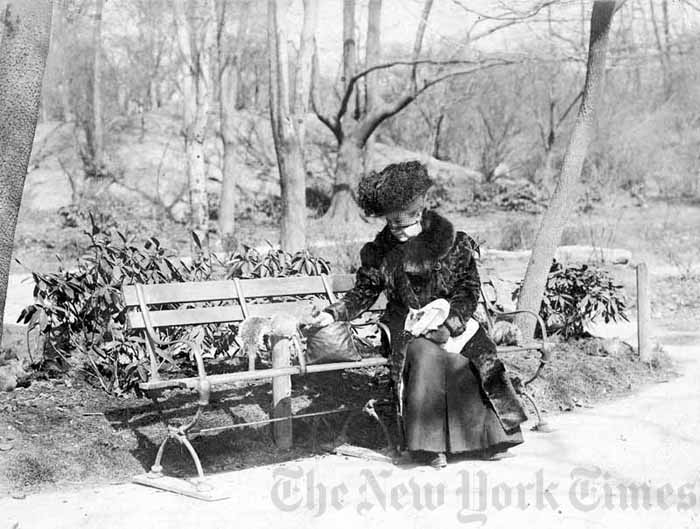
Petting squirrels was still popular in Central Park at that time, I have found.

Central Park squirrel

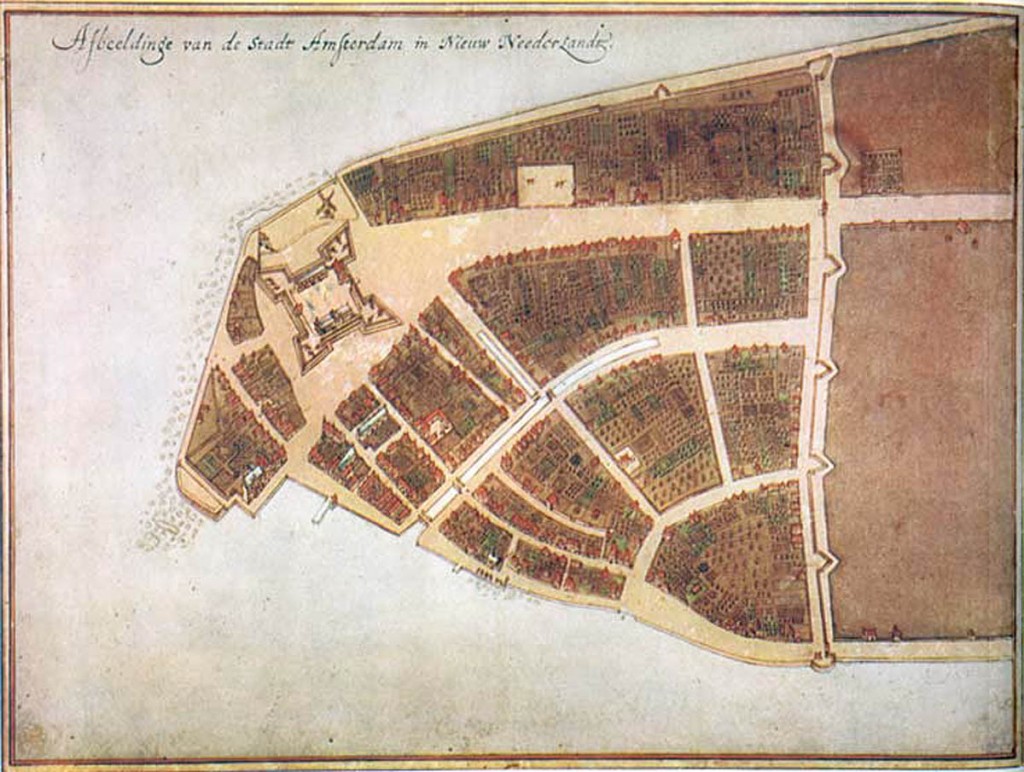
I recall the day at the NYPL Manuscripts room when I found a small envelope containing two thumb-sized black-and-white photographs depicting the very first street plan of New York, drawn in 1660.

CastelloPlanOriginal-1024x772

They were snapped by Stokes’ researcher behind a guard’s back at the Florence villa where the map was housed, and sent back over the sea to his boss in New York City. Stokes must have leapt out of his chair (also in the New York Public Library, where he had a private second-floor office) when he saw those first pics in 1916.

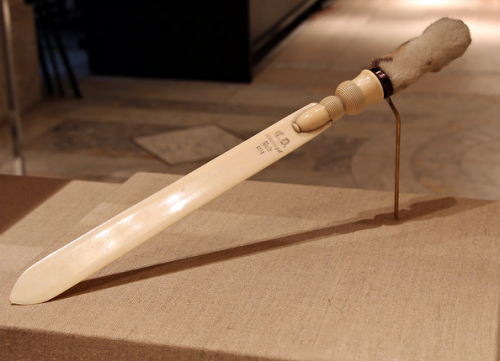
A friend of mine, the curator Thomas Mellins,  produced Celebrating 100 Years, an exhibit for the New York Public Library that brought some of its best archival artifacts out of mothballs. Did you know that this book-and-paper institution in in the possession of the walking stick Virginia Woolf had with her when she waded into the water on her last day? It floated to the surface. The Library also has such objets as Jack Kerouac’s typewriter, yes, the one on which he wrote On the Road. And my personal favorite, perhaps because I had just been reading David Copperfield when I saw it — Dickens’ personal copy of David Copperfield, the one he used when touring for the book, pocket-sized, complete with his penciled-in notations for emphasis. There is also the genius’ letter opener, topped with the taxidermied paw belonging to Dickens’ cat, Bob.

letter opener

The pleasure of handling archival materials is an emotion that you can’t experience second-hand, unfortunately. You have to be there, deep amid the tarnished porringers and the satin slippers. But there is a website I like a lot that gives you snippets of historical artifacts. Slate features a department called The Vault: Historical Treasures, Oddities, and Delights.  You can see, if not touch, pieces of history like a hand-written dance instructional from 1817, an 1893 letter promising compensation to former slaveowners, or Bram Stoker’s literary plans for Dracula. You don’t get to sit underwater at the Manuscripts Collection, true, but you can turn the virtual pages in the comfort of your living room, in your stocking feet.

4 Comments

Filed under Art, Fiction, History, Jean Zimmerman, Love, Fiercely, Photography, Publishing, Writers, Writing