Category Archives: Culture

Lowdown on the High Line

New York City’s High Line park is totally overexposed. I’m going to expose it further.

walking

I walk with three menfolk from the top to the bottom of this new icon of the Manhattan landscape, stunned by the native plantings that seem to find city soil the best fertilizer in the world.

yellow flowers

I spent a day in the country looking at wildflowers and saw no profusion like this.

cone

Superflowers.

purple flowers

And a planting of bamboo, which has to be tightly constrained by a metal guard to keep it happy in its place. Kind of the opposite of Jesse, who isn’t happy unless he’s on the open seas or in some other free environment.

jess:bamboo

The High Line was  built between 1929 and 1934 from Gansevoort to 34th Streets to lift dangerous freight trains above the traffic. For years, meat, produce and dairy products were shipped to town and arrived at the third floor level of plants. That might have been a little inconvenient, but the situation previous was insupportable. In the nineteenth century, people actually called Tenth Avenue “Death Avenue” because the street-level railroad caused so many accidents. Men in an outfit called the “West Side Cowboys” were hired to ride in front of trains and wave red flags to warn traffic off.

cowboy

In 1980 the last train came through with a load of frozen turkeys. Then the rail bed deteriorated. Gil, who lived in the city then, says, “It was the high line, alright, everyone was getting high.” What grew there was what the High Line people now politely call a “self sown landscape.” In other words, weeds. Weeds, condoms, syringes.

Now there are trees, grasses and flowers, and I think even Larry, who lives on a farm surrounded by midwestern forest, is impressed.

larry

The gardeners of the High Line transformed the place, beginning in 1999. It’s a classic urban place to stop and smell the roses.

climbing roses

Wild roses are fairest, said Louise May Alcott, and nature a better gardener than art. The High Line has nature, art and a third thing, a deep industrial past.

There are musicians.

asian musician

Painters.

painter

It even has its own clothing franchise, with sarongs that read “Dreams Come True on the High Line.”
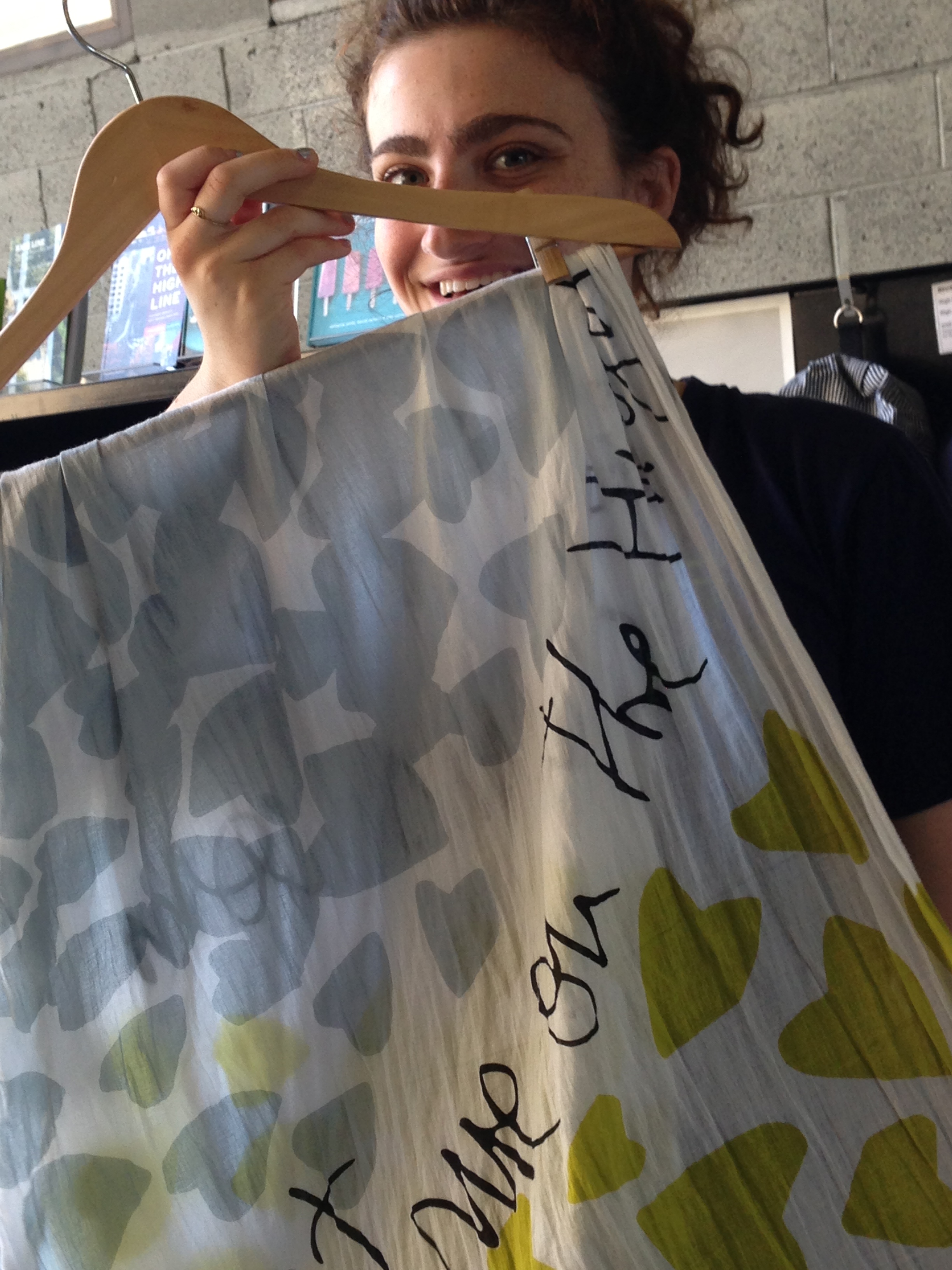
sarong

Sculpture rises up along the walkway.

funny sculpture

And human sculpture, as people freeze for pictures. What the High Line should have next to the fresh fruit ice pops stand is a camera kiosk. Someone would get rich. Tourists throng — you can walk a long way down the path and not hear a word of English.
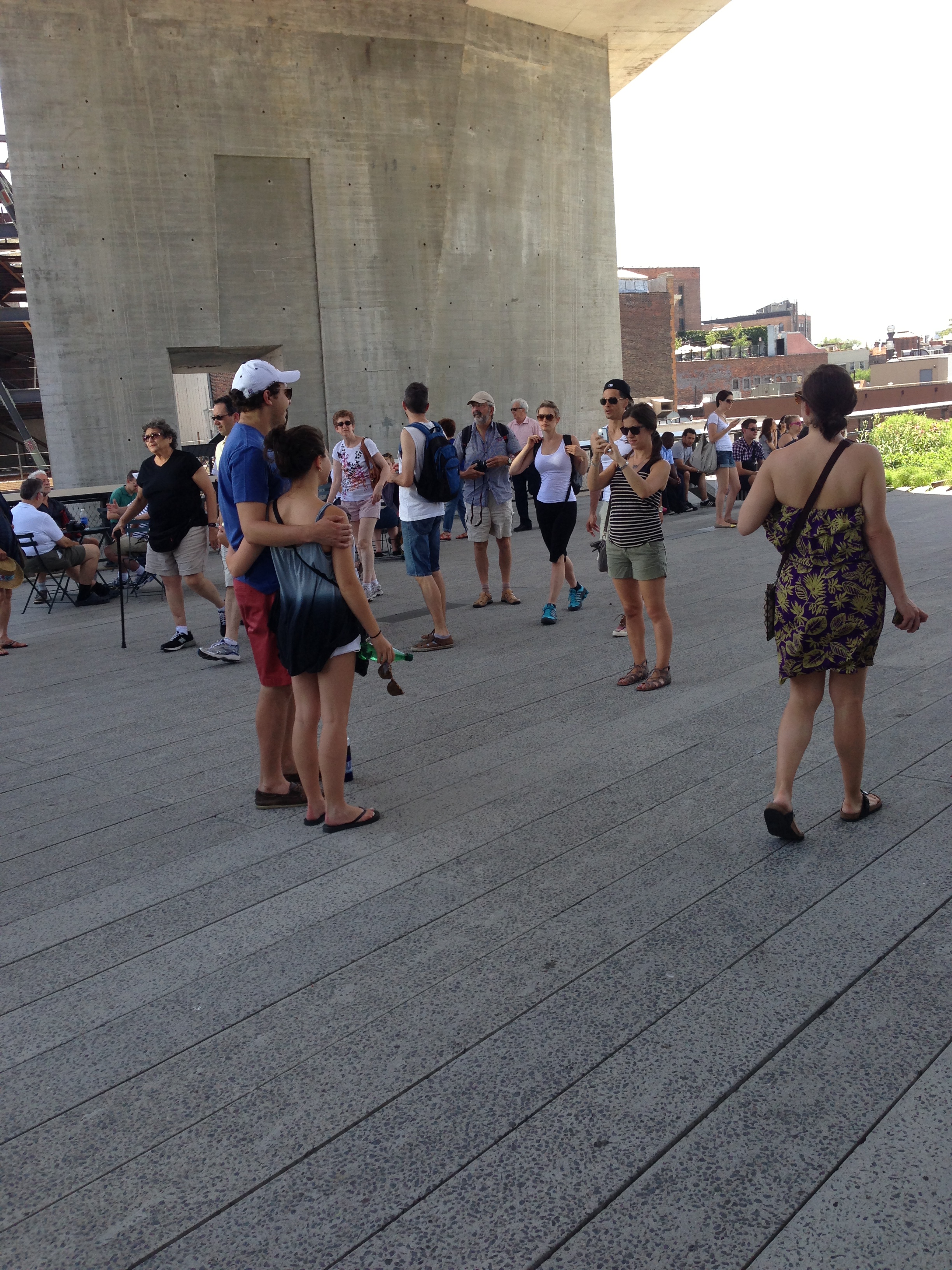
taking pictures

With the new, there’s the old – a mysterious pattern of bricks.

bricks

And a towering old painted sign: BONDED. Across it a tag reads REVS, shortened from REVLON, a famous graffitti artist. “It’s got to be on the edge, where it’s not allowed,” REV has said. There’s room on the High Line for all vintages.

old sign

The Gehry-designed IAC Building, at 555 West 18th Street, with its milky, origami exterior, has been open since 2007. Vanity Fair called it the world’s most attractive office building. It’s especially great to see it in tandem with structures of other vintages, including the old-fashioned piedmont of a lower one whose top is flush with the park.

Gehry

The Standard Hotel soars above. It gained some notoriety when High Line strollers realized they could look up and see happy exhibitionists making whoopee in the floor-to-ceiling windows.

the standard

(When Chuck Barris was looking for a word to meet the network censors’ standards on the Newlywed Game, the term ultimately settled upon was whoopee.) Meat trolleys for hanging beeves still exist if you look closely. Right along the Standard, in the shadows, a rusted remnant of the  district’s sanguinary past.

beeves

But one essential thing about the High Line is the views.

cityview

In the nineteenth century, landscape architects carved out pastoral views on grand country estates, cropping trees advantageously to accentuate vistas of rivers, mountains, or other natural elements. The High Line is the 21st century equivalent, with quirky street perspectives all around, framed from this tall iron structure.

bridge

After our promenade, we descend to vintage New York cobbles. A remnant of the lost city.
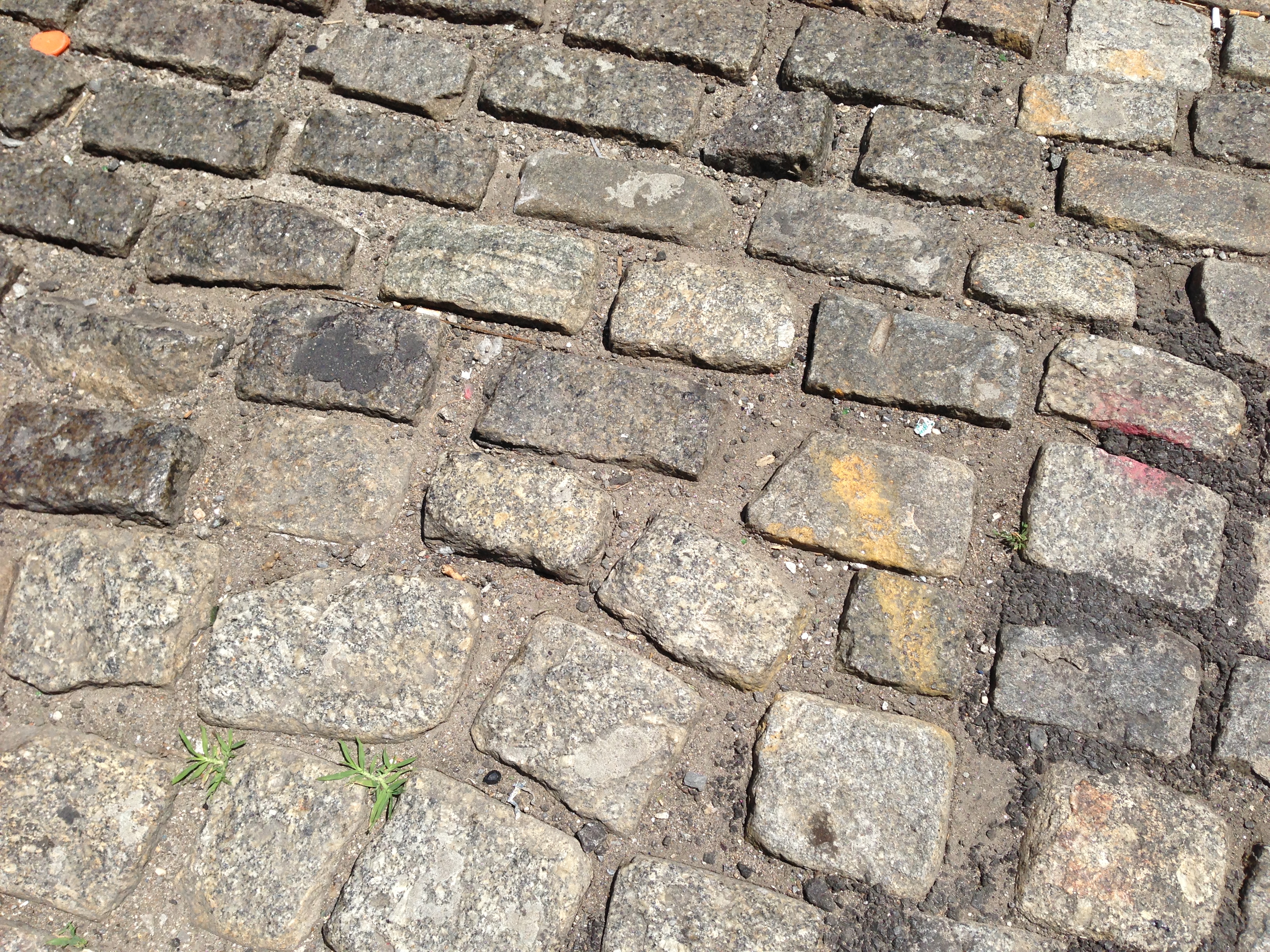
cobbles

We refuel at a restaurant called The Spotted Pig.
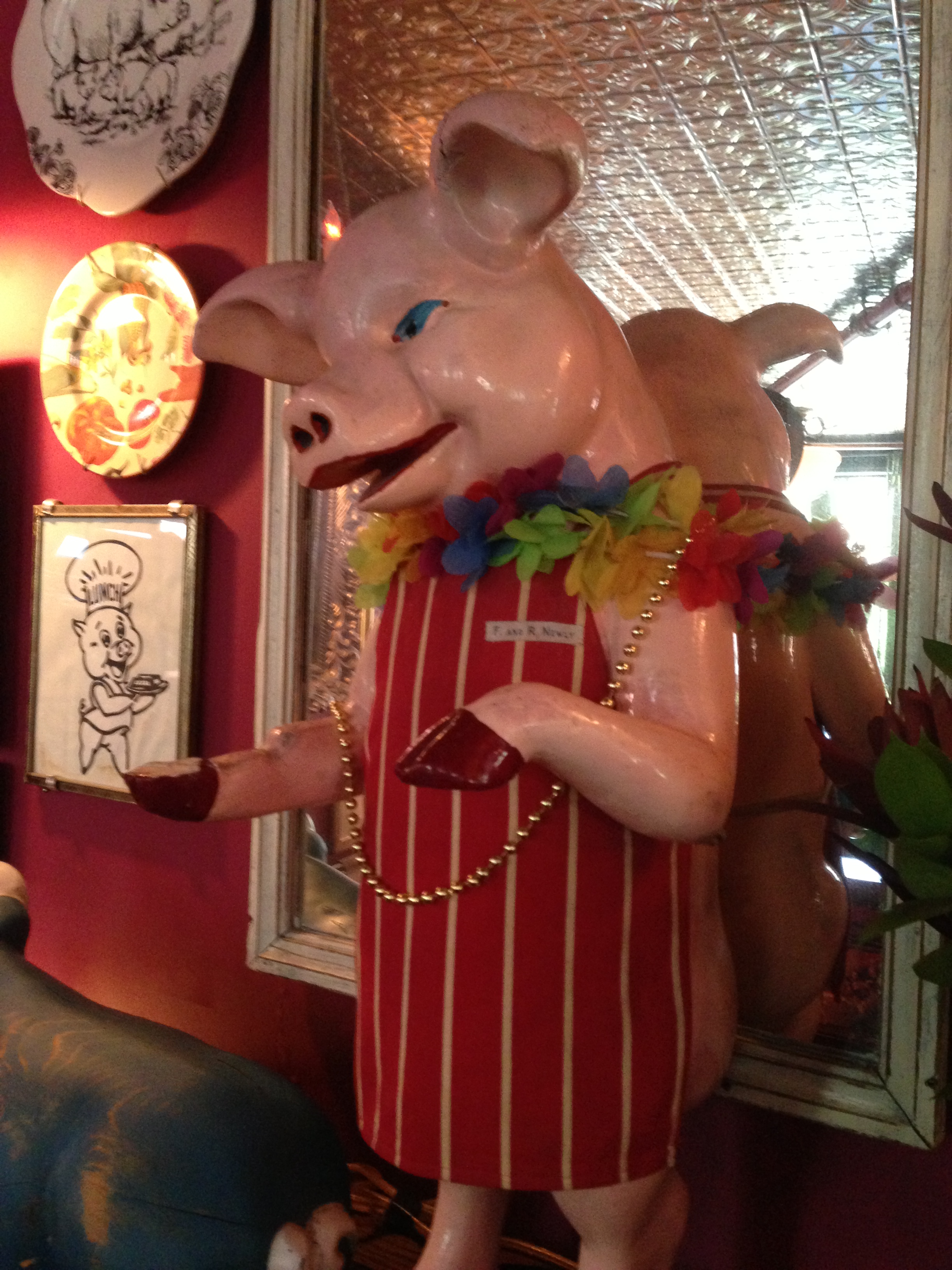
pig

The eggs it serves are divine, with crunchy flecks of sea salt.

egg

I am tired after our sun-blasted walk of a two miles. Jesse is wide awake, which he always is, except when he’s asleep.

jess eyes

And the french fries… well, it is hard to shovel them in fast enough.

fries

The chef strews the shoestrings here with shreds of rosemary. Everything tastes better after the High Line. An ordinary pinapple smoothie from a new perspective.

smoothie

A fantastic church frieze overhead. Had it always been there? I can’t recall. The galleries of Chelsea are closed on Sunday, but that doesn’t mean the great sidewalks of New York are closed for business.

girl graffiti

Too much graffiti has been scrubbed off in recent years. Manhattan is the new Minneapolis. Now we have clean, healthy biking all over town. In Greenpoint, Brooklyn,  where I visited a week ago, it’s a different – and more colorful – story, as it hasn’t quite shed its industrial past and makes a fine canvas for folks who do outdoor outsider art.

slut tribe

Here in the Meatpacking District we find a few worthy efforts.

boy graffitti

Two chicks etched on the sidewalk beneath our feet.
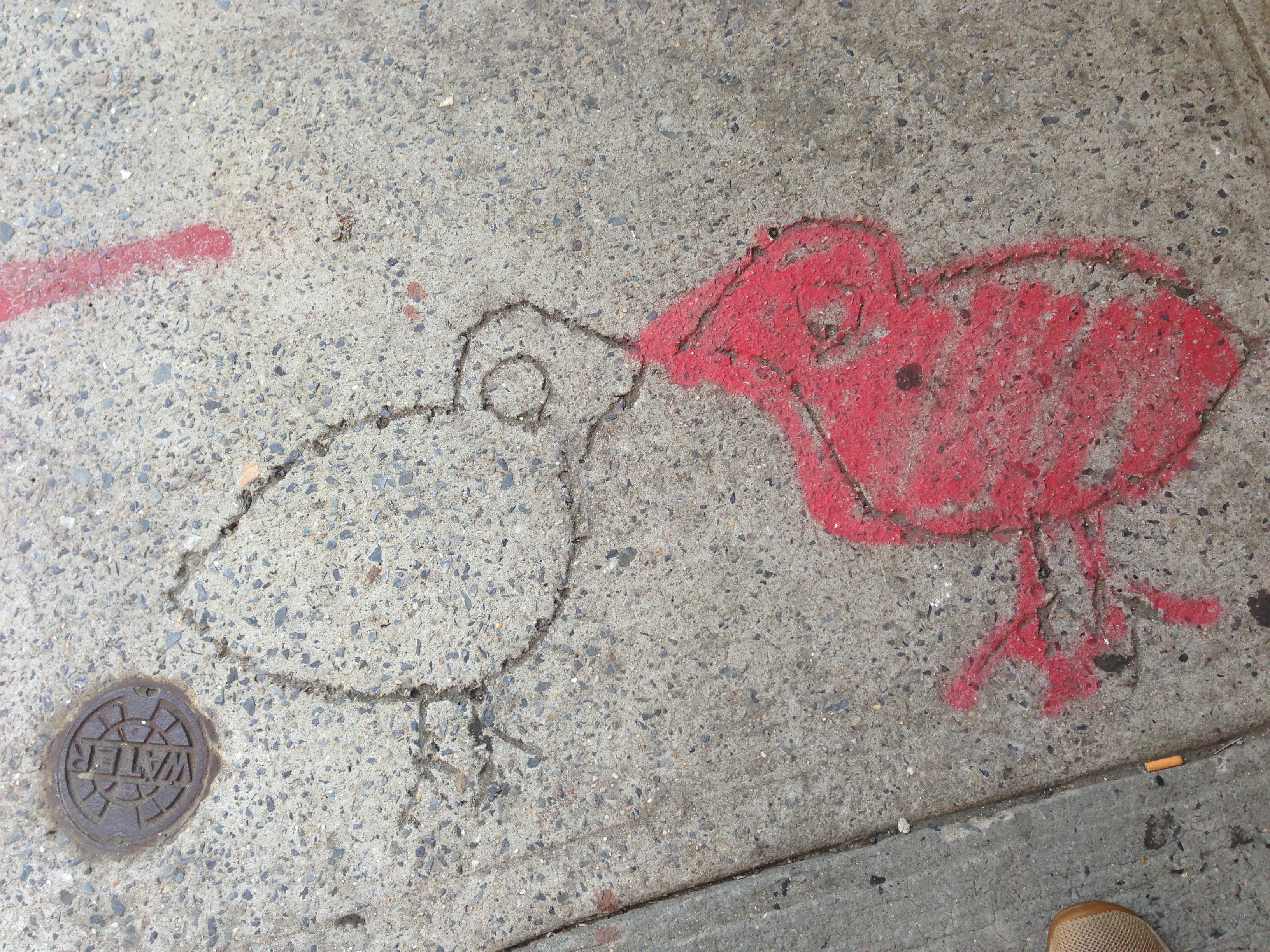
chick sidewalk art

For some reason I like these simple birds, making kissy next to their little water fountain.

The all-seeing eye. The Eye of Providence.

evil eye

On the island of Manhattan, if you let your vision wander up, you see some marvelous things. A blue horizon chockablock with architects’ freshest concoctions. Pieces of old New York, dusty red bricks that have miraculously been saved from the wrecking ball. Climbing roses, if you’re walking the High Line. From that same pathway, a glimpse of a well-to-do fanny in a chic hotel window. And there are still wooden water towers.

water tower

Just two companies, Rosenwach Tank Company and Isseks Bros., manufacture the tanks, which are unpainted and made with untreated wood. A new water tower is a leaky water tower, as it takes time for the material to become saturated and watertight. Chelsea has one, completely dry of course, that has recently been transformed into an exclusive club called Night Heron. You can see it from the High Line.
1 Comment

Filed under Art, Cooking, Culture, Fashion, History, Jean Zimmerman, Nature, Photography, Writers, Writing

By Heart

Driving west on Route 6, towards the Catskills, a summer weekday morning, and that old Talking Heads song comes on the radio:

I’m writing ’bout the

Book I read

I have to sing about the

Book I read

I’m embarassed to admit it hit the soft spot in my heart

When I found out you wrote the

Book I read so


Take my shoulders as they touch your arms i’ve

Got little cold chills but I feel alright the

Book I read was in your eyes oh oh

Thinking about when the book you’re reading touches you so much, the words become a part of you. The extreme of that is memorization.

My friend Bethany Pray, the person we’re driving to visit today, commits poems to memory. She wouldn’t say so, but it’s a rather serious pursuit. Not just a limerick for party performances, not a haiku or two. Real poems.  A discipline. She once told me she knew 20 or 30 by heart.

happy bethany

I’ve seen Bethany and Gil have poetry duels around campfires.

Slams? They’re easy. You get up and read or recite your verse, people cheer or boo. With a duel you must remember all the lines of a Shakespeare or a Blake. Not so easy.

Bethany says her favorite to recite is John Berryman’s Sonnet #37
.

Sigh as it ends… I keep an eye on your

Amour with Scotch,—too cher to consummate;

Faster your disappearing beer than late-

ly mine; your naked passion for the floor;

Your hollow leg; your hanker for one more


Dark as the Sundam Trench; how you dilate


Upon psychotics of this class, collate

Stages, and… how long since you, well, forbore. 


Ah, but the high fire sings on to be fed


Whipping our darkness by the lifting sea


A while, O darling drinking like a clock.

The tide comes on: spare, Time, from what you spread


Her story,—tilting a frozen Daiquiri,


Blonde, barefoot, beautiful,

     flat on the bare floor rivetted to Bach.

I remember Bethany recited it on a long hike we took around the rustic Rockefeller Preserve in Tarrytown, New York, and how I thought it was a poem I would find hard to follow on paper, let alone in air. Berryman was a tough one.
john-berryman

Berryman’s a favorite of Gil’s, too. Gil is at a slight disadvantage in a duel, at least in terms of volume, since he has not applied himself to more than a dozen titles. “There’s a word in Arabic,” he says, “for someone who has memorized the whole of the Koran.” HBO did a show on it, called Koran by Heart. But it’s rare to get a prize for memorizing poetry today unless you’re in 8th grade honors English.

quranramadan2

When I was in graduate school the Nobel Prize winning poet Joseph Brodsky loved the poetry of Thomas Hardy (and you thought Hardy only wrote novels) and made us memorize his poems and come in to class and write them out. Not a good assignment for me, as I barely can remember my own name sometimes.

“Pasternak was reading his poems in an auditorium in Russia and dropped his notes,” says Gil. “As he bent to get them the crowd picked up where he left off and finished the poem for him.”

Bethany calls herself a “poet without a portfolio,” but she is modest. Before earning a  law degree she collected an MFA from the Warren Wilson MFA program. She was already working as a paralegal, but “life was boring so I would put a poem in my desk drawer,” occasionally pulling it out. Not to read it – to memorize it.

Her coffee table groans politely under the weight of its poetry. “Kay Ryan is really great,” she says.

coffee table

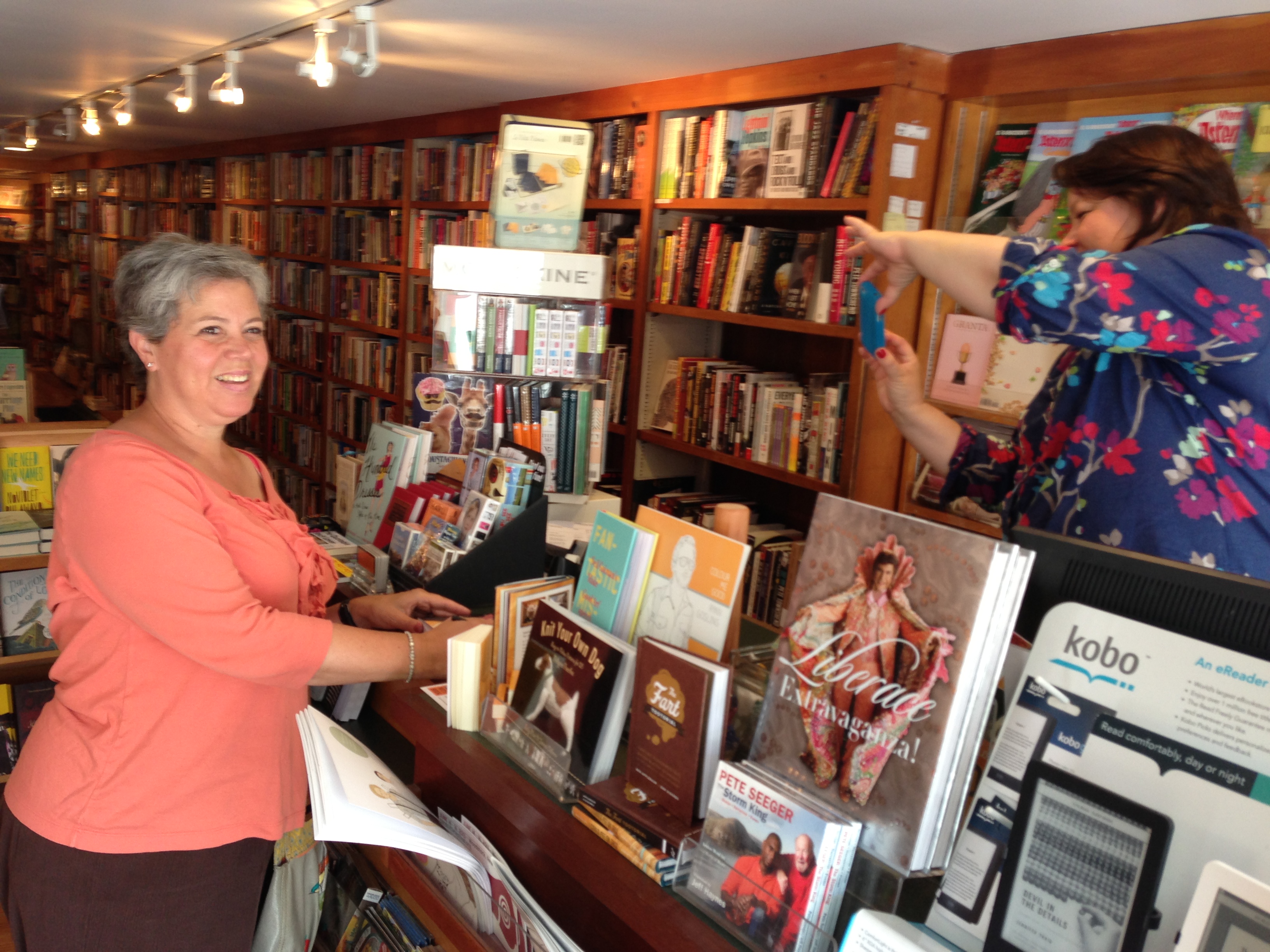
The duel still in our future, we stop for a sweet moment at Woodstock’s 35-year-old book store The Golden Notebook, to find that they are sold out of The Orphanmaster, with five buyers in the past week alone.

happy Jean

“It’s actually on my bedside table right now,” says Desiree, at her perch behind the counter. “My husband just read your book. He doesn’t like anything, he doesn’t like puppies, and he loved it.”

“You got to feel very famous,” Bethany tells me after we’ve left, happy that she guided us into the shop.

Woodstock is full of bibliophiles and music lovers.

guitar 1

Guitar sculptures stud the sidewalks, each one groovier than the next.

guitar 2

A café has a quiet patio that seems perfect for the poetry throwdown, beneath garlands of honeysuckle and twittering birds, near a lovely puppy with a clubfoot. We get ready to wax poetic. Or rather, they do. I prepare to clap and faint.

gil:beth

Gil begins with Thomas Wyatt’s sonnet to Anne Boleyn, Whoso list to hunt, I know where is an hind… His brain only smokes a little bit as he gropes in his memory.

Gil searching

Bethany goes with Emily Dickinson: On a Columnar self–. “It’s hard to understand her language,” says Bethany. “It’s a kind of mental straitjacket on her passions.”

What do both the duellists have in their quiver? What passions do they share?

They fuck you up, your mum and dad.   
    They may not mean to, but they do.   
They fill you with the faults they had
    And add some extra, just for you…

That’s the opening of Philip Larkin’s dark, hilarious This Be the Verse, one that Bethany and Gil could reel off together, as if in a rock band or at an Irish pub. Gil tells Bethany about the time he recited it in a talent contest at a Universalist family retreat in woodsy Minnesota and got sent away with his knuckles rapped. It’s hardly family friendly, but so brilliant, and Larkin was Poet Laureate of Britain, after all..

Gil’s turn. Blake’s London. I wander through each charter’d street…

Bethany: Ode to Autumn by John Keats.

Beth reciting

She delivers the three long stanzas and we are properly floored.

Another poem for the two of them together –another Berryman, one of the Dreamsongs. Life, friends, is boring. We must not say so.

Coffee all around.

Bethany, another Dickinson. Gil, some Macbeth. Bethany, Spring by Larkin. And she finishes with Berryman’s wonderful I keep an eye on your/Amour.

“His wife learned he was having an affair by reading those poems,” says Gil. I think Gil was inspired to hit the books for his next contest with Bethany, whenever that might occur.

“People survived in the Gulag archipelago by reciting long stretches of poetry,” says Bethany. She knows a poem by Pushkin. She recited it to someone she met, a Russian mail-order bride, who burst into tears, she was so homesick.

4 Comments

Filed under Culture, Fiction, Jean Zimmerman, Poetry, Writers, Writing

A Farm Grows in Brooklyn

Or sometimes Queens.

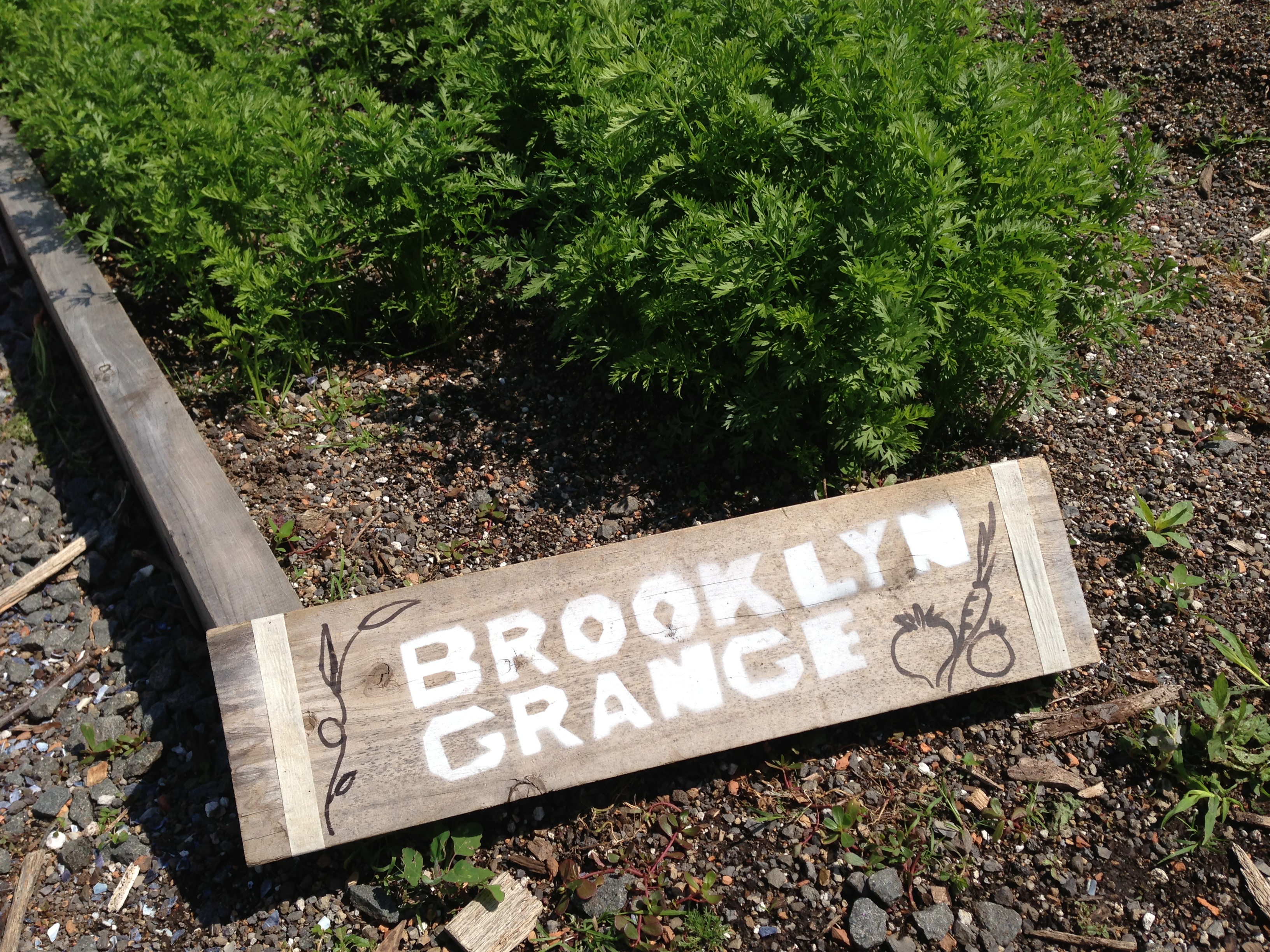
brooklyn grange sign

We had to find our way through a coffeehouse and the winding corridor of a building before getting to the unmarked elevator that led to the roof. Then we knew we had hit pay dirt, so to speak.

farm sign aslant

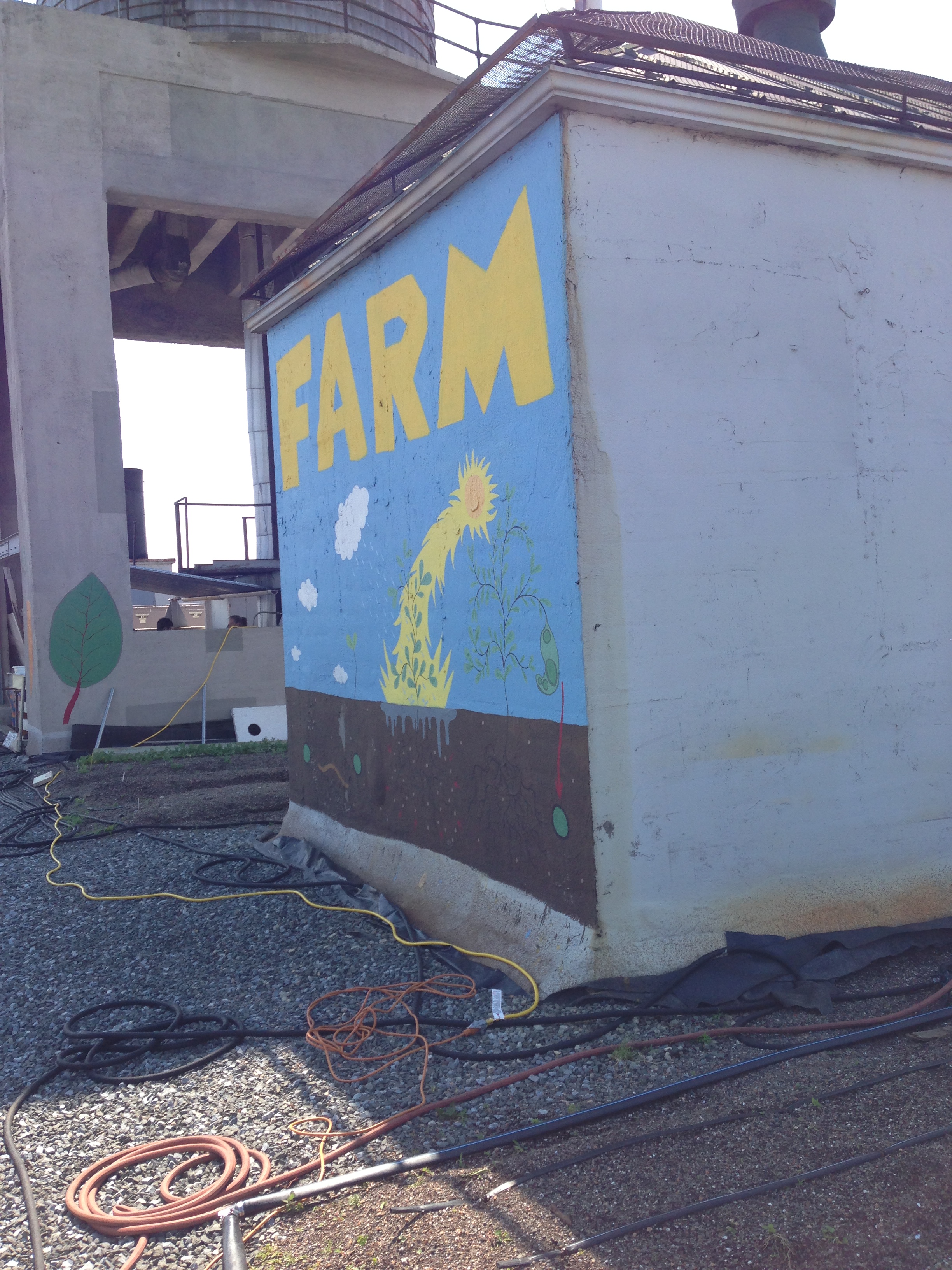
Brooklyn Grange is the largest rooftop farm in the country and perhaps the world. Sited atop a building that originated as a furniture factory, it has the space to produce at least three dozen different vegetables and herbs in the course of a season. You would never know it’s there, looking up from Northern Boulevard, a car-choked  thoroughfare that muscles its way through Queens, New York.

farm bldg

We were a little early. The volunteers were still bagging up the greens for the CSA as Gwen, a busy farm worker, applied sunscreen to her arms. This is great weather for kale, said Gwen. All the rain makes it really spring up. The farm stand also displayed beautifully fresh carrots, mesclun, scallions.

greens in rows

A farm on a roof has to have all the things a farm has on the ground. Worms.

worms

Compost.

compost bins

The farm manager, Bradley, wearing a bright green tee shirt whose back was emblazoned with the words, “This is what a feminist looks like,” told me a little about the chickens.

chickens

The dramatic white one, he said, was a Japanese silky. I asked him about the manure, so great for vegetables. They have about a dozen birds. They give what they can, said Bradley. He directed the volunteers out among the rows to harvest thyme and flowers. Tourists and photographers were beginning to show up, most with the kind of equipment that views like the Farm’s deserve. This one, taken on another day, is by a photographer named Cyrus Dowlatshahi.

Brooklyn-Grange-by-Cyrus-Dowlatshahi2

You feel you could leap the distance from the pepper plants to the Empire State Building in one stride – or at least that Philip Petit could make a project of the crossing.

Photographer Rob Stephenson has made some striking pictures of New York’s farms and gardens.

Hells Kitchen

Not just rooftops but the kind of small, intimate plots that can in found in Harlem and the Bronx, and nurture peoples’ souls as well as their stomachs.

community garden

Close up at Brooklyn Grange you can see the serious thought behind the endeavor.

lettuce w sign

The rows of stakes waiting for the tomato’s slow and steady climb.

tomato stakes

There are roughly 1.2 million pounds of soil in this one-acre plot.  Could the concrete slab roof  give way? Absolutely not. All these details and more are readily available on line.
You can book an event at the rooftop, even a wedding. Perhaps guests could weed between glasses of champagne.
Brooklyn Grange is joined by other urban farms in New York: Added Value, Tenth Acre Farms, Battery Urban Farm, Gotham Greens and and Eagle Farm are just a few of these enterprises. One researcher was quoted in The New York Times last year: “In terms of rooftop commercial agriculture, New York is definitely a leader at this moment.”

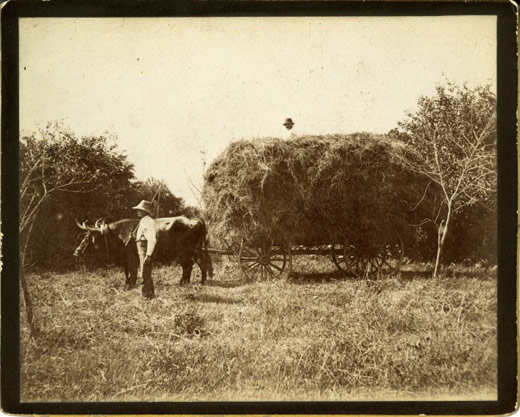
There is a long history of agriculture in the boroughs of Brooklyn and Queens.

Farming-Scene

According toRobin Shulman in her lively and informative book Eat the City: A Tale of the Fishers, Foragers, Butchers, Farmers, Poultry Minders, Sugar Refiners, Cane Cutters, Beekeepers, Winemakers, and Brewers Who Built New York, “As late as 1880, Brooklyn and Queens were the two biggest vegetable-producing counties in the entire country.” She cites one observer as saying, “The finest farmlands in America, in full view of the Atlantic Ocean.” Farmers in the boroughs used the manure of city horses to fertilize their crops, which they brought to the Manhattan market by boat.

I’m thinking about farming as I coax my tiny vegetable plot to maturity. My new strawberries have come in.

new strawberries

And some tomatos, the size and texture of an Atomic Fireball – remember those? – though not the color, yet.

fourth of july

But I’m tired of all this just looking at good stuff growing. Where’s the table in the fashionable farm-to-table equation?

One was set for us at The Farm on Adderley, in the neighborhood of Ditmas Park, Brooklyn. There is nothing like a restaurant with a mission statement: it “has evolved to pursue the principles of supporting local farmers, artisans, entrepreneurs as much as possible, making delicious food from that, and serving it in a completely honest way.”

pastured poultry

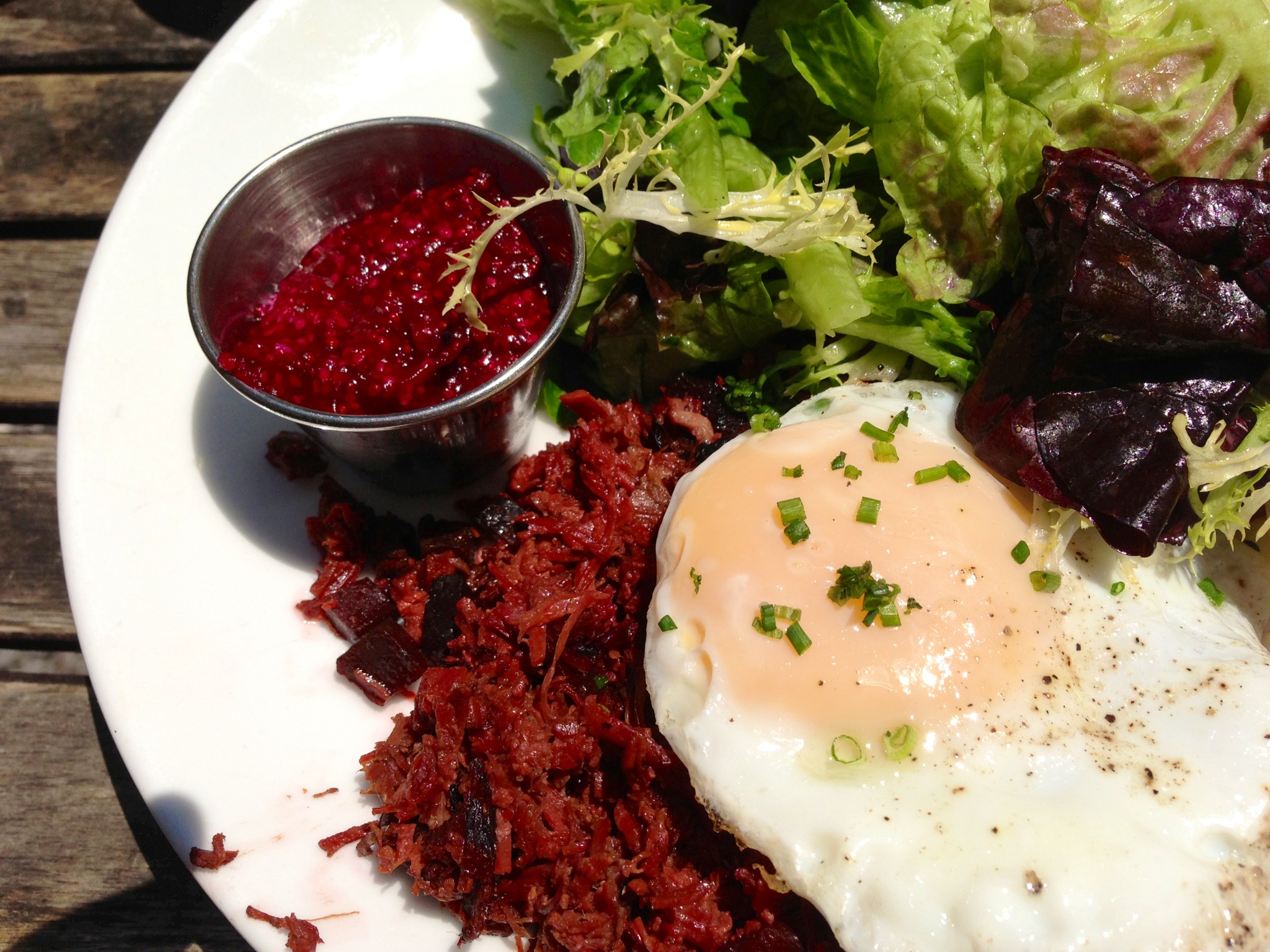
You can get a list of the local farmers who provide the kitchen’s ingredients. But that doesn’t mean anything to me unless I get a plate of food that’s good – as was my red flannel hash, its corned beef colored deeply with beets, and an even deeper burgundy horseradish served alongside. Did it taste better because the beef that was corned had roamed freely? Yes, I believe it did.

hash

The hostess brought to mind a farm girl in her friendliness, and she seated us in the garden, between a towering fir tree and a luxuriant grape vine, next to a wooden crate planted with chard and mint. The sun shone down, and we could have been out in the country. The place hosts events, like a New Amsterdam dinner “curated” by food historian Sarah Lohman, who is an educator at the Lower East Side Tenement Museum and author of a blog called Four Pounds Flour, devoted to “historic gastronomy,”

We were lost in the perfectly crisp, chewy, salty french fries, served with a sultry curry dip.

french fries

Couldn’t help, though, but overhear the young couple next to us planning their nuptials. Should we let them know about Brooklyn Grange? There could be worse places to grow your relationship.

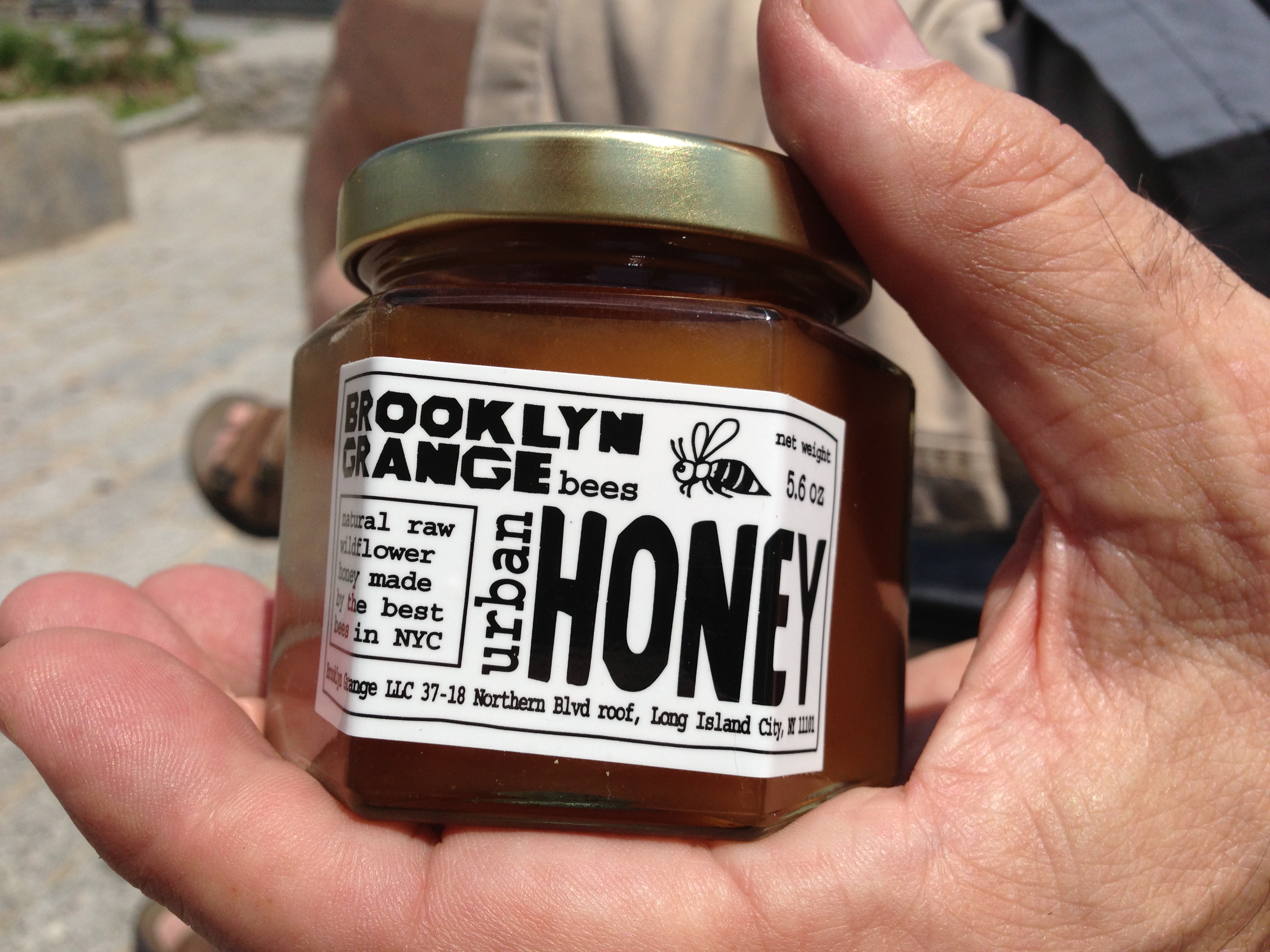
honey


4 Comments

Filed under Cooking, Culture, History, Home, Jean Zimmerman, Nature

Serene and Green

I wondered how it would work, so I went to find out. A literary event in a clothing store in Yonkers, New York. A literary event that had nothing to do with fashion, actually: Reeve Lindbergh, the author of family memoirs, essays and children’s books, would be reading excerpts from the latest volume of her mother Anne Morrow Lindbergh’s writings, Against Wind and Tide:Letters and Journals 1947-1986.

against

The store was Green Eileen, an offshoot of Eileen Fisher where I often go to replenish my wardrobe.

colorful clothes

The clothes Eileen Fisher designs are elegant and serene, with unstructured lines and natural fabrics. If you like linen and silk, this is the place for you. It’s definitely the place for me, but by the same token I often wonder if I can live up to my clothes.

Maybe I like this place so much because the company’s ads showcase graceful  silver foxes alongside the usual younger models. Grey is the new brunette, or didn’t you know?

jean grey

There was an elegant buffet and wine. Reeve began. She read from the book, but even more interesting was the patter that pulled those passages together.

reeve

She told us about her mother’s ever-present blue notepads, containing carbon paper to make three copies, one for the letter recipient, one for her personal archives and one for the master archive at Yale (open to all as of April, as it happens). Anne Morrow Lindbergh often wrote three to four long letters in a day, yet despaired of getting enough writing done. Reeve remembers banging on the door of her mother’s “writing house” and how mad her father got – that’s the only time she had to write, he reminded his daughter.

The title of this volume is a quote from Harriet Beecher Stowe, who claimed that writing, for a wife and mother, is “rowing against wind and tide.” When Reeve herself became a writer, at one point she tragically lost a child and was afraid she would never put pen to paper again. Her mother’s reassurances “probably saved my life,” she told us. “Mom said stop reading the things you think you should be reading and instead write on little scraps of paper the things going on around you.” Reeve still makes this a practice, she said.

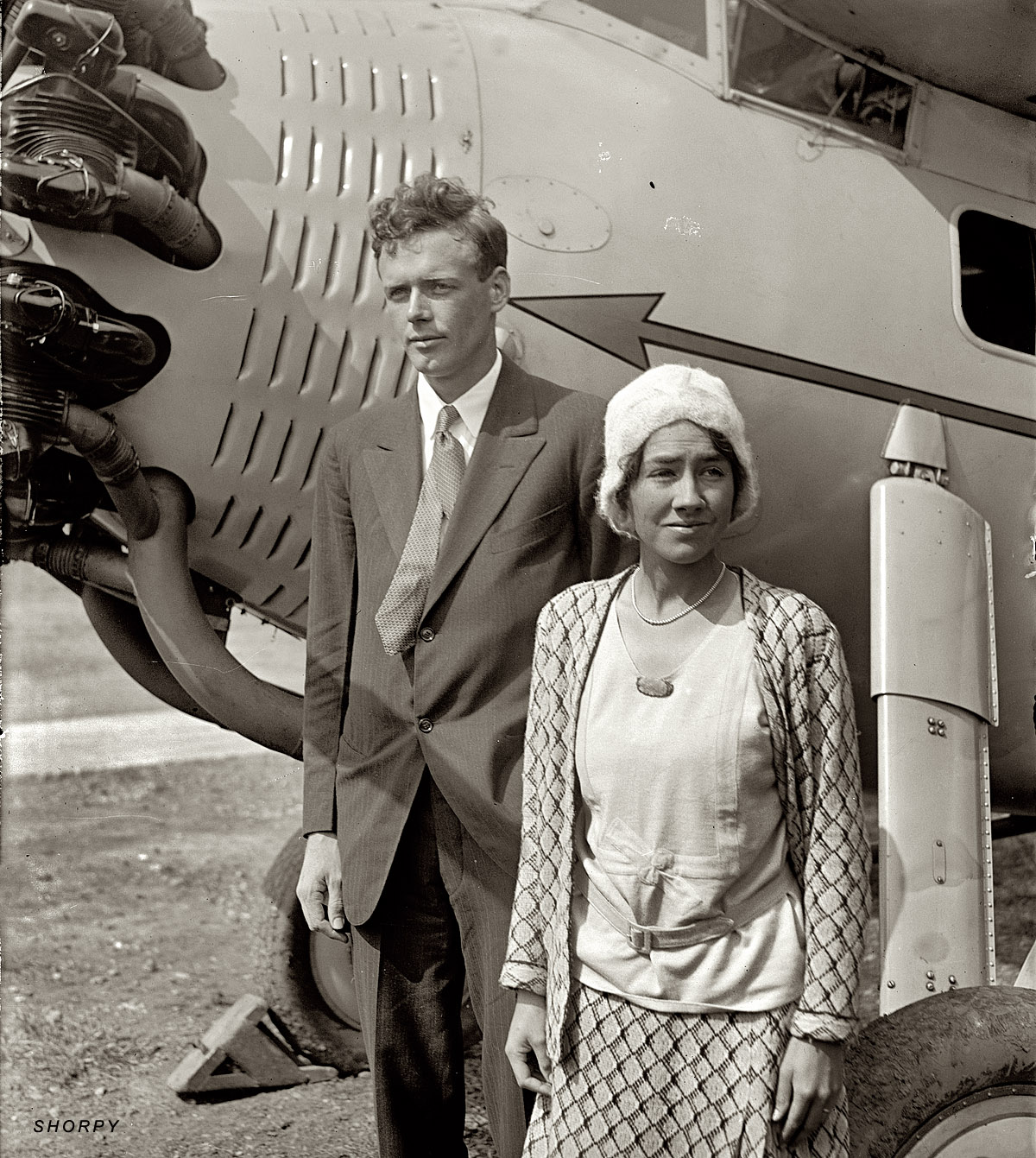
lindberghs

Anne Morrow married Charles Lindbergh, then the most famous man in the world, in 1927, and got her own pilot’s license the following year. They flew the world over while she continued to produce nonfiction, fiction, articles and poetry, with the 1955 Gift From the Sea a seminal work of feminism and environmentalism, never having gone out of print.  A book mothers give to their daughters, who give it to their daughters in turn.

Gift from the Sea

Reeve spoke about her father’s comings and goings, even his infidelities, about the “strong and interdependent relationship” the Lindberghs had nonetheless over 40 some odd years. Charles Lindbergh “showed us a world – his world – that he wanted us to see,” said Reeve of the family, but he could definitely be difficult. Reeve’s mother, she said, always felt her husband’s controversial opinions about Hitler and the Second World War had been misconstrued.

In this volume, Anne Morrow Lindberg talks about her pregnancies, about considering an abortion, about a miscarriage. She rewrites her wedding vows: “Since I know you are not perfect I will not worship you,” is one. “Marriage is not a solution to but a mirror of problems,” another. She wrote a lot about the need for aloneness –how important it is.

“I see life as a journey toward insight,” said Anne Morrow Lindbergh in a speech at the Cosmopolitan Club when she was 75.

Reeve’s editor on the new volume sat in a front row and nodded as she detailed how together they had combed through the archives at Yale to fill the book. All the material was handwritten and had to be typed before the painstaking selection.

The presentation concluded, and I wandered among the garments that lined the store like bright, clean flags. I’d love to be a person to wear textured pink silk.

pink shirt

Two books were being sold: Against Wind and Tide and a children’s book by Reeve Lindbergh called Homer, the Library CatTen bucks from the sale of each book would go to the Eileen Fisher Foundation.

Jen Beato, the Store Leader, told me why a presentation of the work of Anne Morrow Lindbergh fits the setting of Green Eileen. Every book wouldn’t make sense, she said, but this one shows “how challenges she faced are similar to today’s challenges.”

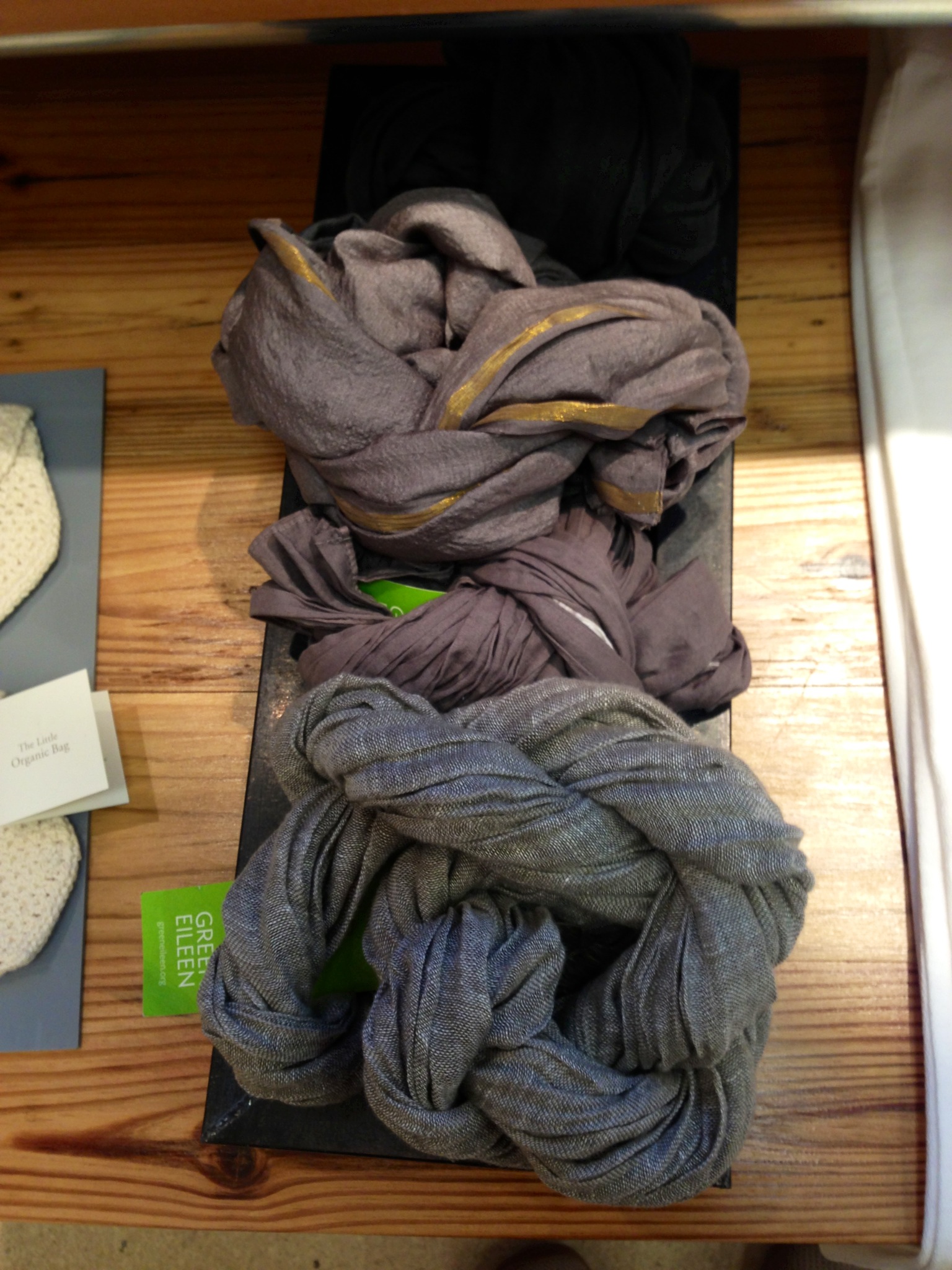
knots

Green Eileen accepts contributions of gently used Eileen Fisher clothing – say you lose some weight, or gain some weight, and you can no longer fit into that perfect pair of pajama-y palazzo pants — which it recycles and sells at an affordable price, with the proceeds going to causes for women and girls locally, nationally and around the world. The National Women’s History Museum,  the New York Women’s Foundation and Planned Parenthood, among many others.

The company makes good points, so I feel virtuous running my fingers over that sleek textured silk.

pink

The average American throws away 68 pounds of clothes per year. Over 4% of global landfills are filled with clothing and textiles. Almost 100% of used clothing is in fact recyclable.

Green Eileen has a pretty cool blog. The store is always sponsoring workshops about crazy things like recycling your wool, cashmere and silk into fabric jewelry. Maybe I’ll go to one sometime.

As night fell, inspired and on my way to insight, I wandered past the rack of beautiful castoffs, now reclaimed.

white clothing

In a simple white bag, I toted my virtuous purchase. Not the pink silk, but  a knee-skimming shift of white linen that will look serene and elegant on my daughter. Then I’ll take something out of my closet to give back to the store.

7 Comments

Filed under Culture, Fashion, History, Home, Jean Zimmerman, Publishing, Writers, Writing

Strangers on a Carousel

I get to see the carousel horses at Binghamton.

george w girlThe Triple Cities, actually — Johnson City, Endicott and Binghamton. A part of the world that strikes me as sort of a blank, a cipher.

blank sign 2Some houses crumble and gape, seemingly lost in time.

sad house


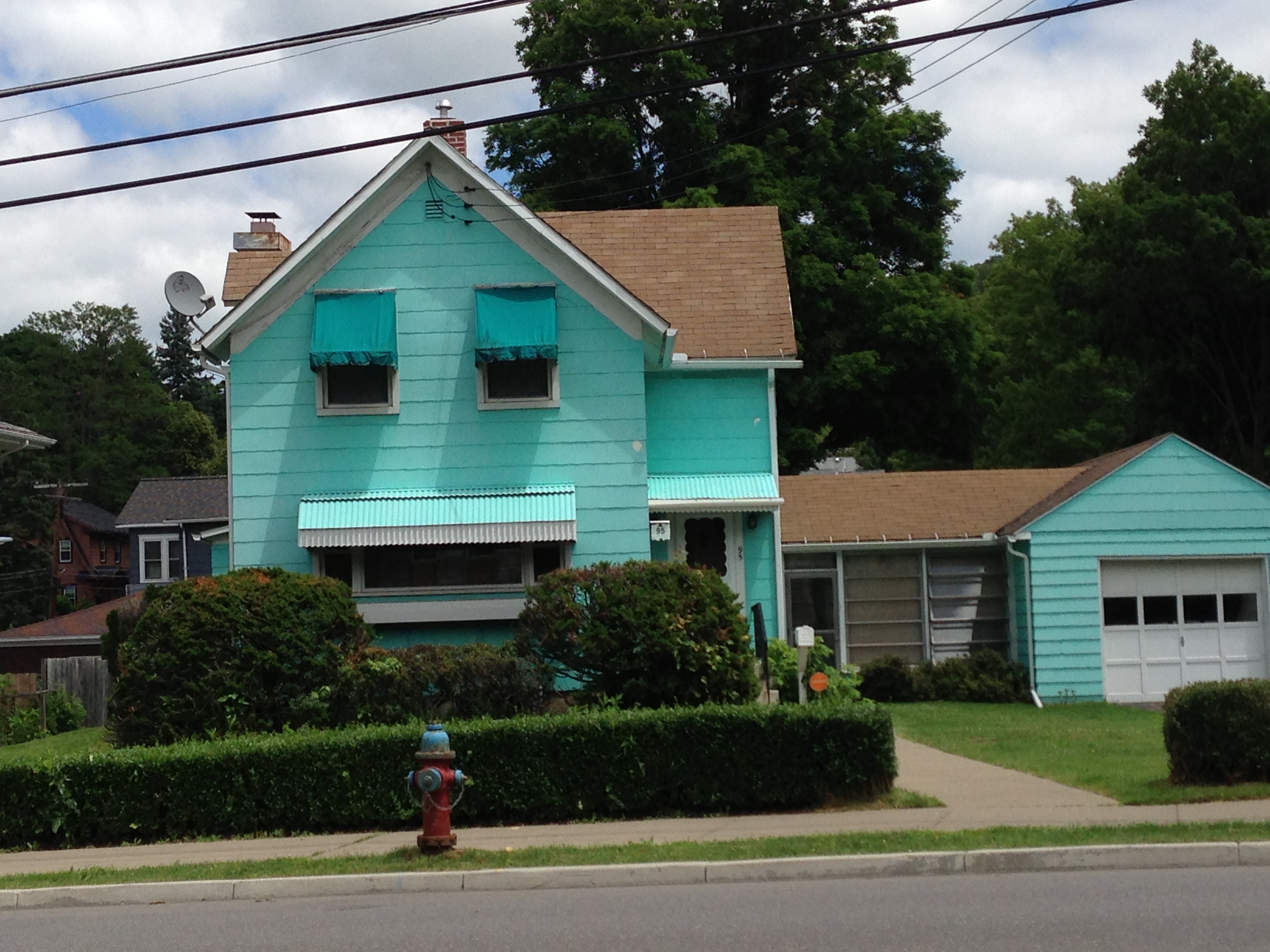
Others are spruced up as garishly as 42nd Street tarts.

blue houseOf course, some of this decrepitude I love. A weatherbeaten sign with “international” flair.

signA space-age car dealership with weeds sprouting up.

card dealerAll thoughts of the crumbling present go away when we visit four of the six  heirloom merry-go-rounds that still grace the Binghamton area (out of 150 in North America). The first one was installed in 1920, and sits next to a  little zoo — you see and smell a big black pig in its pen as you go ’round. The Ross Park carousel is completely unadvertised, a secret gem known to only a few, reached via a flower-bordered path. The horses, “jumpers,” as they’re called, are a little tattered.

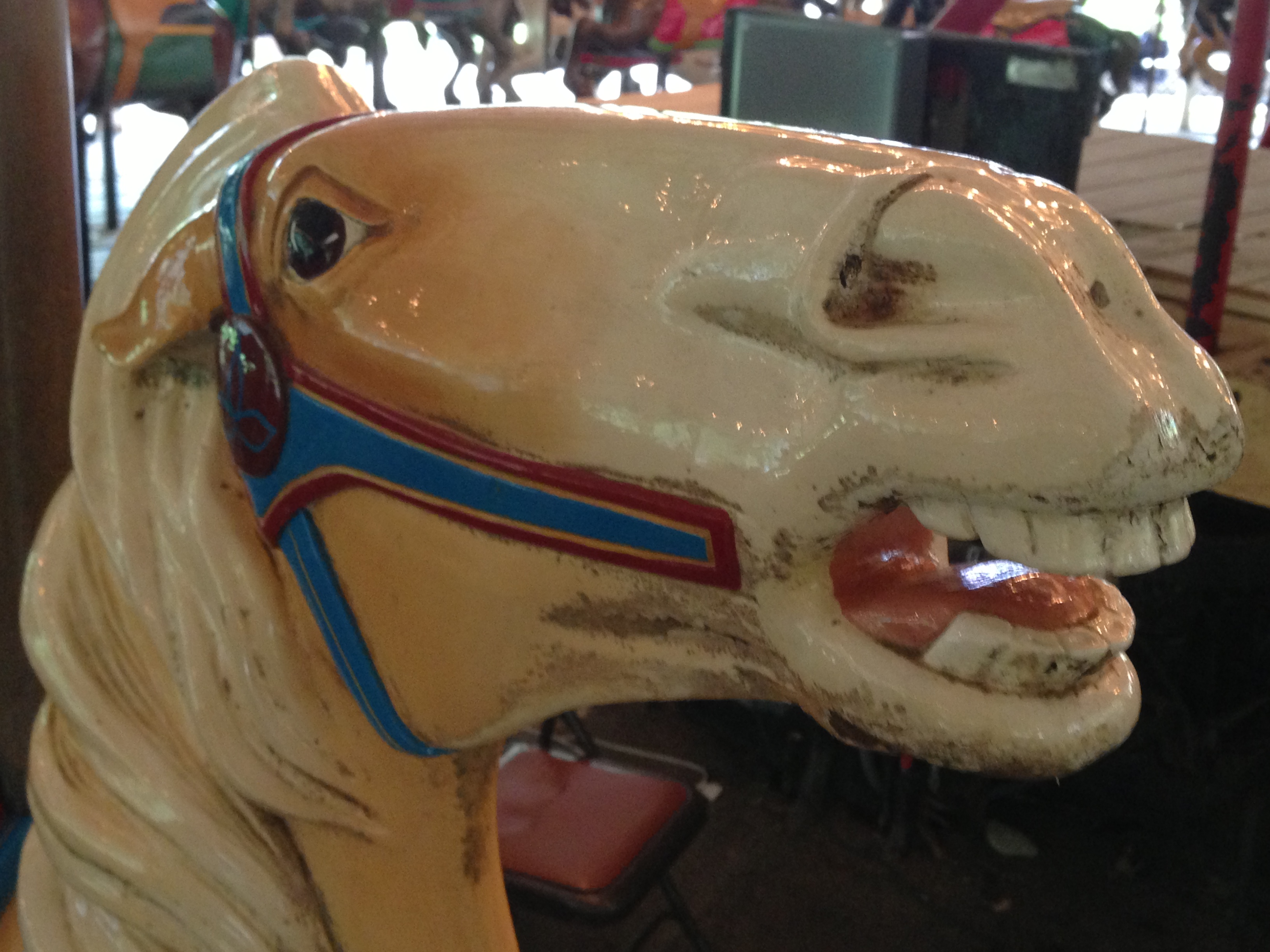
zoo horse 2Gently worn. Still, the original 51-key Wurlitzer Military Band Organ sends you around, and the chariots are flanked by a bathing beauty and an ape, which we sit next to for the whole ride, not noticing its dramatic visage until we rise, slightly rocky, to our feet.

zoo apeA young Tobey-Maguire-in-a-shaved-head-role lookalike blows a whistle, the carousel comes to a halt and we jump off.

The richest men of the city, the Johnson men, funded these spectacular rides of hand-carved wood, made by the Allan Herschell Companies of North Tonawanda, New York. You can visit them all in a day if you get there at the right times, as we do, fueled by a long set of Captain Beefheart on the university radio station. Another of the carousels, in Endicott’s Little Italy, projects a more demure ambiance. It’s housed conveniently next to both a swimming pool (“No Wet Clothing Allowed”) and a window for home-made frozen custard, where a girl is in the middle of changing out the Holy Cannoli for the Watermelon on the flavor board when we arrive.

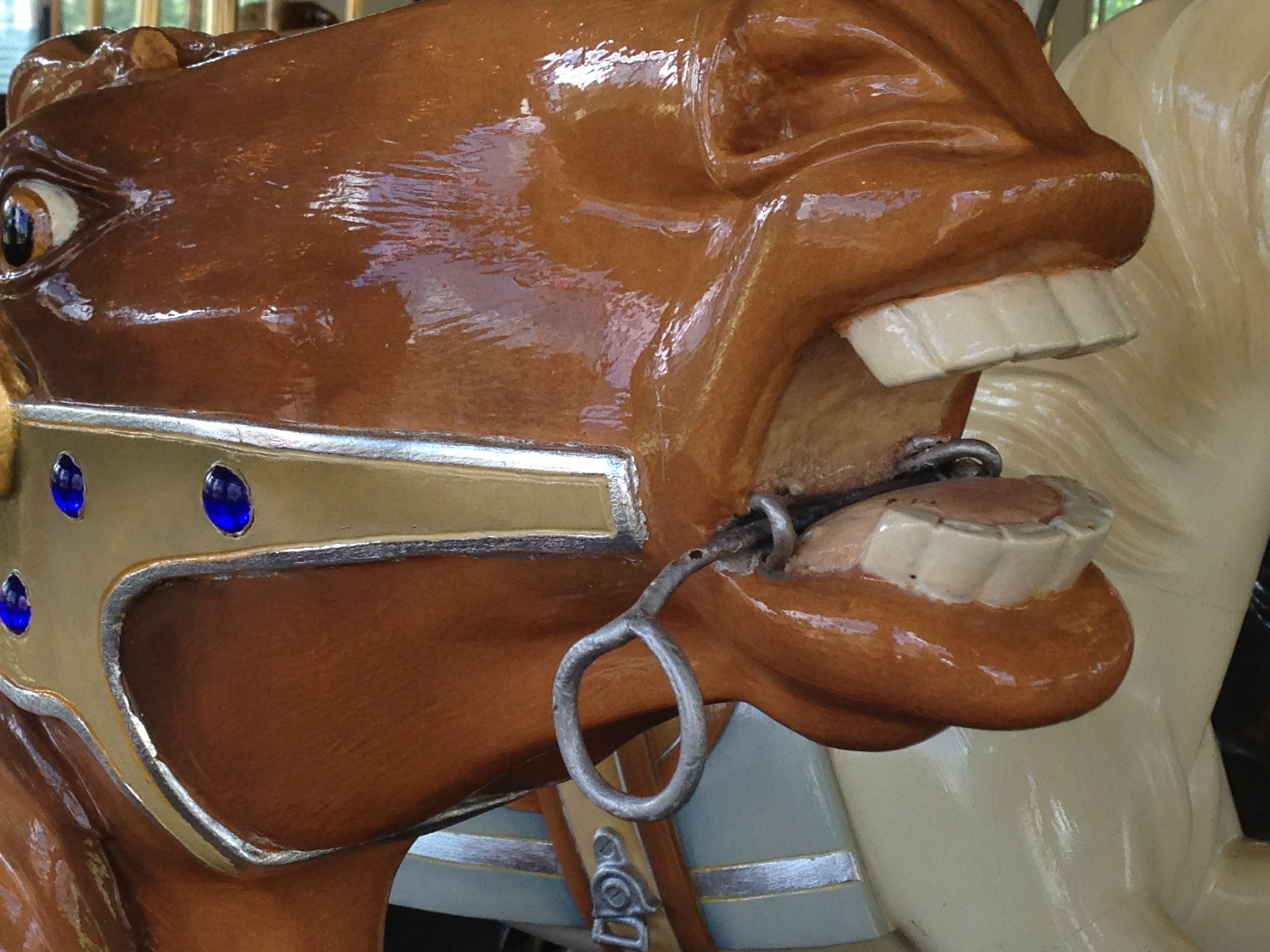
george horseCare has been taken to preserve and restore the beasts over the years. They are pretty, high-stepping it around the ring. Once upon a time you had to pay admission — a piece of litter! — to get a ride. Now it’s free to all and you can leave your trash in the can where it belongs.

Suddenly, the pavilion gets very quiet. All the kids vamoosed. Is there anything spookier than a silent carousel, especially one that will be 80 years old next year? Then again, calliope music can seem manic, even deranged, and the whole atmosphere fraught — see Strangers on a Train, when the whole ride flies off its axis.

And the horses go around and around, around and around. In Savage Girl I tell the tale of New York’s Central Park carousel, which once upon a time was drawn in its circle by mules trudging in a basement beneath the platform. True story.

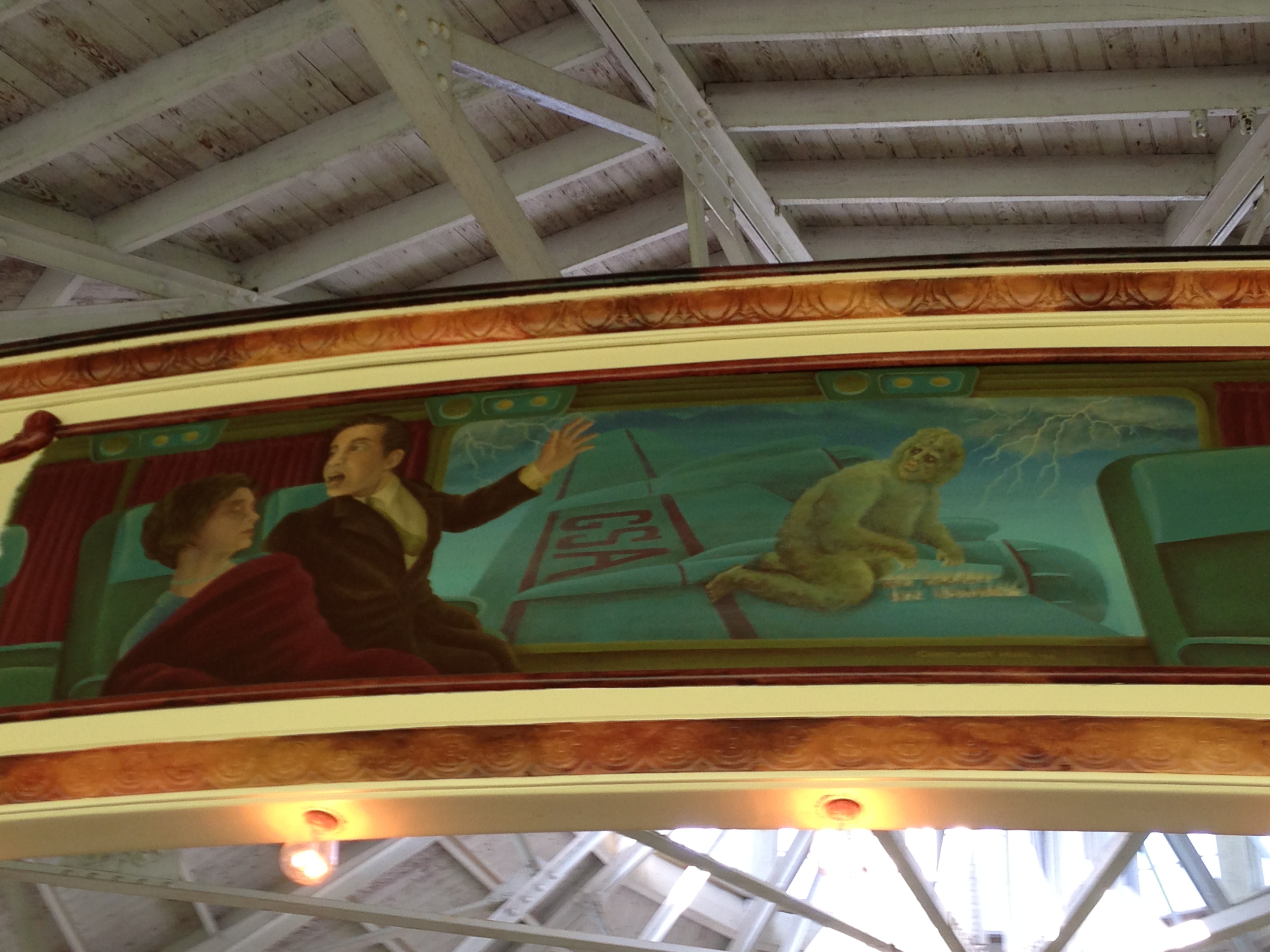
Another carousel, this one at “the Rec”, one of the area’s most used parks,  unexpectedly has a series of rounding boards which feature scenes from Rod Serling’s Twilight Zone. They were painted by artist Cortlandt Hull during a refurbishing in 2011.

twi 3The carousel came to Recreation Park in 1925, well before the TV series, but Serling grew up in Binghamton riding the carousel, so it all makes sense. There’s even a picture of the carousel itself– a scene from the show or a fictive portrait of Serling in his old stomping grounds?

twi 2Endicott-Johnson, the company that earned fortunes for the family that built these beauties, was so big, it made every pair of boots that outfitted American soldiers in world war one. George F. Johnson, the company’s big daddy, in 1916 mandated a 40-hour-work week. Generous, for the time. So was giving his 24,000 workers carousels.

Jack Dougherty, ready with his whistle on a lanyard, told me that they have to be careful at the Rec, closing it up when some rowdy middle schoolers come raging around every afternoon.

Jack

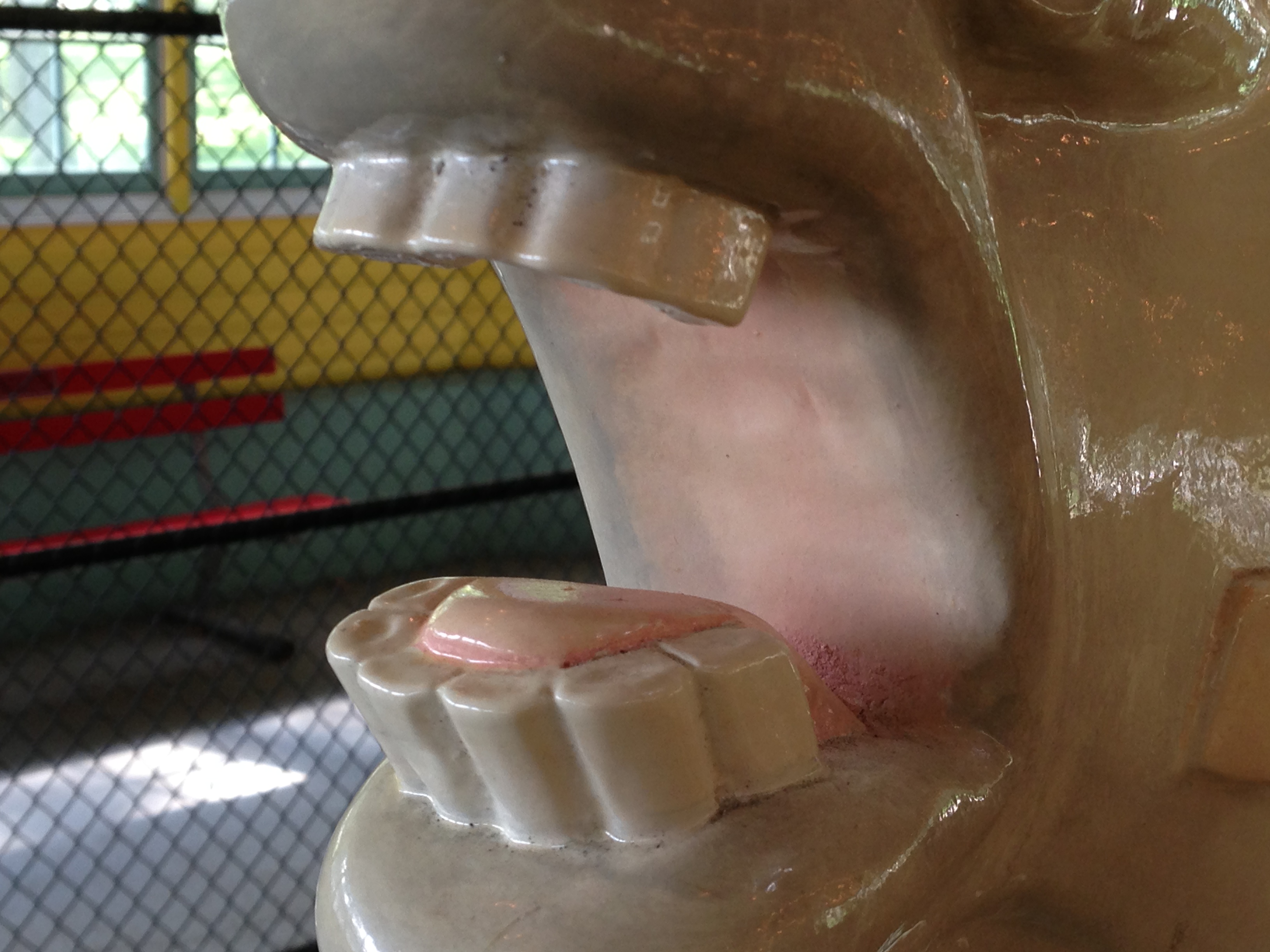
Can’t risk damage to the jumpers. The detail is really exquisite.

twilight chompers


They seem much more sturdy than they are. They’re real/not real.

I wonder if the children of the Triple Cities are somehow happier because of all the carousels in their midst? On the day his namesake merry-go-round opened in 1934, more than 500 neighborhood children paraded to George W. Johnson’s house with a bouquet of flowers to show their gratitude.

george brown horse


Made by human hands, each of them, so brawny and so delicate.

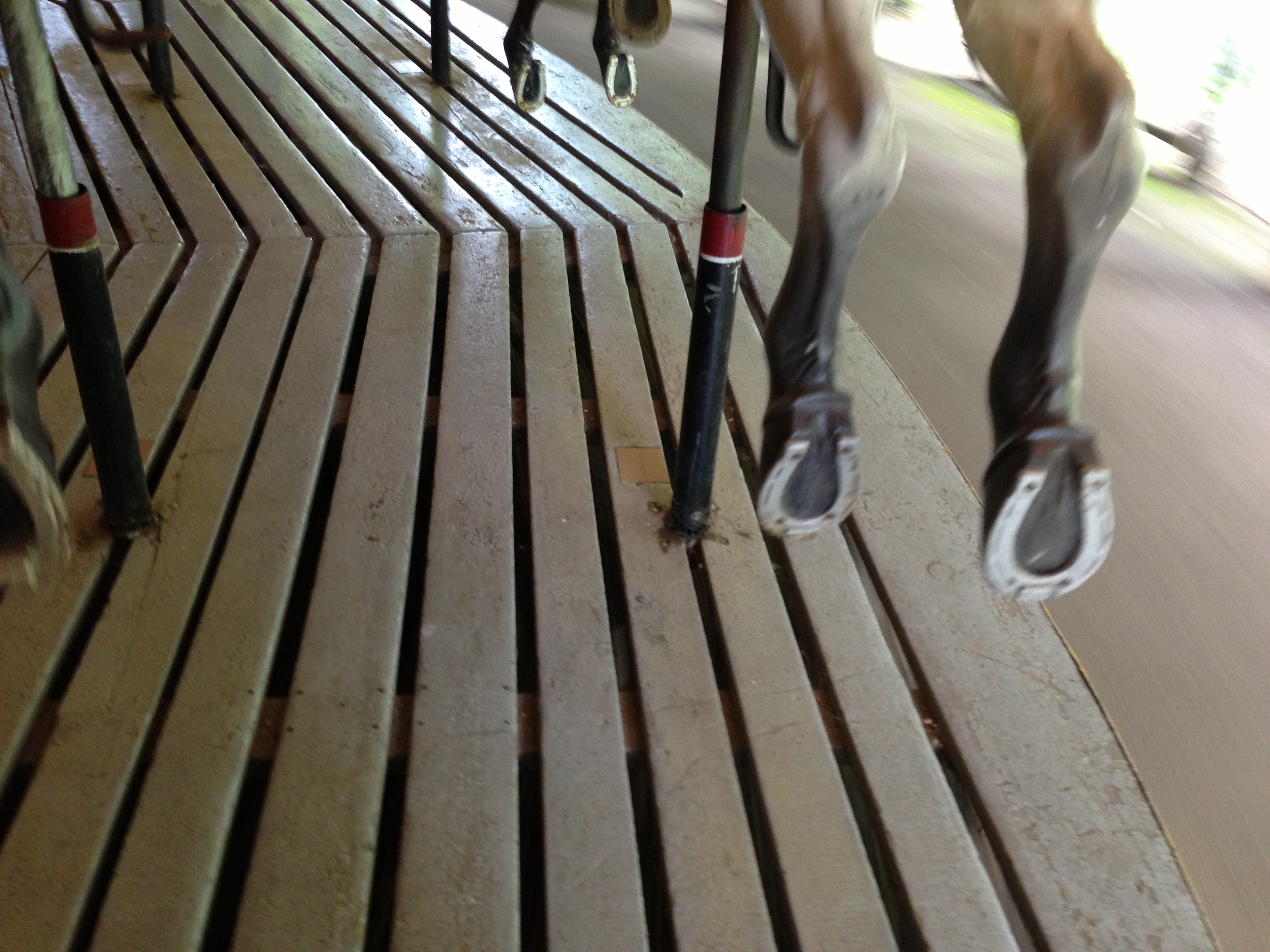
zoo hoofs


5 Comments

Filed under Art, Culture, Fiction, History, Jean Zimmerman, Savage Girl

The Incomplete Fetch

Gil and I have a conversation about Oliver, who has the entrenched habit of greeting whomever arrives at our front door with a shoe in his mouth.

Oliver fetching


Gil: We used to have a purebred dog who looked like a movie star. Whenever we took her out, her adoring public would gather around to ooh and ahhh. This was before a lot of people had shiba inus.

Daisy


Me: She was beautiful, but she never brought us any shoes. In fact, everything had to be brought to her.

Gil: Our present beast, in contrast, has issues. Oliver is a mutt, an unlikely combination of a basset hound and a pit bull.

Maud:Ollie


Me: He was a rescue puppy, which excuses some of his defects. Clown-face is the best name we ever had for him.

Gil: He looks stumpy and low to the ground. He has a slight harelip. His breath is atrocious. If his adoring public ever gathered around him, he’d growl and bark at them. Oliver is an example of a creature that is difficult to love.

oliver about to copy

But love him we do, with a passion. I sometimes think this is a gift he gives us, challenging us to love when loving is sometimes not that easy.

Me: The more I see of men, the more I like my dog. So said Pascal. I think that Oliver’s incomplete fetch at the door — incomplete both because you don’t start the action by throwing to him, and because he won’t drop the shoe at your feet — is perfection itself.

ollie shoe out the door


Gil: We have taken to wagering what kind of footwear he will greet us with: a sandal, a boot, a clog. His present-giving never fails to cheer us.

Me: You have to admire the spirit of a dog, no matter show stupid it may see sometimes. Oliver performs the same act over and over again just as eagerly.  Sometimes with a sock, if a shoe’s inconvenient.

Ollie nose sockIf we leave the house for half an hour he brings a shoe. If we then go out for fifteen minutes, when we return he will offer the same prize, dipping his head and smiling through the gift. Devoted, submissive, jiving and shucking.

ollie shoeWhat a good boy am I. An open heart. It’s as if he’s saying, Whatever else I am, I am this flawlessly faithful dog too.

Gil: Is loving more rewarding when it’s difficult? It puts me in mind of a line from a sad poem by John Engels. Precisely to the degree that you have loved something: a house, a woman, a bird, this tree, anything at all, you are punished by time.

Me: We humans should all bring the shoe to the door with the same fervor Oliver does. With the same open heart. What do we get in return? If we’re lucky, the privilege of rolling on our backs in the dewy grass, scratching that perpetual itch.

Oliver rolling


6 Comments

Filed under Culture, Dogs, Home, Jean Zimmerman, Nature, Poetry, Writers

Links in the Chain

A handful of links for a rainy day.

A beautiful look at hand paintings by Moscow-based artist and poet Svetlana Kolosova.

surrealfairytalepalmpaintingsbysvetlanakolosova6

Info about the Biblewalk and Living Bible Museum in Mansfield, Ohio.

OHMANbible12_jobJob appears real!

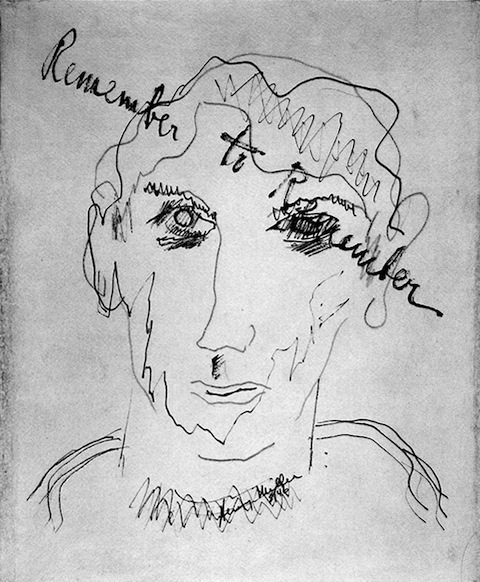
Amazing self-portraits by writers. Henry Miller drew his in 1946.

4b-millerselfportrait


The story of how the Kindle came to be, from an insider’s point of view.

An article on a blog about the history of makeup that discusses whether cosmetics of the past poisoned the women who wore them with ingredients like lead and mercury.

Bildnis-von-Elizabeth-Gunning-Herzogin-von-Argyll-von-Allan-Ramsay-31966


Ten ultra-secluded underground locations, for those times when you’ve disclosed government secrets and need a private place to crash.

And finally, three Japanese hotels that have been in business for a thousand years.

tl-inset_webThis one, Nisiyama Onsen Keiunkan, was built around a hot spring that supposedly has curing powers. Maybe it cured women with makeup-induced illnesses.


3 Comments

Filed under Art, Culture, Fashion, History, Home, Jean Zimmerman, Writers, Writing

Rock Paper Scissors Book

Kids write books. They just don’t appear on Kindle.

And they couldn’t. They’re hand-wrought. Messy. One of a kind.

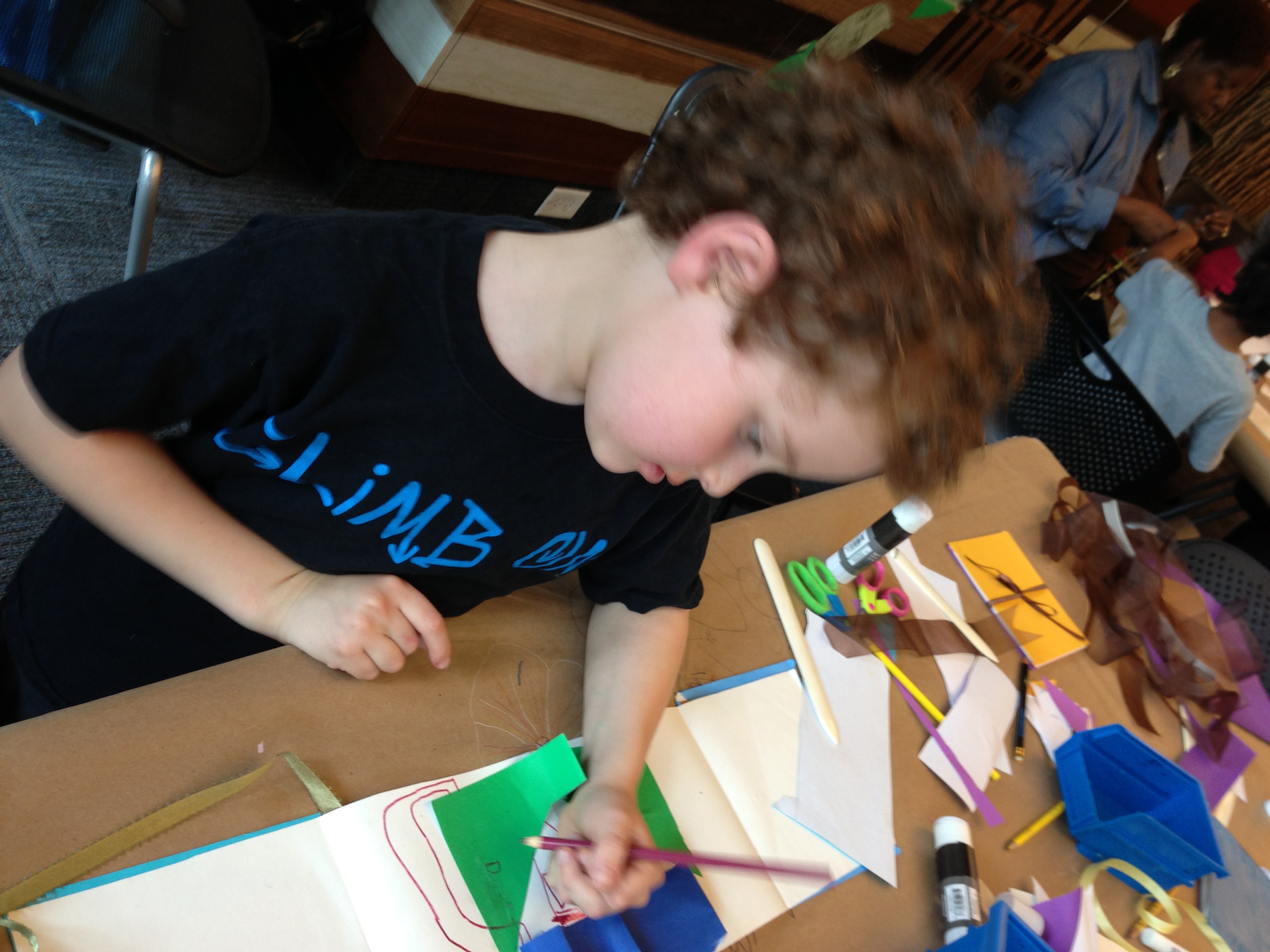
We took our nephew Jasper to a book-making class for children today at the Cooper-Hewitt Museum’s Design Center in Harlem. Jasper is a lefty — is that why he has a creative streak, or is it because he’s my nephew? Just asking.

lefty


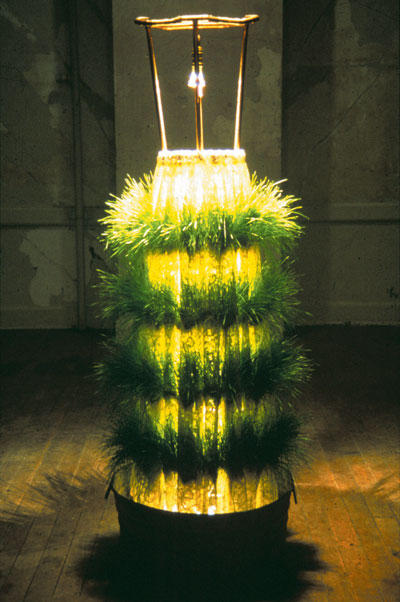
The ever-patient instructor was an artist named Michele Brody, who is well known for producing site-specific installations, including many  involving plants and water.

brody

She likes to show the entire life cycle, she told me, including the decay and death of the plants.

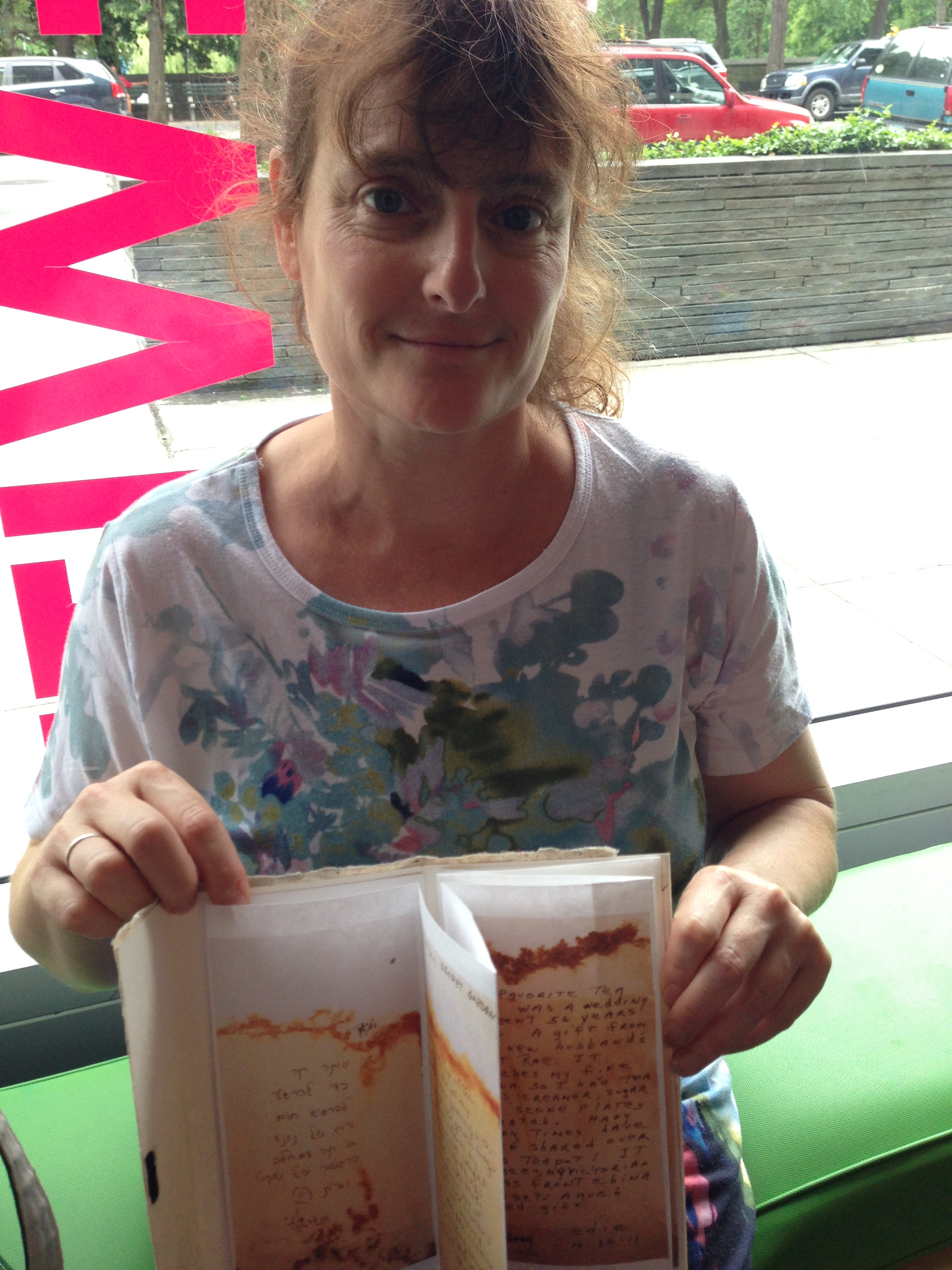
Michele Brody


But she’s also  produced art volumes about tea and stained by tea, so she knows about putting together books from scratch. Today she introduced me to a novel concept, that of the bone folder.

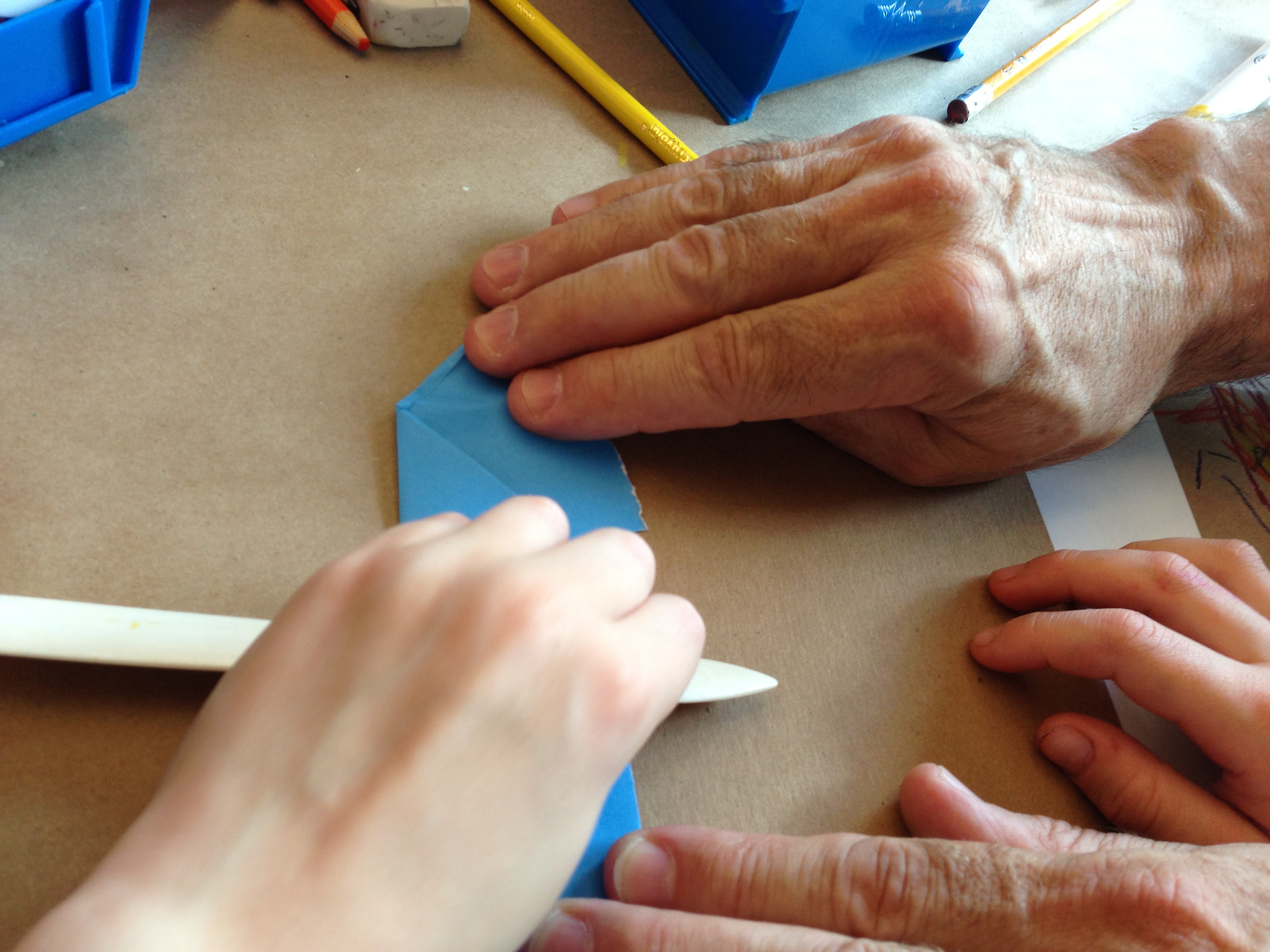
bone folder

The bone folder is a smooth ivory tool that allows you get a nice sharp crease in the paper you’re using to bind your book, and to smooth out any bubbles that might appear in the glueing process. How satisfying, sliding the tool along those bubbles.

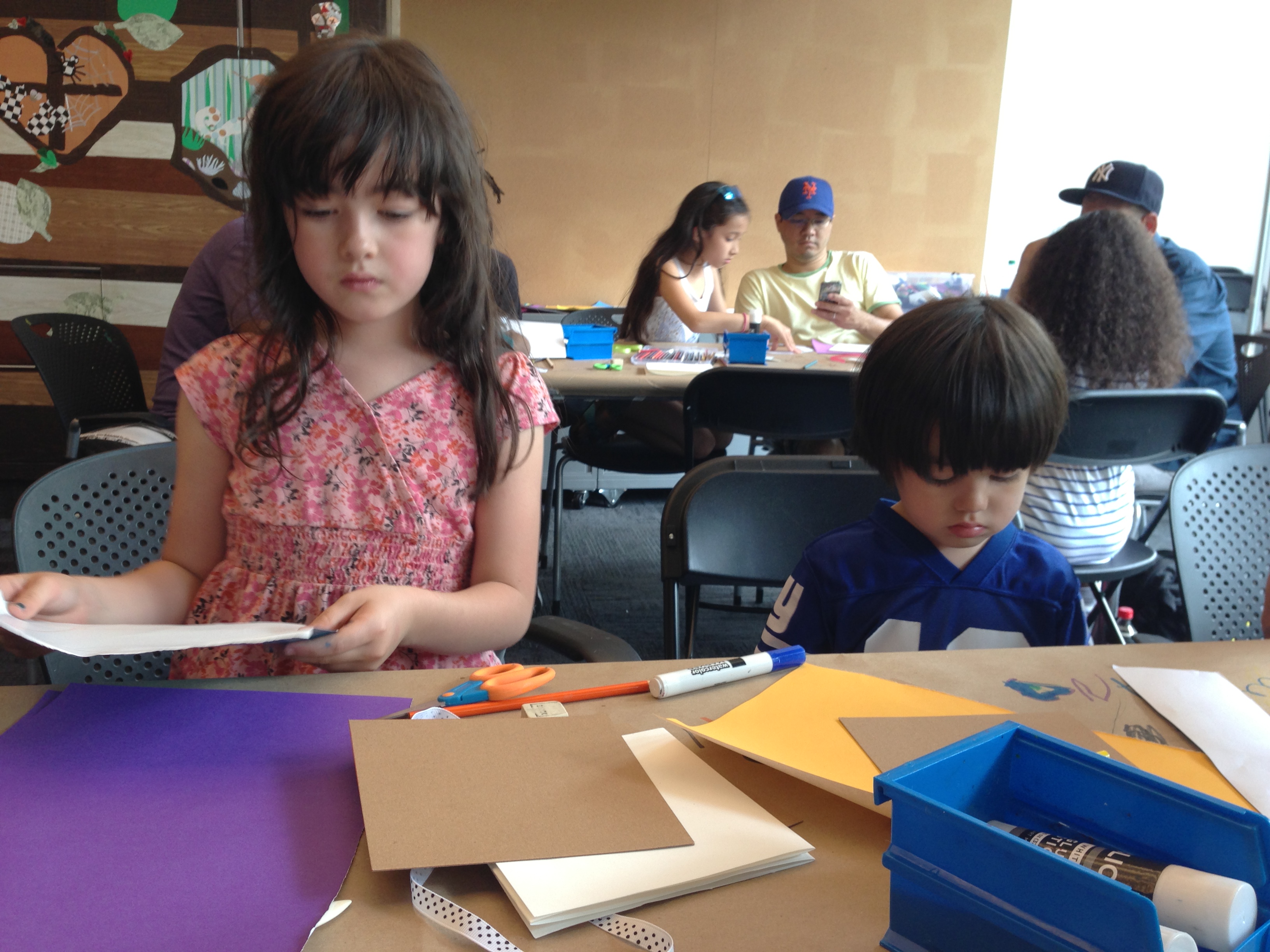
The children in the class dove in with cardboard, markers and ribbons every which way. Siblings Aidan and Molly — “silly and active,” according to Jasper —  did better than I did. I watched their creations materialize across the table.

Molly:Aidan


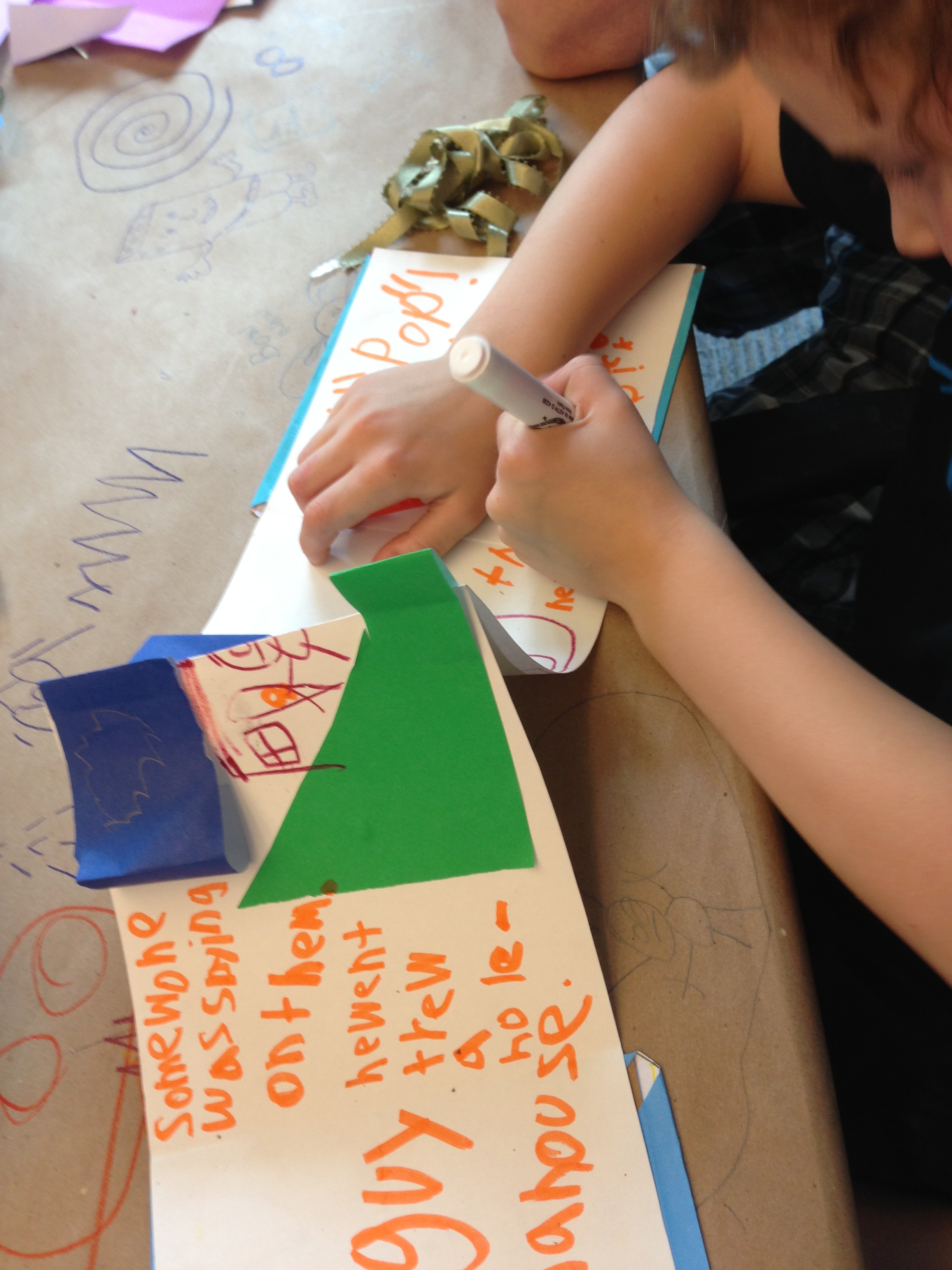
Jasper’s book was crammed with action and surprises. If he could only write a single book in his life, this one would be enough, but of course he’s already written hundreds.

Pop!


What did he like best about writing a book, I inquired.

The kid’s answer was immediate. The pop-ups, he said. He has always liked building pop-ups into his works. Architectural, three-dimensional, crazy blasts from another dimension.

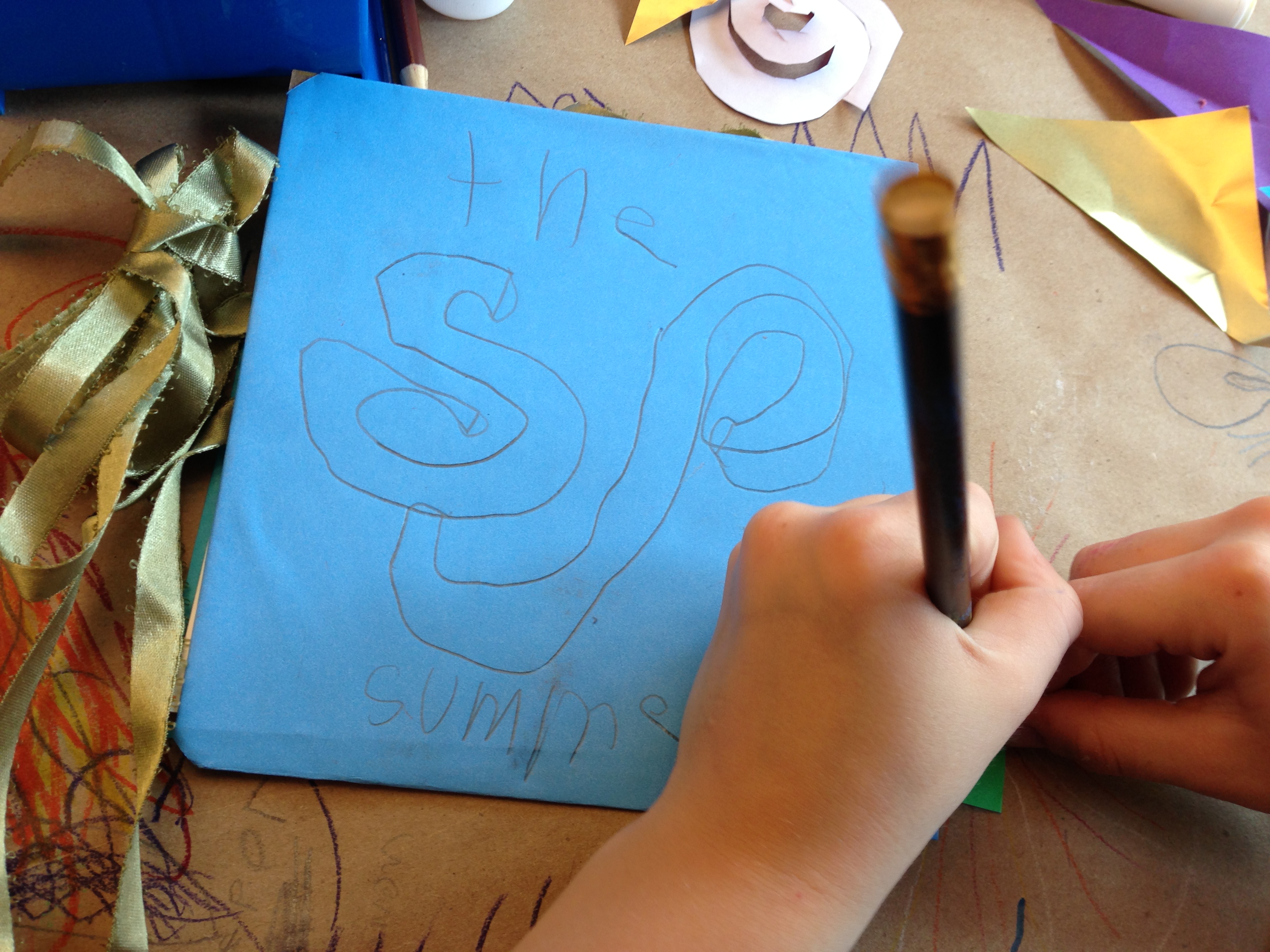
Kindle just can’t accommodate construction-paper pop-ups. And that is why you will never be able to order Jasper Zimmerman’s The Spy in Summer from Amazon. It’s the story of a spy who steals the bad guy’s jewelry, then eats him — well, that last part is not actually in this volume, says the author, but it will be in the sequel.

the spy in summer


That one will have pop-ups, too.


2 Comments

Filed under Art, Culture, Fiction, Jean Zimmerman, Publishing, Writers, Writing

The Highest Bidder

“There have been horror films set in storage facilities,” says Gil.

“I can only imagine,” says Maud.

Gil likes to run the cart through to our storage locker, especially if he’s got Maud for a passenger.

gil running

We’ve kept about half our belongings in the deep freeze since moving to the Cabin.

gil:maud

Too. Much. Stuff.

“Every increased possession loads us with new weariness,” said John Ruskin. What did John Ruskin know about it? Between the English countryside and Mayfair, he had plenty of space to stash his private editions and his watercolors.

gil:stuff

Will we ever find Maud’s backpack and sleeping pad so she’ll be equipped for her next adventure? She’s going to New Mexico to conduct research for her senior thesis, on descansos, the elaborate roadside shrines that mark auto fatalities. In New Mexico they’re very grand and very sad.

In A&E’s “Storage Wars,” people bid on the contents of repossessed storage lockers after looking for ten minutes at just the front of the container. Bidders get excited and spend a lot on what turns out to be junk. Our locker wouldn’t inspire much action.

Television also brings us a scene in “Breaking Bad” where Walter White opens a typically bland looking locker to find his wife has used it to hide an enormous brick of cash, probably 4′ by 10′ by 10′. Only thing about it is they can’t spend this treasure or he’ll go to jail. For a long time. Walt asks how much is there and Skyler says, I have no idea.

You could say that about the number of books stored in our cage.

“Is there anything we put away in storage that you miss having?” I ask Maud.

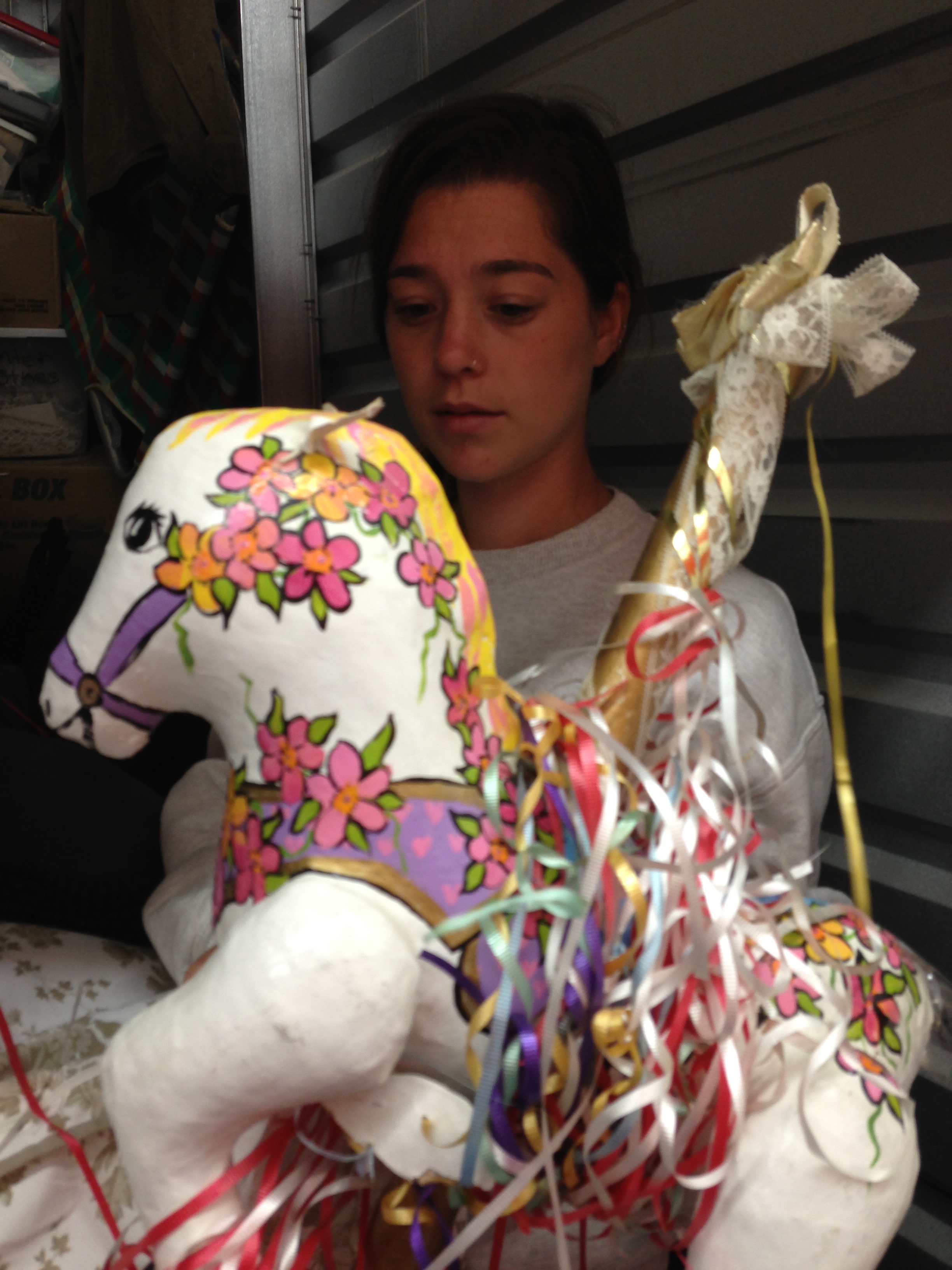
“My birthday piñata,” she says. We had a “nonviolent” piñata commissioned for Maud’s 5th birthday, its papier mache in the shape of a carousel horse. There were ribbons for the little tykes to pull to release the candy rather than bashing it with sticks. The horse had a breastplate with Maud’s name on it. We knew it was in storage someplace with its tail broken off, the tail floating  someplace in storage too.

“Is there anything you would want out of here?” I ask Gil.

“One thing I desperately want to have right now,” he said, “but won’t be able to find, is the picture of my mother and my father in their 20’s. I want to display it at my mom’s memorial service. But it’s lost in there.” That picture proved to 14-year-old Gil that his parents were young once, his dad holding a pipe and his mom looking devilish.

“Maud, what do you think is in all those boxes?”

maud's back

“Books, clothing, photos. Dead bodies.”

Sure, there have been evil deeds in storage lockers. We saw a thriller once in which a serial killer kept the clothing trophies of his victims in a locker. And in Silence of the Lambs Jodie Foster enters one to find a head in a jar.

But we find good things. Better than good. Softball gear, from Maud’s high school varsity team. Tents. We went to North-South Lake, remember that, our fragrant late night campfires? A wedding dress, still lovely in its ever-browning box. Copies of books we wrote, with passion. Gently used snorkeling gear. Let’s go, let’s go away somewhere warm and sandy sometime!

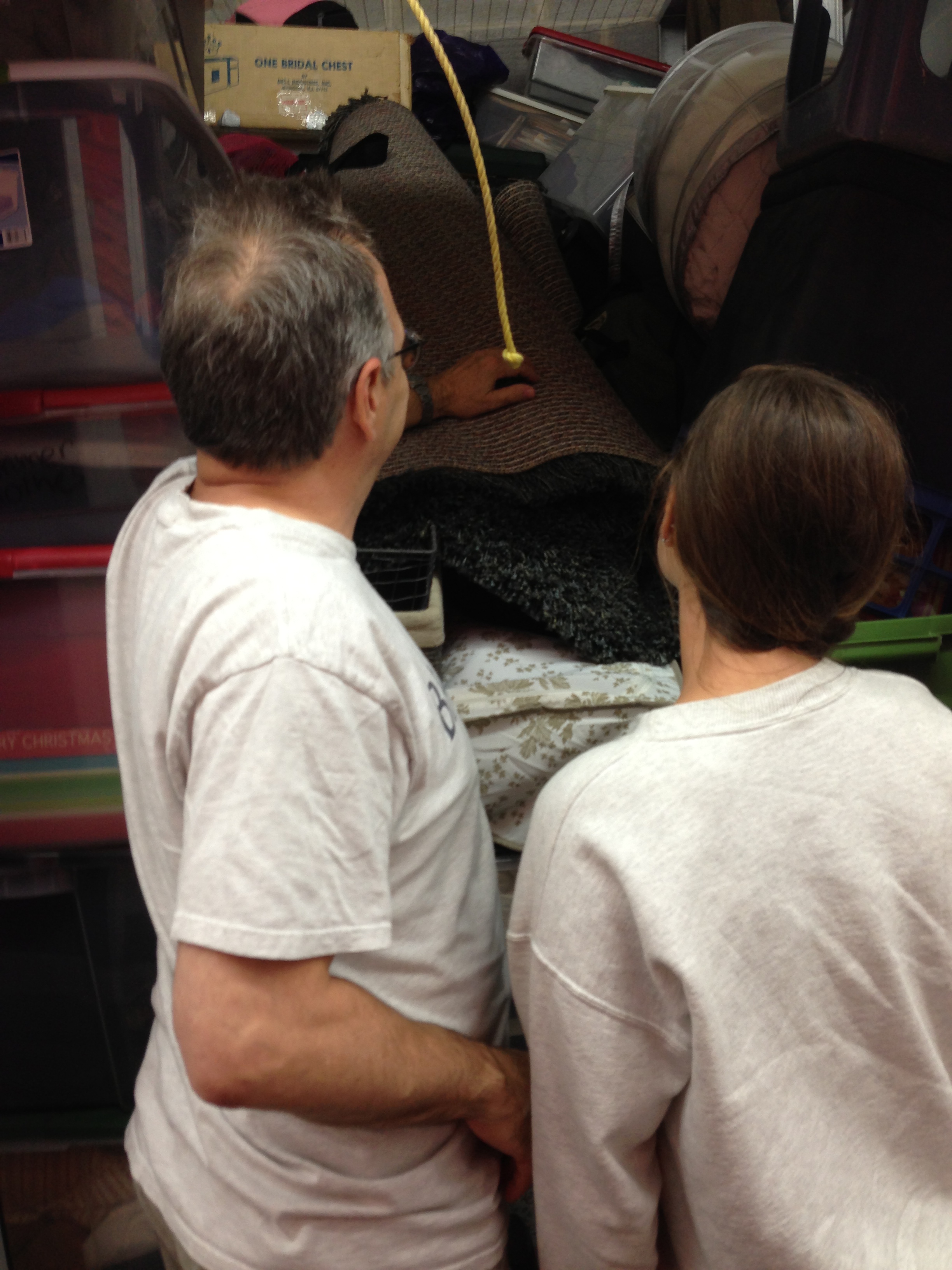
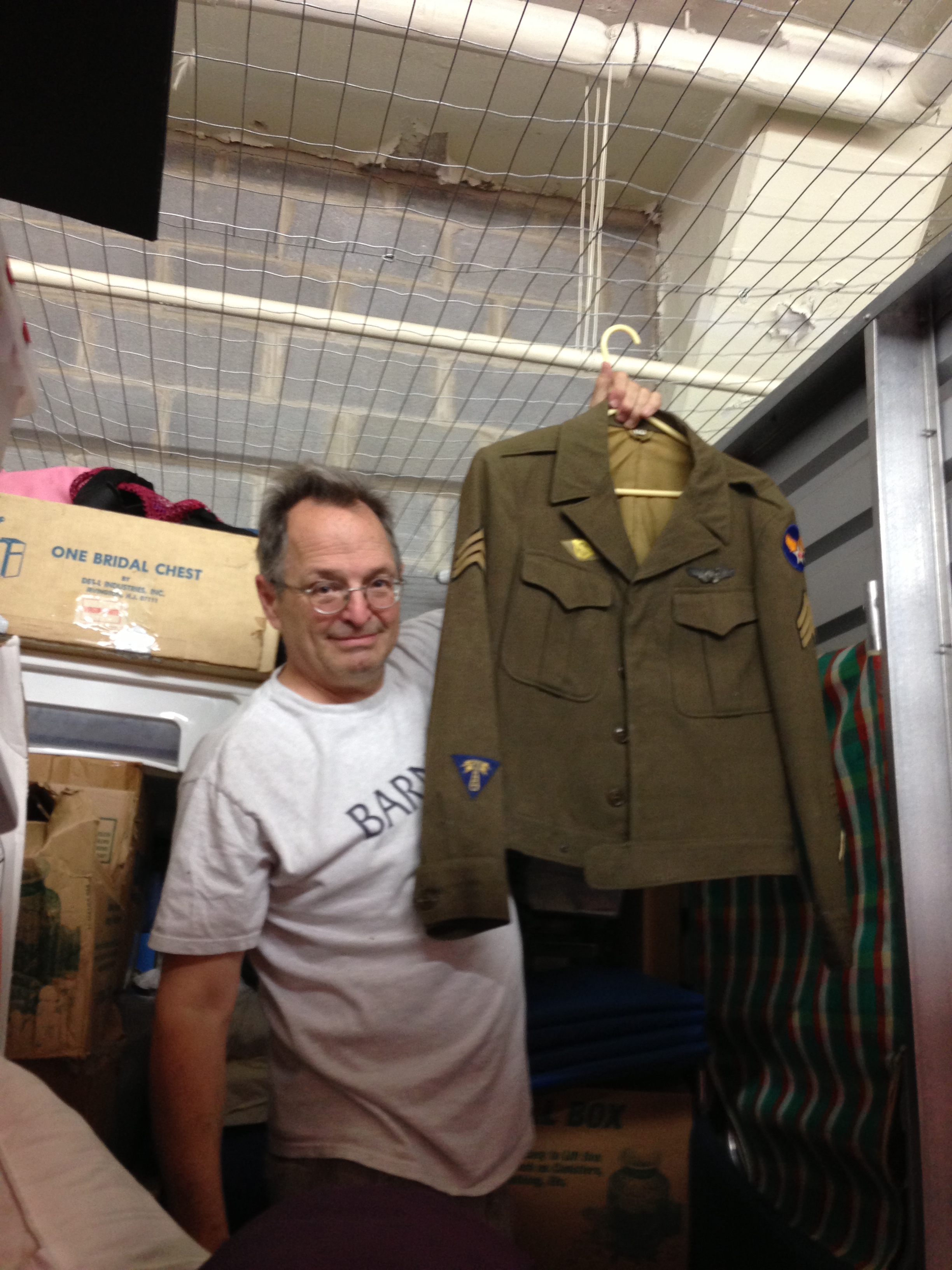
Gil finds the army jacket of Acton, his father.

acton's jacket

Maud finds her carousel horse.

maud:horse

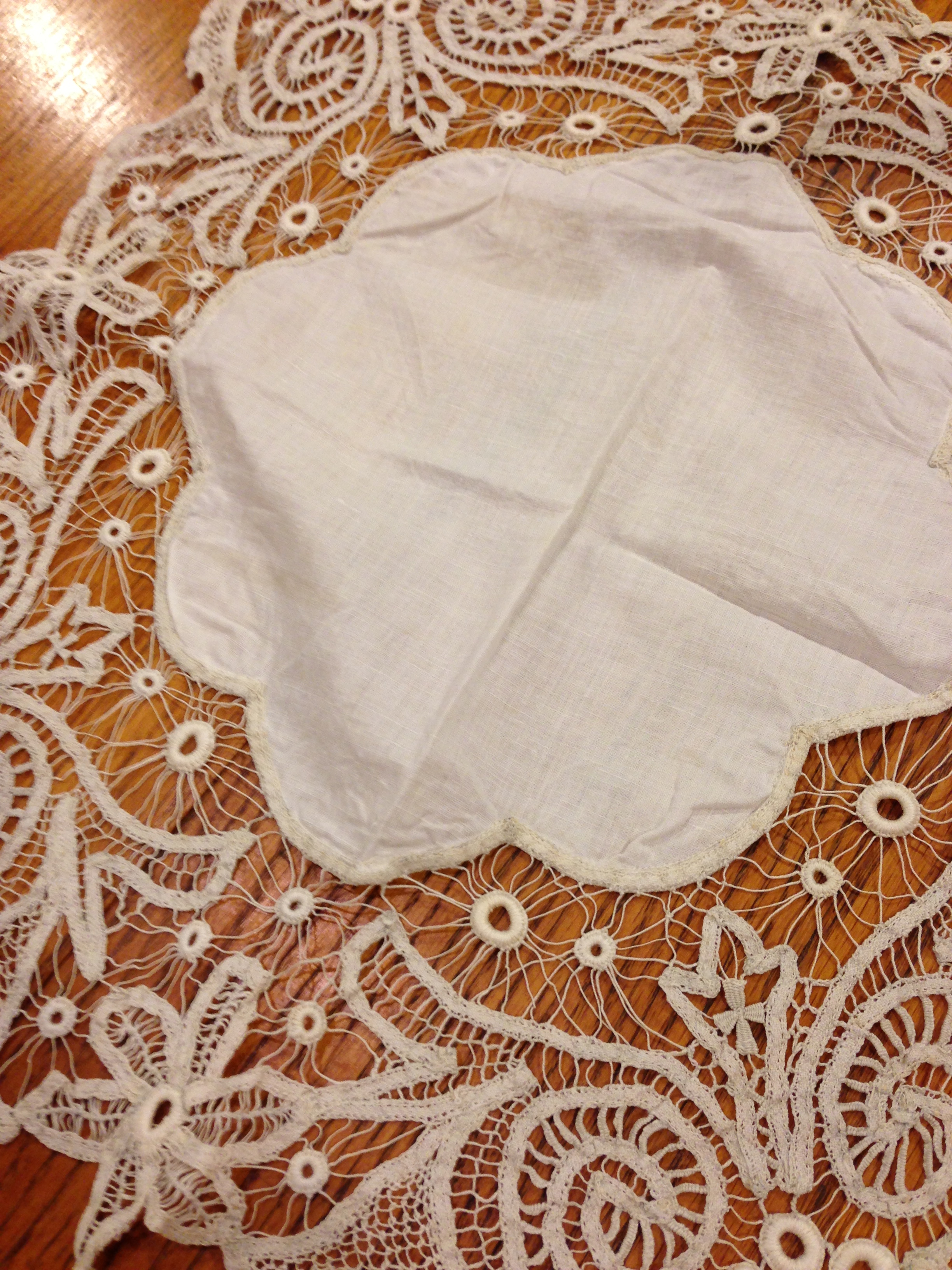
I lift down something precious, the lacework made by my Tennessee matriarchs. “Really?” says Gil. Our house is so small. For some reason I need this work by me, from the deep freeze to my warm house.

lace from storage

We have a conversation. “How much of this stuff would you remember if it all disappeared one day?” said Gil. “How much of it would you really miss.”

red

“All of it,” I say. “I’d remember it all.”

elevator

6 Comments

Filed under Art, Culture, Fashion, Film, Home, Jean Zimmerman, Publishing

Prayers and Limits

Rainy day rush hour on 9A, the four-lane that runs through Manhattan and north past the Cabin. Traffic has us crawling. But the radio is loud, with Phosphorescent singing Ride On/Right On.

phosphorescent

E-Z lyrics:

Let’s go for a ride, hey you turn me right on


Let’s get on the bike, hey you turn me right on


Ain’t nothing to hide and hey you turn me right on


The city at night, hey she turn me right on

Phosphorescent’s the moniker for an Alabama-to-Brooklyn boy named Matthew Houck (he previously went by the nom de guerre Fillup Shack) and he has out a new album, perfect for rainy day traffic jam listening.

I’m approaching that long, weedy section of highway, bordered by a sluggish streambed, where ordinarily the cars sail along briskly. There’s a sign along here someplace, planted out here near the road by someone who remains invisible. It’s plain plywood, painted white with black Gothic lettering and a simple legend: GOD ANSWERS PRAYERS. I’ve passed it hundreds of times, but I’ve never been able to get a picture of it because traffic moves so fast and there’s no shoulder to stop on. The sign just blinks by.

Now, God and I are not ordinarily on the most intimate terms. But I love this sign that has greeted me on every drive home and in many frames of mind, including the most dispirited. GOD ANSWERS PRAYERS. Okay, whatever you say. And I start to wonder about other manifestations of the same phrase.

gap rock

They abound, on hats as well as rocks.

gap hat

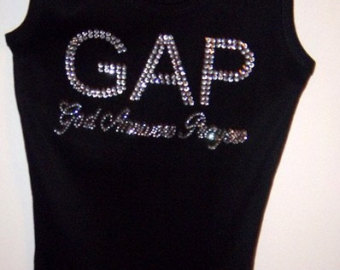
In rhinestones.

gap rhinestones

Is that what GAP means, as in The Gap? Those nice pants I bought last Fall? Never knew.

Zowie. Turn the radio up. Mr. David Bowie has come out with a new body of work, including the exciting song The Next Daythe video for which has been condemned by the Catholic Church as indecent. Well, it does show Bowie attired as Christ alongside Gary Oldman as a debauched priest (I thought Oldman was already a debauched priest) and Marion Cotillard as a beautiful prostitute with stigmata wounds.

david.bowie_

Bowie hadn’t put out a record in a decade, I guess he felt pent up.

my-prayers-have-been-answered

Ho hum, the traffic does crawl. Gil was in a jam yesterday and God answered his prayers with the Dan Hicks song on his shuffle, Traffic Jam.

Dan Hicks

Prayers, they don’t always work so good. I favor the sentiment of Oliver Wendell Holmes: We have learned that whether we accept from Fortune a spade, and look downward and dig, or from Aspiration an axe and rope to scale the ice, the one and only success which is ours to command is to bring to our work a mighty heart.

As true today as it was when he said it in 1884. It doesn’t fit on a plywood sign, unfortunately.

You can get a daily “meditation” like the Holmes quote in your inbox from All Souls, a church that is almost not a church it is so open-minded – “deeds, not creeds” is its motto. To get you questioning things like prayer.

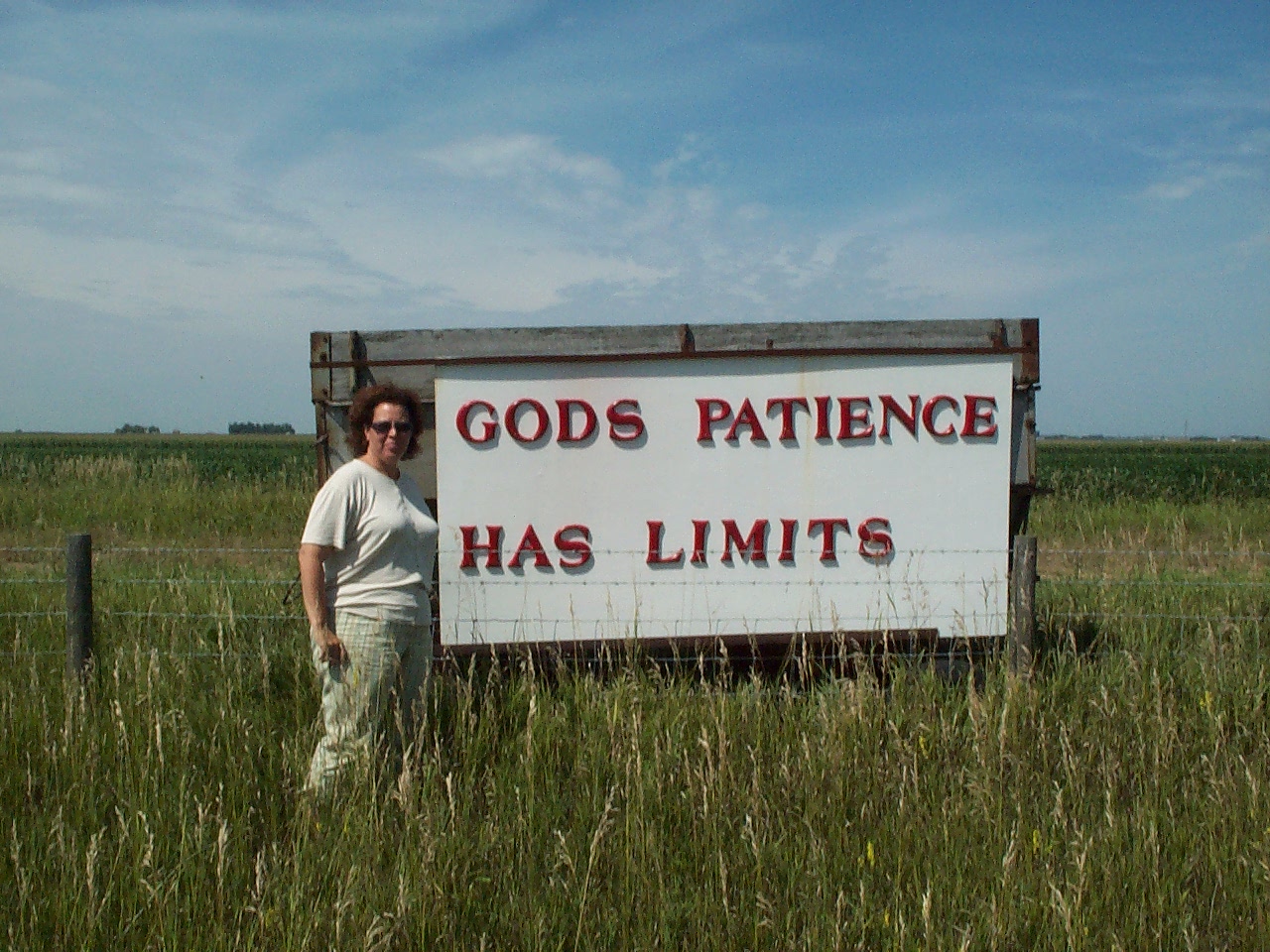
That sign on 9A, I like it almost as much as the one I saw by the side of a Nebraska highway about ten years ago. We wanted to bring it home with us but couldn’t figure out a way to tie it on top of the car.

god's patience has limits

A God with limits? Isn’t that heretical? For some reason I like the in-your-face Nebraska farm wife who stuck it along the interstate. She was probably shaking her fist at us as we drove away.

Whooosh—there goes GOD ANSWERS PRAYERS. Funny, I was just praying I would see that sign come around.

3 Comments

Filed under Culture, History, Home, Jean Zimmerman, Music, Photography, Writers, Writing

For Art’s Sake

The art of the perfect egg cream.

At Veselka Coffee Shop in New York City’s East Village, Eddie explained that we came in at just the right time, because his is the real deal. None better.

How long did it take you to reach perfection, I asked, watching him furiously stir the seltzer, vanilla and milk into a froth. A few years, he said, ha ha. Everybody loves Eddie, said the waitress. Eddie, said the counterman, your wife is calling on line one.

Eddie

The art of coffee in a takeout cup.

coffee

There are those people who truly grok a to-go cup, light, no sugar, and others who will never understand. Those who get it will survive.

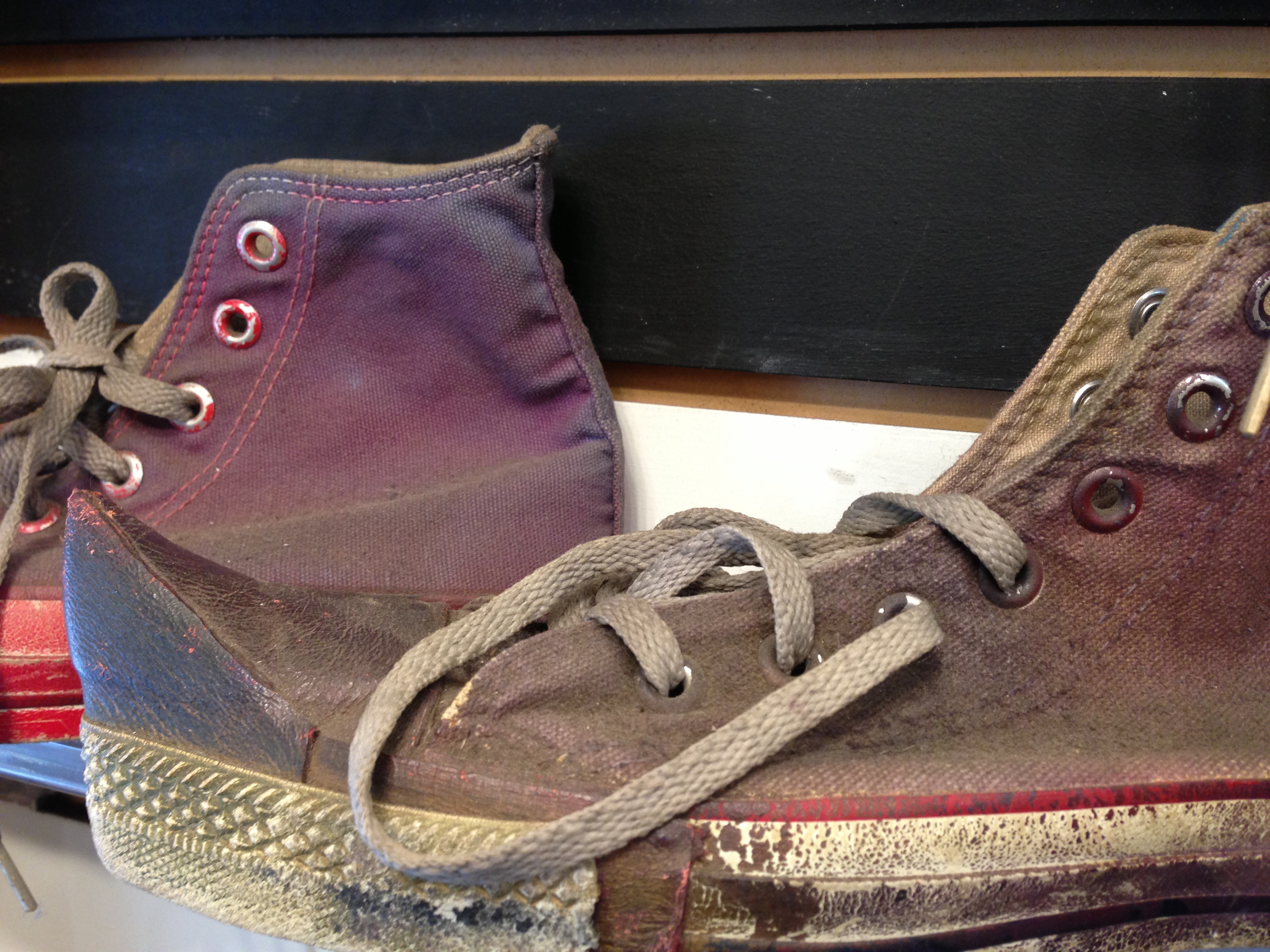
The art of the handcrafted athletic shoe. Boris works out of shoebox of a shop on St. Mark’s Place, customizing Converse sneakers. This must be one of his masterpieces.

converse

The art of the display window.

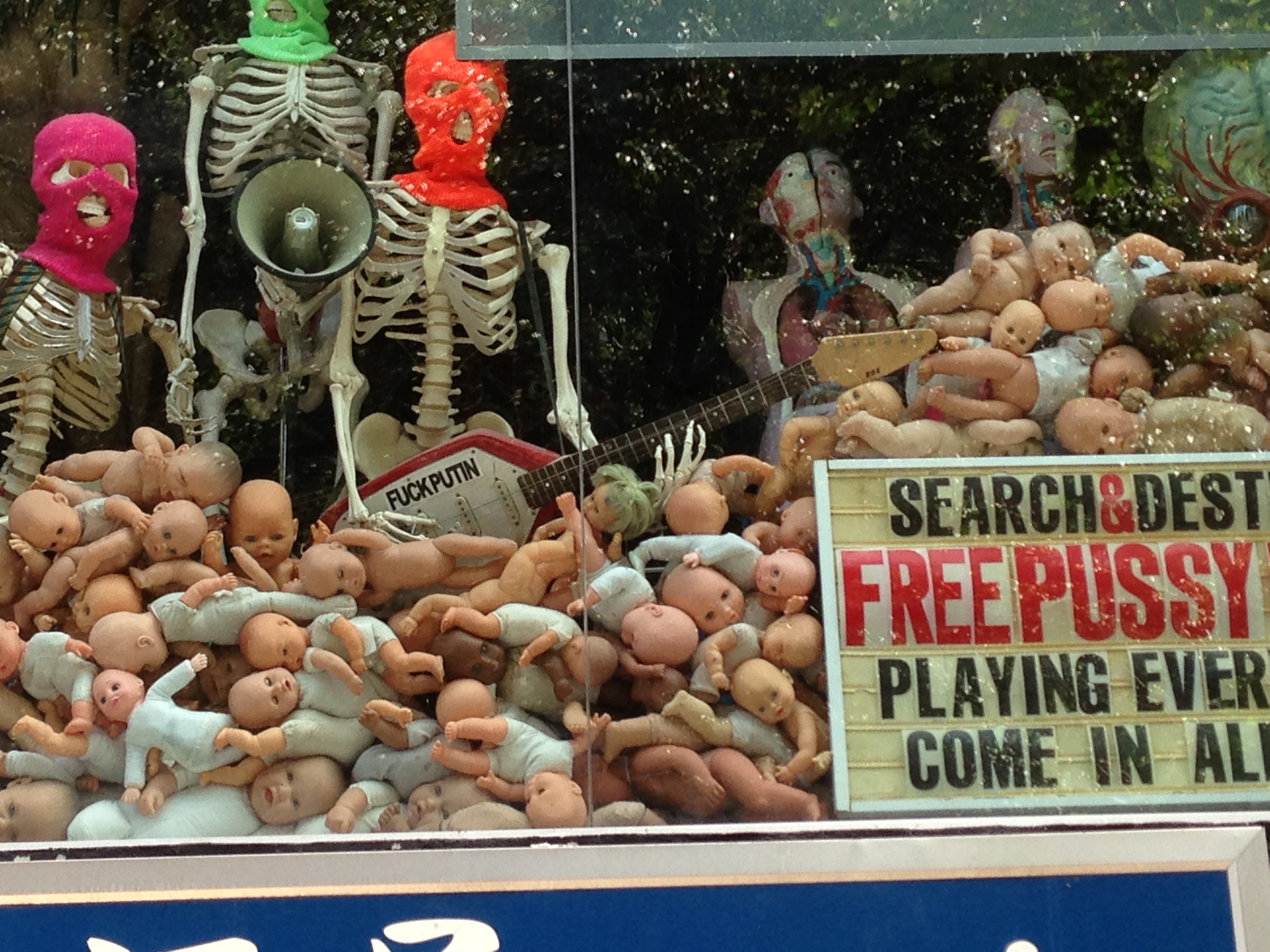
doll window

Maud and I made our way all around the East Village today but couldn’t convince ourselves to venture inside this storefront. I do, however, believe in the cause of Free Pussy Riot, the truncated message displayed on the sign – two of the three rockers are still in jail in Russia on some trumped up charge of fomenting unrest and making people think. Free Pussy Riot!

The art of the subway mosaic.

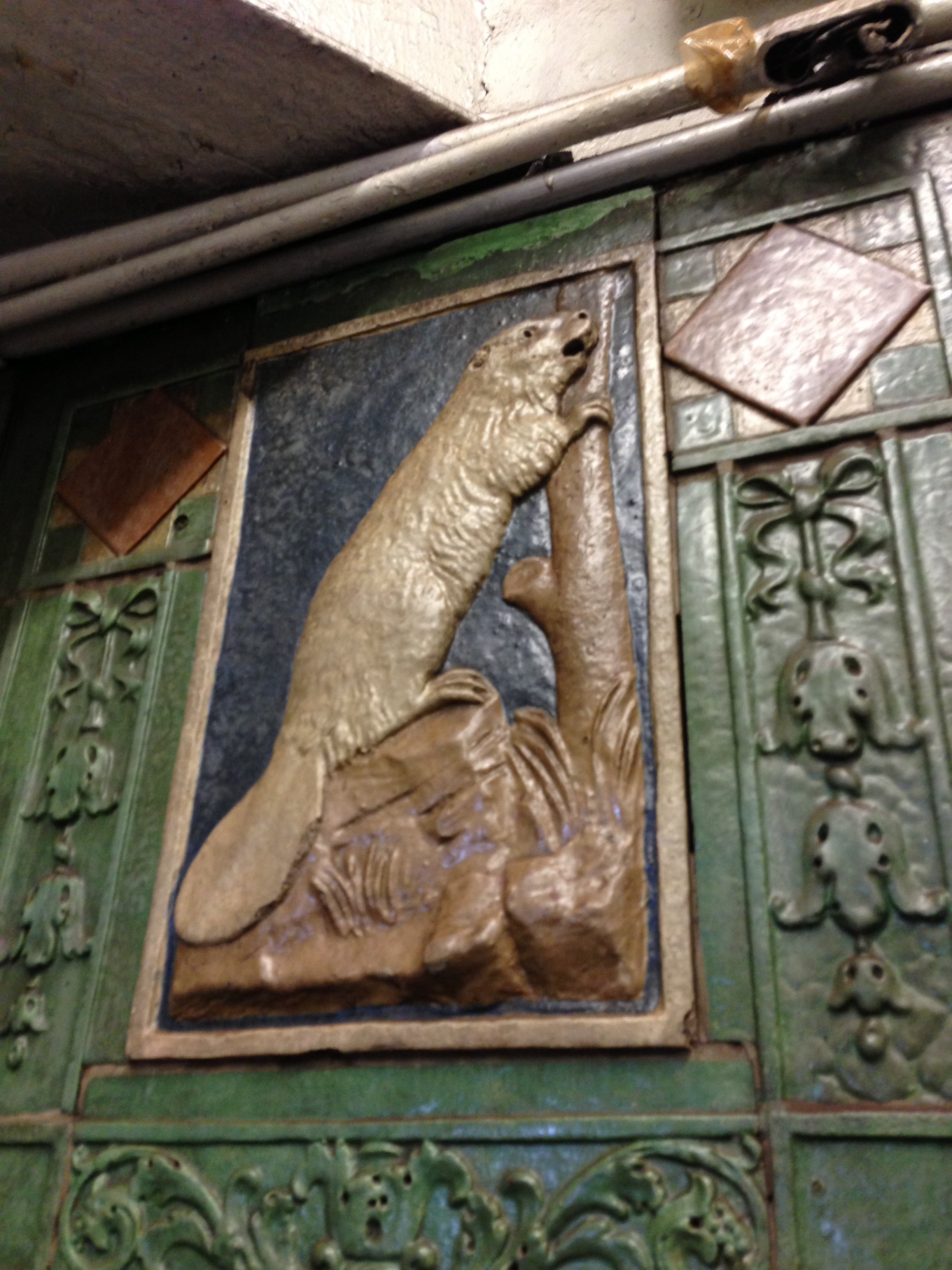
astor place beaver

New York’s subways house some splendid creative works, usually related to the locale of the stop. The Astor Place subway walls display ceramic plaques of beavers — made by the Grueby Faience Company in 1904 — because fur baron John Jacob Astor’s mansion stood nearby, and his fortune derived from the beaver-pelt trade.

The art of the old-time luncheonette.

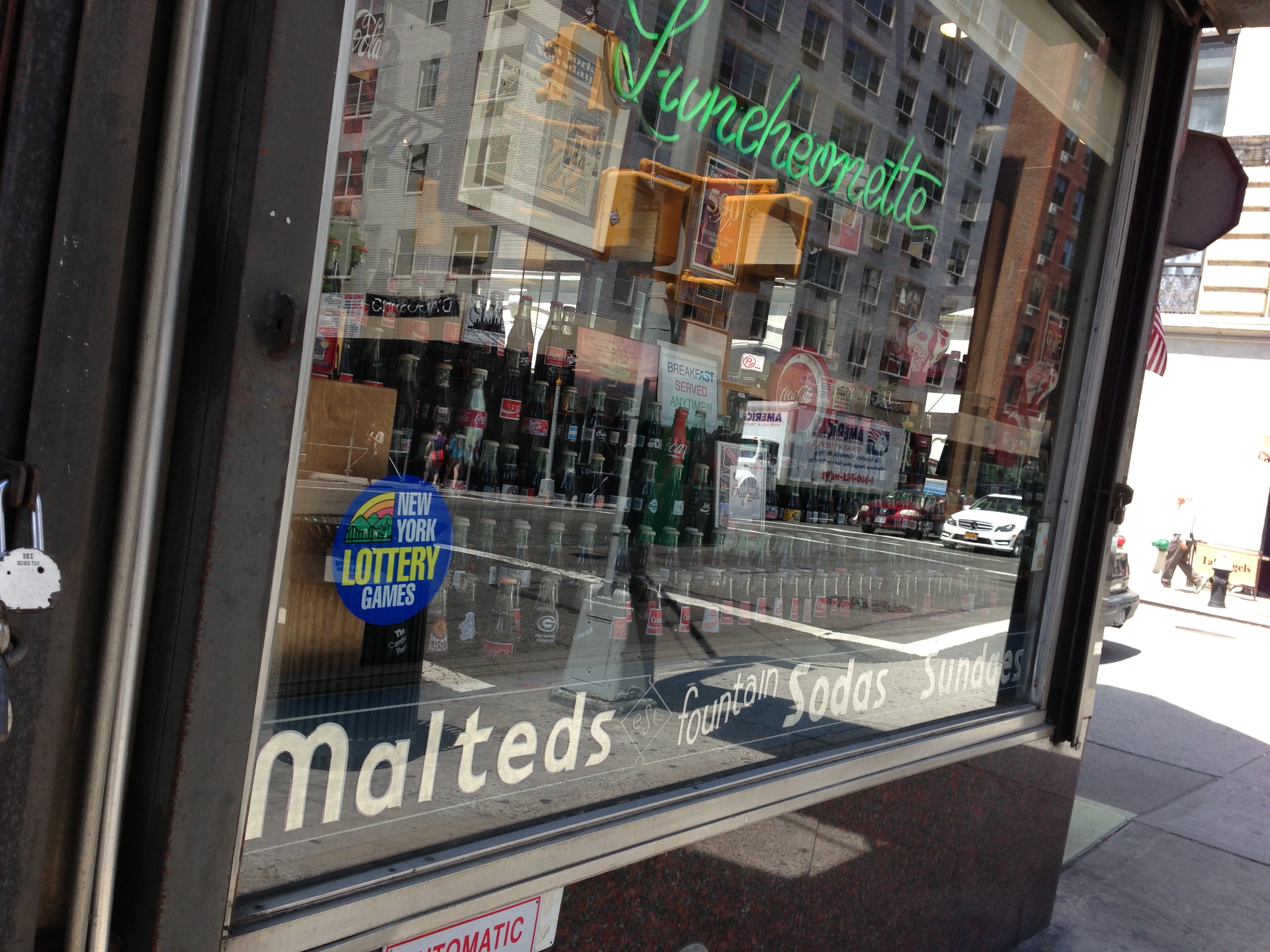
It sometimes seems as though everything old, dear, and genuine in Manhattan has been driven out, but once in a while a gem like the Lexington Candy Shop Luncheonette survives. It has been serving up milk shakes and lemonade since 1925.

lexington luncheonette

The art of the tooth-hurting truffle.

We grazed the cherry caramel samples at the counter of Vosges Haut-Chocolat, which sounds French but is actually out of Chicago.

caramels

Admired the pure silk hankies they use to wrap up the really important custom gifts.

silk

Then we each had a truffle of our own. Maud’s was the Rooster, with taleggio cheese, Tahitian vanilla and organic walnuts. Mine was a Woolloomooloo, featuring coconut and macadamia nuts. Gil’s getting a bacon/chocolate confection for Father’s Day.

The art of instilling disquiet.

rooftop people

The rooftop garden at the Metropolitan Museum currently features one of the most wonderful, most disturbing installations I’ve seen. The Pakistani artist Imran Qureshi was inspired by escalating bombings in Lahore when he spilled and splattered blood-red acrylic paint across the nearly 8,000-square-foot open space of the Metropolitan’s deck. Elegantly dressed European tourists traipsed across the blossoms of blood as if they were nothing.

rooftop paint 2

To me they called up the times I’ve come upon a recent deer/car collision on the highway, with the pavement still a wash of gore. Or the searing images from Gil’s book Aftermath, Inc., in which he describes the stains that occurred following trauma events, such as murder or suicide. The artist Qureshi has said, “Yes, these forms stem from the effects of violence. They are mingled with the color of blood, but at the same time this is where a dialogue with life, with new beginnings and fresh hope start.”

The art of water vapor.

cloud

Far above the paint, the New York clamor, the scene, serene, inviolable, sublime. Art for art’s sake.

8 Comments

Filed under Art, Culture, Fashion, History, Jean Zimmerman, Nature, Photography, Writing

Out of Africa

Maud is back from Malawi.

back from malawi

Wearing a chichinge, a wrap skirt of block-printed African cloth. Her resilient muscles are only a little sore, and she seems impervious to jet lag after 20  hours in the air.

Maud and her group from buildOn, working with hundreds of village men, laid a foundation and raised a quarter of the walls for a new school block that will allow the town of Mpandakila to educate its 5th and 6th graders. So that after 4th grade the kids will not drop out rather than hike the six kilometers to the nearest school.

Maud ate nsima — corn porridge — pumpkin greens and soupy beans for 12 days, sleeping on a bamboo mat in a very special homestead. Her hosts were one of the chiefs of the community and his wife and their five precocious daughters. Also grandma, the babies of the two eldest daughters, and a two-day-old goat that cried for its mom all night. 

A hen slept in the room with Maud and her friend Claire, laying its eggs while they were sleeping.  The chief offered the young women a chicken as they left, which they took and sold to the bus driver who took them six hours back to Lilongue. They fed it ground nuts (peanuts), which they picked fresh from the vine every morning.

Dancing was a big thing in the village, to the pounding of drums and the ululations of the older women. The whole village loved learning the Macarena.

What Maud loved learning about the most was how to carry water atop her head — and dirt, and bricks. A woven circle of straw helped her balance. 

water carrier

It felt so far away, but at the same time there was a human familiarity about it all — a smile as you walked by someone, the  bossiness of the sisters. Maud didn’t come away with any answers about the best way to go about helping other countries, without imposing your will or encouraging dependency. What matters is asking the questions, and coming away with more.

Zikomo kwambiri means thank you very much in Chichewa.

6 Comments

Filed under Cooking, Culture, Fashion, History, Home, Jean Zimmerman, Music

Playground Nightmares

As if those clanking swing chains weren’t somehow spooky enough, and those boink-y critters that tended to throw you off when you least expected it, here we have, from Russia, some playground elements that are worthy of a horror film.

Do. Not. Go. To.

These playgrounds.

Ever.

For more images, see 11 Terrifying Images of Old Soviet Playgrounds | Mental Floss.

2 Comments

Filed under Art, Culture, History, Jean Zimmerman