Category Archives: Writing

Day 1-In Which I Learn to Hobble

It was a success, the surgery, though I awoke from the anesthesia blubbering like a baby. It’s normal, said the orthopedic surgeon, come to check on me. A lot of people cry. Then it was hip, hop, on to the wheelchair, on to the crutches, off to my new full-time lair, my living room, my foot on pillows above the couch.

cast

My snouted nursemaid wedged beside me.

ollie nurse

My other nursemaids scurry to my orders. My computer, please! My muffin! My book! Put it close, I’ve got to get an NPR review done this week. Could you please turn that light off? Or on?

I have a good view of Maud’s metallic blue fighter fish, Brussels, making his small way around the bowl.

brussels

Somehow, thinking about the immediate future, though I never had much patience for that fish, I now feel kindly toward it. Brussels reminds me of myself in my own little living room bowl. Except I hobble, can’t float at all, when I want to go brush my teeth.

Trying to stretch myself outside this world, adventuring via pictures of the past to the motor adventure taken in 1918 by John Burroughs, Thomas Edison, Henry Ford and Harvey Firestone.

This brilliant crew took a 12-day car camping trip in Burroughs’ automobile when he was 81.

NoondayRestFinal.jpg.CROP.article920-large

John Burroughs, less well known today than the others, was ragingly popular by that time in his life. Gil and I used to visit his country retreat, a tiny cabin called Slabsides that stood beside a celery marsh in West Park, New York.

slabsides

Burroughs’ fans have kept it intact, so you can see it as he did. Being there always made me want to inhabit a cabin, and now  mine is virtually like his.

burroughs-at-slabsides

… I was offered a tract of wild land, barely a mile from home, that contained a secluded nook and a few acres of level, fertile land shut off from the vain and noisy world by a wooded precipitous mountain… and built me a rustic house there, which I call ‘Slabsides’, because its outer walls are covered with slabs. I might have given it a prettier name, but not one more fit, of more in keeping with the mood that brought me thither … Life has a different flavor here. It is reduced to simpler terms; its complex equations all disappear.

Young college women used to travel in hordes by train to Slabsides to pay homage to the great man, a pioneer of nature writing who published some 25 volumes, of which a million and a half volumes were sold during his lifetime.

In 1918, a convoy of eight vehicles accompanying the brainy colleagues toured Pennsylvania, West Virginia, Tennessee, and Virginia, stopping to camp on farms, examine old industrial sites, take hikes along rivers, and measure farming implements for fun, documenting as they went.

Some shooting entertained Ford and Firestone.

ford and firestone shooting

At night around the campfire the two industrialists, the naturalist and the inventor wound down by chewing over Shakespeare, Thoreau, chemistry. Don’t you wish you could have been there? In a way, you can, because photos from the trip are stored at Harvard’s Widener Library, with a smaller portfolio at my favorite website, Slate’s The Vault.

Closer to home yet exotic in its own way, the wool I am sending away for to keep my hands busy during this nonambulatory period.

What is mohair, anyway, I wonder, as I fawn over the silk and mohair skein available from the chicest yarn store I know, Purl in Soho, New York City.

It’s from a line called Haiku made by a company called Alchemy. The shade is called Teardrop. Is that not irrisistable?
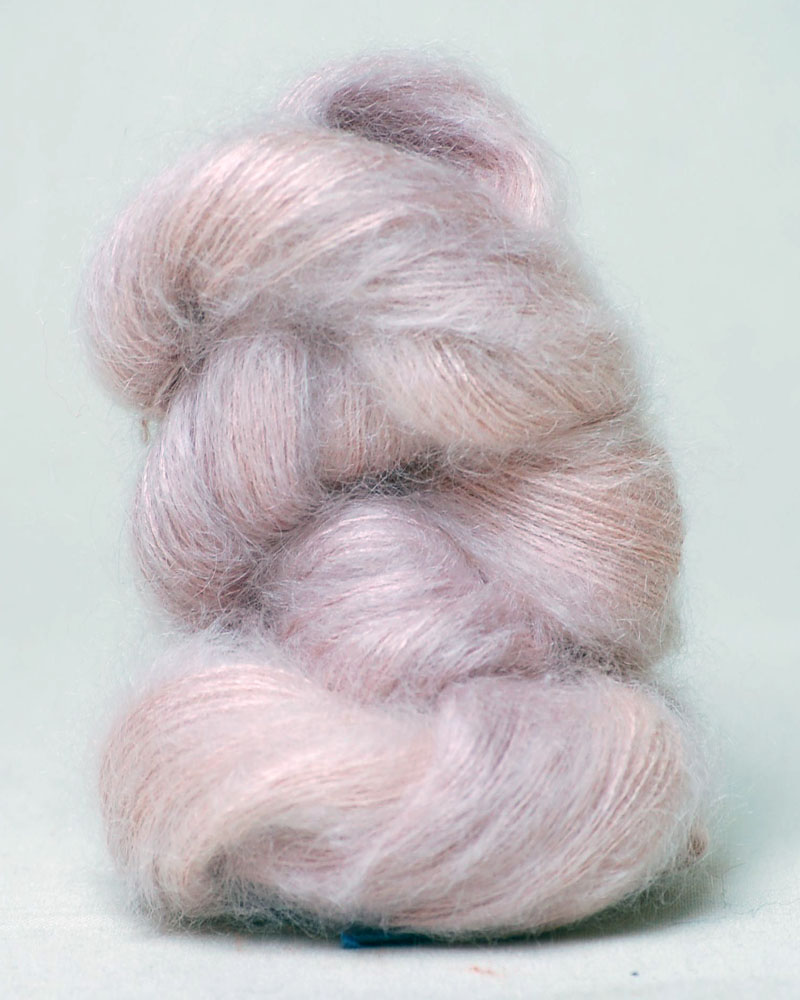
Alchem's Haiku-Teardrop

The yarn comes not from a sheep but a goat, the Angora, which emigrated from Tibet to Turkey in the 16th century, and it’s one of the oldest textile materials in use. It’s made of keratin, like hair, wool, horns and skin. Mohair is warm in winter, while remaining cool in summer. It is flame resistant, crease resistant, and does not felt. The goats are mainly bred in South Africa now.
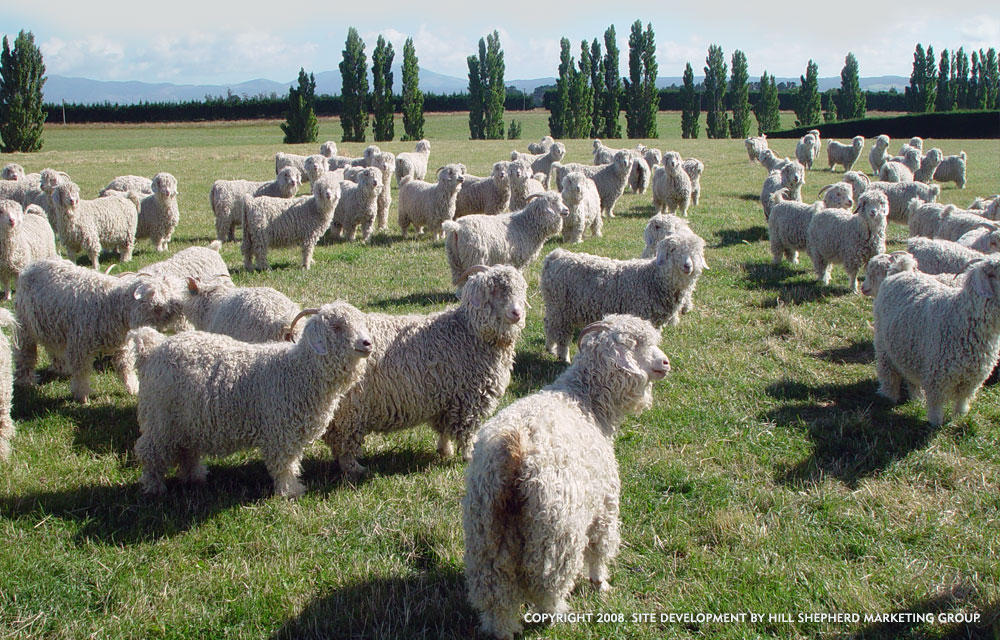
angora_goat_11_12

And it is of course beautifully luxurious. Makes your fingers sing. Should I choose this color instead? It’s for a slip of an elegant bandana, not the kind you’d wear around a Slabsides campfire. Evening Pink.
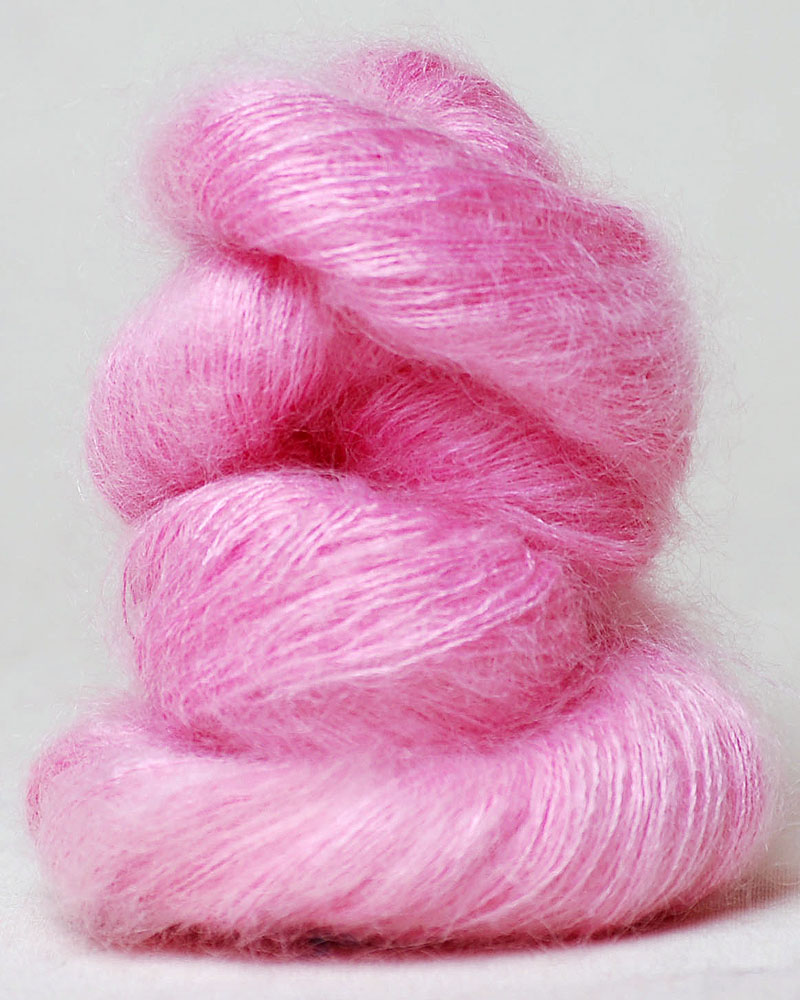
Haiku-Evening Pink

If Firestone and Ford and Edison were on their way over to roast weenies, maybe a scarf in this hue would be more refined: Blue Jay Way.
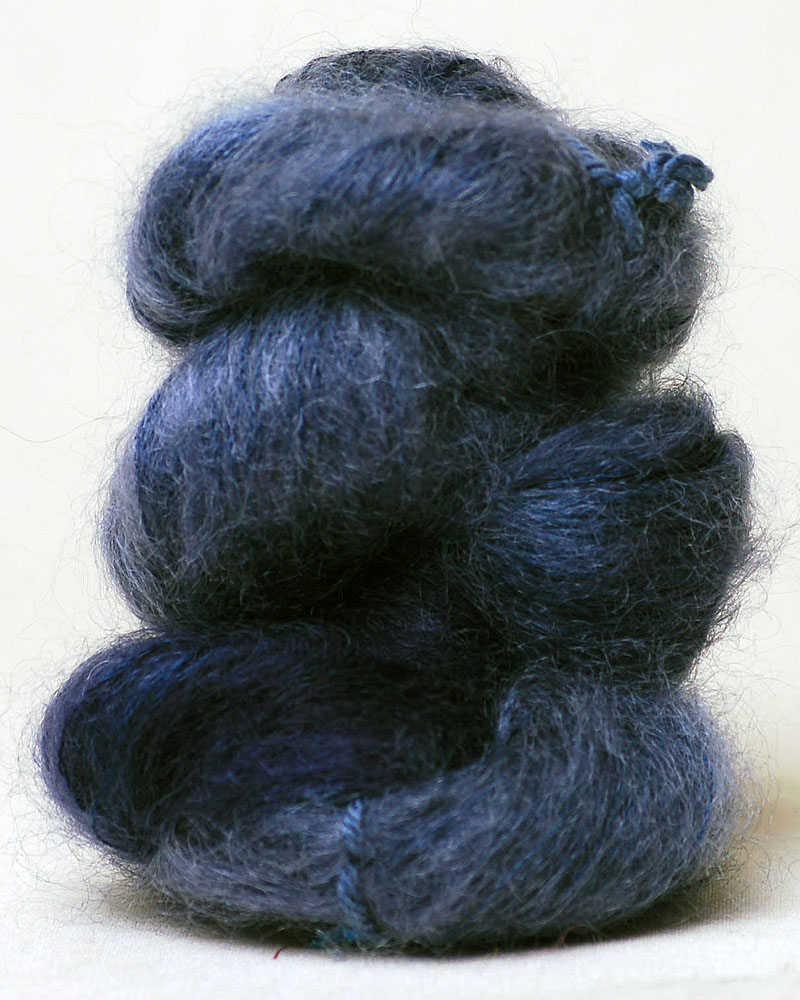
Haiku-Blue Jay Way

So many choices when your leg is up and all you’ve got to do is dream.

2 Comments

Filed under Art, Culture, Dogs, Fashion, History, Home, Jean Zimmerman, Knitting, Nature, Photography, Publishing, Writers, Writing

Captive Audience

Millbrook, New York is a quiet town, a town of well-behaved dogs on leashes and potted flowers.

box of flowers

A town of rice pudding with cinnamon at a cute bakery called Babette’s Kitchen.

rice pudding

The last notable murder in Millbrook took place a century ago – a nanny named Sarah Brymer was strangled when her employers, of the Barnes Compton clan, left their estate for a New York City visit during a January snowstorm. The coachman, Frank Schermerhorn, did it – though he first tried to pin the blame on the Japanese butler – then cut his own throat with a straight razor when he was apprehended.

That was a long time back and everybody’s forgotten about it.

So it was interesting to be invited to Millbrook’s warm and comfortable Merritt Bookstore for a discussion/book signing today where attendees could “discover the art of mystery.” I was joined by another novelist, Koethi Zan, whose book The Never List was published earlier this month.

16158525

Koethi is a former entertainment industry lawyer who makes her debut with this riveting book. She knows everything there is to know on the subject of girls and women taken captive by craven men, then tortured and imprisoned for years. She is also an authority on the subject of the women who eventually escape these men. And she has worked this knowledge into a thriller which has received strong acclaim from people like Jeffery Deaver and Tess Gerritsen.

It was great to meet Koethi.

Jean and Koethe

She brought her husband, Stephen Metcalf, a critic-at-large at Slate who has a nonfiction book on the 1980s in the works. I brought Gil – yes, Gil Reavill, whose speciality is also crime and whose recent book is Mafia Summit.

All the great minds were present. The only thing lacking was an audience.

It happens sometimes. When you make appearances as an author, you don’t know whether to expect 120 people or three. When it’s three, you still have to be mentally present, be on your game, because these wonderful people made the effort to come out and see you, after all. Amazing!

In this case, nada. So, with two of the book store’s staff, we sat around in the cozy garrett upstairs and had a very stimulating talk about writing books.

We talked about creating a bad guy. How do you get inside his head? Koethi said that for The Never List it was more about her characters trying to ascertain how her bad guy ticked. For me, with The Orphanmaster, I said it was partly about figuring out what he would think and do that was completely the opposite of what I would think and do.

How do you discipline yourself when you don’t feel like working? Five hundred words a day, said Koethi. That is my minimum.

We talked about fact-based prose. About research. (One of my favorite subjects.) I told them about how I had based my protagonist in The Orphanmaster on a real person I had written about for an earlier work, The Women of the House, and how I had all my research practically done when I started my novel. Stephen talked about the book he is working on, about the plenitude of letters regarding the artist Jean-Michel Basquiat, one of his central figures. Koethi, as I said, has absorbed everything on captive females.

She told us about some of the recent high-profile cases, and said that while it seems some of these young women are coming back to a semblance of mental health it’s not always what it seems.

We talked about captivity narratives, about the classic John Wayne film The Searchers, about an article that has recently been published in The New York Review of Books on the subject, about Ride the Wind, a historical novel based on the Cynthia Parker story. The subject interests me historically because in Savage Girl, the central figure spends some time with the Plains Indians.

A lot to chew on. All of this and a full cheese platter too.

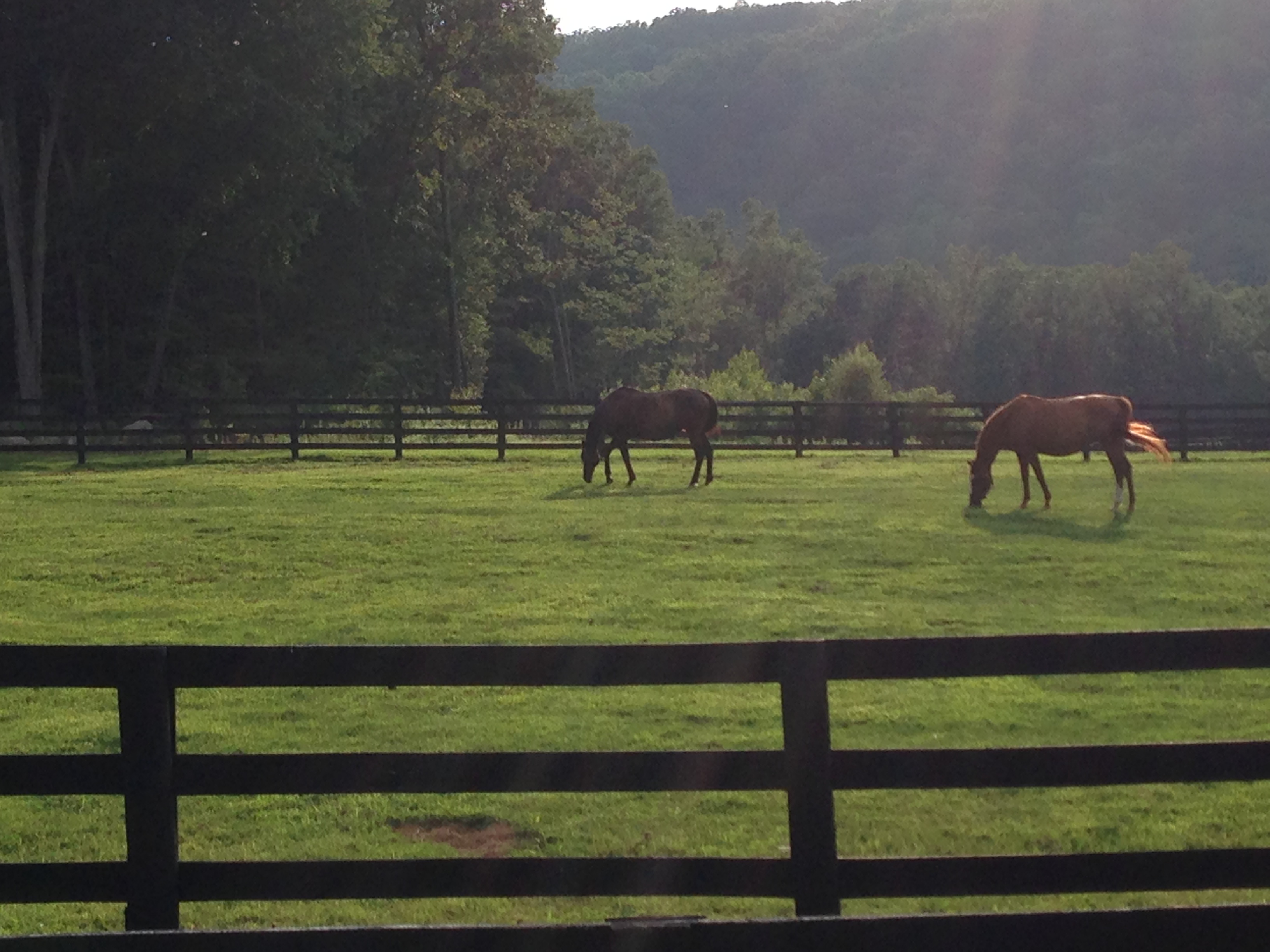
We meandered home on the back roads, through soccer fields and corn fields and gently curving horse meadows.

horses

There was only one exception to the bucolic charm of the open road: the ruin of an abandoned complex that was Wingdale, a mental hospital which operated upstate from 1924-1994 and is said to be haunted by ghosts. With its crumbling brick and busted windows, it looks like the perfect set for a horror film.

No visitors allowed.

wingdale

There’s always something behind the happy façade.

3 Comments

Filed under Culture, Fiction, History, Jean Zimmerman, Savage Girl, The Orphanmaster, Writers, Writing

NPR: Great Historical Fiction for Summer 2013

I liked digging into recent historical fiction for my summer round-up on NPR, which is hot off the presses. I knew some of the authors’ work already, and some novels I discovered for this assignment. I tried for a balance of time periods and styles when I selected the books to review. What I was really going for, though, was fiction that took off from specific fact, historical personae or events that grounded the work.

So these were the books I reviewed.

Orphan Train by Christina Baker Kline.

orphan train

The Black Country by Alex Grecian.

black country

The Blood of Heaven by Kent Wascom.

blood of heaven

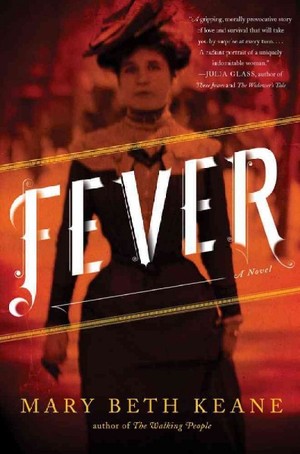
Fever by Mary Beth Keane.

fever

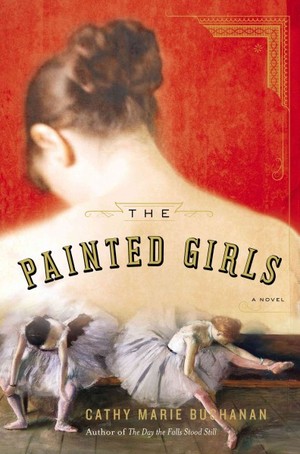
The Painted Girls by Cathy Marie Buchanan.

painted girls

I hope you enjoy your summer reading, whether it takes place in a lawn chair, on a beach towel, or on the couch in front of the air conditioner!

10 Comments

Filed under Culture, Fiction, Jean Zimmerman, Publishing, Writers, Writing

Stop Your Sobbing

How do you cope with the prospect of failure?  Not failure itself, that’s pretty easy. You cry, brush yourself off, move on.

But the likelihood of screwing up. Ah, that’s another thing.

I’m talking about my vegetable garden, which turns out to be both a success and a bomb.

My weeds! They have taken over. Excuses: Heat. Rain. Humidity. Social distractions. And I’ve got to work, after all.

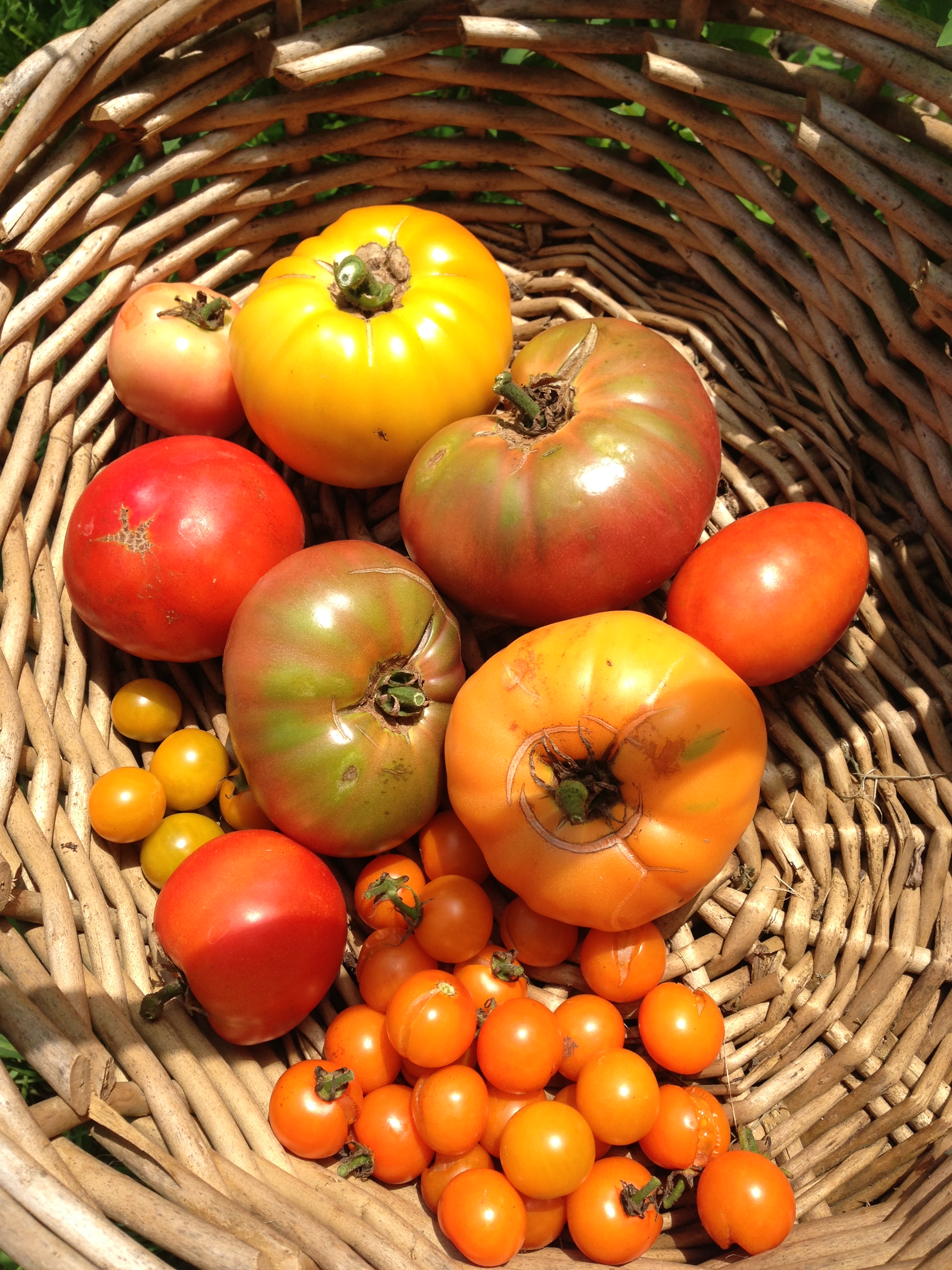
I have tomatoes, so how can I whine? A rainbow of heirlooms.

mixed tomatoes

Basil bushes that could make topiary pesto.

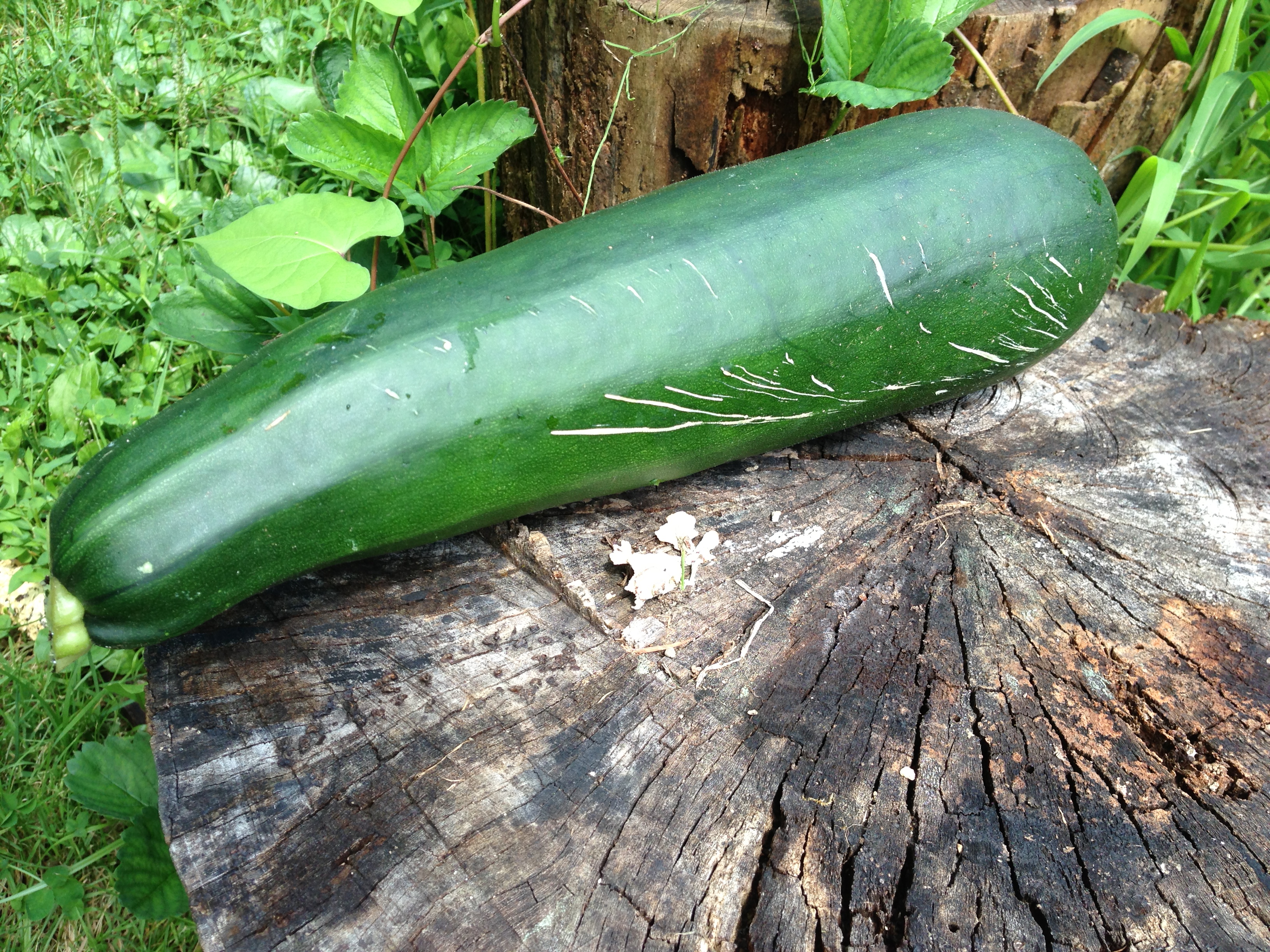
Squash, huge, far too much too eat.

zucchini

Does anyone actually like stuffed zucchini boats?

My herbs were are great before they crushed by toppling mint. The lavender and tarragon have exploded. Next to them, the pinks I planted as companions have bloomed constantly. My raspberry volunteers produced berries that accent vanilla ice cream perfectly.

berries

And here’s the point. Everything is sprouting, bushy, overgrown. The weeds sprawl. But the plants I expected to do well – the pole beans, say, masses of vines and leaves – have produced no beans.

beans

Some cuke plants have thrived, but others flatlined. Peppers, yes, eggplant, nada. Cosmos making a brave go of it.

cosmos

The beautiful crinkled leaves of the rainbow chard? Gourmet rabbit lunches, long gone.

The journey is the goal. To quote Gil, quoting some Oriental sage.

Oh. So it was all about the planting of those wrinkly little potato sections in May, watching the green plants thrive in June, finally the digging of the hard red tubers out of the earth, greeting the earthworms that were their bosom companions. Getting the good dirt under my nails.

potatoes soil

Having a perfectly manicured kitchen garden where every crop prospers isn’t the point even if it was possible. I’ve had that experience, in the past, on a sunny slope with plenty of chicken manure and it was pretty great. But then I didn’t share a marsh with turtles and snakes and red-tailed hawks. I didn’t live in the shady, ethereal woods.

I could use a hand with the weeding. In the meantime, let’s listen as Jonathan Richman sings the Kinks’ Stop Your Sobbing.

5 Comments

Filed under Cooking, History, Home, Jean Zimmerman, Nature, Photography, Writing

Portals Into Other Worlds

I’m thinking about how you can visit other times and places on the web, peeking through portals the way you peer through a cutout in the plywood surrounding a construction site. Here are fifteen visits I’ve made lately that I’d recommend.

It was a mistake for Rolling Stone to make a rock star out of a creep.

jahar:jim

That doesn’t mean the article that goes with the picture is not good journalism. And don’t we want to know, don’t we have to know, what makes terrorists tick, in order to know how to combat the evil they do? If you don’t feel like patronizing Rolling Stone at the moment to read the piece, if you’re interested in long-form reportage on all kinds of subjects, from a history of the famous indie rock club Maxwell’s to a star 16-year-old pitcher in Japan, go to Longform.org, which reprints new and classic nonfiction from around the web.

Amazon-Kindle1

Admit it, you want to know the inside story of the Kindle. What brainiacs came up with this gizmo that might mean the end of books as we know and love them? (I actually have a Kindle Fire and don’t find it hasn’t stifled my desire to read print on paper, just saying.)

It sounds almost banal, but I guarantee that when you hook into The Evolution of Love Songs (1904-2007) you will not be able to quit. I’m waiting for part 2, 2008-2013.

Up my alley, and I hope yours, a view of how the lives of American women changed over the 19th century through the art of the time.  In particular, life on the farm, complete with Winslow Homerian milkmaids.

Winslow Homer (American artist, 1836-1910) The Milk Maid


There are so many food blogs. I like npr’s the salt.

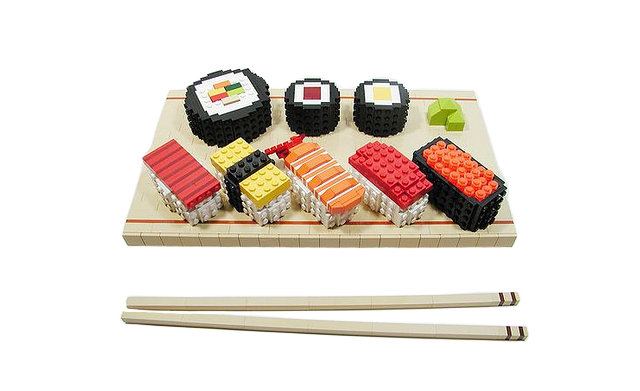
A view into a different world would include the minds of people who make Lego their personal idiom. They do things like make plastic sushi and other amazing Lego food creations. 

Lego sushi

I’m interested in the alternate lives of feral children, especially since my next novel Savage Girl  describes all the trouble one can get into in Gilded Age New York. Like how do you participate in a refined dinner party when you’re accustomed to tearing meat apart with your fingers? Every now and then a contemporary wild child surfaces with an interesting story. You can read about Marina Chapman, a British housewife who claims she was raised by monkeys in Colombia.

 marina chapman

Want to know about neolithic cooking? The Rambling Epicure tells you, and it starts with “one bucket wild spinach leaves.” The excellent food site gives you a recipe from Jane Le Besque’s cookbook, Un Soufflé de Pollen: Livre de Cuisine et de Peinture. A painter, Le Besque lives in the Pays de Gex in the foothills of the Jura mountains, and this is her “artistic vision” of primitive cuisine.

See how other people connect — passionately — with the past. Reenactors get their due with 36 photos from around the world.

reenactors

Here, actors and actresses from Iere Theatre Productions play the roles of indentured East Indian laborers and British constabulary police during a reenactment of the first arrival of East Indians to Trinidad and Tobago, on Nelson Island in the Gulf of Paria off the west coast of Trinidad.

It’s not all about Gettsyburg, clearly.

reenactors 2

These children are taking part in a mock military parade at an amusement park in Pyongyang to mark International Children’s Day, in this photo taken on June 1, 2013.

Okay, the squeamish should not tune in to7 Bio-Artists Who Are Transforming the Fabric of Life Itself” at the site io9.

rabbit

It’s about how some provocative artists today deal with biotechnology. Working with scientists and engineers, these geniuses transform living tissue and even their own bodies into works of art. For example, Brazilian-American “transgenic artist” Eduardo Kac took a rabbit and implanted it with a Green Fluorescent Protein (GFP) found in jellyfish. When placed under a blue light, the rabbit glows an otherworldly hue.

On the lighter side, see the longest domino chain in the world made of books: 2,131 of them.

 My dog is named a very modern Oliver. He looks exactly like his name.

oliver about to copy

Medievalists.net has a well-researched piece on ancient pet names, such as dogs called Sturdy, Whitefoot, Hardy, Jakke, Bo and Terri, and a cat in England named Gyb – the short form of of Gilbert –  or one named Mite, who prowled around Beaulieu Abbey in the 13th century, or Belaud, a grey cat belonging to Joachim du Bellay in the 16th century. Isabella d’Este owned a cat named Martino. I bet nobody died their animals green.

Buzzfeed has 16 noble photos of women writers at work, including a great one of Anne Sexton immersed in her craft.

anne sexton

From MessyNessyChic.com, the story of an artist whose work was discovered in the trash 50 years after his death.

Charles Dellschau

This grouchy butcher by trade, an immigrant named Charles Dellschau, had secretly been busy assembling thousands of intricate drawings of flying machines, sewn together in homemade notebooks with shoelaces.

And for anyone who didn’t catch this when it went big on the web, Dustin Hoffman showed us his softer side in reminiscing about Tootsie and what playing a woman meant to him. The interview is a window into the psyche of someone whose brilliant work opened a window into a psyche we were lucky to see.

tootsie25

3 Comments

Filed under Art, Cooking, Culture, Dogs, Fashion, Fiction, History, Home, Jean Zimmerman, Nature, Poetry, Savage Girl, Writers, Writing

Dirty Disney

I expected the Paul McCarthy show at New York’s Park Avenue Armory to be raunchy, demented, transgressive. What I didn’t anticipate was that it would be hilarious.

Screen-Shot-2013-07-08-at-9.34.24-AM

If you follow the contemporary art world you know that McCarthy excels at tweaking the public’s nose. Not long ago there was the giant inflatable “Complex Pile” he contributed to ultra-civilized monumental art shows.

poop

The fifty-one-foot dog poop went pop in a downpour one recent day in Hong Kong, but not before it had made its comment on our expectations for the public sculpture we’re used to admiring. Plastic dolls, masks and ketchup have also figured in the 68-year-old McCarthy’s oeuvre over the years.

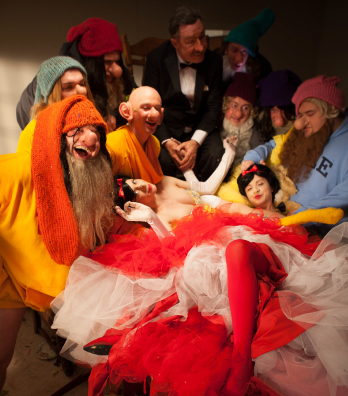
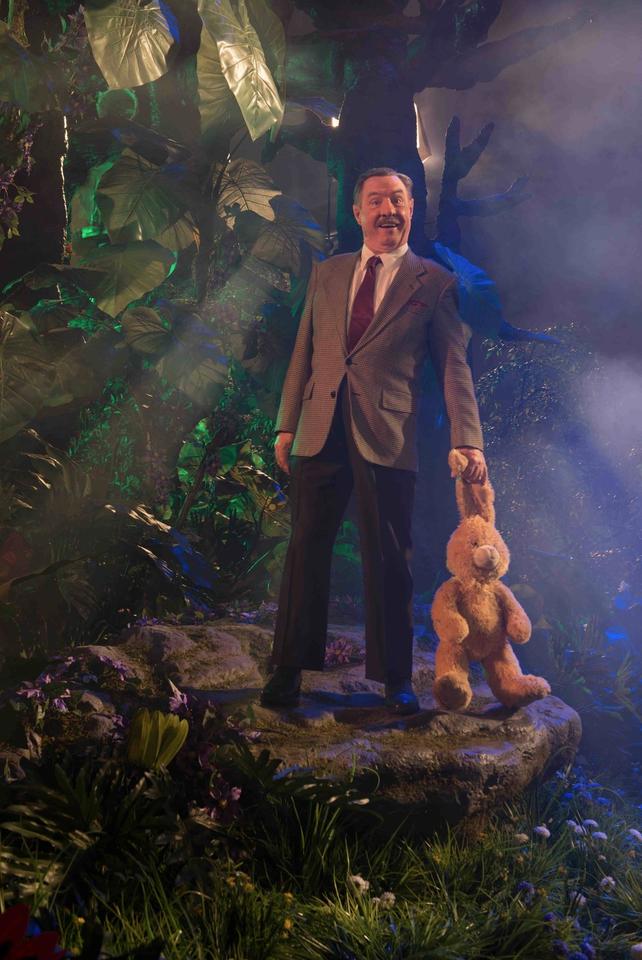
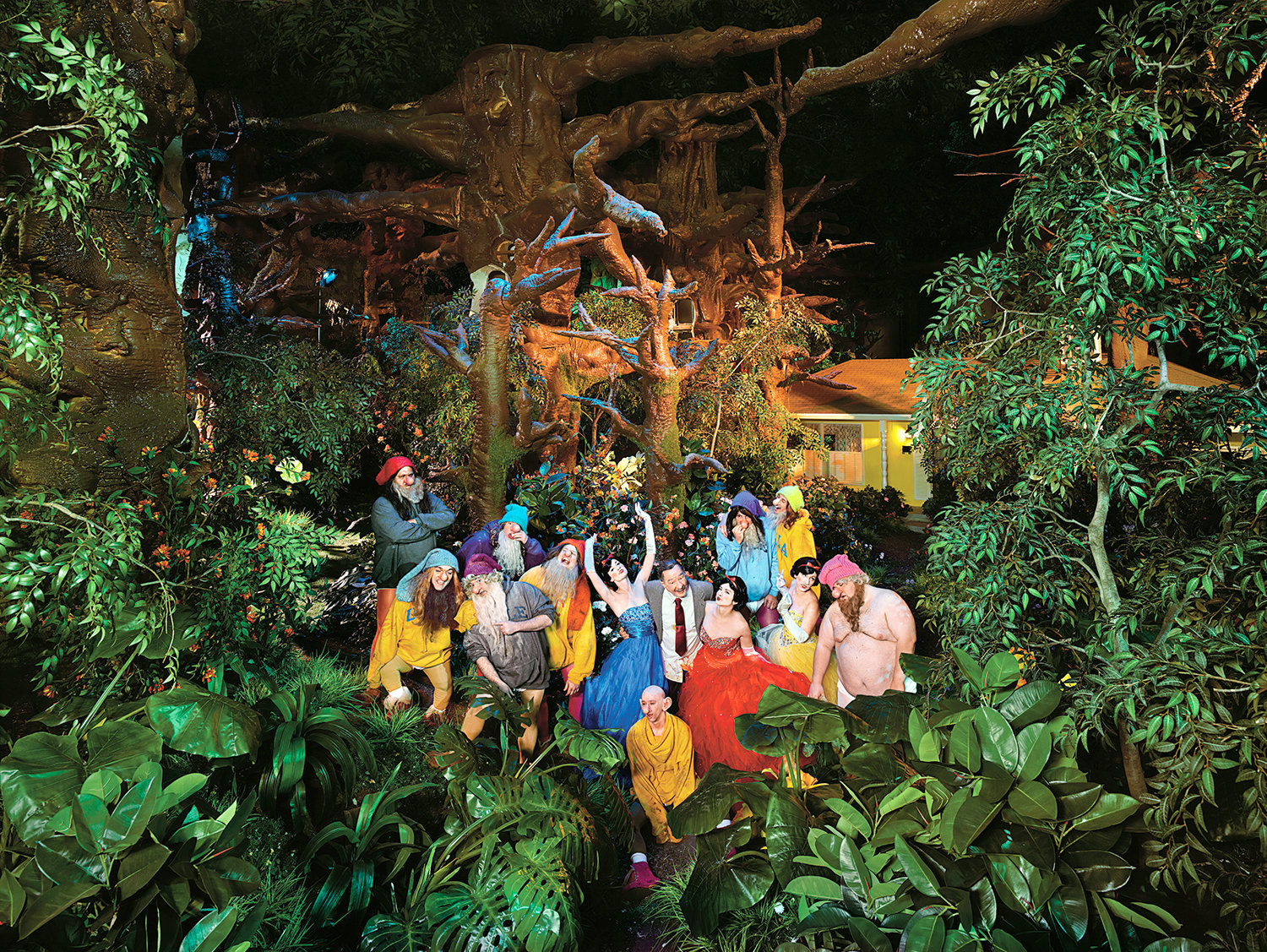
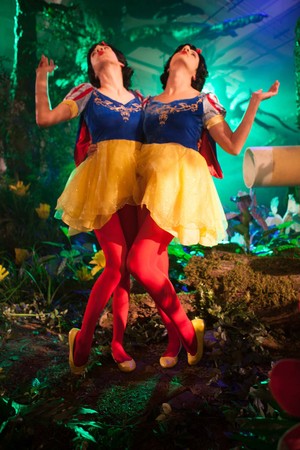
In W/S,  the largest installation the artist has ever created, we have a multimedia reimagining of the tale of Snow White and the Seven Dwarfs, its Disney iconography mashed up with elements of horror and porn and probably a few other elements I missed. In the films that are the bulwark of the show, McCarthy plays an ersatz Walt Disney, here called Walt Paul, nose prosthetiicized to the max.

061813white4

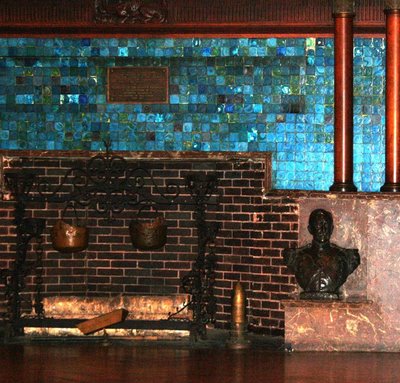
Neither Maud nor I said much as we went around the Armory’s cavernous Wade Thompson Drill Hall, one of the largest public spaces in Manhattan. The last time I visited the Armory it was for the prim and proper Winter Antiques Show, and I remember marvelling at the fancily gorgeous reception rooms designed by people like Louis Comfort Tiffany.

armorytiffany3

This time we heard the exhibit before we saw anything, a raucous moaning and groaning like a bloated x-rated soundtrack. The noise emanated from two gigantic screens, each as big as a drive in theater’s. On the screens, dwarves cavorted with  White Snow – McCarthy’s version of the Disney heroine — in a hectic, squalid party.

screen

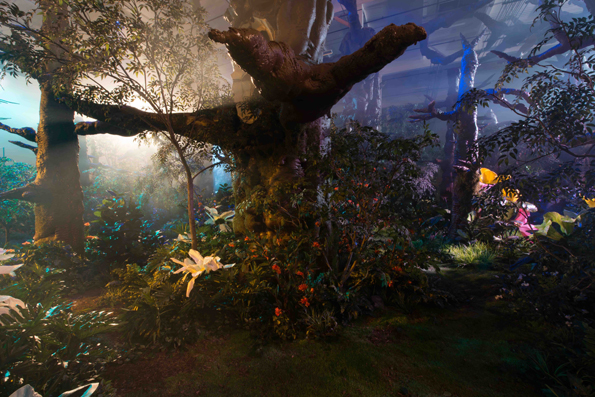
Under the blast of sound we couldn’t hear each other anyway. In front of us stood a large, Wonderland-proportioned forest of painted styrofoam trees and garish monster flowers.

forest dark

Its lavish 8,800 square feet formed the centerpiece of the show and had served as the soundstage of the production, before it was carted to New York from Los Angeles in dozens of tractor-trailers.

forest

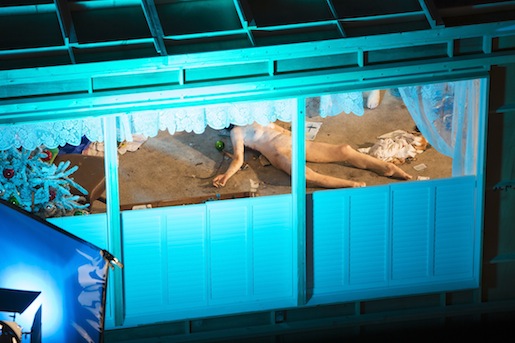
A house, or “cottage,” stood in front of us, or anyway a film set version of one. The back was punctuated with a series of square peepholes like the ones you see at some major construction sites. I’ve always liked peering into those. Here there was the same suggestion of a secret view.

body

There were disturbing glimpses of the aftermath of something gone terribly wrong, a woman and a man collapsed in a tacky living room. But the squirt bottle of Hershey’s was the tipoff as to the display’s tomfoolery. You do know that in Hollywood, Hershey’s often substitutes for blood, don’t you?

In W/S, McCarthy exhumes Walt Disney and has him trot around getting into trouble before really getting into trouble at the hands of Grumpy, Sneezy, et al. All I could think of was a guy I knew who landed a good job working at Disney in the ‘60s before Walt personally had him fired for sporting a beard.

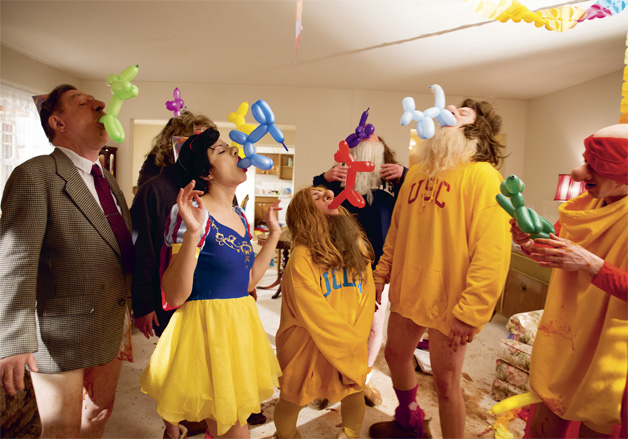
Now here was one of the most famous men in the world surrounded by beards and noses and genitalia and a lot of chocolate syrup, making love to a wench of a White Snow, all of them doing everything that no one would ever do in a Disney film (or theme park or corporation). It’s an upside down, inside out world, as crude and scary as the other was clean and safe. I imagine the Disney barracudas preparing their legal briefs.

balloons

Randy Kennedy of The New York Times did a piece on the artist recently that said, “His work can – and does – provoke physical revulsion. But it is not mere provocation; it’s intended as an all-out assault, a ‘program of resistance,’ as he calls it. And the older he gets, the more explicit he has become that his target is the American entertainment-consumer economy.”

Spectators weren’t allowed in the forest, but in a smaller film arcade along the side we could observe chapters of the story. An unclothed Prince Charming wandered through its glades. Shocking events transpired. We could also visit another house in a retro ranch style that is actually a three-quarter-scale replica of McCarthy’s Salt Lake City childhood home. Alex Poots, Artistic Director of the Armory, has had a lot of explaining to do about the piece, and at one point he said, “it explores the vast and at times distressingly dark corners of the human psyche.” And the dark corners of some pretty sad vintage rooms, I would say.

screen set

Walt Paul is not Paul McCarthy – the latter lives in Pasadena with his wife of 46 years, surrounded by kids, grandkids and pets. His grown son partnered with him in putting on W/S.

portrait


McCarthy told an interviewer that the show “may have something to do with how we see reality and desire. And art. This is a kind of hyper-reality of desire. A Disneyesque landscape that does not exist. A dreamscape.” All of this styrofoam and soundstage equipment comes at a cost, of course, and the project required millions of dollars. I like to think of Walt Paul in his lumpy nose approaching potential benefactors: Well, there’s this plastic forest, see, and this Hershey’s syrup…

I read a review that said the show “put the grim back into the classic Brothers Grimm fairytale.” I saw it as a series of extravagant what-ifs. What if Snow White had a split (or triple) personality? What if there was a handsome prince who didn’t rescue her but treated her more like a centerfold than a princess? What if Walt actually appeared in his own movies alongside Bambi, say, or Cinderella? What if those beloved childhood movies were more like stag films? What if the dwarves weren’t wholesome and helpful and cute but more like your twisted Uncle Charlie?

ws

The Grimm tales have always been dark. The great children’s author Philip Pullman recently came out with a new version, just in time for the 200th anniversary of their first publication.

grimm


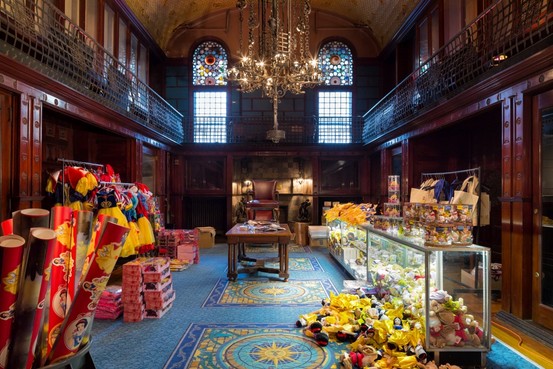
McCarthy’s show is also unabashedly commercial, with plentiful Snow White artifacts available in the gift shop.

Disney stuff

Pullman’s Fairy Tales From the Brothers Grimm are punchy and elegant but also violent and raw. In his translation of Snow White, a huntsman cuts out the heart and liver of a wild boar and takes them back to the evil queen as evidence of the girl’s death. “The cook was ordered to season them well, fry them, and the wicked queen ate them all up.”

Do you recall the conversation parents have had from time to time about whether these ancient fairy tales offer an appropriate reading experience for their innocent youngsters? The answer is No, if you’re doing it right. And this version is done to a turn.


3 Comments

Filed under Art, Culture, Fiction, Film, History, Jean Zimmerman, Publishing, Writers, Writing

Swedish Farm

My friend Sarah Hollister, an American who has lived in Sweden for some years now, agreed to do a guest post for me. Her perspective and her pictures are lovely. Here she is:

We’re soon leaving the Henning Mankell Gård (translated farm) up here in Härjedalen in the northwestern part of Sweden. Just one more day. One of the great things about this writing residence is that family is welcome (there’s even a sweet baby crib in one of the bedrooms) so my partner Gunnar has been here with me which has been good. This house is too big for one person.

IMG_1634

I spent the first day roaming the roominess of the house, up and down the stairs, examining the books in the library, checking out the huge laundry room, washer, dryer, and a drying closet for heavy rugs. Just enjoying the space before I settled down in my workroom on the first floor.

Gunnar and I took some day trips on the two cycles provided and discovered a number of deserted houses up here, people who had given up. Though we also saw some very prosperous looking farms.

IMG_1486

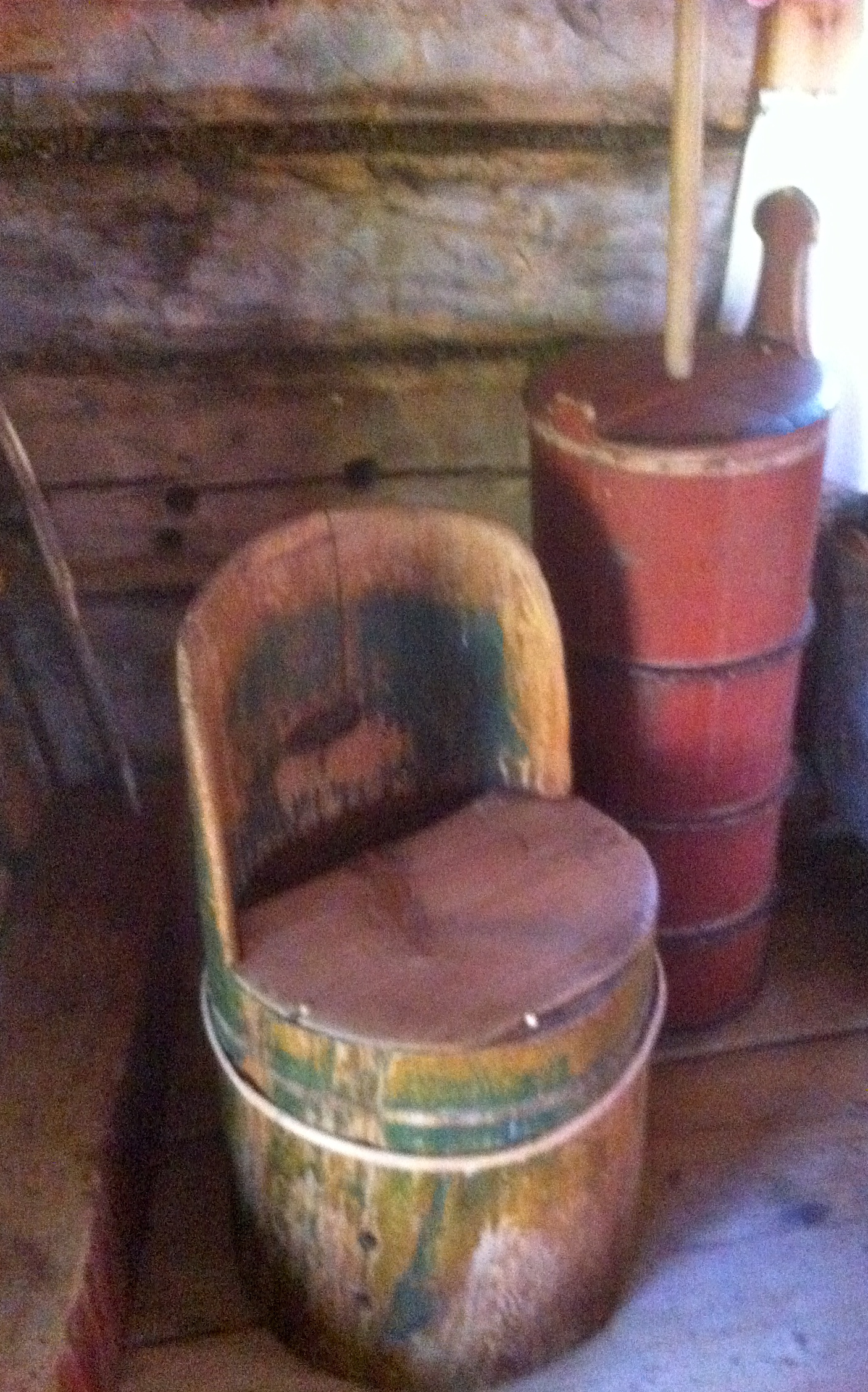
You can’t be in this part of Sweden without encountering a fäbod, (translated mountain pasture). But a fäbod is more than grass, it’s a concept, now lost, a way of living. Fäbods consist of a cluster of small weathered log houses built on a site where there was plenty of green grass for cows to graze to their heart’s content.

We visited  one just up the road from the Mankell Gård, climbing up the narrow path that led to the high pasture. I thought of cows, of many cows navigating these paths covered in roots and rocks, mooing and balking.

IMG_1536

The log houses are fairly small, no bigger than a large farm shed, with low ceilings, dispelling the myth of the towering Vikings. It’s easy to bump your head if you don’t duck. Most of the buildings were built for storage, hay and wheat, milk and butter products.

IMG_1523

In one of the buildings, we found pictures carved into the beam logs. There was a written explanation on the door that explained the pictures were representations of the wars between Norway and Sweden, border skirmishes that took place up here in this part of Sweden. It was hard to tell though. The small figures looked like ordinary men and women to me. Someone had an interest in art.

IMG_1532There is one log house (as in every fäbod) specifically to house a young girl, the fäbodjäntan. It’s difficult to find an English translation for this word —  let’s say cow tender. She helped drive the cows up the mountain, then stayed on alone tending the cows over the long summer days.

What do we know about these girls, the fäbodjäntans? They had a song they used to call out to the cows, their voices echoing up and down the hills and mountains. I like the romance of it, I admit. They slept in small beds in the small wooden houses of the fäbod. They were kept warm by a fireplace should the need arise, cooked their meals there as well and at times were allowed a visit from their fiancé if they had one. A larger bed with a curtain was available for those visits.

IMG_1518

Gunnar pointed out that morality was not so strict in those days, at least for farm girls.

IMG_1517

I’ve grown used the quiet of the mountains, the sunlight glinting off the birch leaves, shimmering, silvery. I wouldn’t mind living in a fäbod myself. They’re for sale if someone has a knack (and the money to spend) for renovation. It would be nice though to spend a whole summer in one, dreaming and writing.

IMG_1520

3 Comments

Filed under Art, Culture, History, Home, Jean Zimmerman, Nature, Photography, Writers, Writing

Blues Chicken

With every last i dotted in the proofread Savage Girl galleys, I raced to my reward, a sultry New York City where everyone, it seemed, was perambulating, doing something exciting and interesting. Gil and I would go among them, we would do something exciting and interesting, too.

Eat chicken, for one.

Questlove, the drummer and frontman for the band the Roots, has got so deep into the fried poultry business that he had some kind of a late night throwdown with Momofuko head honcho and chicken man David Chang on Late Night with Jimmy Fallon. Now the musician has opened a counter joint in New York’s Chelsea Market called Hybird that serves exclusively drumsticks, fried dumplings, biscuits and cupcakes. All the essentials for a balanced diet.

hybird

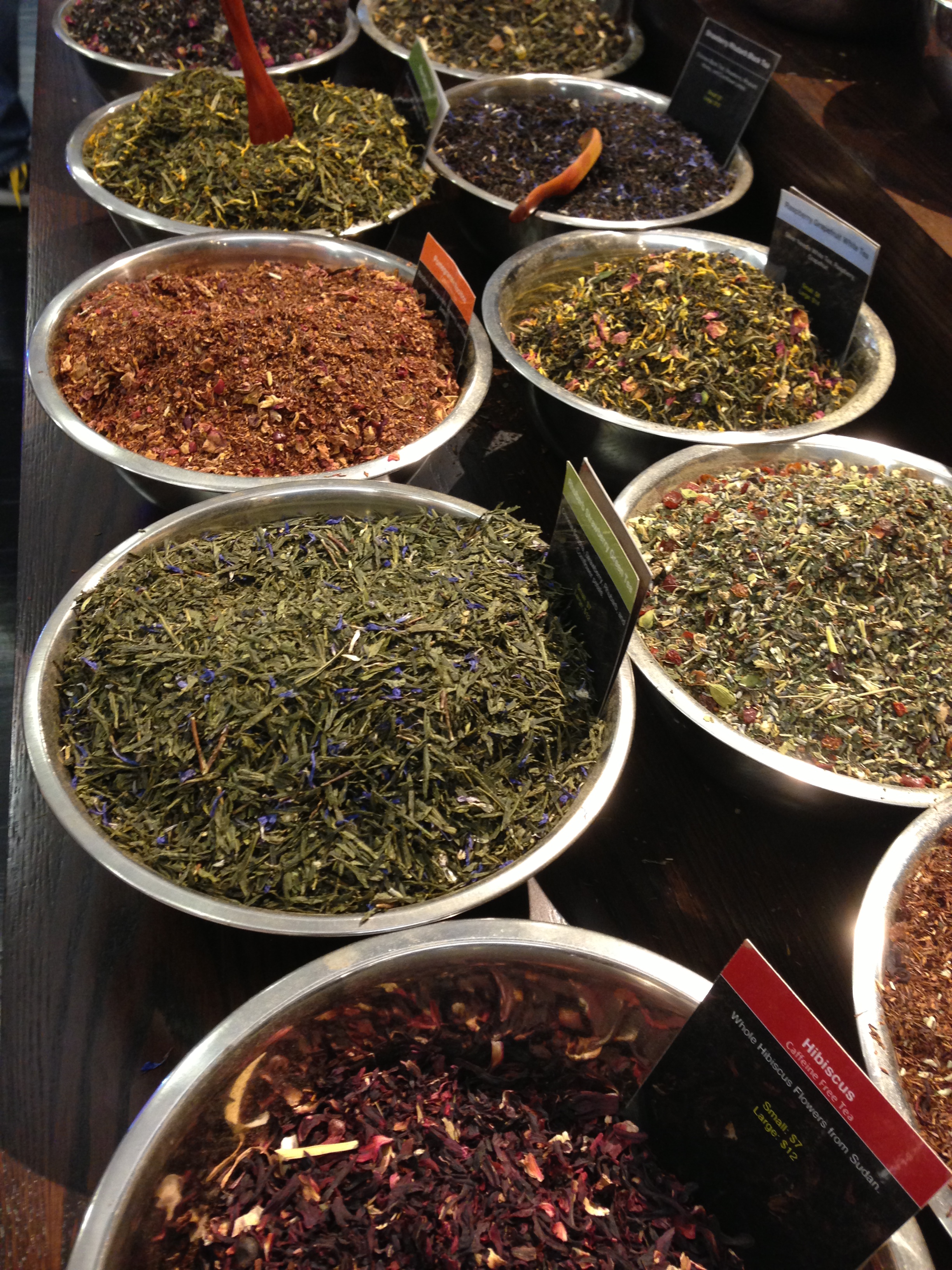
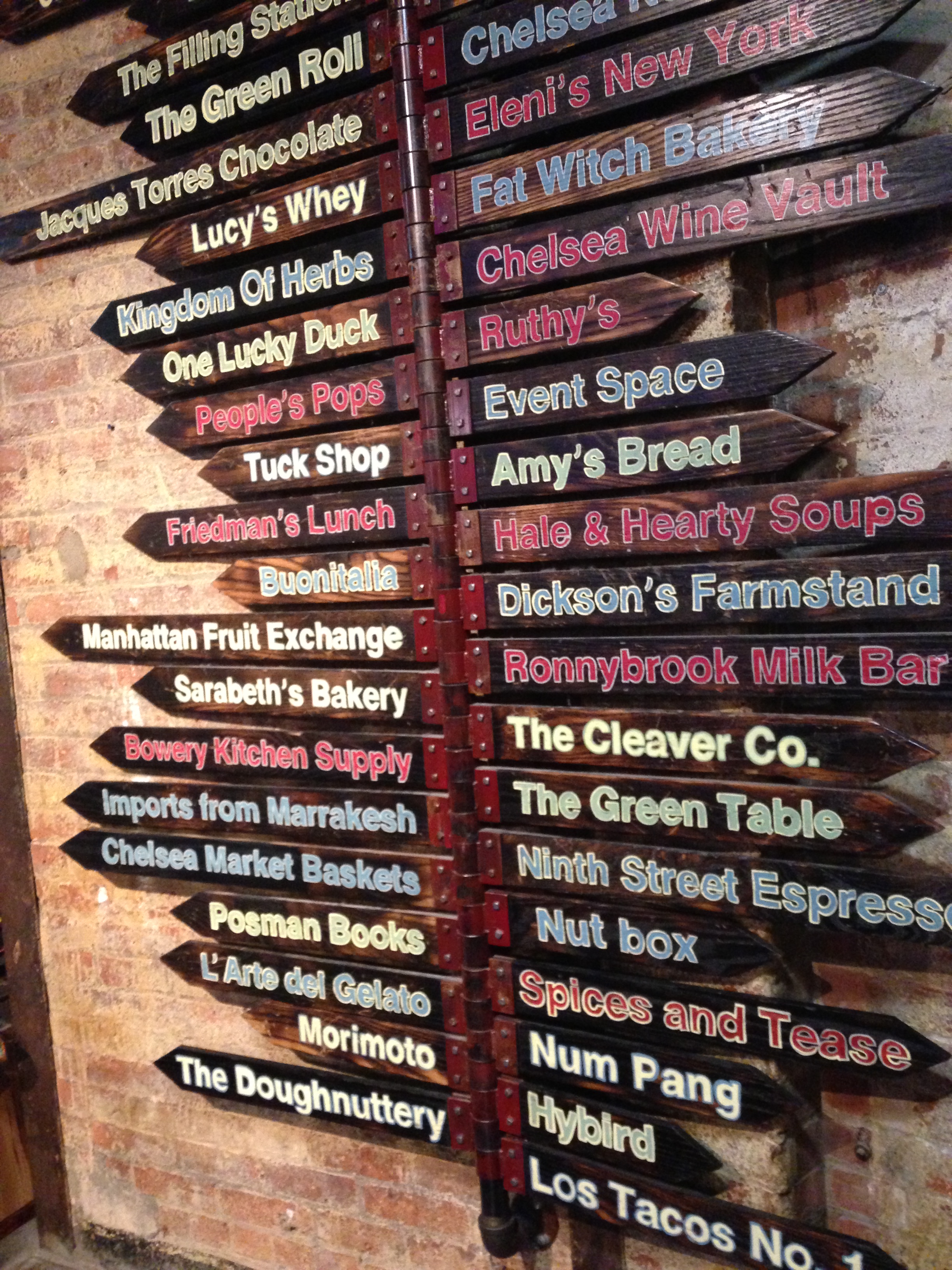
We got to the labyrinthine food concourse in midafternoon, ahead of the crowds, snaking through a corridor lined with dozens of teas, our stomachs rumbling.

tea

The enormous Chelsea Market complex is located on the premises where the Oreo was developed and perfected, lending an air of sanctity to our excursion.

Chelsea Market features a lot of exciting things. Chilled, hefty lobsters.

lobsters

Falling water.

chelsea waterfall

Food venues. Outrageously good smells swirled around us.

bounty

What it didn’t have before is this particular chicken.

chix box

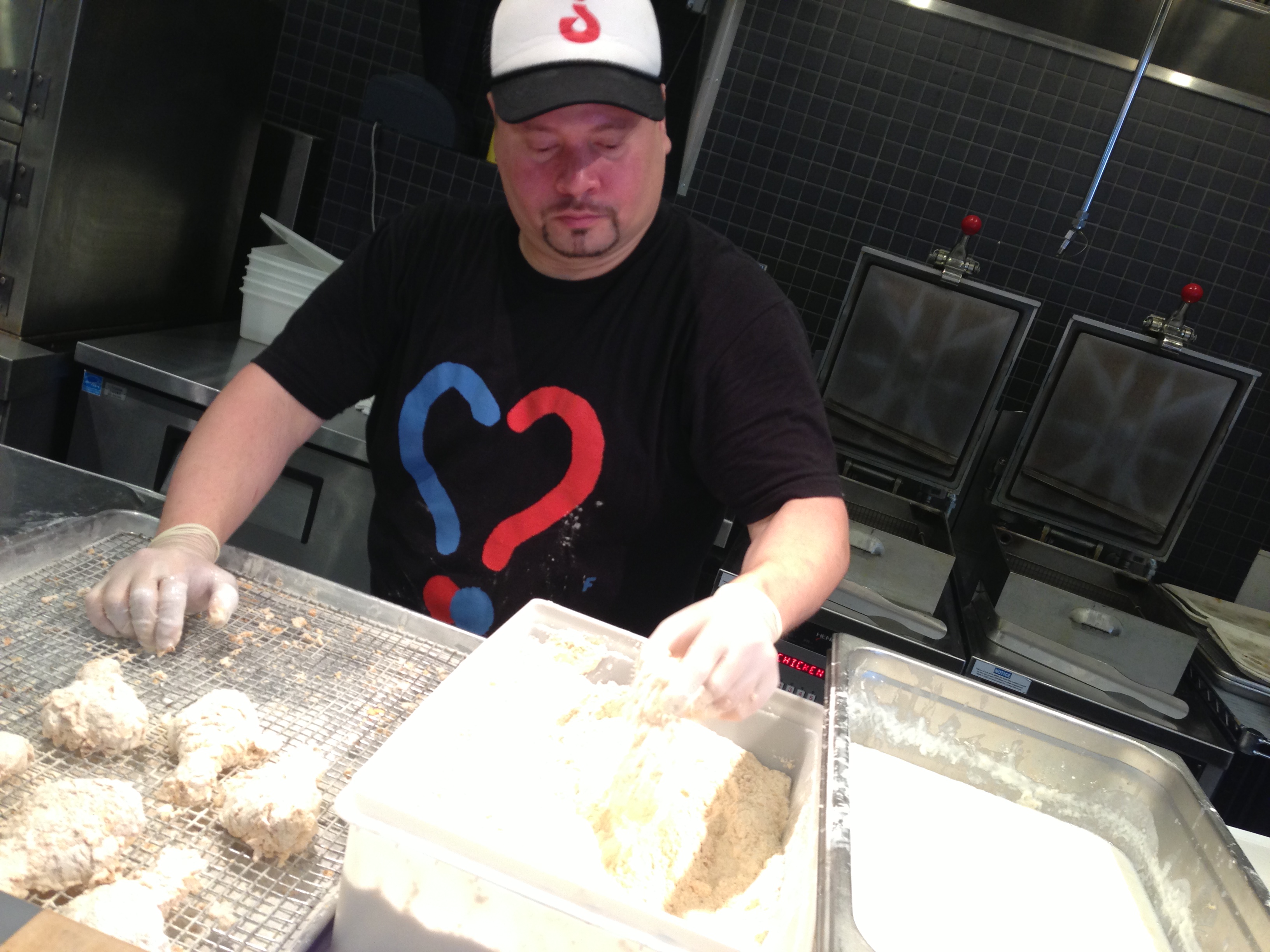
What is the seasoning, I asked Sammy, the guy double dipping chicken parts in a creamy paste behind the counter, when I managed to unstuff my mouth with chicken.

sammy

It’s a secret, Sammy said. A lady from Philadelphia comes in and mixes it up for us. She brings all the spices but she doesn’t tell us what they are.

I love a secret, especially when it tastes as good as this. The biscuit too was perfectly crumbly, smeared with honey butter, and we piled on further with crunchy dumplings that oozed out their sweet-savory crab filling when bitten.

Stencilled footsteps seemed to indicate where you should stand at Hybird, and naturally Gil was outside the lines.

feet

I saved the cupcake, whose flavor was described as “Sexual Chocolate,” for the car, a sexier environment than Chelsea Commons.

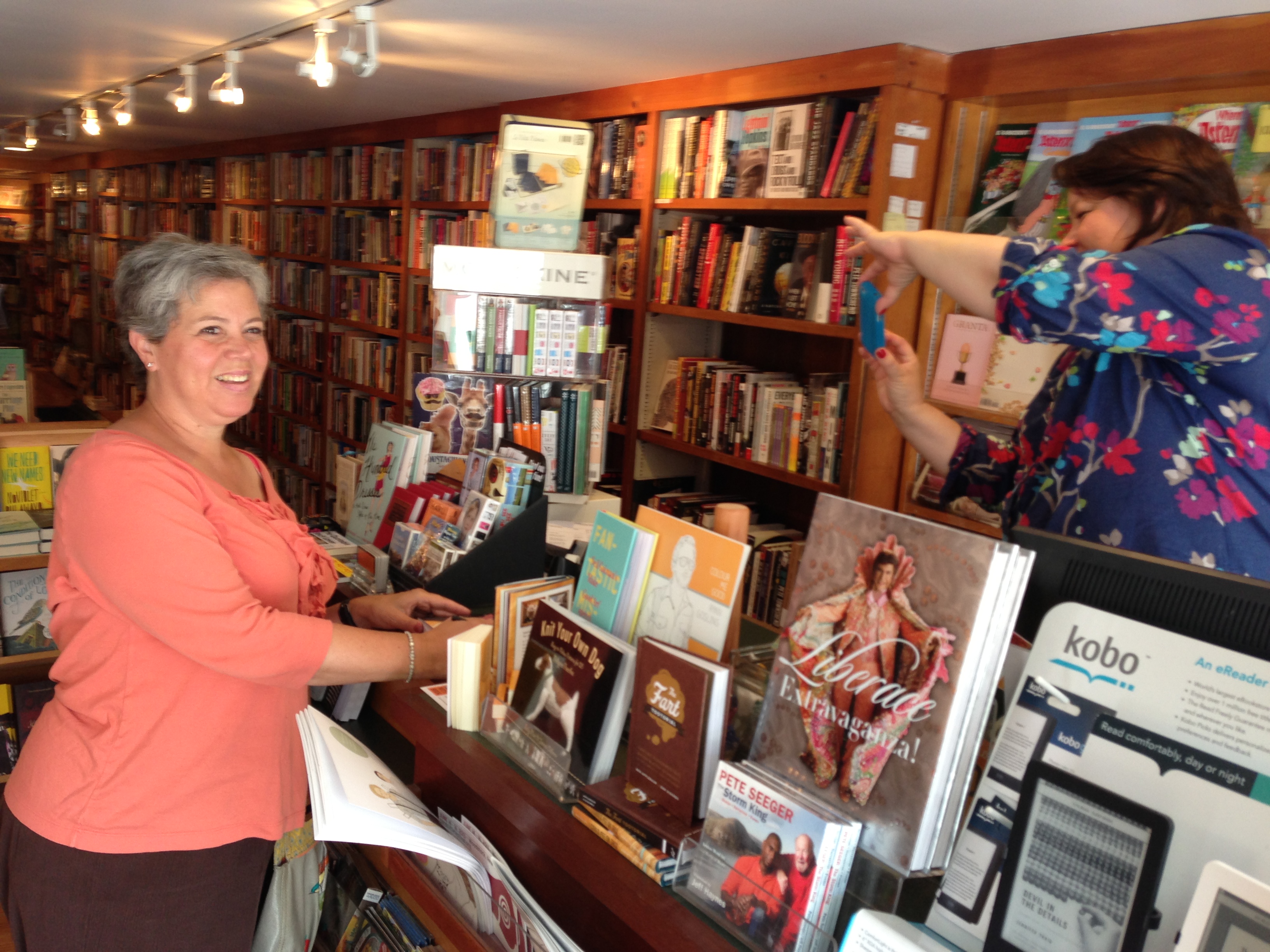
A bookstore.

books

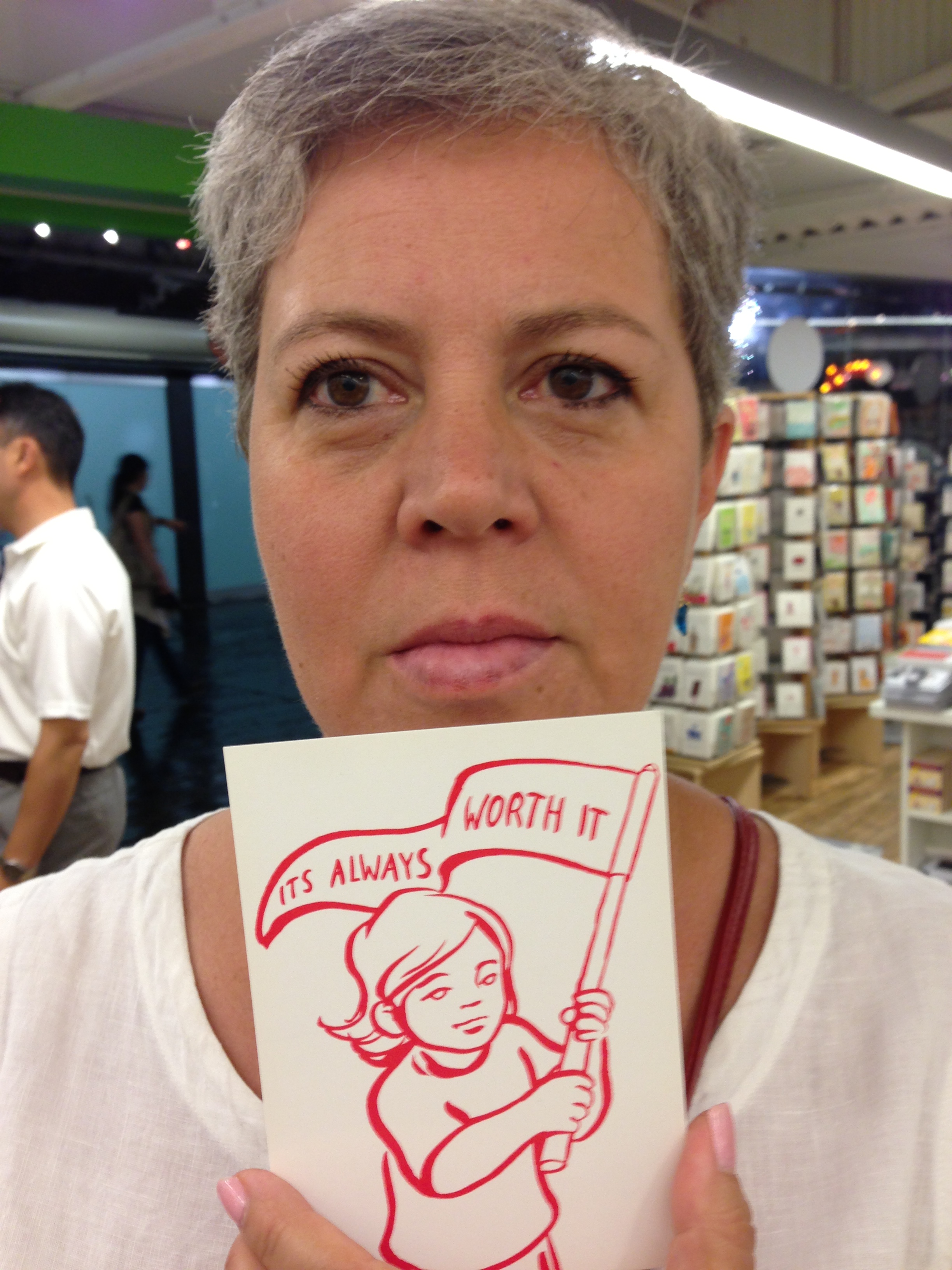
Nary a copy of The Orphanmaster in sight. It happens. I fell back on my motto, handily available on a postcard.

it's always worth it

You never know who you will meet on a summer afternoon ramble around New York. In this case a young woman wearing a pair of the new Google glasses.

google glasses

Wilma told me she’d just picked them up upstairs, in the Google offices, having won them in a contest. She said she was recording a video of me as we spoke.

Sated, Gil and I continued to the World Financial Center, in Battery Park City, directly across the Hudson from Jersey City. We were looking forward to a triple bill of bluesy rockers, or rockin’ blues players, depending on your perspective, on a public terrace that sits in the shadow of the Freedom Tower.

freedom day

The sun shone so bright and hot that half the waiting crowd put up their rain umbrellas, a spectrum of colored and patterned domes across the concrete. New Yorkers are always more slovenly than they are expected to be, and serious exhibitionists. Women flaunted the briefest sundresses up to their backsides and sweat-slicked men ran shirtless through the crowd. In the harbor a stroll away, sailboats and yachts docked, and motor boats cruised in to check out the action.

harbor

Alejandro Escovedo hit the stage with his sweet blasts of melody, punk rock in its roots. His song Sensitive Boys could make you cry, or was that the sun glare in your eyes. He brought on David Hidalgo to do a searing You Are Like a Hurricane. Alejandro called it the Canadian national anthem.

We met up with friends and family at the venue. My touselled buddy Sandra the artist-environmentalist noticed that the masts of the little boats were themselves rocking, pushed by the wind, in line with the beat of the tunes.

touseled Sandra

Los Lonely Boys, the Chicano rock band out of San Angelo, Texas, were tight. A trio of brothers, they call their music Texican Rock ‘n’ Roll. How can three guys make so much noise? marveled Gil.

Los Lonely Boys

The lead singer and guitarist Henry shouted above the applause, We appreciate it! We know you can be anywhere else!

And it was true of course, on this summer night, with this breeze and the salmon streaks of sunset glowing, in this fantastic city. We could be doing anything but we chose to be here because Heaven, their hit debut single from a decade ago, was so exciting.

How far is heaven? Los Lonely Boys sang. You know it’s right here, right now, shouted Henry, in New York City!

Los Lobos followed, another American Chicano group, this one from California, with considerable chops that they took no time in putting out on the stage. They’d been around since the ‘80s, after all. The sun set, the klieg lights glowed, people wrapped their arms around each other and danced.

By the time we gathered our things, the skinny minx beside me who’d been flipping her skirt in time to the beat was sweetly reunited with her man.

couple

Love and music in sun-stunned, summertime New York City. A treat as scrumptious as fried chicken.

1 Comment

Filed under Cooking, Culture, Dance, Jean Zimmerman, Music, Nature, Publishing, Savage Girl, Writers, Writing

Tuber or Not Tuber

My potatoes are ready to harvest. Knuckling up from under the crumbly soil, red, firm, practically begging to be dug.

potatoes stalks

The tops of the plants have collapsed and faded, letting me know the tubers have reached their point of ripeness.

And I’m on my knees (on my gardening pad, protecting my getting-to-be-arthritic knees) thinking about things that grow under the soil.

potatoes soil

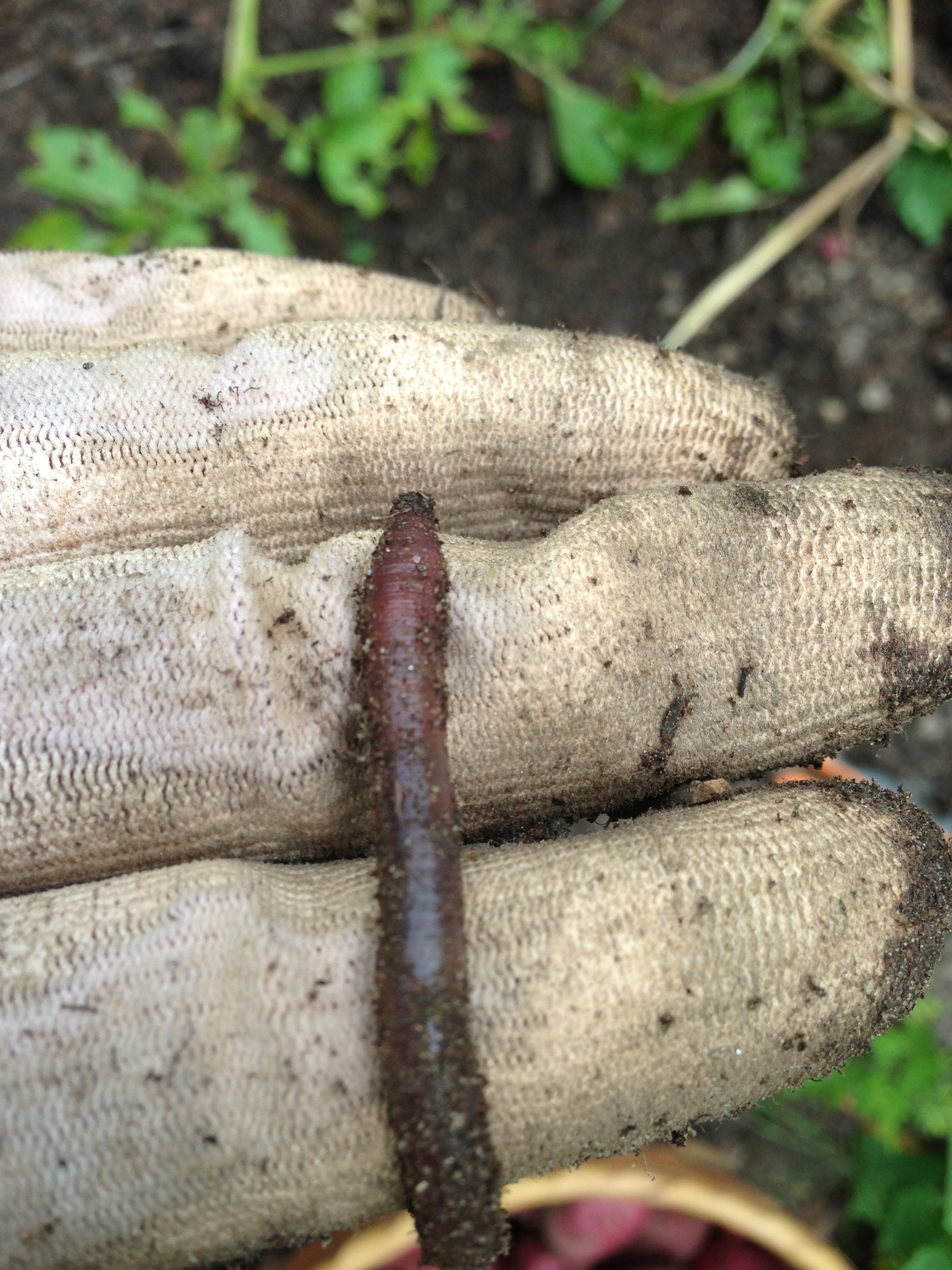
Earthworms, like the one strutting across my gloved fingers, surprised in its wanderings around the potato neighborhood. Gil tells me that earthworms are actually an invasive species and have disrupted the ecology of the forest floor.

worm

I’ve always liked earthworms, admired their digestive capabilities, and wanted them to multiply in my garden. At the same time, being a little squeamish, I’m anxious about coming across them writhing in my path.

Here are potatoes, washed and sliced, for a summer gratin.

potatoes raw

So fresh they slice more like cukes or squash. Moist like just-picked tomatoes.

tomatoes

I’m thinking about anxiety, another thing that, like a potato, grows underground. You can put them aside, the things that worry you, by day. The yet-to-be-paid bills, the yet-to-be-written article, the yet-to-be-published book, the yet-to-be-proofread galleys, the yet-to-be-folded laundry. But roundabout 11pm, lying between the sheets, the air conditioner blotting out all distractions, those anxieties come back for their nightly haunting. Herbal tea, you say? Hot milk? Meds? All you can do is dig yourself out of the dirt by the next day’s sunlight.

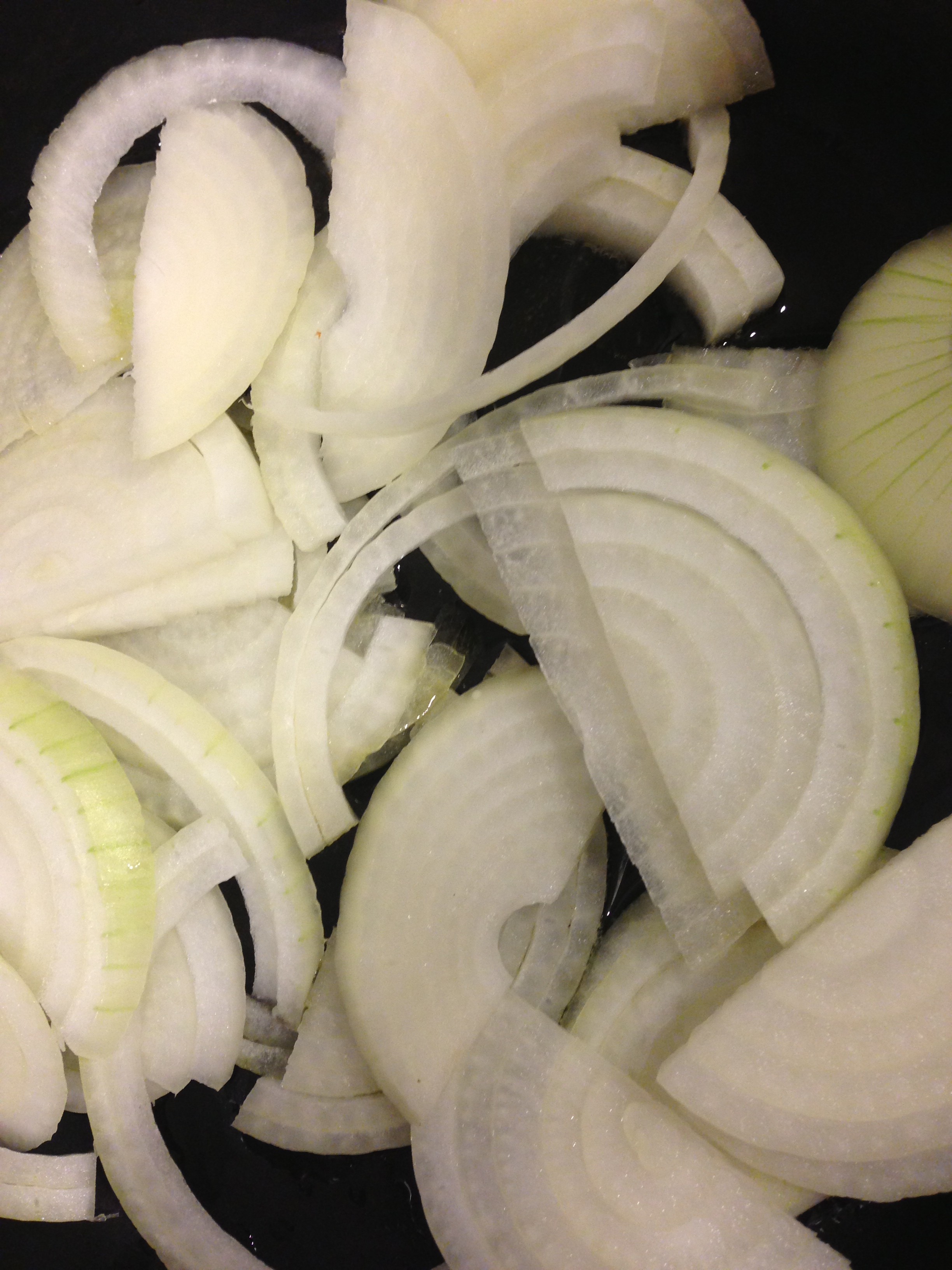
Onions swell beneath the dirt. Onions to fry in olive oil for the gratin.

onions raw

Creativity also grows underground. Say I have an idea for a new story. An idea about the way a certain neighborhood looks in a New York of a different age. A thought about a character the other characters call simply the Turk. A whaleboat loaded with cabbages. Ideas percolate under the surface and peep up occasionally. You’d better write them down in a notebook or they’ll descend back down again.

Layer the potatoes in a casserole dish. This gratin is simple. Place the rounds, spoon the onions over and then the shredded gruyere. One, two, three layers. Extra cheese on top (no anxiety about its cost or its cholesterol!).

Give anyone deserving a shred.

oliver cheese

Take a break from proofreading your galleys. Pour a pint of cream over the layers. A pinch of salt, a few grinds of pepper.

gratin

Crank the oven to 425 degrees. It’s hot in here, isn’t it? The rest of the ten pounds of  potatoes, homely and crumbly, await their cold bath. They’re dug up now, won’t ever go back. Anxiety, creativity, things to bring into the light of day. It’s their turn in the sun.

potatoes basket

4 Comments

Filed under Cooking, Culture, Dogs, Fiction, Home, Jean Zimmerman, Nature, Publishing, Writers, Writing

Il Rituale dei Bambini Perduti

Italy has weighed in.

anteprima-il-rituale-dei-bambini-perduti-L-fp4Qio

My Italian publisher’s visual interpretation of the drama of The Orphanmaster is not perhaps what I would have expected. It’s baroque. It’s scary.

It’s amazing to think of people sitting down with a copy of Il Rituale dei Bambini Perduti, so far from the island of Manhattan in 1664.

If you can read the language, check out a book blog.

13 Comments

Filed under Culture, Fiction, Jean Zimmerman, Publishing, The Orphanmaster, Writing

The Taksim Square Book Club

In  Turkey, people are reading books. In public.

Which is amazing, considering the country’s recent history.

Taksim Square Book Club

People are afraid of losing freedoms. And they’re finding a clever way to meet in public when demonstrations have been banned. Book clubs as free speech.

From Ataturk – which means Father of the Turks – who founded the Republic in 1922, all the way up to the present day, the country has had strong secular leadership.

ataturk3

Now the hardliners have come in. In Tacsim square the prime minister wanted to destroy part of a park for “redevelopment.” Somehow that struck a chord with the public and hundreds of thousands of people took to the streets.

The complexities of this story are better left for a political writer, but the numbers have already reached these totals, according to one source: 4,500,000 people provided their support for the Gezi Park Resistance; there were 603 protests in 77 provinces; at least 75 people were arrested; at least 1,750  injured; 3 people including one police officer died. There is an excellent visual timeline of the “ten days of resistance.” New developments are not promising.

Taksim Square Book Club

As an alternative to the violence, the Turkish performance artist Erdem Gunduz chose to stand with his hands in his pockets, facing the Ataturk Cultural Centre in Taksim Square for eight hours.

erdem-gunduz-kimdir-gezi-parki-duran-adam-4746497_1628_o

Gunduz become the symbol of the resistance movement. Thousands of people emulated his action, standing still for minutes or hours around the country. “The Taksim Square Book Club” dovetailed with the still postures, and the books people are choosing form a reflection of their thoughtfulness in the face of this tremendous cultural upheaval. Albert Camus, The Myth of Sisyphus, about God and meaning. Gabriel Garcia Marquez’s Leaf Storm. Nineteen eighty-four. Turkish writer Tezer Oslu’s short story collection Old Garden-Old Love. When Nietzche Wept, a historical novel by Irvin David Yalom. Again, Nineteen eighty-four.

Taksim Square Book Club

What would you hold?

8 Comments

Filed under Culture, Fiction, History, Jean Zimmerman, Photography, Publishing, Writers, Writing

Lowdown on the High Line

New York City’s High Line park is totally overexposed. I’m going to expose it further.

walking

I walk with three menfolk from the top to the bottom of this new icon of the Manhattan landscape, stunned by the native plantings that seem to find city soil the best fertilizer in the world.

yellow flowers

I spent a day in the country looking at wildflowers and saw no profusion like this.

cone

Superflowers.

purple flowers

And a planting of bamboo, which has to be tightly constrained by a metal guard to keep it happy in its place. Kind of the opposite of Jesse, who isn’t happy unless he’s on the open seas or in some other free environment.

jess:bamboo

The High Line was  built between 1929 and 1934 from Gansevoort to 34th Streets to lift dangerous freight trains above the traffic. For years, meat, produce and dairy products were shipped to town and arrived at the third floor level of plants. That might have been a little inconvenient, but the situation previous was insupportable. In the nineteenth century, people actually called Tenth Avenue “Death Avenue” because the street-level railroad caused so many accidents. Men in an outfit called the “West Side Cowboys” were hired to ride in front of trains and wave red flags to warn traffic off.

cowboy

In 1980 the last train came through with a load of frozen turkeys. Then the rail bed deteriorated. Gil, who lived in the city then, says, “It was the high line, alright, everyone was getting high.” What grew there was what the High Line people now politely call a “self sown landscape.” In other words, weeds. Weeds, condoms, syringes.

Now there are trees, grasses and flowers, and I think even Larry, who lives on a farm surrounded by midwestern forest, is impressed.

larry

The gardeners of the High Line transformed the place, beginning in 1999. It’s a classic urban place to stop and smell the roses.

climbing roses

Wild roses are fairest, said Louise May Alcott, and nature a better gardener than art. The High Line has nature, art and a third thing, a deep industrial past.

There are musicians.

asian musician

Painters.

painter

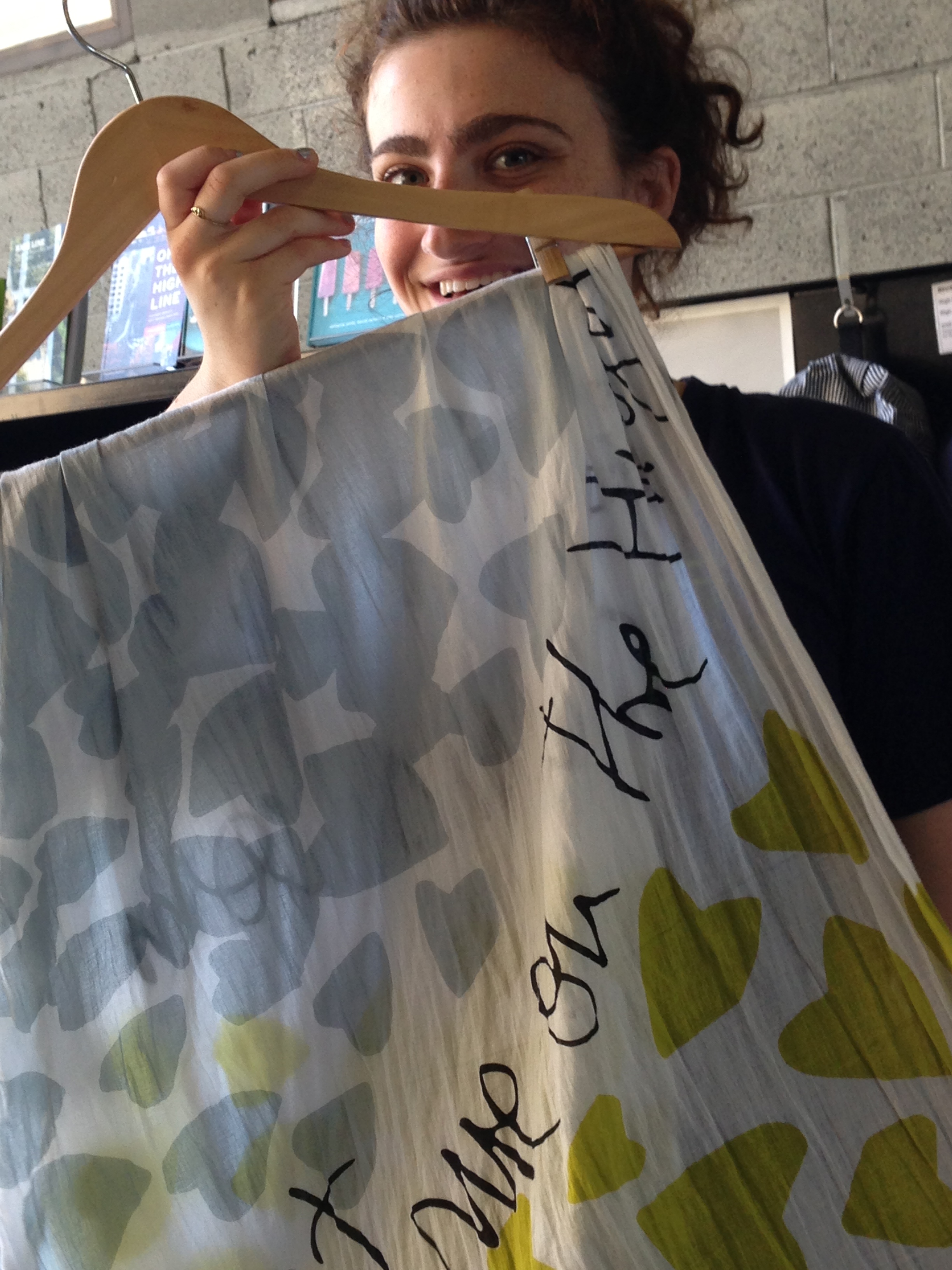
It even has its own clothing franchise, with sarongs that read “Dreams Come True on the High Line.”

sarong

Sculpture rises up along the walkway.

funny sculpture

And human sculpture, as people freeze for pictures. What the High Line should have next to the fresh fruit ice pops stand is a camera kiosk. Someone would get rich. Tourists throng — you can walk a long way down the path and not hear a word of English.

taking pictures

With the new, there’s the old – a mysterious pattern of bricks.

bricks

And a towering old painted sign: BONDED. Across it a tag reads REVS, shortened from REVLON, a famous graffitti artist. “It’s got to be on the edge, where it’s not allowed,” REV has said. There’s room on the High Line for all vintages.

old sign

The Gehry-designed IAC Building, at 555 West 18th Street, with its milky, origami exterior, has been open since 2007. Vanity Fair called it the world’s most attractive office building. It’s especially great to see it in tandem with structures of other vintages, including the old-fashioned piedmont of a lower one whose top is flush with the park.

Gehry

The Standard Hotel soars above. It gained some notoriety when High Line strollers realized they could look up and see happy exhibitionists making whoopee in the floor-to-ceiling windows.

the standard

(When Chuck Barris was looking for a word to meet the network censors’ standards on the Newlywed Game, the term ultimately settled upon was whoopee.) Meat trolleys for hanging beeves still exist if you look closely. Right along the Standard, in the shadows, a rusted remnant of the  district’s sanguinary past.

beeves

But one essential thing about the High Line is the views.

cityview

In the nineteenth century, landscape architects carved out pastoral views on grand country estates, cropping trees advantageously to accentuate vistas of rivers, mountains, or other natural elements. The High Line is the 21st century equivalent, with quirky street perspectives all around, framed from this tall iron structure.

bridge

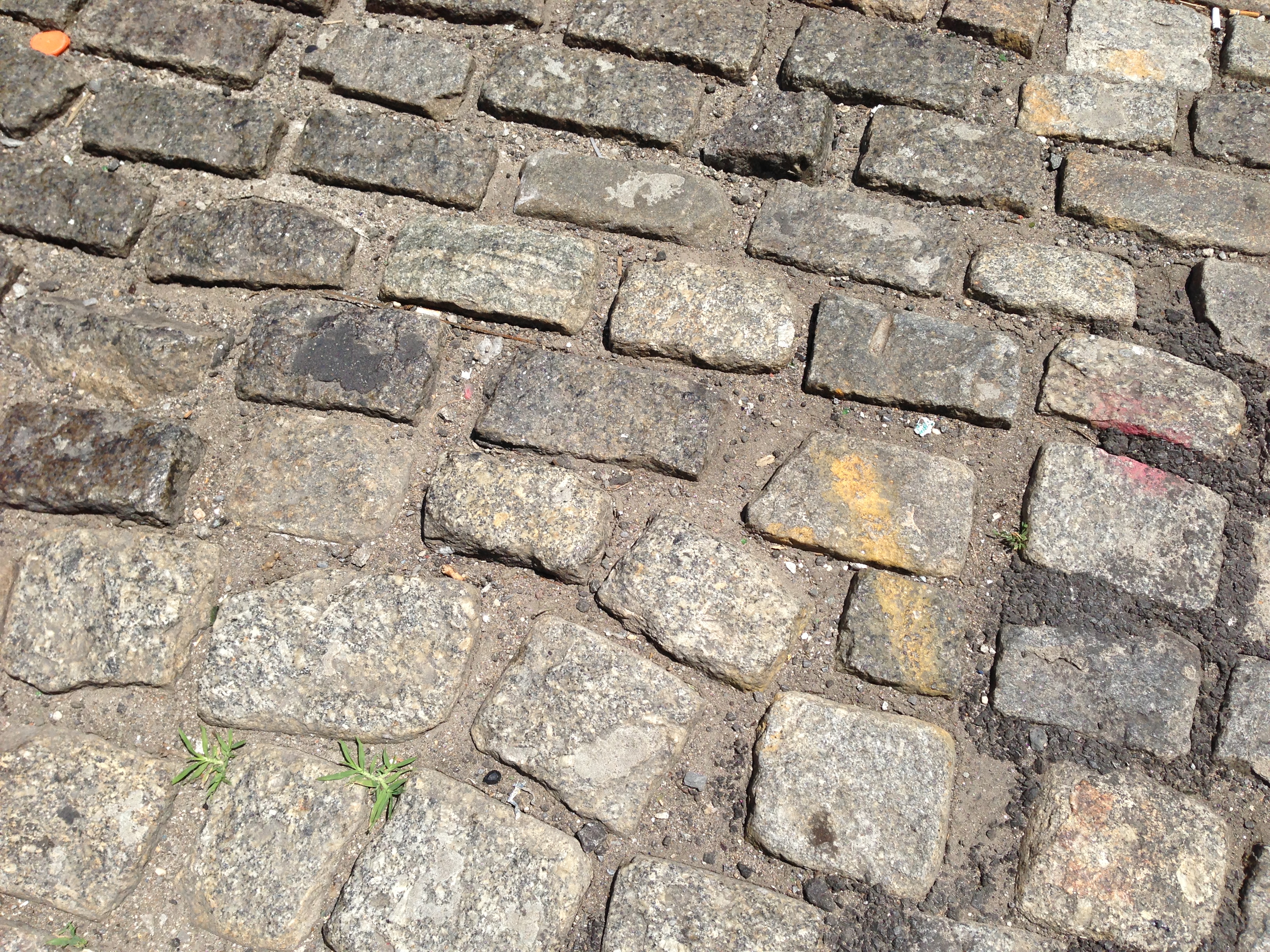
After our promenade, we descend to vintage New York cobbles. A remnant of the lost city.

cobbles

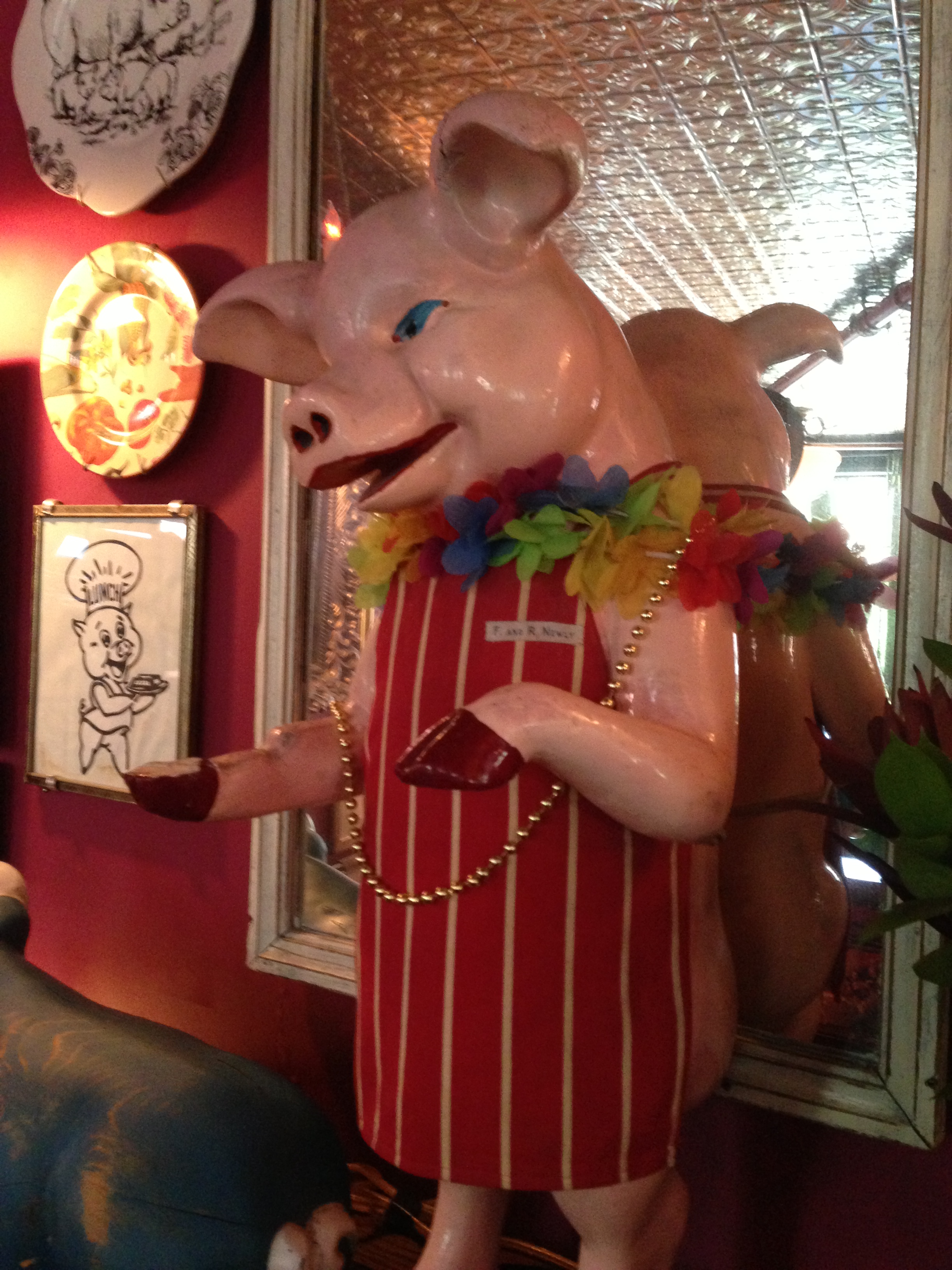
We refuel at a restaurant called The Spotted Pig.

pig

The eggs it serves are divine, with crunchy flecks of sea salt.

egg

I am tired after our sun-blasted walk of a two miles. Jesse is wide awake, which he always is, except when he’s asleep.

jess eyes

And the french fries… well, it is hard to shovel them in fast enough.

fries

The chef strews the shoestrings here with shreds of rosemary. Everything tastes better after the High Line. An ordinary pinapple smoothie from a new perspective.

smoothie

A fantastic church frieze overhead. Had it always been there? I can’t recall. The galleries of Chelsea are closed on Sunday, but that doesn’t mean the great sidewalks of New York are closed for business.

girl graffiti

Too much graffiti has been scrubbed off in recent years. Manhattan is the new Minneapolis. Now we have clean, healthy biking all over town. In Greenpoint, Brooklyn,  where I visited a week ago, it’s a different – and more colorful – story, as it hasn’t quite shed its industrial past and makes a fine canvas for folks who do outdoor outsider art.

slut tribe

Here in the Meatpacking District we find a few worthy efforts.

boy graffitti

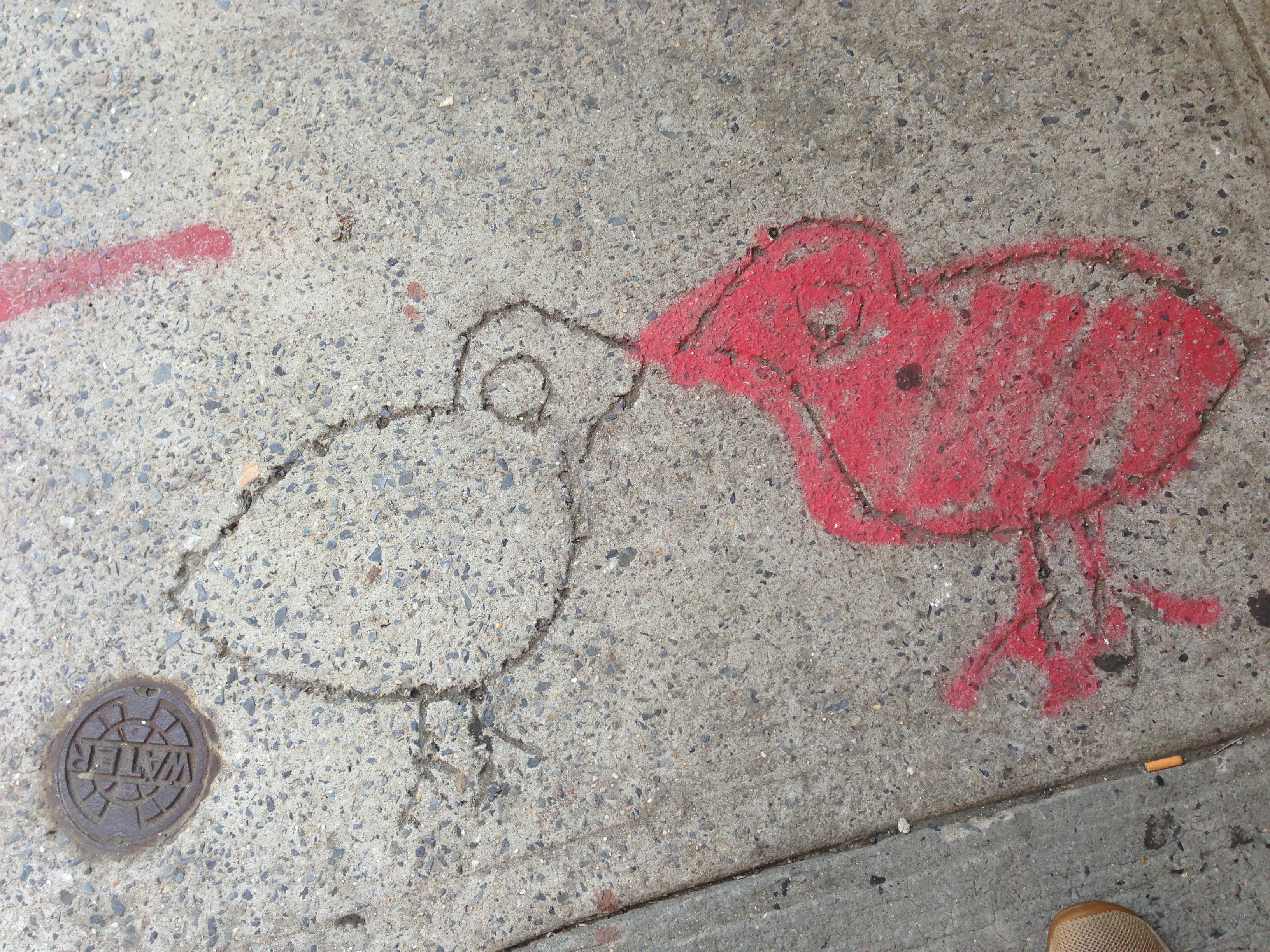
Two chicks etched on the sidewalk beneath our feet.

chick sidewalk art

For some reason I like these simple birds, making kissy next to their little water fountain.

The all-seeing eye. The Eye of Providence.

evil eye

On the island of Manhattan, if you let your vision wander up, you see some marvelous things. A blue horizon chockablock with architects’ freshest concoctions. Pieces of old New York, dusty red bricks that have miraculously been saved from the wrecking ball. Climbing roses, if you’re walking the High Line. From that same pathway, a glimpse of a well-to-do fanny in a chic hotel window. And there are still wooden water towers.

water tower

Just two companies, Rosenwach Tank Company and Isseks Bros., manufacture the tanks, which are unpainted and made with untreated wood. A new water tower is a leaky water tower, as it takes time for the material to become saturated and watertight. Chelsea has one, completely dry of course, that has recently been transformed into an exclusive club called Night Heron. You can see it from the High Line.

1 Comment

Filed under Art, Cooking, Culture, Fashion, History, Jean Zimmerman, Nature, Photography, Writers, Writing

Sneak Peak

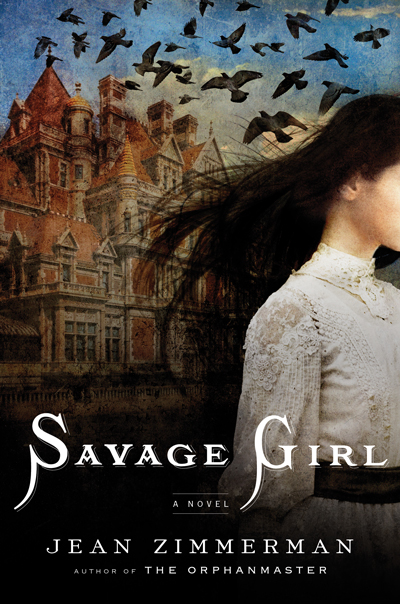
It’s a long time, the final gestation of my novel Savage Girl. Nine months until its publication date in March 2014. But I’m already excited. The book has been written. Edited. Copyedited. We now have a cover.

Savage Girl cover 3

And even some catalog copy. It gives the gist of the story, which is both a tangled web and clear as day. It tells of

the dramatic events that transpire when an alluring, blazingly smart eighteen-year-old girl named Bronwyn, reputedly raised by wolves in the wilds of Nevada, is adopted in 1875 by the Delegates, an outlandishly wealthy Manhattan couple, and taken back East to be civilized and introduced into high society.

This girl

hits the highly mannered world of Edith Wharton-era Manhattan like a bomb. As she takes steps toward her grand debut, a series of suitors find her irresistable. But the willful girl’s illicit lovers begin to turn up murdered.

Savage Girl would not be the same story, would not be so much fun, were it not for its narrator, Hugo Delegate, a Harvard medical student and the scion of the family that takes Bronwyn in.

The tormented, self-dramatizing Hugo Delegate speaks from a prison cell where he is prepared to take the fall for his beloved Savage Girl. This narrative – a love story and a mystery with a powerful sense of fable – is his confession.

So says the catalog description. When the book pops out of the oven next winter you’ll have a chance to judge for yourself.


4 Comments

Filed under Art, Fiction, Jean Zimmerman, Publishing, Savage Girl, Writers, Writing

By Heart

Driving west on Route 6, towards the Catskills, a summer weekday morning, and that old Talking Heads song comes on the radio:

I’m writing ’bout the

Book I read

I have to sing about the

Book I read

I’m embarassed to admit it hit the soft spot in my heart

When I found out you wrote the

Book I read so


Take my shoulders as they touch your arms i’ve

Got little cold chills but I feel alright the

Book I read was in your eyes oh oh

Thinking about when the book you’re reading touches you so much, the words become a part of you. The extreme of that is memorization.

My friend Bethany Pray, the person we’re driving to visit today, commits poems to memory. She wouldn’t say so, but it’s a rather serious pursuit. Not just a limerick for party performances, not a haiku or two. Real poems.  A discipline. She once told me she knew 20 or 30 by heart.

happy bethany

I’ve seen Bethany and Gil have poetry duels around campfires.

Slams? They’re easy. You get up and read or recite your verse, people cheer or boo. With a duel you must remember all the lines of a Shakespeare or a Blake. Not so easy.

Bethany says her favorite to recite is John Berryman’s Sonnet #37
.

Sigh as it ends… I keep an eye on your

Amour with Scotch,—too cher to consummate;

Faster your disappearing beer than late-

ly mine; your naked passion for the floor;

Your hollow leg; your hanker for one more


Dark as the Sundam Trench; how you dilate


Upon psychotics of this class, collate

Stages, and… how long since you, well, forbore. 


Ah, but the high fire sings on to be fed


Whipping our darkness by the lifting sea


A while, O darling drinking like a clock.

The tide comes on: spare, Time, from what you spread


Her story,—tilting a frozen Daiquiri,


Blonde, barefoot, beautiful,

     flat on the bare floor rivetted to Bach.

I remember Bethany recited it on a long hike we took around the rustic Rockefeller Preserve in Tarrytown, New York, and how I thought it was a poem I would find hard to follow on paper, let alone in air. Berryman was a tough one.

john-berryman

Berryman’s a favorite of Gil’s, too. Gil is at a slight disadvantage in a duel, at least in terms of volume, since he has not applied himself to more than a dozen titles. “There’s a word in Arabic,” he says, “for someone who has memorized the whole of the Koran.” HBO did a show on it, called Koran by Heart. But it’s rare to get a prize for memorizing poetry today unless you’re in 8th grade honors English.

quranramadan2

When I was in graduate school the Nobel Prize winning poet Joseph Brodsky loved the poetry of Thomas Hardy (and you thought Hardy only wrote novels) and made us memorize his poems and come in to class and write them out. Not a good assignment for me, as I barely can remember my own name sometimes.

“Pasternak was reading his poems in an auditorium in Russia and dropped his notes,” says Gil. “As he bent to get them the crowd picked up where he left off and finished the poem for him.”

Bethany calls herself a “poet without a portfolio,” but she is modest. Before earning a  law degree she collected an MFA from the Warren Wilson MFA program. She was already working as a paralegal, but “life was boring so I would put a poem in my desk drawer,” occasionally pulling it out. Not to read it – to memorize it.

Her coffee table groans politely under the weight of its poetry. “Kay Ryan is really great,” she says.

coffee table

The duel still in our future, we stop for a sweet moment at Woodstock’s 35-year-old book store The Golden Notebook, to find that they are sold out of The Orphanmaster, with five buyers in the past week alone.

happy Jean

“It’s actually on my bedside table right now,” says Desiree, at her perch behind the counter. “My husband just read your book. He doesn’t like anything, he doesn’t like puppies, and he loved it.”

“You got to feel very famous,” Bethany tells me after we’ve left, happy that she guided us into the shop.

Woodstock is full of bibliophiles and music lovers.

guitar 1

Guitar sculptures stud the sidewalks, each one groovier than the next.

guitar 2

A café has a quiet patio that seems perfect for the poetry throwdown, beneath garlands of honeysuckle and twittering birds, near a lovely puppy with a clubfoot. We get ready to wax poetic. Or rather, they do. I prepare to clap and faint.

gil:beth

Gil begins with Thomas Wyatt’s sonnet to Anne Boleyn, Whoso list to hunt, I know where is an hind… His brain only smokes a little bit as he gropes in his memory.

Gil searching

Bethany goes with Emily Dickinson: On a Columnar self–. “It’s hard to understand her language,” says Bethany. “It’s a kind of mental straitjacket on her passions.”

What do both the duellists have in their quiver? What passions do they share?

They fuck you up, your mum and dad.   
    They may not mean to, but they do.   
They fill you with the faults they had
    And add some extra, just for you…

That’s the opening of Philip Larkin’s dark, hilarious This Be the Verse, one that Bethany and Gil could reel off together, as if in a rock band or at an Irish pub. Gil tells Bethany about the time he recited it in a talent contest at a Universalist family retreat in woodsy Minnesota and got sent away with his knuckles rapped. It’s hardly family friendly, but so brilliant, and Larkin was Poet Laureate of Britain, after all..

Gil’s turn. Blake’s London. I wander through each charter’d street…

Bethany: Ode to Autumn by John Keats.

Beth reciting

She delivers the three long stanzas and we are properly floored.

Another poem for the two of them together –another Berryman, one of the Dreamsongs. Life, friends, is boring. We must not say so.

Coffee all around.

Bethany, another Dickinson. Gil, some Macbeth. Bethany, Spring by Larkin. And she finishes with Berryman’s wonderful I keep an eye on your/Amour.

“His wife learned he was having an affair by reading those poems,” says Gil. I think Gil was inspired to hit the books for his next contest with Bethany, whenever that might occur.

“People survived in the Gulag archipelago by reciting long stretches of poetry,” says Bethany. She knows a poem by Pushkin. She recited it to someone she met, a Russian mail-order bride, who burst into tears, she was so homesick.

4 Comments

Filed under Culture, Fiction, Jean Zimmerman, Poetry, Writers, Writing

Serene and Green

I wondered how it would work, so I went to find out. A literary event in a clothing store in Yonkers, New York. A literary event that had nothing to do with fashion, actually: Reeve Lindbergh, the author of family memoirs, essays and children’s books, would be reading excerpts from the latest volume of her mother Anne Morrow Lindbergh’s writings, Against Wind and Tide:Letters and Journals 1947-1986.

against

The store was Green Eileen, an offshoot of Eileen Fisher where I often go to replenish my wardrobe.

colorful clothes

The clothes Eileen Fisher designs are elegant and serene, with unstructured lines and natural fabrics. If you like linen and silk, this is the place for you. It’s definitely the place for me, but by the same token I often wonder if I can live up to my clothes.

Maybe I like this place so much because the company’s ads showcase graceful  silver foxes alongside the usual younger models. Grey is the new brunette, or didn’t you know?

jean grey

There was an elegant buffet and wine. Reeve began. She read from the book, but even more interesting was the patter that pulled those passages together.

reeve

She told us about her mother’s ever-present blue notepads, containing carbon paper to make three copies, one for the letter recipient, one for her personal archives and one for the master archive at Yale (open to all as of April, as it happens). Anne Morrow Lindbergh often wrote three to four long letters in a day, yet despaired of getting enough writing done. Reeve remembers banging on the door of her mother’s “writing house” and how mad her father got – that’s the only time she had to write, he reminded his daughter.

The title of this volume is a quote from Harriet Beecher Stowe, who claimed that writing, for a wife and mother, is “rowing against wind and tide.” When Reeve herself became a writer, at one point she tragically lost a child and was afraid she would never put pen to paper again. Her mother’s reassurances “probably saved my life,” she told us. “Mom said stop reading the things you think you should be reading and instead write on little scraps of paper the things going on around you.” Reeve still makes this a practice, she said.

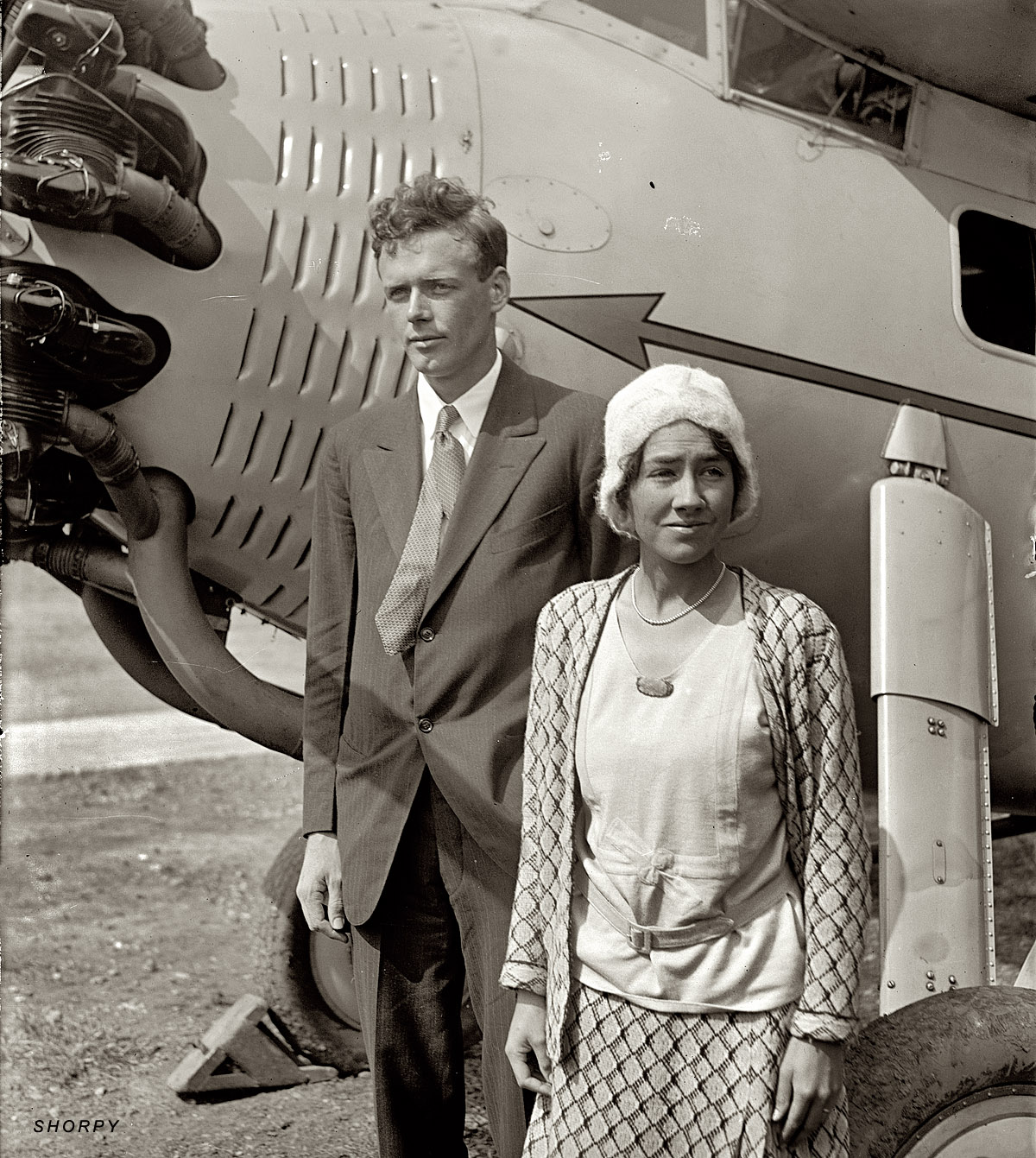
lindberghs

Anne Morrow married Charles Lindbergh, then the most famous man in the world, in 1927, and got her own pilot’s license the following year. They flew the world over while she continued to produce nonfiction, fiction, articles and poetry, with the 1955 Gift From the Sea a seminal work of feminism and environmentalism, never having gone out of print.  A book mothers give to their daughters, who give it to their daughters in turn.

Gift from the Sea

Reeve spoke about her father’s comings and goings, even his infidelities, about the “strong and interdependent relationship” the Lindberghs had nonetheless over 40 some odd years. Charles Lindbergh “showed us a world – his world – that he wanted us to see,” said Reeve of the family, but he could definitely be difficult. Reeve’s mother, she said, always felt her husband’s controversial opinions about Hitler and the Second World War had been misconstrued.

In this volume, Anne Morrow Lindberg talks about her pregnancies, about considering an abortion, about a miscarriage. She rewrites her wedding vows: “Since I know you are not perfect I will not worship you,” is one. “Marriage is not a solution to but a mirror of problems,” another. She wrote a lot about the need for aloneness –how important it is.

“I see life as a journey toward insight,” said Anne Morrow Lindbergh in a speech at the Cosmopolitan Club when she was 75.

Reeve’s editor on the new volume sat in a front row and nodded as she detailed how together they had combed through the archives at Yale to fill the book. All the material was handwritten and had to be typed before the painstaking selection.

The presentation concluded, and I wandered among the garments that lined the store like bright, clean flags. I’d love to be a person to wear textured pink silk.

pink shirt

Two books were being sold: Against Wind and Tide and a children’s book by Reeve Lindbergh called Homer, the Library CatTen bucks from the sale of each book would go to the Eileen Fisher Foundation.

Jen Beato, the Store Leader, told me why a presentation of the work of Anne Morrow Lindbergh fits the setting of Green Eileen. Every book wouldn’t make sense, she said, but this one shows “how challenges she faced are similar to today’s challenges.”

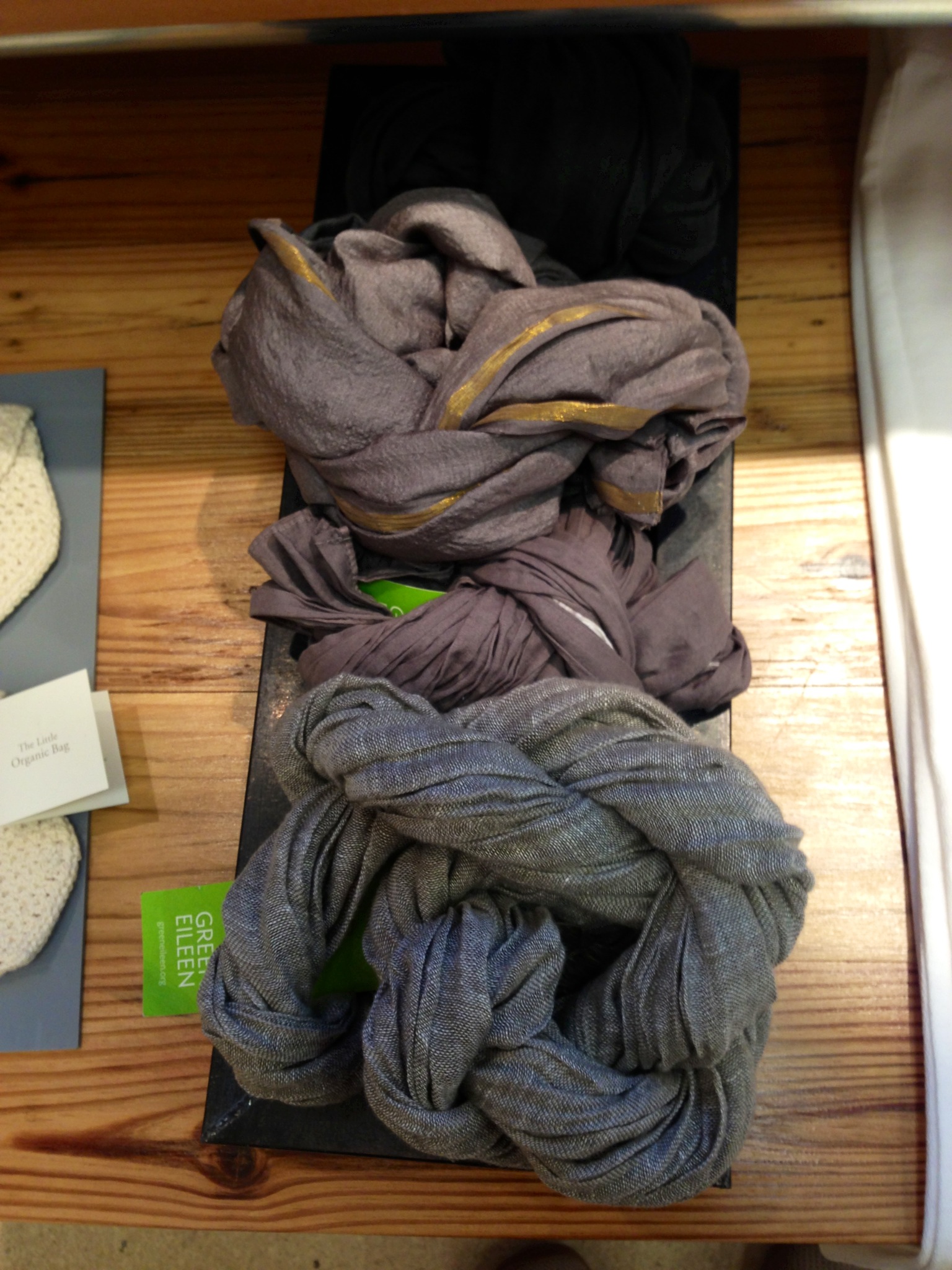
knots

Green Eileen accepts contributions of gently used Eileen Fisher clothing – say you lose some weight, or gain some weight, and you can no longer fit into that perfect pair of pajama-y palazzo pants — which it recycles and sells at an affordable price, with the proceeds going to causes for women and girls locally, nationally and around the world. The National Women’s History Museum,  the New York Women’s Foundation and Planned Parenthood, among many others.

The company makes good points, so I feel virtuous running my fingers over that sleek textured silk.

pink

The average American throws away 68 pounds of clothes per year. Over 4% of global landfills are filled with clothing and textiles. Almost 100% of used clothing is in fact recyclable.

Green Eileen has a pretty cool blog. The store is always sponsoring workshops about crazy things like recycling your wool, cashmere and silk into fabric jewelry. Maybe I’ll go to one sometime.

As night fell, inspired and on my way to insight, I wandered past the rack of beautiful castoffs, now reclaimed.

white clothing

In a simple white bag, I toted my virtuous purchase. Not the pink silk, but  a knee-skimming shift of white linen that will look serene and elegant on my daughter. Then I’ll take something out of my closet to give back to the store.

7 Comments

Filed under Culture, Fashion, History, Home, Jean Zimmerman, Publishing, Writers, Writing