A sober appraisal from this commendable blog:
“This is a worthwhile book for all adults, men and women alike. I suggest purchasing a copy when it is released, this coming Tuesday.”
June 19th, that is.
A sober appraisal from this commendable blog:
“This is a worthwhile book for all adults, men and women alike. I suggest purchasing a copy when it is released, this coming Tuesday.”
June 19th, that is.
Filed under Fiction, Jean Zimmerman, Publishing, The Orphanmaster
We watched a turtle dig her nest in the muddy soil. She disappeared. We found an egg on top of the buried nest later. She forgot it? Discarded? It lies there, luminous.

Filed under Home, Jean Zimmerman, Nature, Photography
Some book bloggers have had nice things to say about The Orphanmaster, which pleases me. Here are a few snippets, just to brag. I especially like “delightfully horrific.”
“The best thing about The Orphanmaster is its historical detail. Zimmerman does an excellent job of setting the scene and integrating issues and concerns the colonists had during that time. The legend of the witika was delightfully horrific.” (http://readersrefuge.blogspot.com/2012/06/book-review-orphanmaster-by-jean.html)
“The first thing I have to mention is Zimmerman’s writing. She has a way with words. The novel is complex and beautiful. I learned new terms and got to appreciate just how crazy Dutch looks. Reading The Orphanmaster is simply a pleasure.” (http://readeroffictions.blogspot.com/2012/05/new-amsterdam-travis-giveaway.html)
“Zimmerman’s historical detail is rich and intriguing, and makes the hunt for a serial killer, a common thriller plot these days, seem new and, well, thrilling.” (http://www.criminalelement.com/blogs/2012/06/fresh-meat-the-orphanmaster-by-jean-zimmerman-victoria-janssen-historical-children-organized-crime)
“Every once in a while, an outstanding historical thriller comes along that transports you back in time and makes the story’s era come vibrantly alive, while still capturing your imagination with a complex, deftly-designed plot. Jean Zimmerman’s first novel, The Orphanmaster is such a book.” (Suspense Magazine, June Issue)
Filed under Fiction, Jean Zimmerman, Publishing, The Orphanmaster, Writing
Apple has chosen The Orphanmaster as one of its ten Best Books for June!
Filed under Fiction, Jean Zimmerman, Publishing, The Orphanmaster
Well, I know at least 360 people will go home with The Orphanmaster. That is because I have been summoned into the offices of my publisher to autograph 360 copies of the novel. The books will be sent to stores that have already ordered them.
How does one produce 360 signatures? Rapidly and with gusto. My experience with signing many fewer copies on other occasions is that you have to make sure to hold your fingers loosely around the pen. Keep a loose wrist as well. And it has to be a pen with free flowing ink, but not messy — the Rollerball is a good one. Though a Bic will do fine in a pinch.
Be good to those who care about the resale value of the work: sign on the title page. Include the date.
Then scrawl your name as large as you can.
Filed under Fiction, Jean Zimmerman, Publishing, The Orphanmaster
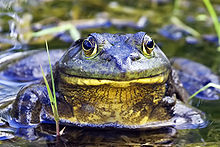
The peepers have ceased their peeping, but now through the upstairs window at night we hear the croak of myriad bullfrogs down in the swamp. Gil said that they had polished off the peepers, and could even manage a meal of mice. I refused to believe a frog could eat a mouse.
But it’s true. Sometimes half a foot long, the bullfrog stalks its prey, rotating its thickset body toward it and taking muscular leaps forward, then executing a ballistic lunge (eyes closed all the while) and extending its elastic mucous-coated tongue to engulf its meal. What it can’t pull into its mouth with its tongue it stuffs in with its forearms.
“You never see a frog so modest and straightforward as he was, for all he was so gifted.” (Mark Twain)
Yes, mice do make a meal. Investigations of frog stomachs have also revealed small turtles, birds, snakes and bats.
Even another bullfrog will do.
Filed under Home, Jean Zimmerman, Nature

Hollar Hand Muff
Wenceslas Hollar has been called the finest engraver of the seventeenth century. He was certainly an amazing depicter of fur hand muffs.

A Cap and a Muff
These are his images. Hollar came to London early in his career and basically never left, intent as he was upon documenting all he saw around him, including the Great Fire of London.
A muff could not have been essential in those days — people did wear gloves, after all, fine hand-stitched leather gloves — but they seemed to be necessary as a fashion statement. I don’t know if you ever had one, but I fondly remember the white rabbit fur muff I was given as a child. The seventeenth century became the heyday of fur, much of which came from America (with pelts traded avidly by Blandine van Couvering of The Orphanmaster), and a hand muff could be mink or bear or even muskrat, but the softer and smoother the better.

Mask and Muff
It’s not trick or treat. This finely attired woman wears a face mask, what was in the mid-1700s called a sun-expelling mask, in order to protect her delicate complexion. The muff looks almost too heavy to carry.
Another thing: men of the period wore hand muffs also. Only theirs were bigger. At one point in The Orphanmaster, when Blandine and Drummond are beginning to dig into the mystery of the orphan disappearances, they meet on the New Bridge that arches over the Canal, overlooking the hills of Brooklyn. It’s a cold Winter morning, and both of them carry handsome fur muffs (Blandine’s is silver fox). Fashion forward, and ready to track down a murderer.
Filed under Fashion, History, Jean Zimmerman, The Orphanmaster
The sounds of a Dutch windmill, its creak and whoosh. Think of it next time you make your way down Broadway south of Wall Street.
Filed under History, Jean Zimmerman
Last night I participated in an event at the Algonquin on 44th Street cohosted by the hotel and Penguin.
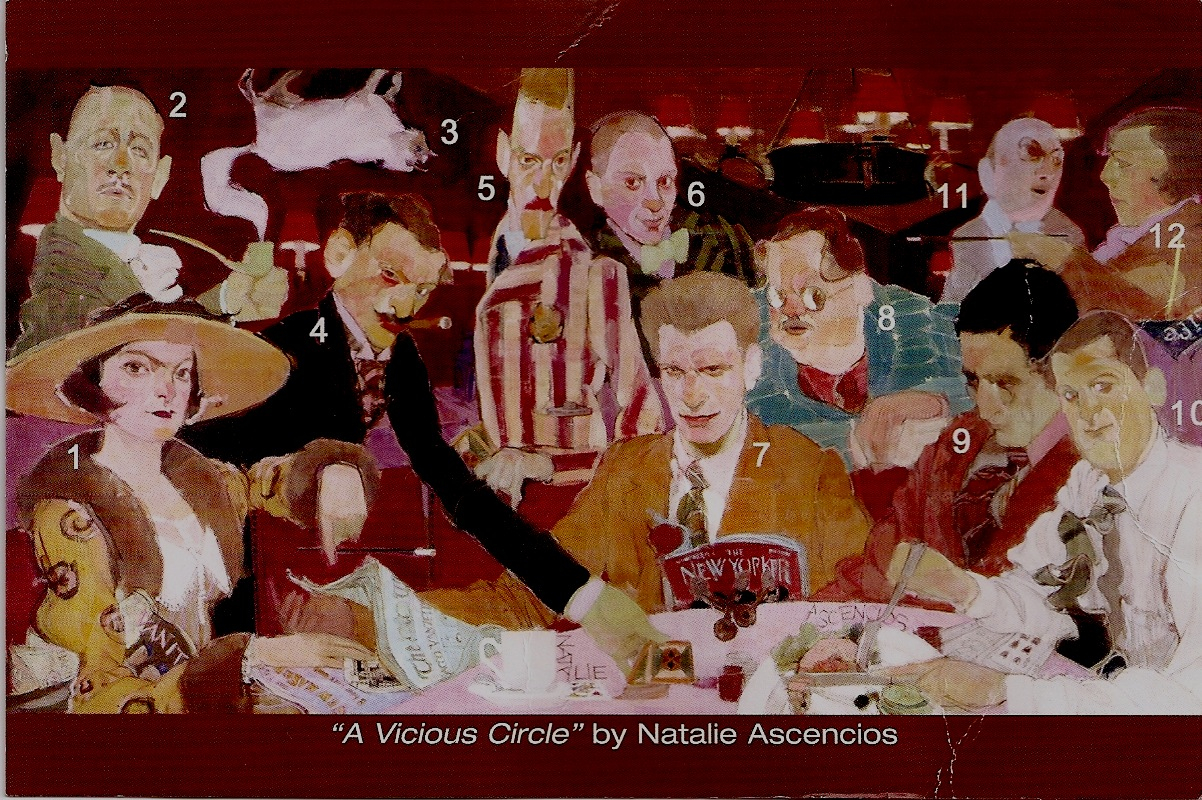
We seated ourselves around the round (actually, now oval) table. We have an oval table at our house but what happens around it is not so witty.
Another Parker-ism: You can lead a whore to culture but you can’t make her drink. (She was challenged to use “horticulture” in a sentence.)
I settled myself in the spot of Dorothy Parker (1). The seat was still warm. My fellow author David R. Gilham took his place beside me and we talked, answered questions and read a bit for a good-humored audience.
Can you take a guess at some of the other faces above?
2. Robert Benchley
6. Harpo Marx
9. George S. Kaufman
12. Edna Ferber
3. Matilda, the hotel mascot (now replaced by another Matilda)
By a few sentences in, my butterflies had flown, and I was ready to spill the tale of a beautiful, brave New Amsterdam woman who investigates a series of grisly killings alongside a sensitive stud soldier. The victims are orphans, and the killer may be a supernatural Indian spirit.
What would Dorothy Parker make of that?
Filed under Fiction, History, Jean Zimmerman, Publishing, The Orphanmaster, Writing
After getting over my shock that the cars of the NY subway system are now embellished with painted advertisements all over their outsides and insides (I did think it was kind of cool that the interior of one car was done up so the plastic bucket seats all looked like old-fashioned rail-back chairs) I had to pinch myself again. Here I was, going in to meet with Paula Mazur of the Mazur/Kaplan Company, the producers who have optioned The Orphanmaster in order to get it off the ground as a living, breathing motion picture.
These guys specialize in transforming books into film. The Guernsey Literary and Potato Peel Pie Society, a magnificent book, is currently under development, as is Major Pettigrew’s Last Stand. Paula was responsible for Nim’s Island, a wonderful fantasy flick. Mitchell Kaplan, her partner, owns a ridiculous number of book stores in Florida and conceived the Miami Book Fair, one of the biggest and best of its type.
We talked idly of casting (with Michael Fassbender the perfect Drummond in my eyes) but all that is far in the distance.

Fassbender
Writers who have heard of the novel are actually approaching Paula and Mitch, lining up to take a whack at a script. After that come the studios, the actors. One big challenge will be finding or building a location that looks, feels, smells (or, in the movie, looks like it feels like it smells) like 17th century Manhattan, with authentically muddy streets and the odd canal just down the block.
The Orphanmaster has clearly left Cabin World. It hovers in the ether somewhere above the book stores on Main Street and the studio lots of Hollywood. Its time awaits.
Filed under Jean Zimmerman, The Orphanmaster
The Orphanmaster featured today as one of The Arizona Republic‘s hottest new titles for the summer. I inquired of two of my favorite Arizona residents as to whether they might have had anything to do with the selection, but they demurred.
There’s another novel on the list that’s very worth reading, The Yard, by Alex Grecian, a nice guy and excellent writer to boot. The mystery concerns Scotland Yard just after it has been consumed with the case of Jack the Ripper, and it conveys a rich flavor of the period.
Filed under Fiction, Jean Zimmerman, Publishing, The Orphanmaster
A late Spring fire roaring in the hearth, dinner of seared peppery tuna with kale and garlic scapes, watching a silent 1920 Last of the Mohicans. Don’t forget… a chilled n/a beer in hand. What could be more perfect?

Scapes
Filed under Cooking, Home, Jean Zimmerman
Next week I’ll be serving on a panel of writers in an event at the Algonquin Hotel, 59 West 44th Street (between 5th & 6th Aves). The event is a collaboration of the Hotel, newly spruced up, and my publisher, Penguin, as part of BEA (BookExpo America) week activities. The idea in particular is to celebrate the history and spirit of the Roundtable, in the back of the hotel when you walk in — best known for the lethal witticisms of Dorothy Parker, Robert Benchley, Bennet Cerf, et al. — which the Algonquin wants to re-imagine for the 21st century.
Dorothy Parker: “What fresh hell is this?”
I’ll be talking about the fresh hell of The Orphanmaster, and how it came to be. If you feel like coming, the evening’s open to the public as well as hotel patrons. It’s 5:30 to 6:30 on Wednesday, June 6th. I doubt dry martinis will be gratis, but they’re pretty good here anyway.
More Parker:
“I like to have a martini,
Two at the very most.
After three I’m under the table,
after four I’m under my host.”

Parker
Filed under Fiction, History, Jean Zimmerman, Publishing, The Orphanmaster, Writers
The staircase of Kingston bluestone showed most of its steps worn to a gentle concavity by the tens of thousands of people who have come through the building’s portals in the 125 years since it went up. University Settlement House represented I.N. Phelps Stokes’ debut architectural effort. Carefully renovated and restored over the years to be useful in the present and yet respectful of the past, the structure still hums with activity. When I toured the place, preschoolers were eating a hot lunch, passing chili and rice around their knee-high table with utmost mannerliness.
University Settlement began in 1886 with six boys gathering two times a week in a Forsyth Street basement. At the time, more than 3,000 people lived in the typical Lower East Side block. Immigrants poured into the neighborhood, most desperately in need of basic services. About ten years later a competition determined who would design an urgently needed new structure. Reformers like Stokes and some of his peers took a serious interest in changing conditions, their interest piqued by the galvanizing photography of Jacob Riis. In the new building, limestone and brick and five stories tall, a local could get a bath, take an English lesson, enroll in a kindergarten class (then a radical notion, when it was considered normal for children to work in sweat shops). There was also the adventure of the Metropolitan Museum of Art sponsoring an exhibit of some of its finest works at the Settlement and, moved by the widespread interest evinced by locals in art, to finally open the its doors on Sunday to accommodate people who labored six days a week.

Jacob Riis Documented Tenement Dwellers
If you ever happen to enter the building (at Rivington and Eldridge Streets), you see the tall ceilings, the gracious dimensions, the intricate stone mosaic work underfoot. Huge sash windows admit copious amounts of light, something we take for granted but that for Lower East residents of the turn of the last century would be a blessing after the cramped, sunless tenements in which they resided. I’m planning to come to the Settlement House some time in the Fall to give a talk about I.N. Phelps Stokes and Edith Minturn Stokes, their commitment to philanthropy, and what led a white shoe guy like Stokes to throw himself into designing the Settlement House. I hope people will come, if only to see those bluestone steps, worn by the tread of all those the Settlement has served over the years.
Filed under History, Jean Zimmerman, Love, Fiercely
I got a request from someone who asked if I would like to visit with her book club. Yes! I spoke with reading groups regarding The Women of the House and it was highly enjoyable to hang out with a group of well-read, well-spoken book lovers. Sometimes there were snacks, too. So if you or anyone you know has a reading group that brings in authors, do let me know in a comment and I might be able to come.
Filed under Fiction, Jean Zimmerman, The Orphanmaster
 Jean Zimmerman