Category Archives: History

L.E.C.M.-Elysium-Karma

An interminable eighteen days until the brittle cast comes off my leg. In the meantime, Gil Reavill has consented to contribute yet another juicy post to this page. Here he is.

JEAN ZIMMERMAN (writes Gil) is well celebrated for her parking karma. This arcane skill is probably not noteworthy in any other place than New York City and San Francisco, but within the confines of Manhattan, especially, it is golden. Jean’s strategy, by the by, is to drive directly to the place we’re heading for and not slow to look for street parking along the way. Like as not, she finds a spot close upon  the goal.

In Cabinworld, cabin fever is a quite literal situation, and Jean insisted on getting herself and her splint-bound leg off the couch and out of the house this afternoon. We decided on Elysium, the Matt Damon movie by the South African writer-director Neill Blomkamp, who directed a 2009 film we both liked, District 9. Lured by brand-new reclining La-Z-Boy style seats, we aimed for the AMC theater on 84th Street and Broadway. (These are the best movie seats in the world, says Jean, worth going to a film for even when the film is rotten.)

Pulling up directly in front of the movie house, we found ourselves opposite a sedan with a driver sitting in the driver’s seat. Jean posed the traditional NYC question: Are you leaving? Yes, I am, said the driver. And he did. It was magic, especially for unloading a knee scooter and a person with a hurt foot.

Parking Karma

Karma is a belief that there is some form of justice in the universe. Behave badly, be reincarnated as a worm or some other lower life form. Do good and step up the chain of being toward bodhisattva.

Gamblers call it luck. Here’s a passage from Jean’s The Orphanmaster that deals with it:

Drummond had witnessed the world’s best gamblers at play, including Prince Henry, a demon at cards. Bassett was Henry Stuart’s game, and he could win a hundred pound on the turn of a queen, only to lose it the next hand. Drummond knew the action well enough to understand the play was not really about winning and losing.

It was about faith and belief.

The field of battle and the gaming table. Drummond once stood beside an officer, a good man judged by all to be lucky and deserving, only to see a dressed-stone cannon ball take off his head. Every soldier learned the harshest lesson of battle in ways that re-ordered his very soul: Luck had nothing to do with it. Randomness ruled.

The gambler wanted to believe differently, that the world held some secret order to it, one that would accord him a special measure of good fortune. Every play tested the gambler’s faith in that belief.

Jean’s parking karma notwithstanding, I’ve always considered karma as no more than a comforting fairy tale. The universe is random and makes no exception at all for human concerns.

Martin Luther King, Jr. articulated a belief similar to karma, not in Buddhist/Hindu terms but with his usual Southern Baptist eloquence: The arc of the moral universe is long, but it bends toward justice.

Martin-Luther-King-Jr-9365086-2-402

It would be pretty to think so, as Hemingway would say. Such a kernel of optimism might be necessary in order to commit to the long-haul cause of social justice. King no doubt needed to believe to endure the incredible trials he encountered.

Talk of karma and the bend toward justice somehow implies that the universe will take care of itself. You don’t have to get on up off of your duff. But social justice doesn’t just happen. It needs a push.

Here is King’s great predecessor in the cause, Frederick Douglass:

Those who profess to favor freedom, and yet deprecate agitation, are people who want crops without plowing up the ground. They want rain without thunder and lightning; they want the ocean without the awful roar of its waters. This struggle may be a moral one; or it may be both moral and physical; but it must be a struggle. Power concedes nothing without a demand; it never did and it never will. Find out what people will submit to, and you have found out the exact amount of injustice which will be imposed upon them. The limits of tyrants are prescribed by the endurance of those whom they oppress.

This August 28 marks the 50th anniversary of the March on Washington for Jobs and Freedom, the occasion for King’s celebrated “I Have a Dream” speech. Five years later, just before his assassination, his political strategy had widened to a specific economic purpose. He proposed another march on Washington, D.C., this one rendered tragic by his death: The Poor People’s Campaign in June 1968.

Civil rights is a dangerous enough cause to push, but demanding economic equality, that’s what they’ll kill you for.

Elysium, the movie that we watched flat on our backs in the AMC 84th Street Theater, was surprisingly political. (Political enough to make you drop your popcorn, says Jean.)

gil reclining

A broad-gauge fable of sorts, it spoke to the world’s most pressing issue, according to Dr. King. It usually goes by the name of “income inequality” today. We’re creating a two-tier society, segregated, policed and imbalanced.

In the film, the haves have decamped the earth for Elysium, a paradisal, mandala-like orbiting space environment.

elysi

The have-nots, down below, live in impoverished, overpopulated, climate-fried squalor. It’s like America after the Walton family and the Koch brothers get through with it: one sprawling, fetid favela.

The film has a covert message, with plenty of clues littered throughout. Elysium, a word the ancient Greeks invoked for paradise, is code for L.E.C.M. (say it fast), the alt-culture rallying cry of Love, Empathize, Create, March.

Damon’s solid, but Jodie Foster, as the military bigwig who concedes nothing without an armed invasion, turns in not her best performance ever. The steampunk flavor of the art direction is really the movie’s star. It just looks cool.

explosive

One way to follow the dictates of Frederick Douglass and agitate for social justice in 2054 Los Angeles, it turns out, is to have a rack of metal implanted into your skull.

What the haves really have and the have-nots haven’t any of, in Neill Blomkamp’s dystopian vision, is health care. It’s oddly endearing to watch a $115 million Hollywood action movie where the climax is… everybody gets the Affordable Care Act! (In the form of a magic box in your living room that instantly cures all ills, says Jean. Wouldn’t you like to have one? Now if Obama could manage that, that would be karma.)

1 Comment

Filed under Art, Culture, Film, History, Jean Zimmerman

I Am the Walrus

I’m about a foot shorter and slightly less blubbery, and my tusks have not come in, but my habit of lolling on the couch is pronounced.

walrus face

I could be lying atop a Greenland ice floe. A tooth-walking seahorse (Odonus rosmarus) through and through, cast-footed variety. Basically sedentary. Shellfish savoring. Laughable? Don’t people sort of snicker at walruses?

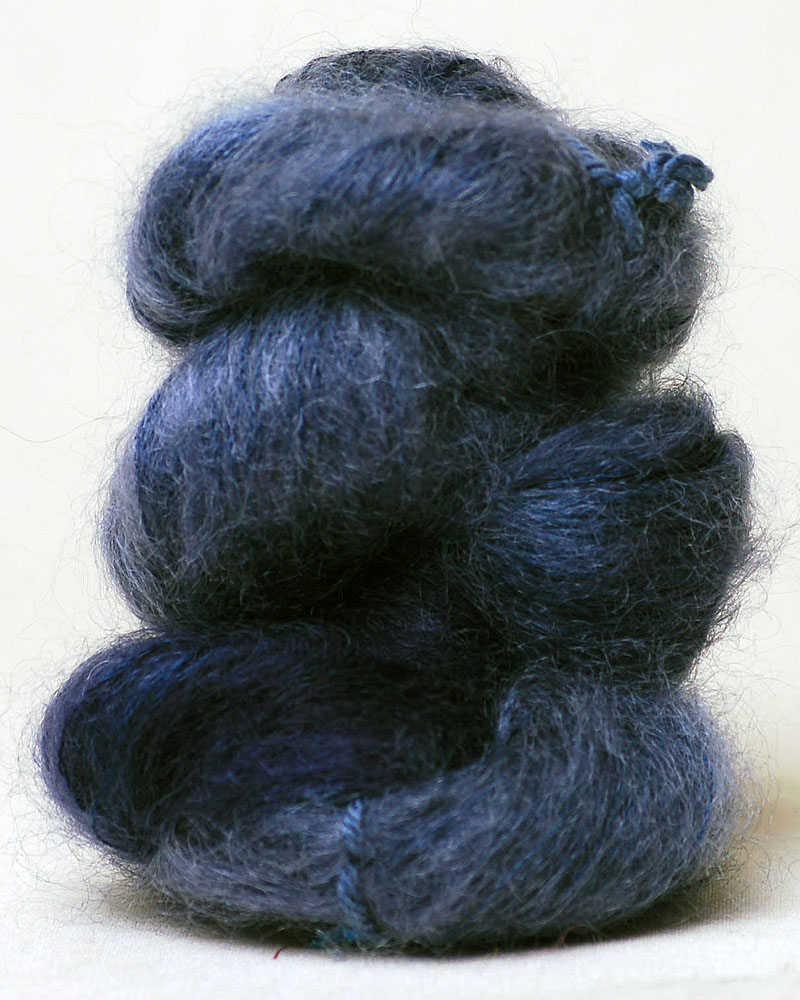
My main function these days, when I’m resisting the urge to watch past episodes of Orange Is the New Black, is to absorb information. That and try to knit a mohair bandana with a pair of metal toothpicks, willing Oliver not to drag the tiny wound-up ball of pink fluff under the coffeetable.

oliver snout

(Not successful, and I nearly rebroke the bones in my foot retrieving it.)

mohair

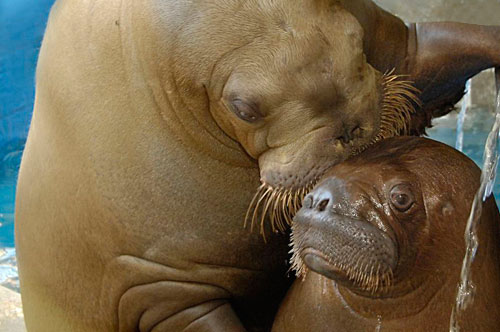
Walruses show affection.

baby-walrus-kissed-by-mother

There’s more where that one came from, walrus fetishists.

Aside from walrus kiss-bombs, I sourced a few more of life’s interesting details today.

1. A California man named Jerry Gretzinger has spent 50 years drawing an enormous map of a world he invented.  Hmnh, you say, don’t people do this every day? Well, maybe brainy 3rd graders do something similar on a sheet of oaktag.  But his is just so much more carefully delineated than others, did I mention 2,000 feet long, and he uses a weird deck of cards he pasted up to determine next steps he will take on the thing. Including which neighborhoods get what he calls “voided,” or just suddenly blasted out of existance.

gretzinger1

There is a great mini doc about him, and you might want to bring home some colored pencils when you’re out today. (Note the envy in that: when you’re out today.) For more great stuff on do it yourself cartography (and moving gigantic maps) try Making Maps.
2. I never knew what was in O magazine – lists upon lists of Oprah’s fave books that were going to earn more than my books ever would? But today I checked out the September issue because we got a subscription in error. And it turned out the issue was all about hair. Here is something so inutterably weird I reread it a few times. A timeline of how glamorous hair extensions come to be. It begins with Hindu pilgrims shaving their heads at the temple Tirumala in Tiraputi, India. (I did a little further research. As many as 10,000 pilgrims get their hair shaved by 500 temple barbers every single day.) The hair is fumigated and wrapped in bundles in Bangladore, then shipped by private courier to Rome to be bleached and dyed. Six weeks later it goes to U.S. salons. After 3 to 6 months use the repurposed locks get tossed in the trash. Footnote from the same O: 90 percent of celebrities at the Academy Awards are wearing extensions – everyone except, according to one expert, children and women with pixie cuts. I guess men, too, go unextended. But who knows.

3. A lot of people consider the Hudson to be “my river.” Me too. That’s why I was surprised not to have known before that the actual start of the estuary, the southern terminus that is, is deemed by scientists to occur precisely at Manhattan’s Battery.

stock-footage-aerial-panorama-downtown-manhattan-wtc-financial-district-east-river-hudson-rivers-battery

I knew it began down there in the Harbor someplace, but everything seemed pretty watery and diffuse to me. Now I realize that you have Hudson River Mile 0 at the Battery, the George Washington Bridge at HRM 12, the Tappan Zee at 28, Bear Mountain at 47, Beacon-Newburgh Bridge at 62, the Mid-Hudson Bridge at 75, the Kingston-Rhinecliff Bridge at 95, the Rip Van Winkle 114, and the Federal Dam at Troy, the head of tidewater, at 153. The tidal section of the Hudson constitutes a bit less than half the total distance – 315 miles – from Lake Tear of the Clouds to the Battery. I learned this scrap and so many other things from the State Department of Environmental Conservation’s weekly easy–to subscribe to e-newsletter, Hudson River Almanac. If you want to know how many hummingbirds appeared in someone’s yard this May, and how that compared with last year’s count, or the story of a kingfisher riding the back of a hawk, or that Atlantic blue crabs are known to rivermen as “Jimmys,”(mature males) “Sooks,” (mature females) and “Sallys (immature females), this is the place for you. I find I want to know these things.

Hummingbird-Wallpaper

It’s amazing what you’re ignorant of as a walrus.

3 Comments

Filed under Art, Culture, Dogs, Fashion, History, Home, Jean Zimmerman, Knitting, Nature, Photography, Publishing, Writers, Writing

Live From Lincoln Center

AND ONCE AGAIN, let me welcome guest post-er Gil Reavill, who took himself out of Cabinworld while I was in lockdown to visit Lincoln Center Out of Doors in Manhattan:

After days of rain (writes Gil) the 30th Annual Roots of American Music, under the aegis of Lincoln Center Out of Doors Festival, kicked off the weekend with perfect weather.

A political rant festered in the warmth of the beautiful sunshine on the Upper West Side of Manhattan. All around the Lincoln Center cultural mecca, billionaires had festooned their names. Bloomberg sponsored the music festival, so that name was emblazoned on banners and signs. There was also Hearst Plaza, as well as David H. Koch Theater, home of the New York City Ballet and formerly the home of City Opera, used to be called the New York State Theater. If just plain folks do it, it’s called graffiti and prosecuted. But if big-money smears its name around on buildings, it’s called philanthropy and celebrated.

This is how the scam works. Conservatives agitate to eliminate arts funding (among other frivolities like roads and bridges). Under pressure from the billionaire-owned-and-operated Republican party, arts funding is duly cut to the bone. So when some noblesse oblige moneybag like David Koch comes along, a funding-parched venue like Lincoln Center (which was, after all, founded by Rockefeller money) can do nothing else but buckle. The populist-named New York State Theater becomes Koch Theater, and the arts become privatized.

David Koch and his brother Charles Koch lead the radical right-wing libertarian charge. They want to be free of government interference for their pollution-spewing enterprises. The day I willingly enter an edifice named after a corporate gangster like Koch is “when shrimps learn to whistle,” a phrase Nikita Khrushchev liked to use. If we adequately funded our public institutions, they wouldn’t have to lease themselves to big-money robber barons.

Then there was something called the “Modern Luxury Lounge sponsored by Celebrity Cruises,” an enormous covered and cordoned off seating area erected stage left at Damrosch Bandshell. American have slowly gotten accustomed to the idea that these sort of luxury skyboxes/VIP areas are always looking down on them whenever they venture into public spaces. But such zones are a clear violation of the egalitarian spirit. They’ve been tearing down stadiums all over the country just to erect replacements that feature more skyboxes, more segregated playgrounds for the rich. Just remember, folks, some pigs are more equal than others.

But on to the music.

In the smaller performance space on the north side of the Met, we caught the New Orleans band Hurray for the Riff Raff fronted by the wonderful Alynda Lee Segarra.

Alynda_Hurray for the Riff Raff

Her smooth, powerful alto is her own, but her phrasing reminded me a little of Concrete Blonde’s Johnette Napolitano. She writes and sings all the band’s songs herself. She killed with The Body Electric, a kind of answer song to the whole tradition of Omie Wise-style he-done-her-wrong murder ballads. How would a man feel, she asks in her lyrics, if a song like Omie Wise was about his own daughter? Beautifully strong stuff, worth tracking down.

The program transferred to the Damrosch Park bandshell on the south side of the Met. Kicking off the evening show was a rockabilly revue, featuring the real reason for showing up that night: James Burton, master of the telecaster, Elvis’s longtime guitarist for his live shows, who played with everybody else under the Sun Records sun, too.

Master of the Telecaster James Burton

Arkansas’s biggest singer (in the literal sense of the word: he’s 6’7″), Sleepy LaBeef performed the vocal duties and brought along his own band.

Sleepy LaBeef_James Burton

Burton did a definitive version of Mystery Train and showed why he was name-checked by almost every person on stage that night.

Burton

Jason Isbell of the Drive-by-Truckers did a full-throated middle set, featuring a song by Isbell’s fiddle player and wife, Amanda Shires, formerly of the Thrift Store Cowboys.

Amanda Shire

Isbell’s recent Southeaster and Shires’s brand-spanking new Down Fell the Doves form a one-two punch for the couple, both albums released within a couple months from each other.

Isbell and Shire

Tough acts to follow. After all the roaring guitars from the all the multiple-personnel bands that crowded Lincoln Center all day, could a single performer with a single acoustic possibly hold the stage? Nick Lowe managed to make it look easy.

Lowe

The man is simply one the best songwriters alive today. What’s really great about Lowe is how long he’s been out there—from way back in the day when he wrote “(What’s So Funny About) Peace Love and Understanding” for his late-60s band, Brinsley Schwarz. Half a century later, he just keeps going without losing a step, his vocals and songwriting still superb. Lowe’s performance at Damrosch was masterful. Just one guy (he’d probably say “bloke”) held the whole 2,000-plus audience mesmerized with feel-good pop tunes and killer lyrics. Lowe may be a dinosaur, but he’s the kind that eats younger bands for lunch.

Lowe onstage

4 Comments

Filed under Culture, History, Jean Zimmerman, Music

Captive Reader

And another great guest post from Gil Reavill, who between brewing coffee, clearing away dishes and bearing down on his own book has managed to fill in literarily while I’m off my foot.

EVER SINCE JEAN shared a bookstore appearance with novelist Koethi Zan, author of The Never List, the theme of captive women seems like a bad tooth that we can’t help worrying.

never list

The horrific tales of Ariel Castro, the Cleveland kidnapper, rapist and murderer, remain in the news long after his captives took back their hard-won freedom. Recently they leveled Castro’s home, part of a plea deal that spared the predator a death sentence.

I wrote about the phenomenon in my book Aftermath, Inc.

Ed Gein’s Wisconsin farmhouse, destroyed by fire. John Wayne Gacy’s house in Des Plains, Illinois, bulldozed flat, as was O.J. Simpson’s Rockingham estate. Jeffrey Dahmer’s Oxford apartment building, with its infamous apartment 213, demolished. These sites were, in the language of real estate experts, ‘stigmatized’ properties. You know you have transgressed in some basic, Decalogue-violating manner when authorities raze your house and sow your fields with salt.

gacy house

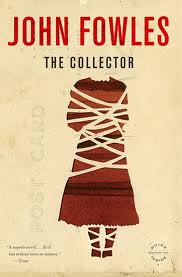
The theme of captive women crops up with stinging regularity in literature. John Fowles’s great novel The Collector was the first treatment of the theme that I encountered, probably as a too-young adolescent.

fowles

In our household, stories of Cynthia Parker and other women taken by Indians have become familiar through research for Jean’s novel, Savage Girl. Captivity is such a popular leitmotif in romance novels that it must form an admitted element in female fantasy. But the difference between rape fantasies and rape, as psychologists reiterate, is that women are in control of their fantasies.

During her research for The Never List, Zan became exhaustively familiar with captive women cases the world over. She tracks the survivors and gives sobering accounts of their inability to adjust to life after captivity. Often such women become recluses, unable to face life after enslavement.

Of course, stories of a lot of these victims never make the news. It might come as a shock to some benighted souls that human slavery did not exactly vanish from the face of the earth with the end of the American Civil War. Read Nicholas Kristoff’s great call to arms, Half the Sky, or David Batstone’s Not for Sale for accounts of sexually enslaved females all over the world (including right here in River City).

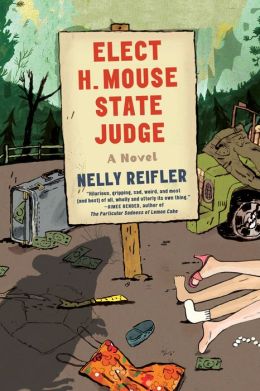
So it was with a creeping sense of recognition that I delved into our friend Nelly Reifler’s captivating (ahem) debut novel, Elect H. Mouse State Judge, out this week from Faber and Faber.

NellyReifler2

H. Mouse is by turns entertaining and disturbing, with Reifler treading a razor’s edge between Wind in the Willows and, say, Chuck Palahnuik, William Vollmann or Andrew Vachss. The innocence here is false innocence, and the topical true-crime reality of captive women leaks through the fairy tale.

H. Mouse is that eminently familiar figure, a compromised politician. His daughters Susie and Margo are taken by a religious nut named Father Sunshine (one Reifler’s best creations). The title character reaches out to a couple of shady political fixers named Barbie and Ken—yes, the very same ragingly popular iconic couple toyed with by children since the doll’s introduction in 1959. Ever wonder how Barbie and Ken do the nasty? Reifler tells us (it involves the removal of limbs). Lawyers from Mattel, Inc. ought to be knocking on Reifler’s door any day now.

elect

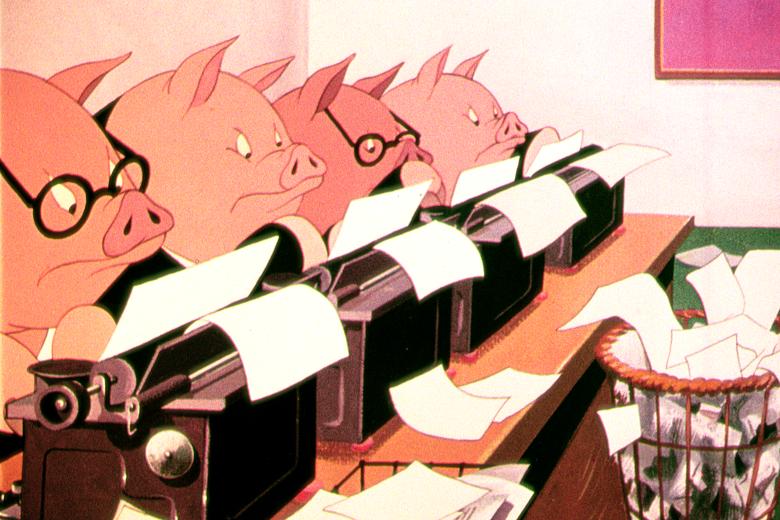
The figure of an unreliable narrator is a common one, but with H. Mouse I felt myself put into the position of an unreliable reader. I had the uncanny sense of humming along, enjoying the mice-and-foxes fable, then snapping awake to a nightmare. Reifler’s trap is baited with honey: the tone of faux sweetness is devilish, since one soon learns that it cannot last. Throughout these pages I suffered a quite enjoyable case of literary whiplash, something along the lines one feels with Animal Farm. (There’s a story kicking around, I can’t remember where I encountered it, about a student telling his professor that Orwell’s masterpiece was an excellent tale of the barnyard. The professor told the student to go back and read the novel again.)

79347104_animal-far_340402b

Elect H. Mouse State Judge is short, bittersweet and has a kick like a mule. Not since Art Spiegelman’s Maus have rodents been harnessed to so great effect.

5 Comments

Filed under Culture, Fiction, History, Home, Jean Zimmerman, Publishing, Savage Girl, Writers, Writing

A Full-throated Yodel

Today, Gil Reavill guest-posts as I rest:

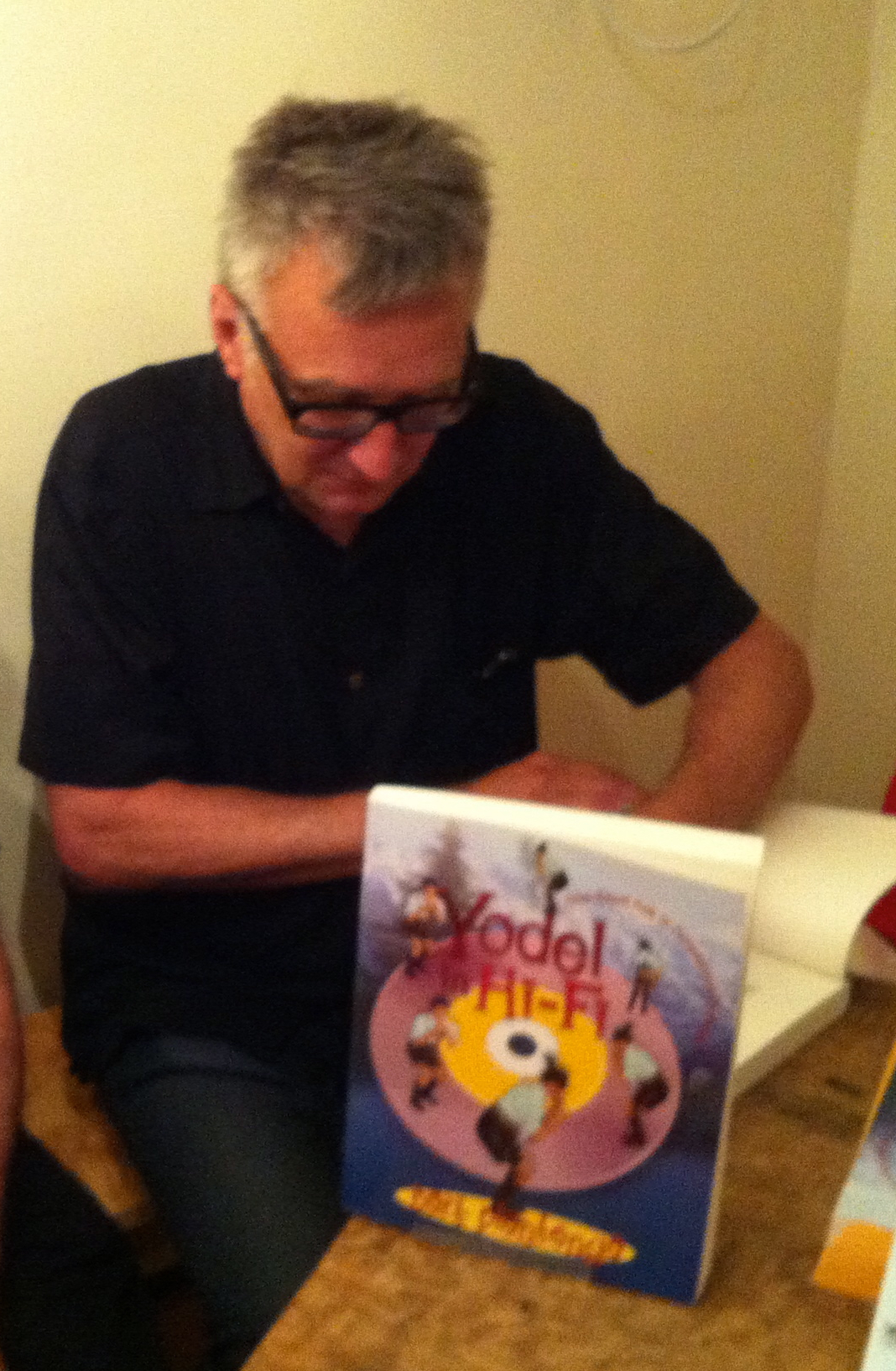
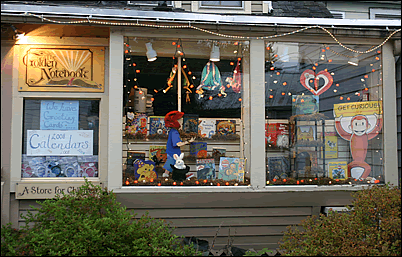
THAT SOUND YOU HEAR is the yodels echoing down from the Catskill Mountains. Author, provocateur, deejay, beer mystic and worldwide yodeling authority Bart Plantenga recently appeared for a full-throated presentation and book-signing at Woodstock, NY’s great indie bookstore, The Golden Notebook.

Bart Signing

The event was held on a tourist-flocked sunny Saturday in Woodstock, aka the People’s Republic of Woodstock. The iconic Aquarian village looked to be thriving and was chock full of public art and cheeky signage.

Woodstock sign

The Golden Notebook is one of our all-time favorites as both a bookstore and a book: the venue is named after Doris Lessing’s nervous breakdown of a masterpiece.

golden-800wi

A feminist touchstone of the Sixties, Notebook turned a lot of minds around and established the author as a leading light in the literature of the day. Margaret Drabble famously called it “inner space fiction.”

doris

We summered in Woodstock once back in the day at the Byrdcliffe Arts Colony in the hills above town, staying in one of the tiny cabins. The founder of Byrdcliffe believed in the health benefits of bathing, so he furnished each cabin there with immense eight-foot-long clawfoot tubs. Water was delivered to the faucet by a spring-fed system which ran through hoses that snaked through the woods. Bob Dylan’s old place was just down the road, and we snuck in for a nighttime swim or two in his former grotto. That year the Byrdcliffe Playhouse was doing a stage adaptation of the film Casablanca, and during the show a spotlight rigged on the theater’s roof would strobe the darkness and a claxon would sound as Louis and his friends would search for “the usual suspects.”

Byrdcliffe-theatre

With the publication of his second book on the subject, Yodel in Hi-Fi: From Kitsch Folk to Contemporary Electronica, our friend Bart has established himself as an unparalleled resource for musicologists, aficionados and just plain yodel-crazy folks. While he does not indulge in the art himself, Plantenga has exhaustively documented yodeling practices all over the globe.

yodel in hi fi

He rounds up the usual suspects—Switzerland, Germany, Scandinavia—but gives fascinating insights into unexpected yodeling traditions among the Pygmy people in Africa and the Hmong in Southeast Asia. Yodeling is a method of changing pitch from ordinary chest register to falsetto, long used as a communication method in mountainous countries where the echo is most pleasing to the ears. Of course it also appears as a vocal effect in many different kinds of music, most notably in country and western but also, as Plantenga shows, in classical, electronica, pop and pretty much every other style on the face of the earth. The great country music pioneer Jimmie Rogers rode to fame on the strength of his “blue yodel.”

yodel

Johnny Weismuller’s Tarzan yodel entered into the modern pop culture in the middle of the last century, and the practice was played for laughs by comic Carol Burnett, who used to open her television show with a suitably loony example. Plantenga’s reach goes much deeper than these popular examples, unearthing gems such as Bollywood actor Kumar, a yodeling sub-genre of German video porn (!), and South Korean faux-Bavarian yodeling groups. Bart spoke about yodeling as an “outburst of joy,” citing the “total Oktoberfest insanity” of alcohol-fueled burghers who bust out in freestyle tavern yodel throwdowns. “I like anomalies that make people re-assess clichés,” he says, and in Yodel in Hi-Fi, he has unearthed dozens of them.

8 Comments

Filed under Culture, History, Jean Zimmerman, Music, Writers, Writing

Day 1-In Which I Learn to Hobble

It was a success, the surgery, though I awoke from the anesthesia blubbering like a baby. It’s normal, said the orthopedic surgeon, come to check on me. A lot of people cry. Then it was hip, hop, on to the wheelchair, on to the crutches, off to my new full-time lair, my living room, my foot on pillows above the couch.

cast

My snouted nursemaid wedged beside me.

ollie nurse

My other nursemaids scurry to my orders. My computer, please! My muffin! My book! Put it close, I’ve got to get an NPR review done this week. Could you please turn that light off? Or on?

I have a good view of Maud’s metallic blue fighter fish, Brussels, making his small way around the bowl.

brussels

Somehow, thinking about the immediate future, though I never had much patience for that fish, I now feel kindly toward it. Brussels reminds me of myself in my own little living room bowl. Except I hobble, can’t float at all, when I want to go brush my teeth.

Trying to stretch myself outside this world, adventuring via pictures of the past to the motor adventure taken in 1918 by John Burroughs, Thomas Edison, Henry Ford and Harvey Firestone.

This brilliant crew took a 12-day car camping trip in Burroughs’ automobile when he was 81.

NoondayRestFinal.jpg.CROP.article920-large

John Burroughs, less well known today than the others, was ragingly popular by that time in his life. Gil and I used to visit his country retreat, a tiny cabin called Slabsides that stood beside a celery marsh in West Park, New York.

slabsides

Burroughs’ fans have kept it intact, so you can see it as he did. Being there always made me want to inhabit a cabin, and now  mine is virtually like his.

burroughs-at-slabsides

… I was offered a tract of wild land, barely a mile from home, that contained a secluded nook and a few acres of level, fertile land shut off from the vain and noisy world by a wooded precipitous mountain… and built me a rustic house there, which I call ‘Slabsides’, because its outer walls are covered with slabs. I might have given it a prettier name, but not one more fit, of more in keeping with the mood that brought me thither … Life has a different flavor here. It is reduced to simpler terms; its complex equations all disappear.

Young college women used to travel in hordes by train to Slabsides to pay homage to the great man, a pioneer of nature writing who published some 25 volumes, of which a million and a half volumes were sold during his lifetime.

In 1918, a convoy of eight vehicles accompanying the brainy colleagues toured Pennsylvania, West Virginia, Tennessee, and Virginia, stopping to camp on farms, examine old industrial sites, take hikes along rivers, and measure farming implements for fun, documenting as they went.

Some shooting entertained Ford and Firestone.

ford and firestone shooting

At night around the campfire the two industrialists, the naturalist and the inventor wound down by chewing over Shakespeare, Thoreau, chemistry. Don’t you wish you could have been there? In a way, you can, because photos from the trip are stored at Harvard’s Widener Library, with a smaller portfolio at my favorite website, Slate’s The Vault.

Closer to home yet exotic in its own way, the wool I am sending away for to keep my hands busy during this nonambulatory period.

What is mohair, anyway, I wonder, as I fawn over the silk and mohair skein available from the chicest yarn store I know, Purl in Soho, New York City.

It’s from a line called Haiku made by a company called Alchemy. The shade is called Teardrop. Is that not irrisistable?

Alchem's Haiku-Teardrop

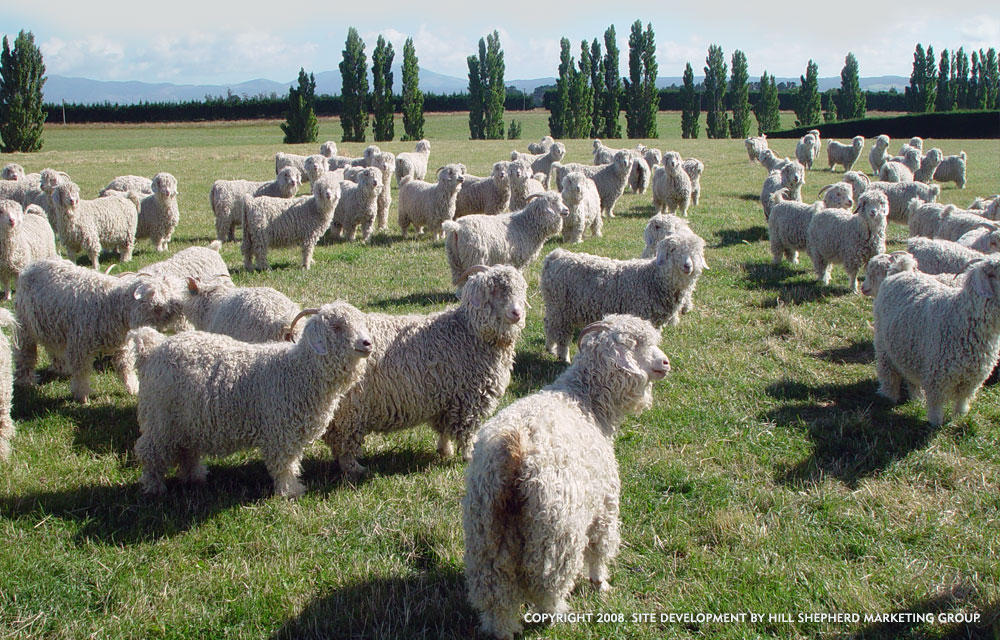
The yarn comes not from a sheep but a goat, the Angora, which emigrated from Tibet to Turkey in the 16th century, and it’s one of the oldest textile materials in use. It’s made of keratin, like hair, wool, horns and skin. Mohair is warm in winter, while remaining cool in summer. It is flame resistant, crease resistant, and does not felt. The goats are mainly bred in South Africa now.

angora_goat_11_12

And it is of course beautifully luxurious. Makes your fingers sing. Should I choose this color instead? It’s for a slip of an elegant bandana, not the kind you’d wear around a Slabsides campfire. Evening Pink.

Haiku-Evening Pink

If Firestone and Ford and Edison were on their way over to roast weenies, maybe a scarf in this hue would be more refined: Blue Jay Way.

Haiku-Blue Jay Way

So many choices when your leg is up and all you’ve got to do is dream.

2 Comments

Filed under Art, Culture, Dogs, Fashion, History, Home, Jean Zimmerman, Knitting, Nature, Photography, Publishing, Writers, Writing

Of Leeches and Fiberglass

Five hundred years ago I would be having leeches applied to my leg today. Now it’s just a thigh-high fiberglass cast. And I know my foot will get better. (Even with all those leeches, a person would probably never get out there again in the millet fields.)

imagesJust so you know, I may not be posting as regularly in the next month or so, as I drift in a medicinal haze. We’ll see what adventures are to be had in my living room, aside from gorging on episodic tv and Poptarts. And guest bloggers are welcome, those with adventures to share, just leave me a comment and we’ll discuss.


7 Comments

Filed under Culture, History, Home, Jean Zimmerman, Nature

Pogo Schtick NYC

By the time we arrived, the Big Air finals had ended. Pogopalooza 10 was barreling towards its final couple of hours. None of the participants, it seemed, were tired. They were hardly breaking a sweat. It was as if the 10th Annual World Championships of Extreme Pogo, held in venues around New York City over the past day and a half, had just barely begun.

nyc

The crowd surged around the cordoned-off performance area in Union Square Park, on Broadway between 14th and 17th Streets. Because it was New York, where everything happens, twin ferrets made an appearance in the bustling audience, a distraction that was pretty much overlooked.

ferrets

The real attraction was the lineup of Xpogo stars, the ones hoping to break Guinness Records or at least achieve their personal best. This was the largest pogo stick event world wide, and all the pro athletes were here.

First came a practice period, with a break in the middle for one brave pogoer to take the mike and propose marriage to his pogo-fan girlfriend. He dropped to one knee and spoke of his happiness, and the crowd applauded. A guy in an orange helmet jumped by the couple: “Hey, congrats,” he said with a grin. (The two betrothed are pictured in the middle.)

jack jump

Then a yellow-hatted, yellow-tied, yellow-suspendered master of ceremonies out of a Wizard of Oz  remake introduced a contestant who had pogoed 23.22 miles, and broken a Guinness record with 70,271 bounces (seven straight hours). The athlete made  a pitch for his charity, Bounce to a Cure.

Next came the the Best Trick competition. The dozen or so contestants ranged in age from 16 to28 and in looks from movie-star handsome to pretty darn cute. Fluorescent garb seemed somewhat de rigeur, as were sturdy helmets.

crowd w mc

When I was about 10, I ruled on the pogo stick, setting records on my driveway with 100 jumps at a time. I didn’t put a lot of air between my stick and the blacktop, it just felt good to go boing-a-boing-a-boing. To keep that balance for so long. To hold on when it looked like I might crash down.

grow_to_pro_pogo_stick_4

The athletes now acquiescing to pre-Tricks interviews had bigger plans. Some of them, after all, could take themselve fully nine feet in the air, just for a start. There was Wacky Chad from Syracuse, the one in the fluorescent orange helmet and kicks.

jack cu

Also, a qualifier known as Manchild, who jumps his pogo backwards but had no name as of yet for his move. There was Michael Mena, who called his move the “Manchild” out of respect for his colleague. The other contestants gave previews of their tricks: the under the leg bar spin, the infinity wrap, the double 180 wrap, the grisly whip. “You’ll just have to wait and see,” said one fellow who had stripped to the waist, with a mischievous expression.

The Ramones song Judy is a Punk blared from the speakers as the action began.

“None of these tricks have been landed before!” announced the mc.

mc cu

And I noticed that this sport looked fun and all, but was anything but safe. You could injure your body, yes, but you could even more easily bruise your ego. One after the other, the jumpers broke the line and came out into the center, boing-a, boing-a, going through their moves. And invariably, each one wiped out. Dusted himself off. Rejoined the line.

Beck’s Loser was now in the air, a fitting soundtrack for these redblooded competitors who seemed immune to failture.

A guy in sunglasses came out and tripped himself up almost before he began – every single time. “It’s a very technical move,” said the mc, “Give him a hand.”

pogo_stick

A duo on a double pogo tried over and over again to achieve a back flip—and they did manage to nail it, only they landed with their feet on the ground rather than the stick’s pedals.

pogo duo better

Manchild came so close, so many times.

manchild jumping

Dan Mahoney, from Nova Scotia, the bare-chested athlete with the wry smile, at 20 is a veteran jumper.

dan hand up better

He held the world record for highest jump on a pogo stick (9’6”). He went high, high, high, with his trick at Union Square, he flew, and the figure he cut was so complex that a second after he’d done it I couldn’t even figure out what he did. Still, he failed.

dan jump better

Until he made it. Yes! Glory. The crowd erupted. Yet the competition continued, as the judges would assess the overall performances at the end of the period and make a cumulative judgment.

The Black Keys Howling for You, their big stadium hit, pounded from the amplifiers now as a backdrop for a sport in a smaller stadium, a struggling extreme sport whose people have performed in Beijing, Rome, London, Japan. Can pogoing ever achieve the respect given snowboarding or skateboarding?

Another champion, Biff Hutchinson of Burley, Idaho, jumped into the fray, accomplishing a back flip, then another, then another. Earlier he had taken first in the Big Air contest.

nasty air prize

No one wanted to stop. Even Wacky Chad had to come out for one more ride.

Finally, the end. I watched Mahoney remove his sneaks and socks and carefully examine his feet. He had developed a small limp in the course of the contest. Now he went forward to collect his prize. Do his interview. “When I think of a trick,” the athlete told the audience, “I can see it in my head.” He’s won this prize for four years now. “I love you all,” he said.

Fail and try again. Fail, and win. That was the spirit of the day. But did I dare?

I approached the open pogo area, where brash little pink skirted toddlers and perplexed looking middle agers tried to develop some confidence on the stick.

free pogo area

I was the last in line for the day.

I’d done it before. Yes, several decades before. But give me a moment to collect myself, we’d see who still had the chops.

jz pogo jump

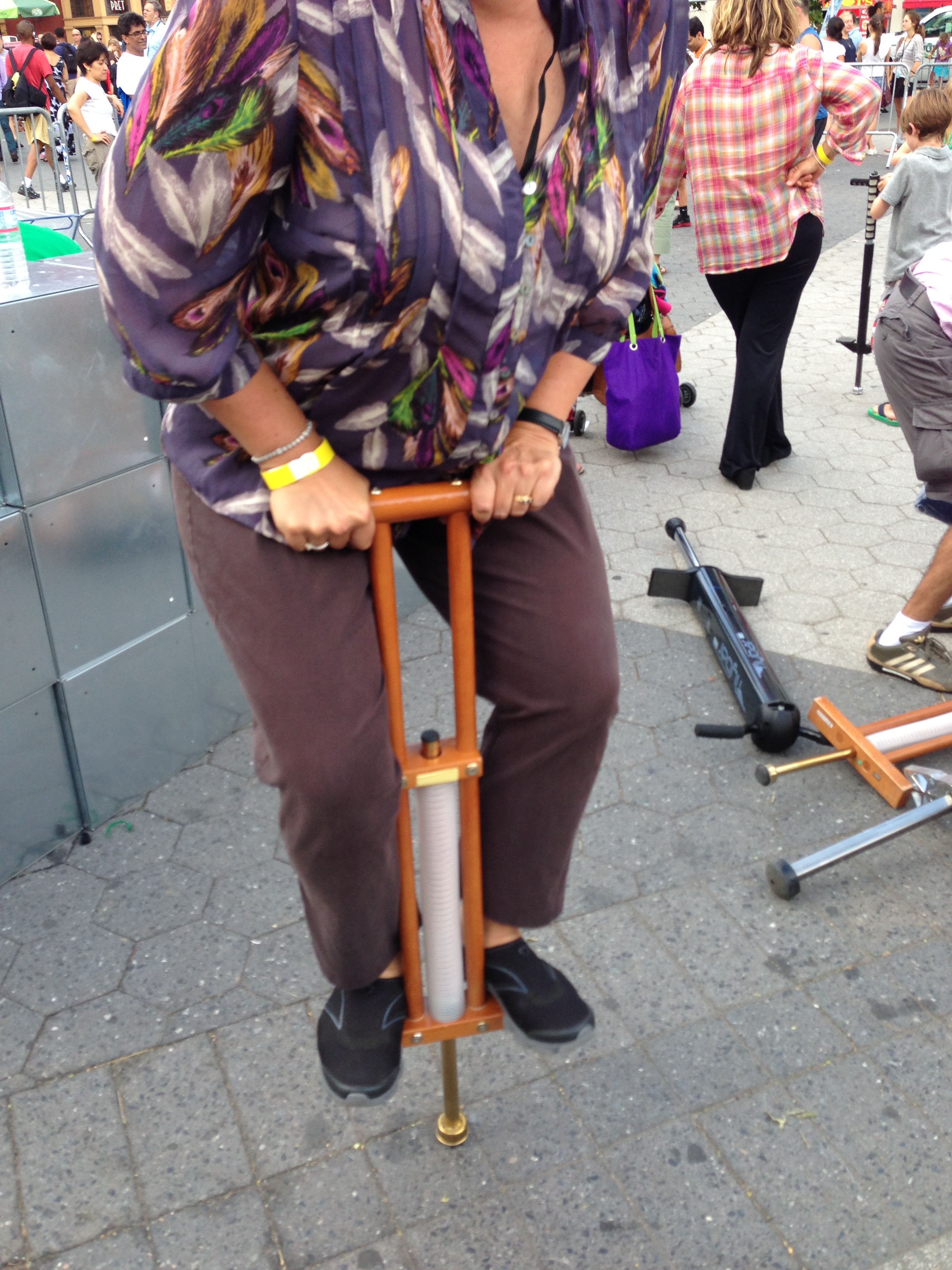
I left my fluorescents at home. I still had my boing-a attitude, though. I asked to use one of the big bazookas but was told by a helper, “That’s what they use,” pointing to the professional pogo pit. That was okay. I mounted my steed and managed not one, not two, but eight jumps. I fell off, then I got up. I dusted myself off.

jz pogo smug

Eight good bounces. Only 92 more to go.

5 Comments

Filed under Culture, Fashion, History, Home, Jean Zimmerman, Photography

Captive Audience

Millbrook, New York is a quiet town, a town of well-behaved dogs on leashes and potted flowers.

box of flowers

A town of rice pudding with cinnamon at a cute bakery called Babette’s Kitchen.

rice pudding

The last notable murder in Millbrook took place a century ago – a nanny named Sarah Brymer was strangled when her employers, of the Barnes Compton clan, left their estate for a New York City visit during a January snowstorm. The coachman, Frank Schermerhorn, did it – though he first tried to pin the blame on the Japanese butler – then cut his own throat with a straight razor when he was apprehended.

That was a long time back and everybody’s forgotten about it.

So it was interesting to be invited to Millbrook’s warm and comfortable Merritt Bookstore for a discussion/book signing today where attendees could “discover the art of mystery.” I was joined by another novelist, Koethi Zan, whose book The Never List was published earlier this month.

16158525

Koethi is a former entertainment industry lawyer who makes her debut with this riveting book. She knows everything there is to know on the subject of girls and women taken captive by craven men, then tortured and imprisoned for years. She is also an authority on the subject of the women who eventually escape these men. And she has worked this knowledge into a thriller which has received strong acclaim from people like Jeffery Deaver and Tess Gerritsen.

It was great to meet Koethi.

Jean and Koethe

She brought her husband, Stephen Metcalf, a critic-at-large at Slate who has a nonfiction book on the 1980s in the works. I brought Gil – yes, Gil Reavill, whose speciality is also crime and whose recent book is Mafia Summit.

All the great minds were present. The only thing lacking was an audience.

It happens sometimes. When you make appearances as an author, you don’t know whether to expect 120 people or three. When it’s three, you still have to be mentally present, be on your game, because these wonderful people made the effort to come out and see you, after all. Amazing!

In this case, nada. So, with two of the book store’s staff, we sat around in the cozy garrett upstairs and had a very stimulating talk about writing books.

We talked about creating a bad guy. How do you get inside his head? Koethi said that for The Never List it was more about her characters trying to ascertain how her bad guy ticked. For me, with The Orphanmaster, I said it was partly about figuring out what he would think and do that was completely the opposite of what I would think and do.

How do you discipline yourself when you don’t feel like working? Five hundred words a day, said Koethi. That is my minimum.

We talked about fact-based prose. About research. (One of my favorite subjects.) I told them about how I had based my protagonist in The Orphanmaster on a real person I had written about for an earlier work, The Women of the House, and how I had all my research practically done when I started my novel. Stephen talked about the book he is working on, about the plenitude of letters regarding the artist Jean-Michel Basquiat, one of his central figures. Koethi, as I said, has absorbed everything on captive females.

She told us about some of the recent high-profile cases, and said that while it seems some of these young women are coming back to a semblance of mental health it’s not always what it seems.

We talked about captivity narratives, about the classic John Wayne film The Searchers, about an article that has recently been published in The New York Review of Books on the subject, about Ride the Wind, a historical novel based on the Cynthia Parker story. The subject interests me historically because in Savage Girl, the central figure spends some time with the Plains Indians.

A lot to chew on. All of this and a full cheese platter too.

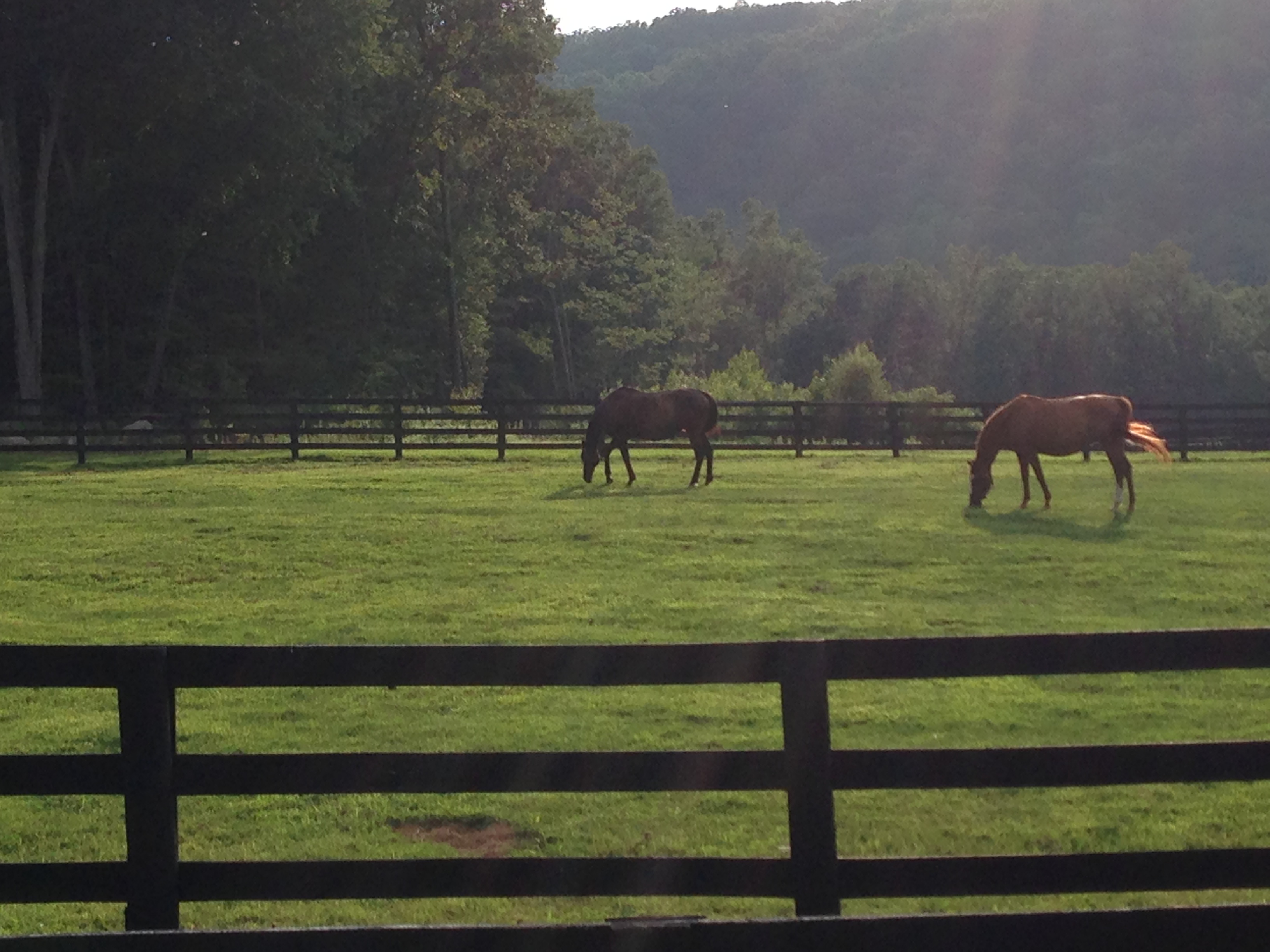
We meandered home on the back roads, through soccer fields and corn fields and gently curving horse meadows.

horses

There was only one exception to the bucolic charm of the open road: the ruin of an abandoned complex that was Wingdale, a mental hospital which operated upstate from 1924-1994 and is said to be haunted by ghosts. With its crumbling brick and busted windows, it looks like the perfect set for a horror film.

No visitors allowed.

wingdale

There’s always something behind the happy façade.

3 Comments

Filed under Culture, Fiction, History, Jean Zimmerman, Savage Girl, The Orphanmaster, Writers, Writing

Stop Your Sobbing

How do you cope with the prospect of failure?  Not failure itself, that’s pretty easy. You cry, brush yourself off, move on.

But the likelihood of screwing up. Ah, that’s another thing.

I’m talking about my vegetable garden, which turns out to be both a success and a bomb.

My weeds! They have taken over. Excuses: Heat. Rain. Humidity. Social distractions. And I’ve got to work, after all.

I have tomatoes, so how can I whine? A rainbow of heirlooms.

mixed tomatoes

Basil bushes that could make topiary pesto.

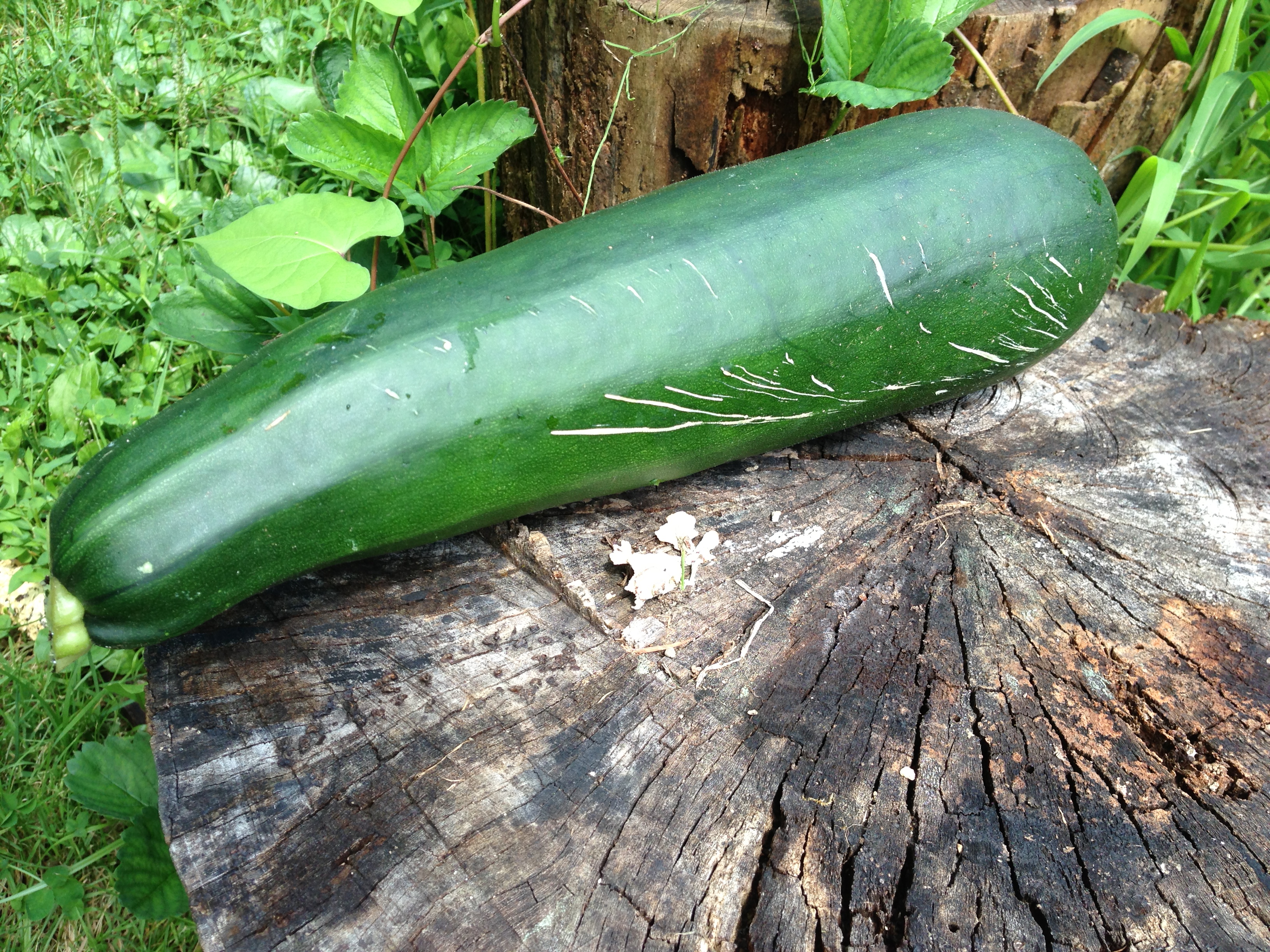
Squash, huge, far too much too eat.

zucchini

Does anyone actually like stuffed zucchini boats?

My herbs were are great before they crushed by toppling mint. The lavender and tarragon have exploded. Next to them, the pinks I planted as companions have bloomed constantly. My raspberry volunteers produced berries that accent vanilla ice cream perfectly.

berries

And here’s the point. Everything is sprouting, bushy, overgrown. The weeds sprawl. But the plants I expected to do well – the pole beans, say, masses of vines and leaves – have produced no beans.

beans

Some cuke plants have thrived, but others flatlined. Peppers, yes, eggplant, nada. Cosmos making a brave go of it.

cosmos

The beautiful crinkled leaves of the rainbow chard? Gourmet rabbit lunches, long gone.

The journey is the goal. To quote Gil, quoting some Oriental sage.

Oh. So it was all about the planting of those wrinkly little potato sections in May, watching the green plants thrive in June, finally the digging of the hard red tubers out of the earth, greeting the earthworms that were their bosom companions. Getting the good dirt under my nails.

potatoes soil

Having a perfectly manicured kitchen garden where every crop prospers isn’t the point even if it was possible. I’ve had that experience, in the past, on a sunny slope with plenty of chicken manure and it was pretty great. But then I didn’t share a marsh with turtles and snakes and red-tailed hawks. I didn’t live in the shady, ethereal woods.

I could use a hand with the weeding. In the meantime, let’s listen as Jonathan Richman sings the Kinks’ Stop Your Sobbing.

5 Comments

Filed under Cooking, History, Home, Jean Zimmerman, Nature, Photography, Writing

Portals Into Other Worlds

I’m thinking about how you can visit other times and places on the web, peeking through portals the way you peer through a cutout in the plywood surrounding a construction site. Here are fifteen visits I’ve made lately that I’d recommend.

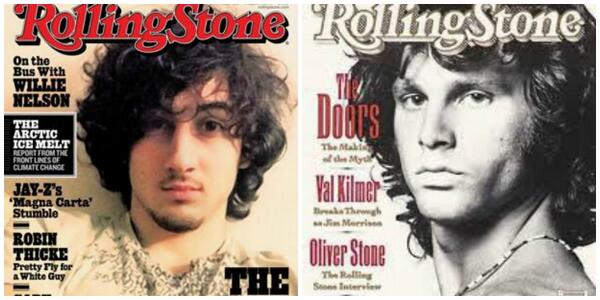
It was a mistake for Rolling Stone to make a rock star out of a creep.

jahar:jim

That doesn’t mean the article that goes with the picture is not good journalism. And don’t we want to know, don’t we have to know, what makes terrorists tick, in order to know how to combat the evil they do? If you don’t feel like patronizing Rolling Stone at the moment to read the piece, if you’re interested in long-form reportage on all kinds of subjects, from a history of the famous indie rock club Maxwell’s to a star 16-year-old pitcher in Japan, go to Longform.org, which reprints new and classic nonfiction from around the web.

Amazon-Kindle1

Admit it, you want to know the inside story of the Kindle. What brainiacs came up with this gizmo that might mean the end of books as we know and love them? (I actually have a Kindle Fire and don’t find it hasn’t stifled my desire to read print on paper, just saying.)

It sounds almost banal, but I guarantee that when you hook into The Evolution of Love Songs (1904-2007) you will not be able to quit. I’m waiting for part 2, 2008-2013.

Up my alley, and I hope yours, a view of how the lives of American women changed over the 19th century through the art of the time.  In particular, life on the farm, complete with Winslow Homerian milkmaids.

Winslow Homer (American artist, 1836-1910) The Milk Maid


There are so many food blogs. I like npr’s the salt.

A view into a different world would include the minds of people who make Lego their personal idiom. They do things like make plastic sushi and other amazing Lego food creations. 

Lego sushi

I’m interested in the alternate lives of feral children, especially since my next novel Savage Girl  describes all the trouble one can get into in Gilded Age New York. Like how do you participate in a refined dinner party when you’re accustomed to tearing meat apart with your fingers? Every now and then a contemporary wild child surfaces with an interesting story. You can read about Marina Chapman, a British housewife who claims she was raised by monkeys in Colombia.

 marina chapman

Want to know about neolithic cooking? The Rambling Epicure tells you, and it starts with “one bucket wild spinach leaves.” The excellent food site gives you a recipe from Jane Le Besque’s cookbook, Un Soufflé de Pollen: Livre de Cuisine et de Peinture. A painter, Le Besque lives in the Pays de Gex in the foothills of the Jura mountains, and this is her “artistic vision” of primitive cuisine.

See how other people connect — passionately — with the past. Reenactors get their due with 36 photos from around the world.

reenactors

Here, actors and actresses from Iere Theatre Productions play the roles of indentured East Indian laborers and British constabulary police during a reenactment of the first arrival of East Indians to Trinidad and Tobago, on Nelson Island in the Gulf of Paria off the west coast of Trinidad.

It’s not all about Gettsyburg, clearly.

reenactors 2

These children are taking part in a mock military parade at an amusement park in Pyongyang to mark International Children’s Day, in this photo taken on June 1, 2013.

Okay, the squeamish should not tune in to7 Bio-Artists Who Are Transforming the Fabric of Life Itself” at the site io9.

rabbit

It’s about how some provocative artists today deal with biotechnology. Working with scientists and engineers, these geniuses transform living tissue and even their own bodies into works of art. For example, Brazilian-American “transgenic artist” Eduardo Kac took a rabbit and implanted it with a Green Fluorescent Protein (GFP) found in jellyfish. When placed under a blue light, the rabbit glows an otherworldly hue.

On the lighter side, see the longest domino chain in the world made of books: 2,131 of them.

 My dog is named a very modern Oliver. He looks exactly like his name.

oliver about to copy

Medievalists.net has a well-researched piece on ancient pet names, such as dogs called Sturdy, Whitefoot, Hardy, Jakke, Bo and Terri, and a cat in England named Gyb – the short form of of Gilbert –  or one named Mite, who prowled around Beaulieu Abbey in the 13th century, or Belaud, a grey cat belonging to Joachim du Bellay in the 16th century. Isabella d’Este owned a cat named Martino. I bet nobody died their animals green.

Buzzfeed has 16 noble photos of women writers at work, including a great one of Anne Sexton immersed in her craft.

anne sexton

From MessyNessyChic.com, the story of an artist whose work was discovered in the trash 50 years after his death.

Charles Dellschau

This grouchy butcher by trade, an immigrant named Charles Dellschau, had secretly been busy assembling thousands of intricate drawings of flying machines, sewn together in homemade notebooks with shoelaces.

And for anyone who didn’t catch this when it went big on the web, Dustin Hoffman showed us his softer side in reminiscing about Tootsie and what playing a woman meant to him. The interview is a window into the psyche of someone whose brilliant work opened a window into a psyche we were lucky to see.

tootsie25

3 Comments

Filed under Art, Cooking, Culture, Dogs, Fashion, Fiction, History, Home, Jean Zimmerman, Nature, Poetry, Savage Girl, Writers, Writing

Dirty Disney

I expected the Paul McCarthy show at New York’s Park Avenue Armory to be raunchy, demented, transgressive. What I didn’t anticipate was that it would be hilarious.

Screen-Shot-2013-07-08-at-9.34.24-AM

If you follow the contemporary art world you know that McCarthy excels at tweaking the public’s nose. Not long ago there was the giant inflatable “Complex Pile” he contributed to ultra-civilized monumental art shows.

poop

The fifty-one-foot dog poop went pop in a downpour one recent day in Hong Kong, but not before it had made its comment on our expectations for the public sculpture we’re used to admiring. Plastic dolls, masks and ketchup have also figured in the 68-year-old McCarthy’s oeuvre over the years.

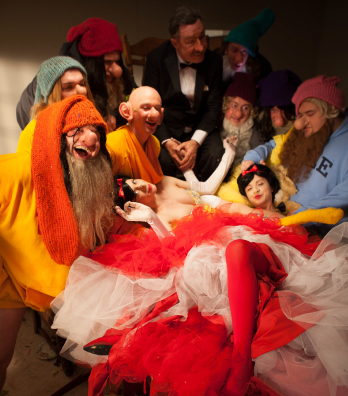
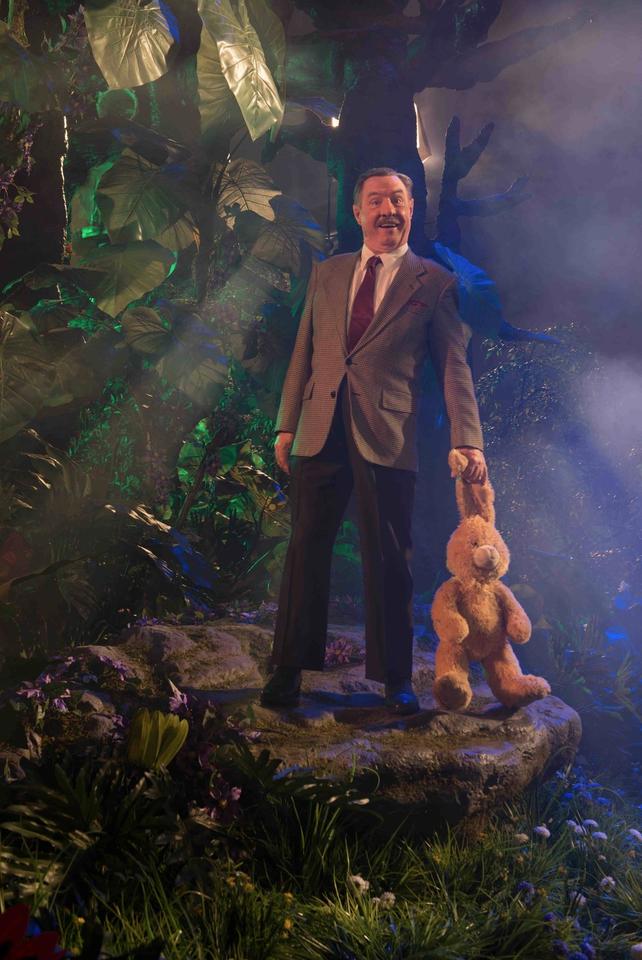
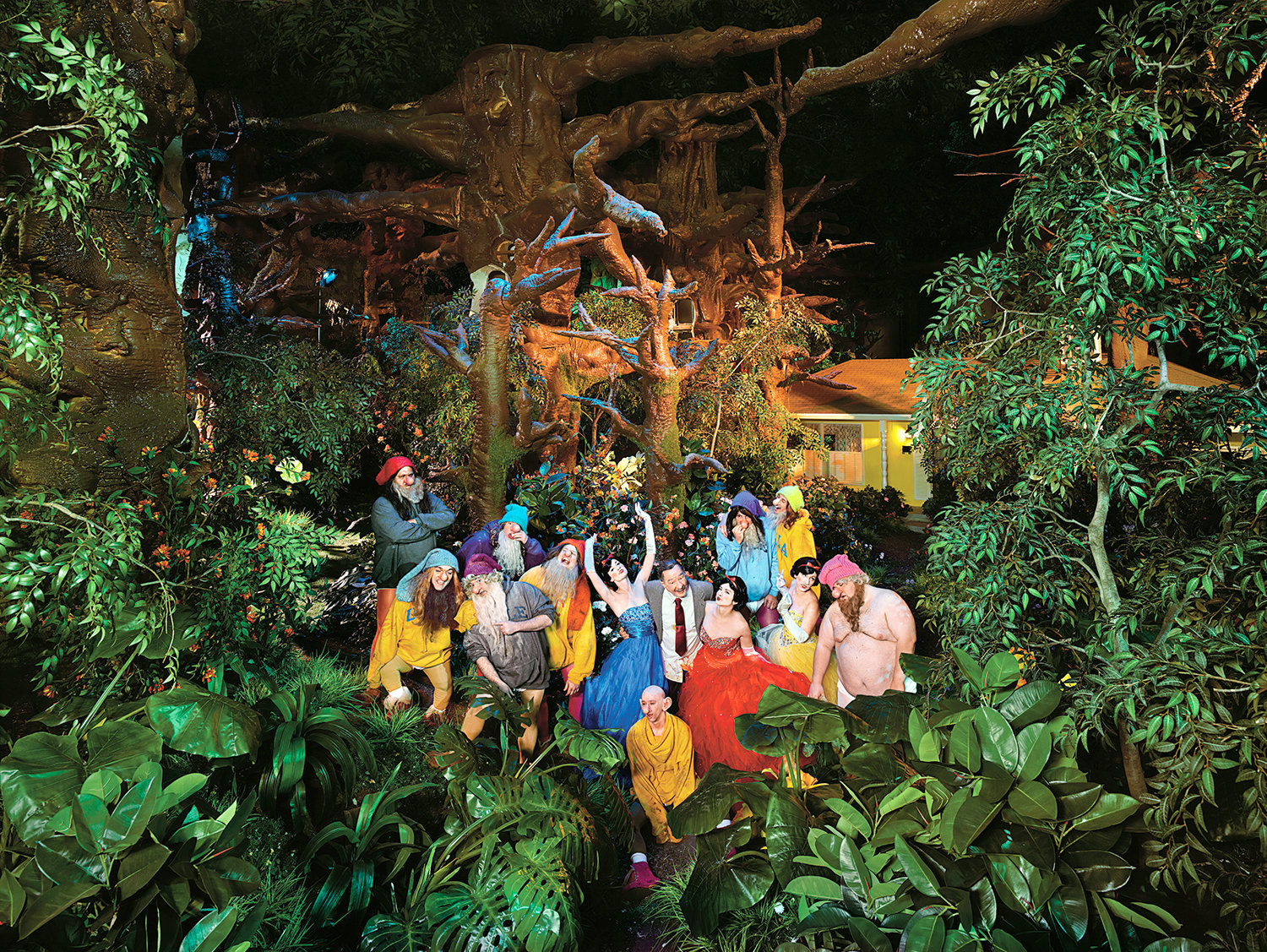
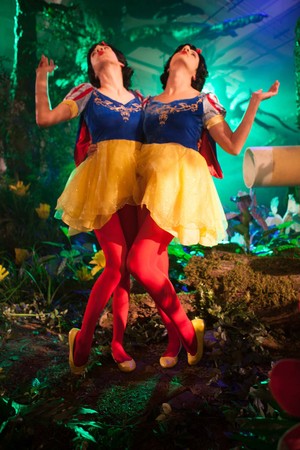
In W/S,  the largest installation the artist has ever created, we have a multimedia reimagining of the tale of Snow White and the Seven Dwarfs, its Disney iconography mashed up with elements of horror and porn and probably a few other elements I missed. In the films that are the bulwark of the show, McCarthy plays an ersatz Walt Disney, here called Walt Paul, nose prosthetiicized to the max.

061813white4

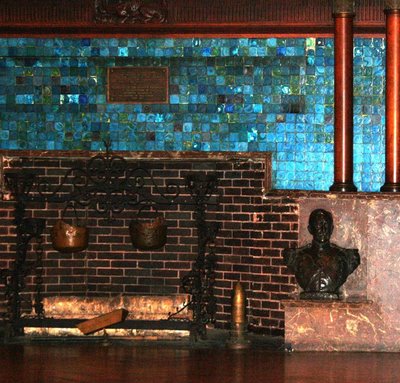
Neither Maud nor I said much as we went around the Armory’s cavernous Wade Thompson Drill Hall, one of the largest public spaces in Manhattan. The last time I visited the Armory it was for the prim and proper Winter Antiques Show, and I remember marvelling at the fancily gorgeous reception rooms designed by people like Louis Comfort Tiffany.

armorytiffany3

This time we heard the exhibit before we saw anything, a raucous moaning and groaning like a bloated x-rated soundtrack. The noise emanated from two gigantic screens, each as big as a drive in theater’s. On the screens, dwarves cavorted with  White Snow – McCarthy’s version of the Disney heroine — in a hectic, squalid party.

screen

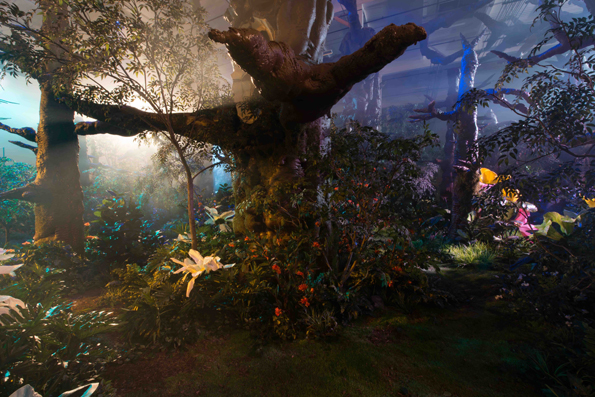
Under the blast of sound we couldn’t hear each other anyway. In front of us stood a large, Wonderland-proportioned forest of painted styrofoam trees and garish monster flowers.

forest dark

Its lavish 8,800 square feet formed the centerpiece of the show and had served as the soundstage of the production, before it was carted to New York from Los Angeles in dozens of tractor-trailers.

forest

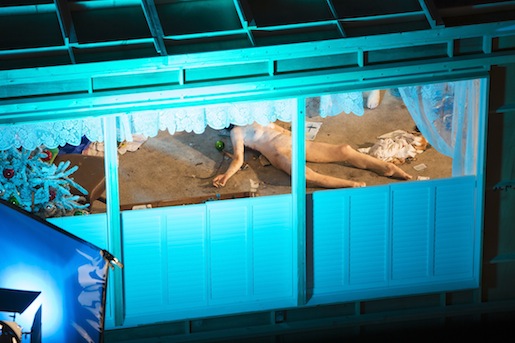
A house, or “cottage,” stood in front of us, or anyway a film set version of one. The back was punctuated with a series of square peepholes like the ones you see at some major construction sites. I’ve always liked peering into those. Here there was the same suggestion of a secret view.

body

There were disturbing glimpses of the aftermath of something gone terribly wrong, a woman and a man collapsed in a tacky living room. But the squirt bottle of Hershey’s was the tipoff as to the display’s tomfoolery. You do know that in Hollywood, Hershey’s often substitutes for blood, don’t you?

In W/S, McCarthy exhumes Walt Disney and has him trot around getting into trouble before really getting into trouble at the hands of Grumpy, Sneezy, et al. All I could think of was a guy I knew who landed a good job working at Disney in the ‘60s before Walt personally had him fired for sporting a beard.

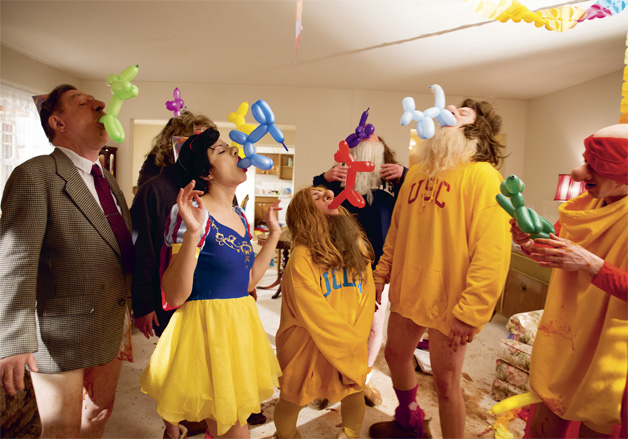
Now here was one of the most famous men in the world surrounded by beards and noses and genitalia and a lot of chocolate syrup, making love to a wench of a White Snow, all of them doing everything that no one would ever do in a Disney film (or theme park or corporation). It’s an upside down, inside out world, as crude and scary as the other was clean and safe. I imagine the Disney barracudas preparing their legal briefs.

balloons

Randy Kennedy of The New York Times did a piece on the artist recently that said, “His work can – and does – provoke physical revulsion. But it is not mere provocation; it’s intended as an all-out assault, a ‘program of resistance,’ as he calls it. And the older he gets, the more explicit he has become that his target is the American entertainment-consumer economy.”

Spectators weren’t allowed in the forest, but in a smaller film arcade along the side we could observe chapters of the story. An unclothed Prince Charming wandered through its glades. Shocking events transpired. We could also visit another house in a retro ranch style that is actually a three-quarter-scale replica of McCarthy’s Salt Lake City childhood home. Alex Poots, Artistic Director of the Armory, has had a lot of explaining to do about the piece, and at one point he said, “it explores the vast and at times distressingly dark corners of the human psyche.” And the dark corners of some pretty sad vintage rooms, I would say.

screen set

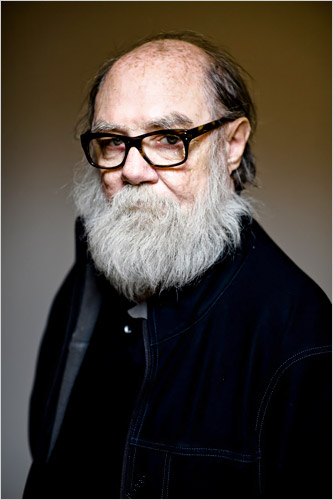
Walt Paul is not Paul McCarthy – the latter lives in Pasadena with his wife of 46 years, surrounded by kids, grandkids and pets. His grown son partnered with him in putting on W/S.

portrait


McCarthy told an interviewer that the show “may have something to do with how we see reality and desire. And art. This is a kind of hyper-reality of desire. A Disneyesque landscape that does not exist. A dreamscape.” All of this styrofoam and soundstage equipment comes at a cost, of course, and the project required millions of dollars. I like to think of Walt Paul in his lumpy nose approaching potential benefactors: Well, there’s this plastic forest, see, and this Hershey’s syrup…

I read a review that said the show “put the grim back into the classic Brothers Grimm fairytale.” I saw it as a series of extravagant what-ifs. What if Snow White had a split (or triple) personality? What if there was a handsome prince who didn’t rescue her but treated her more like a centerfold than a princess? What if Walt actually appeared in his own movies alongside Bambi, say, or Cinderella? What if those beloved childhood movies were more like stag films? What if the dwarves weren’t wholesome and helpful and cute but more like your twisted Uncle Charlie?

ws

The Grimm tales have always been dark. The great children’s author Philip Pullman recently came out with a new version, just in time for the 200th anniversary of their first publication.

grimm


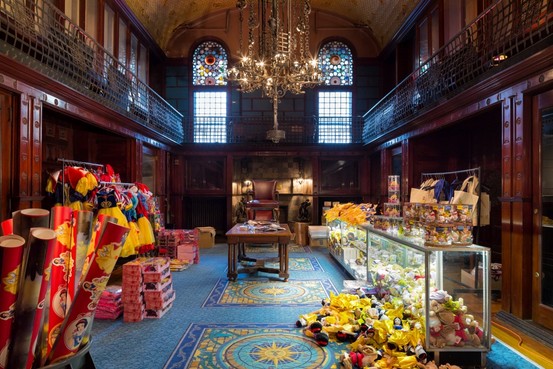
McCarthy’s show is also unabashedly commercial, with plentiful Snow White artifacts available in the gift shop.

Disney stuff

Pullman’s Fairy Tales From the Brothers Grimm are punchy and elegant but also violent and raw. In his translation of Snow White, a huntsman cuts out the heart and liver of a wild boar and takes them back to the evil queen as evidence of the girl’s death. “The cook was ordered to season them well, fry them, and the wicked queen ate them all up.”

Do you recall the conversation parents have had from time to time about whether these ancient fairy tales offer an appropriate reading experience for their innocent youngsters? The answer is No, if you’re doing it right. And this version is done to a turn.


3 Comments

Filed under Art, Culture, Fiction, Film, History, Jean Zimmerman, Publishing, Writers, Writing

The Real Stuff of the Past

Ice. Bricks. Wrecks.

schultz brick

I discovered three potential novels today in a small museum in Kingston, New York. Anyway, there were artifacts that could be the seeds of novels, historical subject matter so robust and potent that some writer’s sure to climb on board. One day soon, I hope.

I was there for a festival celebrating the Hudson River, but it didn’t take place, so I was left to wander without a plan. The Hudson River Maritime Museum houses itself in a weathered brick building on Rondout Creek in Kingston, where it keeps alive the history of the area. It teems with artifacts from the D and H canal, which brought anthracite coal from the innards of the country to the Hudson between 1828 and 1898, from the steamboats that brought nineteenth-century travellers from New York City north, the tugboats which dominated this place when so much freight went by ship, and the various industries that sprang up around here in the nineteenth century.

The dock area bustled. You could see the Half Moon, the working replica of the ship Henry Hudson drove up this very river, complete down to the most persnickety detail.

hudson detail

Costumed interpreters introduced jaded suburbanites to a living space smaller than the smallest New York City apartment.You could also see a new topmast being planed for the boat, by a gentleman foregoing period tools for more efficient electric sanders.

mast

There was a yellow submarine.

submarine

The Seahorse can hold two crew members and has been used for archaeological dives in Lake George.

Mammoth propellers studded the grounds.

propeller

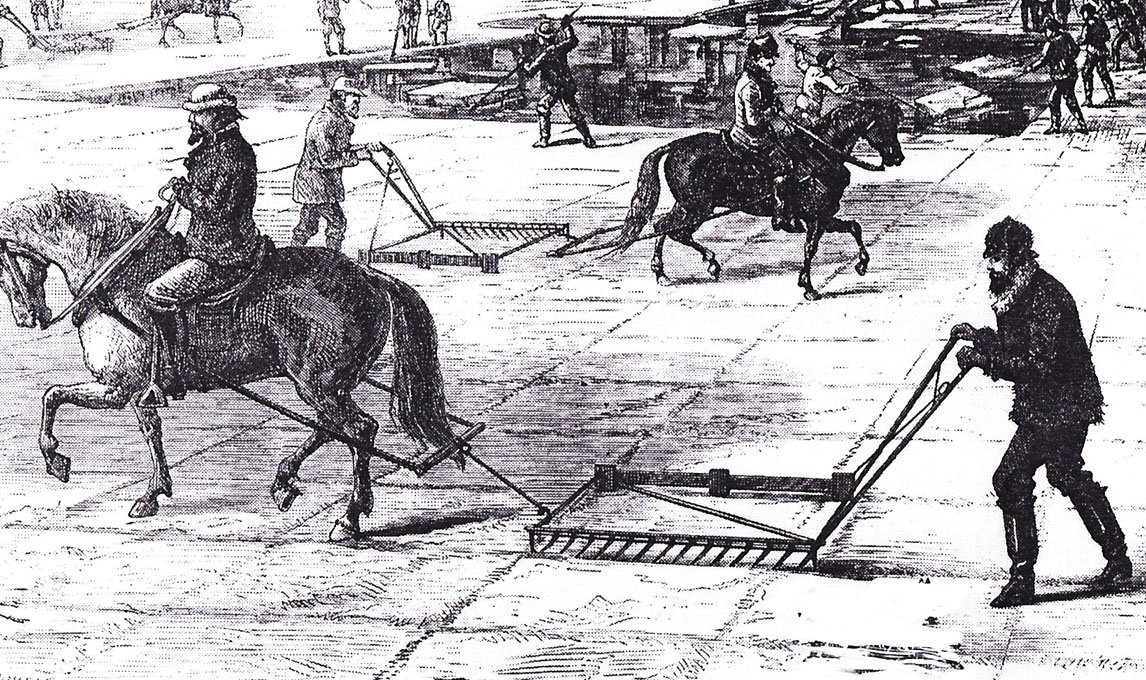
But what I loved, going inside the chock full precincts of the museum, was the ice. Here was talk, detailed talk, of an industry that had basically vanished by mi-century but was incredibly important before.

The Kingson area was a hub for ice harvesting. And since ice was crucial for warm weather food preservation (not to mention ice cream making), it was big business.

iceharvesting

Over one hundred ice houses dotted the shores of the Hudson in 1900. Manhattan and Brooklyn consumed 1.3 million tons in 1879. Everything about the industry was big, especially the ice saws and other tools.

ice saws

One detail that especially excited me is that the same horses employed to drag huge blocks of ice off of the river during the winter would be brought down to New York City to pull the ice wagons in the summer. I’d like to follow one of those ice horses, alternate between life in two such different port cities.

ice wagon

One of my  heroines out of history, English traveller and diarist Fanny Trollope, made the comment, in the 1830s, “I do not imagine there is a home without the luxury of a piece of ice to cool the water and harden the butter.” I’d love to read more and write more about the sweat that went into that cold work.

Bricks.

2 bricks

The Dutch in New Amsterdam imported small, hard yellow bricks from Holland. Then someone realized the magnificence of the natural clay deposits in America. Along the Hudson River men molded “green brick” in wood frames, and it had to be carefully turned when drying.

turning

Imprinted names came either from the brickyard owner or could be commissioned.

brick tower

Such beautiful, beefy stuff, this brick, and the story behind it.

Then, the wrecks. Some of the steamboat capsizings on the Hudson in the middle of the 1800s were doozies. People were so excited about the new toy, a boat without sails, that they raced passenger steamers up and down the Hudson seemingly without a thought in their heads. The boats offered their genteel riders swellegant accommodations and a chance to see the breathtaking views along the way.

The Swallow, built in 1836 in Brooklyn, raced the Rochester between New York and Albany in a snow squall in 1843. Well, it stuck on a rock, ultimately breaking in two, and 15 of the 200 passengers died. In the total darkness of night, they couldn’t see that they were close enough to get easily to shore.

swallow_steamboat_burning

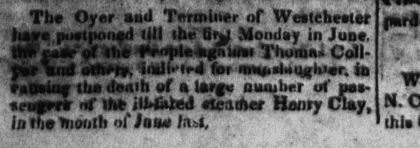
The Henry Clay disaster occurred when the boat left Albany in 1852 and began racing the Amenia, with a fire erupting at Yonkers and the craft beaching at Riverdale. Seventy men and women died, including the famous landscape architect Andrew Jackson Downing. It was, as you can imagine, a nightmare and a scandal and terrific news copy all combined.

clay

There was the Thomas Cornell (ran aground), the Daniel Drew (burned), the Trojan (burned), John H. Cordts (burned). A piece of panelling from the Cordts has been preserved. These were magnificent creatures, these vessels, costly, exciting. And doomed.

burnt detail

In the silt of the Hudson lie small boats, barges, sunken bricks, barnacled anchors. All mysterious pieces of the past, hidden from us.

Those steamboat races, though. They are fact. But they are the stuff of great fiction.

ferry sign

6 Comments

Filed under Culture, Fiction, History, Jean Zimmerman

A Manhattan Birthday Boat

Today was my birthday. I decided to take the two adventurers closest to me and go on the high seas. An oceanographic architectural tour of Manhattan launches most days from Pier 62, on the island’s west side, and the fact that it was the hottest day of the year made a liquid frolic all the more appealing.

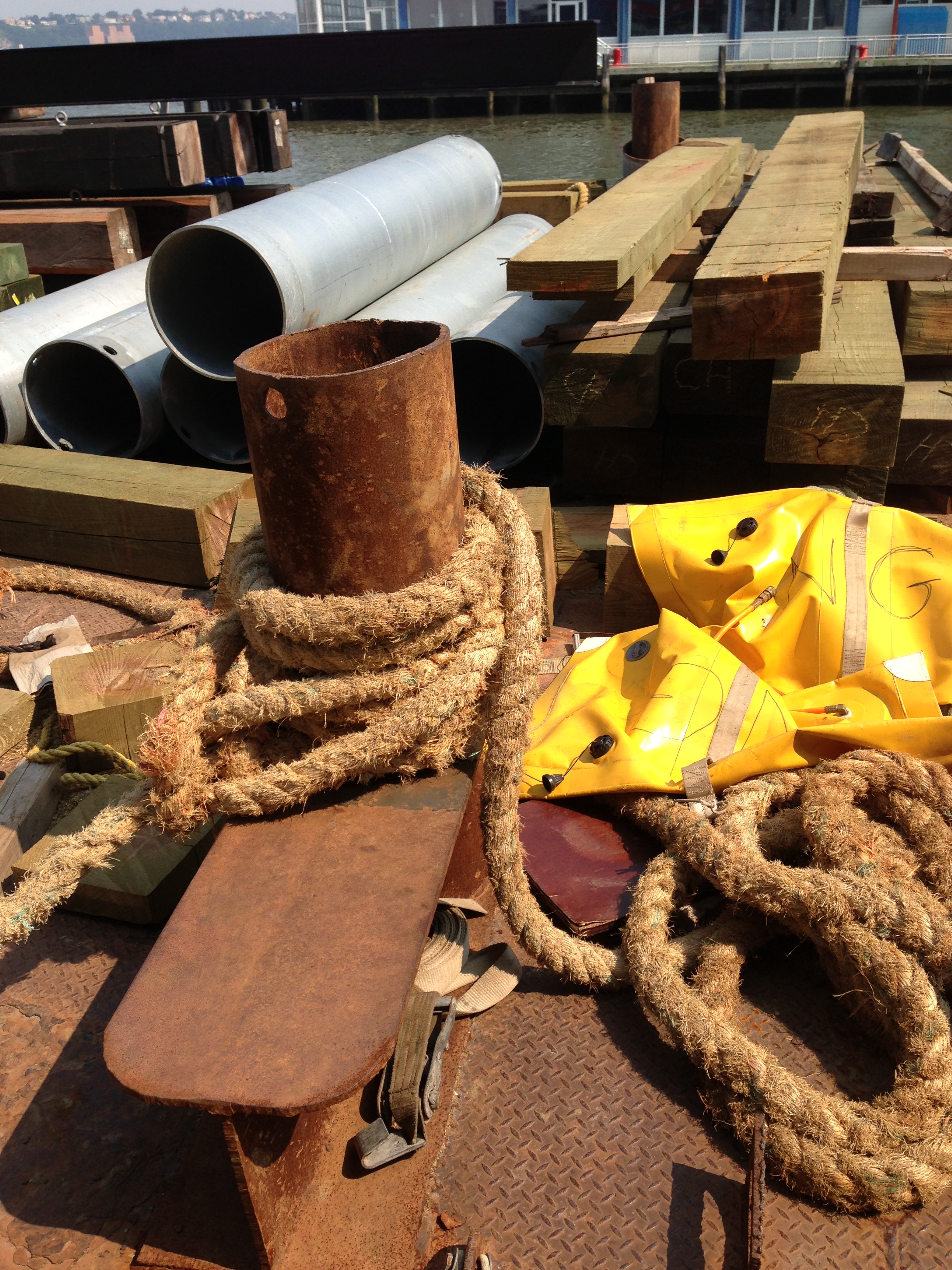
Pier 62, part of the Chelsea Piers sports complex, has some offerings for while you’re waiting for your boat to launch. You can watch hundreds of elementary-age gymnasts and soccer buffs perform in the air-conditioned splendor of a huge indoor gym. Watch deckhands spiff up the many yachts tied to the dock. Check out the picturesque marine ropes stashed at the end of the pier.

ship rope

Wonder about a Marcel du Champs-style composition of dining fork and some kind of bulbous ship hitch.

ship thing

Note the gallery of oversize photographs celebrating Chelsea Piers, including one of the Lusitania sailing out on its final, doomed voyage, with horse carriages stacked up watching it depart.

lusitania

Our boat was Manhattan, built in 2006 to resemble a 1920s riverboat, all light and gleaming wood panelling.

the manhattan

The cruise traveled south on the Hudson River to the Upper Bay, curtseyed to the Statue of Liberty, continued down around the Battery, up the East River, then retraced its steps, west again, all the way up to 125th Street, where it circled back to the starting point.

Austin, the captain, introduced the incredibly savvy architects Arthur Platt and Scott Cook, who would be narrating our journey. We wouldn’t be able to tour the very top of the island, said Austin, because of the heat: the steel of the swing bridge at Spuyten Duyvil had reached 95 degrees. If they swung it open, its expansion would make it impossible to close. On a brighter note, Hannah and Heather would be manning the bar, serving up ice-cold beverages for the next three hours, even champagne.

Maud, please, will you have some champagne for my birthday, I implored my daughter, since I myself refrain from alcohol and someone should raise a toast.

No, Mom, she said, the breeze ruffling her hair as we pulled out past Battered Bull of Georgetown, motoring into the channel. Water, she said. I want water.

Good thought. You could sit inside on this trip, in the climate-controlled saloon, and see the sights through glass. Or you could sit at the bow, on a bench outside in the red-hot sun, the New York harbor wind whipping your face. Where do you think we sat?

I learned. I learned so much. And then I forgot so much. The architects knew everything in the world about New York. And something about New Jersey too.

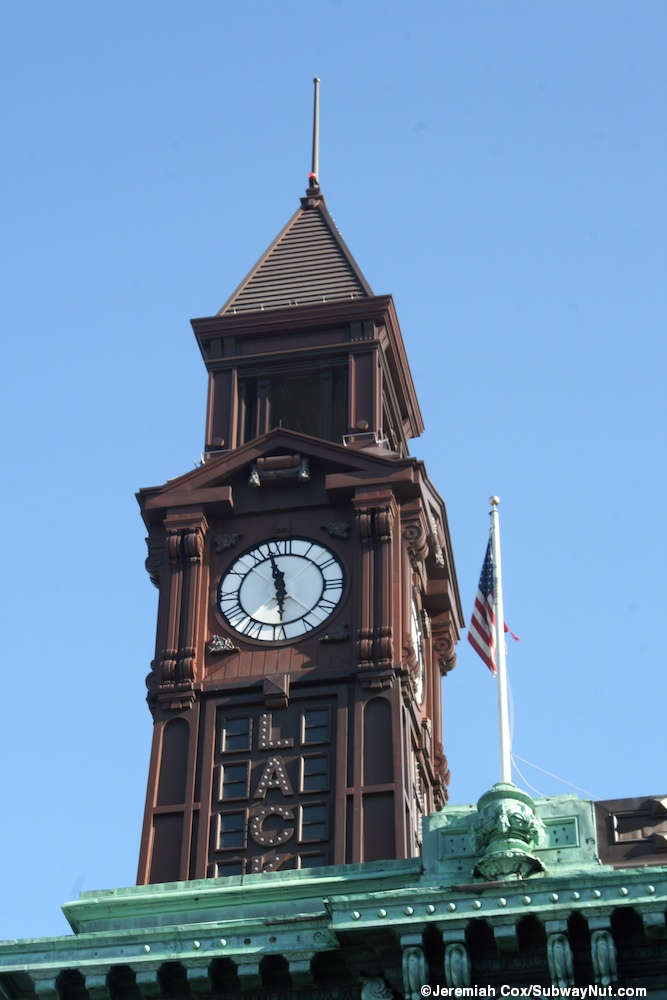
Like that the Erie Lackawanna rail terminal in Hoboken, for example, was built in 1909, and its dull brown color represents the hue of copper before it oxidizes – like the color of the Statue of Liberty originally. I never knew that.

That was a refrain that ran through my sunburned skull all day: I never knew that.

hoboken_terminal32

Or the fact that Ellis Island sits on the site of one of the harbor’s four original “oyster islands,” barely visible at high tide, and that Ellis Island, where so many American immigrants were “processed” was built first of wood and burned in 1897.

Ellis_Island_First_Bldg_Burnt_15-June-1897

That the Statue of Liberty’s skin is two pennies thin, and the torch is covered in 24 carat gold. Her sandals are upturned because Liberty is “always on the move.”

statue-of-liberty-torch1

I never knew that either.

Or the following interesting things, absorbed between cooling draughts of water.

On Governor’s Island – we talked a lot about the future of New York, not only the past — the biggest demolition project ever planned in New York, of old Coast Guard buildings, will create hills eighty feet high from which to view the Statue and Manhattan.

On the Brooklyn Waterfront, the site of Wallabout Bay, you can now take a bike tour of the Navy Yard.

We passed Williamsburg, Greenpoint – it’s “your last opportunity to look at this industrial waterfront,” said the architectural commentary. Brooklyn is developing so fast. “Bloomberg’s administration has upzoned more acreage in the history of New York than any other.” But even Bloomberg might be stymied by what was described as the “black mayonnaise” sediment of the oil-contaminated Newtown Creek.

newtown

On Roosevelt Island stands a monument, a shrine to FDR, designed by the architect Louis Kahn, who passed away in Pennsylvania Station and  “it took a while to identify him.” I certainly never knew that about Louis Kahn. In fact, I could barely believe it.

In Harlem you find the concept of “the tower in the park”, when public housing units stand solo, without a connection to the larger community.

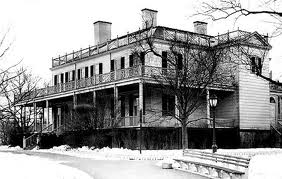
It was 1790 when Archibald Gracie built a house in what was then the countryside outside of New York City, never dreaming that his domicile would one day be the home of mayors (current mayor excluded, as he already has eleven homes).

gracie

And it was at this point that I put aside some of my adventuring spirit and stumbled inside to an air-conditioned seat. I was having fun — yet I wondered if the seasickness that has plagued me throughout my life had come back to haunt me. Then the music of fact revived me. That and the fizz of a diet Coke.

In 1909 the Metropolitan Life building with its elegant cupola was the highest in the world.

metropolitan

One difference between public and private high rises is that the private ones have balconies.

The Woolworth Building is just now having its centennial.

Gulp. Water. Is this boat rocking or is it me?

There is a very famous, ultra-cool architectural firm called SHoP. Never knew it.

One of the newer fancy buildings, of the many, many fancy buildings in New York, features an indoor dog walking court and built in nanny-cams.

Goldman Sachs employees take a private ferry every day from Manhattan to the firm’s offices in Jersey City.

The “exploded Malibu Barbie house” of artist Julian Schnabel was built on top of a stable.

NYT2008031214231288C

Fireboat 343, docked at Pier 40, was named for the 343 firefighters killed on 9/11.

343

Maybe if I were to go outside, get a breeze? Another Coke? Would my queasiness subside?

Frank Gehry’s sumptuous IAC building of smoky glass was made by “cold warping” the panels on site.

Gehry-IAC-building

There is now such a thing as a permanent window washing crane stationed atop several skyscrapers. It’s controversial, if that matters to you.

We passed a trio of kayakers at Pier 76, bobbing, no doubt very hot, but feeling very chill there in the waters of Manhattan.

And finally what the architect Scott called his favorite structure – his favorite, after all these hundreds? – the Lehigh Building. The “architects held back vertical elements at the façade,” he said, praising its “no nonsense” lines, its wraparound windows.

favorite bldg

We stumbled off the gangplank, our brains sunstruck, saturated and several pounds heavier. We collapsed.

gr after

Even youth faded in the heat.

mr after

But we revived with some time in a restaurant in an old boat called the Frying Pan.

frying pan

And taking the place of birthday cake, an ice cream sandwich with red velvet wafers and cream cheese ice cream.

red velvet

Home to dry land and cool, fragrant birthday flowers, from Maud.

birthday flowers

4 Comments

Filed under Cooking, Culture, History, Home, Jean Zimmerman, Nature, Photography

Something to Cry Over

I like to go adventuring. Small adventures or large, I’m happy if I see something new and arresting. If I have a frisson of … something… delight, wonder, whatever you want to call it. With a companion, adventuring’s the best.

So today I was a little down. Finished my work for the day, marking up an ancient, earnest screed of colonial history with a dull Sharpie, no adventure in sight. No companion either, with Gil bearing down on his writing, Maud gallivanting with a friend, other people at jobs or vacations. Only me and Oliver, and I’m not customarily invited on his adventures.

There were always the onions. I had already withdrawn to my cool underground kitchen lair to make a batch of pesto for dinner.

pesto

But now, no adventures to the fore, the onions presented themselves as a project.

onion basket

I’d never grown onions before. This summer, they grew incredibly fast. I put them out to harden on a plastic tarp under the brutal sun because I thought that’s what you do with them.

drying onions

Now to pickle them.

I had a recipe, from The Savory Way by veggie-genius Deborah Madison, that I’d made before, calling for red onions, but mine are white and from my taste test much tarter and tangier than the recipe’s onions, which turn a delicate ballet-worthy shade of pink.

Much more of a crying-over onion.

I trimmed them up, brushed the dirt from their whiskered bottoms. Sliced them in crisp rounds. Listened to Alejandro Escovado’s Castanets on the radio, a song so good it could make you cry.

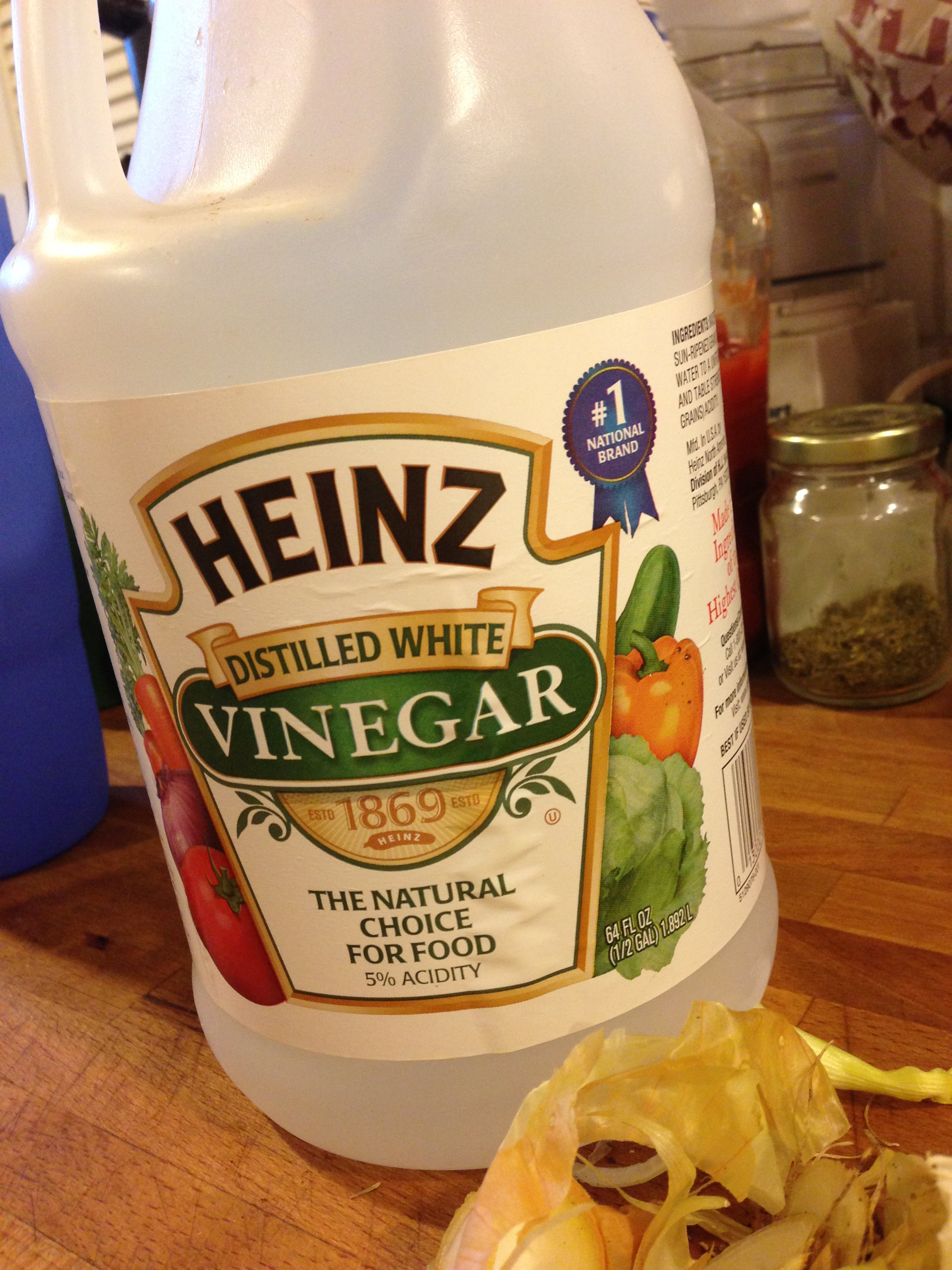
The recipe calls for boiling water splashed over the onions in a colander, after which you pack the rings  in jars and douse them in a vinegar solution.

heinz

Who is not filled with a sense of well being upon viewing a fresh gallon jug of Heinz white vinegar?

Of course the success of the enterprise lies largely in the containers — all preserving being an opportunity to show off your beautiful canning jars. I picked up these pint-size blue Mason beauties in Wisconsin this summer, together with their matte zinc lids.

jars

Reviewed the recipe thus far with Oliver. Placed the onions on the brick floor, just under his snout. He has been known to sample vegetables.

onions on brick

I think impassive  is the word for his expression.

oliver 1

When I politely suggested he take another look, his reaction was subtle but firm. Ears now aloft. Are you kidding me?

oliver 2

The recipe includes accoutrements that it seems have nothing to do with flavor and everything with appearance. The perfect bay leaves.

bay

The thyme I rescued from my garden, burning my bare feet to get there, wading through the weeds and getting dive bombed by a purple dragonfly. An adventure of sorts.

Traces of onions have been found in Bronze Age archaeological sites alongside date stones and the remains of figs. Workers who built the pyramids may have been fed radishes along with onions, a bitter repast for bitter work. Roman gladiators got onion juice rubdowns. In the Middle Ages wise men prescribed onions  to facilitate both bowel movements and erections — one stop shopping.

But I’ve got to get back to my kitchen adventure and pour the vinegar elixir over the slices.

final

Not the adventure I’d hoped for today, but perfect nonetheless.

5 Comments

Filed under Cooking, Culture, History, Home, Jean Zimmerman, Nature