It’s nothing. Really.

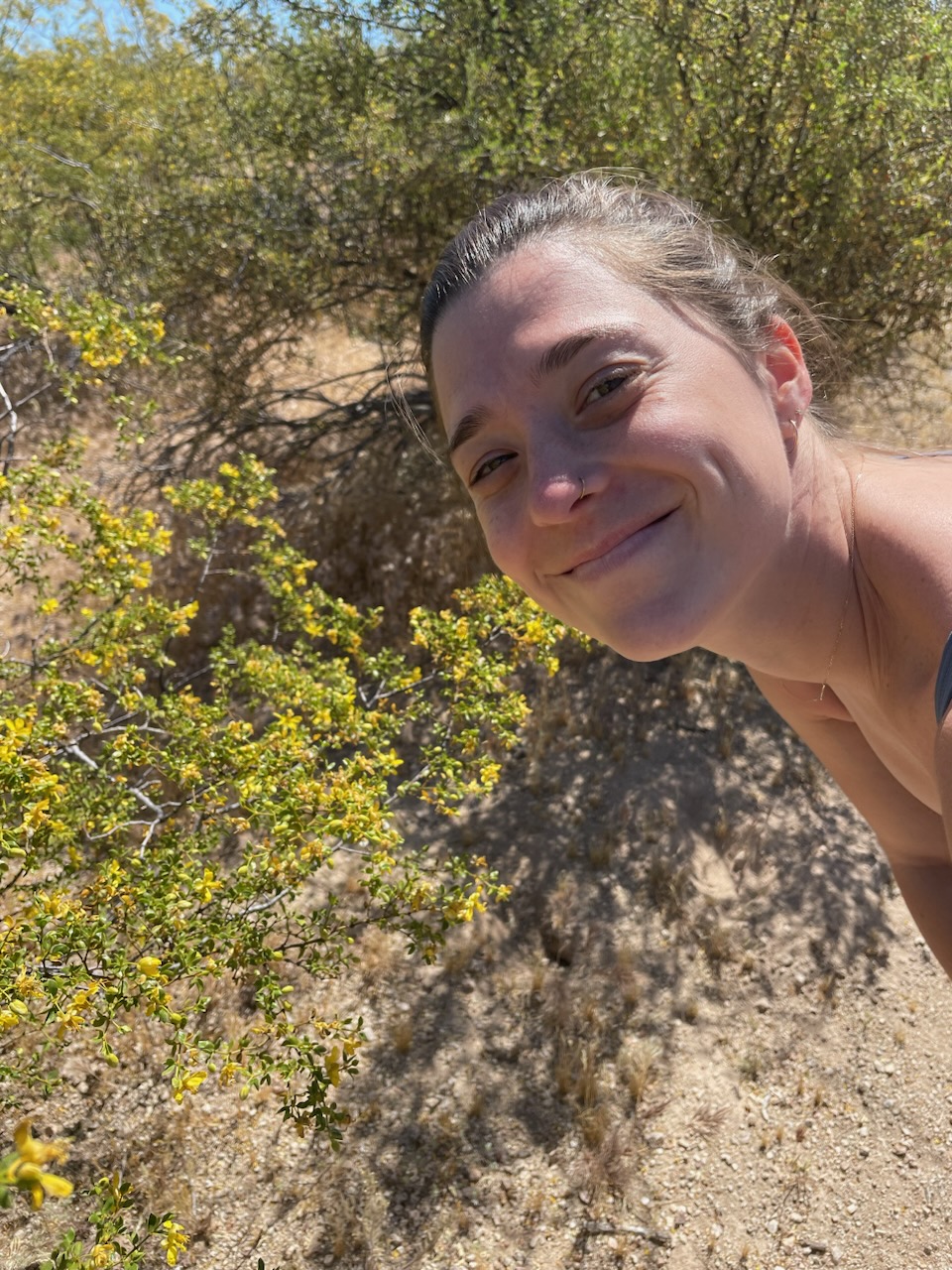
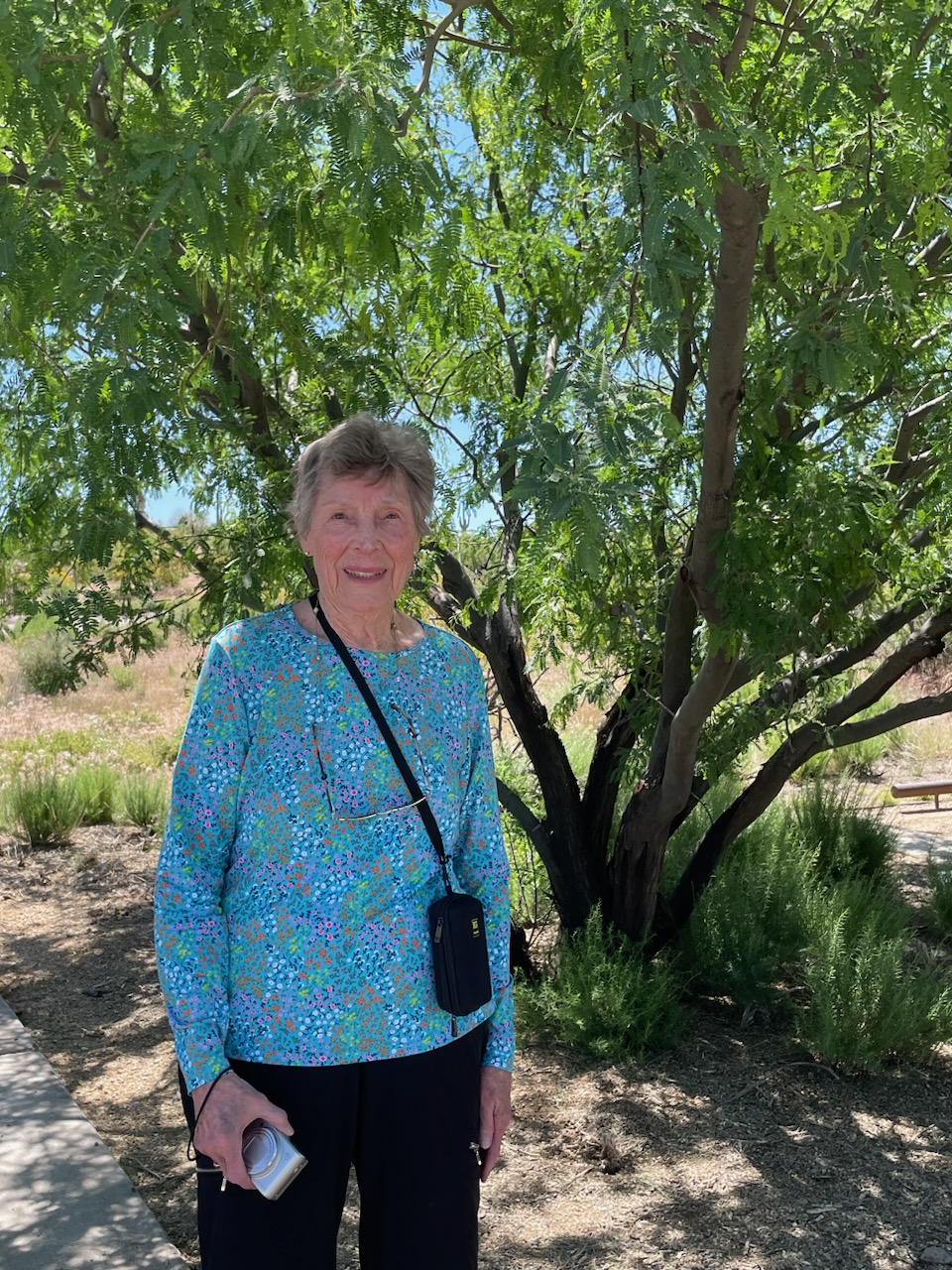
Three generations take a hike at Brown’s Ranch, in Scottsdale. Nothing important happens.

Nothing worth recording.

Except for everything.

My mother, my daughter, me. Sixty years separate those two. My daughter is thirty-one.

I’m somewhere in the middle. In the middle of age and work, love and life.

It’s not a long hike, really a stroll, a saunter. This half a mile is a long enough hike when it’s almost one hundred degrees. We get ourselves ready to go.

We examine plants.

Mother: Looks like something you would find in a window on Madison Avenue. Some fancy florist arrangement.

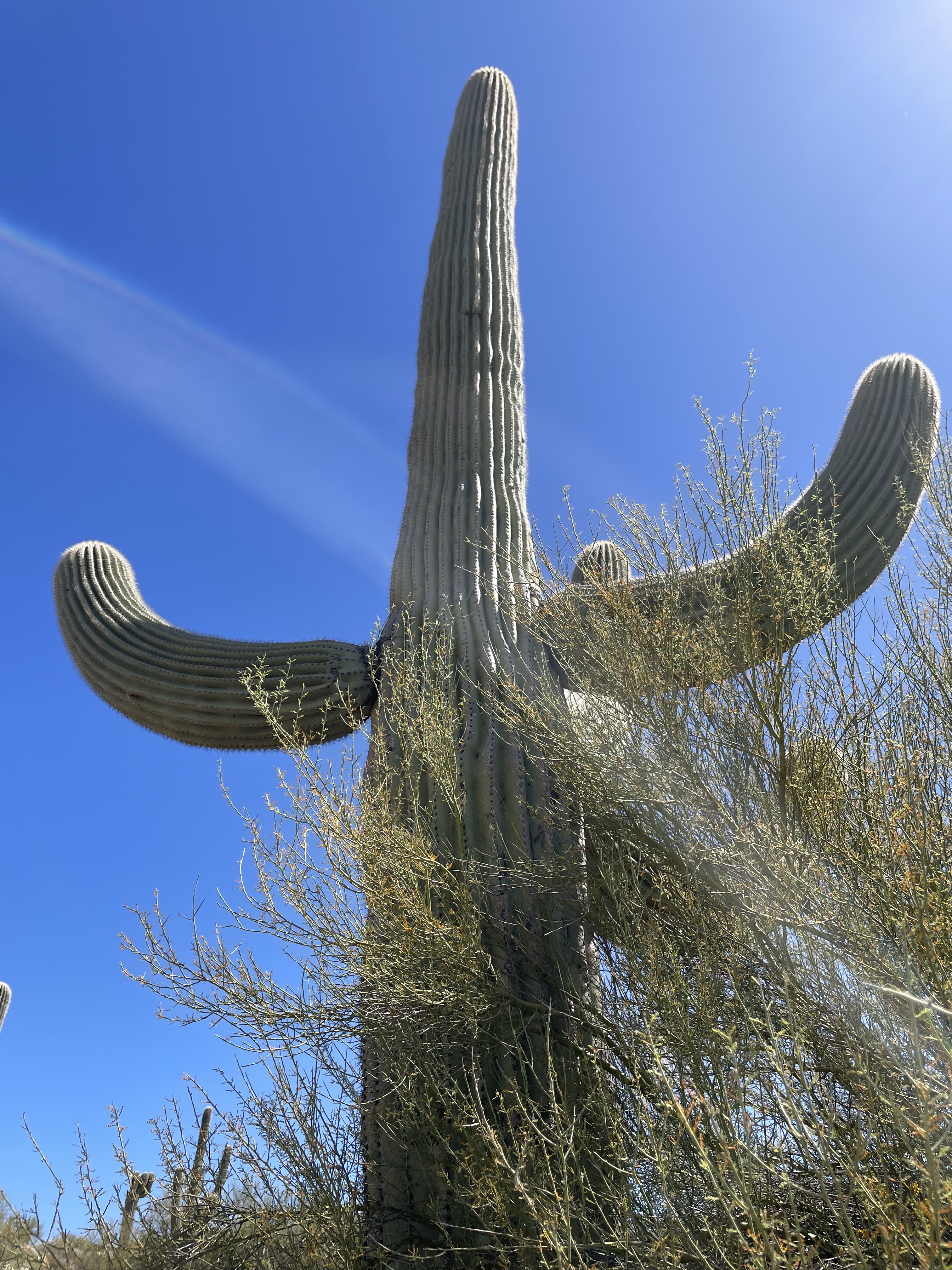
Daughter: That’s the quintessential saguaro.

Mother: That one’s pretty healthy, isn’t it.

Velvet mesquite.

Do I dwell too much on insignificance? I have always liked the unimportant things.

A bird flits away.

Mother: Was it a female cardinal?

Me (know it all): You know what a female cardinal looks like? They’re green.

Mother: No, they’re brown.

Me: Okay, green-brown.

Nothing of consequence is discussed. There’s an agave. Nothing special.

Me: (the know it all): You see, you don’t have to get far off the beaten track to see everything nice.

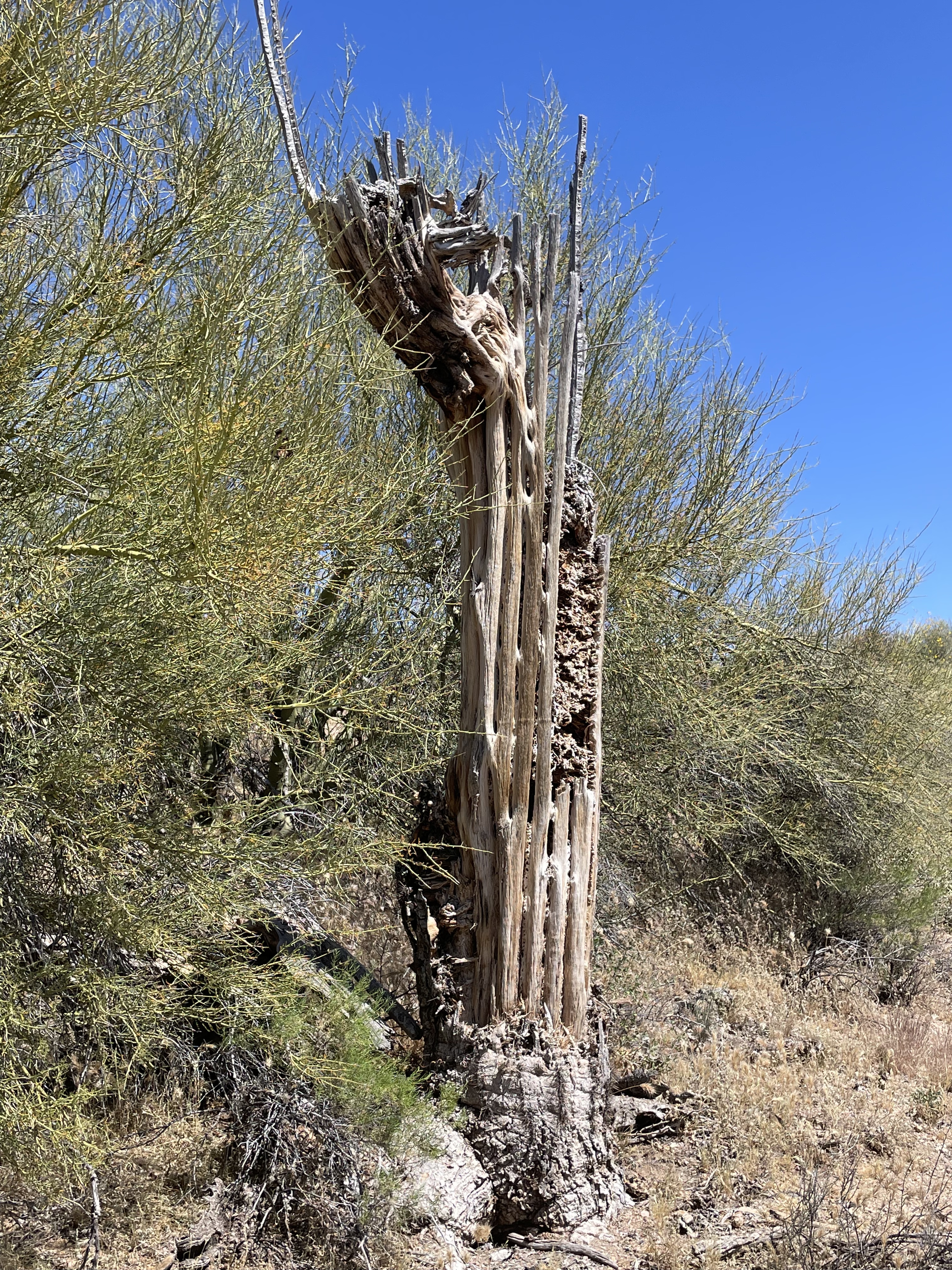
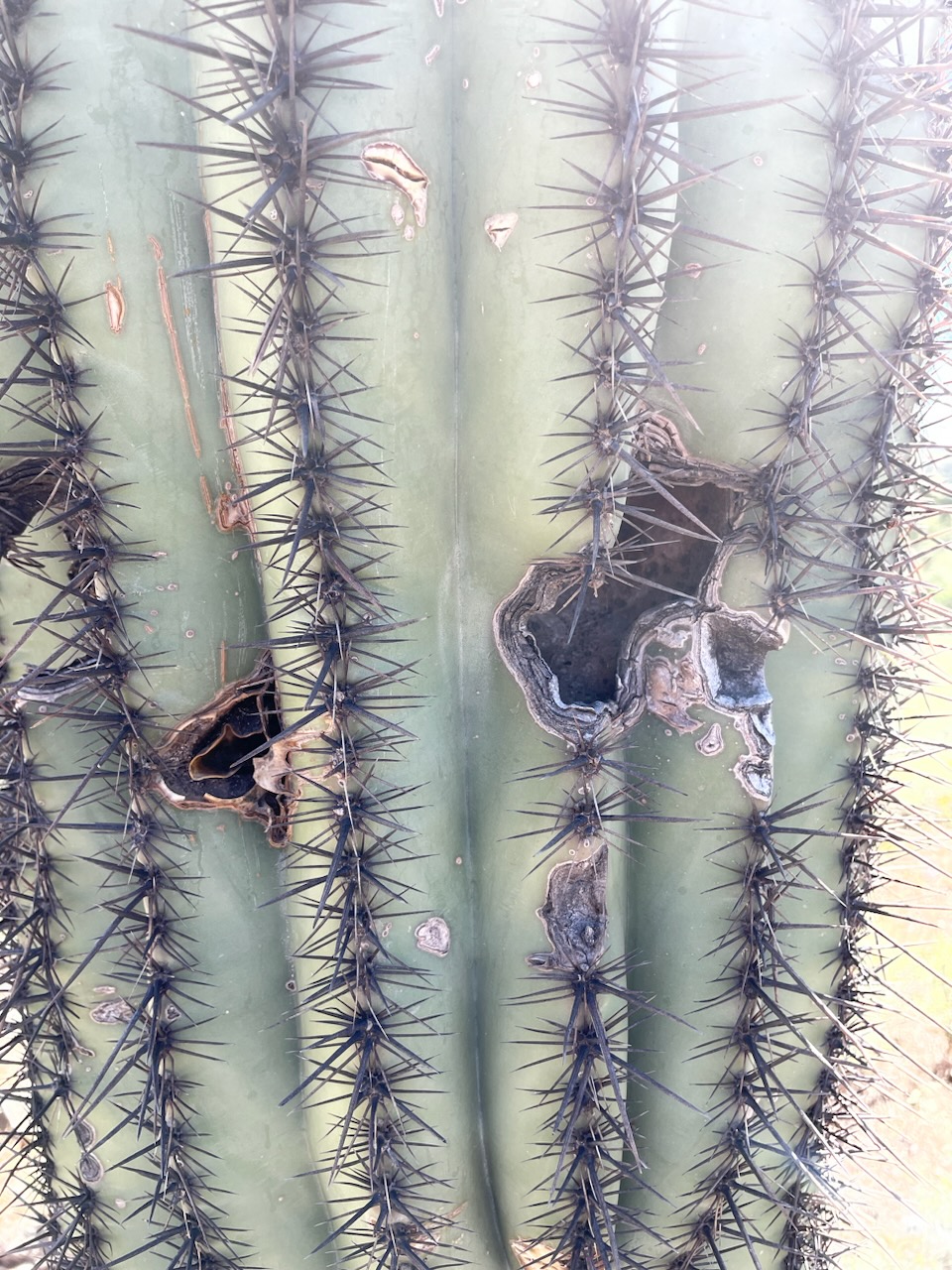
Daughter: A saguaro skeleton.

Mother: I’ve seen that before.

We see other specimens we recognize from previous walks here. Old friends. Meaningless probably to anyone else.

We know saguaro have buds that will later flower.

Daughter: How much do they grow per year?

Me (Having no idea): Two inches.

There are phenomena we didn’t know existed. We had seen plenty of saguaros but never seen the honeyed droplets at the end of one’s arm.

Mother:  I’ve never seen that before.

Daughter: That’s definitely the buds coming out.

Always something new in the ancient desert.

We see a plant with with little pale bubbles.

Mother: Don’t touch. It could be poisonous, because it’s white.

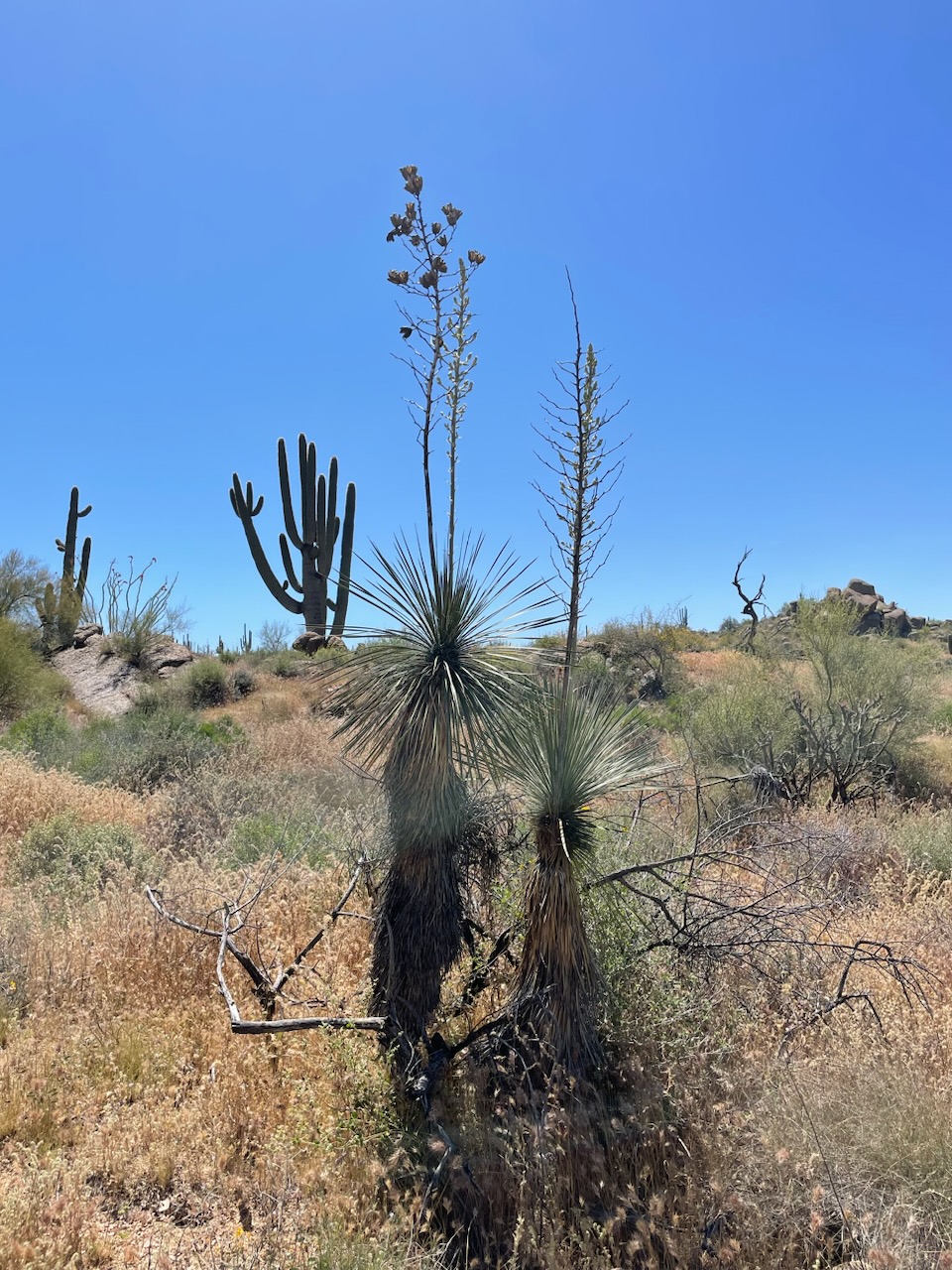
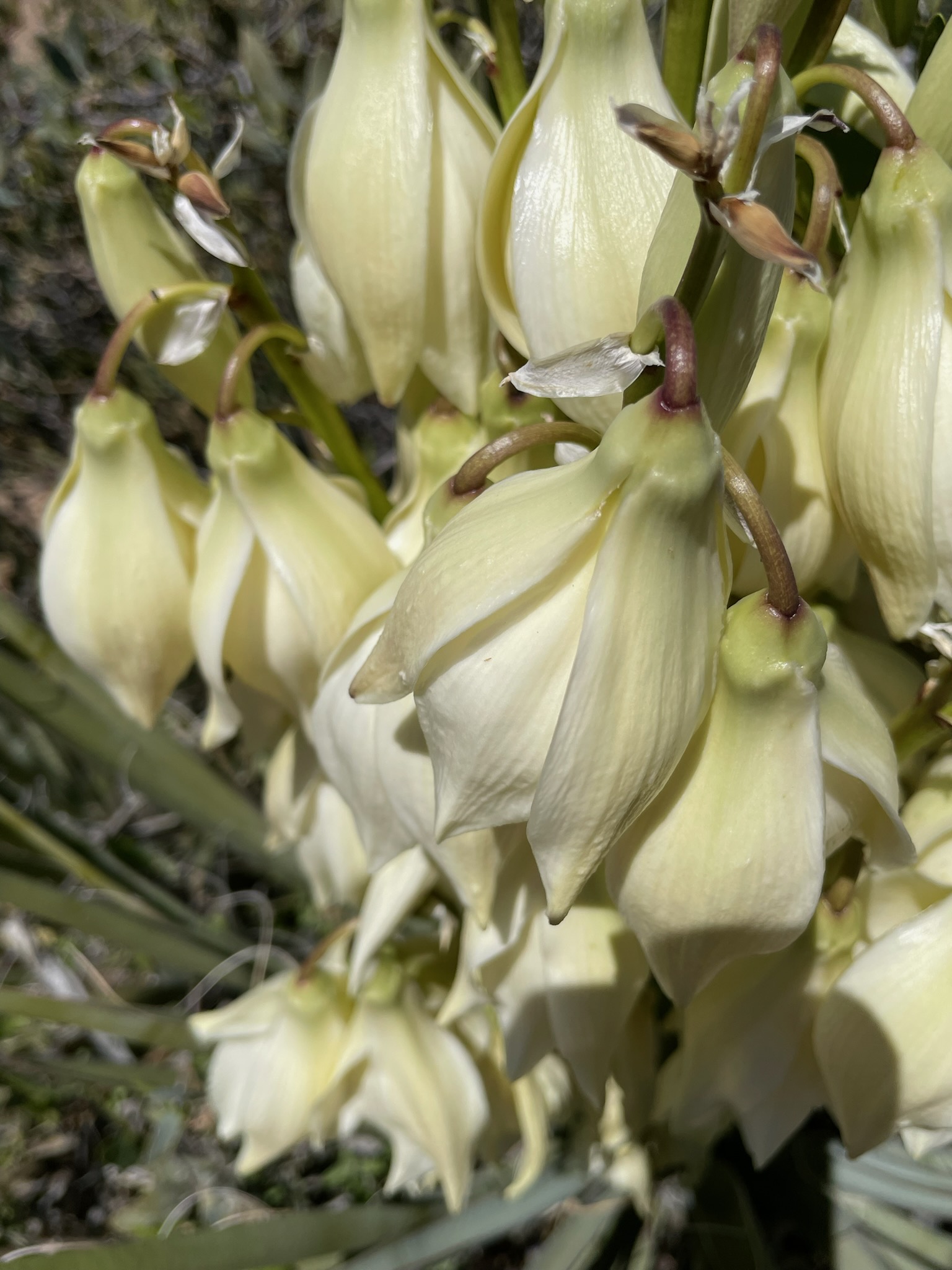
Yucca has white blossoms too. We identify them.

We see an information placard saying that coyotes use the wash as a highway.

Daughter: It’s a fun way of thinking about it.

Someone has seen fit to tag one fishhook cactus.

Me: Wonder why?

No one knows. It just is what it is.

Mother: That’s mallow.

Mother: I wish they’d provide some shade here.

There is no shade in the desert, it’s only sun, sun sun.

Me: Let’s sit down for a few minutes.

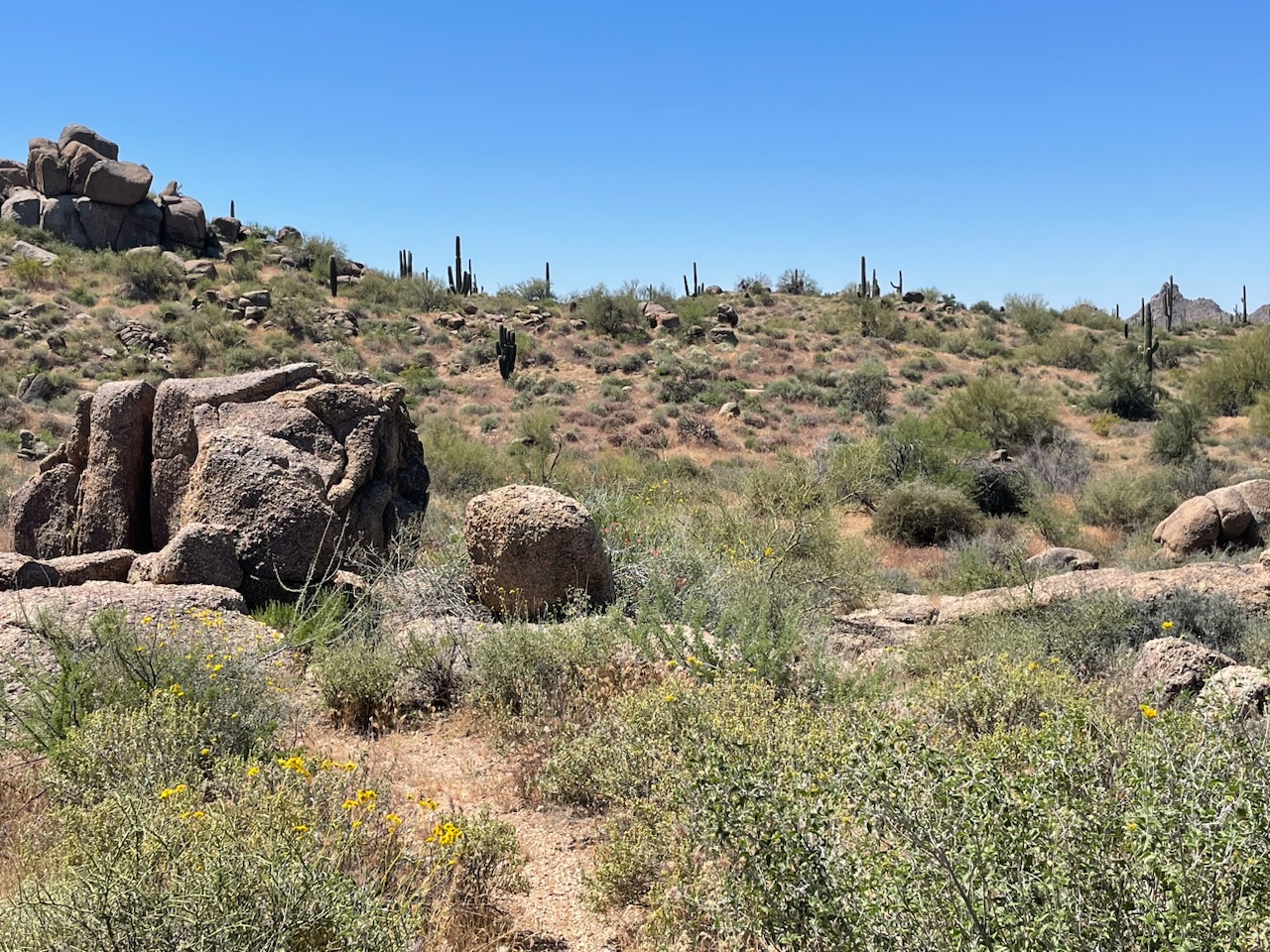
The view is ravishing, of course, but it is also nothing, an ordinary view for these parts.

Save the tough stuff for some other time. There’s so much to talk about. Not now.

Daughter: If you see human trash don’t pick it up because pack rats will use it for their den.

Mother: That’s a hedgehog cactus.

Daughter: Nice.

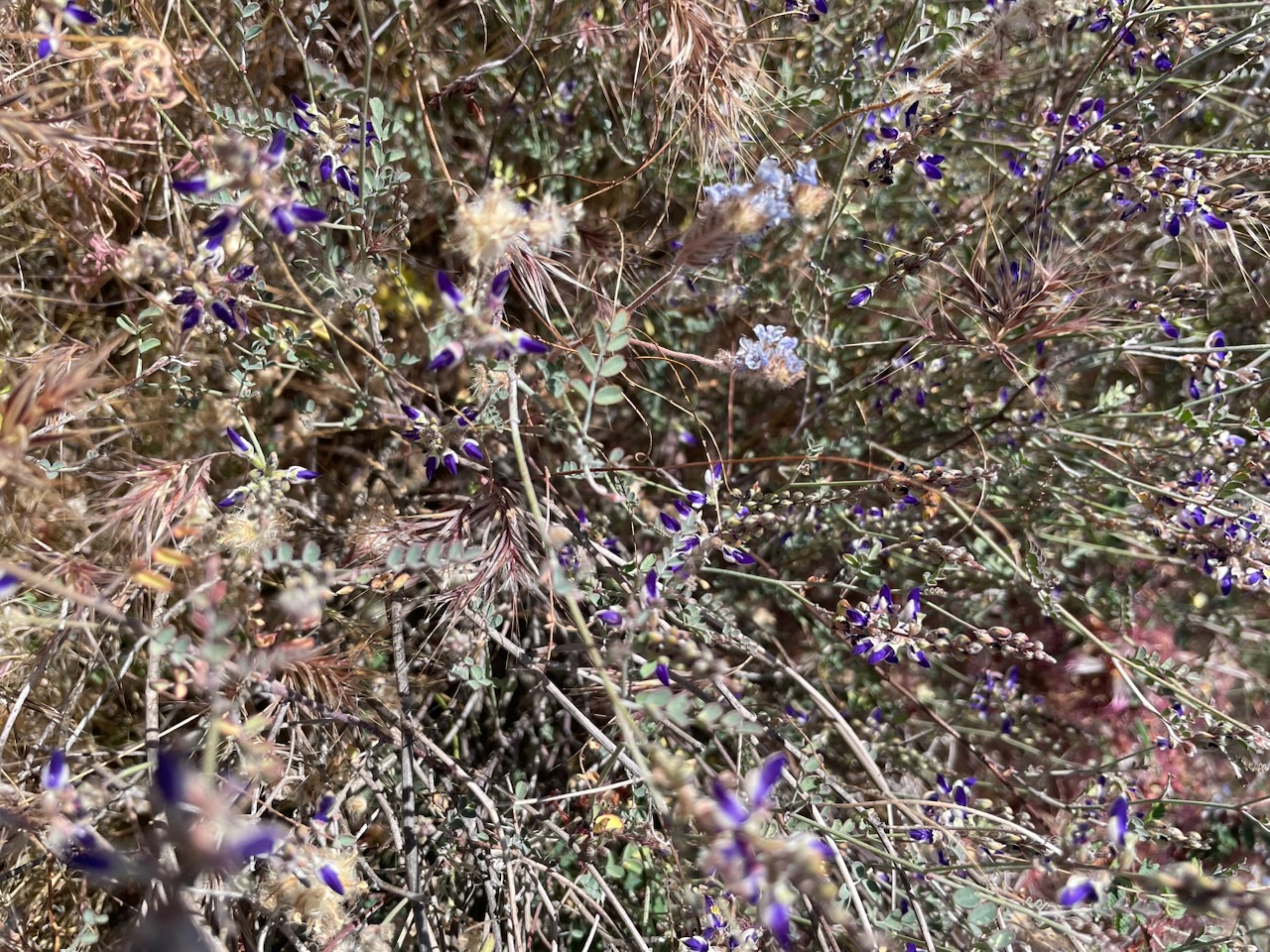
We see delicate purple flowers and crush them between our fingers.

Daughter: I think it’s lavender.

Me: Maybe.

Mother: Desert lavender is a thing.

We’re not sure. I like it when you admire things and you don’t know their names.

Daughter: The things you see when everything looks dead.

The nearly mundane. The unflamboyant.

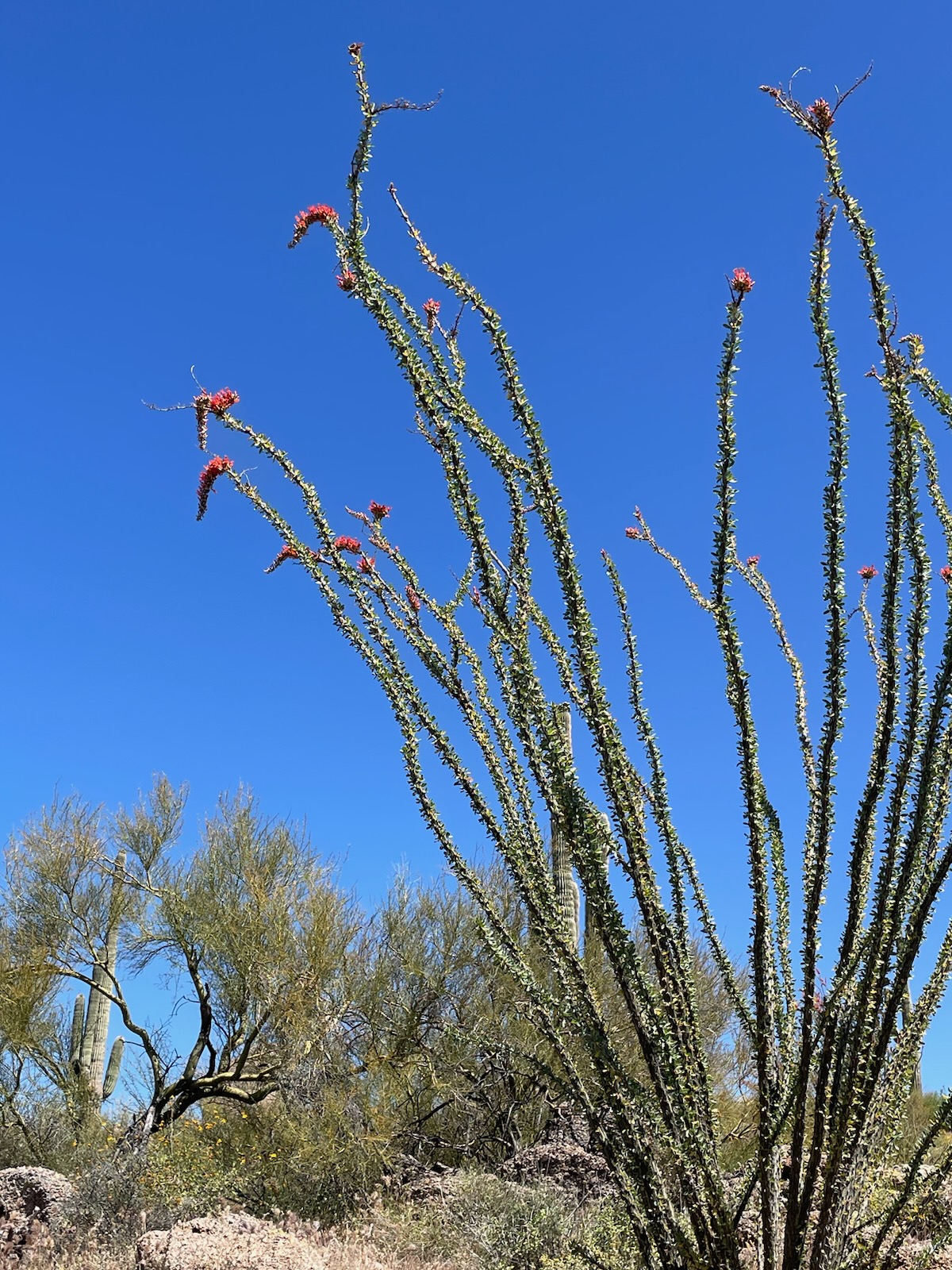
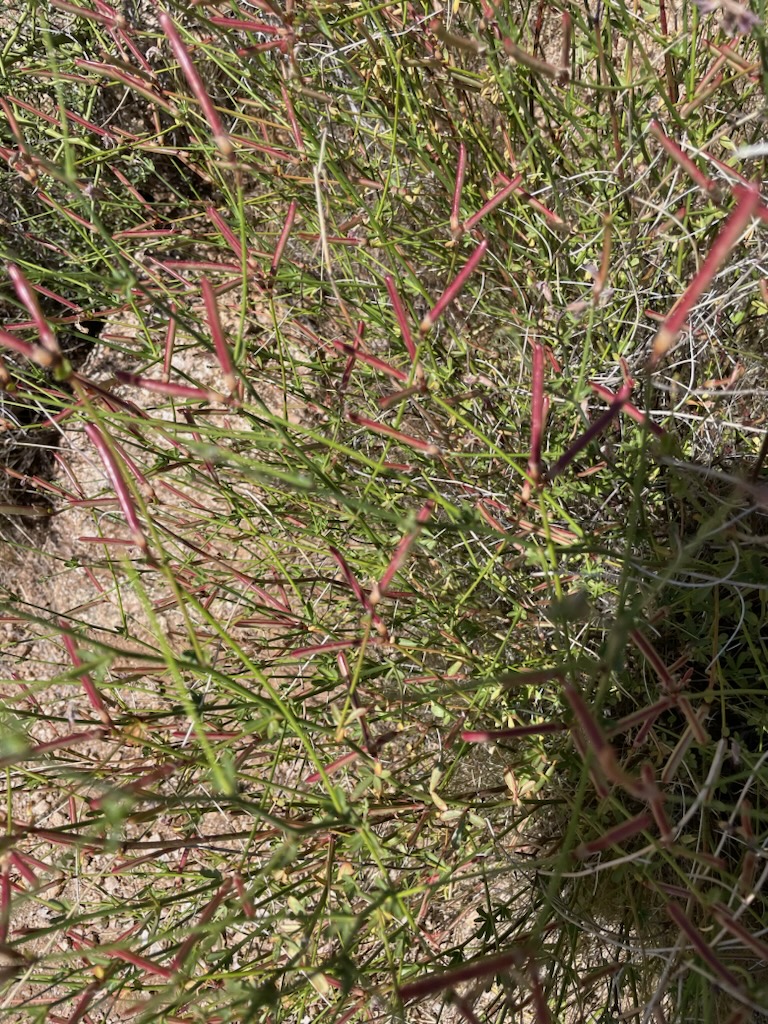
Flame orange tubes, barely visible.

Daughter: Little hot dogs.

Mother: I like way they grow out of the rock like that.

Only the small things matter. The barely seen. The almost missed.

Half a dozen lizards scamper ahead with their tails held high. A rabbit bounds away.

A nothing flower. A plant without a name.

Me: I don’t know what that is, do you?

Mother: No.

Daughter: No.

A butterfly appears, you can barely see it in shrubbery.

Mother: I think I know the name of that one.

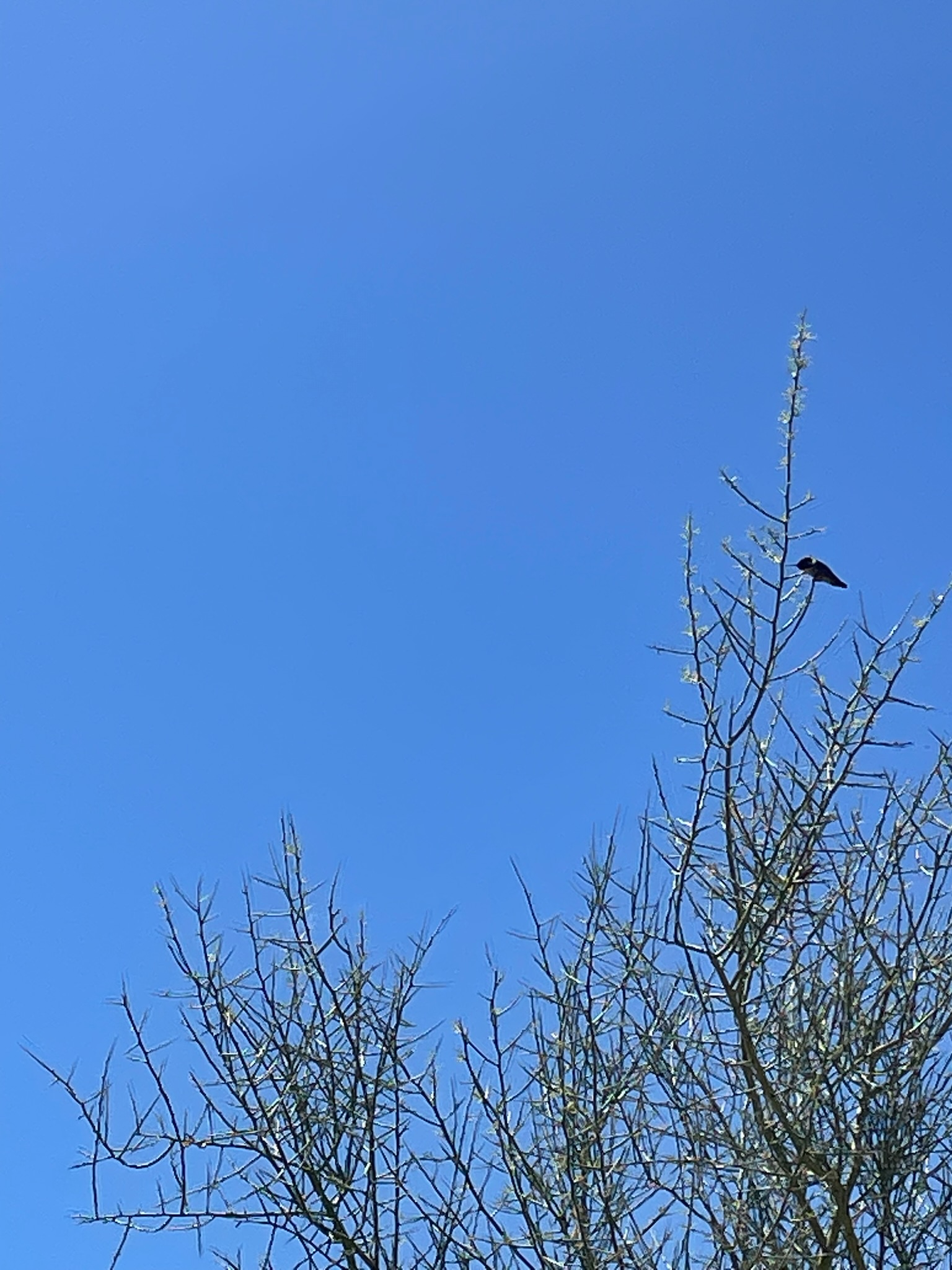
Another bird.

Mother: A hummingbird. See the sharp beak?

Me: Really?

Daughter: Yes, definitely.

Mother: Solid as granite, isn’t that an expression?

Daughter: Are these the same ones we saw before?

Me (definitively): Yes, definitely.

Mother: I don’t know.

A beneficence of the mundane. Just wondering. Not sure. Trying to figure things out, but not working at it too hard.

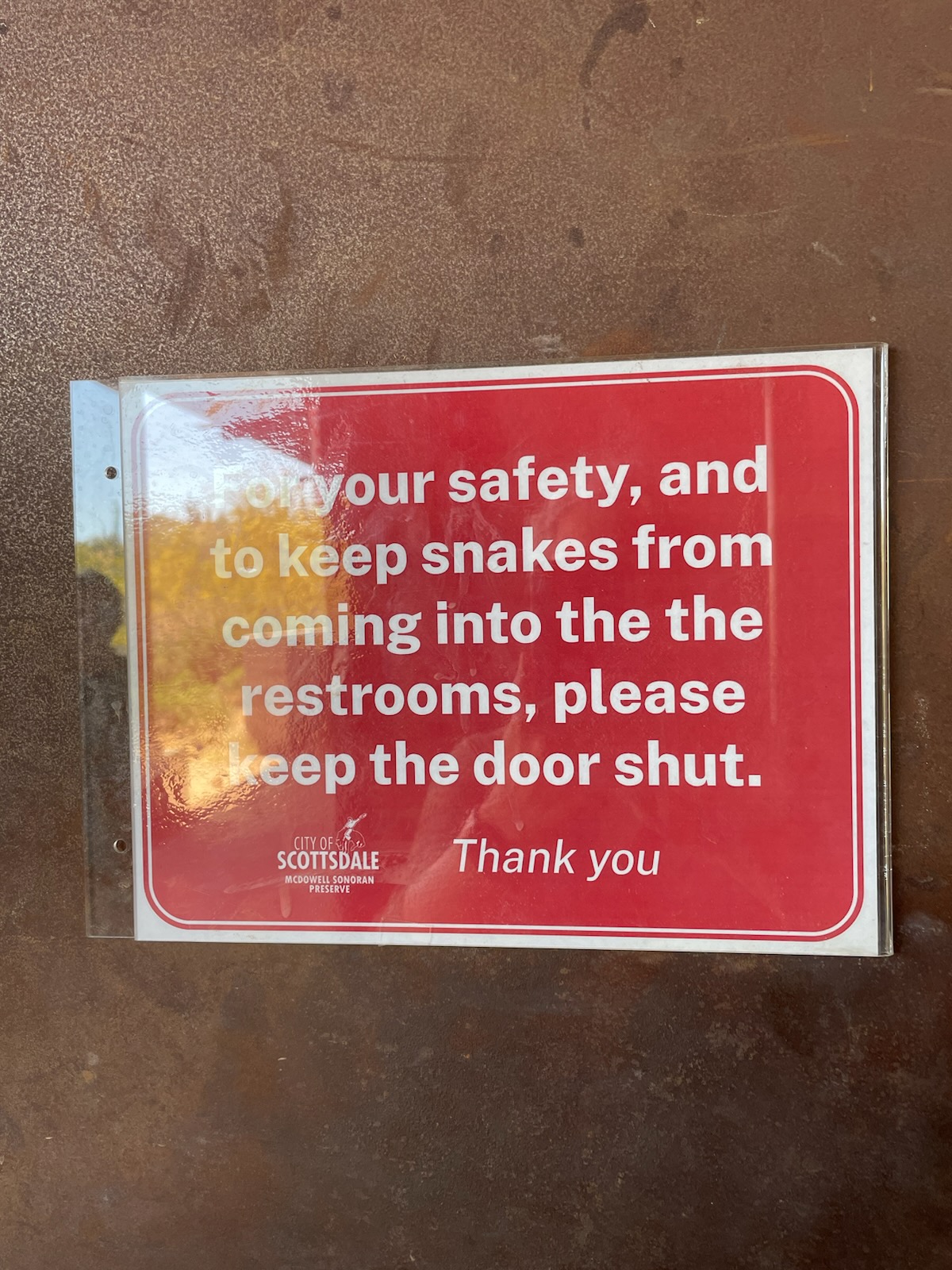
Restroom at the end of the trail.

Mother: They know quite a bit about snakes, don’t they? Someone must have seen them in the restroom.

Snakes. They must. But it’s no big deal. Nothing to make a fuss over. Hardly worth mentioning.

Leave a comment

Filed under Jean Zimmerman

I fall in love

with the big old trees the moment I walk into Muir Woods. Same as everyone.

It’s a funny place. On the one hand these redwoods, ancient marvels of nature, on the other a precious tourist attraction.

I go there accompanied by two smart people, Bay Area denizen Lisa, my friend of fully 45 years, and local landscape architect and pro urban forester Karla.

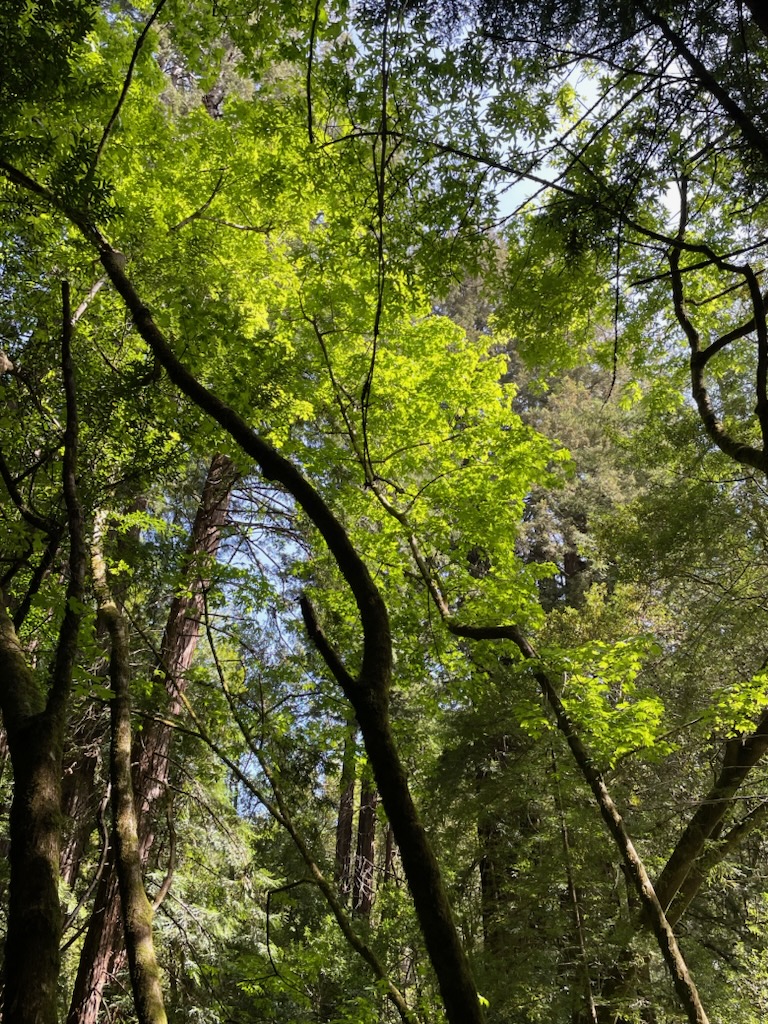
We enter amid the startling hush of trees, relatively uncrowded because it’s not yet the height of the season.

Lisa says, The new foliage looks so soft, doesn’t it? It’s gorgeous.

Karla: Did you know that the redwoods get fifty percent of their water from the fog? And the fog patterns have been changing.

Muir Woods is a careful, considered sort of place.

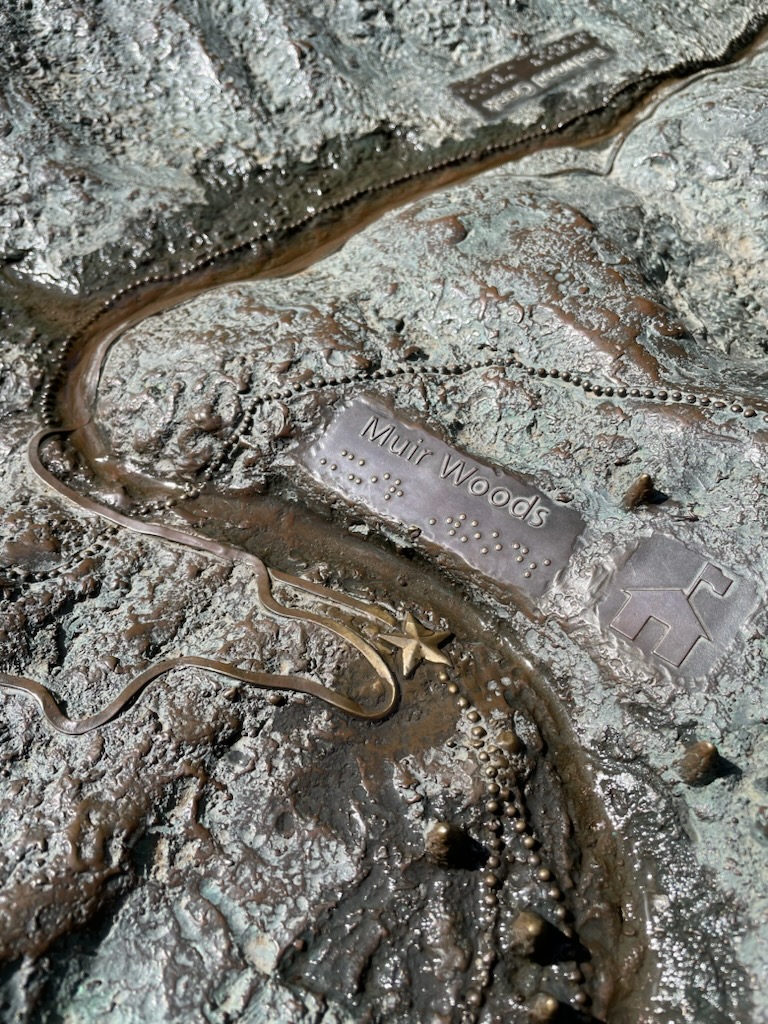
At the entrance you’ll find a carved map of the terrain, helpfully imprinted in braille. Interesting choice. As a young inventor John Muir nearly went blind when a piece of metal flew off of a project and damaged his cornea. He recovered his sight, thankfully.

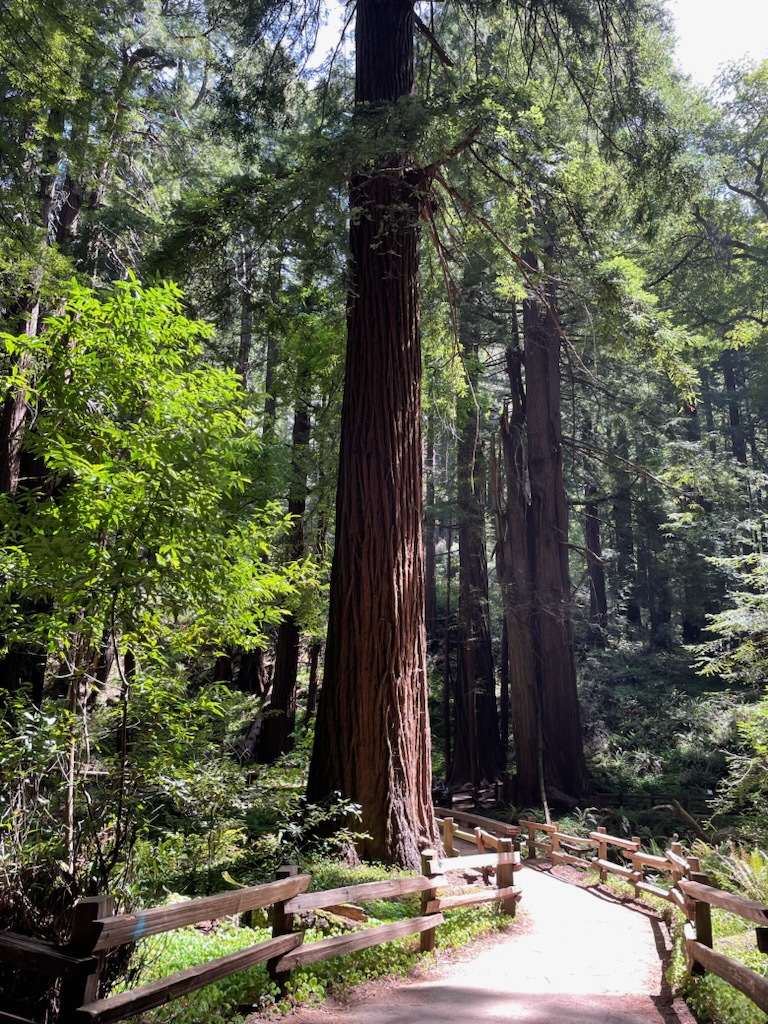
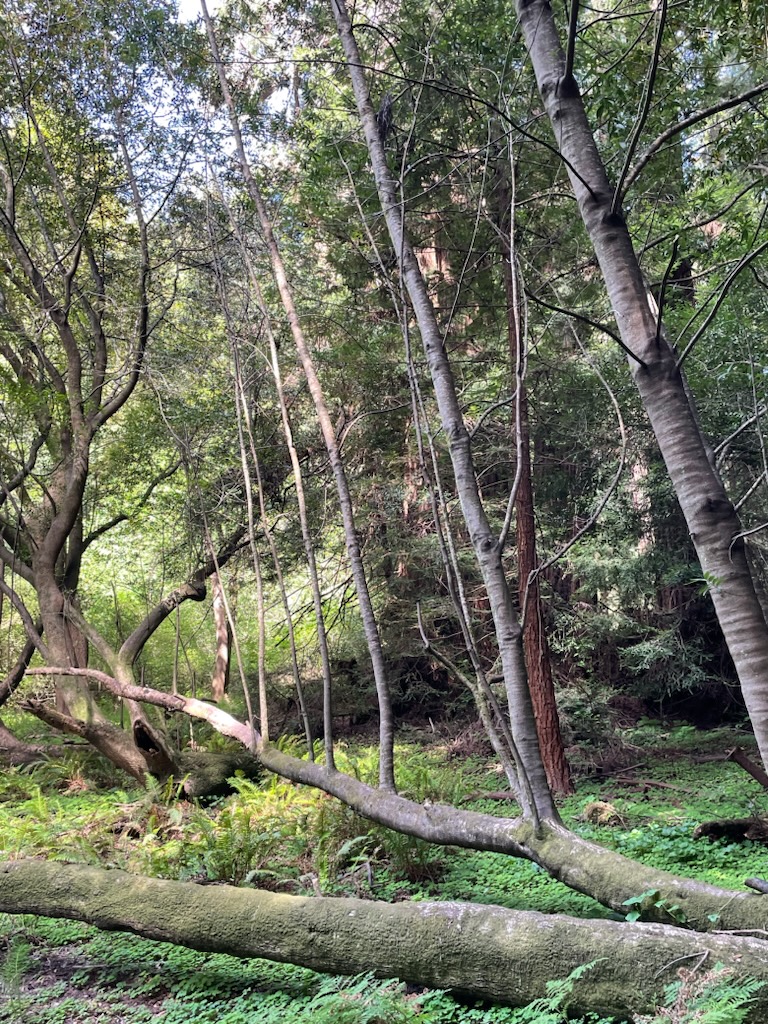
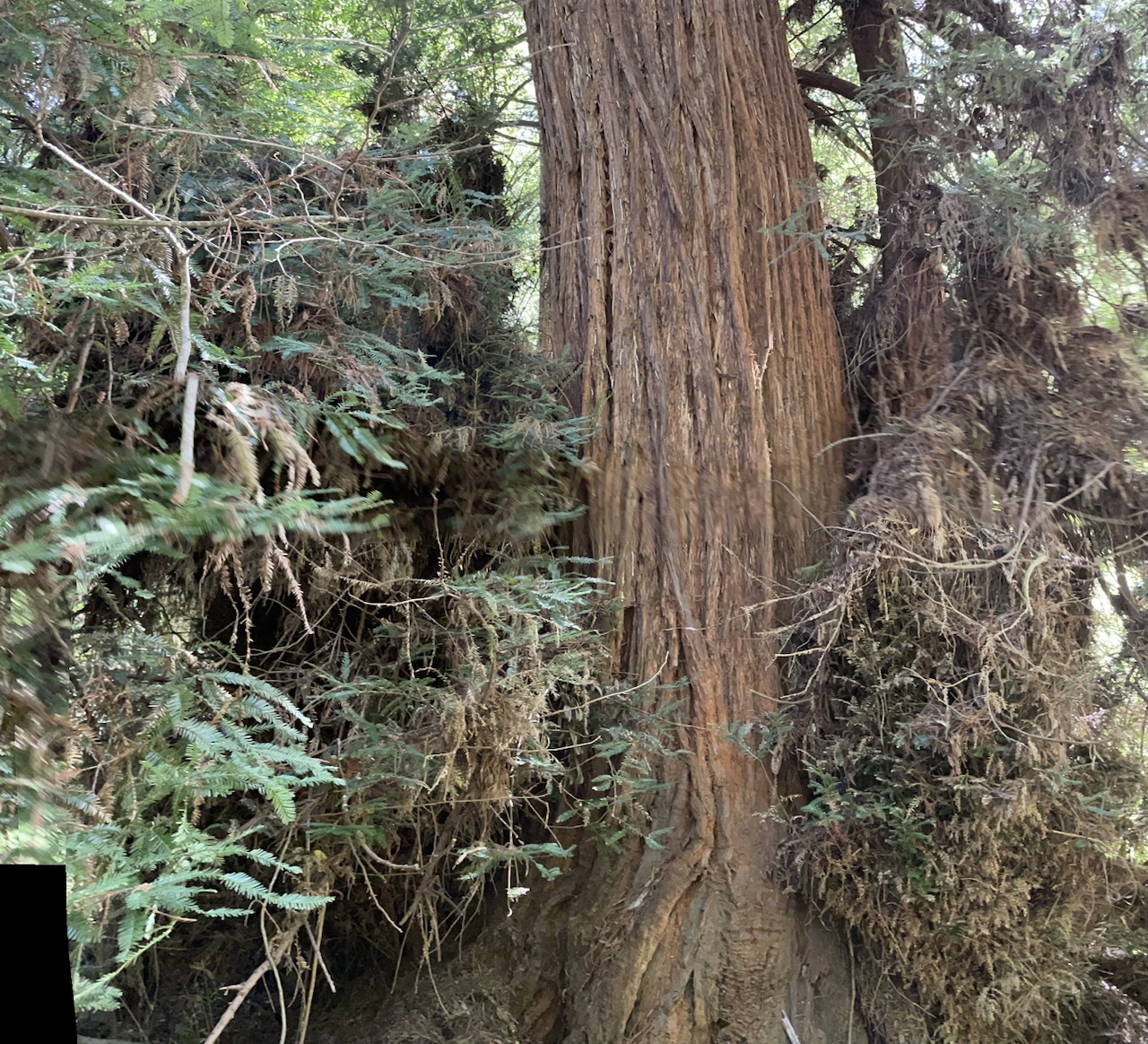
It is no wilderness. The paths are paved or wood plank. Over them tower the gentle giants. We admire them, same as everyone.

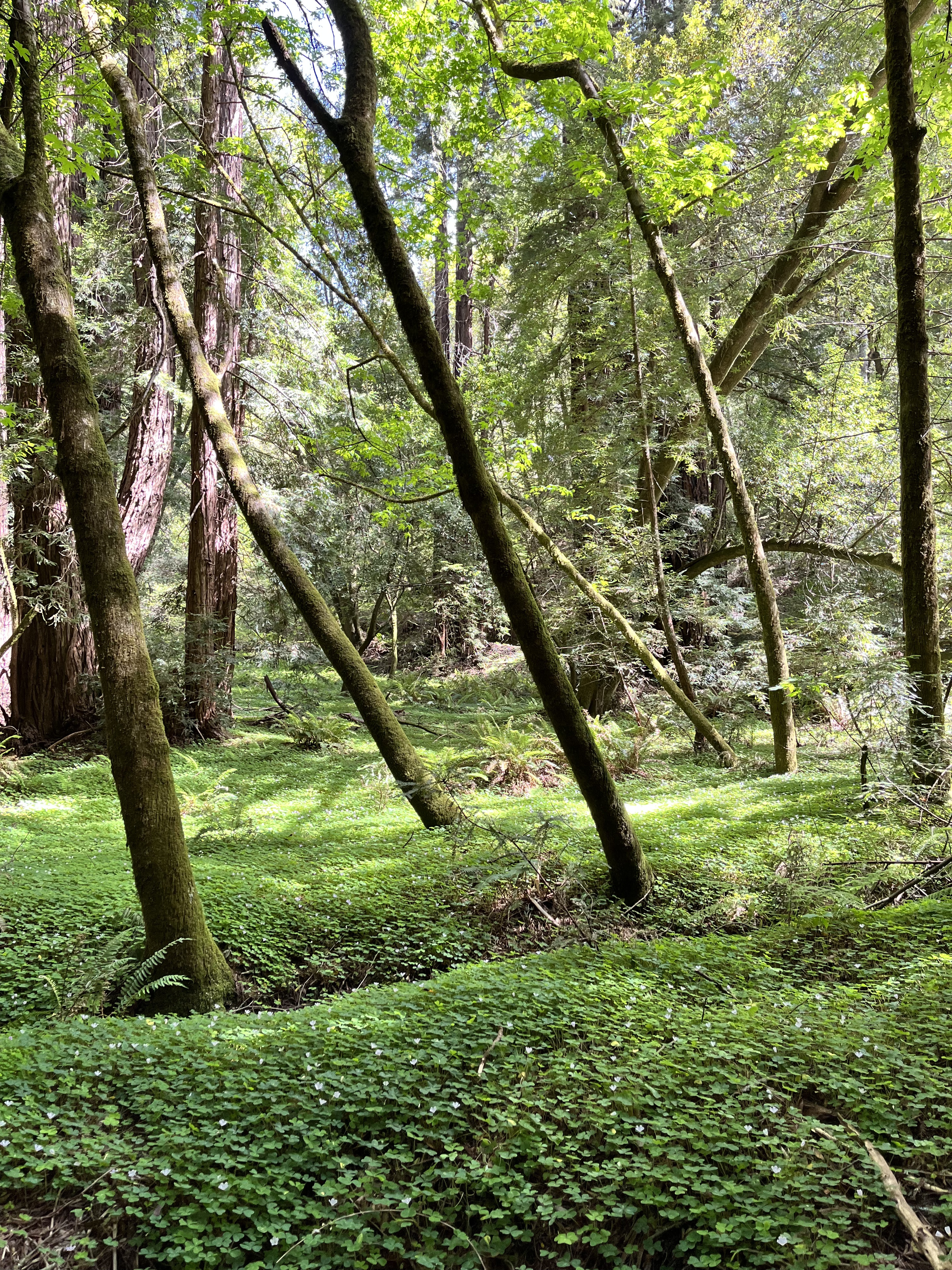
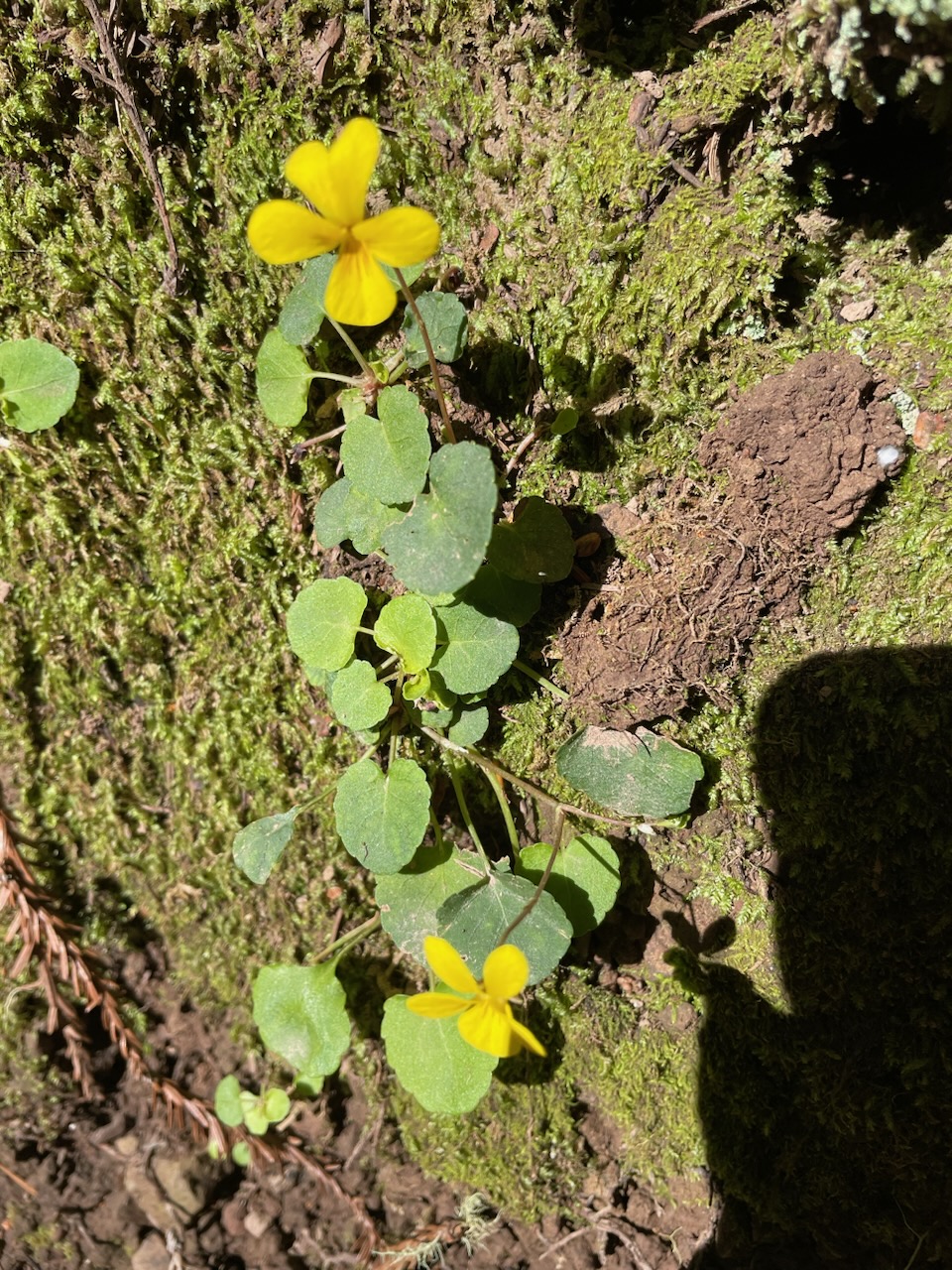
We see some marvelous wildflowers. Trees and trees and more trees. A creek. We experience awe, same as everyone.

Karla worked at the nonprofit Friends of the Urban Forest off and on for two decades, most recently as vice president of operations, before going off on her own as a landscape architect. She also is helping the Society of Municipal Arborists fine tune its high-level leadership program, called the Municial Forestry Institute, to better serve the urban foresters of the future, looking at possible gaps in curriculum, study materials, teachers. Karla and I both graduated from MFI in different years. Rethinking the program is a big job, and she’s “like the head spider, weaving it all together.”

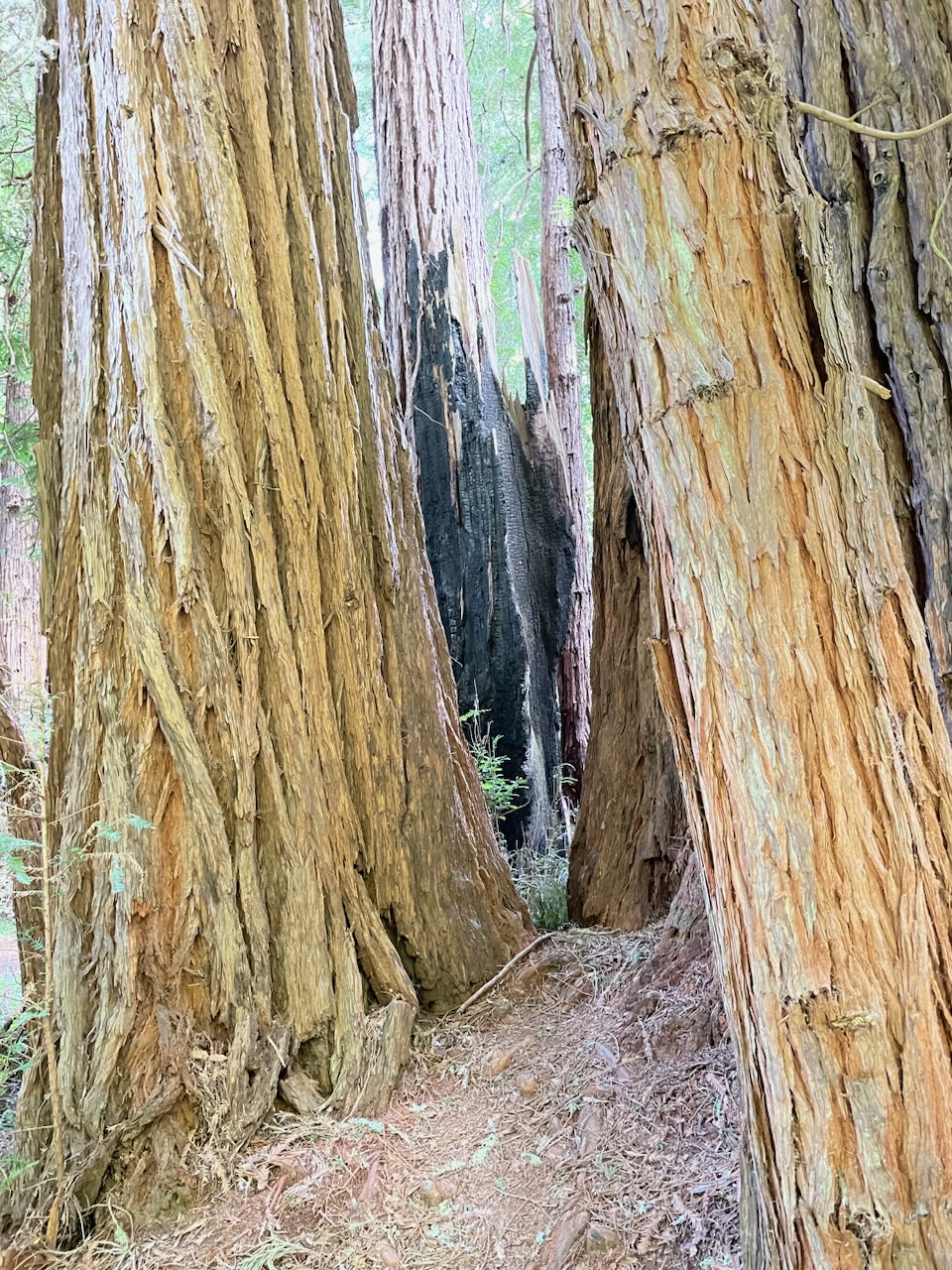
We stop at a fairy circle of redwoods as we go – the center one burned in a long-ago fire and youngsters sprung up around it. This piece of land was saved when the wealthy couple John and Elizabeth Kent saw the future and bought 611 acres in 1905, afterward deeding it to the federal government and insisting it be named after Muir.

We wonder at the felling of these incredible trees before the turn of the twentieth century. How could people do such a thing? I have often found that arborists can be counterintuitive when it comes to trees, even unsentimental. Karla comments, My apartment is built of redwood. The gold rush helped build the city too, but without the redwood trees San Francisco would not exist.

People come from all around the world to experience these trees, to learn about nature.

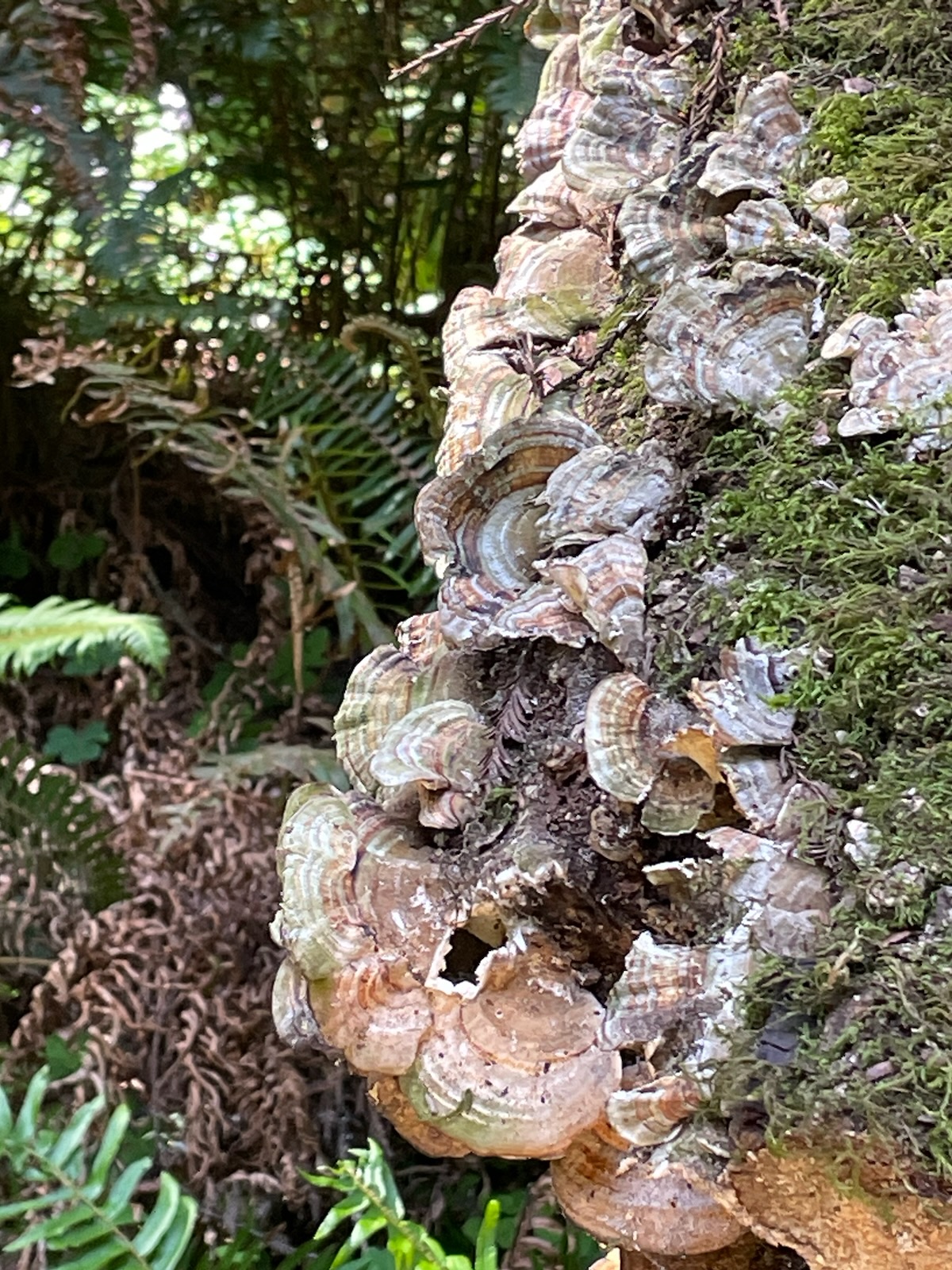
Us too. I am wowed by some intricate fungi.

We admire the velvety moss all around, same as everyone. I tell Karla and Lisa that in the Muir biography I am reading I have learned that Muir had a close relationship with a married woman who started him on his naturalist road and who had a proficiency in mosses.

We speak of peoples’ feelings about trees in everyday life, apart from spectating in Muir Woods. Karla says, In San Francisco there really are some people that just don’t want a street tree. Either they don’t want you to put a tree there, or they don’t trust that the city will take care of it, or multiple people live in one house and there’s no parking, so they want to park on the sidewalk.

I mention the bugaboo I’ve come across in New York City, where people complain that falling acorns dent the roof of their car or that leaves are a mess to rake up. We admire the plants edging the paths here.

I ask Karla about invasives, a hot topic where I live on the east coast. If you’re asking about whether only native plants should be planted, or are invasive plants destroying our natural ecology, it’s two different things, she says. In California we have a type of broom that is invasive. When we have a massive fire and it grows under the trees, the flames spread even more quickly. Broom is really difficult to get rid of.

Karla says she wants do more professionally with fire protection, telling me, It’s a national problem, not only in California, as well as all over the world. And it’s only going to get worse.

We pass lots of educational signage.

Commemorative plaques.

I say, I know a lot of people who are serious hikers who might not touch this place with a ten-foot pole, it’s so civilized.

Karla says, Not everybody has the ability to travel far or hike long distances, or even to figure out where to go and make their way there. And in fact, despite the paved paths and inescapable signage, you can still hear the trees rustling in the breeze, the waters of the stream burbling, the birdsong all around. It’s pretty great that a person confined to a wheelchair can come here and experience these wonders.

Lisa shows me some graffiti. You know that humans love a place when they make the effort to carve an autograph.

Emily from Australia comes over with grandmother to chat, her pigtails swinging as she jumps up and down. She makes us guess her age. Six. I saw a spider web hotel!

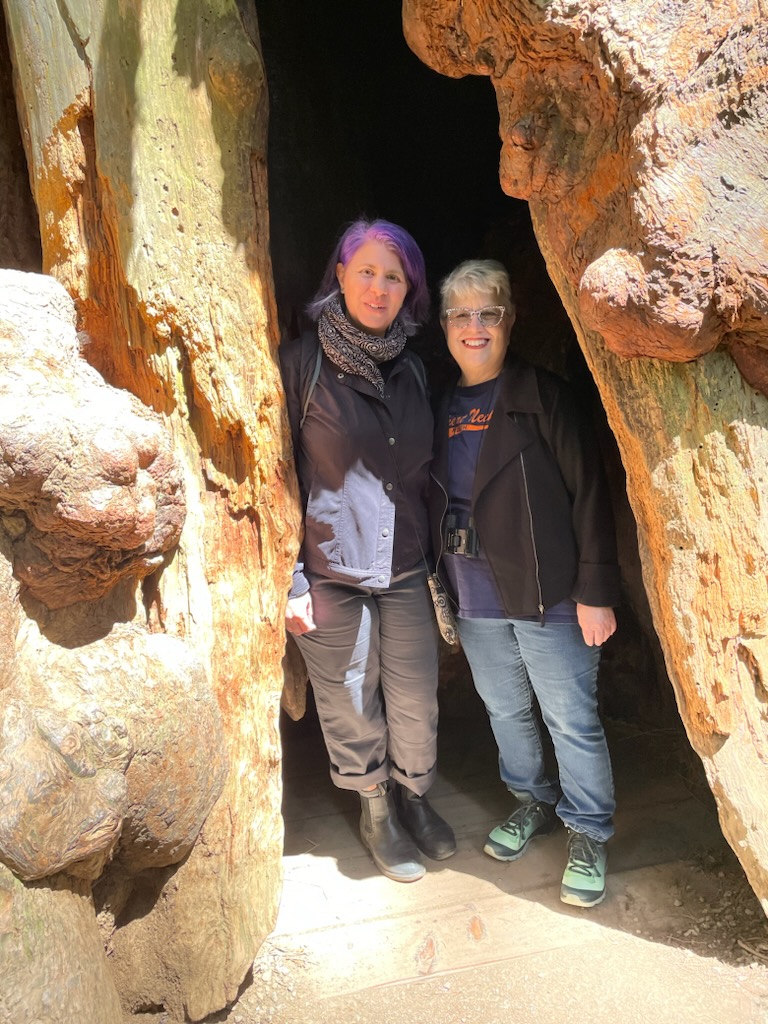
Down the path, I insist that Karla and Lisa take a pose in a redwood crevice so I’ll have a souvenir, same as everyone.

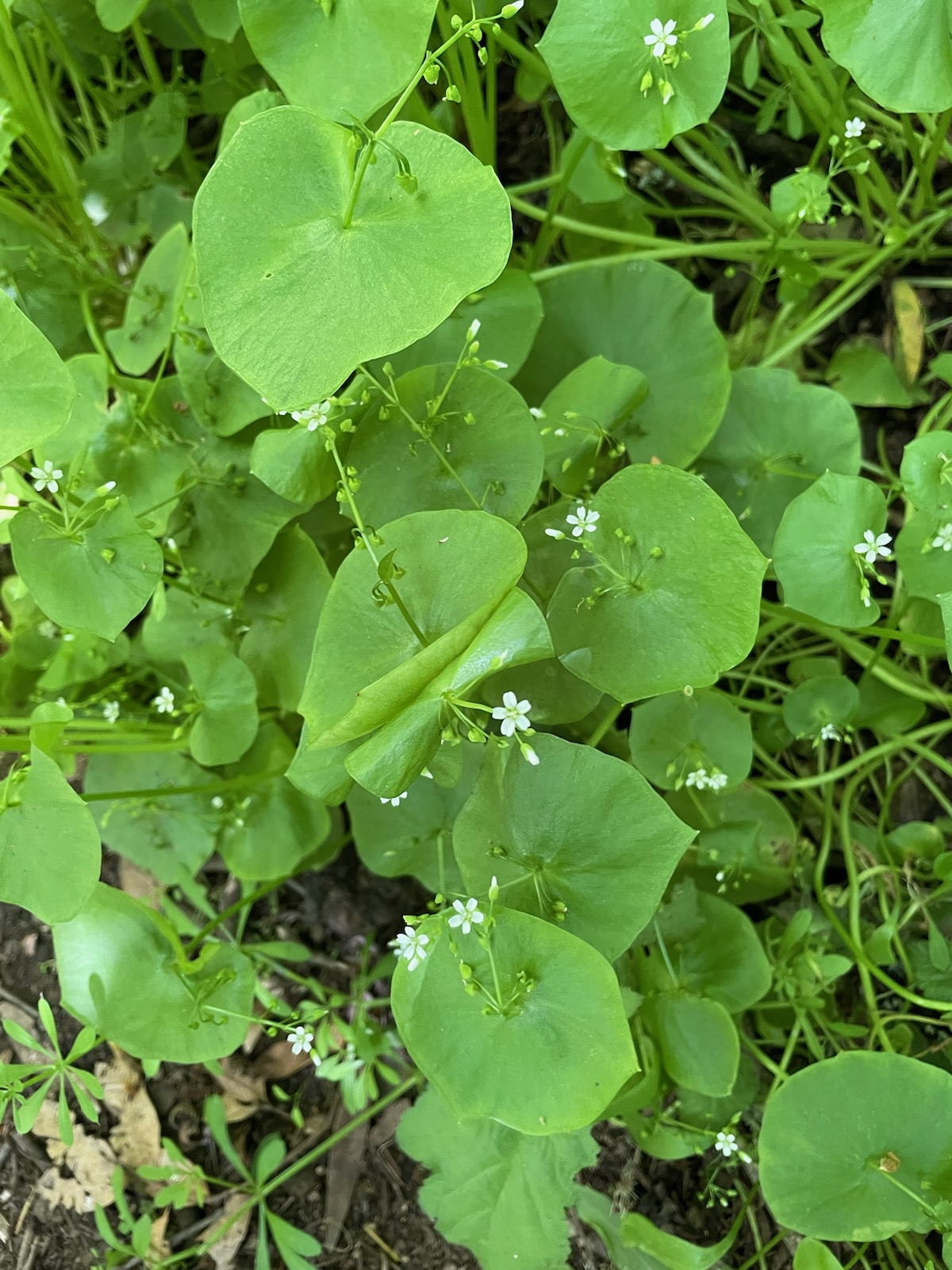
We ooh and ahh about the redwood sorrel. They fold up when direct sunshine hits them. Little umbrellas, says Karla.

Lisa notices a plant that looks orchid-like, and in fact is a type of orchid.

And a giant horsetail.

Karla says, That might be one of the most primitive plants, along with gingkos.

Then we come to a massive timeline.

It gives the usual chronology of Muir Woods, but has been annotated to relay different facts, facts that might have been thought unimportant in the past.

What about the timeline? I ask Karla.

What about adding all those new factoids? What’s up with the revisionist history?

I would say it’s the broader history, the true history, she says firmly. THE history.

Karla was good enough to spend time with me and make sense of some of the more important issues of our day. The National Park Service was not quite as forthcoming. In answer to my query about meeting with a ranger on May 25, Public Affairs Specialist Julian Espinoza with the Office of Communications & External Affairs at Golden National Recreation Area sent apologies for the delay in getting back to you on this. Unfortunately, given the limited capacity of our staff at Muir Woods, we aren’t able to participate in an interview of that length. Okay.

In the very-small-world department, we discover that Lisa’s aspiring landscape architect nephew Alex, who attends the Merritt College Urban Forestry Program, founded in 2018 to train workers for the blossoming tree industry, just recently interviewed Karla for an assignment, asking questions about her career, how she got to her position, and what a typical day is like.

One of the most significant things I took away from the Municipal Forestry Institute was the suggestion that we find a mentor, she says, someone that I could go to for guidance, advice, unconditional support. Having someone who was always in my corner gently pushing me gave me the encouragement I needed to make big career decisions. It’s become important to me to do the same for others. I love giving support to people who are beginning their careers and helping grow new urban forestry leaders. Sharing my own work experiences seems to give hope, inspiration and motivation – and we all need a little bit of that no matter where we are in our careers.

Karla, Lisa and I make our way to the exit. We see a token of the recent past, already hopelessly dated, oddly out of place in these pristine but yet not so pristine woodlands.

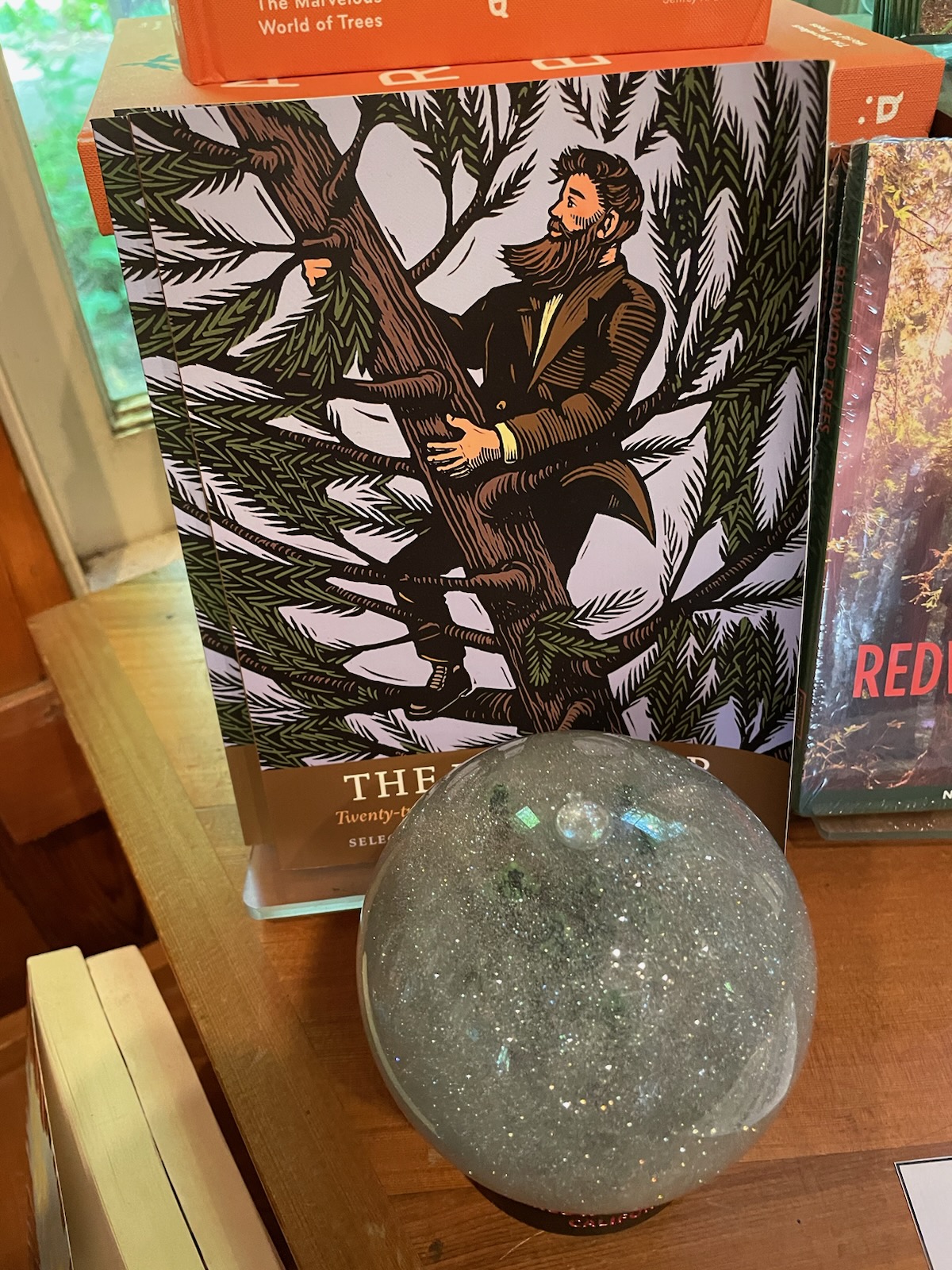
Exiting through the gift shop there are carved bears.

There are baubles.

I forego the fog globe but get a few books, John Muir’s writings on the wonders of the natural world. I want something to take with me that will help me remember Muir Woods.

Same as everyone.

Leave a comment

Filed under Jean Zimmerman

Too soon? Too late? Or just on time.

It would seem to be just about the right time to visit Fairy Duster Trail at Spur Cross Ranch in Cave Creek. We see a perfect fairy duster.

Even though it is April, the supposed height of the wildflower season, it seems as though all of the blooms are somehow not enough. But maybe we are just greedy. After all, the slopes here are flooded with yellow.

Some saguaros are in bud – you can see the nubs on their tips. Too soon to see any actual blooms.

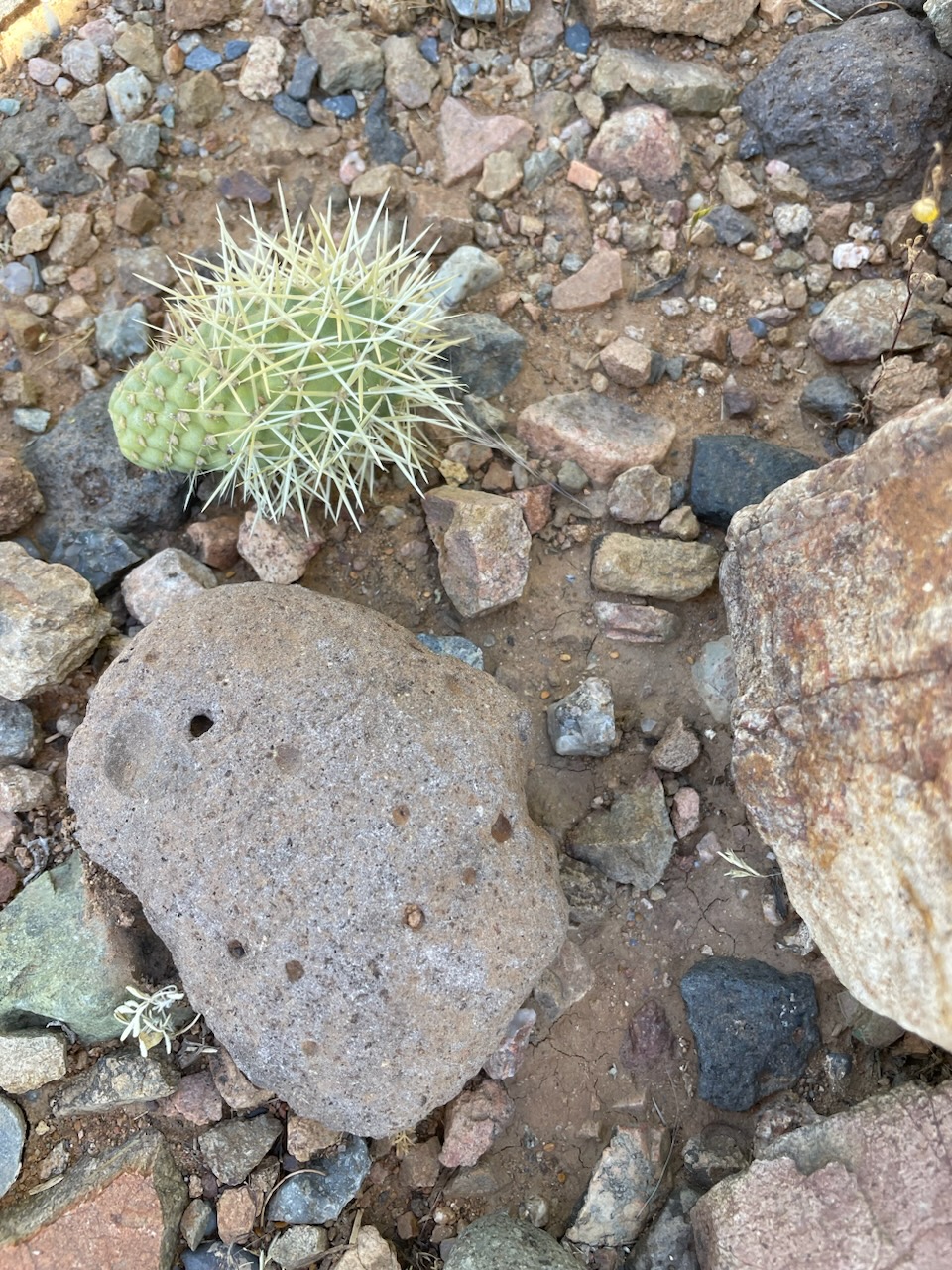
The jumping cholla has jumped off its parent but will not take root for a long, long time.

Prickly bear barely obliges.

Well, some do oblige, if you’re paying attention. Note the bug that crept in, barely visible.

Some plants seem to have already gone to seed, like this lady, possibly some kind of clematis.

Way beyond too late for this gentleman skeleton.

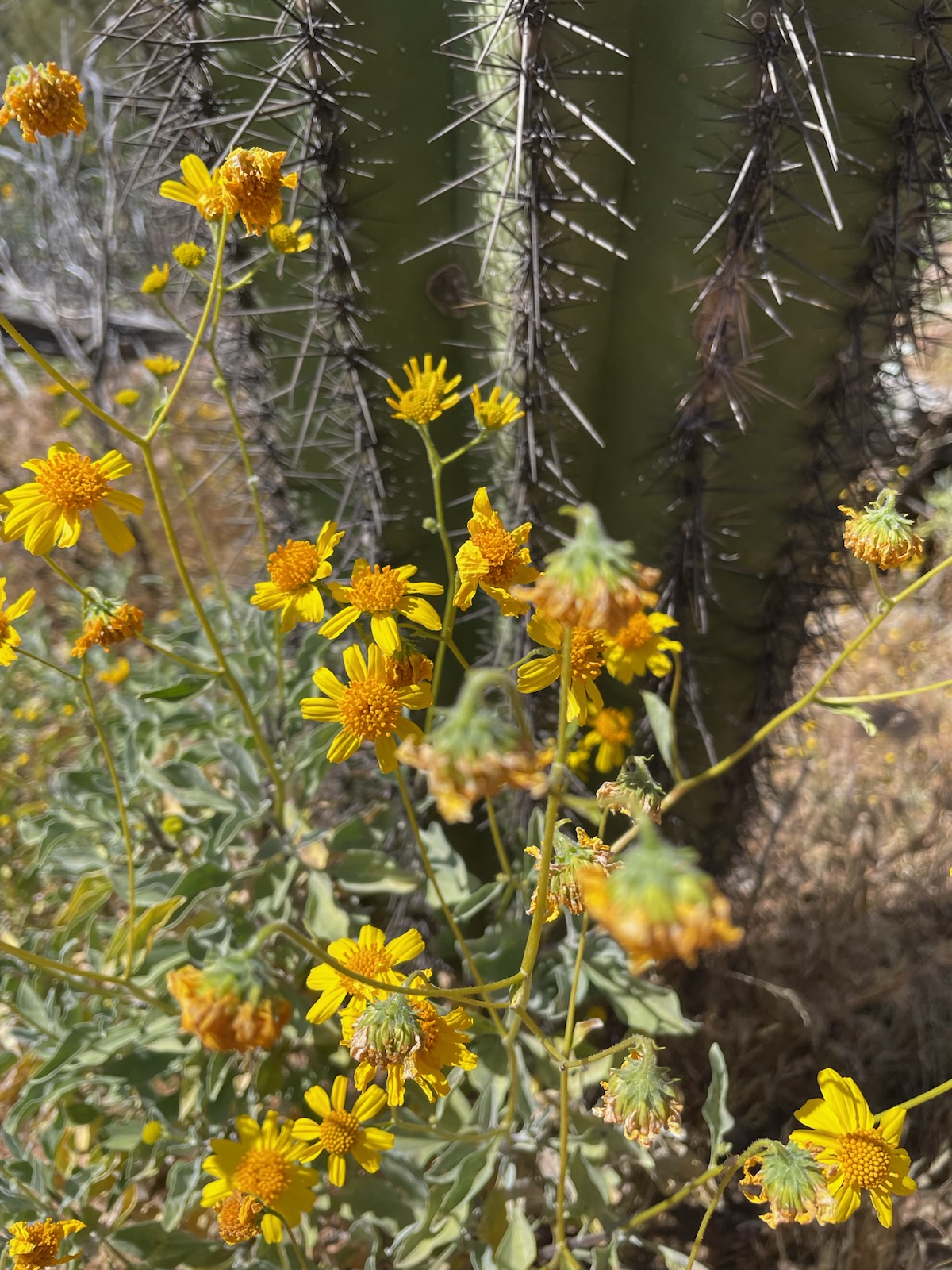
Yes, there is plenty of brittlebush. There is always plenty of brittlebush.

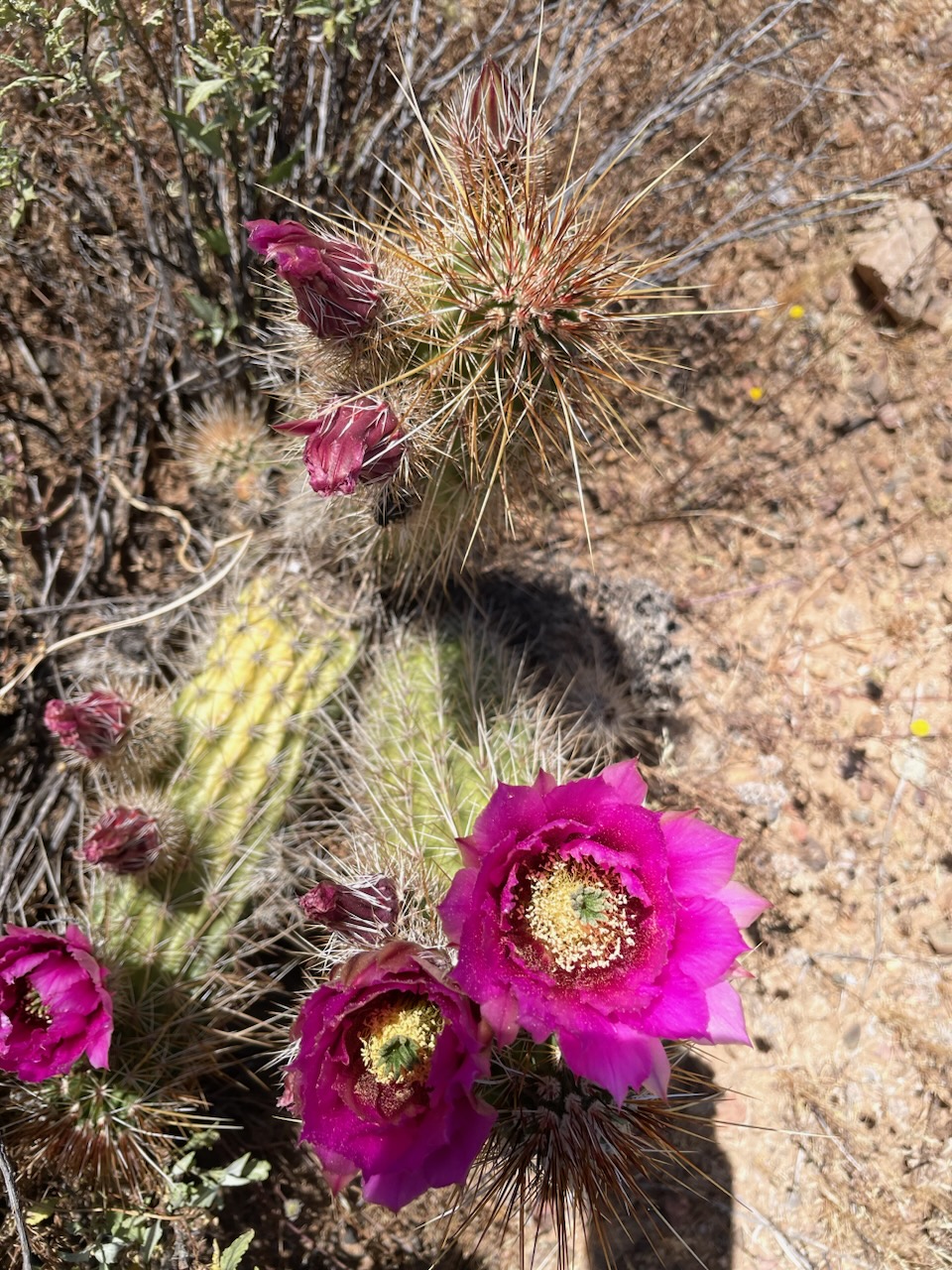
And some nice strawberry hedgehog.

But why can’t they all be blooming for us, all at once? Thank you, chamomile. You are right on time.

We sit for a while under a shelter to cool off.

In another month or two we won’t be out on this trail at all. It’s already too hot to go far.

Contemplate the cowboy on the old rusted fence.

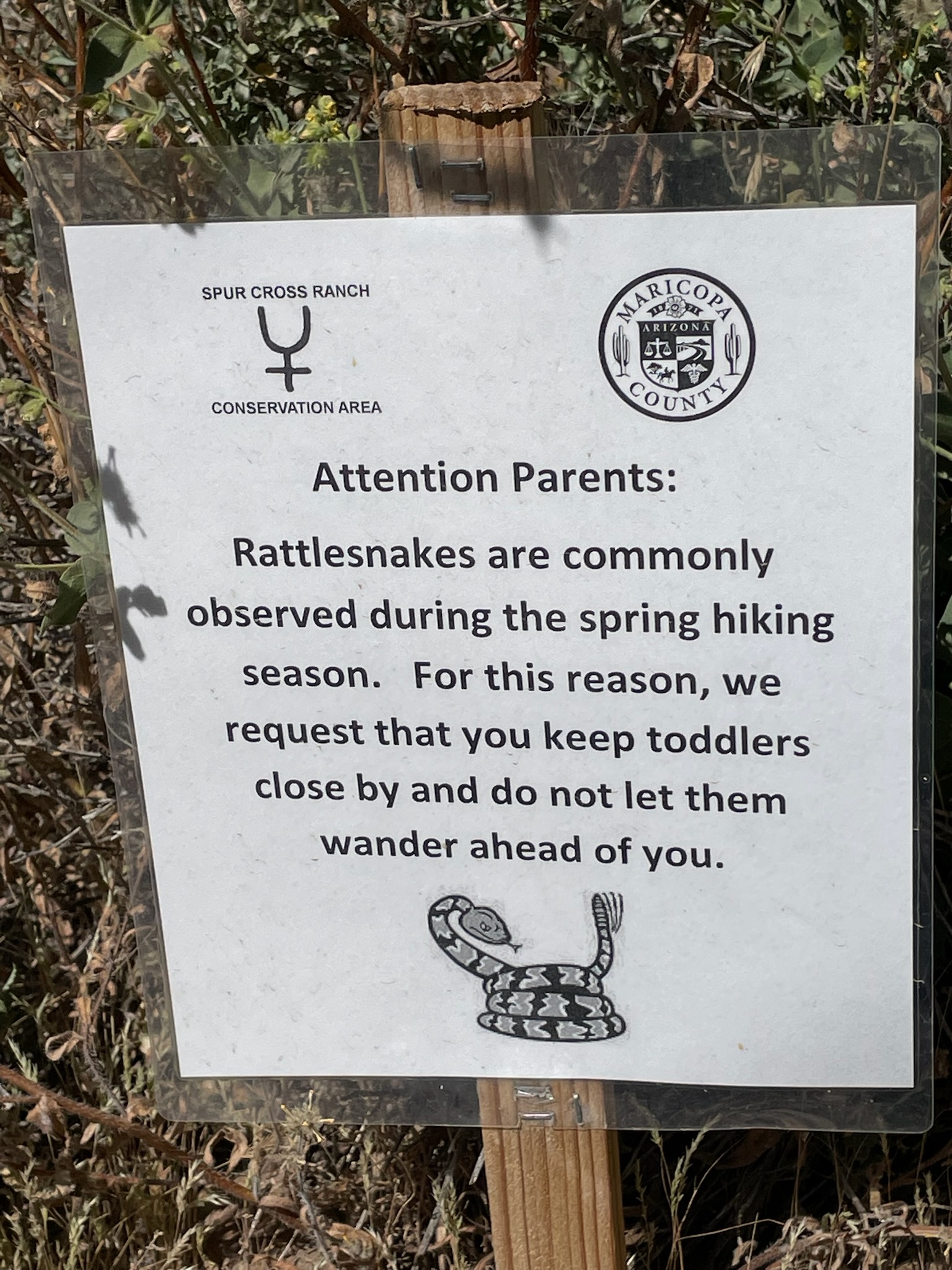
Wondering if we’ll see a rattlesnake.

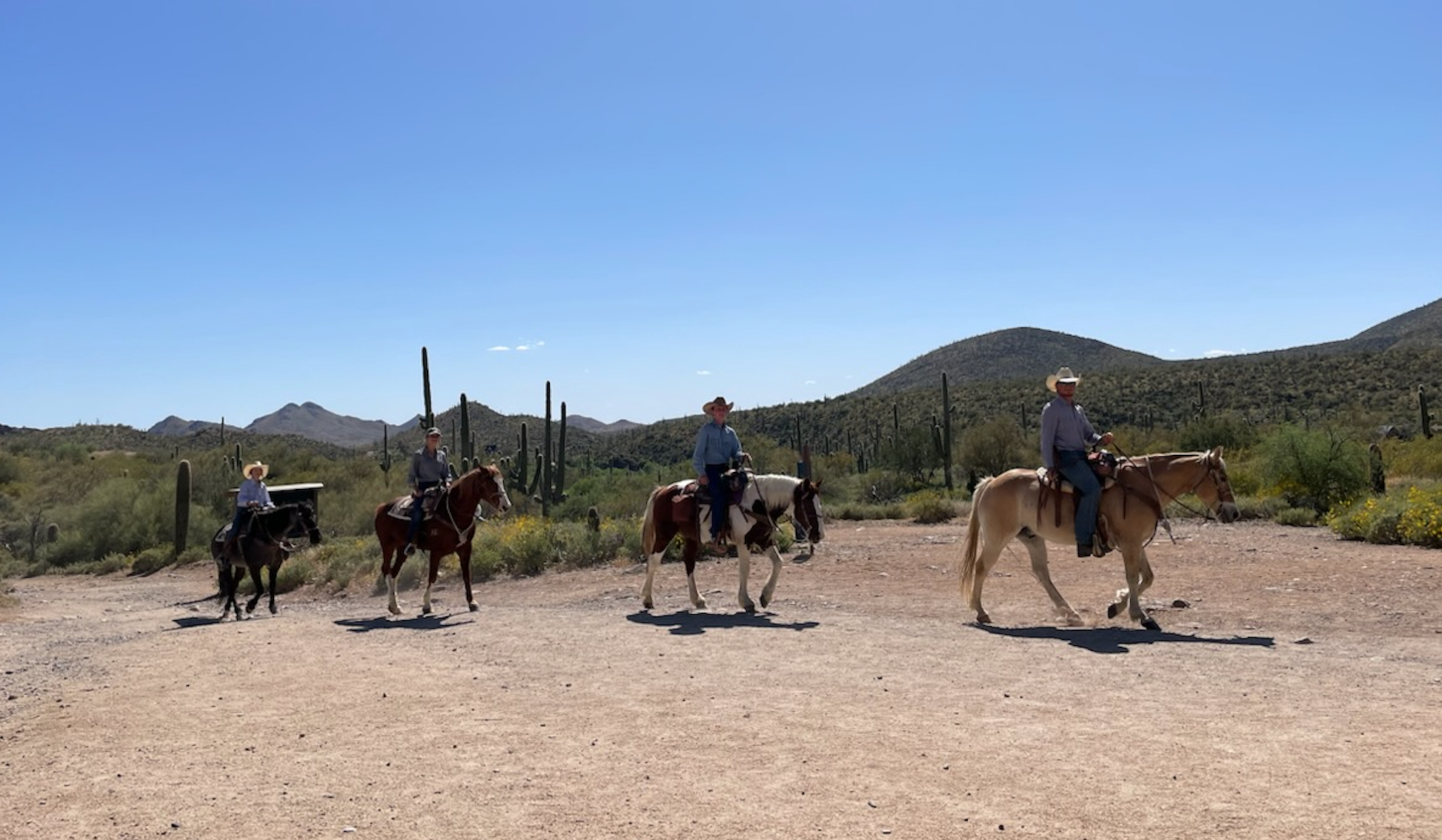
Envying the horseback riders coming through. Hydrate! A couple of the girls shout to us.

Is it a lupin or purple sage? Nubilous (look that one up). Anyway it won’t stay still to pose.

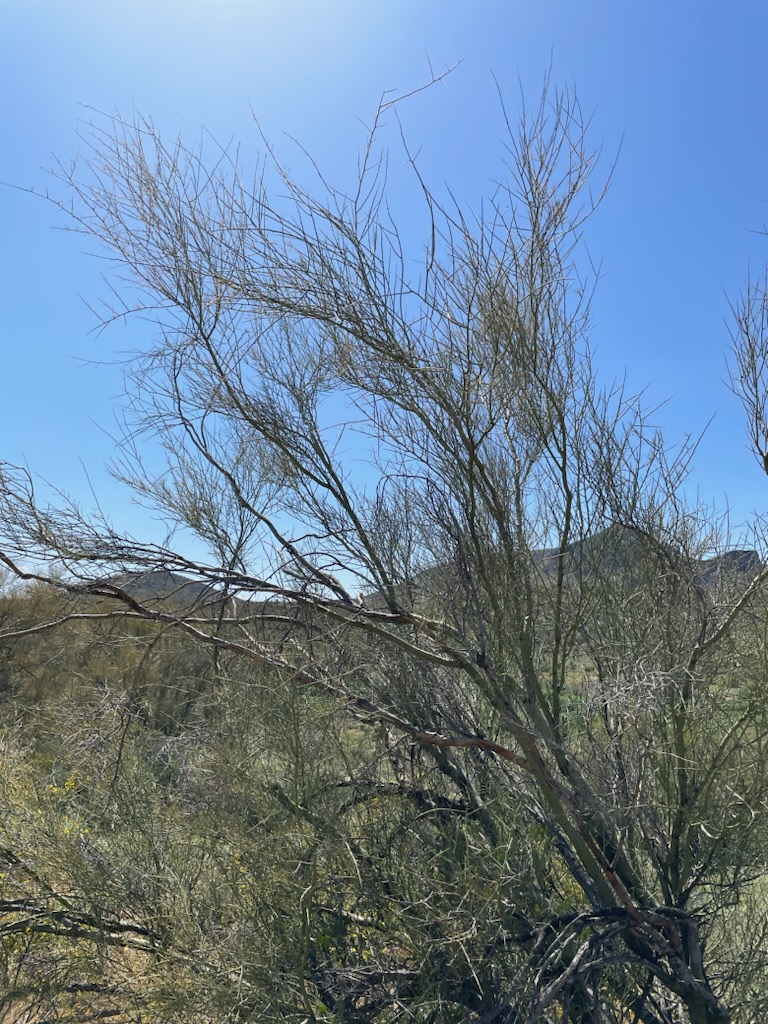
It all seems to make sense suddenly, in the presence of a wispy palo verde, but perhaps that is only a case of pareidolia (look that one up too).

Buddhist nun Pema Chodron relates a story about a woman running away from tigers, coming to a cliff and hanging from it with one tiger above, one below. A mouse is gnawing at the vine to which she is clinging. Suddenly she sees a little bunch of strawberries growing near to her on the rock. She looks at them, looks at the mouse, looks up and down at the tigers. Then she plucks a berry and puts it in her mouth.

In the distance, the creek line shows green.

Each moment is just what it is, Chodron writes. It might be the only moment of our life, it might be the only strawberry we’ll ever eat. We could get depressed about it, or we could finally appreciate it and delight in the preciousness of every single moment of our life.

Focus on what is in right in front of you.

Even the dullest cheatgrass is splendid.

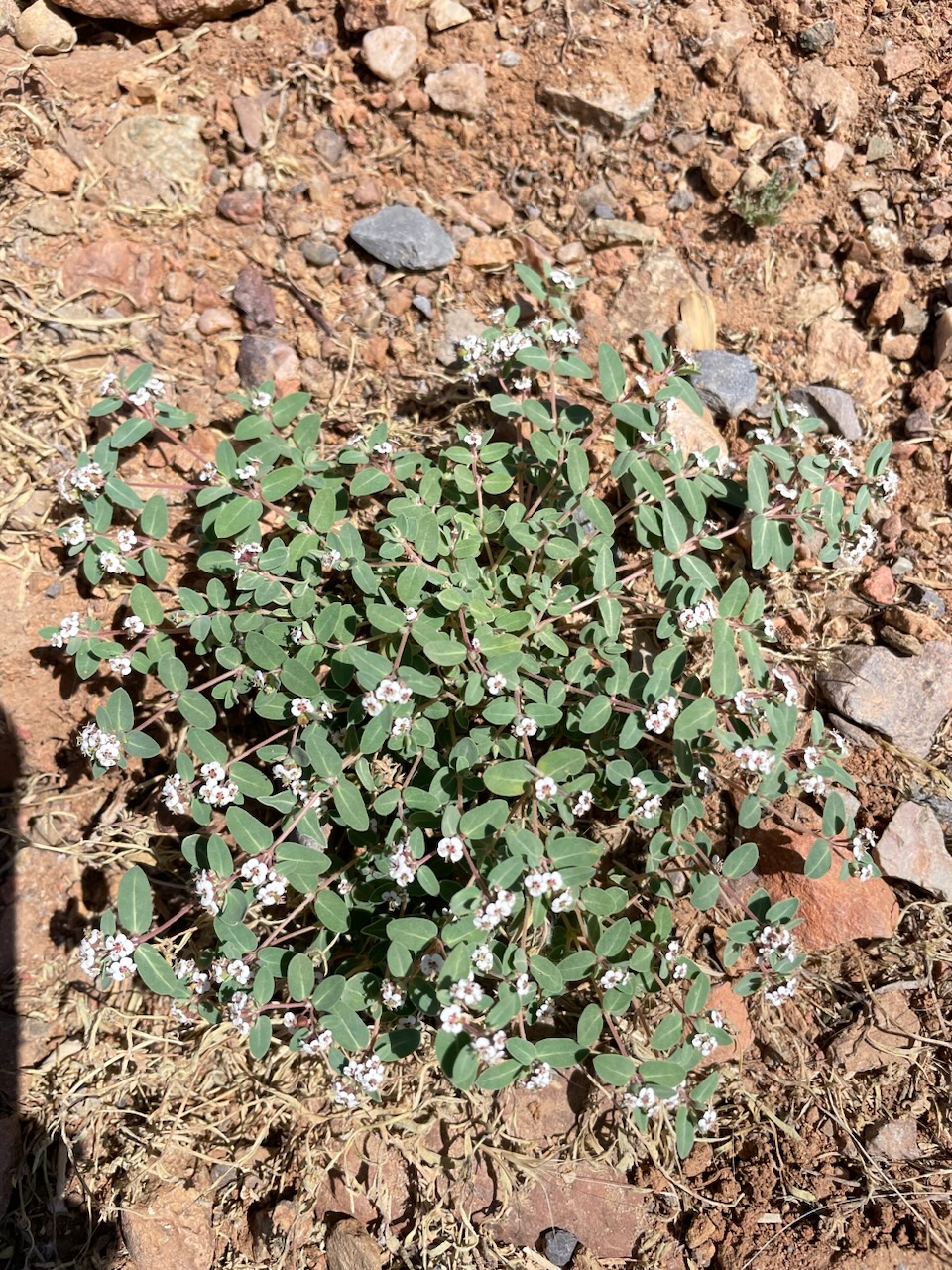
Everything is perfectly what it is. The tiniest euphorbia.

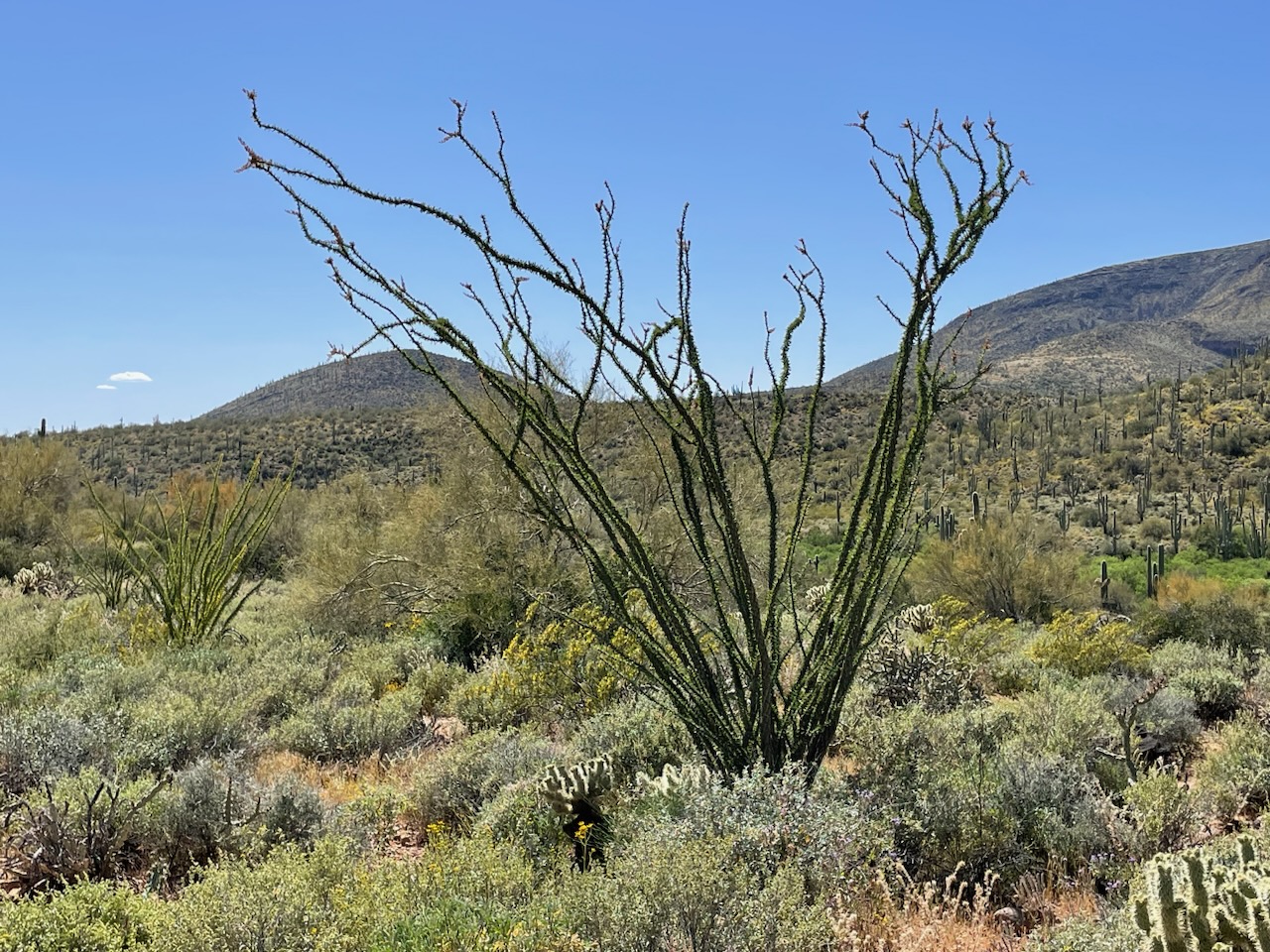
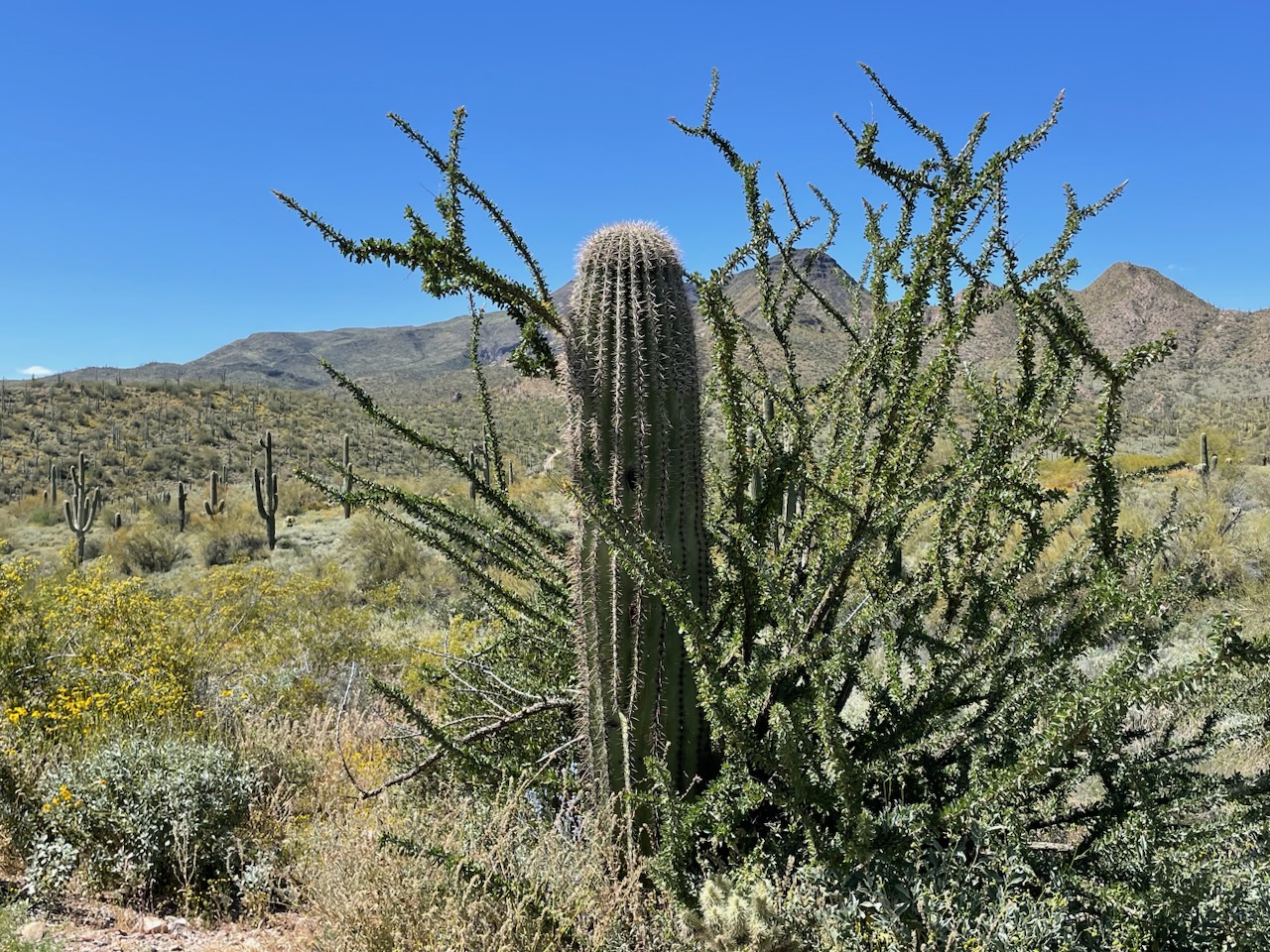
The most spectacular ocotillo embracing a young saguaro in a love grip.

Not too soon. Not too late. Just on time.

2 Comments

Filed under Jean Zimmerman

This blog post is about the Jewish food. 

For the Jewish singles event, see Matzo Ball. According to Wikipedia, “The Matzo Ball is an annual Christmas Eve nightlife event and party held in a number of major cities in the United States targeted primarily at young Jewish singles and organized by Mazel Events, LLC (previously the Society of Young Jewish Professionals).”

מַצָּה

קניידלעך

マッツォー

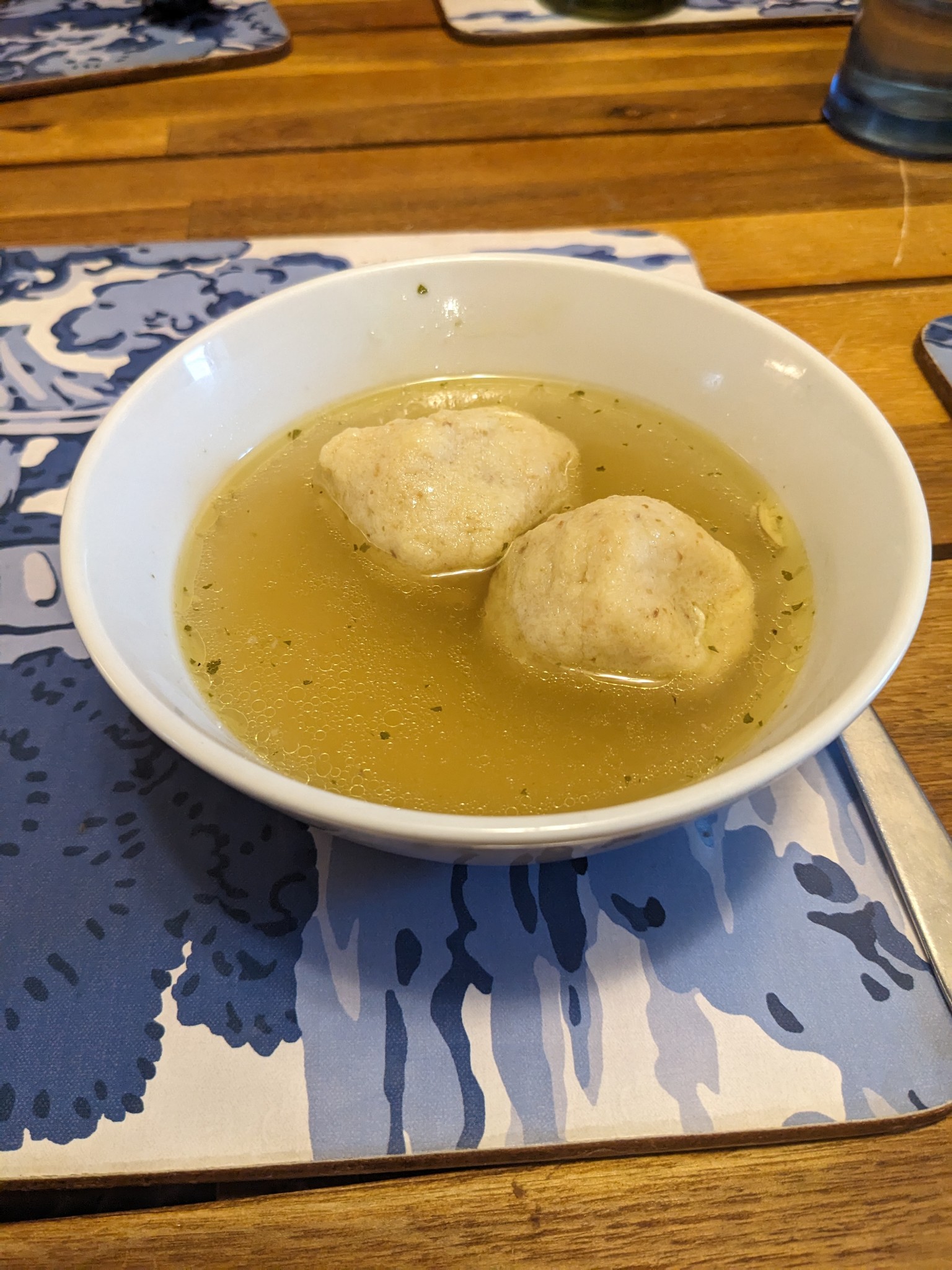
What was he cooking?

Matzoh ball soup, apparently!

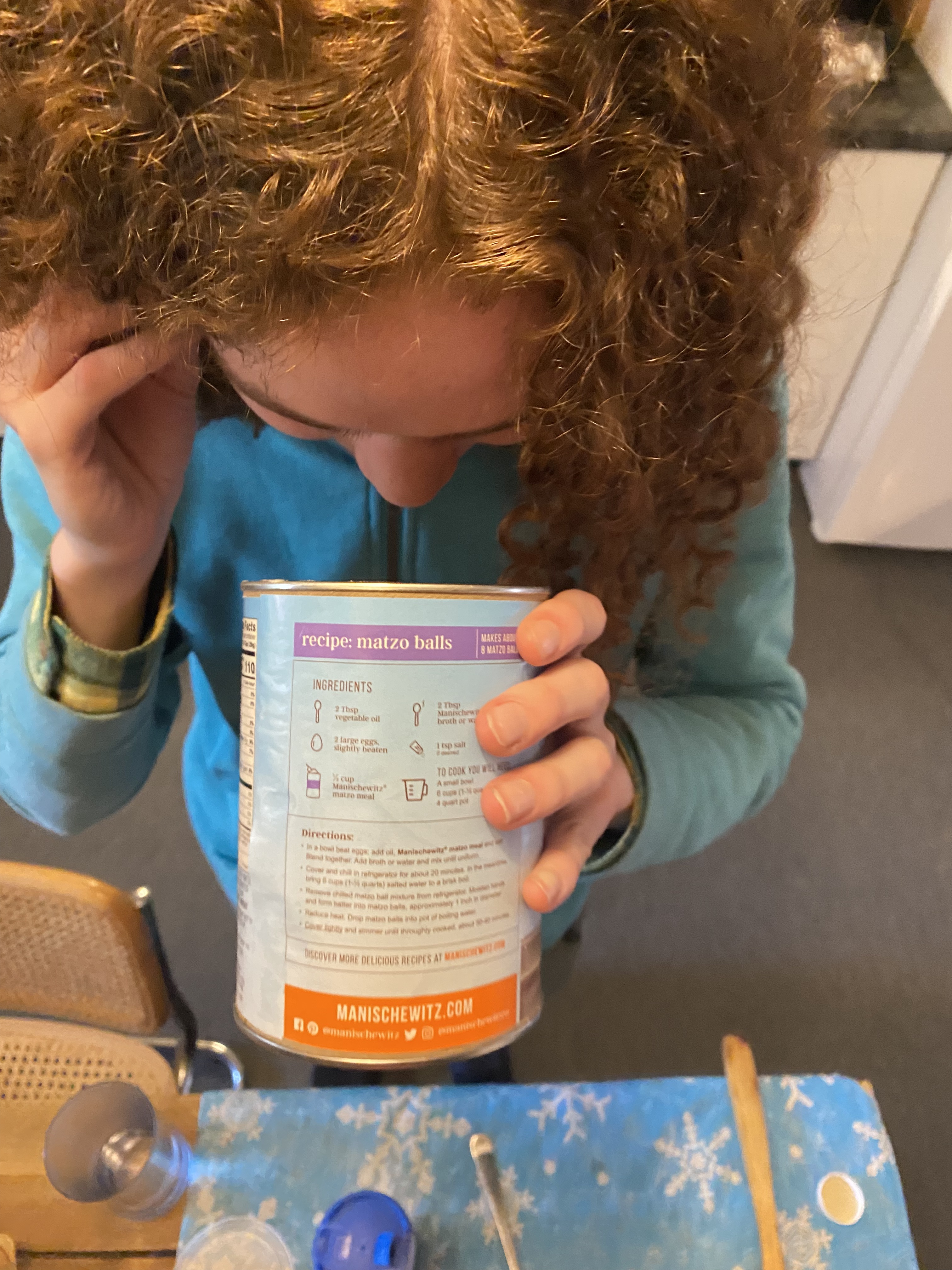
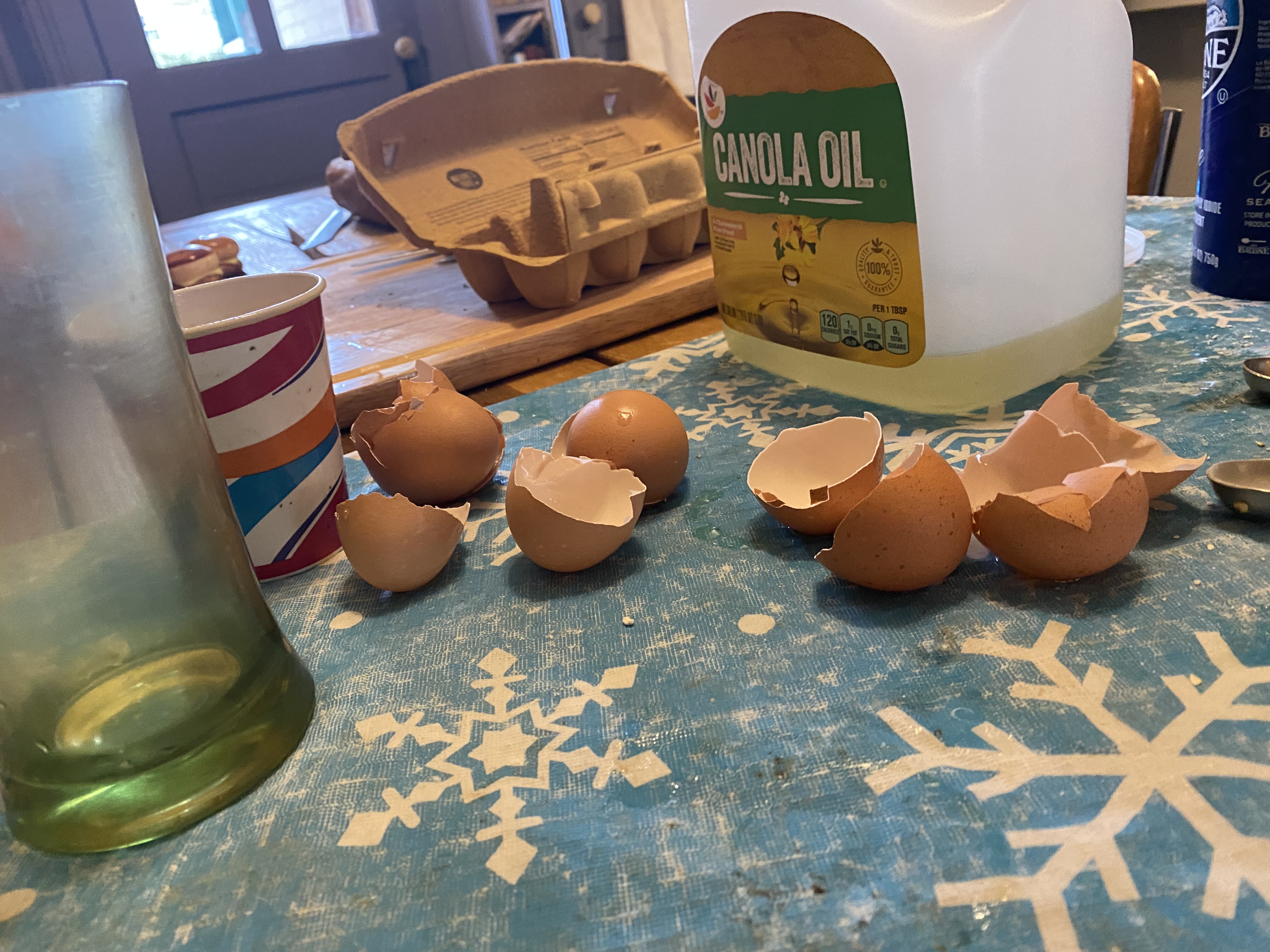
Matzoh is definitely the food of all time. Some may say that it is the rite of spring. We, the matzohrazzi, decided to photograph and document our matzohbulous Matzoh-making process!

Since we are nearing the time of the cherry tree festival, here is a matzoh haiku:

Matzoh Matzoh Mat

Zoh Matzoh Matzoh Matzoh

Matzoh Matzoh Mat

In Japanese: 

マッツォー マッツォーマッツ

ォーマッツォーマッツォーマッツォー

マッツォー マッツォーマッツ

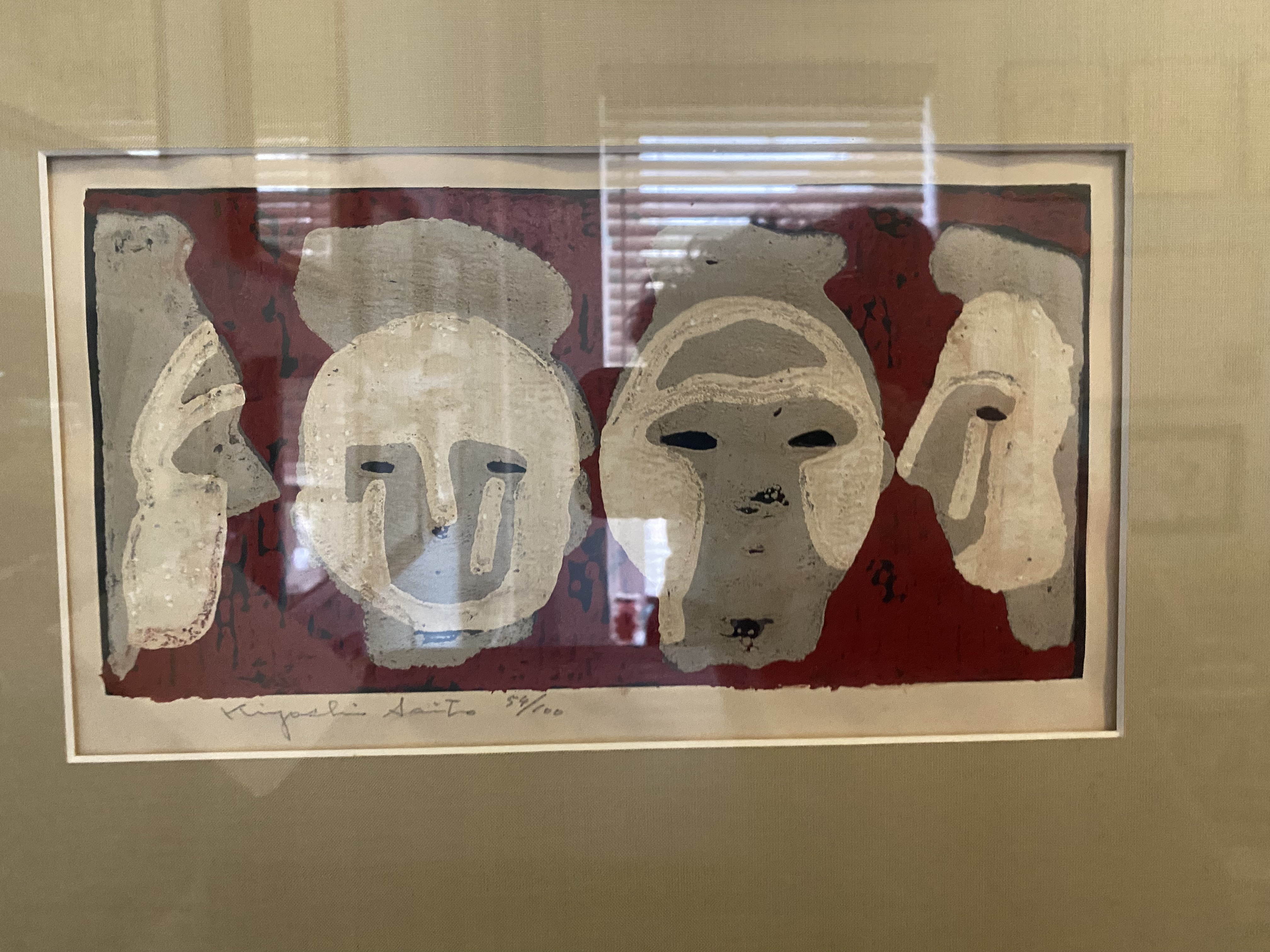
We realized that there is no kanji character for matzoh, so here is Jasper’s artistic interpretation:

“Confucianism? I don’t really buy it.”  — Jasper

By ‘Ler and ‘Sper

The latest episode of Eclectic Home Cooking 101.

Leave a comment

Filed under Jean Zimmerman

If you’re champing at the bit to see the cherries

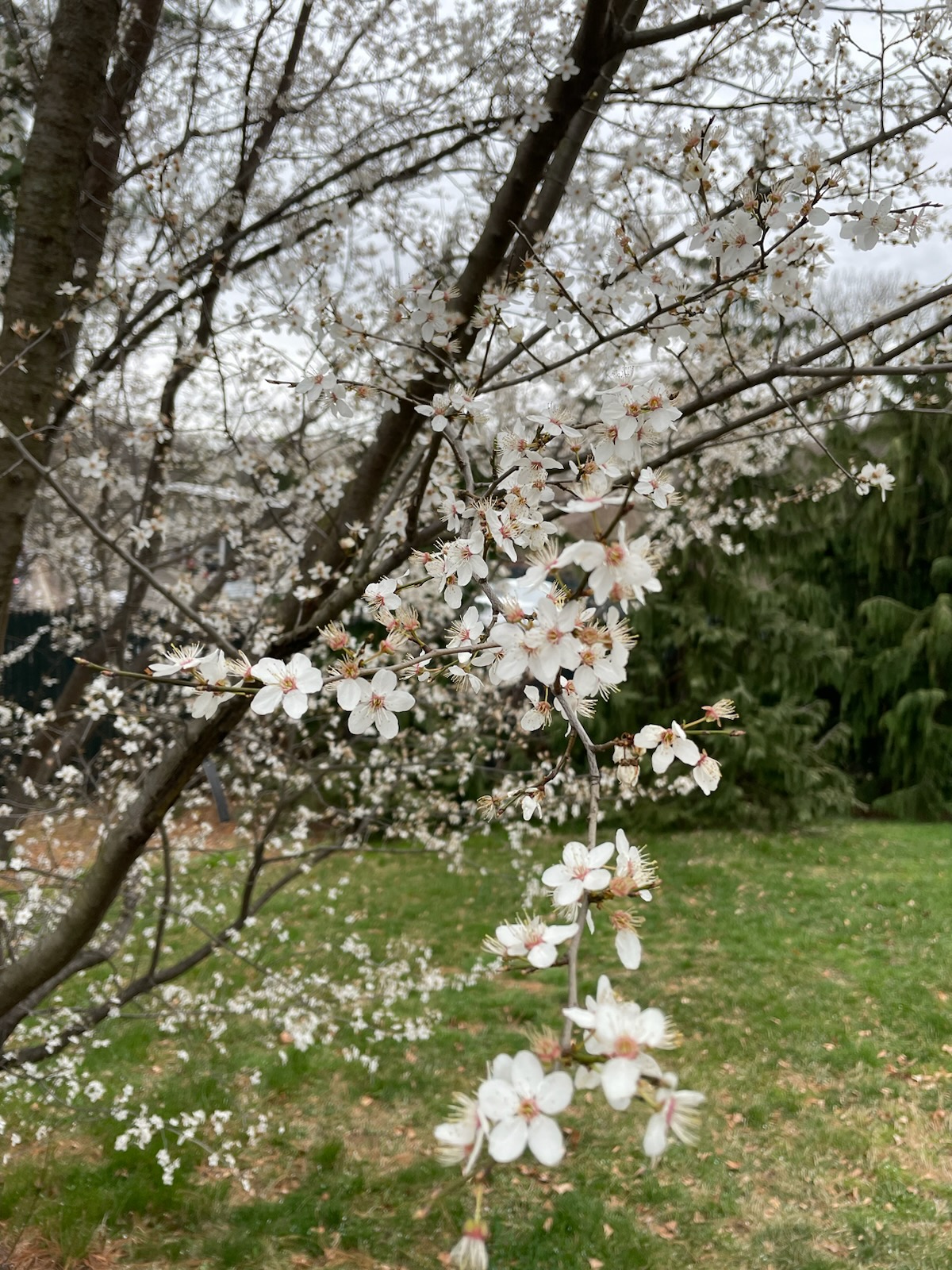
(I know I was) it’s easy enough to take yourself down the Mosholu Parkway to the New York Botanical Garden in the Bronx. However, the place’s Cherry Collection –sounds like a high-end clothing line – might not be in full bloom yet. That’s okay. Cherry trees are spectacular even if they are just barely flowering. Like Prunus cerasifera var. divaricata.

Why did George Washington chop down a cherry tree? Unsure, and it might be a myth, but that could be another strike against him along with the facts that he sic’d his Revolutionary soldiers on the Indigenous peoples of the Northeast, also that he blew off spunky and beautiful Mary Philipse, and also that he had severely scarred skin from the smallpox he contracted as a youngster. That last was not his fault, so we’ll forgive him. And he does score a few points for freeing the 124 enslaved people that were his “property,”  albeit after his death.

But I digress. My friend Barbara and I were kvelling somewhat yesterday over the first few blossoms at the NYBG on an early spring day as crisp as a Granny Smith apple. Well, I was kvelling, but Barbara was shivering.

Even on a cold afternoon with a milky sky like yesterday’s they were lovely. Or perhaps especially on a day with clouds! The blossoms show up better. On a blue-sky day everything cherry-related almost overwhelms with sugary sumptuousness.

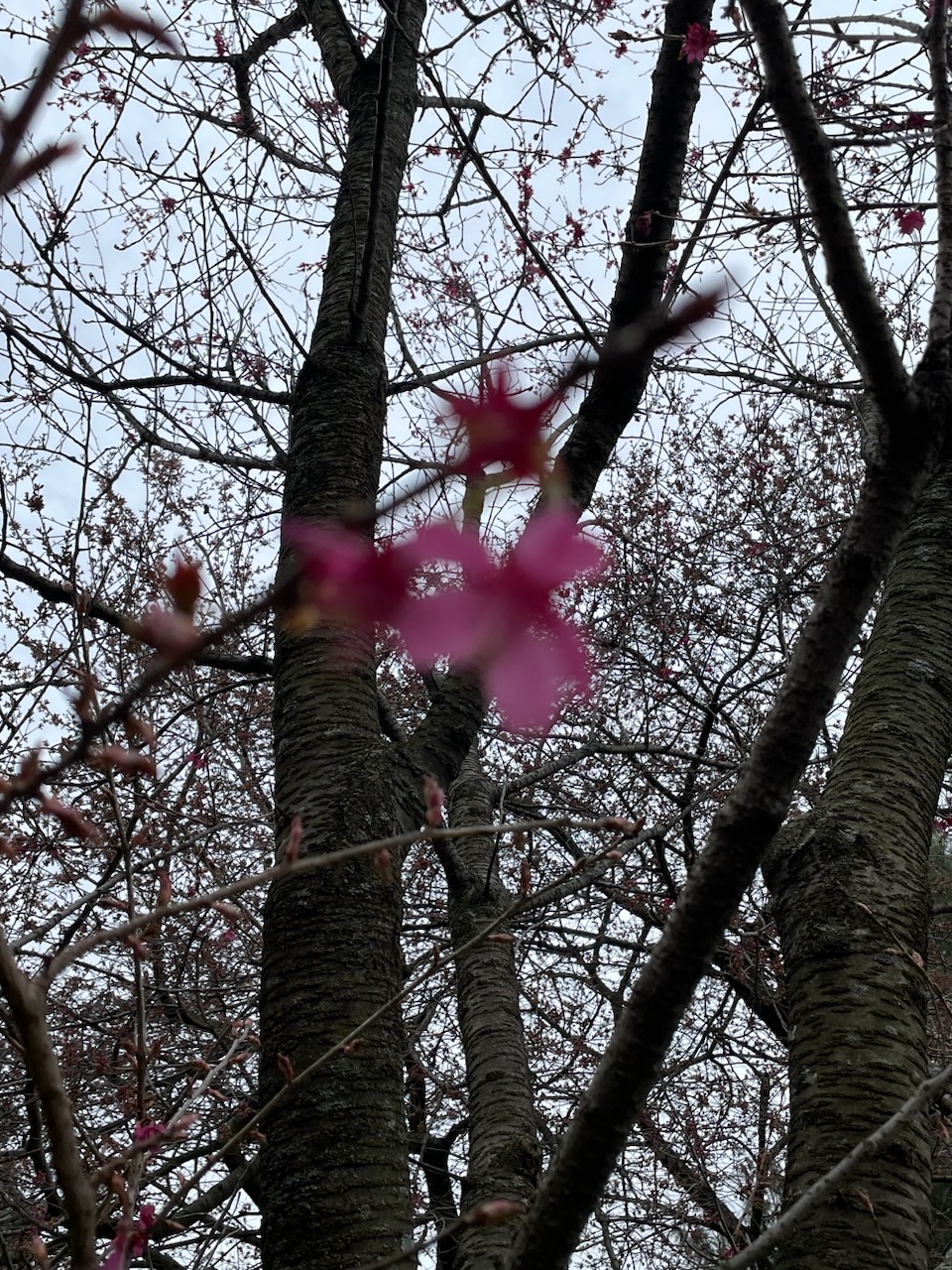
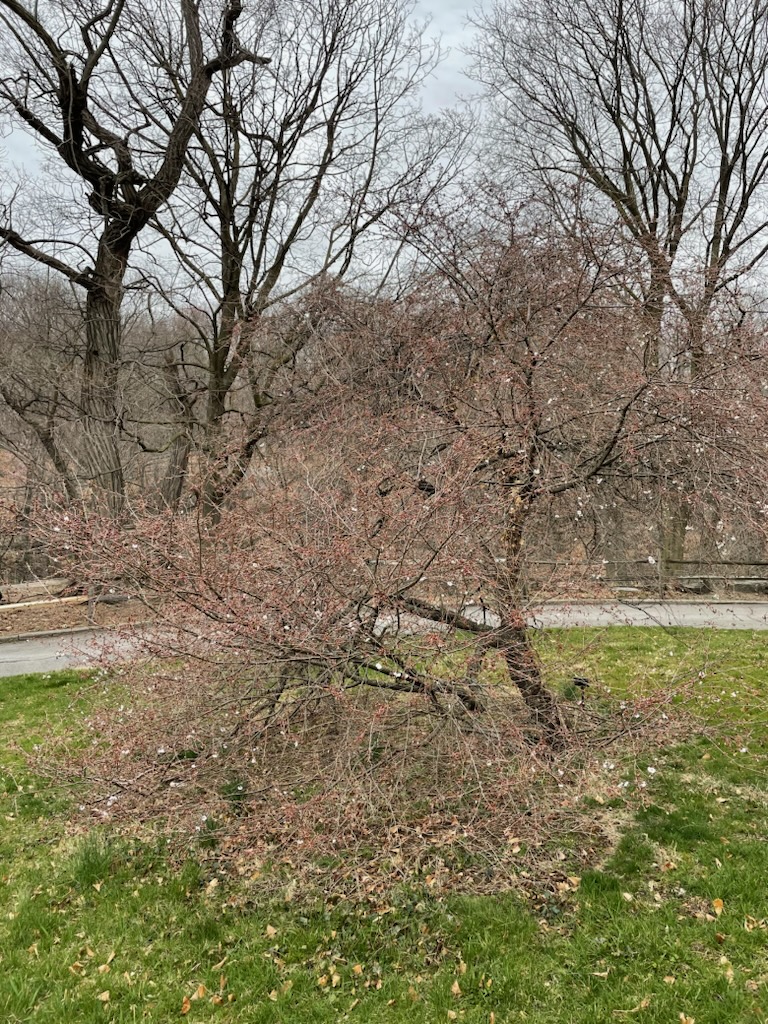
We saw just a whisper of blossom, a smudge of pink…

Trees on the verge, holding on to their promise, most of them barely in bud. The sense of expectation was palpable.

In a week or two this cherry orchard will be mobbed. Yesterday, there was no one around. Silent, and under the cottony clouds all the more mysterious.

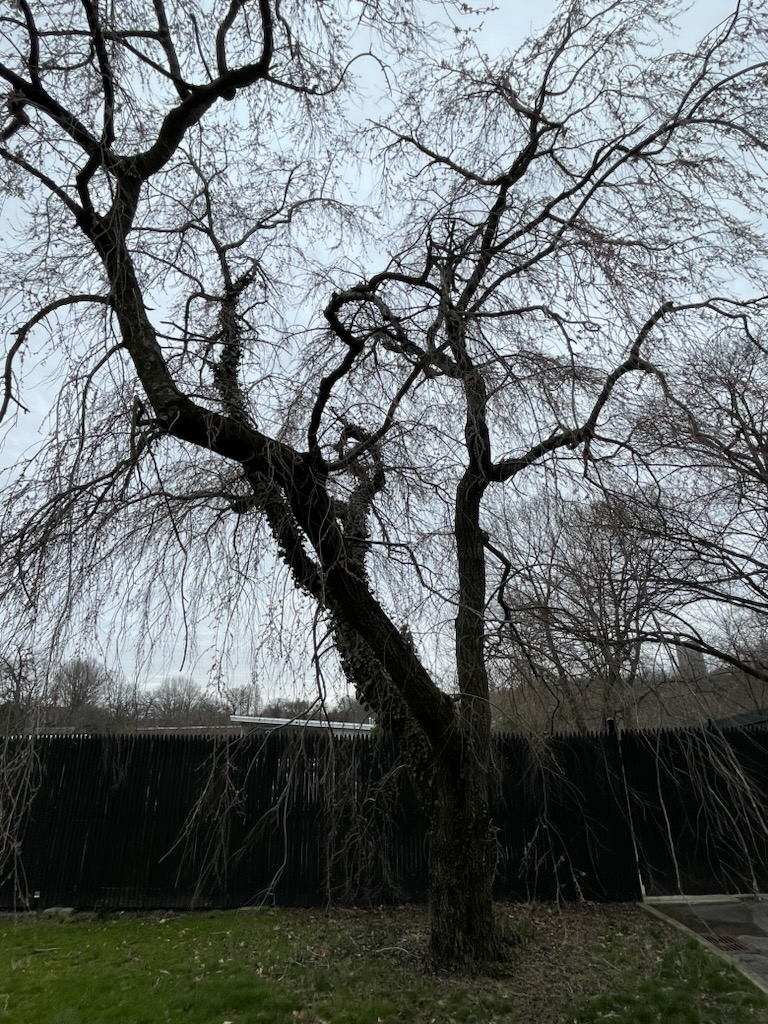
Without all the frou frou of flowers, you become aware of the skeletons of the statuesque mature ones. The weepers. Their bone structure.

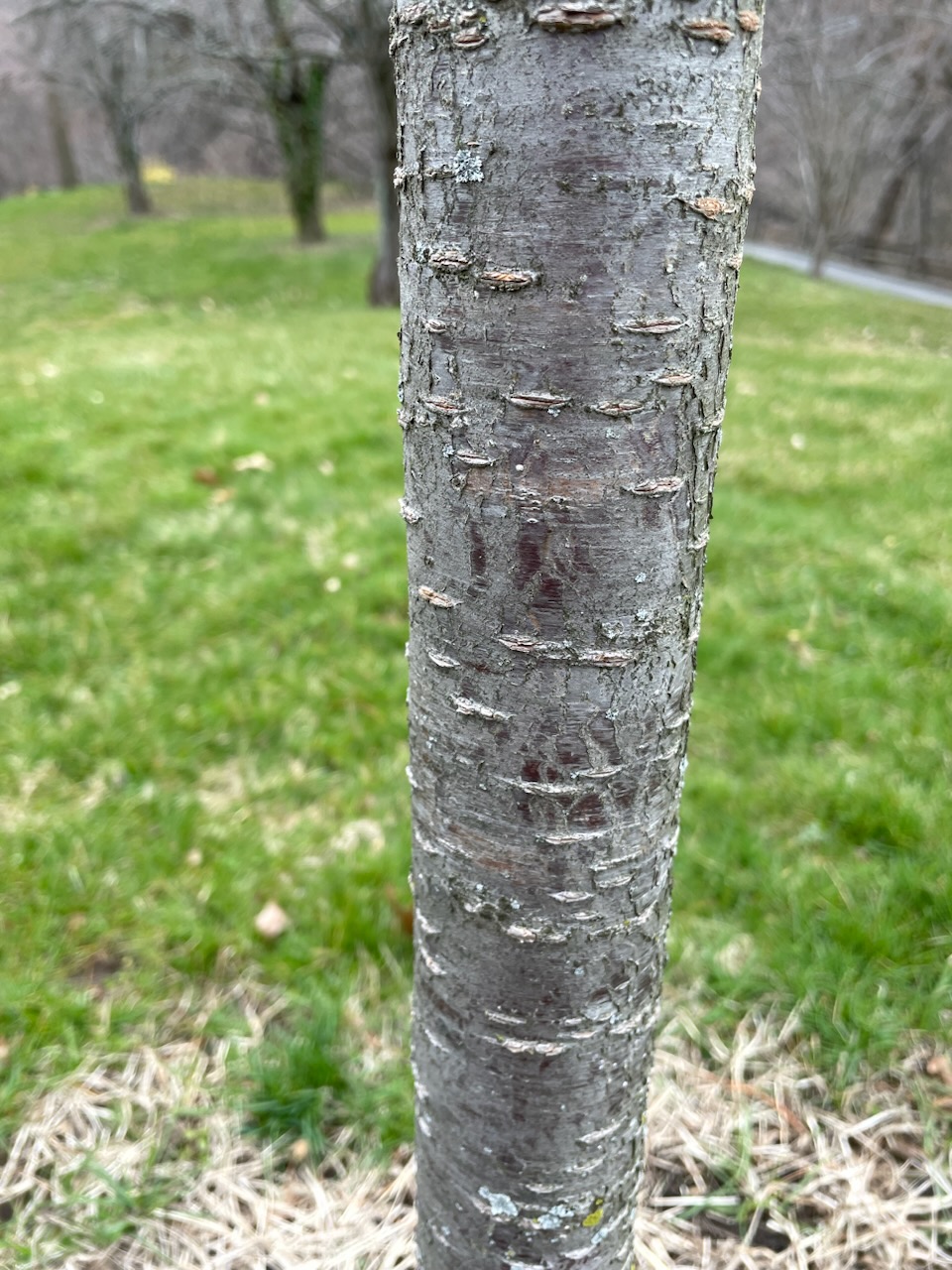
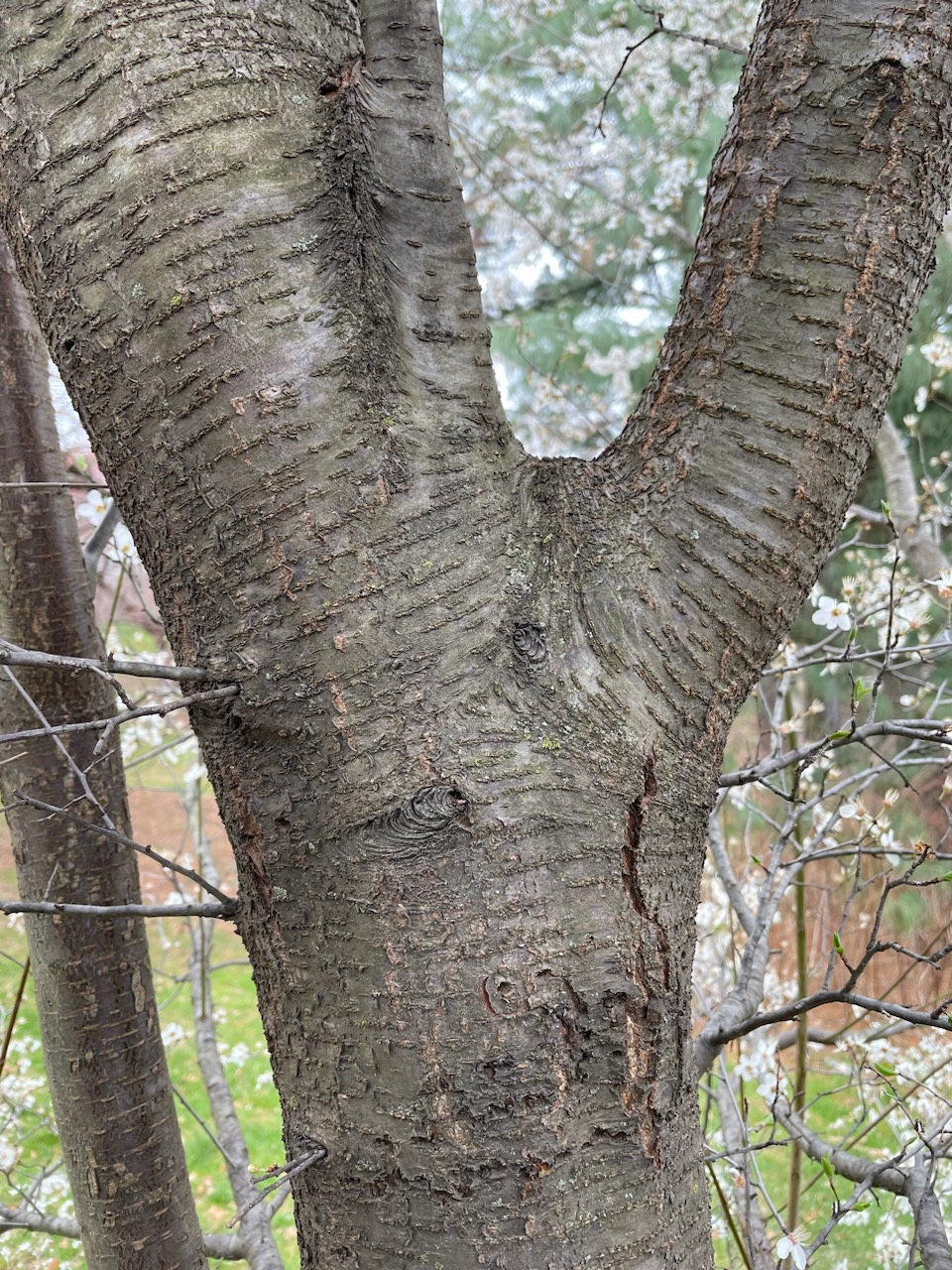
You could really notice the lenticels on the bark, the raised pores — the elegant horizontal stitchery that helps the tree breathe. Among the older, wizened specimens we saw a young one, no longer a sapling but more a teenager in cherry years.

Barbara and I ventured from our usual haunts along the Hudson River just for these trees. They’re about the only things that could pull a sane person away from our habitual perambulation, the River is so beauteous, so perfect.

In Japan during sakura season over 1,000 locations around the country showcase cherry blossoms and millions of people take themselves out into groves to worship the  trees and ponder the ephemeral nature of being. American arborists like to make a joke: How many trees does a regular person think there are? Christmas trees, and everything else. But there is one notable addition. Almost everyone knows these pink-white clouds of blooms every March and April along the eastern seaboard. They are just about the only trees people actually make pilgrimages to see. Even people who are not tree people become converts.

Barbara’s not only my walking buddy but my writing friend. Between our effusions over these flowers we talked of words and our experiences putting them on paper. The rare triumph when you succeed. The disappointment when you fail. The need to get what you care about out there to readers. We don’t have to explain why we need to, it’s so integral to each of us.

We stood at the edge of cherry blossom way. When did you know you wanted to be a writer? I asked. Barbara’s father before her wrote novels. He had a bestseller, after which the family moved into a nicer house. When she was little, Barbara said, she had wanted to be a painter. Her father presented her with a gift when she was 10 years old. “I’m going to give you the best present you’re ever going to get,” he said. She opened it and found a blank book, pages empty for her to write her own words.

When I was in elementary school I filled blank notebooks with my childish loopy signature scrawled over and over because that’s what I believed writers did. I seem to recall my parents feeling I was wasting paper. Only much, much later would I come to know how rare the honor is for a writer—actually signing your name in a published book for some reader who thinks your work is valuable.

Sometimes people came to their life’s work early. I’ve been reading a biography of the ornithologist John James Audubon in which he recounts one of the curious things which perhaps did lead me in after times to love birds, and to finally study them with pleasure infinite. A nanny kept several parrots and a monkey as pets, and when the biggest parrot demanded its breakfast one morning – Milk and bread for the parrot Migonne! — the monkey up and murdered it. The sensations of my infant heart at this cruel sight were agony to me…

Barbara’s knee sometimes hurts her. My foot aches. We are neither of us young. On the outside. Inside we are sixteen, or twenty one. The authentic age, the age when words flow one to the next uninhibited, unencumbered by physical defects. The life of the mind, of the senses. You could be in a wheelchair and kvell over cherry blossoms. In actuality writing and kvelling are synonyms. Ways of encountering the world. Appreciating your environment. Taking its measure.

With cherry blossoms we celebrate not only the perfect flowers on the branch but the petals as they fall and drift off in the breeze. As they perish. No tragedy, just the way it is. Life and death, the whole kaboodle in a brief breathtaking moment.

So Barbara and I talked about writing. We always talk about writing. It’s what we do. Yes, we talk about health, husbands, idle gossip about people we know. But it always comes back to the experience of stringing words together and then, secondarily, the sometimes frustrating, sometimes exhilarating effort to get those words out into the world.

Barbara runs a program called Story Shop, a creative arts workshop that’s all about the intersection of art and writing, in which she encourages kids to create original stories but not necessarily on paper – the narrative can be assembled out of found objects, drawn, mapped, acted, sung. A key piece these days, she said, is building miniature worlds.

She explained  that the kids she knows in middle school tell her that today, teachers say that when you write you must only do so  from your direct personal experience – not employing the voice of another gender, race, even an animal. One student told her that she was dissuaded from making up a story about aliens because she’d never been to outer space.

So you couldn’t write a story from the perspective of a cherry blossom, I suppose, like this Prunus ‘Hally Jolivette.’

That, my friends, is tragic.

Leave a comment

Filed under Jean Zimmerman

“I celebrate myself, and sing myself”

in the inimitable phrasing of Walt Whitman back in 1892.

I just received news that I have been awarded a residency at Catwalk Institute in the Hudson Valley this May to work on my upcoming nonfiction book Heartwood (about Americans’ complicated love affair with our forests) – pure unalloyed time to focus and write. So I celebrate myself by visiting Wave Hill, the botanical garden in the Riverdale neighborhood of the Bronx.

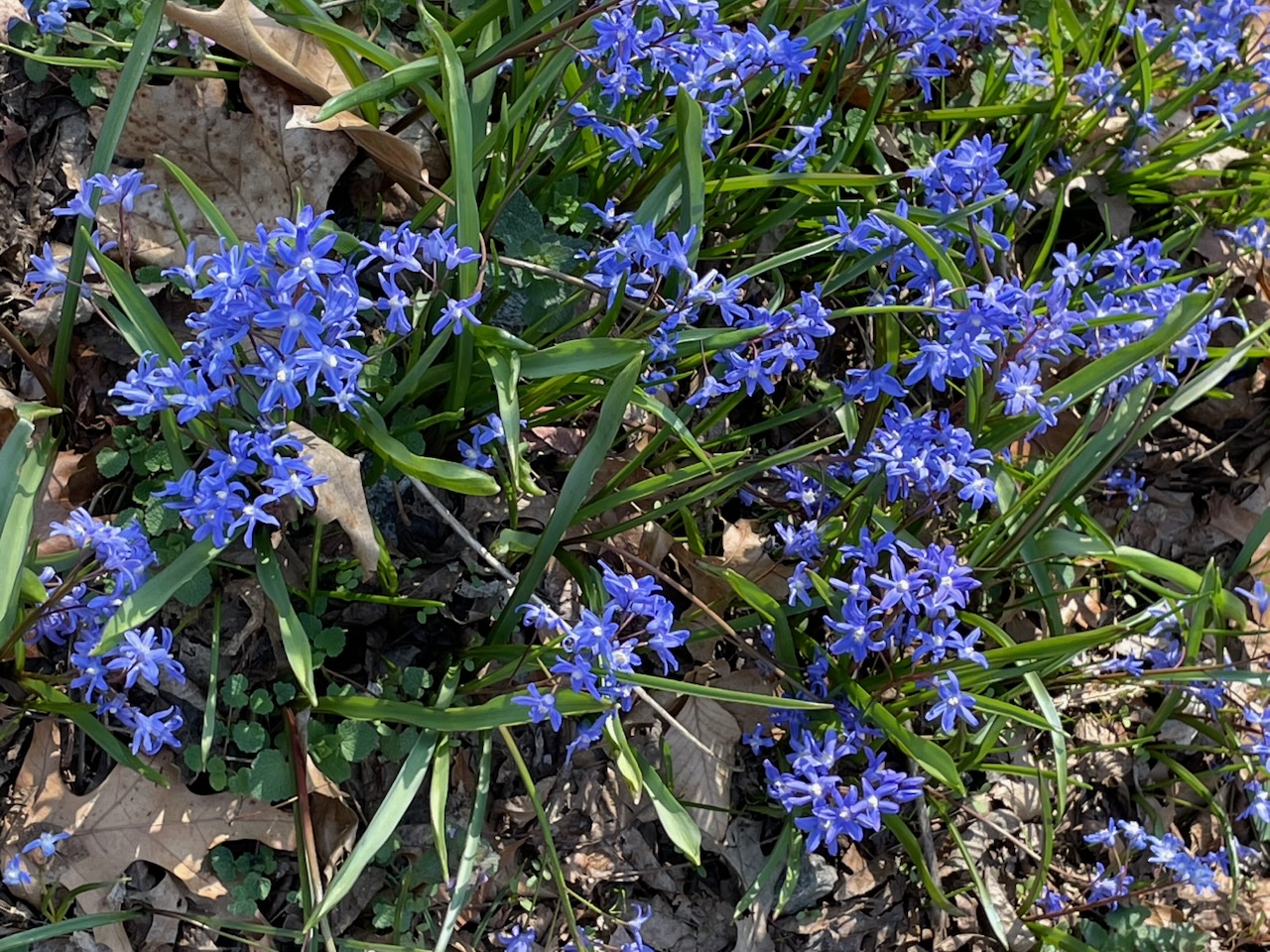
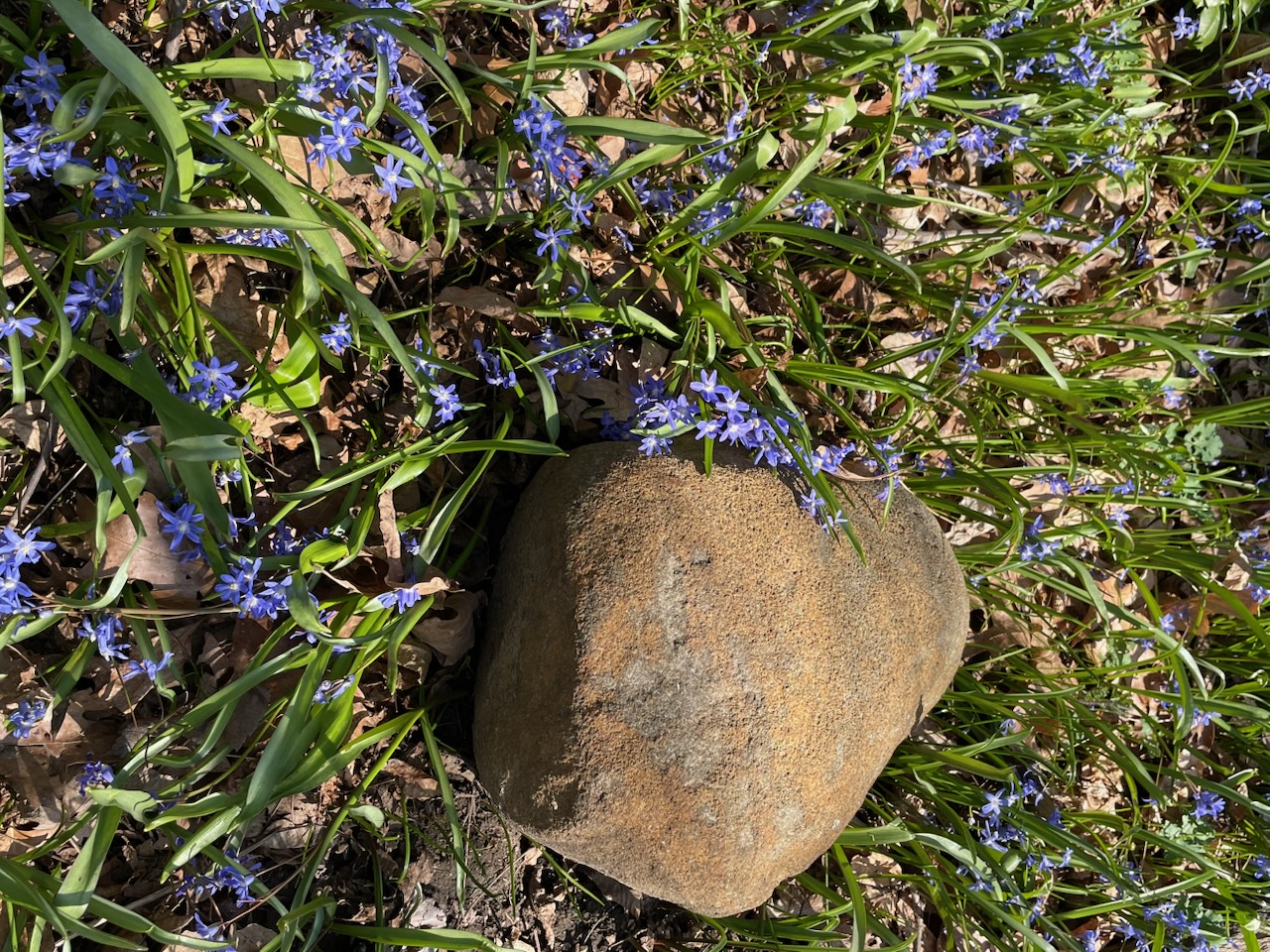
There, also as Walt had it in Song of Myself, I loafe and invite my soul. Early spring is always thrilling, but Wave Hill has every wondrous element of the season in spades. First and foremost, the glory-of-the-snow. Aka Scilla luciliae. I might be wrong about that, I’m often wrong.

One thing I’m right about is that the plant is fantastic here at Wave Hill, carpeting the grounds, every place you look. Closer.

Even closer.

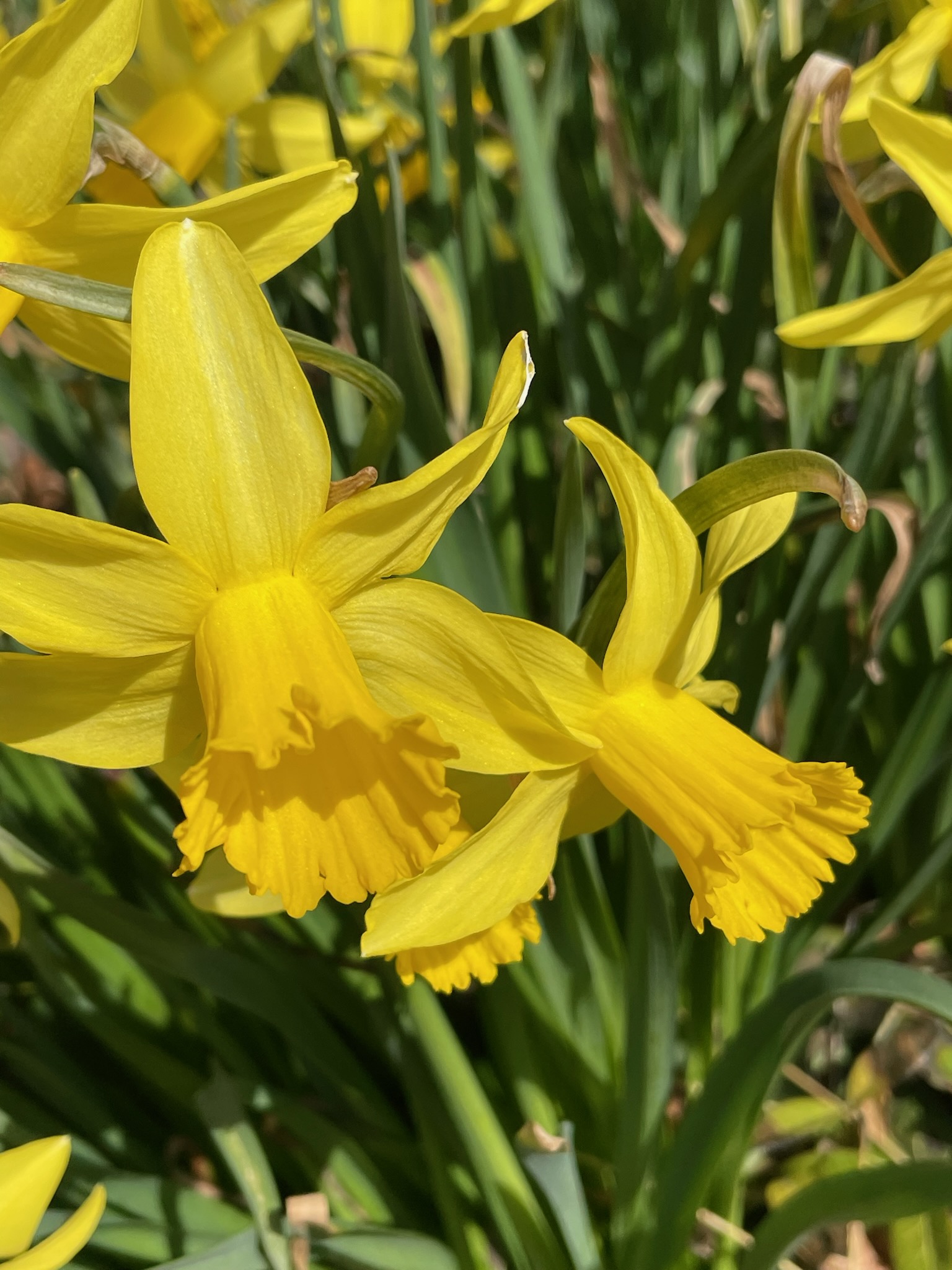
And all else just as exquisite in the cold late-March air, accompanied by bird song. The daffodils.

Crocuses.

The atmosphere is not a perfume, it has no taste of the distillation, it is odorless,

It is for my mouth forever, I am in love with it,

I will go to the bank by the wood and become undisguised and naked,

I am mad for it to be in contact with me.

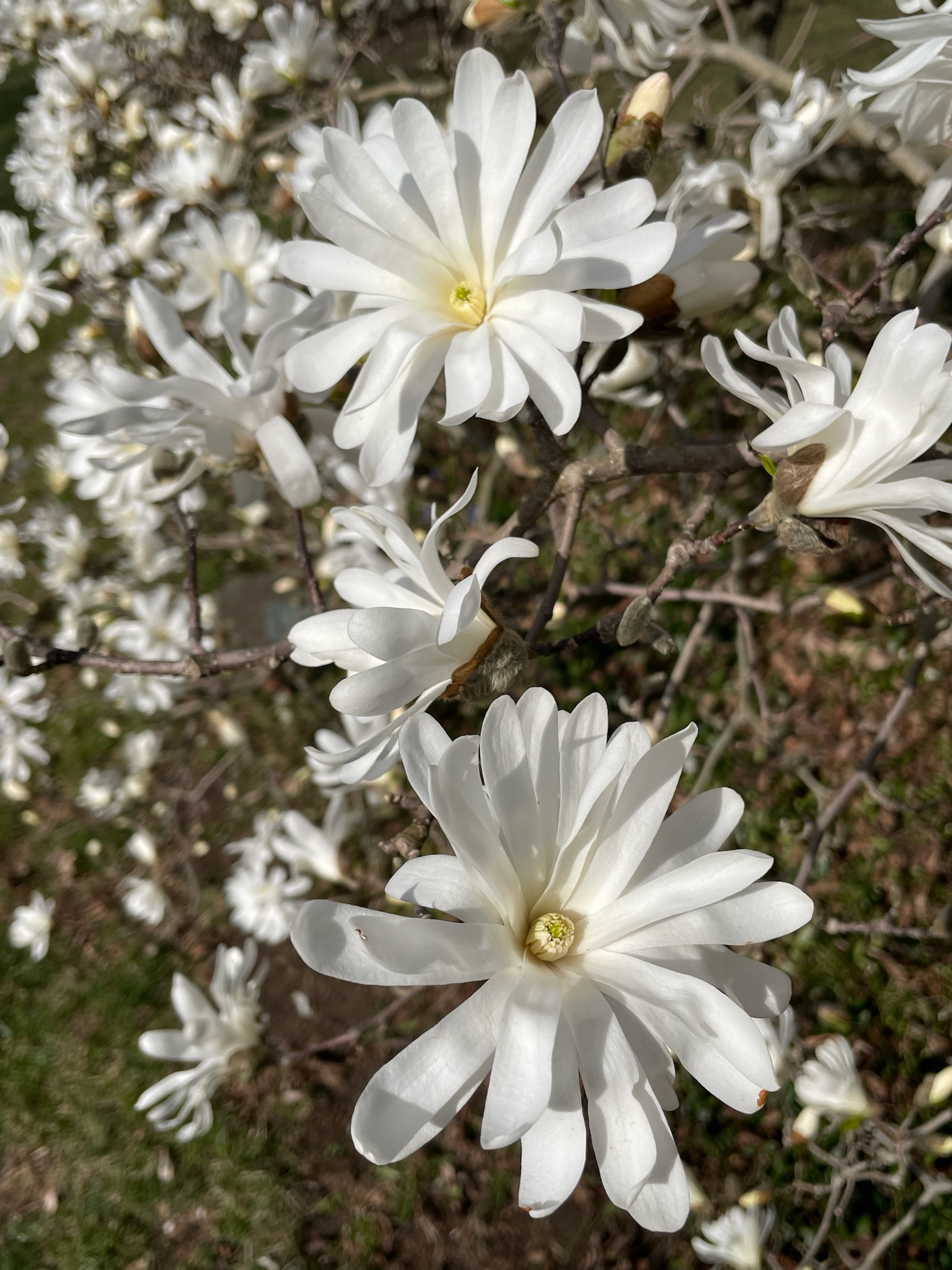
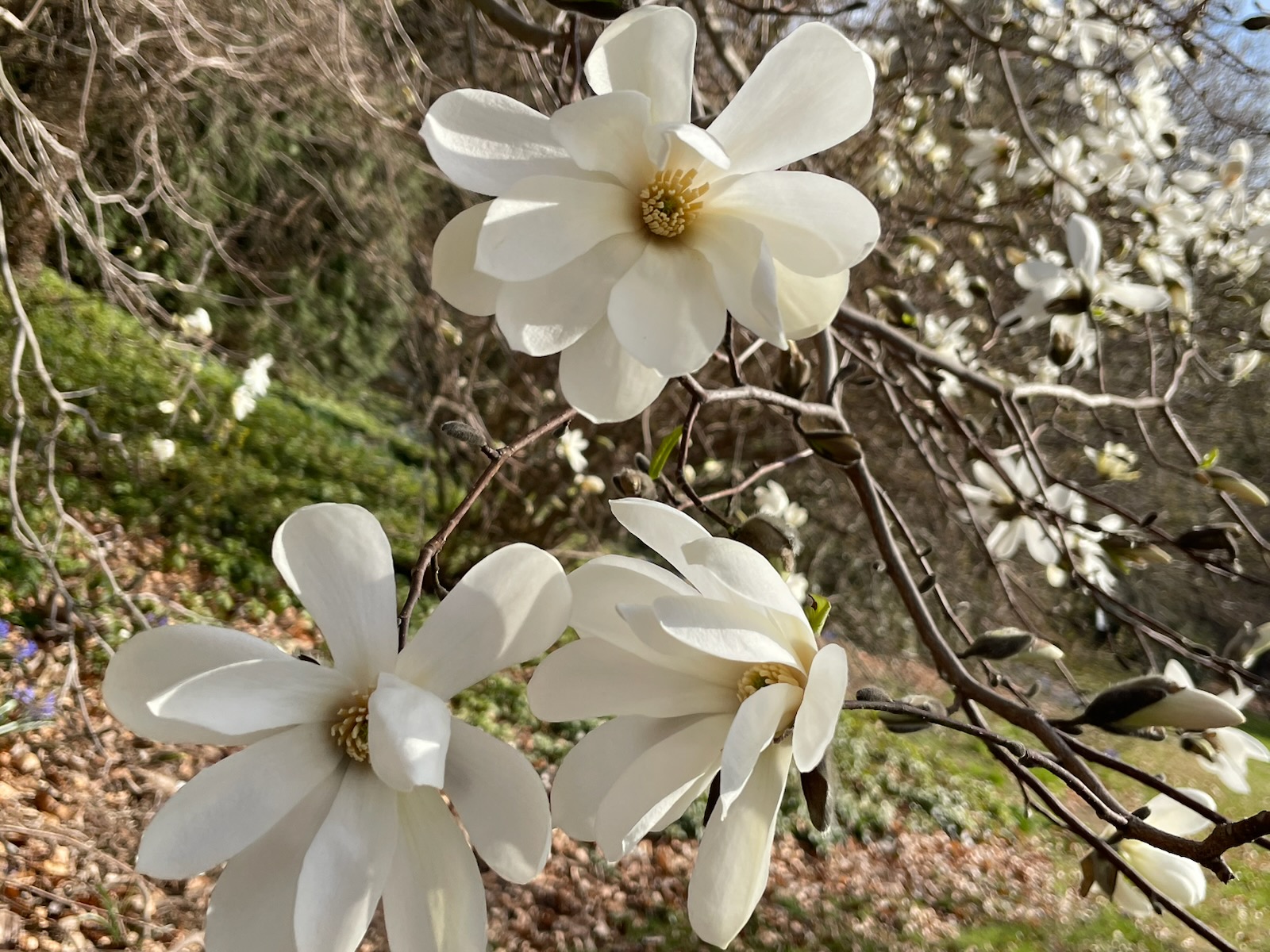
So many different magnolias. Magnolia x loebneri.

All of them awesome.

The first, freshest forsythia.

Even the lowly dandelion is stupendous here.

The mighty old linden I always admire. So buff.

I love the contrast with its delicate buds, that red harbinger of all that is to come.

That feeling in the air.

Clear and sweet is my soul, and clear and sweet is all that is not my soul.

Plenty of spots to rest your weary legs.

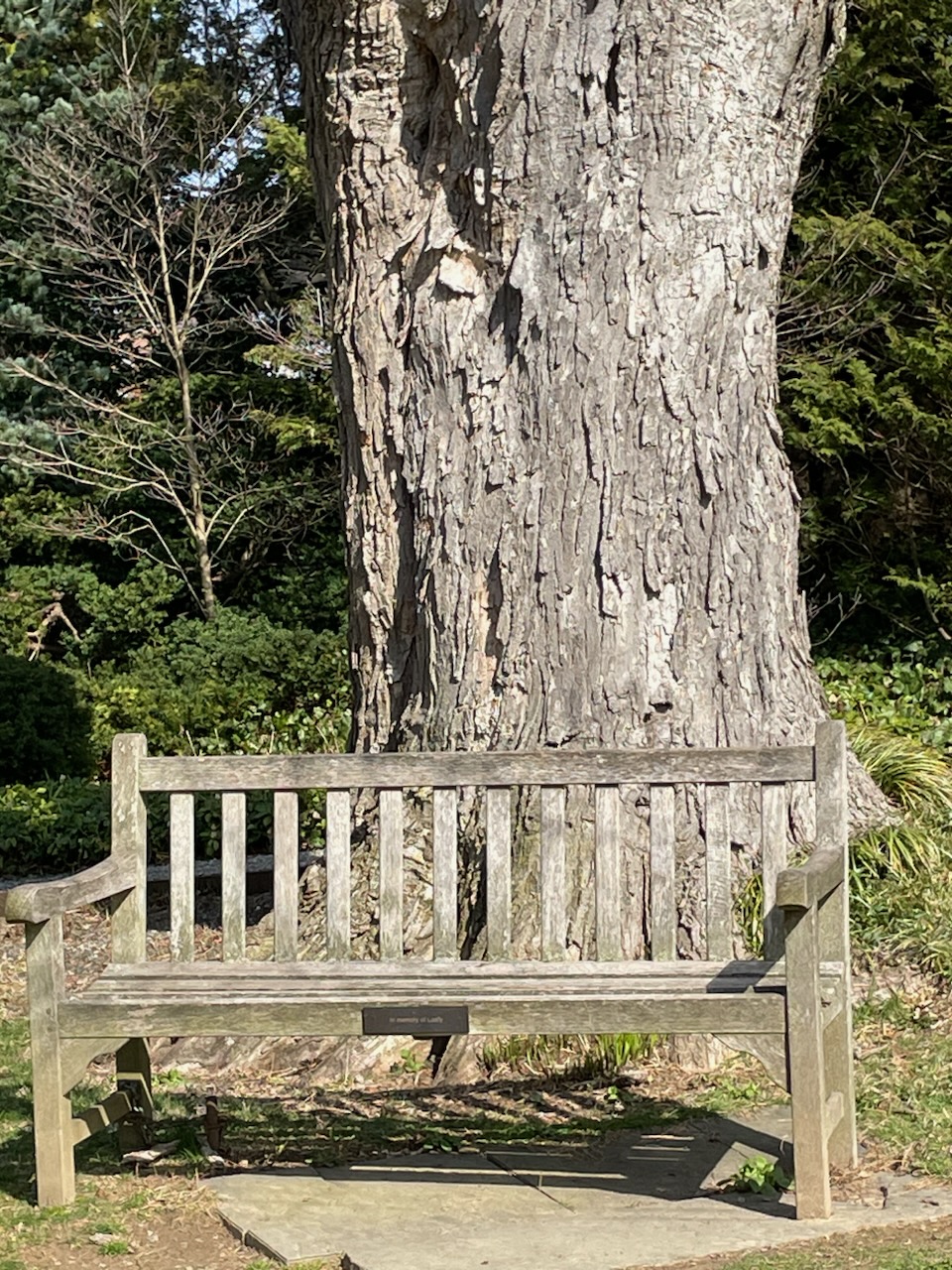
That’s an especially nice aspect of Wave Hill. They say that it’s okay to sit and do nothing once in a while, especially under a massive old sugar maple.

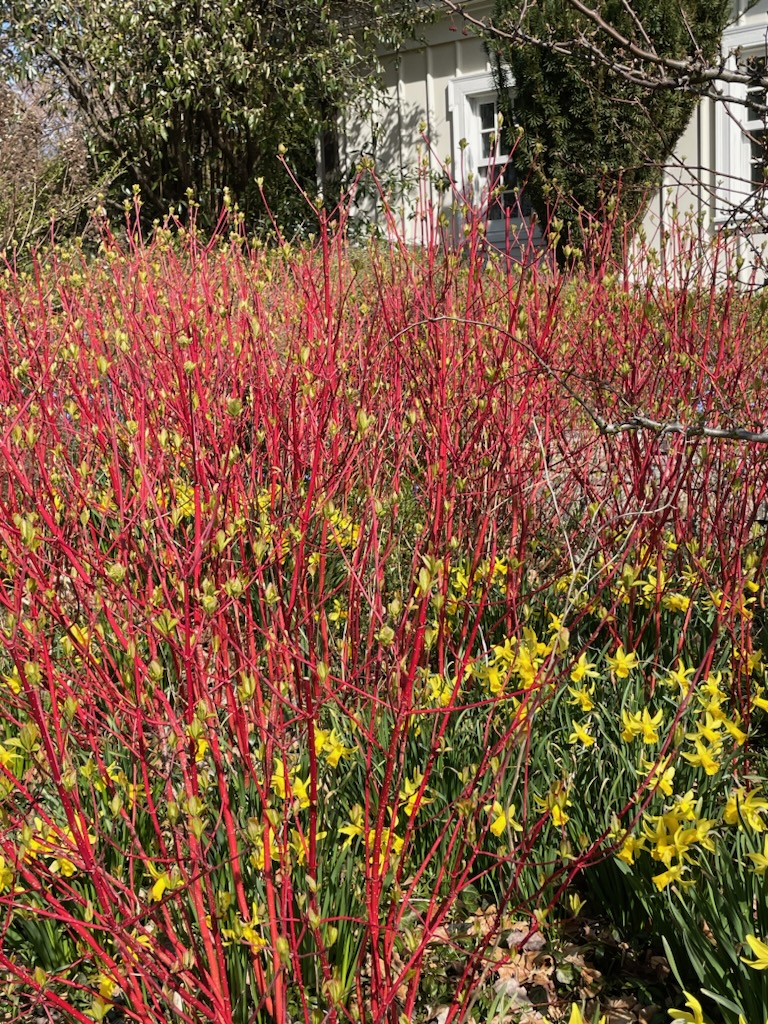
Colors effervesce. Cornus alba ‘Westonbirt’.

Crazy chartreuse needles hang in the air.

Yes, always more blue, blue, blue.

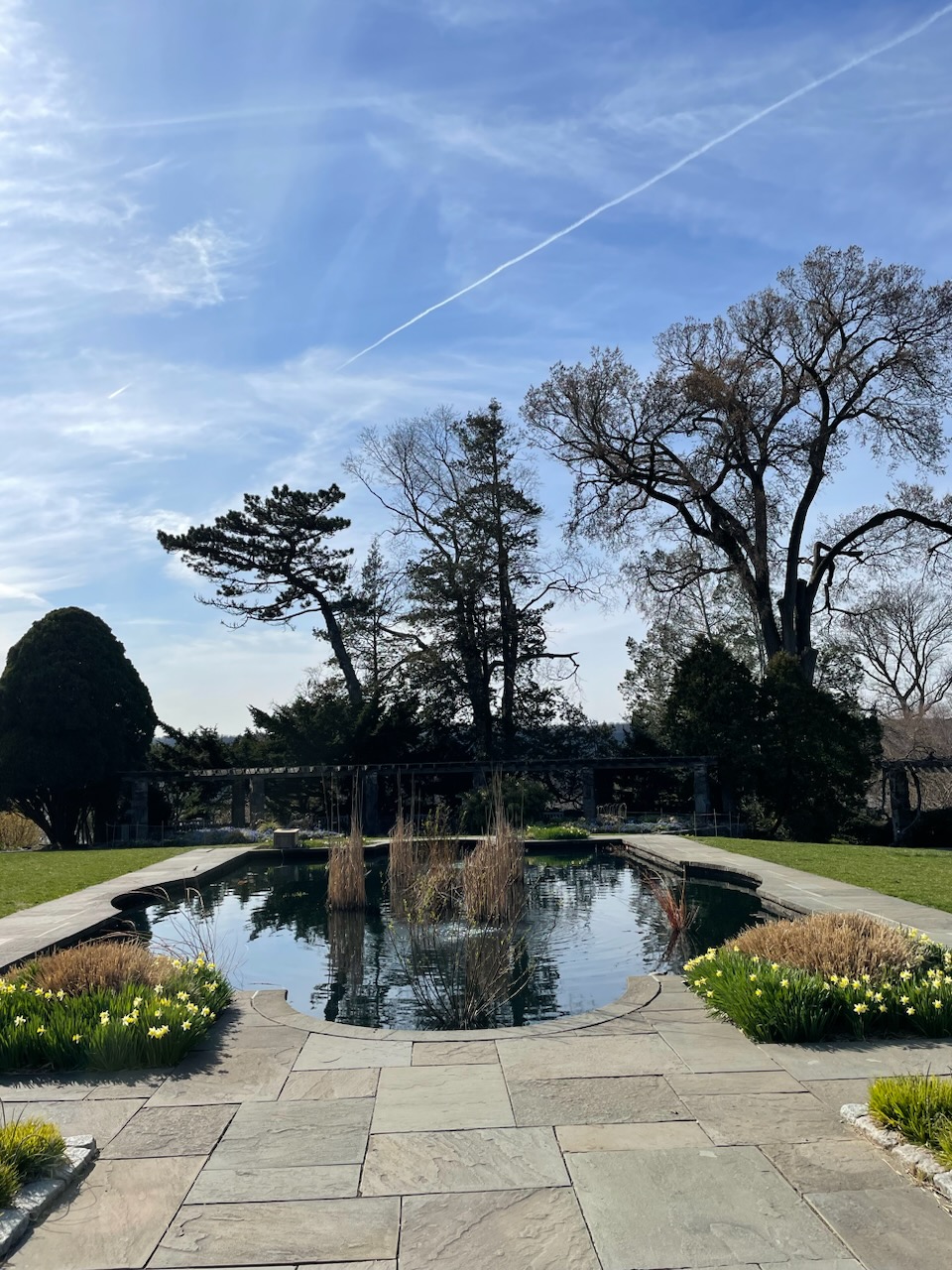
A reflecting pool, so quiet, a good place to contemplate future gladness.

What is commonest, cheapest, nearest, easiest, is Me,

Me going in for my chances, spending for vast returns,

Adorning myself to bestow myself on the first that will take me,

Not asking the sky to come down to my good will,

Scattering it freely forever.

But with all that me, me, me, let’s not forget that we share the earth — especially its trees — with other critters.

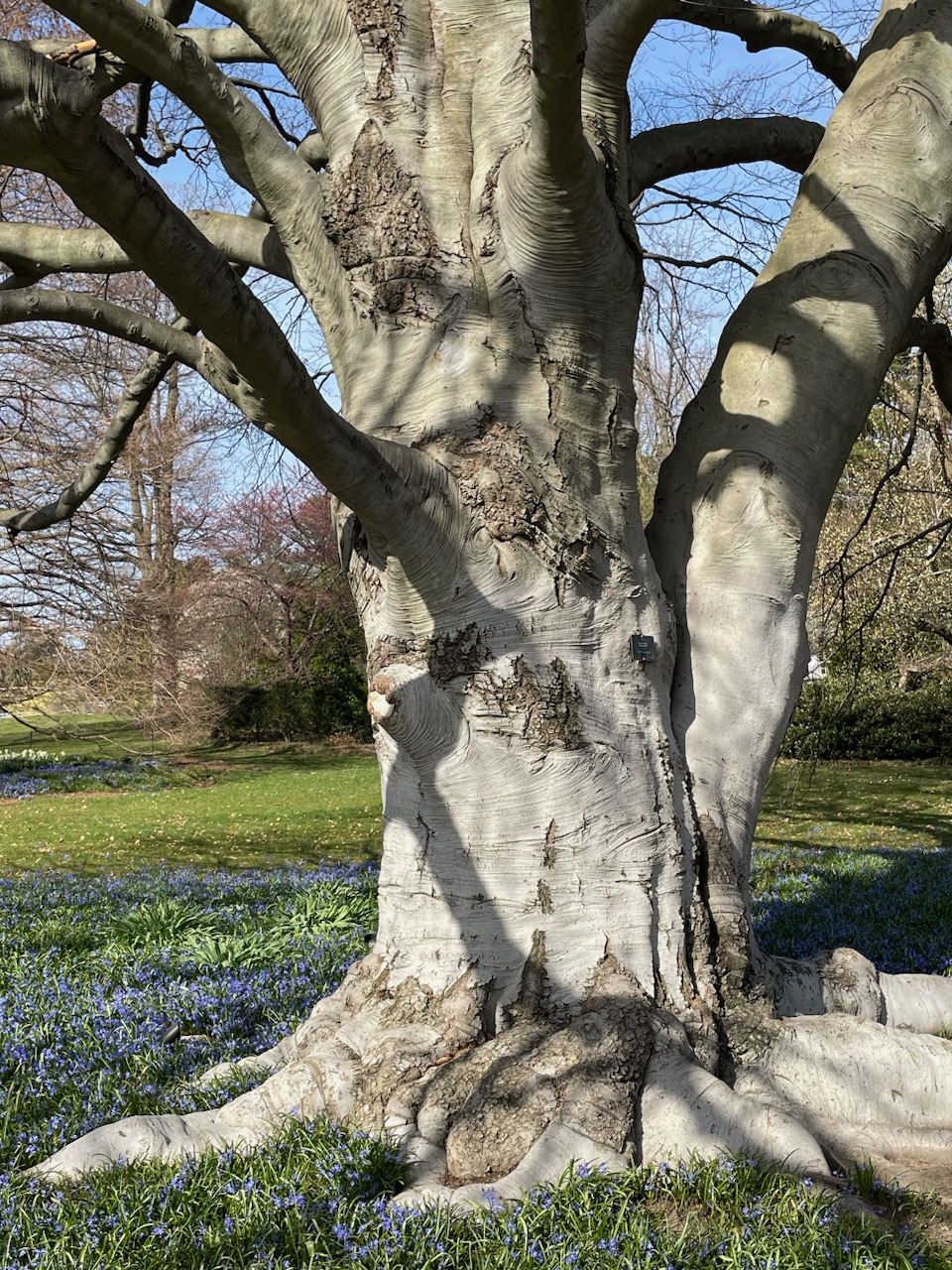
And yes, my favorite copper beeches are ready for their moment. The sheer scale astounds.

The silver of her trunk.

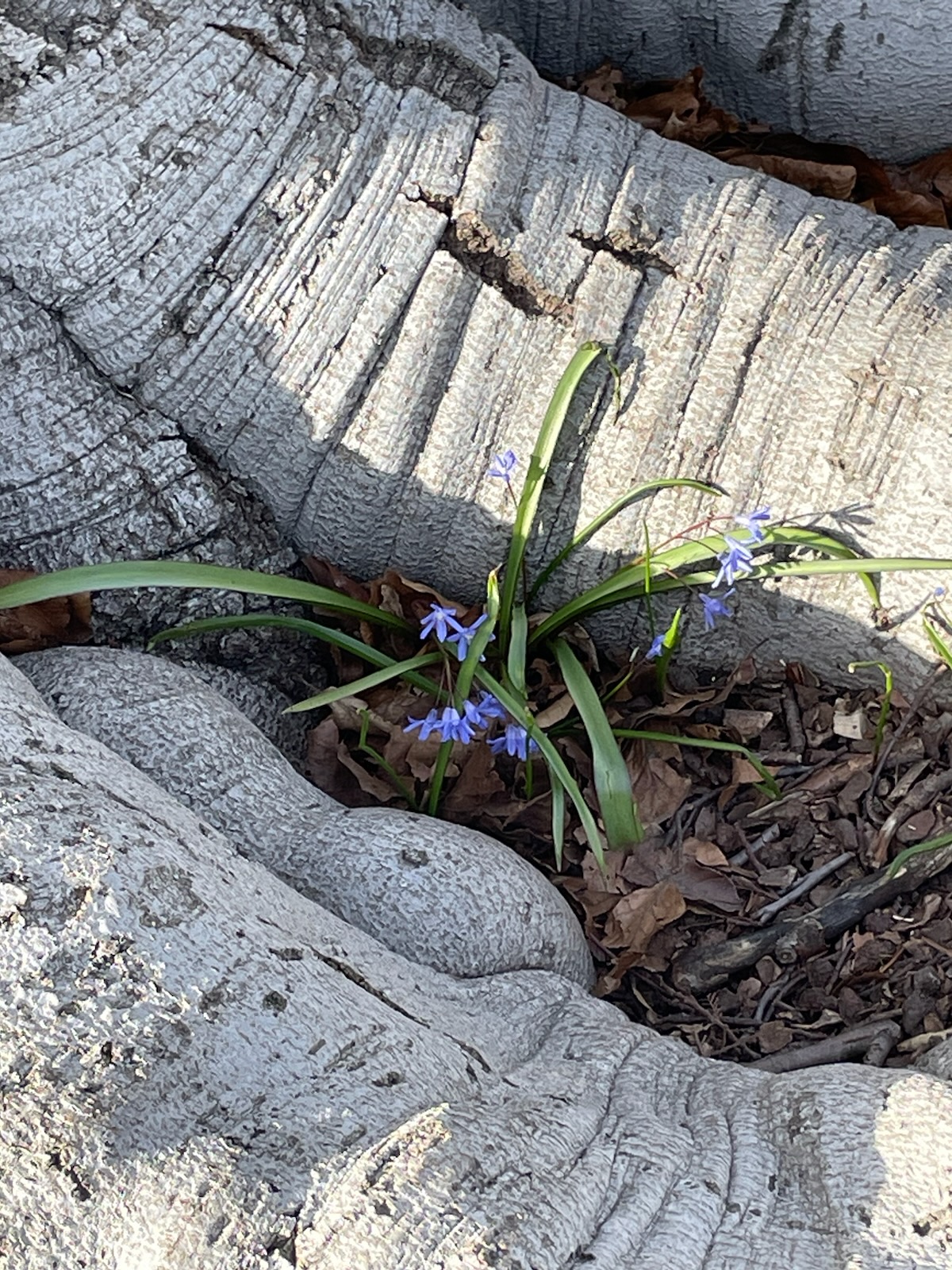
Glory-of-the-snow snuggles between the roots.

Perfection.

Do you take it I would astonish?

Does the daylight astonish? does the early redstart twittering through the woods?

Do I astonish more than they?

This hour I tell things in confidence,

I might not tell everybody, but I will tell you.

In the distance, the sheen of river and sky.

I am happy.

7 Comments

Filed under Jean Zimmerman

A bent tree and a black butterfly

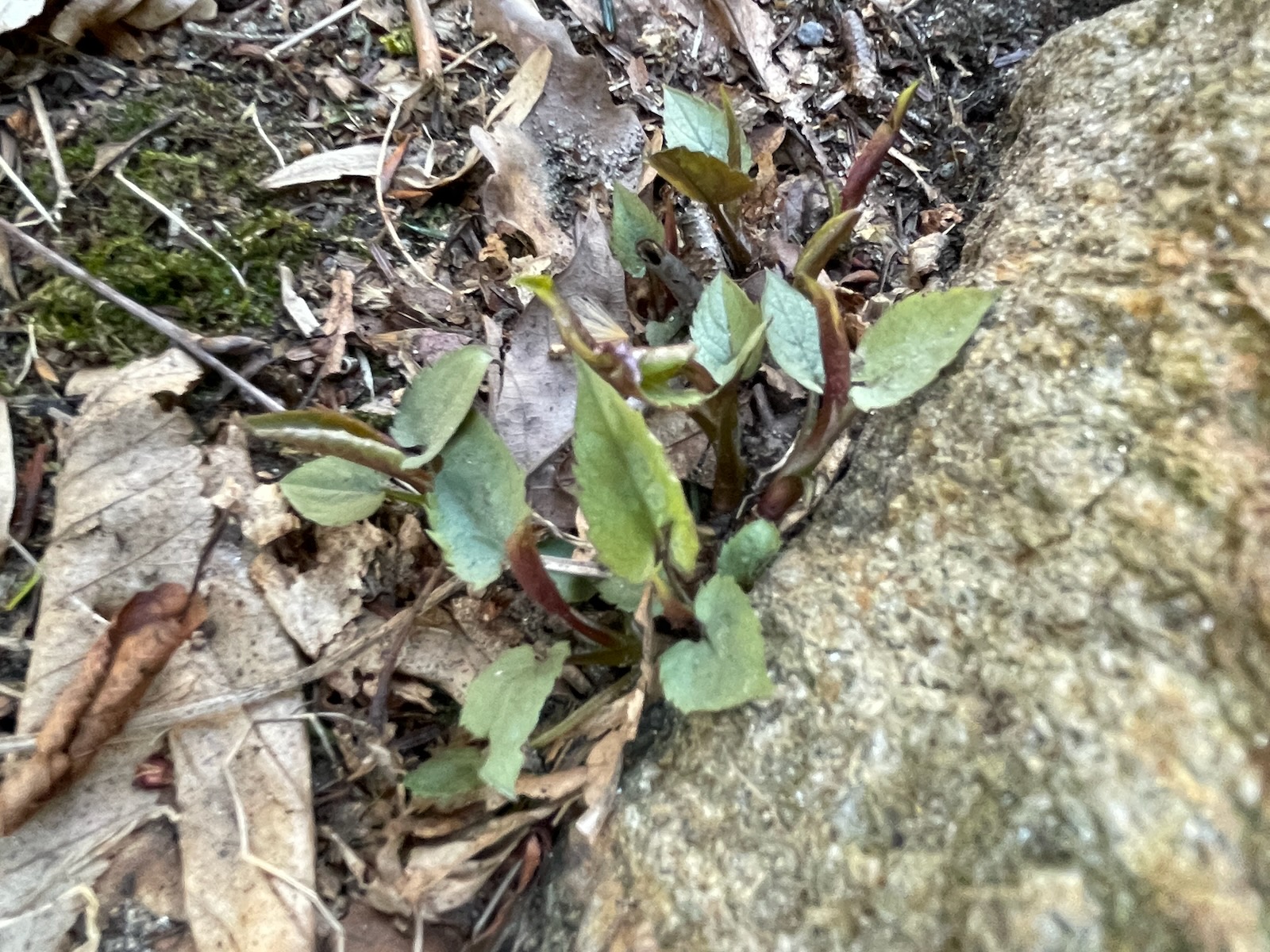
figured prominently in my hike along the northern section of the Old Croton Aqueduct on a day so early in spring that only a few plants were peeping up green.

Also peeping up reddish-brown with yellow streaks, in the case of skunk cabbage.

One of my favorite plants, the skunk cabbage enjoys an interesting chemistry which allows it to create its own heat, often melting the snow around itself as it first sprouts, and always comes dressed in some of my favorite colors. It could be an official Pantone Color of the Year. (The Pantone Color Institute Program, begun in 1999, previously has included such boring hues as Classic Blue and Tangerine Tango.) Once popularized thus, you could buy a ball gown or paint your walls with it. Actually, the Pantone Color of the Year has already been chosen for 2023, and it is Viva Magenta, which is not that far off.

So then, the Color of the Year for 2024! Skunk Cabbage. It may be poisonous for us, but pollinators find it delicious.

I was fortunate on the OCA trail to have naturalist Diane Alden as my guide. Some years ago, Diane showed me around Wildflower Island at Teatown, a gorgeous place that you can’t visit unless you tour it privately, they are so dedicated to not mashing down the precious horticulture. Here we saw a white wood aster just poking out.

Wild plants are Diane’s passion, and she has devoted herself to rooting out invasives on the OCA trail so that native flora can flourish. I don’t believe I had ever set foot on this northern portion, which soars above the Croton River Gorge.

Since 2014, Diane’s initiative with Friends of the Old Croton Aqueduct (she’s a board member) she has had a great deal of success, pulling in tons of volunteers of all ages, especially on I Love My Parks Day every spring.

On our promenade, I saw some familiar things I knew the names of, as well as those I’ve seen a million times but couldn’t name, and those I’d never even noticed. It was that kind of a walk, when all your synapses are wide open and you want to commit every observation to memory.

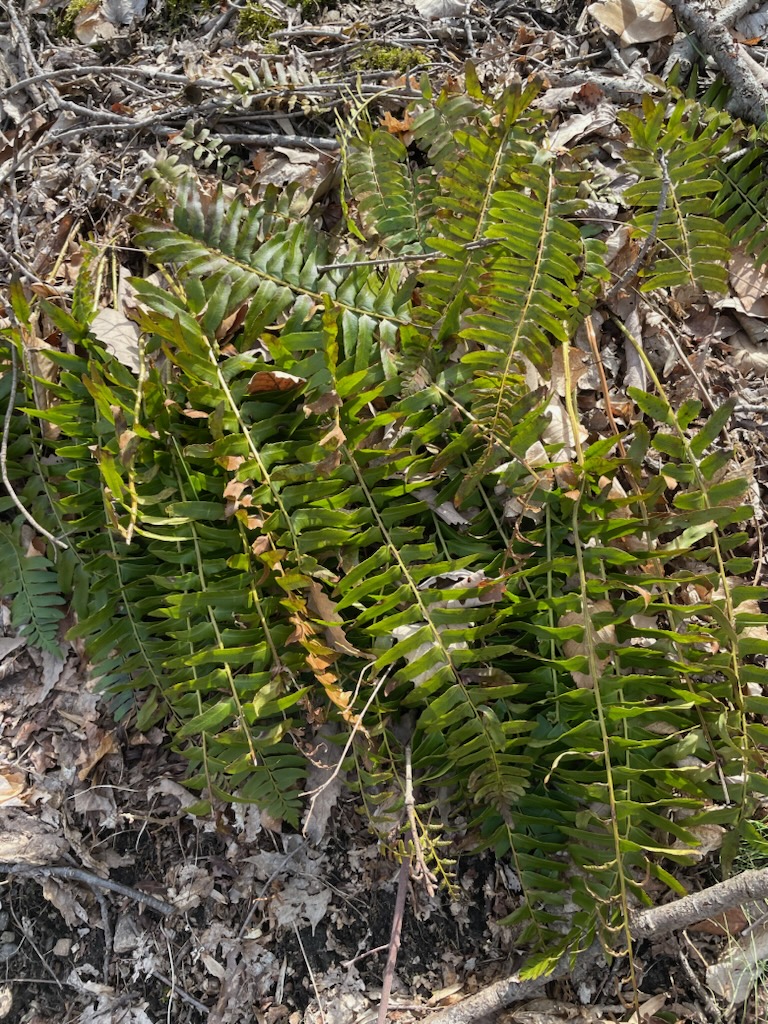
Diane pointed out Christmas ferns, which it turns out have the remarkable ability to self mulch.

Lift off the new growth to find the old fronds mouldering underneath, ingeniously protecting the roots. Diane pointed out some rushes, and reminded me of the lyric that helps naturalists differentiate grass-like specimens in lieu of an ID book: Sedges have edges, Rushes are round, Grasses have nodes all the way to the ground. We talked about lichen.

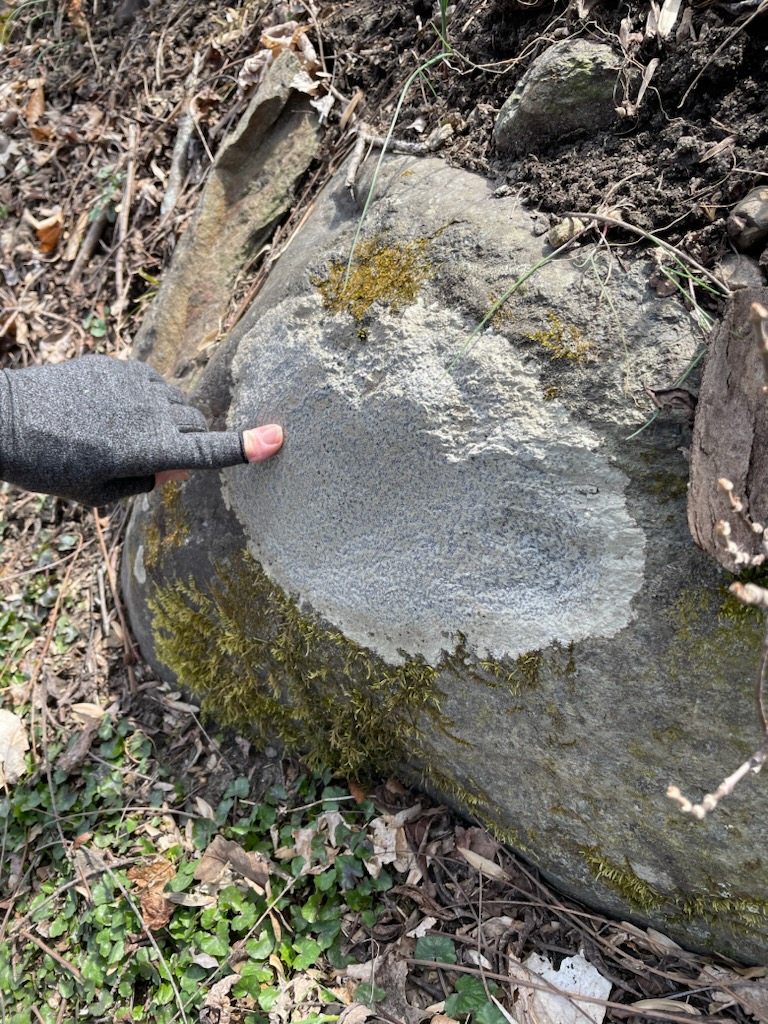
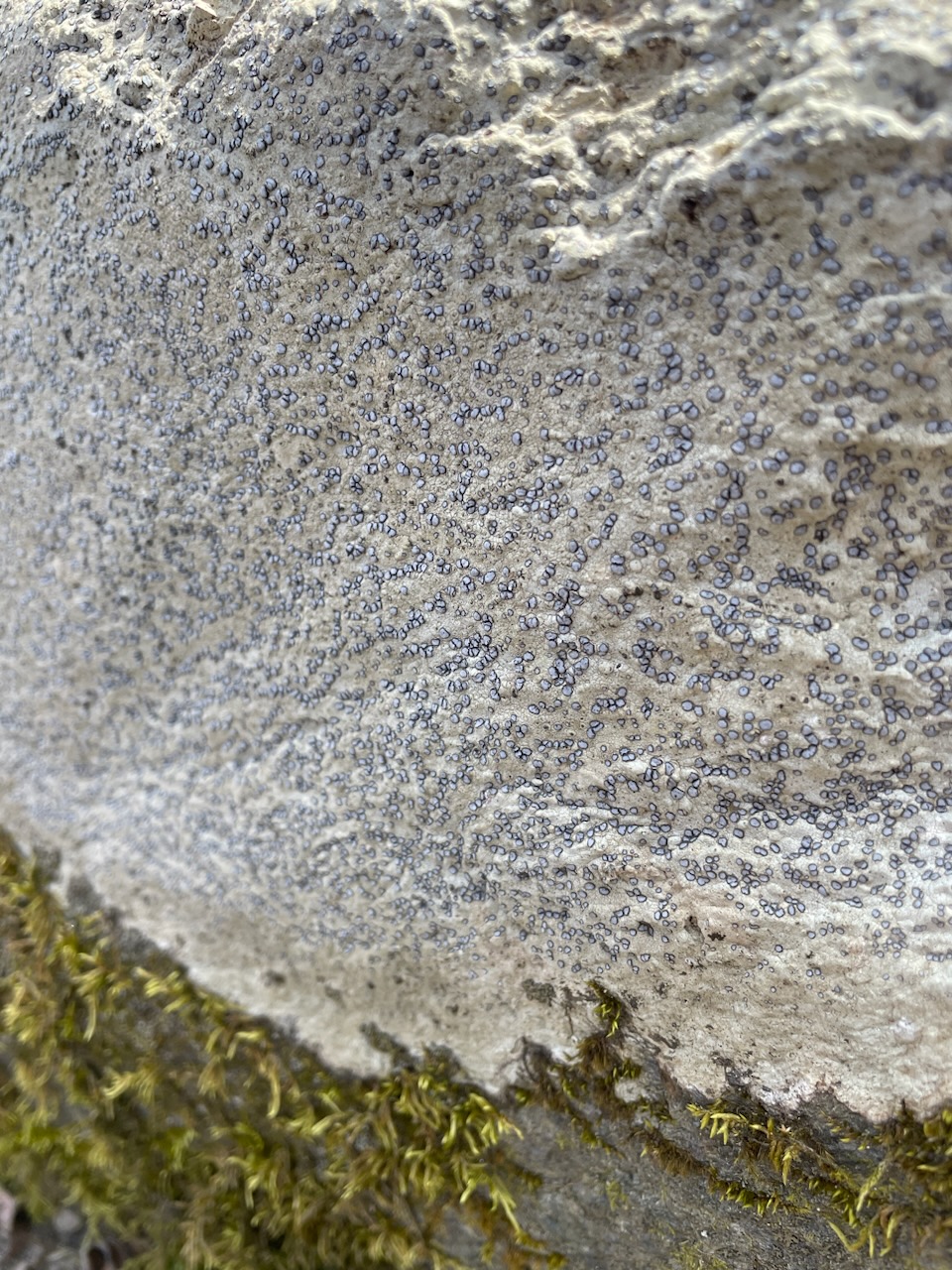
This one is crustose, one of three major kinds. There are also the foliose and the fructicose. Lichens are a type of symbiotic organism made up of a plantlike partner and a fungus. Known colloquially as smokey-eye boulder lichen, the one we saw featured an exquisite tapestry of tiny dots if you bothered to take a close up view.

Crustose, Diane said, “can’t peel off.” Guess that’s a handy survival tactic.

Just then a mourning cloak butterfly appeared. “That’s the first I’ve seen this year!” said Diane. I could not capture it with my camera, it swooped and flitted so fast, but I did Google the species later.

Nymphalis antiopa, native to both Eurasia and North America. has a name which came over with Scandinavian or German rather than British settlers. There is a cool historical nugget concerning the species. British lepidopterist L. Hugh Newman ran a butterfly farm in Kent that supplied the creatures for Sir Winston Churchill’s enjoyment and also wrote many popular books in the 1940s and 50s (Butterfly Haunts, Butterfly Farmer, Butterflies of the Fields and Lanes, Hills and Heathlands… and so on). He likened the wing’s pattern to a girl who disliked having to dress in drab mourning clothes and defiantly let a few inches of bright hem show below her black dress. I like just about all defiance, so I love this butterfly.

We walked by the bane of the invasive-eradicator’s existence, multiflora rose bushes, just now beginning to leaf out.

Native to Asia, the multiflora rose first came to the U.S. in the 1860s, when it was employed by a well-meaning but somewhat naïve horticultural industry as an ornamental garden plant. Fast forward to the 1930s, when the USDA Soil Conservation Service thought it would provide a nice natural barrier to roaming farm animals (a “living fence”). Well, the bush skedaddled out of any confines that ever held it back, and has since been classified as a noxious weed in many states. Scores of volunteers have pricked their fingers pulling out the shrub along this trail.

Diane described garlic mustard, which “exudes a fungicide so we are eager to eradicate it to preserve our valuable mushrooms that are so important to the health of the forest.” Also, those “pretty little yellow flowers all along the edges of the trail” are lesser celandine, and they crowd out the much more beautiful wild violet.

Invasive plants have no natural enemies. Even the deer eschew them. Diane pointed out a stalk of the particularly evil wild raspberry, whose sumptuous fruits I have sampled many times but which wreak havoc with birds’ digestive systems, “kind of like junk food.” It’s nearly as bad as porcelain berry, and that’s saying something. I wondered if well-meaning invasive whackers ever yank up anything good by mistake. Diane told me that once a fellow who had not been adequately trained proudly displayed a plant he had ripped out by the roots, believing it to be porcelain berry. Sad ending, it was actually a rare doll’s eyes plant.

We want the birds to eat good foods and prosper! As if on cue, a lovely little nest appeared.

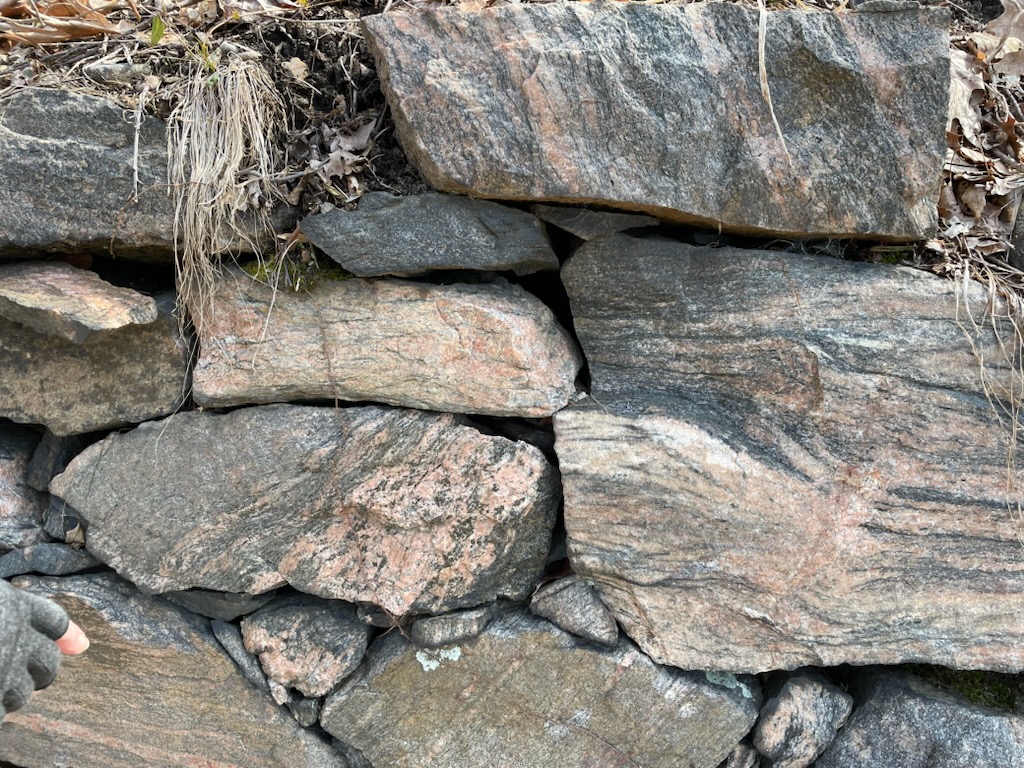
Something that survives when Diane’s volunteers succeed are intricate stone walls dating back to the mid-1800s. These have the most beautifully pink-streaked quartz.

Robert Frost is famous for these lines:

Something there is that doesn’t love a wall,

That sends the frozen-ground-swell under it,

And spills the upper boulders in the sun;

And makes gaps even two can pass abreast.

Recognizing that historic walls are vulnerable, the Friends commandeered stone mason George Cabrera to shore them up. I had to confess to Diane that I love old, tumbling-down structures better than any tidied-up restoration. But the farmers who originally assembled these stones – probably employing the same stonemasons who built the underground Aqueduct itself – would have repaired them so that they would last forever. So it only makes sense to honor their efforts by doing so now.

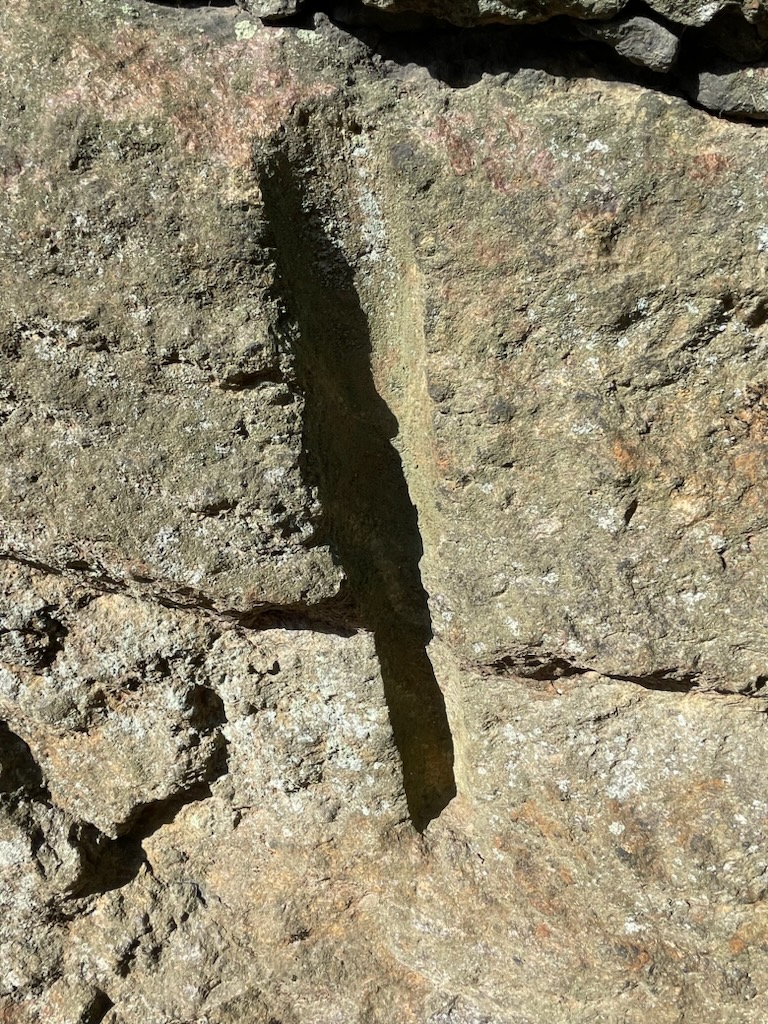
Speaking of stone, we passed through rock that was split apart by gunpowder at the time the Aqueduct was installed, between 1837 and 1842. Yes, gunpowder.

Diane pointed to chutes cored out from above where the powder would be dropped down and ignited. Boom! Impressive technology predating dynamite’s invention by Alfred Nobel in 1867.

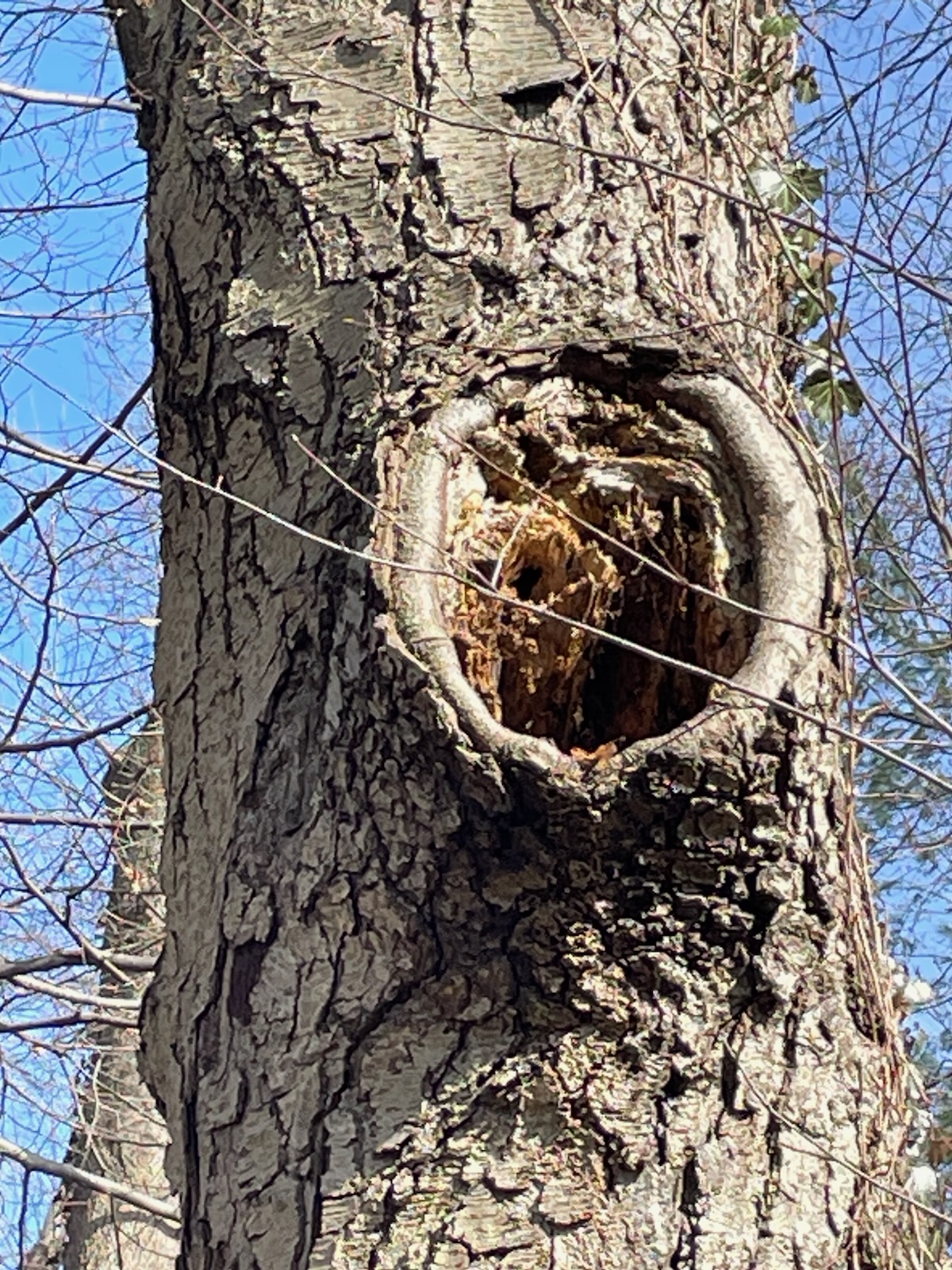
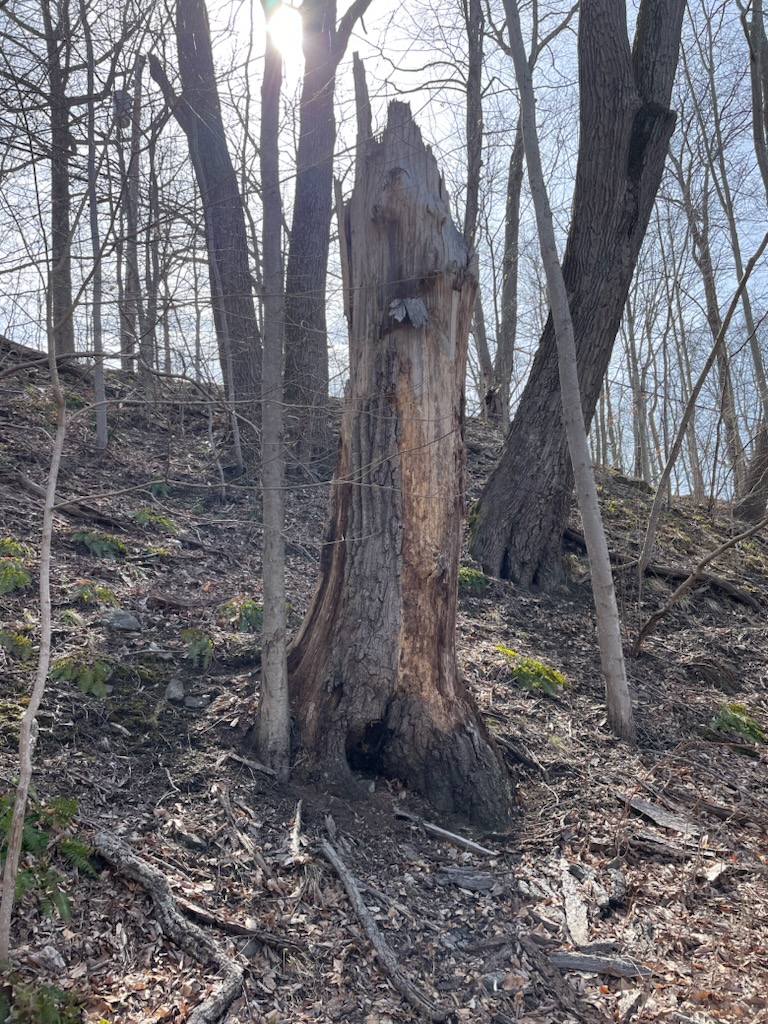
We passed some incredible trees. A broken off trunk with loads of character and a nice hidey hole at its base. Dead trees often go underappreciated for their important role as habitat.

A soaring hemlock. Hello up there!

I remember asking a more seasoned arborist if losing all those lower branches meant the tree was dying. The answer: No, the tree just wants to conserve its energy in order to keep growing. And, as Diane pointed out, to reach for the sunlight. Trees, as usual, are smart.

Some impressive roots here too.

And a sight that struck me as almost too amazing. A branch bent up at a right angle. Was this just an unusual growth habit? Sometimes trees do grow in ways that might be construed as strange – say, conjoined trees, my favorite. This might be different, though.

Could it possibly be what is called a Trail or Marker Tree, or more technically a Culturally Modified Tree? These specimens, which curve and grow sideways at such an impossible angle, often turned sharply up toward the sky, are historical curiosities found all around the country, whether out in the woods or in city parks or front yards.

Experts say that CMT’s once helped the Native Americans who trained their growth find safe paths through rough forests and locate river crossings or natural springs, shelter or encampments Tom Belt of the Cherokee Nation of Oklahoma explained their purpose: “The bending of trees was essentially part of a great highway system that allowed people from many tribes to interact with each other, and there was an inordinate amount of trade going on.”

I don’t know if the one on the trail today was a Marker Tree, but I want to believe.

We racewalked back, late to meet a friend for lunch. Diane’s house has a rapturous view of the Hudson, dozens of birds attendant at the bird feeder – she tracks their comings and goings daily – and one hundred or so thriving houseplants. She offered to gift me with one. Would I prefer a walking iris or a jade plant? Decisions, decisions. Once, long ago, I kept a jade plant that I sadly, shall we say, undernurtured. I figured I’d make atonement for that fiasco this time around.

The jade plant has taken up residence on my office window sill. If you peer out the window into the distance, the ridge you see is the top of the Palisades. Not a Hudson River view, but close enough on this day of small but impressive sights in early spring.
1 Comment

Filed under Jean Zimmerman

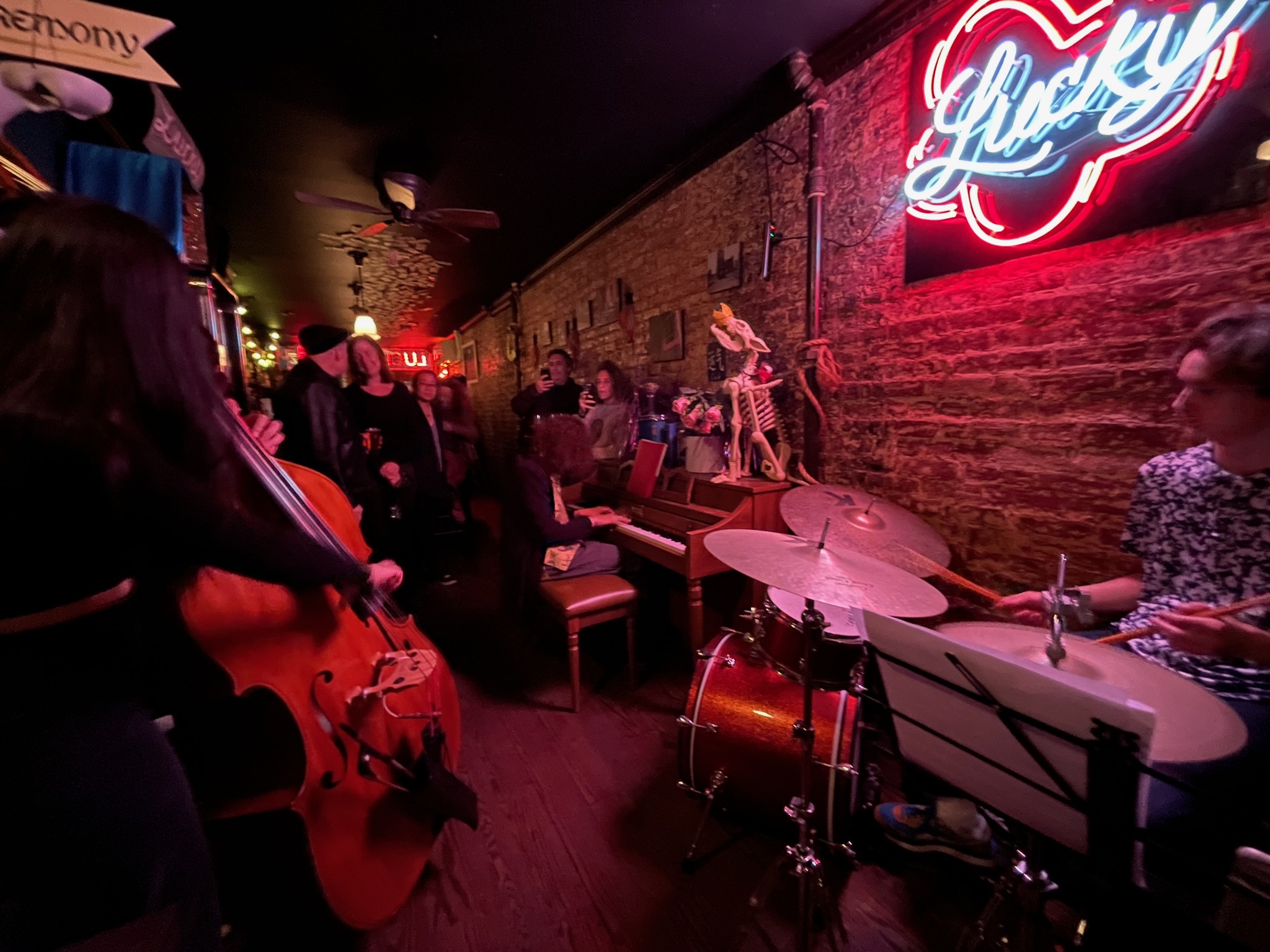
It takes more than luck to play music at Lucky.

It takes skill – and also guts, especially if you happen to be a 16-year-old pianist making your debut leading a jazz trio in New York City.

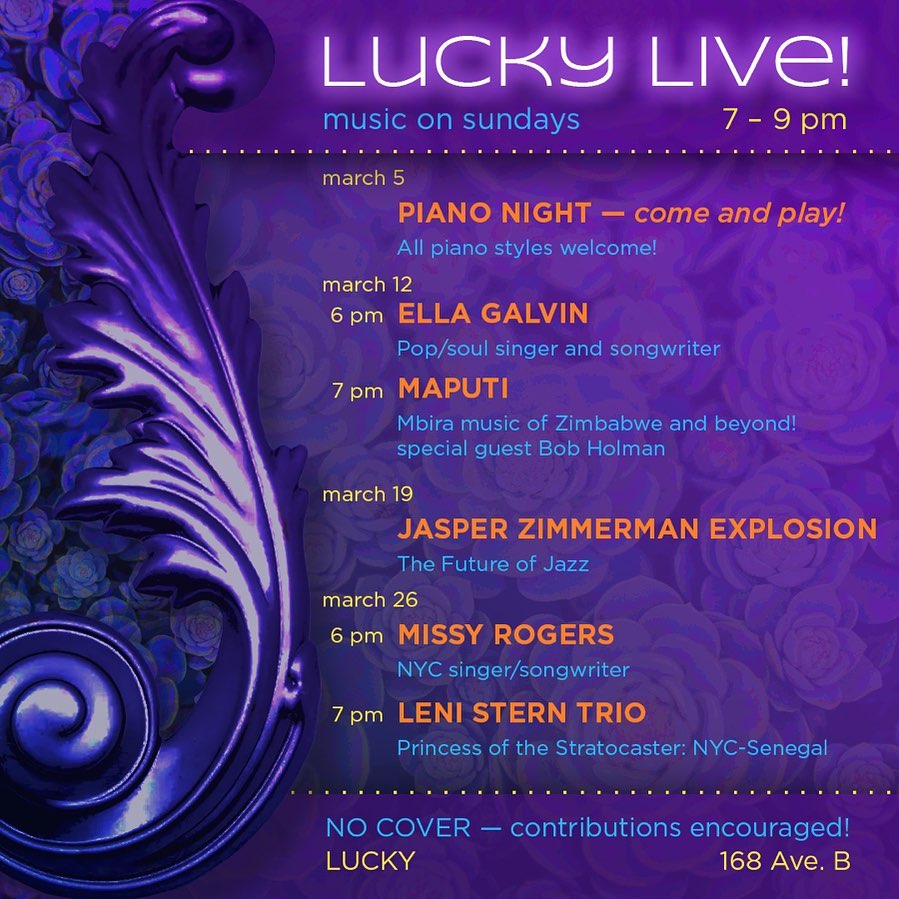
The Jasper Zimmerman Explosion appeared at the intimate establishment a couple of nights ago. No cover. No minimum. Just lots of cool. Lucky’s on Avenue B, after all.

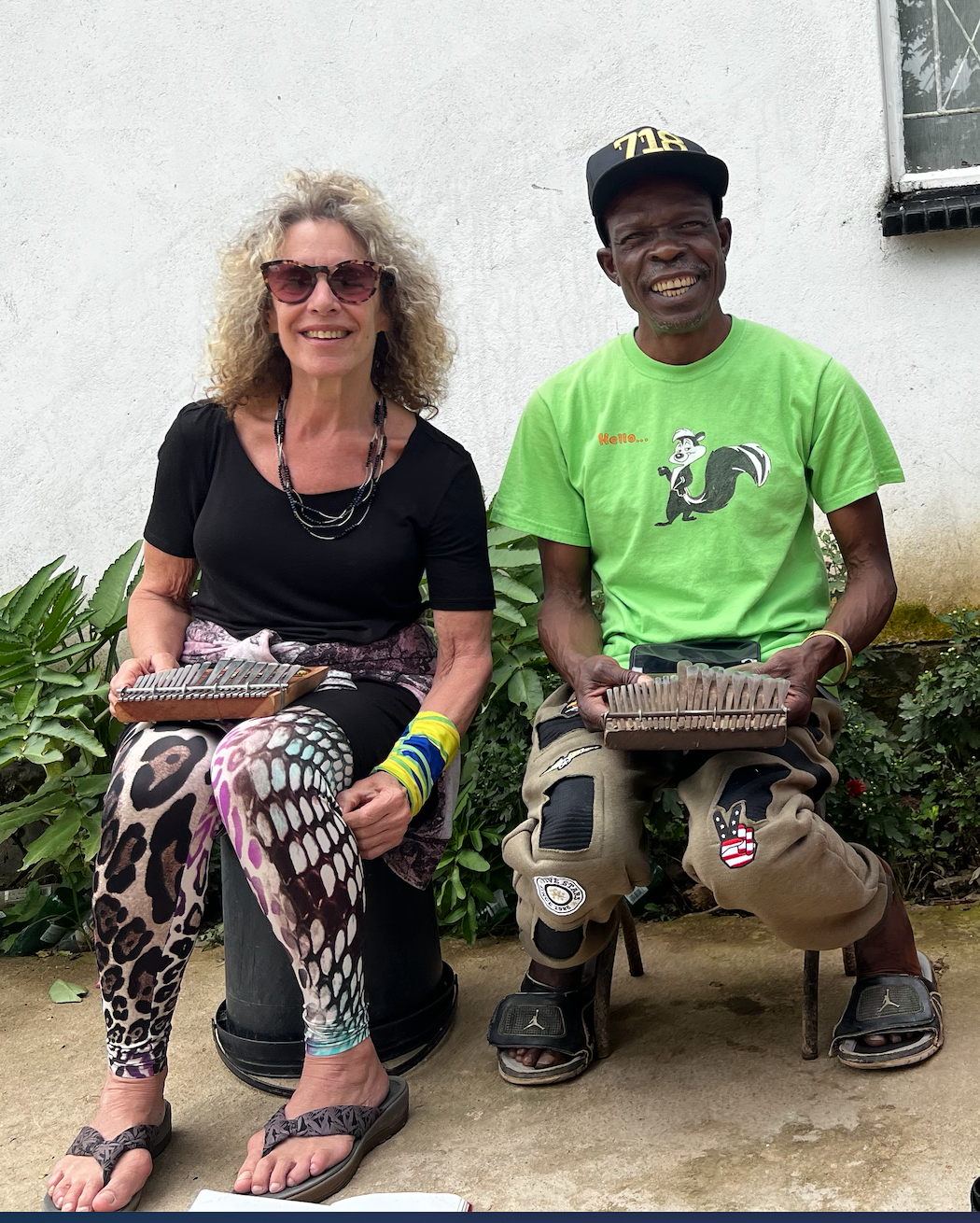
My friend Nora, also a musician just back from a voyage to Zimbabwe, organized the series of events in which the Explosion appeared. She has two groups of her own, Maputi, which is traditional, and Timbila, original music based on tradition.

Every Sunday after the main event comes piano night.

Nora’s favored instrument is the mbira. Mbira is the spiritual music of Zimbabwe, used to communicate with ancestral spirits. Nora told me about playing mbira in a mermaid ceremony there, an all-day event that also featured hosho (gourd shakers), drums and singing. Mediums on these occasions become possessed, and it’s amazing, she said.

Nora first traveled to Zimbabwe to study in 1996 and has been back many times.  She loves it there and is always inspired by the musicians she plays with.

Jasper happens to be my nephew, but I’m not the only one who considers him a great talent at his young age. He has already shared the stage with some phenomenal musicians, recognizable names in the field.

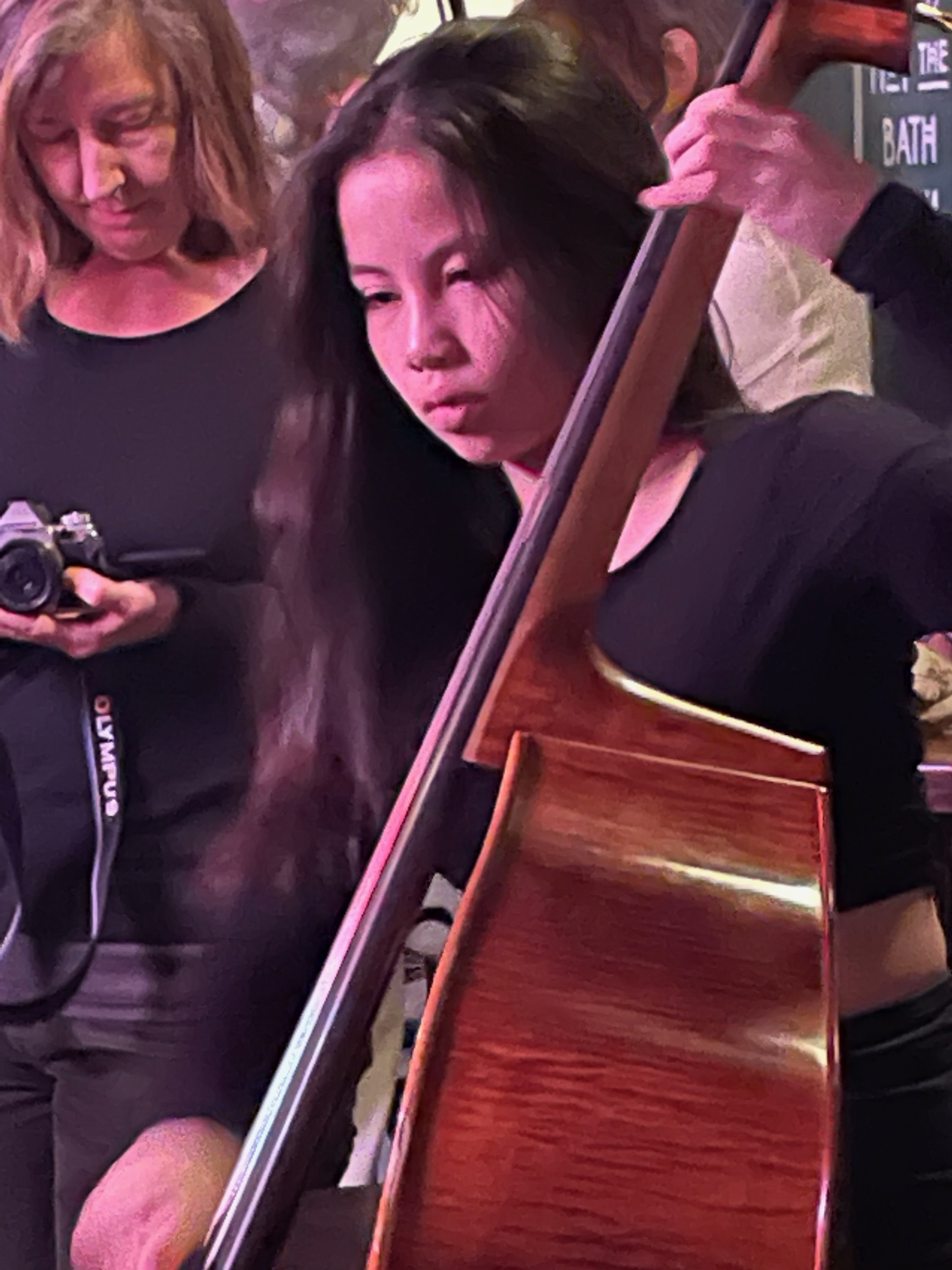
For this gig he was playing with some other outstanding musicians. Ruby Farmer on bass. She’s in 11th grade.

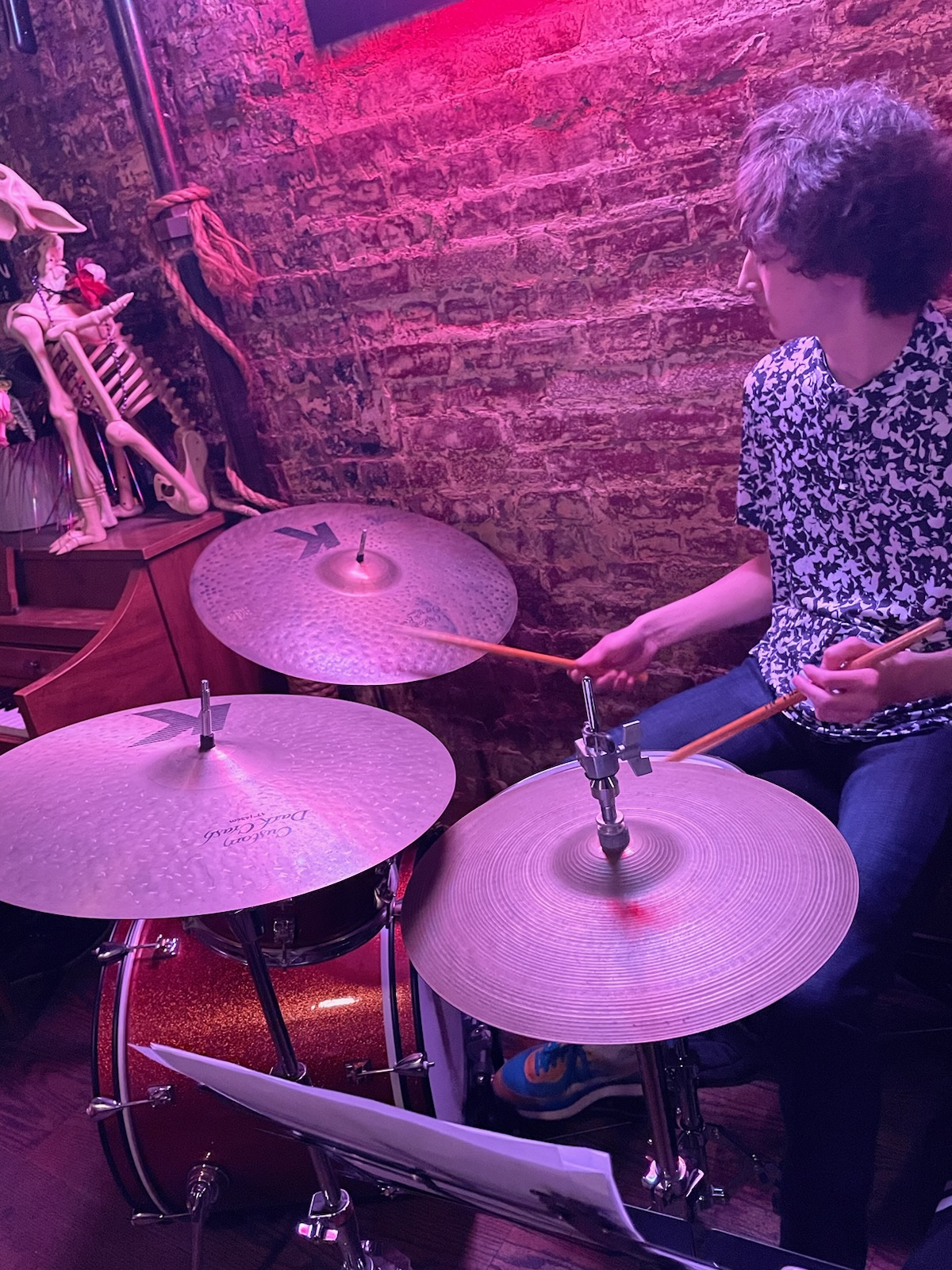
Coleman Breining on drums. He was respectful of the small space and peoples’ endless desire to yak over drinks, and made great use of the brushes.

They’re so cute, I couldn’t help but comment to Nora as we stood entranced by the side of the bar. I don’t think you can call them cute when they’re so good, she said. And of course she was correct.

Lucky proved to be a great venue for this startup appearance. Abby Ehmann owns the joint. As the sole proprietor, she has had an interesting career trajectory – one perhaps more typical for New York City than elsewhere – from graphic artist for web projects to photographer’s rep to ad agency proofreader to Penthouse magazine editor to cyber-fetish party planner to… barkeep at this fabulous boite.

She told a newspaper interviewer once that she came up with the name of the bar one sleepless night: “I thought there would be a million places with that name but I Googled it and there was no bar in America called Lucky.” She also opened sober bar Hekate just across Avenue B, where patrons like me can get a delicious exotic mocktail and no one laughs at you for eschewing booze.There is witchy stuff for sale at Hekate, too.

The name of Abby’s perpetual ornament, her teacup toy poodle, is Scribble.

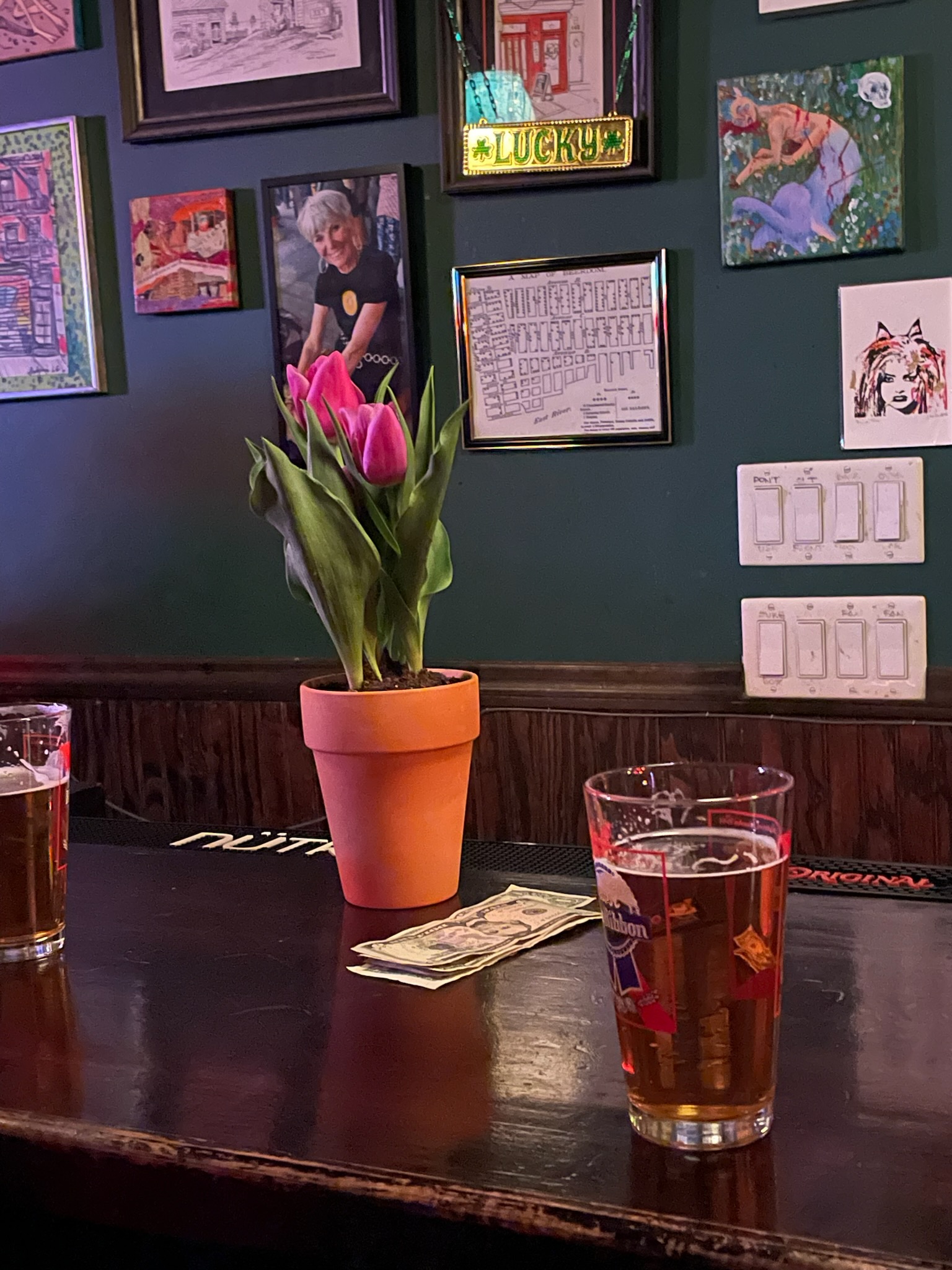
Lucky had held a vernal equinox celebration earlier in the day, so everyone was gussied up and had a happy afterglow. Spring flowers bloomed on the bar.

The place is New-York-City-Loisada hip. The décor.

Moneyed ceiling.

The people. I had a bond with someone I met at Lucky for the first time, Alison Collins – I’d helped her out in a very minor way by transporting one of her sculptures when she was out of town, at the suggestion of a mutual friend.

Now she presented me with something wonderful, a little nest sculpture, suitable either for hanging or displaying on a flat surface.

The Explosion’s eclectic set list included I Didn’t Know What Time It Was by Rogers and Hart, Epistrophy by Thelonius Monk and Wayne Shorter’s Fee Fi Fo, along with Jasper’s original compositions Balloon Ping Pong and Interstellar Cable Car. When they played Cole Porter’s Just One of Those Things at Gil’s request, delivering the tune impeccably with no charts, no music, nothing, Gil pretty much kvelled. They really showed their chops. He overheard Ruby’s deadpan response when Jasper told them they’d be playing the number, Yeah, I think I played that once.

I talked to Jasper afterwards about the experience. Last night was so much fun, he told me. Ruby, Coleman, and I have been rehearsing together for so long, and it was really nice to play together in a performance setting.

About the venue: Since Lucky was such a small space (we could hardly fit the bass and drums!), and the piano was just a little upright, I didn’t expect much of the acoustics. However, the piano, bass, and drums all cut through and I was told that people in the back could hear us clearly. Playing at Lucky reminded me of the bygone days of New York jazz, where musicians performed in dive bars similar to it.

Pretty sure the rest of the Explosion, Lucky’s owner, the bar’s patrons and the other performers in Nora’s line-up would feel good about that dive bar lineage.

Leave a comment

Filed under Jean Zimmerman

A warm and moist hush prevails

in the exhibition area of the New York Botanical Garden’s Annual Orchid Show.

And is there any better kind of hush? Especially on a cold and blustery late winter day in the Bronx.

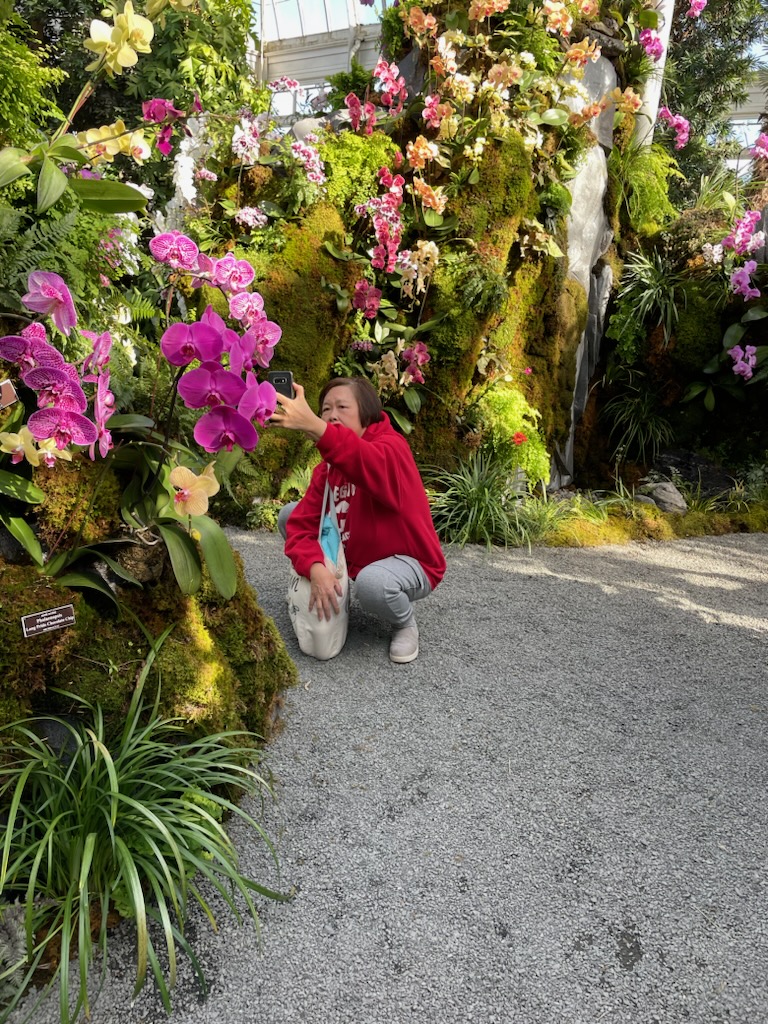
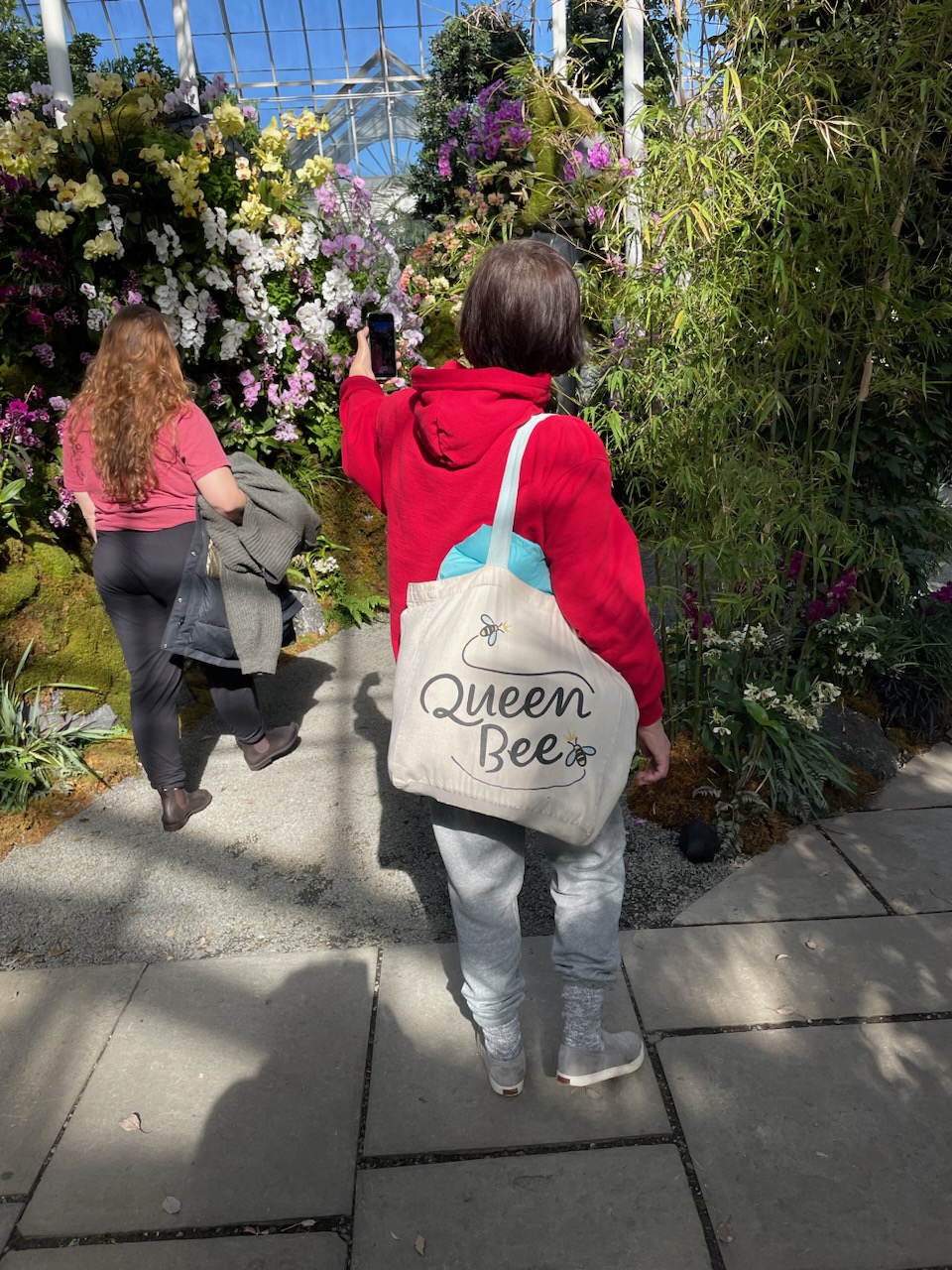
Orchid lovers endure heart palpitations all around. At least those not too consumed with taking pictures.

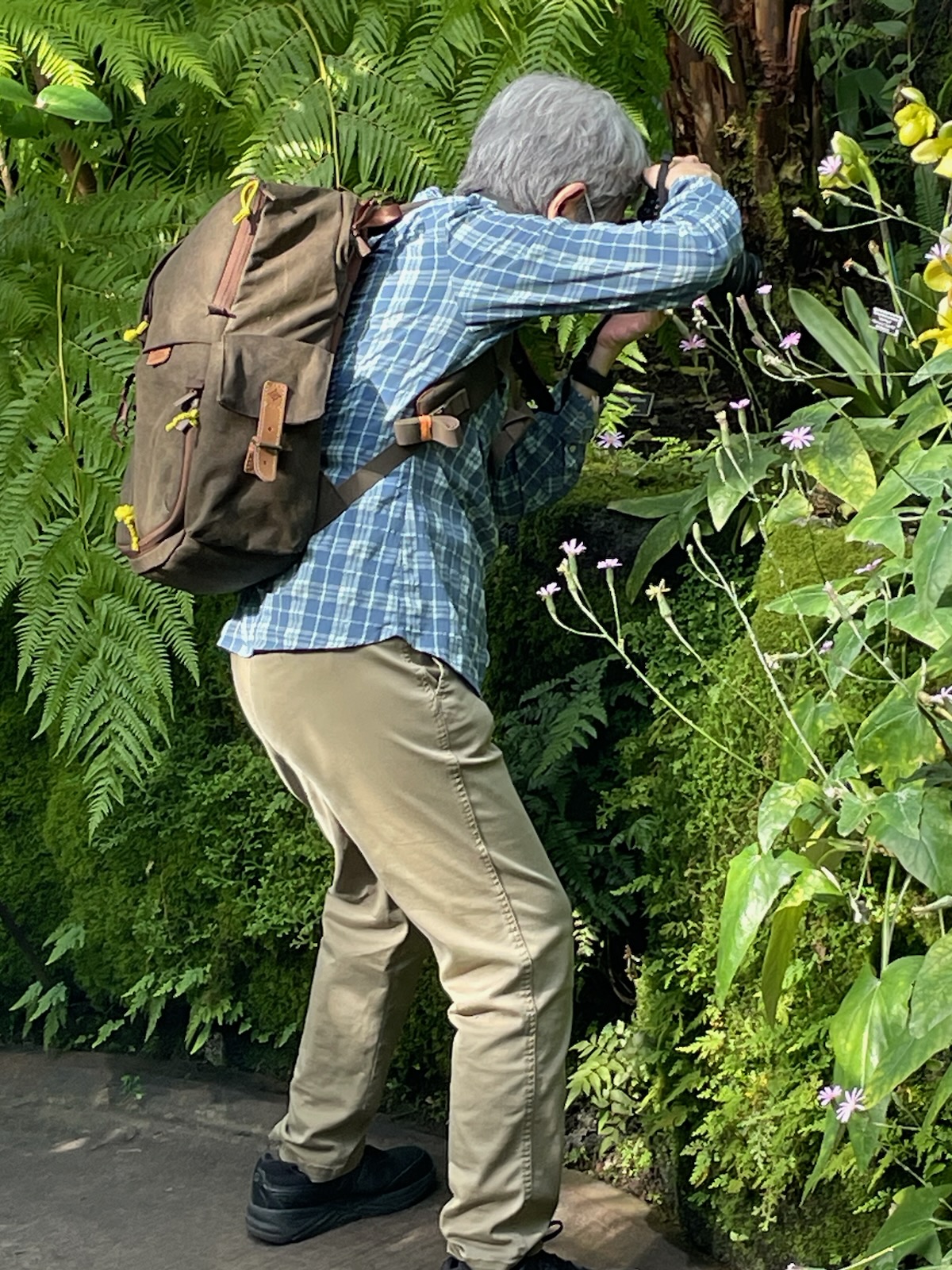
Photographers are legion here. So many photo opps, so little time.

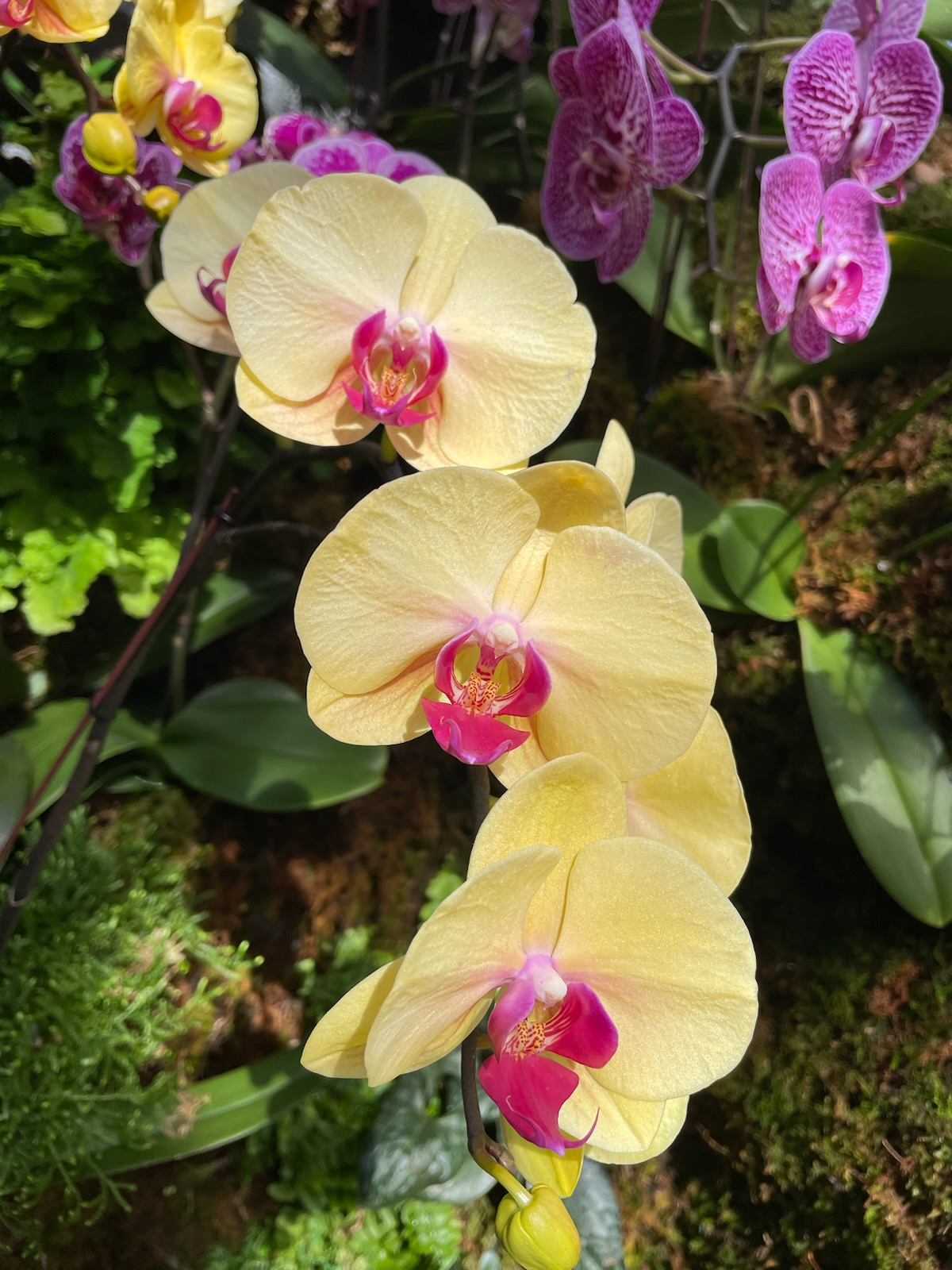
Orchids posing throughout the place. You’d think they know they’re beautiful.

Who cares if they are vain? They deserve the attention.

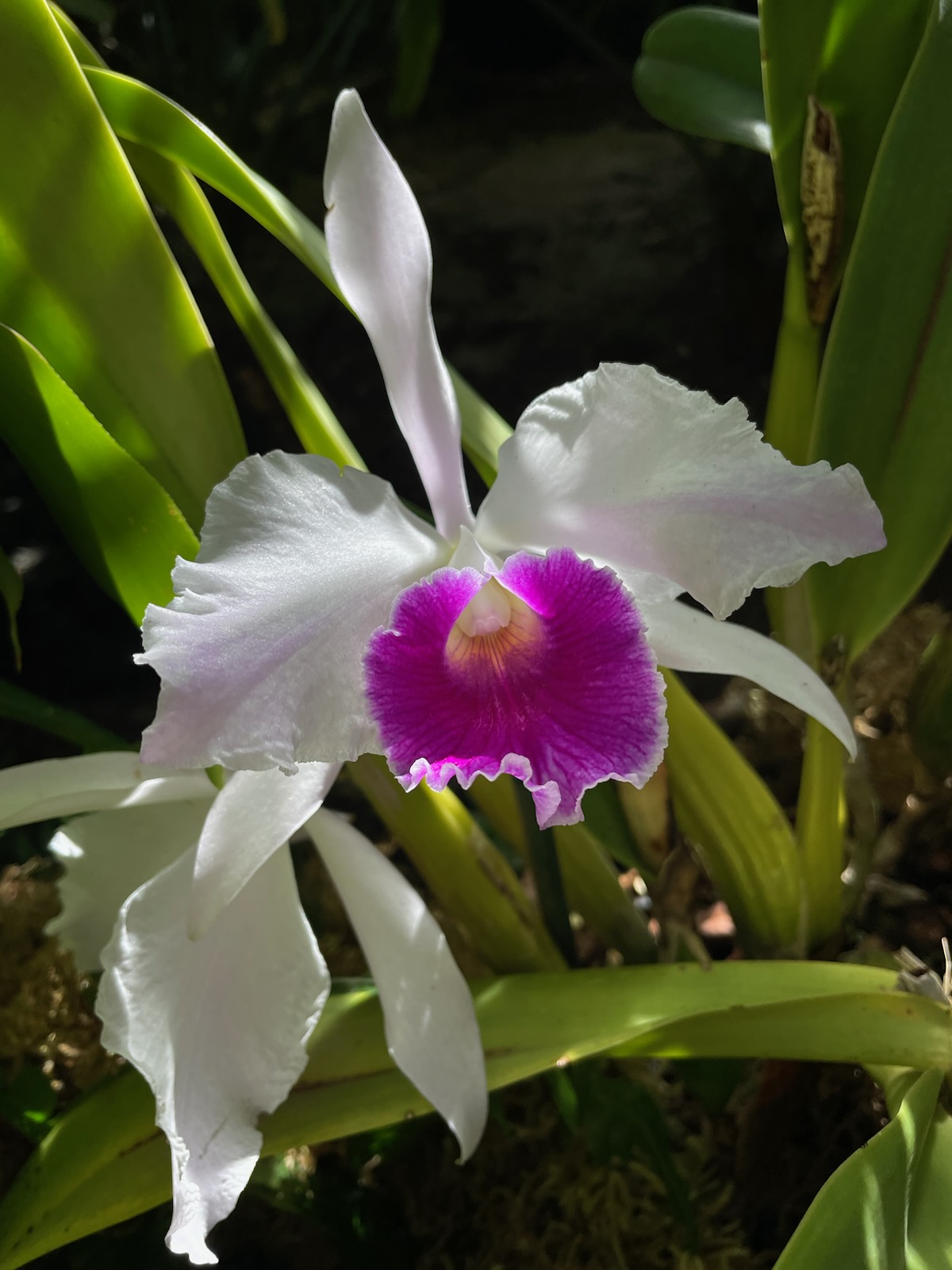
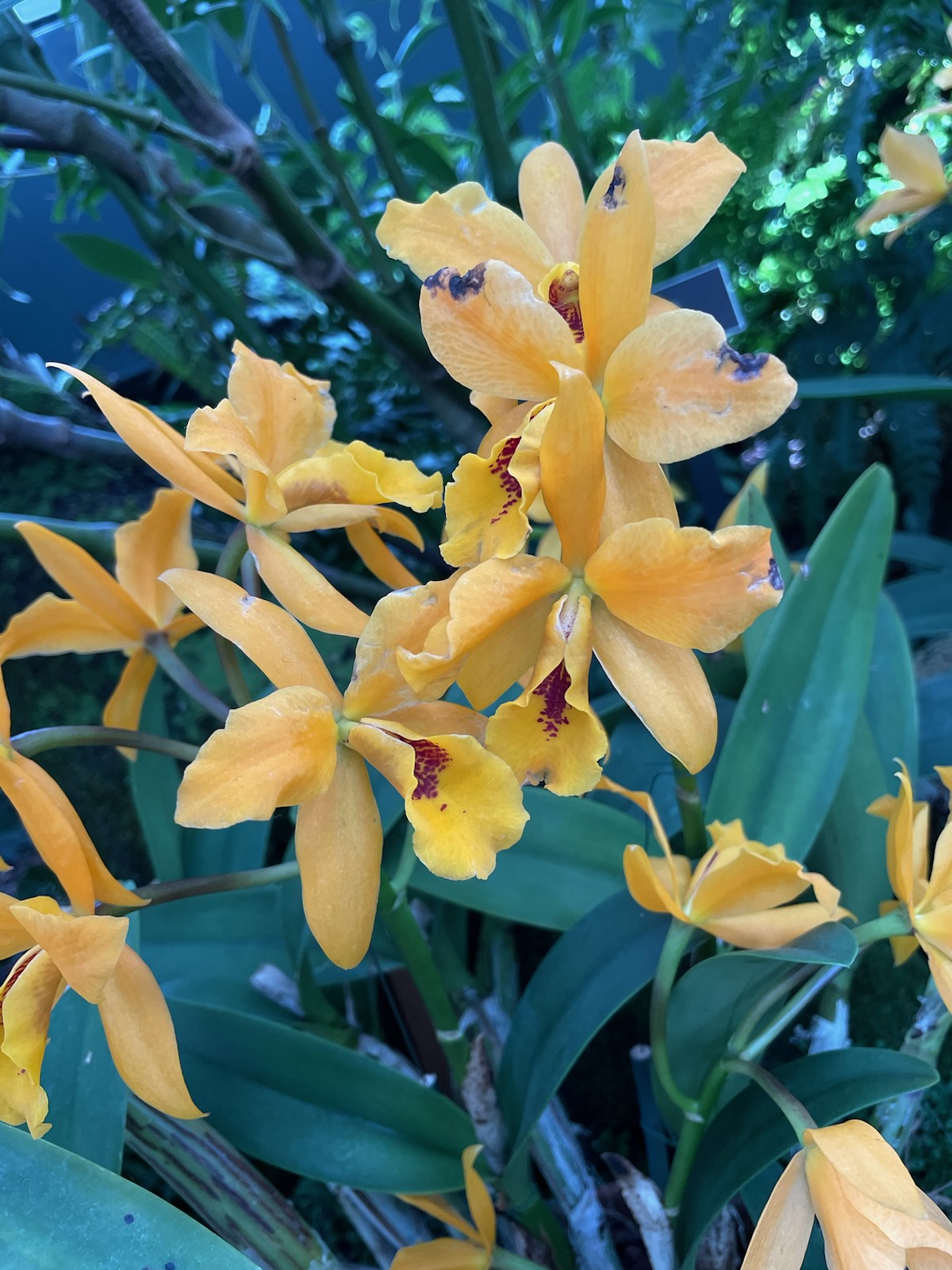
Some amazing specimens here. The cane orchid.

So rare and yet so common.

As Chet Baker has it most cornily in My Funny Valentine:

You make me smile with my heart
Your looks are laughable
Unphotographable
Yet you’re my favorite work of art

I can name them if pressed. Not if the flowers are pressed, I mean if it is desired that I know their names. There is the slipper orchid.

The ghost orchid.

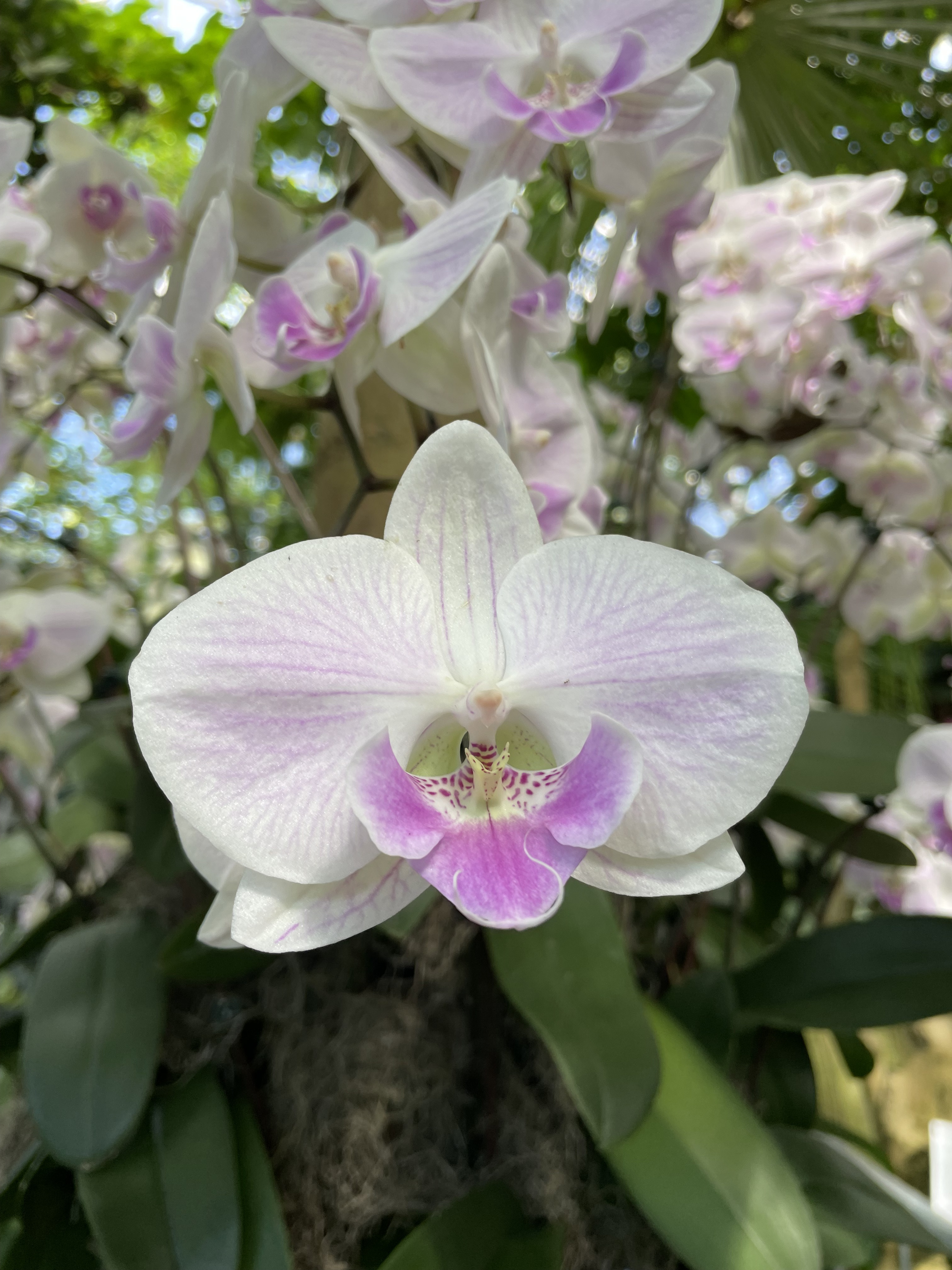
The moth orchid.

Most familiar is the corsage orchid, the one you’ll find at every prom.

But the anonymous ones, or the ones in front of which I am muscled aside by fellow Iphone snappers, are really just as fine.

I can also tell you the orchid’s biological features: the fused male and female parts in one structure, called the column; the solid, sticky masses of pollen, called pollinia; a modified petal called a labellum, which insects use as a landing platform. The lip might be small or large, ridged, ruffled, or pouch-shaped. Somehow it all sounds too sexy. Let’s have some innocent flowers, shall we?

After a turn or two down the humid pathways, Gil asks, “Have we been this way before?”

Who knows? In a haze of orchid splendor, before and after fade. It is total tropical immersion. My head spins. My mind fills with fantasies, dreams, nightmares, poetry. Didn’t a monster grab me last night in my sleep?

There is actually poetry conveniently installed here by the powers that be, verse by Wang Huizhi:

I release my feelings among these hills and streams;

Carefree and detached, I forget all constraints…

If you can tear your eyes away from the petals, NYBG has other treasures. Look up.

Or look down.

A king anthurium hailing from Colombia.

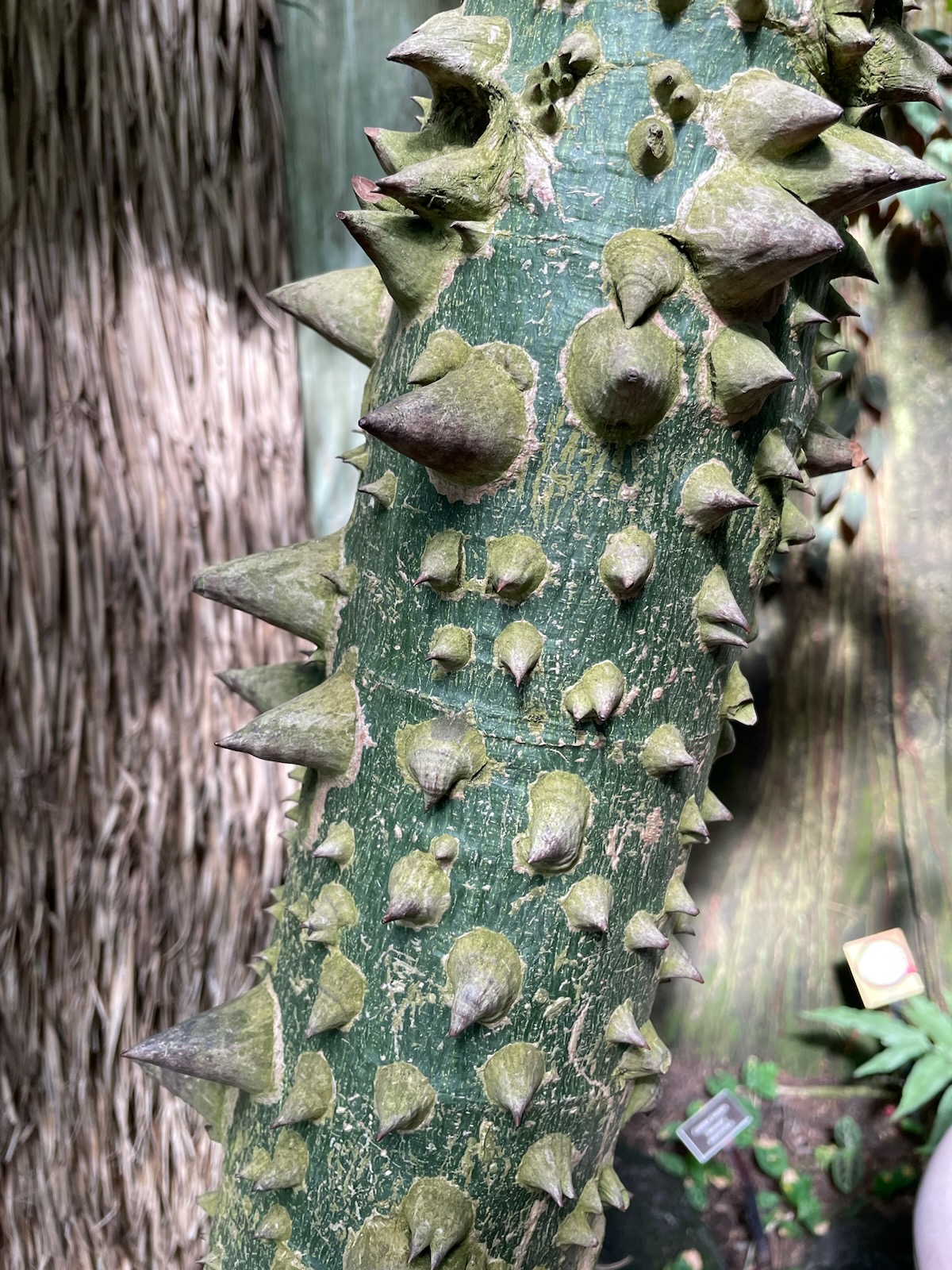
A floss-silk tree, from Peru.

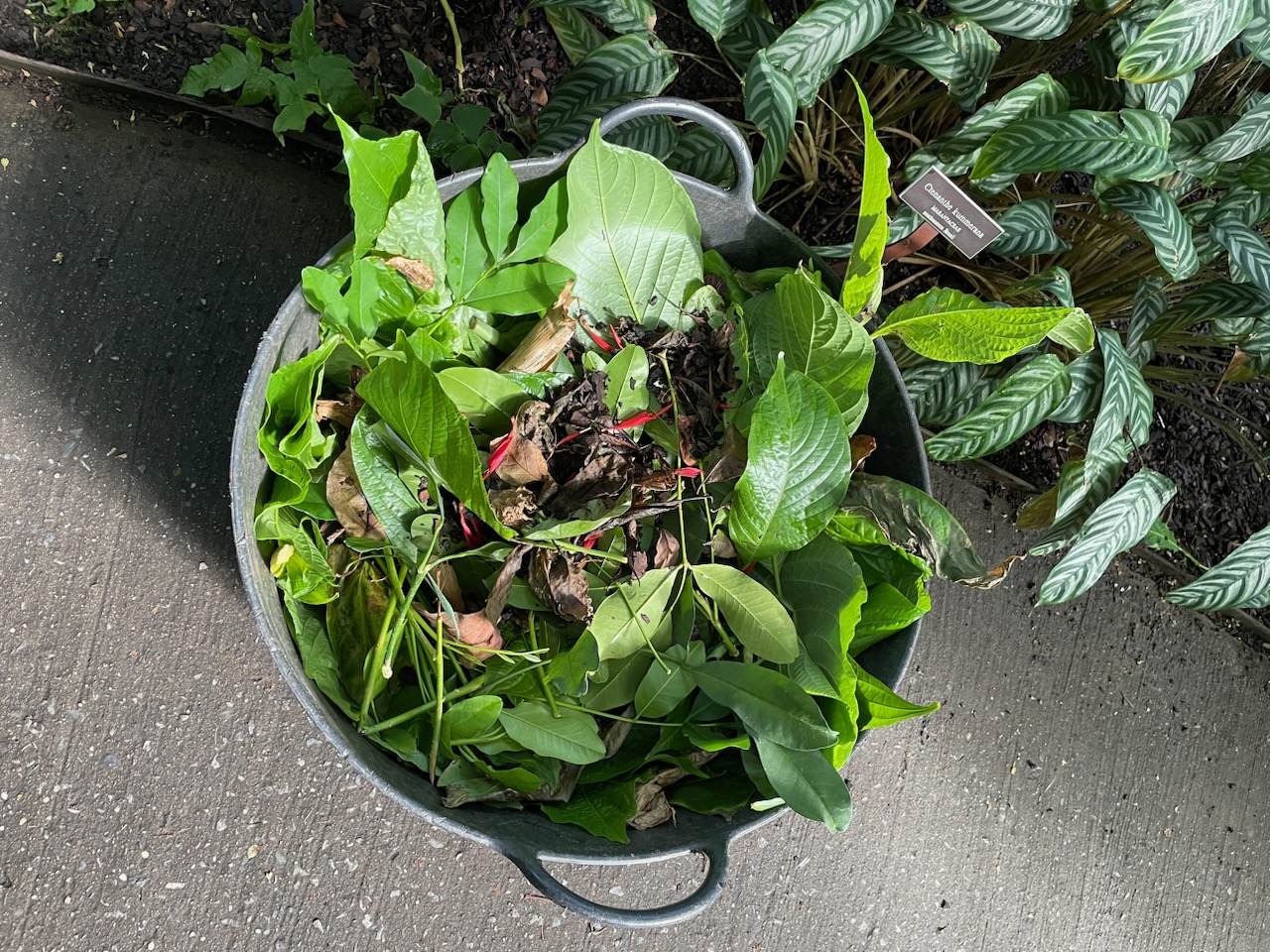
As a break from the sometimes-a-tad-too-sweet orchids, I also like to observe what goes on behind the scenes. The vegetation trash in a bin.

Staff gardeners comparing notes.

All around above our heads there is a sound… kind of like birdsong. Are there birds in here? asks a woman, focusing her camera above at the staghorn fern.

Also, what is that thing? I tell her there is a label, it’s a staghorn fern. Oh, she says, I think it’s the sound of the wind.

Go through the flame-draped tunnel…

And you will find… more orchids.

I like my cigar but I take it out of my mouth once in a while, says Gil, quoting Groucho Marx.

Yes, there are a lot of orchids here.

Strangely, it turns out we know the young lady who “designed” the show.

She is the daughter of an old friend, and I happen to know that her big brother is named Huckleberry. She did a great job here.

Along the way it is possible to learn that the most rare color for orchids is blue. But I see no blue orchid among the thousands here. I ask a security guard, Have you seen a blue orchid here?

No, he says helpfully. But I think there’s one at the library. In a pot. Nice idea, but then we’d have to take ourselves out of the fragrant sauna into the cold gale outside. We’ll stick to the fleshy white ones here.

Eventually it is necessary to exit. You like orchids?… Nasty things. Their flesh is too much like the flesh of men, their perfume has the rotten sweetness of corruption. That’s from the noir classic The Big Sleep.

The gift shop offers johnny jump ups, a welcome respite from the orchidium.

And… more orchids, of the 24-dollar variety.

Let’s pretend orchids are really as special as they seem to think they are.

They deserve the glory.

At least once a year.

Leave a comment

Filed under Jean Zimmerman

A thing that is mysterious, evocative, meaningful

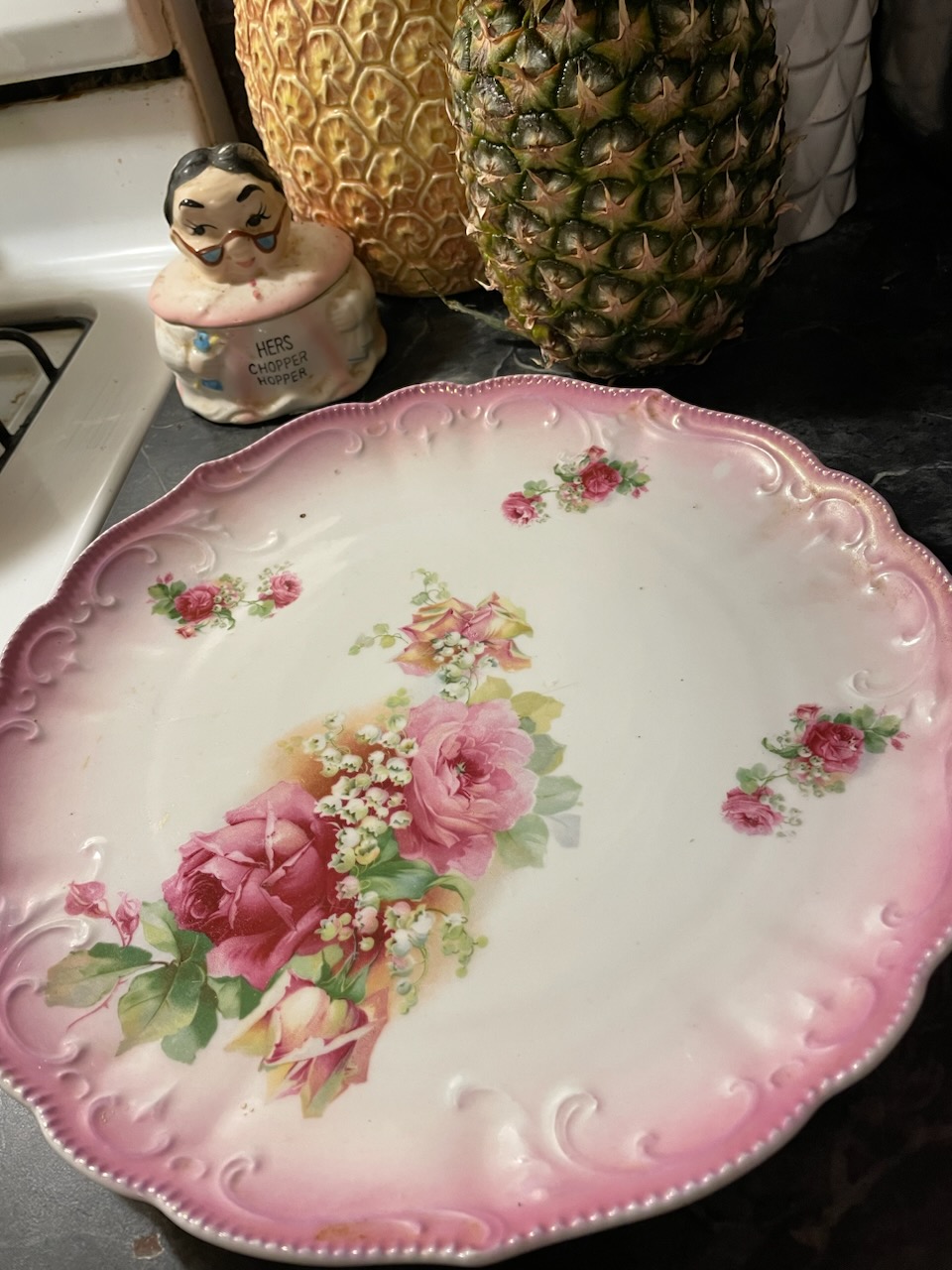
–at least to me: a plate. It is an old plate. I’m going to call it a cake plate.

It belonged to someone in my family. I never knew her. She lived a long time ago.

Her name, oddly, was Brown. Even odder, her last name was Coats. So her name was Brown Coats. If you want her actual name, of course, it was more normal: Mary Susan Dudley. But she was known as Brown. She was my mother’s father’s grandmother – my great great grandmother.

Families usually have one person who is the historical navigator, the genius of genealogy,the generational scribe. The one who plots out all the branches of the tree, scrupulously investigating the nooks and crannies of the past that everyone else is too busy to look into. In my family, that person is not me, but most likely my brother.

I’ve always been interested in a more global narrative, in female fur traders or heroic housewives or hot jet pilots of earlier eras. Not necessarily individuals I’m related to, but all of us. I’ve always told myself that investigating the stories of these people not in my actual family is essential.

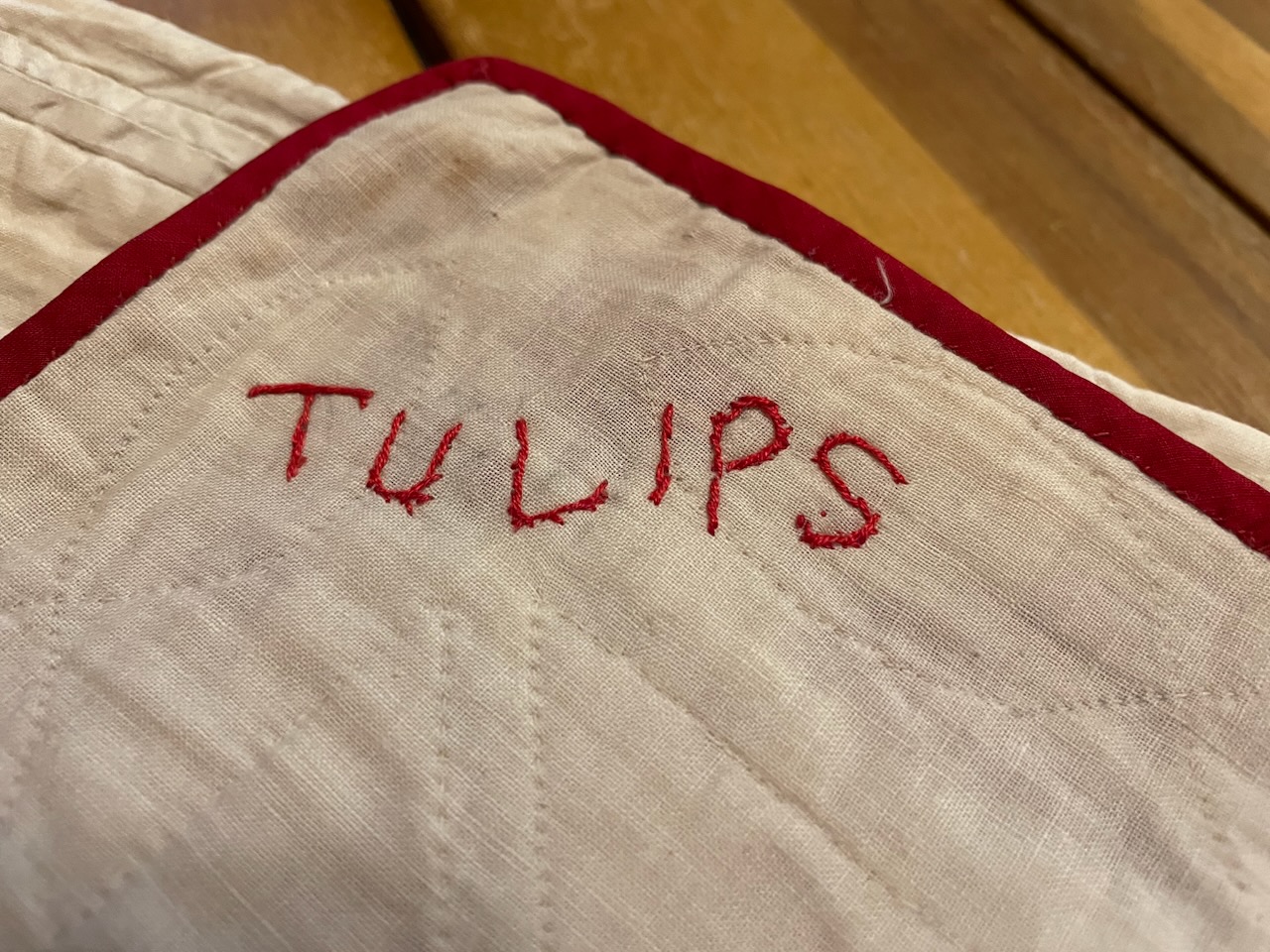
I’ve loved the stories and the artifacts that have come down from people I knew in my family. On my mother’s side, my great aunt, Mary House, who sewed a fantastic quilt I’m lucky enough to have in my possession.

A home economics teacher, Auntie kept a neat home in a converted potato barn in small-town Greenfield, Tennessee. We used to go there and visit – I remember eating buttery corn on the cob at her kitchen counter, picking green beans out front, playing with a new litter of kittens that lived under the wooden porch boards. She helpfully stitched a label for the quilt on its back.

Auntie had a sweet face and she was a sweet woman, but strong, too.

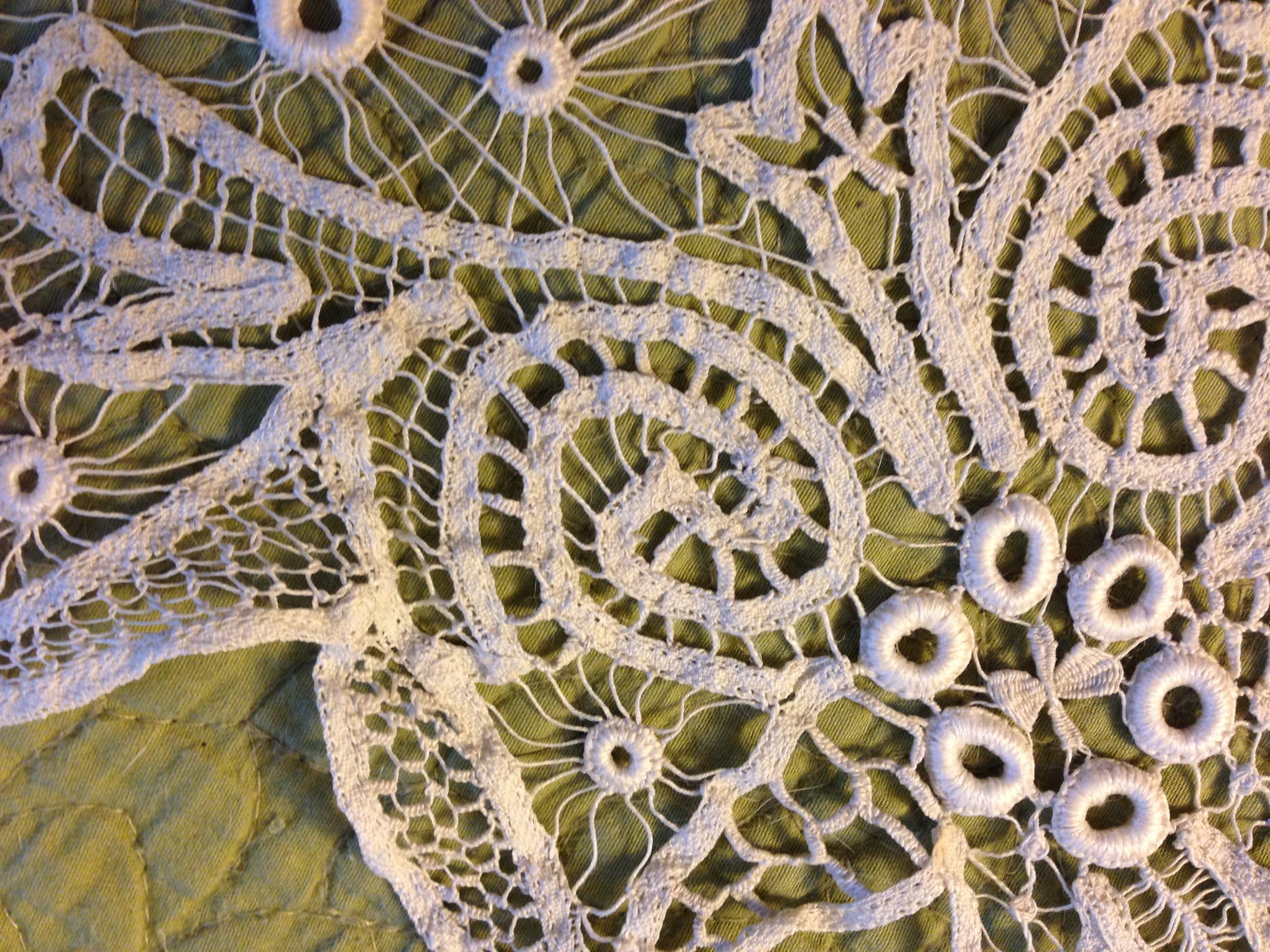
She knew everything in the world about needle crafts, being an expert in sewing and tatting, and she taught my clumsy fingers a little bit about crochet.

She was my grandmother Virginia’s sister, my mother’s mother’s sister.

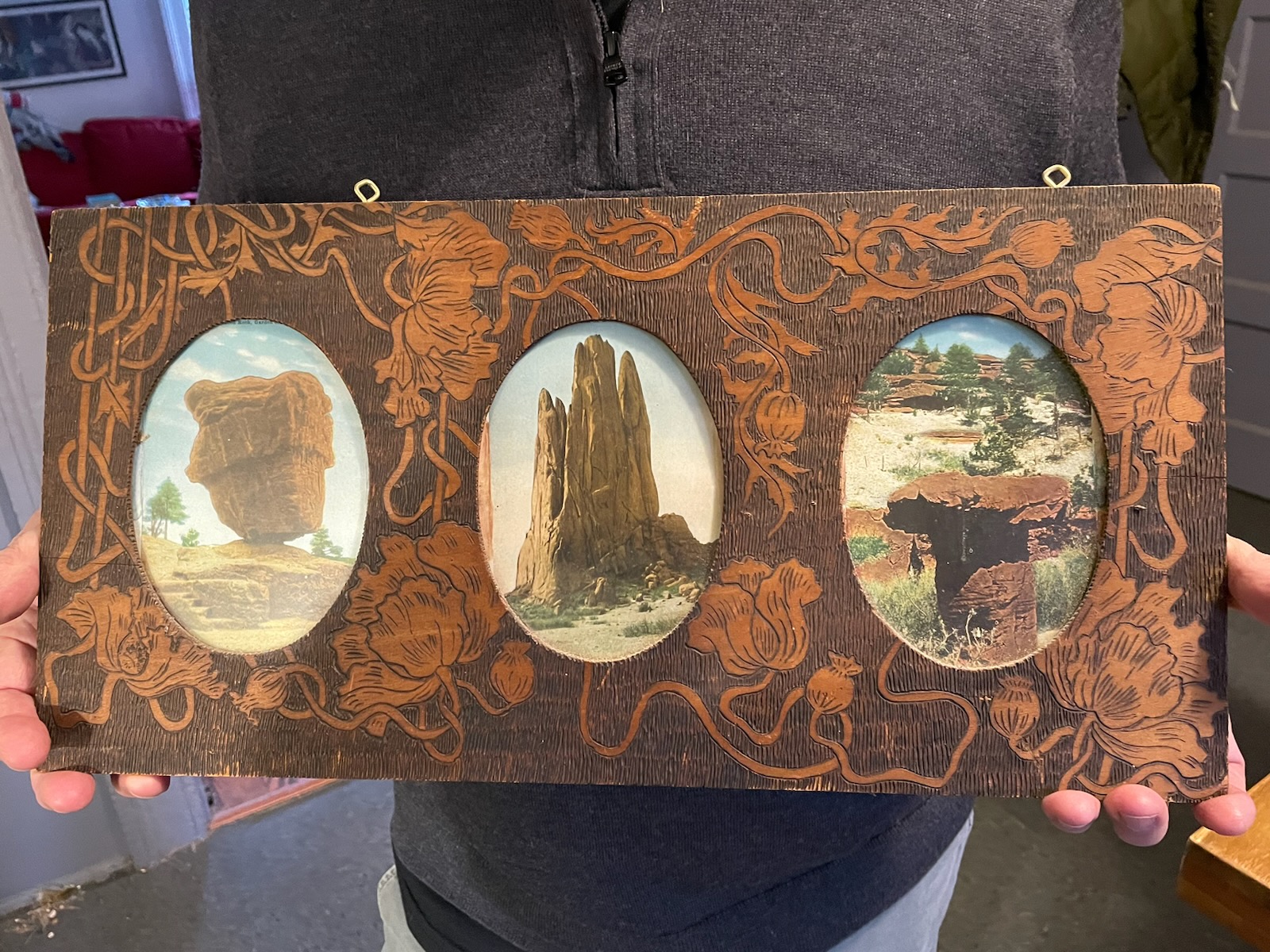
On the other side of my mother’s family, her father’s relatives, matters have always seemed a little murkier. I know about Brown’s cake plate because I have it on a shelf. I know about a series of pictures in a burned-wood frame because this prized artifact was the product of my grandfather’s mother’s hands. The images were from a trip out west by train to the Panama-Pacific International Exposition in San Francisco in 1915.

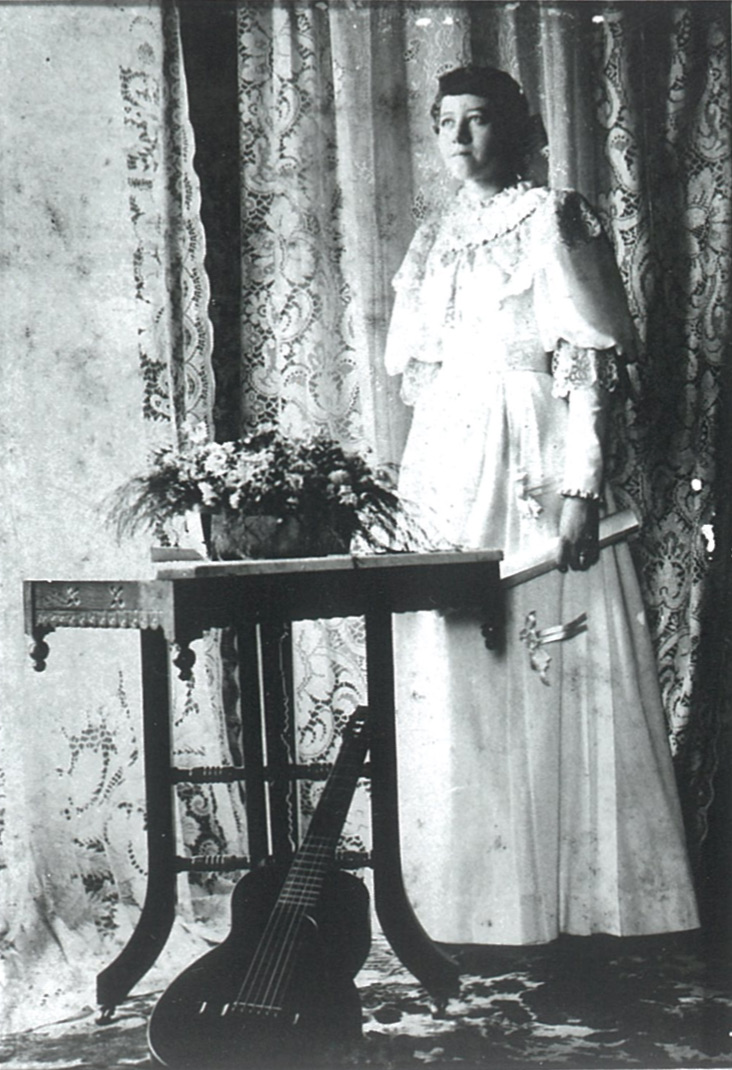
Her name was Lockie. My great grandmother treasured her magnificent little son – my grandfather – and poured herself into raising him until she died in 1920, at the age of 43, probably of pernicious anemia.

A teacher and a religious woman, Lockie claimed in her diary to have read the entire bible to Jean, my grandfather, when he was 13 years old. She had artistic skills, evidenced by an oil painting of a child, a drawing of horses and embroidery or “fancy work” depicting a rose that have survived the years, along with my framed western tryptich. She was an active member of the Women’s Temperance movement and probably — thinks my mother—a suffragist.

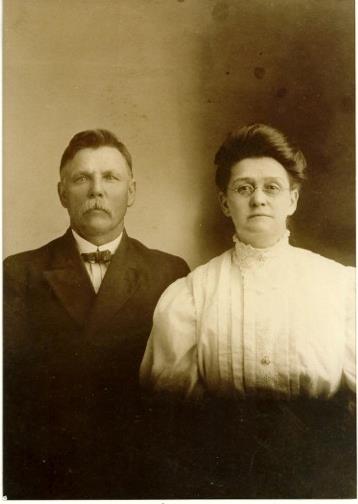
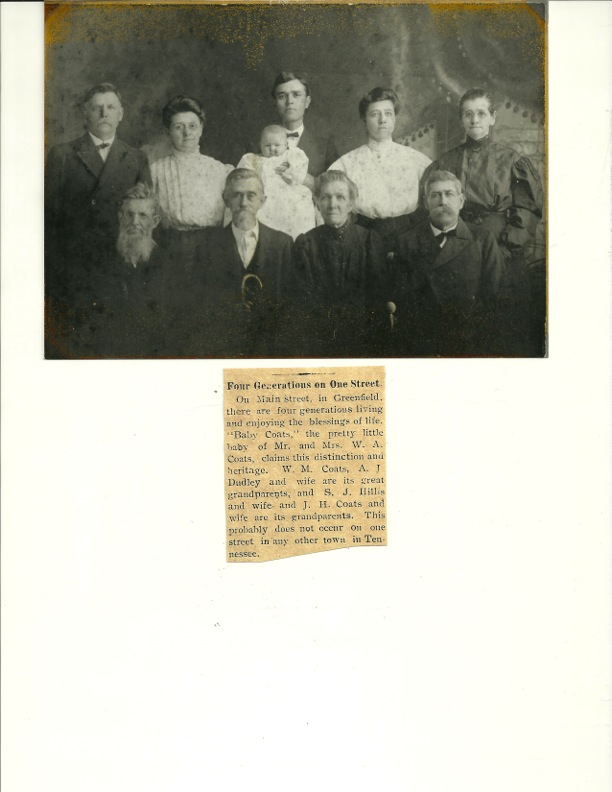
I recently came across a photo and a newspaper clipping that describes the people in it.

The article talks about Lockie and her “pretty little baby” and her husband Andrew Coats, about Brown and her husband John Hawkins Coats, and their Dudley and Hillis parents. It seems all four generations lived on the same street in little Greenfield, “enjoying the blessings of life.” Main Street. Long afterwards, I spent time there, visiting my grandparents in the tall, rambling Victorian house my mother grew up in. Swinging on the porch swing, so novel for a modern suburban kid like myself.

I’ve tried to read the faces of these people in my family. Especially the women. I am forever interested in women’s stories. I would love to learn more about the lives of Lockie and Brown, of Virginia and Mary, to not take them for granted. To treat the members of my own family as a worthy historical subject. I know so little. Brown Coats—more than a funny name or a faded sepia photo.

The last words of my great grandmother Lockie’s diary before she succumbed: “May we each and every one be prepared to meet that day.”

Real history. Personal history.

4 Comments

Filed under Jean Zimmerman

A shout out to nurses everywhere

on this rah-rah chest-thumping holding-up-half-the-sky International Women’s Day 2023. Nurses are the lifeblood of our society. I may be a bit biased because my daughter is an RN, soon to be a nurse practitioner. Here she is all rigged out to do battle with Covid.

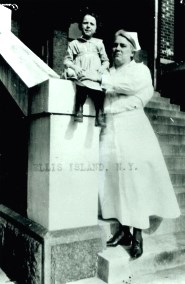
Brava Maud! I like to talk about nurses when I give Hard Hat Tours of the abandoned hospital complex at Ellis Island, because they were so fundamental there.

As they always are. Ellis Island Hospital employed great doctors – it was a fine hospital, one of the best in the country in the early years of the 20th century. But nurses’ great skills and essential kindness were absolutely vital.

Elements of their existence persist in the ruined spaces. A scrap of shower curtain holds on in one of the washroom’s in the nurses’ quarters.

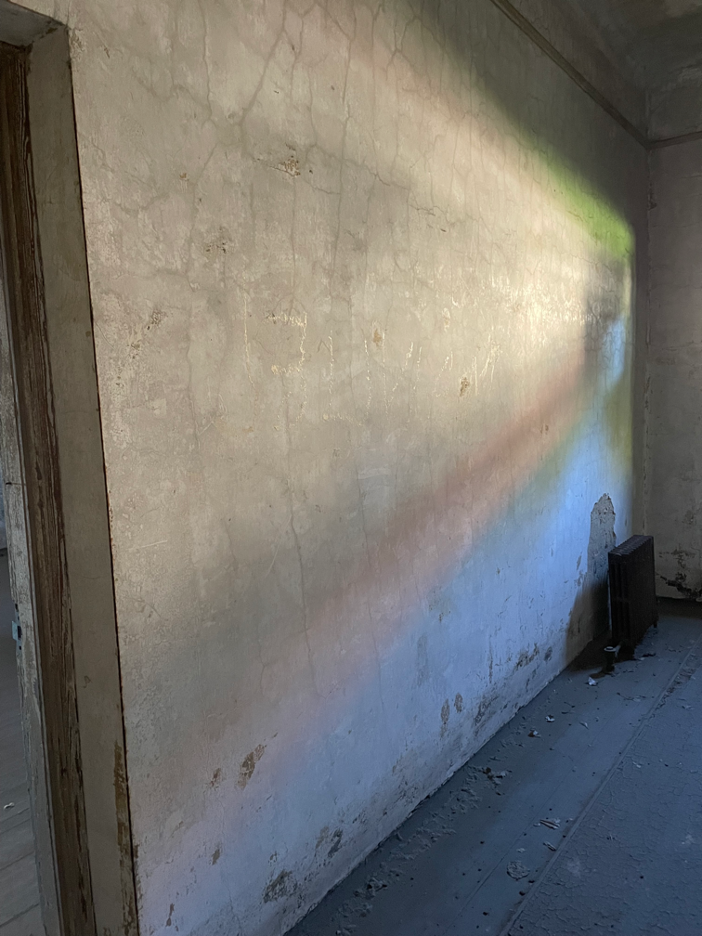
I always point out a rainbow that appears on a wall there every day, at some times fainter than others, which I’m pretty sure is the nurses’ way of communicating with us.

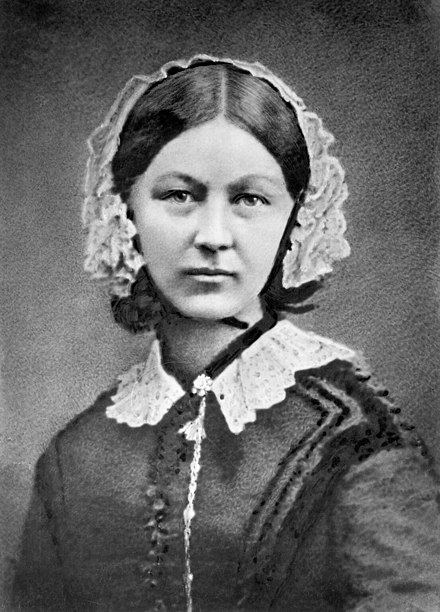
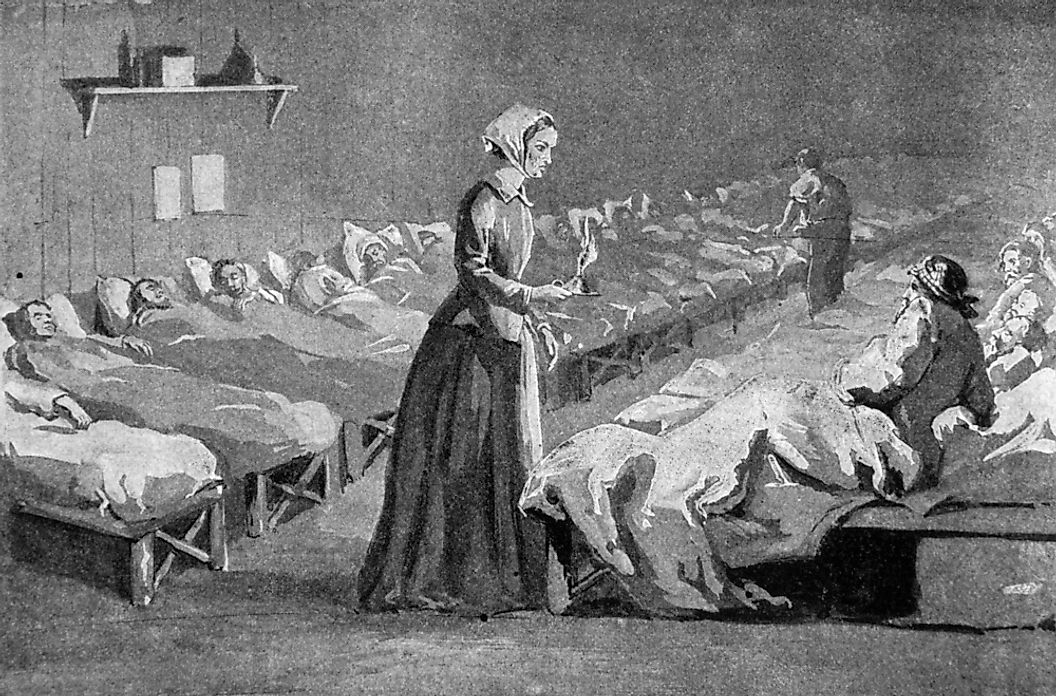
One nurse who was pretty much the patron saint of Ellis Island is someone everyone’s heard of: Florence Nightingale.

I love this photo because in it she looks so old-fashioned, sort of like an old fuddy duddy, but in fact she was anything but. She was a radical, a pioneer. Her beliefs when applied at Ellis Island probably account for an extraordinarily high survival rate among the 500,000 people who were treated there over the years before the hospital closed in 1954. A British nurse who practiced during the Crimean War–before antibiotics, before penicillin–she believed in a few simple tenets. Sunshine. Fresh air. You can see a vestige of her philosophy in the baby-cage rage of the 1930s.

Another of her beliefs was hygiene, translated specifically at Ellis to handwashing. She was nicknamed the Lady of the Lamp for her personal vigilance in soldiers’ wards.

Life before hand washing could be dirty, yes, but also dangerous.

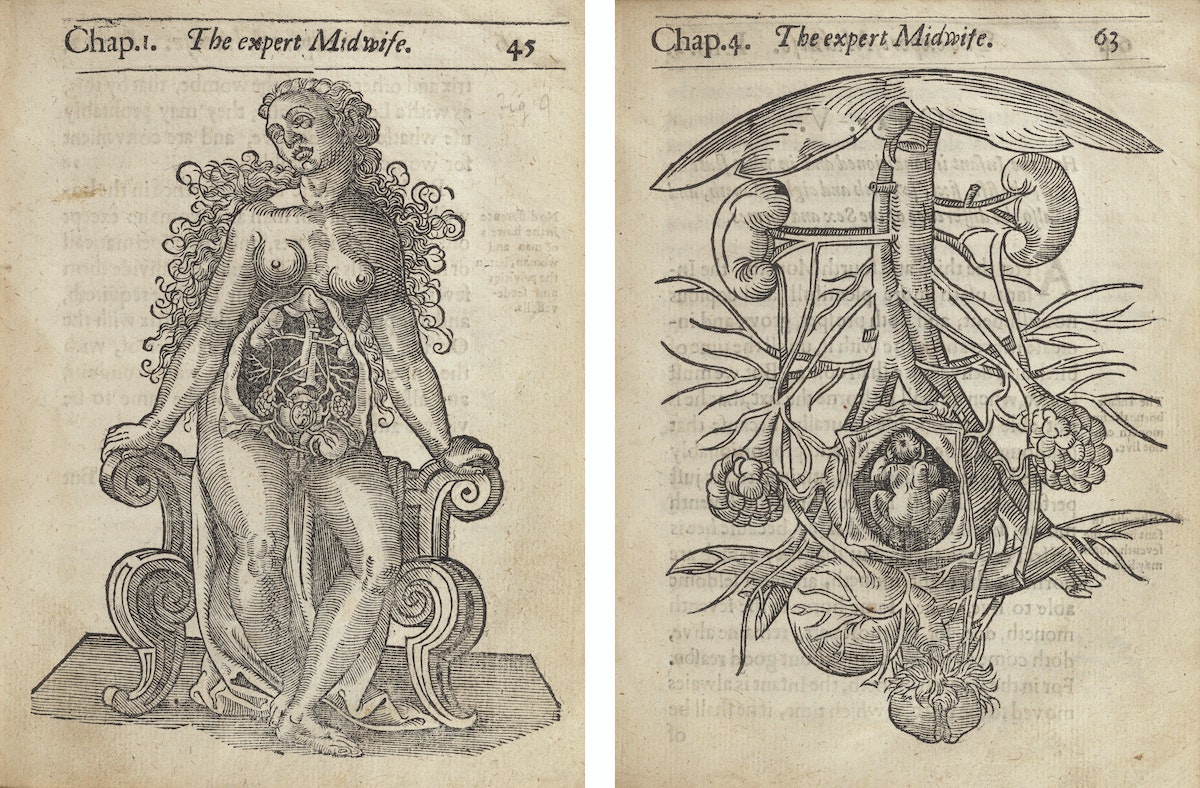
Before the nineteenth century a bacterial infection known as childbed fever claimed the lives of the many thousands of women going to hospitals to give birth. Doctors hadn’t yet come around to the idea that handwashing was important. Ignorant about germs, they didn’t bother.

Most doctors, naturally, were male. Puerperal fever was both common and tragic. Two of Henry XIII’s wives died this way. So did Mary Wollstonecraft, who wrote the seminal Vindication of the Rights of Women in 1792.

 It seems obvious now, especially with the Pandemic, when we’re always washing our hands. But in the mid-1800s, birthing practices had not come far beyond what they were in the seventeenth century.

And childbed fever continued to be a scourge, though so few people remember it now.

Women’s history, please! Let’s be more than a footnote.

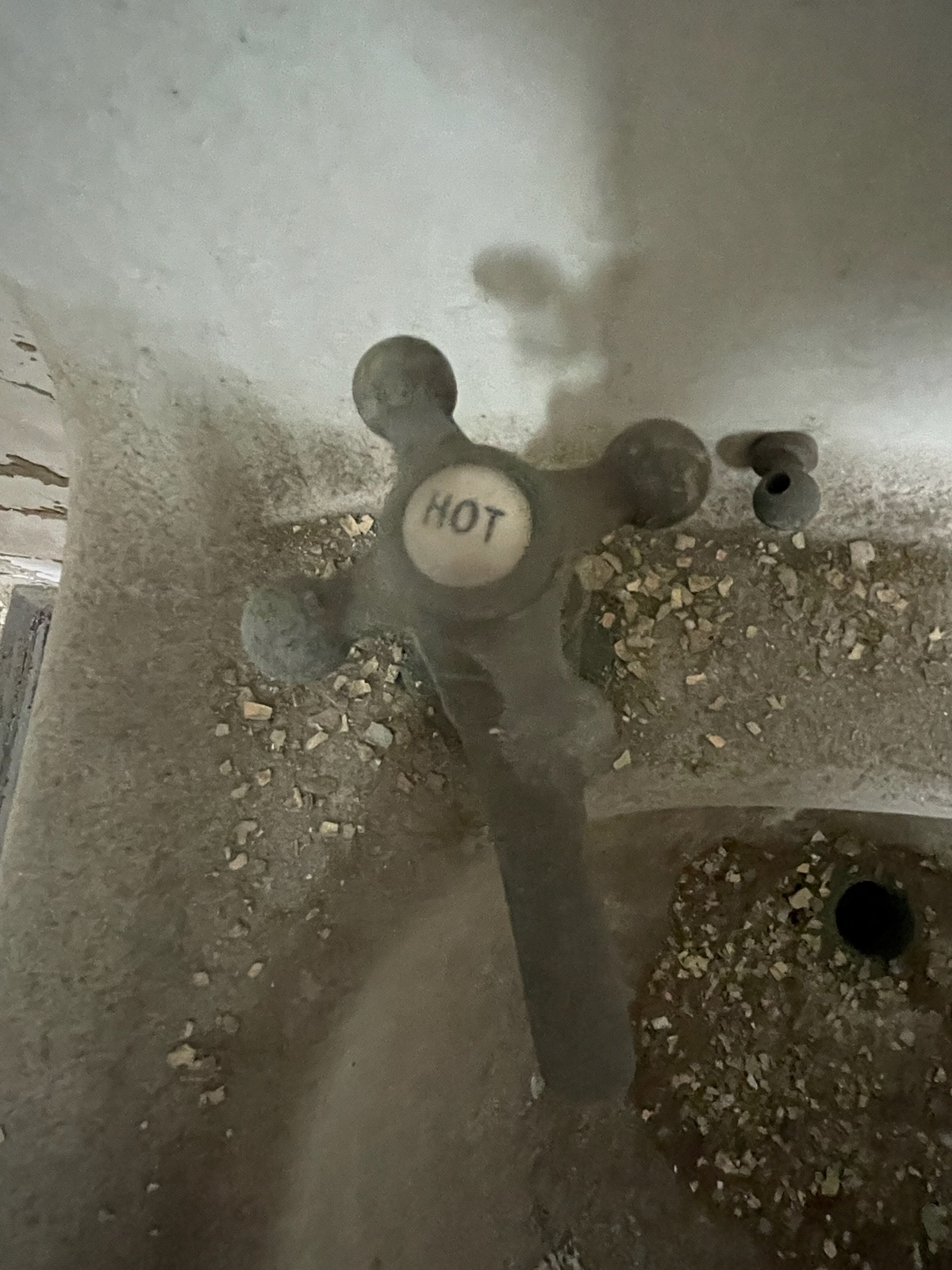
Around 350 babies came into this world at Ellis Island. In the abandoned hospital you can find handwashing sinks throughout, not placed there by accident or as a nicety — evidence that medical practitioners knew how important it was to simply wash your hands before and in between procedures so as not to spread infection.

I had a smart teenager on a tour who termed them the Nightingale sinks, his eyes filled with new knowledge.

The grounds at the Hospital once featured beautifully landscaped gardens, compared by some to the finest spas in Europe, so that patients, doctors, and sailors would be able to get that sun and fresh air that Nightingale considered so critical. The wards were created with huge windows to admit light and ventilation.

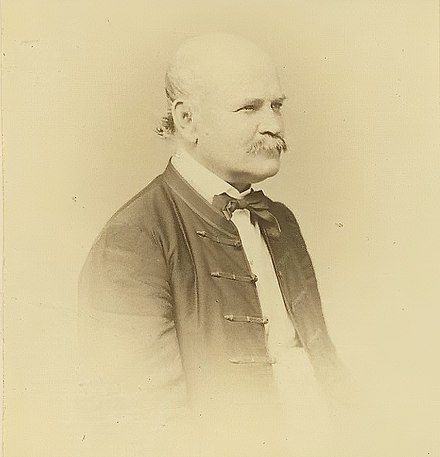
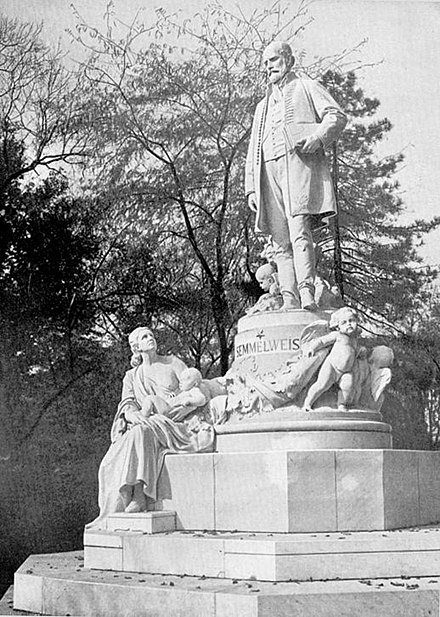
One medical researcher who was crucial to eradicating childbed fever was Hungarian physician Ignaz Semelweize. Scorned and ridiculed  by the medical establishment, he wound up dying in 1865 in an insane asylum after a savage beating by guards left him with an untreated gangrenous wound on his hand.

In 1847, Semelweize famously decreased death from the disease in the First Obstetrical Clinic of Vienna from nearly 20% to 2% through the use of handwashing with calcium hypochlorite. He had observed that some women even preferred to give birth in the streets rather than going to a hospital. A street birth, they knew, was more survivable than delivery by a doctor with dirty hands. Much later, Semelwieze would receive his due.

When doctors got with the program and finally began washing their hands, the incidence of childbed fever plummeted and women survived. At around the time the Ellis Island Hospital opened its doors in 1900, handwashing was just becoming routine.

The nurses at Ellis were reportedly formidable. There’s a story about a patient who suffered from mental anguish after a horrible ocean passing and typhus – she tried to do away with herself by jumping into the harbor in winter, and a heroic nurse jumped in after her and saved her. Try to fathom that.

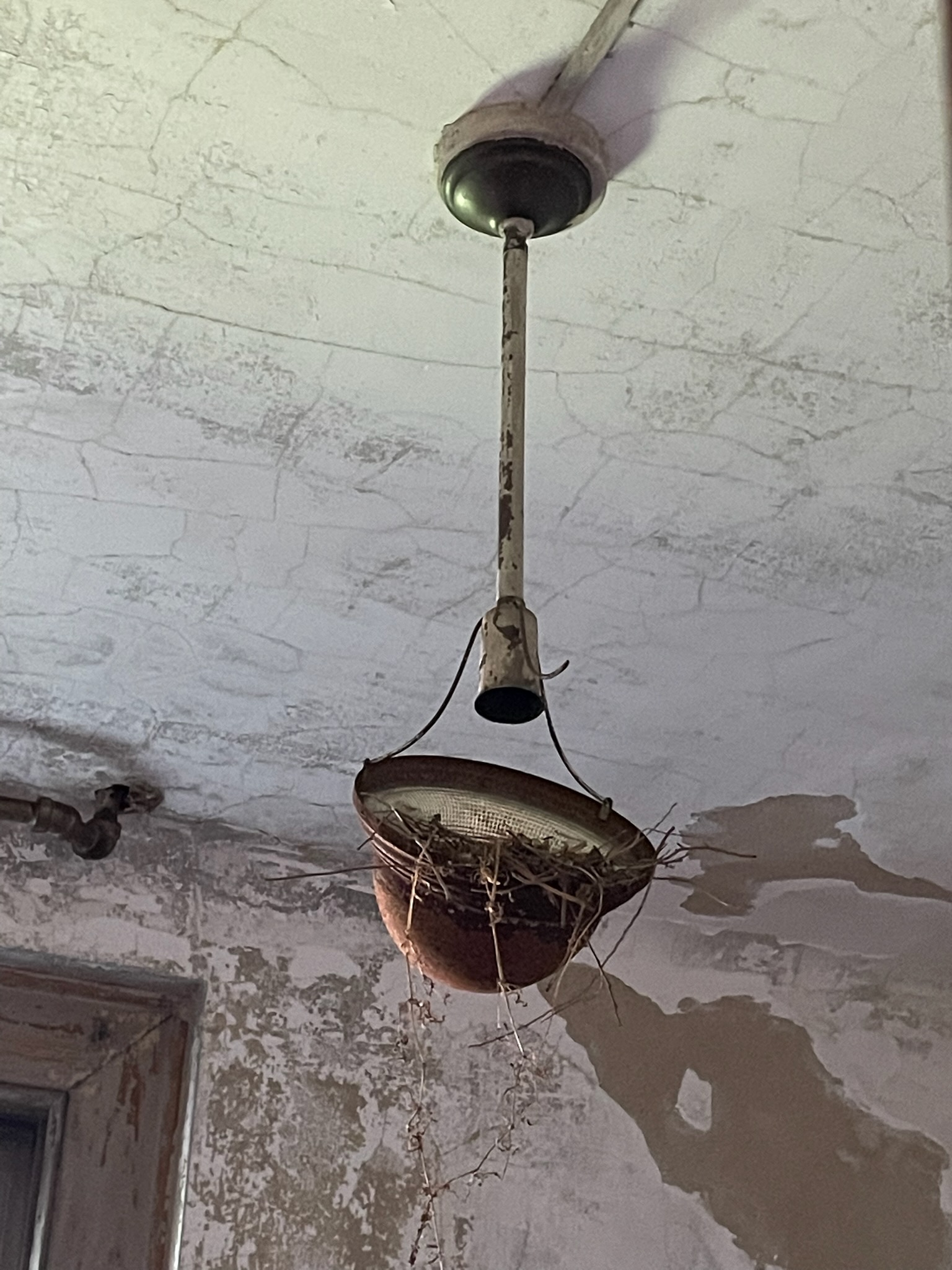
Long since the hospital’s abandonment by humans, we see other critters’ nurturing here.

Nurses at Ellis didn’t make a lot of money. They had to remain single. We know that they went out of their way to teach immigrant children reading and writing. Seventy percent of immigrants did not speak English, and nurses knew how important that was to being successful in their new country.  We also have a set of directives for nurses, and while some are ho-hum one pops out: You shall not kiss or hug your patients. What does this suggest? It’s probably not wise to embrace your measles patient, you might catch measles – but these nurses were so caring and compassionate, they had to be told not to. Nurses knew how important nurturing was to the healing process.

As they still do.

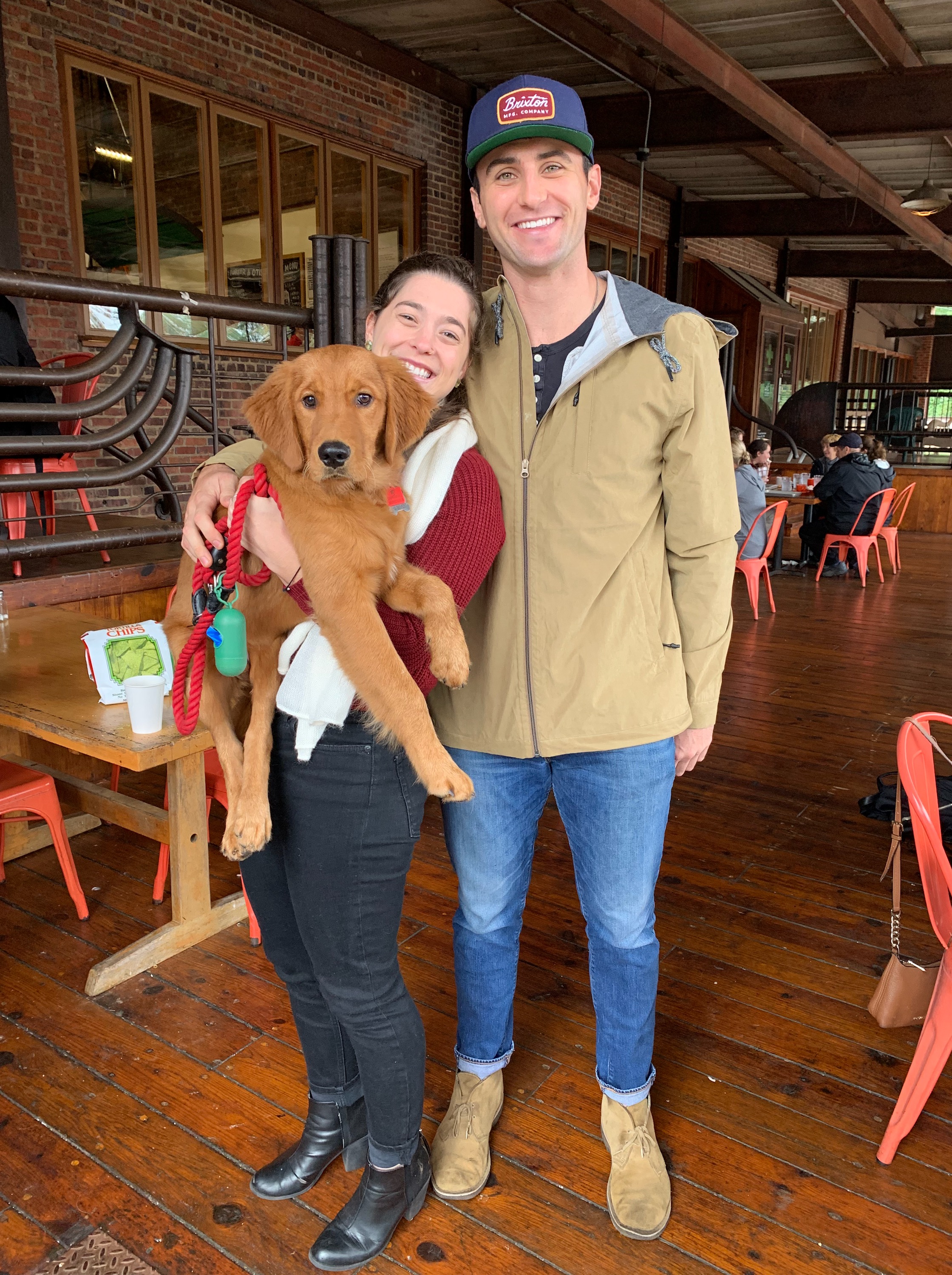
At the end of a tough day at the hospital where she works, Maud comes home and decompresses by relaxing with her pups and husband and tuning in to true crime podcasts.

We have only scant evidence of Florence Nightingale’s personal life, how she might have decompressed, so I appreciate these artifacts. Comfy moccasins!

She deserved them. And then some.

2 Comments

Filed under Jean Zimmerman

If you want to know where the bodies are buried

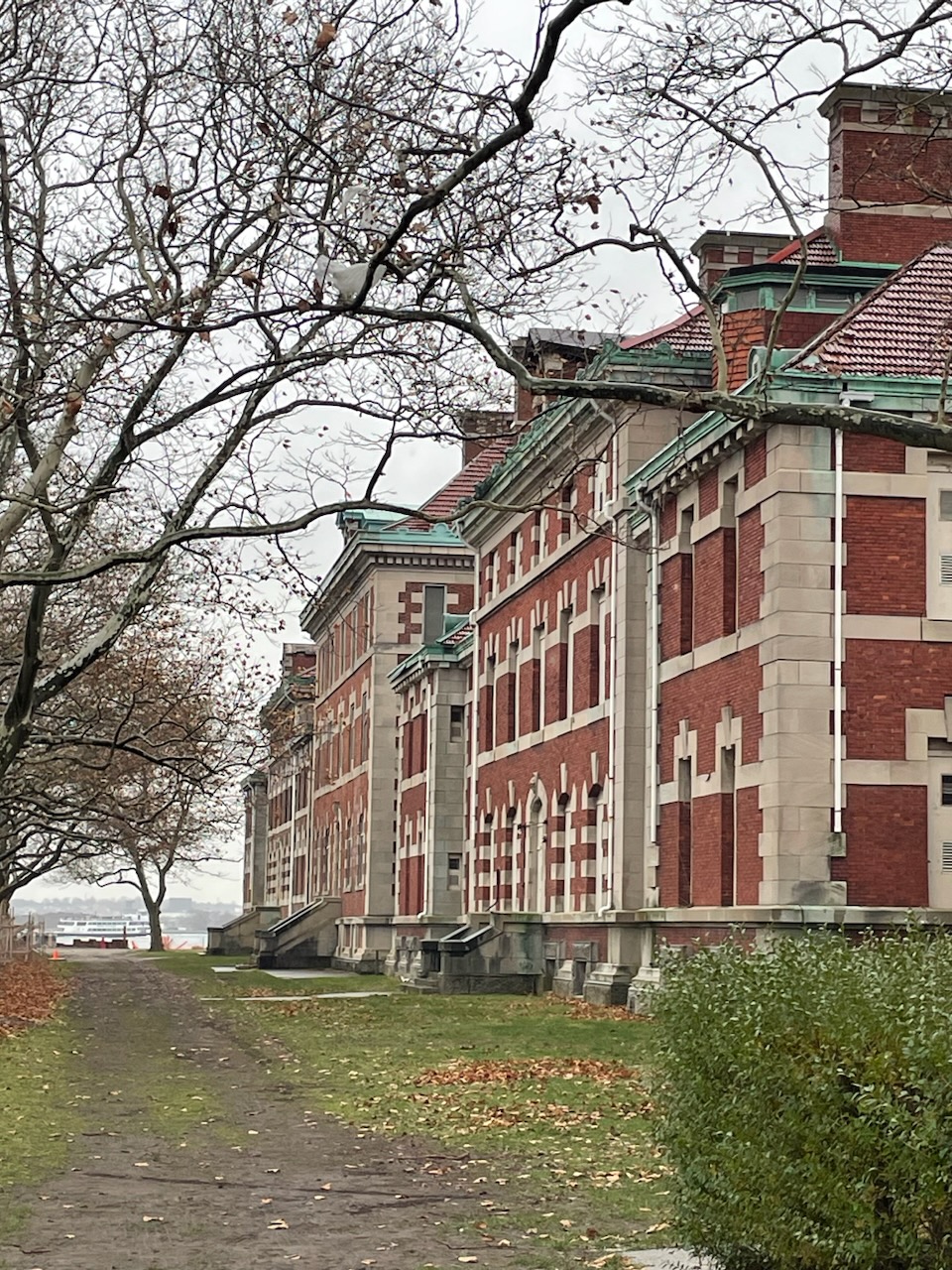
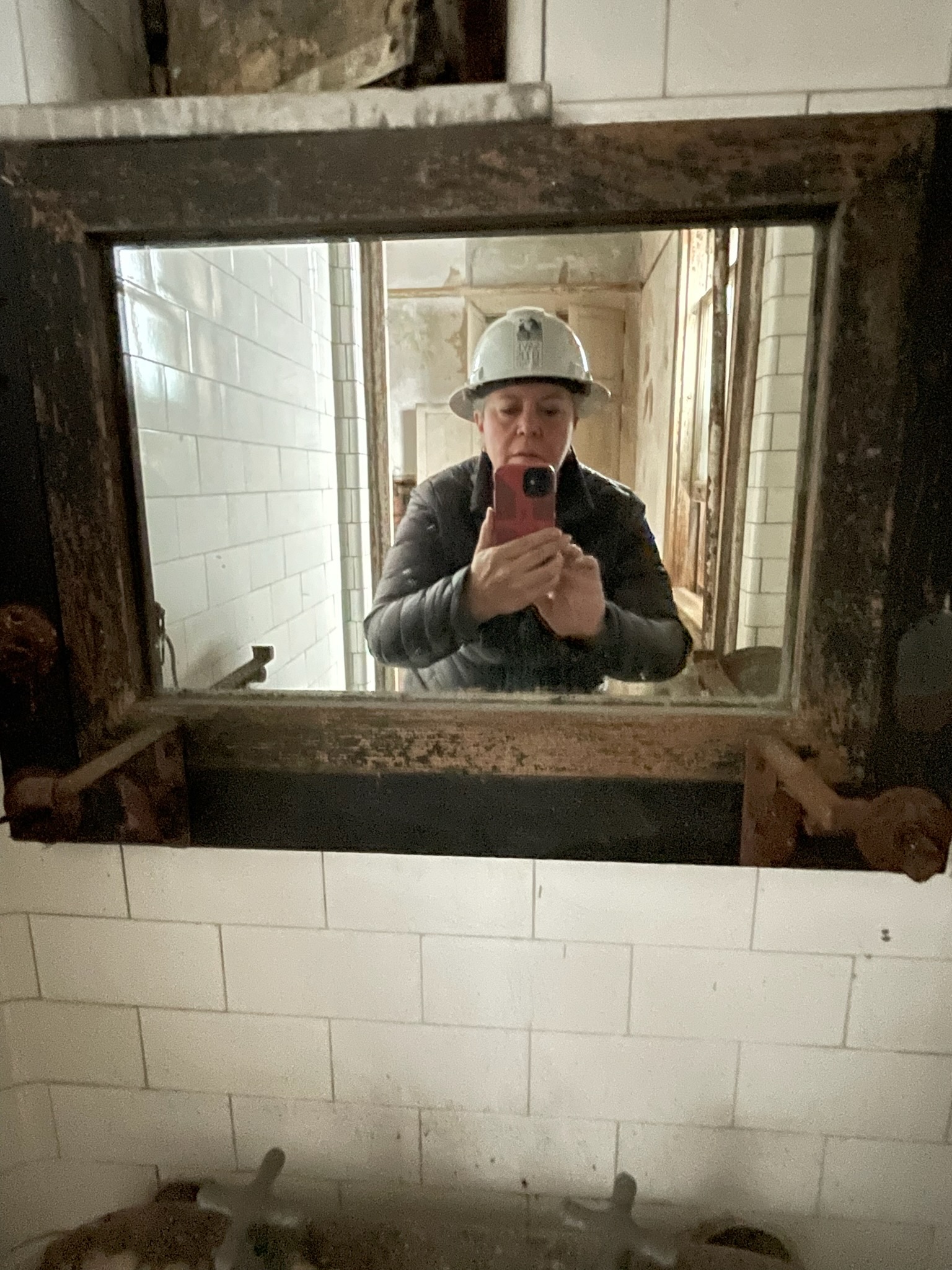
I can show you – at least the ectoplasmic ones at the Ellis Island Hospital ruin. If you come on a photography tour, we get to snoop around the old, crumbling areas we don’t usually take visitors on our regular Hard Hat Tours.

Today I went around with Chris, who moved to NJ from the UK five years ago and was lucky enough to be gifted with the tour by a family member. (If an immersion in an amazing ruin interests you either as a professional or amateur photographer, let me know and I’ll steer you to the right person at Save Ellis Island to set it up.)

The “new” morgue/autopsy room, dating to the 1930s, features refrigerated cabinets which held cadavers, and aspiring doctors would sit on bleachers to learn about anatomy.

A previous morgue, more intimate, was repurposed as a laboratory where guinea pigs were research subjects.

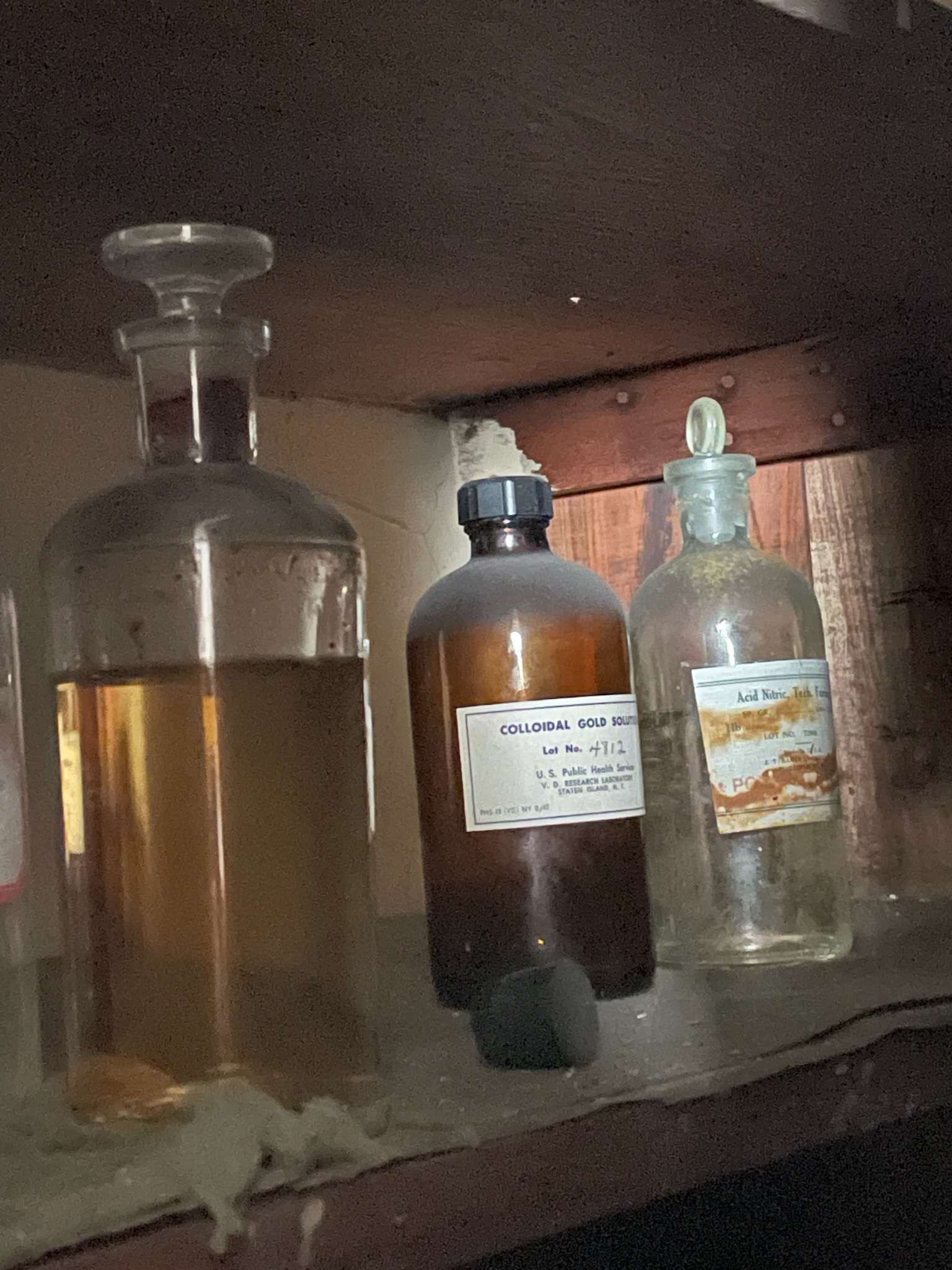
The pharmacist’s quarters, still containing essential potions in a locked cabinet. Since the Middle Ages, colloidal gold was famous for its curative properties.

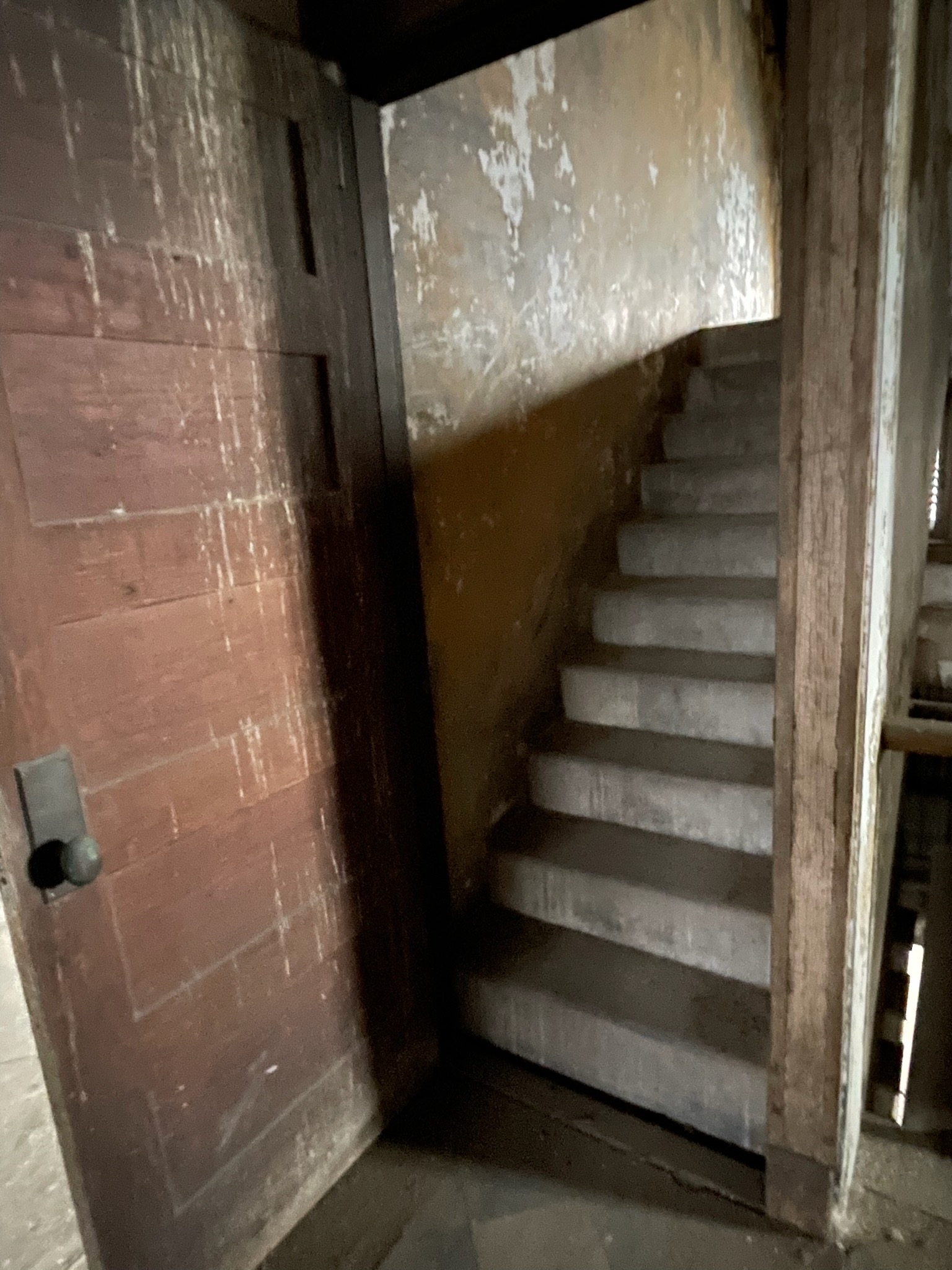
Random corridors.

Random rooms.

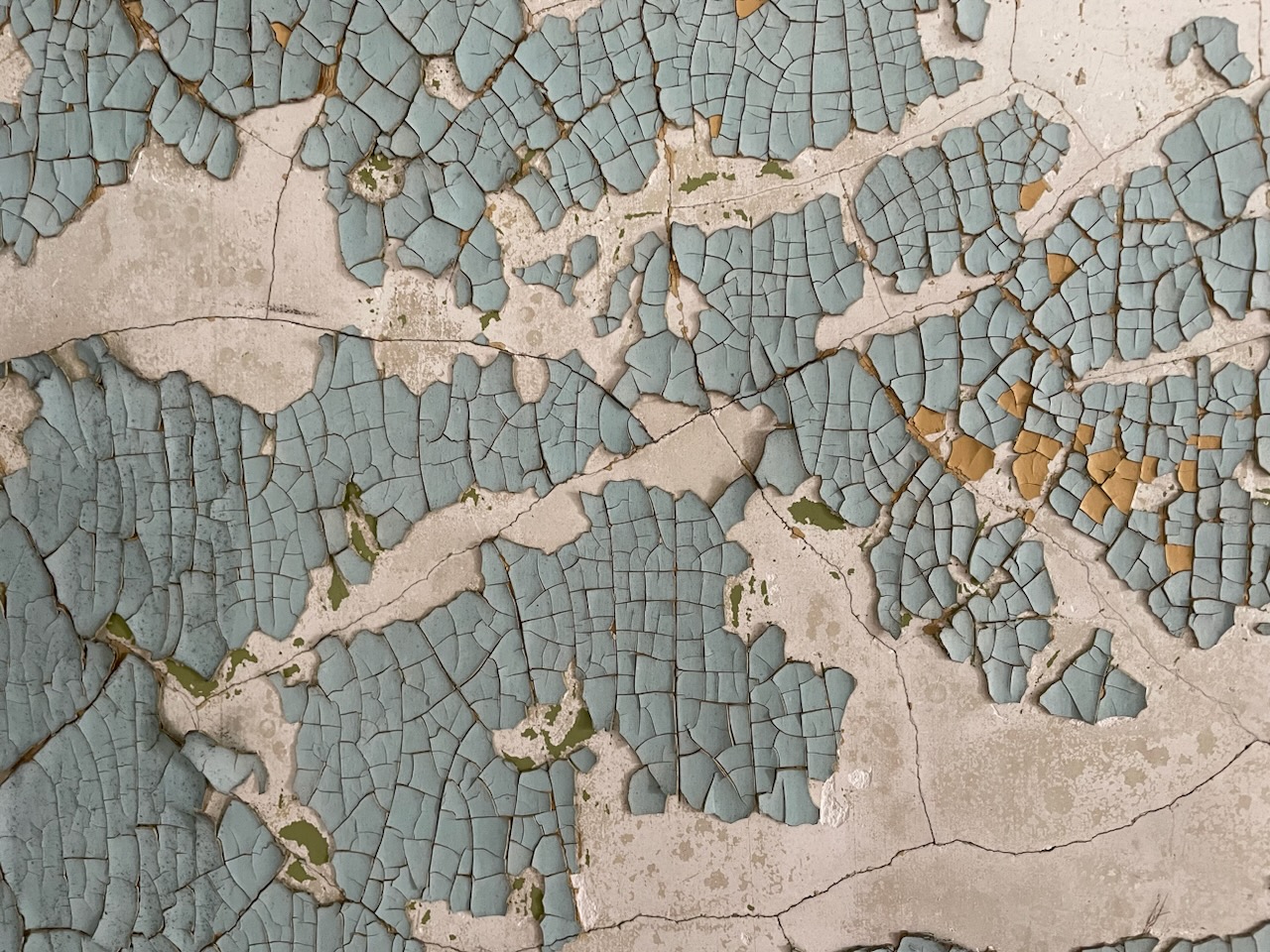
The paint itself evocative of all the years the buildings were used – around 1900 to 1954, when the federal government walked away from Ellis Island, declaring it “surplus property.”

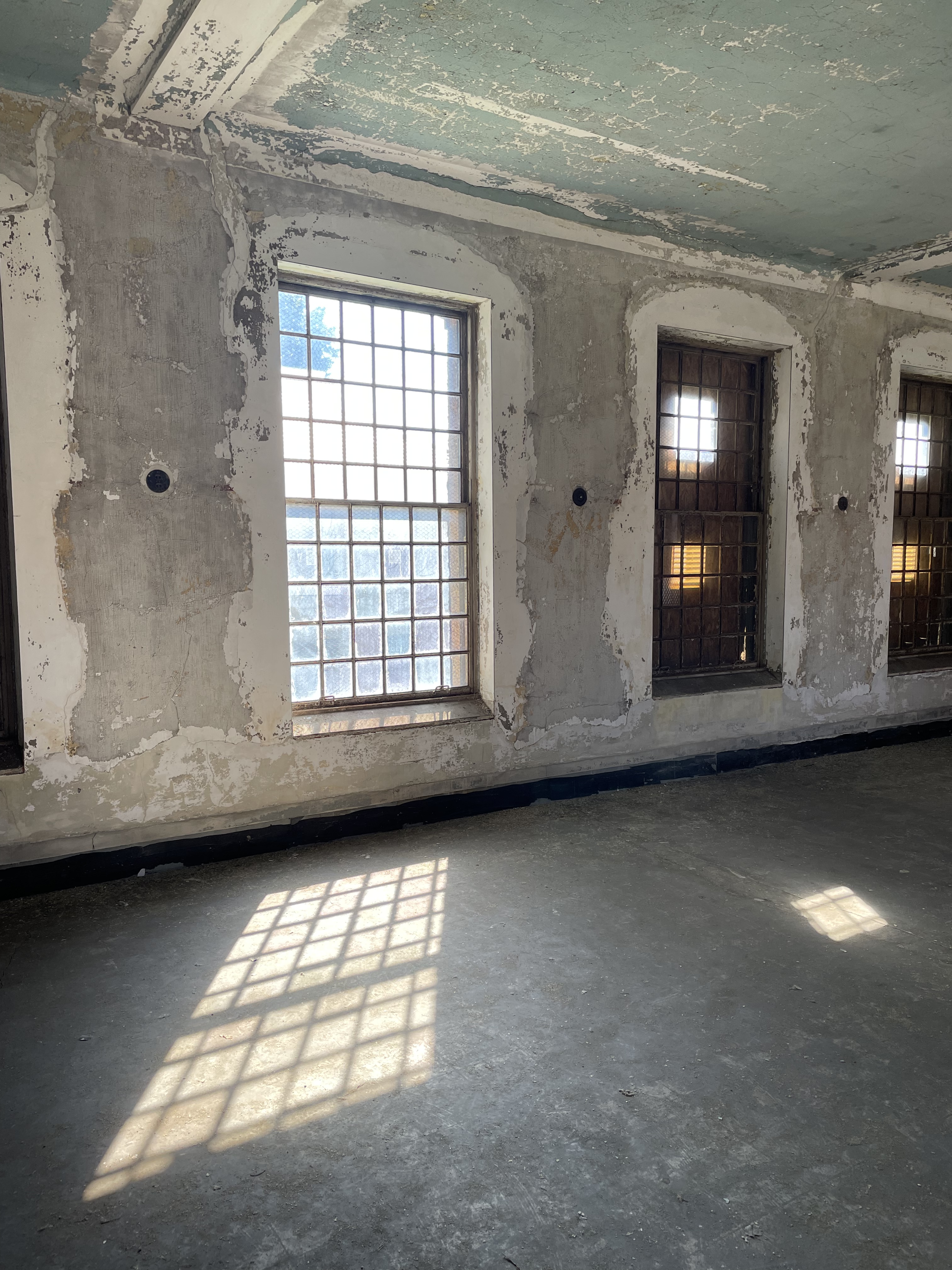
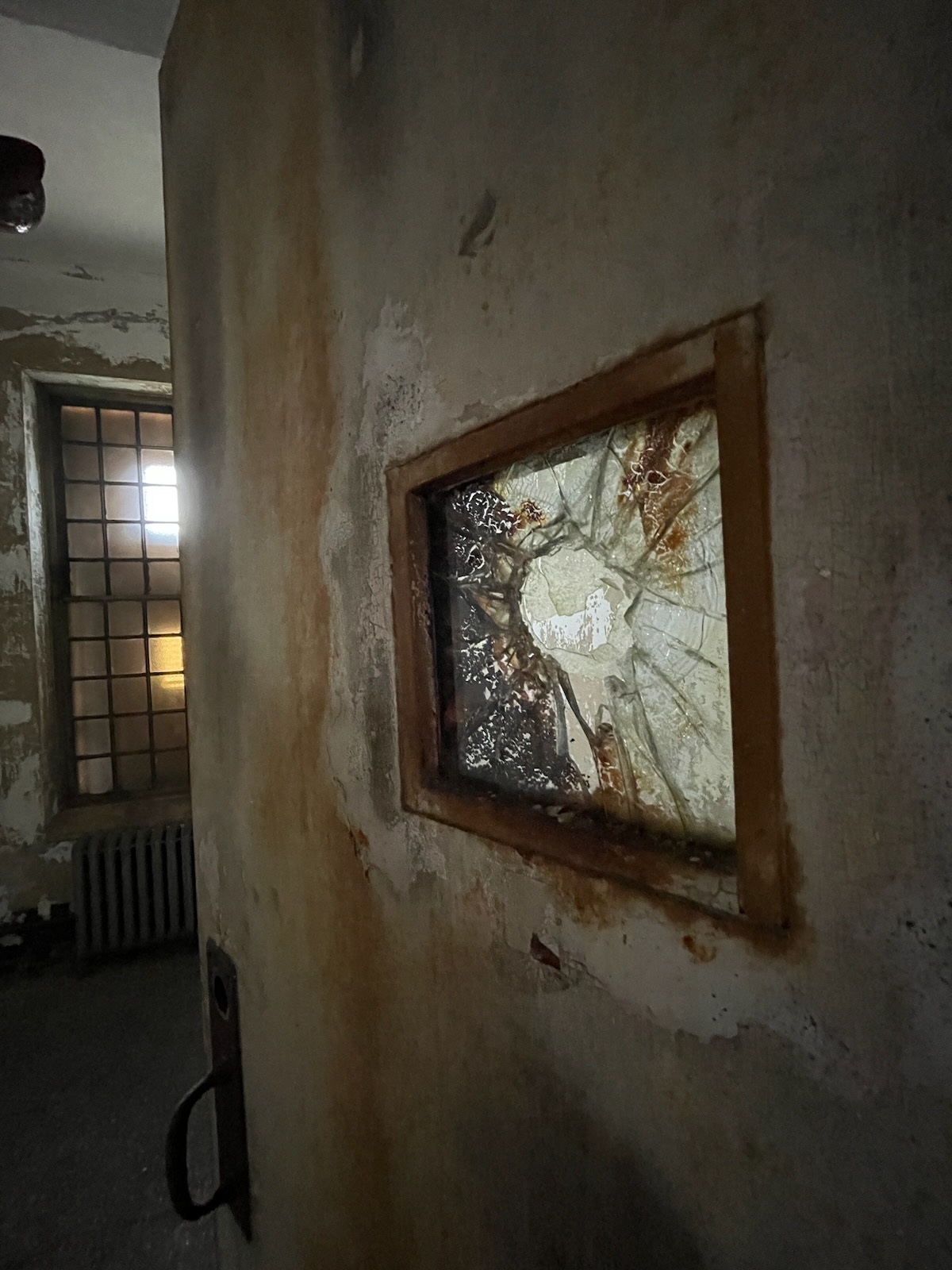
Psych wards where blue paint was often used, supposedly because it was considered a calming color.

What do you suppose the experts meant with green paint?

Other psych wards, single rooms.

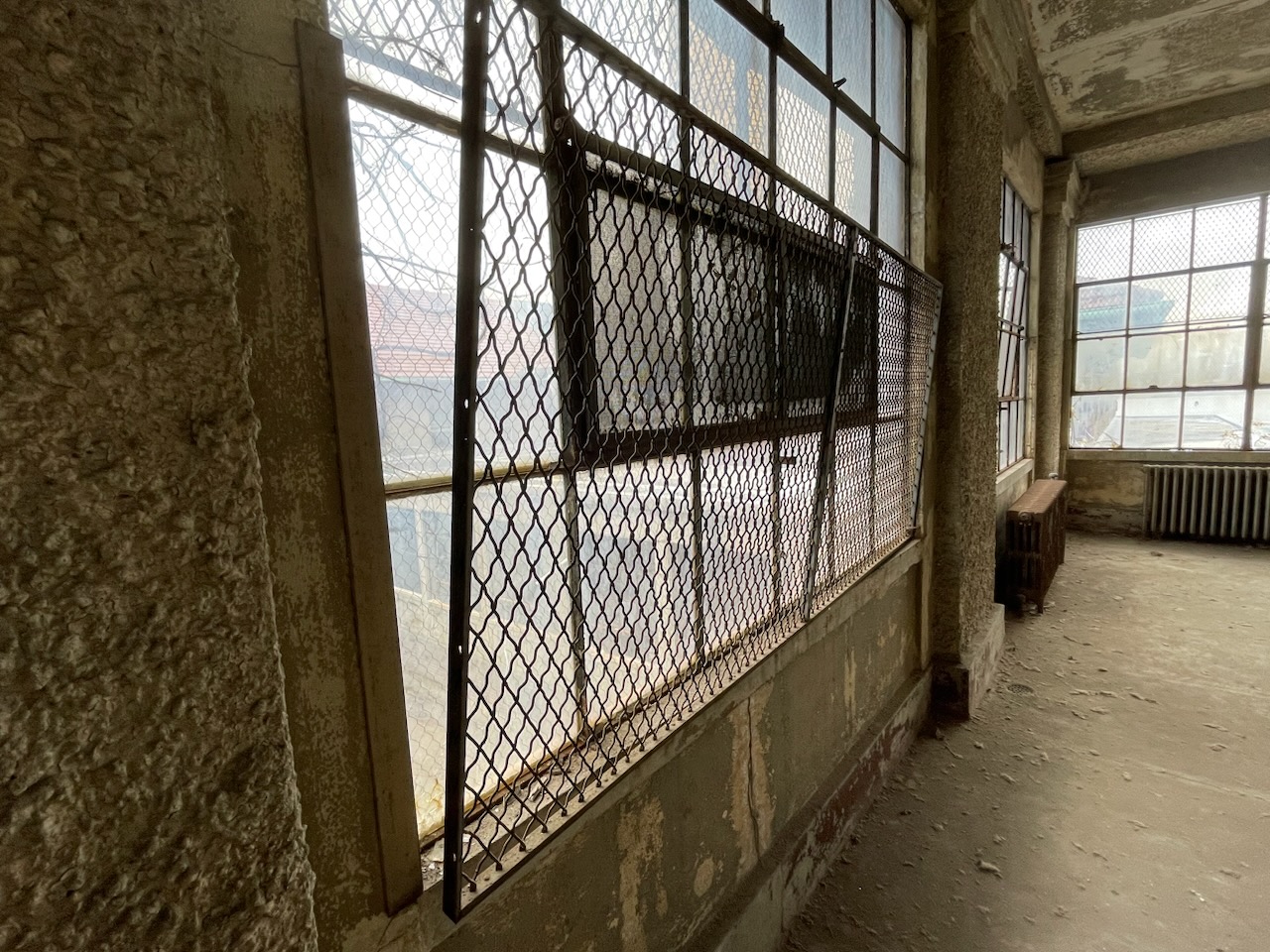
Windows barred in the event that depressed patients might take matters into their own hands.

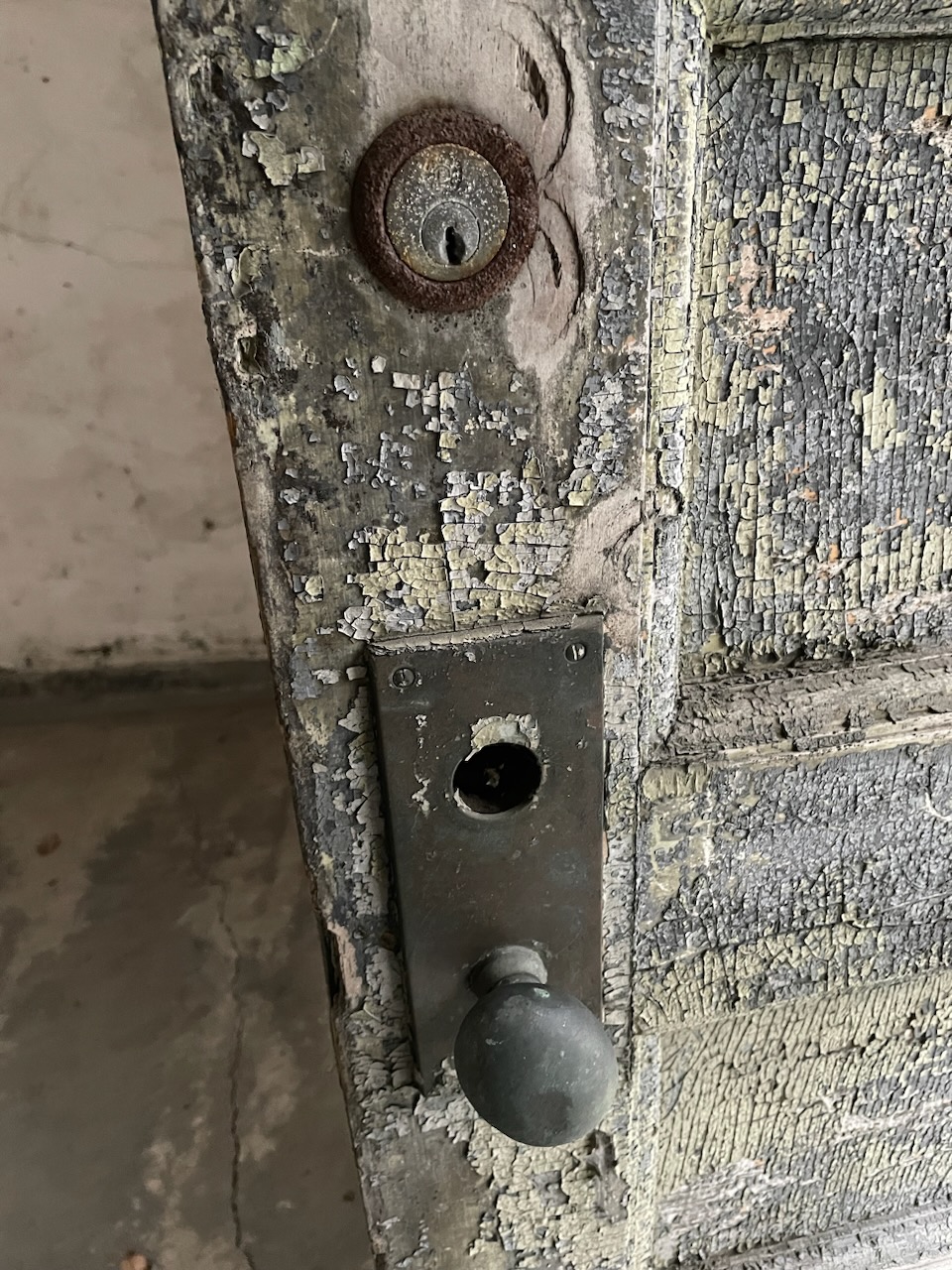
Doors prohibited exit.

Ancient graffiti says it all.

Please, come in.

No, really.

After you.

Be my guest.

Even the smallest details.

Historical gems. To me, anyway.

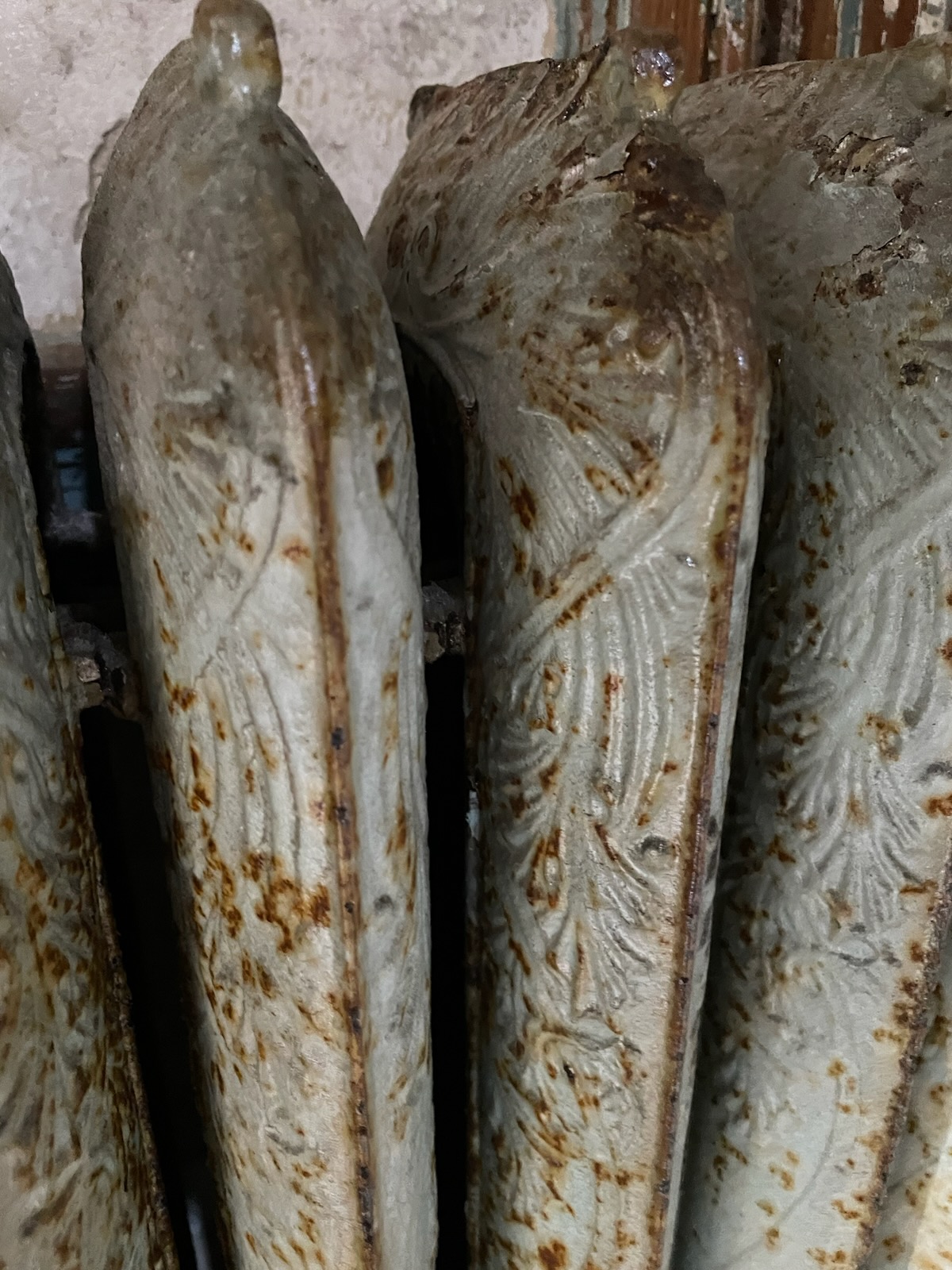
Don’t think they make radiators like they used to.

Sometimes it’s a relief to gaze out a window.

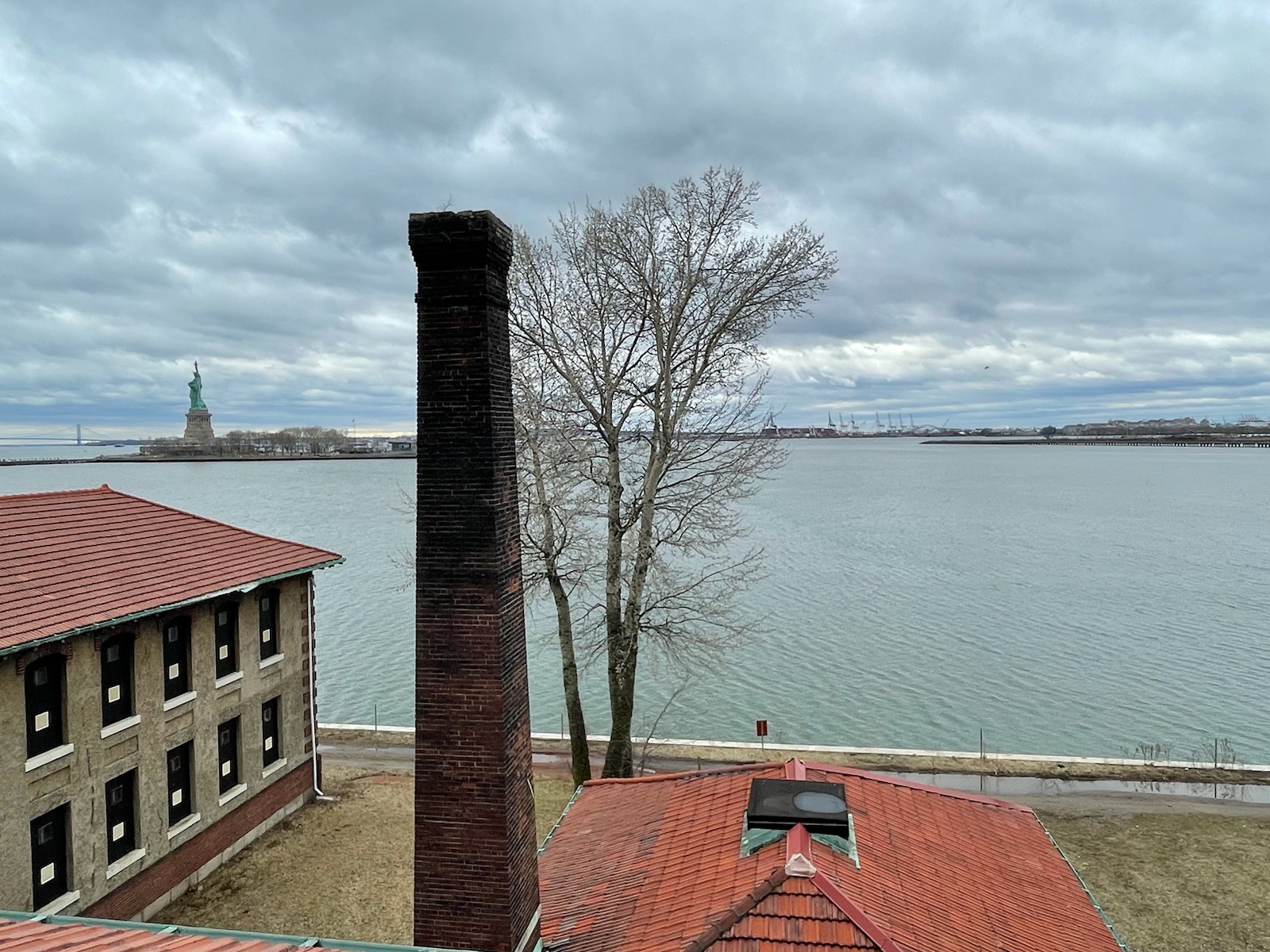
Yes, that is Our Lady of the Harbor in the distance.

Hang up your coat.

Stay a while.

Leave a comment

Filed under Jean Zimmerman

There is really no such thing as nondescript

in any borough of New York City.

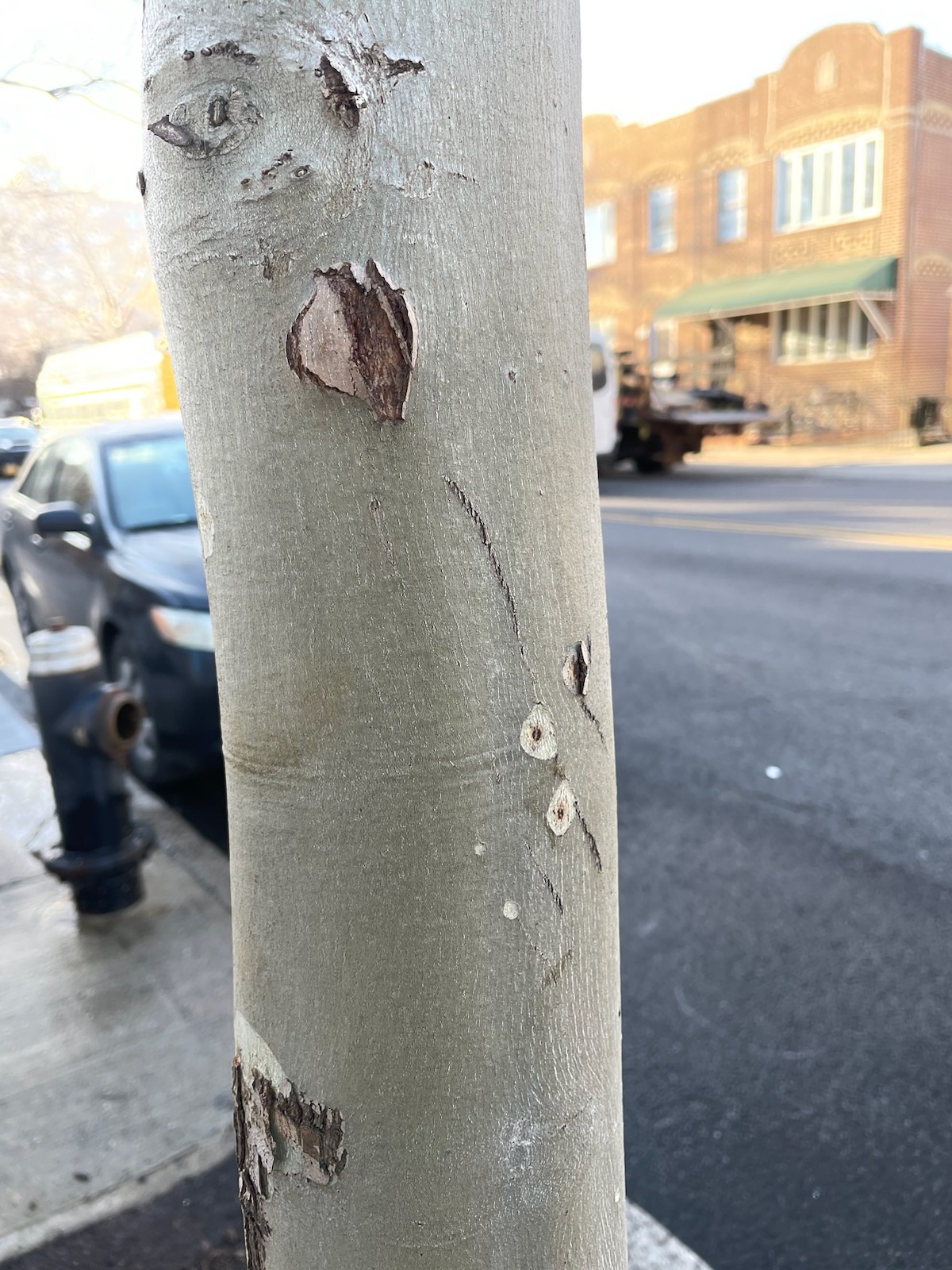
Here I am in an ordinary neighborhood of Brooklyn, rather humdrum, really, inspecting and preserving trees, and so many things have a hint of the marvelous.

The human impulse toward landscape adornment reigns supreme.

People here love their cherries.

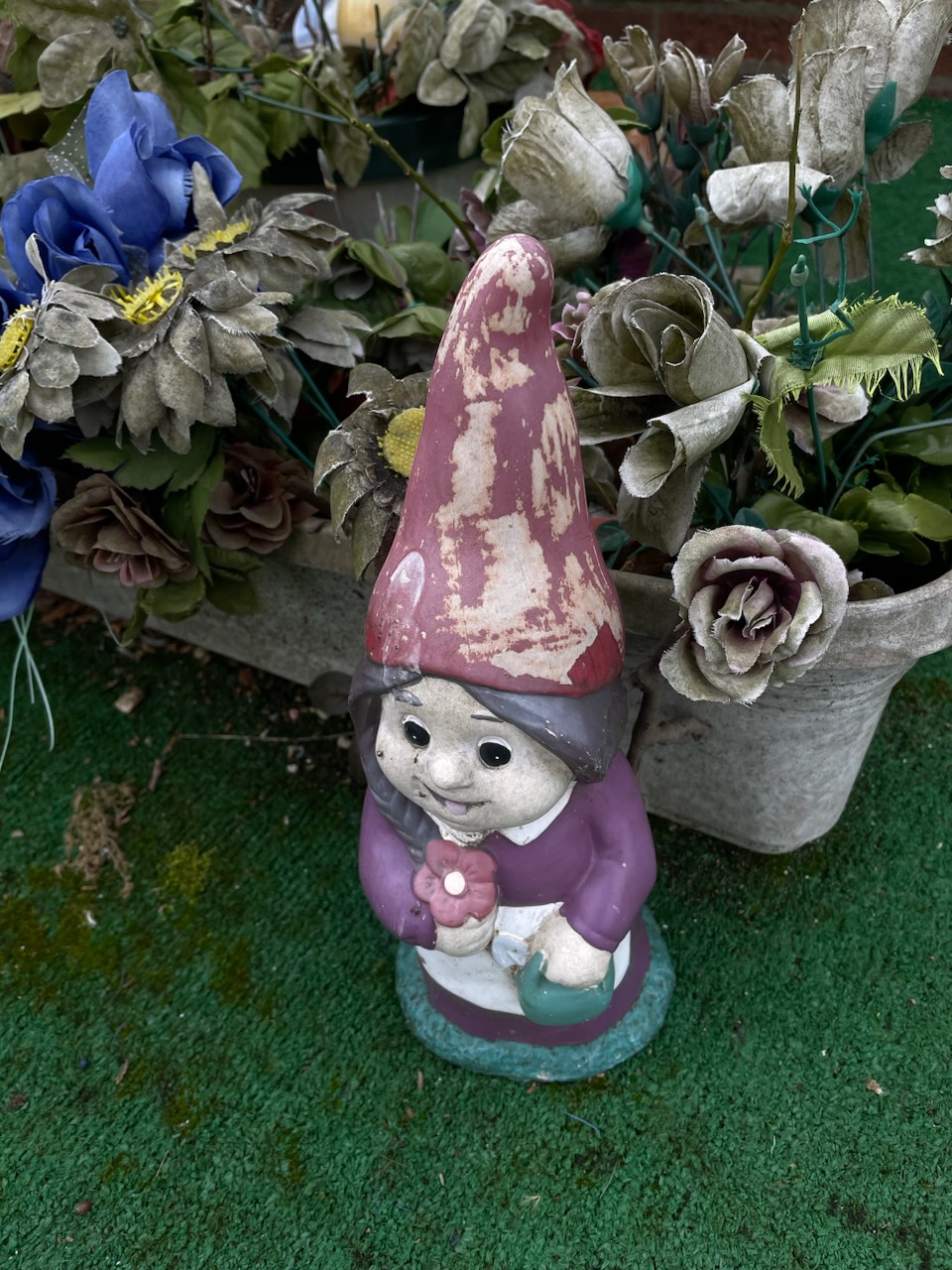
Doctor Seuss ornamentals.

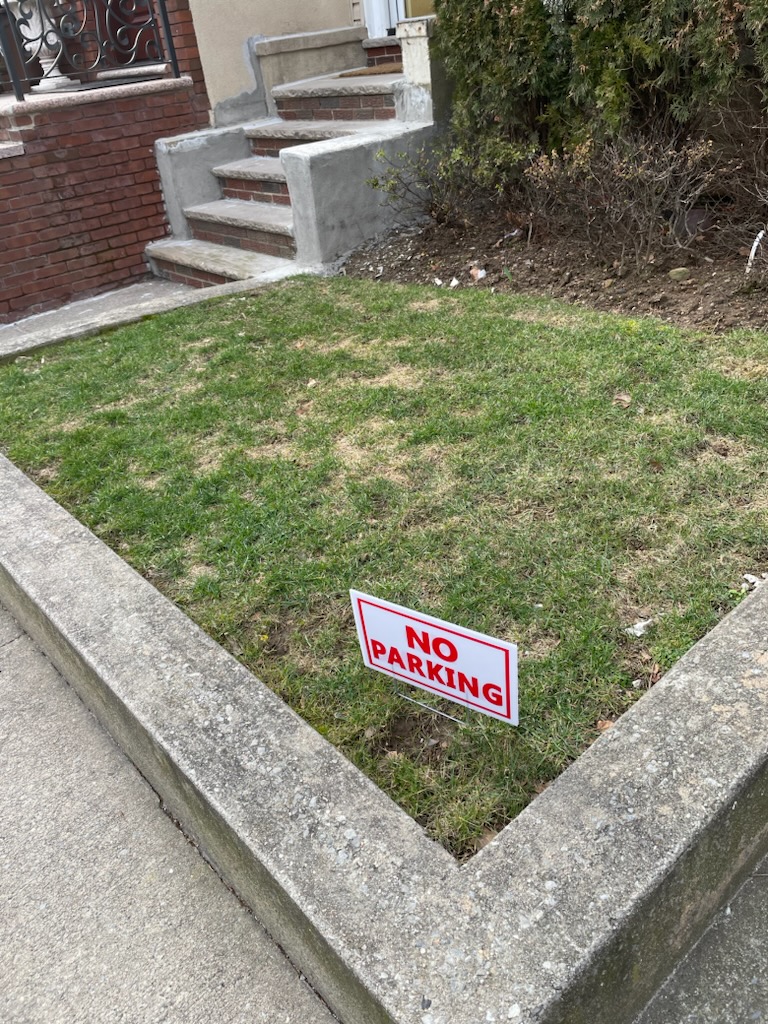
Their pipsqueak lawns.

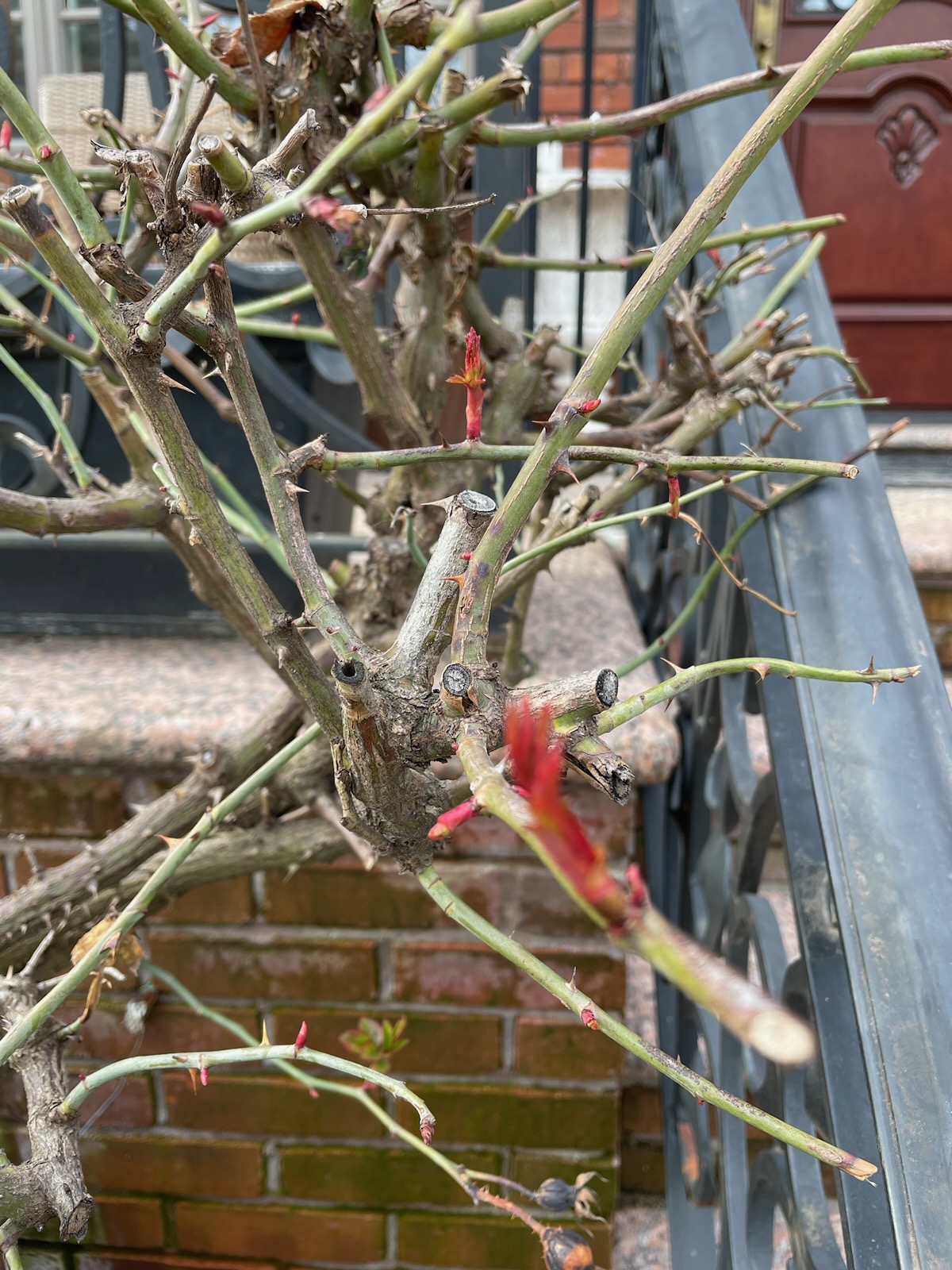
Their rose bushes, now hesitantly broaching the subject of spring.

But why wait if an artificial bloom looks just about as lovely on a late winter day?

Their Himalayan cedars, for goodness sake! Who woulda thunk it, on Brooklyn’s 58th Street? Yes, I know, a tree grows in Brooklyn.

I ponder the idea a friend shared today that there may be more trees on Earth than there are stars in the Milky Way. Not all that many trees here, but the ones that do exist are clearly treasured. I’m looking after some young London plane trees today. Someone has to protect them, and at this moment that someone happens to be me. A privilege. Thank you.

Barbara Kingsolver once said something cool. She talked about how important it is “to look hard, for a long time, at a single glorious thing: a flame of red geranium outside my bedroom window. And then another: my daughter in a yellow dress. And then another: the perfect outline of a full, dark sphere behind the crescent moon. Until I learn to be in love with my life again.” Yes.

Brooklynites love their orthodoxies.

Of all kinds.

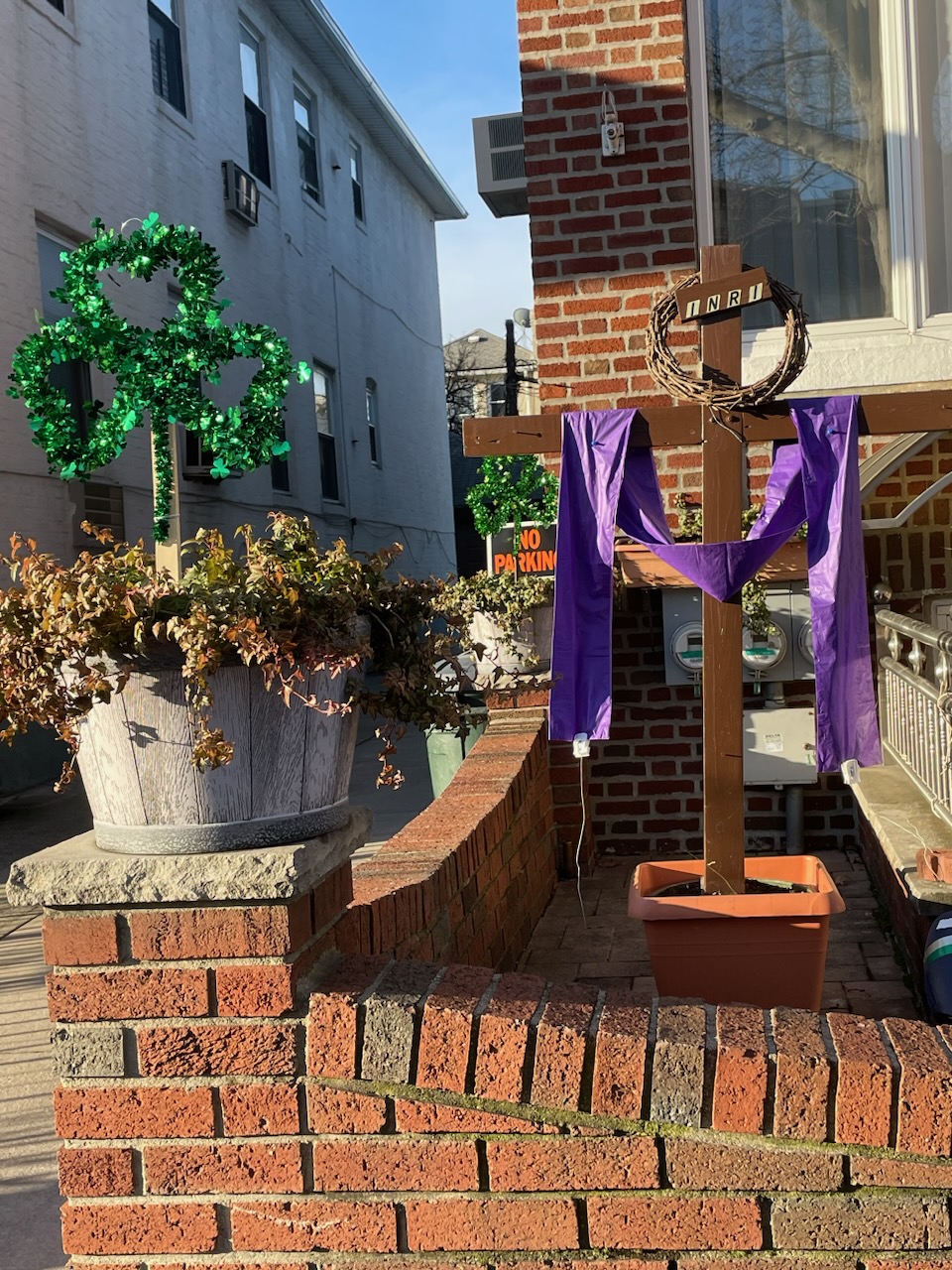
The abbreviation INRI stands for Iesus Nazarenus Rex Iudaeorum, which translates to Jesus of Nazareth the King of the Jews. The reason for this, if you want the abridged version, is because the first complete combined bible was translated by St. Jerome into Vulgate Latin. People became used to the Latin and continued to use INRI. Such an ancient concept in our awfully contemporary age.

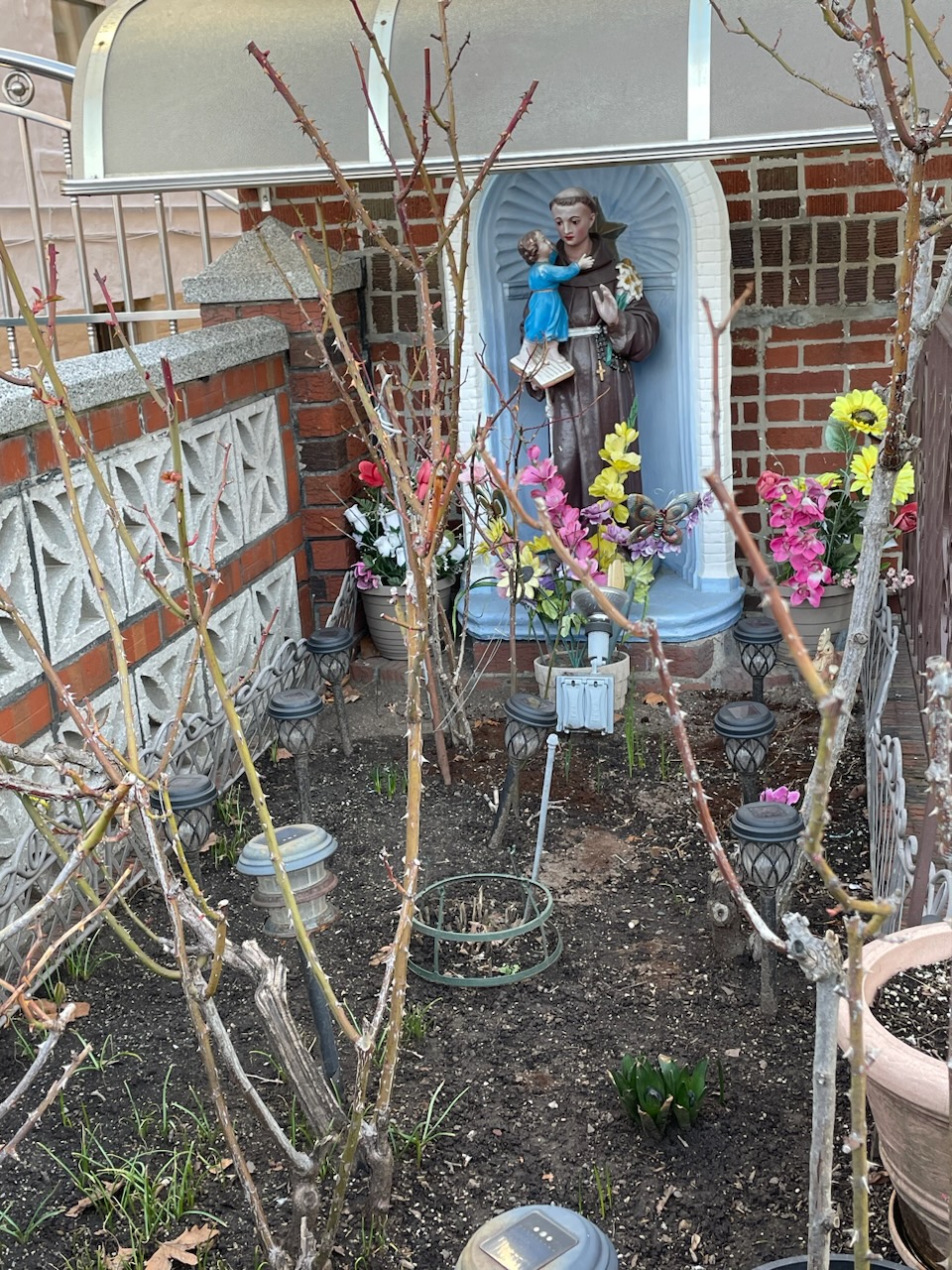
I’ve always found the mysticism of the boroughs fascinating. The abundance of shrines.

Might this placid gentleman be some saint or other? I’ve never been good at keeping them straight. They’re all important, though.

The people I meet have a kindliness that I think might surprise folks elsewhere in the country. The foreman at the gigantic construction project down the street pointed me in the direction of the Mobil station down the road where “they have gas! Restrooms! Food! Everything!” And the Rite-Aid clerk proved equally hospitable, glancing once at my reflective vest and waving me on to the employee bathroom.

The belief systems here are deeply ingrained.

Driving down to the Mobil station along Bay Parkway takes you right through the middle of Washington Cemetery. As if on cue, Lucinda Williams comes on the radio: You’ve got to get right with God.

Gigantic, and plunked down right in the middle of this residential neighborhood, the cemetery was founded in Kings County in 1850, outside the independent city of Brooklyn, and from the first served primarily German Jewish immigrants. I feel like I might stumble upon some long-lost relative here.

 You can wend your way through the grave plots on paths called Rose, Hyacinth, Jasmine, Aster, Lotus, Evergreen, Cedar, Maple, Cypress, Orange, Sycamore, Spruce, Aspen, Balsam, Oak, Magnolia, Arcadia and Birch. The burial ground has its share of both Yiddish theater stars and gangsters.

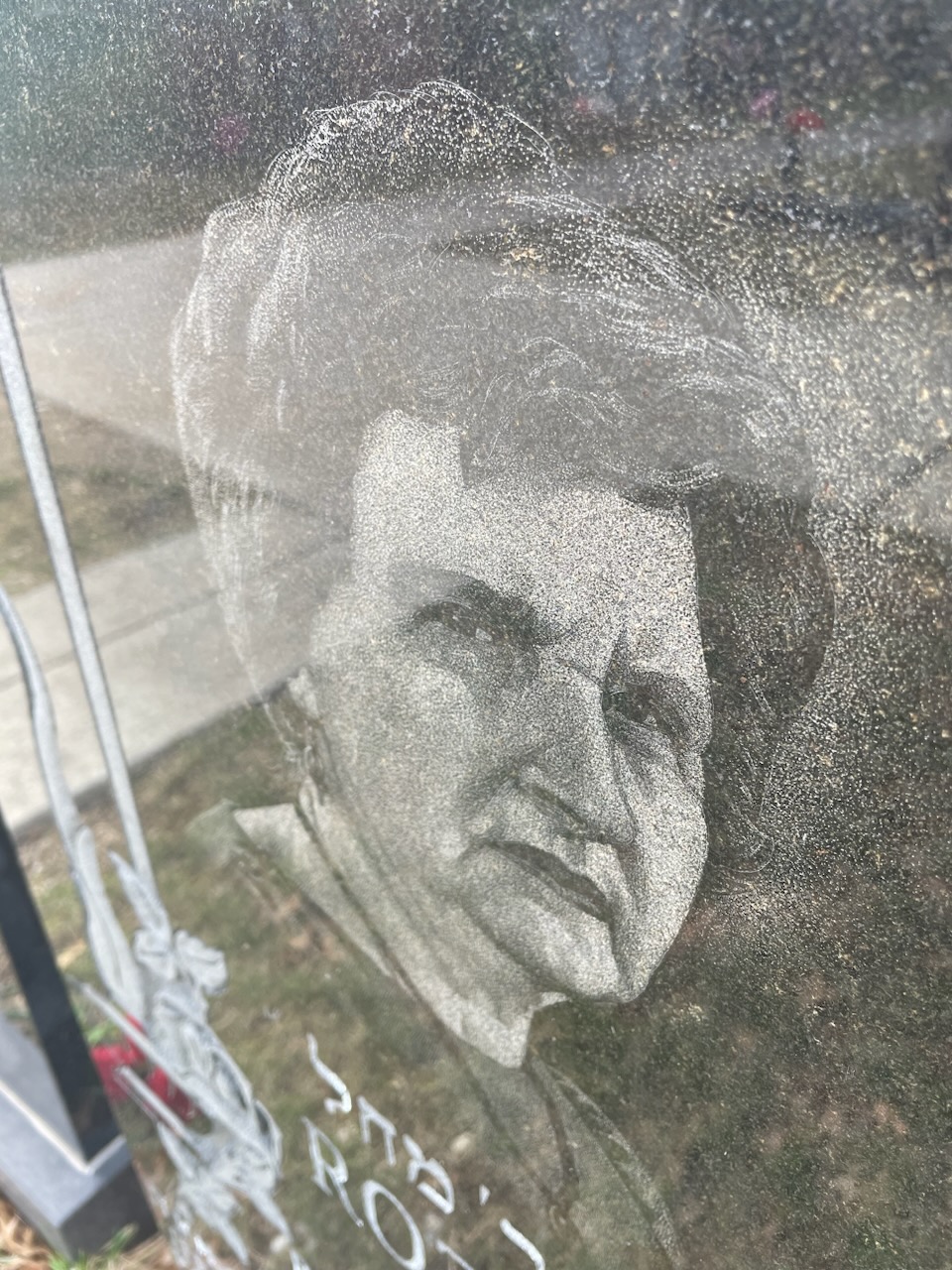
Never pass up an opportunity to walk through a cool cemetery. Especially when there are tombstones with photographs, the latest style in death, which has always got something new going on.

And handsome stone lions.

And what must be lambs.

Some of the deceased seem not to have been caught on an especially great day.

But as is often the case in graveyards you can find greenery captured in stone.

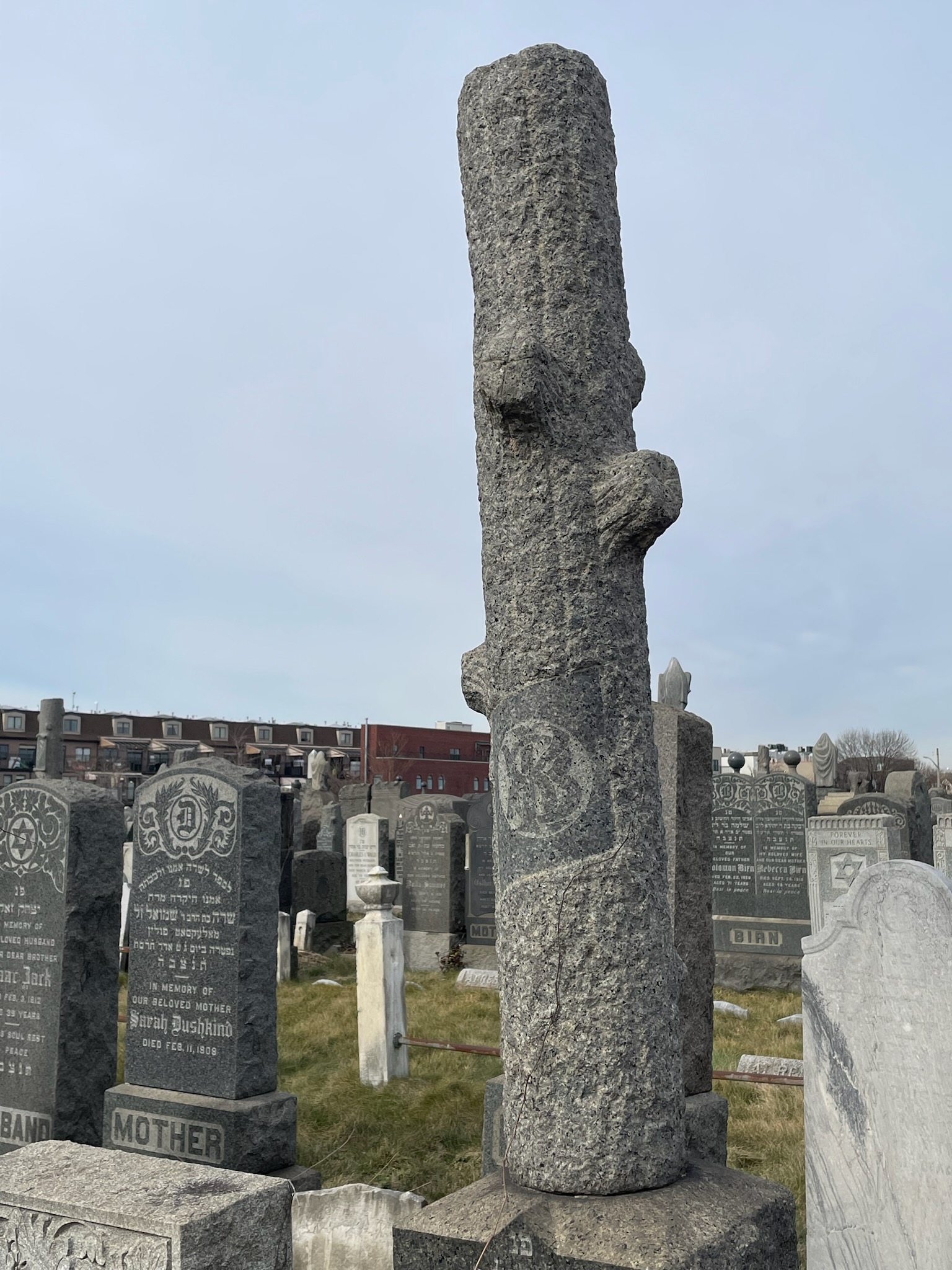
And extremely symbolic severed trees.

You know me, I prefer the old-old. The namelessly poetic.

Everything pukka on this ho-hum late winter day.

Learning about stuff.

Anticipating spring.
Leave a comment

Filed under Jean Zimmerman

Drifting along the trail around Teatown Lake at dusk

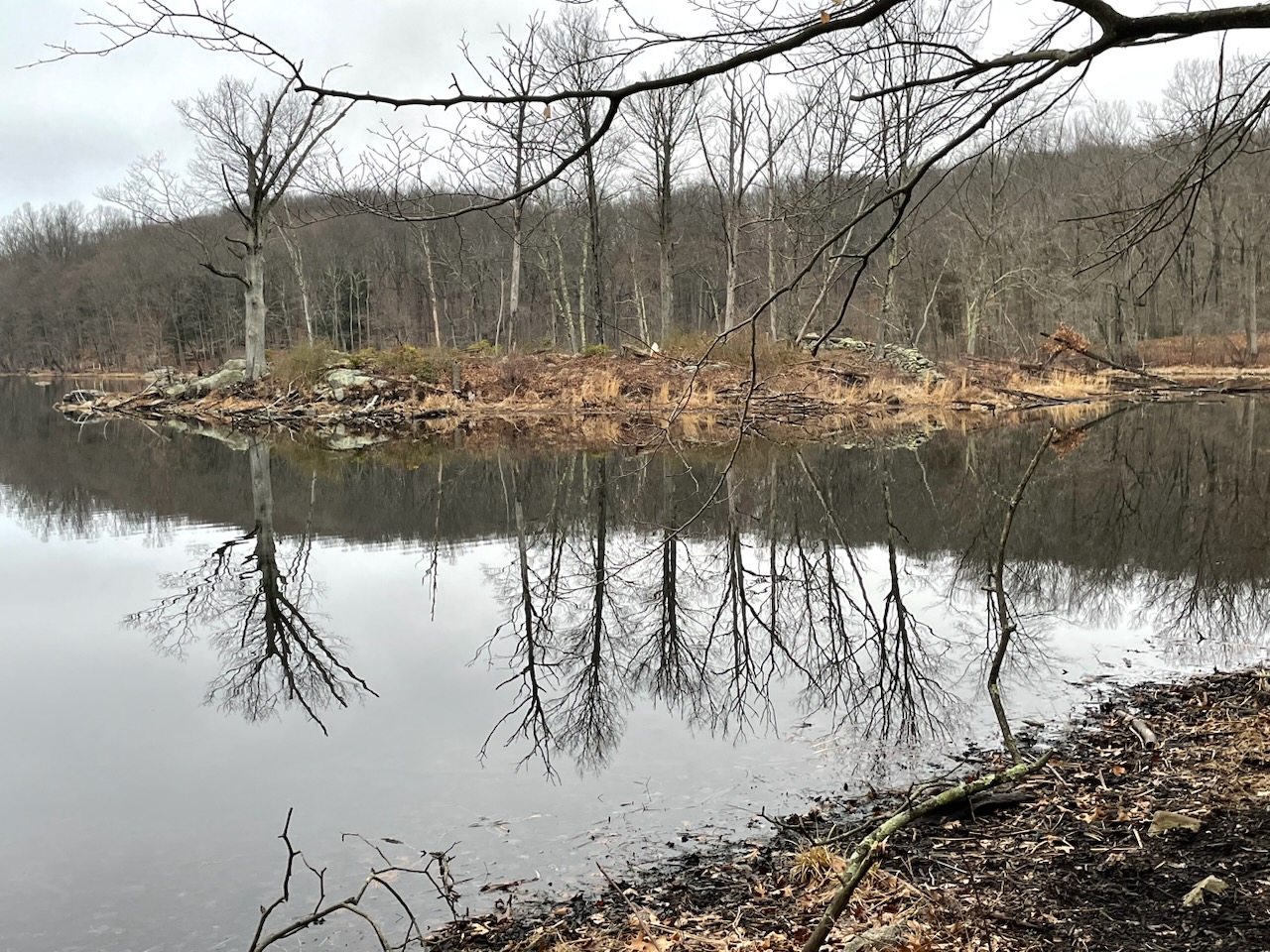
can be wondrous. A silent dream.

A wolf could probably take this one-and-a half-mile trail in around ten minutes, loping the loop.

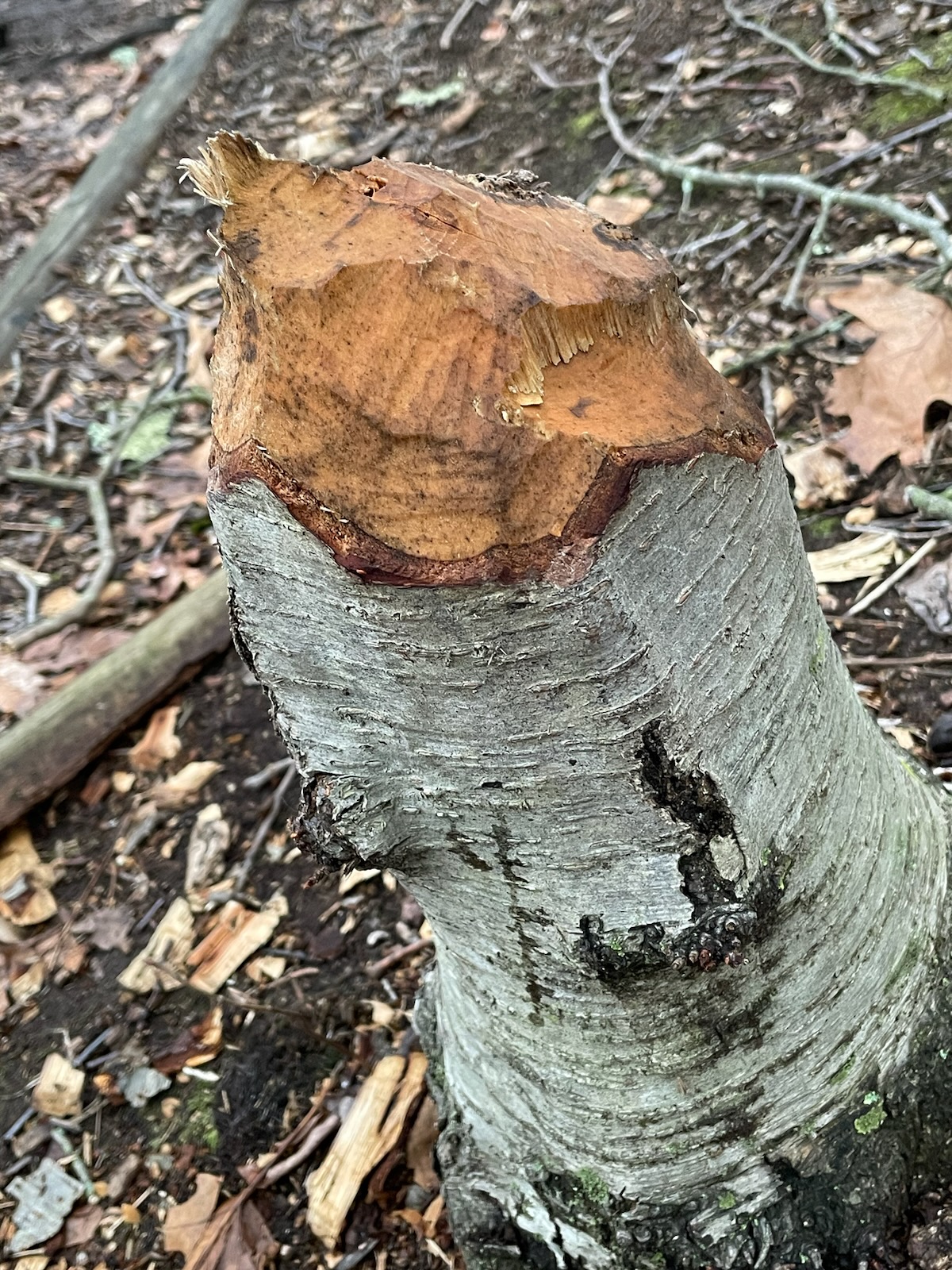
If a wolf inhabited these woods. Which is improbable. Bears, though, might. And beavers, definitely. Evidence of their newly gnawed work abounds.

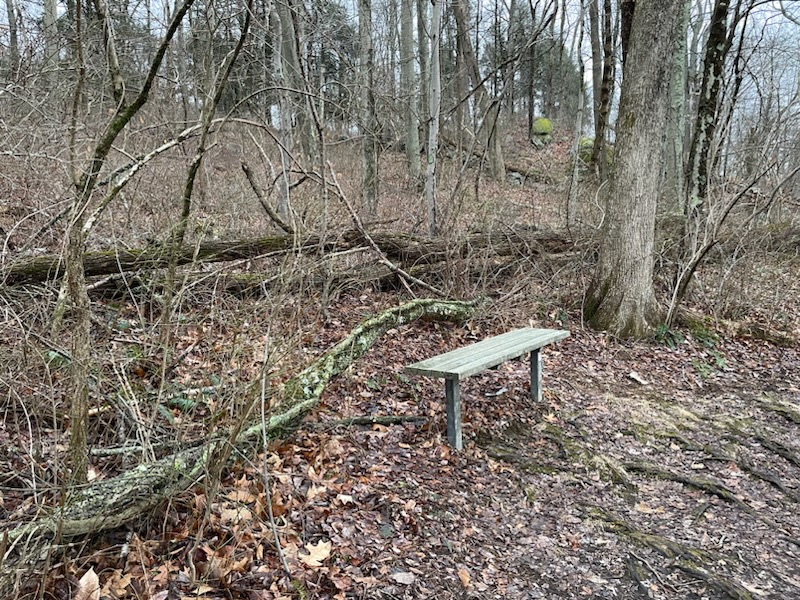
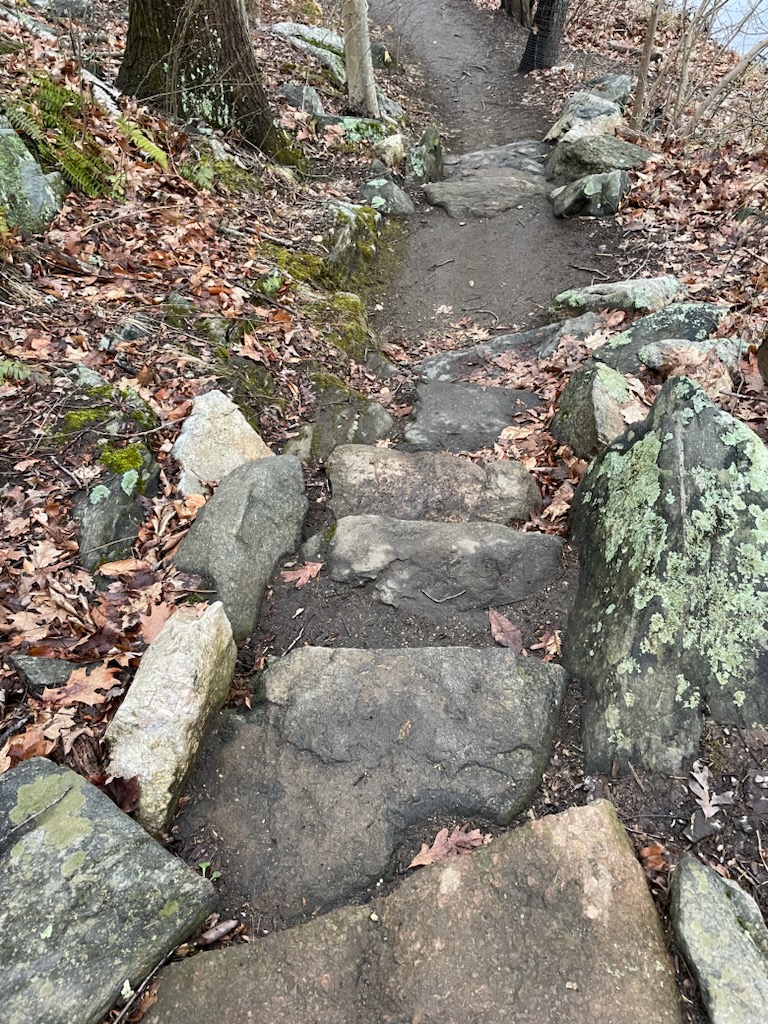
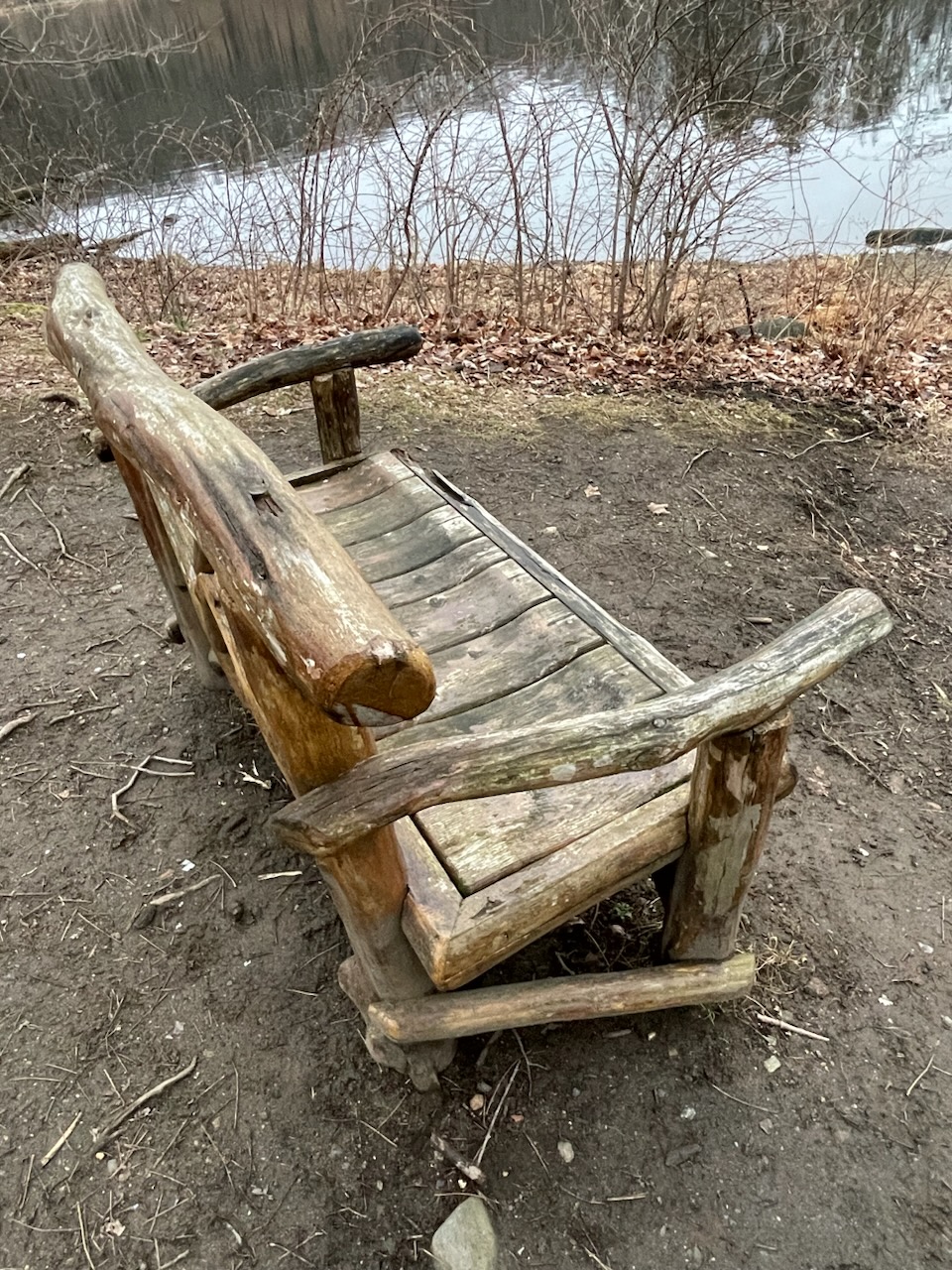
It’s gloriously somber and moody today, but could be restful if you took advantage of the benches carefully placed along the way.

I’m hiking the opposite direction of the way I usually go. Clockwise, starting in the wildflower tract, now of course devoid of flowers in winter. The lake itself at the 1,000-acre Teatown Lake Reservation was created in 1924 when Bailey’s Brook was dammed.

Yes, I would like to climb you. Thank you for the invitation.

I’ve heard exactly one sound in the thirty minutes I’ve walked: a lone dog barking in the distance. And now the geese, skidding to a landing on the surface of the lake. They sound as if they’re yelping as they go.

I know from speaking with a knowledgeable person on the Goose Patrol at Ellis Island that the ones passing through on their migration are about to start mating, hatching goslings. I can’t wait. I also find I cannot wait to go around the next turn here and see what awaits me.

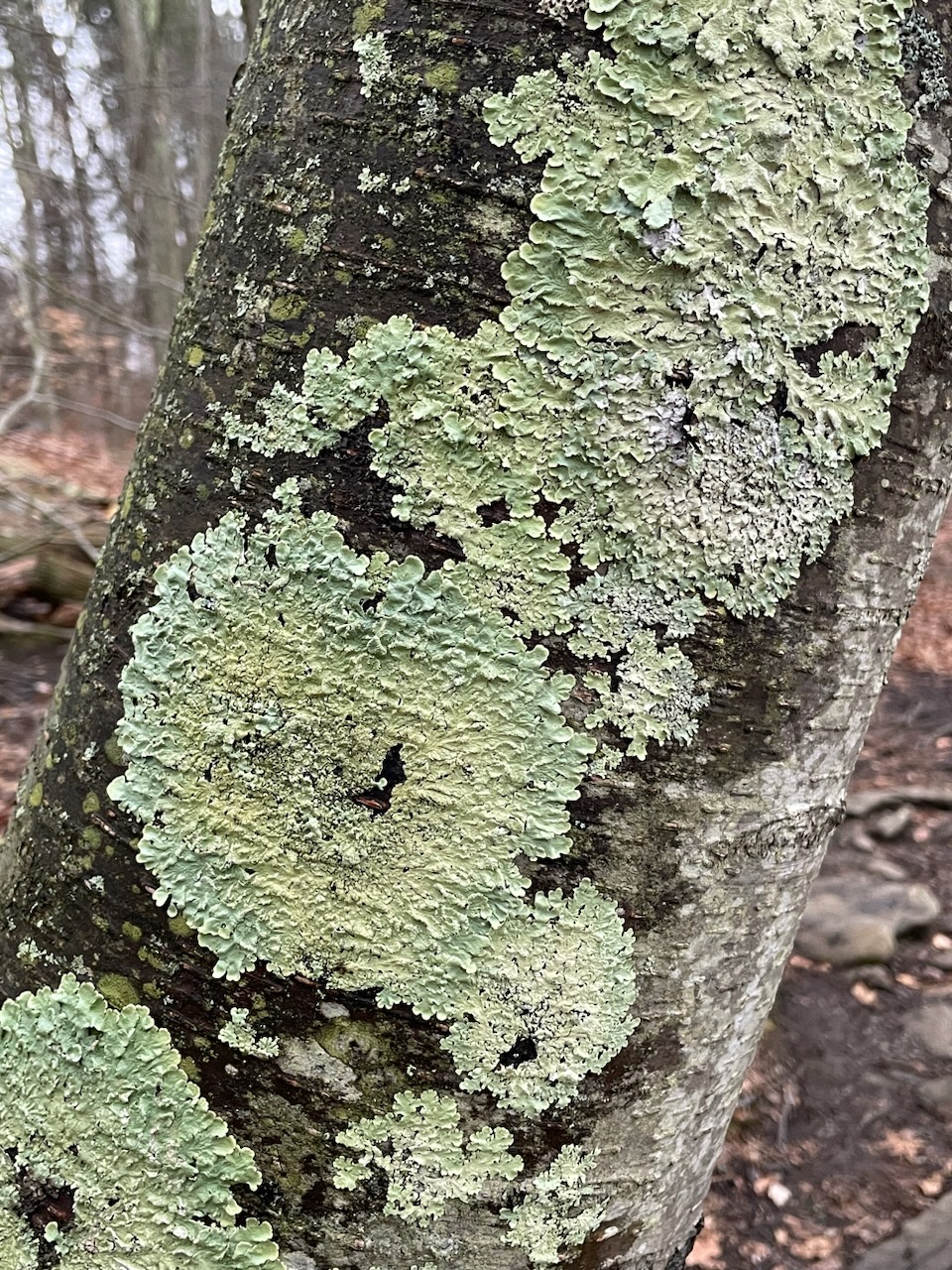
It begins to seem silly, the baggage I carried in. Worries over money, love, work. They have no place here among the fallen brown leaves and the lichen.

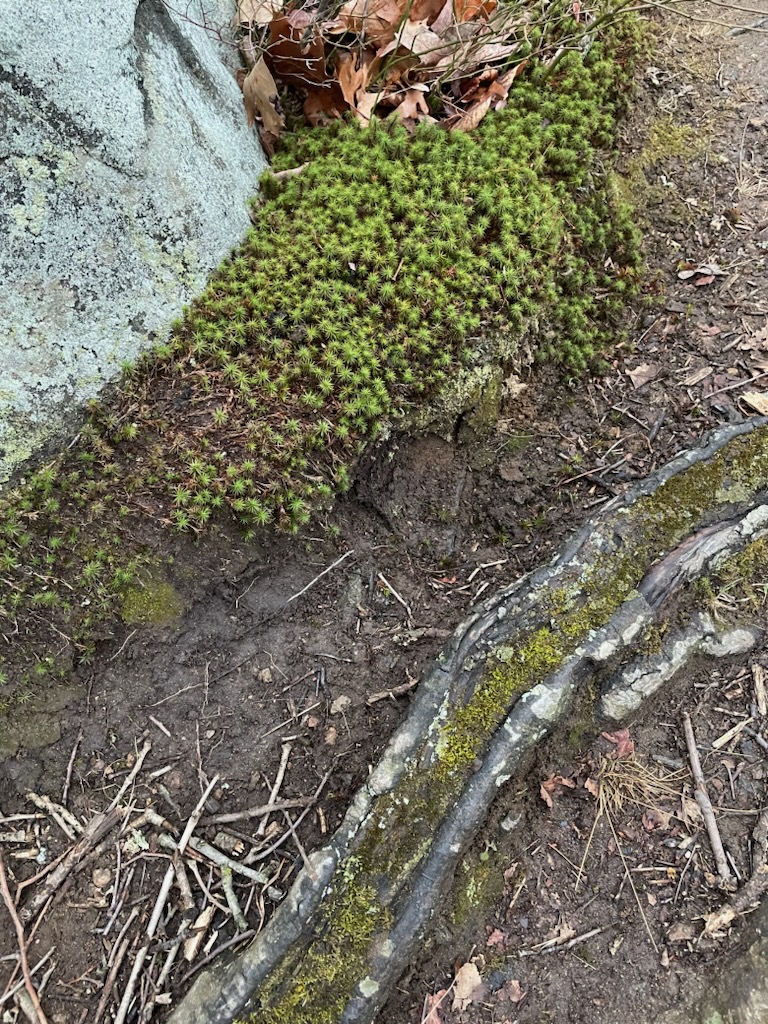
The emerald moss.

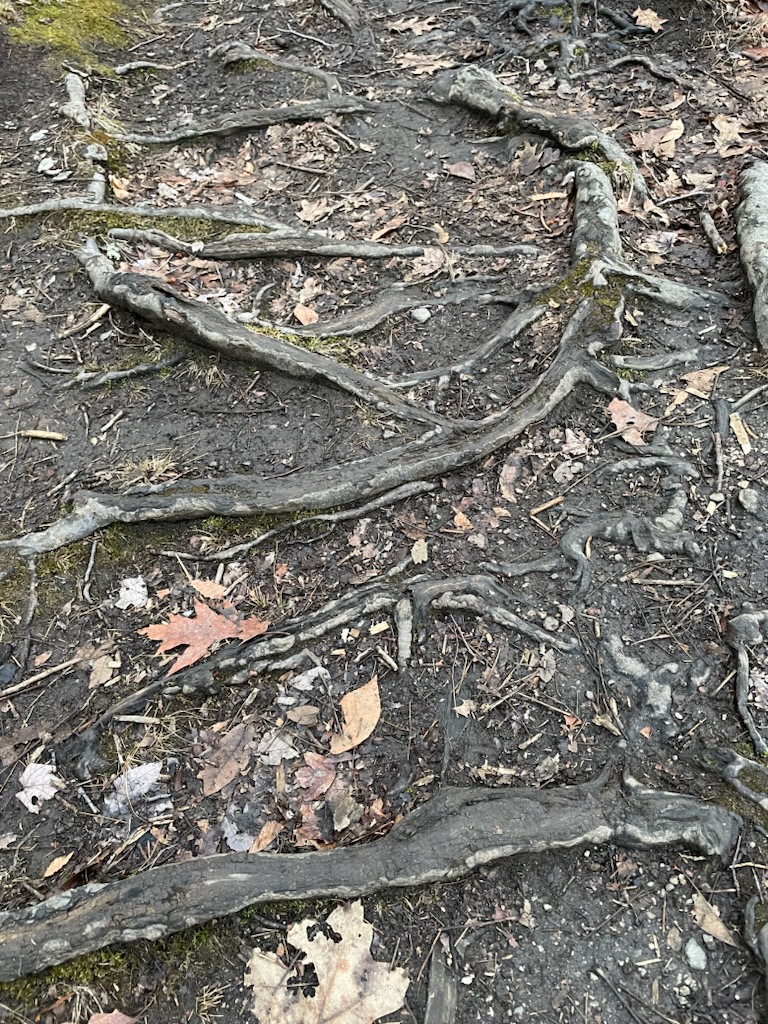
The roots that sprawl over the path. My only worry here is that I might trip and break an ankle, so I take it slow.

I recently heard the buzzphrase slow travel, which means immersion in a place, being present in the moment rather than whisking yourself along a route to see more, more, more. This is a slow hike.

Yes, if you go up, then you must go down. Hikers always say the downhill is harder. I don’t know. Today I don’t care.

Clearly there is no fishing allowed here on the lake.

They mean it when they say so. Another bench, a graceful one.

But I’m not stopping. Some trees are funny. You have to ask yourself sometimes, What do they think they’re doing? There is surely a reason for it all.

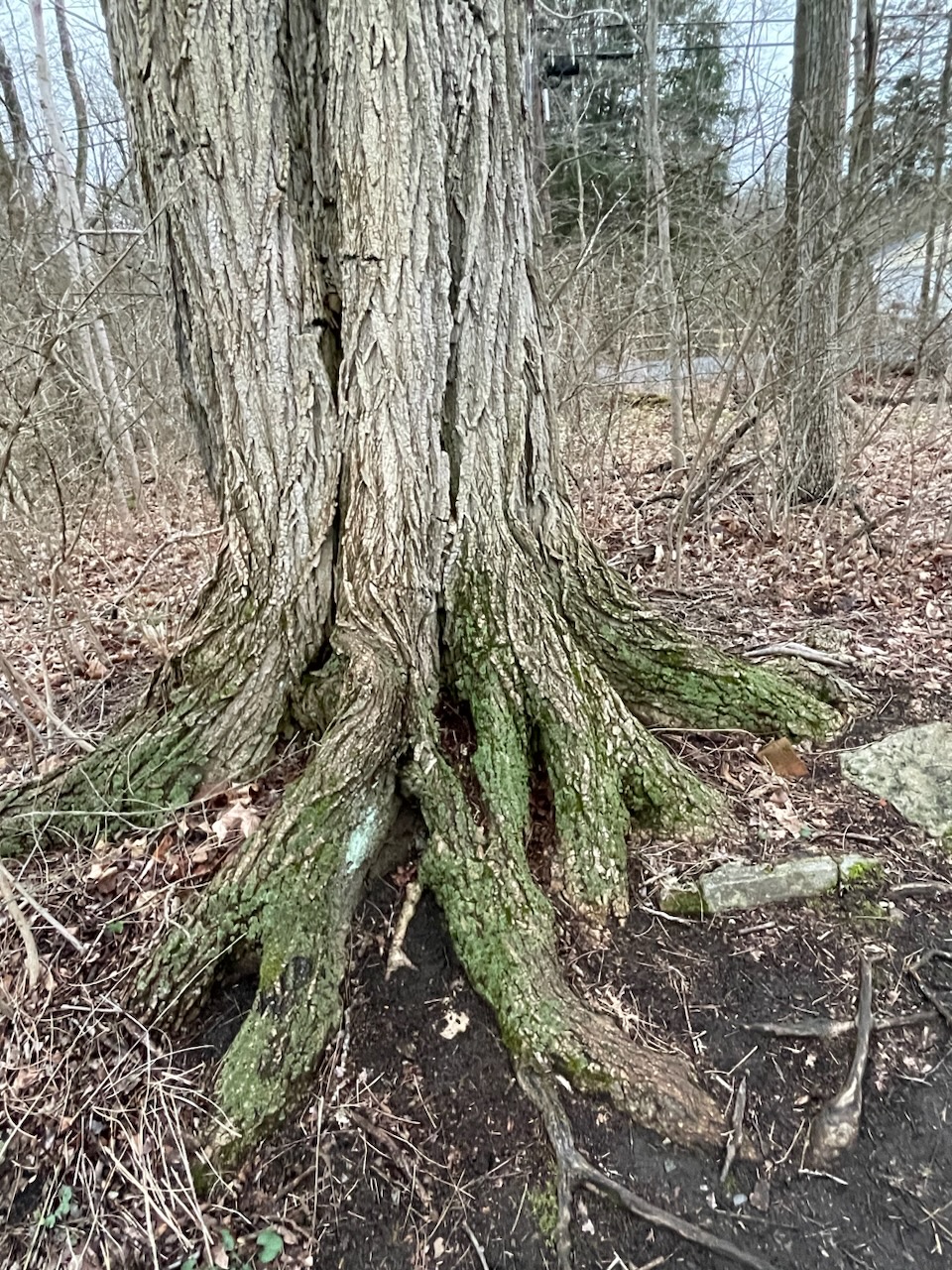
The ancient locust trees here nearly overwhelm with their personality.

I think I’ll walk as far as I can. I’m never going home.

The surface of the water is so placid. I watch the ducks dunk for their supper. It’s so easy for them. Or at least it looks easy. Maybe it’s not! Maybe every day is a challenge, even for ducks.

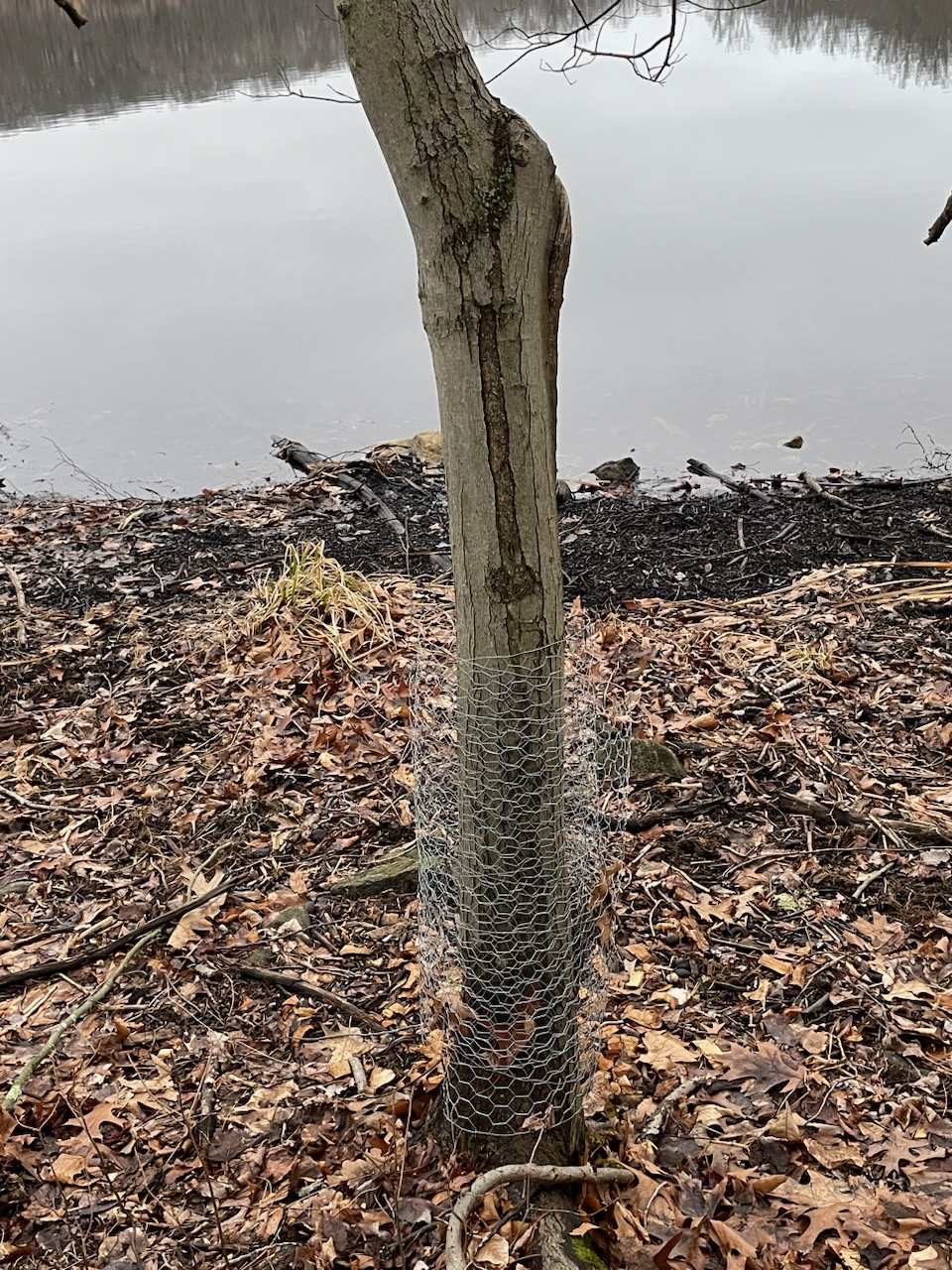
Scouting for beaver dens. Where are they? I see protection against them all over the shoreline.

I scare up a pair of mallards, male and female. I’m sorry! Pardon me, but do you mate for life?

I start to cross the bridge. Sometimes don’t you feel so alone? At those moments it feels good to be actually alone, physically alone.

Then a couple of humans approach out of nowhere, male and female, all in black. They seem to be racewalking toward me. Really? There’s so much to take your time for here.

Teatown does a nice job maintaining this place. Someone recently repaired the bridge walk using great care.

It’s cultivated woods here, not forest. The fifteen miles of trails have been well tagged, in every color of the rainbow, practically.

Overhead, in the distance, undeniable evidence of humans.

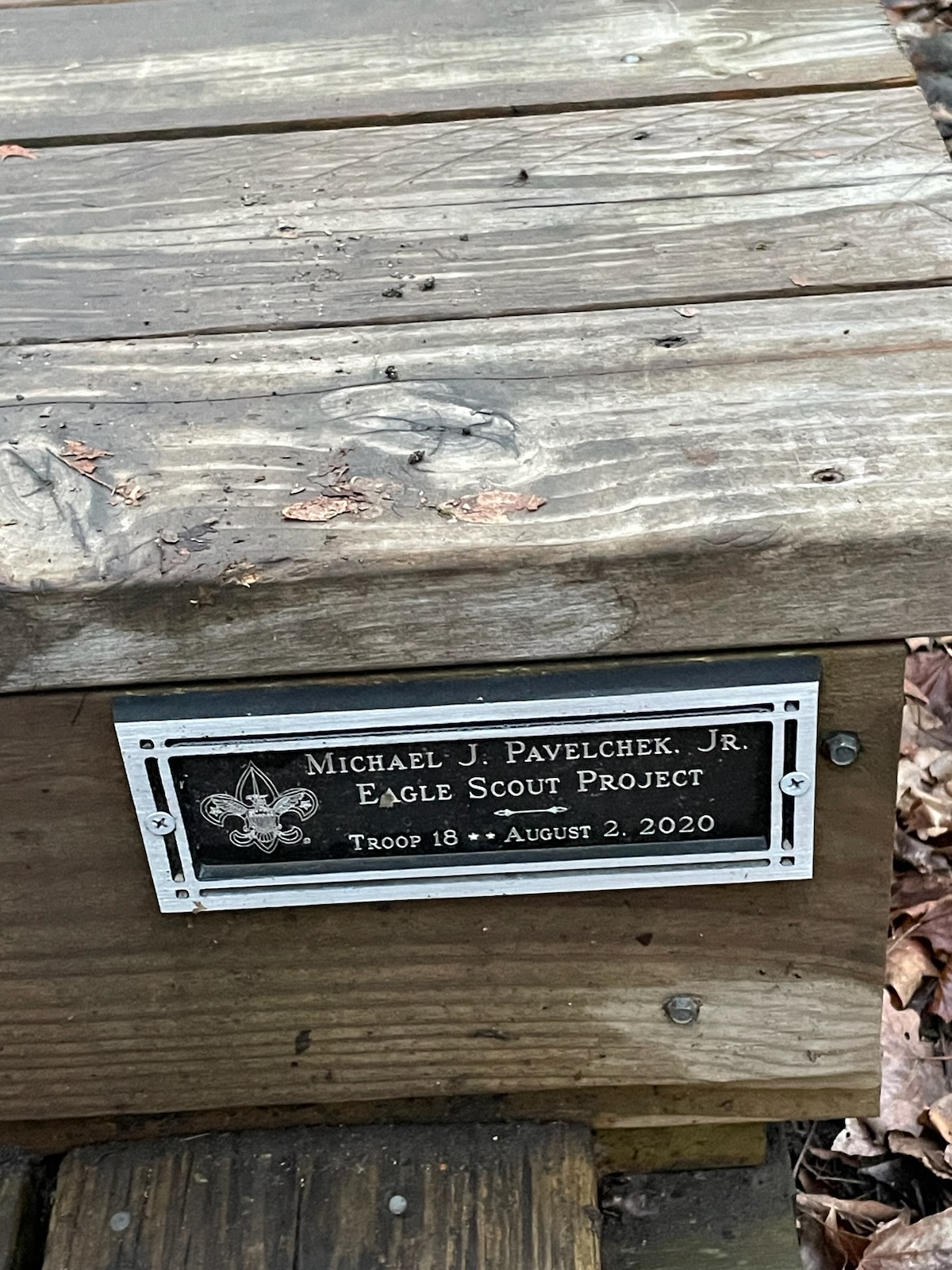
It seems every bench and small bridge is named for someone special.

Might not mind that so much if I knew the people. I like things that are nameless, though. Anonymous stone walls mark a different era.

I used to live near here, in Ossining, just down the road. In an old, old log cabin. Seems like such a long time ago. I don’t want to go back there. But I still love these woods.

Ever have this feeling that you might get lost, even though you know you can’t possibly get lost? I know that if I hug the shore of this lake and keep going, I will return to where I started. Still. I don’t quite remember being here before, in this exact spot. The dangers of life are infinite, and among them is safety. Goethe said that.                                                    

 The dog barks again. It’s not as if I’m out in the wild.

But it is so deserted here, so devoid of immediate human presence that I feel I can void my bladder trailside. Pee like nobody’s watching! to paraphrase about a million folks.

Thank you kindly, Mr. Root, said the fallen branch, for offering me a place to rest myself.

Some things just look staged, even here. There’s red oak with a humorous burl.

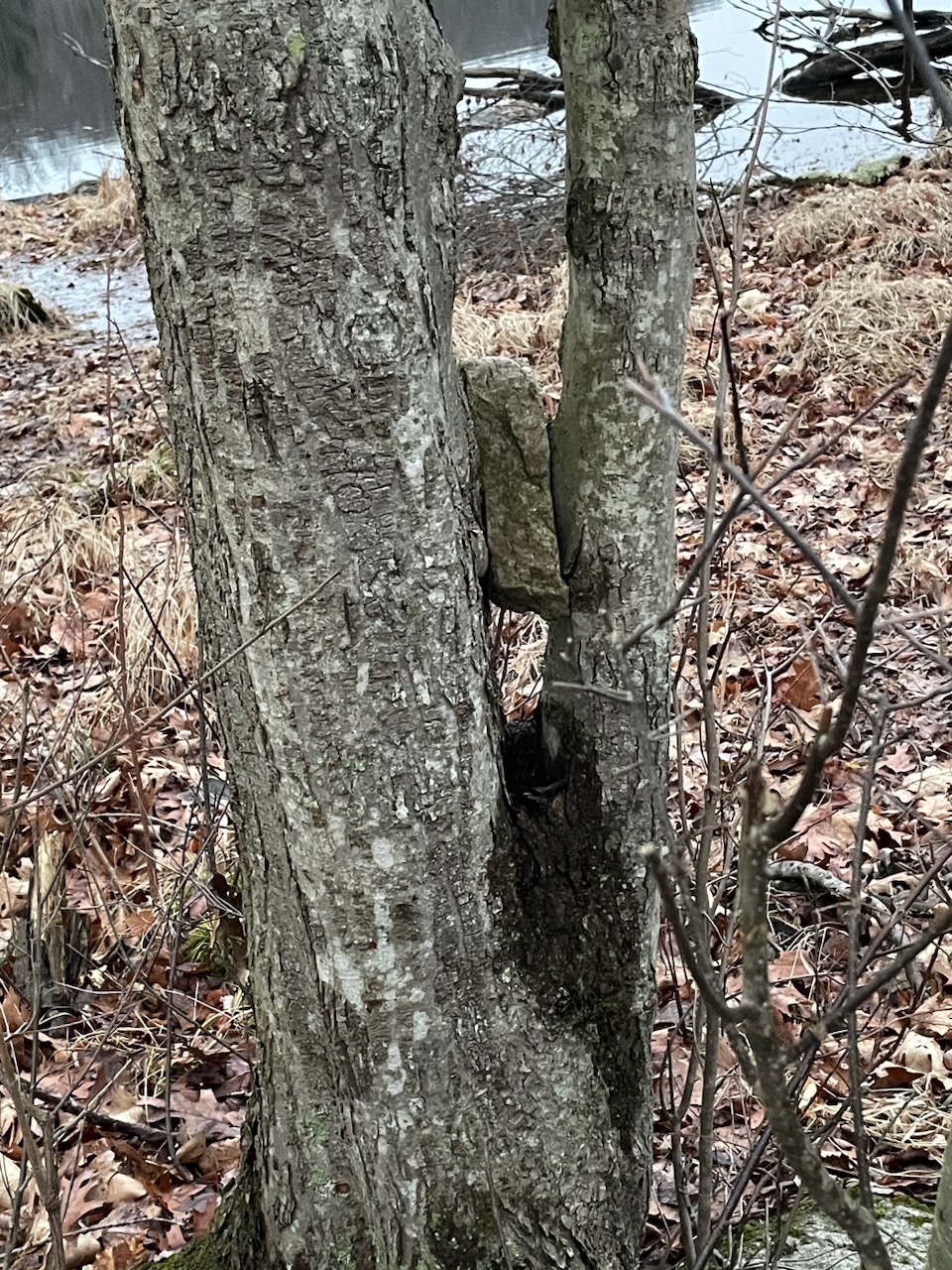
Probably more comical if you’re a tree person. Will someone please explain what happened here, that a stone wound up grasped between twin trunks?

What is the biology?

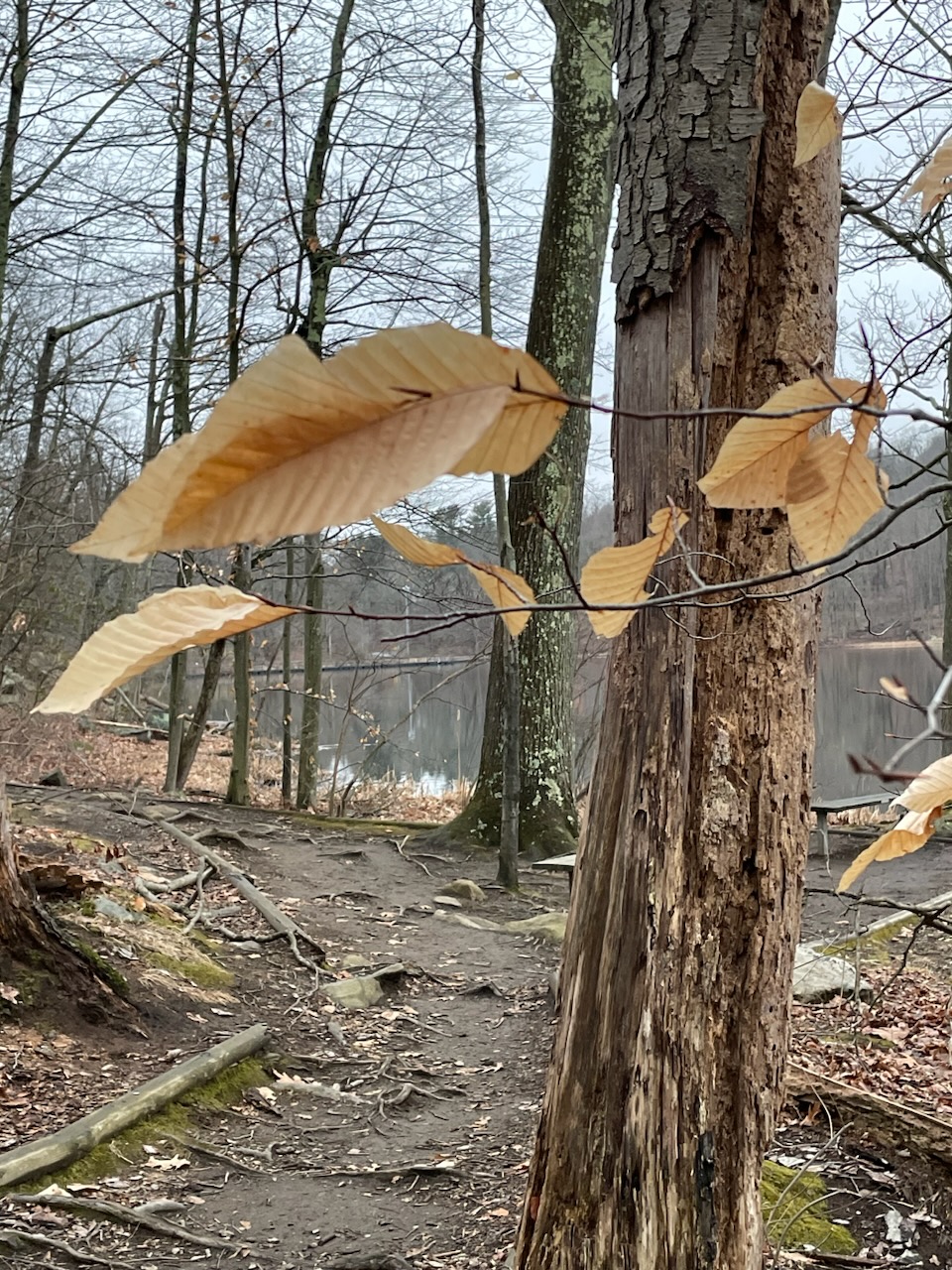
The beech leaves hold on through the winter. Beech leaf disease is having a moment. I don’t care to think about it today.

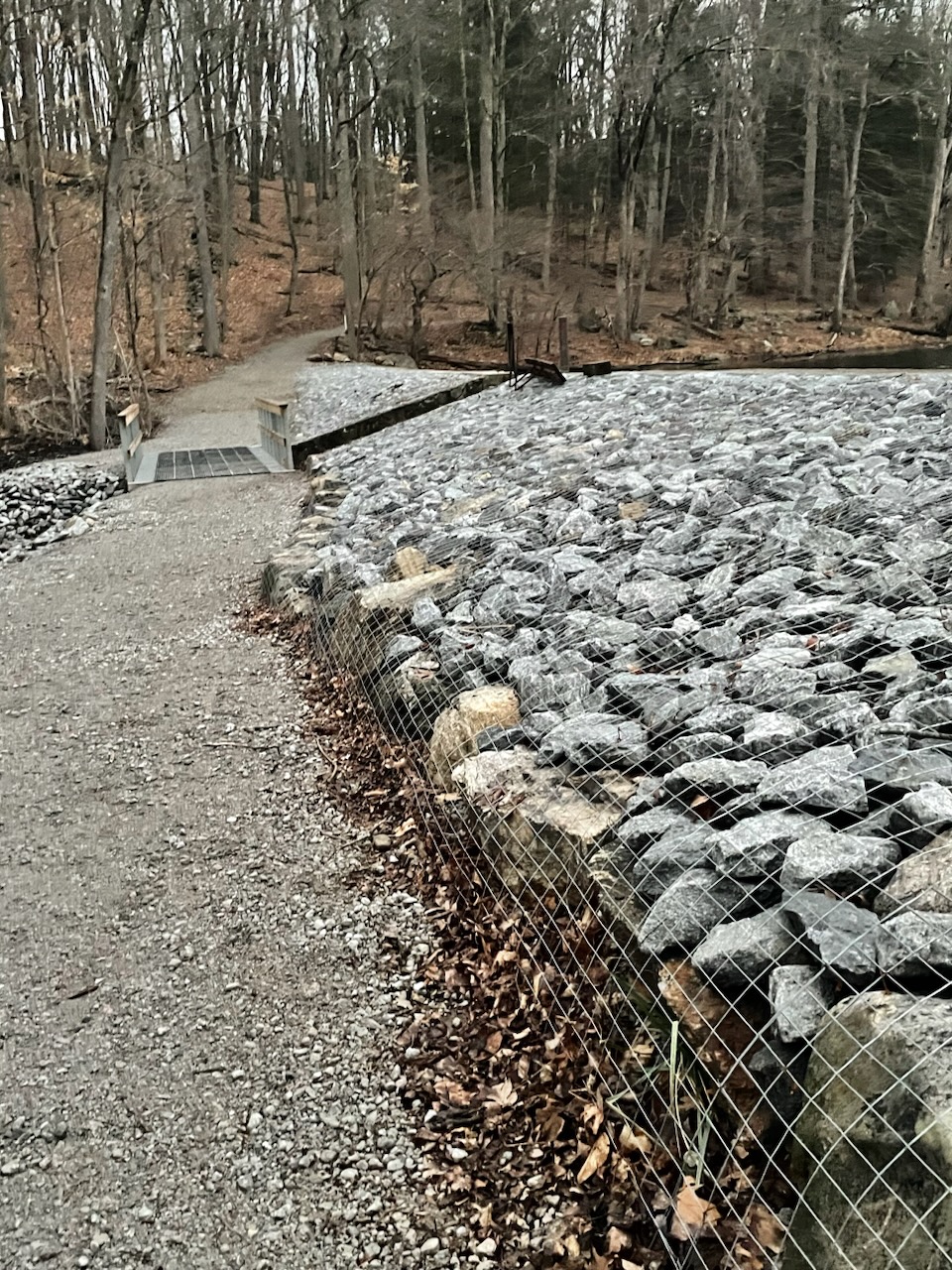
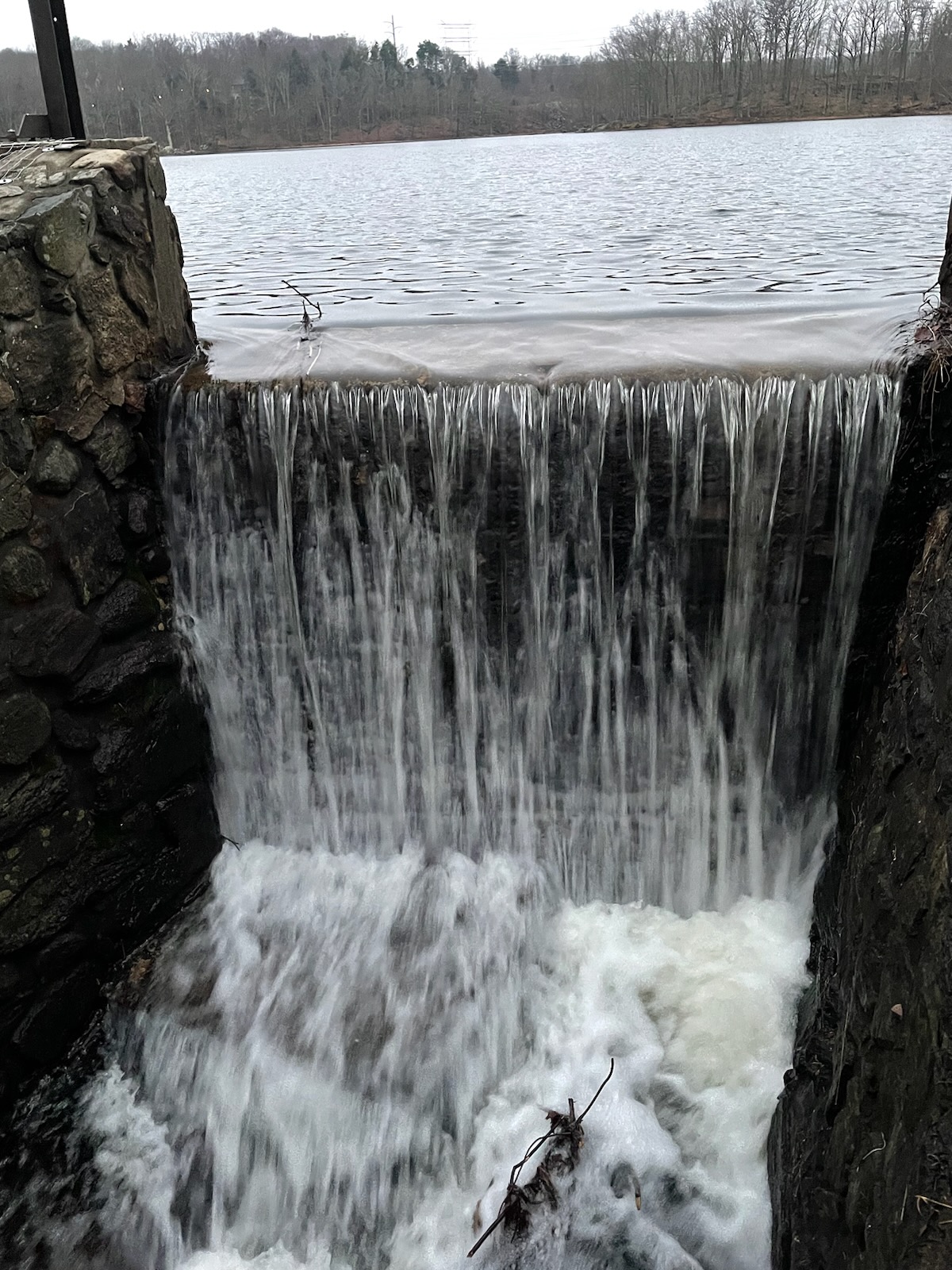
I have hit the dam, so I know where I am, though they’ve “improved” this area so much with riprap I barely recognize it.

Still the water fluices down, unstoppable.

When will I get back? Dark is falling. Still, no one is expecting me. I could fall asleep out here for long time, years even, and nobody would miss me. Perhaps in this old rustic shelter.
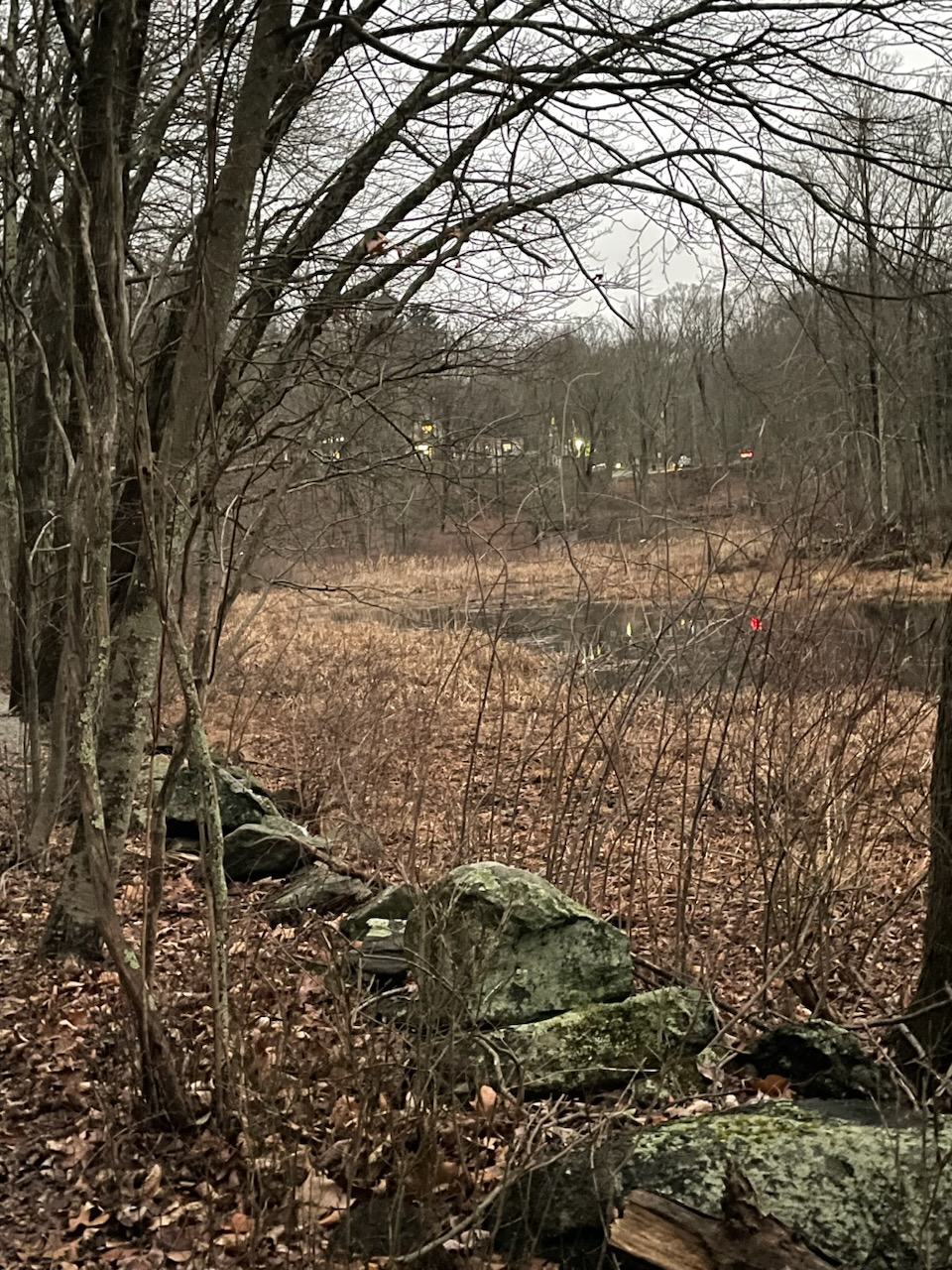
I see lights in the near distance. As night descends, things just get more and more beautiful.

I’ll be back just in time for what really got me here – a panel discussion at Teatown about trees, and how great they are. All about ecosystems, carbon sequestration, thermoregulation.

Somehow I think I’ve already done the math.

On the other hand, there might be cookies there. Or at least granola bars. I better show up.

3 Comments

Filed under Jean Zimmerman

Combine two teenage boys, eight potatoes

and a heaping spoonful of enthusiasm, and you get a lesson in making latkes.

Once again, thanks to Jasper and Tyler for documenting this edition of Eclectic Home Cooking 101 in my small but sturdy kitchen.

INGREDIENTS:

8 potatoes

2 onions

2 eggs

1 tsp salt

½ tsp pepper

6 tbsp flour

1 cup vegetable oil

PLAYLIST

Hermeto Pascoal

While his music can get pretty loud and crazy at times, Hermeto Pascoal’s music is really interesting harmonically and rhythmically, and combines many different kinds of Brazilian music with jazz.

Emilio Solla

Versed in many different styles from Argentina and elsewhere, Solla’s music is textural, intricate, and beautiful, with a fair amount of complexity and sophistication.

Maria Schneider

One of the most prolific big band composers of the current era, Maria Schneider’s music is forward-looking and hopeful, always with an underlying touch of elegance.

HOW IT’S DONE:

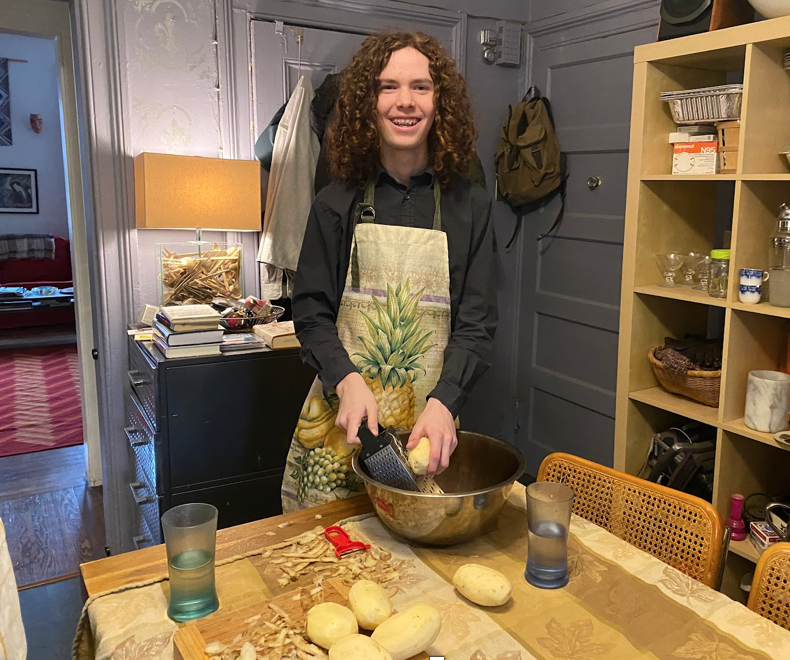
Peel the potatoes, then grate them into a large bowl.

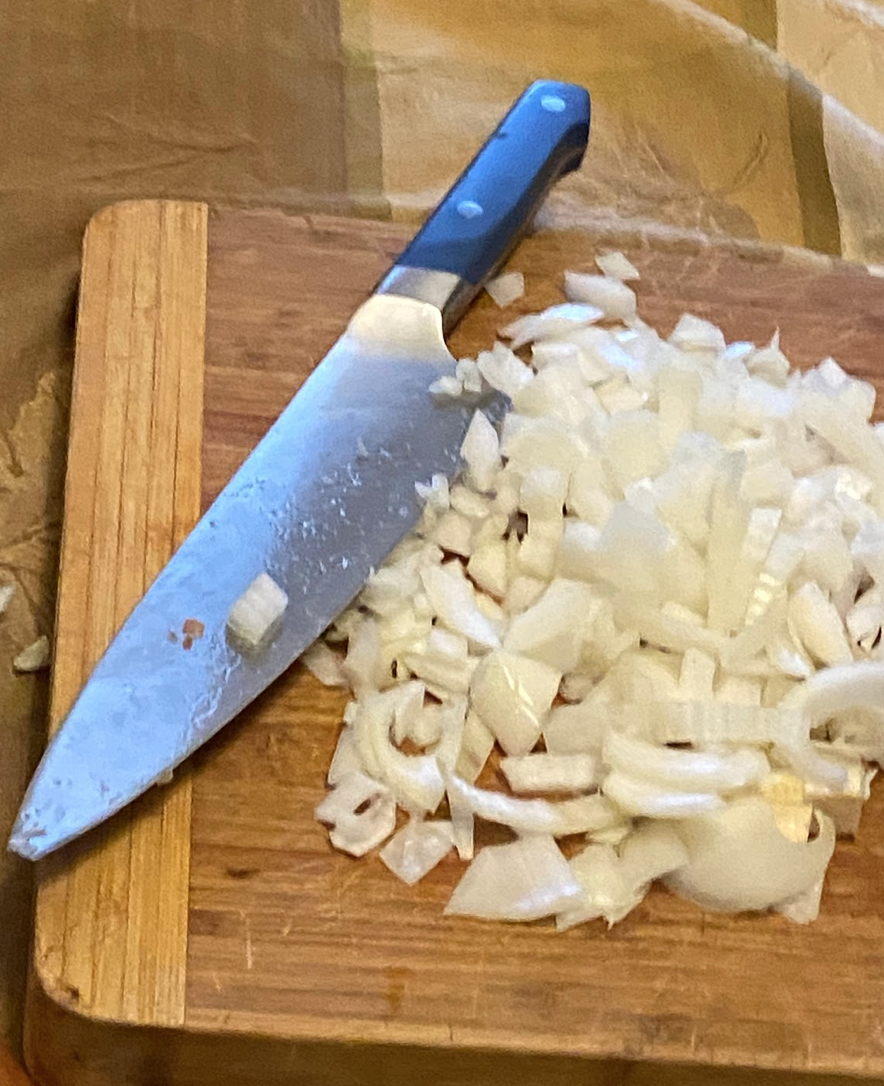
Chop the onion into thin (but not too thin) pieces. Jasper: “The hardest part of making the latkes was cutting the onions and trying not to cry!”

Mix the onions with the grated potatoes.

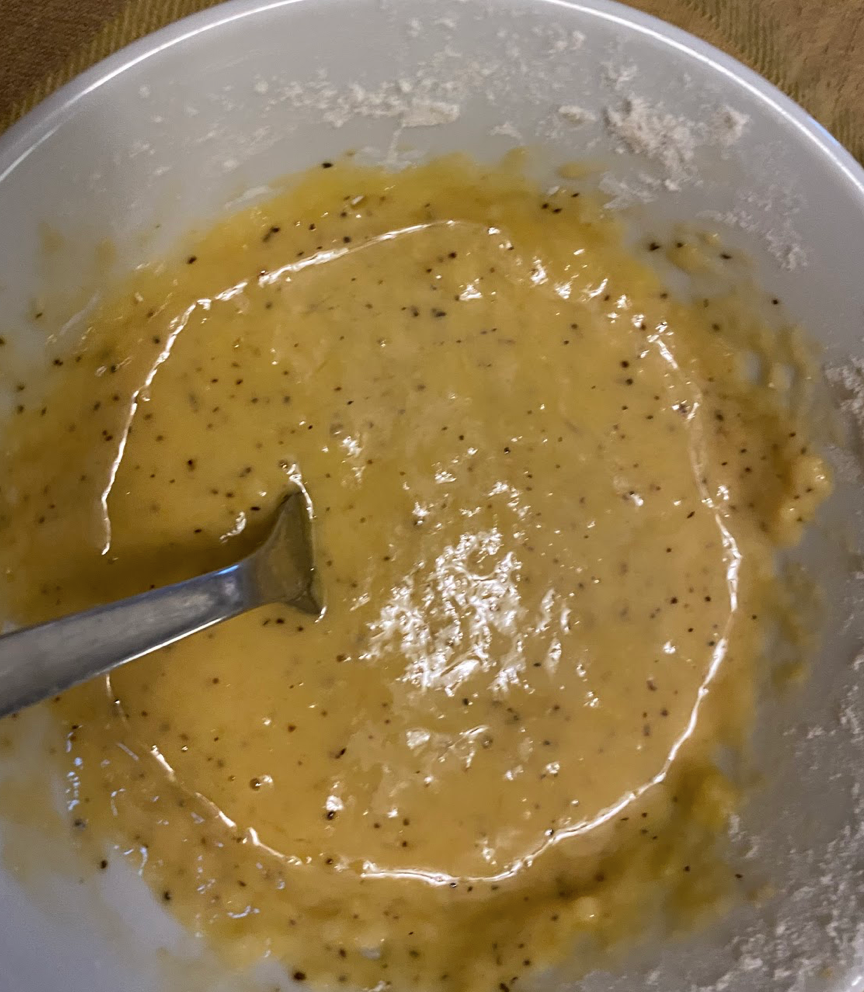
In a separate bowl, beat the eggs and add the flour. Add pepper and salt.

Combine all the ingredients into a large bowl and mix.

Put a pan on the stove.

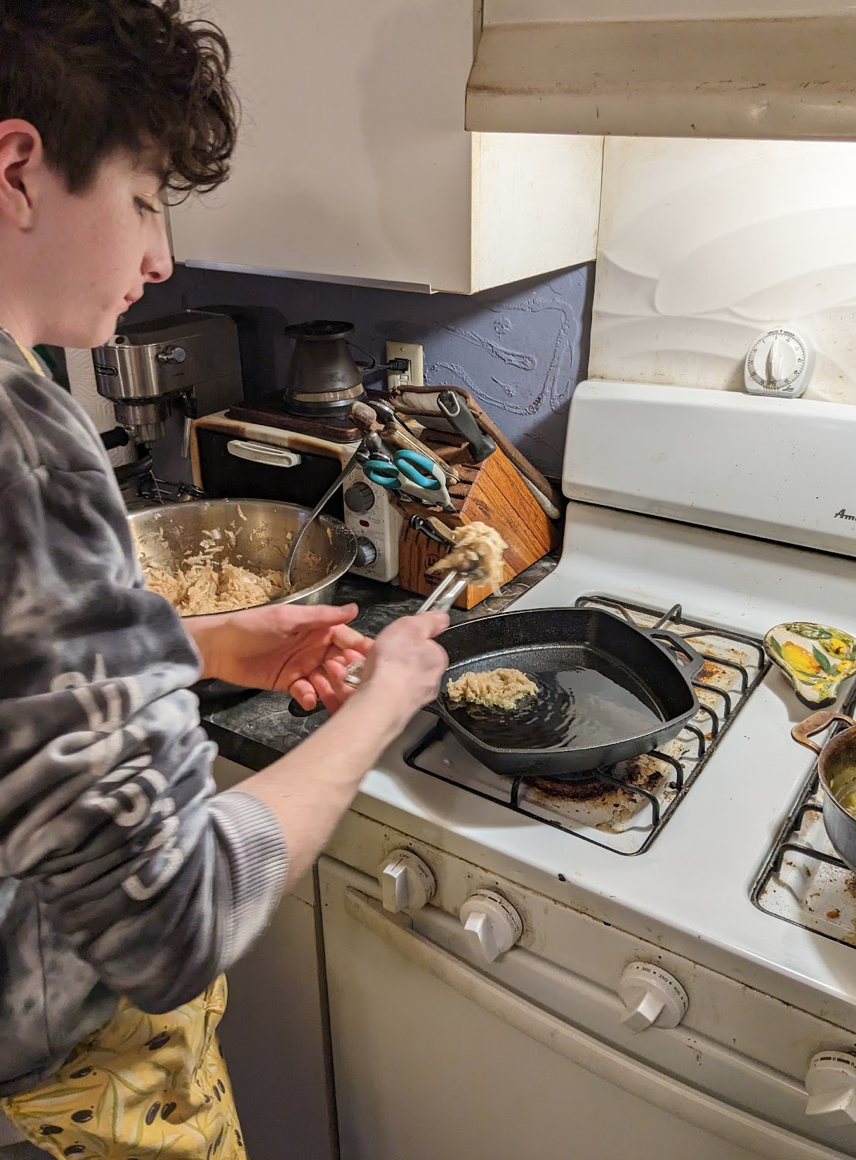
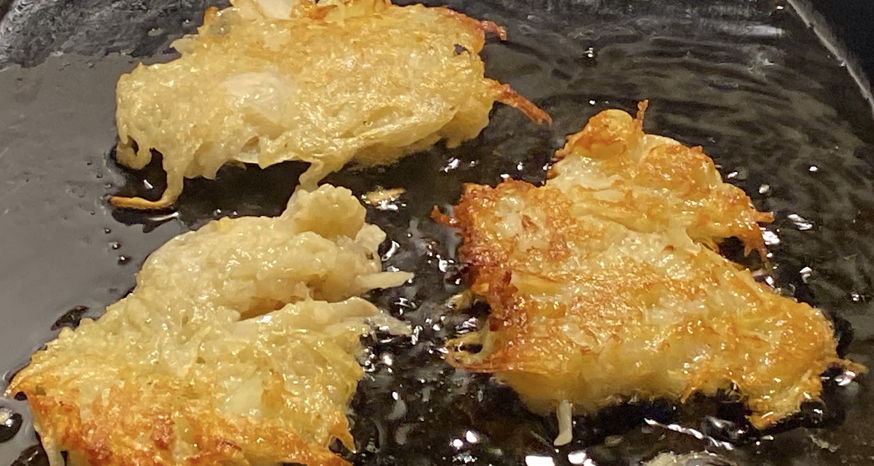
Scoop some latke batter and put it on the pan. TIP: use an ice cream scoop. Then pat it down. It doesn’t have to be a perfect circle!

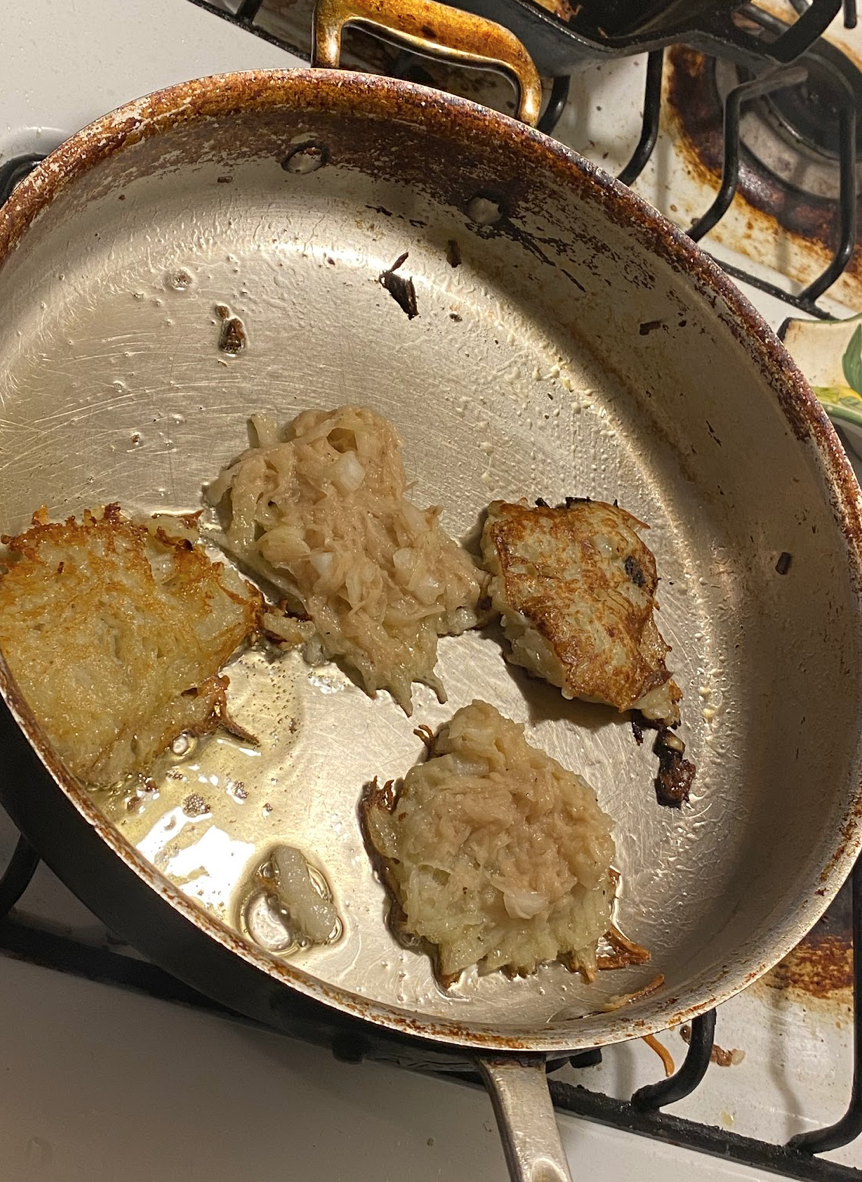
After a while, flip the latke over to cook the other side. 

Tyler says, “The part I think I struggled with most was knowing how much time to let the latkes bake so they’re not over or undercooked.”

When the latke is done, put it in the oven to keep it warm.

Repeat until the batter is all gone.

TIP: Combine and conquer. You can scoop multiple latkes into the oven at a time!

Serve with applesauce or sour cream (or both)!

THE RESULTS:

“I love latkes because they are delicious (of course) and go so well with many different toppings,” says Jasper.

Tyler says, “One of the reasons I love latkes is my aunt always makes them for my family during religious holidays (I am Jewish) so when I eat them that’s what I associate them with. I also just love the taste of latkes, especially with apple sauce.”

Enjoy!

1 Comment

Filed under Jean Zimmerman