Category Archives: Fiction

The Whale

This is a wonderful thing: an internet presentation of Moby-Dick, or The Whale, with each chapter delivered by an individual reader, and artwork commissioned to illustrate the text. It’s called the Moby Dick Big Read, http://www.mobydickbigread.com, and you can download a chapter a day — that would be 135 chapters. You can also begin at the beginning and go at as leisurely pace as you wish.

“I have written a blasphemous book,” said Melville when his novel was first published in 1851, “and I feel as spotless as the lamb.”

The world paid his book little mind. Moby-Dick never sold out its initial printing of 3,000 copies, and his total earnings from the American edition amounted to just $556.37. By 1876, in fact, all of Melville’s works were out of print. It was not until the next century that the writer’s brilliance was appreciated.
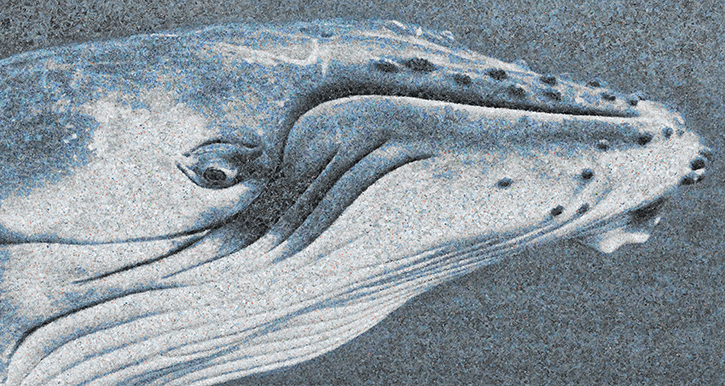
Artist: Chris Jordan

What I’m finding, as I knit and listen, is that listening makes me want to go back and read the book on the page. Perhaps that is because too much of my brain is preoccupied with knitting 12 then purling 12, knitting 7 then purling 7. But also, Melville’s prose is just too great to only hear, you want to relish it in print.

Like Ishmael’s description of the officers’ mess, Chapter 34. In the cabin, he writes:

“was no companionship; socially, Ahab was inaccessible. Though nominally included in the census of Christendom, he was still an alien to it. He lived in the world, as the last of the Grisly Bears lived in settled Missouri. And as when Spring and Summer had departed, that wild Logan of the woods, burying himself in the hollow of a tree, lived out the winter there, sucking his own paws; so, in his inclement, howling old age, Ahab’s soul, shut up in the caved trunk of his body, there fed upon the sullen paws of its gloom!”

Leave a comment

Filed under Fiction, Jean Zimmerman, Writers

A Tale of Two Women

Where is Auntie when I need her? My great aunt was a crafter before the shorthand existed. A home economics teacher in rural Tennessee, she taught me how to crochet as a child (I seemed constitutionally unable to learn to knit) and going to her tiny house out on the highway meant diving into closets full of fabric. She had a big field of green beans in front, a kitchen counter where we would eat buttery corn on the cob, a litter of kittens under the porch. Now that I’ve finally learned to love knitting, but lack the know-how to do much with it, I could really use her patient hands, deftly lifting the yarn and looping it back on the needle to help me out of whatever spot I’ve gotten myself in now.

After I gave a talk today at Ossining Library I began thinking about what has always made me want to write about strong women. Blandine van Couvering, Margaret Hardenbroeck, and the rest of the ladies I’ve treated in my nonfiction. Growing up with Auntie is one reason. Another is my father’s mother, also a force of nature, but in a different style. She did things her way, always. With a Polish-Jewish family only recently come to America, she ate lobster. When Joyce’s Ulysses was still banned in the U.S., she got her hands on a rare copy. She was a certifiable intellectual, a Manhattanite, with New York windows that overlooked the craggy grey outcroppings of Central Park.

They were two of my earliest heroines. What they would make of me as an adult I can’t say for sure, but I hope I’d do them proud.

3 Comments

Filed under Cooking, Fiction, History, Jean Zimmerman

Cheever and Evans et. al.

When John Cheever died, the flags in Ossining flew at half mast. He lived in Ossining from 1961 until his death in 1982 — just down Cedar Lane from the Cabin, as it happens. A vitrine dedicated to the writer occupies a wall of the Ossining Public Library, built in 2007, and many locals have a Cheever story to tell. Like the one a neighbor shared about the time John stripped naked to swim at a cocktail function and it cleared the party. Whatever his behavior, his skill and imagination had me stoked when I took a fiction writing class in college where the only  text was the writer’s Collected Stories.

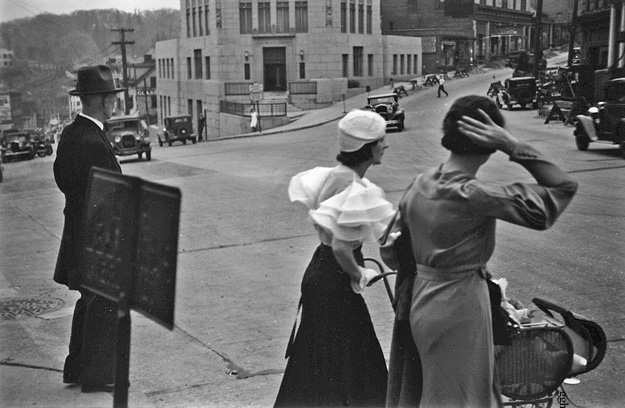
Cheever wasn’t the only great artist to live in Ossining — Walker Evans resided on his sister’s farm here in 1928 (where he grew hybrid gladiolas) and intermittently in the years afterward, and he produced dozens of photographs here, including this one, in the collection of the Met.

We drive by the bank standing at this fork every time we go to the library.

Evans called himself “tourmente, serre par la sante perverse d’Amerique” — “tormented, constrained by the perverse well-being of America.”

When they first met Cheever worked as a darkroom assistant to Evans. Later Evans captured a young, penniless Cheever’s boarding house room on Hudson Street. In all the photos Walker Evans took in Ossining, he never depicted Sing Sing, the looming prison for which the town was named. And he never shot the expansive Hudson.

However, Ossining is known historically as much as a fisherman’s spot as an artist’s haven. Witness this giant sturgeon caught off the Ossining waterfront, one of nature’s monstrous creatures.

I will have the pleasure of presenting at the Ossining Public Library on Saturday at 1:30 pm, with pictures, as I customarily do. Signing copies of The Orphanmaster afterward. Come one, come all.

3 Comments

Filed under Art, Fiction, History, Jean Zimmerman, Photography, Writers

Love, Fiercely Chocolate

Lake Mahkeenac, aka Stockbridge Bowl, lies down a long slope of woods from the Kripalu Institute, aka the site of the fabled Shadowbrook, the 100 room Stokes mansion completed here in Lenox in 1893. On the Lake, the Mahkeenac Boat Club is basically unchanged since that earlier era and reached only via a discreet driveway and a walk through pine-fragranced woods. The little sailboats have names like Moth, Hermes and Sprite.

Another relic of the Gilded Age offered me a podium and a slide projector this afternoon for what they call a talk and tea. Ventfort Hall, ever more shored up and scrubbed, held a crowd with a very serious interest in the Stokes clan and whatever local associations with the Minturn family could be dug up. There were even some Stokes descendants who could proudly say Well, when great grandfather built that house…

There were cucumber sandwiches out on the sweeping veranda. I was glad we had decided not to invite Oliver on this jaunt. He detests cucumber.

I ended the evening at the ice cream parlor with an experience that would have caused the Victorians to keel over. Chocolate ice cream with a kick of cayenne, causing my tongue to melt just a bit as I gobbled it down. Hot and icy, sweet and savory at once, that’s a prescription for poetry.

Tomorrow, toes in the Stockbridge Bowl– then another bowl of some surprising ice cream. Lavendar and honey? Parfumiers would approve.

Leave a comment

Filed under Fiction, History, Jean Zimmerman, Love, Fiercely, Publishing, Writing

Hot Sage

So I took a break. I’ve been blasted by the 105-degree Arizona heat (go out quick, feel the fire, duck back in), and have enjoyed the delicious sage aroma in the air and the sight of baby jackrabbits drinking moisture from the putting green turf. I’ve found that sushi tastes great in the middle of the desert. Oh, and I’ve enjoyed talking about The Orphanmaster with 75 gracious seniors at a place called Silverstone, in Scottsdale, home to mom and dad.

It’s always interesting to share pictures related to 1660s Manhattan when you are in 2012 and across the country from Manhattan. You can show the intricate, drawn-to-scale street plan of New Amsterdam dating from 1660, and it looks not so much like historic fact as it does magic, a fantasy of a place invented, a tale out of a story book, not possibly real. And yet it all was. The sights and sounds of that Manhattan could be experienced as vividly as the hot gale off the desert here today, or the sumptuous sage, or the nibbling bunnies on their sea of acid green.

In 1660s Manhattan, sea lions sunned themselves on rocks in the surf at the base of the island, where Battery Park is today.  You could look up in the sky at noon and witness pigeons wheeling in clouds so dense they blotted out the sun. Ox carts clogged Broadway. Bears climbed in the orchard trees. Noise. Scent. Knockaround drunks. Dazzling meadows of wildflowers.

What I wouldn’t give to set foot there, step into that 1660 map for just a split second.

Leave a comment

Filed under Fiction, History, Jean Zimmerman, Publishing, The Orphanmaster, Writing

Iconography/Orphanmaster

Watchung Booksellers in Montclair last night was cool, with a crack of thunder and streaks of lightning out the window just as I was reading a scary passage from the book.

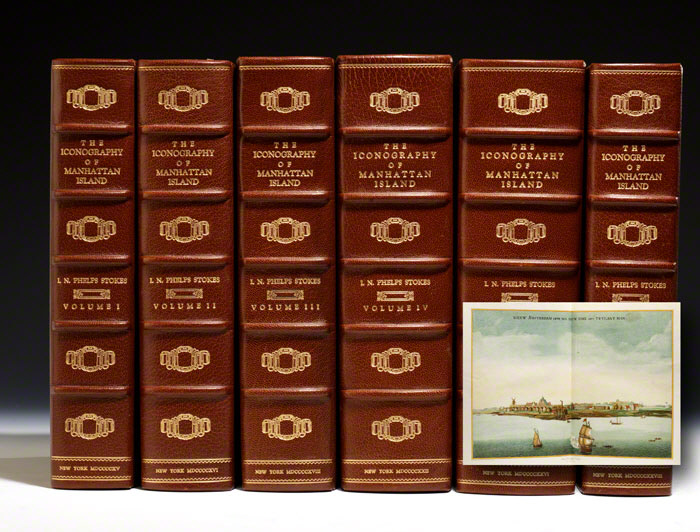
A lot of people wanted to know where I did the research for The Orphanmaster. The easy answer is: The Iconography of Manhattan Island, the brilliant compendium of all maps, views and information about New York from long before it was called New York. Published in 1926 and still available in research libraries (and my home library, I’m happy to say), it is a Manhattan history lover’s dream. And did I mention that the huge tome’s creator was I.N. Phelps Stokes, subject along with his beautiful wife Edith Minturn of my recent book Love, Fiercely: A Gilded Age Romance. Theirs was a charmed, fabulously wealthy life that had impossible highs and ultimately spiraled down into difficulty and poverty, largely because of Stokes’ obsessive love affair with The Iconography. The fact remains that without The Iconography there would be no Orphanmaster. I obtained so much period detail from this masterful, 30-pound set of volumes.

An Original Set, circa 1926

Leave a comment

Filed under Fiction, History, Jean Zimmerman, Love, Fiercely, Publishing, The Orphanmaster, Writing

The Orphanmaster Origins

A little bit about how The Orphanmaster came to be: For years I have written nonfiction. Never a novel. If I ever thought about writing fiction, I pushed it out of my head, saying, That’s not me, that’s not something I could ever do.

I began to think of myself as a writer when I was small, and experimented with different forms, getting a Masters of Fine Arts in Poetry before turning to the world of facts, of reality, of history and biography, of nonfiction. Which I love.

A few years ago I wrote a book like that, a work of colonial history that featured a strong, determined woman in 1660s New Amsterdam. Margaret Hardenbroeck worked brilliantly in the fur trade, She was so driven that by the time she died she was the richest woman in New York.

I enjoyed writing about that era, when fur was king, and when Manhattan featured a fluid, uneasy mix of peoples—eighteen languages spoken on the street! A threshold time, just before the British invasion, brutal and exciting at once. But I was frustrated by the paltry amount of personal information I could get about Margaret. I wanted to go deeper.

The Orphanmaster’s central character, Blandine van Couvering, came out of that desire. Creating the fictional persona of Blandine, I could write around the gaps of history, fill in the psychological spaces of my character. I could deepen and enlarge upon the strength and intelligence of this real woman, plumb her soul, discover her sense of humor. And give her the wardrobe she deserved.

At the same time, something else about the period haunted me—the idea of the orphanmaster, which I’d come across in writing about New Amsterdam, a real government post that to me sounded spooky and vaguely nefarious. An orphanmaster is actually someone charged with protecting the many children on Manhattan who have lost their parents. But I always felt there was a mystery here, a story that was not all sweetness and light.

Still I hesitated. I was sitting on all my notebooks filled with rich details about New York before it was called New York, I had a heroine, a theme, even the beginnings of a plot. Why don’t you use all that stuff? my encouraging husband kept asking. Could I possibly write fiction? Just write me a murder, he said.

That was the beginning. Many chapters and plot twists later, I am here to tell you that writing The Orphanmaster was as challenging as I’d imagined it would be, but far more rewarding. There is nothing like seeing your characters spring up out of the ground as you go along, to feel every morning as you sit down at your computer that, Today, anything can happen!

October 8, 1663, the island of Manhattan. An early blizzard….

Leave a comment

Filed under Fiction, History, Jean Zimmerman, The Orphanmaster, Writing

Hello, Savage Girl

After a string of many unbirthdays I am finally having my birthday, a double-digit extravaganza which I am so far marking with house cleaning, phone interviews and pancakes at a local diner with Maud.

Really, the finest present I have received so far is yesterday’s news that Savage Girl has been accepted for publication by Viking.

Savage Girl begins in 1875 in Virginia City, Nevada, at the height of the silver boom. A teenaged girl is being exhibited as a sideshow attraction — promoters advertise her as a wild child raised by wolves. An extremely wealthy couple comes from New York City to inspect their mines; they adopt the girl and bring her back to Manhattan with the idea of raising her up as a debutante. Murder and mayhem follow.

The novel is narrated by Hugo Delegate,  a sensitive, brooding 22-year-old anatomy student and son of the wealthy mine owners, who  gets drawn into the hectic events surrounding the savage girl’s immersion in New York’s Gilded Age.

Everyone involved is so excited to see the public birth of Hugo and Savage Girls’ story.

Happy birthday.

Leave a comment

Filed under Fiction, Jean Zimmerman, Publishing, Savage Girl, Writing

Connecticut Book Night

Fine breezy evening in Madison, Connecticut. Ions off the Long Island Sound buffering my face in the oh-so-genteel seaside bar.

Then a packed house at RJ Julia, one of the finest independent bookstores in the land. I received a lovely introduction by Roxanne, the shop’s owner, and the choice of any book in the store to take home as a gift. Perspicacious questions from the audience. A sore hand from signing, always a good thing.

Earlier in the day I found out I will be doing a show with Free American Radio, which goes out to 25 stations nationwide.

After my talk a bunch of us, including some of my bestest friends, went out to a completely classic clam shack and had fire-roasted clams and lobsters, maybe the tastiest shellfish I’ve ever consumed, as the sun went down and the night turned blue. The lobster came freely out of its shell as though it intended to be eaten.

When I got home I listened to a cd sent to me by a  lively dj in Boston, an interview we’d done recently, that was a gas to hear even if I did sound foolish more than once.

Oh yeah, and I got an offer on my beloved Savage Girl.

More on that subject later.

Leave a comment

Filed under Fiction, Jean Zimmerman, Publishing, The Orphanmaster, Writing

New York Times Book Review Praises The Orphanmaster

Marilyn Stasio of The New York Times Book Review praises The Orphanmaster in her Crime column!

She calls it “the ideal historical mystery for readers who value the history as much as the mystery.”

Pretty much what I always say to describe the book, history-mystery with some supernatural thrown in.

Leave a comment

Filed under Fiction, Jean Zimmerman, Publishing, The Orphanmaster

Washington Talking Book, Talking About The Orphanmaster

This a very interesting place, the Washington Talking Book & Braille Library (WTBBL), in Seattle, and I had the pleasure of a conversation there with Ms. Addi Brooks. Here it is.

Leave a comment

Filed under Fiction, Jean Zimmerman, Publishing, The Orphanmaster, Writing

CBS on The Orphanmaster

My interview with Jeff Glor of AuthorTalk appears on CBS.com today!

Check it out.

Leave a comment

Filed under Fiction, Jean Zimmerman, Publishing, The Orphanmaster, Writing

Orphanmaster Beach Bag Pick – L.A. Times

The money shot, as they say in Hollywood: “There’s romance, espionage, accusations of witchcraft — all the trappings of a great historical page-turner.”

1 Comment

Filed under Fiction, Jean Zimmerman, Publishing, The Orphanmaster

Daily News Reviews The Orphanmaster

Sherryl Connelly of the New York Daily News gives a thumbs up to The Orphanmaster.

“Absorbing period fiction.”

Leave a comment

Filed under Fiction, Jean Zimmerman, Publishing, The Orphanmaster

Reporting From New Amsterdam

FYI, Jean Zimmerman, reporting from New Amsterdam, an interview for TheDay.com.

17th Century Manhattan

Leave a comment

Filed under Fiction, Jean Zimmerman, Publishing, The Orphanmaster, Writing