Yes, true. But what about the Great Trees of New York City? This is the brainchild of New York City Parks, which is reviving a project that was last completed in the 1985 with the goal of identifying the most iconic trees in all the five boroughs. Ordinary citizens nominate exceptional trees, as many as they want, as defined by their historic, botanical and cultural significance.

Having been fortunate enough to be appointed a judge for 2023’s Great Tree Search, I am excited to start off on some new adventures. My assigned beat is the Bronx, a great place whose eclectic neighborhoods stretch all the way from the swellegant precincts of Riverdale to the famously underserved South Bronx. It’s also a place I’ve spent considerable time as a consultant on tree preservation for NYC.

This time I go some places I’ve never been before, and discover a fantastic meshing of arboriculture and history. I enlist Gil as a driver, because it’s hard to drive in New York City traffic and spot trees at the same time, even gigantic trees. We have a spreadsheet to guide us that cites peoples’ nominations as well as some of their comments about why a particular specimen is worthy of the distinction.

The first entry on our list is quite civilized. A ginkgo on a small street abutting Webster Avenue.

Ginkgo biloba dates back 270 million years, and was thought to be extinct until it was rediscovered by a German scientist in late 1600s Japan. A group of Chinese Buddhist monks made it their mission to save and cultivate the species.

It is one of the few trees useful for food foraging in this urban jungle. Yes, the fruits are slimy, smelly. But each one holds a nut at its core (actually a seed) that is sold in Korea, Japan and China as a “silver apricot nut.” They are usually roasted prior to eating and used in desserts, soups and with meat. Each fall you’ll see many people in the City gathering this ample harvest.

Will I really have to choose among these trees? I’m already asking myself – and I’ve only seen one so far! But let’s continue.
We prowl along to little Perry Avenue in the Bronx and discover a gargantuan willow oak.
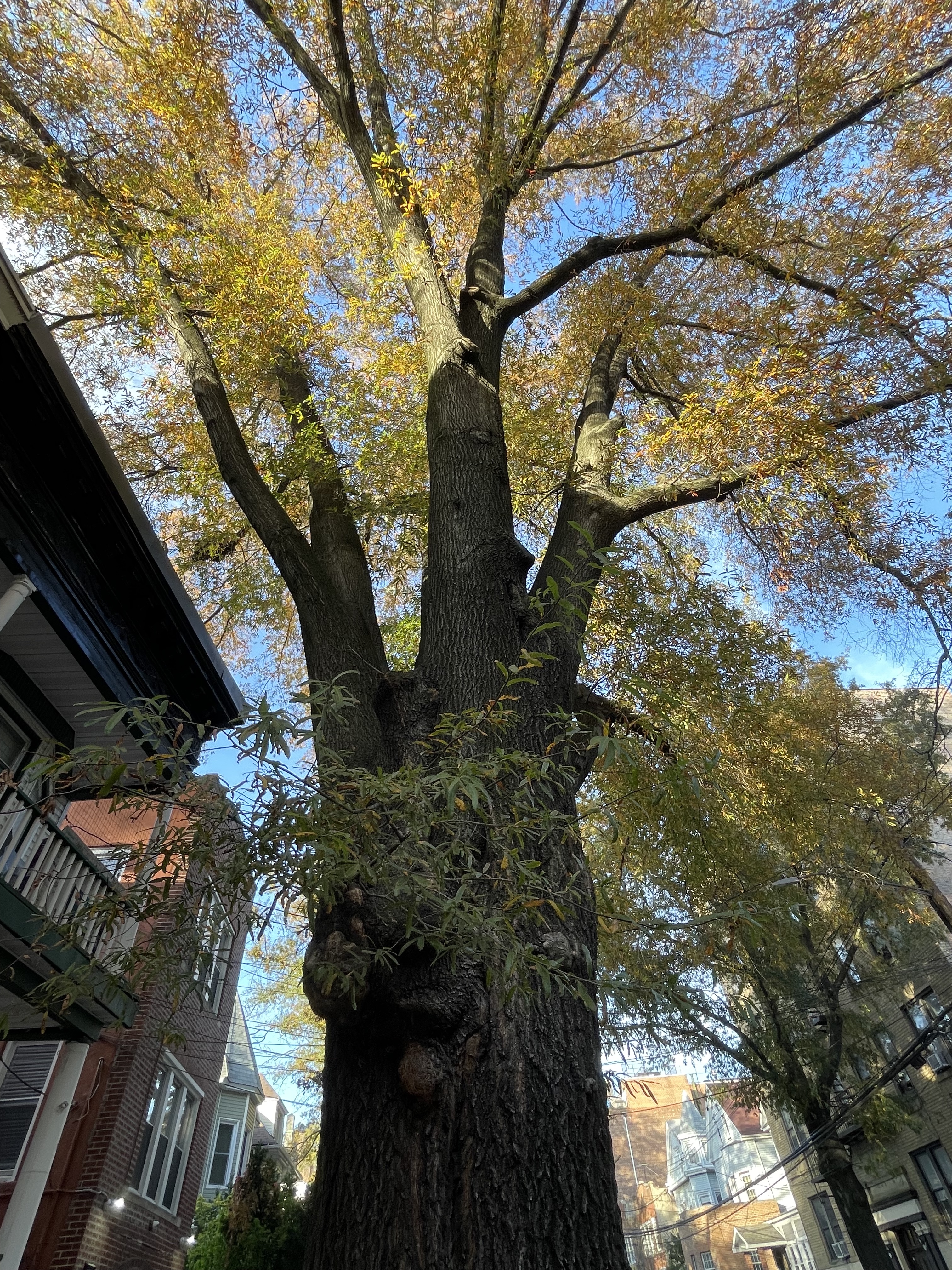
What on earth is it doing in this quiet backwater?

Among other things, towering over the houses with health-giving shade, creating a beautiful fall carpet of leaves, and offering shelter for squirrels with a major nest. Oh yes, and uncomplainingly eating carbon and pouring out oxygen for us slackers to breathe.
We find another nominee on a peaceful little street, Thierot Avenue.

A silver maple. Now, these trees get a bad rap among urban foresters. They’re brittle, they rain down branches, yada yada. But look at this beauty. “It is the LARGEST TREE in the community,” reads the comment on the spreadsheet. “Could be a hundred years old.”
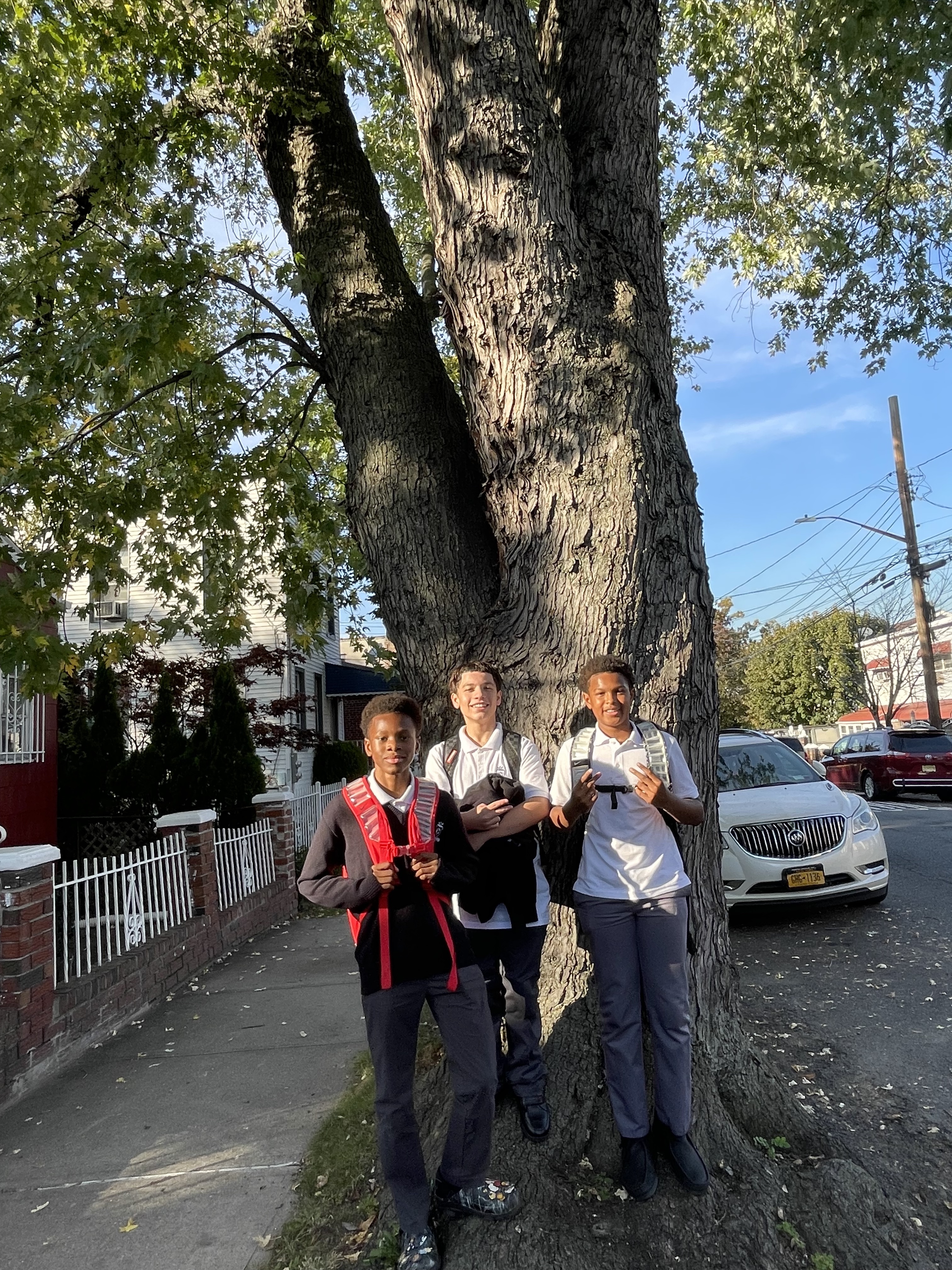
Huge (of course), three stems, fantastic shaggy bark, spreading her roots all over the place as is her right. And a perfect place for posing schoolkids. Who shout “Save the Trees!” over their shoulders as they scamper away.
We venture to Corona Park, home to several potential Great Trees, all of them amazing. First, a majestic American elm at the corner entrance.

A photo really cannot do her justice. You have to mosey underneath those sprawling branches, touch the bark. Gaze overhead at the sky through her crown.

Perhaps the most beautiful tree I’ve ever seen. (And I’ve seen a few, so maybe just the most beautiful of the day. So far.) Then, we go elsewhere in the same park in quest of two hefty ashes that grow across a path from each other, seemingly competing for the Venus of New York prize. One is a marvel, yes. “This majestic Green Ash with a trunk size of 54″ is a gem and sits in the center of the pathway along passive lawn areas and rolling hills.”
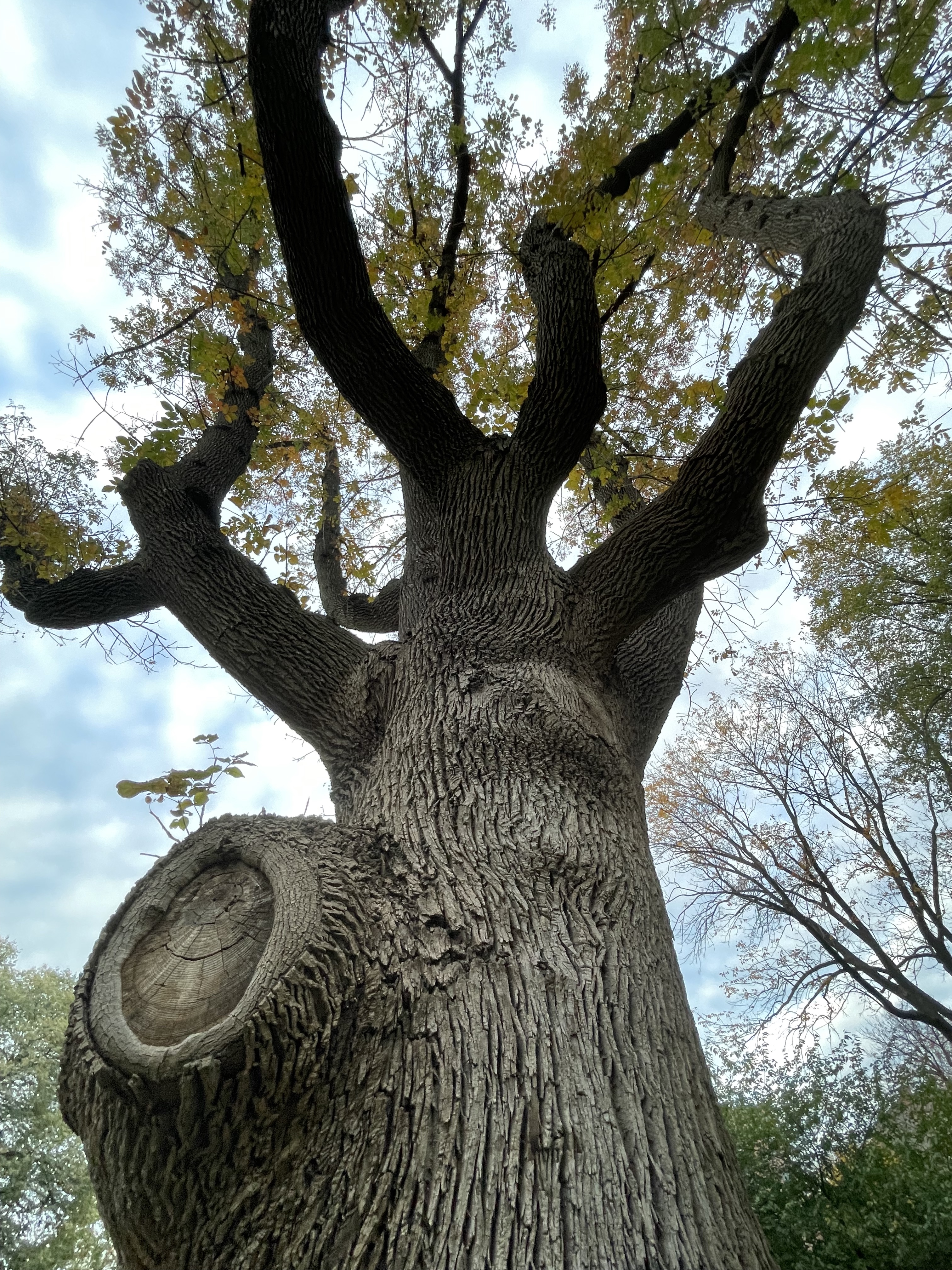
To locate the tree I ask some folks hanging out with their kids in the nearby playground. They do not speak English, so their seven year old translates as they gesture down the way: “Big tree down there, take a turn to the right and you can’t miss it!” An understatement.

Even more impressive, the ash nearby. “Thickest tree in the Bronx, probably NYC too.”

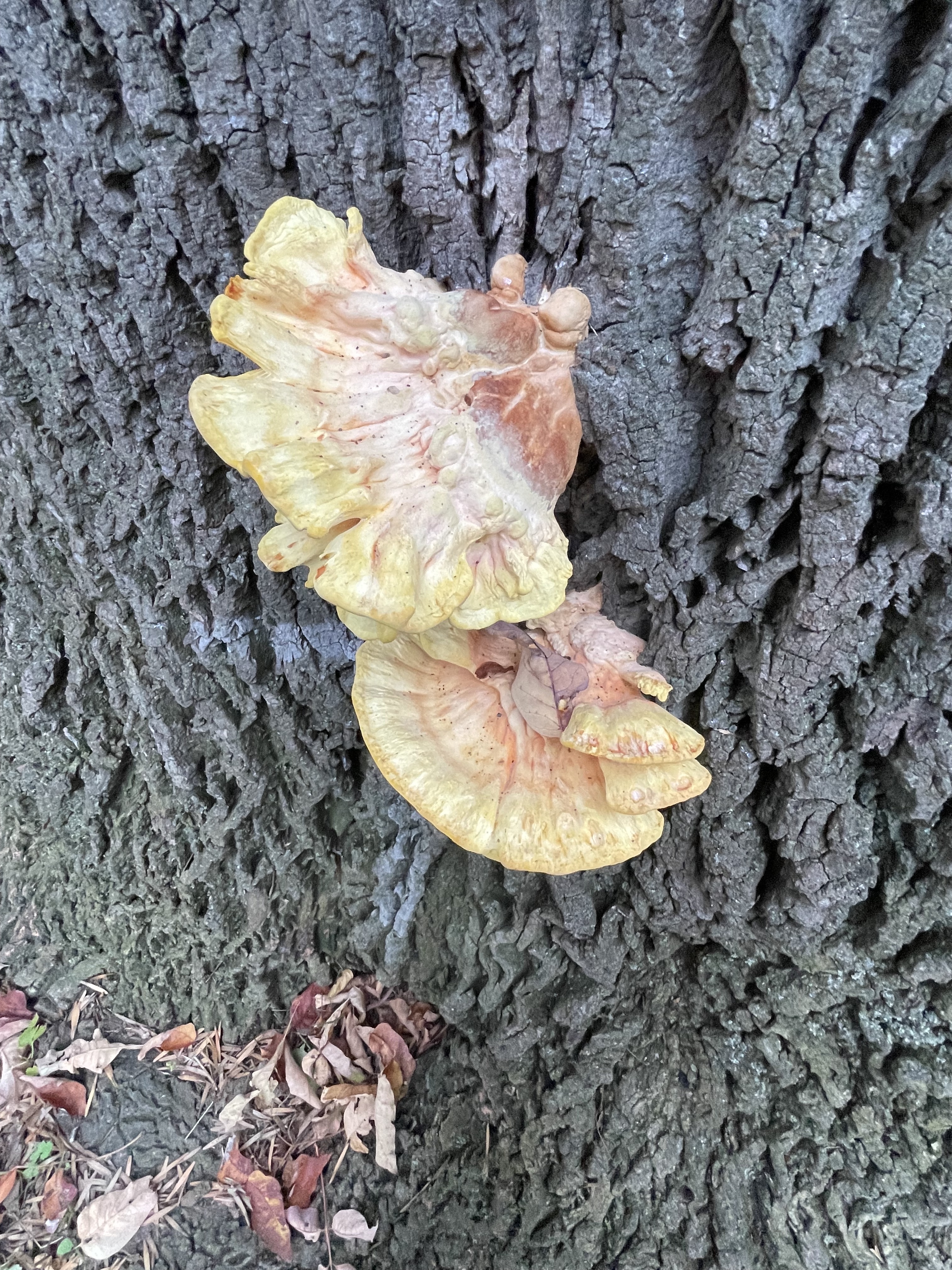
Don’t you mind the fruiting bodies at the base, this one is clearly a survivor.
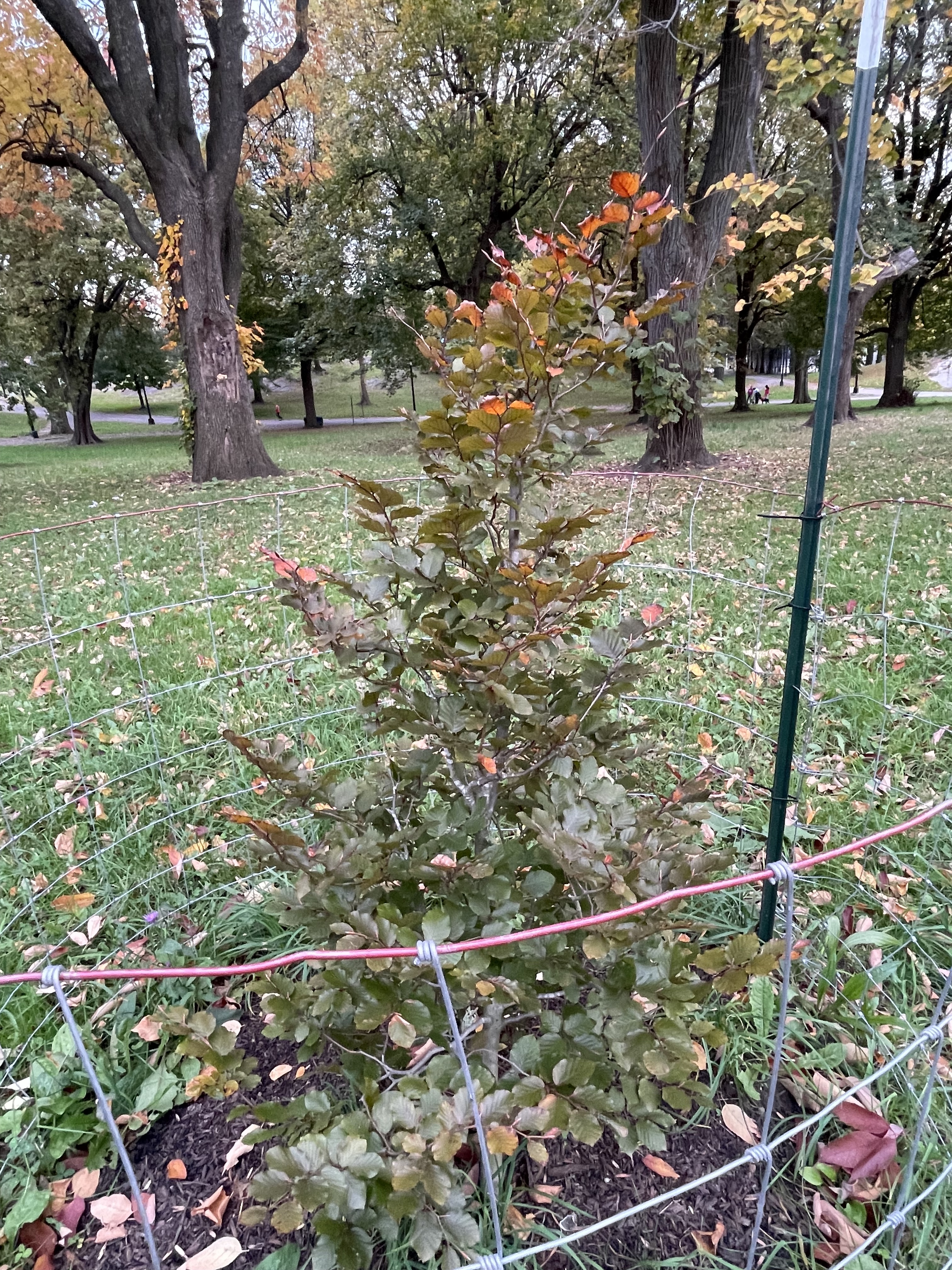
Wandering out of the park at as the dusk grows all around us I notice a planting that will ensure the health of this urban forest for the future, a baby beech.
Since we’re making these adventures at the end of the workday, we’re lucky enough to visit all these sites at the magic hour, just as the sun is getting ready to set. So we arrive at a spot we’ve heard about but never spent a lot of time, Pelham Bay Park.

We take our nightfall hike on a trail around Hunter Island, 166 acres of wilderness in the heart of the Bronx, right on the Long Island Sound. The person who nominated a post oak here wrote a lengthy treatise on the specimen’s history, saying, in part: “This grove of post oaks dates back to the 1760s. Post Oak is native but rare in NYC. This beautiful specimen is growing right out of bedrock that includes gneiss with stunning seams of quartz, and is right on the Sound. This tree projects the grit and resilience for which the city is renowned.”

Of course, that more than whets my appetite to find this spectacular tree. But it’s not easy. Entering the park, we find massive white oaks and scarlet oaks. This is a mast year, and all around the ground is carpeted with acorns that crunch underfoot.

A trail takes us through groves of sweet birch.

We see almost no one.
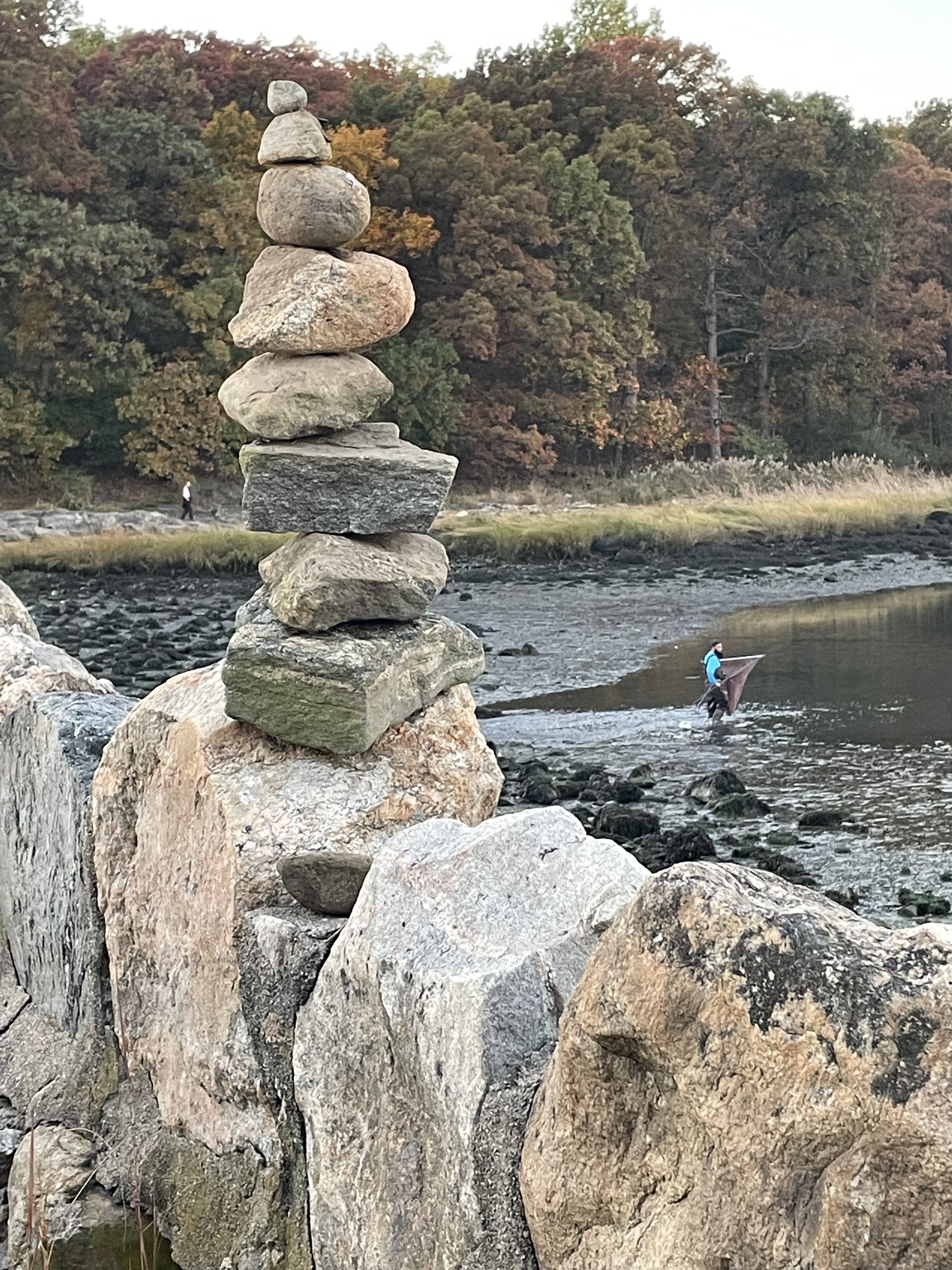
I wade ankle deep across a mossy inlet, into the darkening woods under a rising full moon.

It gets dimmer, dimmer.

Wither the post oak? It’s a member of the white oak family, and all the trees in these woods have interbred for so long that I think any of them could be the oak in question. Though I cannot find the exact leaf, with its lobes that remind some of a Maltese cross, there are plenty of similar leaves.

We’ll have to come back again, perhaps by the light of day.

On another afternoon, back in the city proper, we locate a venerable black tupelo.

“At the edge of the forested land on Mosholu Parkway North, facing the apartment buildings.” Sounds mysterious, and I’m afraid we will not find it, especially as the gloaming comes on. We cadge a parking space and I walk directly to the tree as by a homing device.

I think of a couple of lines by poet Jane Hirshfield: “I would like not minding, whatever travels my heart. To follow it all the way into leaf-form, bark-furl, root-touch, and then keep walking, unimaginably further.”
We discover a cottonwood just off Van Cortland Park South in an old schoolyard. It towers over the neighborhood. Once, apparently, during the Revolutionary War, this tree was used for hanging traitors.”
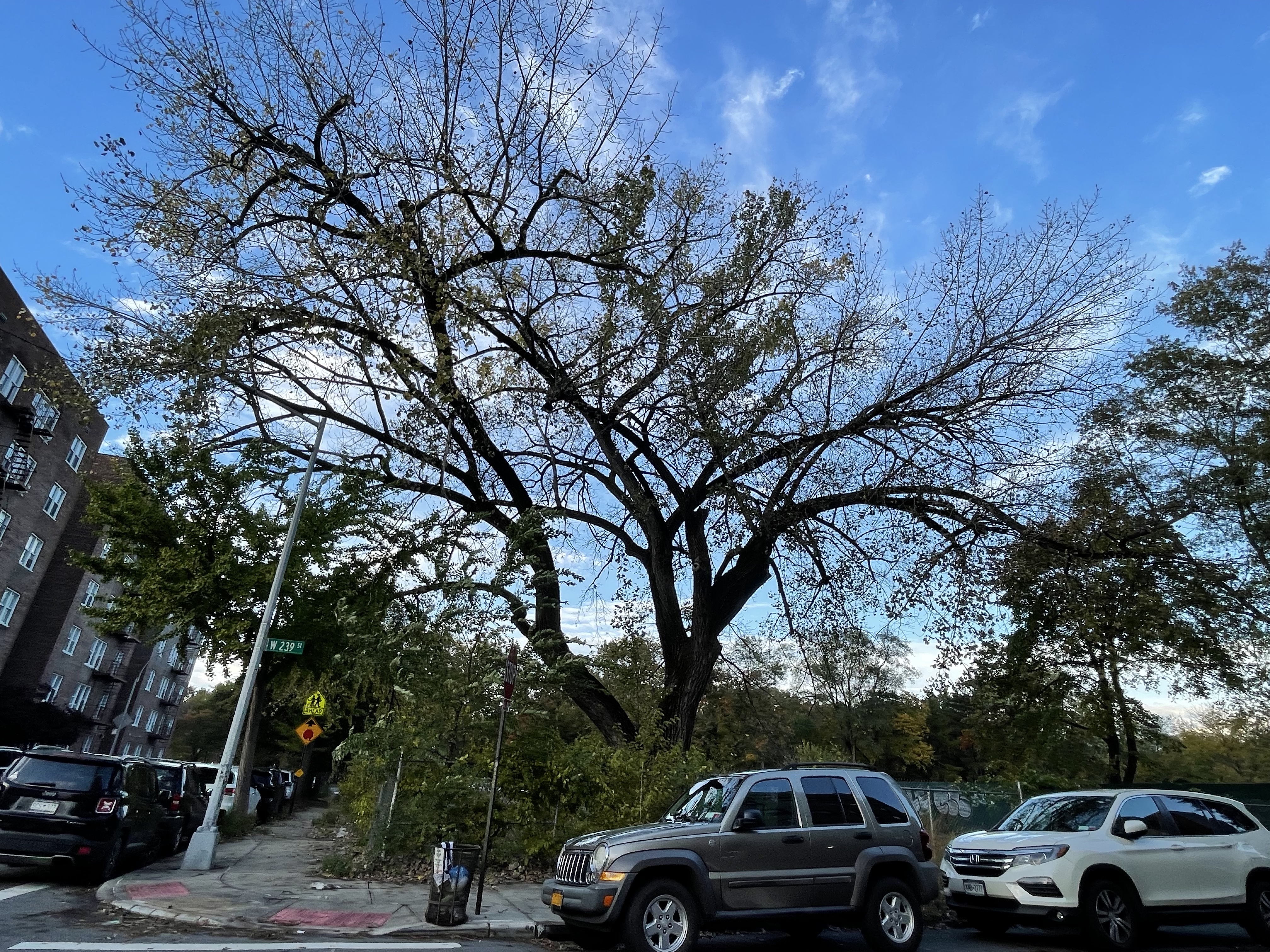
I check the spreadsheet. “Cottonwood trees typically grow in riparian areas, which at first seems odd, given its current location, but makes sense once you realize that the Tibbets Brook runs underneath.” I’ve heard that Tibbetts Brook is soon to be daylighted, and I wonder what will happen to the cottonwood when that happens. Will they retain it and will it continue to provide shade and beauty of local residents?
Moshulu Parkway and Gun Hill Road are sites for some other old-old trees that also date back to the Revolution. We visit “the oldest sassafras tree in the Bronx, an amazing holdover from when the land was converted from farm to parkland.”

It is said to be larger than the state champion in Green-Wood Cemetery. And that’s saying something. “However, its true age will never be known because it is mostly hollow.”
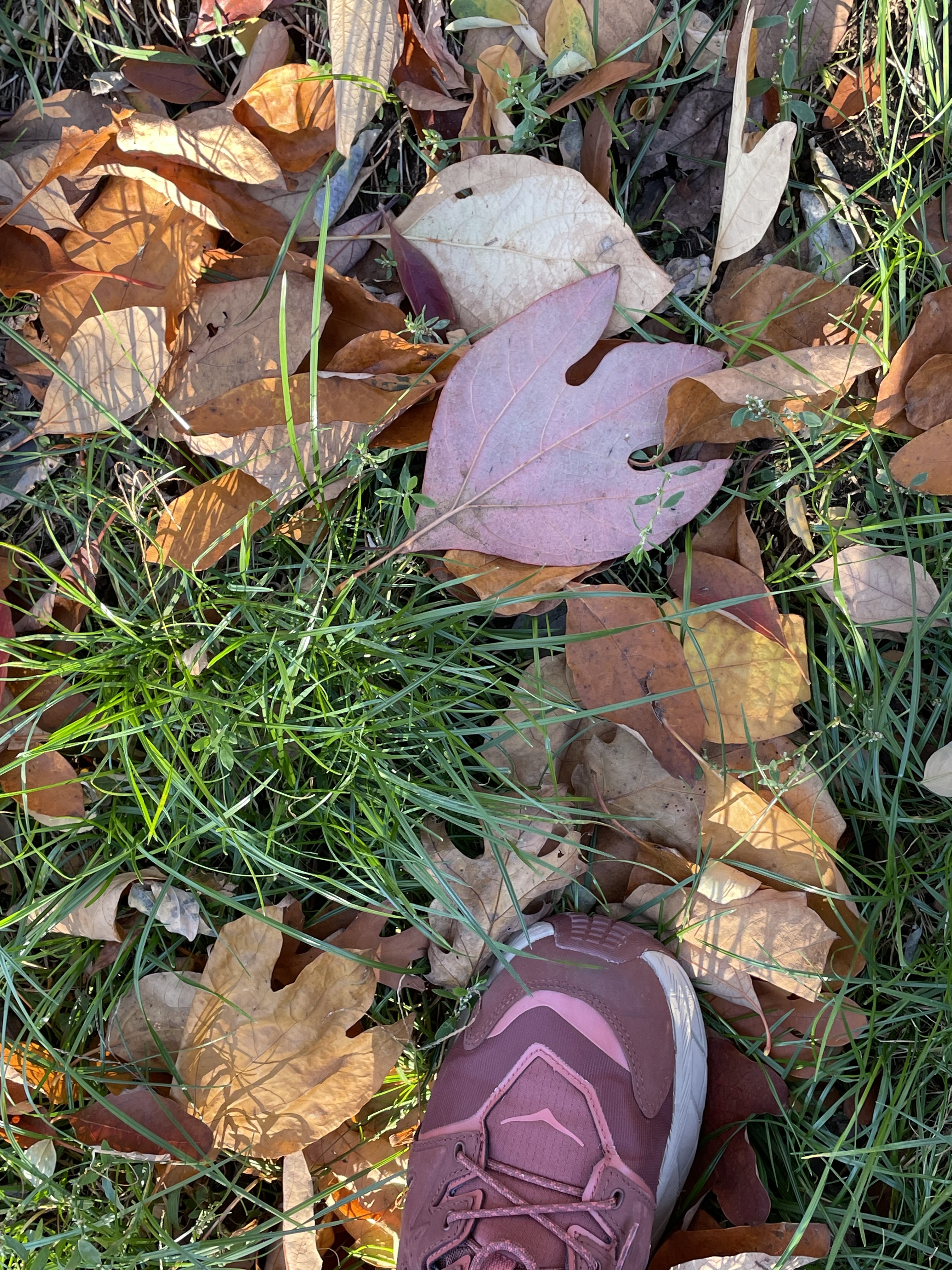
No matter, it is magnificent. Nearby, a white oak stands tall above a wall on Gun Hill Road.

Beneath the tree’s enormous canopy runs the Old Aqueduct Trail, another landmark, an engineering marvel from from the time when clean water was piped in from the Croton Reservoir in northern Westchester County. “Assuming was planted along Gun Hill as historical marker.” Makes total sense.
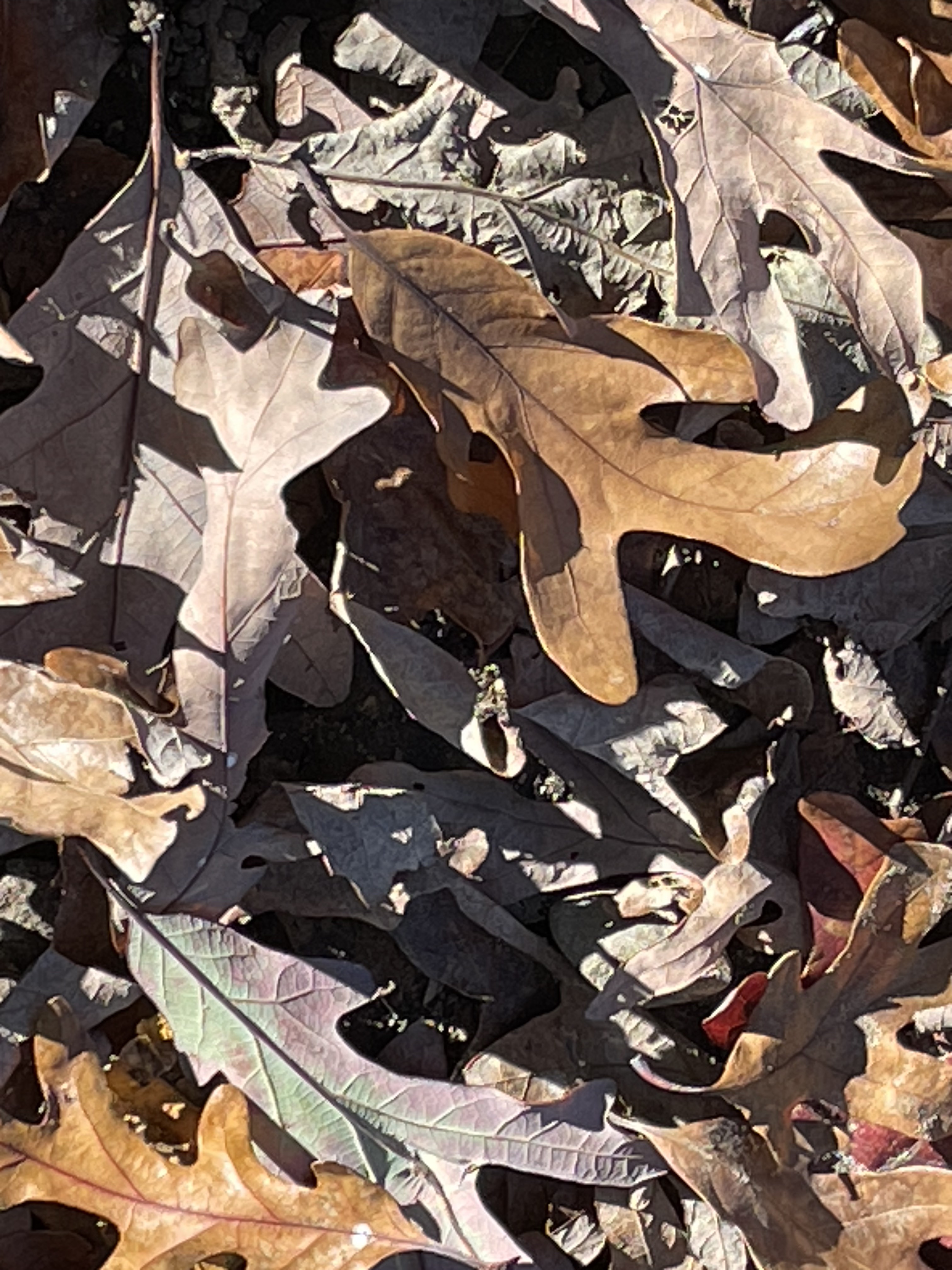
All Gil can say for hours afterward is: That white oak. That white oak was amazing. The wonders of this city’s urban forest are manifold. I’m starting to dream about Bronx trees. We’ve been going out to find them every day.
Now we venture to Ewen Park. I’ve never heard of the place, but I know there is a nominated cherry tree here “south of the dog run.” Tramping all over and unable to find it, we see some of the substantial rock formations that never got blasted away when much of New York City was originally leveled for development.
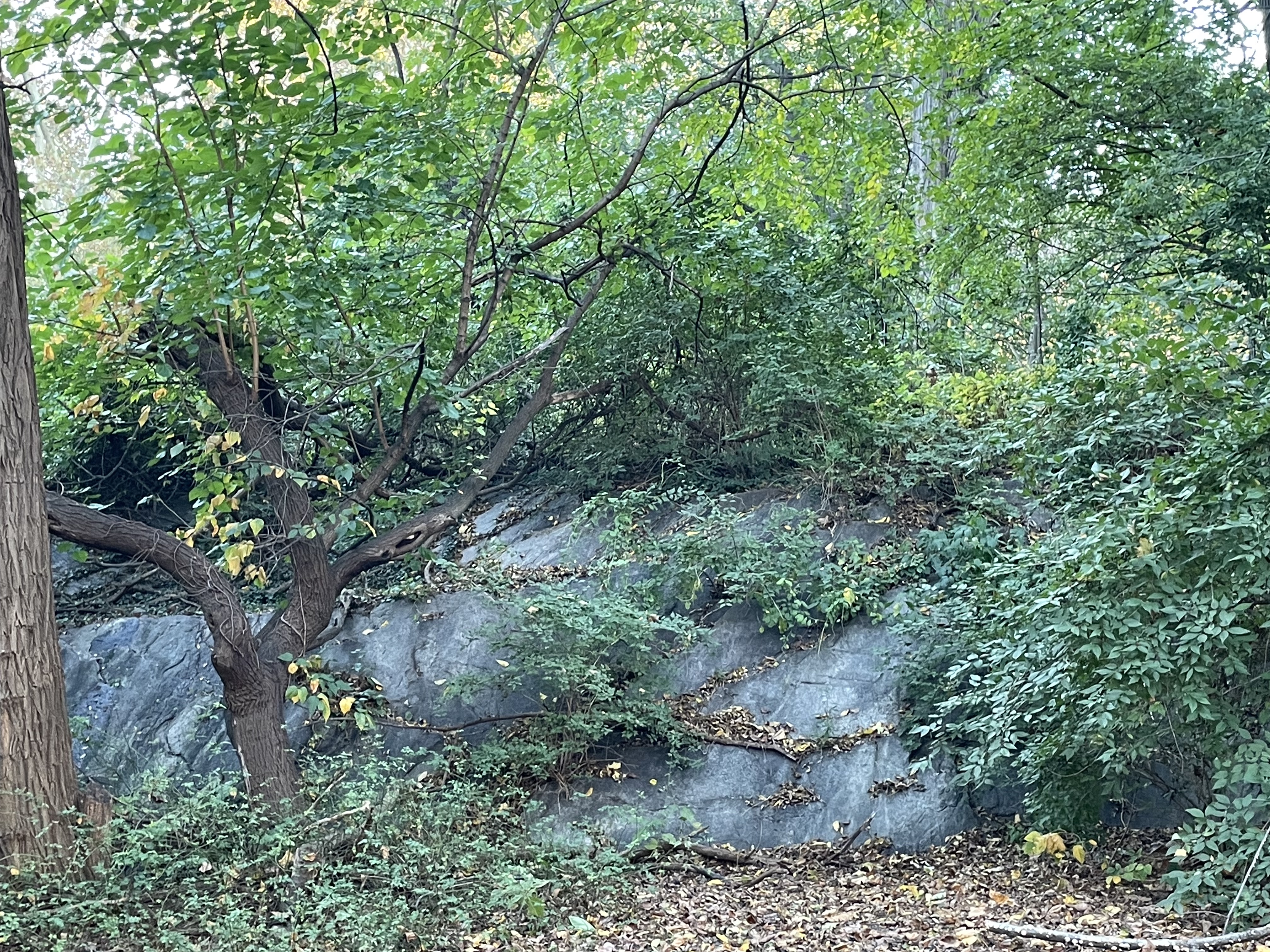
We ask a dog walker to direct us.

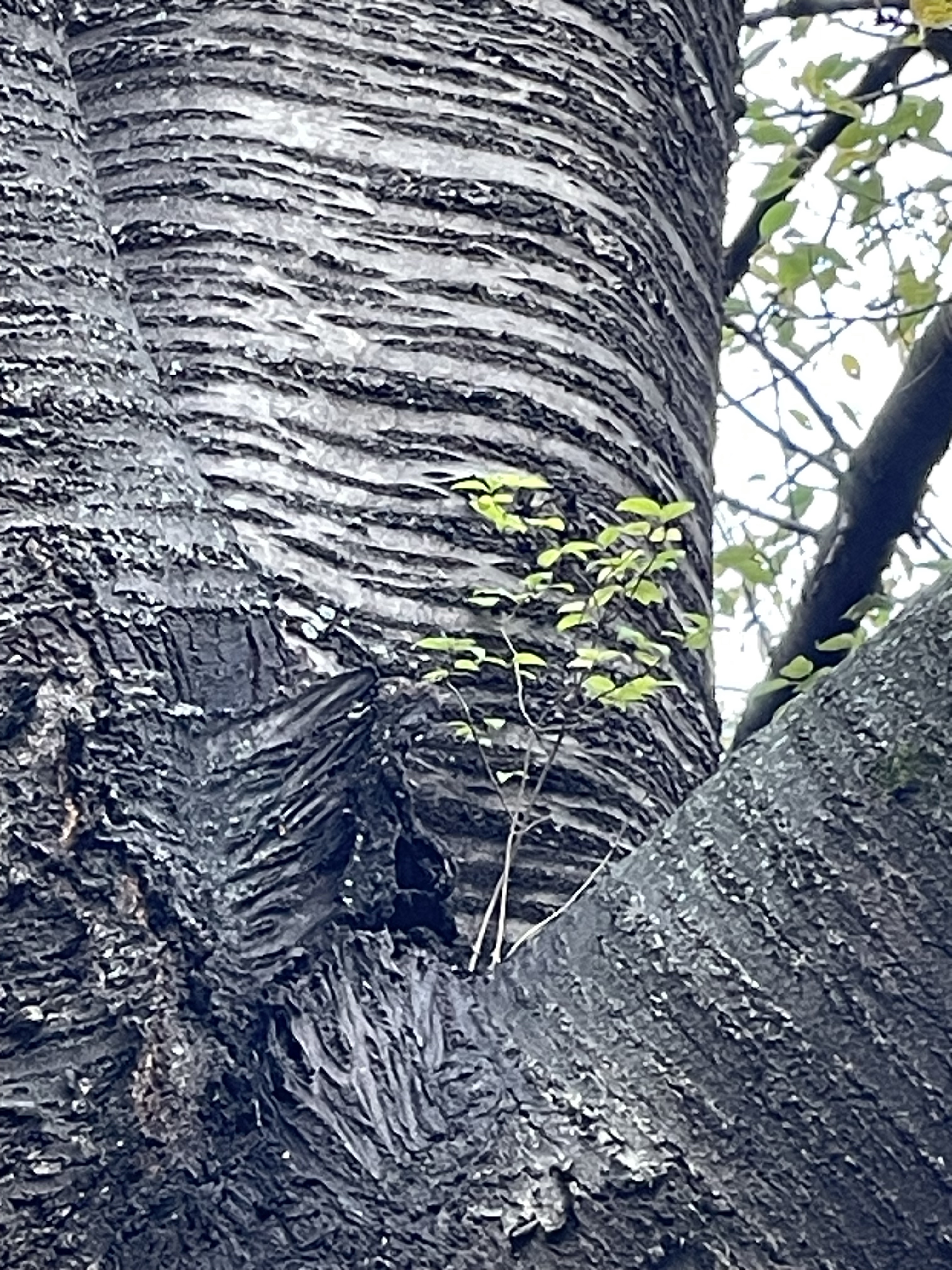
Poseidon, a proud Cane Corso, would not be caught dead in a dog run. But Poseidon’s helpful person directs us down the hill and up the “unmarked trail” to the spot. She has me at “unmarked trail,” my favorite kind of path. We locate the huge old cherry.

“This is one of the biggest, oldest trees in the park,” reads the nomination. “It provides habitat and food for our migratory and resident birds.” Its once-delicate lenticels have gone crusty with age.

It nestles a young’un in its crook.
On the way out of the park, I find a microforest of sweetgums. What’s not to love about a sweetgum?

Their prickly seedballs are a marvel of the season.

Two conjoined trunks seemed to be pouring their hearts out.

I admire a small maple, sporting the usual colorful frou frou of the season. Watch me turn colors! I’m a maple! Sure, m’am, but you clearly haven’t met the other contenders, the sassafras or the black tupelo.
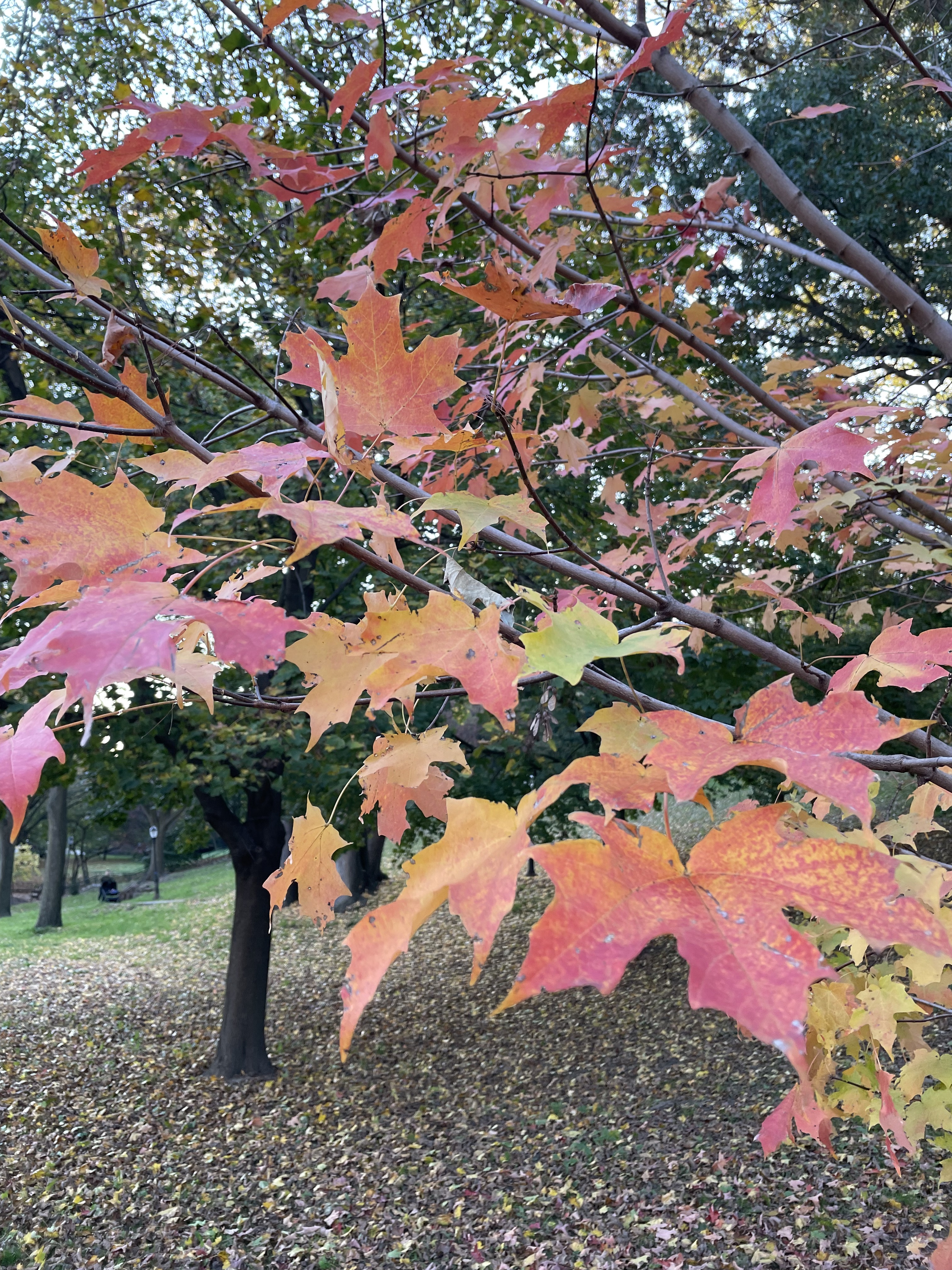
Everywhere I go I stumble upon fantastic trees that were not nominated as Great Trees. Yes, the pin oak in Crotona is spectacular. The zelkovas on Webster, definitely worth noting officially. But what about this particular sweetgum?

Ewen Park, which I’d never before heard of, dates back to when Frederick Van Cortland owned the land. It has a long stone staircase that serves as a conduit between the neighborhoods of Kingsbridge and Riverdale. At the base of the steps I find a marker that establishes the place’s bona fides. It states the number of stairs. In Latin.

History is everywhere. You can read the past in the trunks and branches, leaves and fruits of the trees in the Bronx. Some of them Great Trees. But also, trees that might not necessarily be identified as such. Not necessarily winners, but trees that are nonetheless special.

And that is pretty great.













 Jean Zimmerman