Tag Archives: Bronx

Winter color so vivid all around

at Wave Hill, the historic estate in Riverdale, the Bronx. Always a magnificent public-access arboretum, but perhaps especially beautiful on this brisk early afternoon in mid-December.
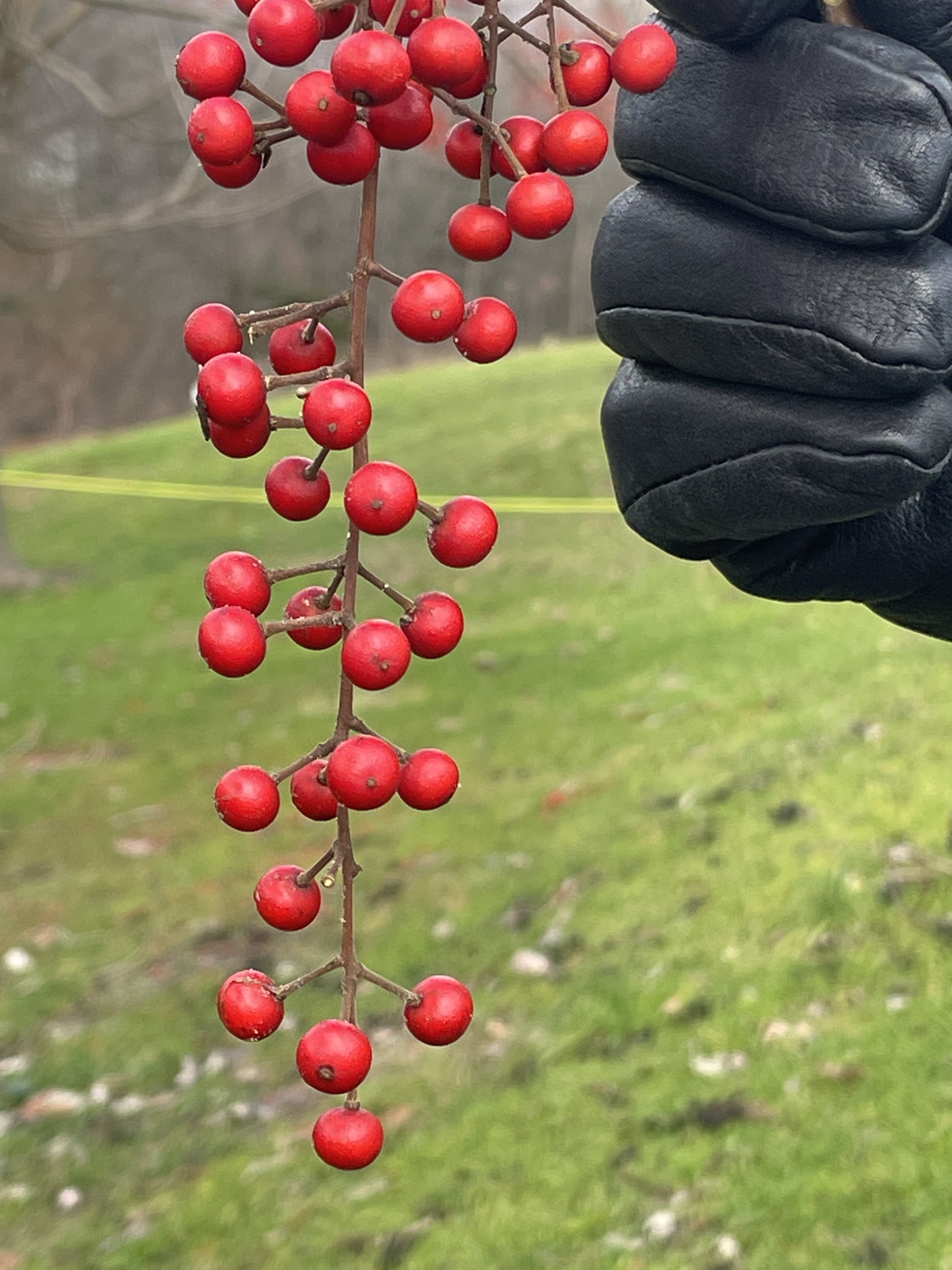
Berries all around. Not only crimson holly, perfect for the season.
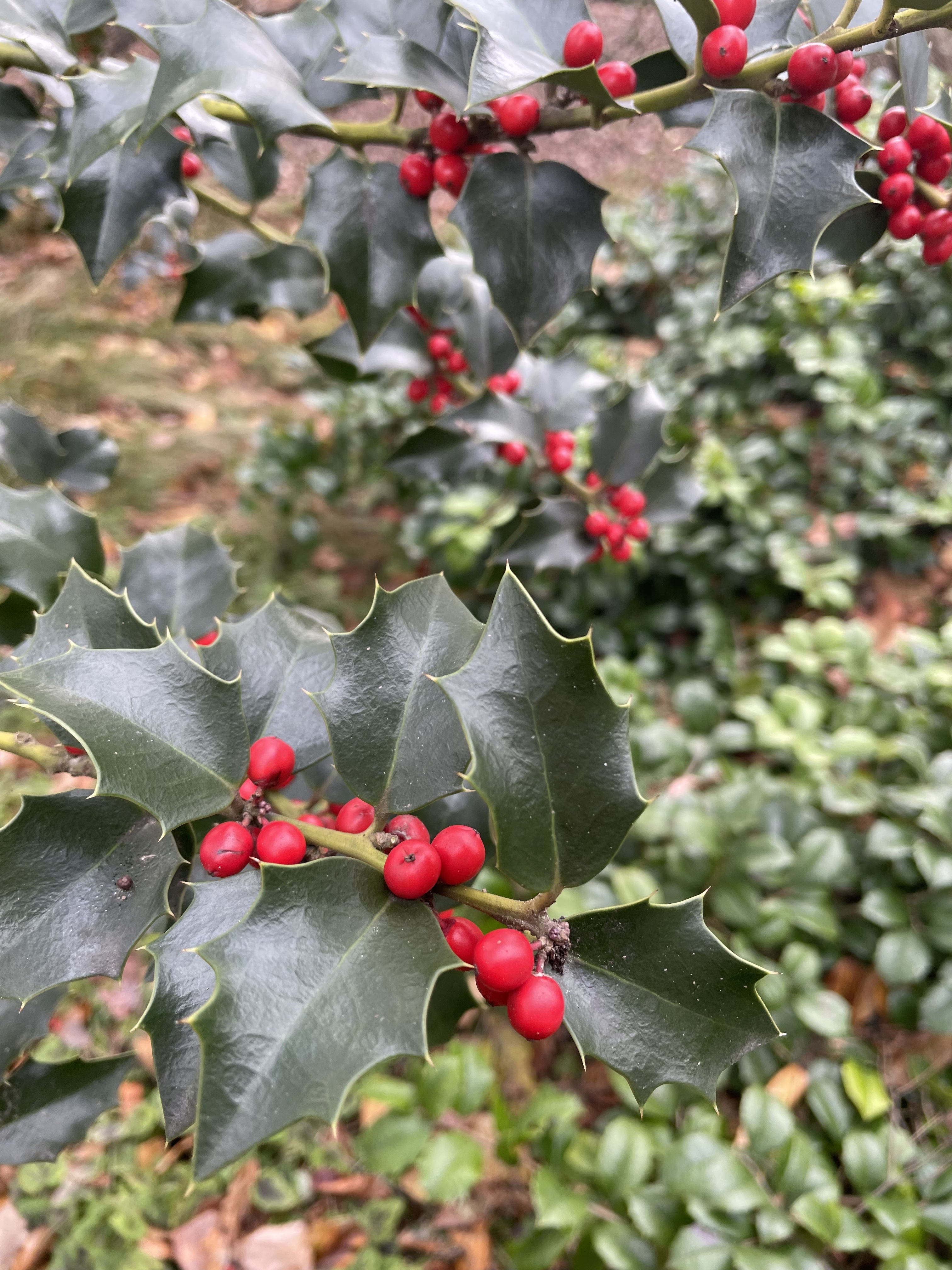
But purple. The aptly named beautyberry.

Shakespeare wrote about boughs which shake against the cold,/Bare ruin’d choirs, where late the sweet birds sang. He might have been describing one of the most majestic trees here, a weeping beech.

The birds, though, are still at Wave Hill in full force.
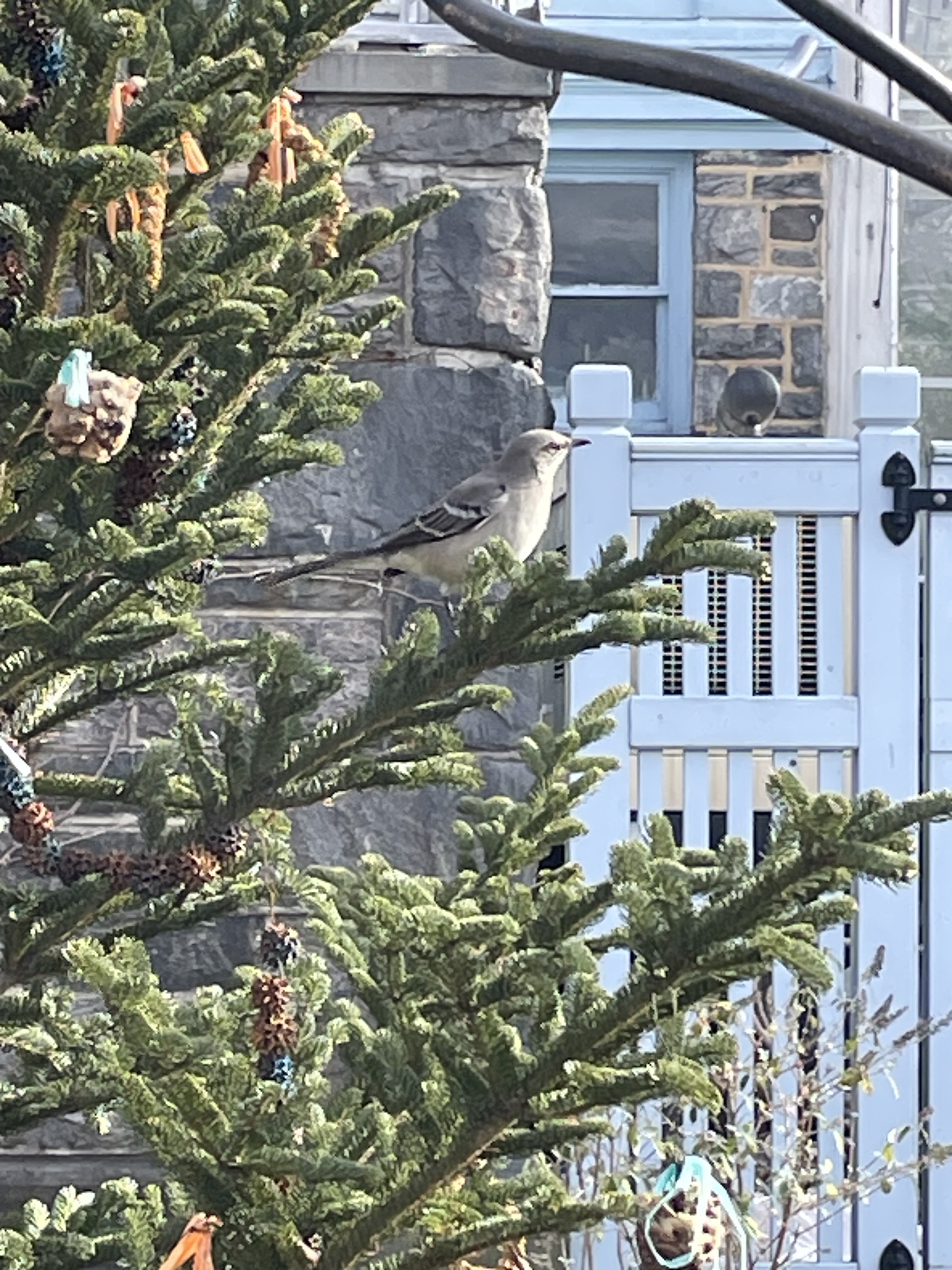
Making a mad racket and perching on branches specially decorated for them.
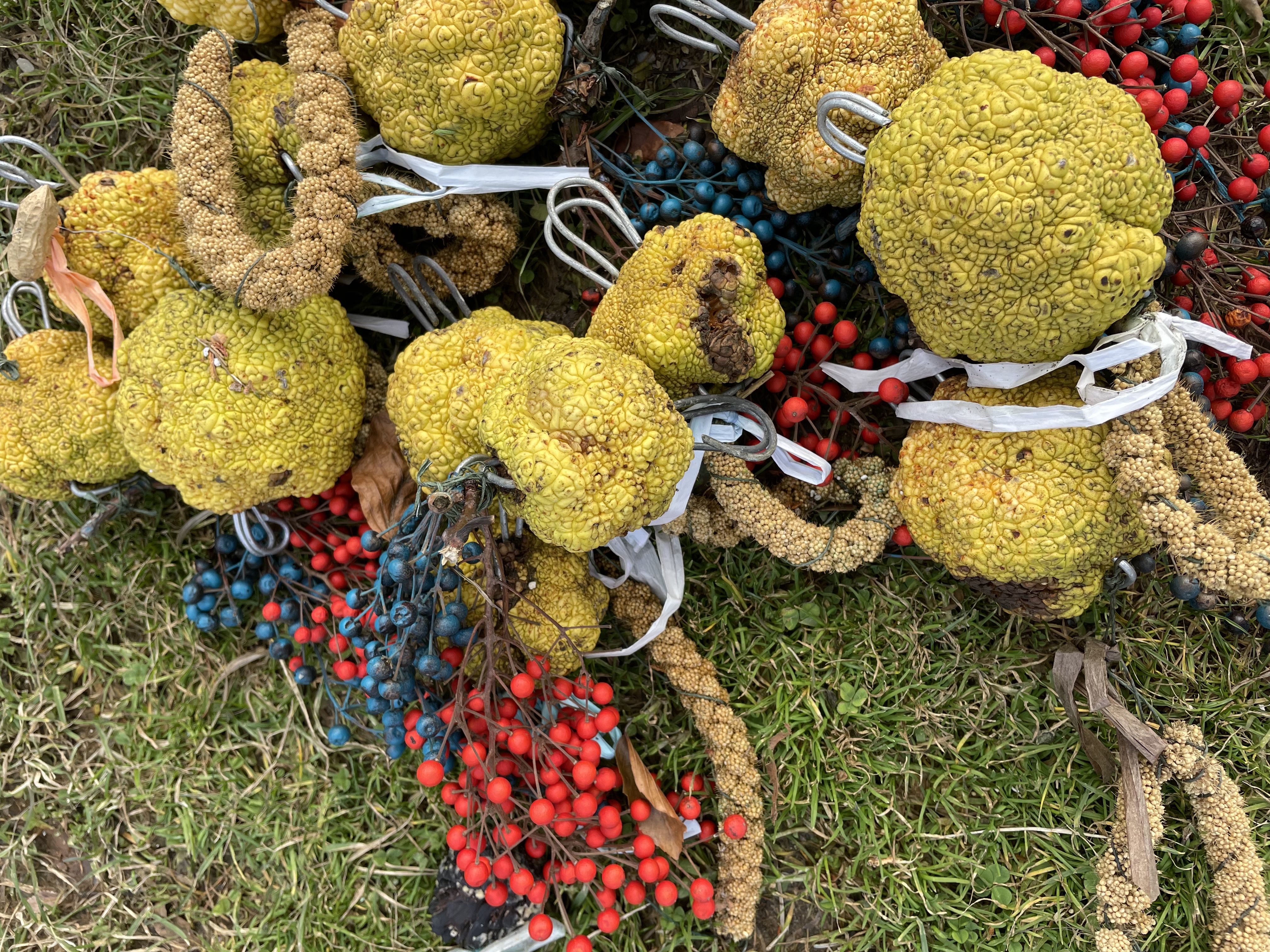
Garlands of things they love to eat. Berries, yes. Also, even more delectable for them, the fruits of the Osage orange. An ancient species that dates back to at least the last ice age, when seeds were most likely spread by mastodons, sloths and other creatures that consumed them.

Squirrels like the seedballs too, hence the one we find partially devoured along our way.

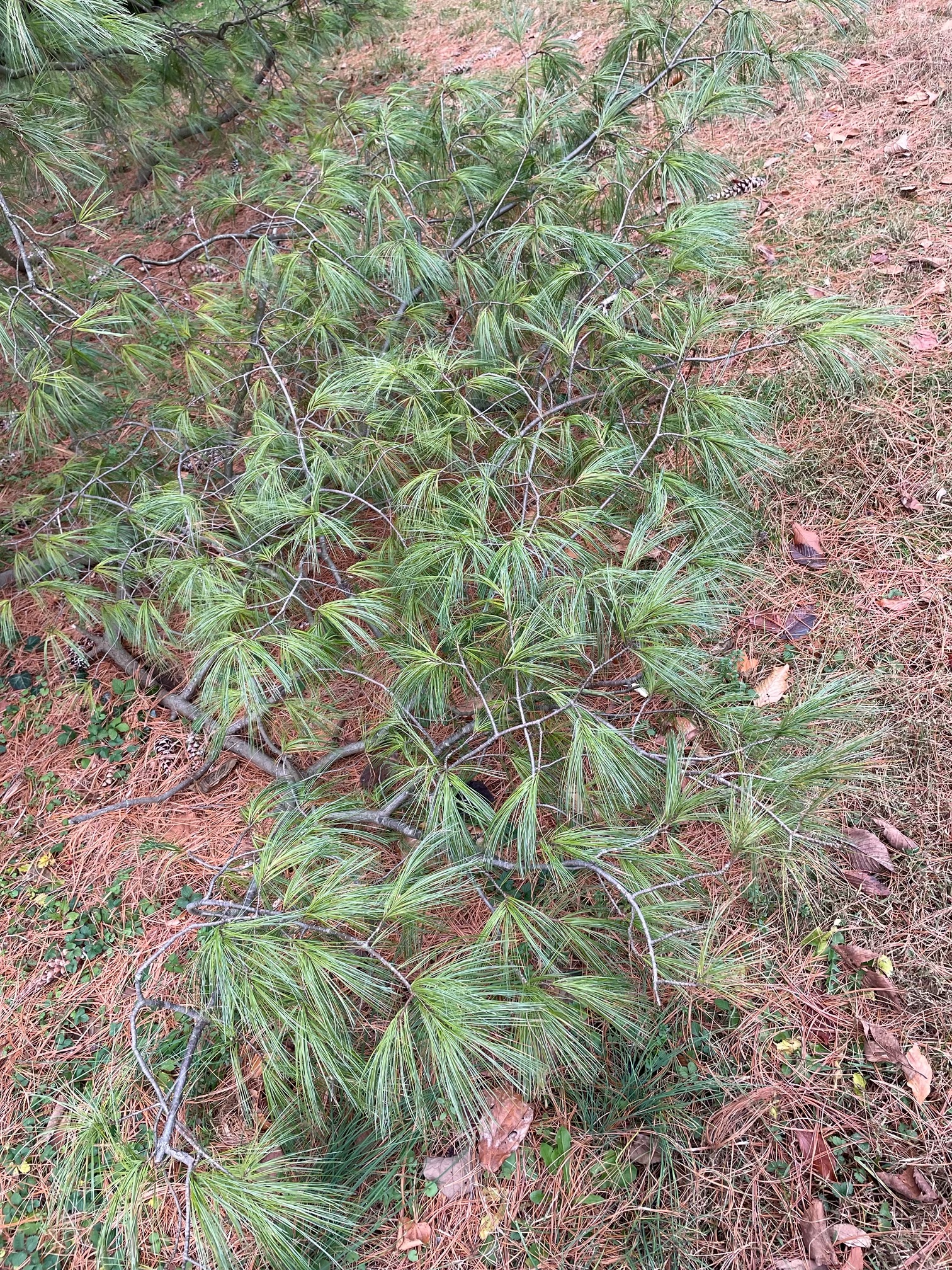
To celebrate the fir tree season, we pay a visit to the conifer grove.
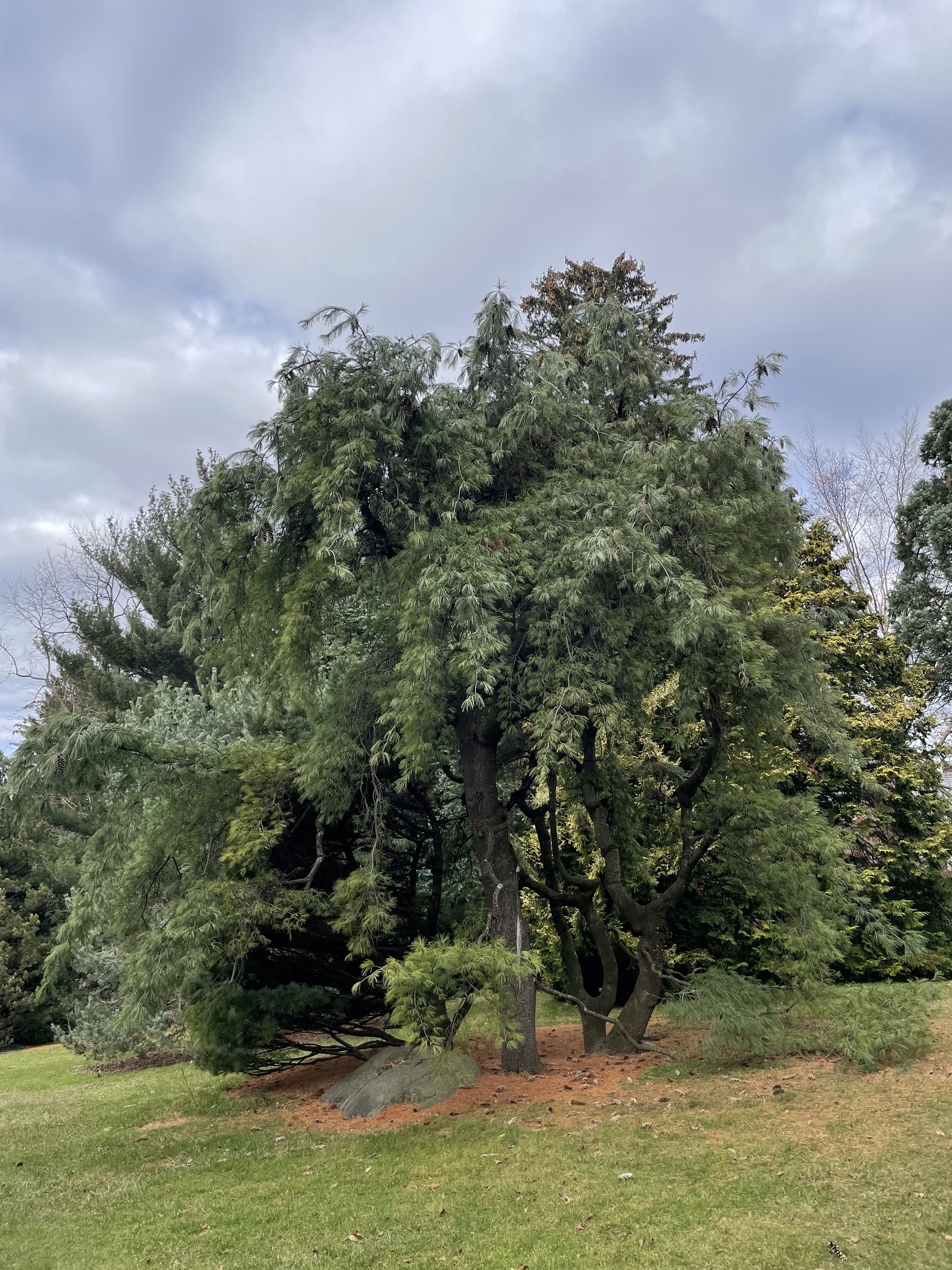
Gorgeous specimens all around.
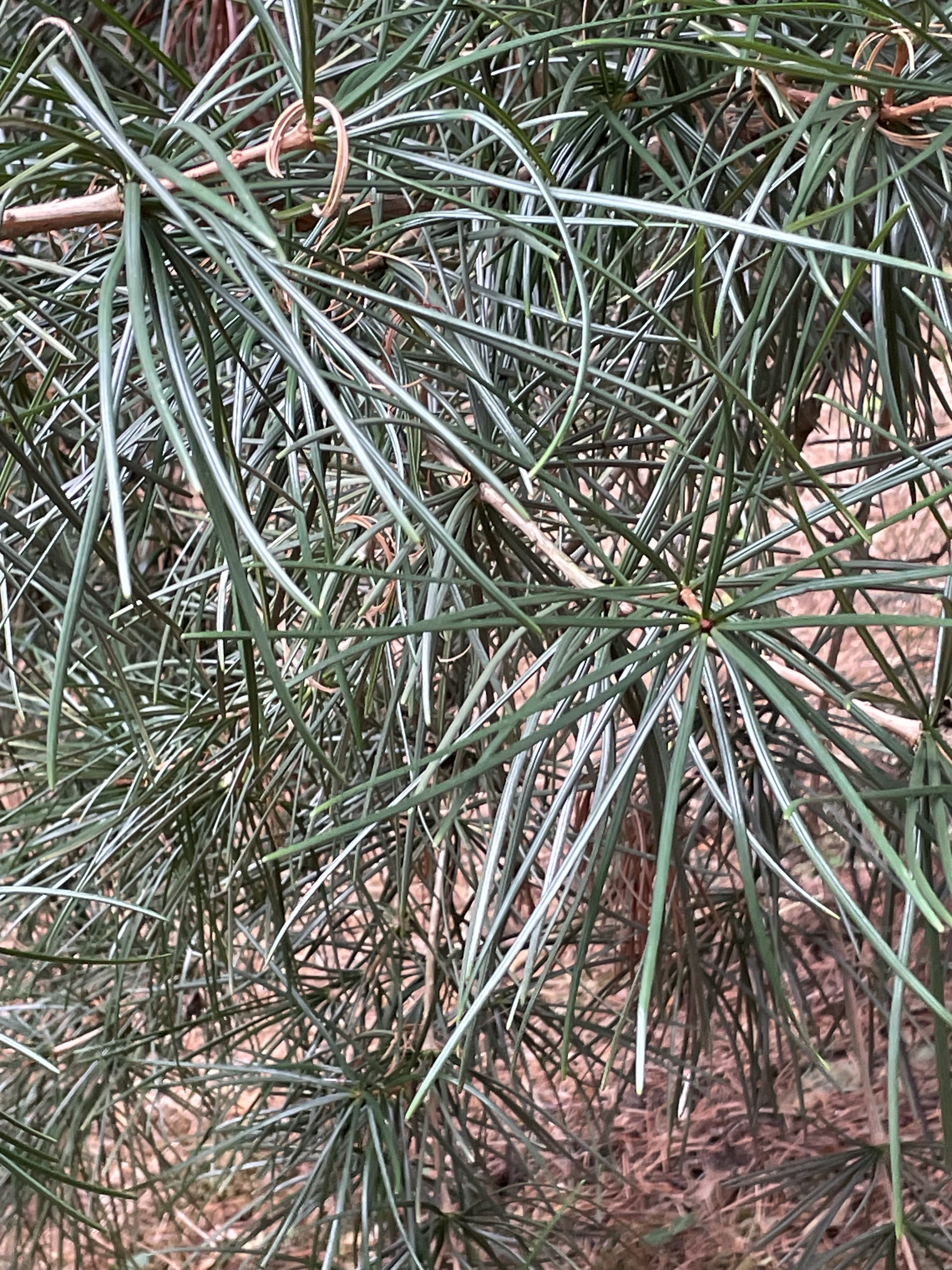
So many different species.
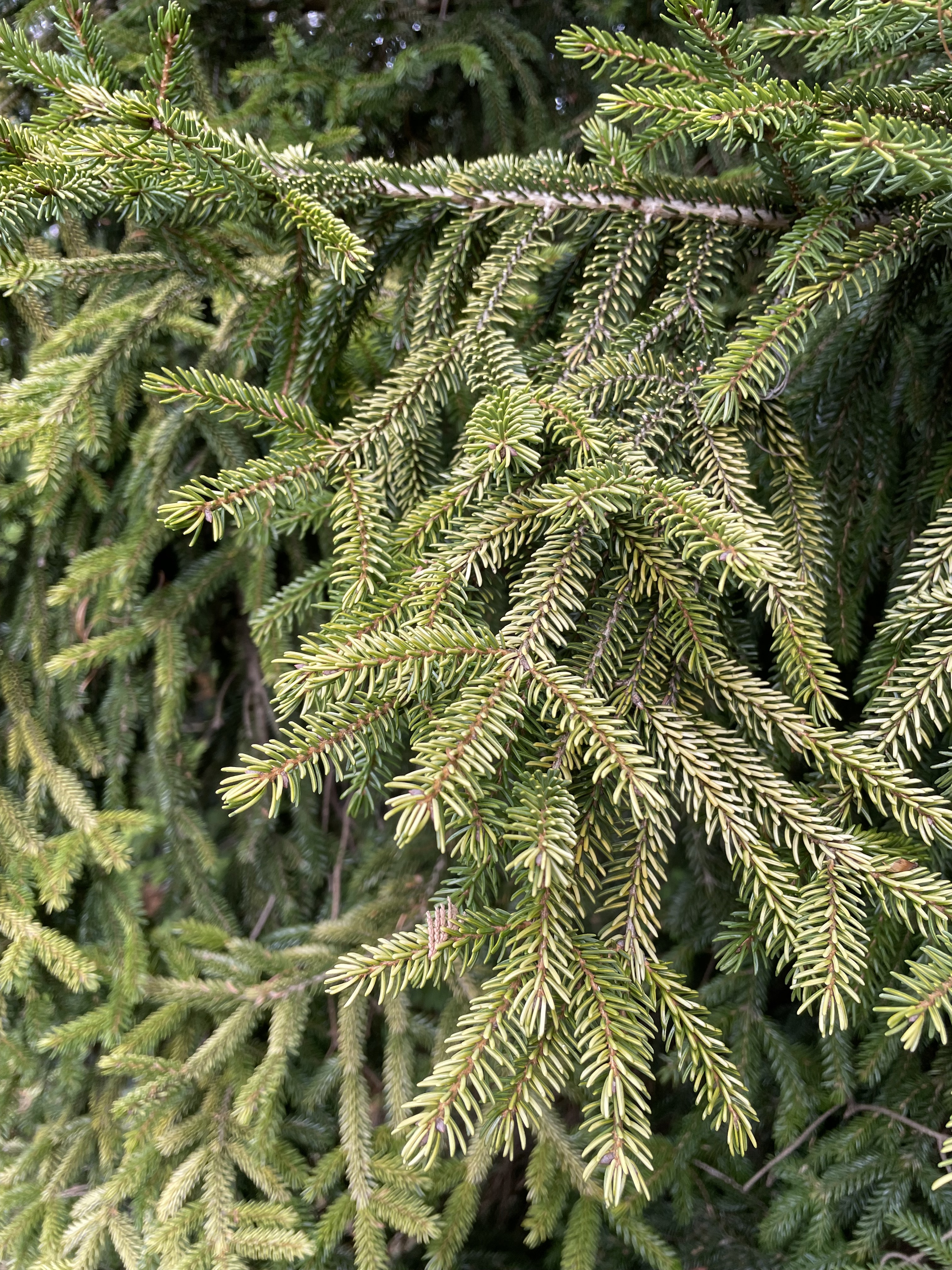
Each beautiful in its own way
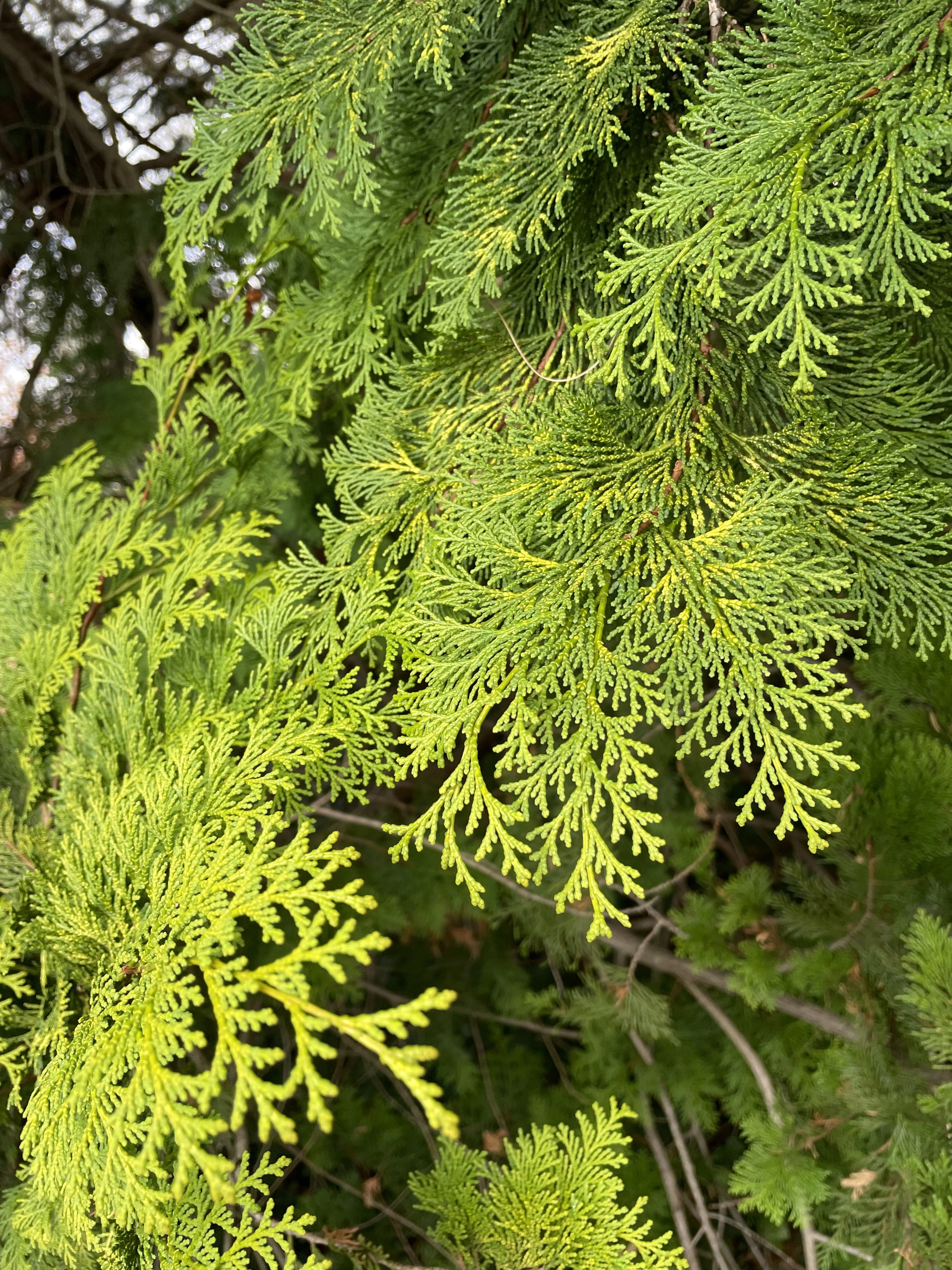
Some exotic, like a China fir.

There is even a giant redwood cultivar. A real redwood, like they have on the West Coast.

Is it possible to overuse the descriptor beautiful? On this day, no. Everything is beautiful.

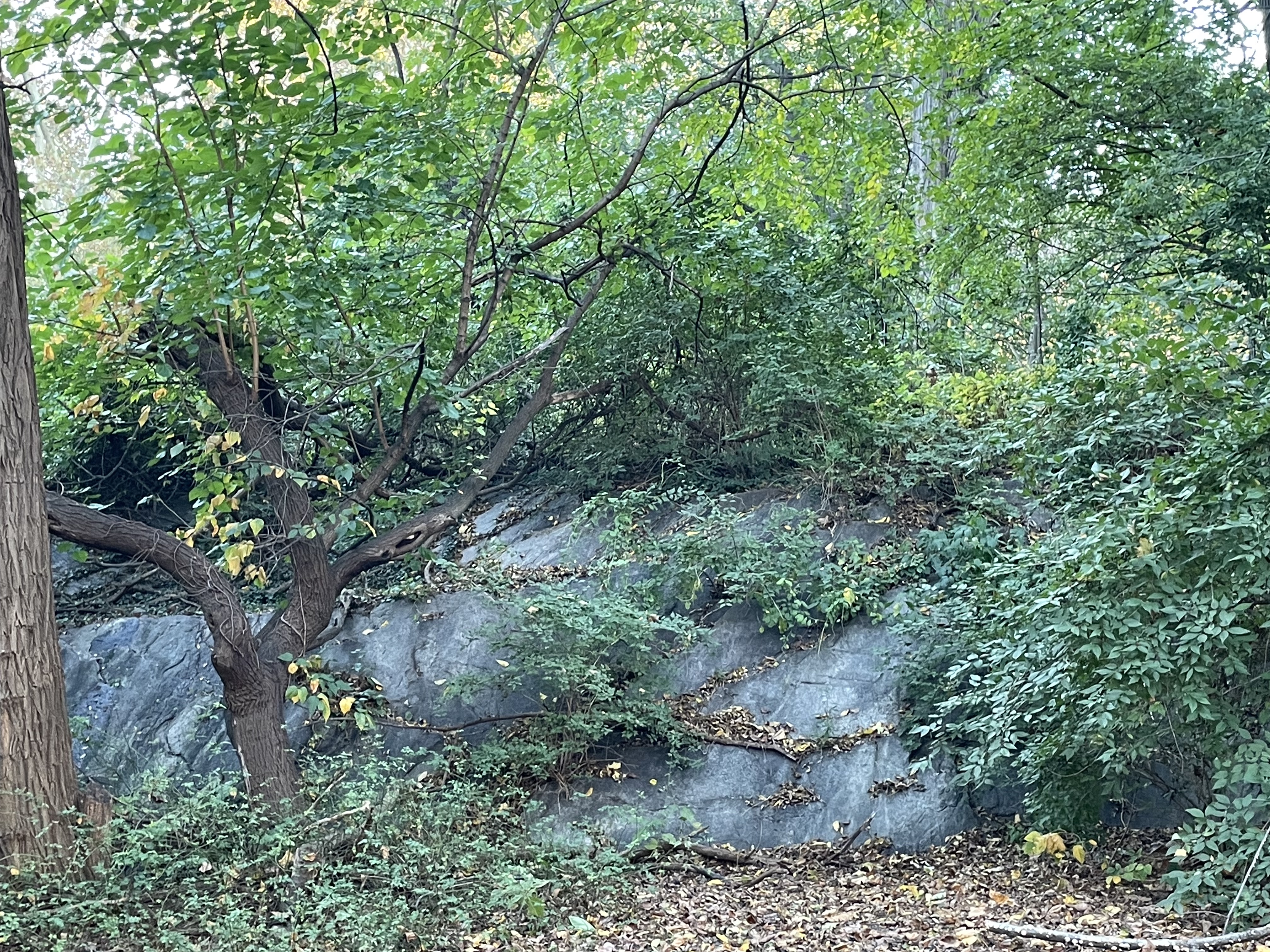
We take the Woodland Trail, which winds along the edge of the property. We see evidence of the human hand tucked into the corners. This isn’t an old-growth forest, after all!

A private school adjoins the property. We hear children shrieking on a playground as we go, having fun at recess. Find a gazebo — nice place to sit and reflect, if that’s your thing. Ours is more along the lines of walking to stay warm on this cold early afternoon.

Someone was here before and loved someone.

A hand-hewn belvedere. Think about the people employed here to build it long ago, probably old-world stonemasons who gifted our country with their expertise.
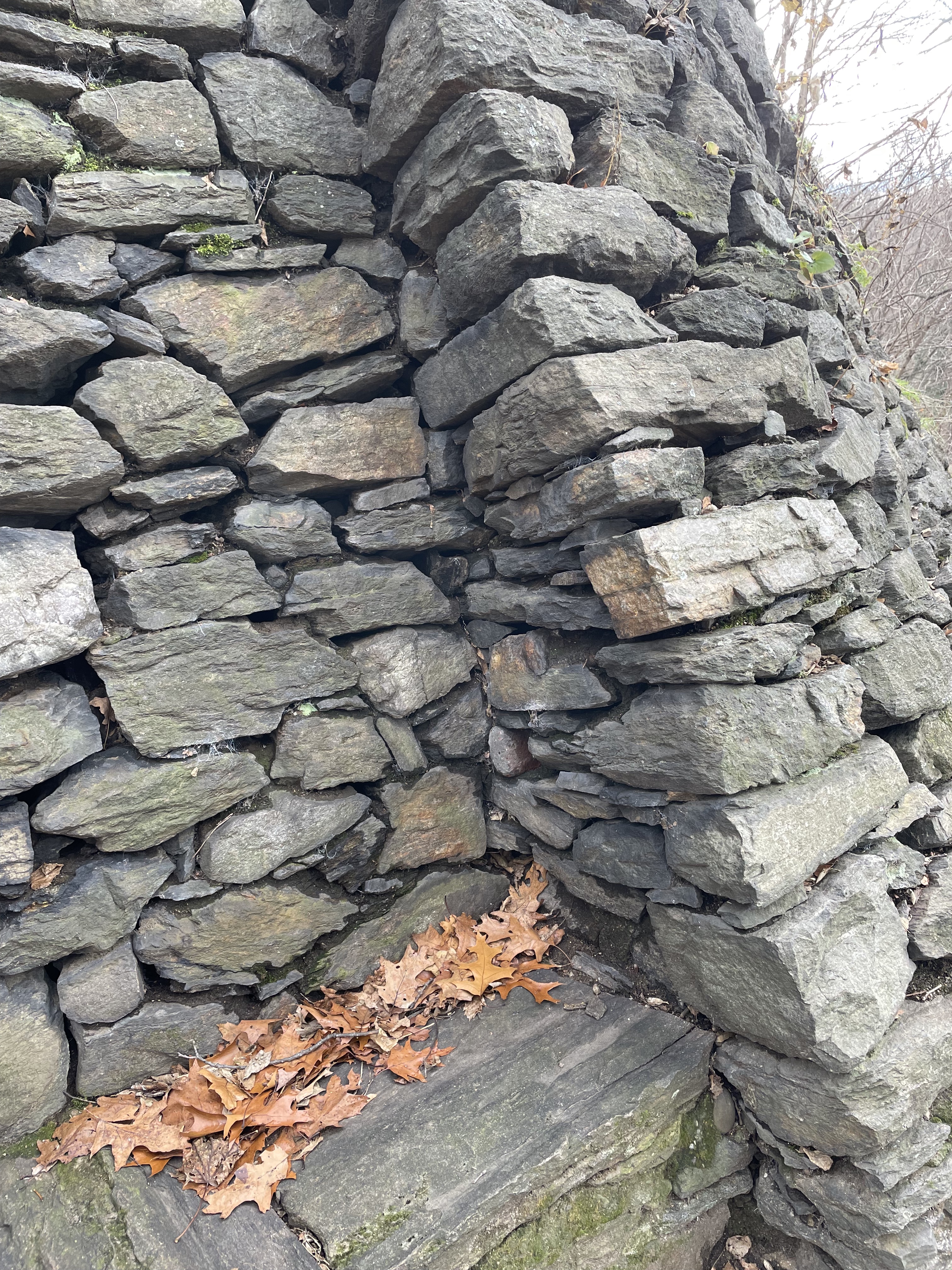
So much texture in these woods.

Hackberry.
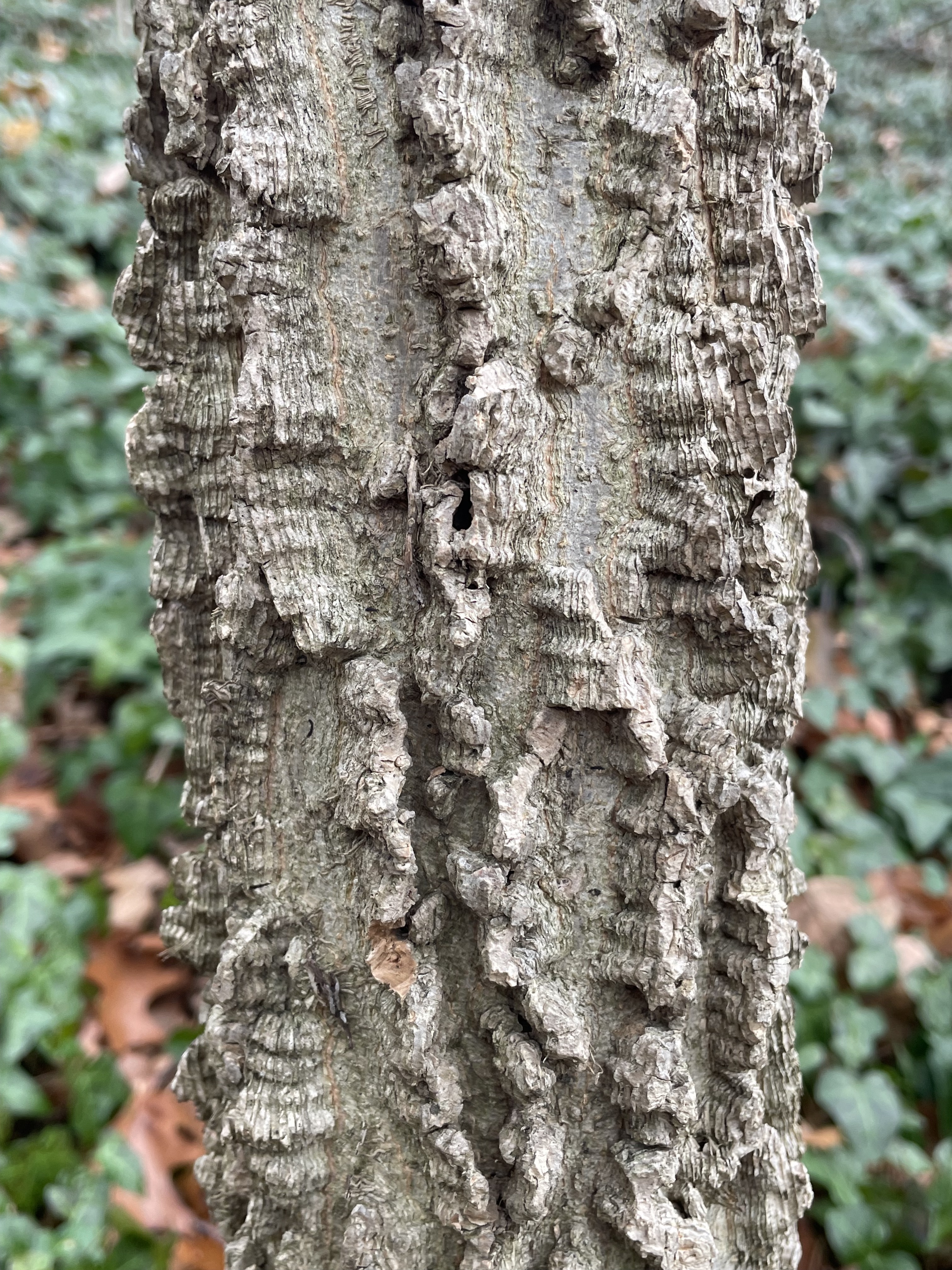
Black cherry.

Sweet birch.

Lichen.

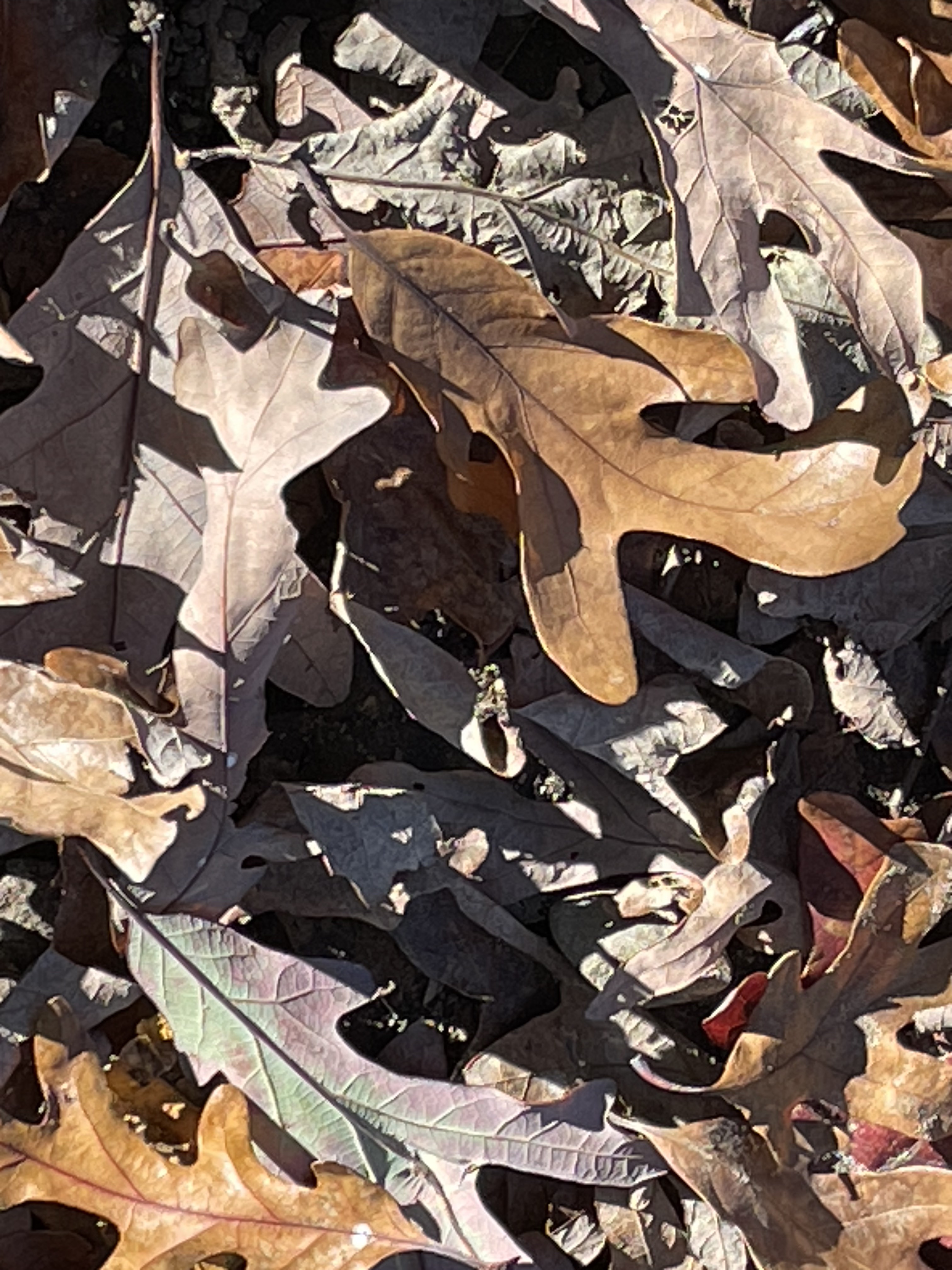
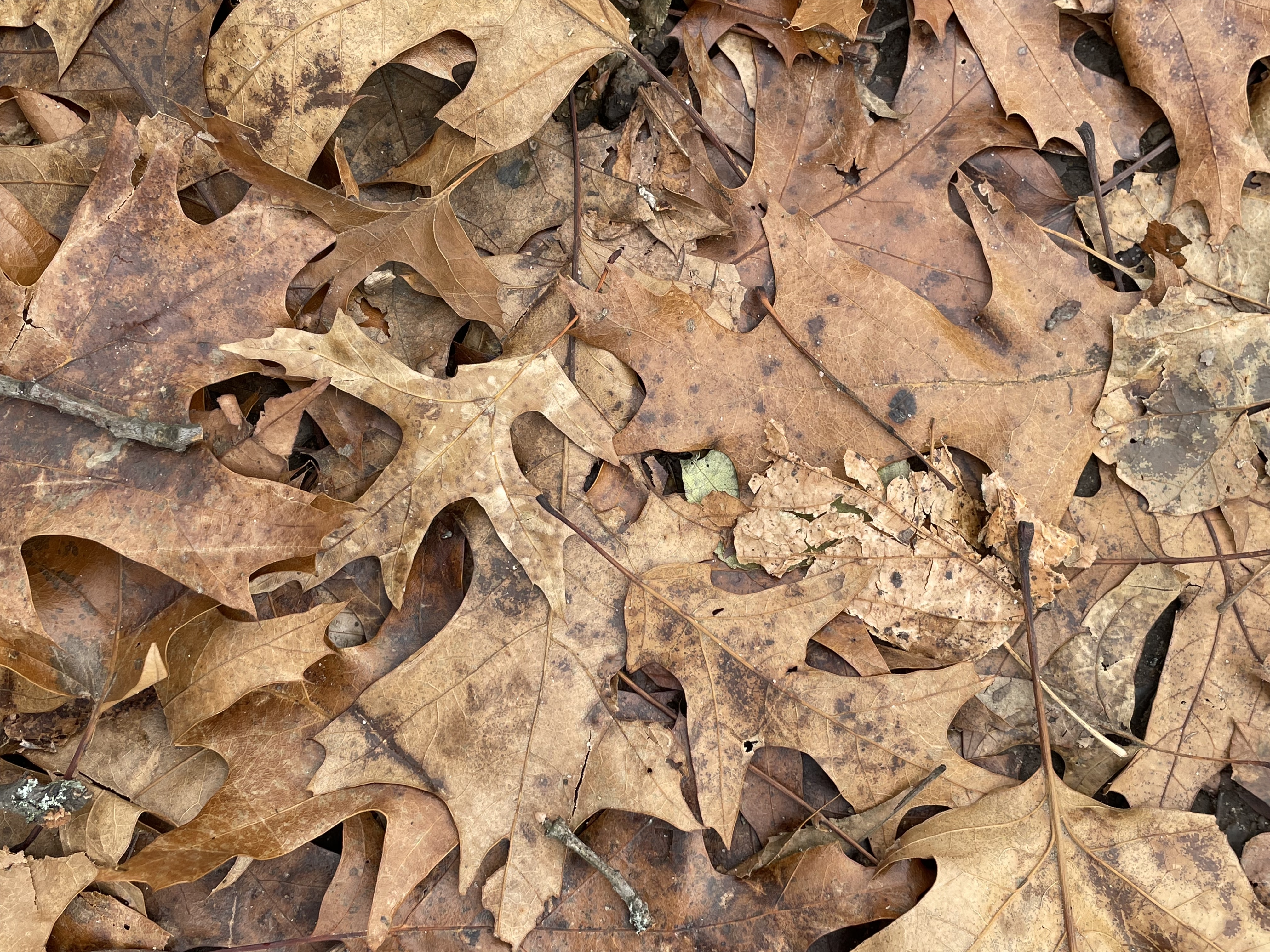
The intricate embroidery of oak leaves underfoot.
Something odd, a measuring tape around a trunk.

Wonder if someone trying to get a DBH left this tool by mistake. This is an arboretum, after all. Or are they trying to girdle the tree so that it will fall over time? Nah, who would do that to a fine old Northern red oak?

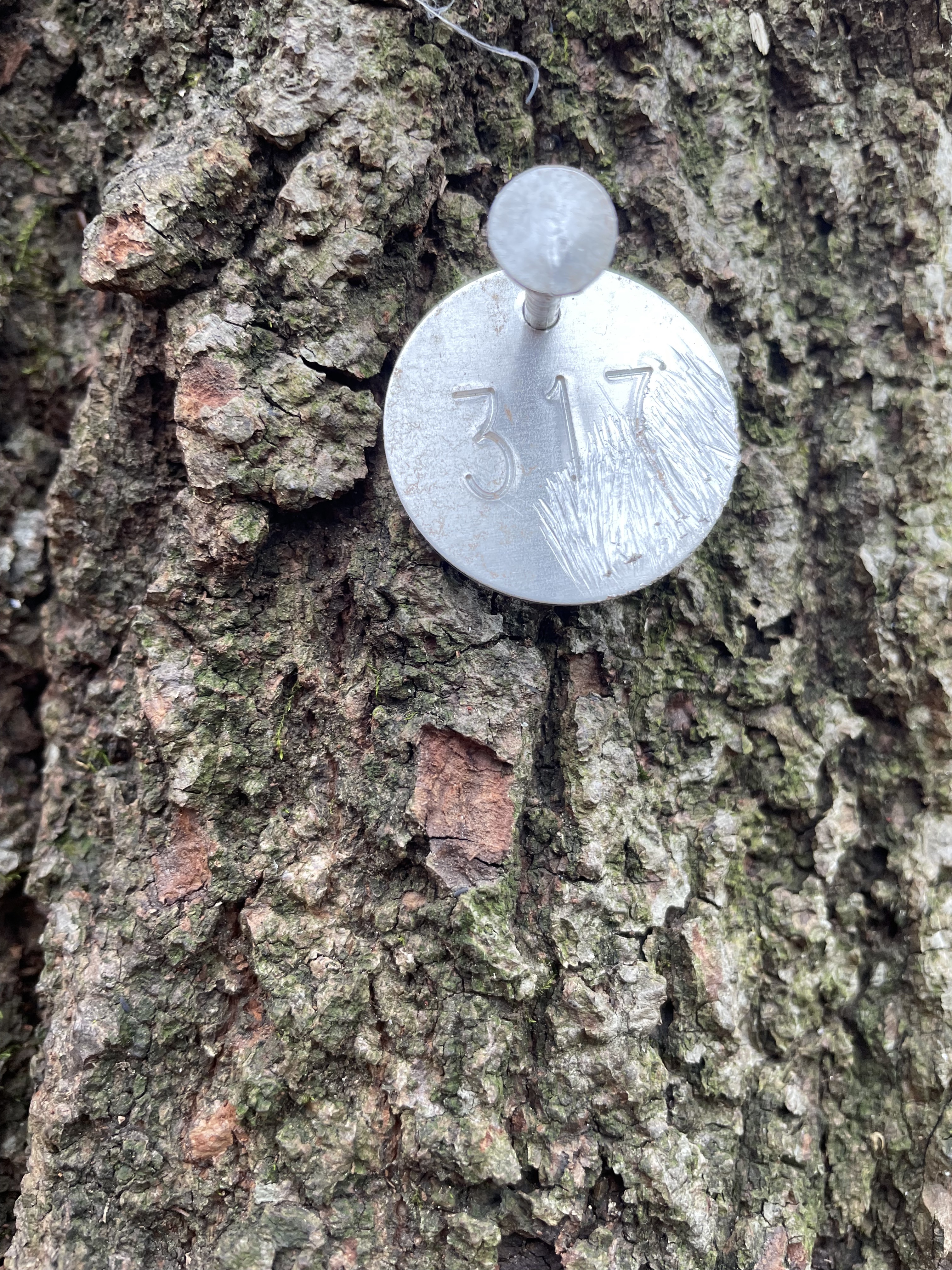
Mysteries. Who tagged this tree and for what inventory?
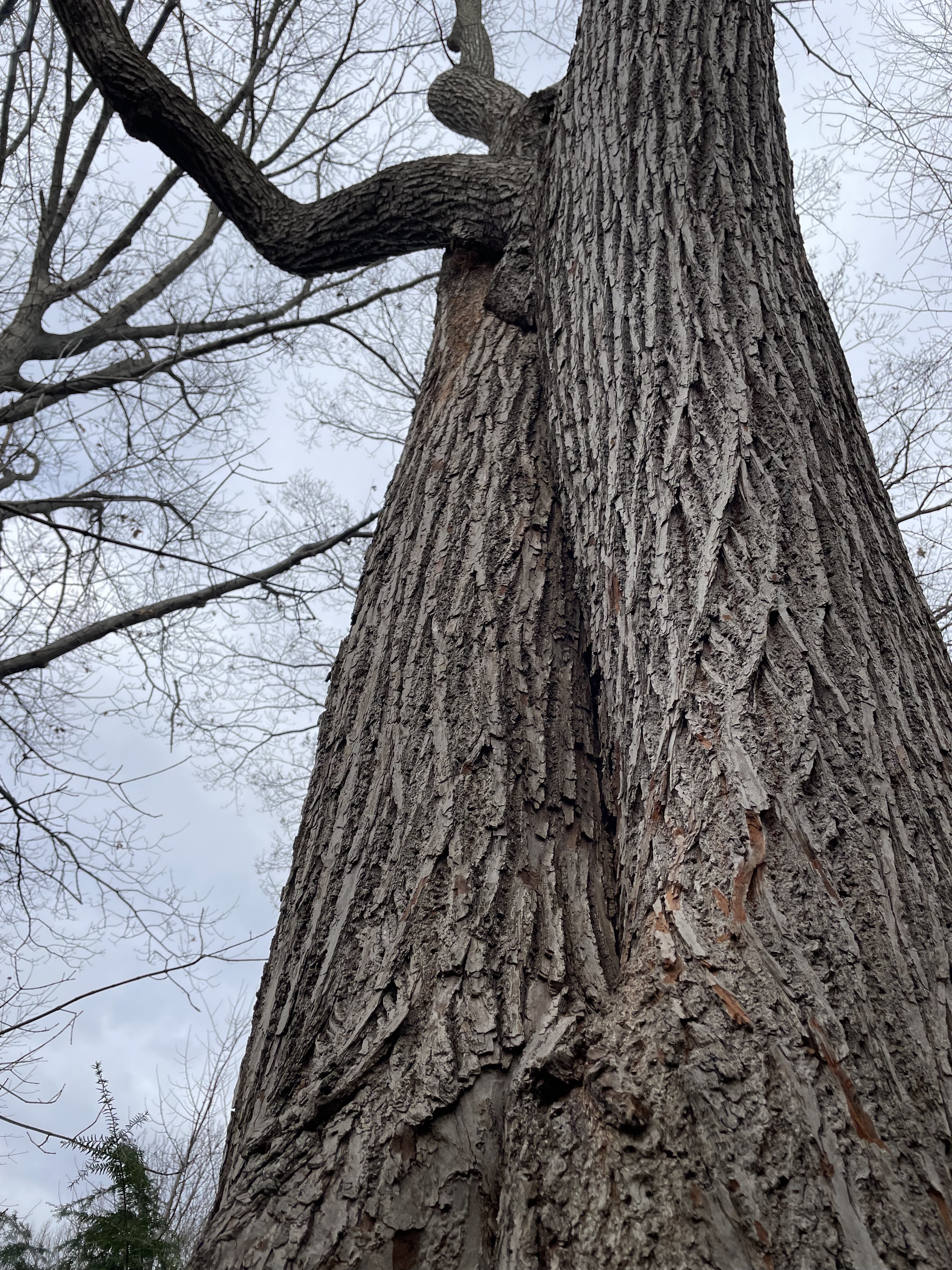
How could any tree be as beautiful as this one with braided twin trunks? Tell me if you find one.
Wave Hill isn’t only about trees and plants. There’s history here too. Illustrious visitors spent time on the estate, with an overnight guest list including Thomas Huxley and Charles Darwin. A teenage Teddy Roosevelt summered here. Later, as governor of the state, he became very active in preserving the view across the river.

Did Roosevelt’s  Wave Hill summers have anything to do with his adult efforts to create the National Parks system? Inquiring minds want to know.
Arturo Toscanini also put in some time here. He’d play concerts on the lawn. His guests included Queen Elizabeth II and John Foster Dulles. Mark Twain stayed at Wave Hill between 1901 and 1903.

There are numerous historic buildings, and I’ve often wondered where specifically Twain resided. We know that he set up a writing retreat in the branches of a chestnut tree.

In her memoir, his daughter Clara quoted Twain as saying: I believe we have the noblest roaring blasts here I have ever known on land; they sing their hoarse song through the big tree-tops with a splendid energy that thrills me and stirs me and uplifts me and makes me want to live always.

We go in to get warm in one of the buildings, the one with a ballroom and a great old fireplace decorated for the holidays.

Twain also wrote, This dining-room is a paradise, with the flooding sunshine, the fire of big logs.

I greet old friends at Wave Hill, great trees I’ve visited time and time again over the years. The grand littleleaf linden.

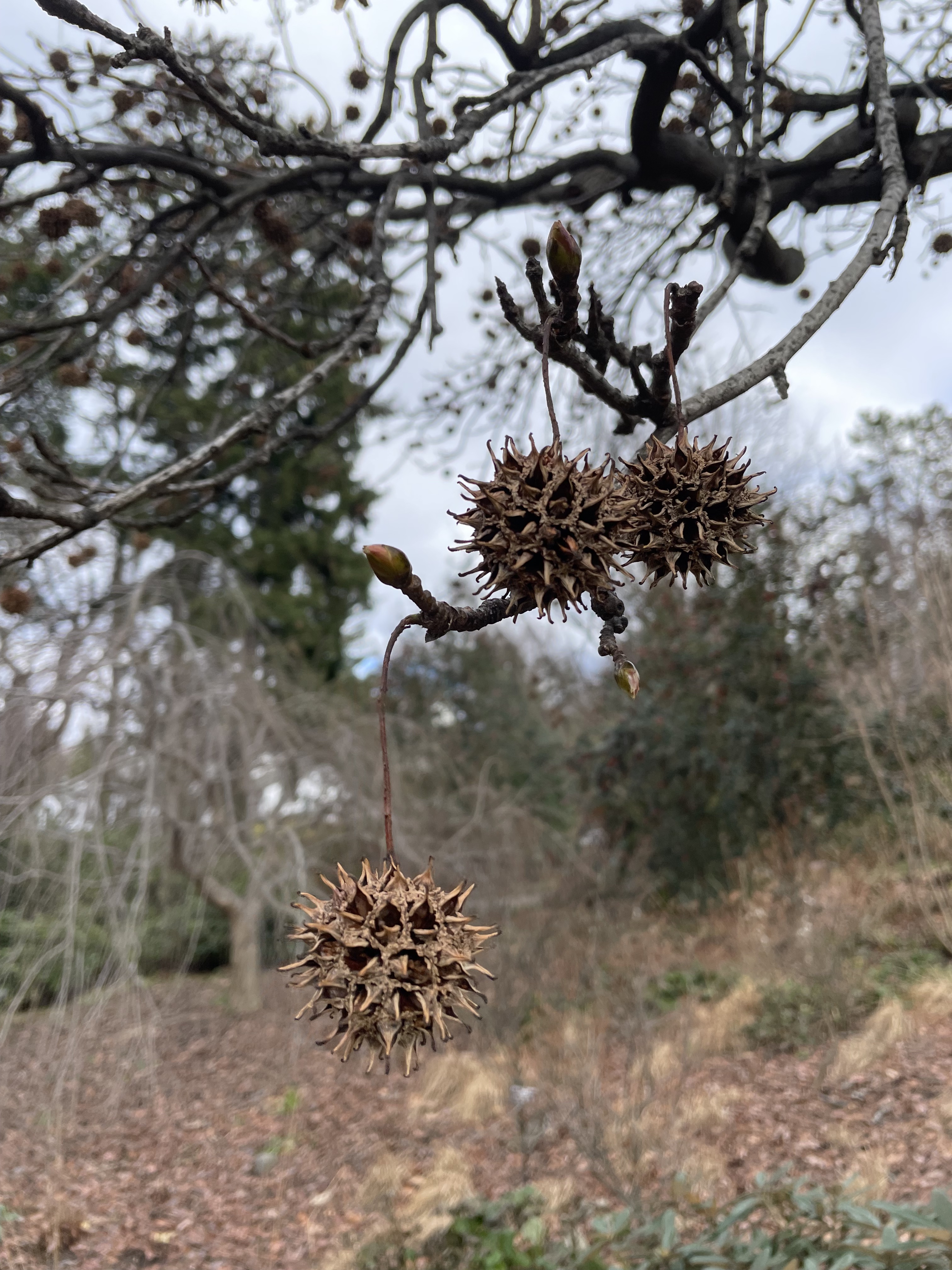
A particular sweetgum.
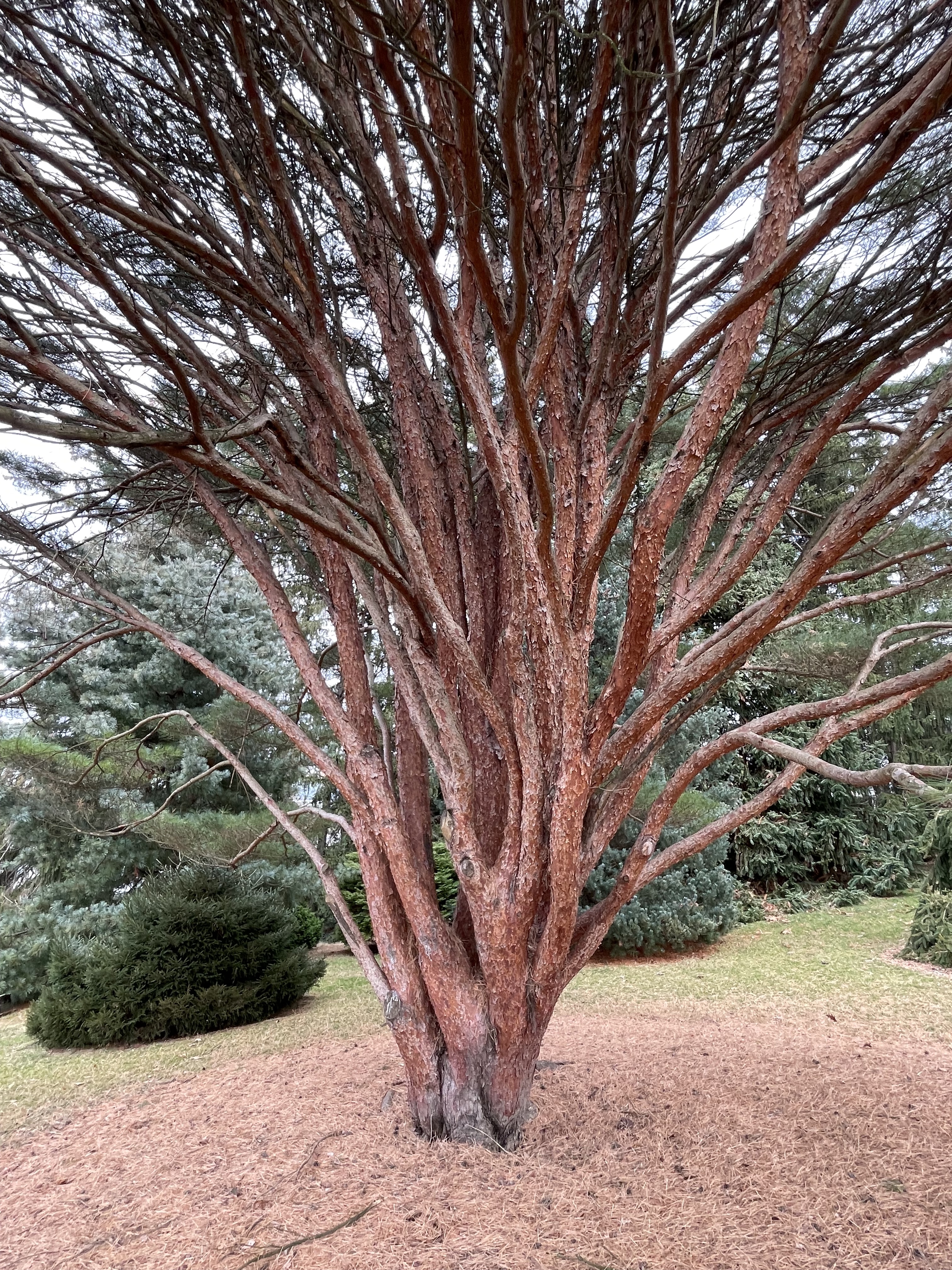
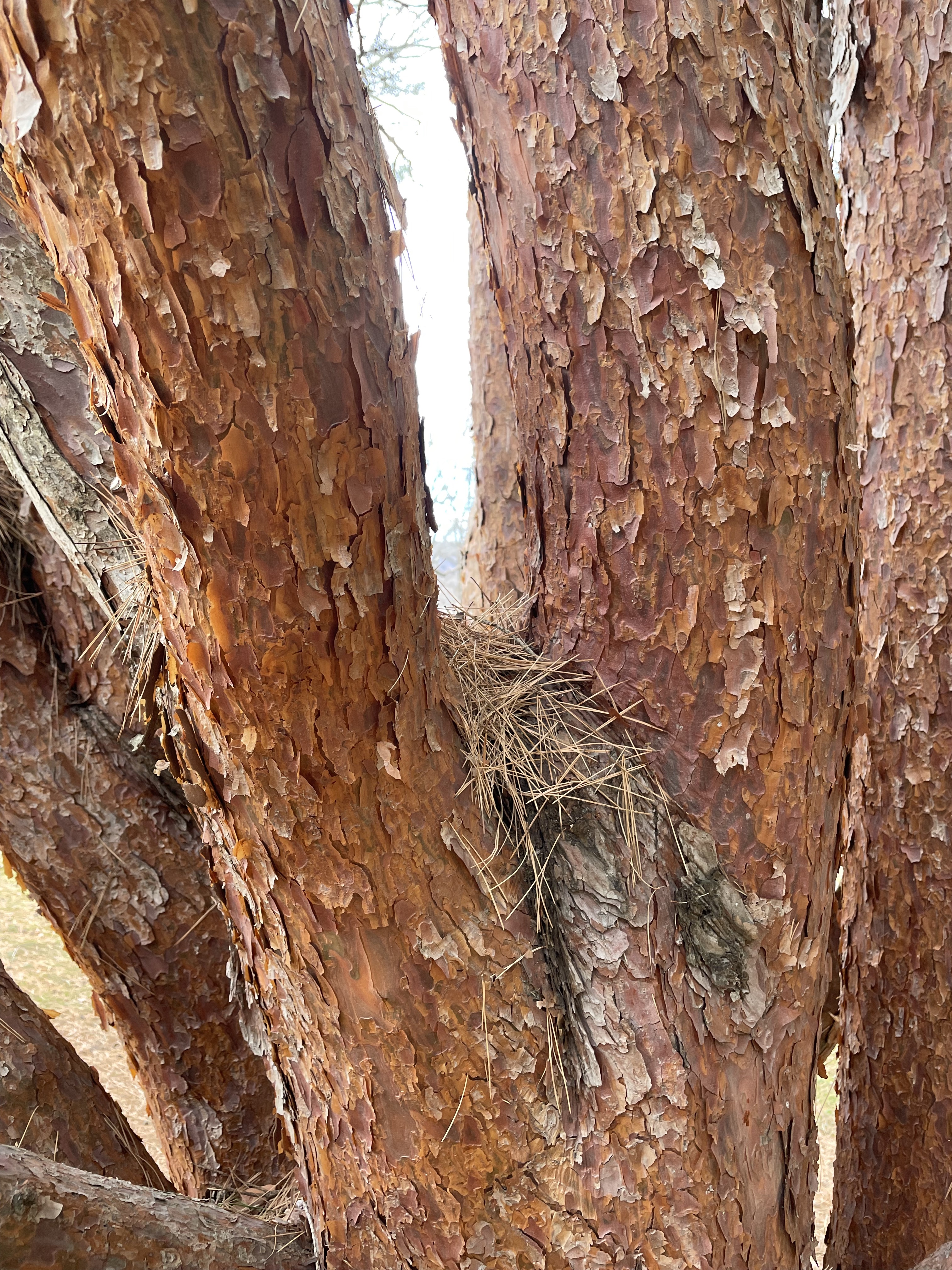
The crazy looking red of the Japanese red pine .
Go up close and see the delicately beautiful thatch of needles in its crook.
We pass a quiet place where spring bulbs slumber. I’ve seen this careful sign before.

Then, at the end of our walk, the copper beech. There are two here, actually. One is perfectly balanced, untouched by time.
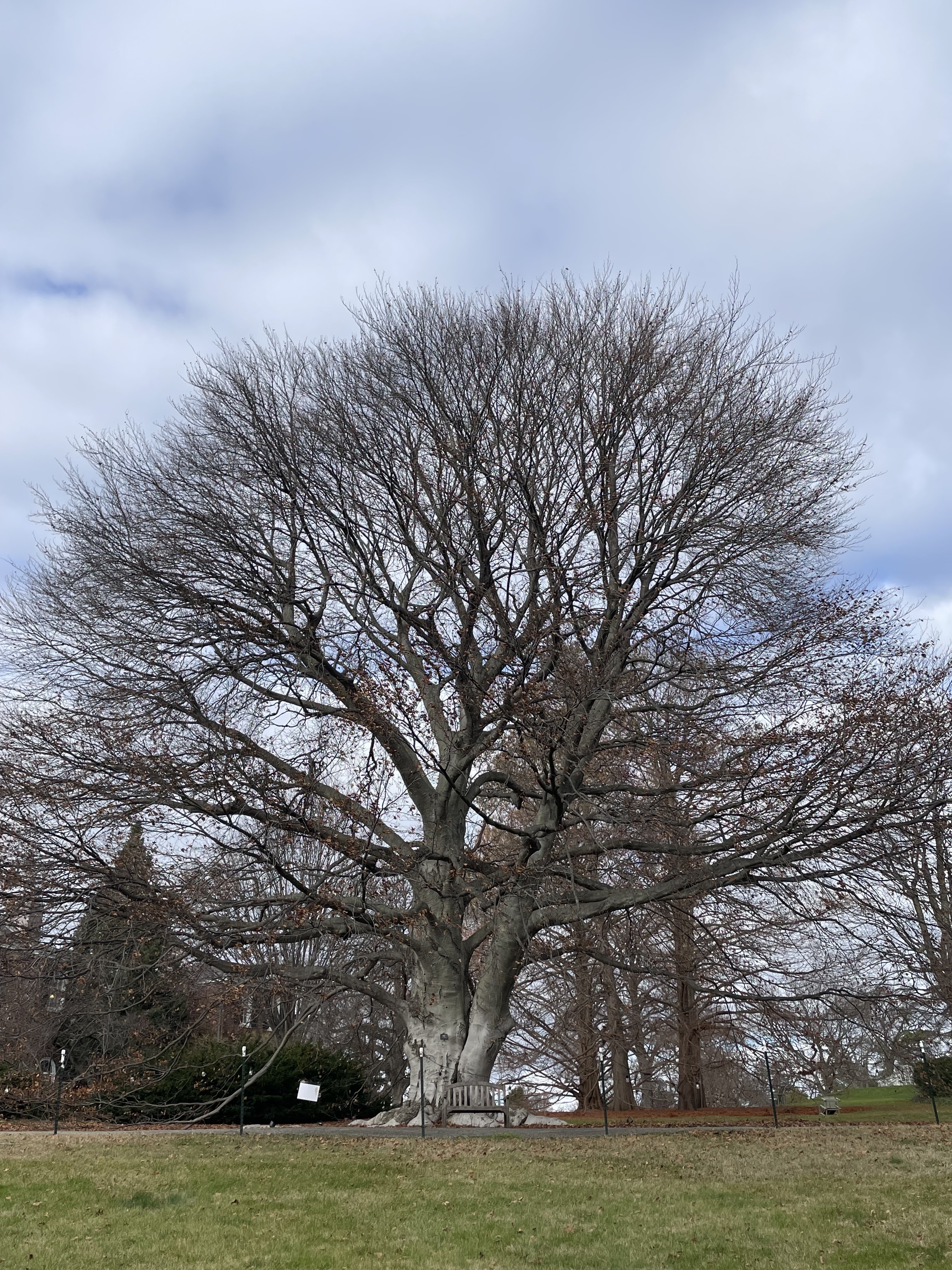
The other, though, down a slope, I like just as much. She has bark that has been scarified over the years by people engraving their initials and hearts.
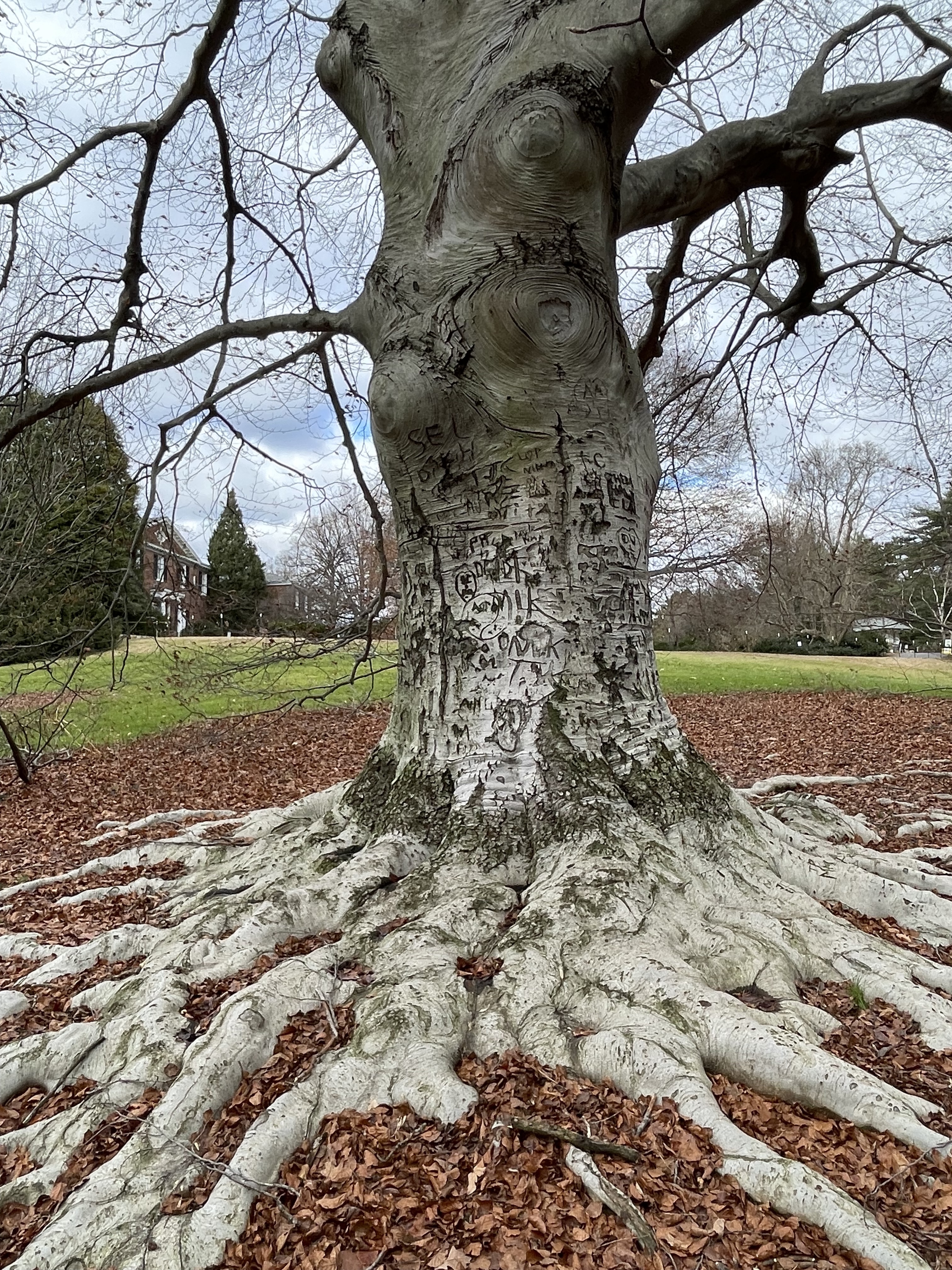
In her book about the beech, Casting Deep Shade, poet C.D. Wright tells us that the druids grew wise eating the nuts of the species. This being a mast year, I find tons of beechnuts underfoot at Wave Hill.

Some tree folks don’t like these autobiographical messages on beech bark, opining that the practice of carving disrupts the tree’s vascular system. But look at the health of this tree, probably two hundred years old. I like the engraved graffiti, because to me it proves people’s strong, abiding connection with trees.

It seemed a mere toss-up whether she said, “I love you,” or whether she said, “I love the beech-trees,” or only “I love—I love,” wrote Virginia Woolf in Night and Day

Thoreau wrote, I frequently tramped eight or ten miles through the deepest snow to keep an appointment with a beech-tree, or a yellow birch, or an old acquaintance among the pines.
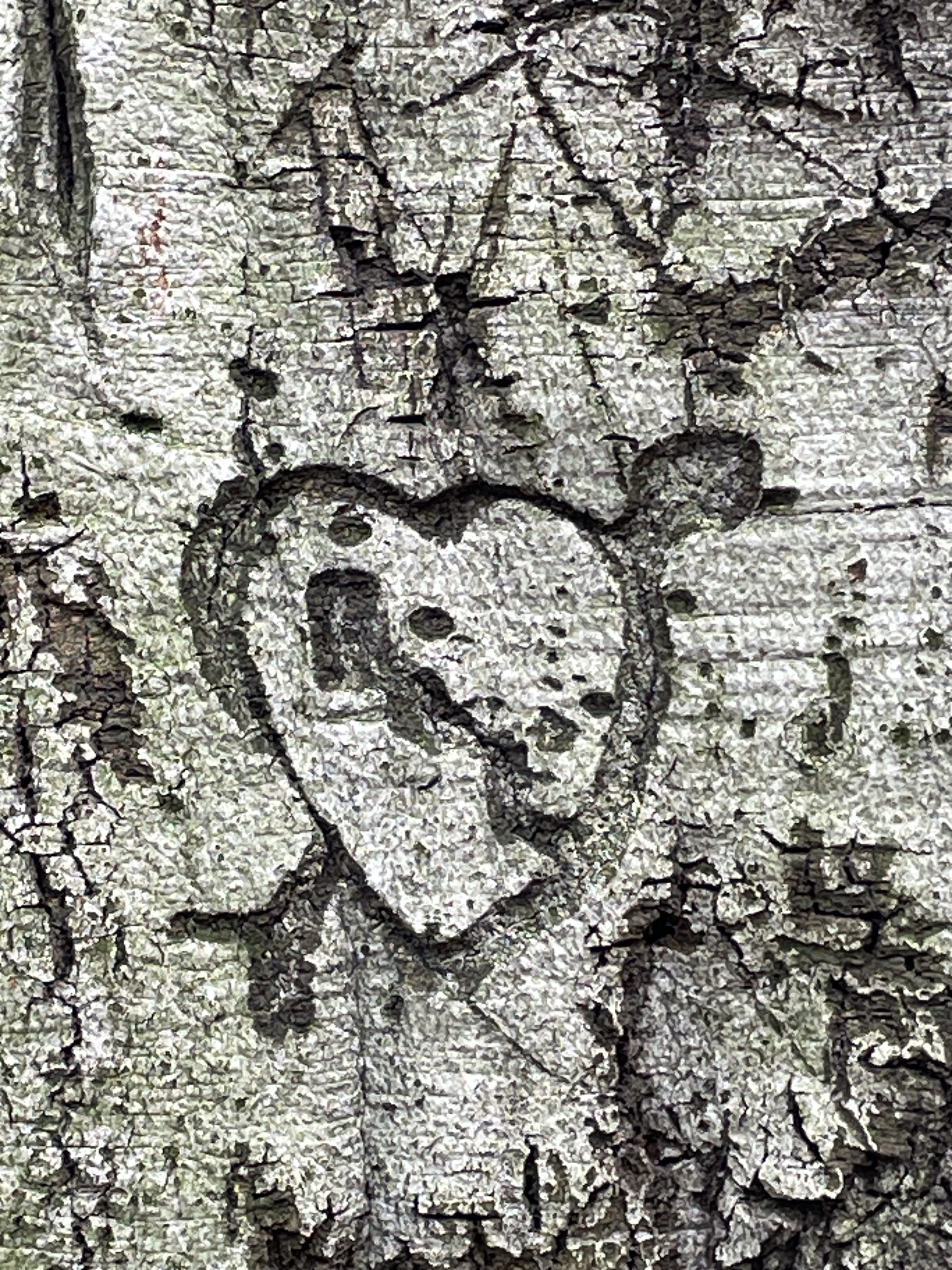
Love is like a tree, wrote Victor Hugo. It grows of its own accord, it puts down deep roots into our whole being. I like to think of some lost soul tramping miles through a forest, too shy to unburden himself to the person he cares for, and surreptitiously taking switchblade out of pocket to pronounce, indelibly, the sentiment I love—I love.
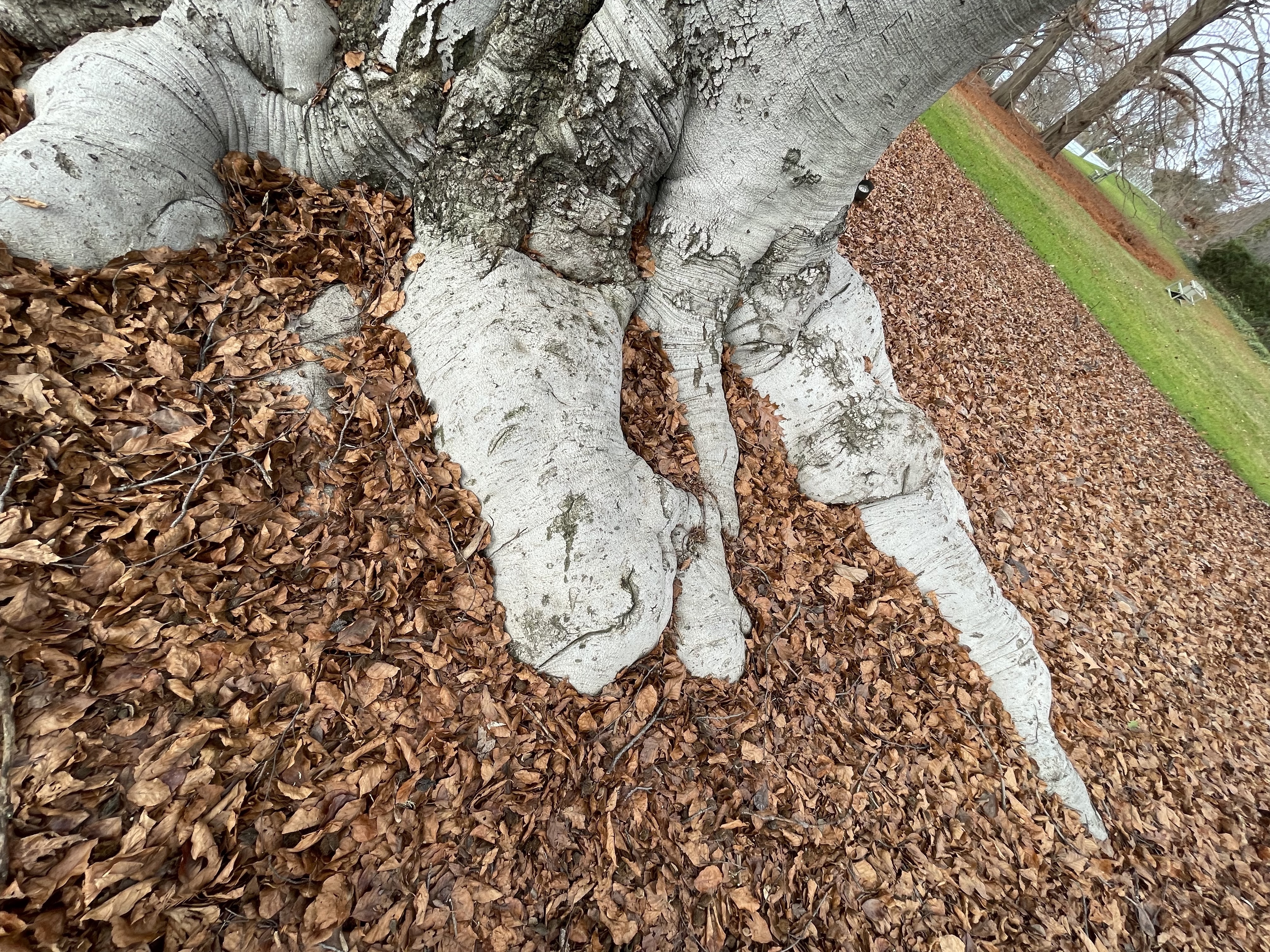
Herman Hesse wrote, When we have learned how to listen to trees, then the brevity and the quickness and the childlike hastiness of our thoughts achieve an incomparable joy.

We leave the estate.

Passing by more beauty as we go.
Wind up at a favorite deli only a few blocks away for some sustenance after our poetic excursion —somewhat less poetically, with one of the best sandwiches in New York City. This pastrami might be historic. Even beautiful, if you consider its taste in your mouth.

Almost historic, almost as beautiful as the landscapes of Wave Hill.

2 Comments

Filed under Jean Zimmerman

There are many great trees in New York City.

Yes, true. But what about the Great Trees of New York City? This is the brainchild of New York City Parks, which is reviving a project that was last completed in the 1985 with the goal of identifying the most iconic trees in all the five boroughs. Ordinary citizens nominate exceptional trees, as many as they want, as defined by their historic, botanical and cultural significance.

Having been fortunate enough to be appointed a judge for 2023’s Great Tree Search, I am excited to start off on some new adventures. My assigned beat is the Bronx, a great place whose eclectic neighborhoods stretch all the way from the swellegant precincts of Riverdale to the famously underserved South Bronx. It’s also a place I’ve spent considerable time as a consultant on tree preservation for NYC.

This time I go some places I’ve never been before, and discover a fantastic meshing of arboriculture and history. I enlist Gil as a driver, because it’s hard to drive in New York City traffic and spot trees at the same time, even gigantic trees. We have a spreadsheet to guide us that cites peoples’ nominations as well as some of their comments about why a particular specimen is worthy of the distinction.

The first entry on our list is quite civilized. A ginkgo on a small street abutting Webster Avenue.

Ginkgo biloba dates back 270 million years, and was thought to be extinct until it was rediscovered by a German scientist in late 1600s Japan. A group of Chinese Buddhist monks made it their mission to save and cultivate the species.

It is one of the few trees useful for food foraging in this urban jungle. Yes, the fruits are slimy, smelly. But each one holds a nut at its core (actually a seed) that is sold in Korea, Japan and China as a “silver apricot nut.” They are usually roasted prior to eating and used in desserts, soups and with meat. Each fall you’ll see many people in the City gathering this ample harvest. 

Will I really have to choose among these trees? I’m already asking myself – and I’ve only seen one so far! But let’s continue.

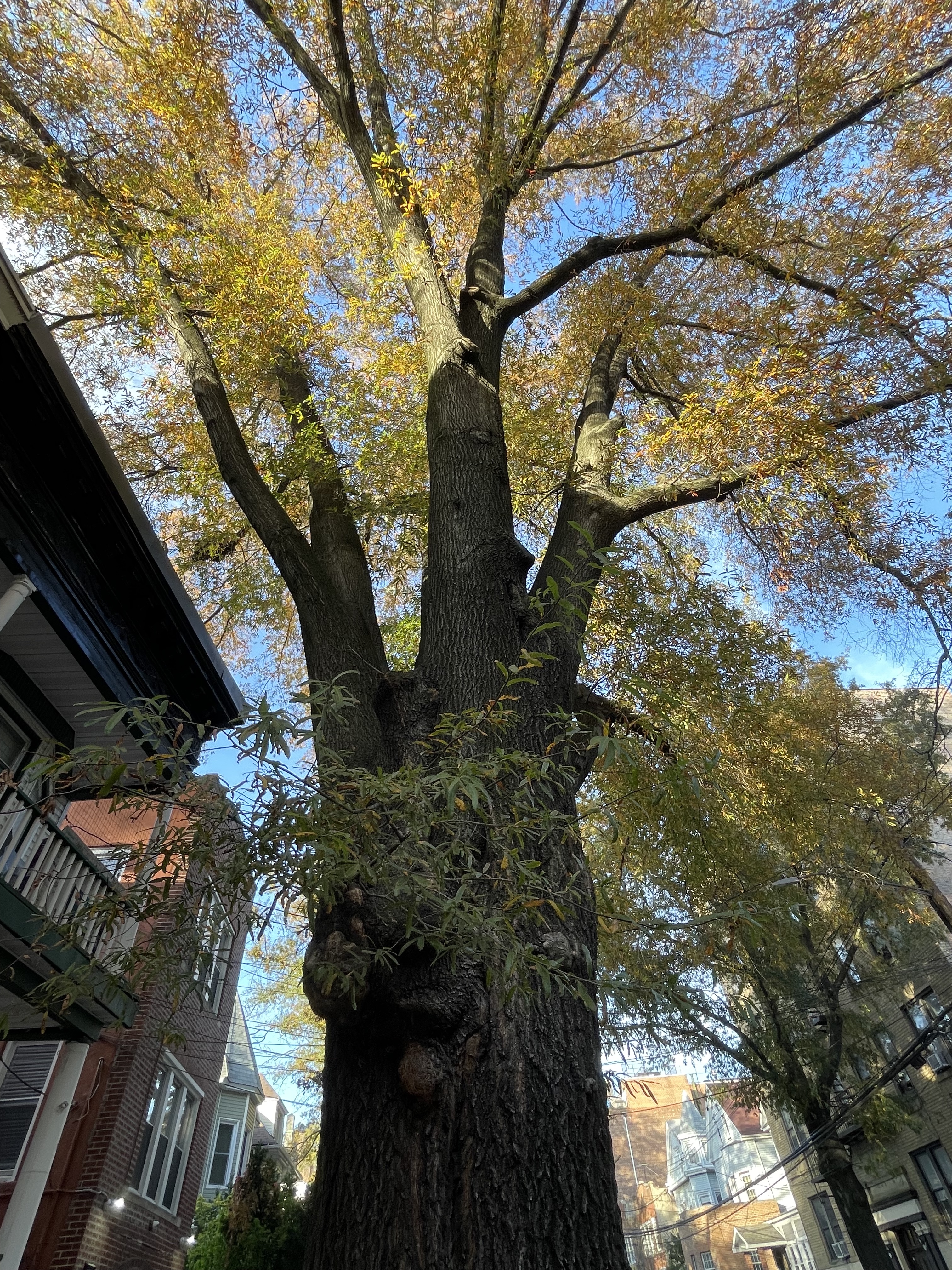
We prowl along to little Perry Avenue in the Bronx and discover a gargantuan willow oak.

What on earth is it doing in this quiet backwater?

Among other things, towering over the houses with health-giving shade, creating a beautiful fall carpet of leaves, and offering shelter for squirrels with a major nest. Oh yes, and uncomplainingly eating carbon and pouring out oxygen for us slackers to breathe.

We find another nominee on a peaceful little street, Thierot Avenue.

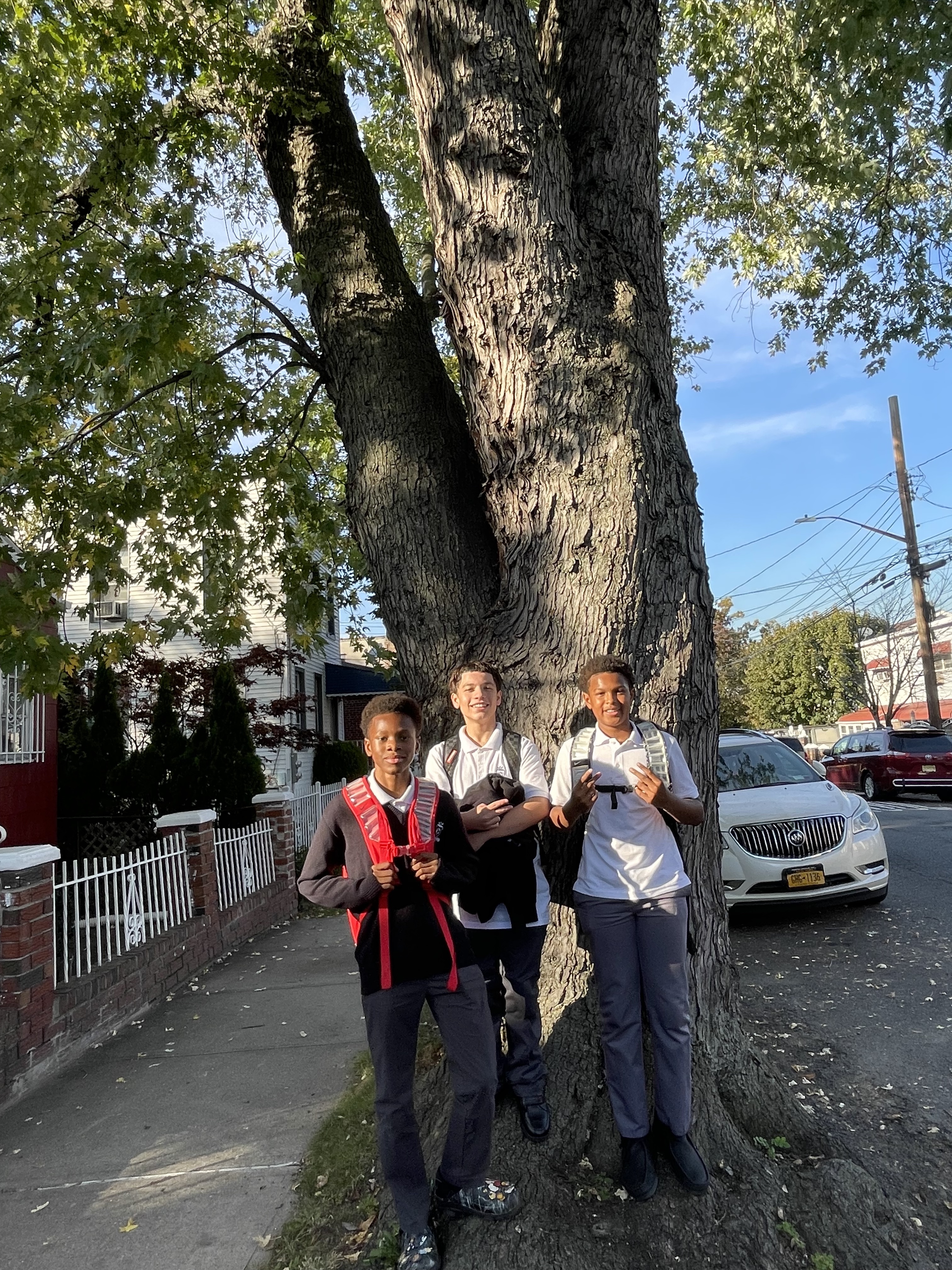
A silver maple. Now, these trees get a bad rap among urban foresters. They’re brittle, they rain down branches, yada yada. But look at this beauty. “It is the LARGEST TREE in the community,” reads the comment on the spreadsheet. “Could be a hundred years old.”

Huge (of course), three stems, fantastic shaggy bark, spreading her roots all over the place as is her right. And a perfect place for posing schoolkids. Who shout “Save the Trees!” over their shoulders as they scamper away.

We venture to Corona Park, home to several potential Great Trees, all of them amazing. First, a majestic American elm at the corner entrance.

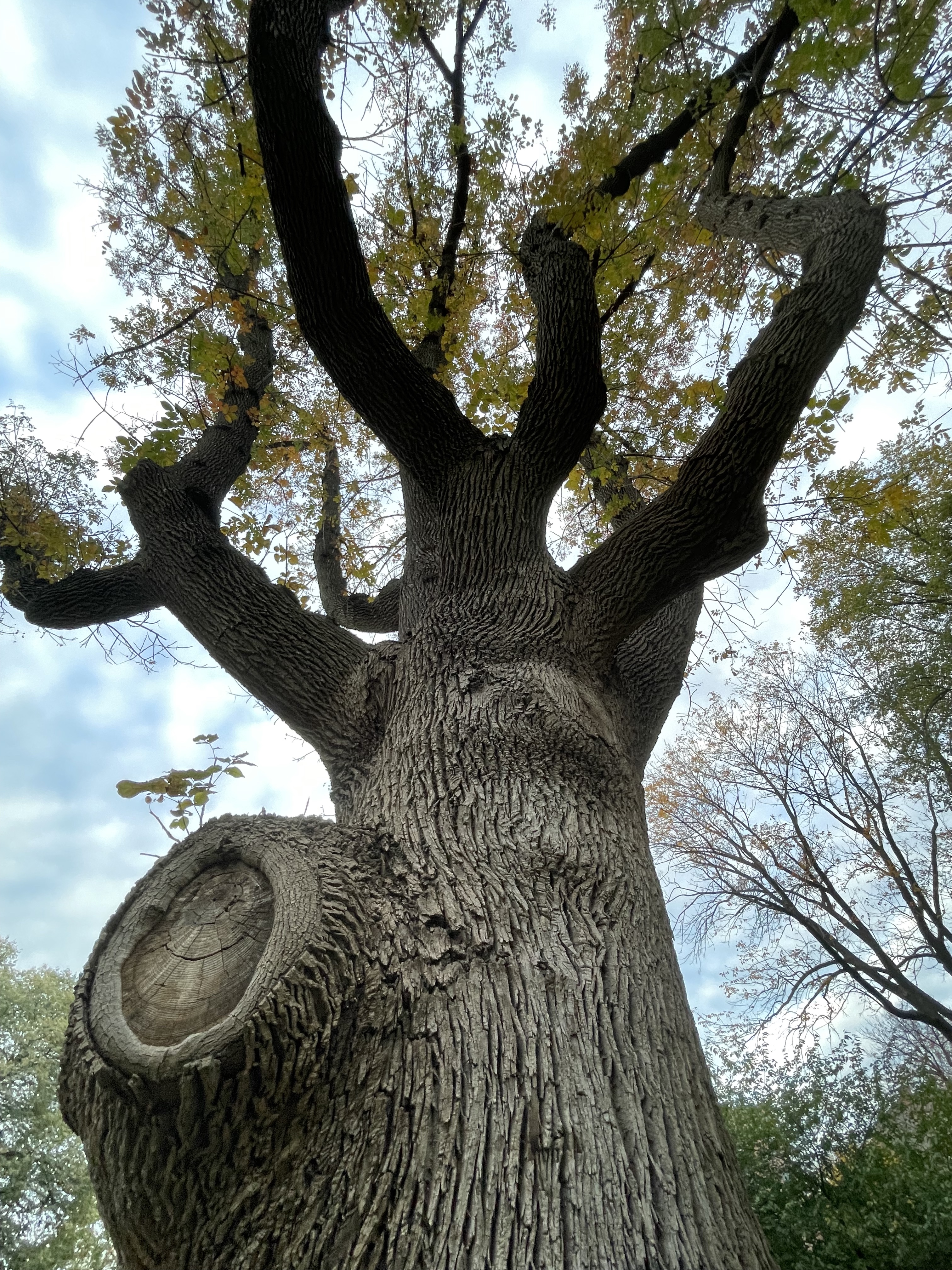
A photo really cannot do her justice. You have to mosey underneath those sprawling branches, touch the bark. Gaze overhead at the sky through her crown.

Perhaps the most beautiful tree I’ve ever seen. (And I’ve seen a few, so maybe just the most beautiful of the day. So far.) Then, we go elsewhere in the same park in quest of two hefty ashes that grow across a path from each other, seemingly competing for the Venus of New York prize. One is a marvel, yes. “This majestic Green Ash with a trunk size of 54″ is a gem and sits in the center of the pathway along passive lawn areas and rolling hills.”

To locate the tree I ask some folks hanging out with their kids in the nearby playground. They do not speak English, so their seven year old translates as they gesture down the way: “Big tree down there, take a turn to the right and you can’t miss it!” An understatement.

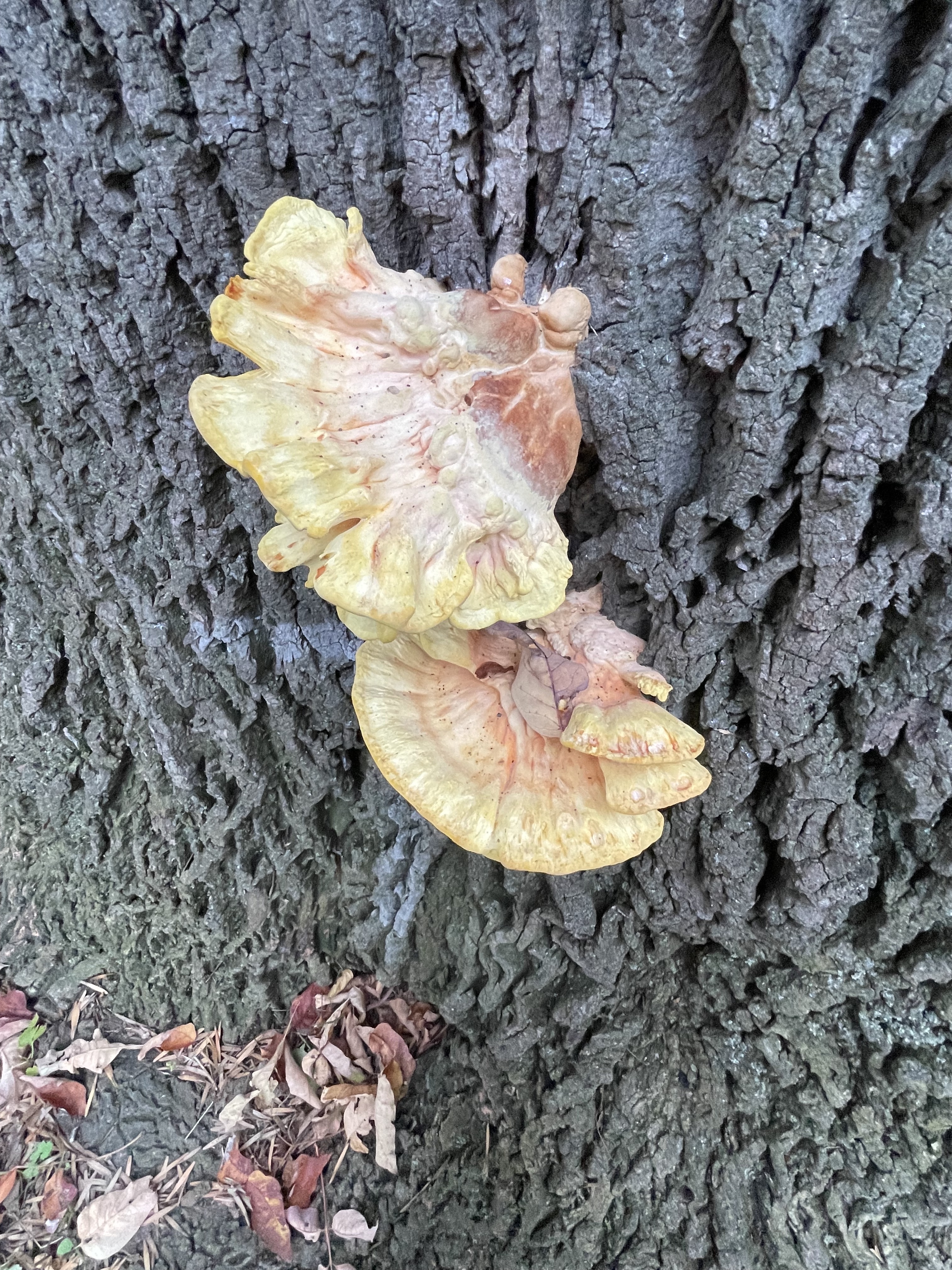
Even more impressive, the ash nearby. “Thickest tree in the Bronx, probably NYC too.”

Don’t you mind the fruiting bodies at the base, this one is clearly a survivor.

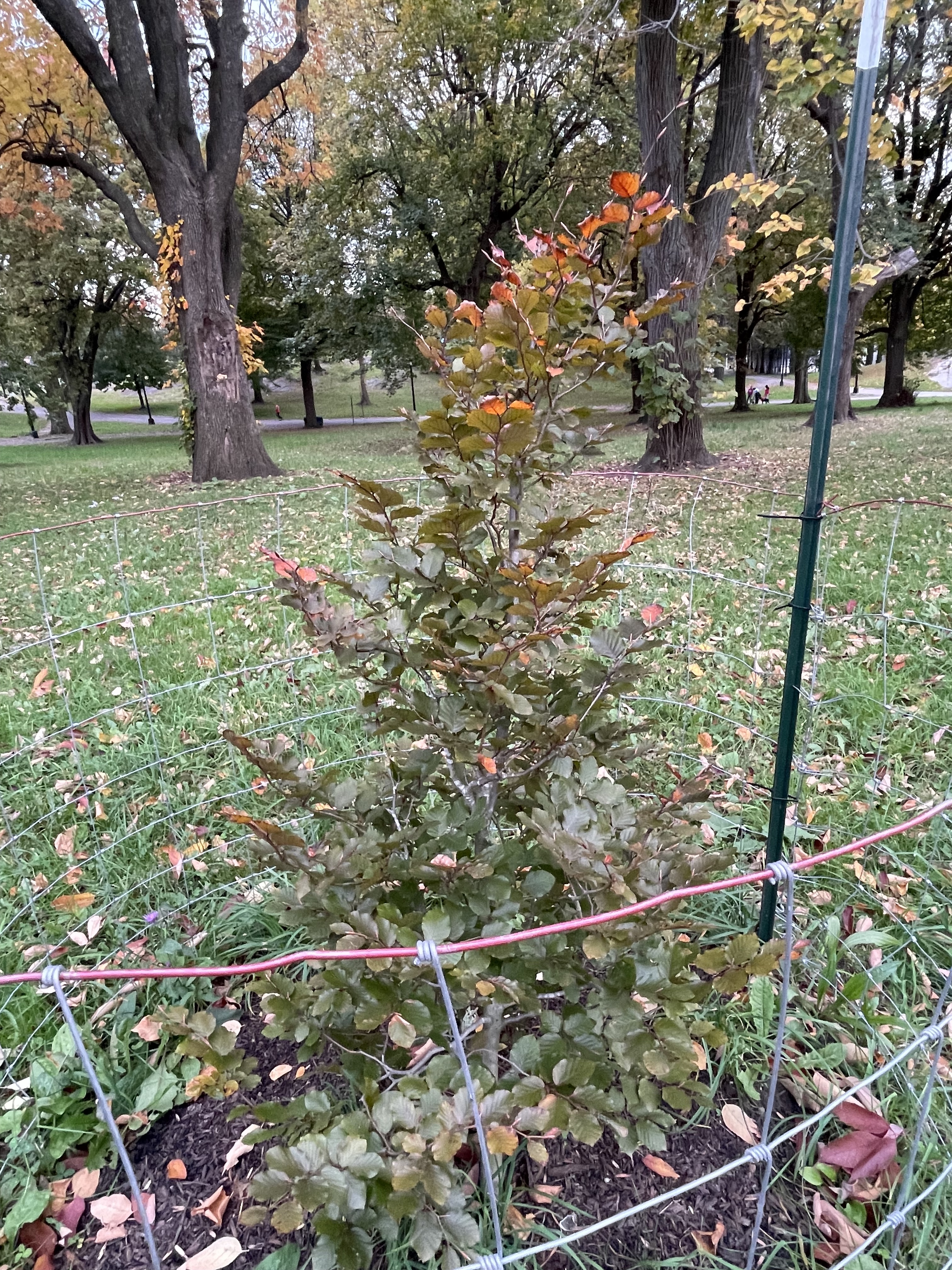
Wandering out of the park at as the dusk grows all around us I notice a planting that will ensure the health of this urban forest for the future, a baby beech.

Since we’re making these adventures at the end of the workday, we’re lucky enough to visit all these sites at the magic hour, just as the sun is getting ready to set. So we arrive at a spot we’ve heard about but never spent a lot of time, Pelham Bay Park.

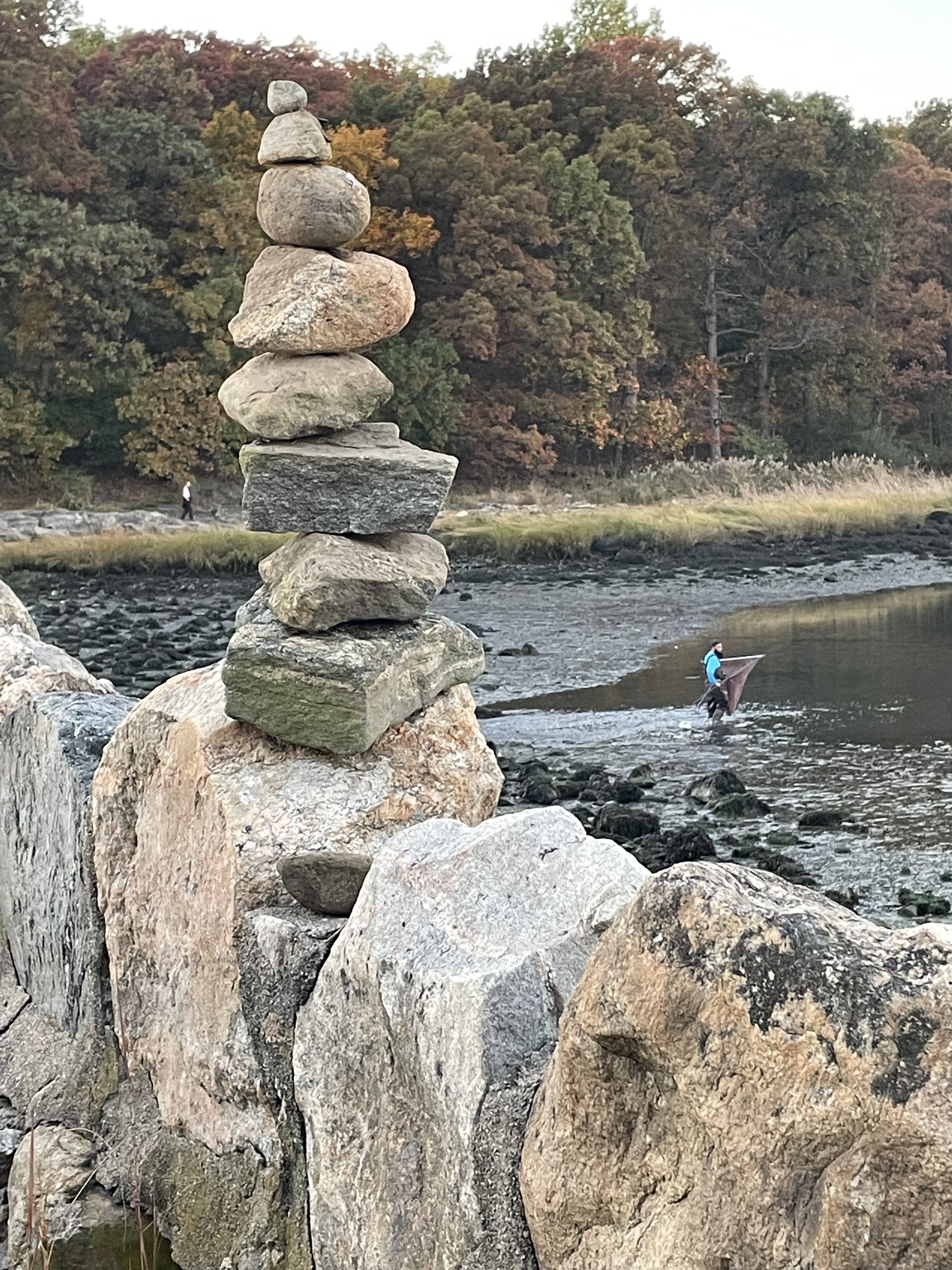
We take our nightfall hike on a trail around Hunter Island, 166 acres of wilderness in the heart of the Bronx, right on the Long Island Sound. The person who nominated a post oak here wrote a lengthy treatise on the specimen’s history, saying, in part: “This grove of post oaks dates back to the 1760s. Post Oak is native but rare in NYC. This beautiful specimen is growing right out of bedrock that includes gneiss with stunning seams of quartz, and is right on the Sound. This tree projects the grit and resilience for which the city is renowned.”

Of course, that more than whets my appetite to find this spectacular tree. But it’s not easy. Entering the park, we find massive white oaks and scarlet oaks. This is a mast year, and all around the ground is carpeted with acorns that crunch underfoot.

A trail takes us through groves of sweet birch.

We see almost no one.

I wade ankle deep across a mossy inlet, into the darkening woods under a rising full moon.

It gets dimmer, dimmer.

Wither the post oak? It’s a member of the white oak family, and all the trees in these woods have interbred for so long that I think any of them could be the oak in question. Though I cannot find the exact leaf, with its lobes that remind some of a Maltese cross, there are plenty of similar leaves.

We’ll have to come back again, perhaps by the light of day.

On another afternoon, back in the city proper, we locate a venerable black tupelo.

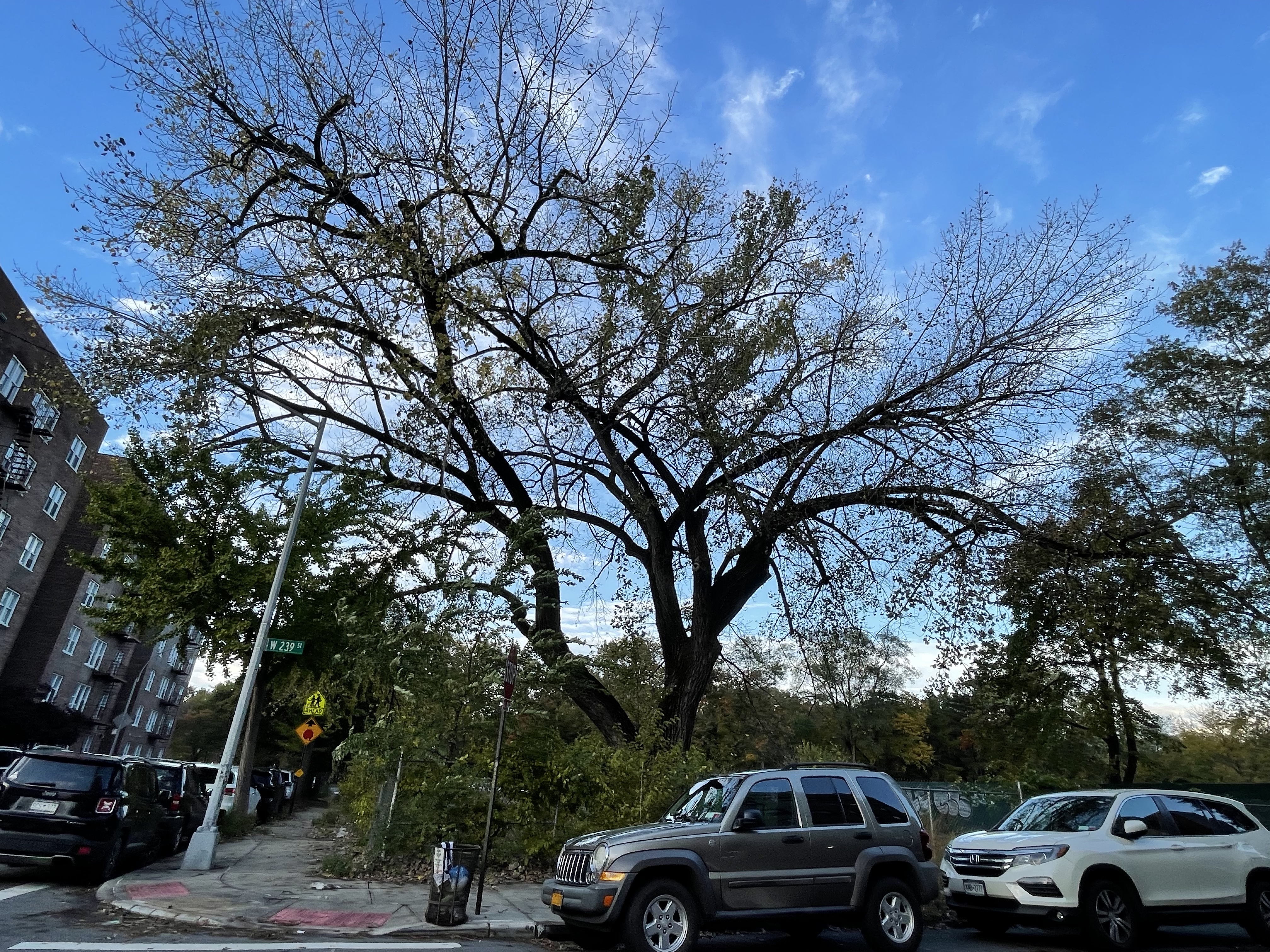
“At the edge of the forested land on Mosholu Parkway North, facing the apartment buildings.” Sounds mysterious, and I’m afraid we will not find it, especially as the gloaming comes onWe cadge a parking space and I walk directly to the tree as by a homing device.

I think of a couple of lines by poet Jane Hirshfield: “I would like not minding, whatever travels my heart. To follow it all the way into leaf-form, bark-furl, root-touch, and then keep walking, unimaginably further.”

We discover a cottonwood just off Van Cortland Park South in an old schoolyard. It towers over the neighborhood. Once, apparently, during the Revolutionary War, this tree was used for hanging traitors.”

I check the spreadsheet. “Cottonwood trees typically grow in riparian areas, which at first seems odd, given its current location, but makes sense once you realize that the Tibbets Brook runs underneath.” I’ve heard that Tibbetts Brook is soon to be daylighted, and I wonder what will happen to the cottonwood when that happens. Will they retain it and will it continue to provide shade and beauty of local residents?

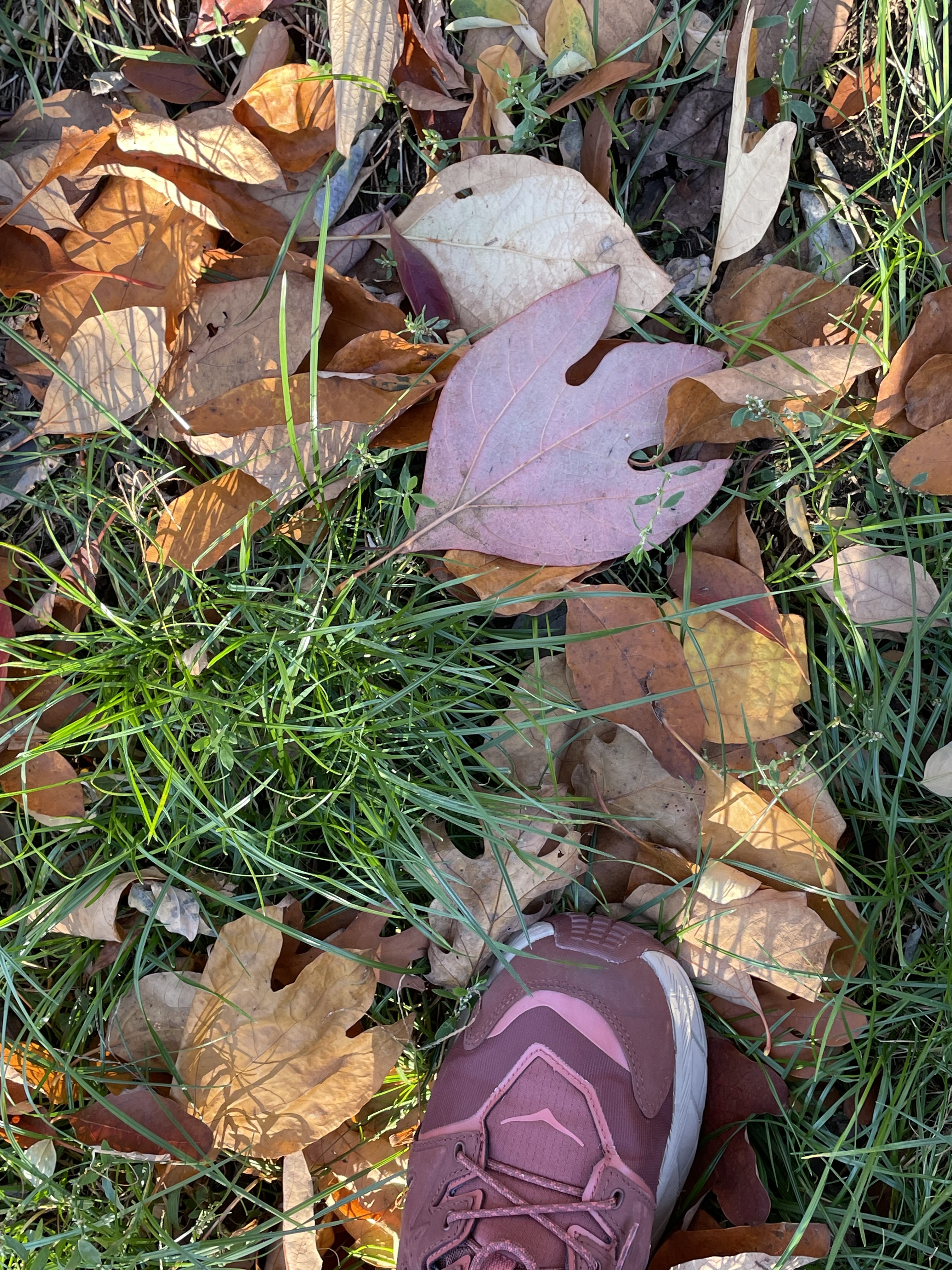
Moshulu Parkway and Gun Hill Road are sites for some other old-old trees that also date back to the Revolution. We visit “the oldest sassafras tree in the Bronx, an amazing holdover from when the land was converted from farm to parkland.”

It is said to be larger than the state champion in Green-Wood Cemetery. And that’s saying something. “However, its true age will never be known because it is mostly hollow.”

No matter, it is magnificent. Nearby, a white oak stands tall above a wall on Gun Hill Road.

Beneath the tree’s enormous canopy runs the Old Aqueduct Trail, another landmark, an engineering marvel from from the time when clean water was piped in from the Croton Reservoir in northern Westchester County. “Assuming was planted along Gun Hill as historical marker.” Makes total sense.

All Gil can say for hours afterward is: That white oak. That white oak was amazing. The wonders of this city’s urban forest are manifold. I’m starting to dream about Bronx trees. We’ve been going out to find them every day.

Now we venture to Ewen Park. I’ve never heard of the place, but I know there is a nominated cherry tree here “south of the dog run.” Tramping all over and unable to find it, we see some of the substantial rock formations that never got blasted away when much of New York City was originally leveled for development.

We ask a dog walker to direct us.

Poseidon, a proud Cane Corso, would not be caught dead in a dog run. But Poseidon’s helpful person directs us down the hill and up the “unmarked trail” to the spot. She has me at “unmarked trail,” my favorite kind of path. We locate the huge old cherry.

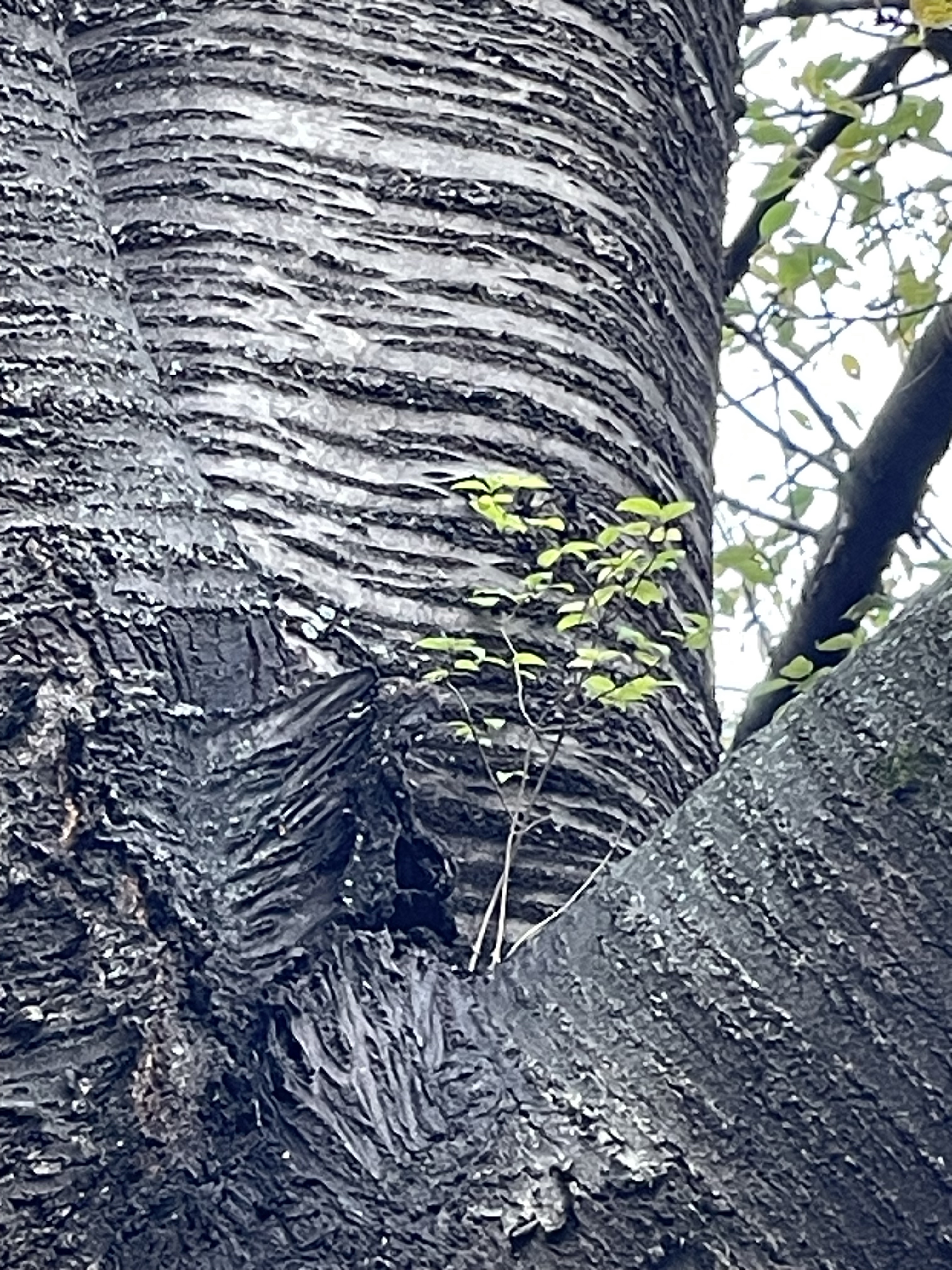
“This is one of the biggest, oldest trees in the park,” reads the nomination. “It provides habitat and food for our migratory and resident birds.” Its once-delicate lenticels have gone crusty with age.

It nestles a young’un in its crook.

On the way out of the park, I find a microforest of sweetgums. What’s not to love about a sweetgum? 

Their prickly seedballs are a marvel of the season.

Two conjoined trunks seemed to be pouring their hearts out.

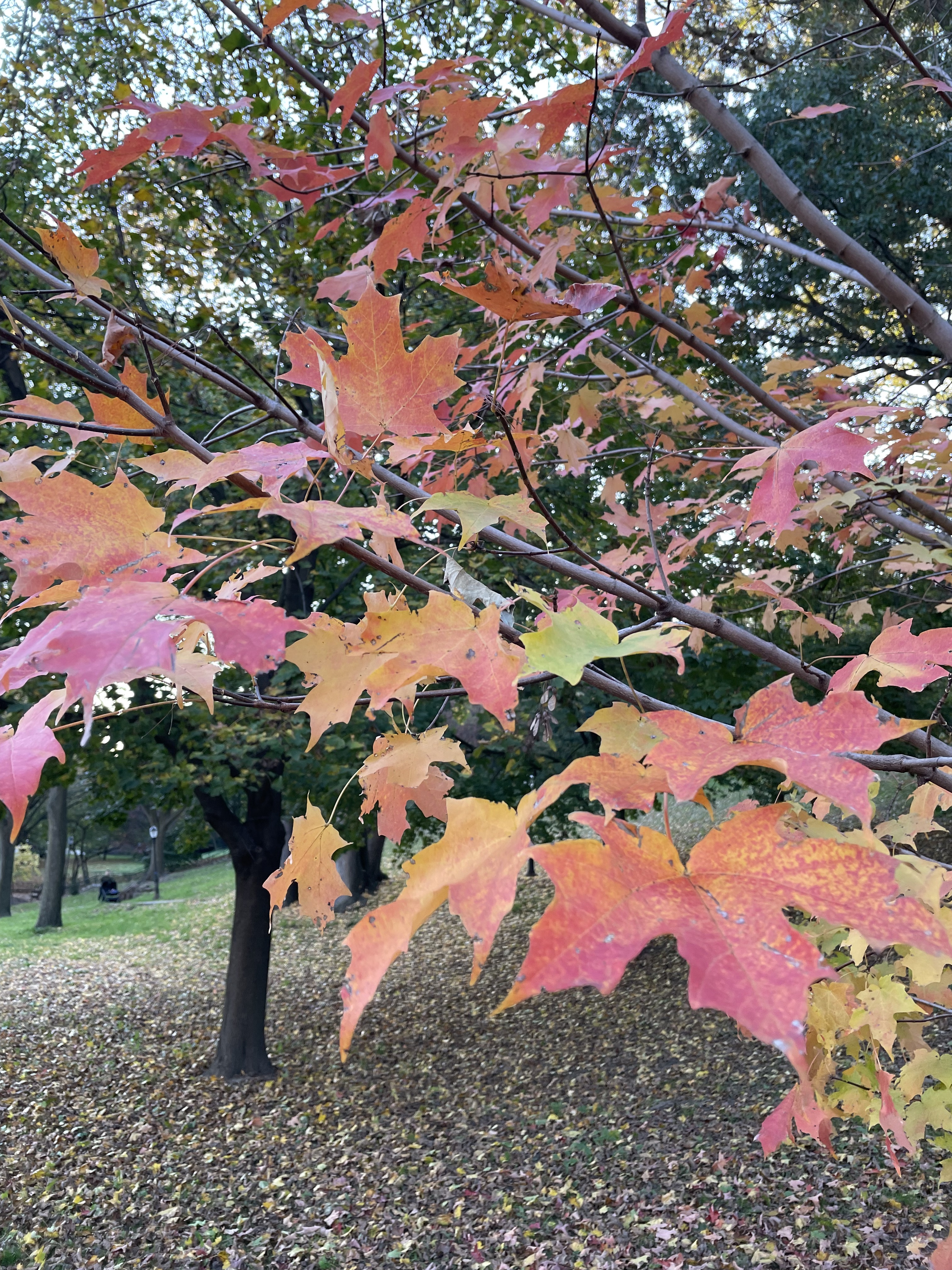
I admire a small maple, sporting the usual colorful frou frou of the season. Watch me turn colors! I’m a maple! Sure, m’am, but you clearly haven’t met the other contenders, the sassafras or the black tupelo.

Everywhere I go I stumble upon fantastic trees that were not nominated as Great Trees. Yes, the pin oak in Crotona is spectacular. The zelkovas on Webster, definitely worth noting officially. But what about this particular sweetgum?

Ewen Park, which I’d never before heard of, dates back to when Frederick Van Cortland owned the land. It has a long stone staircase that serves as a conduit between the neighborhoods of Kingsbridge and Riverdale. At the base of the steps I find a marker that establishes the place’s bona fides. It states the number of stairs. In Latin.

History is everywhere. You can read the past  in the trunks and branches, leaves and fruits of the trees in the Bronx. Some of them Great Trees. But also, trees that might not necessarily be identified as such. Not necessarily winners, but trees that are nonetheless special.

And that is pretty great.

3 Comments

Filed under Jean Zimmerman

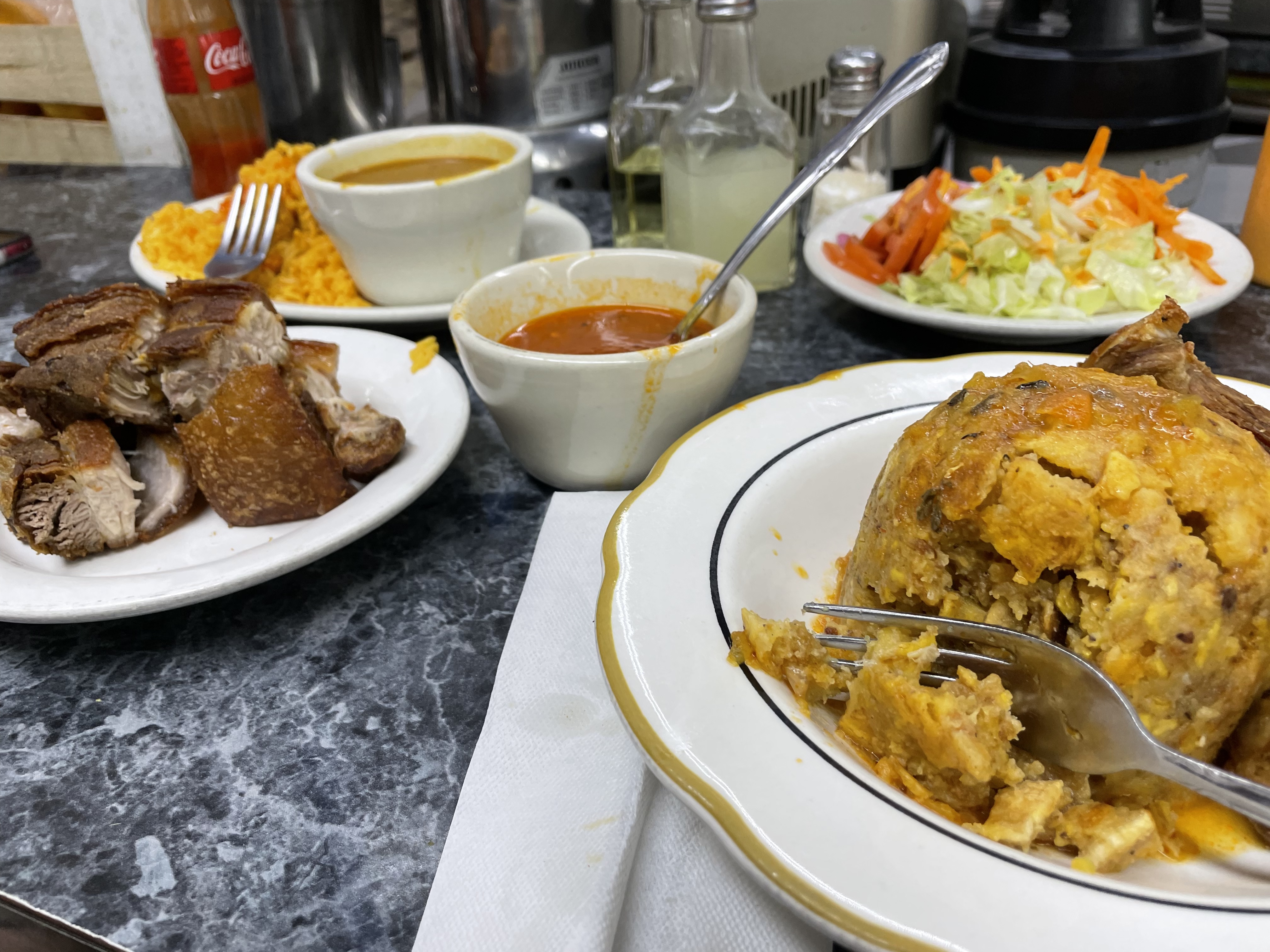
The finest mofongo in New York City

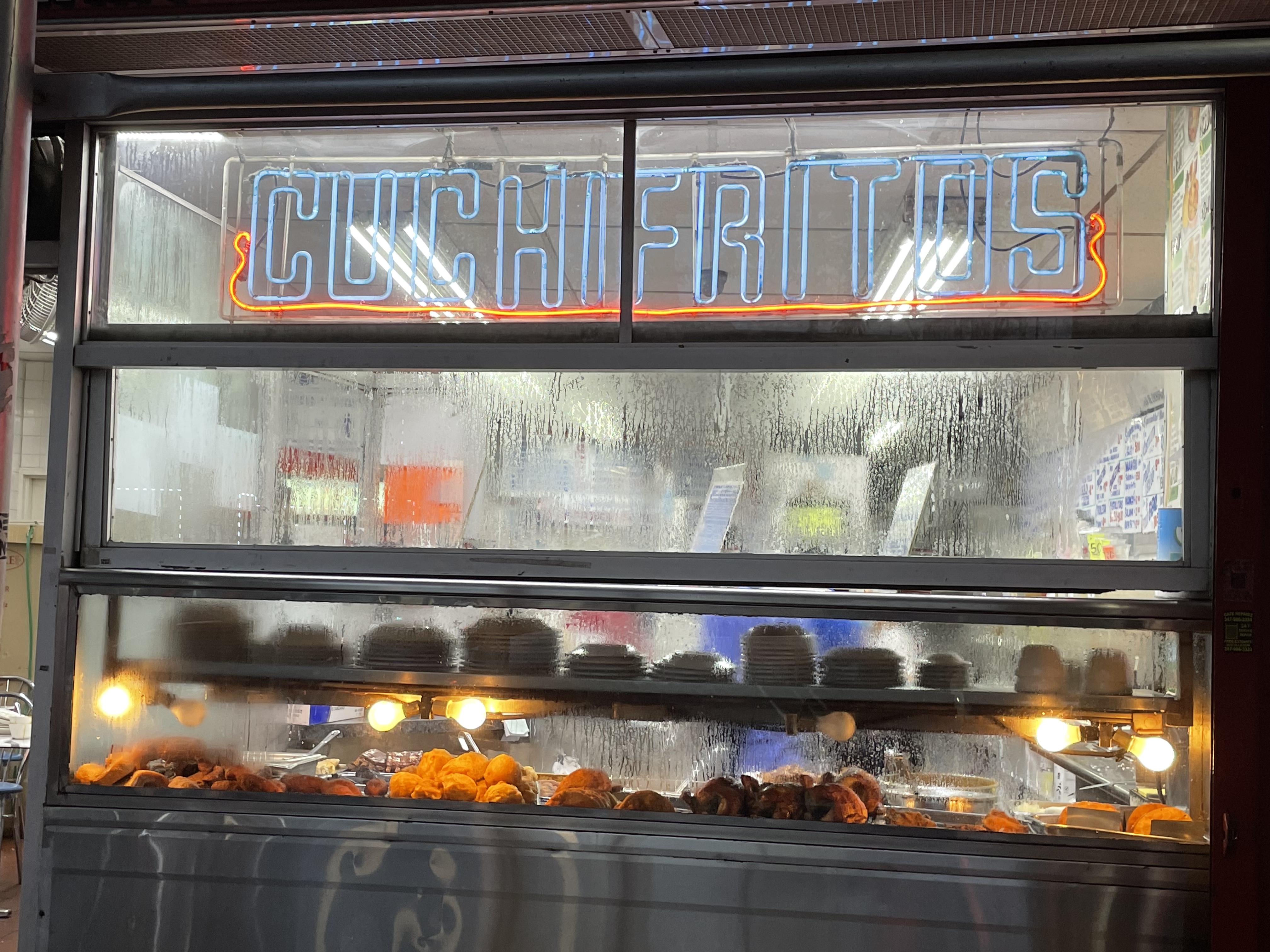
would be hard to identify, there is so much fine mofongo in New York. But I have a hunch it might be prepared in the unassuming kitchen of 188 Bakery Cuchifritos, on 188 Street, just off of Grand Concourse in the Bronx. 

I worked around the corner for six months last year protecting trees, meeting some incredible people along the way.

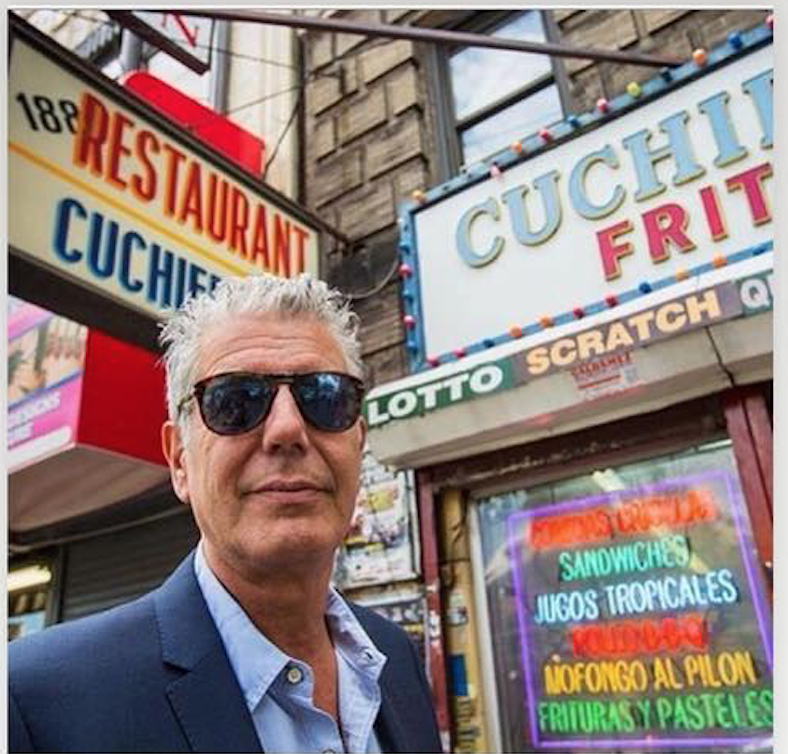
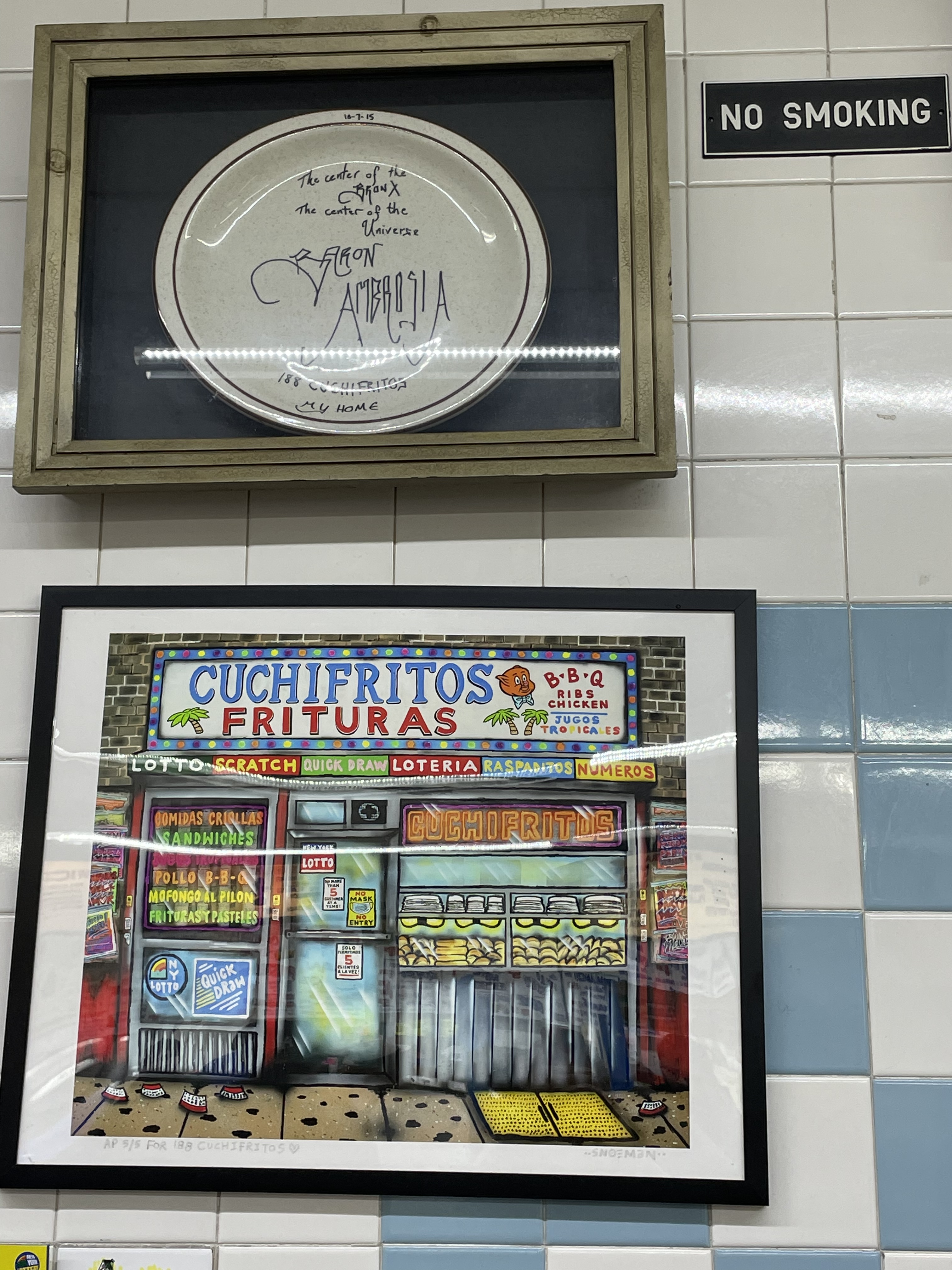
Anthony Bourdain agreed with me, chowing down here in Parts Unknown, and his signed glossy adorns one wall of the joint, where patrons customarily ignore it and go on with their ordering and chewing.

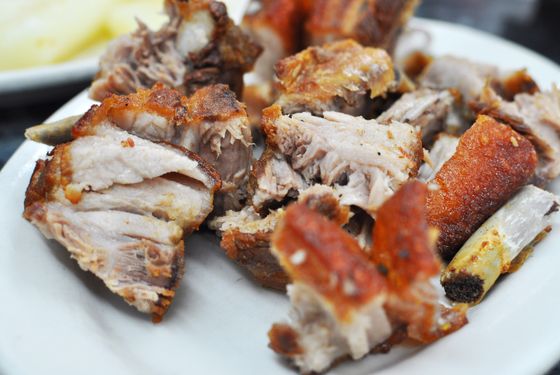
The specialty is Puerto Rican/Latin cuisine. The crunchy pork chicharrons Dominicano are out of this world, a nice challenge to your Lipitor. It’s a boomerang of a bone, cleaver-chopped and served in bite-size wedges of crispy skin, meat and fat.

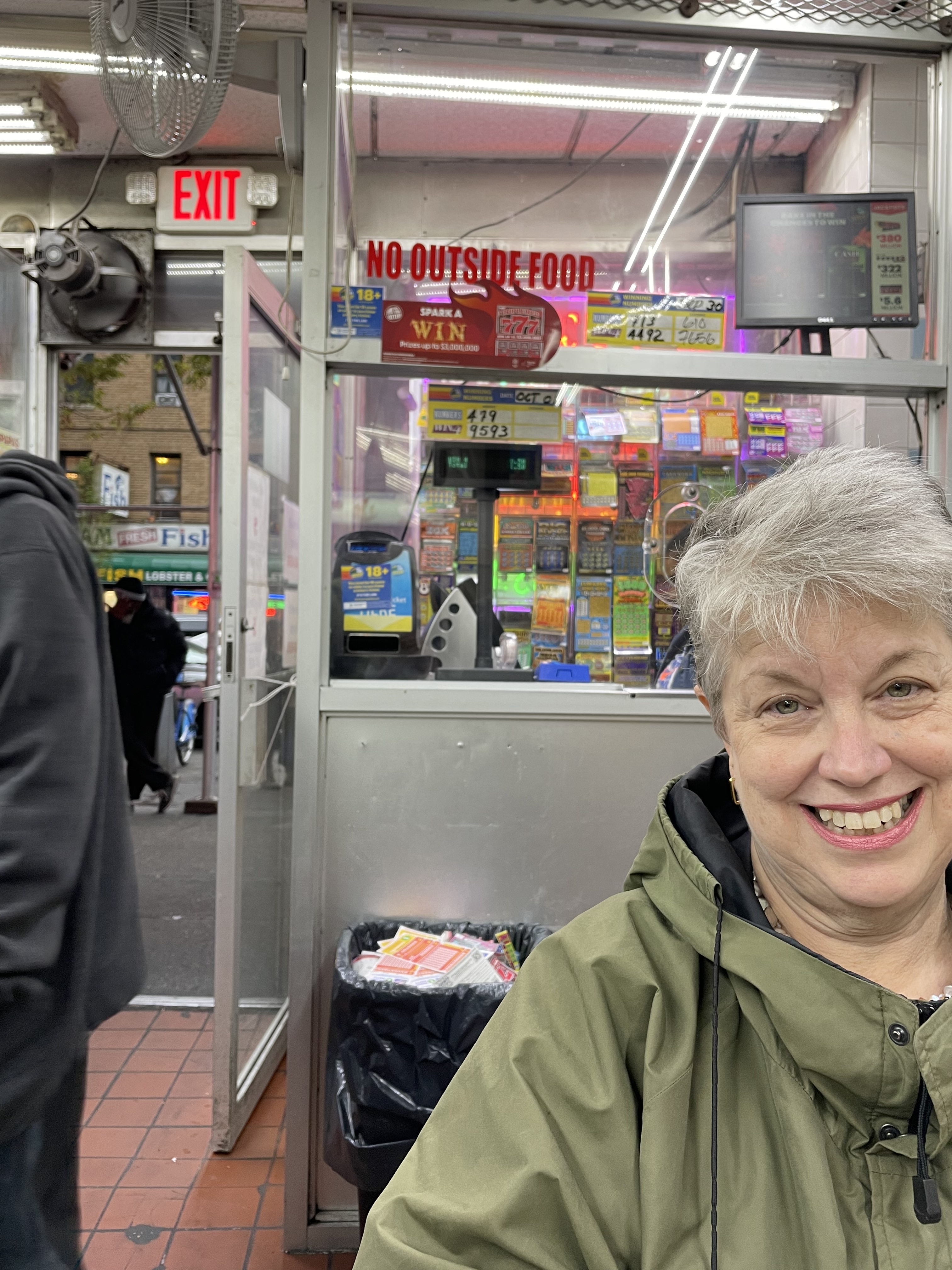
The place has other distinctions. It is as far as I have seen the only restaurant in town with a dedicated Lotto booth on the premises. A busy one, too. Made a former New Yorker happy by taking her here to dinner.

You can fill your stomach here every day of the year, from 9 am to 11 pm. It has been in business for 30 years, and even has a Facebook page. Whether you go for breakfast or dinner it is jammed, a line for takeout snaking through the door. The counter people efficiently juggle phone orders and packing up meals.

I tend to like any handwritten sign, so the menu board at 188 Cuchifritos is a delight.

Customers cut across a wide swathe of the population.

Usually there is a fairly high proportion of street people wandering in and hoping for a handout, alongside the paying customers. The common denominator here is a craving for sustenance.

The mofongo al pilon – a plantain dish derived from Spanish, Taino and West African cuisines–is stuffed with pork cracklings and served with a tomato-and-garlic infused gravy. The cook mashes starchy platanos in a classic wooden mortar and pestle and it comes to the table as a dome that you explode with your fork. One foodie reviewer described the taste with the buzz-word umami, and I think that as pretentious as that is, it’s not far off.

While waiting for the mofongo to emerge from the kitchen you might study the cartoon tiles on the wall. I have translated some of them, albeit clumsily.

Married man, spoiled donkey.

Two children and a mother are three devils for the father.

The guests are happy but that’s when they leave.

Okay. I never claimed to study Spanish in school, and anyway my mouth is watering too much to make good sense of the jokes. There is also some fine artwork on display.

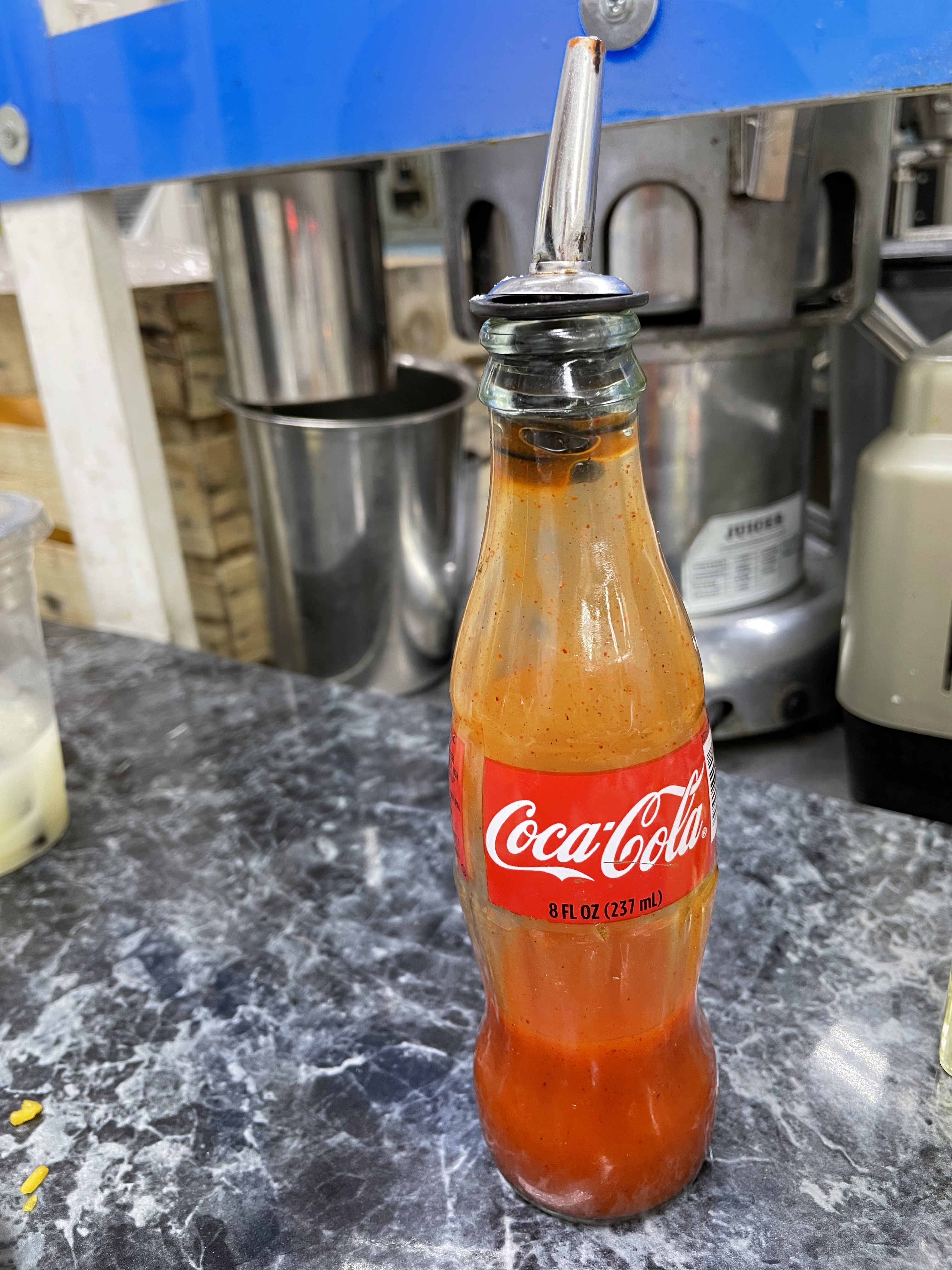
Home-made hot sauce readily available and in an awesome recycled container.

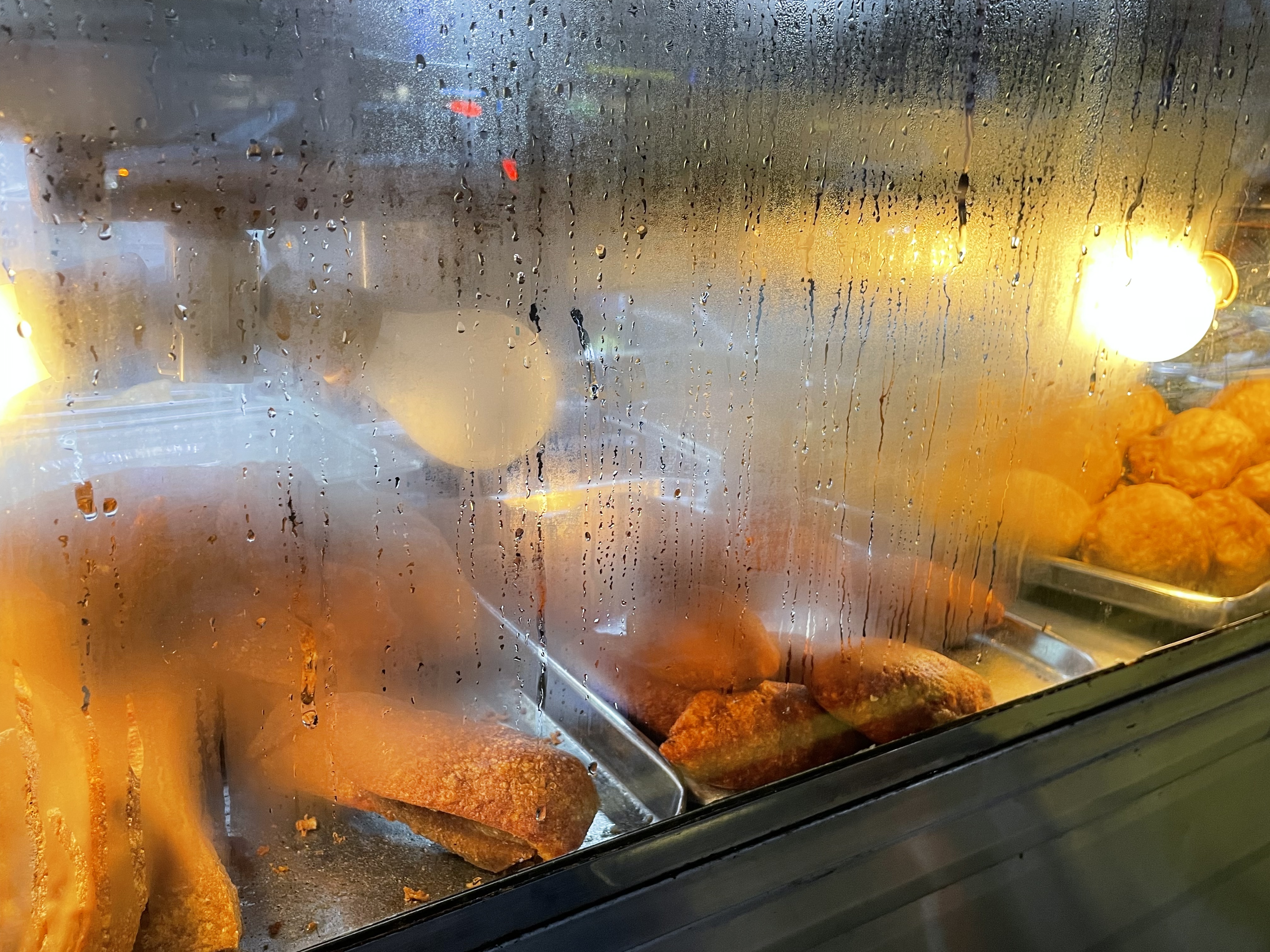
The frituras, fried snacks displayed in the window, include one I love but don’t know the name of.

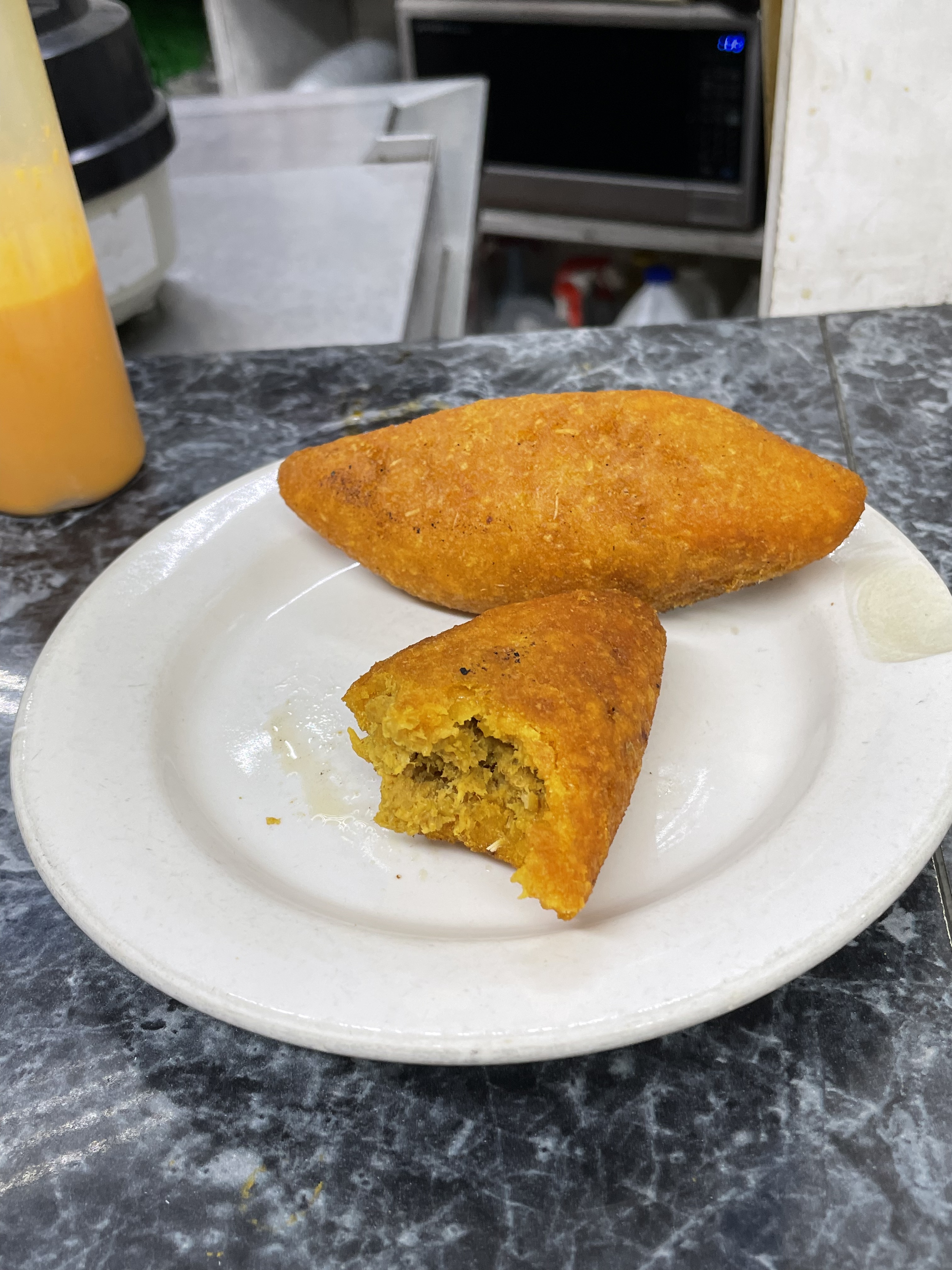
I just tell the wise waitress “the football shaped one,” indicating the oblate spheroid with hand gestures, and she knows what I mean.

I have now done research and found that it is more correctly alcapurria, a yucca fritter stuffed with picadillo, the classic Latin American blend of beef, tomatoes, and olives. I’ll try to remember that for next time.

It is possible to order pig ears, tongue, or stomach, though I haven’t done so. Yet.

I can’t decide which I like better, the counter or the five or so tiny tables. The service is always superb no matter where you sit. If you order like we do you and sit at the counter, though, you can barely fit all the plates in front of you. Yes, you can even get a salad to cut the fat if you insist. Plenty of rice and beans to take home, though of course you’ll have to eat without the cartoons for entertainment.

“I don’t know any place porkier,” was Bourdain’s summation. I would just add: when you are next in the Bronx, get lucky and go.

Leave a comment

Filed under Jean Zimmerman

Trees are more trouble than they’re worth

to some people, but others take painstaking care to preserve them.

Meet Jimmy, one of my favorite individuals at work.

His job is exclusively to build and repair tree guards on the Grand Concourse construction site. He is, he told me, officially a carpenter by trade, as far as the union is concerned. That’s an honorable and well-paid profession. But we’re lucky to have him doing what he does. He squares up the enclosures and hammers the boards together, often standing back to scrutinize them before he starts to correctly gauge the tenor of the job.

We’re chatting.

You must get tired of this, I say, referring to the orange snow fencing, a bale of which he carries around with him much of the day. It’s constantly getting ripped from the frames and he is constantly fixing it.

No, he says. I used to be. But now I covered my house with it inside and out, that’s how much I like it.

He sees himself as a bit of a comic.

What I see is a skinny, herky jerky guy who dances down the Concourse like a leprechaun, cigarette in mouth, hammer in hand, tool belt clanking, working his magic to protect the trees from harm.

It’s good you do it, I say. Otherwise the crew would knock down the trees.

No, they wouldn’t, he contradicts. They know they’re living things. I tell them that that tree there was Jesus’ original crown of thorns.

He means the honey locust – the site has a forest of them. Tree workers hate them because they get pricked so bad.

No, says Jimmy. The guys appreciate the trees. They are sweethearts. Really.

Well, shut my mouth. Sometimes I think a particular machine operator takes some sadistic joy in breaking branches with his bucket.

Still, I know that one day these tree guards will come off and the honey locusts and American elms and London planes and amur maples will once again introduce themselves to the world, and the neighborhood will be the better for it. It takes work to preserve them, but it’s well worth it.

Jimmy is a lot of things, a philosopher, a comedian, even an arborist. I told him I appreciated what he does and he told me he appreciated me appreciating what he does.

And he may possibly an actor. A producer discovered him on the job and told him he wanted him for a bit part on screen.  Then he came back. He told Jimmy they decided they wanted him for a bigger role. He was just too good to be a cameo.

That would be great, he’d get his SAG card and hobnob with hot shots. But it would be a loss for the Grand Concourse to have him no longer nurturing the tree guards, butt in mouth, a hammer in his hand.

2 Comments

Filed under Jean Zimmerman

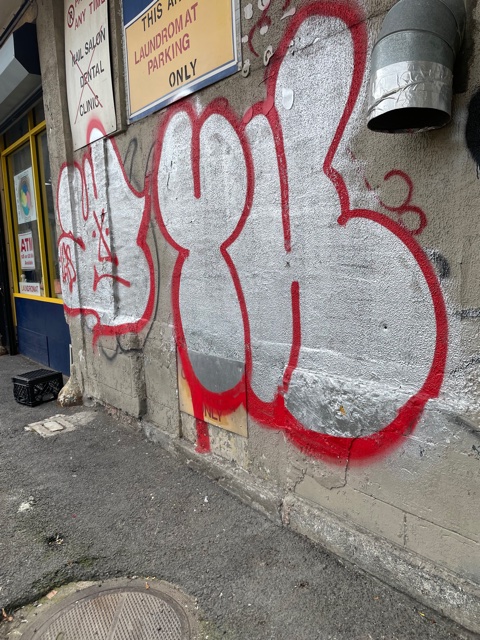
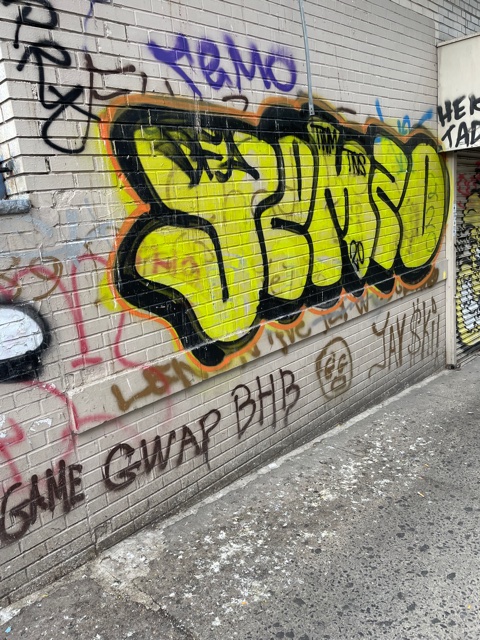
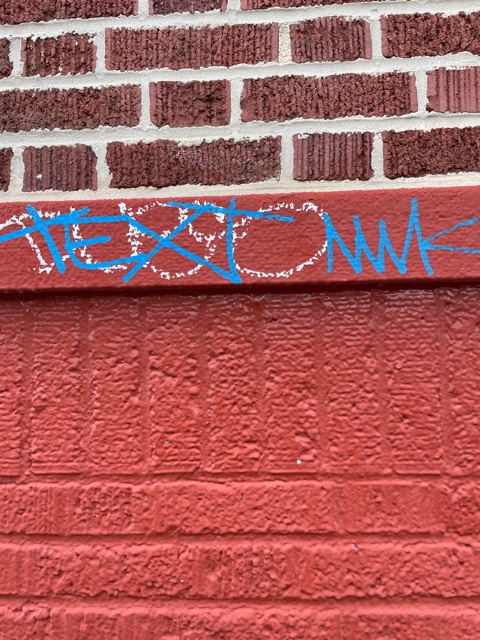
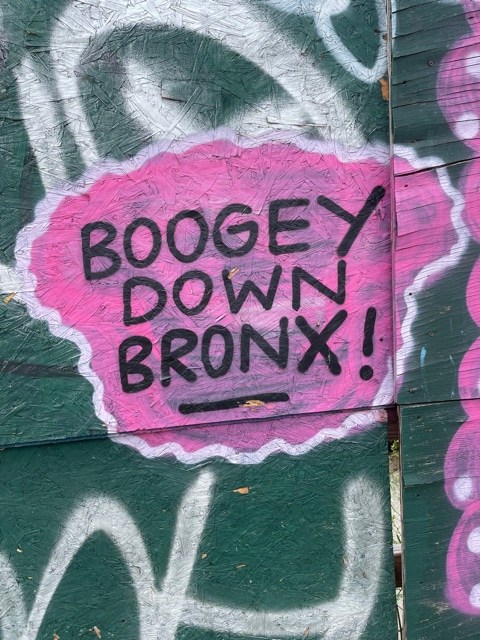
You can’t unsee the graffiti in the Bronx

once you see it. And it is all around you.

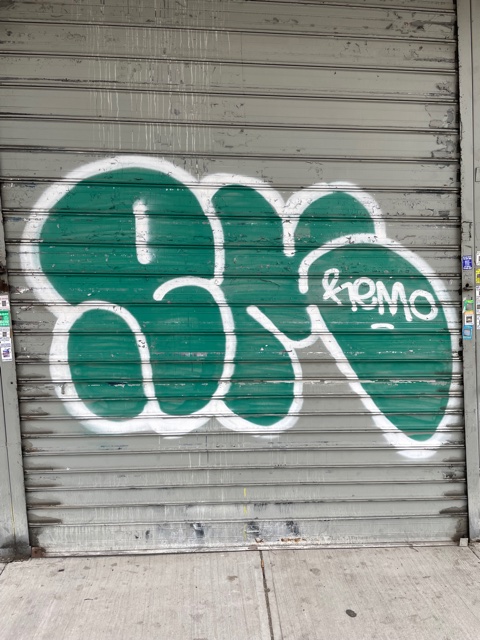
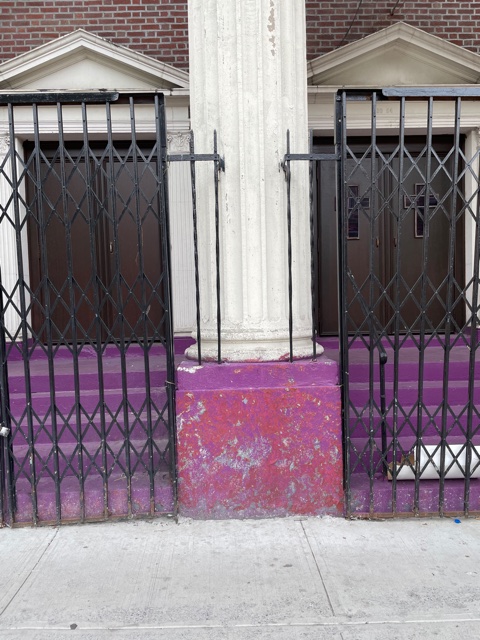
Some surfaces would seem to be left alone. Church walls, for example. Or cars. But everything else is fair game, and especially popular are store gates, the kind that get opened in the morning and pulled down at night.

Every surface is game.

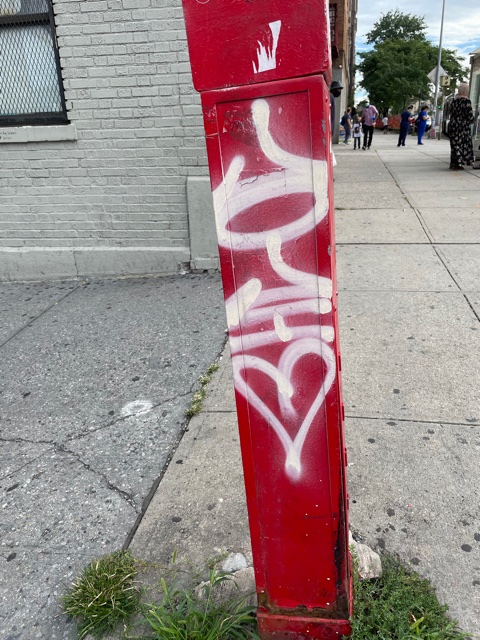
You’ll find mailboxes.

Dumpsters.

Houses.

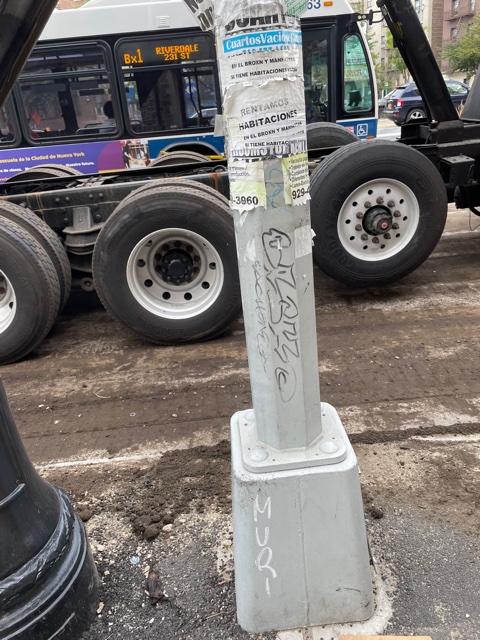
Even lightpoles.

Self expression. It’s such a powerful human urge.

A lot of these look as if they were spraypainted by the same person, but I’m sure I’m missing the subtleties.

I happen to like the metallic images.

The runic ones.

Indulge me. When I looked on the Grand Concoure in about a four block radius, I found so many striking examples.

And my favorite, I guess.

Washington Square Arch in the West Village has chronic problems with graffiti. It was tagged one night amongst general mayhem, and by the next morning they had removed the anti-cop slogans, leaving “ghost graffiti” that would only be finally removed from the porous, delicate stone  at a later date. 

In the Bronx, nothing gets removed.

You start to see color everywhere, even where it’s ungraffitied.

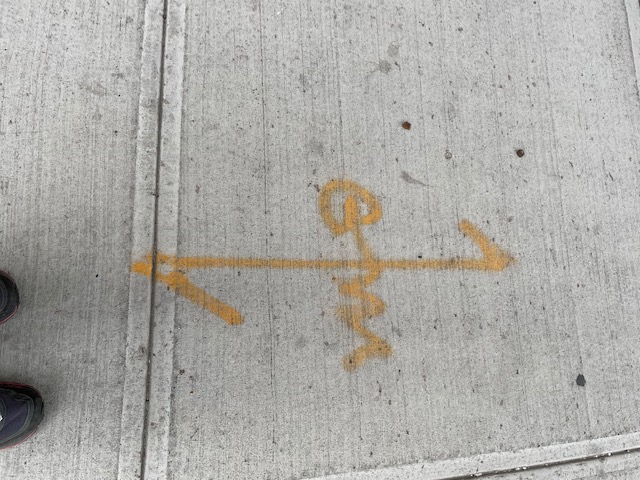
Utility markouts are  really a kind of graffit. You’ll notice them on every sidewalk. Yellow means gas. Don’t dig too near or you might get blown up. Red, electric.

Some fundamental graffiti history. A while back there was a huge warehouse called 5 Pointz in Queens – it was constructed in 1892 as a factory that built water meters — that served as the canvas for dozens of graffiti artists as well has leasing studios to artists inside.

We visited, and something amazing was that after a certain viewing period one artist would cover over the work of another artist with his own work. Just wipe it away. That was the accepted method of showing as much good stuff as could be shown. Very democratic.

I was wearing a cast on my foot at the time and I asked the artist named King Bee if he would tag it.

Fast forward and of course something so impossibly cool could not last. The owner of the structure announced that he was razing 5 Pointz to put up a residential complex, and all the artists would have to leave. He had the walls whitewashed overnight. Even a plea from Banksy could not save the brilliant assortment of aerosol art. The developer got payback – a judge made him pay 6.7 million in damages to 21 artists.

The Royal “King Bee,” born Alfredo Bennett the guy who decorated my cast, grew up in this part of the Bronx and honed his aerosol chops here, in fact.  His way of “giving back” was to furnish extravagant murals at 17-50 Grand Concourse and other Bronx locations. His oeuvre, which includes madly stinging bees, is something to admire. I like it better than the paintings of some of the genteel artists venerated by collectors and museums. George Seurat, for example, or Rubens.

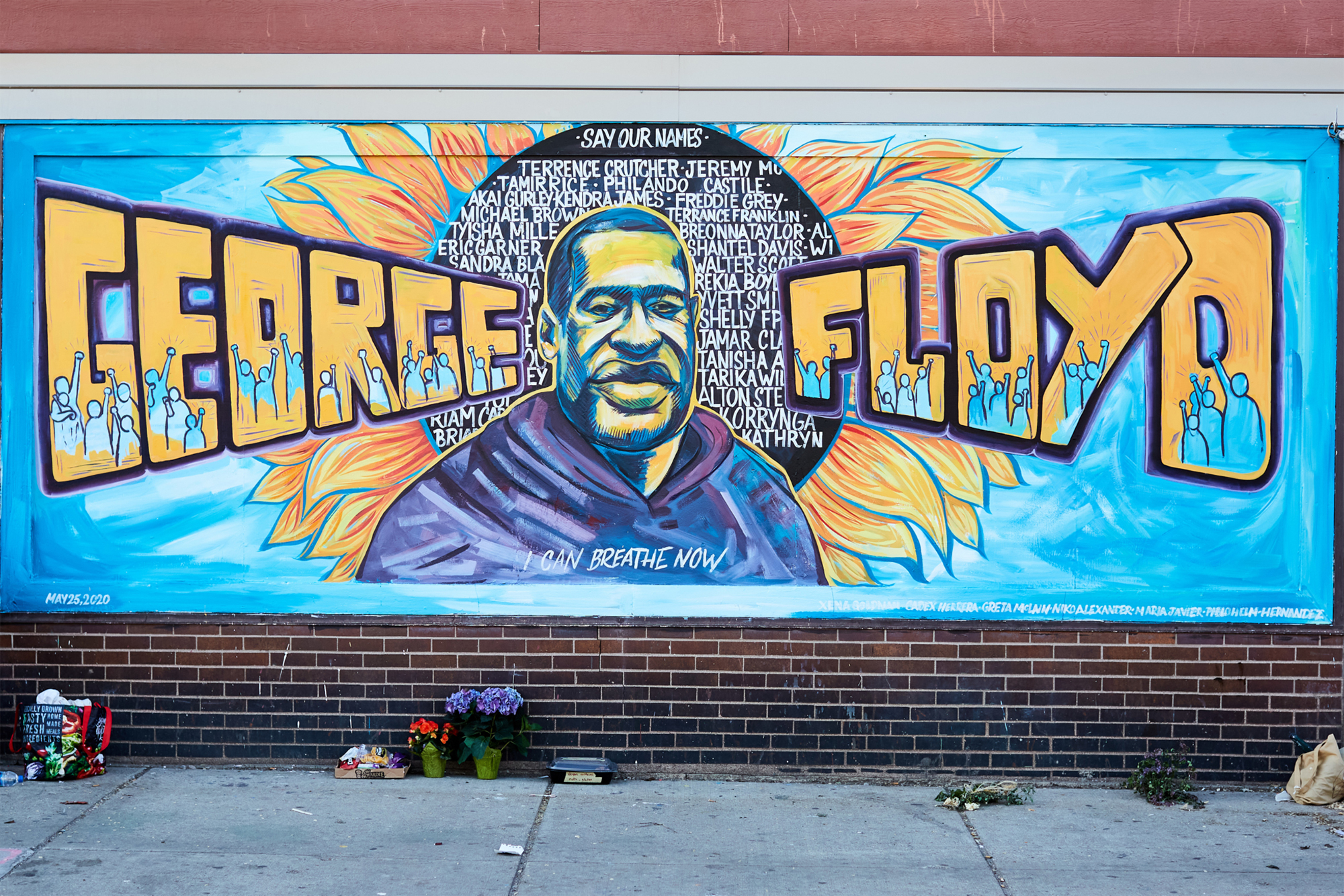
There is a difference between the iconic murals of George Floyd – found now in cities including Houston, Philadelphia, Portland and Los Angeles, Miami Chicago as well as Minneapolis, and so often defaced  by white nationalists – and the personal idiom of the streets.

But they both require paint and skill – perhaps some just need a taller ladder.

Leave a comment

Filed under Jean Zimmerman

Dollar coffee

is a bodega staple I’ve always thought is among the best things in the Bronx. Hot, strong, milky and cheap. It’s universal in the borough, along with the chopped cheese sandwich (also known as a chop cheese), a mess of ground beef, melted cheese, tomato, lettuce, a mystery sauce and some other things on a Kaiser roll, guaranteed to drip down your chin.

Within this little microburst of a neighborhood, just a few blocks of the Grand Concourse, I’m beginning to scratch the surface of its foodways.

There is the grocery I park my car next to–onions out front– which features floors cleaner than mine at home, a full butcher counter, a sandwich maker, iced coffee, a spic and span bathroom (with toilet paper!) and a tiny litter box, presumably for a tiny cat. And at the cash register the loveliest woman, whose brother owns the place.

Searching in another greengrocer for a bathroom (It’s in the basement! Headshaking no) I’m in a quandary. This place has a dozen varieties of tuber but no public bathroom.

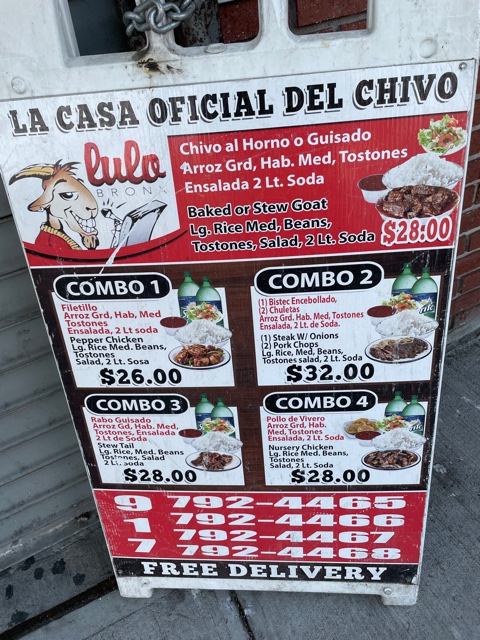
An elderly gentleman wearing a kerchief directs me to Lulo, a restaurant across the street.

It is the official house of goats. A guy on the sidewalk yesterday told me I look like a horse. Could have been worse. Anyway, I don’t eat horses, and I don’t eat goats, I like their Satanic eyes too much. Lulo is also immaculate, all of its furniture covered with slick, easy to wipe down plastic.

Home to the dollar coffee, the Grand Concourse is also home to The Real Coffee Man.

And, shock, the dollar slice.

I thought that was obsolete. And I’ll give it a try one of these days, coffee on the side.

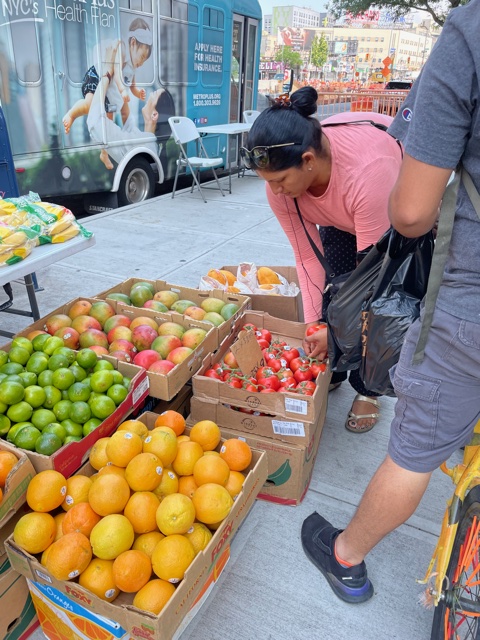
There is such careful attention given to selecting among the fruits and vegetables on the little produce stands on nearly every corner. The proprietess tenderly chooses the perfect tomatoes for a man on a bike.

Kennedy Chicken, Popeye’s and Dunkin may have a foothold here on the GC, but as long as chop cheese reigns, they will never push off the mom and pops.

1 Comment

Filed under Jean Zimmerman