Or would she be, in her small, secret part of herself, pleased? Possibly even thrilled to see all the hoopla and fuss made over her at the abode where she spent all her years.
It is possible to tour the house, which sits in the shade of a mature tulip tree.
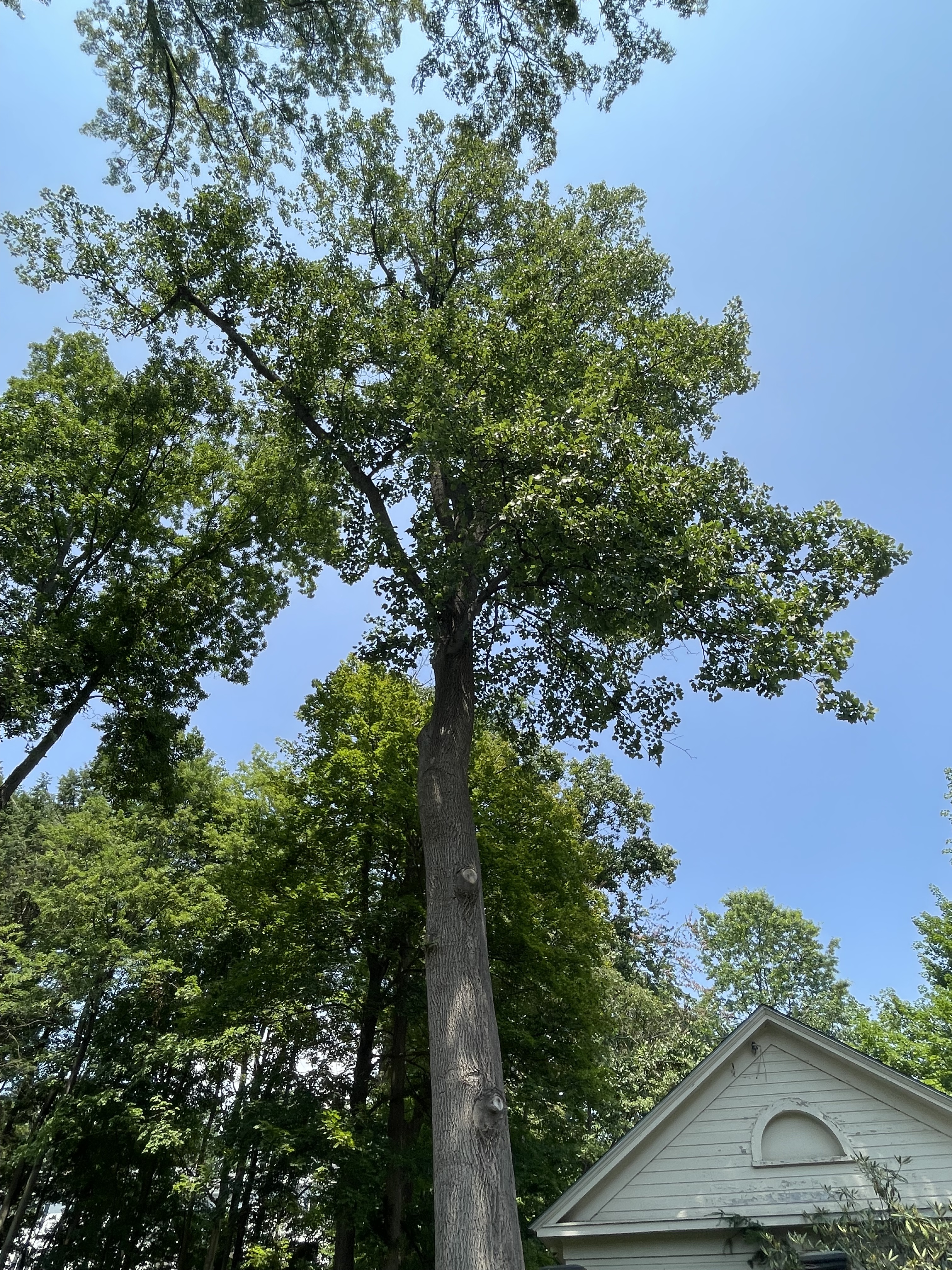
Probably a sapling when Emily lived here on Main Street.
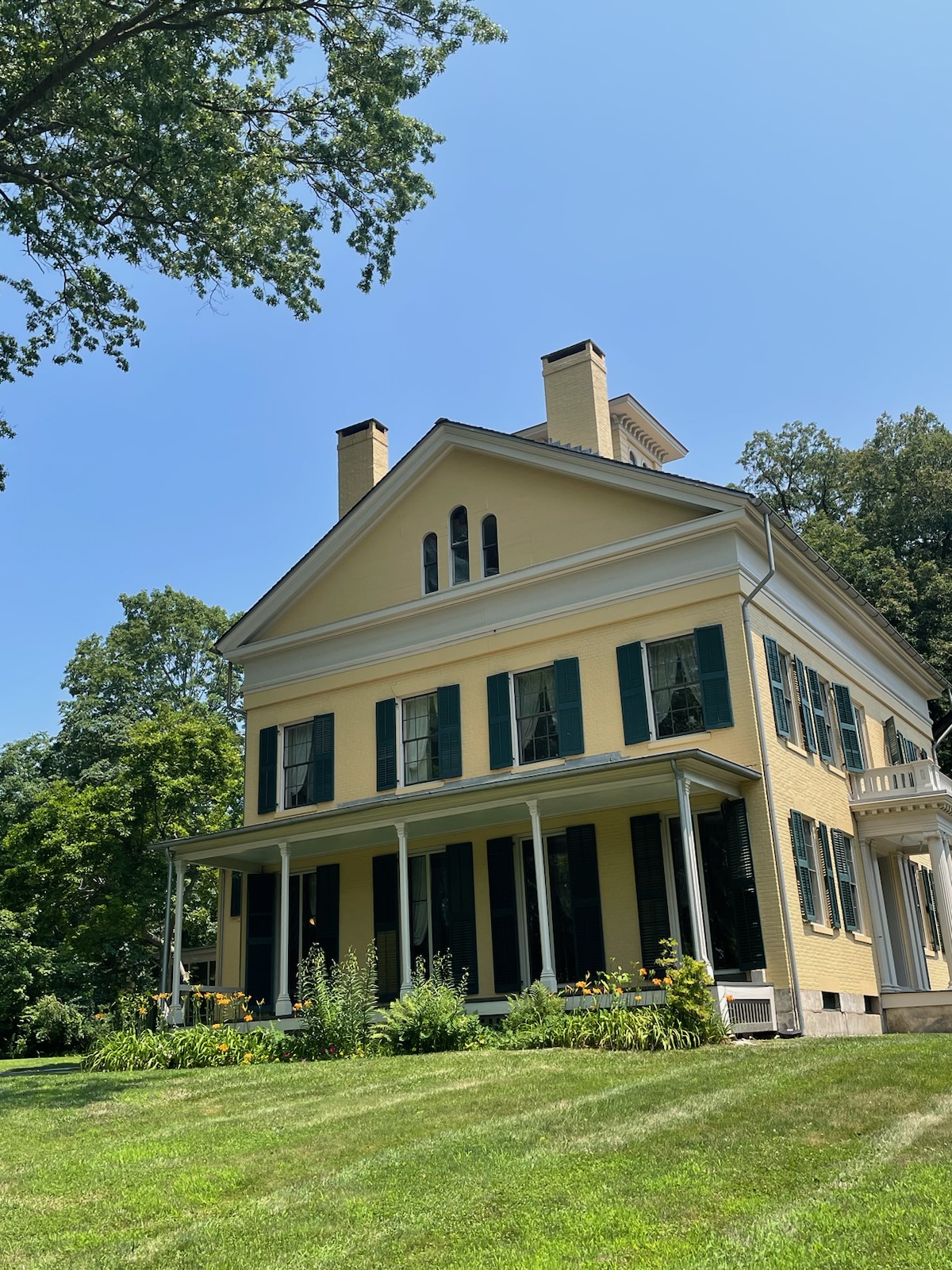
It was quite different then. Her well-to-do family owned a lot of land. Across the street were ten acres called the Dickinson meadow. A conservatory adjoined the house, where the family grew exotics like cactus and jasmine. During her lifetime, she assembled a collection of 424 pressed flower specimens she had collected, classified and labeled.

Some of the furnishings are original to the Dickinson family. If you see a pinecone don’t sit on it, cautions our docent. The pinecones indicate the artifacts original to the family.
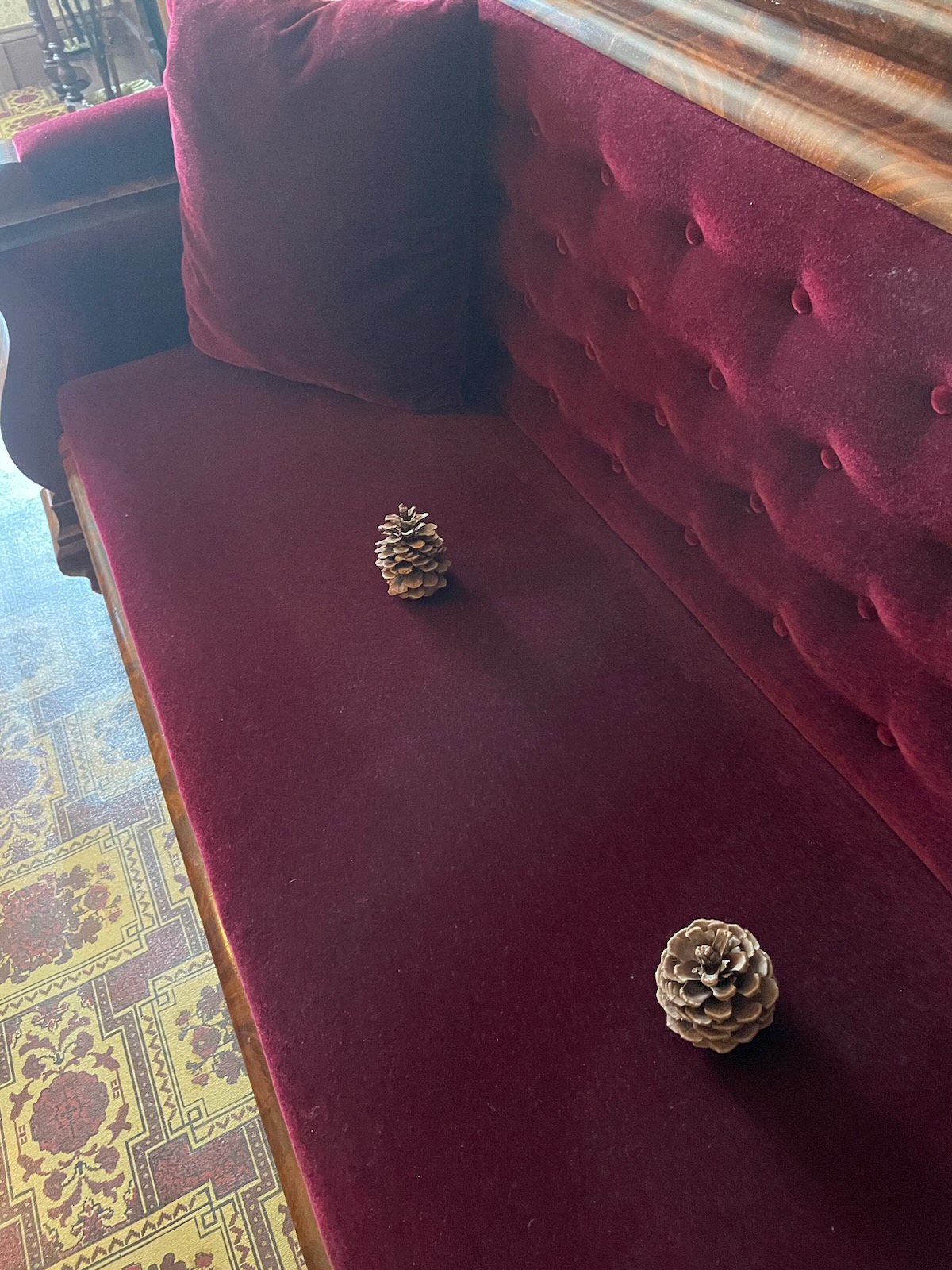
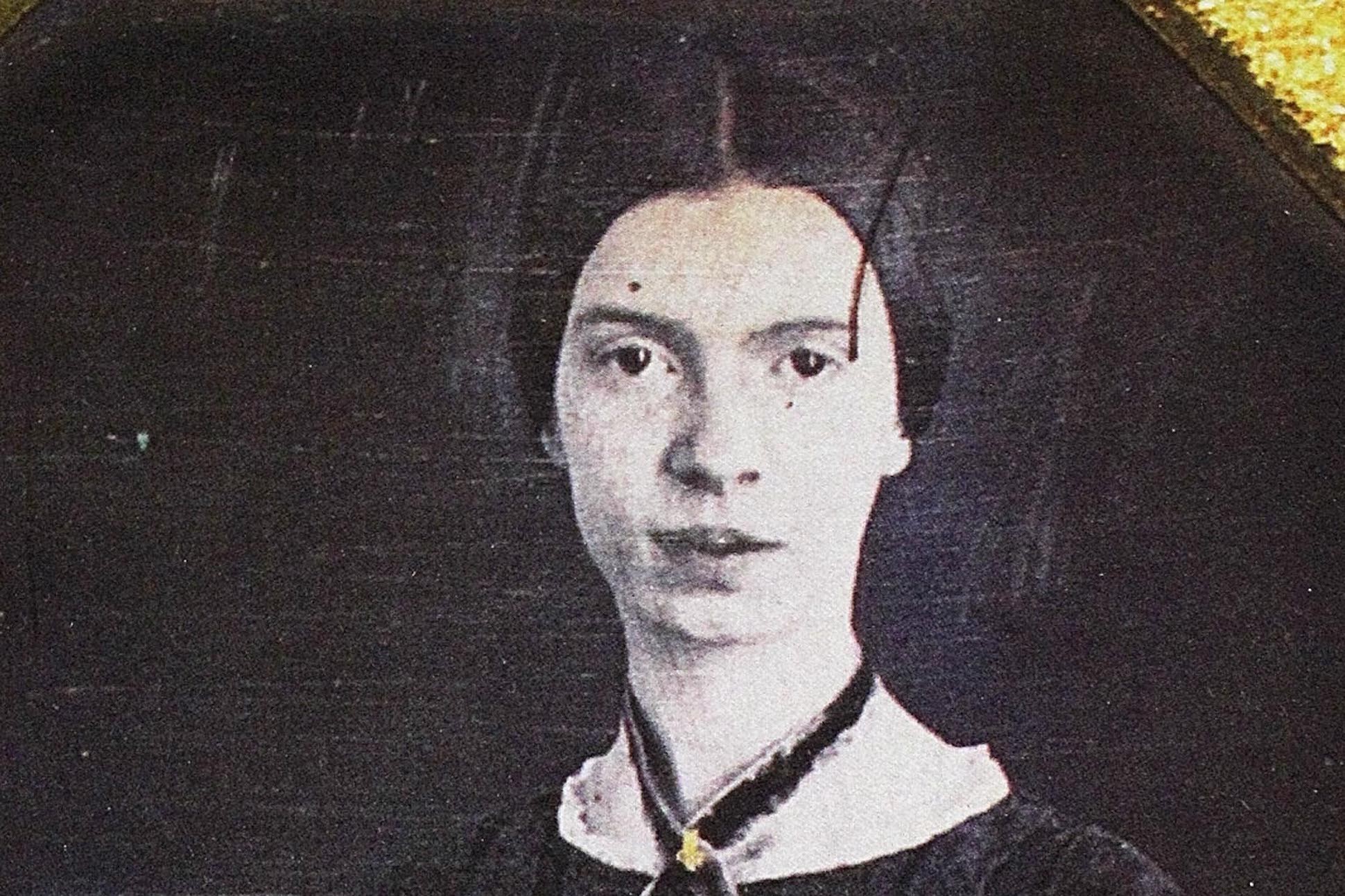
I think that might have given Emily at least a polite chuckle. We see the parlor containing a reproduction of a portrait of Emily with her siblings Austin and Lavinia as youngsters. The docent points out the color of Emily’s hair: red.
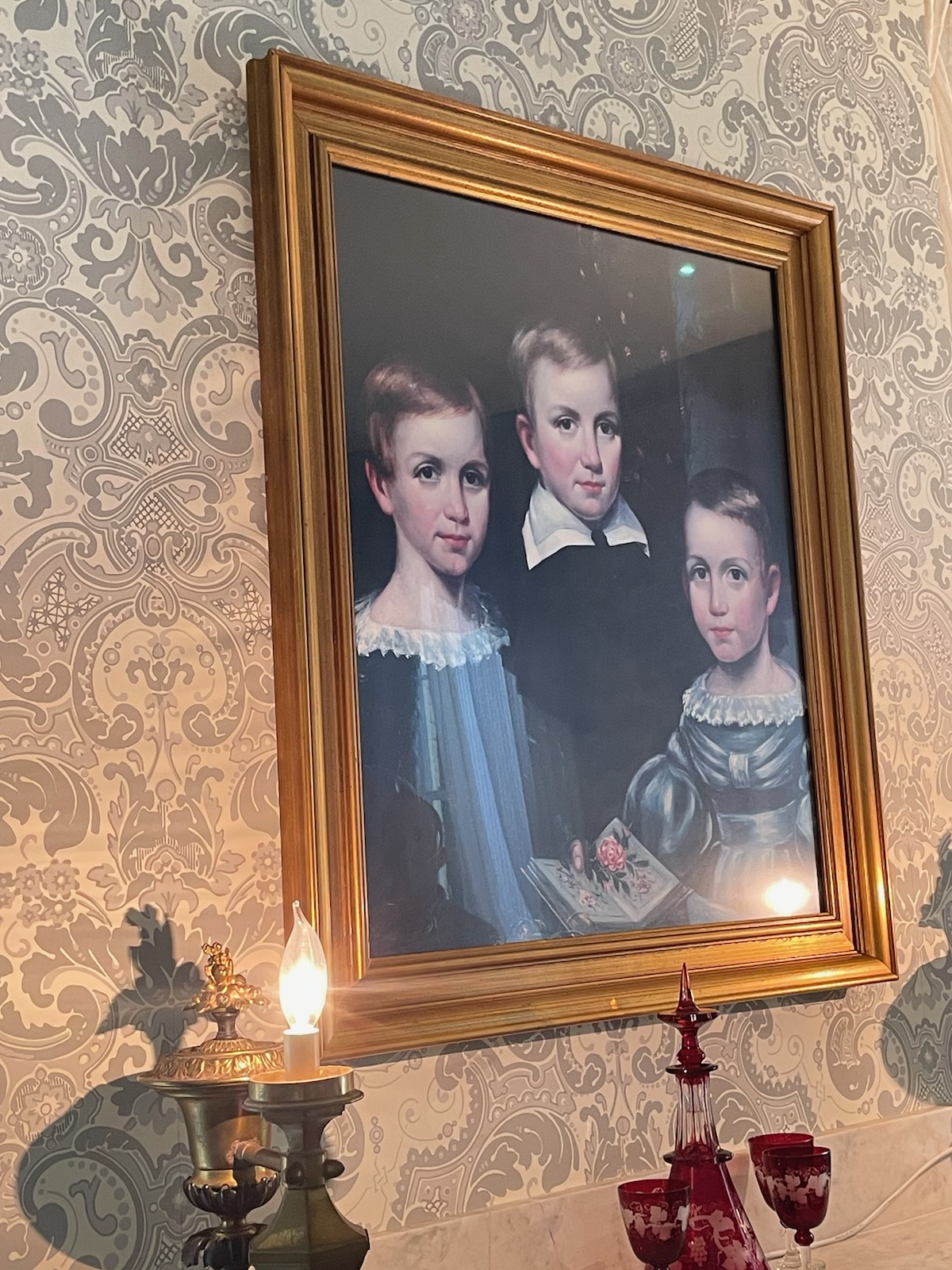
Unlike the only picture we have of her as an adult, which is black and white.
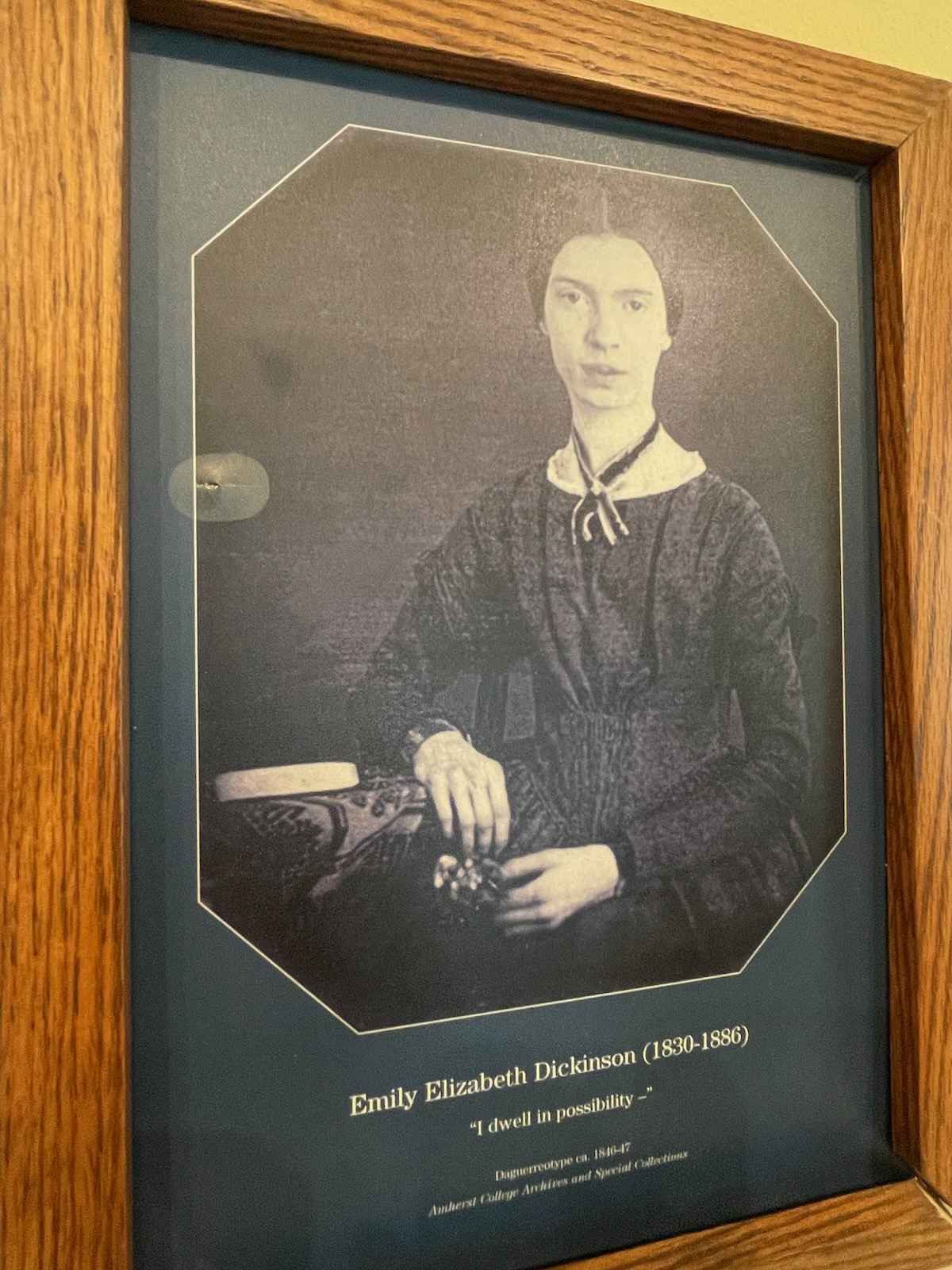
Amherst College has a lock of that hair in their possession. I’d like to go take a look at that sometime.
Dickinson wrote 1,789 poems, with only ten published during her lifetime. In the summer of 1858 she began to review her work, penning clean copies of poems she had written previously. She assembled these carefully pieced-together manuscript books in small booklets called fascicles that contained nearly eighteen hundred poems, and no one knew of their existence until after her death.
A newspaper lies on a side table. This is where she discovered the editor Thomas Wentworth Higginson, literary critic, radical abolitionist and ex-minister, the mentor who would encourage her creative explorations throughout her life.
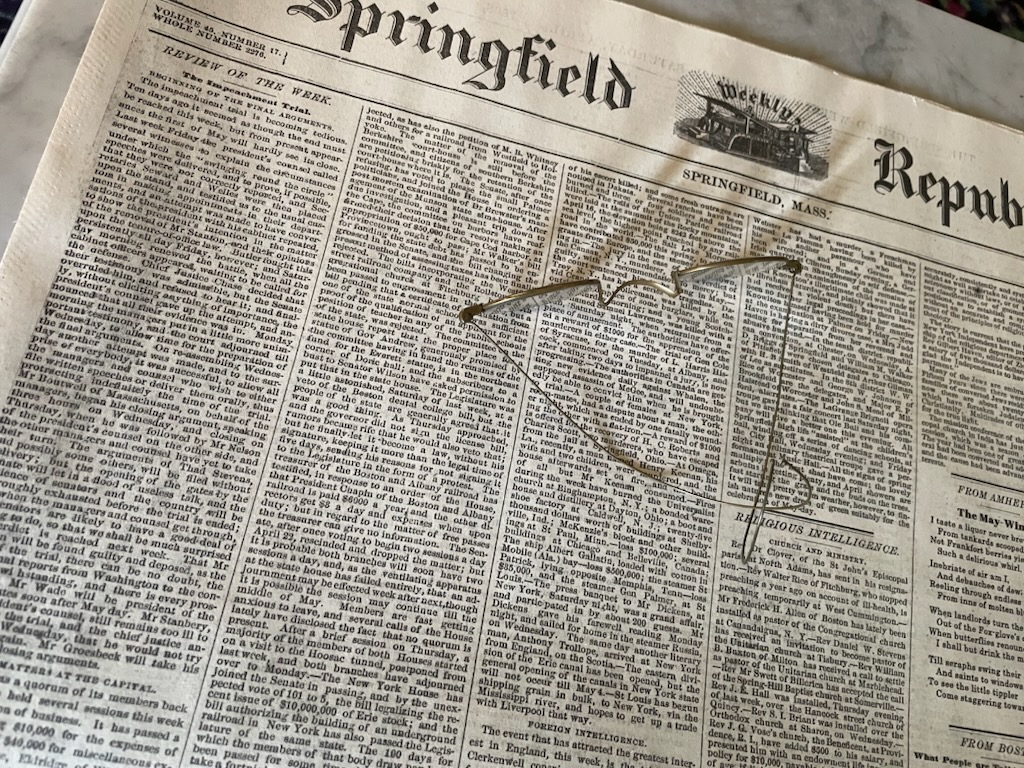
In her first letter to Higginson in 1862, Dickinson wrote, Are you too deeply occupied to say if my Verse is alive? She was not young then — she was born in 1830 — but she was perhaps a bit insecure.
We tourists see the study with its books (ersatz copies of what would have been on these shelves, as her actual books went to Harvard and Yale as per her wishes) Her father gave her whatever books she wanted but said the ones she liked might jiggle the mind. For example, Henry Wadsworth Longfellow’s Kavanagh. Really?
We ascend the stairs.
The Amherst population apparently referred to her as The Myth, because she basically disappeared from view after a certain point.
We come to Dickinson’s bedroom. It’s on the top floor, a place where Emily spent her increasingly reclusive adult years. We see a white house gown or house dress on a dressmaker’s dummy, a garment a woman would not wear out in public, a sort of announcement of a strategy to withdraw from the world.
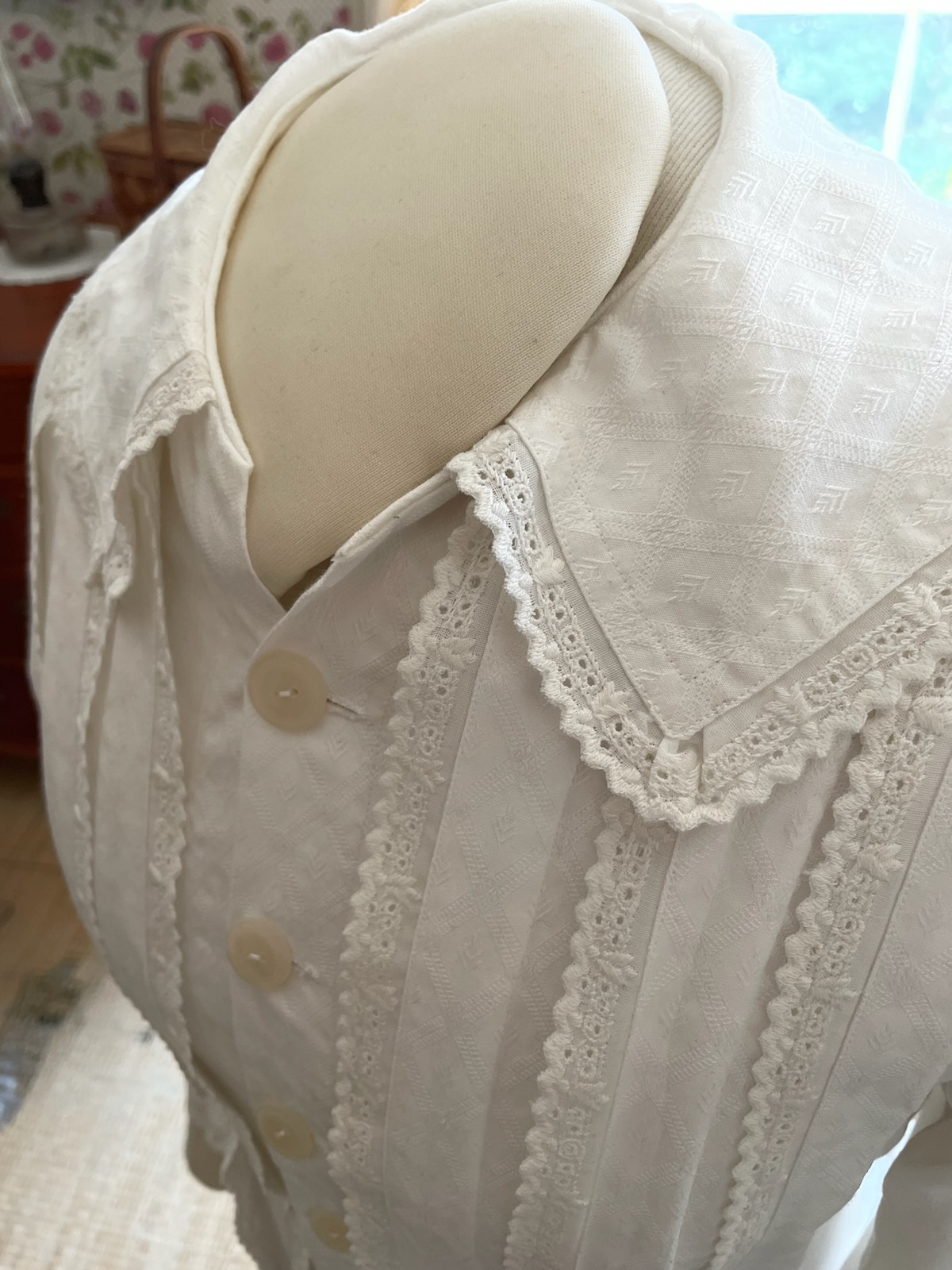
It’s not the original but a replica of her one surviving article of clothing, a cotton dress it is believed she sewed sometime between 1878 and 1882. Given the scarcity of photographic documentation, It is possible she actually favored bright red or purple garments!
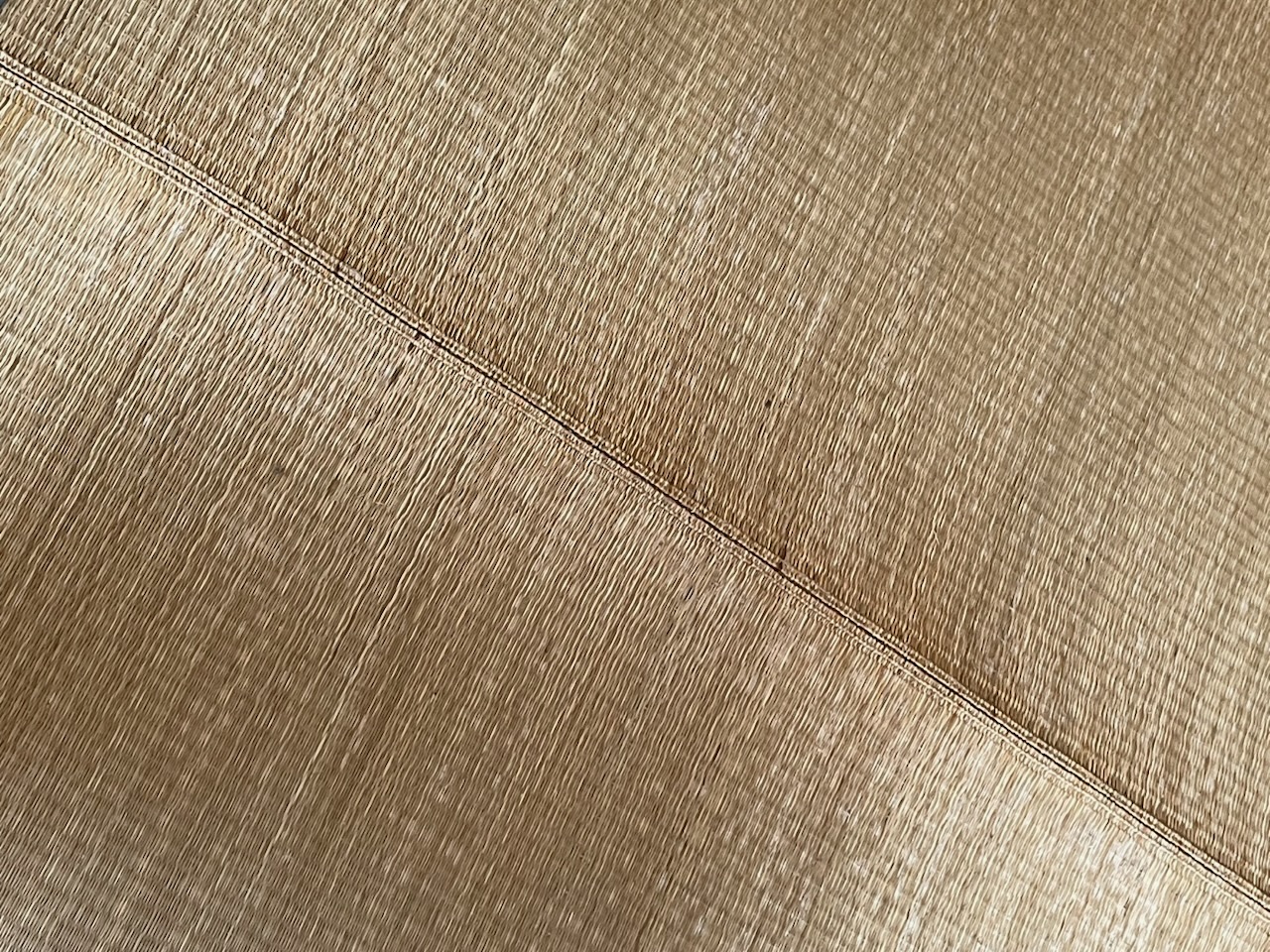
We see tatami mats on the floor, also replicas of the originals, and find out something pretty amazing. Experts have established from the tread marks on the floor the steps she took from one place to another in the tiny room – her feet wore grooves. Spooky.
We see Dickinson’s desk – well, again, not her real desk, that’s owned by Harvard, but an exact replica. This must be where she assembled those fascicles.
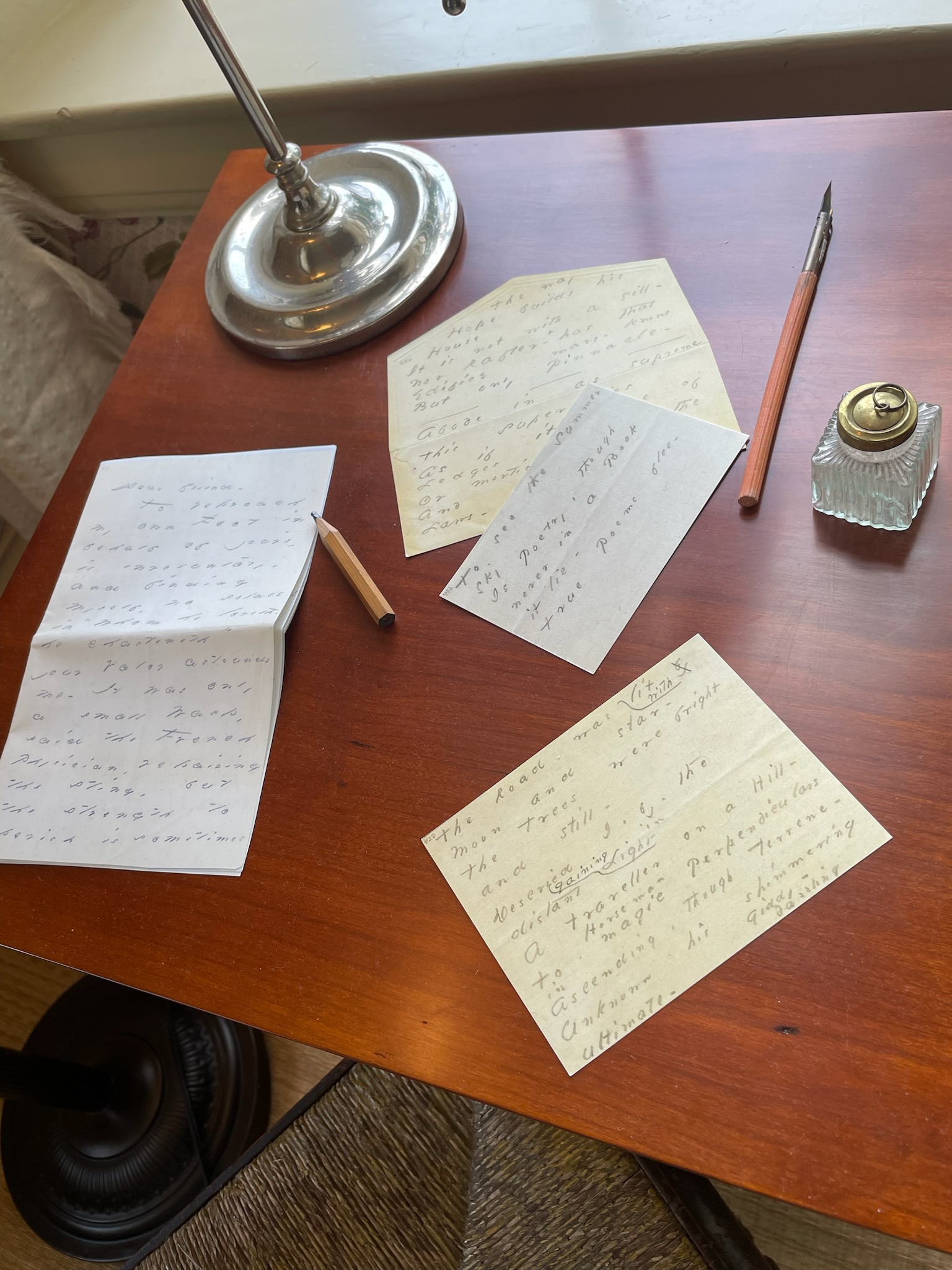
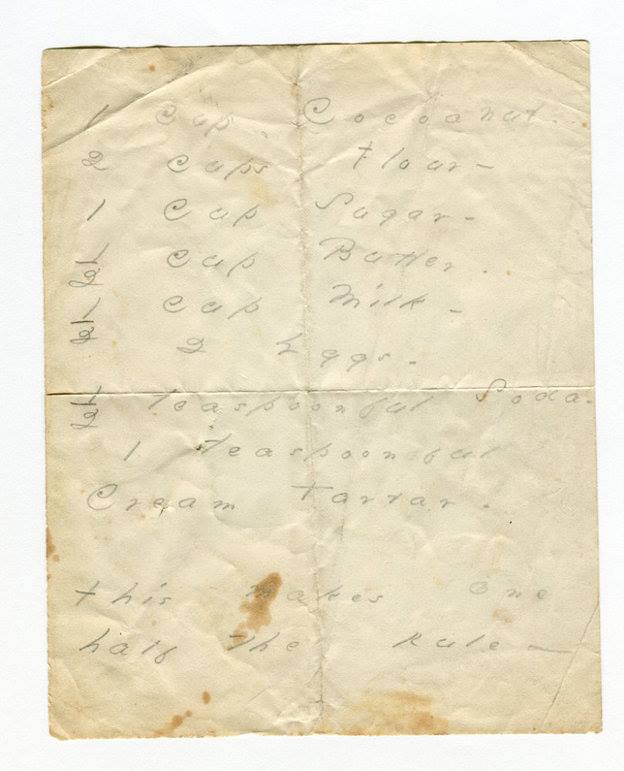
More spookiness. Emily lowered baskets filled with treats out this window for her beloved nephew Thomas Gilbert Dickinson, who died at the age of eight of typhoid fever. She was, apparently, quite the baker. She was famous for her “black cake” made with rum and raisins, and won second place in an Amherst baking competition. And we have a recipe for coconut cake, written on the back of a poem.
We learn a little bit about her relationship with her brother’s wife, Susan Gilbert.Dickinson. Emily sent her two hundred poems and 300 passionate letters. Preserved, an envelope with Open me carefully in Dickinson’s cursive on the outside.
Austin and Susan, increasingly estranged in their marriage (not surprisingly) lived next door. The women’s love affair, a secret hidden in plain sight. Dickinson’s letters go somewhere along these lines:
Susie, will you indeed come home next Saturday, and be my own again, and kiss me… I hope for you so much, and feel so eager for you, feel that I cannot wait, feel that now I must have you — that the expectation once more to see your face again, makes me feel hot and feverish, and my heart beats so fast… my darling, so near I seem to you, that I disdain this pen, and wait for a warmer language.
In 1998, The New York Times reported on an infrared study showing that much of Dickinson’s work had been deliberately censored to exclude the name Susan. At least eleven of Dickinson’s poems were dedicated to her sister-in-law, though those dedications were later erased.
Some of the poems would seem to point directly to the love affair, like Wild Nights.
Were I with thee
Wild Nights should be
Our luxury!
Futile — the Winds —
To a Heart in port —
Done with the Compass —
Done with the Chart!
Rowing in Eden —
Ah, the Sea!
Might I but moor — Tonight —
In Thee!
You’d have to be blind not to see the personal, human passion in these lines.
And then we get to the great poet’s bedstead.
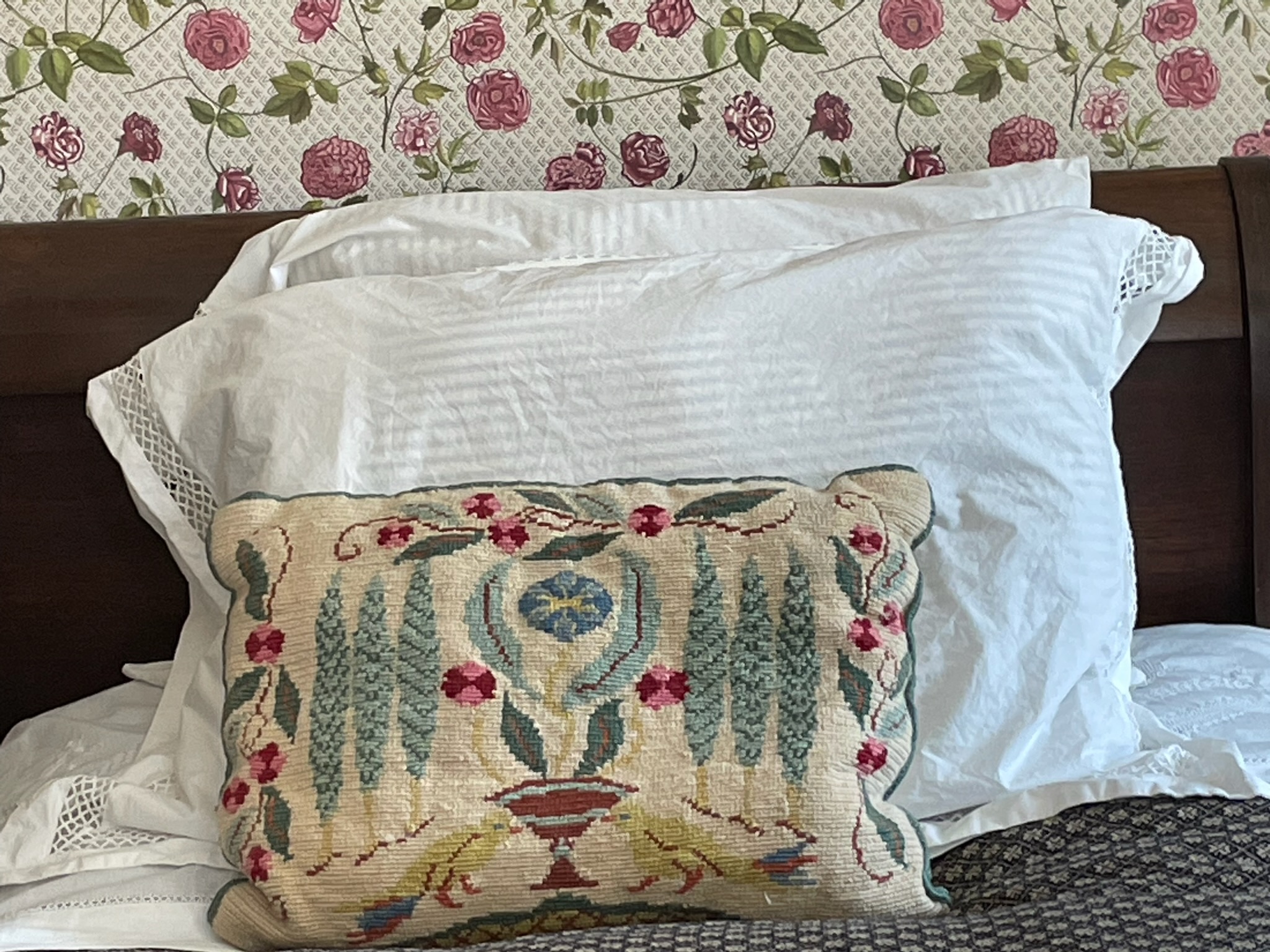
It is the real thing, not a replica. This is where she dreamed at night. This is where she died. I lay my hand against the headboard.
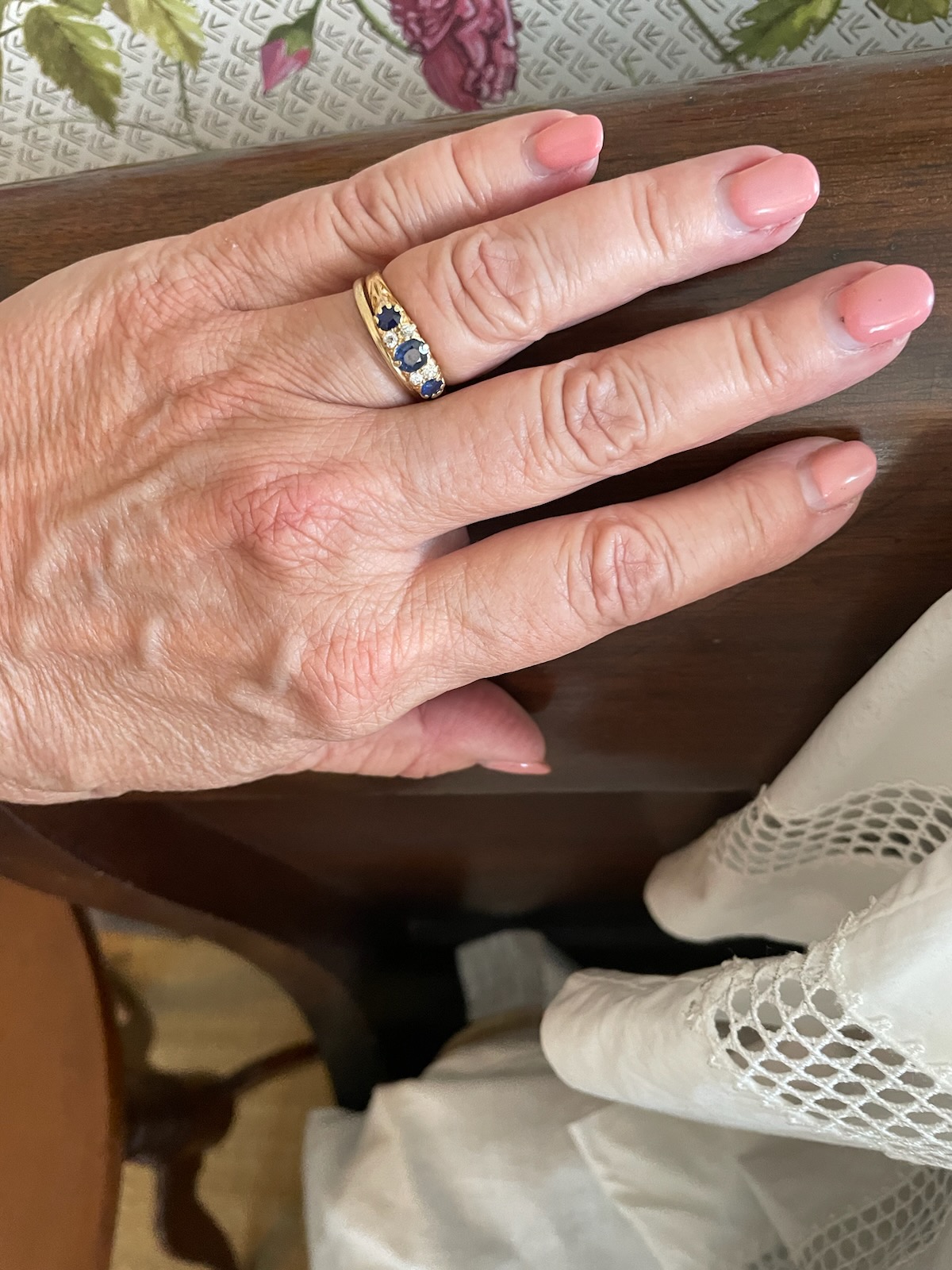
It is exhilarating to touch what Dickinson touched. And yet, so, so sad. I feel we’re invading the core privacy of this extremely private woman, this brilliant writer, this recluse, a ghost in a room filled with a dozen callow tourists.
In the well-stocked giftshop we find tee shirts emblazoned with some of her most famous lines.
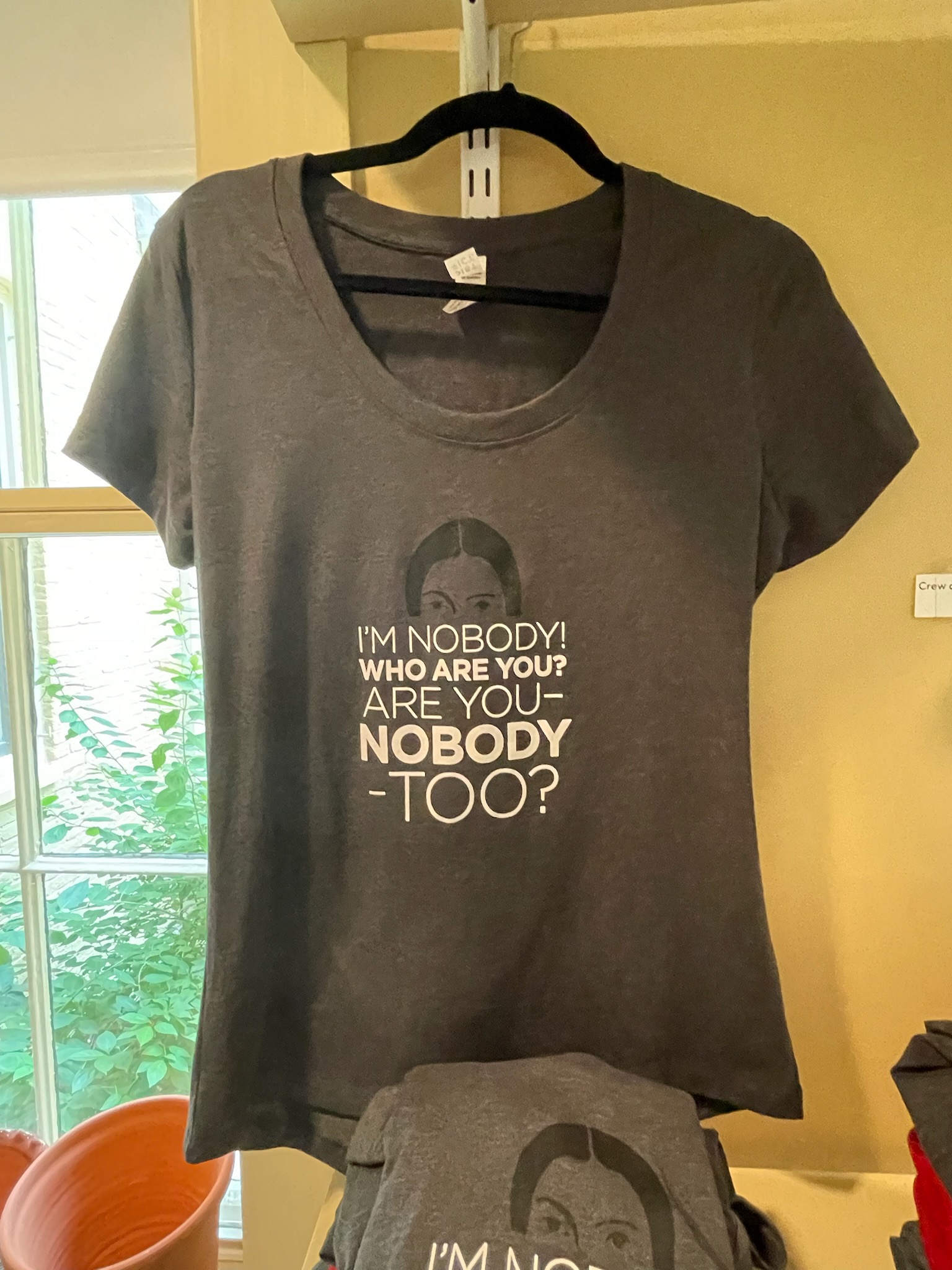
It chokes me up a little to see her delicate, haunting language inscribed on a garment you’d sweat on in the gym.
Then I buy one. I cannot resist. As I could not resist the opportunity to trail in her footsteps on the tatami mats above. To touch the headboard against which she would have leaned, probably with her nose in a book.
Emily Dickinson died at the age of 55. Her brother wrote in his diary that the day was awful… she ceased to breathe that terrible breathing just before the [afternoon] whistle sounded for six. Her physician gave the cause of death as Bright’s disease.
After Dickinson’s death, her sister Lavinia kept a promise to her and burned much of the poet’s correspondence. Dickinson had not, however, left any instructions concerning the forty notebooks and loose sheets gathered in a locked chest. Her poetry has now been translated into languages including French, Spanish, Mandarin, Persian, Kurdish, Turkish, Georgian, Swedish and Russian.
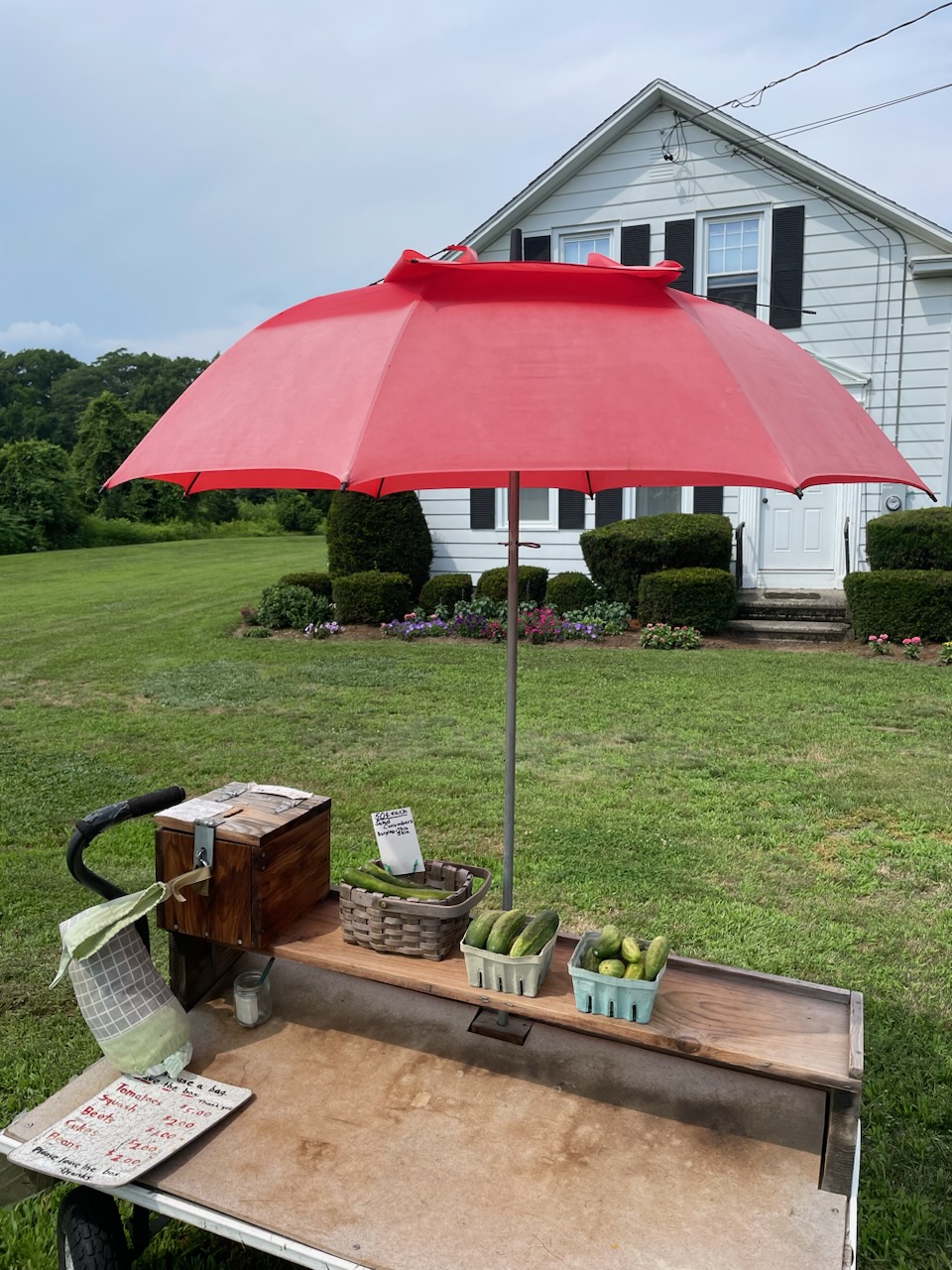
After our visit to the homestead we decide to track down her burial plot. We pass a farmstand and put a few dollar bills in a box to buy some early cucumbers, thinking that this little enterprise could have existed in Dickinson’s time.
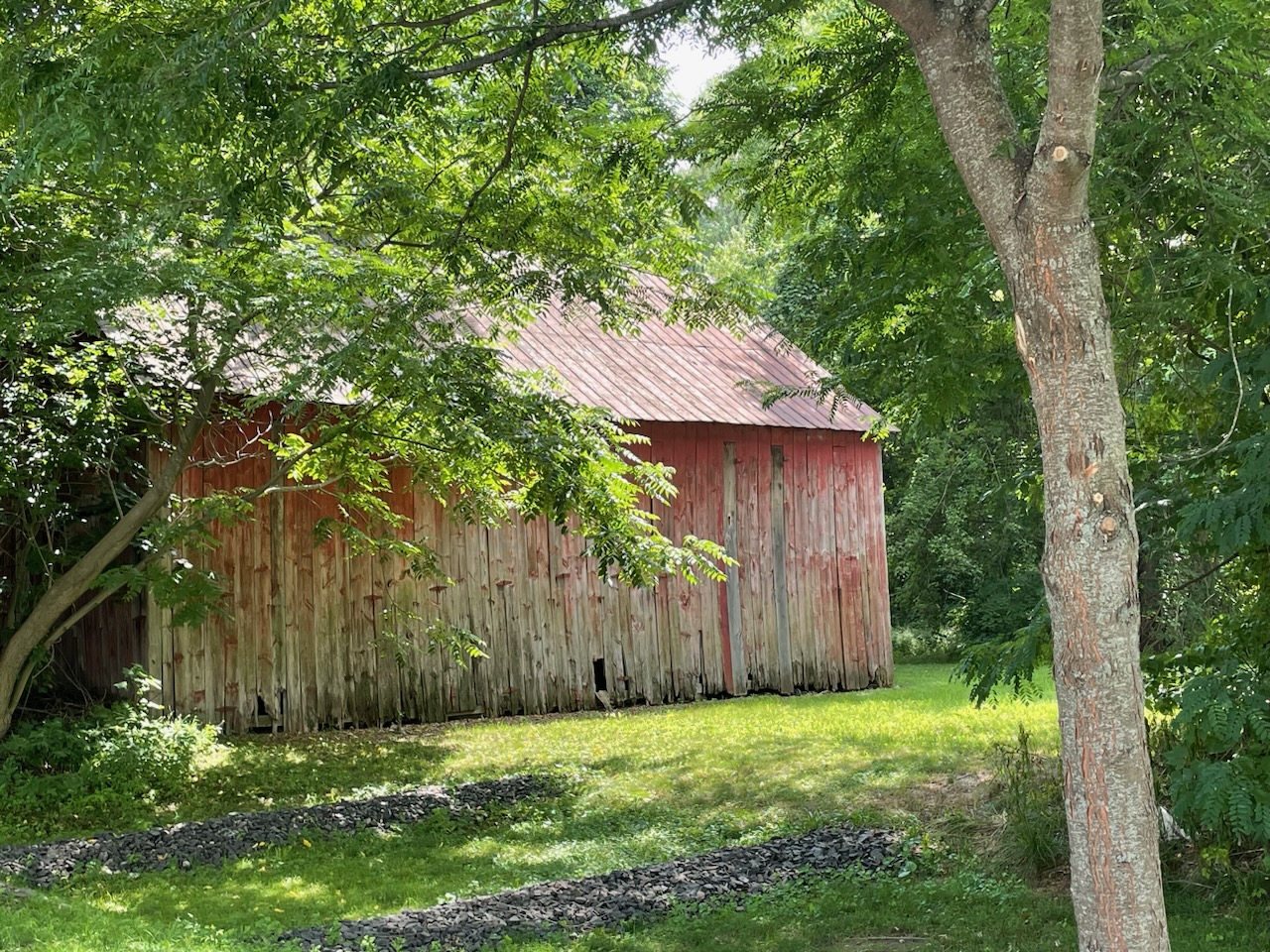
We pass an old barn, probably dating back to that era.
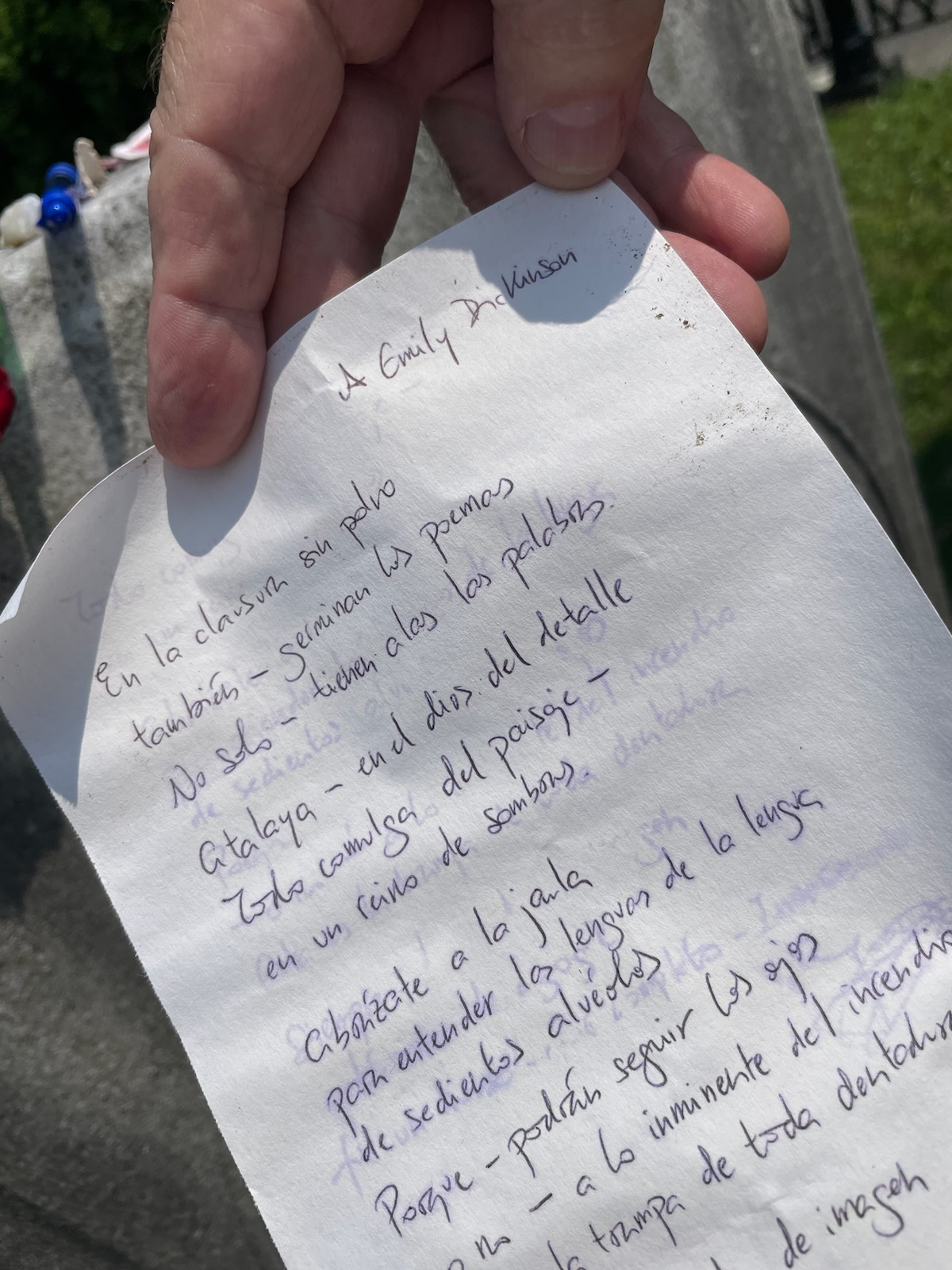
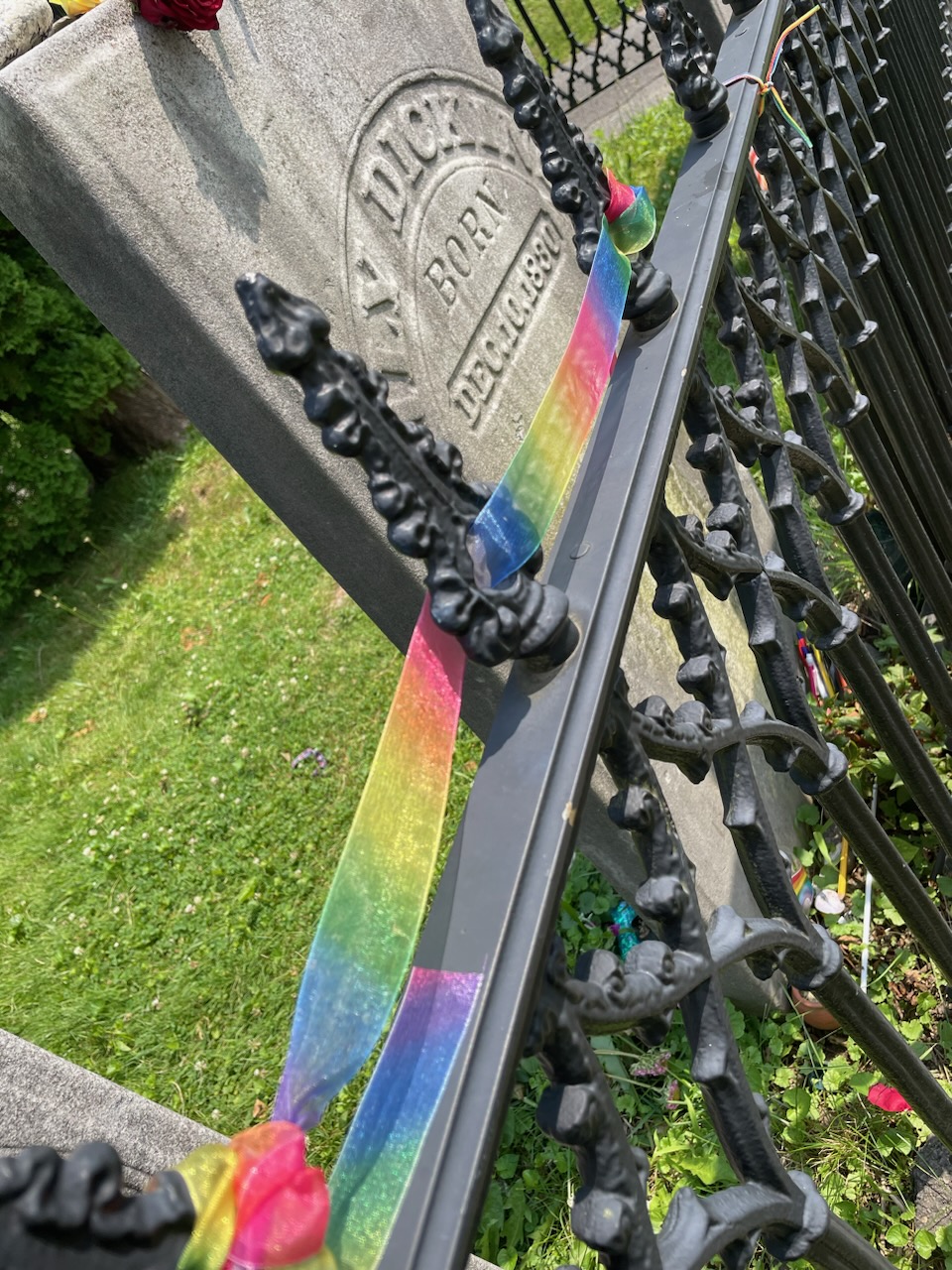
Finally we visit her grave. It is surprisingly hard to find.
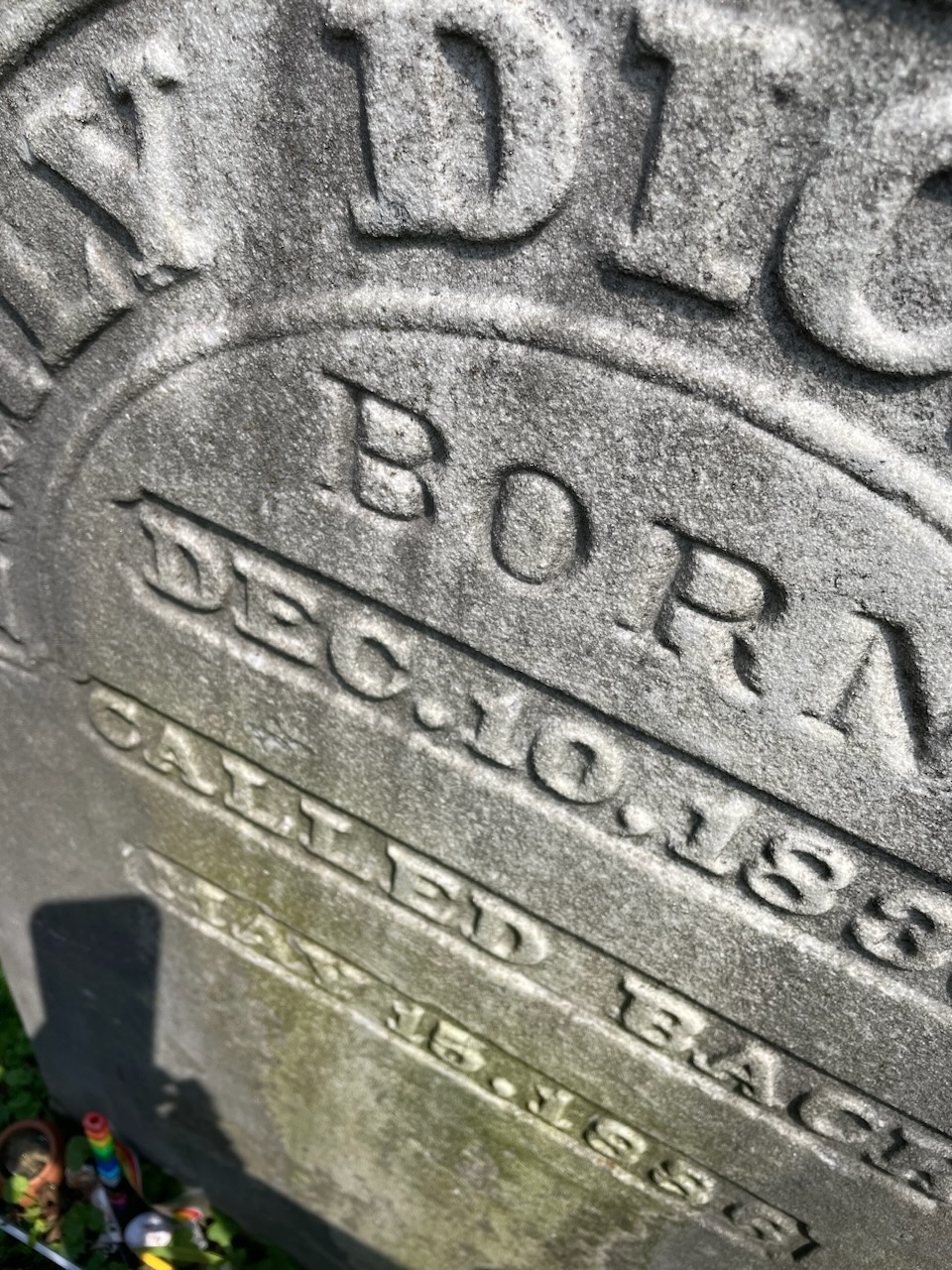
But then, once we get there, impossible to miss. People who believed in the power of her love for another woman decorated the site with rainbows.
I leave my daughters hair comb among the many other tributes.
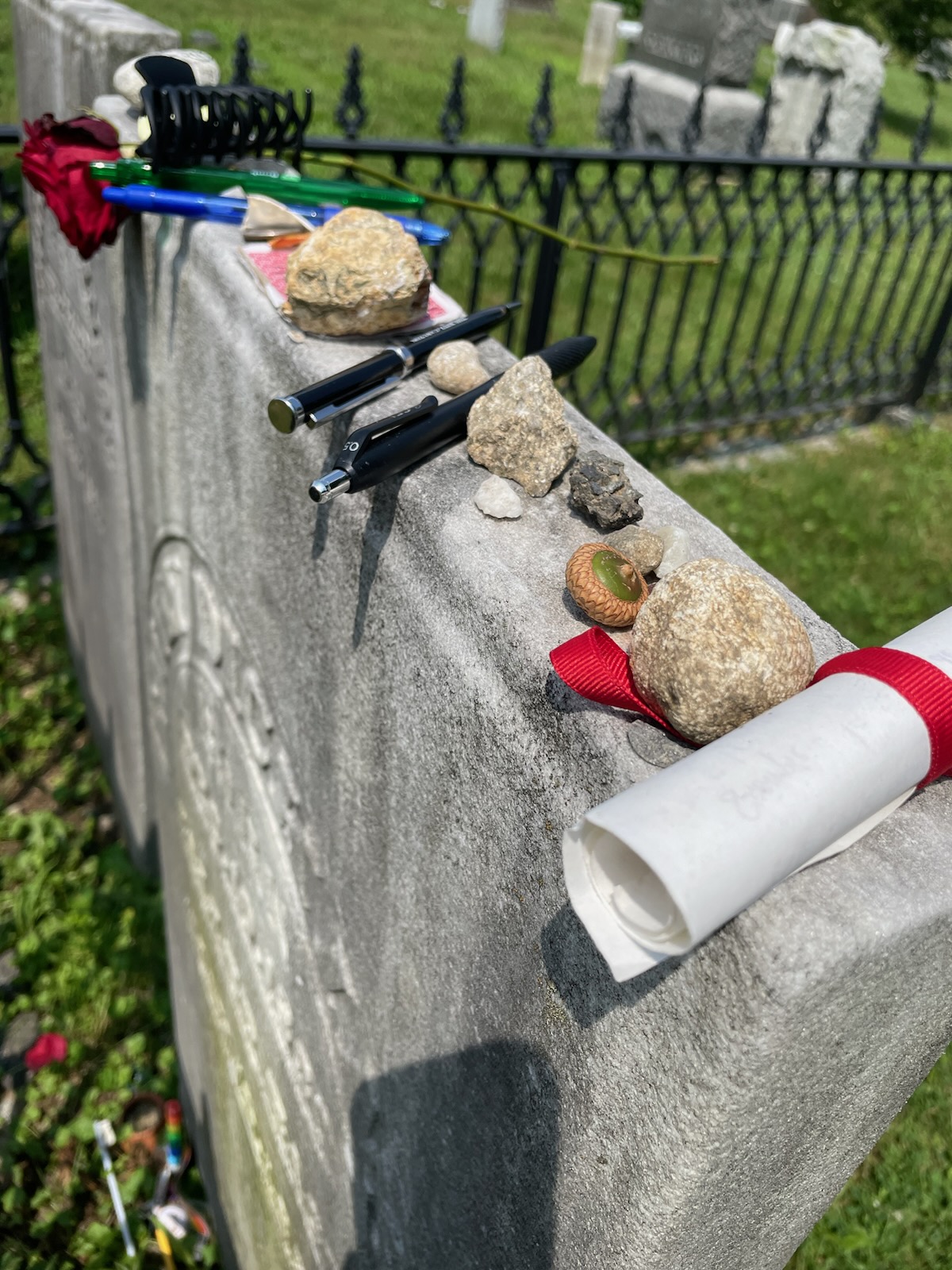
I think it might look nice in Emily’s red hair.
 Jean Zimmerman