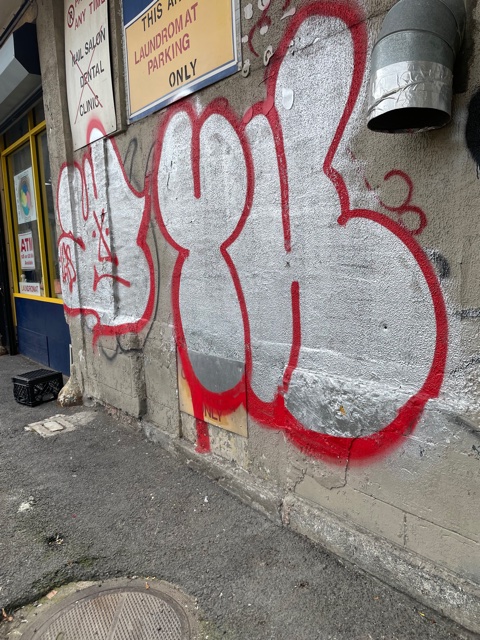
You can’t unsee the graffiti in the Bronx

once you see it. And it is all around you.
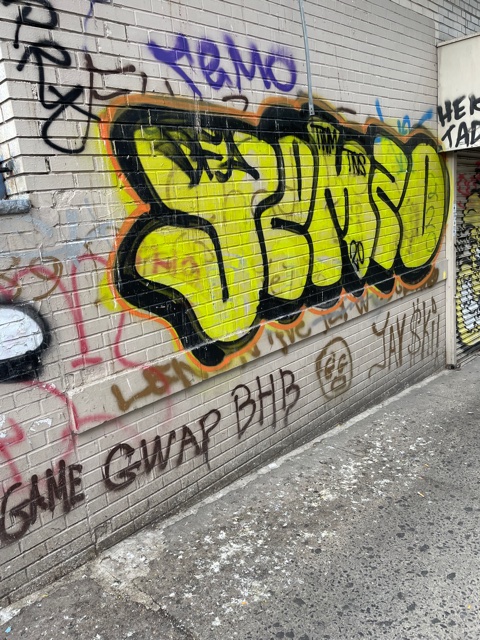
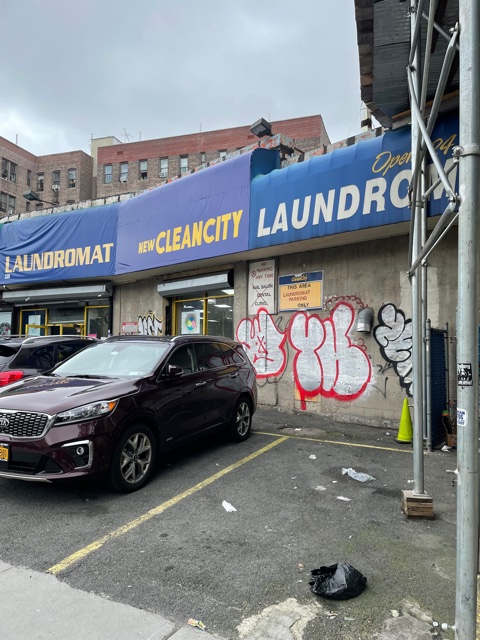
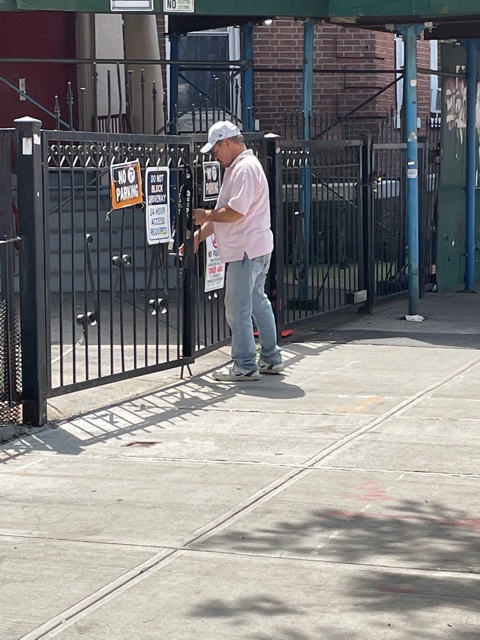
Some surfaces would seem to be left alone. Church walls, for example. Or cars. But everything else is fair game, and especially popular are store gates, the kind that get opened in the morning and pulled down at night.

Every surface is game.
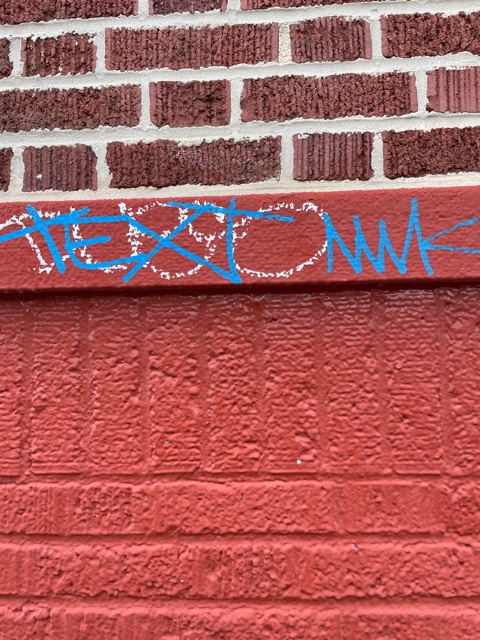
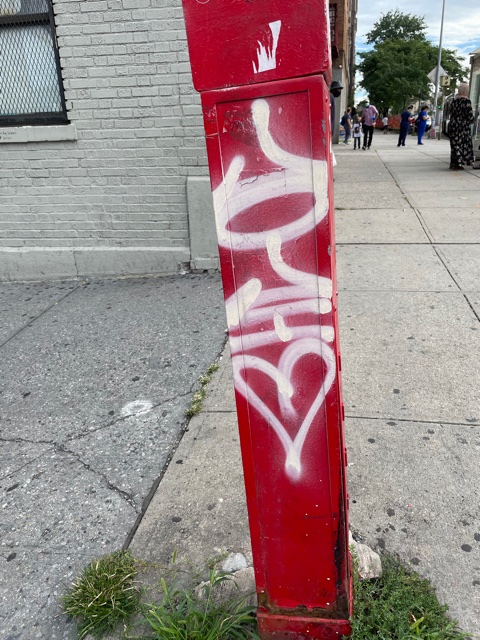
You’ll find mailboxes.

Dumpsters.

Houses.

Even lightpoles.
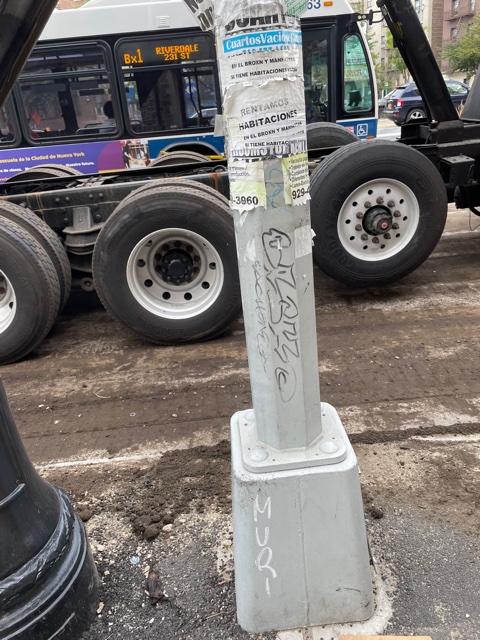
Self expression. It’s such a powerful human urge.

A lot of these look as if they were spraypainted by the same person, but I’m sure I’m missing the subtleties.
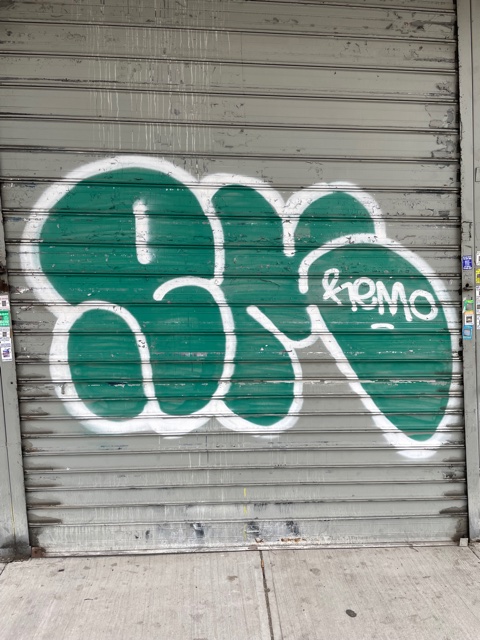
I happen to like the metallic images.

The runic ones.

Indulge me. When I looked on the Grand Concoure in about a four block radius, I found so many striking examples.

And my favorite, I guess.
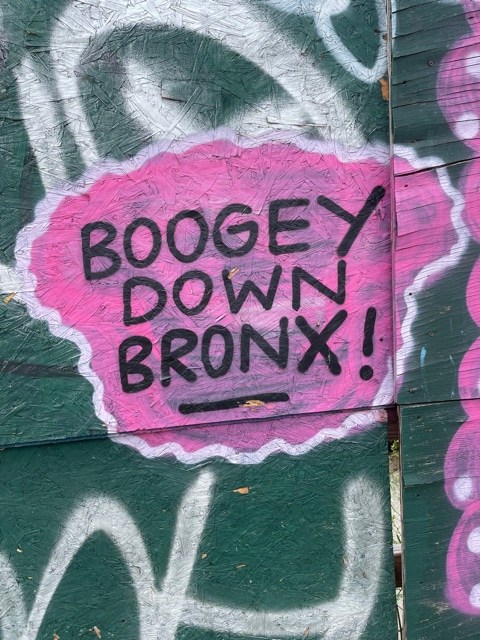
Washington Square Arch in the West Village has chronic problems with graffiti. It was tagged one night amongst general mayhem, and by the next morning they had removed the anti-cop slogans, leaving “ghost graffiti” that would only be finally removed from the porous, delicate stone  at a later date. 

In the Bronx, nothing gets removed.

You start to see color everywhere, even where it’s ungraffitied.
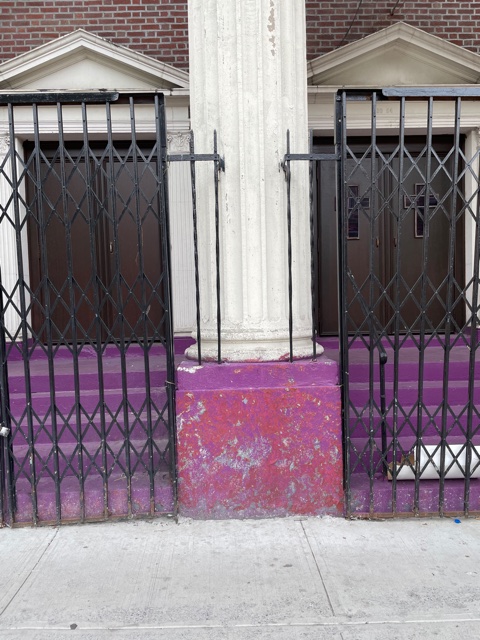
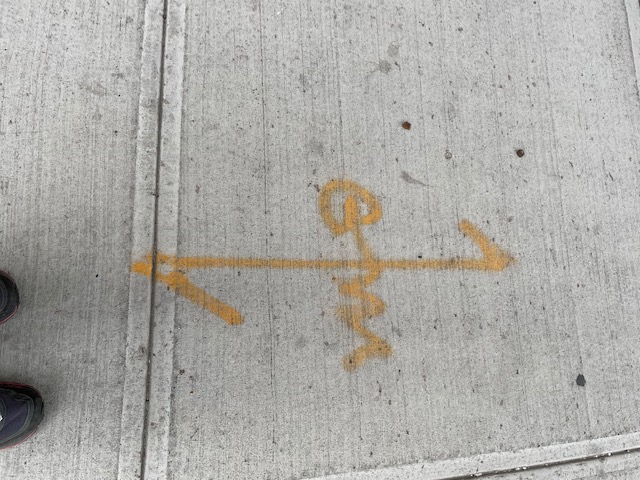
Utility markouts are  really a kind of graffit. You’ll notice them on every sidewalk. Yellow means gas. Don’t dig too near or you might get blown up. Red, electric.
Some fundamental graffiti history. A while back there was a huge warehouse called 5 Pointz in Queens – it was constructed in 1892 as a factory that built water meters — that served as the canvas for dozens of graffiti artists as well has leasing studios to artists inside.

We visited, and something amazing was that after a certain viewing period one artist would cover over the work of another artist with his own work. Just wipe it away. That was the accepted method of showing as much good stuff as could be shown. Very democratic.

I was wearing a cast on my foot at the time and I asked the artist named King Bee if he would tag it.

Fast forward and of course something so impossibly cool could not last. The owner of the structure announced that he was razing 5 Pointz to put up a residential complex, and all the artists would have to leave. He had the walls whitewashed overnight. Even a plea from Banksy could not save the brilliant assortment of aerosol art. The developer got payback – a judge made him pay 6.7 million in damages to 21 artists.
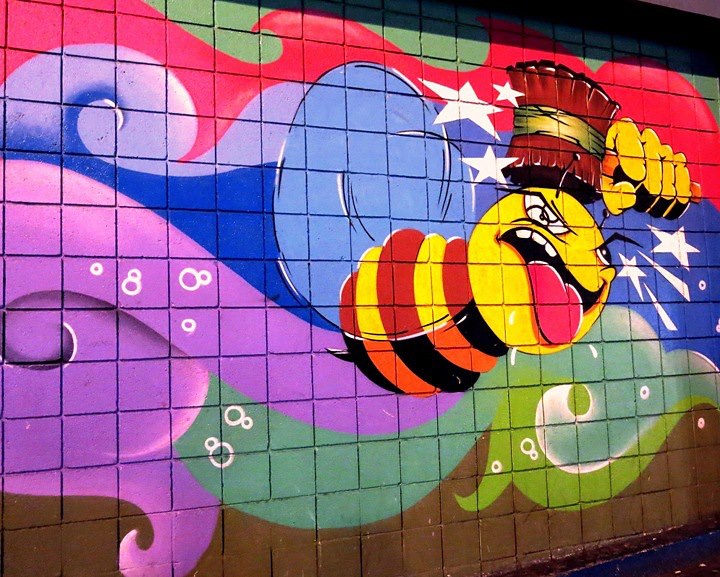
The Royal “King Bee,” born Alfredo Bennett the guy who decorated my cast, grew up in this part of the Bronx and honed his aerosol chops here, in fact.  His way of “giving back” was to furnish extravagant murals at 17-50 Grand Concourse and other Bronx locations. His oeuvre, which includes madly stinging bees, is something to admire. I like it better than the paintings of some of the genteel artists venerated by collectors and museums. George Seurat, for example, or Rubens.

There is a difference between the iconic murals of George Floyd – found now in cities including Houston, Philadelphia, Portland and Los Angeles, Miami Chicago as well as Minneapolis, and so often defaced  by white nationalists – and the personal idiom of the streets.
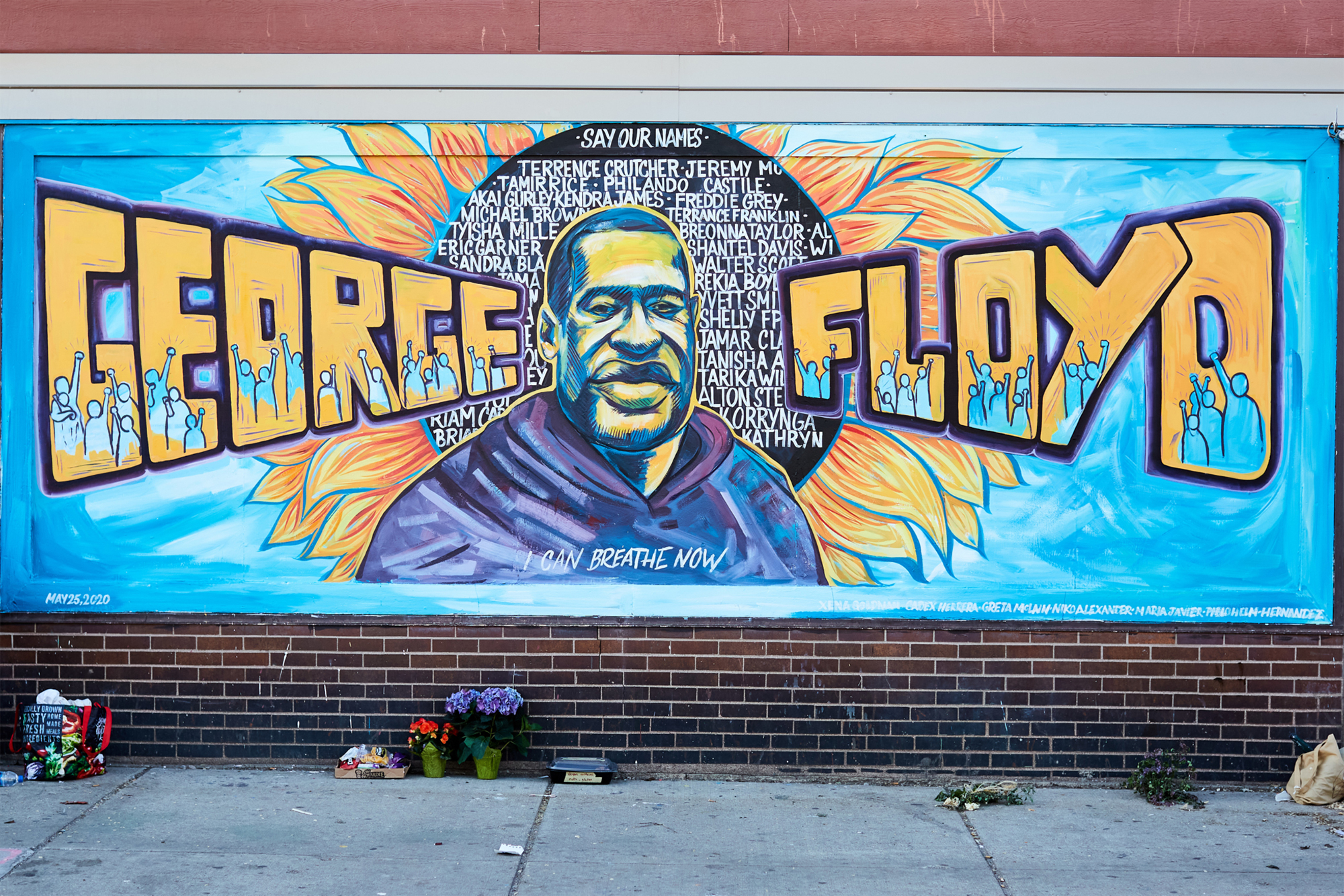
But they both require paint and skill – perhaps some just need a taller ladder.

1 Comment

Filed under Jean Zimmerman

The scents of the Grand Concourse,

both pleasant and foul, follow me as I walk the avenue inspecting trees to make sure they’re not injured by the major construction project underway, alerting the contractor to tree pits that have had stuff dumped in them.

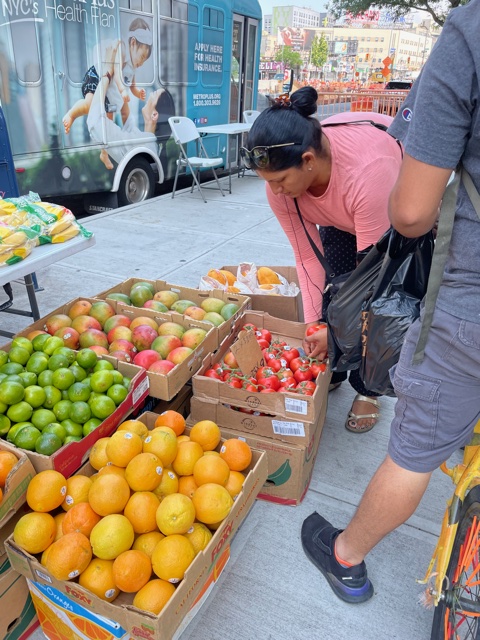
First is citrus heaven, as I go past the many small produce stands where the proprietor peels oranges on a spit, afterwards bagging them for the clientele. The aroma wafts out to the sidewalk, freshening the morning.

One not so lovely, the smell of the pet store. Canine poop and pee rise like a cloud in front of the shop.

Puppy mill puppies include that little Golden in the window,  and can cost 2,800 dollars in the case of this English bulldog.

Which I would love to bring home, but can’t afford. Plus I prefer pit bulls.

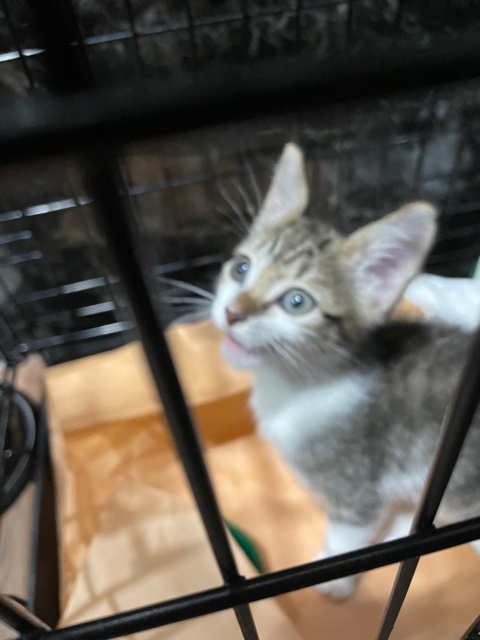
Speaking of pets, the bodega I patronize just acquired a kitten named Winston, who is kept in the bathroom but has perfumed the whole store already.

Hard hats do not usually patronize shops here, but I go in if I’m interested.

I enter a nail salon to use the facilities – they really seem like every other store in the Bronx, alternating with hair braiding places – and I’m hit with dense, choking smoke from the acrylic shaping that goes on here. The bathroom is sparkling clean, as is the case in every establishment run by women here.

A relief to pass by the other big presence, the laundromat, with its sudsy air emanating from the open doors. 

The trees themselves offer a green breeze, especially if you harvest a few to determine the species – some sort of elm, as yet to be determined, with a problem as evidenced by the pin pricks.

And at the fish store, where the fish seem to have just swam in from the sea, the tangy salt breeze begs me to take home a salmon, bluefish, anything but the shark, a species which is now being overfished. In the morning they take them out of boxes of ice and line them up in an orderly fashion for choosy shoppers.

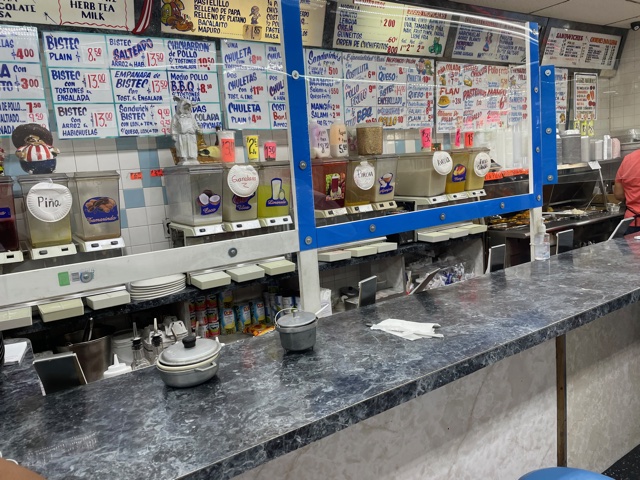
Or you can go to the cuchifritos restaurant, a hole in the wall that doesn’t even have a name in the window. The smell of the best fried pork in the neighborhood draws long lines, and when I wait I have the most delicious pina colada I’ve ever drunk.

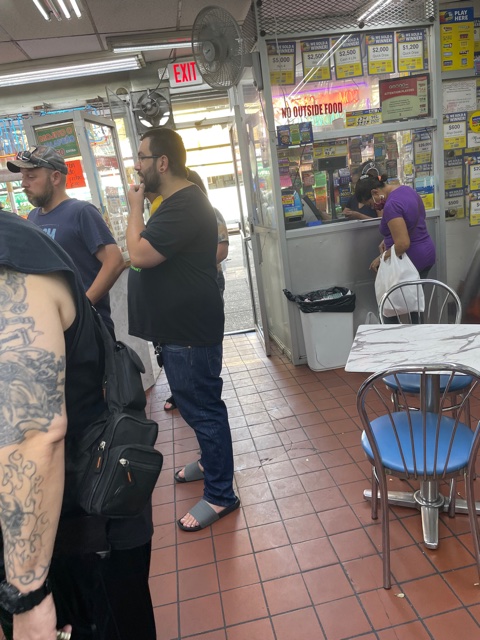
It’s the only eatery I’ve ever patronized with a Lotto booth. Well used, too.

And finally, the garlic that hits my nose when I rip open the tostones package, its contents rich with grease and salt. Every day I promise myself I won’t indulge, a promise inevitably broken.

It’s an aromatic distinction of the Grand Concourse, one of so many. I’m going to get a bag of Tostones right now.

1 Comment

Filed under Jean Zimmerman

Some biology etymology

for the curious, and useful in dinner party chat.

Canopy cover is vital in arboriculture, in description of those overhead limbs that weave together and block some of the sun’s rays, but what about those trees whose branches seem to avoid touching those of other trees? Do they actually exist? There are several. The phrase describing them is crown shyness, and it takes place in some forests, particularly those with lodgepole pines, eucalyptus, mangroves and some other tropical trees. Why? Botanists don’t have an answer yet, but it might have to do with a far-red (one down from infra-red) light reflected from neighborhood foliage which makes twigs at the end of branches shy away from each other.

Crown Shyness of a Rain Tree

On a completely different note, two unrelated  creatures have a similar problem and thus develop similar solutions. Like porcupines (rodents) and hedgehogs (insectivores). Convergent evolution describes how they develop similar spines. You knew that, probably.

Perhaps Illegal to Keep as a Pet

Dewlap is a word Dickens might utilize to describe the chins of an elderly person to comical effect, but in biology it refers to the wobbly flap of skin under the chin of large herbivores such as the moose, eland – African antelope —  or kouprety — a rare species of wild cattle in Asia. Iguanas also have dewlaps that fold up until they need to inflate them to impress females. As if they’re not cool enough already.

An Eland in the Sunset, Amboseli National Park, Kenya.

The cute little worm lizard, termed an amphisbaenian, is blind and legless, and neither worm nor lizard. What it has is a sharp set of teeth, and it belongs to a distinct set of reptiles found mainly in Africa and the Americas. They spend their lives burrowing under the ground. Fun! Some scientists believe they are closely related to the ancestors of mammals.

Worm Lizard Camouflaging Itself on a Human Finger

Conservationists sometimes seem to focus a little too heavily on flagship species such as the giant panda or wolves or elephants in order to gain funding. No matter how tired you might be of panda appeals (or maybe you’re not and never will be sick of pandas) it’s a good thing. The protection of their habitats protect less charismatic threatened mammals, amphibians and bird.

An Especially Fetching Panda

Batesian mimicry occurs when a harmless insect, say the marmalade hoverfly,  mimicks the markings of more dangerous insects like wasps and bees to gain protection by association. I know they would fool me. Named for Norman Bates?

Episyrphus balteatus or Marmalade Fly, a very common hoverfly.

Spiders and scorpions have book lungs, their way of extracting oxygen from their surroundings and expelling carbon dioxide. These are enclosed in under-body pouches that resemble a loosely bound book – it’s thought that they evolved from the underside of an aquatic ancestor resembling horseshoe crabs. Are horseshoe crabs edible? Just an idle query.

Scorpion (Opistophthalmus carinatus) in defensive position, Kalahari desert

Scientists have described it as the single most important event in anyone’s life: gastrulation, the moment when a simple cluster of cells folds in on itself to produce a gut, a front and back end, and the basic tissue types. In vertebrates (us, but also creatures like the starfish) that first dent in the cluster’s surface becomes the anus. In everything else it becomes the mouth.

Impossibly Beautiful Starfish

4 Comments

Filed under Jean Zimmerman

More spooky doings

in the Bronx. A fresh length of topsoil is laid down in one of the new medians at 175 Street on the Grand Concourse. This will bring shrubbery and trees in all shapes and sizes to the neighborhood. It will, we hope, transform the lives of people here in some organic way.

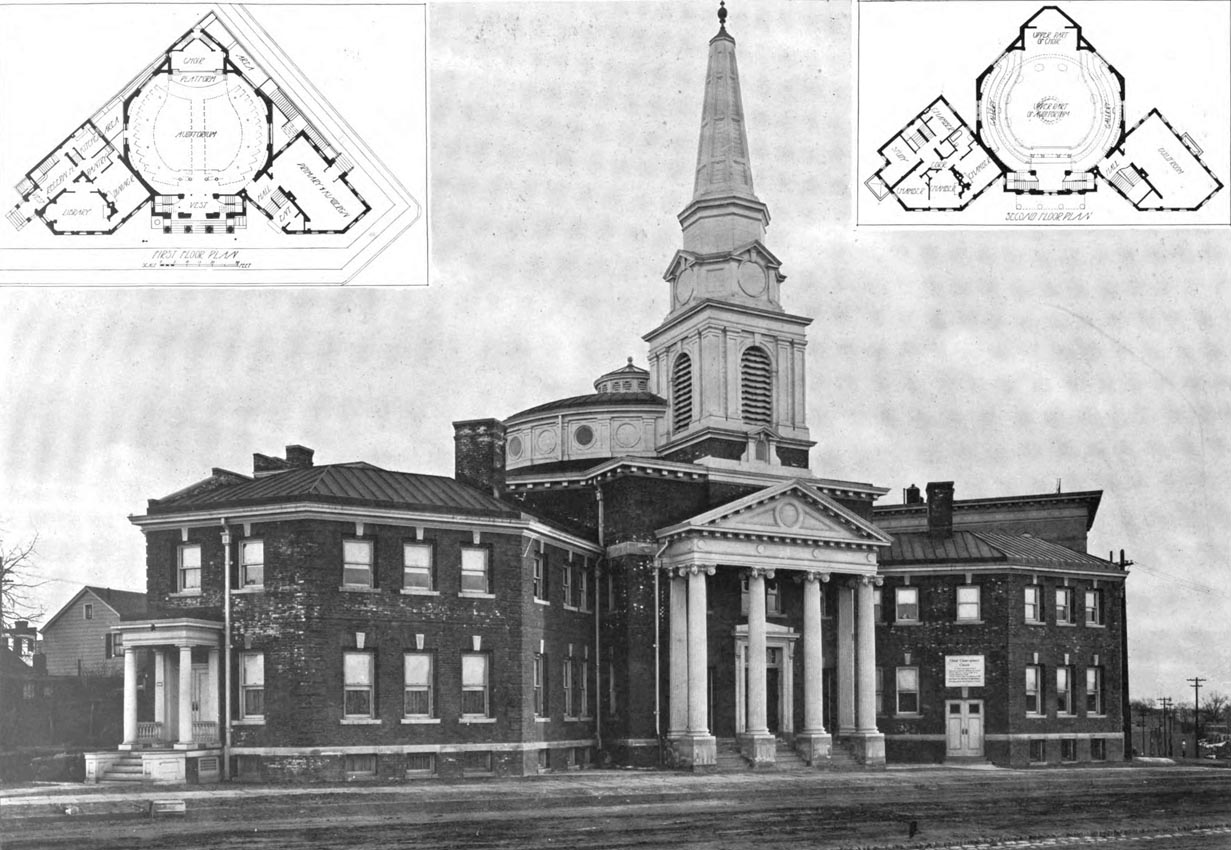
Meanwhile, I happen to look up, and floating above, grey against the grey sky, is the cupola of what I am to find is a derelict church over one hundred years old.

It is all locked up so I can’t get in to see it. A fellow inspector tells me that homeless individuals had holed up in part of the building, until they were finally evicted, after years of effort.

The church was built in 1910, by Christ Congregational Church of Mount Hope, of Georgian-style red brick and white trim. Spacious and handsome, it was designed by  Hoppin & Koen of New York City, the same architectural firm that created the Albany County Courthouse and other distinguished structures. In the center of the building, the sanctuary has a domed roof of tin, painted green, and an entrance framed by a portico with four columns. I can vaguely see them behind the chain link fence. Above the portico is the square tower that is still visible, and which once held up a tiered steeple.


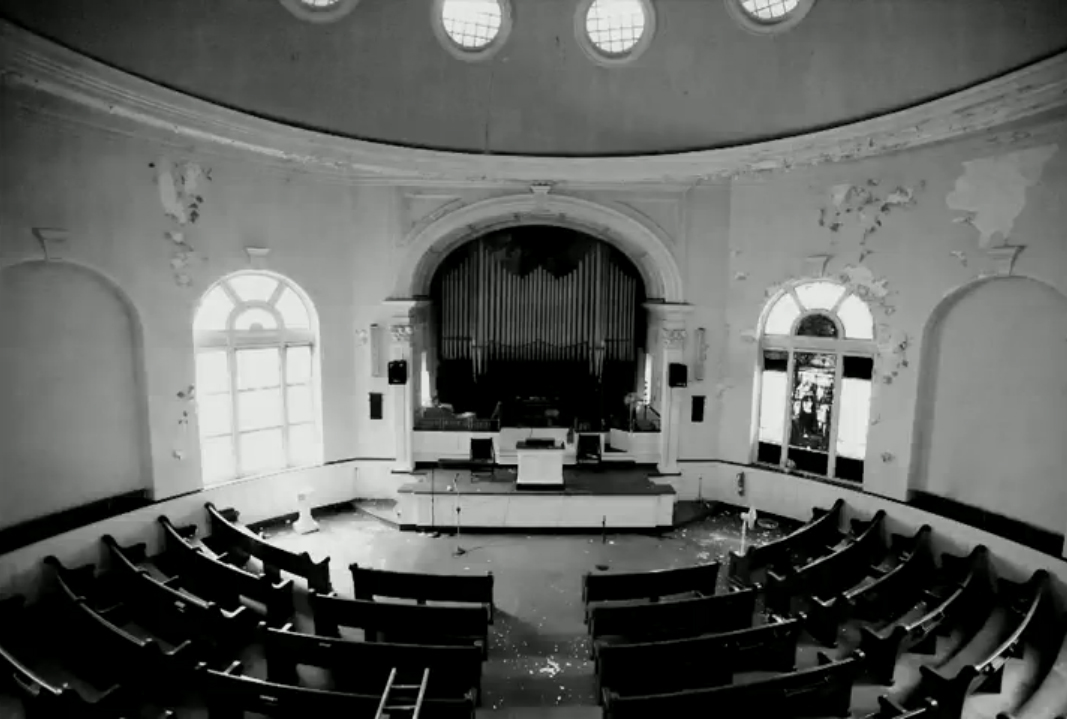
For decades the church had a large and worshipful congregation. There is an auditorium that can hold almost 400 people, as well as a gymnasium and meeting rooms. Recently it was owned by the Pilgrim United Church of Christ.

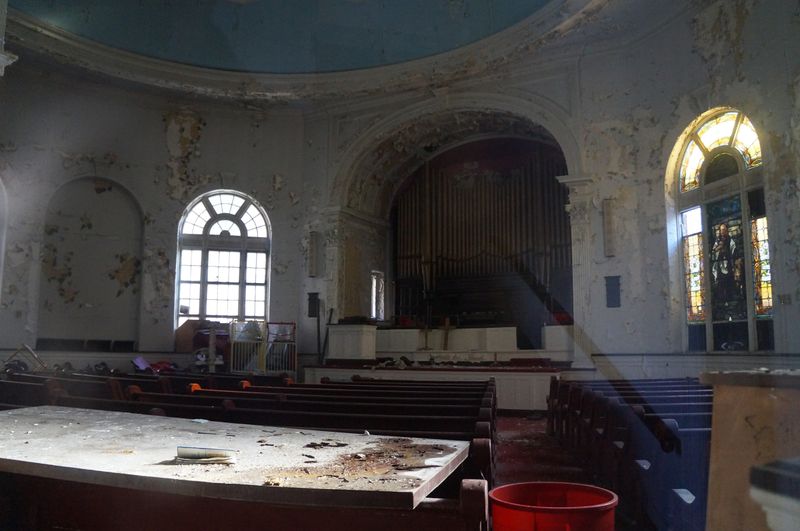
When things fell apart, paint and plaster peeling—supposedly because various pastors let the structure go to ruin – this was the result. It carries myriad Department of Buildings violations.

Its magnificent organ was silenced.  Made by M.P. Möller, in Hagerstown, Md. in 1914, it had a deluxe tubular-pneumatic action. It was tested in 2012 and found to be ruined.

Various residents of the neighborhood have fought so that the church would not be razed and turned into a proposed homeless shelter. The local Community Board sees potential for the building as a cultural venue for the Mount Hope locale. 1,000 people signed a petition. A determined few congregants still huddle in a side room to pray. Outside the locked gates, I meet a couple of young men who would probably be candidates for that shelter – they were standing, shuffling, seemingly waiting for someone. They inform me that the current Dominican Pastor is a fraud – they had in fact been living on the first floor and he evicted them and he doesn’t even own the 

building, they gripe. They don’t mention ghosts, but I am sure there are plenty around in the cavernous church.

They leave and the pastor arrives in his shiny red  SUV. Unlocks the gates, backs his car inside.

That must be Reverand Israel Martinez, he of the Iglesia Evangelica Los Peregrinos.

Maybe someone will succeed in saving this sad, crumbling architectural once-gem. In addition to new plantings and trees outside, the people who live in the neighborhood, could use a beautiful place to go, and to pray if that makes sense for them. It could be as beautiful as the new trees on the medians.

2 Comments

Filed under Jean Zimmerman

New York Trashy

Should be the nickname of this small piece of the Bronx. You can’t escape the litter.

Maybe there just aren’t enough appropriate receptacles?

Someone carefully put her half-full cup on the ground. I don’t like Dunkin iced coffee either, but I don’t leave it just hanging out there.

There are guardians of the clean everywhere if you look for them.

Every day I walk past Darion hosing down the sidewalk in front of the defunct Paradise Theater.
His job is to keep the place clean, “and it’s big!,” he told me. It sure is — in its heyday it was one of the biggest in the city, if not in the country. Some of the other shopkeepers water their sidewalks, too – I like that as it cleans the soles of my workboots when I walk by.
Others use a ubiquitous small broom and dustpan to get the litter.

Tidy.

The proprietor of a juice bar told me, “You have to keep it clean. It’s better for business.” I will go in to get a green smoothie today.

First thing in the morning, 7am, they are out creating order out of chaos.

Discarded masks lay around everywhere.

What happened? Did someone just get tired of wearing it and fling it to the ground? Three quarters of the residents here wear masks inside and out, everybody, old and young. I don’t know whether this means they haven’t got the vax or that they got it and they’re protective anyway.

I engaged a sanitation bigwig in a starched forest-green uniform and badge and a driver in her streetcleaning vehicle about the trash. Number one, he intoned, there are three types of trash – homeowners, shops, and garbage on the ground (duh).  It’s much worse, he said, since Covid. Alternate side of the street parking was suspended, which I took to mean that it was hard for garbage workers to get through the cars to get the bags. He said that when they have the resources the City makes inroads with the sidewalk trash. And oh yes, he said, noting my hard hat and reflective vest, the contractors working here are responsible for much of the garbage. What else should he say when I asked him why there was so much garbage lying around. He did not wish to have his photo taken, nor did she.

I don’t think this bench/table is trash, it was simply left in front of the supermarket overnight and serves some purpose.

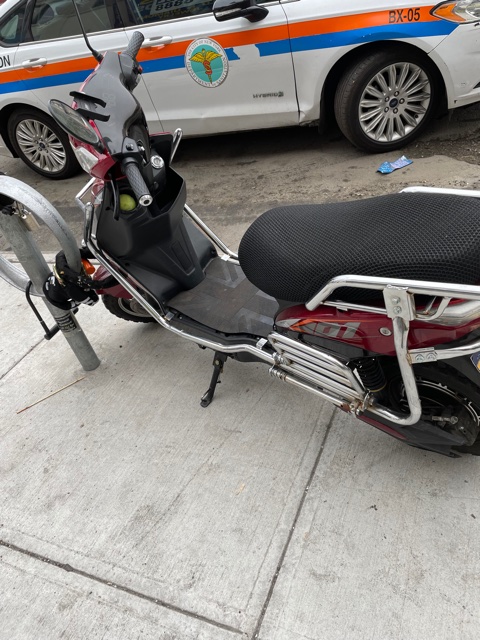
There are clean shiny things in the neighborhood. Scooters and sanitation vehicles.

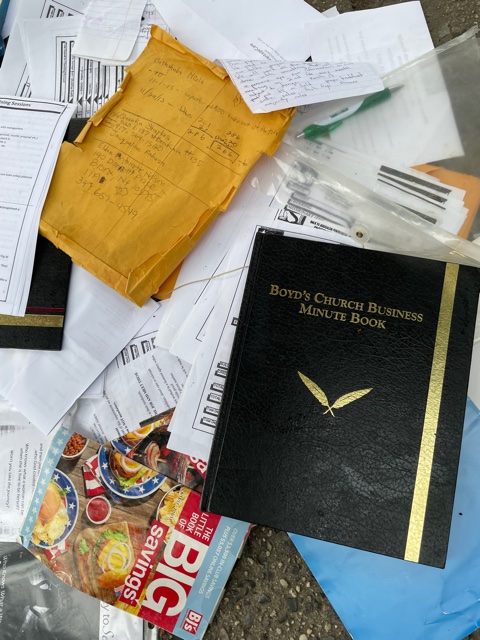
Sometimes you have a jarringly deep glimpse of a person’s life.

What happened to this individual and how did so many important documents end up scattered on the Grand Concourse? There is a story there.

Sometimes it’s a glimpse you don’t want, like a used Q-tip.

Tree pits grow yuck as well as trees.

There I draw the line. Each tree should enjoy a pristine growing environment. Although I’m biased, of course.

And I haven’t even gotten to New York Shitty. All the kindly sweepers and washers couldn’t banish what the dogs leave behind.

4 Comments

Filed under Jean Zimmerman

The beauty of street trees

is the subject of Matthew Lopez Jensen’s Tree Love: Street Trees and Stewardship in New York City, https://www.terrain.org/2021/unsprawl/tree-love-new-york-city/. I highly recommend the article’s beautiful photos and elegant prose.

Leave a comment

Filed under Jean Zimmerman

If you go to the High Line

don’t expect to have it to yourself. Once upon a time if you happened to be passing through Chelsea you could wander up to the one and a half mile long park and the sensation would be one of openness, a respite from the claustrophobia that comes with living in a city with 8 million people. Now you need a timed pass to gain entry.

The guy in the Willie Wonka hat gave us a break though, letting us by like a couple of celebrities.

What first inspired a coalition of people to create the High Line–once the railway for provisions headed to lower Manhattan and making its way directly through some buildings as it went–was the realization that the railbed had become host to a veritable meadow in its years of disuse.

It also hosted junkies and hookers, needles and condoms, but the coalition was made up of visionaries. This part of town had had many lives. In earlier years, the 1920s, a different train had gone down 9th Avenue proper, killing so many pedestrians that cowboys were called in to warn people away from the tracks, waving red bandanas as a visual aid. For a time the area was known as Death Avenue.

Once the tracks were elevated, transit of foodstuffs was assured. Meat, especially, came down to Gansevoort street and the warren of warehouses that made up the meat market. The trains stopped running with the rise of trucking, ending in the ‘80s. When I first lived in New York during that decade I remember seeing beef carcasses hung in open bays and cobblestones slick with blood and lard.

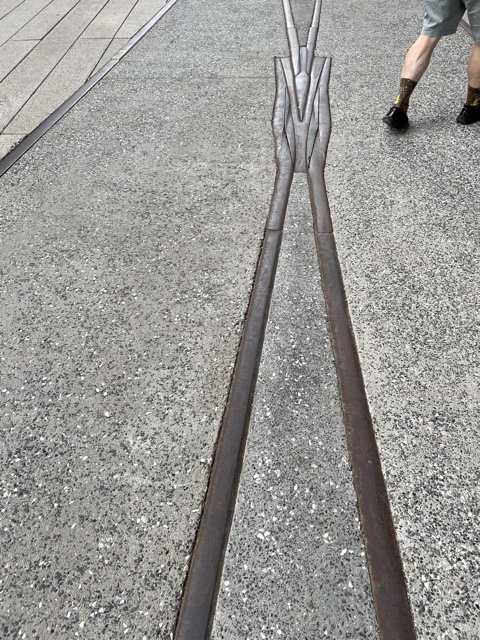
There is little residue of that time today, though the rails remain.

The gardening team has created a gem that changes with the seasons.

Today, purple coneflowers dominated. The rails show through.

Since the High Line opened in 2009, the birches have grown up.

And some trees you wouldn’t imagine would flourish, like this big leaf magnolia.

Art is everywhere.

Though sometimes you have  to seek it out.

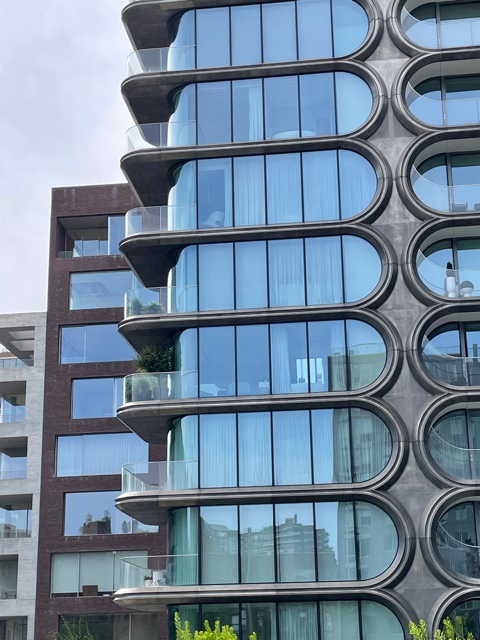
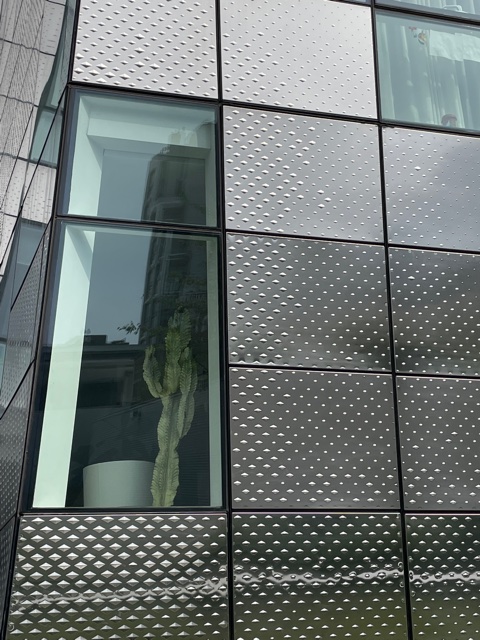
But what also has grown is the throng of new buildings that crowd the park on every side.

Some apartments are so close that you feel like a snoop just walking along.

In fact, when I first started going to the High Line it was rather famous for a glass building that housed sexual exhibitionists.

Many views are blocked, though you can still look straight down 23rd street, and if you happen to be in the right spot you can see the Hudson.

But the main thing you see is people.

It is a babble of foreign languages, with the High Line featured in guide books all over the world.

And everyone is marching along, phones held aloft for pictures (me included, obviously). It’s a place that is quintessentially urban, a crowd scene – but isn’t that why we visit New York City?

Leave a comment

Filed under Jean Zimmerman

Even at seven a.m.

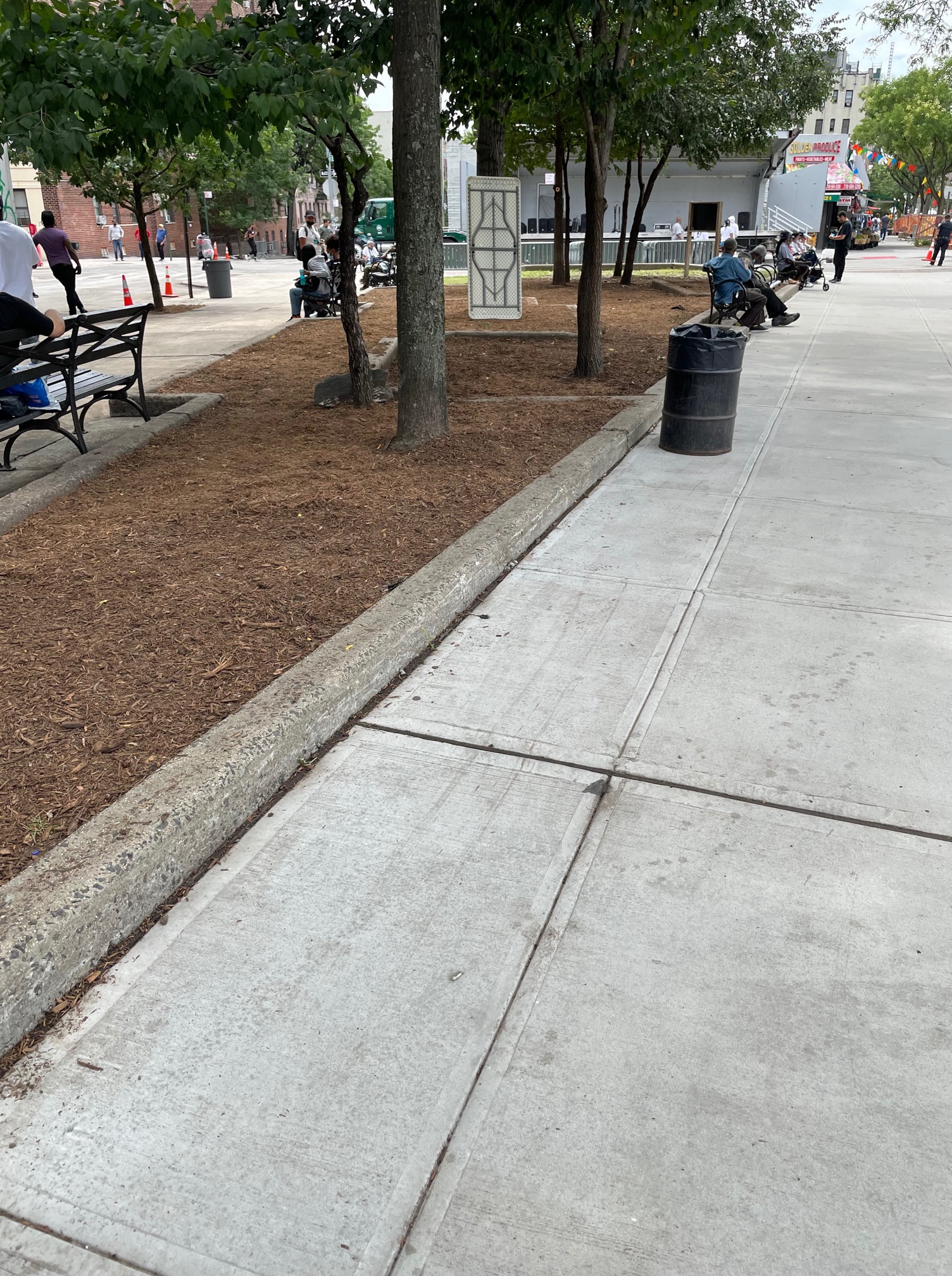
you could tell something was going on. The tiny park across the street on the Grand Concourse had been miraculously covered in clean mulch overnight, its tree pits and the ground all around and under the benches dark brown and shredded, all new.

The sign announcing the name of the park, the Bergen Triangle, is almost as large as the park itself.

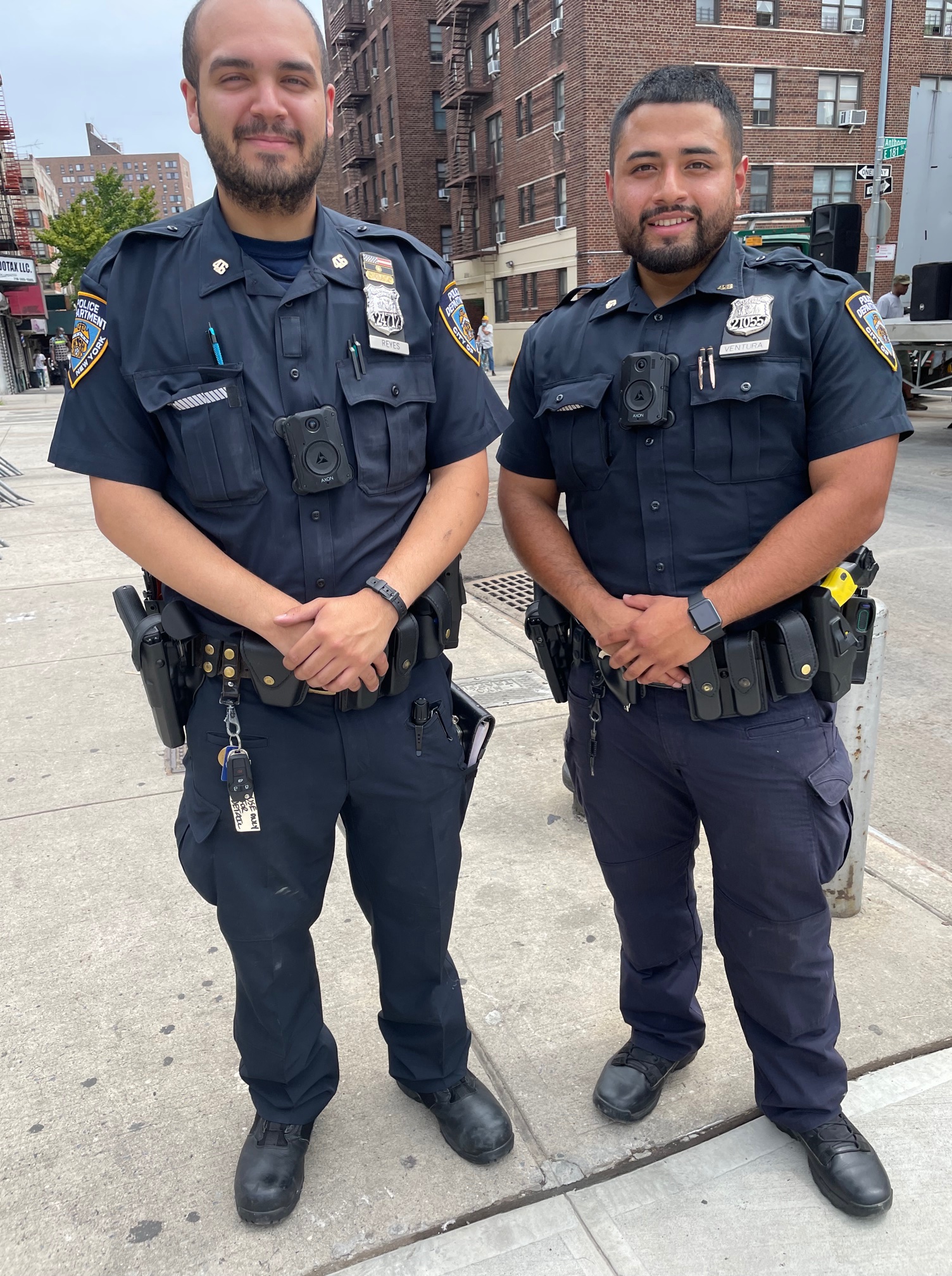
Two Parks employees wielded leaf blowers to chase away stray shreds. Then blue tents marked NYPD went up along one side. A cop brought over a metal barricade to divert traffic from the Concourse side road. Cars parked inconveniently found themselves towed.

Sanitation vehicles, street sweepers, began to circle the triangle – three, four times. Someone wanted this area to be spic and span.

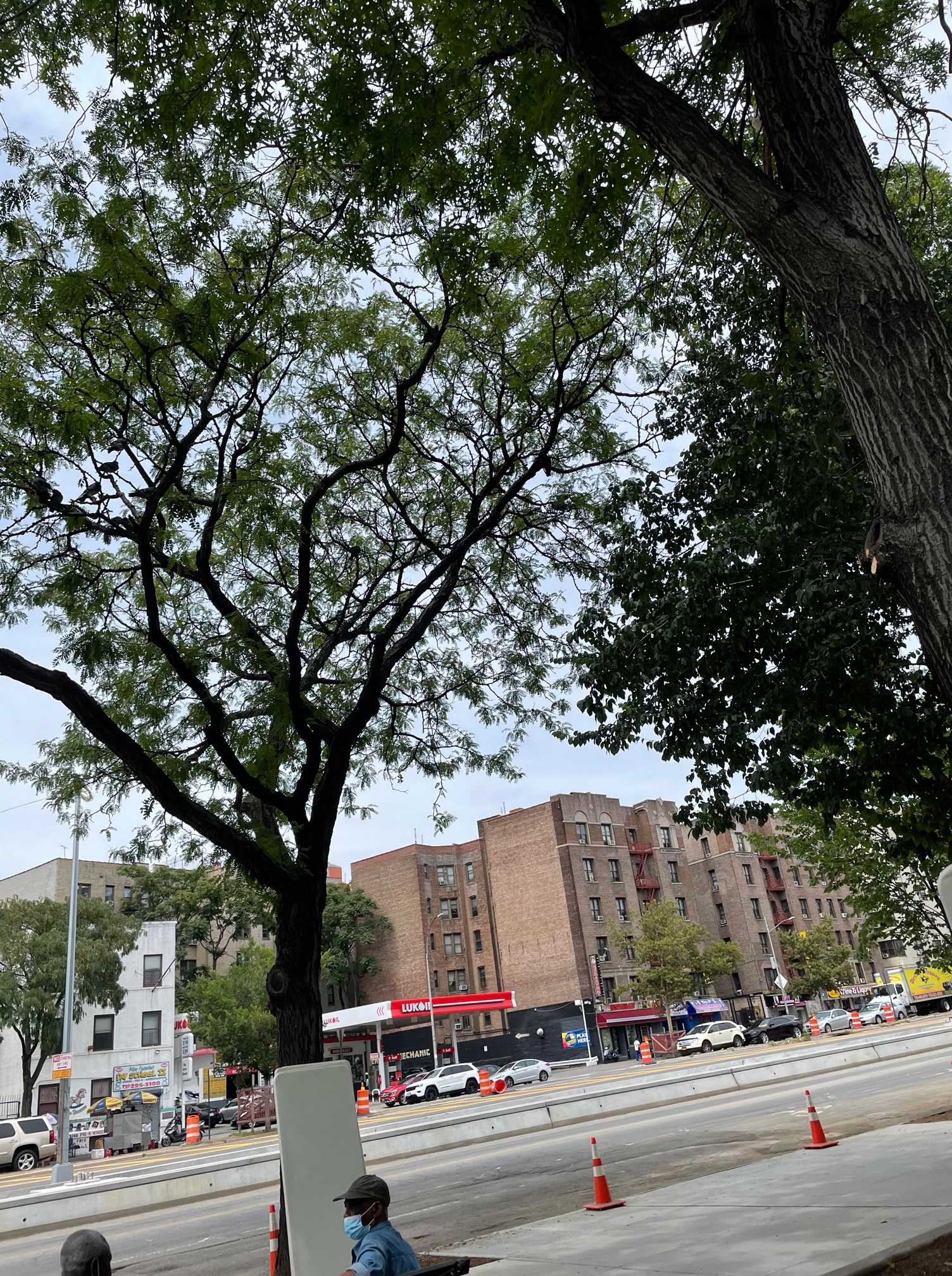
This park is usually distinguished not by cleanliness but by its canopy.

People settle in there to talk, play music, sometimes rap with a  speaker, and feed the pigeons – hence the thick coating of bird droppings on the sidewalk, something hard to avoid as I’m walking up the avenue to the work site. Some of the park sitters are lunatics, but most sit calmly enjoying the shade, which is what much of the Concourse lacks.

Recent studies have revealed the immense importance of shade on both health and mood.  When urban areas lack tree canopy people suffer.

I smelled a visit from a dignitary in all this tarting up activity. The Governor? the Mayor? Lady Gaga? I figured the action would be coming from the direction of the 94thPrecinct stationhouse a block away on 181 Street.

The Bergen Triangle originated when New York City acquired the land “for street purposes by condemnation” according to the web site of New York City Parks and Recreation. After Anthony Avenue was completed, the Department of Highways and Transportation turned the leftover lands to Parks in 1932. Parks created the bluestone-curbed, cement sidewalked, turn-of-the-century-style benches with shrubbery and pin oaks. These are the type of benches that Robert Moses favored.

Note: there are a few pin oaks still but honey locusts dominate as always in this neighborhood (the kind mercifully without thorns).

The park’s name came from William “Billy” C. Bergen (1862-1925), a one-time policeman known as the “millionaire cop” because he made a fortune developing empty lots in the Bronx at the beginning of the 20th century after starting a career as a beat cop. Walking his beat, Bergen couldn’t help  but notice large land lots as yet undisturbed by the new subway lines just coming through. When the Third Avenue El and the Jerome Avenue El opened, bringing people and industry, Bergen bought and sold with gusto, eventually becoming a developer and builder and finally a mover and shaker in Democratic politics. A small number of his houses still stand in the Bronx.

Millionaire Cop

Bergen Triangle is bounded by Anthony Avenue (the aforementioned street with the empty land — hard to imagine now), Grand Concourse and East 181 St.

Sirens start to sound. Is it starting? No, that’s just an ambulance wailing as usual.

Friendly cops congregate all around the park.

A temporary bandstand appears, hammered together by Parks workers.

At 4:00, “National Night Out Against Crime” will start – in over seventy locations!—with the purpose of improving police-community relations. One officer tells me the Mayor will indeed “stop by.” Stop by? “Alright, he’ll speak.” There are to be barbecue, face painting, musical acts. And, probably thinking there is clean mulch in the Bergen Triangle every day, the Mayor.

Leave a comment

Filed under Jean Zimmerman

Is there a creepy feeling in the air

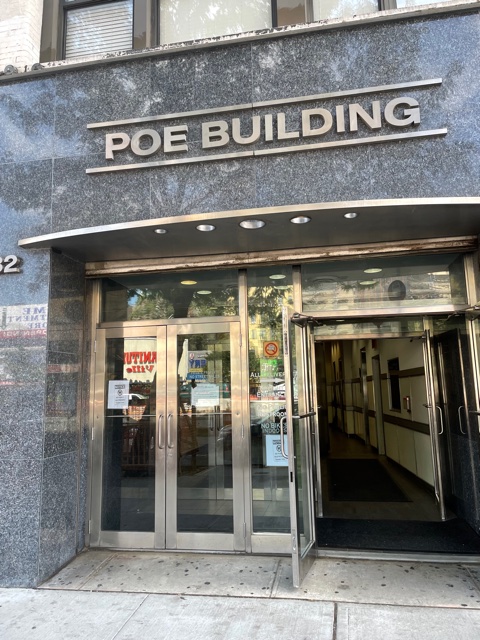
or is it just me? I’m standing on the sidewalk, looking up at a block-long office building with its name prominently displayed across the front: POE BUILDING. It seems incongruous now, but makes sense when you consider when the building when up, in 1917. The Grand Concourse had just been laid, and the people of New York were going all out to venerate Edgar Allan Poe.

Poe spent a lot of time in the Fordham neighborhood of the Bronx, but only after hopping around from one residence to another in New York City and elsewhere.

Born in Boston in 1809, he first came to Manhattan with his wife Virginia and his mother-in-law Maria, and stayed for a few months in the West Village. They moved to Philadelphia. They returned in 1844, living in a boarding house downtown before moving to a farmhouse owned by the Brennan family, in the vicinity of what today is West 84 Street and Broadway.

Over the years he published not only Gothic poetry but short stories and criticism. He was a central figure in the movement known as Romanticism. Some of his stories (The Tell-tale Heart is an especially creepy one I like) were gold. Supernatural and detective fiction were his specialties.

Poe was apparently the first well-known literary figure to try to support himself off his writing, and it’s unclear whether he made a good job of it. He had no children – perhaps a lack of funds is why. His checkered life included marriage to his 13-year-old first cousin Virginia and an ill-fated military career, failing as a cadet at West Point.

The Raven, an overnight success, was written at the Brennan Farmhouse, and The Evening Mirror, where Poe worked as a critic, was good enough to publish it. The newspaper’s headquarters at 26 Ann Street still have a plaque devoted to Poe (though apparently you can’t get in to see it), as do seemingly all the other nooks and crannies he made his own over the years. The site of Brennan Farmhouse got a plaque, too, when it was razed in 1922.

After yet again moving to Greenwich Village, Poe leased a small cottage in the Fordham section of what was then Westchester County, from the Valentine family. The rent was $100 a year. It was the spring of 1847.

In large part Poe moved there because of Virginia’s illness, tuberculosis – it was thought that the fresh country air would banish it. However, the same year they moved in, she died, and two years later 40-year-old Poe himself was to die, raving on the streets of Baltimore, whether because of disease, substance abuse, alcohol, suicide, syphilis, or existential. The cause has never come clear.

Fast forward a few years, after Virginia’s mother Maria desperately tried to sell off the house’s furnishings (Virginia’s death bed remains).  Literary-minded folks tried to save the cottage, and succeeded in 1913 when the house was moved to a new location, a newly created park with the great writer’s name.

It became a New York City landmark in 1966, standing at 2640 Grand Concourse at East Kingsbridge Road – just down the way from POE BUILDING at 2432, which went up in 1917 when the city was in the grip of Poe-mania.

Leave a comment

Filed under Jean Zimmerman

Shelter, below and above ground

is fundamental on this Grand Concourse construction site, where I am the resident arborist.

I’ve always had a penchant for the plywood trenches built for the crew to go down into the bowels of the earth to repair the sewer pipes.

They look so much like upside down houses, and the carpenter on this crew, Joseph, builds the house as the men proceed with the work, not before. People are always scrambling down long ladders to get to the pipes below.

It would be like living in a house as you construct it. This one is so deep that the walls have to be immensely sturdy and perfect – a person could easily be squashed in a collapse. It has happened.

I remember as a child building tiny dream houses in trees out of acorns and twigs. I climbed the apple tree sometimes but was more drawn to creating a home at the base of an oak trunk in the front yard.

Same, a little later, when I fell in love the The Borrowers, by Mary Norton, the novel which portrays a family living in a cigar box.

I would have given anything to do that, live in miniature, especially since I loved the smell of cigar tobacco.

I can also relate to that other essential element in construction – tree guards.

What is their purpose exactly? Someone who has gone down a street lined with them might inquire. Of course, they are created to protect the tree during construction, in particular to protect the critical root zone so that it doesn’t get trampled or mashed (compacted) in the course of the work, impairing the health of the tree. They’re also great for making sure a piece of heavy equipment doesn’t knock the tree over. Trees are perishable and need this protection. When the tree guard gets mangled by heavy equipment, you can knock the box back into shape pretty easily.

But who’s got the time to set them up straight the way they should be? Eventually, the foreman orders one of the crew to do it.

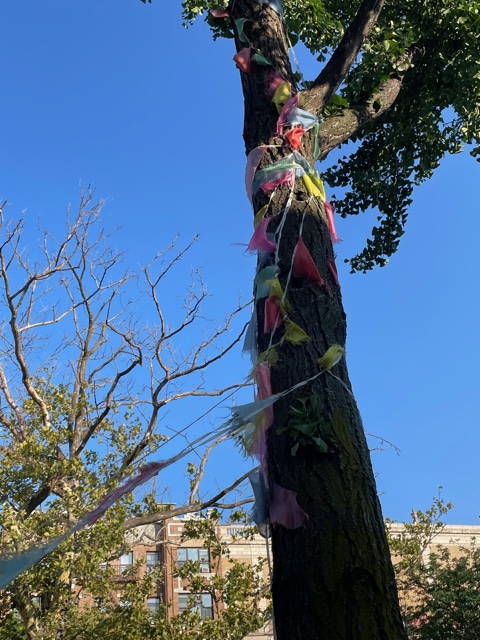
I’ve seen neighborhood people make tree guards a part of their lives, ornamenting them. These ribbons wind up from the tree guard.

Or using them in some kind of stunt, like hanging a chair over the top, ha ha.

Or just making use of them in some fashion. Mop drying.

They are inherently house-like, the perfect temporary home for a tree under assault by forces engaged in making roads and sidewalks.

So you may find their orange snow netting unsightly, but it serves a crucial purpose.

Tree protection–as the trench is person-protection.

Leave a comment

Filed under Jean Zimmerman

Dollar coffee

is a bodega staple I’ve always thought is among the best things in the Bronx. Hot, strong, milky and cheap. It’s universal in the borough, along with the chopped cheese sandwich (also known as a chop cheese), a mess of ground beef, melted cheese, tomato, lettuce, a mystery sauce and some other things on a Kaiser roll, guaranteed to drip down your chin.

Within this little microburst of a neighborhood, just a few blocks of the Grand Concourse, I’m beginning to scratch the surface of its foodways.

There is the grocery I park my car next to–onions out front– which features floors cleaner than mine at home, a full butcher counter, a sandwich maker, iced coffee, a spic and span bathroom (with toilet paper!) and a tiny litter box, presumably for a tiny cat. And at the cash register the loveliest woman, whose brother owns the place.

Searching in another greengrocer for a bathroom (It’s in the basement! Headshaking no) I’m in a quandary. This place has a dozen varieties of tuber but no public bathroom.

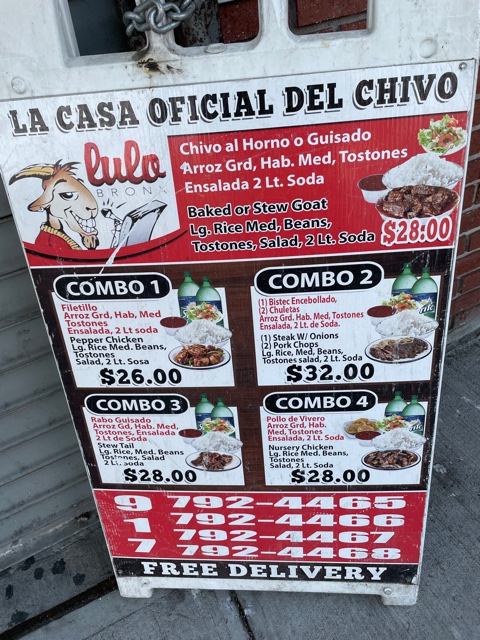
An elderly gentleman wearing a kerchief directs me to Lulo, a restaurant across the street.

It is the official house of goats. A guy on the sidewalk yesterday told me I look like a horse. Could have been worse. Anyway, I don’t eat horses, and I don’t eat goats, I like their Satanic eyes too much. Lulo is also immaculate, all of its furniture covered with slick, easy to wipe down plastic.

Home to the dollar coffee, the Grand Concourse is also home to The Real Coffee Man.

And, shock, the dollar slice.

I thought that was obsolete. And I’ll give it a try one of these days, coffee on the side.

There is such careful attention given to selecting among the fruits and vegetables on the little produce stands on nearly every corner. The proprietess tenderly chooses the perfect tomatoes for a man on a bike.

Kennedy Chicken, Popeye’s and Dunkin may have a foothold here on the GC, but as long as chop cheese reigns, they will never push off the mom and pops.

1 Comment

Filed under Jean Zimmerman

Outside of NYC

you wouldn’t guess we have

native plants

waterfalls

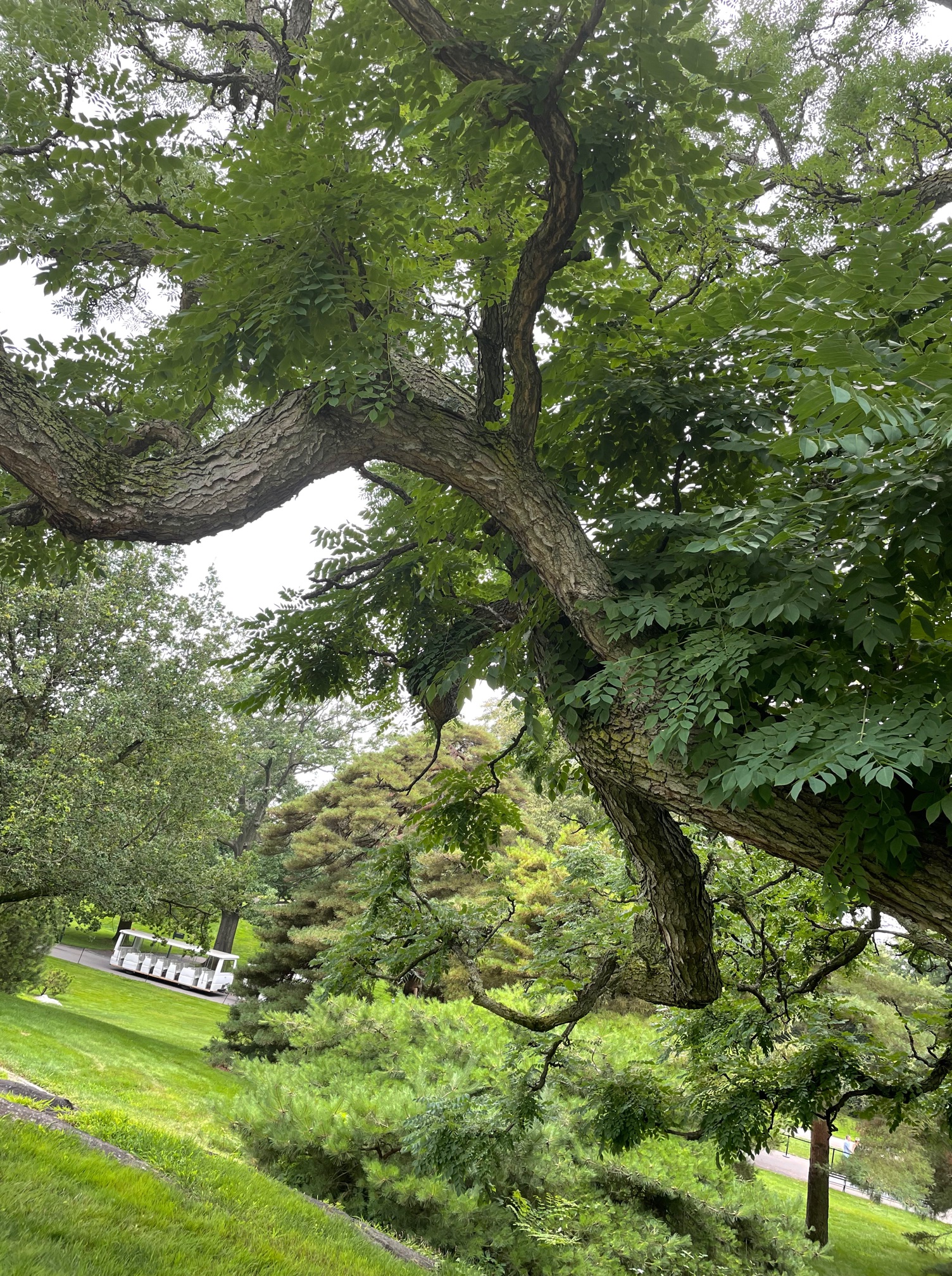
towering old trees (this one a kentucky coffee tree)

wildflowers

magical floating spheres amid reeds

more wildflowers

But we do.

When you come to New York, go to Times Square or the Statue of Liberty, by all means, but visit the Botanical Garden in the Bronx if you want to get your green on.

1 Comment

Filed under Jean Zimmerman

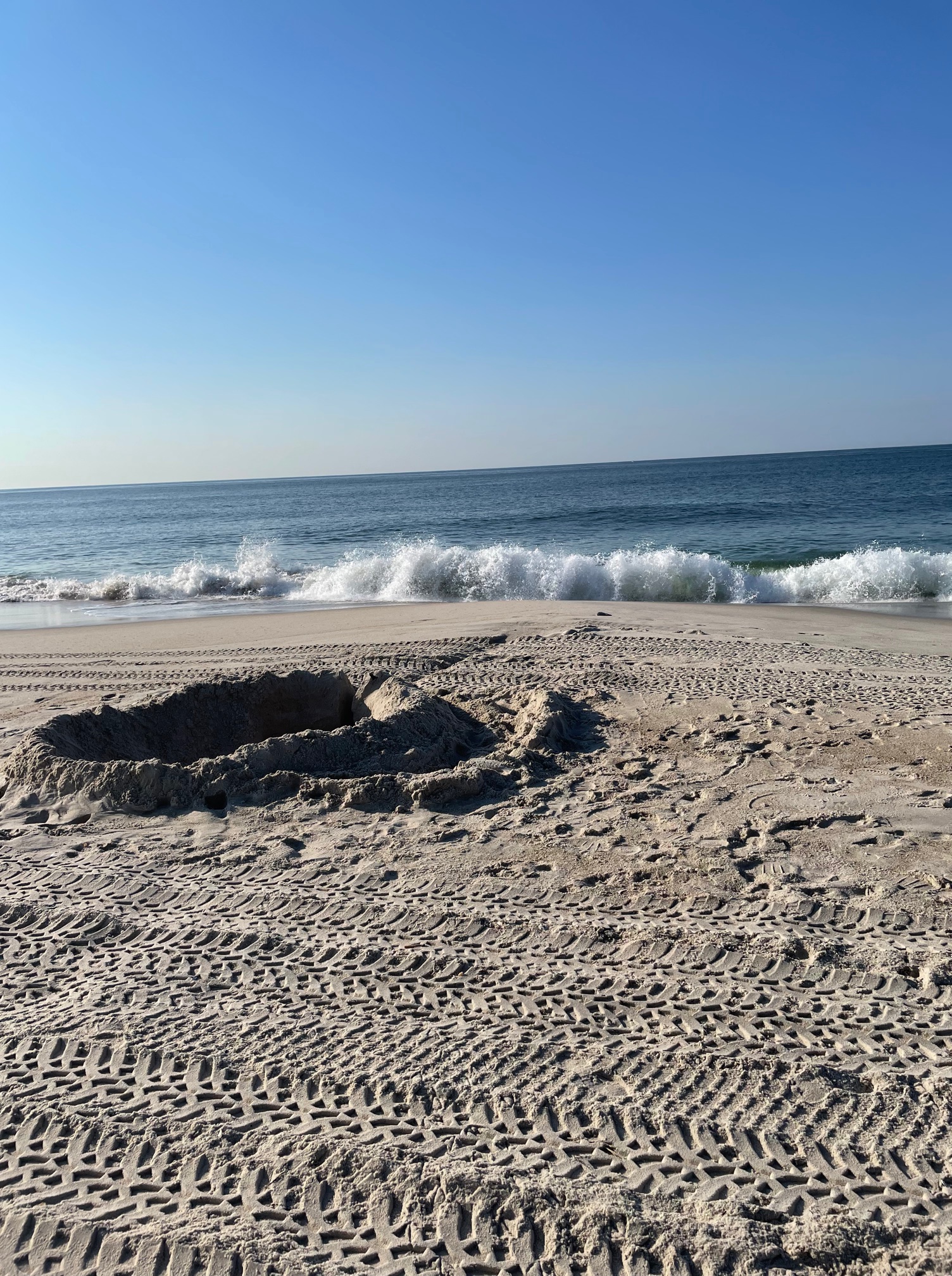
The crater was there

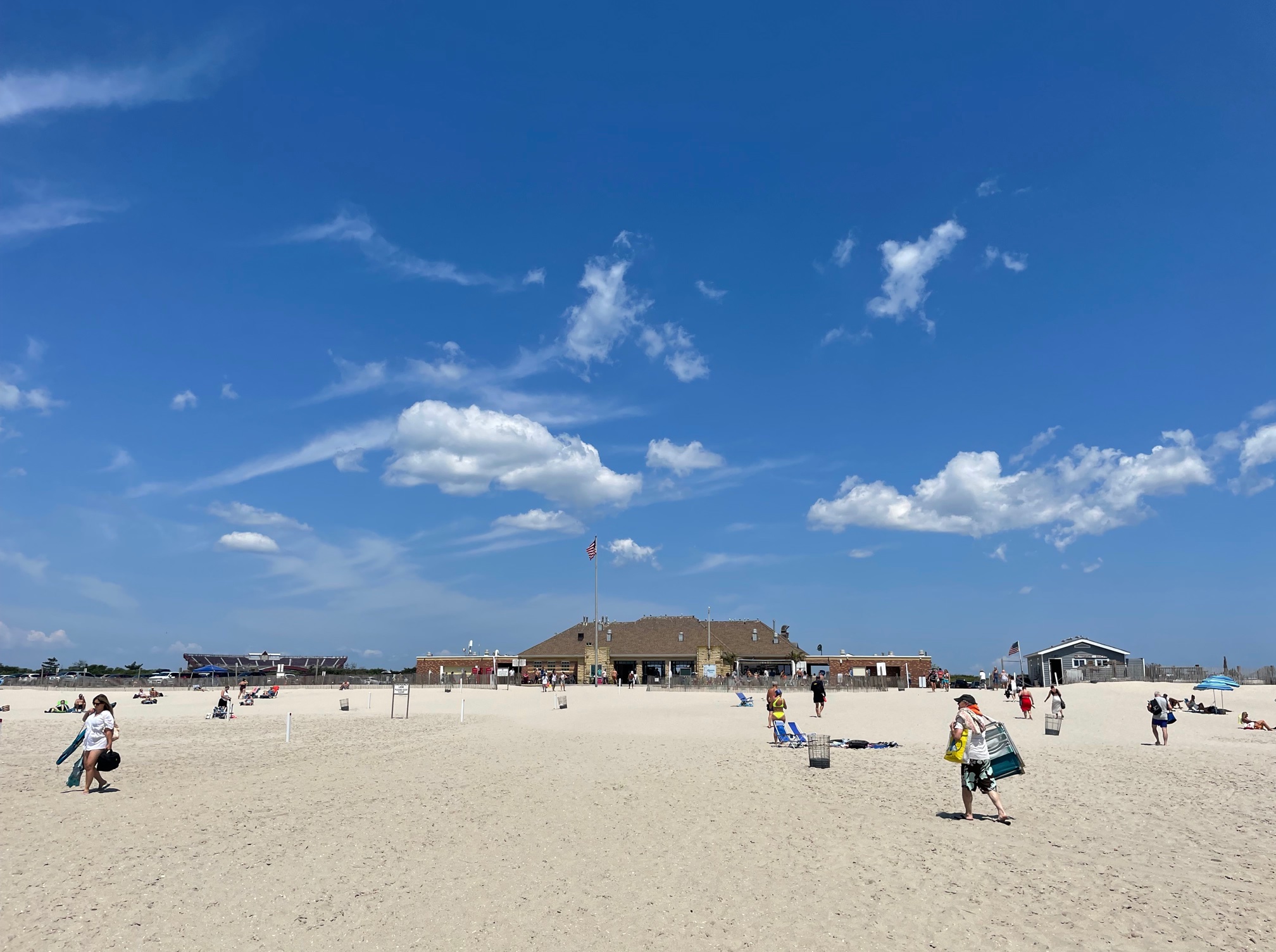
when we arrived at Jones Beach. Could this be a more perfect beach day?

I commented that if the deep azure of the sky had a few puffy clouds it might be even more perfect.

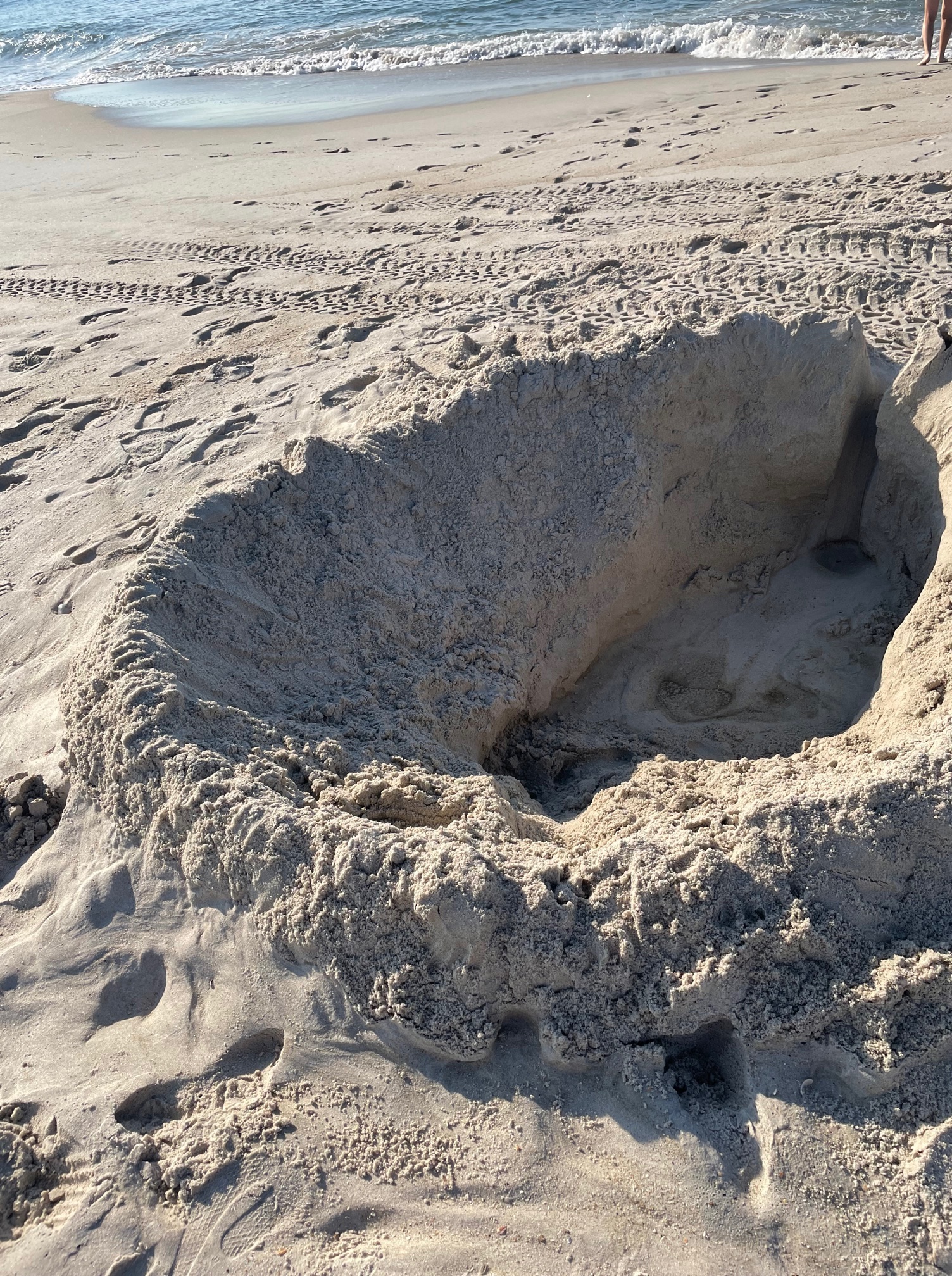
It was wonderful, though, getting on the sand so early that the crater was just feet away from our chairs. It would keep pesky beachgoers (just like us) at a distance, and yet afford us entertainment throughout the morning.

Someone had worked hard at digging it, that was for sure. How deep did it go? I imagined an underground grotto populated by hibernating seagulls and some of the sharks the lifeguards warned us against as they hurriedly blew their whistles and hustled swimmers out of the drink for about half an hour.

Little kids and parents approached the side of the crater. Parents, one after the other: Don’t touch, someone else made that, its theirs. Ever vigilant. We thought children would defy their mothers and fathers, but they all seemed too shy or intimidated to jump right in, as we thought at least some would.

One girl drifted all around the crater’s edge, touched the sand, drifted some more, while mom waited impatiently for her to come down to the ocean. (Note: thongs are the suit du jour.) The daughter peeked over the side, took a handful of sand, followed when her mother beckoned, then gravitated back to the crater.

It was a little like that psychology experiment with the kids and the marshmallows. They’re given just one and told that if they wait to eat it they’ll get three. When we watch through the hidden window, they almost all stuff their faces immediately. In this case, delayed gratification, or no gratification, seemed the rule of thumb. I did see a boy burying himself in sand. Maybe he would brave the crater?

In all the sand-and-surf delight and bonhomie that seems ever present post-Covid (post- in our hard fought corner of the country, New York), something stood out. The ice cream vendor was back – Chipwich! Frozen milky way bars! Frozen fruit bars!

Jorge hadn’t sold on the beach last summer during the pandemic. Now he was back, and a coconut Froz Fruit never tasted so good.

Those puffy clouds? They arrived as we got ready to go. What is more perfect than perfect? 

I don’t know, you tell me.

Leave a comment

Filed under Jean Zimmerman

Birds to wear and to eat

I heard a lecturer today refer to birds whose populations had been depleted at one time because people chose to hunt them in great quantities, often to eat. Robins, he enumerated specifically. A recipe for robin pie was printed in Wehman’s Cook Book, in 1890: “Cover the bottom of a pie-dish with thin slices of beef and fat bacon, over which lay ten or twelve robins, previously rolled in flour, stuffed as above, season with a teaspoonful of salt, a quarter ditto of pepper, one of chopped parsley, and one of chopped eschalots, lay a bay-leaf over, add a gill of broth, and cover with three quarters of a pound of half puff taste, bake one hour in a moderate oven, shake well to make the gravy in the pie form a kind of sauce, and serve quite hot.”

In the 1800s, species that went extinct included the Great Auk, the Labrador Duck, and the Heath Hen. Today, many birds are protected by the Migratory Bird Treaty Act.

John James Audubon, for whom the Audubon Society is named, painted wonderful renditions of birds and sometimes snakes. See his Ferruginous Thrush, from Birds of America.

What is less well known is that once he had shot and posed his subject out in the wild in order to paint it, he would roast the carcass for his dinner. I wonder how the Ferruginous Thrush tasted.

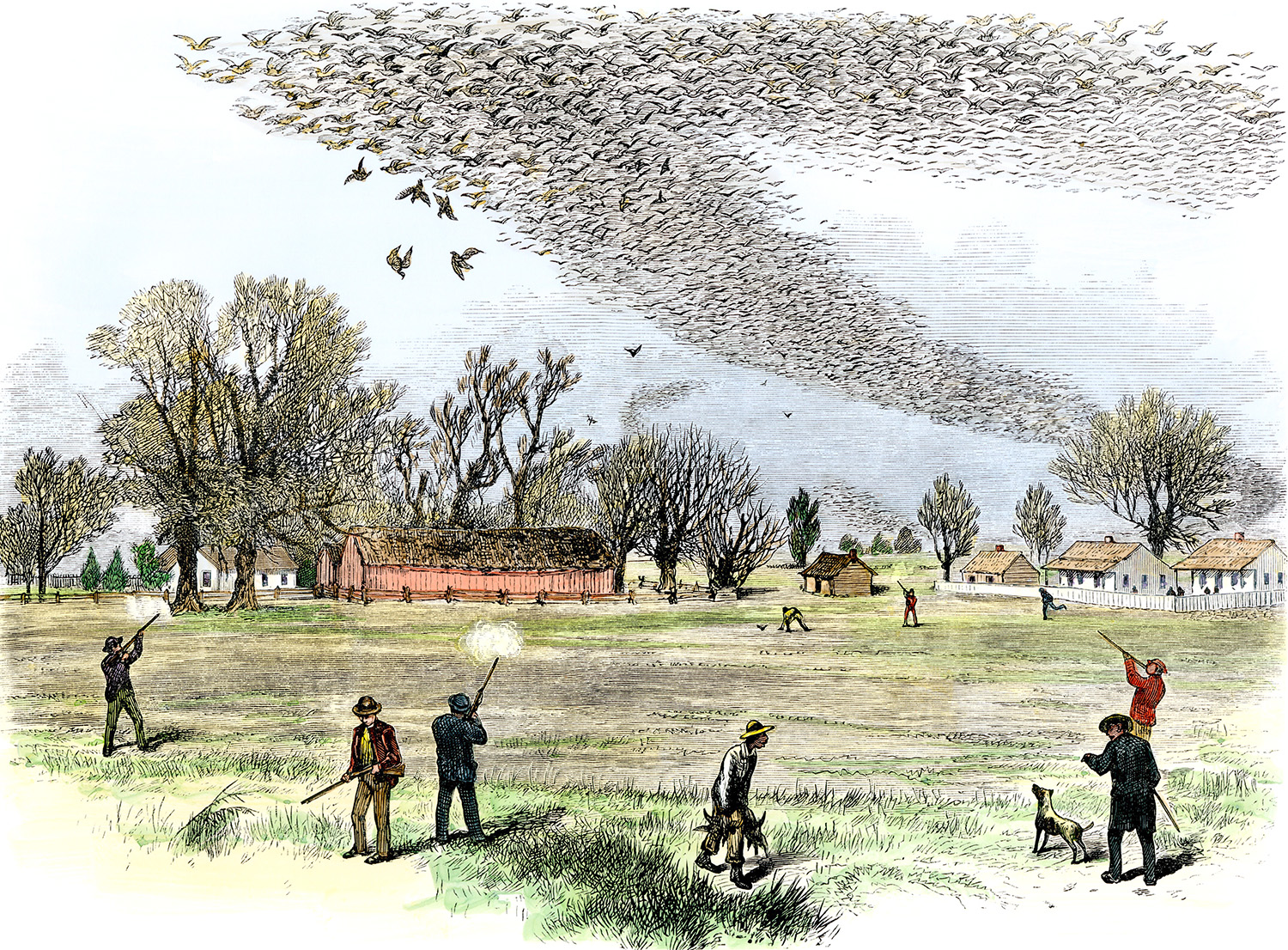
Audubon’s appetites existed on a very small scale compared with Americans’ relationship with the passenger pigeon. Masses of them appeared in the sky and communities would gather to shoot them down. John Muir recalled having “seen flocks streaming south in the fall so large that they were flowing over from horizon to horizon in an almost continuous stream all day long, at the rate of forty or fifty miles an hour, like a mighty river in the sky, widening, contracting, descending like falls and cataracts, and rising suddenly here and there in huge ragged masses like high-plashing spray.”

In 1871, one nesting area in Wisconsin., measuring 850 square miles, contained more than 130 million pigeons. The last two passenger pigeons we know of died in a zoo in 1914. There is currently a genome project attempting to bring back these magnificent birds.

These weren’t like the city pigeons we disdain now, they were bigger and multicolored, more like a tropical bird. They would be transported from the wilds outside of NYC by barge to make New Yorkers’ pot pies.

Birds provided the decoration for hundreds of thousands of women’s hats, beginning to appear as high fashion in the nineteenth century. Feathers, whole birds, heads were proudly worn.

Would you prefer to eat your robin in a pie or wear it on a hat? Neither one, thank you.

1 Comment

Filed under Jean Zimmerman

The grand dame

that is the Grand Concourse in the Bronx has certainly seen better days.

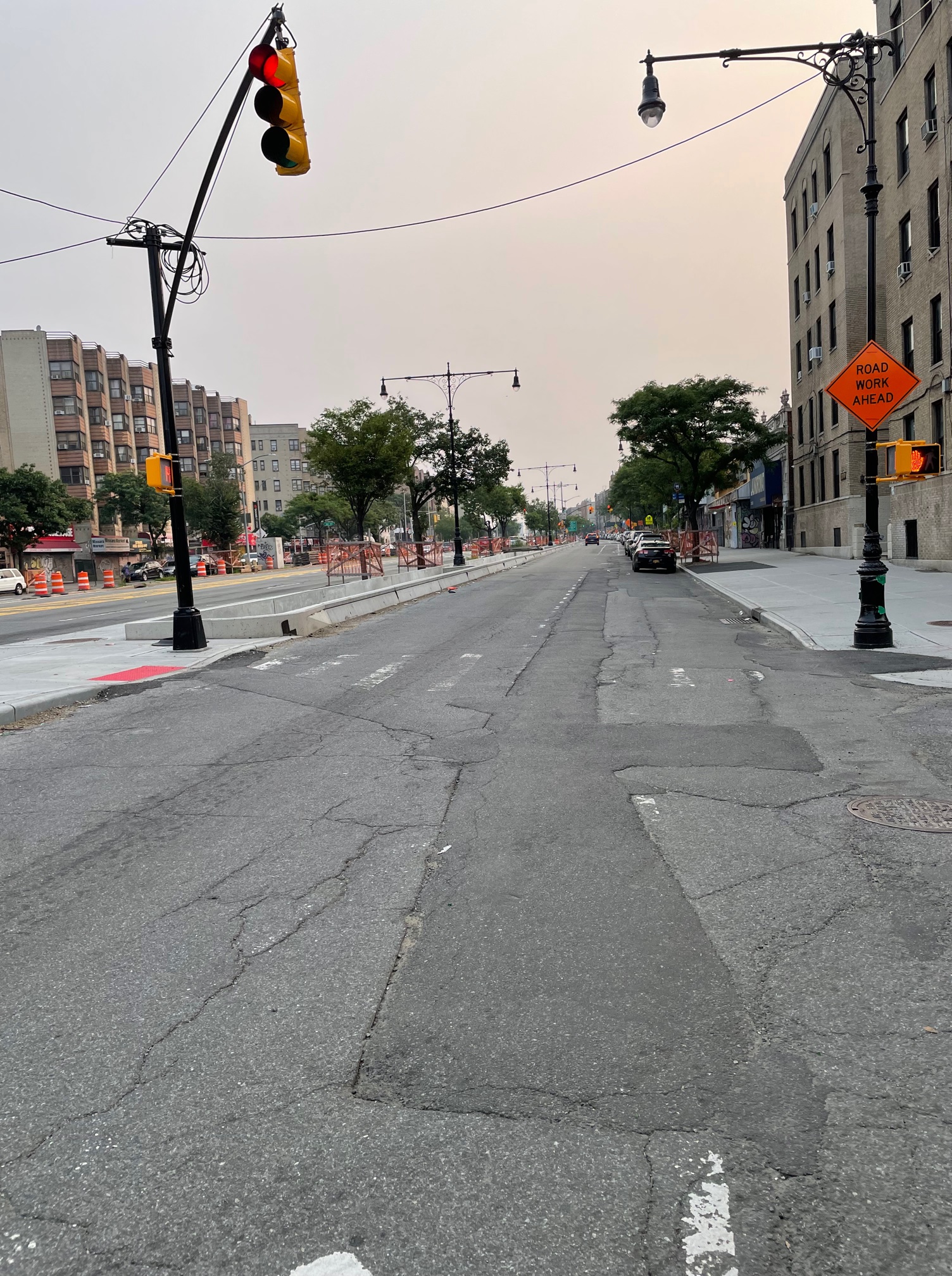
But there is still an awful lot of life there. Crews are installing new sidewalks and new medians separating the wide boulevards (2 lanes and a service road in each direction). They need a tree inspector to make sure no harm comes to the gingkos and zelkovas lining the avenue.

You’ve got wonder about people in the city, the way they love to lean things up against trees. Why? They can be told again and again not to and still you find a clutter of debris around the base of a tree. In this case it’s actually condoned. Huh?

But if you’re in the neighborhood, why not enjoy the local scenery?

I like hand lettered wall art.

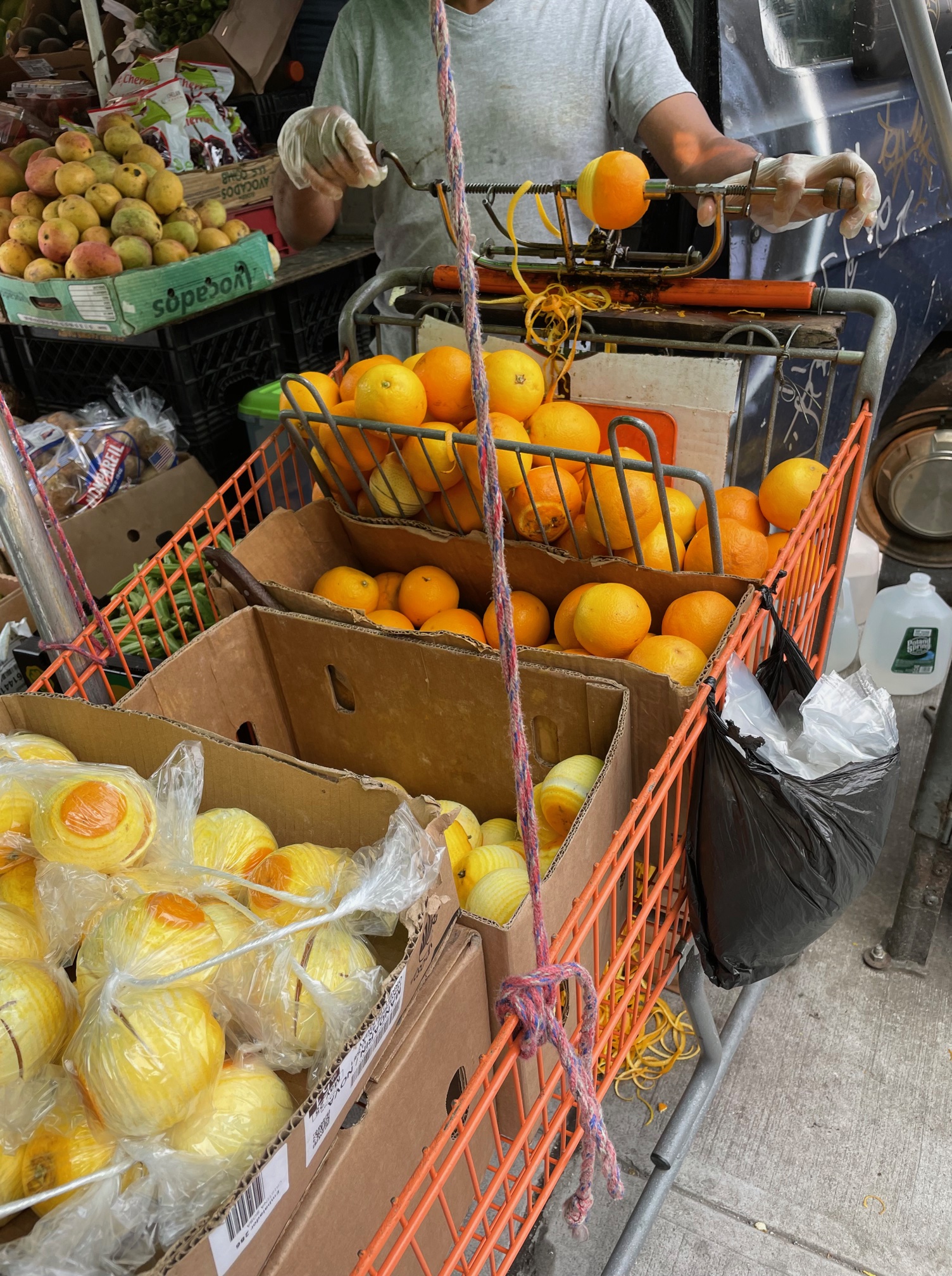
Bronx residents love fruit, judging by the number of produce stands, including this one that has the owner peeling your orange for you.

There is still some of the past. The Grand Concourse was built in the late 1800s to rival the great boulevards of Europe, and it soon became a middle class haven, before the advent of white flight and the deterioration of the Bronx in general. Once in a while you meet someone who tells you their old Jewish granny used to live on the Concourse.

Glimmers of the past exist.

And most amazing, a  hulking, barely visible grand building.

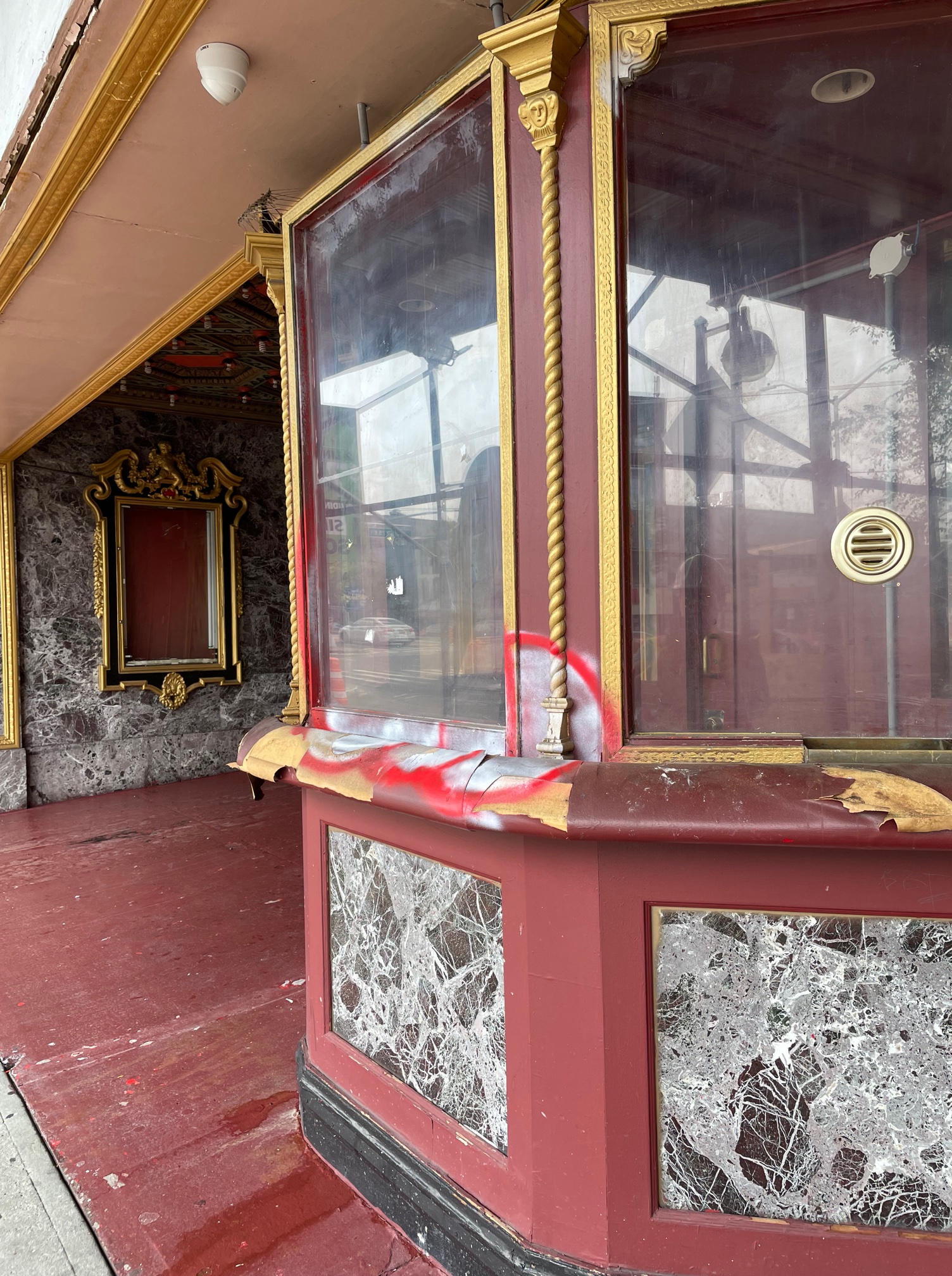
Behind the scaffolding stand, the Paradise Theater, built in 1929 and used for various types of entertainment since, even since it fell on terrible times – supposedly a church holds forth there now, though that’s hard to believe.

The ticket book evokes times gone by, as does the ceiling above it.

But really, the Concourse is contemporary.

Concerned with the important things.

Fresh.

And the home of thousands of grand pit bulls. This one snarls, then comes in for a pet.

I’m not sure about his manners, but he’s a handsome devil.

I wonder if pit bulls were the breed of choice at the turn of the century? Helen Keller had a pit bull named Sir Thomas. She was born in that era, so maybe the Grand Concourse was teeming with them.

Leave a comment

Filed under Jean Zimmerman