Fortunately, a tugboat made itself available for landlubber sightseeing.
We would view New York Harbor as we had never viewed it before. And believe me, we had viewed it before plenty of times. Once, even, on a tugboat, in fog so dense you could have been sailing in any harbor.
Walking to the South Street Seaport, along Peck Slip, you could almost inhale the atmosphere of past days when the first ferry in the city opened and you had to pay three wampum beads to get on. You got the attention of the ferryman by blowing a shell horn. The cobblestones may not be the originals, but they’re close to it. People steal them so the powers that be are always having to replace them.
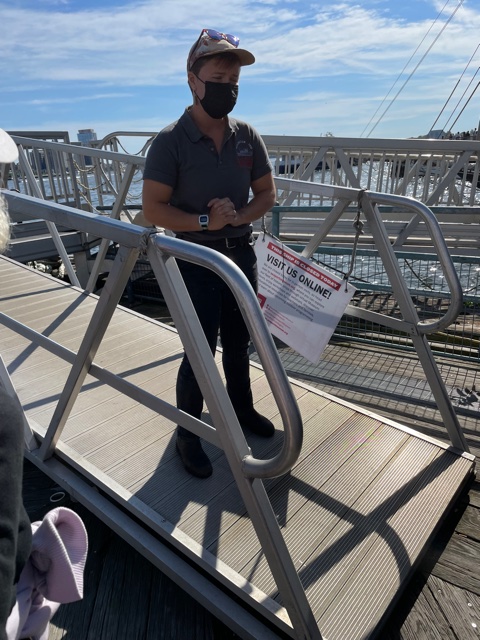
The last surviving New York-built wooden tugboat, W. O. Decker, may have charm and historic panache, but something it lacks is an array of handholds to grip when you hit the swells. Before we climbed aboard, we got a briefing from Fern Hoffman, the captain. She got her accreditation from the Coast Guard, which she told me is like the DMV for sailing.
The Deckers have a long history of tugboat building. The W.O. Decker was built in 1930 in Queens. Apparently the family is still in the business. The tug was built for shifting barges and for local towing.
Things got tricky almost immediately. You had to descend a gangway to one ship, then cross one ship’s deck, climb a step and clamber down into the tug. You could see the harbor water down between the two vessels. It would be a good way to crush a leg or two. I balked, but the deckhands gave me a boost and we were good to go.
One of the deckhands, noting that I was a bit rocky, advised that it would be good to stay at the bow of the ship, so as not to feel the waves with as much violence. You can sit on the “bits,” I think she said, pointing to some metal knobs jutting up from the deck.
Yes, but. I would prefer not to, in the words of Bartleby. I’d rather stay glued to the bulkhead.
The Statue obliged as we cruised by. White sails, a tall ship, dozens of jet skis driven by the clinically insane.
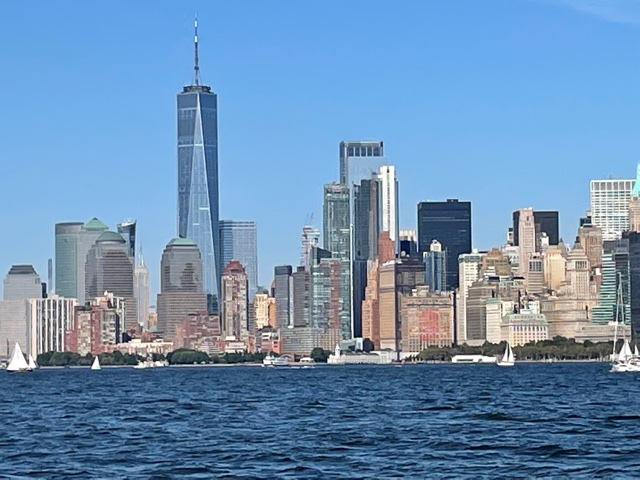
So did Lower Manhattan.
This view pretty much defines chockablock.
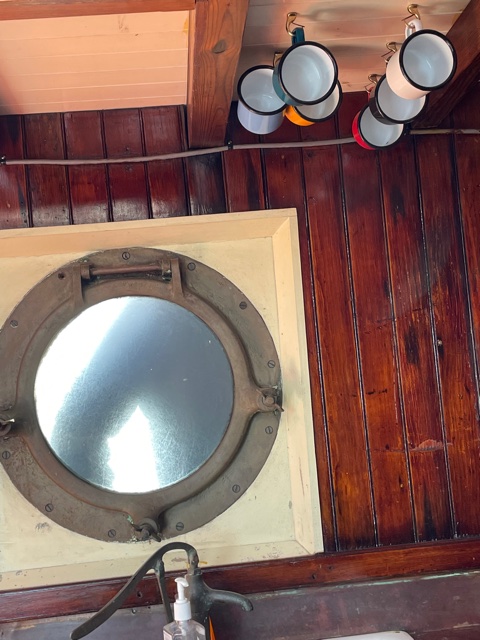
It was good to take a breather in the saloon, and I wanted to abscond with one of the cups hanging from a beam but refrained.
The innards.
I would have liked to unroll the nautical charts stashed in the bridge.
A woman at the wheel.
She really pulled that thing, backing into the harbor as we got home.
Nicely done, said Gil.
There’s still time to mess up, she said with a grin.
I knew what she was talking about. But I needn’t have worried. My egress from the boat was 100 times more graceful than the onboard had been. Back on Peck Slip, I ruminated on a lesson I’d learned somewhere along the way: Walking on cobblestones improves your balance.
A bus shelter ad went up on 187 Street. A fresh-faced young women in pastels, a fanny pack at her waist, a skateboard flipped up in front of her feet. And a hajib. She looks like she’s having a ball.
The company behind the ad, Modanisa, touts itself as modern. It offers all sorts of outfits, from evening gowns to track suits. The on-line catalog offers muted tones, flat black, stark white. What they have in common: a head covering.
Occasionally Muslim women sway down the sidewalk of the Bronx, sometimes wearing light colors, sometimes black, some wearing the head scarfs called hijabs, others partly covering their faces with nigahs, others dressed head to toe in black (or blue) burqas with a mesh over the face so that some visibility is possible. What does the world look like through a mesh screen, I wonder.
The practice of covering women’s heads is so widespread and variable in many countries that it is almost difficult to describe the practice. Basically, head or body coverings are worn by Muslim women in many countries as a sign of modesty.
There have been fights over the right to wear burqas over recent years. Many countries, including, famously, France, banned the hajib around 5 years ago in public buildings and in schools. Syria and Egypt ban face veils in school. Remember the controversy over the “burgini”? Should women all wrapped up fit in on the beach? Nike has a version.
Others – Austria, Denmark, Belgium, Switzerland, just for a start– have banned the burqa, though not the hajib.
On the other hand, enlightened countries such as the U.S etc., turn a blind eye on the issue of covering up women, saying they are all for freedom of religion. But who created and runs and enforces the rules of the religious that requires women to cover up? Men.of course. Men invented “modesty”. Burqas cannot be found in the Kuran. The necessity of covering up seems to be a male construct.
The common denominator of all these types of covering is hair. Why is hair so threatening? Why does modesty absolutely require covering it? Because that’s what it seems to come down to. Men can’t be allowed to lay eyes on the hair of a women who “belongs” to another man. Hair is powerful, indeed. Hair is life.
Afghanistan and Iran are the worst offenders. Look at the history of Iran. Two slogans of the 1979 revolution: “Wear a veil, or we will punch your head,” and “Death to the unveiled.” In February 2018, Iranian Police released an official statement saying that any women found protesting Iran’s compulsory veiling code would be charged with “inciting corruption and prostitution,” which carries a maximum sentence of 10 years in prison.
In Afghanistan, as is apparent whenever you watch the evening news, the Taliban are heavily invested in the burqa.
When the Taliban retreated a decade ago, women continued to wear it out of concern for their safety, actually afraid that if they dressed in street clothes physical harm would come to them. The burqa became a symbol of the conservative and totalitarian Taliban rule.
And, if a woman isn’t covered up enough, there is an even more startling version called the Gulf Burqa, a metallic-looking fashion mask mainly worn in the Persian Gulf, and said to indicate that the wearer is married.
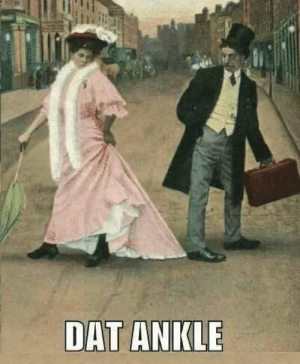
Are we so different? America used to have unwritten dress codes for women. Until just about the Roaring Twenties, dresses brushed your slippers and any glimpse of an ankle was scandalous, verboten.
The ankle was seductive and had to be hidden.
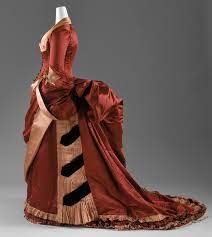
In the nineteenth century, upward of the ground, bustles amplified the butt.
Crinoline hoops, the precurson to the bustle, had already made it difficult to sit down. It is said that doorways had to be widened to allow the voluminous bell-shaped skirts entry to a room.
In the days of chamber pots, I have often wondered, how did a woman wad up all that fabric to do her business?
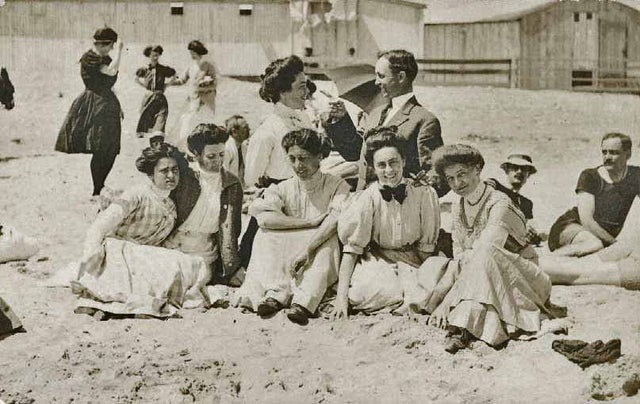
Going to the beach was really raunchy. Bathing suits included boots.
Bicycles, in part, changed women’s dress. At the turn of the 20th century, everyone went bike-crazy. For men, it was easy-on, easy-off, and you were suddenly free with the wind in your hair. For women, not so fast. All that heavy cotton pique draped over the pedals, the wheels. And women really wanted to ride – they were’t going to be left behind. Bloomers, born in this era, offered a solution, although they were greeted with some scorn.
Women had a liberty of movement they hadn’t had before. They had ceased being covered up.
It took time for actual trousers to come around for most U.S. women. Even as late as the sixties, sixth grade marked the last year we were required to wear dresses in my local public school. Katherine Hepburn and a few other social icons put on pants before the rest of their gender, sounding the alarum that such a mode of fashion wouldn’t damn you to hell for being “immodest”.
Now the spectrum has swung the other way, with people like Britney Spears unfairly beaten up for her clothing choices – for her to reveal her bosom now is the equivalent of her great-great-grandmother showing an ankle. Rihanna has a lingerie line with some fetching numbers. She has the power to inspire other people to dress immodestly.
We are breaking out of our burqas.You can really go down the rabbit hole with Modanisa, which is based in Turkey – which doesn’t require head coverings – and reaches 16 million people a month on its web site. Their statement of purpose: “ to meet modest women’s desire to wear the clothes that fit the life and times they live in.”
First, as you click through the site, you freak out with their more traditional items, then you see the burkini.
Then you see that they actually have uncovered models’ heads to display their activewear.
I didn’t see a skateboard on the Modanisa site. You have to provide your own. Yet that, too, is a possibility, even in Afganistan, if countries like the United States stop coddling the men who repress women in the name of religion.
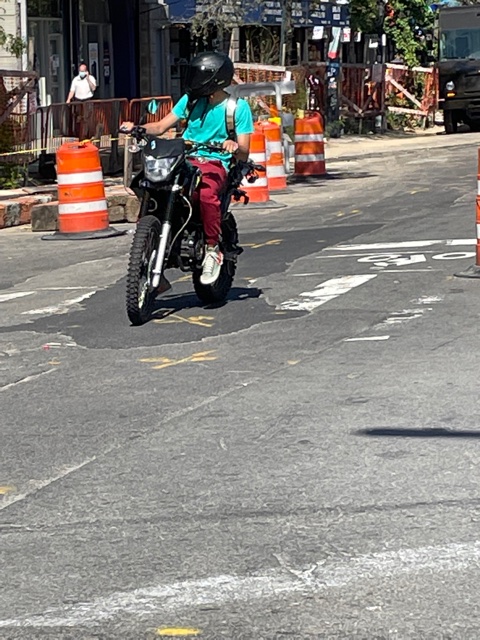
Motorized scooters and e-bikes have taken over the streets here, as well as plain old scooters, the type on which you stand to move forward. Good balance required for that. And of course the old-fashioned kind of bicycle.
Scooters tear up the Grand Concourse, on the service roads, but most especially on the sidewalks, swerving around pedestrians, going every which way.
Bike lanes? Nah. They’re for squares.
Storefronts are clogged with locked bikes (with serious chains) awaiting their owners to emerge.
The bike-less nod, zoned out on who knows what.
Scooters course around them.
Junk collectors collect bike wheels.
It’s absolutely bonkers.
Pretty soon it will be like Bangkok around here.
The fabulous Leon Bridges came out with his song Motorbike this year:
On the back of my motorbike? Switch lanes twenty-nine, ooh It’s whatever you like, ooh On the back of my motorbike, write your name in the sky, ooh It’s whatever you like, we can ride, ride, ride
Romantic song and video that makes a person crave riding behind her beau in the open country. That “29” baffles me; his age maybe.
Not only boys take the reins.
I saw a mom on a scooter, one small child in front of her and two behind, holding on tight as she aced the curve from the side street to the avenue.
Motorbikes cost a lot less than a car. $1,000, $2000 bucks. E-Bikes go for around $5000. They’re hot. You can get a food delivery job riding one.
Don’t you dare bring your bike inside!
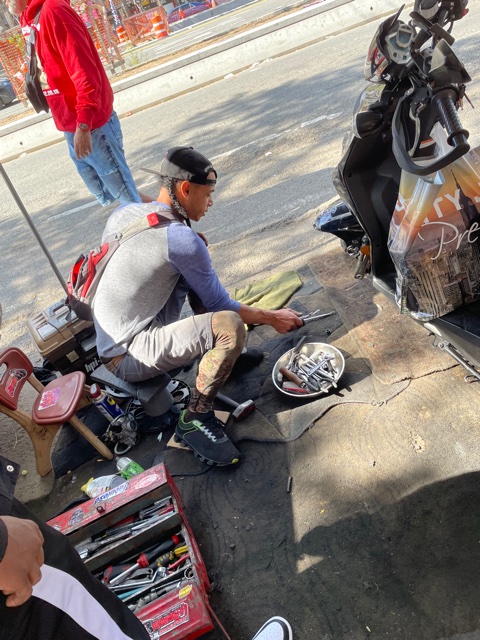
There is a cool pop-up bike repair place in the street next to a produce vendor. It’s private, mainly hidden by a tarp like a canopy, and a bunch of gear heads huddle there every afternoon, their tools all over the pavement, fixing scooters. When I stopped there to investigate I was not especially welcome because a. I don’t speak Spanish, b. I am an alien in a hard hat and c. I possess a vagina. No pictures, I was told firmly. In my experience, when someone declines having their photo taken they are hiding something.
But… but… let’s not talk about the buts, shall we? No, let’s. I pitched off an e-bike this summer and was lucky to come away tumbled like a rock in a rock polisher, with a temporary concussion. So I am somewhat biased as to the dangers of these machines. Especially in New York City! Which is filled with white ghost bikes memorializing cyclists’ deaths.
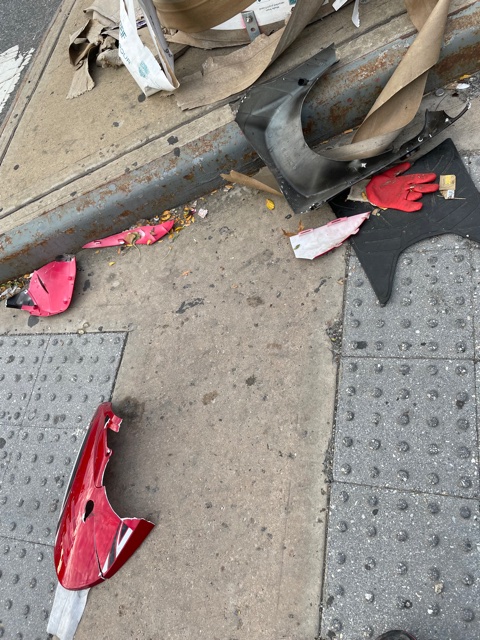
Also, I came across the detritus of a wrecked bike under the light pole it had smashed into. Shards of plastic and metal everywhere. And a very unnerving single glove.
Don’t they? They just grow and will go on growing forever.
We all know that animals go extinct.
Think of the thylacine, whose species died out in New Zealand toward the middle of the twentieth century. This incredible dog-like marsupial with the jaw of a crocodile was hunted out of existence, and the last one spent its final days in a cage.
Or the passenger pigeon, in the nineteenth century. They flew in clouds so gigantic that they blocked out the light of the sun. But their numbers were ultimately decimated for food and sport.
Or the elephant bird, a flightless wonder 10 feet tall that disappeared from Madagascar, the island where it made its home, around 1,000 AD. Think mega-ostrich.
When fauna die off, we mourn their loss — at least I do. And now people are taking steps to ensure the survival of some, like the mountain gorilla, and the leatherback turtle. Only two northern white rhinos remain on earth, and they are kept carefully fenced in a Kenyan nature preserve. A third rhino, a male, died a few years back and so these two females have no way of continuing the line of succession. It’s over. Actually, not if some crazy Italian scientists have their way — they developed 12 embryos of the northern white rhino and we’ll see what happens.
It might come as a surprise to learn that certain trees also stand in danger of extinction. To be precise, as science has been on this point, one in three of the world’s tree species are now at risk of becoming extinct. A consortium of experts called The Global Tree Assessment has done its homework and found that In fact there are twice as many threatened tree species as there are mammals, birds, amphibeans and reptiles combined.
It is crushing to learn that more than 400 tree species have less than 50 individuals left in the wild. Some are familiar, say the members of the Global Tree Assessment – even magnolias, oaks and maples, surprisingly, are at risk.
But a lot of these endangered species grow far away, in tropical forests, and it’s more or less out of sight, out of mind. These forested areas have been logged out, cleared for farming, or invaded by various pests and diseases. When the trees go, habitat for birds and animals goes too. It’s devastating.
Forests cover approximately 31%of the world’s land surface and their total economic value has been estimated at around $150 trillion. They contain around 50% of the world’s terrestrial carbon and help provide 75% of its accessible freshwater. These benefits could be lost if tree species go extinct.
Here are a few examples of trees in trouble. Blink and they may disappear.
Mahogany might be the best known threatened tree. Swietenia macrophylla is one of the most valuable hardwoods, used for furniture and musical instruments, cherished for its beauty. One tree alone can be worth many thousands of dollars. Native to the tropics of the Americas, it was one of the first to be called out as endangered, due to illegal logging.
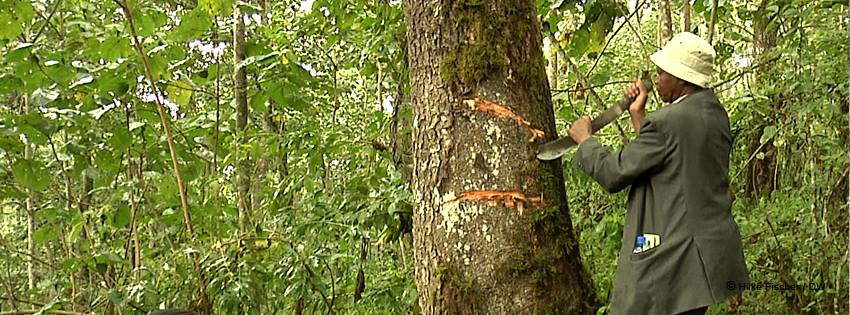
African Cherry’s bark contains a compound that has proven useful in treating medical disorders such as prostrate problems, malaria and kidney disease. The international trade in the bark of Prunus africana is fully $200 million. Overharvesting has led to its demise.
Highly fragrant Agarwood produces a resin that is used in perfume and incense. Aquilaria malaccensis has a global trade value of $32 billion. The production of the resin is stimulated when it suffers the attack of a dangerous fungus. Overharvesting, again, has led to as many as 20 species being threatened..
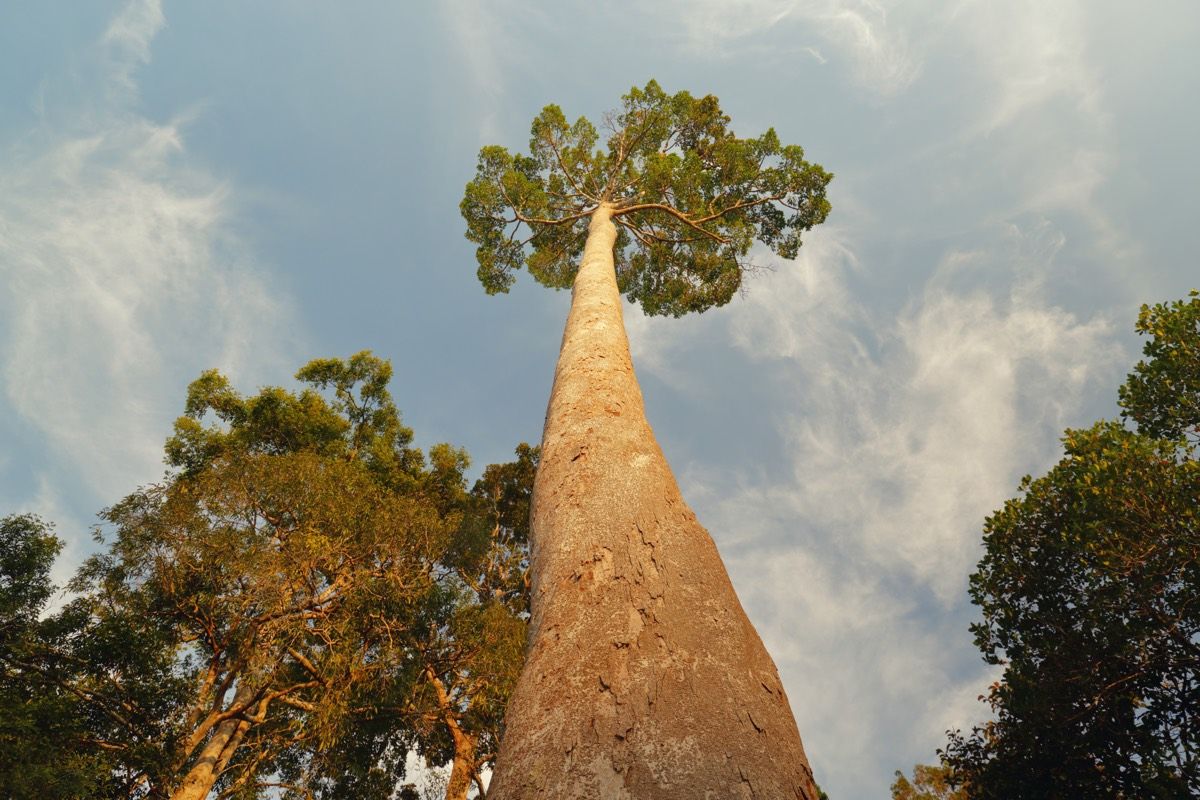
Dipterocarps can be found in Southeast Asia – 680 species grow there. Often the most abundant trees in the forest canopy, it produces high quality timber. From the island of Borneo alone come $3.5 billion worth of exports each year, and 182 species face extinction. The tallest known tropical tree, Shorea faguetiana, may ultimately disappear.
Closer to home is the Pacific yew, Taxus brevifolia, the source of the anti-cancer drug Paclitaxel. Logging threatens to wipe the tree out.
What can a person do? Well, don’t take forests for granted. Don’t take trees for granted. If we do that, some may go the way of the thylacine. Also, develop alternatives. Different medicines. Different flooring. A guitar made with a different type of wood. Or learn to play the banjo.
It’s a change of mindset. By the time we start feeling bad about it, it will be too late.
to begin with, roasted, encrusted with falafel and embellished with baby arugula and lemon salsa verde. But it is something else again when it has been crafted “by Chef Bill Tellepan who found great inspiration from the plant-based menu for the Met Gala.” At the Metropolitan Museum, all things become elevated, and that includes an overpriced slice of the “75th Anniversary Cake.” Dense, white and so sweet, it almost made me cry.
I like to envision AOC at the recent Met Gala, the fashion industry’s equivalent of the Oscars, in her white gown slashed with the words Tax the Rich, wolfing down a slice of this cake.
When you go to the Met, it’s a good thing to focus on one exhibit if you don’t want your eyes to spin in your head. So the Portraiture of the Medicis seemed like a good idea.
However, I got distracted by the old Dutch masters, Rembrandt and the like, that hang just across from the dining room.
I love this aspiring artist, Gerard de Lairesse, sad and diseased, disfigured by syphilis, who began as a pupil of Rembrant’s and eventually disparaged his master’s brush strokes, comparing his work to “liquid mud on the canvas.” Sour grapes, methink, to disdain Rembrandt, one of the greatest of all time, who died a pauper.
On to 16th century Venice. I think some of those portrayed look a bit cartoonish.
But Duke Cosimo and the rest of the Venetian royalty must have liked them, they commissioned pictures of themselves again and again.
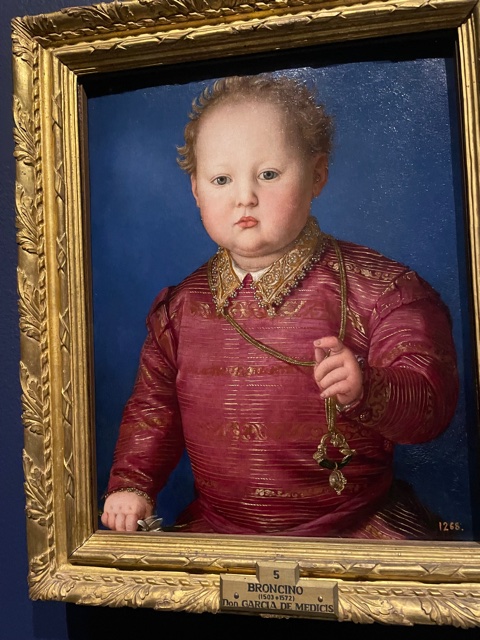
Who doesn’t like a baby, especially a royal child of Cosimo and Eleanora de Medici?
Unfortunately he was to die of malaria on a family hunting trip to Tuscany.
A dress of red velvet amazingly preserved and displayed was originally worn by Eleanor, then wound up in a convent where it was used to clothe statues of saints. For textiles to have survived all this time they have to have been helped along by God or his minions.
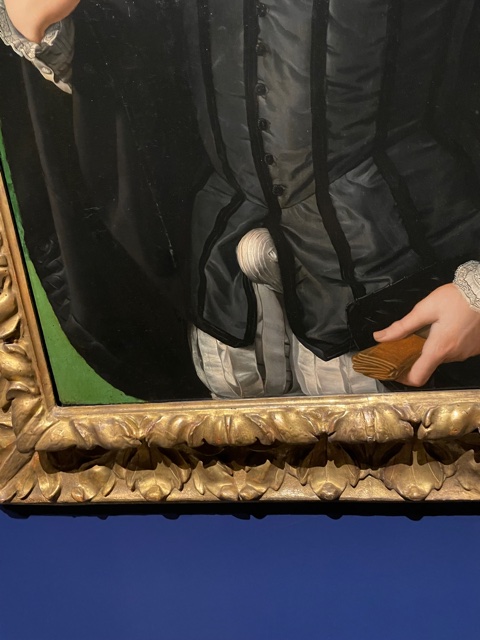
I’ve seen this arrogant young man before, Ludovico Capponi, in the Frick Collection, adorned in a black taffeta jerkin, painted by Bronzino in 1550. He was supposedly quite the ladies man.
And naturally had quite the codpiece.
If you scan the rooms of the exhibit, it might strike you that something is missing. Oh, yes, the female sex. Certainly men dominated as Italian rulers at that time, but you can search out a few powerful women.
This is Laura Battiferri and she was a celebrated poet. She had something going on with poet and painter Bronzino (platonic–haha)S and he wrote to her: “You, through your own valor, vanquish (Petrarch’s) Laura and (Dante’s) Beatrice, and you are above them in worth, and perhaps also their lovers in style and song.” He didn’t pose her with a codpiece but an open book.
It brought to mind another revered woman of the Rennaisance, this one French: Louise Labe. Her remarkable life included expert horsemanship and crossdressing as a courier as well as producing some of the finest poetry of the age. I wonder if she and Laura Battiferi knew of each other.
I have decided that Louise Labe’s life must be rendered in book form, nonfiction or fiction as yet to be determined. I think I will have to write it.
The air grows muggy among the Venetian aristocrats, no matter how much their costumes are to be admired.
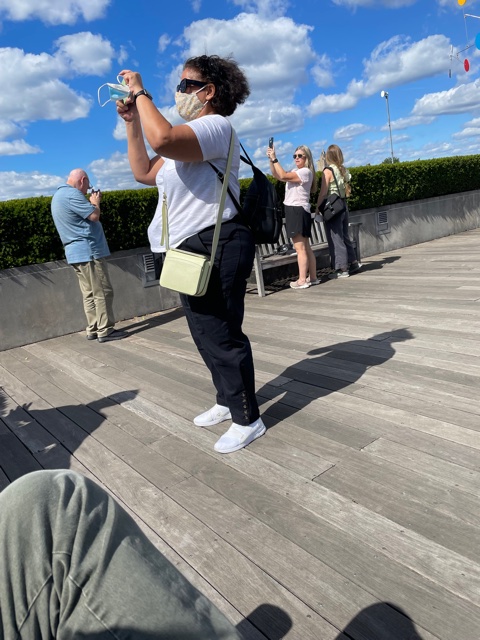
The rooftop view makes the canopy of Central Park look like one gigantic green pillow. I would like a dollar for every photo taken of the skyline in an afternoon.
A young guy walks by wearing a black tee shirt emblazoned with the words of Melville’s Bartleby: I WOULD PREFER NOT TO. If you have not read this short story, Bartleby the Scrivener, please get on your Kindle and do so after you finish reading this post.
Someone’s idea of art. Anything goes up on the roof of the Met. There once was a haunted house there.
Lines extend all around the Temple of Dendur, people wanting to get into the costume exhibit that just opened and was celebrated by the Gala and its plant-based cuisine. Let them eat plant-based cake!
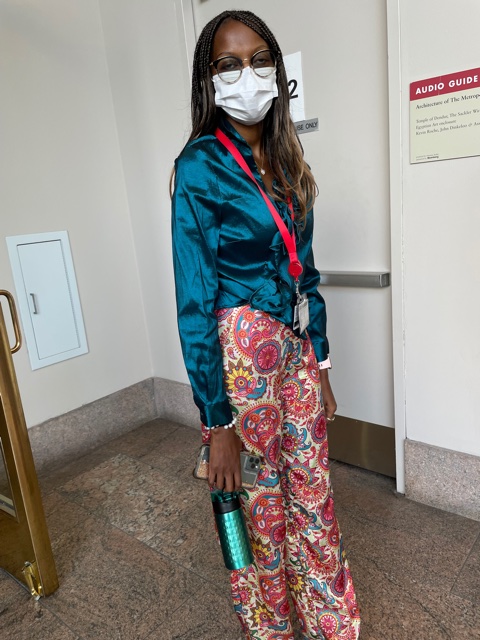
An “ambassador” named Susan had been assigned to keep people from wandering into the wrong galleries by mistake. I think in that outfit I would follow her anywhere.
With a head rendered mushy by art over indulgence, I make my way out of the building, but not before stopping in front of something that proves the Metropolitan does absolutely contain multitudes.
A taxidermied deer adorned with scads of crystal bubbles.
Yes. If intelligence is the ability to seek out nectar and pollinate flowers, yes. In terms of long-term travel to their southern climes and back, Monarchs in particular never cease to amaze.
But are they dependable? In terms of showing up when they’re expected, to bask in humans’ adoration? Not so much.
The events of the day at Wave Hill, the century and a half old estate that is now an arboretum and horticultural center, were supposed to highlight butterflies. There was a “Nature Walk: Butterflies in the Garden” and special arts and crafts activities for families. The last expedition had just gone out when we arrived mid-afternoon, so we thought we’d go it alone.
We saw brilliant flowers.
Of all colors.
Shapes. Sizes.
Surely some that would appeal to a butterfly.
Look, there’s a monarch! said Gil. But it had vanished.
I see a little white one, said Josefa. A cabbage moth, corrected Gil.
There were some bees of different types. Where there were bees wouldn’t you expect butterflies?
We learned that Louis Bauer, the horticultural director at Wave Hill, was going to be honored at a party in a couple of days. I met Louis when I sold him a tree inventory for Wave Hill a few years ago. I remember asking him how he kept everything so beautiful in the greenhouses there. I go in three or four times a day and stick my finger in the soil to see if they have enough water, he said. Simple genius.
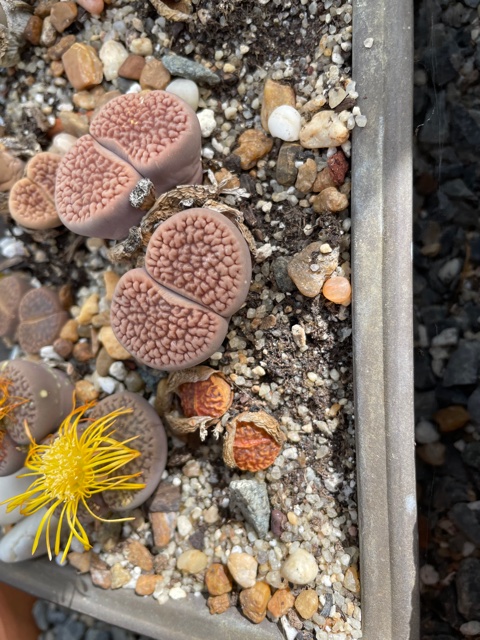
The greenhouses, of course, had no butterflies, but some prehistoric looking desert plants.
And a buxom cactus.
More flowers. Nothing fluttered by.
Quiet trails.
Vistas in every direction. Some of them private.
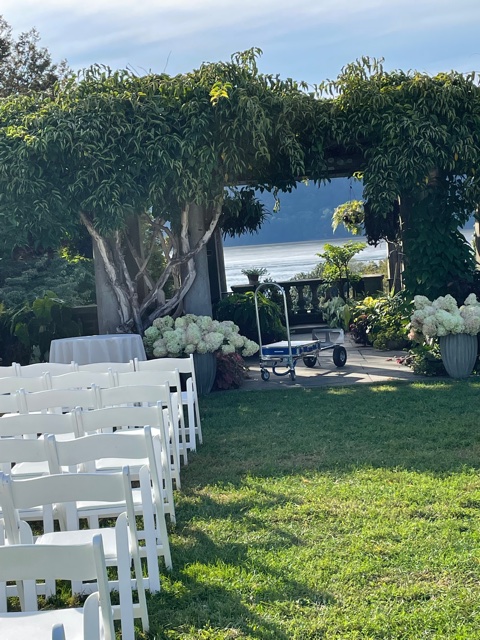
The most fabulous view out over the Hudson was getting ready for its closeup with white wedding party chairs.
We just about gave up. Not only did we not see butterflies, we didn’t see anybody looking for butterflies. Was this some colossal joke?
A sculpture on the lawn made use of succulents, moss, and a tire fetched out of the Bronx River.
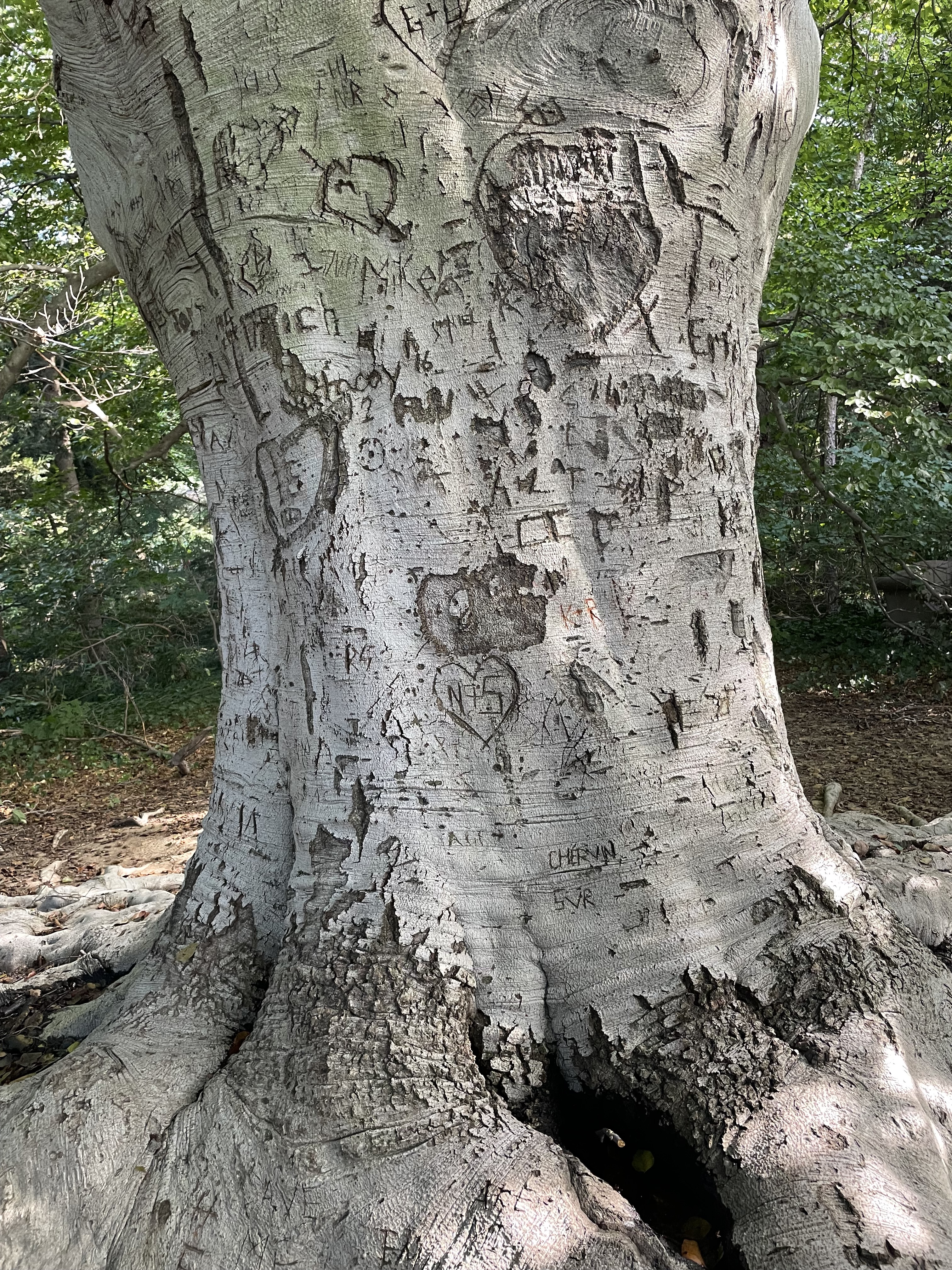
Wave Hill has a pair of copper beeches to die for. One of the elephantine pair has pristine bark that you just want to go up to and pet. The other’s branches drape down to the ground and hide a trunk covered with a venerable array of carvings. I have always liked beech bark carvings. It makes for a good place to meet a friend for a private assignation. I feel like I’ve done that sometime, in another life.
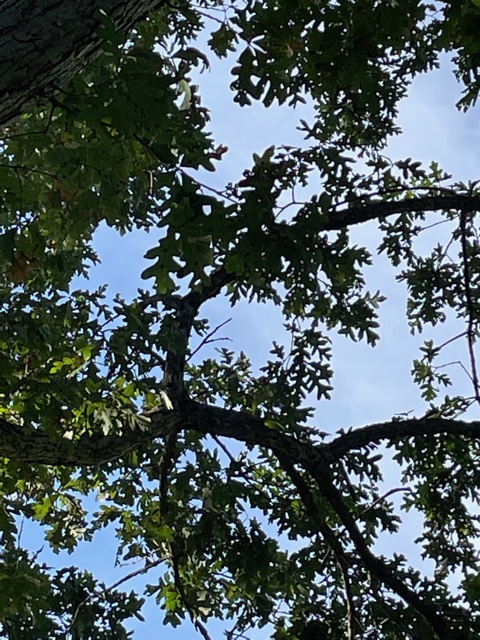
We stretched out in the adirondack chairs that make Wave Hill an even more perfect place. In the mellow shade of a white oak. The burnished glaze of fall made us collapse with thirst.
So the winged creatures missed the cameras and the oohs and ahhs. They took the nectar and ran. They had better places to hang out. They’re that smart.
to some people, but others take painstaking care to preserve them.
Meet Jimmy, one of my favorite individuals at work.
His job is exclusively to build and repair tree guards on the Grand Concourse construction site. He is, he told me, officially a carpenter by trade, as far as the union is concerned. That’s an honorable and well-paid profession. But we’re lucky to have him doing what he does. He squares up the enclosures and hammers the boards together, often standing back to scrutinize them before he starts to correctly gauge the tenor of the job.
We’re chatting.
You must get tired of this, I say, referring to the orange snow fencing, a bale of which he carries around with him much of the day. It’s constantly getting ripped from the frames and he is constantly fixing it.
No, he says. I used to be. But now I covered my house with it inside and out, that’s how much I like it.
He sees himself as a bit of a comic.
What I see is a skinny, herky jerky guy who dances down the Concourse like a leprechaun, cigarette in mouth, hammer in hand, tool belt clanking, working his magic to protect the trees from harm.
It’s good you do it, I say. Otherwise the crew would knock downthe trees.
No, they wouldn’t, he contradicts. They know they’re living things. I tell them that that tree there was Jesus’ original crown of thorns.
He means the honey locust – the site has a forest of them. Tree workers hate them because they get pricked so bad.
No, says Jimmy. The guys appreciate the trees. They are sweethearts. Really.
Well, shut my mouth. Sometimes I think a particular machine operator takes some sadistic joy in breaking branches with his bucket.
Still, I know that one day these tree guards will come off and the honey locusts and American elms and London planes and amur maples will once again introduce themselves to the world, and the neighborhood will be the better for it. It takes work to preserve them, but it’s well worth it.
Jimmy is a lot of things, a philosopher, a comedian, even an arborist. I told him I appreciated what he does and he told me he appreciated me appreciating what he does.
And he may possibly an actor. A producer discovered him on the job and told him he wanted him for a bit part on screen. Then he came back. He told Jimmy they decided they wanted him for a bigger role. He was just too good to be a cameo.
That would be great, he’d get his SAG card and hobnob with hot shots. But it would be a loss for the Grand Concourse to have him no longer nurturing the tree guards, butt in mouth, a hammer in his hand.
is not just a creaky old John Hughes movie. Pink has become the ethos, the philosophy, the dream and the religion for girls of the elementary school age and under. Until they betray pink for purple…
This conclusion will not surprise anyone with eyes in their head over the past quarter century.
I’ve been told that in Japan, boys wear pink and girls blue. Not true, according to reputable sources (the interwebs). Males and females in that country do, though, apparently mix and match colors in their apparel, ignoring sex-related social constructs.
The stores on the Grand Concourse have girl-pink stacked high.
Pink bikes beckon.
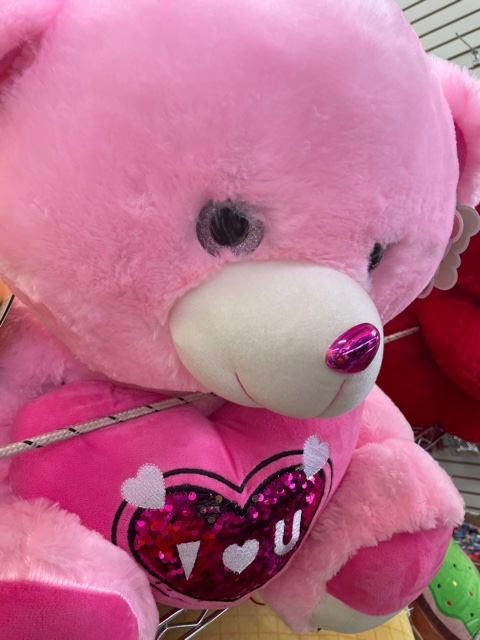
Stuffed animals present themselves as irresistable.
Magical.
Pink’s popularity for grown women grew over the 20th century, from the choices of Mamie Eisenhower to Jayne Mansfield to, jumping ahead, the Plastics in Mean Girls who dressed in pink on Wednesdays. Can we forget Hillary Clinton’s bright pink blazer?
The situation differs for small fry. They have all become princesses. Princesses are sweet, not solid. In fact, being a princess is nothing a child can aspire to. Yes, thy possess magic, but not with powers to make anything actually happen.
Why should anyone care? That toddler in her stroller, buried in fluffy pink, is so comfy, so cute! And girls in pink grow up to be perfectly capable pink-attired woman, like this one awaiting her Covid shot.
Rainbows are everywhere now. Why not give girls the gift of choosing any color they truly desire? It would take some counter-brainwashing, true, with all the material goods available, the clothing and toys and tutus drenched in pink. But it would be good if anyone could be pretty in any color.
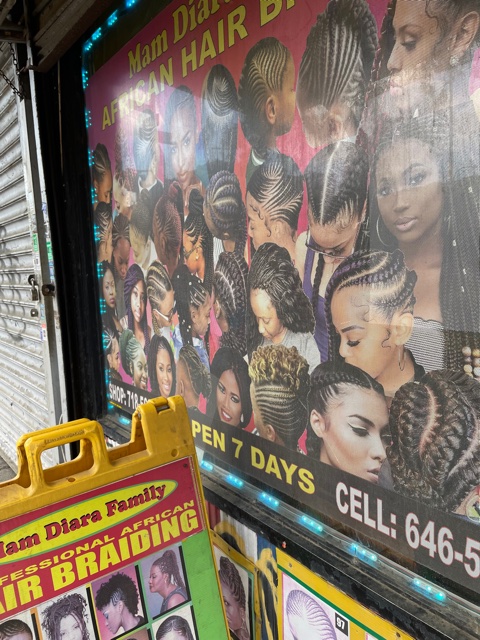
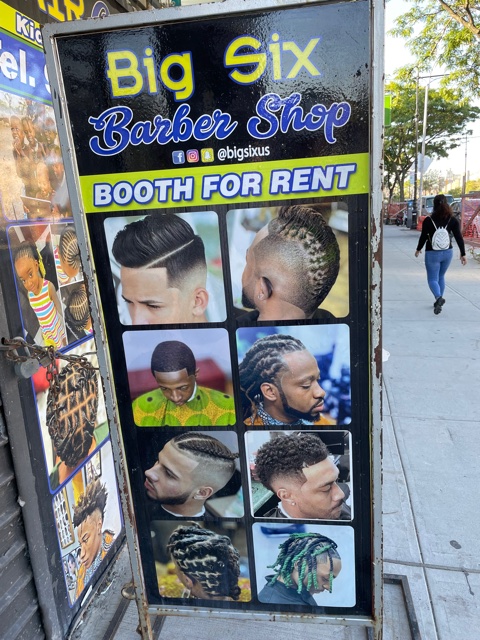
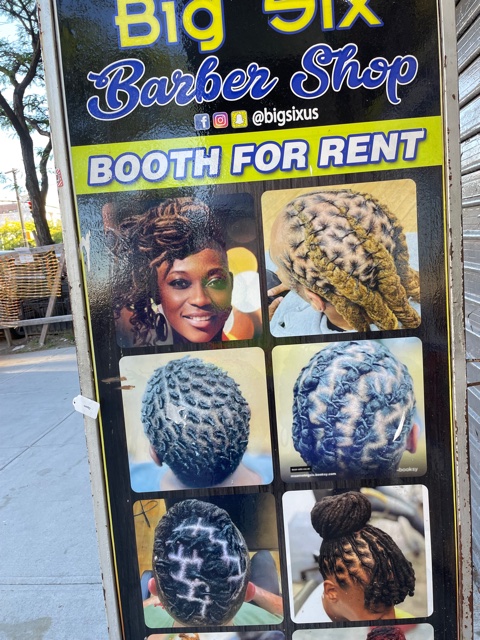
on the Grand Concourse. I pass at least one hair salon on every block, interspersed with supermarkets, household goods, bodegas, hookah shops and the goat restaurant.
The signs are not all for hair braiding. Straight hair gets its due.
Including this goofy martian coif.
But mainly the ads showcase braids.
Extravagant hair styling makes me think about novelist Chimamanda Ngozi Adichie’s best-selling Americanah, described accurately by the New York Times as “witheringly trenchant and hugely empathetic,” and which won the National Book Critics Circle Award in 2013. It’s a moving story about two people from Nigeria, one of whom comes to America and one to London. I won’t tell the rest in case you read it (and you ought to). But one thing that stands out for me in the fabric of the novel is the amount of time the main character spends in African hair braiding salons. This was foreign to me. If you read Adichie, the granular detail with which she describes having her hair done could only have come from her own experience.
Scholars of African history see the practice as many thousands of years old, with braids even etched into the back of the head of the Great Sphinx of Giza. African tribes, groups and regions adorned their heads in specific ways, not restricted to cornrows. Styles date back to at least 3000 B.C., including Ghana braids, Fulani braids, Goddess braids, Box braids and dreadlocks.
On the Concourse, there are many more images of fancy hair braiding than there are actual stylings on the street. It seems to be more aspirational, or maybe done for a special occasion.
Of course there are other origin tales besides the African. Some go back to the Venus of Willendorf, thought to be 25,000 years old and discovered in Austria in 1908.
Just 11.1-centimeters tall, this limestone beauty seems undeniably to have a head of cornrows. If I could steal one object from a museum, this would be it. I’d have to go to Vienna, where the Venus is exhibited in their Natural History Museum
Now for an alternative narrative, possibly apocryphal. It is said that cornrows were used to help the enslaved escape their misery. Cornrows were used to transfer information; they were maps of a sort. Benkos Bioho, a radical who lived in Columbia, South America, is said to have devised the practice in the 1500s. Bioho and ten others escaped the slave port of Cartagena and founded San Basilio de Palenque, known as the “village of maroons.” Later this became the first free village in the Americas. His reward: he was captured by the government, hanged and quartered. Before that, though, he taught braiding.
iCurved braids represented roads to be traveled to escape. Also, the enslaved hid seeds in their hair to plant crops once they reached freedom. No slaveholder would ever suspect.
It’s also said that braided hair was called “cane rows” to denote the sugar cane fields in which captive workers toiled so horrifically.
This strategy recalls the red blanket hung on the line to guide those on the underground railroad to freedom.
How much of this legacy is embedded in the hair styles of Grand Concourse? The signs advertising braiding always looked gaudy to me. It’s good to look deeper.
quoth General William Tecumseh Sherman in an 1879 speech. Stating the obvious, clearly, but a rhetorical flourish still current today.
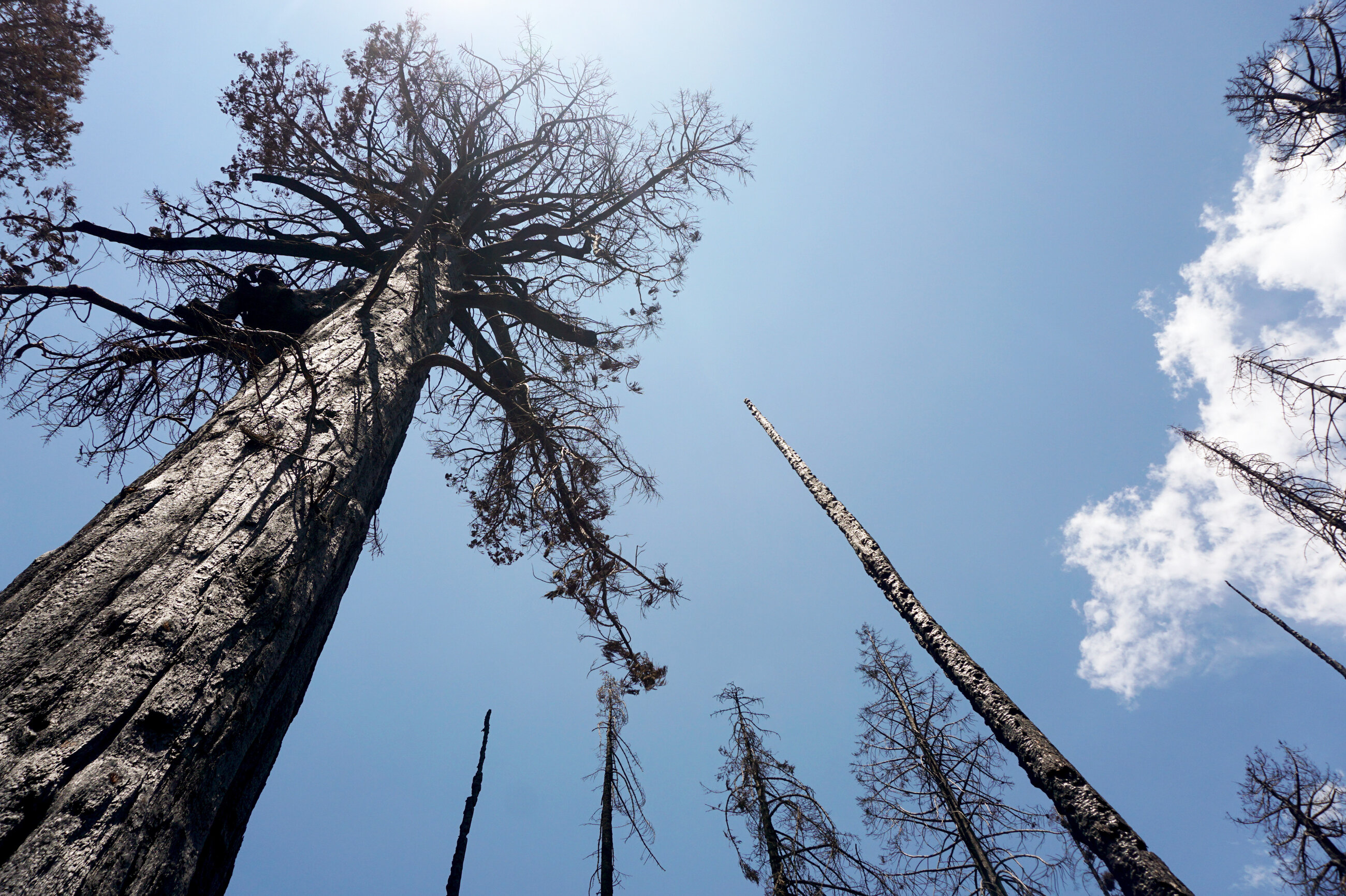
Rivalling the predations of human warfare, though, is the battle against the flres now ravaging so much of the West, including one of the greatest beings on our planet. In the path of the destruction, the giant sequoia . So far the fire has burned though almost 18,000 acres.
How can a flimsy piece of aluminum foil save “General Sherman,” the sequoia that holds the distinction of being the largest tree in the world.
Here are just a few facts about the tree, which has endured its share of tape measuring humans over the years. General Sherman has a volume of 52,508 cubic feet, stands 275-feet tall and is thought to be between 2,300 and 2,700 years old. It’s circumference at ground is 102.6 feet. The height of the first branch above the base is 130 feet. It is the biggest of the big. From the ground, you can’t see to the top of it.
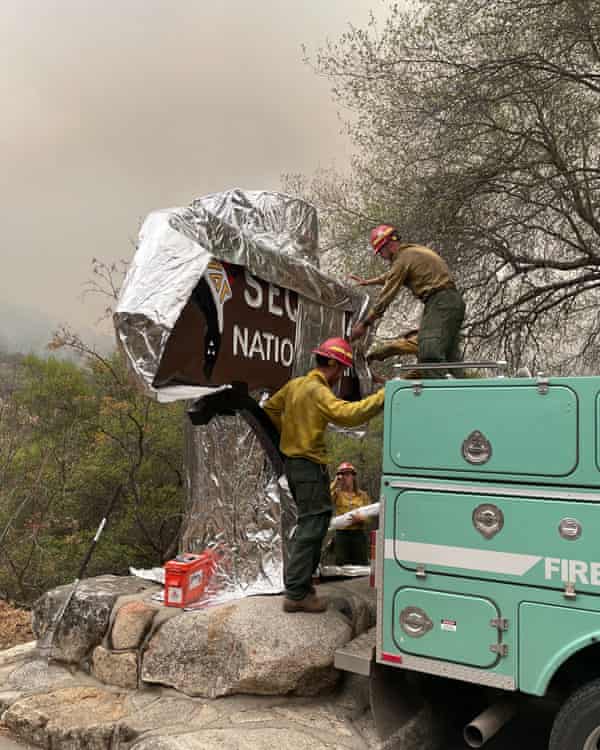
To protect the sequoia forests from the brutal heat of the KNP Complex fire, firefighters have seen fit to wrap General Sherman’s trunk, as well as historic cabins and signs. They think it will work. Also important, the systematic controlled burning of the past 50 years, which has eliminated the brush that would become flame fuel at the base of the trees.
Fire can actually be a boon to giant sequoias, helping them release seeds from their cones and clearing land for young trees to grow. But the intensity of the fires we’re seeing now can devastate groves – The Castle fire last year killed as many as 10,600 large sequoias. Climate change will only exacerbate the destructive heat of future fires.
General Sherman, the tree, has been embraced by Americans, but that wasn’t always the case. The conifer species of the genus Sequoiadendron once grew widely across the northern hemisphere. There are fossil remains of the subfamily Sequoioidae from the Jurrassic period, not only in North America but also Greenland, Europe and Asia. Then came the Ice Age. What was left standing? The giant sequoia and the coast redwood.
Also related, the dawn redwood, from China and thought to be extinct until its chance discovery in the last century by a Chinese forester. Cones were brought to the U.S. by an Arnold Arboretum expedition and today they are often propagated by rooting woody cuttings. A handsome tree, it resembles its family members but is of manageable size.
For centuries or longer the forest surrounding General Sherman had been known by Native Americans – some tribes called it Wawona, named for the call of the northern Spotted Owl, others designated the giant sequoia the Toos-pung-ish of Hea-mi-withic.
Then an entirely new group of people descended upon the land the Indians knew. The giants of California can first be found in hunter’s private diaries from the mid-19th century. Then, in 1852, a man chasing a bear found himself in the forest now known as the Calveras State Park. General Sherman was called the “Sylvan Mastadon.” No one even believed the hunter’s account. It was like finding Big Foot. So people swarmed to the phenomenon. Tourists piled on.
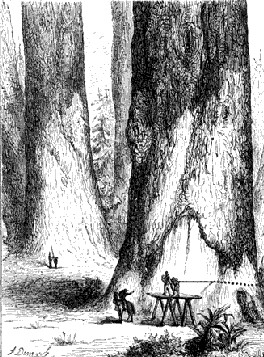
What next? Loggers, of course. They had their way with the trees, traversing new roads, utilizing railroad transport. Some trees were felled to actually verify their existence – for example, the Mark Twain tree, in 1891. Slices of its trunk went to the American Museum of Natural History and the British Museum of Nautral History.
Profit drove the felling of huge ancient trees. Ironically, the wood was less then useful because it splintered as it fell. Loggers would dig trenches and fill them with boughs to cushion the blow of tree limbs crashing down.
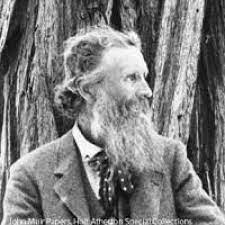
The great naturalist John Muir fought to create Yosemite Park, and the logging of the giants mainly stopped by around 1920. The founding of the Sierra Club was largely his doing. “And into the forest I go,” wrote the eminently quotable Muir, “to lose my mind and find my soul.” The man was a respository of pithy quotes, and if you haven’t ever read My First Summer in the Sierra you have a treat to look forward to.
Still, until 1980 younger specimens of the sequoia came under the axe. We’re talking 3,000 year old monarchs.
But what of General Sherman, the Union Army hero? How’d the foil-girded tree come by its name? First off, remember that Sequoia gigantean got its name from Sequoyah, the Native American creator of the Cherokee writing system.
William Tecumseh Sherman’s parents also bestowed upon him an Indian sobriquet — his middle moniker a Shawnee chief who built a confederacy of Ohio Indian tribes and fought with the British during the War of 1812.
Ironic when you consider his role in the American Indian Wars, when he urged U.S. troops to “exterminate all the brutes.”
General Sherman the tree was anointed in 1879 to honor the Union general most famous for his scorched-earth “march to the sea”, devastating Georgia and the Carolinas. The story goes that General Sherman the tree was named by a naturalist who served under Sherman the man in the 9th Indiana Calvalry
But names being fungible, General Sherman the tree had already had another title. A 40-person socialist commune inhabited the Sierra Nevada’s sequoia groves from 1886 to 1892. The Kaweah Colony based its economy on sustainable logging. It named the tree Karl Marx. Karl Marx quotes Ben Franklin as saying, “War is robbery, commerce is generally cheating.” I don’t think the sequoia loggers would have agreed.
War is hell. Thank you for that, General Sherman the man. Just living for some people can be hell as well. But wildfire that decimates some of the most magnificent things we know ranks up there. So please, astoundingly brave firefighters, use aluminum foil or whatever it takes to preserve the trees, champions of champions. As John Muir said, “The Big Tree is Nature’s forest masterpiece, and so far as I know, the greatest of living things.”
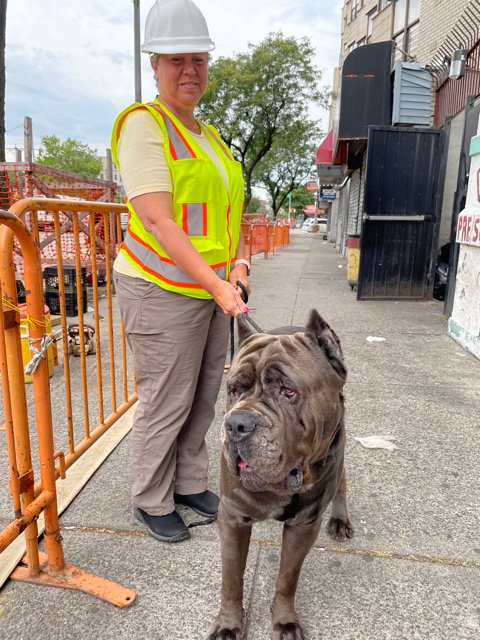
and wound up even better. At 7:30 am I stood on the Grand Concourse sidewalk petting Spartacus, a dog belonging to a neighborhood guy.
This massive animal, an Italian Mastiff (or Cane Corso) was a puppy at 150 pounds and destined to grow bigger. He was gentle as a kitten.
The afternoon progressed as usual, inspecting trees and their roots in trenches, munching plantain chips, drinking too much iced coffee.
Then we head to a concert at a place called Brooklyn Steel: Black Pumas, the psychedelic-rhythm and blues band whose smash Colors has had everyone entranced in the past year.
First, to eat. A Taste of Heaven pops up as right around the corner from the concert, in east Williamsburg.
You here for the venue? says Tony, who owns the place and is chief cook. Well, yes.
Jerk ribs, cabbage, collard greens from an aluminum dish with a plastic fork. From a steam table. A quart container of mango KoolAid to slake the thirst, because everything is popping with spice.
We dine outside, no indoor seating, at a tiny table. About the best grub I’ve had recently, and that includes a fancy restaurant high in the air where you had an extraordinary vision of verdant central park stretched out in front of you. The food, not so extraordinary. I can’t tell you the number of times I’ve dined out someplace supposedly fantastic and said I could do better at home.
Not here. I can’t fathom how he turned out this food in his tiny kitchen, but it is magical.
We’re number one on Yelp, says Tony, leaving his station and setting another tin of jerk ribs down in front of us gratis so we can both try them. And, in fact, checking out Tony’s boast, A Taste of Heaven stands out on Yelp as number one out of 184 soul food restaurants in New York. Unfortunately they have no dessert, but an elderly lady sitting on the one chair inside pulls a yellow supermarket cake out of her plastic shopping bag and offers to give me a slice. She urges me to take it. It’s lemon! she says.
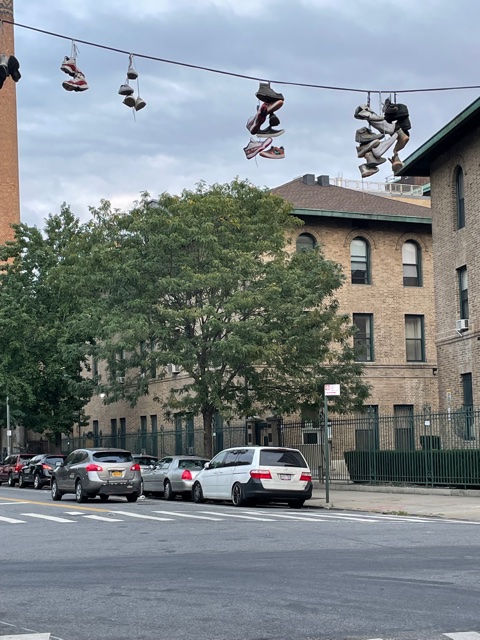
In case you want to find a Taste of Heaven, it stands at a crossroads.
Marked by the eternally ubiquitous sneakers that hang from a wire above the street.
A short drive takes us to find something sweet, through Brooklyn’s gentrified blocks with their clean sidewalks and glossy windows. Mature willows tower over young ginkgos..
A super-spare and clean gym open to the street.
Some great band names.
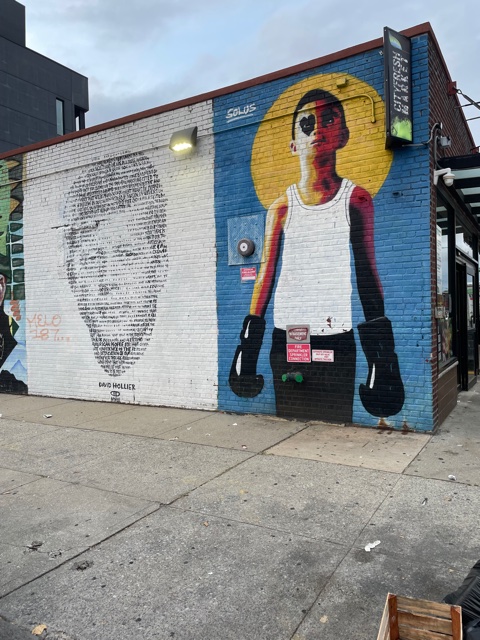
Entertaining murals. Note: you can’t see JFK’s face with the naked eye, only with the camera. A mystery how it’s done.
A chocolate cone is good on this end-of-summer evening, yet brings us up close to a ghost bike, one of the shrines you find all around town to bicyclists killed in traffic. Descansos, as they’re called in the Southwest, where the victims of highway accidents are sometimes memorialized by side-of-the-highway assemblages of car parts, in addition to photos and other sentimental items.
It gave me a frisson of PTSD since I recently had a bike wreck which left me banged up and bruised and slightly concussed. All better now.
The venue was jammed, the last of a four-night stint.
but it’s as if the universe knows it’s the twentieth anniversary of 9/11 and presents us with a day that eerily resembles that day, the bluebell sky, the lovely cool of late summer, the feeling of peace and anticipation of all the good things fall will bring.
You know what comes next. And everyone has their 9/11 story, trotted out among friends and family for the occasion as if rubbing the old wound will heal it.
It’s the day before the anniversary, late afternoon, and we are on our way to an art opening on Manhattan’s southern tip, on South Street. The uneasy anticipation of the big day has begun to well up, along with excitement about the art show, which bills itself as the Independent Art Fair, and is to take place at Casa Cipriani, the swellegant restaurant we can’t ordinarily afford, situated on the upper floor of the Governor’s Island Ferry Terminal.
lThis show is where the up and comers hang their work. It’s a white hot market apparently for these comparatively juvenile artists, ones who haven’t made it yet to Upper East Side walls.
Driving down the West Side Highway toward 10 South Street, at South Ferry, we share tales of that day. How Gil and I went down to library park in Hastings, with its magnificent view of Manhattan Island, and watched the smoke plume from the towers before they fell. How I was on the phone with my father only a little later, both of us glued to the tv screen, when the first tower pancaked. Josefa’s husband was ill and she was rushing him to the hospital when she first heard about the tragedy on the car radio. A friend of ours who lived downtown abandoned her car on the FDR and ran toward the fire to pick up her kid at a preschool steps away from the flames. You have a 9/11 story too, don’t you?
So memories loom over the day before the anniversary, but can’t quell the sense that the city is coming back from its newest tragedy, the pandemic. Art as palliative.
We sit on the balcony of the Battery Maritime Building.
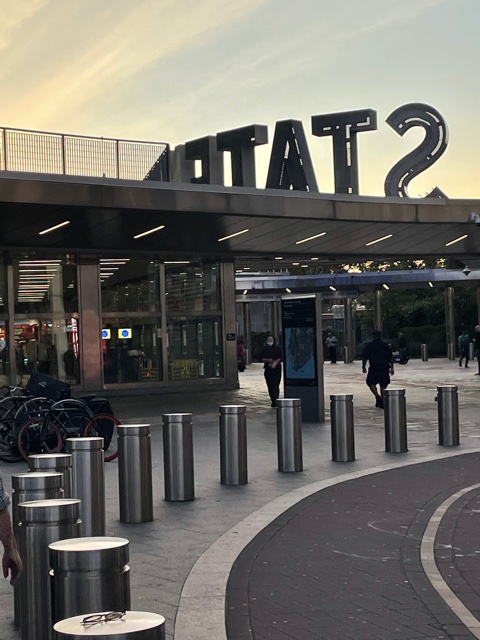
The Beaux-Arts building was built from 1906 to 1909 and designed by the firm Walker and Morris as the easternmost section of the partially completed Whitehall Street Ferry Terminal. It has backstage views of the Staten Island Ferry sign.
And various rushing roadways.
But you always feel the presence of another time, through design details it’s easy to overlook.
The reception is thronged with artists and patrons. If you must sit and eat dinner — and I am famished — it is delicious.
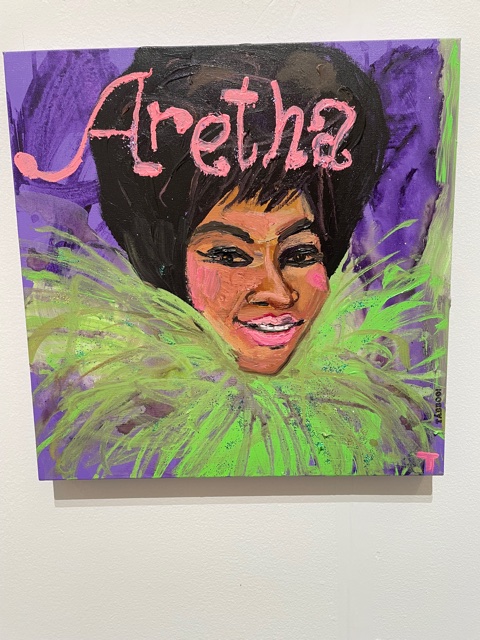
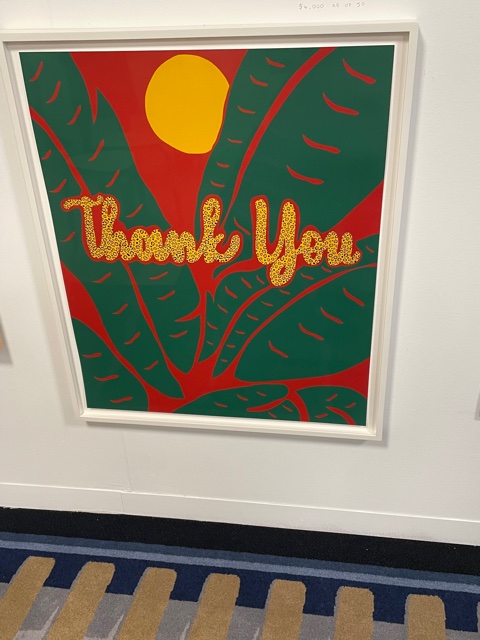
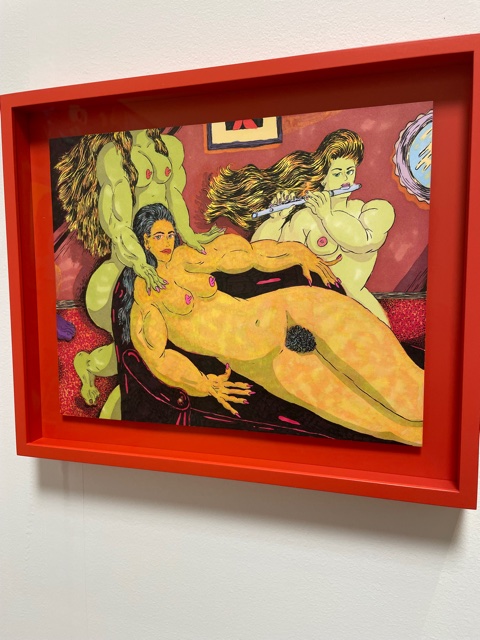
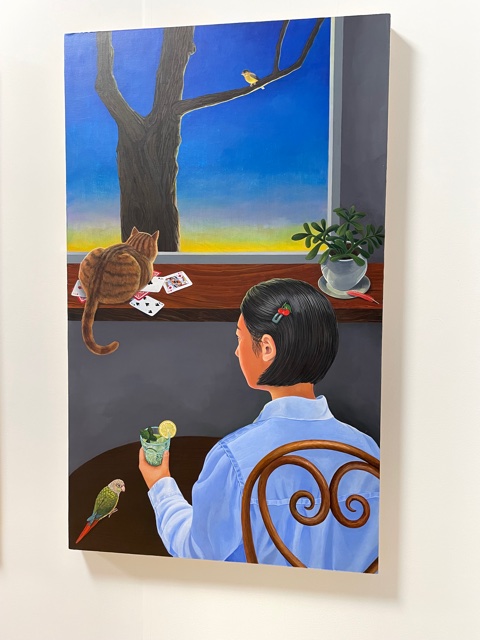
The art is relatively low-end in terms of an investment, ranging from 10 to 10,000 dollars, according to the knowledgable art dealer, Rick, who invited us. It’s quite a range.
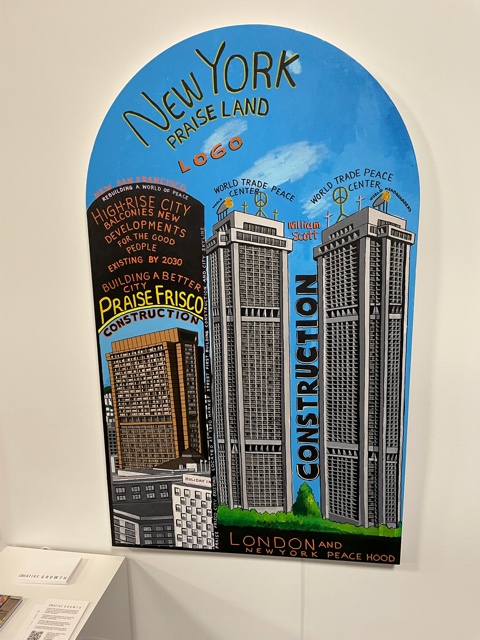
I like some more than others.
As would anyone.
But it’s nothing to worry over, on this day before the anniversary of 9/11, a year and a half since Covid hit our city.
Humans.
Cats.
Computer art. The toebone is connected to the ankle to the kneebone.
An homage to the early 20th century revolutionary revelatory Russian artist Malevich.
Textiles. I like that.
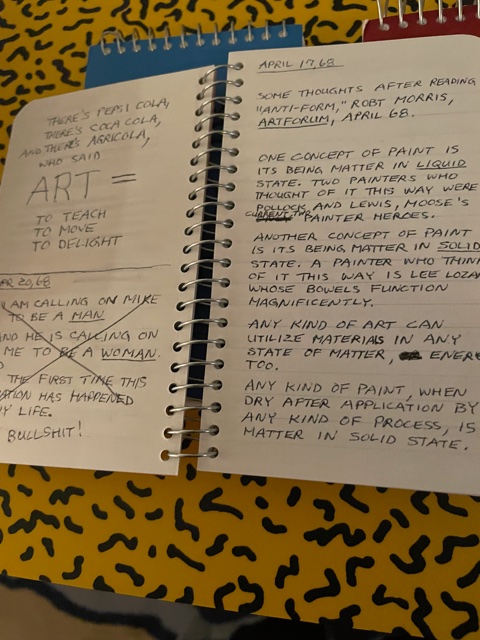
There is a shop at which you can buy an artist’s facsimile of her own notebooks for $25 apiece. Lee Lozano, look her up. Wow.
What a concept.
We wander among the rooms that used to be the ferry’s waiting area. You can still get transportation to Governor’s Island and Jersey City down below. People are boarding to go to Governor’s Island even now, at 7 pm on a Friday night.
Where we are, dealers are hustling, selling art.
I won’t buy any.
But it’s a kind of wonderful event, a way of marking the distance between then and now. Art flourishes, even in the wake of darkness.
A raised traffic median is just a long trough with soil in it. And, of course, plantings, and sometimes trees.
The City of New York has applied its hive mind to widening the street medians of the Grand Concourse, which is what brings me here – to inspect the existing trees that might be impacted by the street construction, and to check out the importation of shrubs etc. when it takes place later this fall, in the cool planting season.
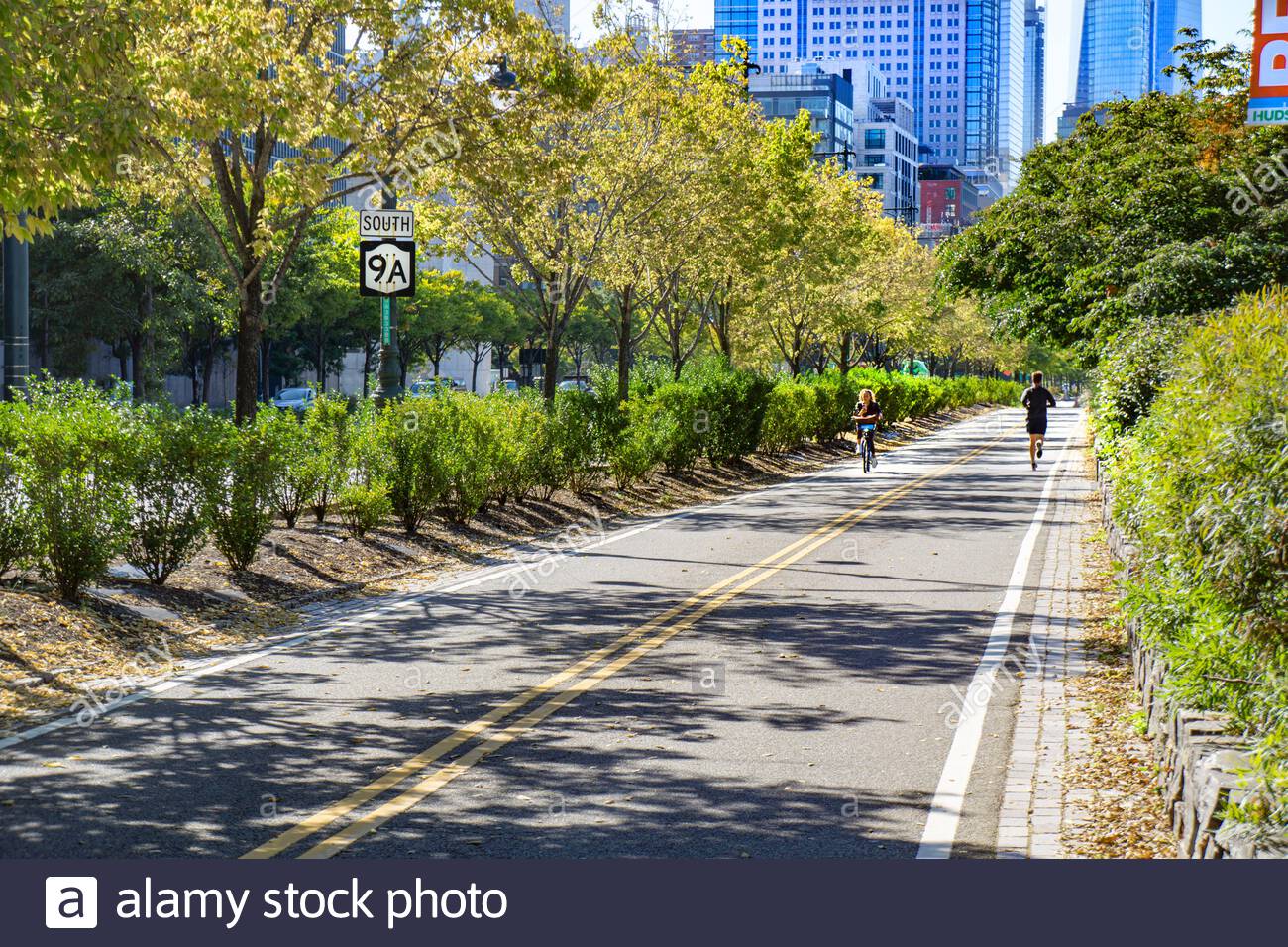
So… why is this happening? We’re talking about a raised median, which is rare in NYC. Yes, there is the West Side Highway, which I was lucky enough to tour in a golf cart earlier this year when bidding for a job to maintain its vegetation.
There’s a strip of beautiful trees and roses in season dividing two lengths of highway, all with a phenomenal view of the Hudson River.
Every median holds 24 inches of soil above the roadbed, according to the Department of Transportation Street Design guidelines. Hard to imagine this collection of construction debris materializing into a cohesive bed of plants, but that’s the plan. And crews are hard at work making it happen.
It seems that the point is not only beautifying a thoroughfare but controlling the vehicles that use it. Lane narrowing, which comes about when more space is taken up by medians, has the effect of what the experts call “traffic calming.” Sometimes cities remove an entire lane, which is known as a “road diet.” In this case the road will still be wide, 2 lanes northbound and southbound and service lanes on either side as well.
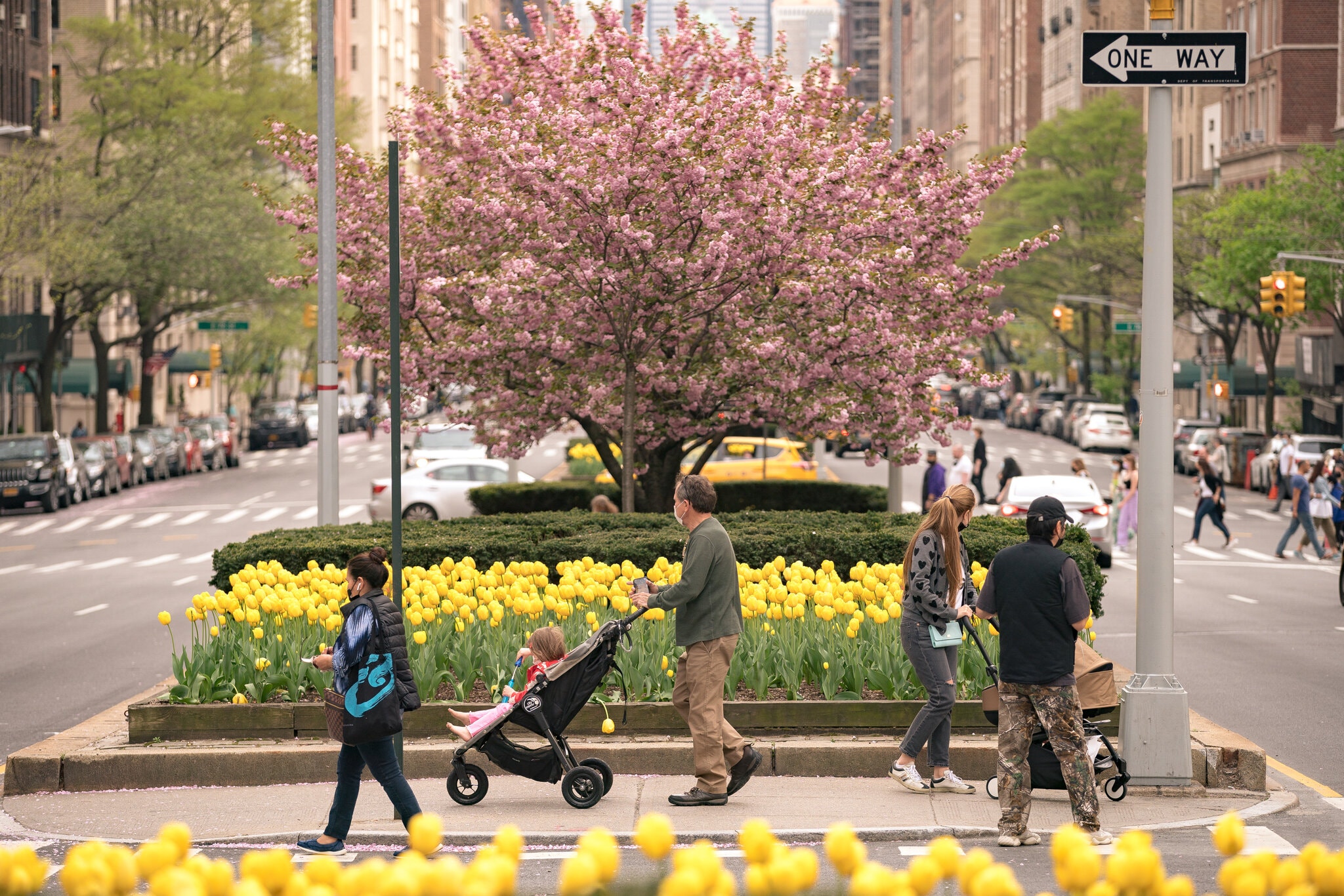
There is a famous, old traffic median in this city, running the length of Park Avenue north of the Helmsley building, which straddles it. It might be worth visiting NYC just to drive through that twisty tunnel. The median’s tulips and begonia beds date to the 1950s.
The park narrowed over the years but I’ve always found it beautiful, and obviously diligently cared for.
Back in the day, traffic was a bit unwieldy in NYC, especially at the turn of the century, when horse carts jockeyed for space with street cars, pedestrians and even some automobiles.
Pictures from the turn of the 20th century show traffic going every which way. It definitely needed some calming! Park Avenue, though, was a respite – it was actually a pedestrian park seated in the middle of a tamer Park Avenue.
People could stroll, sit, push prams, whatever, in safety. Now the powers that be are planning a remake for Park Avenue to become more like it once was.
Designs have been sketched.
I want to go there and be calm.
But I think that the Grand Concourse will be completed first.
We have trees. Lots of honey locust.
Some of the areas farther downtown have already been finished.
It’s hard to imagine the stretch of the road where I monitor trees botanically beautified. I can’t wait to see it.
That was my idea at the New York Botanical Garden, along with hundreds of other visitors still drying out after being pummeled by Ida.
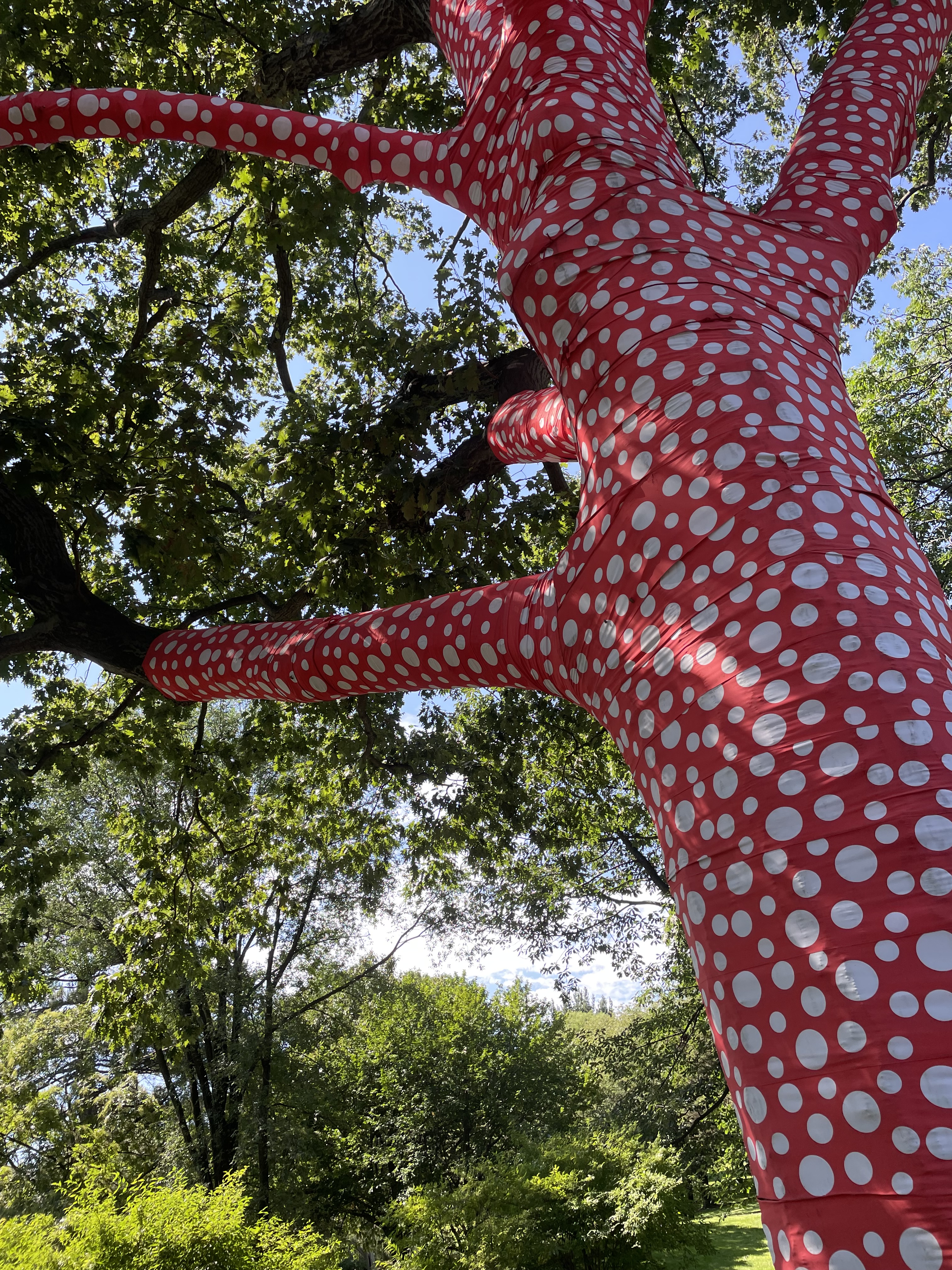
Yayoi Kusama has been the artist in residence for months, transforming outdoor and indoor spaces, populating them with her whimsical works. Now 92 and one of the most prominent Japanese artists, she drew acclaim in the 60s for organizing happenings where the naked participants would be painted with polka dots.
This installation is a bit more tame, though it has plenty of dots.
Eschewing the rock garden, the stand of virgin forest and the rose garden – a sacrifice, with the later bloomers at their peak – we visited Kusama-world.
Some works can be found in the peerless Victorian greenhouse, designed by Lord & Burnham, the preeminent designer of glass houses in the U.S. in the nineteenth century, in the Italian Renaissance style, which houses the Garden’s collection of tropical plants. You can find flourishing palms like this one from Brazil.
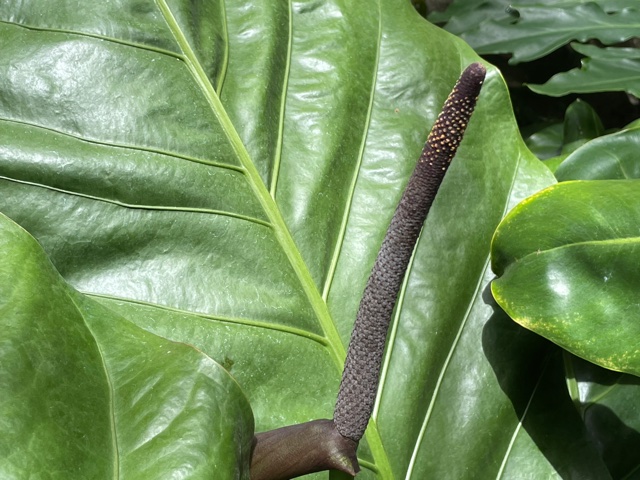
Or this quite remarkable phallic charmer, also hailing from South America.
Now Kusama can be found here as well, with a pumpkin sculpture. The Garden has cleverly included a quote from the artist with each work.
I parted a row of zinnias and reached in to pluck the pumpkin from its vine. It immediately began speaking to me in a most animated manner. It was still moist with dew, indescribably appealing, and tender to the touch.
Everything is saturated with color.Even the flower beds are intended to mimic her work. I am happy that I have painted flowers. There are no objects more interesting.
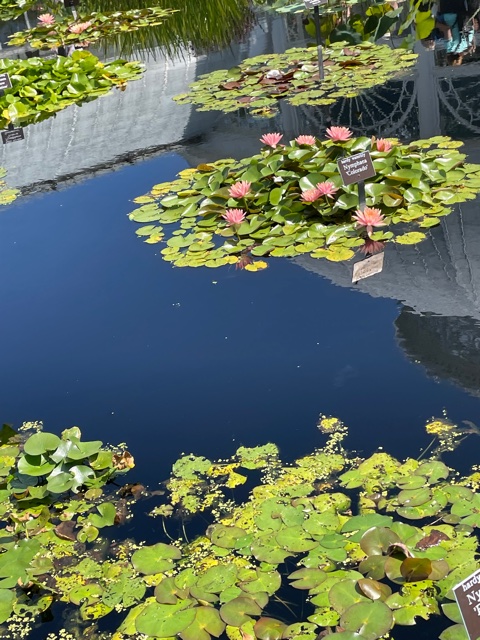
Step outside. The lily pool, like everything else horticulatural here, has been annotated for your edification.
Personally I think lilies can speak for themselves.
Especially in the late summer sunlight.
The koi in the pool could probably eat a man. Are they alive or did Kusama paint them?
A path leads to a little Kusama-designed hut. You are handed a sticker with an image of a poppy and are told to place it wherever in the room you like. A lot of people have obviously preceded us.
The whole “house” is awash with poppies. Some prefer to take their poppies home with them.
I thought when I saw the 1905 statue that stands square in the middle of Ocean Grove, New Jersey.
My Stokes, of course, is I.N. Phelps Stokes, the white-shoe iconographer and Manhattan-phile I wrote about in Love, Fiercely: A Gilded Age Romance. This was a different branch of the Stokes clan and a man famous for a completely different kind of endeavor: saving souls.
Ellwood Stokes founded Ocean Grove in the mid-nineteenth century and it rapidly became a Methodist camp meeting community with regular revivals at over which he presided. Pastors still come to the place to share their wisdom, although the subject matter differs a bit. When we leaned into the godly precincts there was an avid audience of worshippers laughing as the minister described his wife’s morning sickness and linked it to Godliness.
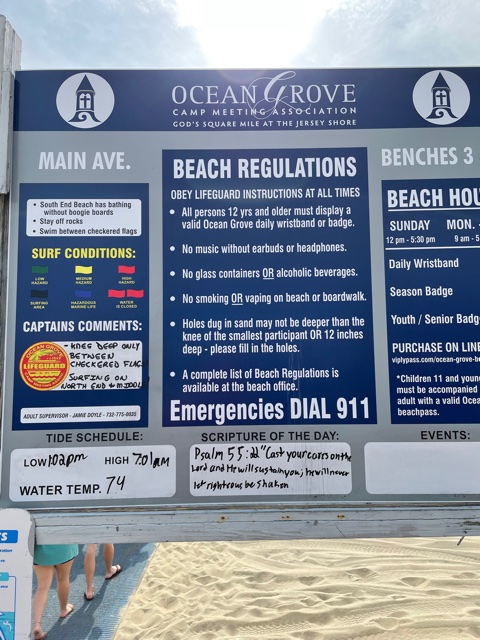
If you want to find out the conditions for swimming at the delightful beach you get a biblical proverb too, something to ponder as you tan. Bruce Springsteen grew up right down the way, but I have a feeling he did not come here for spiritual inspiration.
Ocean Grove is one of the most picturesque towns I’ve been to. Totally dry, too.
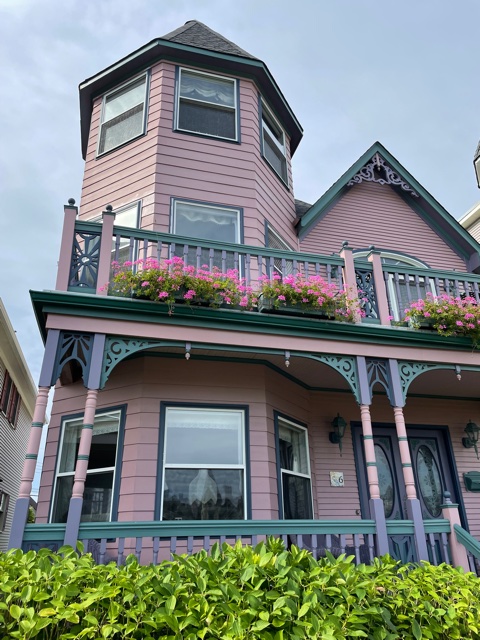
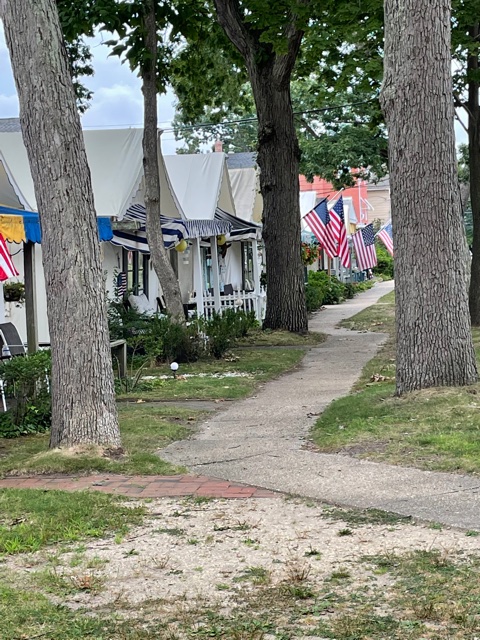
Houses are almost impossibly charming. It seemed people were sleeping in the Saturday we visited, it was so quiet.
Gingerbread to die for.
Flaming crape myrtle in almost every yard.
When Stokes founded the place those houses would not have existed.
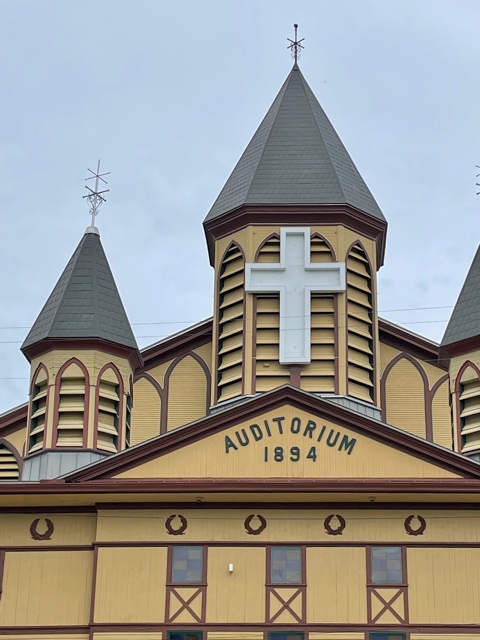
He was so proud when the 9,000 seat Great Auditorium went up.
Parishioners set up modest platform tents to be nearer to the action.
They still stand, and are a hot commodity.
The real estate in Ocean Grove is competitive, but writer-types still manage to sneak in. Introducing Nancy Naglin, who with her husband J.J. Kane first summered here and then wound up as a permanent resident.
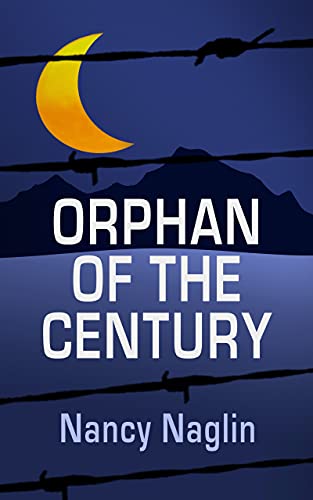
Nancy wrote an incredible book called Orphan of the Century, a wild ride that depicts a boy born in 1923 as he roams the underworlds of Poland, China and other countries as a crack pool player – an epic story of gambling, survival, sexual identity and the dignity of the human heart.
Orphan of the Century may be purchased at Amazon and will make a fine gift for anyone who likes adventure and fun in a summer read as well as the occasional racy tweak. To quote the back, which is sometimes a good idea, the novel “is an epic story of gambling, survival, sexual identity and the dignity of the human heart.” It’s on my bedside table now. I think Ellwood Stokes would have read it in secret for some private titillation.
Come to Ocean Grove and spend an afternoon under the town’s lovely park of white pines. Nancy will sign a copy for you.
























































































































 Jean Zimmerman